
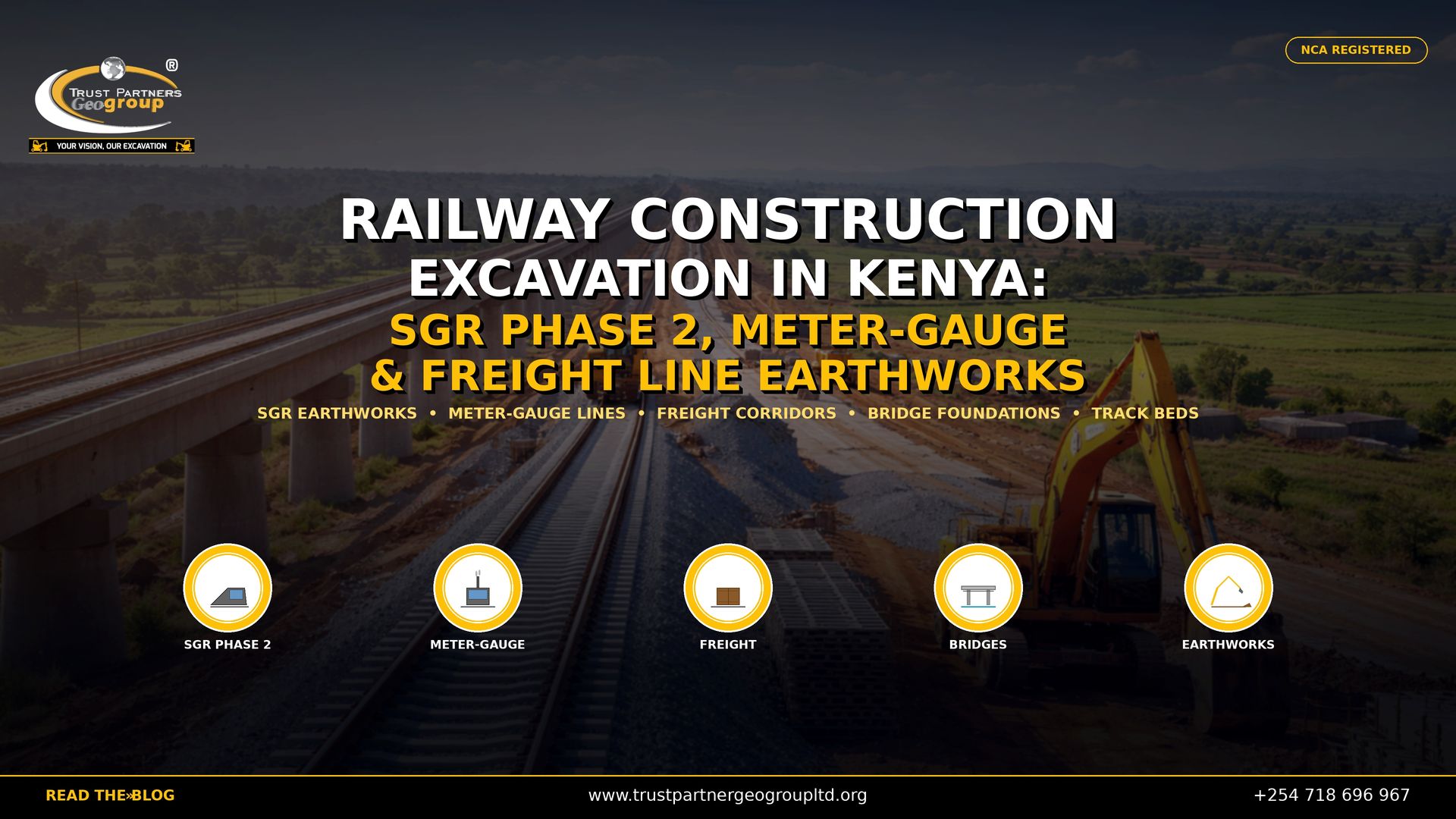
Railway Construction Excavation in Kenya: SGR Phase 2, Metre-Gauge and Freight Line Earthworks [2026]
Corridor-Scale Earthworks for Kenya's Railway Renaissance — SGR Extension, Metre-Gauge Revival & Private Freight Lines
Kenya is laying track again — and every kilometre of rail begins with earthworks. From the anticipated SGR Phase 2 construction corridor toward Malaba, to the rehabilitation of the century-old metre-gauge network and new freight line excavation in Kenya's industrial zones, railway projects are generating some of the largest mass-earthworks scopes in East Africa. This 2026 industry analysis breaks down the engineering, equipment, costs and compliance behind railway excavation in Kenya — written for contractors, procurement officers, investors and county governments preparing to build. With 15+ years of excavation experience across Kenya, Trust Partners Geo-Group brings a contractor's-eye view of what it actually takes to move a railway from drawing board to ballast.

Our team has delivered bulk excavation, road earthworks and foundation works across all 47 counties — from deep basements in Nairobi to corridor earthworks in the Rift Valley. We publish field-tested guidance so developers and procurement teams can specify railway earthworks with confidence.
1. Kenya's Railway Construction Boom: The 2026 Landscape
Kenya's rail sector is in its most active phase since the Uganda Railway was pushed inland from Mombasa in 1896. Three parallel streams of work now define the market for railway excavation in Kenya:
- Standard Gauge Railway expansion. With Phase 1 (Mombasa–Nairobi) and Phase 2A (Nairobi–Naivasha) operational, attention has shifted to the Naivasha–Kisumu–Malaba extension commonly referred to as SGR Phase 2 construction, which would connect Kenya's line to Uganda's planned SGR and unlock seamless freight from the port of Mombasa to the Great Lakes region.
- Metre-gauge rehabilitation. Kenya Railways continues to rehabilitate legacy lines — Nairobi–Nanyuki, Nakuru–Kisumu, Gilgil–Nyahururu and branch lines — restoring formation, drainage and ballast that deteriorated over decades.
- Private freight and industrial spurs. Cement plants, steel mills, inland container depots (ICDs), special economic zones and the Naivasha dry port are commissioning dedicated freight sidings, each requiring formation earthworks, drainage and a proper train track foundation.
For earthworks contractors, this convergence matters. Rail corridors are among the most earthwork-intensive civil projects per kilometre: a single SGR kilometre can involve 30,000–80,000 m³ of cut and fill — more than many building projects move in their entirety. The Nairobi–Mombasa Expressway has demonstrated the scale of corridor procurement now underway in Kenya (see our Nairobi–Mombasa Expressway earthworks briefing), and rail corridors follow the same procurement logic at even tighter geometric tolerances.
2. What Is Railway Construction Excavation?
Railway construction excavation is the complete cycle of earthworks required to convert raw terrain into a stable, precisely graded corridor capable of carrying trains at design speed and axle load. It is fundamentally different from building or even road excavation in three ways:
- Linear scale. Rail projects are corridors, not sites. Earthworks plant must be productive while constantly relocating — sometimes advancing only 200–400 metres per week — which changes how you plan haulage, fuel, water for compaction, and machine logistics.
- Tighter geometric tolerances. A train track foundation cannot hide errors. Finished formation levels typically carry tolerances of ±10–20mm and crossfall accuracy of ±0.1%, enforced by survey and GPS machine control rather than a grader operator's eye.
- Dynamic loading. Formation must survive millions of repetitive axle loads (up to 25 tonnes per axle on SGR) without progressive settlement. That drives stricter compaction specs — commonly 95–100% Modified Proctor — and layer-by-layer density testing.
A complete railway earthworks scope includes: corridor clearing and grubbing, topsoil stripping, mass cut and fill, rock excavation and ripping, embankment construction in controlled layers, subgrade preparation and proof rolling, sub-ballast (capping) placement, drainage excavation (side drains, culverts, cut-off drains), bridge and underpass foundation excavation, station and yard platforms, and borrow pit and spoil dump management.
Many of these sub-scopes mirror work we detail in our earthwork and base preparation guide for road projects — but with rail-specific geometry, deeper drainage and heavier load design.
3. SGR Phase 2 Construction: Earthworks Scope and Scale
The Standard Gauge Railway is designed to Chinese National Railway Class I standards, and its earthworks specifications are the most demanding ever applied at scale in Kenya. Understanding them is essential for any contractor bidding into SGR Phase 2 construction supply chains.
Formation geometry and volumes
The SGR single-track formation width is approximately 7.7–11.4 metres at the top of formation depending on whether the section is embankment or cutting, with side slopes typically 1:1.5 to 1:1.75. Maximum gradient is around 1.2%, and minimum curve radii of 800–1,200m mean long, sweeping alignment corrections through hilly country — which in turn generates enormous cut volumes through the Rift Valley escarpments west of Naivasha.
The Naivasha–Kisumu–Malaba corridor challenge
The proposed Phase 2 corridor crosses some of Kenya's most difficult earthworks terrain:
- Nyamasaria–Kisumu lowlands: black cotton soil requiring undercutting and replacement with rock fill or stabilized material — the same expansive-soil techniques we apply in black cotton soil foundation works.
- Nandi and Kakamega highlands: deep cuts through weathered rock, benching, slope drainage and erosion control on steep ground.
- Yala and Nzoia river crossings: major bridge foundation excavation, cofferdams and approach embankments over soft alluvium.
- Malaba border zone: flat but poorly drained ground demanding raised embankments and extensive culvert chains.
Subcontract opportunities
Main-contractor packages on SGR are typically held by international EPC firms, but Kenyan subcontractors routinely win: access road construction and maintenance, borrow pit development, culvert and minor bridge excavation, drainage chains, station platform earthworks, and haulage. Firms with modern fleets — such as our 30-tonne Hyundai HX300SL excavators — and GPS machine control capability are best placed to meet the productivity and tolerance requirements.
4. Metre-Gauge Rehabilitation and Upgrade Earthworks
Kenya's metre-gauge network — over 2,700 km of legacy track — is being selectively revived because it already reaches towns the SGR does not: Nanyuki, Kisumu, Butere, Kitale and the branch lines feeding agricultural belts. Rehabilitation earthworks differ fundamentally from new-build excavation:
| Parameter | SGR (New Build) | Metre-Gauge (Rehabilitation) |
|---|---|---|
| Formation width | 7.7–11.4 m | 5.5–6.6 m (existing corridor) |
| Design axle load | 25 tonnes | 16–20 tonnes |
| Max gradient | ~1.2% | Up to 1.5–2% (legacy alignment) |
| Ballast depth | 300–350 mm crushed stone | 200–250 mm, often re-screened and topped up |
| Typical earthworks | Mass cut/fill, new embankments, major structures | Formation repair, re-ballasting, drainage renewal, washout reconstruction |
| Earthworks tolerance | ±10–20 mm, GPS-controlled | ±25–50 mm, survey-controlled |
| Working constraint | Greenfield corridor | Live or intermittent rail traffic — possessions and lookout protection required |
Typical metre-gauge rehab scopes include: re-excavating silted side drains and cut-off drains, reconstructing washed-out embankment sections after floods, scarifying and re-compacting fouled formation, installing new culverts at chronic flooding points, and placing fresh ballast with tamping. Because trains may still run, all excavation near live track requires Kenya Railways possessions, certified lookouts and strict plant-exclusion zones — a compliance culture your earthworks subcontractor must already have.
5. Freight Line and Branch Line Excavation in Kenya
The fastest-growing niche in freight line excavation in Kenya is privately funded: industrial sidings, ICD connections and port-relief spurs. Drivers include:
- Inland Container Depots: the Naivasha ICD and proposed expansions in Nairobi and Mombasa require yard earthworks, hardstand subgrades and rail formation within confined, operational sites.
- Industrial spurs: cement, steel and grain facilities along the Athi River–Mombasa corridor are reconnecting to rail to cut haulage costs, typically 1–5 km branch lines with one or two turnouts.
- Special Economic Zones and EPZs: zone developers increasingly reserve rail corridors in master plans — earthworks must be built now even if track comes later. Our EPZ site preparation guide covers this interface.
- Port and logistics links: Mombasa port-area rail works and the logistics park earthworks sector in Nairobi are converging, with container yard subgrades built to near-rail tolerances.
Freight line earthworks are commercially attractive for mid-size contractors: scopes of 2–10 km, private clients with faster procurement than government, and specs that reference (rather than exceed) mainline standards. A typical private siding earthworks contract runs KES 150–600 million — squarely within the capacity of established Kenyan firms with owned or reliably hired fleets.
6. Train Track Foundation: Ballast, Sub-Ballast and Formation Engineering
The train track foundation is where railway excavation either succeeds or fails. Every layer has a defined function and specification:
| Layer | Typical Thickness | Material | Function & Spec |
|---|---|---|---|
| Subgrade (formation) | — | Compacted in-situ or fill soil | Bearing platform; ≥95% Modified Proctor; CBR ≥5–8%; proof-rolled; levels to ±20mm |
| Capping / sub-ballast | 150–300 mm | Well-graded gravel/sand, no fines contamination | Load spreading, separation, frost & pumping protection; compacted in ≤150mm layers |
| Ballast | 250–350 mm (under sleeper) | Crushed angular hard stone, 25–63mm gradation | Load distribution to formation, drainage, sleeper restraint, tamping adjustment |
| Sleepers & rail | — | Concrete sleepers, 54–60 kg/m rail (SGR) | Track structure placed by specialist track-laying contractor after earthworks handover |
Three failure modes dominate Kenyan formations and all are earthworks problems, not track problems:
- Ballast fouling and pumping on black cotton and clay subgrades — prevented by correct sub-ballast separation layers and, on the worst ground, geotextile/geogrid installation over the formation.
- Embankment settlement from under-compacted fill — prevented by 200–300mm layer construction with density testing every layer, a discipline detailed in our earthworks QA/QC and compaction testing guide.
- Drainage failure — standing water is the single biggest killer of African rail formations. Side drains must be excavated to falls that actually discharge, and culverts must be sized for short-rains peak flows, not average flows.
Material sourcing is a project within a project: ballast requires hard, durable crushed rock (typically from licensed quarries near the corridor), and formation fill may come from borrow pits along the alignment. On long corridors, haul distance is the dominant cost variable — which is why corridor earthworks planning starts with a mass-haul diagram, not a machine count.
7. Bridge, Culvert and Drainage Excavation Along Rail Corridors
Roughly 15–25% of a Kenyan rail corridor's earthworks budget sits in structures and drainage rather than running formation:
- Bridge abutments and piers: deep open-cut or caisson excavation for foundations across the Athi, Nzoia, Yala and seasonal river systems. See our technical guide on caisson excavation for bridge foundations in Kenya.
- Box and pipe culverts: installed every 0.5–2 km depending on terrain; each requires foundation excavation, bedding, backfill in compacted layers, and wing-wall works. Poorly compacted culvert backfill is the classic source of "bumps" in new lines.
- Side drains and cut-off drains: continuous excavation along the corridor, with lined sections through erodible soils in the highlands.
- Retaining structures: where the alignment hugs hillsides — common on escarpment sections — anchored or reinforced-earth walls may be required; our MSE/reinforced-earth retaining wall guide explains the excavation and installation sequence.
Sequencing rule of thumb: drainage and structures before wet seasons, formation after. Contractors who invert this sequence spend the next season re-excavating what the rains destroyed.
8. Station, Yard and Siding Earthworks
Stations and yards concentrate earthworks into tight, high-value sites: platform foundations, multiple parallel formations at varying levels, drainage collectors, car parks and access roads — essentially a small town's worth of civil works at one location. Key considerations:
- Multiple formation levels: yards fan out from one track to six or more; each transition is a grading and compaction exercise in confined geometry.
- Urban interfaces: Nairobi, Kisumu and Mombasa stations sit amid live utilities — excavation requires utility mapping, hand-dig zones and permit-to-work systems identical to urban basement practice.
- Vibration-sensitive neighbours: where yards abut existing buildings, controlled excavation methods apply — the same discipline we describe in our hospital foundation excavation and vibration control article.
9. Equipment Selection for Railway Earthworks
Corridor earthworks reward big, reliable iron and punish downtime — a stalled machine 80 km from the nearest town costs the whole chain behind it. A typical 20–30 km section fleet:
| Machine | Typical Class | Role on Rail Earthworks | 2026 Hire Rate (Nairobi, guide) |
|---|---|---|---|
| Hydraulic excavator | 30–50 t | Bulk cut, drain excavation, structure pits, loading trucks | KES 8,500–14,000/hr with operator |
| Hydraulic excavator | 20 t | Culverts, finishing, confined station works | KES 6,500–9,000/hr |
| Bulldozer | D6–D8 | Spreading fill, corridor clearing, borrow pits | KES 9,000–15,000/hr |
| Motor grader | 140–160 hp | Formation profiling to ±20mm, drain shaping | KES 7,000–10,000/hr |
| Vibratory / padfoot roller | 10–18 t | Layer compaction, proof rolling | KES 5,500–8,500/hr |
| Dump trucks | 25–40 t | Cut-to-fill haulage, borrow haulage | Per-km or per-m³ rates; see fleet sizing guide |
| Hydraulic breaker (on excavator) | Matches 20–40 t carrier | Rock in cuttings where blasting is restricted | Attachment premium on carrier rate |
| Water bowser | 10,000–20,000 L | Compaction moisture, dust control | KES 35,000–60,000/day |
For rates context, see our 2026 excavator hire price guide, the dump truck fleet sizing calculator, and the motor grader hire guide. For corridor-length campaigns, the economics of long-term heavy equipment hire vs. lease almost always favour negotiated monthly packages over spot hire.
GPS machine control: the tolerance enabler
Rail formation tolerances effectively require GPS/Total Station machine control on graders and dozers. 3D systems cut trimming passes by 40–60%, eliminate most survey re-work, and produce as-built surface data for handover documentation. We cover this in GPS machine control for excavators and precision earthmoving and drone surveying for volume calculation and progress tracking — both now standard on well-run Kenyan corridor projects.
10. Railway Excavation Cost Analysis: 2026 Budget Benchmarks
Indicative 2026 earthworks costs for Kenyan rail corridors (excluding structures of span >6m, land acquisition and track materials):
| Terrain / Section Type | Typical Earthworks Volume | Indicative Cost per km (KES) | Key Cost Drivers |
|---|---|---|---|
| Flat savannah / plains (e.g., Kajiado, Tana River) | 20,000–40,000 m³ | 25–45 million | Haul distance, water for compaction |
| Rolling farmland (e.g., Western Kenya) | 40,000–70,000 m³ | 45–70 million | Cut-fill balance, culvert density |
| Black cotton lowlands (Kisumu approach) | + undercut/replace | 55–85 million | Unsuitable soil replacement, geotextiles |
| Escarpment / highland cuts (Rift Valley, Nandi) | 80,000+ m³ incl. rock | 80–150+ million | Rock excavation, slope benches, retaining walls |
| Station / yard site (per site) | 50,000–200,000 m³ | 150–600 million | Multi-level grading, urban constraints, drainage collectors |
Unit-rate anchors for budgeting: general cut-to-fill earthworks currently run KES 250–450 per m³ and rock excavation KES 800–2,200 per m³ depending on hardness and method — see our 2026 earthworks cost per cubic metre breakdown and rock excavation rate guide. For corridor-level comparison, our road construction cost per kilometre estimate provides a useful parallel benchmark.
11. Regulatory Compliance, NCA Requirements and Safety Standards
Railway earthworks in Kenya sit at the intersection of several regulatory regimes:
- NCA registration: earthworks subcontractors must hold the appropriate NCA class for civil/road works. Requirements are summarised in our NCA contractor registration guide for excavation works.
- Kenya Railways: any work on or near live track requires possessions, approved method statements, and certified safety lookouts. Plant must maintain stand-off distances from the nearest rail.
- NEMA: corridors crossing wetlands, rivers and forests require EIA licences; borrow pits and spoil dumps each carry their own environmental conditions.
- County governments: wayleaves, access road approvals and borrow pit permits are county-level — budget time for all 47-county variations if your corridor is long.
- DOSH/Workplace safety: corridor projects must run formal safety management — daily briefings, plant-operator certification, exclusion zones and incident reporting. Operator standards are covered in our industry guidance on certified machine operators.
Specifications typically reference a mix of the client's project spec (SGR projects reference Chinese Class I railway standards), Kenya Bureau of Standards materials specs, and internationally, AREMA or BS/EN track-formation guidance. Your QA/QC plan — layer thickness, density testing frequency, survey verification — must be agreed before the first cut, not negotiated after a failed test.
12. Frequently Asked Questions
How much does railway excavation cost per kilometre in Kenya?
Railway earthworks typically cost KES 25–60 million per kilometre depending on terrain, cut-to-fill balance and drainage structures. Escarpment sections with deep rock cuts can exceed KES 100 million per kilometre. A corridor-specific geotechnical survey and mass-haul analysis give the most reliable budget.
What is SGR Phase 2 and where will it run?
SGR Phase 2 refers to the planned extension of the Standard Gauge Railway from Naivasha through Kisumu to Malaba on the Uganda border. It requires large-scale formation excavation, bridge foundations, station earthworks and drainage across the Rift Valley and Western Kenya, creating major subcontract opportunities for local earthworks firms.
What is a train track foundation made of?
Four layers: compacted subgrade (formation), a 150–300mm sub-ballast capping layer, 250–350mm of crushed angular-stone ballast, and the sleeper-and-rail assembly. Each layer has strict gradation and compaction specifications to carry up to 25-tonne axle loads without settlement.
Who does railway earthworks in Nairobi and Kenya?
NCA-registered civil contractors with mass-earthworks fleets execute railway earthworks. Trust Partners Geo-Group provides railway excavation, formation grading, drainage and heavy equipment for hire nationwide — call +254 718 686 967 for a corridor or siding assessment.
What is the difference between SGR and metre-gauge railway earthworks?
SGR uses a wider formation (7.7–11.4m), 25-tonne axle loads and gentler gradients, demanding mass new earthworks. Metre-gauge rehabilitation works within the existing 5.5–6.6m corridor, focusing on formation repair, drainage renewal and re-ballasting, often alongside live rail traffic.
How long does railway formation excavation take per kilometre?
A well-matched fleet completes 150–400 metres of finished formation per week depending on volumes. A 10km section with balanced cut-and-fill typically takes 4–8 months including drainage structures and sub-ballast placement, weather permitting.
What equipment is used for freight line excavation in Kenya?
30–50-tonne excavators for bulk cut, bulldozers for spreading, GPS-equipped motor graders for formation profiling, vibratory/padfoot rollers for compaction, dump trucks for haulage and hydraulic breakers for rock. Tight rail tolerances make GPS machine control effectively mandatory.
13. Conclusion: Positioning for Kenya's Rail Decade
Whether the headline project is SGR Phase 2 construction toward Malaba, a metre-gauge revival through the highlands, or a private freight line excavation connecting a factory to the mainline, the pattern is constant: rail projects are won in the earthworks. Formation quality determines track quality; drainage determines whether the line survives its third rainy season; and contractor selection determines whether the budget holds.
For developers and procurement teams, the 2026 playbook is clear: commission geotechnics early, budget drainage honestly, demand GPS machine control on formation works, and contract earthworks partners with documented QA/QC systems and modern fleets. For more on related infrastructure excavation, read our previous analysis on foundation excavation for churches, mosques and temples across Kenya, and our master resource on excavation in Kenya — costs, methods and contractors.
Ready to Break Ground on Your Rail Corridor or Siding?
Trust Partners Geo-Group delivers NCA-compliant railway earthworks, formation grading, drainage and heavy equipment for hire — serving Nairobi, Mombasa, Kisumu, Nakuru, Naivasha and all 47 counties.
Call +254 718 686 967 Request a Free Site AssessmentRailway Construction Excavation in Kenya: SGR Phase 2, Metre-Gauge and Freight Line Earthworks [2026]
Corridor-Scale Earthworks for Kenya's Railway Renaissance — SGR Extension, Metre-Gauge Revival & Private Freight Lines
Kenya is laying track again — and every kilometre of rail begins with earthworks. From the anticipated SGR Phase 2 construction corridor toward Malaba, to the rehabilitation of the century-old metre-gauge network and new freight line excavation in Kenya's industrial zones, railway projects are generating some of the largest mass-earthworks scopes in East Africa. This 2026 industry analysis breaks down the engineering, equipment, costs and compliance behind railway excavation in Kenya — written for contractors, procurement officers, investors and county governments preparing to build. With 15+ years of excavation experience across Kenya, Trust Partners Geo-Group brings a contractor's-eye view of what it actually takes to move a railway from drawing board to ballast.
Our team has delivered bulk excavation, road earthworks and foundation works across all 47 counties — from deep basements in Nairobi to corridor earthworks in the Rift Valley. We publish field-tested guidance so developers and procurement teams can specify railway earthworks with confidence.
1. Kenya's Railway Construction Boom: The 2026 Landscape
Kenya's rail sector is in its most active phase since the Uganda Railway was pushed inland from Mombasa in 1896. Three parallel streams of work now define the market for railway excavation in Kenya:
- Standard Gauge Railway expansion. With Phase 1 (Mombasa–Nairobi) and Phase 2A (Nairobi–Naivasha) operational, attention has shifted to the Naivasha–Kisumu–Malaba extension commonly referred to as SGR Phase 2 construction, which would connect Kenya's line to Uganda's planned SGR and unlock seamless freight from the port of Mombasa to the Great Lakes region.
- Metre-gauge rehabilitation. Kenya Railways continues to rehabilitate legacy lines — Nairobi–Nanyuki, Nakuru–Kisumu, Gilgil–Nyahururu and branch lines — restoring formation, drainage and ballast that deteriorated over decades.
- Private freight and industrial spurs. Cement plants, steel mills, inland container depots (ICDs), special economic zones and the Naivasha dry port are commissioning dedicated freight sidings, each requiring formation earthworks, drainage and a proper train track foundation.
For earthworks contractors, this convergence matters. Rail corridors are among the most earthwork-intensive civil projects per kilometre: a single SGR kilometre can involve 30,000–80,000 m³ of cut and fill — more than many building projects move in their entirety. The Nairobi–Mombasa Expressway has demonstrated the scale of corridor procurement now underway in Kenya (see our Nairobi–Mombasa Expressway earthworks briefing), and rail corridors follow the same procurement logic at even tighter geometric tolerances.
2. What Is Railway Construction Excavation?
Railway construction excavation is the complete cycle of earthworks required to convert raw terrain into a stable, precisely graded corridor capable of carrying trains at design speed and axle load. It is fundamentally different from building or even road excavation in three ways:
- Linear scale. Rail projects are corridors, not sites. Earthworks plant must be productive while constantly relocating — sometimes advancing only 200–400 metres per week — which changes how you plan haulage, fuel, water for compaction, and machine logistics.
- Tighter geometric tolerances. A train track foundation cannot hide errors. Finished formation levels typically carry tolerances of ±10–20mm and crossfall accuracy of ±0.1%, enforced by survey and GPS machine control rather than a grader operator's eye.
- Dynamic loading. Formation must survive millions of repetitive axle loads (up to 25 tonnes per axle on SGR) without progressive settlement. That drives stricter compaction specs — commonly 95–100% Modified Proctor — and layer-by-layer density testing.
A complete railway earthworks scope includes: corridor clearing and grubbing, topsoil stripping, mass cut and fill, rock excavation and ripping, embankment construction in controlled layers, subgrade preparation and proof rolling, sub-ballast (capping) placement, drainage excavation (side drains, culverts, cut-off drains), bridge and underpass foundation excavation, station and yard platforms, and borrow pit and spoil dump management.
Many of these sub-scopes mirror work we detail in our earthwork and base preparation guide for road projects — but with rail-specific geometry, deeper drainage and heavier load design.
3. SGR Phase 2 Construction: Earthworks Scope and Scale
The Standard Gauge Railway is designed to Chinese National Railway Class I standards, and its earthworks specifications are the most demanding ever applied at scale in Kenya. Understanding them is essential for any contractor bidding into SGR Phase 2 construction supply chains.
Formation geometry and volumes
The SGR single-track formation width is approximately 7.7–11.4 metres at the top of formation depending on whether the section is embankment or cutting, with side slopes typically 1:1.5 to 1:1.75. Maximum gradient is around 1.2%, and minimum curve radii of 800–1,200m mean long, sweeping alignment corrections through hilly country — which in turn generates enormous cut volumes through the Rift Valley escarpments west of Naivasha.
The Naivasha–Kisumu–Malaba corridor challenge
The proposed Phase 2 corridor crosses some of Kenya's most difficult earthworks terrain:
- Nyamasaria–Kisumu lowlands: black cotton soil requiring undercutting and replacement with rock fill or stabilized material — the same expansive-soil techniques we apply in black cotton soil foundation works.
- Nandi and Kakamega highlands: deep cuts through weathered rock, benching, slope drainage and erosion control on steep ground.
- Yala and Nzoia river crossings: major bridge foundation excavation, cofferdams and approach embankments over soft alluvium.
- Malaba border zone: flat but poorly drained ground demanding raised embankments and extensive culvert chains.
Subcontract opportunities
Main-contractor packages on SGR are typically held by international EPC firms, but Kenyan subcontractors routinely win: access road construction and maintenance, borrow pit development, culvert and minor bridge excavation, drainage chains, station platform earthworks, and haulage. Firms with modern fleets — such as our 30-tonne Hyundai HX300SL excavators — and GPS machine control capability are best placed to meet the productivity and tolerance requirements.
4. Metre-Gauge Rehabilitation and Upgrade Earthworks
Kenya's metre-gauge network — over 2,700 km of legacy track — is being selectively revived because it already reaches towns the SGR does not: Nanyuki, Kisumu, Butere, Kitale and the branch lines feeding agricultural belts. Rehabilitation earthworks differ fundamentally from new-build excavation:
| Parameter | SGR (New Build) | Metre-Gauge (Rehabilitation) |
|---|---|---|
| Formation width | 7.7–11.4 m | 5.5–6.6 m (existing corridor) |
| Design axle load | 25 tonnes | 16–20 tonnes |
| Max gradient | ~1.2% | Up to 1.5–2% (legacy alignment) |
| Ballast depth | 300–350 mm crushed stone | 200–250 mm, often re-screened and topped up |
| Typical earthworks | Mass cut/fill, new embankments, major structures | Formation repair, re-ballasting, drainage renewal, washout reconstruction |
| Earthworks tolerance | ±10–20 mm, GPS-controlled | ±25–50 mm, survey-controlled |
| Working constraint | Greenfield corridor | Live or intermittent rail traffic — possessions and lookout protection required |
Typical metre-gauge rehab scopes include: re-excavating silted side drains and cut-off drains, reconstructing washed-out embankment sections after floods, scarifying and re-compacting fouled formation, installing new culverts at chronic flooding points, and placing fresh ballast with tamping. Because trains may still run, all excavation near live track requires Kenya Railways possessions, certified lookouts and strict plant-exclusion zones — a compliance culture your earthworks subcontractor must already have.
5. Freight Line and Branch Line Excavation in Kenya
The fastest-growing niche in freight line excavation in Kenya is privately funded: industrial sidings, ICD connections and port-relief spurs. Drivers include:
- Inland Container Depots: the Naivasha ICD and proposed expansions in Nairobi and Mombasa require yard earthworks, hardstand subgrades and rail formation within confined, operational sites.
- Industrial spurs: cement, steel and grain facilities along the Athi River–Mombasa corridor are reconnecting to rail to cut haulage costs, typically 1–5 km branch lines with one or two turnouts.
- Special Economic Zones and EPZs: zone developers increasingly reserve rail corridors in master plans — earthworks must be built now even if track comes later. Our EPZ site preparation guide covers this interface.
- Port and logistics links: Mombasa port-area rail works and the logistics park earthworks sector in Nairobi are converging, with container yard subgrades built to near-rail tolerances.
Freight line earthworks are commercially attractive for mid-size contractors: scopes of 2–10 km, private clients with faster procurement than government, and specs that reference (rather than exceed) mainline standards. A typical private siding earthworks contract runs KES 150–600 million — squarely within the capacity of established Kenyan firms with owned or reliably hired fleets.
6. Train Track Foundation: Ballast, Sub-Ballast and Formation Engineering
The train track foundation is where railway excavation either succeeds or fails. Every layer has a defined function and specification:
| Layer | Typical Thickness | Material | Function & Spec |
|---|---|---|---|
| Subgrade (formation) | — | Compacted in-situ or fill soil | Bearing platform; ≥95% Modified Proctor; CBR ≥5–8%; proof-rolled; levels to ±20mm |
| Capping / sub-ballast | 150–300 mm | Well-graded gravel/sand, no fines contamination | Load spreading, separation, frost & pumping protection; compacted in ≤150mm layers |
| Ballast | 250–350 mm (under sleeper) | Crushed angular hard stone, 25–63mm gradation | Load distribution to formation, drainage, sleeper restraint, tamping adjustment |
| Sleepers & rail | — | Concrete sleepers, 54–60 kg/m rail (SGR) | Track structure placed by specialist track-laying contractor after earthworks handover |
Three failure modes dominate Kenyan formations and all are earthworks problems, not track problems:
- Ballast fouling and pumping on black cotton and clay subgrades — prevented by correct sub-ballast separation layers and, on the worst ground, geotextile/geogrid installation over the formation.
- Embankment settlement from under-compacted fill — prevented by 200–300mm layer construction with density testing every layer, a discipline detailed in our earthworks QA/QC and compaction testing guide.
- Drainage failure — standing water is the single biggest killer of African rail formations. Side drains must be excavated to falls that actually discharge, and culverts must be sized for short-rains peak flows, not average flows.
Material sourcing is a project within a project: ballast requires hard, durable crushed rock (typically from licensed quarries near the corridor), and formation fill may come from borrow pits along the alignment. On long corridors, haul distance is the dominant cost variable — which is why corridor earthworks planning starts with a mass-haul diagram, not a machine count.
7. Bridge, Culvert and Drainage Excavation Along Rail Corridors
Roughly 15–25% of a Kenyan rail corridor's earthworks budget sits in structures and drainage rather than running formation:
- Bridge abutments and piers: deep open-cut or caisson excavation for foundations across the Athi, Nzoia, Yala and seasonal river systems. See our technical guide on caisson excavation for bridge foundations in Kenya.
- Box and pipe culverts: installed every 0.5–2 km depending on terrain; each requires foundation excavation, bedding, backfill in compacted layers, and wing-wall works. Poorly compacted culvert backfill is the classic source of "bumps" in new lines.
- Side drains and cut-off drains: continuous excavation along the corridor, with lined sections through erodible soils in the highlands.
- Retaining structures: where the alignment hugs hillsides — common on escarpment sections — anchored or reinforced-earth walls may be required; our MSE/reinforced-earth retaining wall guide explains the excavation and installation sequence.
Sequencing rule of thumb: drainage and structures before wet seasons, formation after. Contractors who invert this sequence spend the next season re-excavating what the rains destroyed.
8. Station, Yard and Siding Earthworks
Stations and yards concentrate earthworks into tight, high-value sites: platform foundations, multiple parallel formations at varying levels, drainage collectors, car parks and access roads — essentially a small town's worth of civil works at one location. Key considerations:
- Multiple formation levels: yards fan out from one track to six or more; each transition is a grading and compaction exercise in confined geometry.
- Urban interfaces: Nairobi, Kisumu and Mombasa stations sit amid live utilities — excavation requires utility mapping, hand-dig zones and permit-to-work systems identical to urban basement practice.
- Vibration-sensitive neighbours: where yards abut existing buildings, controlled excavation methods apply — the same discipline we describe in our hospital foundation excavation and vibration control article.
9. Equipment Selection for Railway Earthworks
Corridor earthworks reward big, reliable iron and punish downtime — a stalled machine 80 km from the nearest town costs the whole chain behind it. A typical 20–30 km section fleet:
| Machine | Typical Class | Role on Rail Earthworks | 2026 Hire Rate (Nairobi, guide) |
|---|---|---|---|
| Hydraulic excavator | 30–50 t | Bulk cut, drain excavation, structure pits, loading trucks | KES 8,500–14,000/hr with operator |
| Hydraulic excavator | 20 t | Culverts, finishing, confined station works | KES 6,500–9,000/hr |
| Bulldozer | D6–D8 | Spreading fill, corridor clearing, borrow pits | KES 9,000–15,000/hr |
| Motor grader | 140–160 hp | Formation profiling to ±20mm, drain shaping | KES 7,000–10,000/hr |
| Vibratory / padfoot roller | 10–18 t | Layer compaction, proof rolling | KES 5,500–8,500/hr |
| Dump trucks | 25–40 t | Cut-to-fill haulage, borrow haulage | Per-km or per-m³ rates; see fleet sizing guide |
| Hydraulic breaker (on excavator) | Matches 20–40 t carrier | Rock in cuttings where blasting is restricted | Attachment premium on carrier rate |
| Water bowser | 10,000–20,000 L | Compaction moisture, dust control | KES 35,000–60,000/day |
For rates context, see our 2026 excavator hire price guide, the dump truck fleet sizing calculator, and the motor grader hire guide. For corridor-length campaigns, the economics of long-term heavy equipment hire vs. lease almost always favour negotiated monthly packages over spot hire.
GPS machine control: the tolerance enabler
Rail formation tolerances effectively require GPS/Total Station machine control on graders and dozers. 3D systems cut trimming passes by 40–60%, eliminate most survey re-work, and produce as-built surface data for handover documentation. We cover this in GPS machine control for excavators and precision earthmoving and drone surveying for volume calculation and progress tracking — both now standard on well-run Kenyan corridor projects.
10. Railway Excavation Cost Analysis: 2026 Budget Benchmarks
Indicative 2026 earthworks costs for Kenyan rail corridors (excluding structures of span >6m, land acquisition and track materials):
| Terrain / Section Type | Typical Earthworks Volume | Indicative Cost per km (KES) | Key Cost Drivers |
|---|---|---|---|
| Flat savannah / plains (e.g., Kajiado, Tana River) | 20,000–40,000 m³ | 25–45 million | Haul distance, water for compaction |
| Rolling farmland (e.g., Western Kenya) | 40,000–70,000 m³ | 45–70 million | Cut-fill balance, culvert density |
| Black cotton lowlands (Kisumu approach) | + undercut/replace | 55–85 million | Unsuitable soil replacement, geotextiles |
| Escarpment / highland cuts (Rift Valley, Nandi) | 80,000+ m³ incl. rock | 80–150+ million | Rock excavation, slope benches, retaining walls |
| Station / yard site (per site) | 50,000–200,000 m³ | 150–600 million | Multi-level grading, urban constraints, drainage collectors |
Unit-rate anchors for budgeting: general cut-to-fill earthworks currently run KES 250–450 per m³ and rock excavation KES 800–2,200 per m³ depending on hardness and method — see our 2026 earthworks cost per cubic metre breakdown and rock excavation rate guide. For corridor-level comparison, our road construction cost per kilometre estimate provides a useful parallel benchmark.
11. Regulatory Compliance, NCA Requirements and Safety Standards
Railway earthworks in Kenya sit at the intersection of several regulatory regimes:
- NCA registration: earthworks subcontractors must hold the appropriate NCA class for civil/road works. Requirements are summarised in our NCA contractor registration guide for excavation works.
- Kenya Railways: any work on or near live track requires possessions, approved method statements, and certified safety lookouts. Plant must maintain stand-off distances from the nearest rail.
- NEMA: corridors crossing wetlands, rivers and forests require EIA licences; borrow pits and spoil dumps each carry their own environmental conditions.
- County governments: wayleaves, access road approvals and borrow pit permits are county-level — budget time for all 47-county variations if your corridor is long.
- DOSH/Workplace safety: corridor projects must run formal safety management — daily briefings, plant-operator certification, exclusion zones and incident reporting. Operator standards are covered in our industry guidance on certified machine operators.
Specifications typically reference a mix of the client's project spec (SGR projects reference Chinese Class I railway standards), Kenya Bureau of Standards materials specs, and internationally, AREMA or BS/EN track-formation guidance. Your QA/QC plan — layer thickness, density testing frequency, survey verification — must be agreed before the first cut, not negotiated after a failed test.
12. Frequently Asked Questions
How much does railway excavation cost per kilometre in Kenya?
Railway earthworks typically cost KES 25–60 million per kilometre depending on terrain, cut-to-fill balance and drainage structures. Escarpment sections with deep rock cuts can exceed KES 100 million per kilometre. A corridor-specific geotechnical survey and mass-haul analysis give the most reliable budget.
What is SGR Phase 2 and where will it run?
SGR Phase 2 refers to the planned extension of the Standard Gauge Railway from Naivasha through Kisumu to Malaba on the Uganda border. It requires large-scale formation excavation, bridge foundations, station earthworks and drainage across the Rift Valley and Western Kenya, creating major subcontract opportunities for local earthworks firms.
What is a train track foundation made of?
Four layers: compacted subgrade (formation), a 150–300mm sub-ballast capping layer, 250–350mm of crushed angular-stone ballast, and the sleeper-and-rail assembly. Each layer has strict gradation and compaction specifications to carry up to 25-tonne axle loads without settlement.
Who does railway earthworks in Nairobi and Kenya?
NCA-registered civil contractors with mass-earthworks fleets execute railway earthworks. Trust Partners Geo-Group provides railway excavation, formation grading, drainage and heavy equipment for hire nationwide — call +254 718 686 967 for a corridor or siding assessment.
What is the difference between SGR and metre-gauge railway earthworks?
SGR uses a wider formation (7.7–11.4m), 25-tonne axle loads and gentler gradients, demanding mass new earthworks. Metre-gauge rehabilitation works within the existing 5.5–6.6m corridor, focusing on formation repair, drainage renewal and re-ballasting, often alongside live rail traffic.
How long does railway formation excavation take per kilometre?
A well-matched fleet completes 150–400 metres of finished formation per week depending on volumes. A 10km section with balanced cut-and-fill typically takes 4–8 months including drainage structures and sub-ballast placement, weather permitting.
What equipment is used for freight line excavation in Kenya?
30–50-tonne excavators for bulk cut, bulldozers for spreading, GPS-equipped motor graders for formation profiling, vibratory/padfoot rollers for compaction, dump trucks for haulage and hydraulic breakers for rock. Tight rail tolerances make GPS machine control effectively mandatory.
13. Conclusion: Positioning for Kenya's Rail Decade
Whether the headline project is SGR Phase 2 construction toward Malaba, a metre-gauge revival through the highlands, or a private freight line excavation connecting a factory to the mainline, the pattern is constant: rail projects are won in the earthworks. Formation quality determines track quality; drainage determines whether the line survives its third rainy season; and contractor selection determines whether the budget holds.
For developers and procurement teams, the 2026 playbook is clear: commission geotechnics early, budget drainage honestly, demand GPS machine control on formation works, and contract earthworks partners with documented QA/QC systems and modern fleets. For more on related infrastructure excavation, read our previous analysis on foundation excavation for churches, mosques and temples across Kenya, and our master resource on excavation in Kenya — costs, methods and contractors.
Ready to Break Ground on Your Rail Corridor or Siding?
Trust Partners Geo-Group delivers NCA-compliant railway earthworks, formation grading, drainage and heavy equipment for hire — serving Nairobi, Mombasa, Kisumu, Nakuru, Naivasha and all 47 counties.
Call +254 718 686 967 Request a Free Site Assessment