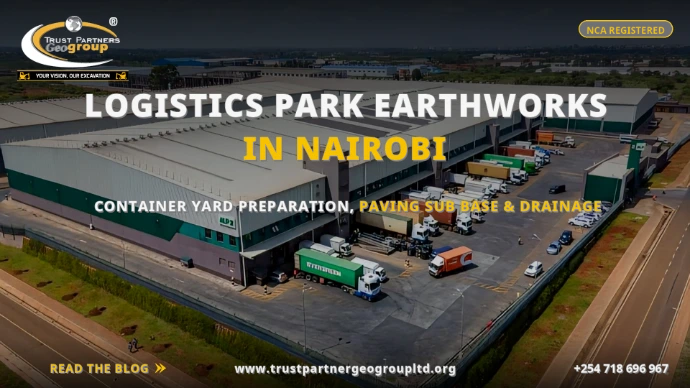
Logistics Park Earthworks in Nairobi: Container Yard Preparation, Paving Sub-base & Drainage
Heavy-duty platforms, paving sub-bases, drainage & precision grading for container yards and distribution hubs in Nairobi, Mombasa, Nakuru & Eldoret
Table of Contents
- 1. What Is Logistics Park Earthworks?
- 2. Site Selection & Geotechnical Requirements
- 3. Clearing, Stripping & Bulk Earthworks
- 4. Container Yard Platform Grading & Compaction
- 5. Paving Sub-base Construction
- 6. Internal Roads & Truck Circulation
- 7. Stormwater Drainage & Oil Separation
- 8. Precision Grading for Gantry Cranes & Reach Stackers
- 9. Weighbridges, Utilities & Services
- 10. NEMA, County & KeNHA Compliance
- 11. Equipment & Fleet Productivity
- 12. Construction Costs & Programme [2026]
- 13. Frequently Asked Questions
- 14. Conclusion
Every container that moves through the Port of Mombasa, every truck that loads at a Nairobi distribution hub, every reach stacker that lifts a 30-tonne box depends on one invisible condition: the ground beneath the yard must not move, rut, or pond. Logistics park construction Kenya developers are learning that a container yard is not merely a flat piece of land - it is a heavy-duty pavement structure engineered for point loads, dynamic traffic and tropical rainfall. This guide covers the full logistics hub site preparation discipline: bulk earthworks, container yard excavation Nairobi contractors execute, paving sub-base design, drainage for large impervious areas, and the precision grading that keeps gantry cranes on their rails - with 2026 costs and the compliance framework that governs trucking yard earthworks from Athi River to Changamwe.
Trust Partners Geo-Group Ltd - Engineering Team
NCA-registered excavation & civil engineering contractor with 15+ years of container yard earthworks, heavy pavement construction and logistics infrastructure experience across East Africa. Reviewed by registered engineers.
1. What Is Logistics Park Earthworks?
A modern logistics park is a multi-functional operation: container storage yards, truck loading bays, warehousing, cross-dock facilities, fuelling stations, weighbridges and administrative offices. Each element imposes different loads on the ground:
- Container stacks: five to six high, each corner casting imposing 150-200 kN on a contact area smaller than a coffee saucer;
- Truck traffic: 40-tonne articulated vehicles braking, turning and accelerating, generating dynamic horizontal forces that shear weak pavements;
- Reach stackers and gantry cranes: concentrated wheel loads of 100-250 kN per tyre, operating on tight turning radii that scrub the surface;
- Impervious surfaces: hectares of container stacks and paved yard that generate runoff coefficients of 0.8-0.9, requiring substantial drainage infrastructure;
- Weighbridges: precision instruments that require dead-level, vibration-free foundations with approach ramps graded to millimetre accuracy.
The earthworks contractor's job is to transform raw land into a platform that can carry all of these loads, drain all of this water, and remain flat and serviceable for 20 years. The discipline is closer to highway engineering than to standard industrial construction - and the costs and specifications reflect that.
2. Site Selection & Geotechnical Requirements
Logistics parks favor sites with specific geotechnical characteristics:
- Topography: gently sloping sites (1-3% natural grade) that allow drainage without excessive cut-to-fill. Flat sites are ideal; steep sites require terracing and retaining walls that complicate truck circulation;
- Soil type: firm laterite, murram or gravelly soils that provide natural CBR of 15-30% and require minimal improvement. Black cotton soil, peat or soft clay must be completely removed or chemically stabilized across the entire yard - a major cost escalation;
- Groundwater: high water tables (common in Mombasa, Kisumu and parts of Nairobi's riparian zones) require raised fill, under-drainage and careful pavement design to prevent subgrade pumping;
- Access: direct connection to highways or port roads without passing through residential areas. KeNHA approval for highway access is a critical path item;
- Load-bearing capacity: the natural ground must support 150-200 kPa without excessive settlement. Where it does not, the entire yard may require 1-2 metres of engineered fill import.
Geotechnical investigation for a logistics park includes boreholes at 50m spacing, CBR testing for pavement design, and plate load tests at proposed weighbridge and crane rail locations. The investigation drives the pavement thickness design - a 100mm difference in sub-base depth across 5 hectares is 50,000 m3 of material, worth KES 60-100 million.
3. Clearing, Stripping & Bulk Earthworks
The first phase removes everything organic and creates the design platform level:
- Clearing: complete removal of vegetation, stumps and root systems. In bush and savanna zones, termite mounds are treated and removed;
- Topsoil stripping: 200-400mm of organic soil removed and stockpiled for berming, landscaping and buffer zone rehabilitation;
- Cut-to-fill: balancing earthworks on site to minimize import. A 5-hectare yard stripped to 400mm and graded to design levels can involve 80,000-150,000 m3 of material movement;
- Import fill: where cut is insufficient, selected granular fill (murram, crushed stone or quarry dust) is imported and placed in 200-300mm layers.
Layer placement discipline: moisture within +/- 2% of optimum, compacted with smooth drum and padfoot rollers to 98% MDD. The upper 300mm of the platform is often proof-rolled with a 10-tonne vibratory roller to identify any remaining soft spots before sub-base construction begins. Our cut-and-fill volume calculation guide explains the survey methods for balancing these quantities.
4. Container Yard Platform Grading & Compaction
The container yard platform is the structural foundation of the entire operation:
| Zone | Grade | Compaction | Tolerance |
|---|---|---|---|
| Container stack area | 1-2% cross-fall | 98% MDD, CBR 30+ | +/- 25mm over 20m |
| Truck circulation | 1-2% cross-fall, 3% max longitudinal | 98% MDD, CBR 30+ | +/- 25mm over 20m |
| Gantry crane rail | Level longitudinally | 100% MDD under rails | +/- 10mm over rail length |
| Weighbridge approach | Level, 0% cross-fall | 100% MDD | +/- 5mm over 20m |
| Warehouse pad | Level to 0.5% fall | 95-98% MDD | +/- 50mm over 20m |
| Fuelling / workshop | 1-2% to oil interceptor | 98% MDD | +/- 25mm over 10m |
GPS machine control on dozers and graders is standard for achieving these tolerances across large areas. A container yard that is flat to the eye but 50mm out of grade will pond water in the rainy season, softening the subgrade and creating potholes under truck traffic. The cost of GPS-controlled grading is recovered many times over in reduced pavement maintenance.
5. Paving Sub-base Construction
The sub-base is the structural layer that distributes container and truck loads to the prepared platform:
Flexible Pavements (Asphalt or Interlocking Pavers)
Typical section: 300-500mm of compacted crushed stone sub-base (CBR 30+, 98% MDD), topped with 150-200mm base course and 50-100mm asphalt wearing course; or 200-300mm sub-base with 80mm concrete interlocking pavers on a 50mm bedding sand. Flexible pavements are faster to construct and easier to repair but require thicker sub-bases and more maintenance under heavy container handling.
Rigid Pavements (Reinforced Concrete)
Typical section: 200-300mm compacted granular sub-base, 150-200mm lean concrete base, and 200-250mm reinforced concrete slab (C30/37 or higher) with dowelled joints. Rigid pavements cost 30-50% more initially but last longer under point loads and require less maintenance. They are the default for high-volume container terminals and crane-run areas.
Sub-base Material
Crushed stone (hard rock, 37.5mm down) is preferred for its angular interlock and high CBR. Selected murram can be used where stone is expensive, but it must be screened to remove oversize and organic material. The earthworks contractor places sub-base in 150-200mm loose lifts, compacts each layer to 98% MDD, and verifies with nuclear density tests every 500 m2.
6. Internal Roads & Truck Circulation
Logistics park internal roads are designed for continuous heavy vehicle traffic:
- Carriageway width: 7-9m for single-lane distributor roads, 10-12m for two-way main arteries, with 1.5-2.5m shoulders;
- Turning radii: 12-15m internal radius for 40-tonne articulated trucks; 20m+ for container trailers with reach stackers;
- Vertical alignment: maximum 5-6% grade for truck circulation; weighbridge approaches must be level for 20m on either side;
- Pavement structure: heavier than yard pavements because trucks brake and accelerate on roads, generating horizontal shear. Sub-base may increase to 400-500mm under main haul routes.
The earthworks contractor must achieve the design geometry before any paving begins. Road alignment errors - a radius too tight, a grade too steep, a cross-fall reversed - cannot be corrected after asphalt or concrete is laid without complete removal and replacement.
7. Stormwater Drainage & Oil Separation
Container yards are among the most hydraulically challenging industrial surfaces: large, flat, impervious, and often contaminated:
| Element | Function | Typical Construction |
|---|---|---|
| Surface channels | Collect yard runoff | Concrete U-drain or V-drain, 400-600mm deep |
| Slot drains | Discrete collection without obstructing containers | Polymer concrete channels with steel grating |
| Culverts | Pass flow beneath roads | RC pipe or box culvert, 600-1,200mm |
| Attenuation pond | Store peak runoff | Excavated basin, 3,000-15,000 m3, clay or geomembrane lined |
| Oil interceptor | Capture hydrocarbons | Coalescing plate separator at fuelling areas |
| Silt trap | Remove sediment | Concrete chamber with baffles, regular desilting |
Yard grading is critical: 1-2% cross-fall is enough to move water but not so steep that container stacks become unstable or trucks struggle to park. Longitudinal grades on truck routes must be 0.5% minimum to prevent ponding in wheel ruts. In high-rainfall areas (Mombasa, Kakamega), attenuation ponds are sized for 1-in-50-year storms; in drier zones (Kajiado, Naivasha), 1-in-25-year may suffice.
8. Precision Grading for Gantry Cranes & Reach Stackers
Rubber-tyred gantry cranes (RTGs) and reach stackers are among the heaviest and most precise machines in the yard:
- RTG rails or runways: where rail-mounted gantries are used, the rail foundation must be graded to +/- 10mm longitudinally and +/- 5mm transversely. Any twist in the rail causes wheel flange wear and derailment risk;
- Reach stacker operating areas: these machines turn in tight circles and impose severe scrubbing loads. The surface must be flat (+/- 25mm) and uniformly compacted to prevent rutting;
- Loading bay aprons: the interface between warehouse dock and truck must be level (+/- 10mm) to allow dock levellers to seal properly. A 20mm step creates a trip hazard and allows rainwater into the loading bay.
Precision grading is achieved with laser levels or total stations on final trim passes. GPS machine control is sufficient for general yard areas but not for crane rails or weighbridges - these require optical level verification at 5m intervals.
9. Weighbridges, Utilities & Services
Modern logistics parks are utility-intensive. The earthworks contractor excavates for:
- Weighbridge foundations: pit-type or surface weighbridges require excavated foundations 2-3m deep with mass concrete on firm bearing. The approaches must be level for 15-20m on each side, with transition ramps no steeper than 5% to prevent truck axles from bridging the deck;
- Power trenches: 600-800mm deep for medium-voltage distribution to warehouses and gatehouses;
- Water and fire mains: 800-1,000mm deep, with hydrant pits excavated at 50-80m intervals;
- Fiber optic ducts: 400-600mm deep, often bundled with power in shared corridors;
- Fuel storage: underground diesel tanks require excavated pits with concrete surrounds and leak detection, typically 3-4m deep with dewatering during construction.
All trenches are backfilled with selected granular material compacted in 150mm layers to 95% MDD. Native clay backfill is prohibited - settlement around utilities creates dips that damage trucks and collect water.
10. NEMA, County & KeNHA Compliance
Logistics park construction operates under multiple regulators:
| Requirement | Authority | What It Covers |
|---|---|---|
| Building plan approval | County government | Warehouses, gates, weighbridges, fire access |
| EIA license | NEMA | Traffic, noise, dust, effluent, drainage discharge |
| Highway access permit | KeNHA / County | Junction design, sight lines, acceleration lanes |
| NCA registration | National Construction Authority | Contractor registration, site safety |
| Power connection | Kenya Power / ERA | Transformer yards, substation foundations |
| Fire clearance | County fire services | Hydrant spacing, access road widths, hardstands |
| Water permits | Water Resources Authority | Abstraction, discharge of yard runoff |
The earthworks phase must comply with NEMA dust suppression (critical on dry murram sites), sediment control (silt fences and settlement ponds to prevent runoff entering watercourses), and noise restrictions near residential areas. Logistics parks near populated zones (parts of Nairobi's Eastern Bypass, Mombasa's Changamwe) often face strict operating hour restrictions during construction.
11. Equipment & Fleet Productivity
The fleet for container yard excavation Nairobi projects emphasizes heavy-duty precision:
| Equipment | Role | Typical Size |
|---|---|---|
| Excavator | Bulk digging, trenching, pond excavation | 20-30 tonne |
| Articulated dump truck | Haulage of fill and sub-base | 30-40 tonne |
| GPS dozer | Platform grading, fill spreading | D6-D8 |
| Motor grader | Final trim, road grading | 140-160 hp |
| Smooth drum roller | Platform and sub-base compaction | 10-14 tonne |
| Padfoot roller | Cohesive fill compaction | 12-16 tonne |
| Wheel loader | Sub-base spreading, stockpile management | 3-5 m3 bucket |
| Water bowser | Dust suppression, moisture conditioning | 10,000-20,000 litre |
For a 5-hectare container yard, a typical fleet moves 1,500-2,500 m3 per day in balanced cut-to-fill. GPS machine control reduces rework by 30-40% on large flat yards and is now considered standard for developments of this scale. Fuel consumption for a fleet this size runs 1,500-3,000 litres per day - logistics must be planned accordingly.
12. Construction Costs & Programme [2026]
Indicative earthworks and paving costs for logistics park development in Kenya:
| Item | 2026 Rate | Notes |
|---|---|---|
| Clearing and topsoil strip | KES 70-150/m2 | Full yard footprint |
| Bulk cut-and-fill earthworks | KES 250-450/m3 | Balanced volumes preferred |
| Platform grading and compaction | KES 180-300/m2 | 98% MDD, CBR 30+ |
| Crushed stone sub-base (supply & place) | KES 1,200-2,000/m3 | Hard rock, 37.5mm down |
| Asphalt wearing course | KES 3,500-5,500/m2 | 50-100mm thick |
| Concrete pavement (rigid) | KES 4,500-7,000/m2 | 200-250mm RC slab |
| Interlocking pavers | KES 2,500-4,000/m2 | 80mm pavers on bedding sand |
| Drainage channels | KES 2,000-4,000/m | Concrete U-drain |
| Attenuation pond excavation | KES 300-500/m3 | Including lining |
| Weighbridge foundation | KES 2-5M each | Mass concrete, approaches |
| Utility trenching | KES 1,500-3,000/m | Backfill with granular material |
All-in project estimates:
- Small container yard (1-2 hectares): KES 15-30 million earthworks and paving;
- Medium logistics hub (5 hectares): KES 35-70 million;
- Large distribution park (10+ hectares): KES 80-150 million.
Programme: small yards 6-10 weeks; medium hubs 12-20 weeks; large parks 6-12 months. Phased handover is standard - the container yard and main access road are completed first so operations can begin while warehouse pads are prepared. Dry-season execution (January-March, June-September) is essential for achieving compaction standards on the large fill volumes logistics parks require.
Pro tip: pavement type selection
For yards with fewer than 50 truck movements per day and container stacks under 3 high, flexible pavement (asphalt or pavers) is cost-effective. For high-volume terminals with 200+ movements and 5-6 high stacking, rigid concrete pavement pays for itself within 5-7 years through reduced maintenance. The earthworks contractor must know the pavement type before grading because rigid pavements require tighter subgrade tolerance (+/- 15mm) than flexible (+/- 25mm).
13. Frequently Asked Questions: Logistics Park Earthworks in Kenya
What is logistics park earthworks and why is it different from standard industrial construction?
Logistics park earthworks is the site preparation discipline that creates heavy-duty platforms capable of supporting container stacks 5-6 units high, constant truck traffic from 40-tonne articulated vehicles, and gantry cranes or reach stackers that impose concentrated wheel loads. Unlike standard factory floors that carry uniform racking loads, container yards must withstand point loads from container corner castings (up to 200 kN per corner), dynamic braking and turning forces from heavy trucks, and all-weather drainage for large impervious areas. The earthworks are deeper (500-800mm of engineered fill and sub-base), more heavily compacted (98% MDD with CBR 30+), and more precisely graded (+/- 25mm for crane rails) than ambient industrial groundworks.
How thick is the paving sub-base for a container yard in Kenya?
Container yard paving sub-bases in Kenya typically require 300-500mm of compacted crushed stone or selected murram for flexible pavements (asphalt or interlocking pavers), or 200-300mm of compacted granular sub-base plus 150-200mm base concrete for rigid pavements (reinforced concrete slabs). The sub-base is placed on a prepared platform of firm natural ground or engineered fill compacted to 98% Mod AASHTO. In weak soil areas, the total pavement structure may increase to 600-800mm including a capping layer of low-grade fill. The design is governed by the expected number of heavy vehicle repetitions: a busy logistics hub with 200+ truck movements per day needs a heavier pavement than a small distribution yard with 20-30 movements.
What does logistics park earthworks cost in Kenya in 2026?
2026 indicative costs for logistics park earthworks in Kenya: clearing and topsoil strip KES 70-150 per m2; bulk cut-and-fill earthworks KES 250-450 per m3; platform grading and compaction KES 180-300 per m2; crushed stone sub-base supply and place KES 1,200-2,000 per m3; asphalt wearing course KES 3,500-5,500 per m2 (supply and lay); concrete pavement KES 4,500-7,000 per m2; drainage channels and culverts KES 2,000-4,000 per linear meter; oil separator and silt trap KES 800,000-2,000,000 each; weighbridge foundation KES 2-5 million. All-in earthworks and paving for a 2-hectare container yard typically runs KES 35-70 million, depending on pavement type and soil conditions.
How is drainage designed for container yards and logistics parks?
Logistics park drainage must handle large impervious areas (container stacks, paved yards, warehouse roofs) and contaminated runoff from truck fuelling, washing and maintenance. The design includes: surface grading at 1-2% cross-fall to concrete or stone-lined channels; underground pipe networks (300-600mm diameter) where open channels would obstruct truck movement; attenuation ponds sized for 1-in-25-year storms to prevent downstream flooding; oil and silt interceptors at fuelling areas and wash bays to capture hydrocarbons before discharge; and culverts at all road crossings sized for peak flows. Because container yards are flat for stacking efficiency, even small grading errors create ponding that softens subgrades and damages pavement - which is why precision grading to +/- 25mm is specified.
What compaction standard applies to container yard platforms?
Container yard platforms in Kenya are compacted to 98% of maximum dry density (Mod AASHTO) for the full depth of fill, with the upper 300mm often compacted to 100% MDD under paved areas. The California Bearing Ratio (CBR) must exceed 30% for sub-base support. Field density tests are performed every 500 m2 per layer, and plate load tests may be required to verify bearing capacity exceeds 200 kPa. Proof-rolling with a 10-tonne vibratory roller is standard practice to identify soft spots before paving begins. Any area that deflects or pumps under proof-rolling must be excavated and re-compacted - container yards cannot tolerate differential settlement that creates dips where water ponds and pavement cracks.
What equipment is used for logistics park earthworks?
Logistics park construction requires heavy civil equipment operating at high precision: 20-30 tonne excavators for bulk earthworks and trenching; articulated dump trucks (25-40 tonne) for haulage; GPS-guided dozers (D6-D8) for platform grading to tight tolerances; motor graders for final trim and road levels; 10-14 tonne smooth drum and padfoot rollers for compaction to 98% MDD; wheel loaders for stockpile management and sub-base spreading; and paver machines or skilled crews for asphalt and concrete surfacing. GPS machine control is essential on dozers and graders because container yards require near-flat surfaces with precise falls - eyeball grading creates ponding that destroys pavement.
How long does logistics park site preparation take in Kenya?
A small logistics park (1-2 hectares) requires 6-10 weeks for complete earthworks and paving: 1-2 weeks clearing and stripping, 3-5 weeks bulk earthworks and platform grading, 2-3 weeks sub-base placement and compaction, and 1-2 weeks drainage and utility installation running in parallel. A medium distribution hub (5-10 hectares) takes 12-20 weeks. Large logistics parks (20+ hectares) with multiple yards, warehouses and internal roads require 6-12 months. Phased handover is standard - the container yard is completed first so operations can begin while warehouse pads are still under construction. Dry-season execution is critical; paving and compaction during heavy rains (April-May, October-November) is inefficient and produces substandard density that leads to premature pavement failure.
What permits does a logistics park need in Kenya?
Logistics park construction in Kenya requires: county building plan approval for warehouses, gates and weighbridges; NEMA EIA license if the development exceeds threshold size or traffic volume; NCA contractor registration for all civil works; Kenya National Highways Authority (KeNHA) or county approval for access road connections to public highways; Kenya Power connection approval for medium-voltage supply; Water Resources Authority permits for abstraction and discharge; and county fire safety approval including hydrant spacing and access for fire tenders. If the park handles hazardous goods or fuel, additional NEMA hazardous substance licensing and spill containment planning are required. The earthworks phase must comply with NEMA dust control and sediment containment regulations, particularly where murram or volcanic soils generate significant dust during dry-season construction.
14. Conclusion: The Yard Is the Business
A logistics park lives or dies on the productivity of its yard. If the pavement ruts, containers cannot be stacked safely. If the yard ponds, trucks cannot load. If the crane rail settles, gantries cannot operate. All of these failures begin in the earthworks phase: inadequate compaction, imprecise grading, poor drainage design, or sub-base material that breaks down under load.
The earthworks contractor for a logistics park is not preparing a floor - they are constructing a heavy-duty pavement foundation that must perform under conditions closer to a highway than a warehouse. Deep excavation, high-density compaction, precision grading, heavy sub-bases and integrated drainage are not optional extras; they are the minimum standard for a facility that handles thousands of tonnes of cargo daily.
Trust Partners Geo-Group Ltd delivers the full logistics park earthworks package across Kenya: bulk clearing and cut-to-fill with GPS-controlled grading, platform compaction to 98-100% MDD with documented testing, crushed stone sub-base placement, drainage and attenuation pond excavation, utility trenching, and precision grading for weighbridges and crane rails. We work to highway engineering standards on industrial schedules - on unit-rate or lump-sum contracts, with NCA-registered crews and the heavy fleet to execute hectare-scale yards on programme and on level.
Logistics Park Earthworks & Container Yard Construction
Heavy-duty platform grading, paving sub-base construction, drainage and precision earthworks for logistics parks, container yards and distribution hubs across Kenya.
Free lead magnet: ask for our Container Yard Earthworks Checklist (PDF) - compaction standards, grading tolerances, drainage hold points and pavement sub-base QA records your pavement contractor will require.
Related Resources
EPZ Construction in Kenya: Site Preparation, Excavation & Infrastructure for Export Zones
The previous blog in our industrial series - multi-tenant industrial park earthworks, roads and drainage.
READ MOREWarehouse Foundation Excavation in Kenya: Slab-on-Grade vs. Raised Floor Systems
Industrial floor earthworks for warehouses and distribution centres within logistics parks.
READ MOREFactory Floor Excavation for Heavy Machinery: Vibration Control & Precision Grading
Precision industrial groundworks for manufacturing facilities with dynamic loads.
READ MORECold Storage Facility Excavation: Insulated Foundations & Frost Line Considerations in Kenya
Deep excavation and thermal protection for cold chain logistics and refrigerated storage.
READ MOREBulk Excavation Cost Per Cubic Meter in Kenya [2026 Updated Rates]
Transparent pricing for the mass earthworks behind every container yard and logistics platform.
READ MOREEarthworks QA/QC: Compaction Testing & Density Control
The layer-by-layer testing regime every container yard platform and road sub-base demands.
READ MORETRUST PARTNERS GEO-GROUP LTD | YOUR VISION, OUR EXCAVATION
WEBSITE: WWW.TRUSTPARTNERGEOGROUPLTD.ORG | EMAIL: INFO@TRUSTPARTNERGEOGROUPLTD.ORG | PHONE: +254 718 68 69 67
FOLLOW US: FACEBOOK | TIKTOK | INSTAGRAM | YOUTUBE | LINKEDIN
© 2026 TRUST PARTNERS GEO-GROUP LTD. ALL RIGHTS RESERVED.
Logistics Park Earthworks in Nairobi: Container Yard Preparation, Paving Sub-base & Drainage
Heavy-duty platforms, paving sub-bases, drainage & precision grading for container yards and distribution hubs in Nairobi, Mombasa, Nakuru & Eldoret
Table of Contents
- 1. What Is Logistics Park Earthworks?
- 2. Site Selection & Geotechnical Requirements
- 3. Clearing, Stripping & Bulk Earthworks
- 4. Container Yard Platform Grading & Compaction
- 5. Paving Sub-base Construction
- 6. Internal Roads & Truck Circulation
- 7. Stormwater Drainage & Oil Separation
- 8. Precision Grading for Gantry Cranes & Reach Stackers
- 9. Weighbridges, Utilities & Services
- 10. NEMA, County & KeNHA Compliance
- 11. Equipment & Fleet Productivity
- 12. Construction Costs & Programme [2026]
- 13. Frequently Asked Questions
- 14. Conclusion
Every container that moves through the Port of Mombasa, every truck that loads at a Nairobi distribution hub, every reach stacker that lifts a 30-tonne box depends on one invisible condition: the ground beneath the yard must not move, rut, or pond. Logistics park construction Kenya developers are learning that a container yard is not merely a flat piece of land - it is a heavy-duty pavement structure engineered for point loads, dynamic traffic and tropical rainfall. This guide covers the full logistics hub site preparation discipline: bulk earthworks, container yard excavation Nairobi contractors execute, paving sub-base design, drainage for large impervious areas, and the precision grading that keeps gantry cranes on their rails - with 2026 costs and the compliance framework that governs trucking yard earthworks from Athi River to Changamwe.
Trust Partners Geo-Group Ltd - Engineering Team
NCA-registered excavation & civil engineering contractor with 15+ years of container yard earthworks, heavy pavement construction and logistics infrastructure experience across East Africa. Reviewed by registered engineers.
1. What Is Logistics Park Earthworks?
A modern logistics park is a multi-functional operation: container storage yards, truck loading bays, warehousing, cross-dock facilities, fuelling stations, weighbridges and administrative offices. Each element imposes different loads on the ground:
- Container stacks: five to six high, each corner casting imposing 150-200 kN on a contact area smaller than a coffee saucer;
- Truck traffic: 40-tonne articulated vehicles braking, turning and accelerating, generating dynamic horizontal forces that shear weak pavements;
- Reach stackers and gantry cranes: concentrated wheel loads of 100-250 kN per tyre, operating on tight turning radii that scrub the surface;
- Impervious surfaces: hectares of container stacks and paved yard that generate runoff coefficients of 0.8-0.9, requiring substantial drainage infrastructure;
- Weighbridges: precision instruments that require dead-level, vibration-free foundations with approach ramps graded to millimetre accuracy.
The earthworks contractor's job is to transform raw land into a platform that can carry all of these loads, drain all of this water, and remain flat and serviceable for 20 years. The discipline is closer to highway engineering than to standard industrial construction - and the costs and specifications reflect that.
2. Site Selection & Geotechnical Requirements
Logistics parks favor sites with specific geotechnical characteristics:
- Topography: gently sloping sites (1-3% natural grade) that allow drainage without excessive cut-to-fill. Flat sites are ideal; steep sites require terracing and retaining walls that complicate truck circulation;
- Soil type: firm laterite, murram or gravelly soils that provide natural CBR of 15-30% and require minimal improvement. Black cotton soil, peat or soft clay must be completely removed or chemically stabilized across the entire yard - a major cost escalation;
- Groundwater: high water tables (common in Mombasa, Kisumu and parts of Nairobi's riparian zones) require raised fill, under-drainage and careful pavement design to prevent subgrade pumping;
- Access: direct connection to highways or port roads without passing through residential areas. KeNHA approval for highway access is a critical path item;
- Load-bearing capacity: the natural ground must support 150-200 kPa without excessive settlement. Where it does not, the entire yard may require 1-2 metres of engineered fill import.
Geotechnical investigation for a logistics park includes boreholes at 50m spacing, CBR testing for pavement design, and plate load tests at proposed weighbridge and crane rail locations. The investigation drives the pavement thickness design - a 100mm difference in sub-base depth across 5 hectares is 50,000 m3 of material, worth KES 60-100 million.
3. Clearing, Stripping & Bulk Earthworks
The first phase removes everything organic and creates the design platform level:
- Clearing: complete removal of vegetation, stumps and root systems. In bush and savanna zones, termite mounds are treated and removed;
- Topsoil stripping: 200-400mm of organic soil removed and stockpiled for berming, landscaping and buffer zone rehabilitation;
- Cut-to-fill: balancing earthworks on site to minimize import. A 5-hectare yard stripped to 400mm and graded to design levels can involve 80,000-150,000 m3 of material movement;
- Import fill: where cut is insufficient, selected granular fill (murram, crushed stone or quarry dust) is imported and placed in 200-300mm layers.
Layer placement discipline: moisture within +/- 2% of optimum, compacted with smooth drum and padfoot rollers to 98% MDD. The upper 300mm of the platform is often proof-rolled with a 10-tonne vibratory roller to identify any remaining soft spots before sub-base construction begins. Our cut-and-fill volume calculation guide explains the survey methods for balancing these quantities.
4. Container Yard Platform Grading & Compaction
The container yard platform is the structural foundation of the entire operation:
| Zone | Grade | Compaction | Tolerance |
|---|---|---|---|
| Container stack area | 1-2% cross-fall | 98% MDD, CBR 30+ | +/- 25mm over 20m |
| Truck circulation | 1-2% cross-fall, 3% max longitudinal | 98% MDD, CBR 30+ | +/- 25mm over 20m |
| Gantry crane rail | Level longitudinally | 100% MDD under rails | +/- 10mm over rail length |
| Weighbridge approach | Level, 0% cross-fall | 100% MDD | +/- 5mm over 20m |
| Warehouse pad | Level to 0.5% fall | 95-98% MDD | +/- 50mm over 20m |
| Fuelling / workshop | 1-2% to oil interceptor | 98% MDD | +/- 25mm over 10m |
GPS machine control on dozers and graders is standard for achieving these tolerances across large areas. A container yard that is flat to the eye but 50mm out of grade will pond water in the rainy season, softening the subgrade and creating potholes under truck traffic. The cost of GPS-controlled grading is recovered many times over in reduced pavement maintenance.
5. Paving Sub-base Construction
The sub-base is the structural layer that distributes container and truck loads to the prepared platform:
Flexible Pavements (Asphalt or Interlocking Pavers)
Typical section: 300-500mm of compacted crushed stone sub-base (CBR 30+, 98% MDD), topped with 150-200mm base course and 50-100mm asphalt wearing course; or 200-300mm sub-base with 80mm concrete interlocking pavers on a 50mm bedding sand. Flexible pavements are faster to construct and easier to repair but require thicker sub-bases and more maintenance under heavy container handling.
Rigid Pavements (Reinforced Concrete)
Typical section: 200-300mm compacted granular sub-base, 150-200mm lean concrete base, and 200-250mm reinforced concrete slab (C30/37 or higher) with dowelled joints. Rigid pavements cost 30-50% more initially but last longer under point loads and require less maintenance. They are the default for high-volume container terminals and crane-run areas.
Sub-base Material
Crushed stone (hard rock, 37.5mm down) is preferred for its angular interlock and high CBR. Selected murram can be used where stone is expensive, but it must be screened to remove oversize and organic material. The earthworks contractor places sub-base in 150-200mm loose lifts, compacts each layer to 98% MDD, and verifies with nuclear density tests every 500 m2.
6. Internal Roads & Truck Circulation
Logistics park internal roads are designed for continuous heavy vehicle traffic:
- Carriageway width: 7-9m for single-lane distributor roads, 10-12m for two-way main arteries, with 1.5-2.5m shoulders;
- Turning radii: 12-15m internal radius for 40-tonne articulated trucks; 20m+ for container trailers with reach stackers;
- Vertical alignment: maximum 5-6% grade for truck circulation; weighbridge approaches must be level for 20m on either side;
- Pavement structure: heavier than yard pavements because trucks brake and accelerate on roads, generating horizontal shear. Sub-base may increase to 400-500mm under main haul routes.
The earthworks contractor must achieve the design geometry before any paving begins. Road alignment errors - a radius too tight, a grade too steep, a cross-fall reversed - cannot be corrected after asphalt or concrete is laid without complete removal and replacement.
7. Stormwater Drainage & Oil Separation
Container yards are among the most hydraulically challenging industrial surfaces: large, flat, impervious, and often contaminated:
| Element | Function | Typical Construction |
|---|---|---|
| Surface channels | Collect yard runoff | Concrete U-drain or V-drain, 400-600mm deep |
| Slot drains | Discrete collection without obstructing containers | Polymer concrete channels with steel grating |
| Culverts | Pass flow beneath roads | RC pipe or box culvert, 600-1,200mm |
| Attenuation pond | Store peak runoff | Excavated basin, 3,000-15,000 m3, clay or geomembrane lined |
| Oil interceptor | Capture hydrocarbons | Coalescing plate separator at fuelling areas |
| Silt trap | Remove sediment | Concrete chamber with baffles, regular desilting |
Yard grading is critical: 1-2% cross-fall is enough to move water but not so steep that container stacks become unstable or trucks struggle to park. Longitudinal grades on truck routes must be 0.5% minimum to prevent ponding in wheel ruts. In high-rainfall areas (Mombasa, Kakamega), attenuation ponds are sized for 1-in-50-year storms; in drier zones (Kajiado, Naivasha), 1-in-25-year may suffice.
8. Precision Grading for Gantry Cranes & Reach Stackers
Rubber-tyred gantry cranes (RTGs) and reach stackers are among the heaviest and most precise machines in the yard:
- RTG rails or runways: where rail-mounted gantries are used, the rail foundation must be graded to +/- 10mm longitudinally and +/- 5mm transversely. Any twist in the rail causes wheel flange wear and derailment risk;
- Reach stacker operating areas: these machines turn in tight circles and impose severe scrubbing loads. The surface must be flat (+/- 25mm) and uniformly compacted to prevent rutting;
- Loading bay aprons: the interface between warehouse dock and truck must be level (+/- 10mm) to allow dock levellers to seal properly. A 20mm step creates a trip hazard and allows rainwater into the loading bay.
Precision grading is achieved with laser levels or total stations on final trim passes. GPS machine control is sufficient for general yard areas but not for crane rails or weighbridges - these require optical level verification at 5m intervals.
9. Weighbridges, Utilities & Services
Modern logistics parks are utility-intensive. The earthworks contractor excavates for:
- Weighbridge foundations: pit-type or surface weighbridges require excavated foundations 2-3m deep with mass concrete on firm bearing. The approaches must be level for 15-20m on each side, with transition ramps no steeper than 5% to prevent truck axles from bridging the deck;
- Power trenches: 600-800mm deep for medium-voltage distribution to warehouses and gatehouses;
- Water and fire mains: 800-1,000mm deep, with hydrant pits excavated at 50-80m intervals;
- Fiber optic ducts: 400-600mm deep, often bundled with power in shared corridors;
- Fuel storage: underground diesel tanks require excavated pits with concrete surrounds and leak detection, typically 3-4m deep with dewatering during construction.
All trenches are backfilled with selected granular material compacted in 150mm layers to 95% MDD. Native clay backfill is prohibited - settlement around utilities creates dips that damage trucks and collect water.
10. NEMA, County & KeNHA Compliance
Logistics park construction operates under multiple regulators:
| Requirement | Authority | What It Covers |
|---|---|---|
| Building plan approval | County government | Warehouses, gates, weighbridges, fire access |
| EIA license | NEMA | Traffic, noise, dust, effluent, drainage discharge |
| Highway access permit | KeNHA / County | Junction design, sight lines, acceleration lanes |
| NCA registration | National Construction Authority | Contractor registration, site safety |
| Power connection | Kenya Power / ERA | Transformer yards, substation foundations |
| Fire clearance | County fire services | Hydrant spacing, access road widths, hardstands |
| Water permits | Water Resources Authority | Abstraction, discharge of yard runoff |
The earthworks phase must comply with NEMA dust suppression (critical on dry murram sites), sediment control (silt fences and settlement ponds to prevent runoff entering watercourses), and noise restrictions near residential areas. Logistics parks near populated zones (parts of Nairobi's Eastern Bypass, Mombasa's Changamwe) often face strict operating hour restrictions during construction.
11. Equipment & Fleet Productivity
The fleet for container yard excavation Nairobi projects emphasizes heavy-duty precision:
| Equipment | Role | Typical Size |
|---|---|---|
| Excavator | Bulk digging, trenching, pond excavation | 20-30 tonne |
| Articulated dump truck | Haulage of fill and sub-base | 30-40 tonne |
| GPS dozer | Platform grading, fill spreading | D6-D8 |
| Motor grader | Final trim, road grading | 140-160 hp |
| Smooth drum roller | Platform and sub-base compaction | 10-14 tonne |
| Padfoot roller | Cohesive fill compaction | 12-16 tonne |
| Wheel loader | Sub-base spreading, stockpile management | 3-5 m3 bucket |
| Water bowser | Dust suppression, moisture conditioning | 10,000-20,000 litre |
For a 5-hectare container yard, a typical fleet moves 1,500-2,500 m3 per day in balanced cut-to-fill. GPS machine control reduces rework by 30-40% on large flat yards and is now considered standard for developments of this scale. Fuel consumption for a fleet this size runs 1,500-3,000 litres per day - logistics must be planned accordingly.
12. Construction Costs & Programme [2026]
Indicative earthworks and paving costs for logistics park development in Kenya:
| Item | 2026 Rate | Notes |
|---|---|---|
| Clearing and topsoil strip | KES 70-150/m2 | Full yard footprint |
| Bulk cut-and-fill earthworks | KES 250-450/m3 | Balanced volumes preferred |
| Platform grading and compaction | KES 180-300/m2 | 98% MDD, CBR 30+ |
| Crushed stone sub-base (supply & place) | KES 1,200-2,000/m3 | Hard rock, 37.5mm down |
| Asphalt wearing course | KES 3,500-5,500/m2 | 50-100mm thick |
| Concrete pavement (rigid) | KES 4,500-7,000/m2 | 200-250mm RC slab |
| Interlocking pavers | KES 2,500-4,000/m2 | 80mm pavers on bedding sand |
| Drainage channels | KES 2,000-4,000/m | Concrete U-drain |
| Attenuation pond excavation | KES 300-500/m3 | Including lining |
| Weighbridge foundation | KES 2-5M each | Mass concrete, approaches |
| Utility trenching | KES 1,500-3,000/m | Backfill with granular material |
All-in project estimates:
- Small container yard (1-2 hectares): KES 15-30 million earthworks and paving;
- Medium logistics hub (5 hectares): KES 35-70 million;
- Large distribution park (10+ hectares): KES 80-150 million.
Programme: small yards 6-10 weeks; medium hubs 12-20 weeks; large parks 6-12 months. Phased handover is standard - the container yard and main access road are completed first so operations can begin while warehouse pads are prepared. Dry-season execution (January-March, June-September) is essential for achieving compaction standards on the large fill volumes logistics parks require.
Pro tip: pavement type selection
For yards with fewer than 50 truck movements per day and container stacks under 3 high, flexible pavement (asphalt or pavers) is cost-effective. For high-volume terminals with 200+ movements and 5-6 high stacking, rigid concrete pavement pays for itself within 5-7 years through reduced maintenance. The earthworks contractor must know the pavement type before grading because rigid pavements require tighter subgrade tolerance (+/- 15mm) than flexible (+/- 25mm).
13. Frequently Asked Questions: Logistics Park Earthworks in Kenya
What is logistics park earthworks and why is it different from standard industrial construction?
Logistics park earthworks is the site preparation discipline that creates heavy-duty platforms capable of supporting container stacks 5-6 units high, constant truck traffic from 40-tonne articulated vehicles, and gantry cranes or reach stackers that impose concentrated wheel loads. Unlike standard factory floors that carry uniform racking loads, container yards must withstand point loads from container corner castings (up to 200 kN per corner), dynamic braking and turning forces from heavy trucks, and all-weather drainage for large impervious areas. The earthworks are deeper (500-800mm of engineered fill and sub-base), more heavily compacted (98% MDD with CBR 30+), and more precisely graded (+/- 25mm for crane rails) than ambient industrial groundworks.
How thick is the paving sub-base for a container yard in Kenya?
Container yard paving sub-bases in Kenya typically require 300-500mm of compacted crushed stone or selected murram for flexible pavements (asphalt or interlocking pavers), or 200-300mm of compacted granular sub-base plus 150-200mm base concrete for rigid pavements (reinforced concrete slabs). The sub-base is placed on a prepared platform of firm natural ground or engineered fill compacted to 98% Mod AASHTO. In weak soil areas, the total pavement structure may increase to 600-800mm including a capping layer of low-grade fill. The design is governed by the expected number of heavy vehicle repetitions: a busy logistics hub with 200+ truck movements per day needs a heavier pavement than a small distribution yard with 20-30 movements.
What does logistics park earthworks cost in Kenya in 2026?
2026 indicative costs for logistics park earthworks in Kenya: clearing and topsoil strip KES 70-150 per m2; bulk cut-and-fill earthworks KES 250-450 per m3; platform grading and compaction KES 180-300 per m2; crushed stone sub-base supply and place KES 1,200-2,000 per m3; asphalt wearing course KES 3,500-5,500 per m2 (supply and lay); concrete pavement KES 4,500-7,000 per m2; drainage channels and culverts KES 2,000-4,000 per linear meter; oil separator and silt trap KES 800,000-2,000,000 each; weighbridge foundation KES 2-5 million. All-in earthworks and paving for a 2-hectare container yard typically runs KES 35-70 million, depending on pavement type and soil conditions.
How is drainage designed for container yards and logistics parks?
Logistics park drainage must handle large impervious areas (container stacks, paved yards, warehouse roofs) and contaminated runoff from truck fuelling, washing and maintenance. The design includes: surface grading at 1-2% cross-fall to concrete or stone-lined channels; underground pipe networks (300-600mm diameter) where open channels would obstruct truck movement; attenuation ponds sized for 1-in-25-year storms to prevent downstream flooding; oil and silt interceptors at fuelling areas and wash bays to capture hydrocarbons before discharge; and culverts at all road crossings sized for peak flows. Because container yards are flat for stacking efficiency, even small grading errors create ponding that softens subgrades and damages pavement - which is why precision grading to +/- 25mm is specified.
What compaction standard applies to container yard platforms?
Container yard platforms in Kenya are compacted to 98% of maximum dry density (Mod AASHTO) for the full depth of fill, with the upper 300mm often compacted to 100% MDD under paved areas. The California Bearing Ratio (CBR) must exceed 30% for sub-base support. Field density tests are performed every 500 m2 per layer, and plate load tests may be required to verify bearing capacity exceeds 200 kPa. Proof-rolling with a 10-tonne vibratory roller is standard practice to identify soft spots before paving begins. Any area that deflects or pumps under proof-rolling must be excavated and re-compacted - container yards cannot tolerate differential settlement that creates dips where water ponds and pavement cracks.
What equipment is used for logistics park earthworks?
Logistics park construction requires heavy civil equipment operating at high precision: 20-30 tonne excavators for bulk earthworks and trenching; articulated dump trucks (25-40 tonne) for haulage; GPS-guided dozers (D6-D8) for platform grading to tight tolerances; motor graders for final trim and road levels; 10-14 tonne smooth drum and padfoot rollers for compaction to 98% MDD; wheel loaders for stockpile management and sub-base spreading; and paver machines or skilled crews for asphalt and concrete surfacing. GPS machine control is essential on dozers and graders because container yards require near-flat surfaces with precise falls - eyeball grading creates ponding that destroys pavement.
How long does logistics park site preparation take in Kenya?
A small logistics park (1-2 hectares) requires 6-10 weeks for complete earthworks and paving: 1-2 weeks clearing and stripping, 3-5 weeks bulk earthworks and platform grading, 2-3 weeks sub-base placement and compaction, and 1-2 weeks drainage and utility installation running in parallel. A medium distribution hub (5-10 hectares) takes 12-20 weeks. Large logistics parks (20+ hectares) with multiple yards, warehouses and internal roads require 6-12 months. Phased handover is standard - the container yard is completed first so operations can begin while warehouse pads are still under construction. Dry-season execution is critical; paving and compaction during heavy rains (April-May, October-November) is inefficient and produces substandard density that leads to premature pavement failure.
What permits does a logistics park need in Kenya?
Logistics park construction in Kenya requires: county building plan approval for warehouses, gates and weighbridges; NEMA EIA license if the development exceeds threshold size or traffic volume; NCA contractor registration for all civil works; Kenya National Highways Authority (KeNHA) or county approval for access road connections to public highways; Kenya Power connection approval for medium-voltage supply; Water Resources Authority permits for abstraction and discharge; and county fire safety approval including hydrant spacing and access for fire tenders. If the park handles hazardous goods or fuel, additional NEMA hazardous substance licensing and spill containment planning are required. The earthworks phase must comply with NEMA dust control and sediment containment regulations, particularly where murram or volcanic soils generate significant dust during dry-season construction.
14. Conclusion: The Yard Is the Business
A logistics park lives or dies on the productivity of its yard. If the pavement ruts, containers cannot be stacked safely. If the yard ponds, trucks cannot load. If the crane rail settles, gantries cannot operate. All of these failures begin in the earthworks phase: inadequate compaction, imprecise grading, poor drainage design, or sub-base material that breaks down under load.
The earthworks contractor for a logistics park is not preparing a floor - they are constructing a heavy-duty pavement foundation that must perform under conditions closer to a highway than a warehouse. Deep excavation, high-density compaction, precision grading, heavy sub-bases and integrated drainage are not optional extras; they are the minimum standard for a facility that handles thousands of tonnes of cargo daily.
Trust Partners Geo-Group Ltd delivers the full logistics park earthworks package across Kenya: bulk clearing and cut-to-fill with GPS-controlled grading, platform compaction to 98-100% MDD with documented testing, crushed stone sub-base placement, drainage and attenuation pond excavation, utility trenching, and precision grading for weighbridges and crane rails. We work to highway engineering standards on industrial schedules - on unit-rate or lump-sum contracts, with NCA-registered crews and the heavy fleet to execute hectare-scale yards on programme and on level.
Logistics Park Earthworks & Container Yard Construction
Heavy-duty platform grading, paving sub-base construction, drainage and precision earthworks for logistics parks, container yards and distribution hubs across Kenya.
Free lead magnet: ask for our Container Yard Earthworks Checklist (PDF) - compaction standards, grading tolerances, drainage hold points and pavement sub-base QA records your pavement contractor will require.
Related Resources
EPZ Construction in Kenya: Site Preparation, Excavation & Infrastructure for Export Zones
The previous blog in our industrial series - multi-tenant industrial park earthworks, roads and drainage.
READ MOREWarehouse Foundation Excavation in Kenya: Slab-on-Grade vs. Raised Floor Systems
Industrial floor earthworks for warehouses and distribution centres within logistics parks.
READ MOREFactory Floor Excavation for Heavy Machinery: Vibration Control & Precision Grading
Precision industrial groundworks for manufacturing facilities with dynamic loads.
READ MORECold Storage Facility Excavation: Insulated Foundations & Frost Line Considerations in Kenya
Deep excavation and thermal protection for cold chain logistics and refrigerated storage.
READ MOREBulk Excavation Cost Per Cubic Meter in Kenya [2026 Updated Rates]
Transparent pricing for the mass earthworks behind every container yard and logistics platform.
READ MOREEarthworks QA/QC: Compaction Testing & Density Control
The layer-by-layer testing regime every container yard platform and road sub-base demands.
READ MORETRUST PARTNERS GEO-GROUP LTD | YOUR VISION, OUR EXCAVATION
WEBSITE: WWW.TRUSTPARTNERGEOGROUPLTD.ORG | EMAIL: INFO@TRUSTPARTNERGEOGROUPLTD.ORG | PHONE: +254 718 68 69 67
FOLLOW US: FACEBOOK | TIKTOK | INSTAGRAM | YOUTUBE | LINKEDIN
© 2026 TRUST PARTNERS GEO-GROUP LTD. ALL RIGHTS RESERVED.