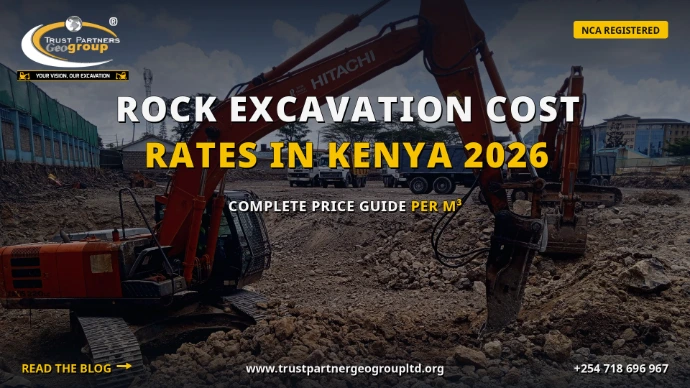
![ROCK EXCAVATION COST [ RATES ] IN KENYA 2026](https://trustpartnergeogroupltd.org/web/image/blog.post/42/author_avatar/ROCK%20EXCAVATION%20COST%20%5B%20RATES%20%5D%20IN%20KENYA%202026?unique=09d327d)
HOW MUCH DOES ROCK EXCAVATION COST IN KENYA? [2026 PRICE GUIDE]
TRANSPARENT PRICING FOR HARD ROCK, MEDIUM ROCK, AND CONTROLLED BLASTING ACROSS ALL REGIONS
ROCK EXCAVATION COST SUMMARY: 2026 KENYA PRICE RANGES
| ROCK TYPE | METHOD | COST PER M³ (KES) | COMMON LOCATIONS |
|---|---|---|---|
| Standard Soil | Standard excavation | 700 – 900 | Parklands, Karen, Lavington, South C |
| Medium Rock | Hydraulic breaker | 900 – 1,300 | Westlands, parts of Upper Hill |
| Hard Rock Class I | Heavy breaking / limited blasting | 1,500 – 1,800 | Upper Hill, deep excavations |
| Hard Rock Class II | Controlled blasting | 1,700 – 2,500 | Upper Hill, commercial high-rises |
| Hard Rock Class III | Specialized blasting / chemical splitting | 2,500 – 4,500 | Deep basements, infrastructure |
KEY INSIGHT
Hard rock excavation costs 3 to 5 times more than standard soil excavation. A 1,000 m³ project that costs KES 800,000 in soil becomes KES 2.5M – 4.5M in hard rock. Always conduct a geotechnical survey before finalizing your excavation budget.
WHAT DRIVES ROCK EXCAVATION COSTS IN KENYA?
Rock excavation pricing is not arbitrary. Six core factors determine your final cost per cubic meter:
1. ROCK HARDNESS AND CLASSIFICATION
Kenya's geology varies dramatically. Nairobi sits on volcanic rock formations; Upper Hill and parts of Westlands encounter weathered and solid rock layers. The harder the rock, the more specialized equipment and methods required — directly increasing cost.
2. EXCAVATION DEPTH
Deep excavations (beyond 15 meters) require benching, specialized shoring, and longer cycle times. Rock at depth is often more consolidated and harder to break. Deep basement excavations in Upper Hill frequently encounter hard rock at 8–15 meter depths.
3. BREAKING METHOD SELECTED
Mechanical breaking with hydraulic hammers is cheaper but slower. Controlled blasting is faster but requires permits, licensed blasters, and safety protocols. Chemical splitting is precise but expensive. Method choice directly impacts both cost and timeline.
4. SITE ACCESSIBILITY
Tight urban plots in Nairobi's CBD, Upper Hill, and Kilimani limit equipment maneuverability. Restricted working hours, proximity to neighbors, and utility congestion all add operational complexity and cost.
5. SPOIL DISPOSAL DISTANCE
Rock spoil is heavier than soil and requires more transport energy. Nairobi County mandates disposal at designated sites. Disposal costs range from KES 800 – 1,500 per ton depending on haul distance and material type.
6. DEWATERING REQUIREMENTS
Rock fractures often contain groundwater. Dewatering during rock excavation adds KES 150,000 – 500,000 per month for well-point systems, deep wells, or sump pumping. Areas like Parklands and Upper Hill have high water tables requiring continuous dewatering.
ROCK EXCAVATION METHODS COMPARED: COST, SPEED, AND SAFETY
| METHOD | COST PER M³ | SPEED | BEST FOR | PERMITS REQUIRED |
|---|---|---|---|---|
| Hydraulic Breaker | KES 900 – 1,300 | Slow (15-25 m³/day) | Medium rock, urban areas | None |
| Heavy Mechanical Breaking | KES 1,500 – 1,800 | Moderate | Hard rock Class I | None |
| Controlled Blasting | KES 1,700 – 2,500 | Fast (50-100 m³/day) | Hard rock Class II, large volumes | Blasting license, NEMA, county permits |
| Chemical Splitting | KES 2,500 – 3,500 | Slow | Precision work near structures | None |
| Diamond Wire Sawing | KES 3,000 – 4,500 | Very slow | Ultra-precision, sensitive environments | None |
WHEN TO USE EACH METHOD
- HYDRAULIC BREAKER: Best for medium rock in residential areas where noise restrictions apply. No permits needed. Cost-effective for small volumes.
- CONTROLLED BLASTING: Best for large hard rock volumes (1,000+ m³) where speed matters. Requires licensed blasters, safety zones, and multiple permits. Not suitable near hospitals, schools, or fragile structures.
- CHEMICAL SPLITTING: Best for precision rock removal near foundations, utilities, or neighboring buildings. Silent operation. Expensive but eliminates vibration damage risk.
- DIAMOND WIRE SAWING: Best for ultra-sensitive environments — heritage buildings, hospitals, or scientific facilities. Slowest and most expensive. Used only when no other method is viable.
REGIONAL ROCK EXCAVATION COST BREAKDOWN: NAIROBI, MOMBASA, KISUMU, NAKURU
Rock excavation costs vary significantly across Kenya's regions due to geology, equipment availability, labor costs, and regulatory environment.
NAIROBI REGION (CENTRAL)
Nairobi commands the highest rock excavation rates in Kenya. The volcanic geology of the Nairobi area creates hard rock conditions, especially in Upper Hill, Westlands, and parts of Kilimani. Urban density increases operational costs through restricted hours, traffic management, and safety protocols.
| ROCK TYPE | COST PER M³ (KES) | NOTES |
|---|---|---|
| Medium Rock | 900 – 1,300 | Westlands, Kilimani |
| Hard Rock Class I | 1,500 – 1,700 | Upper Hill, deep excavations |
| Hard Rock Class II | 1,700 – 2,200 | Upper Hill commercial projects |
| Hard Rock Class III | 2,500 – 4,500 | Mega basements, infrastructure |
MOMBASA REGION (COAST)
Coastal regions generally have sandy, coral, and limestone formations rather than hard volcanic rock. Rock excavation is less common but still required for deep foundations and infrastructure. Rates are 10–15% lower than Nairobi due to less severe rock conditions.
| ROCK TYPE | COST PER M³ (KES) | NOTES |
|---|---|---|
| Medium Rock / Coral | 800 – 1,100 | Limestone, coral formations |
| Hard Rock Class I | 1,200 – 1,500 | Deep foundations, port projects |
| Hard Rock Class II | 1,500 – 1,900 | Specialized infrastructure |
KISUMU & WESTERN REGION
The Western region has mixed geology with volcanic soils and some rock formations. Rates are generally lower than Nairobi but equipment availability for specialized rock breaking is limited, which can drive up costs for complex projects.
| ROCK TYPE | COST PER M³ (KES) | NOTES |
|---|---|---|
| Medium Rock | 850 – 1,200 | Kisumu, Kericho |
| Hard Rock Class I | 1,400 – 1,600 | Deep excavations |
| Hard Rock Class II | 1,600 – 2,000 | Limited specialized equipment |
NAKURU & RIFT VALLEY
The Rift Valley presents unique volcanic rock challenges. Areas near Naivasha, Nakuru, and Eldoret encounter hard volcanic formations that require specialized breaking equipment. The region benefits from lower labor costs but may require equipment mobilization from Nairobi.
| ROCK TYPE | COST PER M³ (KES) | NOTES |
|---|---|---|
| Medium Rock | 800 – 1,100 | Volcanic soils |
| Hard Rock Class I | 1,400 – 1,600 | Volcanic rock formations |
| Hard Rock Class II | 1,600 – 2,000 | Equipment mobilization from Nairobi |
ADDITIONAL COSTS THAT INFLATE ROCK EXCAVATION BUDGETS
Beyond the base rock breaking rate, these ancillary costs can add 30–60% to your total project budget:
| ADDITIONAL SERVICE | DESCRIPTION | ESTIMATED COST |
|---|---|---|
| Geotechnical Survey | Soil/rock testing before excavation | KES 50,000 – 150,000 |
| Shoring Systems | Sheet piles, soldier piles for deep excavations | KES 8,000 – 25,000/m² |
| Dewatering | Well-point systems, deep wells, sump pumping | KES 150,000 – 500,000/month |
| Rock Spoil Disposal | Hauling to approved dumpsites (heavier than soil) | KES 1,000 – 1,800/ton |
| Blasting Permits | County, NEMA, police clearance for controlled blasting | KES 50,000 – 200,000 |
| Vibration Monitoring | Required for blasting near structures | KES 30,000 – 80,000 |
| Site Security | Fencing, lighting, guards for blasting zones | KES 50,000 – 150,000/month |
| Traffic Management | Road occupation permits for spoil transport | KES 20,000 – 60,000 |
| NCA Project Registration | Mandatory for all construction works | Free (currently) |
REAL-WORLD ROCK EXCAVATION COST EXAMPLES
Here are three typical scenarios Trust Partners Geo-Group handles regularly:
SCENARIO 1: RESIDENTIAL BASEMENT, UPPER HILL (MEDIUM ROCK)
- Volume: 500 m³
- Depth: 6 meters
- Rock: Medium (hydraulic breaker)
- Base cost: 500 m³ × KES 1,100 = KES 550,000
- Dewatering (1 month): KES 250,000
- Shoring (150 m²): KES 1,500,000
- Spoil disposal: KES 400,000
- TOTAL: KES 2,700,000
SCENARIO 2: COMMERCIAL HIGH-RISE, UPPER HILL (HARD ROCK CLASS II)
- Volume: 3,000 m³
- Depth: 15 meters
- Rock: Hard Class II (controlled blasting)
- Base cost: 3,000 m³ × KES 2,000 = KES 6,000,000
- Blasting permits & monitoring: KES 250,000
- Dewatering (3 months): KES 1,200,000
- Shoring (400 m²): KES 6,000,000
- Spoil disposal: KES 2,500,000
- TOTAL: KES 15,950,000
SCENARIO 3: ROAD EARTHWORKS, NAKURU (MEDIUM ROCK)
- Volume: 10,000 m³
- Depth: 3 meters (cutting)
- Rock: Medium (hydraulic breaker + bulk excavation)
- Base cost: 10,000 m³ × KES 950 = KES 9,500,000
- Equipment mobilization: KES 300,000
- Spoil disposal: KES 4,000,000
- TOTAL: KES 13,800,000
HOW TO REDUCE YOUR ROCK EXCAVATION COSTS
Rock excavation is expensive, but smart planning can reduce costs by 20–40%:
- CONDUCT GEOTECHNICAL SURVEYS EARLY: A KES 100,000 soil test prevents KES 2M surprises. Know your rock profile before budgeting.
- CHOOSE THE RIGHT BREAKING METHOD: Don't over-specify. Hydraulic breakers handle most medium rock. Reserve blasting for large hard rock volumes.
- OPTIMIZE EXCAVATION SEQUENCING: Phase your excavation to reduce shoring requirements and equipment standby time.
- REUSE ROCK SPOIL: Crushed rock makes excellent backfill, road base, or landscaping material. Reduce disposal costs by 30–50%.
- BUNDLE SERVICES: Combine rock breaking with equipment hire and site preparation. Package discounts often yield 10–15% savings.
- SCHEDULE DURING DRY SEASONS: Rain increases dewatering costs and slows rock breaking progress. Dry season work is 15–20% faster.
- SELECT AN EXPERIENCED CONTRACTOR: Experienced rock excavation contractors complete projects faster with fewer complications. Trust Partners Geo-Group has handled hard rock projects across Nairobi, Mombasa, and the Rift Valley.
PERMITS AND COMPLIANCE FOR ROCK EXCAVATION IN KENYA
Rock excavation — especially blasting — triggers strict regulatory requirements:
- NCA REGISTRATION: All contractors must be NCA-registered. Blasting contractors need additional specialized certification.
- COUNTY EXCAVATION PERMIT: Required from Nairobi City County or respective county government for depths exceeding 3 meters.
- NEMA ENVIRONMENTAL CLEARANCE: Required for large-scale rock excavation or blasting near sensitive areas.
- BLASTING LICENSE: Issued by the Chief Inspector of Explosives. Requires certified blasters, safety plans, and storage protocols.
- POLICE NOTIFICATION: Mandatory for all blasting operations. 48-hour advance notice to local police station.
- UTILITY CLEARANCE: Kenya Power, Nairobi Water, and telecommunications providers must clear the excavation zone before blasting.
- VIBRATION MONITORING: Required for blasting within 100 meters of structures. Third-party monitoring reports protect against damage claims.
Permit and compliance costs for rock excavation typically range from KES 200,000 to KES 800,000 depending on project scale, location, and blasting requirements.
FREQUENTLY ASKED QUESTIONS: ROCK EXCAVATION COSTS IN KENYA
Why is rock excavation so much more expensive than soil excavation?
Rock requires specialized breaking equipment (hydraulic hammers, blasting drills) or explosives. It is denser, harder to remove, and produces heavier spoil requiring more transport energy. Breaking rock is 3–5 times slower than digging soil, increasing labor and equipment costs proportionally.
Can I avoid rock excavation costs by changing my foundation design?
Sometimes. Shallow foundations (raft or strip) may avoid deep rock encounters. However, high-rise buildings require deep pile foundations that penetrate rock regardless. A geotechnical survey early in design can inform cost-effective foundation choices.
Is controlled blasting safe in urban areas like Nairobi?
Yes, when performed by licensed contractors with proper permits, safety zones, and vibration monitoring. Trust Partners Geo-Group has completed controlled blasting in Upper Hill and Westlands with zero incidents. However, blasting is not suitable within 50 meters of hospitals, schools, or heritage buildings.
How long does rock excavation take compared to soil?
Medium rock with hydraulic breakers: 2–3x longer than soil. Hard rock with blasting: 1–2x longer than soil (but much faster than mechanical breaking). A 1,000 m³ soil excavation takes 1 week; the same volume in hard rock takes 2–3 weeks.
Can rock spoil be sold or reused?
Yes. Crushed rock is valuable for road base, concrete aggregate, and landscaping. Some contractors purchase rock spoil from construction sites. Reusing spoil on-site for backfill reduces disposal costs by 30–50%.
What is the deepest rock excavation you have completed?
Trust Partners Geo-Group has completed mega basement excavations exceeding 30 meters deep in Upper Hill, encountering hard rock at multiple levels. These projects required phased blasting, extensive shoring, and continuous dewatering.
Do you offer rock excavation equipment hire separately?
Yes. We offer hydraulic breaker attachments, specialized rock excavation equipment, and certified operators for hire — with or without our project management team. This allows contractors to handle their own rock breaking while accessing our equipment fleet.
How do I get an accurate rock excavation quote?
Contact us for a free site assessment. We conduct preliminary geotechnical evaluation, assess rock conditions, determine the optimal breaking method, and provide a detailed quote with transparent line-item pricing. No obligation.
THE BOTTOM LINE: BUDGET SMART, BREAK RIGHT, BUILD STRONG
Rock excavation is the single most variable cost in Kenyan construction. A project budgeted at KES 800/m³ for soil can balloon to KES 4,500/m³ when hard rock is encountered unplanned. The difference between a profitable project and a budget disaster is early geotechnical knowledge and the right breaking strategy.
At Trust Partners Geo-Group Ltd, we provide transparent rock excavation pricing, free site assessments, and proven expertise across all rock classes and breaking methods. From hydraulic breaking to controlled blasting, we handle Nairobi's hardest rock — legally, safely, and on budget.
— TRUST PARTNERS GEO-GROUP LTD
GET YOUR FREE ROCK EXCAVATION QUOTE TODAY
Every rock formation is different. Contact Trust Partners Geo-Group for a free site assessment, geotechnical evaluation, and detailed rock excavation pricing tailored to your project. We serve Nairobi, Mombasa, Kisumu, Nakuru, Eldoret, and nationwide.
CALL +254 718 68 69 67 EMAIL US VISIT OUR WEBSITE
NAIROBI HQ | SERVING MOMBASA, KISUMU, NAKURU, ELDORET, THIKA & NATIONWIDE
MON - SAT: 8:00 AM - 6:00 PM | 24/7 EMERGENCY SUPPORT
RELATED COST GUIDES
- BASEMENT EXCAVATION COST IN NAIROBI 2026 — Complete price guide per m³ for standard soil, medium rock, and hard rock
- EARTHWORKS COST PER CUBIC METER IN KENYA — 2026 rate breakdown for cut and fill, bulk earthworks, and grading
- SITE CLEARANCE COST IN KENYA — Bush clearing, topsoil removal, and grading prices
- NCA CONTRACTOR REGISTRATION REQUIREMENTS — How to register legally and win tenders
- HEAVY EQUIPMENT FOR HIRE — Excavators, bulldozers, dump trucks, graders & more
TRUST PARTNERS GEO-GROUP LTD | YOUR VISION, OUR EXCAVATION
WEBSITE: WWW.TRUSTPARTNERGEOGROUPLTD.ORG | EMAIL: INFO@TRUSTPARTNERGEOGROUPLTD.ORG | PHONE: +254 718 68 69 67
FOLLOW US: FACEBOOK | TIKTOK | INSTAGRAM | YOUTUBE | LINKEDIN
© 2026 TRUST PARTNERS GEO-GROUP LTD. ALL RIGHTS RESERVED.
HOW MUCH DOES ROCK EXCAVATION COST IN KENYA? [2026 PRICE GUIDE]
TRANSPARENT PRICING FOR HARD ROCK, MEDIUM ROCK, AND CONTROLLED BLASTING ACROSS ALL REGIONS
ROCK EXCAVATION COST SUMMARY: 2026 KENYA PRICE RANGES
| ROCK TYPE | METHOD | COST PER M³ (KES) | COMMON LOCATIONS |
|---|---|---|---|
| Standard Soil | Standard excavation | 700 – 900 | Parklands, Karen, Lavington, South C |
| Medium Rock | Hydraulic breaker | 900 – 1,300 | Westlands, parts of Upper Hill |
| Hard Rock Class I | Heavy breaking / limited blasting | 1,500 – 1,800 | Upper Hill, deep excavations |
| Hard Rock Class II | Controlled blasting | 1,700 – 2,500 | Upper Hill, commercial high-rises |
| Hard Rock Class III | Specialized blasting / chemical splitting | 2,500 – 4,500 | Deep basements, infrastructure |
KEY INSIGHT
Hard rock excavation costs 3 to 5 times more than standard soil excavation. A 1,000 m³ project that costs KES 800,000 in soil becomes KES 2.5M – 4.5M in hard rock. Always conduct a geotechnical survey before finalizing your excavation budget.
WHAT DRIVES ROCK EXCAVATION COSTS IN KENYA?
Rock excavation pricing is not arbitrary. Six core factors determine your final cost per cubic meter:
1. ROCK HARDNESS AND CLASSIFICATION
Kenya's geology varies dramatically. Nairobi sits on volcanic rock formations; Upper Hill and parts of Westlands encounter weathered and solid rock layers. The harder the rock, the more specialized equipment and methods required — directly increasing cost.
2. EXCAVATION DEPTH
Deep excavations (beyond 15 meters) require benching, specialized shoring, and longer cycle times. Rock at depth is often more consolidated and harder to break. Deep basement excavations in Upper Hill frequently encounter hard rock at 8–15 meter depths.
3. BREAKING METHOD SELECTED
Mechanical breaking with hydraulic hammers is cheaper but slower. Controlled blasting is faster but requires permits, licensed blasters, and safety protocols. Chemical splitting is precise but expensive. Method choice directly impacts both cost and timeline.
4. SITE ACCESSIBILITY
Tight urban plots in Nairobi's CBD, Upper Hill, and Kilimani limit equipment maneuverability. Restricted working hours, proximity to neighbors, and utility congestion all add operational complexity and cost.
5. SPOIL DISPOSAL DISTANCE
Rock spoil is heavier than soil and requires more transport energy. Nairobi County mandates disposal at designated sites. Disposal costs range from KES 800 – 1,500 per ton depending on haul distance and material type.
6. DEWATERING REQUIREMENTS
Rock fractures often contain groundwater. Dewatering during rock excavation adds KES 150,000 – 500,000 per month for well-point systems, deep wells, or sump pumping. Areas like Parklands and Upper Hill have high water tables requiring continuous dewatering.
ROCK EXCAVATION METHODS COMPARED: COST, SPEED, AND SAFETY
| METHOD | COST PER M³ | SPEED | BEST FOR | PERMITS REQUIRED |
|---|---|---|---|---|
| Hydraulic Breaker | KES 900 – 1,300 | Slow (15-25 m³/day) | Medium rock, urban areas | None |
| Heavy Mechanical Breaking | KES 1,500 – 1,800 | Moderate | Hard rock Class I | None |
| Controlled Blasting | KES 1,700 – 2,500 | Fast (50-100 m³/day) | Hard rock Class II, large volumes | Blasting license, NEMA, county permits |
| Chemical Splitting | KES 2,500 – 3,500 | Slow | Precision work near structures | None |
| Diamond Wire Sawing | KES 3,000 – 4,500 | Very slow | Ultra-precision, sensitive environments | None |
WHEN TO USE EACH METHOD
- HYDRAULIC BREAKER: Best for medium rock in residential areas where noise restrictions apply. No permits needed. Cost-effective for small volumes.
- CONTROLLED BLASTING: Best for large hard rock volumes (1,000+ m³) where speed matters. Requires licensed blasters, safety zones, and multiple permits. Not suitable near hospitals, schools, or fragile structures.
- CHEMICAL SPLITTING: Best for precision rock removal near foundations, utilities, or neighboring buildings. Silent operation. Expensive but eliminates vibration damage risk.
- DIAMOND WIRE SAWING: Best for ultra-sensitive environments — heritage buildings, hospitals, or scientific facilities. Slowest and most expensive. Used only when no other method is viable.
REGIONAL ROCK EXCAVATION COST BREAKDOWN: NAIROBI, MOMBASA, KISUMU, NAKURU
Rock excavation costs vary significantly across Kenya's regions due to geology, equipment availability, labor costs, and regulatory environment.
NAIROBI REGION (CENTRAL)
Nairobi commands the highest rock excavation rates in Kenya. The volcanic geology of the Nairobi area creates hard rock conditions, especially in Upper Hill, Westlands, and parts of Kilimani. Urban density increases operational costs through restricted hours, traffic management, and safety protocols.
| ROCK TYPE | COST PER M³ (KES) | NOTES |
|---|---|---|
| Medium Rock | 900 – 1,300 | Westlands, Kilimani |
| Hard Rock Class I | 1,500 – 1,700 | Upper Hill, deep excavations |
| Hard Rock Class II | 1,700 – 2,200 | Upper Hill commercial projects |
| Hard Rock Class III | 2,500 – 4,500 | Mega basements, infrastructure |
MOMBASA REGION (COAST)
Coastal regions generally have sandy, coral, and limestone formations rather than hard volcanic rock. Rock excavation is less common but still required for deep foundations and infrastructure. Rates are 10–15% lower than Nairobi due to less severe rock conditions.
| ROCK TYPE | COST PER M³ (KES) | NOTES |
|---|---|---|
| Medium Rock / Coral | 800 – 1,100 | Limestone, coral formations |
| Hard Rock Class I | 1,200 – 1,500 | Deep foundations, port projects |
| Hard Rock Class II | 1,500 – 1,900 | Specialized infrastructure |
KISUMU & WESTERN REGION
The Western region has mixed geology with volcanic soils and some rock formations. Rates are generally lower than Nairobi but equipment availability for specialized rock breaking is limited, which can drive up costs for complex projects.
| ROCK TYPE | COST PER M³ (KES) | NOTES |
|---|---|---|
| Medium Rock | 850 – 1,200 | Kisumu, Kericho |
| Hard Rock Class I | 1,400 – 1,600 | Deep excavations |
| Hard Rock Class II | 1,600 – 2,000 | Limited specialized equipment |
NAKURU & RIFT VALLEY
The Rift Valley presents unique volcanic rock challenges. Areas near Naivasha, Nakuru, and Eldoret encounter hard volcanic formations that require specialized breaking equipment. The region benefits from lower labor costs but may require equipment mobilization from Nairobi.
| ROCK TYPE | COST PER M³ (KES) | NOTES |
|---|---|---|
| Medium Rock | 800 – 1,100 | Volcanic soils |
| Hard Rock Class I | 1,400 – 1,600 | Volcanic rock formations |
| Hard Rock Class II | 1,600 – 2,000 | Equipment mobilization from Nairobi |
ADDITIONAL COSTS THAT INFLATE ROCK EXCAVATION BUDGETS
Beyond the base rock breaking rate, these ancillary costs can add 30–60% to your total project budget:
| ADDITIONAL SERVICE | DESCRIPTION | ESTIMATED COST |
|---|---|---|
| Geotechnical Survey | Soil/rock testing before excavation | KES 50,000 – 150,000 |
| Shoring Systems | Sheet piles, soldier piles for deep excavations | KES 8,000 – 25,000/m² |
| Dewatering | Well-point systems, deep wells, sump pumping | KES 150,000 – 500,000/month |
| Rock Spoil Disposal | Hauling to approved dumpsites (heavier than soil) | KES 1,000 – 1,800/ton |
| Blasting Permits | County, NEMA, police clearance for controlled blasting | KES 50,000 – 200,000 |
| Vibration Monitoring | Required for blasting near structures | KES 30,000 – 80,000 |
| Site Security | Fencing, lighting, guards for blasting zones | KES 50,000 – 150,000/month |
| Traffic Management | Road occupation permits for spoil transport | KES 20,000 – 60,000 |
| NCA Project Registration | Mandatory for all construction works | Free (currently) |
REAL-WORLD ROCK EXCAVATION COST EXAMPLES
Here are three typical scenarios Trust Partners Geo-Group handles regularly:
SCENARIO 1: RESIDENTIAL BASEMENT, UPPER HILL (MEDIUM ROCK)
- Volume: 500 m³
- Depth: 6 meters
- Rock: Medium (hydraulic breaker)
- Base cost: 500 m³ × KES 1,100 = KES 550,000
- Dewatering (1 month): KES 250,000
- Shoring (150 m²): KES 1,500,000
- Spoil disposal: KES 400,000
- TOTAL: KES 2,700,000
SCENARIO 2: COMMERCIAL HIGH-RISE, UPPER HILL (HARD ROCK CLASS II)
- Volume: 3,000 m³
- Depth: 15 meters
- Rock: Hard Class II (controlled blasting)
- Base cost: 3,000 m³ × KES 2,000 = KES 6,000,000
- Blasting permits & monitoring: KES 250,000
- Dewatering (3 months): KES 1,200,000
- Shoring (400 m²): KES 6,000,000
- Spoil disposal: KES 2,500,000
- TOTAL: KES 15,950,000
SCENARIO 3: ROAD EARTHWORKS, NAKURU (MEDIUM ROCK)
- Volume: 10,000 m³
- Depth: 3 meters (cutting)
- Rock: Medium (hydraulic breaker + bulk excavation)
- Base cost: 10,000 m³ × KES 950 = KES 9,500,000
- Equipment mobilization: KES 300,000
- Spoil disposal: KES 4,000,000
- TOTAL: KES 13,800,000
HOW TO REDUCE YOUR ROCK EXCAVATION COSTS
Rock excavation is expensive, but smart planning can reduce costs by 20–40%:
- CONDUCT GEOTECHNICAL SURVEYS EARLY: A KES 100,000 soil test prevents KES 2M surprises. Know your rock profile before budgeting.
- CHOOSE THE RIGHT BREAKING METHOD: Don't over-specify. Hydraulic breakers handle most medium rock. Reserve blasting for large hard rock volumes.
- OPTIMIZE EXCAVATION SEQUENCING: Phase your excavation to reduce shoring requirements and equipment standby time.
- REUSE ROCK SPOIL: Crushed rock makes excellent backfill, road base, or landscaping material. Reduce disposal costs by 30–50%.
- BUNDLE SERVICES: Combine rock breaking with equipment hire and site preparation. Package discounts often yield 10–15% savings.
- SCHEDULE DURING DRY SEASONS: Rain increases dewatering costs and slows rock breaking progress. Dry season work is 15–20% faster.
- SELECT AN EXPERIENCED CONTRACTOR: Experienced rock excavation contractors complete projects faster with fewer complications. Trust Partners Geo-Group has handled hard rock projects across Nairobi, Mombasa, and the Rift Valley.
PERMITS AND COMPLIANCE FOR ROCK EXCAVATION IN KENYA
Rock excavation — especially blasting — triggers strict regulatory requirements:
- NCA REGISTRATION: All contractors must be NCA-registered. Blasting contractors need additional specialized certification.
- COUNTY EXCAVATION PERMIT: Required from Nairobi City County or respective county government for depths exceeding 3 meters.
- NEMA ENVIRONMENTAL CLEARANCE: Required for large-scale rock excavation or blasting near sensitive areas.
- BLASTING LICENSE: Issued by the Chief Inspector of Explosives. Requires certified blasters, safety plans, and storage protocols.
- POLICE NOTIFICATION: Mandatory for all blasting operations. 48-hour advance notice to local police station.
- UTILITY CLEARANCE: Kenya Power, Nairobi Water, and telecommunications providers must clear the excavation zone before blasting.
- VIBRATION MONITORING: Required for blasting within 100 meters of structures. Third-party monitoring reports protect against damage claims.
Permit and compliance costs for rock excavation typically range from KES 200,000 to KES 800,000 depending on project scale, location, and blasting requirements.
FREQUENTLY ASKED QUESTIONS: ROCK EXCAVATION COSTS IN KENYA
Why is rock excavation so much more expensive than soil excavation?
Rock requires specialized breaking equipment (hydraulic hammers, blasting drills) or explosives. It is denser, harder to remove, and produces heavier spoil requiring more transport energy. Breaking rock is 3–5 times slower than digging soil, increasing labor and equipment costs proportionally.
Can I avoid rock excavation costs by changing my foundation design?
Sometimes. Shallow foundations (raft or strip) may avoid deep rock encounters. However, high-rise buildings require deep pile foundations that penetrate rock regardless. A geotechnical survey early in design can inform cost-effective foundation choices.
Is controlled blasting safe in urban areas like Nairobi?
Yes, when performed by licensed contractors with proper permits, safety zones, and vibration monitoring. Trust Partners Geo-Group has completed controlled blasting in Upper Hill and Westlands with zero incidents. However, blasting is not suitable within 50 meters of hospitals, schools, or heritage buildings.
How long does rock excavation take compared to soil?
Medium rock with hydraulic breakers: 2–3x longer than soil. Hard rock with blasting: 1–2x longer than soil (but much faster than mechanical breaking). A 1,000 m³ soil excavation takes 1 week; the same volume in hard rock takes 2–3 weeks.
Can rock spoil be sold or reused?
Yes. Crushed rock is valuable for road base, concrete aggregate, and landscaping. Some contractors purchase rock spoil from construction sites. Reusing spoil on-site for backfill reduces disposal costs by 30–50%.
What is the deepest rock excavation you have completed?
Trust Partners Geo-Group has completed mega basement excavations exceeding 30 meters deep in Upper Hill, encountering hard rock at multiple levels. These projects required phased blasting, extensive shoring, and continuous dewatering.
Do you offer rock excavation equipment hire separately?
Yes. We offer hydraulic breaker attachments, specialized rock excavation equipment, and certified operators for hire — with or without our project management team. This allows contractors to handle their own rock breaking while accessing our equipment fleet.
How do I get an accurate rock excavation quote?
Contact us for a free site assessment. We conduct preliminary geotechnical evaluation, assess rock conditions, determine the optimal breaking method, and provide a detailed quote with transparent line-item pricing. No obligation.
THE BOTTOM LINE: BUDGET SMART, BREAK RIGHT, BUILD STRONG
Rock excavation is the single most variable cost in Kenyan construction. A project budgeted at KES 800/m³ for soil can balloon to KES 4,500/m³ when hard rock is encountered unplanned. The difference between a profitable project and a budget disaster is early geotechnical knowledge and the right breaking strategy.
At Trust Partners Geo-Group Ltd, we provide transparent rock excavation pricing, free site assessments, and proven expertise across all rock classes and breaking methods. From hydraulic breaking to controlled blasting, we handle Nairobi's hardest rock — legally, safely, and on budget.
— TRUST PARTNERS GEO-GROUP LTD
GET YOUR FREE ROCK EXCAVATION QUOTE TODAY
Every rock formation is different. Contact Trust Partners Geo-Group for a free site assessment, geotechnical evaluation, and detailed rock excavation pricing tailored to your project. We serve Nairobi, Mombasa, Kisumu, Nakuru, Eldoret, and nationwide.
CALL +254 718 68 69 67 EMAIL US VISIT OUR WEBSITE
NAIROBI HQ | SERVING MOMBASA, KISUMU, NAKURU, ELDORET, THIKA & NATIONWIDE
MON - SAT: 8:00 AM - 6:00 PM | 24/7 EMERGENCY SUPPORT
RELATED COST GUIDES
- BASEMENT EXCAVATION COST IN NAIROBI 2026 — Complete price guide per m³ for standard soil, medium rock, and hard rock
- EARTHWORKS COST PER CUBIC METER IN KENYA — 2026 rate breakdown for cut and fill, bulk earthworks, and grading
- SITE CLEARANCE COST IN KENYA — Bush clearing, topsoil removal, and grading prices
- NCA CONTRACTOR REGISTRATION REQUIREMENTS — How to register legally and win tenders
- HEAVY EQUIPMENT FOR HIRE — Excavators, bulldozers, dump trucks, graders & more
TRUST PARTNERS GEO-GROUP LTD | YOUR VISION, OUR EXCAVATION
WEBSITE: WWW.TRUSTPARTNERGEOGROUPLTD.ORG | EMAIL: INFO@TRUSTPARTNERGEOGROUPLTD.ORG | PHONE: +254 718 68 69 67
FOLLOW US: FACEBOOK | TIKTOK | INSTAGRAM | YOUTUBE | LINKEDIN
© 2026 TRUST PARTNERS GEO-GROUP LTD. ALL RIGHTS RESERVED.