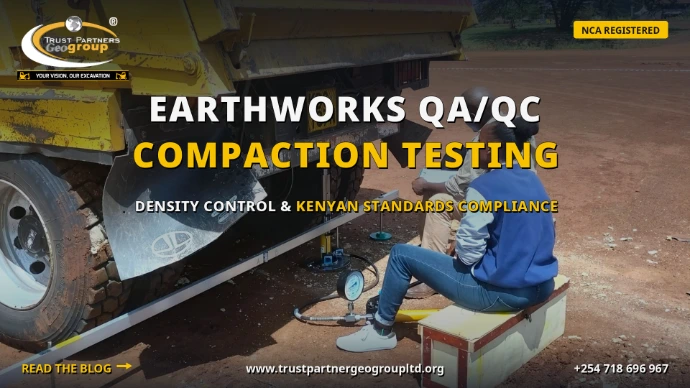
EARTHWORKS QA/QC: COMPACTION TESTING, DENSITY CONTROL & KENYAN STANDARDS COMPLIANCE [2026]
THE COMPLETE GUIDE TO ENSURING YOUR EARTHWORKS MEET KENYAN AND INTERNATIONAL QUALITY STANDARDS
Table of Contents
- 1. Why Earthworks QA/QC is Non-Negotiable
- 2. Kenyan & International Standards for Earthworks
- 2.1 KEBS Standards
- 2.2 BS & ASTM Standards
- 3. The Proctor Test: Foundation of Compaction Control
- 3.1 Modified Proctor Test (ASTM D1557)
- 3.2 Standard Proctor Test (ASTM D698)
- 4. Field Density Testing Methods
- 4.1 Sand Replacement Method
- 4.2 Nuclear Density Gauge
- 4.3 Core Cutter Method
- 5. Moisture Content Control in Kenyan Conditions
- 6. Compaction Equipment Selection by Soil Type
- 7. Testing Frequency & Acceptance Criteria
- 8. QA/QC Documentation & Reporting
- 9. Compaction Testing Costs in Kenya (2026)
- 10. The Trust Partners Geo-Group QA/QC Process
- 11. Frequently Asked Questions
- 12. The Bottom Line: Quality Earthworks Start with QA/QC

WHY EARTHWORKS QA/QC IS NON-NEGOTIABLE
Earthworks form the foundation of virtually every construction project in Kenya - roads, buildings, dams, water pans, and industrial facilities. Yet earthworks failures are among the most common and expensive construction defects. Here's why rigorous QA/QC is essential:
THE COST OF POOR COMPACTION
| FAILURE TYPE | CAUSE | COST IMPACT | PREVENTION |
|---|---|---|---|
| Building settlement | Fill compacted below 95% MDD | KES 500K-5M+ in structural repairs | Field density testing every 200-500 m2 |
| Road surface cracking | Subgrade settlement under traffic | KES 1M-10M per km for reconstruction | Subgrade compaction to 98% MDD minimum |
| Water pan embankment breach | Low density fill, poor moisture control | Complete reconstruction + crop loss | Layered compaction at 95% MDD, moisture control |
| Foundation bearing failure | Inadequate soil bearing capacity | KES 2M-20M+ for underpinning or rebuild | Plate load testing + CBR verification |
| Utility trench collapse | Uncompacted backfill, no testing | KES 200K-2M in repairs + service disruption | Backfill testing in 150mm lifts |
| Drainage system failure | Settlement breaking pipes | KES 300K-3M in excavation and replacement | Bedding compaction to 95% MDD |
THE QA/QC PAYBACK
Proper earthworks QA/QC costs 1-3% of total earthworks budget but prevents failures that cost 10-50x more. On a typical KES 10M earthworks project:
- QA/QC investment: KES 100,000-300,000 (testing, documentation, inspection)
- Avoided failure cost: KES 1M-5M+ (settlement, reconstruction, delays, litigation)
- ROI: 300-1,500% return on QA/QC investment
- Additional benefit: Defensible documentation for warranties, insurance claims, and regulatory compliance
THE NCA COMPLIANCE REQUIREMENT
The National Construction Authority (NCA) mandates quality control documentation for all registered construction projects. Earthworks without proper testing records can result in project suspension, NCA penalties, and rejection of completion certificates. At Trust Partners Geo-Group, our QA/QC documentation meets NCA, KEBS, and county building inspector requirements on every project.
KENYAN & INTERNATIONAL STANDARDS FOR EARTHWORKS
Quality control requires standards. In Kenya, earthworks QA/QC follows a combination of Kenyan standards, British standards, and American standards depending on the project type and client requirements.
KEBS STANDARDS (KENYA BUREAU OF STANDARDS)
| STANDARD | TITLE | APPLICATION |
|---|---|---|
| KS 02-103 | Earthworks for Roads - Specification | Road construction, highway earthworks, embankments |
| KS 02-104 | Compaction Requirements for Earthworks | Minimum compaction percentages by project type |
| KS 02-105 | Soil Testing Methods for Construction | Laboratory and field testing procedures |
| KS 02-107 | Building Foundations - Earthworks | Foundation excavation, backfill, bearing capacity |
| KS 02-108 | Quality Control for Earthmoving Operations | QA/QC procedures, documentation, reporting |
BRITISH & AMERICAN STANDARDS (REFERENCED IN KENYA)
| STANDARD | TITLE | APPLICATION |
|---|---|---|
| BS 1377:4 | Methods of Test for Soils - Compaction | Proctor tests, moisture content, density |
| BS 1377:9 | Methods of Test for Soils - In-situ Tests | Field density, plate load, CBR |
| BS 8004 | Code of Practice for Foundations | Foundation design, bearing capacity, settlement |
| ASTM D1557 | Modified Proctor Test | Maximum dry density for heavy compaction |
| ASTM D698 | Standard Proctor Test | Maximum dry density for light compaction |
| ASTM D6938 | Nuclear Density Gauge Testing | Rapid field density measurement |
| ASTM D2166 | Plate Load Test | Bearing capacity verification |
| AASHTO T99/T180 | Proctor Tests (Road Standards) | Highway and road construction |
COMPACTION REQUIREMENTS BY PROJECT TYPE (KEBS KS 02-104)
| PROJECT TYPE | MINIMUM COMPACTION | TEST METHOD | MOISTURE RANGE |
|---|---|---|---|
| Building foundations | 95-98% Modified Proctor | Sand replacement or nuclear gauge | OMC +/- 2% |
| Road subgrade | 95-98% Modified Proctor | Sand replacement or nuclear gauge | OMC +/- 2% |
| Road sub-base | 98-100% Modified Proctor | Sand replacement or nuclear gauge | OMC +/- 2% |
| Dam embankments | 95% Modified Proctor | Sand replacement | OMC +/- 2% |
| Water pan embankments | 95% Modified Proctor | Sand replacement | OMC +/- 2% |
| Utility trenches | 90-95% Modified Proctor | Sand replacement or nuclear gauge | OMC +/- 3% |
| Landscaping fill | 85-90% Standard Proctor | Visual + spot tests | Near OMC |
| Structural backfill | 95% Modified Proctor | Sand replacement | OMC +/- 2% |
THE PROCTOR TEST: FOUNDATION OF COMPACTION CONTROL
The Proctor test is the single most important laboratory test in earthworks QA/QC. It establishes the Maximum Dry Density (MDD) and Optimum Moisture Content (OMC) for a given soil - the benchmarks against which all field compaction is measured.
MODIFIED PROCTOR TEST (ASTM D1557 / BS 1377:4)
The Modified Proctor Test is the standard for Kenyan construction. It simulates heavy compaction equipment (vibratory rollers, heavy tamping) and produces higher density values than the Standard Proctor.
- Hammer weight: 4.5 kg (10 lbs)
- Drop height: 450 mm (18 inches)
- Layers: 5 layers in 150mm mold
- Blows per layer: 25 or 56 depending on mold size
- Compactive effort: 56,000 kJ/m3 (2,700 ft-lb/ft3)
- Result: Maximum Dry Density (MDD) and Optimum Moisture Content (OMC)
PROCTOR TEST PROCEDURE
- Sample preparation: Collect 30-40 kg of representative soil from the borrow pit or stockpile. Break down large lumps, remove organic matter and particles >20mm.
- Moisture adjustment: Divide sample into 5 portions. Add water to achieve moisture contents ranging from dry to wet (typically 4-6 points spanning expected OMC).
- Compaction: Compact each portion in the Proctor mold using the specified hammer weight, drop height, layers, and blows.
- Weighing: Weigh the compacted sample + mold. Calculate wet density.
- Moisture content: Extract a representative sample from the mold, weigh wet, dry in oven at 105-110 degrees C for 24 hours, weigh dry. Calculate moisture content.
- Calculations: Dry density = Wet density / (1 + moisture content). Plot dry density vs moisture content curve.
- Results: Peak of curve = MDD. Moisture content at peak = OMC.
STANDARD PROCTOR TEST (ASTM D698 / BS 1377:4)
The Standard Proctor Test uses lighter compaction energy and is suitable for projects with lower load requirements or where heavy compaction equipment is unavailable.
- Hammer weight: 2.5 kg (5.5 lbs)
- Drop height: 300 mm (12 inches)
- Layers: 3 layers in 150mm mold
- Blows per layer: 25 or 56 depending on mold size
- Compactive effort: 12,400 kJ/m3 (600 ft-lb/ft3)
- Typical result: MDD 10-15% lower than Modified Proctor for same soil
CRITICAL: NEVER MIX PROCTOR TYPES
One of the most common and dangerous errors in Kenyan construction is specifying 95% compaction without specifying which Proctor test. If your specification says "95% compaction" but the laboratory tested Standard Proctor while the field tests reference Modified Proctor values, your actual compaction could be 15-20% below requirement. Always specify: "95% of Modified Proctor Maximum Dry Density (ASTM D1557)" or "95% of Standard Proctor Maximum Dry Density (ASTM D698)." Trust Partners Geo-Group verifies Proctor type on every project before field testing begins.
TYPICAL PROCTOR RESULTS FOR KENYAN SOILS
| SOIL TYPE | MODIFIED PROCTOR MDD (KG/M3) | OMC (%) | STANDARD PROCTOR MDD (KG/M3) | TYPICAL USE |
|---|---|---|---|---|
| Red volcanic soil (Murram) | 1,800-2,100 | 8-12 | 1,600-1,850 | Road subgrade, building fill |
| Black cotton soil | 1,500-1,700 | 15-22 | 1,300-1,500 | Not recommended without stabilization |
| Sandy soil (coastal) | 1,700-2,000 | 10-14 | 1,500-1,750 | Drainage layers, pipe bedding |
| Clayey soil | 1,600-1,850 | 14-20 | 1,400-1,650 | Core walls, liners (if treated) |
| Lateritic soil | 1,750-2,000 | 10-15 | 1,550-1,800 | Road base, foundation fill |
| Gravelly soil | 1,900-2,200 | 6-10 | 1,700-1,950 | Sub-base, drainage |
| Rock fill | 2,000-2,400 | 4-8 | 1,800-2,100 | Embankments, heavy foundations |
FIELD DENSITY TESTING METHODS
Field density tests verify that compaction in the field matches or exceeds the laboratory Proctor results. Three methods are commonly used in Kenya, each with advantages and limitations.
SAND REPLACEMENT METHOD (SAND CONE METHOD)
The sand replacement method is the most reliable and widely accepted field density test in Kenya. It is the reference method against which other methods are calibrated.
- Principle: Excavate a hole of known volume in the compacted soil, weigh the excavated soil, and calculate wet and dry density.
- Equipment: Sand cone apparatus, base plate, calibrated sand (uniform density), weighing balance, moisture content containers, oven.
- Procedure: (1) Level test area and seat base plate; (2) Excavate hole through plate opening (typically 100-150mm diameter, to full lift depth); (3) Collect all excavated soil and weigh; (4) Fill hole with calibrated sand from cone; (5) Weigh remaining sand; (6) Calculate hole volume from sand weight and known sand density; (7) Calculate wet density = soil weight / hole volume; (8) Determine moisture content and calculate dry density.
- Advantages: Highly accurate, accepted by all Kenyan engineers and NCA, works on all soil types including rocky material, no radiation license required.
- Disadvantages: Slow (30-45 minutes per test), labor-intensive, requires skilled technician, sand must be calibrated and protected from moisture.
- Cost: KES 8,000-15,000 per test
NUCLEAR DENSITY GAUGE METHOD
Nuclear density gauges use gamma radiation to measure soil density and moisture content rapidly. They are increasingly popular on large Kenyan projects where speed matters.
- Principle: Gamma rays are directed into the soil from a radioactive source (Cesium-137). The backscattered radiation correlates with soil density. A separate neutron source (Americium-241/Beryllium) measures moisture content via hydrogen detection.
- Equipment: Nuclear density gauge (Troxler, Humboldt, or equivalent), reference block for daily calibration, drill rod for direct transmission mode.
- Procedure: (1) Daily calibration on reference block; (2) Place gauge on test surface (backscatter mode) or drill hole and lower source (direct transmission mode); (3) Count for 1-4 minutes; (4) Read wet density, dry density, moisture content, and percent compaction directly.
- Advantages: Extremely fast (2-3 minutes per test), non-destructive, repeatable, large test area (300-600mm diameter), automatic compaction percentage calculation.
- Disadvantages: Requires Radiation Protection Board license, operator training and certification, cannot be used on rocky or asphalt surfaces, some clients require sand replacement for final acceptance, annual calibration required.
- Cost: KES 5,000-10,000 per test
RADIATION SAFETY REQUIREMENTS IN KENYA
Nuclear density gauges contain radioactive sources and are regulated by the Kenya Radiation Protection Board (RPB). Requirements: (1) RPB license for possession and use; (2) Trained and certified operator (RPB-approved training course); (3) Secure storage with radiation warning signage; (4) Transport in approved Type A package; (5) Quarterly leak tests; (6) Annual source strength verification; (7) Emergency response plan for source damage or loss. Trust Partners Geo-Group maintains full RPB compliance for all nuclear density gauge operations.
CORE CUTTER METHOD
The core cutter method is a simple, low-cost alternative for cohesive soils where sand replacement equipment is unavailable.
- Principle: Drive a steel cylinder (core cutter) of known volume into the soil, extract the soil core, and determine density from weight and volume.
- Equipment: Steel core cutter (100mm diameter x 130mm height), dolly, rammer, weighing balance, moisture content containers.
- Procedure: (1) Clean and grease core cutter; (2) Place on level soil surface; (3) Drive cutter into soil using dolly and rammer; (4) Trim flush with surface; (5) Extract cutter with soil core; (6) Trim ends and weigh; (7) Determine moisture content; (8) Calculate dry density.
- Advantages: Simple, no sand required, low equipment cost, suitable for cohesive soils.
- Disadvantages: Not suitable for granular or rocky soils, less accurate than sand replacement, requires level surface, limited to shallow depths.
- Cost: KES 3,000-6,000 per test
| METHOD | ACCURACY | SPEED | BEST FOR | COST/TEST | ACCEPTANCE |
|---|---|---|---|---|---|
| Sand Replacement | +/- 1-2% | 30-45 min | All soils, formal acceptance | KES 8,000-15,000 | Universal |
| Nuclear Gauge | +/- 2-3% | 2-3 min | Large projects, daily control | KES 5,000-10,000 | With sand replacement backup |
| Core Cutter | +/- 3-5% | 15-20 min | Cohesive soils, small projects | KES 3,000-6,000 | Limited (cohesive only) |
MOISTURE CONTENT CONTROL IN KENYAN CONDITIONS
Moisture content is the second critical variable in compaction control. Even with the best equipment and maximum roller effort, soil compacted at the wrong moisture content will not achieve specified density. In Kenya's variable climate - from humid coastal conditions to dry Rift Valley winds to unpredictable Nairobi rains - moisture control is a daily challenge.
OPTIMUM MOISTURE CONTENT (OMC) IN PRACTICE
OMC is not a single fixed number - it varies by soil type, source, and even season. The Proctor test determines OMC for a specific soil sample, but field conditions require continuous monitoring and adjustment.
- Too dry (below OMC - 2%): Soil particles resist rearrangement, voids remain, low density achieved. Visual signs: dusty, crumbly, difficult to shape. Solution: Water uniformly and mix thoroughly before compaction.
- At OMC (+/- 2%): Water lubricates particles, allowing them to slide into densest configuration. Visual signs: soil holds shape when squeezed, slight sheen on surface, no free water. This is the target zone.
- Too wet (above OMC + 2%): Water fills voids between particles, creating a slurry that cannot support load. Visual signs: muddy, pumps under roller, leaves ruts. Solution: Aerate by blading, allow to dry, or mix with dry material.
MOISTURE TESTING METHODS
| METHOD | PROCEDURE | TIME | ACCURACY | BEST FOR |
|---|---|---|---|---|
| Oven drying (BS 1377:2) | Weigh wet sample, dry at 105-110 degrees C for 24 hours, weigh dry | 24 hours | +/- 0.1% | Reference method, laboratory |
| Microwave drying | Dry sample in microwave in 2-minute intervals, weigh between intervals | 15-20 min | +/- 0.5% | Field approximation |
| Speedy moisture tester | Calcium carbide reacts with water, pressure gauge reads moisture content | 3-5 min | +/- 1-2% | Rapid field testing |
| Nuclear gauge | Neutron source detects hydrogen (water) in soil | 1-2 min | +/- 1-2% | Large projects with gauge |
| Hand feel test | Experienced technician estimates moisture by squeezing and observing | Instant | +/- 3-5% | Preliminary assessment only |
MOISTURE CONTROL TECHNIQUES FOR KENYAN CONDITIONS
DRY SEASON MOISTURE MANAGEMENT (JANUARY-MARCH, JULY-OCTOBER)
- Water trucks: Apply water uniformly via water trucks with spray bars. Rate: 10-20 liters/m2 depending on soil type and deficit.
- Mixing: Use motor grader or disc harrow to mix water into soil to full lift depth. Surface watering alone creates a wet crust over dry interior.
- Timing: Water in early morning or evening to minimize evaporation. Midday watering in Nairobi or Nakuru can lose 30-50% to evaporation before compaction.
- Stockpile watering: For borrow pit material, water stockpiles 24-48 hours before use to allow uniform moisture distribution.
- Monitoring: Test moisture content every 200-500 m2 or every 2 hours of compaction. Adjust watering rate based on results.
WET SEASON MOISTURE MANAGEMENT (APRIL-JUNE, NOVEMBER-DECEMBER)
- Aeration: Use motor grader to blade and turn soil, exposing moist layers to sun and wind. Repeat every 2-4 hours depending on conditions.
- Drainage: Install temporary drainage ditches around work areas to prevent water accumulation. Pump standing water immediately.
- Thin lifts: Reduce lift thickness from 250mm to 150mm to speed drying and allow better moisture control.
- Covering: For critical areas, cover stockpiles with tarpaulins to prevent rainwater infiltration.
- Alternative materials: If native soil is too wet, import dry material from borrow pits or use granular sub-base as working platform.
- Schedule adjustment: In prolonged wet weather, suspend earthworks rather than compact wet soil. Reworking wet fill costs more than waiting.
THE BLACK COTTON SOIL CHALLENGE
Black cotton soil in Kenya's Rift Valley and parts of Nairobi presents unique moisture control challenges. Its high clay content (40-60%) and expansive nature mean: (1) OMC is high (15-22%), requiring significantly more water; (2) Swelling when wet can increase volume by 20-30%, destroying compaction; (3) Shrinkage when dry creates cracks that compromise density; (4) Moisture content must be controlled within +/- 1% of OMC (tighter than other soils). For black cotton soil earthworks, we recommend: chemical stabilization (3-5% cement or lime), geotextile separation, or complete replacement with imported granular material. Never attempt uncompacted black cotton soil for structural fill.
COMPACTION EQUIPMENT SELECTION BY SOIL TYPE
The right compaction equipment is as important as the right testing. Using a smooth drum roller on cohesive clay or a sheepsfoot roller on clean sand produces poor results regardless of testing frequency.
| EQUIPMENT TYPE | BEST FOR | COMPACTION MECHANISM | LIFT THICKNESS | PASSES REQUIRED |
|---|---|---|---|---|
| Smooth drum vibratory roller (8-12 ton) | Granular soils, murram, sand, gravel | Vibration rearranges particles into densest packing | 200-300mm | 4-8 passes |
| Smooth drum vibratory roller (15-20 ton) | Heavy granular, rock fill, sub-base | High amplitude vibration + static weight | 300-500mm | 6-10 passes |
| Sheepsfoot / Padfoot roller | Cohesive soils, clay, black cotton | Kneading action breaks down clay lumps, forces air out | 150-200mm | 6-12 passes |
| Pneumatic tire roller (9-13 wheels) | Mixed soils, asphalt, finishing | Kneading action from tire pressure (up to 700 kPa) | 200-300mm | 4-8 passes |
| Tamping rammer (60-80 kg) | Trenches, confined areas, backfill | High impact, low area | 100-150mm | 3-6 passes per lift |
| Vibratory plate compactor (100-500 kg) | Small areas, trenches, granular soils | Vibration + plate weight | 100-200mm | 4-6 passes |
| Grid roller | Rock fill, breaking down oversize | High point pressure breaks rock | 300-600mm | 4-6 passes |
| Impact roller (3-sided or 5-sided) | Deep compaction, ground improvement | High energy impact (up to 50 kJ) | Up to 1,000mm | 10-20 passes |
EQUIPMENT SELECTION GUIDE FOR KENYAN SOILS
- Red volcanic soil (Murram) - Nairobi, Kiambu, Nakuru: Smooth drum vibratory roller (10-15 ton) is ideal. Murram compacts well under vibration. For road sub-base, use 15-20 ton roller with 6-8 passes at 250mm lifts.
- Black cotton soil - Rift Valley, parts of Nairobi: Sheepsfoot or padfoot roller essential. Smooth drum will skate over the surface without compacting the interior. Consider chemical stabilization (3-5% cement) before compaction. If stabilized, use smooth drum vibratory roller.
- Sandy soils - Coast, parts of Garissa: Smooth drum vibratory roller with high frequency, low amplitude setting. Pneumatic tire roller for finishing to seal surface. Water lightly to prevent segregation.
- Lateritic soils - Western Kenya, Kakamega: Smooth drum vibratory roller (10-12 ton). Lateritic soils respond well to vibration but can become slippery when wet. Control moisture carefully.
- Rock fill - quarries, deep fills: Heavy smooth drum roller (20+ ton) or grid roller for initial breakdown, followed by vibratory roller for finishing. Impact rollers for deep ground improvement on large sites.
- Mixed soils with clay pockets: Combination approach - sheepsfoot roller for clay zones, smooth drum for granular zones. Test each zone separately as Proctor results will differ.
THE LIFT THICKNESS RULE
Lift thickness must match equipment capability. A common error on Kenyan sites is placing 400mm lifts and compacting with a 10-ton roller - the top 150mm may achieve 95% MDD while the bottom 250mm remains at 80%. This creates a hidden weak layer that causes differential settlement. Rule of thumb: lift thickness = maximum roller drum diameter / 2. For a 1.5m diameter roller, maximum lift = 750mm. For typical 10-ton rollers (1.2m drum), maximum practical lift = 300mm. Always test density at the bottom of the lift, not just the surface.
TESTING FREQUENCY & ACCEPTANCE CRITERIA
Testing frequency balances quality assurance with cost control. Too few tests miss failures; too many waste budget. The following guidelines represent Kenyan industry best practice and KEBS recommendations.
MINIMUM TESTING FREQUENCY BY PROJECT TYPE
| PROJECT TYPE | COMPACTION TEST FREQUENCY | MOISTURE TEST FREQUENCY | PROCTOR TEST FREQUENCY | CBR / PLATE LOAD |
|---|---|---|---|---|
| Building foundation (small, <500 m2) | 1 per 200 m2 per lift | 1 per 500 m2 | 1 per soil type | 1 per foundation |
| Building foundation (large, >500 m2) | 1 per 300 m2 per lift | 1 per 300 m2 | 1 per soil type + 1 per 500 m3 | 1 per 500 m2 |
| Road subgrade (urban) | 1 per 500 m2 per lift | 1 per 500 m2 | 1 per 1,000 m3 | 1 per 1,000 m2 |
| Road subgrade (highway) | 1 per 1,000 m2 per lift | 1 per 1,000 m2 | 1 per 2,000 m3 | 1 per 2,000 m2 |
| Road sub-base | 1 per 500 m2 per lift | 1 per 500 m2 | 1 per 1,000 m3 | 1 per 1,000 m2 |
| Dam/water pan embankment | 1 per 300 m2 per lift | 1 per 300 m2 | 1 per 500 m3 | 1 per 1,000 m2 |
| Utility trench | 1 per 50m run or 200 m2 | 1 per 100m | 1 per soil type | Not typically required |
| Landscaping fill | 1 per 1,000 m2 | Visual check | 1 per project | Not required |
| Borrow pit material | 1 per 500 m3 | 1 per 500 m3 | 1 per material type | 1 per 2,000 m3 |
ACCEPTANCE CRITERIA & REMEDIAL ACTION
| TEST RESULT | STATUS | ACTION REQUIRED |
|---|---|---|
| Greater than or equal to 98% MDD | Excellent | Accept. No action needed. Document and proceed. |
| 95-97.9% MDD | Pass | Accept for most applications. Monitor adjacent areas. |
| 92-94.9% MDD | Marginal | Reject for structural fill. Accept for non-structural only with engineer approval. Rework structural areas. |
| 90-91.9% MDD | Fail | Reject. Remove lift, adjust moisture, recompact, retest. Investigate cause (equipment, moisture, material). |
| Less than 90% MDD | Critical fail | Reject. Remove full lift. Do not cover with next lift. Root cause analysis mandatory. May require design review. |
| Moisture > OMC + 3% | Too wet | Stop compaction. Aerate, dry, or remove and replace. Retest moisture before resuming. |
| Moisture < OMC - 3% | Too dry | Water uniformly, mix thoroughly, retest moisture, then compact. |
THE TRUST PARTNERS GEO-GROUP TESTING PROTOCOL
On every earthworks project, we implement a three-tier testing approach:
- Tier 1 - Production Control (Daily): Nuclear density gauge tests every 300-500 m2 during active compaction. Results within 3 minutes allow real-time adjustment of moisture and roller passes.
- Tier 2 - Acceptance Testing (Per Lift): Sand replacement tests at 20% of nuclear gauge locations for verification. These formal tests are documented in the QA/QC register and submitted to the engineer.
- Tier 3 - Special Testing (As Required): CBR tests for road projects, plate load tests for building foundations, Atterberg limits for clay soils, and particle size distribution for aggregate verification.
This protocol ensures no failure goes undetected while keeping testing costs proportionate to project value.
QA/QC DOCUMENTATION & REPORTING
Testing without documentation is worthless. In Kenya, proper QA/QC documentation serves four purposes: (1) proof of compliance for NCA and county inspectors; (2) defense against warranty claims; (3) basis for payment certificates; (4) reference for future maintenance or expansion.
REQUIRED DOCUMENTATION FOR EVERY EARTHWORKS PROJECT
| DOCUMENT | CONTENTS | FREQUENCY | RETENTION |
|---|---|---|---|
| Daily Compaction Test Report | Date, location (chainage/offset), lift number, test method, wet density, dry density, moisture content, % MDD, pass/fail, technician signature | Every test | Project duration + 10 years |
| Moisture Content Record | Location, time, method, result, adjustment made, weather conditions | Every moisture test | Project duration + 5 years |
| Laboratory Proctor Report | Soil source, test method, MDD, OMC, moisture-density curve graph, technician, laboratory accreditation | Per soil type | Project duration + 10 years |
| Material Source Approval | Borrow pit location, material description, approval date, engineer signature, quantity approved | Per source | Project duration + 10 years |
| Method Statement | Compaction equipment, lift thickness, passes, moisture control, testing frequency, acceptance criteria | Before works start | Project duration + 10 years |
| Equipment Calibration Records | Gauge serial number, calibration date, reference block reading, calibration certificate | Monthly / Annual | Current + 2 years |
| Non-Conformance Report (NCR) | Description of failure, location, cause, corrective action, retest results, engineer approval | Per failure | Project duration + 10 years |
| As-Built Earthworks Drawing | Actual fill levels, test locations, material boundaries, drainage features | After completion | Permanent |
| Photographic Evidence | Before/during/after photos of key stages, test locations, equipment, failed areas | Weekly minimum | Project duration + 5 years |
| Final QA/QC Summary Report | Total tests, pass/fail statistics, NCR summary, material quantities, compliance statement | After completion | Permanent |
DIGITAL QA/QC SYSTEMS
Modern projects in Kenya are moving from paper-based QA/QC to digital systems. Benefits include:
- Real-time data: Test results uploaded from field tablets within minutes of completion
- GPS integration: Test locations automatically mapped, eliminating location disputes
- Automated alerts: Failed tests trigger immediate notifications to engineers and site managers
- Dashboard reporting: Project-wide compaction statistics visible to all stakeholders
- Cloud storage: Permanent, searchable records accessible from any device
- Photo integration: Geotagged photos linked to test reports
At Trust Partners Geo-Group, we use digital QA/QC platforms on all projects above KES 5M, with paper backup for regulatory submissions. This hybrid approach satisfies both modern efficiency requirements and traditional documentation expectations.
COMPACTION TESTING COSTS IN KENYA (2026)
QA/QC costs are a small fraction of total project value but deliver disproportionate risk reduction. Here is the 2026 pricing for earthworks testing services in Kenya.
PER-TEST PRICING
| TEST TYPE | NAIROBI / CENTRAL | MOMBASA / COAST | KISUMU / WESTERN | NAKURU / RIFT | ELDORET / NORTH |
|---|---|---|---|---|---|
| Sand replacement (field density) | KES 8,000-12,000 | KES 10,000-15,000 | KES 9,000-14,000 | KES 8,000-12,000 | KES 10,000-15,000 |
| Nuclear density gauge | KES 5,000-8,000 | KES 6,000-10,000 | KES 5,500-9,000 | KES 5,000-8,000 | KES 6,000-10,000 |
| Core cutter method | KES 3,000-5,000 | KES 4,000-6,000 | KES 3,500-5,500 | KES 3,000-5,000 | KES 4,000-6,000 |
| Laboratory Proctor test | KES 15,000-20,000 | KES 18,000-25,000 | KES 16,000-22,000 | KES 15,000-20,000 | KES 18,000-25,000 |
| CBR test (laboratory) | KES 20,000-30,000 | KES 25,000-35,000 | KES 22,000-32,000 | KES 20,000-30,000 | KES 25,000-35,000 |
| Plate load test | KES 50,000-80,000 | KES 60,000-100,000 | KES 55,000-90,000 | KES 50,000-80,000 | KES 60,000-100,000 |
| Atterberg limits | KES 8,000-12,000 | KES 10,000-15,000 | KES 9,000-14,000 | KES 8,000-12,000 | KES 10,000-15,000 |
| Particle size distribution | KES 6,000-10,000 | KES 8,000-12,000 | KES 7,000-11,000 | KES 6,000-10,000 | KES 8,000-12,000 |
| Moisture content (oven) | KES 2,000-4,000 | KES 3,000-5,000 | KES 2,500-4,500 | KES 2,000-4,000 | KES 3,000-5,000 |
PROJECT PACKAGE PRICING
| PACKAGE | INCLUDES | PRICE (KES) | BEST FOR |
|---|---|---|---|
| Basic QA/QC | 20 sand replacement tests + 2 Proctor tests + daily moisture checks | 180,000-250,000 | Small building projects (<500 m2) |
| Standard QA/QC | 50 sand replacement + 10 nuclear gauge + 4 Proctor + CBR + documentation | 400,000-600,000 | Medium projects (500-2,000 m2) |
| Comprehensive QA/QC | 100+ tests, all methods, digital reporting, weekly summaries, NCR management | 800,000-1,200,000 | Large projects (2,000+ m2 or roads) |
| Road Project Package | Subgrade + sub-base testing, CBR, gradation, full documentation for KURA/KENHA | 1,000,000-2,000,000 | Road construction (per km) |
| Dam/Water Pan Package | Embankment testing, core material testing, spillway testing, NEMA compliance docs | 600,000-1,500,000 | Water infrastructure projects |
| Full Geotechnical Investigation | Boreholes, lab testing, Proctor, CBR, plate load, foundation recommendation report | 150,000-500,000 | Pre-construction site assessment |
Prices exclude transport to sites outside 50km radius of Nairobi. Remote sites (Garissa, Marsabit, Turkana) attract 20-40% surcharge. All packages include technician, equipment, and formal reports.
THE TRUST PARTNERS GEO-GROUP QA/QC PROCESS
At Trust Partners Geo-Group Ltd, our QA/QC process is integrated into every earthworks project from day one. We do not treat testing as an afterthought - it is a core part of our construction methodology.
PHASE 1: PRE-CONSTRUCTION QUALITY PLANNING
- Site investigation: Before breaking ground, we conduct geotechnical investigation to understand soil types, moisture conditions, and bearing capacity. This informs our compaction strategy and testing protocol.
- Method statement: We prepare a detailed method statement specifying: equipment types and weights, lift thicknesses, moisture control procedures, testing frequencies, acceptance criteria, and documentation requirements. This is submitted to the engineer for approval before works commence.
- Material sourcing: All borrow pit materials are tested and approved before delivery to site. We verify Proctor characteristics, gradation, and suitability for the intended application.
- Equipment calibration: All compaction equipment and testing instruments are inspected and calibrated. Nuclear density gauges are verified against reference blocks daily.
- Team briefing: Site supervisors, operators, and technicians are briefed on the QA/QC plan, acceptance criteria, and documentation requirements.
PHASE 2: DURING CONSTRUCTION QUALITY CONTROL
- Real-time monitoring: Our technicians are on site during all active compaction. Nuclear density gauge tests are conducted every 300-500 m2 during production, with immediate feedback to roller operators.
- Moisture management: Moisture content is checked every 2 hours or every 500 m2. Water trucks or aeration equipment are deployed immediately when moisture drifts outside the OMC +/- 2% band.
- Lift verification: Each lift is tested before the next lift is placed. We never cover untested fill - this is a non-negotiable rule on all Trust Partners Geo-Group sites.
- Sand replacement backup: For every 5 nuclear gauge tests, we conduct 1 sand replacement test for verification. This dual-method approach catches gauge errors and satisfies conservative engineers.
- Photographic records: Key stages are photographed with GPS-tagged images: stripped subgrade, each completed lift, test locations, equipment in action, and any failures or corrective actions.
- Daily reporting: At the end of each shift, a summary report is compiled showing: area compacted, tests conducted, pass/fail statistics, moisture trends, and any non-conformances.
PHASE 3: POST-CONSTRUCTION QUALITY ASSURANCE
- Final testing: After the last lift is completed, we conduct a final round of testing at 50% of normal frequency to verify no degradation occurred during construction.
- As-built documentation: We prepare as-built drawings showing actual fill levels, test locations, material boundaries, and any deviations from design.
- Final QA/QC report: A comprehensive report is compiled including: all test results, statistical analysis, NCR log with corrective actions, material quantities, equipment utilization, and a compliance statement.
- Handover: All documentation is submitted to the engineer, client, and NCA (if required) in both digital and hard copy formats.
- Warranty support: Our QA/QC records are retained for 10 years, providing defensible documentation for any warranty claims or future investigations.
- TRUST PARTNERS GEO-GROUP LTD
FREQUENTLY ASKED QUESTIONS: EARTHWORKS QA/QC IN KENYA
What is the minimum compaction requirement for earthworks in Kenya?
For most earthworks in Kenya, the minimum compaction requirement is 95% of maximum dry density (MDD) determined by the Modified Proctor Test (ASTM D1557 / BS 1377:4). Road subgrades and building foundations typically require 95-98% MDD. Embankments for water pans and dams require 95% MDD minimum. Lower compaction (90-92% MDD) is sometimes permitted for non-structural fill or landscaping areas. Always confirm the specific requirement in your project specifications or geotechnical report.
How often should compaction testing be done on a construction site?
Compaction testing frequency depends on project size and risk. Standard practice in Kenya: one test per 500 m2 of fill area per lift, or one test per 250 m3 of placed fill. For critical areas (building foundations, road subgrades), increase to one test per 200 m2. For large highway projects, one test per 1,000 m2 may suffice for uniform material. Minimum frequency: one test per day of active compaction, regardless of volume. Trust Partners Geo-Group typically tests every 300 m2 for building projects and every 500 m2 for road earthworks.
What is the difference between Standard Proctor and Modified Proctor tests?
The Standard Proctor Test (ASTM D698) uses a 2.5 kg hammer dropped from 300mm, delivering 12,400 kJ/m3 of compactive effort. The Modified Proctor Test (ASTM D1557) uses a 4.5 kg hammer dropped from 450mm, delivering 56,000 kJ/m3 - 4.5 times more energy. Modified Proctor produces higher MDD values and is the standard for Kenyan construction. Standard Proctor is used for lighter loads like landscaping. Never mix results: if your specification requires 95% Modified Proctor, testing to Standard Proctor will give misleadingly high percentages and potentially unsafe compaction.
How much does compaction testing cost in Kenya?
Sand replacement (field density) test: KES 8,000-15,000 per test. Nuclear density gauge test: KES 5,000-10,000 per test. Laboratory Proctor test: KES 15,000-25,000 per soil type. Plate load test: KES 50,000-100,000 per location. CBR test: KES 20,000-35,000 per sample. Atterberg limits: KES 8,000-15,000 per sample. Full geotechnical investigation package: KES 80,000-250,000 depending on scope. Trust Partners Geo-Group offers bundled QA/QC packages that reduce per-test costs by 20-30% for large projects.
What happens if compaction test results fail?
If a compaction test fails (below specified percentage of MDD), the failed area must be reworked: remove the lift, adjust moisture content to within 2% of optimum, and recompact with additional roller passes. Retest the same location and adjacent areas. Document the failure, corrective action, and retest results in the QA/QC log. For repeated failures, investigate: wrong material, insufficient roller weight, too thick lifts, or wrong moisture. Never cover failed fill with the next lift - this hides the problem and creates a weak layer that may cause settlement or structural failure.
What is optimum moisture content and why does it matter?
Optimum Moisture Content (OMC) is the water content at which a soil achieves its maximum dry density (MDD) under a given compactive effort. At OMC, soil particles pack most tightly. Too dry: particles cannot slide past each other, low density achieved. Too wet: water fills voids, particles float apart, low density and potential pumping under load. In Kenya, OMC for murram soils is typically 8-12%, for clay soils 15-20%, and for sandy soils 10-14%. Testing within plus or minus 2% of OMC is mandatory for achieving specified compaction. Watering or drying soil to reach OMC is standard practice on Kenyan construction sites.
Which Kenyan standards apply to earthworks quality control?
Key Kenyan standards: KEBS KS 02-103 (Earthworks for Roads - Specification), KS 02-104 (Compaction Requirements), KS 02-105 (Soil Testing Methods). International standards referenced: BS 1377 (British Standard Methods of Test for Soils), ASTM D1557 (Modified Proctor), ASTM D6938 (Nuclear Density Gauge). For building foundations: BS 8004 (Foundations) and KS 02-107. Environmental: NEMA guidelines for soil erosion control during earthworks. NCA registration is required for contractors performing earthworks on projects above KES 500,000. Trust Partners Geo-Group maintains compliance with all applicable KEBS, BS, and ASTM standards on every project.
Can I use nuclear density gauge for compaction testing in Kenya?
Yes, nuclear density gauges are permitted and widely used in Kenya for rapid compaction testing. Advantages: results in 2-3 minutes vs 30-45 minutes for sand replacement, non-destructive, repeatable. Requirements: gauge must be calibrated annually, operator must be trained and certified, radiation safety protocols must be followed (storage, transport, handling). Disadvantages: requires radioactive source license from the Radiation Protection Board, cannot be used on rocky or asphalt surfaces, and some clients prefer sand replacement for final acceptance. Trust Partners Geo-Group uses both methods: nuclear gauge for daily production control and sand replacement for formal acceptance testing.
What documentation is required for earthworks QA/QC in Kenya?
Required documentation: (1) Daily compaction test reports with location, depth, lift number, test method, result, and pass/fail status; (2) Moisture content records for each lift; (3) Laboratory Proctor test results for each soil type used; (4) Material source approval certificates; (5) Method statements for compaction procedures; (6) Equipment calibration records; (7) Non-conformance reports with corrective actions; (8) As-built drawings showing actual fill levels vs design; (9) Photographic evidence of key stages; (10) Final QA/QC summary report. NCA and county building inspectors may request any of these documents during site visits. Proper documentation is essential for project handover and warranty.
How do I choose the right compaction equipment for my soil type?
Soil type determines equipment selection: (1) Cohesive soils (clay, black cotton): smooth drum vibratory rollers, sheepsfoot rollers, or padfoot rollers - vibration and kneading action breaks down clay lumps; (2) Granular soils (sand, gravel, murram): vibratory smooth drum or pneumatic tire rollers - vibration rearranges particles into densest configuration; (3) Mixed soils: combination rollers with vibration and oscillation; (4) Rock fill: heavy smooth drum rollers (20+ ton) with minimal vibration; (5) Asphalt: static steel drum rollers. Lift thickness must match equipment capability: 150-200mm for light rollers, 200-300mm for medium rollers, 300-500mm for heavy rollers. Too thick a lift results in inadequate compaction at the bottom.
THE BOTTOM LINE: QUALITY EARTHWORKS START WITH QA/QC
In Kenya's construction industry, the difference between a project that lasts 50 years and one that fails in 5 often comes down to earthworks quality control. Compaction testing is not an expense - it is the most cost-effective insurance policy in construction. For every shilling spent on QA/QC, you avoid 10-50 shillings in repair, reconstruction, and litigation costs.
The key principles are simple but non-negotiable:
- Test before you build: Proctor tests define your targets. Without them, you are compacting blind.
- Test during construction: Field density tests verify that compaction meets specification. Every lift, every day.
- Control moisture: The best roller cannot compact soil at the wrong moisture content. Water management is as important as compaction.
- Match equipment to soil: Sheepsfoot for clay, vibratory smooth drum for granular, heavy rollers for rock. Wrong equipment = failed compaction.
- Document everything: Test results, moisture records, NCRs, photos, as-builts. Documentation is your defense if things go wrong.
- Follow standards: KEBS, BS, ASTM - these are not suggestions. They are the minimum requirements for safe, durable construction.
At Trust Partners Geo-Group Ltd, we integrate QA/QC into every earthworks project from planning through handover. Our technicians, equipped with calibrated nuclear density gauges and sand replacement apparatus, are on site during all active compaction. Our digital reporting systems provide real-time visibility to engineers and clients. Our documentation meets NCA, KEBS, and county inspector requirements without exception.
Whether you are building a foundation in Nairobi, a road in Nakuru, a dam in Uasin Gishu, or a water pan in Machakos, proper earthworks QA/QC is the foundation upon which everything else rests. Do not compromise on compaction. Do not skip testing. Do not hide failures. Build with quality, document with precision, and your earthworks will outlast the structures they support.
- TRUST PARTNERS GEO-GROUP LTD
NEED PROFESSIONAL EARTHWORKS QA/QC FOR YOUR PROJECT?
Trust Partners Geo-Group provides comprehensive compaction testing, soil density control, and quality assurance for earthworks projects across Kenya. Contact us for a free QA/QC plan, testing quotation, and compliance assessment.
CALL +254 718 68 69 67 EMAIL US VISIT OUR WEBSITE
NAIROBI HQ | SERVING NAKURU, KIAMBU, NYANDARUA, UASIN GISHU, KERICHO, BOMET, LAIKIPIA, ELDORET, THIKA, NYERI, MERU, EMBU, MOMBASA, KISUMU & NATIONWIDE
MON - SAT: 8:00 AM - 6:00 PM | 24/7 EMERGENCY SUPPORT
RELATED RESOURCES
TRUST PARTNERS GEO-GROUP LTD | YOUR VISION, OUR EXCAVATION
WEBSITE: WWW.TRUSTPARTNERGEOGROUPLTD.ORG | EMAIL: INFO@TRUSTPARTNERGEOGROUPLTD.ORG | PHONE: +254 718 68 69 67
FOLLOW US: FACEBOOK | TIKTOK | INSTAGRAM | YOUTUBE | LINKEDIN
© 2026 TRUST PARTNERS GEO-GROUP LTD. ALL RIGHTS RESERVED.
EARTHWORKS QA/QC: COMPACTION TESTING, DENSITY CONTROL & KENYAN STANDARDS COMPLIANCE [2026]
THE COMPLETE GUIDE TO ENSURING YOUR EARTHWORKS MEET KENYAN AND INTERNATIONAL QUALITY STANDARDS
Table of Contents
- 1. Why Earthworks QA/QC is Non-Negotiable
- 2. Kenyan & International Standards for Earthworks
- 2.1 KEBS Standards
- 2.2 BS & ASTM Standards
- 3. The Proctor Test: Foundation of Compaction Control
- 3.1 Modified Proctor Test (ASTM D1557)
- 3.2 Standard Proctor Test (ASTM D698)
- 4. Field Density Testing Methods
- 4.1 Sand Replacement Method
- 4.2 Nuclear Density Gauge
- 4.3 Core Cutter Method
- 5. Moisture Content Control in Kenyan Conditions
- 6. Compaction Equipment Selection by Soil Type
- 7. Testing Frequency & Acceptance Criteria
- 8. QA/QC Documentation & Reporting
- 9. Compaction Testing Costs in Kenya (2026)
- 10. The Trust Partners Geo-Group QA/QC Process
- 11. Frequently Asked Questions
- 12. The Bottom Line: Quality Earthworks Start with QA/QC
WHY EARTHWORKS QA/QC IS NON-NEGOTIABLE
Earthworks form the foundation of virtually every construction project in Kenya - roads, buildings, dams, water pans, and industrial facilities. Yet earthworks failures are among the most common and expensive construction defects. Here's why rigorous QA/QC is essential:
THE COST OF POOR COMPACTION
| FAILURE TYPE | CAUSE | COST IMPACT | PREVENTION |
|---|---|---|---|
| Building settlement | Fill compacted below 95% MDD | KES 500K-5M+ in structural repairs | Field density testing every 200-500 m2 |
| Road surface cracking | Subgrade settlement under traffic | KES 1M-10M per km for reconstruction | Subgrade compaction to 98% MDD minimum |
| Water pan embankment breach | Low density fill, poor moisture control | Complete reconstruction + crop loss | Layered compaction at 95% MDD, moisture control |
| Foundation bearing failure | Inadequate soil bearing capacity | KES 2M-20M+ for underpinning or rebuild | Plate load testing + CBR verification |
| Utility trench collapse | Uncompacted backfill, no testing | KES 200K-2M in repairs + service disruption | Backfill testing in 150mm lifts |
| Drainage system failure | Settlement breaking pipes | KES 300K-3M in excavation and replacement | Bedding compaction to 95% MDD |
THE QA/QC PAYBACK
Proper earthworks QA/QC costs 1-3% of total earthworks budget but prevents failures that cost 10-50x more. On a typical KES 10M earthworks project:
- QA/QC investment: KES 100,000-300,000 (testing, documentation, inspection)
- Avoided failure cost: KES 1M-5M+ (settlement, reconstruction, delays, litigation)
- ROI: 300-1,500% return on QA/QC investment
- Additional benefit: Defensible documentation for warranties, insurance claims, and regulatory compliance
THE NCA COMPLIANCE REQUIREMENT
The National Construction Authority (NCA) mandates quality control documentation for all registered construction projects. Earthworks without proper testing records can result in project suspension, NCA penalties, and rejection of completion certificates. At Trust Partners Geo-Group, our QA/QC documentation meets NCA, KEBS, and county building inspector requirements on every project.
KENYAN & INTERNATIONAL STANDARDS FOR EARTHWORKS
Quality control requires standards. In Kenya, earthworks QA/QC follows a combination of Kenyan standards, British standards, and American standards depending on the project type and client requirements.
KEBS STANDARDS (KENYA BUREAU OF STANDARDS)
| STANDARD | TITLE | APPLICATION |
|---|---|---|
| KS 02-103 | Earthworks for Roads - Specification | Road construction, highway earthworks, embankments |
| KS 02-104 | Compaction Requirements for Earthworks | Minimum compaction percentages by project type |
| KS 02-105 | Soil Testing Methods for Construction | Laboratory and field testing procedures |
| KS 02-107 | Building Foundations - Earthworks | Foundation excavation, backfill, bearing capacity |
| KS 02-108 | Quality Control for Earthmoving Operations | QA/QC procedures, documentation, reporting |
BRITISH & AMERICAN STANDARDS (REFERENCED IN KENYA)
| STANDARD | TITLE | APPLICATION |
|---|---|---|
| BS 1377:4 | Methods of Test for Soils - Compaction | Proctor tests, moisture content, density |
| BS 1377:9 | Methods of Test for Soils - In-situ Tests | Field density, plate load, CBR |
| BS 8004 | Code of Practice for Foundations | Foundation design, bearing capacity, settlement |
| ASTM D1557 | Modified Proctor Test | Maximum dry density for heavy compaction |
| ASTM D698 | Standard Proctor Test | Maximum dry density for light compaction |
| ASTM D6938 | Nuclear Density Gauge Testing | Rapid field density measurement |
| ASTM D2166 | Plate Load Test | Bearing capacity verification |
| AASHTO T99/T180 | Proctor Tests (Road Standards) | Highway and road construction |
COMPACTION REQUIREMENTS BY PROJECT TYPE (KEBS KS 02-104)
| PROJECT TYPE | MINIMUM COMPACTION | TEST METHOD | MOISTURE RANGE |
|---|---|---|---|
| Building foundations | 95-98% Modified Proctor | Sand replacement or nuclear gauge | OMC +/- 2% |
| Road subgrade | 95-98% Modified Proctor | Sand replacement or nuclear gauge | OMC +/- 2% |
| Road sub-base | 98-100% Modified Proctor | Sand replacement or nuclear gauge | OMC +/- 2% |
| Dam embankments | 95% Modified Proctor | Sand replacement | OMC +/- 2% |
| Water pan embankments | 95% Modified Proctor | Sand replacement | OMC +/- 2% |
| Utility trenches | 90-95% Modified Proctor | Sand replacement or nuclear gauge | OMC +/- 3% |
| Landscaping fill | 85-90% Standard Proctor | Visual + spot tests | Near OMC |
| Structural backfill | 95% Modified Proctor | Sand replacement | OMC +/- 2% |
THE PROCTOR TEST: FOUNDATION OF COMPACTION CONTROL
The Proctor test is the single most important laboratory test in earthworks QA/QC. It establishes the Maximum Dry Density (MDD) and Optimum Moisture Content (OMC) for a given soil - the benchmarks against which all field compaction is measured.
MODIFIED PROCTOR TEST (ASTM D1557 / BS 1377:4)
The Modified Proctor Test is the standard for Kenyan construction. It simulates heavy compaction equipment (vibratory rollers, heavy tamping) and produces higher density values than the Standard Proctor.
- Hammer weight: 4.5 kg (10 lbs)
- Drop height: 450 mm (18 inches)
- Layers: 5 layers in 150mm mold
- Blows per layer: 25 or 56 depending on mold size
- Compactive effort: 56,000 kJ/m3 (2,700 ft-lb/ft3)
- Result: Maximum Dry Density (MDD) and Optimum Moisture Content (OMC)
PROCTOR TEST PROCEDURE
- Sample preparation: Collect 30-40 kg of representative soil from the borrow pit or stockpile. Break down large lumps, remove organic matter and particles >20mm.
- Moisture adjustment: Divide sample into 5 portions. Add water to achieve moisture contents ranging from dry to wet (typically 4-6 points spanning expected OMC).
- Compaction: Compact each portion in the Proctor mold using the specified hammer weight, drop height, layers, and blows.
- Weighing: Weigh the compacted sample + mold. Calculate wet density.
- Moisture content: Extract a representative sample from the mold, weigh wet, dry in oven at 105-110 degrees C for 24 hours, weigh dry. Calculate moisture content.
- Calculations: Dry density = Wet density / (1 + moisture content). Plot dry density vs moisture content curve.
- Results: Peak of curve = MDD. Moisture content at peak = OMC.
STANDARD PROCTOR TEST (ASTM D698 / BS 1377:4)
The Standard Proctor Test uses lighter compaction energy and is suitable for projects with lower load requirements or where heavy compaction equipment is unavailable.
- Hammer weight: 2.5 kg (5.5 lbs)
- Drop height: 300 mm (12 inches)
- Layers: 3 layers in 150mm mold
- Blows per layer: 25 or 56 depending on mold size
- Compactive effort: 12,400 kJ/m3 (600 ft-lb/ft3)
- Typical result: MDD 10-15% lower than Modified Proctor for same soil
CRITICAL: NEVER MIX PROCTOR TYPES
One of the most common and dangerous errors in Kenyan construction is specifying 95% compaction without specifying which Proctor test. If your specification says "95% compaction" but the laboratory tested Standard Proctor while the field tests reference Modified Proctor values, your actual compaction could be 15-20% below requirement. Always specify: "95% of Modified Proctor Maximum Dry Density (ASTM D1557)" or "95% of Standard Proctor Maximum Dry Density (ASTM D698)." Trust Partners Geo-Group verifies Proctor type on every project before field testing begins.
TYPICAL PROCTOR RESULTS FOR KENYAN SOILS
| SOIL TYPE | MODIFIED PROCTOR MDD (KG/M3) | OMC (%) | STANDARD PROCTOR MDD (KG/M3) | TYPICAL USE |
|---|---|---|---|---|
| Red volcanic soil (Murram) | 1,800-2,100 | 8-12 | 1,600-1,850 | Road subgrade, building fill |
| Black cotton soil | 1,500-1,700 | 15-22 | 1,300-1,500 | Not recommended without stabilization |
| Sandy soil (coastal) | 1,700-2,000 | 10-14 | 1,500-1,750 | Drainage layers, pipe bedding |
| Clayey soil | 1,600-1,850 | 14-20 | 1,400-1,650 | Core walls, liners (if treated) |
| Lateritic soil | 1,750-2,000 | 10-15 | 1,550-1,800 | Road base, foundation fill |
| Gravelly soil | 1,900-2,200 | 6-10 | 1,700-1,950 | Sub-base, drainage |
| Rock fill | 2,000-2,400 | 4-8 | 1,800-2,100 | Embankments, heavy foundations |
FIELD DENSITY TESTING METHODS
Field density tests verify that compaction in the field matches or exceeds the laboratory Proctor results. Three methods are commonly used in Kenya, each with advantages and limitations.
SAND REPLACEMENT METHOD (SAND CONE METHOD)
The sand replacement method is the most reliable and widely accepted field density test in Kenya. It is the reference method against which other methods are calibrated.
- Principle: Excavate a hole of known volume in the compacted soil, weigh the excavated soil, and calculate wet and dry density.
- Equipment: Sand cone apparatus, base plate, calibrated sand (uniform density), weighing balance, moisture content containers, oven.
- Procedure: (1) Level test area and seat base plate; (2) Excavate hole through plate opening (typically 100-150mm diameter, to full lift depth); (3) Collect all excavated soil and weigh; (4) Fill hole with calibrated sand from cone; (5) Weigh remaining sand; (6) Calculate hole volume from sand weight and known sand density; (7) Calculate wet density = soil weight / hole volume; (8) Determine moisture content and calculate dry density.
- Advantages: Highly accurate, accepted by all Kenyan engineers and NCA, works on all soil types including rocky material, no radiation license required.
- Disadvantages: Slow (30-45 minutes per test), labor-intensive, requires skilled technician, sand must be calibrated and protected from moisture.
- Cost: KES 8,000-15,000 per test
NUCLEAR DENSITY GAUGE METHOD
Nuclear density gauges use gamma radiation to measure soil density and moisture content rapidly. They are increasingly popular on large Kenyan projects where speed matters.
- Principle: Gamma rays are directed into the soil from a radioactive source (Cesium-137). The backscattered radiation correlates with soil density. A separate neutron source (Americium-241/Beryllium) measures moisture content via hydrogen detection.
- Equipment: Nuclear density gauge (Troxler, Humboldt, or equivalent), reference block for daily calibration, drill rod for direct transmission mode.
- Procedure: (1) Daily calibration on reference block; (2) Place gauge on test surface (backscatter mode) or drill hole and lower source (direct transmission mode); (3) Count for 1-4 minutes; (4) Read wet density, dry density, moisture content, and percent compaction directly.
- Advantages: Extremely fast (2-3 minutes per test), non-destructive, repeatable, large test area (300-600mm diameter), automatic compaction percentage calculation.
- Disadvantages: Requires Radiation Protection Board license, operator training and certification, cannot be used on rocky or asphalt surfaces, some clients require sand replacement for final acceptance, annual calibration required.
- Cost: KES 5,000-10,000 per test
RADIATION SAFETY REQUIREMENTS IN KENYA
Nuclear density gauges contain radioactive sources and are regulated by the Kenya Radiation Protection Board (RPB). Requirements: (1) RPB license for possession and use; (2) Trained and certified operator (RPB-approved training course); (3) Secure storage with radiation warning signage; (4) Transport in approved Type A package; (5) Quarterly leak tests; (6) Annual source strength verification; (7) Emergency response plan for source damage or loss. Trust Partners Geo-Group maintains full RPB compliance for all nuclear density gauge operations.
CORE CUTTER METHOD
The core cutter method is a simple, low-cost alternative for cohesive soils where sand replacement equipment is unavailable.
- Principle: Drive a steel cylinder (core cutter) of known volume into the soil, extract the soil core, and determine density from weight and volume.
- Equipment: Steel core cutter (100mm diameter x 130mm height), dolly, rammer, weighing balance, moisture content containers.
- Procedure: (1) Clean and grease core cutter; (2) Place on level soil surface; (3) Drive cutter into soil using dolly and rammer; (4) Trim flush with surface; (5) Extract cutter with soil core; (6) Trim ends and weigh; (7) Determine moisture content; (8) Calculate dry density.
- Advantages: Simple, no sand required, low equipment cost, suitable for cohesive soils.
- Disadvantages: Not suitable for granular or rocky soils, less accurate than sand replacement, requires level surface, limited to shallow depths.
- Cost: KES 3,000-6,000 per test
| METHOD | ACCURACY | SPEED | BEST FOR | COST/TEST | ACCEPTANCE |
|---|---|---|---|---|---|
| Sand Replacement | +/- 1-2% | 30-45 min | All soils, formal acceptance | KES 8,000-15,000 | Universal |
| Nuclear Gauge | +/- 2-3% | 2-3 min | Large projects, daily control | KES 5,000-10,000 | With sand replacement backup |
| Core Cutter | +/- 3-5% | 15-20 min | Cohesive soils, small projects | KES 3,000-6,000 | Limited (cohesive only) |
MOISTURE CONTENT CONTROL IN KENYAN CONDITIONS
Moisture content is the second critical variable in compaction control. Even with the best equipment and maximum roller effort, soil compacted at the wrong moisture content will not achieve specified density. In Kenya's variable climate - from humid coastal conditions to dry Rift Valley winds to unpredictable Nairobi rains - moisture control is a daily challenge.
OPTIMUM MOISTURE CONTENT (OMC) IN PRACTICE
OMC is not a single fixed number - it varies by soil type, source, and even season. The Proctor test determines OMC for a specific soil sample, but field conditions require continuous monitoring and adjustment.
- Too dry (below OMC - 2%): Soil particles resist rearrangement, voids remain, low density achieved. Visual signs: dusty, crumbly, difficult to shape. Solution: Water uniformly and mix thoroughly before compaction.
- At OMC (+/- 2%): Water lubricates particles, allowing them to slide into densest configuration. Visual signs: soil holds shape when squeezed, slight sheen on surface, no free water. This is the target zone.
- Too wet (above OMC + 2%): Water fills voids between particles, creating a slurry that cannot support load. Visual signs: muddy, pumps under roller, leaves ruts. Solution: Aerate by blading, allow to dry, or mix with dry material.
MOISTURE TESTING METHODS
| METHOD | PROCEDURE | TIME | ACCURACY | BEST FOR |
|---|---|---|---|---|
| Oven drying (BS 1377:2) | Weigh wet sample, dry at 105-110 degrees C for 24 hours, weigh dry | 24 hours | +/- 0.1% | Reference method, laboratory |
| Microwave drying | Dry sample in microwave in 2-minute intervals, weigh between intervals | 15-20 min | +/- 0.5% | Field approximation |
| Speedy moisture tester | Calcium carbide reacts with water, pressure gauge reads moisture content | 3-5 min | +/- 1-2% | Rapid field testing |
| Nuclear gauge | Neutron source detects hydrogen (water) in soil | 1-2 min | +/- 1-2% | Large projects with gauge |
| Hand feel test | Experienced technician estimates moisture by squeezing and observing | Instant | +/- 3-5% | Preliminary assessment only |
MOISTURE CONTROL TECHNIQUES FOR KENYAN CONDITIONS
DRY SEASON MOISTURE MANAGEMENT (JANUARY-MARCH, JULY-OCTOBER)
- Water trucks: Apply water uniformly via water trucks with spray bars. Rate: 10-20 liters/m2 depending on soil type and deficit.
- Mixing: Use motor grader or disc harrow to mix water into soil to full lift depth. Surface watering alone creates a wet crust over dry interior.
- Timing: Water in early morning or evening to minimize evaporation. Midday watering in Nairobi or Nakuru can lose 30-50% to evaporation before compaction.
- Stockpile watering: For borrow pit material, water stockpiles 24-48 hours before use to allow uniform moisture distribution.
- Monitoring: Test moisture content every 200-500 m2 or every 2 hours of compaction. Adjust watering rate based on results.
WET SEASON MOISTURE MANAGEMENT (APRIL-JUNE, NOVEMBER-DECEMBER)
- Aeration: Use motor grader to blade and turn soil, exposing moist layers to sun and wind. Repeat every 2-4 hours depending on conditions.
- Drainage: Install temporary drainage ditches around work areas to prevent water accumulation. Pump standing water immediately.
- Thin lifts: Reduce lift thickness from 250mm to 150mm to speed drying and allow better moisture control.
- Covering: For critical areas, cover stockpiles with tarpaulins to prevent rainwater infiltration.
- Alternative materials: If native soil is too wet, import dry material from borrow pits or use granular sub-base as working platform.
- Schedule adjustment: In prolonged wet weather, suspend earthworks rather than compact wet soil. Reworking wet fill costs more than waiting.
THE BLACK COTTON SOIL CHALLENGE
Black cotton soil in Kenya's Rift Valley and parts of Nairobi presents unique moisture control challenges. Its high clay content (40-60%) and expansive nature mean: (1) OMC is high (15-22%), requiring significantly more water; (2) Swelling when wet can increase volume by 20-30%, destroying compaction; (3) Shrinkage when dry creates cracks that compromise density; (4) Moisture content must be controlled within +/- 1% of OMC (tighter than other soils). For black cotton soil earthworks, we recommend: chemical stabilization (3-5% cement or lime), geotextile separation, or complete replacement with imported granular material. Never attempt uncompacted black cotton soil for structural fill.
COMPACTION EQUIPMENT SELECTION BY SOIL TYPE
The right compaction equipment is as important as the right testing. Using a smooth drum roller on cohesive clay or a sheepsfoot roller on clean sand produces poor results regardless of testing frequency.
| EQUIPMENT TYPE | BEST FOR | COMPACTION MECHANISM | LIFT THICKNESS | PASSES REQUIRED |
|---|---|---|---|---|
| Smooth drum vibratory roller (8-12 ton) | Granular soils, murram, sand, gravel | Vibration rearranges particles into densest packing | 200-300mm | 4-8 passes |
| Smooth drum vibratory roller (15-20 ton) | Heavy granular, rock fill, sub-base | High amplitude vibration + static weight | 300-500mm | 6-10 passes |
| Sheepsfoot / Padfoot roller | Cohesive soils, clay, black cotton | Kneading action breaks down clay lumps, forces air out | 150-200mm | 6-12 passes |
| Pneumatic tire roller (9-13 wheels) | Mixed soils, asphalt, finishing | Kneading action from tire pressure (up to 700 kPa) | 200-300mm | 4-8 passes |
| Tamping rammer (60-80 kg) | Trenches, confined areas, backfill | High impact, low area | 100-150mm | 3-6 passes per lift |
| Vibratory plate compactor (100-500 kg) | Small areas, trenches, granular soils | Vibration + plate weight | 100-200mm | 4-6 passes |
| Grid roller | Rock fill, breaking down oversize | High point pressure breaks rock | 300-600mm | 4-6 passes |
| Impact roller (3-sided or 5-sided) | Deep compaction, ground improvement | High energy impact (up to 50 kJ) | Up to 1,000mm | 10-20 passes |
EQUIPMENT SELECTION GUIDE FOR KENYAN SOILS
- Red volcanic soil (Murram) - Nairobi, Kiambu, Nakuru: Smooth drum vibratory roller (10-15 ton) is ideal. Murram compacts well under vibration. For road sub-base, use 15-20 ton roller with 6-8 passes at 250mm lifts.
- Black cotton soil - Rift Valley, parts of Nairobi: Sheepsfoot or padfoot roller essential. Smooth drum will skate over the surface without compacting the interior. Consider chemical stabilization (3-5% cement) before compaction. If stabilized, use smooth drum vibratory roller.
- Sandy soils - Coast, parts of Garissa: Smooth drum vibratory roller with high frequency, low amplitude setting. Pneumatic tire roller for finishing to seal surface. Water lightly to prevent segregation.
- Lateritic soils - Western Kenya, Kakamega: Smooth drum vibratory roller (10-12 ton). Lateritic soils respond well to vibration but can become slippery when wet. Control moisture carefully.
- Rock fill - quarries, deep fills: Heavy smooth drum roller (20+ ton) or grid roller for initial breakdown, followed by vibratory roller for finishing. Impact rollers for deep ground improvement on large sites.
- Mixed soils with clay pockets: Combination approach - sheepsfoot roller for clay zones, smooth drum for granular zones. Test each zone separately as Proctor results will differ.
THE LIFT THICKNESS RULE
Lift thickness must match equipment capability. A common error on Kenyan sites is placing 400mm lifts and compacting with a 10-ton roller - the top 150mm may achieve 95% MDD while the bottom 250mm remains at 80%. This creates a hidden weak layer that causes differential settlement. Rule of thumb: lift thickness = maximum roller drum diameter / 2. For a 1.5m diameter roller, maximum lift = 750mm. For typical 10-ton rollers (1.2m drum), maximum practical lift = 300mm. Always test density at the bottom of the lift, not just the surface.
TESTING FREQUENCY & ACCEPTANCE CRITERIA
Testing frequency balances quality assurance with cost control. Too few tests miss failures; too many waste budget. The following guidelines represent Kenyan industry best practice and KEBS recommendations.
MINIMUM TESTING FREQUENCY BY PROJECT TYPE
| PROJECT TYPE | COMPACTION TEST FREQUENCY | MOISTURE TEST FREQUENCY | PROCTOR TEST FREQUENCY | CBR / PLATE LOAD |
|---|---|---|---|---|
| Building foundation (small, <500 m2) | 1 per 200 m2 per lift | 1 per 500 m2 | 1 per soil type | 1 per foundation |
| Building foundation (large, >500 m2) | 1 per 300 m2 per lift | 1 per 300 m2 | 1 per soil type + 1 per 500 m3 | 1 per 500 m2 |
| Road subgrade (urban) | 1 per 500 m2 per lift | 1 per 500 m2 | 1 per 1,000 m3 | 1 per 1,000 m2 |
| Road subgrade (highway) | 1 per 1,000 m2 per lift | 1 per 1,000 m2 | 1 per 2,000 m3 | 1 per 2,000 m2 |
| Road sub-base | 1 per 500 m2 per lift | 1 per 500 m2 | 1 per 1,000 m3 | 1 per 1,000 m2 |
| Dam/water pan embankment | 1 per 300 m2 per lift | 1 per 300 m2 | 1 per 500 m3 | 1 per 1,000 m2 |
| Utility trench | 1 per 50m run or 200 m2 | 1 per 100m | 1 per soil type | Not typically required |
| Landscaping fill | 1 per 1,000 m2 | Visual check | 1 per project | Not required |
| Borrow pit material | 1 per 500 m3 | 1 per 500 m3 | 1 per material type | 1 per 2,000 m3 |
ACCEPTANCE CRITERIA & REMEDIAL ACTION
| TEST RESULT | STATUS | ACTION REQUIRED |
|---|---|---|
| Greater than or equal to 98% MDD | Excellent | Accept. No action needed. Document and proceed. |
| 95-97.9% MDD | Pass | Accept for most applications. Monitor adjacent areas. |
| 92-94.9% MDD | Marginal | Reject for structural fill. Accept for non-structural only with engineer approval. Rework structural areas. |
| 90-91.9% MDD | Fail | Reject. Remove lift, adjust moisture, recompact, retest. Investigate cause (equipment, moisture, material). |
| Less than 90% MDD | Critical fail | Reject. Remove full lift. Do not cover with next lift. Root cause analysis mandatory. May require design review. |
| Moisture > OMC + 3% | Too wet | Stop compaction. Aerate, dry, or remove and replace. Retest moisture before resuming. |
| Moisture < OMC - 3% | Too dry | Water uniformly, mix thoroughly, retest moisture, then compact. |
THE TRUST PARTNERS GEO-GROUP TESTING PROTOCOL
On every earthworks project, we implement a three-tier testing approach:
- Tier 1 - Production Control (Daily): Nuclear density gauge tests every 300-500 m2 during active compaction. Results within 3 minutes allow real-time adjustment of moisture and roller passes.
- Tier 2 - Acceptance Testing (Per Lift): Sand replacement tests at 20% of nuclear gauge locations for verification. These formal tests are documented in the QA/QC register and submitted to the engineer.
- Tier 3 - Special Testing (As Required): CBR tests for road projects, plate load tests for building foundations, Atterberg limits for clay soils, and particle size distribution for aggregate verification.
This protocol ensures no failure goes undetected while keeping testing costs proportionate to project value.
QA/QC DOCUMENTATION & REPORTING
Testing without documentation is worthless. In Kenya, proper QA/QC documentation serves four purposes: (1) proof of compliance for NCA and county inspectors; (2) defense against warranty claims; (3) basis for payment certificates; (4) reference for future maintenance or expansion.
REQUIRED DOCUMENTATION FOR EVERY EARTHWORKS PROJECT
| DOCUMENT | CONTENTS | FREQUENCY | RETENTION |
|---|---|---|---|
| Daily Compaction Test Report | Date, location (chainage/offset), lift number, test method, wet density, dry density, moisture content, % MDD, pass/fail, technician signature | Every test | Project duration + 10 years |
| Moisture Content Record | Location, time, method, result, adjustment made, weather conditions | Every moisture test | Project duration + 5 years |
| Laboratory Proctor Report | Soil source, test method, MDD, OMC, moisture-density curve graph, technician, laboratory accreditation | Per soil type | Project duration + 10 years |
| Material Source Approval | Borrow pit location, material description, approval date, engineer signature, quantity approved | Per source | Project duration + 10 years |
| Method Statement | Compaction equipment, lift thickness, passes, moisture control, testing frequency, acceptance criteria | Before works start | Project duration + 10 years |
| Equipment Calibration Records | Gauge serial number, calibration date, reference block reading, calibration certificate | Monthly / Annual | Current + 2 years |
| Non-Conformance Report (NCR) | Description of failure, location, cause, corrective action, retest results, engineer approval | Per failure | Project duration + 10 years |
| As-Built Earthworks Drawing | Actual fill levels, test locations, material boundaries, drainage features | After completion | Permanent |
| Photographic Evidence | Before/during/after photos of key stages, test locations, equipment, failed areas | Weekly minimum | Project duration + 5 years |
| Final QA/QC Summary Report | Total tests, pass/fail statistics, NCR summary, material quantities, compliance statement | After completion | Permanent |
DIGITAL QA/QC SYSTEMS
Modern projects in Kenya are moving from paper-based QA/QC to digital systems. Benefits include:
- Real-time data: Test results uploaded from field tablets within minutes of completion
- GPS integration: Test locations automatically mapped, eliminating location disputes
- Automated alerts: Failed tests trigger immediate notifications to engineers and site managers
- Dashboard reporting: Project-wide compaction statistics visible to all stakeholders
- Cloud storage: Permanent, searchable records accessible from any device
- Photo integration: Geotagged photos linked to test reports
At Trust Partners Geo-Group, we use digital QA/QC platforms on all projects above KES 5M, with paper backup for regulatory submissions. This hybrid approach satisfies both modern efficiency requirements and traditional documentation expectations.
COMPACTION TESTING COSTS IN KENYA (2026)
QA/QC costs are a small fraction of total project value but deliver disproportionate risk reduction. Here is the 2026 pricing for earthworks testing services in Kenya.
PER-TEST PRICING
| TEST TYPE | NAIROBI / CENTRAL | MOMBASA / COAST | KISUMU / WESTERN | NAKURU / RIFT | ELDORET / NORTH |
|---|---|---|---|---|---|
| Sand replacement (field density) | KES 8,000-12,000 | KES 10,000-15,000 | KES 9,000-14,000 | KES 8,000-12,000 | KES 10,000-15,000 |
| Nuclear density gauge | KES 5,000-8,000 | KES 6,000-10,000 | KES 5,500-9,000 | KES 5,000-8,000 | KES 6,000-10,000 |
| Core cutter method | KES 3,000-5,000 | KES 4,000-6,000 | KES 3,500-5,500 | KES 3,000-5,000 | KES 4,000-6,000 |
| Laboratory Proctor test | KES 15,000-20,000 | KES 18,000-25,000 | KES 16,000-22,000 | KES 15,000-20,000 | KES 18,000-25,000 |
| CBR test (laboratory) | KES 20,000-30,000 | KES 25,000-35,000 | KES 22,000-32,000 | KES 20,000-30,000 | KES 25,000-35,000 |
| Plate load test | KES 50,000-80,000 | KES 60,000-100,000 | KES 55,000-90,000 | KES 50,000-80,000 | KES 60,000-100,000 |
| Atterberg limits | KES 8,000-12,000 | KES 10,000-15,000 | KES 9,000-14,000 | KES 8,000-12,000 | KES 10,000-15,000 |
| Particle size distribution | KES 6,000-10,000 | KES 8,000-12,000 | KES 7,000-11,000 | KES 6,000-10,000 | KES 8,000-12,000 |
| Moisture content (oven) | KES 2,000-4,000 | KES 3,000-5,000 | KES 2,500-4,500 | KES 2,000-4,000 | KES 3,000-5,000 |
PROJECT PACKAGE PRICING
| PACKAGE | INCLUDES | PRICE (KES) | BEST FOR |
|---|---|---|---|
| Basic QA/QC | 20 sand replacement tests + 2 Proctor tests + daily moisture checks | 180,000-250,000 | Small building projects (<500 m2) |
| Standard QA/QC | 50 sand replacement + 10 nuclear gauge + 4 Proctor + CBR + documentation | 400,000-600,000 | Medium projects (500-2,000 m2) |
| Comprehensive QA/QC | 100+ tests, all methods, digital reporting, weekly summaries, NCR management | 800,000-1,200,000 | Large projects (2,000+ m2 or roads) |
| Road Project Package | Subgrade + sub-base testing, CBR, gradation, full documentation for KURA/KENHA | 1,000,000-2,000,000 | Road construction (per km) |
| Dam/Water Pan Package | Embankment testing, core material testing, spillway testing, NEMA compliance docs | 600,000-1,500,000 | Water infrastructure projects |
| Full Geotechnical Investigation | Boreholes, lab testing, Proctor, CBR, plate load, foundation recommendation report | 150,000-500,000 | Pre-construction site assessment |
Prices exclude transport to sites outside 50km radius of Nairobi. Remote sites (Garissa, Marsabit, Turkana) attract 20-40% surcharge. All packages include technician, equipment, and formal reports.
THE TRUST PARTNERS GEO-GROUP QA/QC PROCESS
At Trust Partners Geo-Group Ltd, our QA/QC process is integrated into every earthworks project from day one. We do not treat testing as an afterthought - it is a core part of our construction methodology.
PHASE 1: PRE-CONSTRUCTION QUALITY PLANNING
- Site investigation: Before breaking ground, we conduct geotechnical investigation to understand soil types, moisture conditions, and bearing capacity. This informs our compaction strategy and testing protocol.
- Method statement: We prepare a detailed method statement specifying: equipment types and weights, lift thicknesses, moisture control procedures, testing frequencies, acceptance criteria, and documentation requirements. This is submitted to the engineer for approval before works commence.
- Material sourcing: All borrow pit materials are tested and approved before delivery to site. We verify Proctor characteristics, gradation, and suitability for the intended application.
- Equipment calibration: All compaction equipment and testing instruments are inspected and calibrated. Nuclear density gauges are verified against reference blocks daily.
- Team briefing: Site supervisors, operators, and technicians are briefed on the QA/QC plan, acceptance criteria, and documentation requirements.
PHASE 2: DURING CONSTRUCTION QUALITY CONTROL
- Real-time monitoring: Our technicians are on site during all active compaction. Nuclear density gauge tests are conducted every 300-500 m2 during production, with immediate feedback to roller operators.
- Moisture management: Moisture content is checked every 2 hours or every 500 m2. Water trucks or aeration equipment are deployed immediately when moisture drifts outside the OMC +/- 2% band.
- Lift verification: Each lift is tested before the next lift is placed. We never cover untested fill - this is a non-negotiable rule on all Trust Partners Geo-Group sites.
- Sand replacement backup: For every 5 nuclear gauge tests, we conduct 1 sand replacement test for verification. This dual-method approach catches gauge errors and satisfies conservative engineers.
- Photographic records: Key stages are photographed with GPS-tagged images: stripped subgrade, each completed lift, test locations, equipment in action, and any failures or corrective actions.
- Daily reporting: At the end of each shift, a summary report is compiled showing: area compacted, tests conducted, pass/fail statistics, moisture trends, and any non-conformances.
PHASE 3: POST-CONSTRUCTION QUALITY ASSURANCE
- Final testing: After the last lift is completed, we conduct a final round of testing at 50% of normal frequency to verify no degradation occurred during construction.
- As-built documentation: We prepare as-built drawings showing actual fill levels, test locations, material boundaries, and any deviations from design.
- Final QA/QC report: A comprehensive report is compiled including: all test results, statistical analysis, NCR log with corrective actions, material quantities, equipment utilization, and a compliance statement.
- Handover: All documentation is submitted to the engineer, client, and NCA (if required) in both digital and hard copy formats.
- Warranty support: Our QA/QC records are retained for 10 years, providing defensible documentation for any warranty claims or future investigations.
- TRUST PARTNERS GEO-GROUP LTD
FREQUENTLY ASKED QUESTIONS: EARTHWORKS QA/QC IN KENYA
What is the minimum compaction requirement for earthworks in Kenya?
For most earthworks in Kenya, the minimum compaction requirement is 95% of maximum dry density (MDD) determined by the Modified Proctor Test (ASTM D1557 / BS 1377:4). Road subgrades and building foundations typically require 95-98% MDD. Embankments for water pans and dams require 95% MDD minimum. Lower compaction (90-92% MDD) is sometimes permitted for non-structural fill or landscaping areas. Always confirm the specific requirement in your project specifications or geotechnical report.
How often should compaction testing be done on a construction site?
Compaction testing frequency depends on project size and risk. Standard practice in Kenya: one test per 500 m2 of fill area per lift, or one test per 250 m3 of placed fill. For critical areas (building foundations, road subgrades), increase to one test per 200 m2. For large highway projects, one test per 1,000 m2 may suffice for uniform material. Minimum frequency: one test per day of active compaction, regardless of volume. Trust Partners Geo-Group typically tests every 300 m2 for building projects and every 500 m2 for road earthworks.
What is the difference between Standard Proctor and Modified Proctor tests?
The Standard Proctor Test (ASTM D698) uses a 2.5 kg hammer dropped from 300mm, delivering 12,400 kJ/m3 of compactive effort. The Modified Proctor Test (ASTM D1557) uses a 4.5 kg hammer dropped from 450mm, delivering 56,000 kJ/m3 - 4.5 times more energy. Modified Proctor produces higher MDD values and is the standard for Kenyan construction. Standard Proctor is used for lighter loads like landscaping. Never mix results: if your specification requires 95% Modified Proctor, testing to Standard Proctor will give misleadingly high percentages and potentially unsafe compaction.
How much does compaction testing cost in Kenya?
Sand replacement (field density) test: KES 8,000-15,000 per test. Nuclear density gauge test: KES 5,000-10,000 per test. Laboratory Proctor test: KES 15,000-25,000 per soil type. Plate load test: KES 50,000-100,000 per location. CBR test: KES 20,000-35,000 per sample. Atterberg limits: KES 8,000-15,000 per sample. Full geotechnical investigation package: KES 80,000-250,000 depending on scope. Trust Partners Geo-Group offers bundled QA/QC packages that reduce per-test costs by 20-30% for large projects.
What happens if compaction test results fail?
If a compaction test fails (below specified percentage of MDD), the failed area must be reworked: remove the lift, adjust moisture content to within 2% of optimum, and recompact with additional roller passes. Retest the same location and adjacent areas. Document the failure, corrective action, and retest results in the QA/QC log. For repeated failures, investigate: wrong material, insufficient roller weight, too thick lifts, or wrong moisture. Never cover failed fill with the next lift - this hides the problem and creates a weak layer that may cause settlement or structural failure.
What is optimum moisture content and why does it matter?
Optimum Moisture Content (OMC) is the water content at which a soil achieves its maximum dry density (MDD) under a given compactive effort. At OMC, soil particles pack most tightly. Too dry: particles cannot slide past each other, low density achieved. Too wet: water fills voids, particles float apart, low density and potential pumping under load. In Kenya, OMC for murram soils is typically 8-12%, for clay soils 15-20%, and for sandy soils 10-14%. Testing within plus or minus 2% of OMC is mandatory for achieving specified compaction. Watering or drying soil to reach OMC is standard practice on Kenyan construction sites.
Which Kenyan standards apply to earthworks quality control?
Key Kenyan standards: KEBS KS 02-103 (Earthworks for Roads - Specification), KS 02-104 (Compaction Requirements), KS 02-105 (Soil Testing Methods). International standards referenced: BS 1377 (British Standard Methods of Test for Soils), ASTM D1557 (Modified Proctor), ASTM D6938 (Nuclear Density Gauge). For building foundations: BS 8004 (Foundations) and KS 02-107. Environmental: NEMA guidelines for soil erosion control during earthworks. NCA registration is required for contractors performing earthworks on projects above KES 500,000. Trust Partners Geo-Group maintains compliance with all applicable KEBS, BS, and ASTM standards on every project.
Can I use nuclear density gauge for compaction testing in Kenya?
Yes, nuclear density gauges are permitted and widely used in Kenya for rapid compaction testing. Advantages: results in 2-3 minutes vs 30-45 minutes for sand replacement, non-destructive, repeatable. Requirements: gauge must be calibrated annually, operator must be trained and certified, radiation safety protocols must be followed (storage, transport, handling). Disadvantages: requires radioactive source license from the Radiation Protection Board, cannot be used on rocky or asphalt surfaces, and some clients prefer sand replacement for final acceptance. Trust Partners Geo-Group uses both methods: nuclear gauge for daily production control and sand replacement for formal acceptance testing.
What documentation is required for earthworks QA/QC in Kenya?
Required documentation: (1) Daily compaction test reports with location, depth, lift number, test method, result, and pass/fail status; (2) Moisture content records for each lift; (3) Laboratory Proctor test results for each soil type used; (4) Material source approval certificates; (5) Method statements for compaction procedures; (6) Equipment calibration records; (7) Non-conformance reports with corrective actions; (8) As-built drawings showing actual fill levels vs design; (9) Photographic evidence of key stages; (10) Final QA/QC summary report. NCA and county building inspectors may request any of these documents during site visits. Proper documentation is essential for project handover and warranty.
How do I choose the right compaction equipment for my soil type?
Soil type determines equipment selection: (1) Cohesive soils (clay, black cotton): smooth drum vibratory rollers, sheepsfoot rollers, or padfoot rollers - vibration and kneading action breaks down clay lumps; (2) Granular soils (sand, gravel, murram): vibratory smooth drum or pneumatic tire rollers - vibration rearranges particles into densest configuration; (3) Mixed soils: combination rollers with vibration and oscillation; (4) Rock fill: heavy smooth drum rollers (20+ ton) with minimal vibration; (5) Asphalt: static steel drum rollers. Lift thickness must match equipment capability: 150-200mm for light rollers, 200-300mm for medium rollers, 300-500mm for heavy rollers. Too thick a lift results in inadequate compaction at the bottom.
THE BOTTOM LINE: QUALITY EARTHWORKS START WITH QA/QC
In Kenya's construction industry, the difference between a project that lasts 50 years and one that fails in 5 often comes down to earthworks quality control. Compaction testing is not an expense - it is the most cost-effective insurance policy in construction. For every shilling spent on QA/QC, you avoid 10-50 shillings in repair, reconstruction, and litigation costs.
The key principles are simple but non-negotiable:
- Test before you build: Proctor tests define your targets. Without them, you are compacting blind.
- Test during construction: Field density tests verify that compaction meets specification. Every lift, every day.
- Control moisture: The best roller cannot compact soil at the wrong moisture content. Water management is as important as compaction.
- Match equipment to soil: Sheepsfoot for clay, vibratory smooth drum for granular, heavy rollers for rock. Wrong equipment = failed compaction.
- Document everything: Test results, moisture records, NCRs, photos, as-builts. Documentation is your defense if things go wrong.
- Follow standards: KEBS, BS, ASTM - these are not suggestions. They are the minimum requirements for safe, durable construction.
At Trust Partners Geo-Group Ltd, we integrate QA/QC into every earthworks project from planning through handover. Our technicians, equipped with calibrated nuclear density gauges and sand replacement apparatus, are on site during all active compaction. Our digital reporting systems provide real-time visibility to engineers and clients. Our documentation meets NCA, KEBS, and county inspector requirements without exception.
Whether you are building a foundation in Nairobi, a road in Nakuru, a dam in Uasin Gishu, or a water pan in Machakos, proper earthworks QA/QC is the foundation upon which everything else rests. Do not compromise on compaction. Do not skip testing. Do not hide failures. Build with quality, document with precision, and your earthworks will outlast the structures they support.
- TRUST PARTNERS GEO-GROUP LTD
NEED PROFESSIONAL EARTHWORKS QA/QC FOR YOUR PROJECT?
Trust Partners Geo-Group provides comprehensive compaction testing, soil density control, and quality assurance for earthworks projects across Kenya. Contact us for a free QA/QC plan, testing quotation, and compliance assessment.
CALL +254 718 68 69 67 EMAIL US VISIT OUR WEBSITE
NAIROBI HQ | SERVING NAKURU, KIAMBU, NYANDARUA, UASIN GISHU, KERICHO, BOMET, LAIKIPIA, ELDORET, THIKA, NYERI, MERU, EMBU, MOMBASA, KISUMU & NATIONWIDE
MON - SAT: 8:00 AM - 6:00 PM | 24/7 EMERGENCY SUPPORT
RELATED RESOURCES
TRUST PARTNERS GEO-GROUP LTD | YOUR VISION, OUR EXCAVATION
WEBSITE: WWW.TRUSTPARTNERGEOGROUPLTD.ORG | EMAIL: INFO@TRUSTPARTNERGEOGROUPLTD.ORG | PHONE: +254 718 68 69 67
FOLLOW US: FACEBOOK | TIKTOK | INSTAGRAM | YOUTUBE | LINKEDIN
© 2026 TRUST PARTNERS GEO-GROUP LTD. ALL RIGHTS RESERVED.