![EXCAVATION IN KENYA: COMPLETE GUIDE TO COSTS, METHODS & CONTRACTORS [2026]](https://trustpartnergeogroupltd.org/web/image/blog.post/53/author_avatar/EXCAVATION%20IN%20KENYA:%20COMPLETE%20GUIDE%20TO%20COSTS%2C%20METHODS%20%26%20CONTRACTORS%20%5B2026%5D?unique=09d327d)
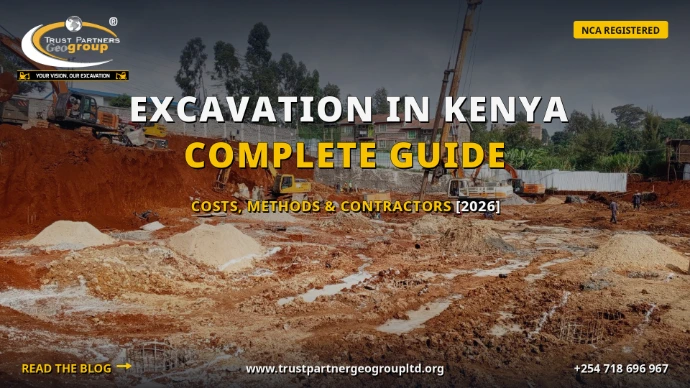
EXCAVATION IN KENYA: COMPLETE GUIDE TO COSTS, METHODS & CONTRACTORS [2026]
EVERYTHING DEVELOPERS, CONTRACTORS & HOMEOWNERS NEED TO KNOW ABOUT EARTHWORKS IN KENYA
Table of Contents
- 1. What Is Excavation and Why It Matters in Kenya
- 2. Types of Excavation Services in Kenya
- 2.1 Bulk Excavation (Cut & Fill)
- 2.2 Basement Excavation
- 2.3 Trench Excavation
- 2.4 Road Excavation
- 2.5 Rock Excavation
- 2.6 Dam & Water Pan Excavation
- 3. Kenya's Soil Conditions and How They Affect Excavation
- 4. Excavation Equipment and Machinery in Kenya
- 5. The Excavation Process: From Survey to Handover
- 6. Excavation Costs in Kenya (2026)
- 7. Permits, Regulations and Compliance
- 8. Excavation Safety Requirements in Kenya
- 9. How to Choose an Excavation Contractor in Kenya
- 10. The Trust Partners Geo-Group Process
- 11. Frequently Asked Questions
- 12. The Bottom Line: Excavation Done Right

WHAT IS EXCAVATION AND WHY IT MATTERS IN KENYA
Excavation is the removal of soil, rock, and other material from a site to create the levels, space, and founding conditions a structure needs. It is the first physical act of construction - and the one that determines everything that follows. Foundations can only be as good as the ground they sit on, and the ground is only as good as the excavation that prepared it.
In Kenya, excavation has taken on new importance over the last decade for three reasons:
- Urban densification: Nairobi, Kiambu, and Mombasa are building up and down. Flat, easy plots are exhausted; developers now build on slopes, on black cotton soil, and over rock - all of which demand serious earthworks. High-rise development in Westlands, Upper Hill, and Kilimani means multi-level basements requiring deep, engineered excavation.
- Infrastructure expansion: The expressway network, bypasses, affordable housing program, and county road upgrades have made mass earthmoving one of the largest construction activities in the country.
- Stricter regulation: Nairobi and Kiambu counties now routinely demand geotechnical reports, NEMA compliance for large earthworks, and NCA-registered contractors. The era of "fundii with a JCB" excavation is ending - at least for any project that wants approvals, insurance, and financing.
The financial stakes are significant. Excavation typically represents 5-15% of total construction cost - but poor excavation causes 100% of foundation failures. A developer who saves KES 200,000 by skipping soil investigation can easily lose KES 2,000,000 to rock discovery, collapse, or re-excavation. This guide exists to make sure that never happens to you.
TYPES OF EXCAVATION SERVICES IN KENYA
"Excavation" covers six distinct services, each with its own methods, equipment, risks, and pricing. Understanding which your project needs is the first step to an accurate budget.
2.1 BULK EXCAVATION (CUT & FILL)
Bulk excavation - also called mass earthworks - is large-scale earthmoving to transform site levels. High ground is cut, low ground is filled, and the result is a level, compacted platform ready for construction. It is measured in thousands of cubic meters and priced per m3.
- Applications: Building platforms on sloping plots, industrial parks, housing estate platforms, school and hospital sites, sports fields, parking yards.
- Equipment: 20-50 ton excavators, bulldozers, dump trucks, motor graders, vibrating rollers, water bowsers.
- Critical requirement: Fill must be placed in 200-300mm layers and compacted to 95% Modified Proctor Density (MPD) with field density testing - otherwise the platform settles and the building cracks.
- 2026 pricing: KES 250-400/m3 cut in soft soil; KES 300-500/m3 fill placement and compaction; KES 200-400/m3 spoil haulage.
2.2 BASEMENT EXCAVATION
Basement excavation creates underground space - parking, storage, plant rooms, or living space - within a building footprint. It is the most technically demanding excavation type because you are digging a deep, vertical-sided hole, often between existing buildings.
- Applications: Apartment and office basements in Nairobi (typically 3-12m deep), residential basements in Karen and Runda, underground tanks and bunkers.
- Key challenges: Lateral earth pressure on vertical faces (requires shoring, soil nails, or retaining walls), groundwater control, protection of neighboring foundations, and working in confined space.
- Sequence: Perimeter support (shoring/piles) installed first, then top-down excavation in stages with anchors or props added at each level.
- 2026 pricing: KES 350-600/m3 excavation, plus KES 1,500-3,500/m2 of excavation face for shoring/support. A single residential basement typically costs KES 800,000-2,500,000 all-in.
2.3 TRENCH EXCAVATION
Trenching is narrow, linear excavation - the most common excavation activity in Kenya by count, if not by volume.
- Applications: Strip foundation trenches, water and sewer pipelines, electrical and fiber ducts, drainage channels, fence foundations.
- Equipment: Backhoe loaders (JCBs) for utility trenches; 20-ton excavators with narrow buckets for pipeline work; trenchers for long cable runs.
- The killer risk: Trench collapse. A cubic meter of soil weighs 1.6-1.8 tons - a collapsing trench wall buries a worker instantly. Any trench deeper than 1.5-2m must be benched, battered, or shored. This is not optional; it is Kenyan law under OSHA 2007.
- 2026 pricing: KES 300-600 per linear meter for depths of 1-2m in soil; rock trenching costs 3-5 times more.
2.4 ROAD EXCAVATION
Road excavation is linear cut-and-fill along a corridor to form the road profile - formation level, subgrade, and drainage - before pavement layers are placed.
- Applications: Access roads, estate roads, county road upgrades, highways (with KeNHA/KURA specifications), hardstanding yards.
- Specifics: Requires precise grade control (motor graders with GPS or stringline), subgrade compaction to 93-95% MPD, side drains, and culverts. Unsuitable material (black cotton, organic soil) must be excavated and replaced - "muck-away and refill" can be 30% of a rural road's earthworks cost.
- 2026 pricing: KES 3M-15M per kilometer for earthworks depending on terrain, with rock and swamp sections at the top of the range.
2.5 ROCK EXCAVATION
Much of Nairobi and Kiambu sits on volcanic rock - basalt, phonolite, tuff - and hitting it changes everything about an excavation's cost and duration.
- Rippable rock: Weathered or fractured rock that a large excavator or dozer ripper can break directly. Cheapest rock scenario.
- Hydraulic hammer (breaker): Excavator-mounted breakers for medium-hard rock. 10-30 m3/day productivity. The standard method in built-up Nairobi where blasting is restricted.
- Drilling and blasting: Fastest and cheapest per m3 for large volumes, but requires a licensed blaster, NEMA approval, vibration monitoring, and neighbor notification. Increasingly difficult to permit in dense suburbs.
- Chemical breaking: Expansive grout in drilled holes - silent and vibration-free, ideal next to existing buildings, but slow (12-24 hours per cycle) and the most expensive option.
- 2026 pricing: Ripping KES 700-1,200/m3; hydraulic hammer KES 1,200-2,000/m3; blasting KES 800-1,500/m3; chemical breaking KES 2,500-4,500/m3.
2.6 DAM & WATER PAN EXCAVATION
Water pans and small dams are a specialty excavation type: a depression is excavated and the excavated material forms a compacted embankment, storing rainwater for irrigation, livestock, or domestic use.
- Applications: Farm water pans (500-10,000 m3), estate and school water storage, county government water programs in ASAL counties (Machakos, Kajiado, Kitui, Garissa).
- Critical elements: Core trench (cut-off) excavation to stop seepage under the embankment, embankment compaction in layers, spillway excavation, and silt trap construction.
- 2026 pricing: KES 500,000 for a small farm pan to KES 8,000,000+ for large dams with engineered embankments. See our dedicated dam excavation guide.
KENYA'S SOIL CONDITIONS AND HOW THEY AFFECT EXCAVATION
Soil is the single biggest cost variable in any Kenyan excavation. The same 1,000 m3 dig can cost KES 300,000 in murram or KES 3,000,000 in basalt. Here is what you are digging in, region by region:
| SOIL / MATERIAL | WHERE FOUND | EXCAVATION BEHAVIOR | FOUNDATION IMPLICATION | COST IMPACT |
|---|---|---|---|---|
| Red volcanic soil (Murram) | Nairobi (Karen, Lavington, Runda), Kiambu highlands | Digs easily with standard excavators; stable faces when dry; excellent engineered fill | Good founding at 1-1.5m; ideal for strip and raft foundations | Lowest - KES 250-400/m3 |
| Black cotton soil | Embakasi, Ruai, Dagoretti, Kajiado, Machakos, Kisumu basin | Sticky and unworkable when wet; rock-hard when dry; equipment bogs down in rains | Must be removed 1-1.5m and replaced with compacted fill - expansive shrink-swell destroys foundations | High - excavation plus removal/replacement adds KES 150K-800K per house |
| Laterite / red loam | Kiambu, Thika, Murang'a, Western Kenya | Digs well; compacts excellently; good fill material | Good bearing capacity; standard foundations work | Low - KES 250-450/m3 |
| Sandy soils | Mombasa & coast, Kajiado, Garissa, Tana River | Easy digging but trench walls collapse immediately; dewatering needed below water table | Adequate bearing when confined; raft foundations common; trenches need shoring or battering | Low digging cost, but shoring adds 30-50% |
| Weathered volcanic rock / tuff | Upper Hill, Kilimani, Westlands, Limuru | Rippable to breakable with hydraulic hammer; variable - can change within one plot | Excellent bearing; may need leveling by hammer for strip footings | Medium-high - KES 700-2,000/m3 |
| Hard rock (basalt, phonolite) | Ngong, Limuru, parts of Upper Hill, Rift escarpment | Requires hammer, blasting, or chemical breaking; slow and expensive | Outstanding bearing - often no foundation improvement needed; but leveling for footings is costly | Highest - KES 1,200-3,500/m3 |
| Fill / made ground | Old Nairobi dumpsites, reclaimed areas, informal settlement edges | Easy to dig but unpredictable - voids, debris, contamination possible | Unsuitable for foundations; must be removed or piled through to natural ground | Variable - removal cost plus disposal fees |
THE ROCK DISCOVERY THAT BREAKS BUDGETS
The most expensive sentence in Kenyan construction is: "Tumepata mawe" - we have hit rock. Rock discovered after a contract is signed is the number one cause of excavation cost overruns. A Kiambu developer in 2025 budgeted KES 400,000 for a basement dig based on a neighbor's experience - then hit phonolite at 2m. Final excavation cost: KES 2.1 million. The protection is simple: a geotechnical investigation with 3-5 test pits or boreholes (KES 80,000-150,000 for a residential plot) tells you exactly what is below before you price the dig. Trust Partners Geo-Group does not quote deep excavation without one - and you should not accept a quote from anyone who does.
QUICK SOIL CHECK: WHAT YOUR PLOT'S LOCATION TELLS YOU
Karen, Langata, Runda, Lavington: Red murram - easy digging, watch for rock shelves at 2-4m.
Kilimani, Upper Hill, Westlands: Shallow weathered rock likely - budget for hammer work in basements.
Embakasi, Ruai, Syokimau, Kitengela: Black cotton soil - budget for removal and replacement.
Thika, Ruiru, Juja: Red loam with laterite - generally favorable, some clay pockets near rivers.
Limuru, Kikuyu, Ngong: Rock country - assume hammer or blasting for anything over 1.5m deep.
Mombasa & coast: Sand and coral rock - easy digging above rock, immediate trench collapse in sand, coral requires breakers.
EXCAVATION EQUIPMENT AND MACHINERY IN KENYA
The right machine makes the difference between a 3-day dig and a 3-week dig. Here is the standard excavation fleet in Kenya, what each machine does, and 2026 hire rates:
| MACHINE | USED FOR | HOURLY RATE (KES) | DAILY RATE (KES) | NOTES |
|---|---|---|---|---|
| Crawler excavator 20-25t | Bulk digging, trenches, loading trucks, basement digs | 4,500-6,500 | 35,000-55,000 | The workhorse of Kenyan excavation; CAT 320 / Komatsu PC200 class |
| Crawler excavator 30-50t | Mass earthworks, hard digging, hammer work | 6,000-9,000 | 50,000-80,000 | Required for hydraulic hammer on medium rock |
| Backhoe loader (JCB 3CX) | Small trenches, utility work, plot-level jobs | 3,000-4,500 | 25,000-35,000 | Most economical for foundation trenches on single houses |
| Bulldozer D6-D8 | Mass push, spreading fill, ripping soft rock, bush clearing | 6,000-10,000 | 50,000-80,000 | Fastest way to move soil under 100m haul distance |
| Motor grader | Final leveling, road formation, precise grading | 4,500-7,000 | 35,000-55,000 | Essential for road and platform finishing to +/-20mm tolerance |
| Vibrating roller 10-12t | Compaction of fill layers and subgrade | 3,000-5,000 | 25,000-40,000 | Paired with water bowser for moisture-conditioned compaction |
| Dump truck 15-25t | Hauling spoil and importing fill | 3,500-5,500 | 30,000-45,000 | Often priced per trip: KES 8,000-25,000 depending on distance |
| Water bowser | Dust control, compaction moisture | - | 15,000-30,000 | Mandatory companion to rollers in dry season |
| Hydraulic hammer attachment | Rock breaking | +2,000-3,500 on excavator rate | - | Chisel wear billed separately on abrasive rock |
| Plate compactor / rammer | Trench backfill, confined areas | 500-1,000 | 3,000-6,000 | Every backfilled trench needs one |
Rates include operator and fuel for Nairobi-based work; dry-hire (machine only) is 30-40% less but rarely advisable. Mobilization to site is charged separately (KES 20,000-80,000 per machine depending on distance), and most machines carry a minimum charge of 4-8 hours.
CONTRACTOR FLEET VS SELF-HIRE: THE REAL MATH
Many developers try to save money by hiring machines directly and managing the dig themselves. The math rarely works. A 1,000 m3 bulk dig requires roughly: 5 excavator days (KES 225,000), 3 dozer days (KES 210,000), 12 truck days (KES 420,000), 2 roller days (KES 70,000), 1 grader day (KES 45,000), mobilization (KES 120,000) = KES 1,090,000 in hire alone - before fuel overruns, operator overtime, breakdowns, and the surveyor and compaction testing you still must add. A fleet-owning contractor prices the same job at KES 850,000-1,100,000 all-in with testing and handover documentation - because owned machines have no hire margin, and an experienced crew finishes in 6 days instead of 10. Self-hire only makes sense for multi-month projects where you can negotiate monthly rates and employ your own operators.
THE EXCAVATION PROCESS: FROM SURVEY TO HANDOVER
A professional excavation project in Kenya follows a defined sequence. Skipping steps is how budgets and buildings collapse. Here is the process Trust Partners Geo-Group runs on every project:
STEP 1: SITE INVESTIGATION & SETTING OUT
- Topographical survey: Existing ground levels, boundaries, trees, structures, and drainage - the baseline for all quantities.
- Geotechnical investigation: Test pits or boreholes to determine soil type, strength, groundwater, and rock depth. KES 80,000-150,000 for a residential plot; KES 300,000-1M for commercial sites. Non-negotiable for basements, slopes, and black cotton areas.
- Underground services scan: Locate Kenya Power cables, water mains, sewer lines, and fiber ducts before any digging. Striking a 66kV cable or a city water trunk main is a disaster you do not recover from cheaply.
- Setting out: Excavation extents, levels, and benchmarks marked by total station or GPS.
STEP 2: SITE CLEARANCE & TOPSOIL STRIPPING
- Bush clearing, tree removal (with county permits where required), and demolition of any obstructions.
- Strip 150-300mm of topsoil across the work area and stockpile it separately - it is valuable for landscaping but useless under foundations.
- Establish temporary drainage so the site sheds water from day one.
STEP 3: BULK CUT & FILL
- Cut high ground in controlled lifts; load and haul to fill areas or spoil sites.
- Place fill in 200-300mm layers - never dumped in thick heaps - each layer moisture-conditioned and roller-compacted.
- Break rock as encountered using the method selected in planning (ripper, hammer, blast, or chemical).
- Bench any slope faces over 3m; shore or batter any vertical faces over 2m.
STEP 4: COMPACTION & QUALITY CONTROL
- Compact every fill layer to 95% Modified Proctor Density (93% for road subgrade unless specified higher).
- Field density testing - sand replacement or nuclear density gauge - at minimum one test per 500 m3 per layer, or per the engineer's specification.
- Trim to formation level with grader; verify levels by survey; tolerance typically +/-20mm for platforms.
- Full details in our earthworks QA/QC and compaction testing guide.
STEP 5: DRAINAGE, DOCUMENTATION & HANDOVER
- Construct permanent surface drainage so the finished platform never ponds water.
- Compile handover pack: as-built survey, layer-by-layer density test results, material records, and photographs.
- Hand over to the structural engineer and county inspector - with documents that make foundation approval straightforward.
EXCAVATION COSTS IN KENYA (2026)
These are current 2026 market rates based on active Trust Partners Geo-Group projects across Nairobi, Kiambu, Machakos, Kajiado, and Nakuru. Rates vary with volume (bigger is cheaper per m3), haul distance, access, and season.
EXCAVATION RATES BY ACTIVITY AND MATERIAL
| ACTIVITY | UNIT | SOFT SOIL (KES) | DENSE/MEDIUM (KES) | ROCK (KES) |
|---|---|---|---|---|
| Site clearance / bush clearing | m2 | 50-80 | 50-80 | 50-80 |
| Topsoil stripping (150-300mm) | m2 | 70-100 | 70-100 | - |
| Bulk excavation (cut) | m3 | 250-400 | 400-700 | 1,200-3,500 |
| Basement excavation | m3 | 350-600 | 500-900 | 1,500-3,500 |
| Trench excavation (1-2m deep) | linear m | 300-450 | 400-600 | 1,200-2,500 |
| Footing pits (column bases) | m3 | 400-600 | 600-900 | 1,500-3,000 |
| Rock - ripping | m3 | - | - | 700-1,200 |
| Rock - hydraulic hammer | m3 | - | - | 1,200-2,000 |
| Rock - drilling & blasting | m3 | - | - | 800-1,500 |
| Rock - chemical breaking | m3 | - | - | 2,500-4,500 |
| Fill placement & compaction (95% MPD) | m3 | 300-500 | 300-500 | - |
| Imported fill (murram, supplied & compacted) | m3 | 800-1,500 | 800-1,500 | - |
| Spoil haulage & disposal | m3 | 200-400 | 200-400 | 250-500 |
| Shoring / lateral support | m2 face | 1,500-2,500 | 2,000-3,000 | 2,500-3,500 |
| Dewatering (pumps, wellpoints) | project | KES 50,000-300,000 lump sum depending on duration and flow | ||
TOTAL PROJECT COSTS BY SCALE (2026)
| PROJECT TYPE | TYPICAL SCOPE | SOFT SOIL | WITH SIGNIFICANT ROCK |
|---|---|---|---|
| Single house foundation trenches | Bungalow/maisonette strip footings | KES 150K-400K | KES 400K-900K |
| Plot leveling (1/8-1/4 acre) | Cut & fill platform, access, compaction | KES 400K-1.2M | KES 1M-2.5M |
| Single residential basement | 500-1,500 m3 with shoring | KES 800K-2.5M | KES 2M-5M |
| Multi-level commercial basement | 5,000-20,000 m3, anchored support | KES 5M-18M | KES 12M-30M |
| Bulk earthworks per acre | Estate/industrial platform | KES 800K-3M | KES 2.5M-7M |
| Access road earthworks per km | Rural/estate road formation + drains | KES 3M-8M | KES 8M-15M |
| Farm water pan | 1,000-5,000 m3 with embankment | KES 500K-2.5M | KES 1.5M-5M |
Rates include labor, equipment, and fuel. Add 20-30% mobilization premium for sites over 50km from Nairobi, 10-20% for night work or accelerated programs, and 30-50% contingency for wet-season working. Detailed rate analysis is in our earthworks cost per cubic meter guide.
WORKED EXAMPLE: BASEMENT EXCAVATION BUDGET (WESTLANDS APARTMENT, 2026)
Scope: 20m x 30m footprint, 4m deep = 2,400 m3. Soil: 2m murram over weathered rock. 20m haul to approved dump.
Mobilization & setting out: KES 180,000
Excavate 1,200 m3 soil @ KES 450: KES 540,000
Hammer & excavate 1,200 m3 weathered rock @ KES 1,600: KES 1,920,000
Shoring/ lateral support 560 m2 face @ KES 2,200: KES 1,232,000
Haulage & disposal 2,400 m3 @ KES 300: KES 720,000
Dewatering allowance: KES 150,000
Survey & testing: KES 120,000
Total: KES 4,862,000 (approximately KES 2,025/m3 all-in) - versus a naive soil-only estimate of KES 1.1M. This is why the geotechnical report comes first.
PERMITS, REGULATIONS AND COMPLIANCE
Excavation in Kenya is regulated at county and national level. Working without the right approvals risks stop orders, fines, and - worse - uninsured liability when something goes wrong.
| REQUIREMENT | AUTHORITY | WHEN NEEDED | NOTES |
|---|---|---|---|
| Approved building plans & construction permit | County government (Nairobi, Kiambu, etc.) | Any foundation or basement excavation | County inspectors may stop work without it; geotechnical report increasingly required for deep or sloped sites |
| NCA contractor registration | National Construction Authority | All commercial excavation work | Verify your contractor's NCA class for earthworks on the NCA portal |
| Environmental Impact Assessment (EIA) / NEMA license | NEMA | Large earthworks (5,000+ m3), dams, sites near rivers/wetlands, blasting | Summary Project Report suffices for smaller works; full EIA for major projects - allow 2-6 months |
| Road reserve approval | KeNHA / KURA / county roads | Any excavation in or across a road reserve (access culverts, service crossings) | Includes reinstatement bond requirements |
| Utility wayleaves & clearances | Kenya Power, water utilities, ICT providers | Digging near power lines, water mains, fiber ducts | Request utility maps before digging; standby crews required near HV lines |
| Blasting permit | NEMA, county, licensed blaster requirement | Any explosive rock breaking | Vibration monitoring and neighbor notification mandatory; often impractical in dense suburbs |
| Tree cutting permit | County / Kenya Forest Service | Clearing indigenous or protected trees | Part of site clearance planning |
| OSHA workplace registration & safety compliance | Directorate of Occupational Safety and Health | All construction sites | Safety file, risk assessments, and competent supervision required |
Trust Partners Geo-Group manages the full permitting chain on behalf of clients - from county permits and NEMA liaison to utility clearances - so excavation starts legally and stays legal.
EXCAVATION SAFETY REQUIREMENTS IN KENYA
Excavation kills more construction workers in Kenya than any other site activity - through trench collapse, machine strikes, and falls. The rules below are not bureaucracy; they are the difference between a finished project and a fatality.
- Support every deep face: Trenches and faces deeper than 1.5-2m must be shored, shielded (trench box), benched, or battered back to a safe angle. No exceptions for "just a quick job" - collapses happen in seconds.
- Inspect daily and after rain: A competent person inspects all excavation faces every morning before work and after any rainfall. Cracks, slumping, or seepage mean stop work immediately.
- Control the edge: Spoil piles at least 1m back from trench edges (1.5 x depth for deep excavations); no materials or vehicles near the crest; barriers and night lighting around every open dig.
- Respect the swing radius: Excavator counterweight strikes are a leading killer. Hard exclusion zones around operating plant; banksman for truck loading and reversing.
- Scan before you dig: Underground services located and marked before excavation; hand-dig within 1m of known services.
- Manage water: Dewater continuously; saturated soil loses strength without warning and trench walls fail hours after rain stops.
- Provide escape: Ladders or ramps within 7.5m travel of every worker in a trench.
- Engineer the deep digs: Any excavation over 5m deep, or shallower digs beside existing buildings, needs a support system designed and inspected by a registered engineer.
- Plan the rescue: Trench collapse rescue is specialized - a documented emergency plan and first-aiders on site are mandatory under OSHA 2007.
- TRUST PARTNERS GEO-GROUP LTD, SITE SAFETY TEAM
HOW TO CHOOSE AN EXCAVATION CONTRACTOR IN KENYA
The excavation contractor market in Kenya ranges from one-JCB operators to full civil engineering firms. The right choice depends on your project's scale and risk - but the vetting process is the same:
- Verify NCA registration: Confirm the contractor's NCA license and class for earthworks on the official portal. Unregistered contractors cannot legally execute commercial works.
- Ask who owns the machines: Fleet-owning contractors (like Trust Partners Geo-Group) price sharper, mobilize faster, and don't stop work because a hired machine was recalled. Ask for the equipment list with registration numbers.
- Demand a geotechnical conversation: If a contractor quotes deep excavation, black cotton, or sloped sites without asking about soil reports - or recommending one - they are guessing with your money.
- Insist on itemized pricing: Rates per m3 by material type, mobilization, haulage per km, compaction, testing, and shoring as separate lines. Lump-sum-only quotes are where variations and disputes breed.
- Check compaction QA/QC: Professional contractors include Proctor and field density testing with documented results. Ask to see a past project's density test report.
- Confirm insurance: Contractor's All Risks (CAR), third-party liability, and WIBA for workers. Excavation beside roads and buildings without insurance is an unacceptable risk.
- Probe the safety system: Ask how they shore trenches, who inspects faces daily, and what their incident record is. Evasive answers tell you everything.
- Call references and visit a live site: Three recent similar projects, one site visit. Watch how the crew works for 30 minutes - organization, edge protection, and housekeeping reveal professionalism instantly.
RED FLAGS WHEN HIRING AN EXCAVATOR
Walk away if a contractor: quotes without a site visit; has no answer for rock discovery in the contract; offers no density testing; cannot produce an NCA number; demands 50%+ upfront; prices dramatically below every other bid (they will recover it in "variations"); or treats shoring as an optional extra. Cheap excavation is the most expensive mistake in Kenyan construction.
THE TRUST PARTNERS GEO-GROUP PROCESS
At Trust Partners Geo-Group Ltd, excavation is our core business - not a side service. Every project runs through four disciplined phases:
PHASE 1: INVESTIGATE & PRICE ACCURATELY
- Free site visit and assessment anywhere in Nairobi, Kiambu, Machakos, Kajiado, and Nakuru (nationwide for larger projects).
- Topographical survey and geotechnical investigation through our registered engineer partners.
- Utility scans and permit mapping - we identify every approval needed before pricing.
- Itemized quotation: per-m3 rates by material, mobilization, haulage, shoring, testing - no hidden lump sums.
PHASE 2: MOBILIZE & EXECUTE
- Own fleet mobilized within days: excavators (20-50t), dozers, graders, rollers, dump trucks, bowsers, and hydraulic hammers.
- Experienced operators and site engineers on every job - no casual labor for critical plant.
- Daily face inspections, toolbox talks, and full PPE enforcement under our OSHA-compliant safety system.
- Weather-smart scheduling: dewatering, diversion drains, and dry-window programming to protect your timeline.
PHASE 3: TEST & VERIFY
- Layer-by-layer field density testing to 95% MPD with documented results.
- Survey verification of every formation level to +/-20mm tolerance.
- Rock quantities measured and agreed jointly - transparent variation handling.
PHASE 4: DOCUMENT & HAND OVER
- Complete handover pack: as-built survey, density test certificates, quantity records, and photo documentation.
- County inspection support and engineer sign-off coordination.
- Post-works settlement monitoring where fill was placed - and a workmanship warranty in writing.
- TRUST PARTNERS GEO-GROUP LTD
FREQUENTLY ASKED QUESTIONS: EXCAVATION IN KENYA
How much does excavation cost per cubic meter in Kenya?
Soft soil bulk excavation: KES 250-400 per m3. Dense or medium material: KES 400-700 per m3. Rock with hydraulic hammer: KES 1,200-2,000 per m3; hard rock with blasting or chemical breaking: KES 2,000-3,500 per m3. Basement excavation: KES 350-600 per m3 plus shoring at KES 1,500-3,500 per m2 of face. Trenching: KES 300-600 per linear meter. Fill placement and compaction: KES 300-500 per m3; spoil disposal: KES 200-400 per m3. Remote sites over 50km from Nairobi add a 20-30% mobilization premium.
What are the main types of excavation in construction?
(1) Topsoil stripping - removing the upper 150-300mm of organic soil; (2) Bulk excavation (cut and fill) - mass earthmoving to create level platforms; (3) Trench excavation - for foundations, pipes, and ducts; (4) Basement excavation - deep digs (3-12m) for underground space; (5) Road excavation - cut and fill along a corridor; (6) Rock excavation - ripping, hammering, blasting, or chemical breaking; (7) Footing excavation - precise pits for column bases; (8) Water pan and dam excavation. Each type has distinct equipment, safety requirements, and pricing.
Do I need a permit to excavate in Kenya?
Yes. Foundation and basement excavation requires approved building plans and a county construction permit. Large earthworks (5,000+ m3 or sensitive sites) need a NEMA license following an Environmental Impact Assessment. Road reserve excavation requires KeNHA, KURA, or county approval. Utility trenches need wayleave consents from Kenya Power, water utilities, or ICT providers. Blasting requires a licensed blaster plus NEMA and county approvals. All commercial excavation must be done by an NCA-registered contractor. Trust Partners Geo-Group handles the full permitting chain for clients.
What is black cotton soil and how does it affect excavation?
Black cotton soil is an expansive clay common in Embakasi, Ruai, Kajiado, Machakos, and the Kisumu basin. It expands up to 10-15% when wet and shrinks when dry, destroying foundations through seasonal movement. For construction, it must be removed to 1-1.5m depth and replaced with compacted murram or engineered fill - adding KES 150,000-800,000 to a typical residential project. It is treacherous to work in during rains (equipment bogs down, trench walls collapse) and can never be reused as structural backfill. A geotechnical investigation confirms its presence and depth before you budget.
How long does excavation take in Kenya?
Foundation trenches for a bungalow: 3-5 days. Plot leveling: 1-2 weeks. A single basement (500-1,500 m3): 2-4 weeks including shoring. Large bulk earthworks (10,000+ m3): 1-3 months. Rock adds 30-100% to any timeline. Rain is the biggest variable - Nairobi's long rains (April-May) and short rains (November-December) can extend programs by 30-50% because wet soil cannot be excavated or compacted properly. Trust Partners Geo-Group programs major earthworks into the dry windows (January-March, June-August) wherever possible.
What equipment is used for excavation in Kenya?
Crawler excavators (20-50 ton) for digging and loading; backhoe loaders for trenches and utilities; bulldozers for mass push and clearing; motor graders for final leveling; vibrating rollers for compaction; dump trucks for haulage; water bowsers for dust and moisture control; hydraulic hammers for rock; and total stations/GPS for setting out. 2026 hire rates: 20-25t excavator KES 4,500-6,500/hour; backhoe KES 3,000-4,500/hour; dozer KES 6,000-10,000/hour; roller KES 3,000-5,000/hour; dump truck KES 3,500-5,500/hour or KES 8,000-25,000 per trip. Hiring a fleet-owning contractor is almost always cheaper than self-hiring machines.
How deep can a basement be excavated in Nairobi?
Residential basements typically go 3-4m (one level); commercial projects in Upper Hill, Westlands, and the CBD commonly reach 6-12m (two to four levels). The limits are groundwater (generally deep in Nairobi's volcanic plateau, but perched water occurs), neighboring structures (digs within 3m of an adjacent building need underpinning or anchored walls), rock head (shallow basalt in Kilimani and Upper Hill raises costs), and economics - below about 10m, all-in costs reach KES 3,000-6,000 per m3. Any dig deeper than 2m legally requires a geotechnical report and engineered lateral support.
What is the difference between bulk excavation and basement excavation?
Bulk excavation reshapes an entire site - cutting high ground, filling low ground, compacting platforms - measured in thousands of m3 at KES 250-700 per m3 in soil. Basement excavation is deep, confined digging within a building footprint, requiring vertical faces, lateral support (shoring, soil nails, retaining walls), and dewatering - costing KES 350-600 per m3 plus KES 1,500-3,500 per m2 of supported face, roughly 2-3 times the all-in cost per cubic meter. Most developments combine both: bulk works to form site levels, then basement digs for the buildings.
What safety measures are required for excavation in Kenya?
Under OSHA 2007 and NCA rules: shoring, shielding, or benching for any trench deeper than 1.5-2m; daily face inspections by a competent person and after every rain event; ladders within 7.5m of trench workers; spoil set back at least 1m from edges; barriers and lighting around open digs; underground services scans before digging; exclusion zones around excavator swing radius; continuous dewatering; PPE for all personnel; and a documented rescue plan. Excavations over 5m deep need engineer-designed support. These rules exist because trench collapse is Kenya's deadliest construction hazard.
How do I choose the best excavation company in Kenya?
Verify NCA registration on the official portal; confirm they own their fleet (ask for the equipment list); expect them to demand or recommend a geotechnical report for deep or difficult digs; insist on itemized per-m3 pricing rather than lump sums; check that compaction testing with documented results is included; confirm CAR insurance and WIBA cover; probe their trench safety practices; and call three references plus visit one live site. Avoid anyone quoting without a site visit, demanding 50%+ upfront, or pricing far below every competitor. Trust Partners Geo-Group meets all these criteria - contact us for a free site assessment and itemized quotation.
THE BOTTOM LINE: EXCAVATION DONE RIGHT
Excavation in Kenya is unforgiving of shortcuts. Our soils swing from cooperative red murram to treacherous black cotton to brutal volcanic rock - sometimes within a single plot. Our rains stop work and collapse trenches. Our regulators increasingly demand the geotechnical reports, permits, and NCA registration that separate professionals from gamblers. And the financial math is brutal in one direction: the money you save skipping investigation, support, or compaction comes back multiplied - as cracked walls, flooded basements, and failed inspections.
The principles are simple:
- Investigate before you excavate: A KES 100,000 soil report prevents million-shilling surprises. Never price a deep dig blind.
- Budget by material, not by hope: Soft soil at KES 250-400/m3 and hard rock at KES 2,000-3,500/m3 are different projects. Know which one you have.
- Support every deep face: Shoring, benching, and retaining are not optional extras - they are the law and the difference between a site and a grave.
- Compact and test every layer: 95% MPD with documented density tests, or accept settlement cracks as your legacy.
- Respect water: Drain the site before, during, and after the dig. Water causes more excavation failures in Kenya than every other factor combined.
- Hire for capability, not price: NCA registration, owned fleet, geotechnical competence, documented QA/QC, and real insurance. The cheapest quote is rarely the cheapest outcome.
At Trust Partners Geo-Group Ltd, excavation is what we do - from single-house foundation trenches in Ruiru to multi-level basements in Westlands, bulk platforms in Nakuru, road earthworks in Machakos, rock breaking in Limuru, and water pans across the ASAL counties. Our own fleet, our own crews, engineer-led planning, and documented quality control mean your project starts on ground you can trust - on time and on budget.
Whether you are breaking ground on your first home or your fiftieth development, the rule is the same: the building you will be proud of in thirty years starts with an excavation you did right in thirty days.
- TRUST PARTNERS GEO-GROUP LTD
PLANNING AN EXCAVATION PROJECT IN KENYA?
Trust Partners Geo-Group provides professional bulk excavation, basement excavation, trench digging, rock breaking, and complete earthworks across Nairobi, Kiambu, Mombasa, Nakuru, Eldoret, and nationwide. Contact us for a free site assessment and itemized quotation.
CALL +254 718 68 69 67 EMAIL US VISIT OUR WEBSITE
NAIROBI HQ | SERVING NAIROBI, KIAMBU, MACHAKOS, KAJIADO, NAKURU, MOMBASA, KISUMU, ELDORET, THIKA, NAIVASHA & NATIONWIDE
MON - SAT: 8:00 AM - 6:00 PM | 24/7 EMERGENCY EXCAVATION SUPPORT
RELATED RESOURCES
TRUST PARTNERS GEO-GROUP LTD | YOUR VISION, OUR EXCAVATION
WEBSITE: WWW.TRUSTPARTNERGEOGROUPLTD.ORG | EMAIL: INFO@TRUSTPARTNERGEOGROUPLTD.ORG | PHONE: +254 718 68 69 67
FOLLOW US: FACEBOOK | TIKTOK | INSTAGRAM | YOUTUBE | LINKEDIN
© 2026 TRUST PARTNERS GEO-GROUP LTD. ALL RIGHTS RESERVED.
EXCAVATION IN KENYA: COMPLETE GUIDE TO COSTS, METHODS & CONTRACTORS [2026]
EVERYTHING DEVELOPERS, CONTRACTORS & HOMEOWNERS NEED TO KNOW ABOUT EARTHWORKS IN KENYA
Table of Contents
- 1. What Is Excavation and Why It Matters in Kenya
- 2. Types of Excavation Services in Kenya
- 2.1 Bulk Excavation (Cut & Fill)
- 2.2 Basement Excavation
- 2.3 Trench Excavation
- 2.4 Road Excavation
- 2.5 Rock Excavation
- 2.6 Dam & Water Pan Excavation
- 3. Kenya's Soil Conditions and How They Affect Excavation
- 4. Excavation Equipment and Machinery in Kenya
- 5. The Excavation Process: From Survey to Handover
- 6. Excavation Costs in Kenya (2026)
- 7. Permits, Regulations and Compliance
- 8. Excavation Safety Requirements in Kenya
- 9. How to Choose an Excavation Contractor in Kenya
- 10. The Trust Partners Geo-Group Process
- 11. Frequently Asked Questions
- 12. The Bottom Line: Excavation Done Right
WHAT IS EXCAVATION AND WHY IT MATTERS IN KENYA
Excavation is the removal of soil, rock, and other material from a site to create the levels, space, and founding conditions a structure needs. It is the first physical act of construction - and the one that determines everything that follows. Foundations can only be as good as the ground they sit on, and the ground is only as good as the excavation that prepared it.
In Kenya, excavation has taken on new importance over the last decade for three reasons:
- Urban densification: Nairobi, Kiambu, and Mombasa are building up and down. Flat, easy plots are exhausted; developers now build on slopes, on black cotton soil, and over rock - all of which demand serious earthworks. High-rise development in Westlands, Upper Hill, and Kilimani means multi-level basements requiring deep, engineered excavation.
- Infrastructure expansion: The expressway network, bypasses, affordable housing program, and county road upgrades have made mass earthmoving one of the largest construction activities in the country.
- Stricter regulation: Nairobi and Kiambu counties now routinely demand geotechnical reports, NEMA compliance for large earthworks, and NCA-registered contractors. The era of "fundii with a JCB" excavation is ending - at least for any project that wants approvals, insurance, and financing.
The financial stakes are significant. Excavation typically represents 5-15% of total construction cost - but poor excavation causes 100% of foundation failures. A developer who saves KES 200,000 by skipping soil investigation can easily lose KES 2,000,000 to rock discovery, collapse, or re-excavation. This guide exists to make sure that never happens to you.
TYPES OF EXCAVATION SERVICES IN KENYA
"Excavation" covers six distinct services, each with its own methods, equipment, risks, and pricing. Understanding which your project needs is the first step to an accurate budget.
2.1 BULK EXCAVATION (CUT & FILL)
Bulk excavation - also called mass earthworks - is large-scale earthmoving to transform site levels. High ground is cut, low ground is filled, and the result is a level, compacted platform ready for construction. It is measured in thousands of cubic meters and priced per m3.
- Applications: Building platforms on sloping plots, industrial parks, housing estate platforms, school and hospital sites, sports fields, parking yards.
- Equipment: 20-50 ton excavators, bulldozers, dump trucks, motor graders, vibrating rollers, water bowsers.
- Critical requirement: Fill must be placed in 200-300mm layers and compacted to 95% Modified Proctor Density (MPD) with field density testing - otherwise the platform settles and the building cracks.
- 2026 pricing: KES 250-400/m3 cut in soft soil; KES 300-500/m3 fill placement and compaction; KES 200-400/m3 spoil haulage.
2.2 BASEMENT EXCAVATION
Basement excavation creates underground space - parking, storage, plant rooms, or living space - within a building footprint. It is the most technically demanding excavation type because you are digging a deep, vertical-sided hole, often between existing buildings.
- Applications: Apartment and office basements in Nairobi (typically 3-12m deep), residential basements in Karen and Runda, underground tanks and bunkers.
- Key challenges: Lateral earth pressure on vertical faces (requires shoring, soil nails, or retaining walls), groundwater control, protection of neighboring foundations, and working in confined space.
- Sequence: Perimeter support (shoring/piles) installed first, then top-down excavation in stages with anchors or props added at each level.
- 2026 pricing: KES 350-600/m3 excavation, plus KES 1,500-3,500/m2 of excavation face for shoring/support. A single residential basement typically costs KES 800,000-2,500,000 all-in.
2.3 TRENCH EXCAVATION
Trenching is narrow, linear excavation - the most common excavation activity in Kenya by count, if not by volume.
- Applications: Strip foundation trenches, water and sewer pipelines, electrical and fiber ducts, drainage channels, fence foundations.
- Equipment: Backhoe loaders (JCBs) for utility trenches; 20-ton excavators with narrow buckets for pipeline work; trenchers for long cable runs.
- The killer risk: Trench collapse. A cubic meter of soil weighs 1.6-1.8 tons - a collapsing trench wall buries a worker instantly. Any trench deeper than 1.5-2m must be benched, battered, or shored. This is not optional; it is Kenyan law under OSHA 2007.
- 2026 pricing: KES 300-600 per linear meter for depths of 1-2m in soil; rock trenching costs 3-5 times more.
2.4 ROAD EXCAVATION
Road excavation is linear cut-and-fill along a corridor to form the road profile - formation level, subgrade, and drainage - before pavement layers are placed.
- Applications: Access roads, estate roads, county road upgrades, highways (with KeNHA/KURA specifications), hardstanding yards.
- Specifics: Requires precise grade control (motor graders with GPS or stringline), subgrade compaction to 93-95% MPD, side drains, and culverts. Unsuitable material (black cotton, organic soil) must be excavated and replaced - "muck-away and refill" can be 30% of a rural road's earthworks cost.
- 2026 pricing: KES 3M-15M per kilometer for earthworks depending on terrain, with rock and swamp sections at the top of the range.
2.5 ROCK EXCAVATION
Much of Nairobi and Kiambu sits on volcanic rock - basalt, phonolite, tuff - and hitting it changes everything about an excavation's cost and duration.
- Rippable rock: Weathered or fractured rock that a large excavator or dozer ripper can break directly. Cheapest rock scenario.
- Hydraulic hammer (breaker): Excavator-mounted breakers for medium-hard rock. 10-30 m3/day productivity. The standard method in built-up Nairobi where blasting is restricted.
- Drilling and blasting: Fastest and cheapest per m3 for large volumes, but requires a licensed blaster, NEMA approval, vibration monitoring, and neighbor notification. Increasingly difficult to permit in dense suburbs.
- Chemical breaking: Expansive grout in drilled holes - silent and vibration-free, ideal next to existing buildings, but slow (12-24 hours per cycle) and the most expensive option.
- 2026 pricing: Ripping KES 700-1,200/m3; hydraulic hammer KES 1,200-2,000/m3; blasting KES 800-1,500/m3; chemical breaking KES 2,500-4,500/m3.
2.6 DAM & WATER PAN EXCAVATION
Water pans and small dams are a specialty excavation type: a depression is excavated and the excavated material forms a compacted embankment, storing rainwater for irrigation, livestock, or domestic use.
- Applications: Farm water pans (500-10,000 m3), estate and school water storage, county government water programs in ASAL counties (Machakos, Kajiado, Kitui, Garissa).
- Critical elements: Core trench (cut-off) excavation to stop seepage under the embankment, embankment compaction in layers, spillway excavation, and silt trap construction.
- 2026 pricing: KES 500,000 for a small farm pan to KES 8,000,000+ for large dams with engineered embankments. See our dedicated dam excavation guide.
KENYA'S SOIL CONDITIONS AND HOW THEY AFFECT EXCAVATION
Soil is the single biggest cost variable in any Kenyan excavation. The same 1,000 m3 dig can cost KES 300,000 in murram or KES 3,000,000 in basalt. Here is what you are digging in, region by region:
| SOIL / MATERIAL | WHERE FOUND | EXCAVATION BEHAVIOR | FOUNDATION IMPLICATION | COST IMPACT |
|---|---|---|---|---|
| Red volcanic soil (Murram) | Nairobi (Karen, Lavington, Runda), Kiambu highlands | Digs easily with standard excavators; stable faces when dry; excellent engineered fill | Good founding at 1-1.5m; ideal for strip and raft foundations | Lowest - KES 250-400/m3 |
| Black cotton soil | Embakasi, Ruai, Dagoretti, Kajiado, Machakos, Kisumu basin | Sticky and unworkable when wet; rock-hard when dry; equipment bogs down in rains | Must be removed 1-1.5m and replaced with compacted fill - expansive shrink-swell destroys foundations | High - excavation plus removal/replacement adds KES 150K-800K per house |
| Laterite / red loam | Kiambu, Thika, Murang'a, Western Kenya | Digs well; compacts excellently; good fill material | Good bearing capacity; standard foundations work | Low - KES 250-450/m3 |
| Sandy soils | Mombasa & coast, Kajiado, Garissa, Tana River | Easy digging but trench walls collapse immediately; dewatering needed below water table | Adequate bearing when confined; raft foundations common; trenches need shoring or battering | Low digging cost, but shoring adds 30-50% |
| Weathered volcanic rock / tuff | Upper Hill, Kilimani, Westlands, Limuru | Rippable to breakable with hydraulic hammer; variable - can change within one plot | Excellent bearing; may need leveling by hammer for strip footings | Medium-high - KES 700-2,000/m3 |
| Hard rock (basalt, phonolite) | Ngong, Limuru, parts of Upper Hill, Rift escarpment | Requires hammer, blasting, or chemical breaking; slow and expensive | Outstanding bearing - often no foundation improvement needed; but leveling for footings is costly | Highest - KES 1,200-3,500/m3 |
| Fill / made ground | Old Nairobi dumpsites, reclaimed areas, informal settlement edges | Easy to dig but unpredictable - voids, debris, contamination possible | Unsuitable for foundations; must be removed or piled through to natural ground | Variable - removal cost plus disposal fees |
THE ROCK DISCOVERY THAT BREAKS BUDGETS
The most expensive sentence in Kenyan construction is: "Tumepata mawe" - we have hit rock. Rock discovered after a contract is signed is the number one cause of excavation cost overruns. A Kiambu developer in 2025 budgeted KES 400,000 for a basement dig based on a neighbor's experience - then hit phonolite at 2m. Final excavation cost: KES 2.1 million. The protection is simple: a geotechnical investigation with 3-5 test pits or boreholes (KES 80,000-150,000 for a residential plot) tells you exactly what is below before you price the dig. Trust Partners Geo-Group does not quote deep excavation without one - and you should not accept a quote from anyone who does.
QUICK SOIL CHECK: WHAT YOUR PLOT'S LOCATION TELLS YOU
Karen, Langata, Runda, Lavington: Red murram - easy digging, watch for rock shelves at 2-4m.
Kilimani, Upper Hill, Westlands: Shallow weathered rock likely - budget for hammer work in basements.
Embakasi, Ruai, Syokimau, Kitengela: Black cotton soil - budget for removal and replacement.
Thika, Ruiru, Juja: Red loam with laterite - generally favorable, some clay pockets near rivers.
Limuru, Kikuyu, Ngong: Rock country - assume hammer or blasting for anything over 1.5m deep.
Mombasa & coast: Sand and coral rock - easy digging above rock, immediate trench collapse in sand, coral requires breakers.
EXCAVATION EQUIPMENT AND MACHINERY IN KENYA
The right machine makes the difference between a 3-day dig and a 3-week dig. Here is the standard excavation fleet in Kenya, what each machine does, and 2026 hire rates:
| MACHINE | USED FOR | HOURLY RATE (KES) | DAILY RATE (KES) | NOTES |
|---|---|---|---|---|
| Crawler excavator 20-25t | Bulk digging, trenches, loading trucks, basement digs | 4,500-6,500 | 35,000-55,000 | The workhorse of Kenyan excavation; CAT 320 / Komatsu PC200 class |
| Crawler excavator 30-50t | Mass earthworks, hard digging, hammer work | 6,000-9,000 | 50,000-80,000 | Required for hydraulic hammer on medium rock |
| Backhoe loader (JCB 3CX) | Small trenches, utility work, plot-level jobs | 3,000-4,500 | 25,000-35,000 | Most economical for foundation trenches on single houses |
| Bulldozer D6-D8 | Mass push, spreading fill, ripping soft rock, bush clearing | 6,000-10,000 | 50,000-80,000 | Fastest way to move soil under 100m haul distance |
| Motor grader | Final leveling, road formation, precise grading | 4,500-7,000 | 35,000-55,000 | Essential for road and platform finishing to +/-20mm tolerance |
| Vibrating roller 10-12t | Compaction of fill layers and subgrade | 3,000-5,000 | 25,000-40,000 | Paired with water bowser for moisture-conditioned compaction |
| Dump truck 15-25t | Hauling spoil and importing fill | 3,500-5,500 | 30,000-45,000 | Often priced per trip: KES 8,000-25,000 depending on distance |
| Water bowser | Dust control, compaction moisture | - | 15,000-30,000 | Mandatory companion to rollers in dry season |
| Hydraulic hammer attachment | Rock breaking | +2,000-3,500 on excavator rate | - | Chisel wear billed separately on abrasive rock |
| Plate compactor / rammer | Trench backfill, confined areas | 500-1,000 | 3,000-6,000 | Every backfilled trench needs one |
Rates include operator and fuel for Nairobi-based work; dry-hire (machine only) is 30-40% less but rarely advisable. Mobilization to site is charged separately (KES 20,000-80,000 per machine depending on distance), and most machines carry a minimum charge of 4-8 hours.
CONTRACTOR FLEET VS SELF-HIRE: THE REAL MATH
Many developers try to save money by hiring machines directly and managing the dig themselves. The math rarely works. A 1,000 m3 bulk dig requires roughly: 5 excavator days (KES 225,000), 3 dozer days (KES 210,000), 12 truck days (KES 420,000), 2 roller days (KES 70,000), 1 grader day (KES 45,000), mobilization (KES 120,000) = KES 1,090,000 in hire alone - before fuel overruns, operator overtime, breakdowns, and the surveyor and compaction testing you still must add. A fleet-owning contractor prices the same job at KES 850,000-1,100,000 all-in with testing and handover documentation - because owned machines have no hire margin, and an experienced crew finishes in 6 days instead of 10. Self-hire only makes sense for multi-month projects where you can negotiate monthly rates and employ your own operators.
THE EXCAVATION PROCESS: FROM SURVEY TO HANDOVER
A professional excavation project in Kenya follows a defined sequence. Skipping steps is how budgets and buildings collapse. Here is the process Trust Partners Geo-Group runs on every project:
STEP 1: SITE INVESTIGATION & SETTING OUT
- Topographical survey: Existing ground levels, boundaries, trees, structures, and drainage - the baseline for all quantities.
- Geotechnical investigation: Test pits or boreholes to determine soil type, strength, groundwater, and rock depth. KES 80,000-150,000 for a residential plot; KES 300,000-1M for commercial sites. Non-negotiable for basements, slopes, and black cotton areas.
- Underground services scan: Locate Kenya Power cables, water mains, sewer lines, and fiber ducts before any digging. Striking a 66kV cable or a city water trunk main is a disaster you do not recover from cheaply.
- Setting out: Excavation extents, levels, and benchmarks marked by total station or GPS.
STEP 2: SITE CLEARANCE & TOPSOIL STRIPPING
- Bush clearing, tree removal (with county permits where required), and demolition of any obstructions.
- Strip 150-300mm of topsoil across the work area and stockpile it separately - it is valuable for landscaping but useless under foundations.
- Establish temporary drainage so the site sheds water from day one.
STEP 3: BULK CUT & FILL
- Cut high ground in controlled lifts; load and haul to fill areas or spoil sites.
- Place fill in 200-300mm layers - never dumped in thick heaps - each layer moisture-conditioned and roller-compacted.
- Break rock as encountered using the method selected in planning (ripper, hammer, blast, or chemical).
- Bench any slope faces over 3m; shore or batter any vertical faces over 2m.
STEP 4: COMPACTION & QUALITY CONTROL
- Compact every fill layer to 95% Modified Proctor Density (93% for road subgrade unless specified higher).
- Field density testing - sand replacement or nuclear density gauge - at minimum one test per 500 m3 per layer, or per the engineer's specification.
- Trim to formation level with grader; verify levels by survey; tolerance typically +/-20mm for platforms.
- Full details in our earthworks QA/QC and compaction testing guide.
STEP 5: DRAINAGE, DOCUMENTATION & HANDOVER
- Construct permanent surface drainage so the finished platform never ponds water.
- Compile handover pack: as-built survey, layer-by-layer density test results, material records, and photographs.
- Hand over to the structural engineer and county inspector - with documents that make foundation approval straightforward.
EXCAVATION COSTS IN KENYA (2026)
These are current 2026 market rates based on active Trust Partners Geo-Group projects across Nairobi, Kiambu, Machakos, Kajiado, and Nakuru. Rates vary with volume (bigger is cheaper per m3), haul distance, access, and season.
EXCAVATION RATES BY ACTIVITY AND MATERIAL
| ACTIVITY | UNIT | SOFT SOIL (KES) | DENSE/MEDIUM (KES) | ROCK (KES) |
|---|---|---|---|---|
| Site clearance / bush clearing | m2 | 50-80 | 50-80 | 50-80 |
| Topsoil stripping (150-300mm) | m2 | 70-100 | 70-100 | - |
| Bulk excavation (cut) | m3 | 250-400 | 400-700 | 1,200-3,500 |
| Basement excavation | m3 | 350-600 | 500-900 | 1,500-3,500 |
| Trench excavation (1-2m deep) | linear m | 300-450 | 400-600 | 1,200-2,500 |
| Footing pits (column bases) | m3 | 400-600 | 600-900 | 1,500-3,000 |
| Rock - ripping | m3 | - | - | 700-1,200 |
| Rock - hydraulic hammer | m3 | - | - | 1,200-2,000 |
| Rock - drilling & blasting | m3 | - | - | 800-1,500 |
| Rock - chemical breaking | m3 | - | - | 2,500-4,500 |
| Fill placement & compaction (95% MPD) | m3 | 300-500 | 300-500 | - |
| Imported fill (murram, supplied & compacted) | m3 | 800-1,500 | 800-1,500 | - |
| Spoil haulage & disposal | m3 | 200-400 | 200-400 | 250-500 |
| Shoring / lateral support | m2 face | 1,500-2,500 | 2,000-3,000 | 2,500-3,500 |
| Dewatering (pumps, wellpoints) | project | KES 50,000-300,000 lump sum depending on duration and flow | ||
TOTAL PROJECT COSTS BY SCALE (2026)
| PROJECT TYPE | TYPICAL SCOPE | SOFT SOIL | WITH SIGNIFICANT ROCK |
|---|---|---|---|
| Single house foundation trenches | Bungalow/maisonette strip footings | KES 150K-400K | KES 400K-900K |
| Plot leveling (1/8-1/4 acre) | Cut & fill platform, access, compaction | KES 400K-1.2M | KES 1M-2.5M |
| Single residential basement | 500-1,500 m3 with shoring | KES 800K-2.5M | KES 2M-5M |
| Multi-level commercial basement | 5,000-20,000 m3, anchored support | KES 5M-18M | KES 12M-30M |
| Bulk earthworks per acre | Estate/industrial platform | KES 800K-3M | KES 2.5M-7M |
| Access road earthworks per km | Rural/estate road formation + drains | KES 3M-8M | KES 8M-15M |
| Farm water pan | 1,000-5,000 m3 with embankment | KES 500K-2.5M | KES 1.5M-5M |
Rates include labor, equipment, and fuel. Add 20-30% mobilization premium for sites over 50km from Nairobi, 10-20% for night work or accelerated programs, and 30-50% contingency for wet-season working. Detailed rate analysis is in our earthworks cost per cubic meter guide.
WORKED EXAMPLE: BASEMENT EXCAVATION BUDGET (WESTLANDS APARTMENT, 2026)
Scope: 20m x 30m footprint, 4m deep = 2,400 m3. Soil: 2m murram over weathered rock. 20m haul to approved dump.
Mobilization & setting out: KES 180,000
Excavate 1,200 m3 soil @ KES 450: KES 540,000
Hammer & excavate 1,200 m3 weathered rock @ KES 1,600: KES 1,920,000
Shoring/ lateral support 560 m2 face @ KES 2,200: KES 1,232,000
Haulage & disposal 2,400 m3 @ KES 300: KES 720,000
Dewatering allowance: KES 150,000
Survey & testing: KES 120,000
Total: KES 4,862,000 (approximately KES 2,025/m3 all-in) - versus a naive soil-only estimate of KES 1.1M. This is why the geotechnical report comes first.
PERMITS, REGULATIONS AND COMPLIANCE
Excavation in Kenya is regulated at county and national level. Working without the right approvals risks stop orders, fines, and - worse - uninsured liability when something goes wrong.
| REQUIREMENT | AUTHORITY | WHEN NEEDED | NOTES |
|---|---|---|---|
| Approved building plans & construction permit | County government (Nairobi, Kiambu, etc.) | Any foundation or basement excavation | County inspectors may stop work without it; geotechnical report increasingly required for deep or sloped sites |
| NCA contractor registration | National Construction Authority | All commercial excavation work | Verify your contractor's NCA class for earthworks on the NCA portal |
| Environmental Impact Assessment (EIA) / NEMA license | NEMA | Large earthworks (5,000+ m3), dams, sites near rivers/wetlands, blasting | Summary Project Report suffices for smaller works; full EIA for major projects - allow 2-6 months |
| Road reserve approval | KeNHA / KURA / county roads | Any excavation in or across a road reserve (access culverts, service crossings) | Includes reinstatement bond requirements |
| Utility wayleaves & clearances | Kenya Power, water utilities, ICT providers | Digging near power lines, water mains, fiber ducts | Request utility maps before digging; standby crews required near HV lines |
| Blasting permit | NEMA, county, licensed blaster requirement | Any explosive rock breaking | Vibration monitoring and neighbor notification mandatory; often impractical in dense suburbs |
| Tree cutting permit | County / Kenya Forest Service | Clearing indigenous or protected trees | Part of site clearance planning |
| OSHA workplace registration & safety compliance | Directorate of Occupational Safety and Health | All construction sites | Safety file, risk assessments, and competent supervision required |
Trust Partners Geo-Group manages the full permitting chain on behalf of clients - from county permits and NEMA liaison to utility clearances - so excavation starts legally and stays legal.
EXCAVATION SAFETY REQUIREMENTS IN KENYA
Excavation kills more construction workers in Kenya than any other site activity - through trench collapse, machine strikes, and falls. The rules below are not bureaucracy; they are the difference between a finished project and a fatality.
- Support every deep face: Trenches and faces deeper than 1.5-2m must be shored, shielded (trench box), benched, or battered back to a safe angle. No exceptions for "just a quick job" - collapses happen in seconds.
- Inspect daily and after rain: A competent person inspects all excavation faces every morning before work and after any rainfall. Cracks, slumping, or seepage mean stop work immediately.
- Control the edge: Spoil piles at least 1m back from trench edges (1.5 x depth for deep excavations); no materials or vehicles near the crest; barriers and night lighting around every open dig.
- Respect the swing radius: Excavator counterweight strikes are a leading killer. Hard exclusion zones around operating plant; banksman for truck loading and reversing.
- Scan before you dig: Underground services located and marked before excavation; hand-dig within 1m of known services.
- Manage water: Dewater continuously; saturated soil loses strength without warning and trench walls fail hours after rain stops.
- Provide escape: Ladders or ramps within 7.5m travel of every worker in a trench.
- Engineer the deep digs: Any excavation over 5m deep, or shallower digs beside existing buildings, needs a support system designed and inspected by a registered engineer.
- Plan the rescue: Trench collapse rescue is specialized - a documented emergency plan and first-aiders on site are mandatory under OSHA 2007.
- TRUST PARTNERS GEO-GROUP LTD, SITE SAFETY TEAM
HOW TO CHOOSE AN EXCAVATION CONTRACTOR IN KENYA
The excavation contractor market in Kenya ranges from one-JCB operators to full civil engineering firms. The right choice depends on your project's scale and risk - but the vetting process is the same:
- Verify NCA registration: Confirm the contractor's NCA license and class for earthworks on the official portal. Unregistered contractors cannot legally execute commercial works.
- Ask who owns the machines: Fleet-owning contractors (like Trust Partners Geo-Group) price sharper, mobilize faster, and don't stop work because a hired machine was recalled. Ask for the equipment list with registration numbers.
- Demand a geotechnical conversation: If a contractor quotes deep excavation, black cotton, or sloped sites without asking about soil reports - or recommending one - they are guessing with your money.
- Insist on itemized pricing: Rates per m3 by material type, mobilization, haulage per km, compaction, testing, and shoring as separate lines. Lump-sum-only quotes are where variations and disputes breed.
- Check compaction QA/QC: Professional contractors include Proctor and field density testing with documented results. Ask to see a past project's density test report.
- Confirm insurance: Contractor's All Risks (CAR), third-party liability, and WIBA for workers. Excavation beside roads and buildings without insurance is an unacceptable risk.
- Probe the safety system: Ask how they shore trenches, who inspects faces daily, and what their incident record is. Evasive answers tell you everything.
- Call references and visit a live site: Three recent similar projects, one site visit. Watch how the crew works for 30 minutes - organization, edge protection, and housekeeping reveal professionalism instantly.
RED FLAGS WHEN HIRING AN EXCAVATOR
Walk away if a contractor: quotes without a site visit; has no answer for rock discovery in the contract; offers no density testing; cannot produce an NCA number; demands 50%+ upfront; prices dramatically below every other bid (they will recover it in "variations"); or treats shoring as an optional extra. Cheap excavation is the most expensive mistake in Kenyan construction.
THE TRUST PARTNERS GEO-GROUP PROCESS
At Trust Partners Geo-Group Ltd, excavation is our core business - not a side service. Every project runs through four disciplined phases:
PHASE 1: INVESTIGATE & PRICE ACCURATELY
- Free site visit and assessment anywhere in Nairobi, Kiambu, Machakos, Kajiado, and Nakuru (nationwide for larger projects).
- Topographical survey and geotechnical investigation through our registered engineer partners.
- Utility scans and permit mapping - we identify every approval needed before pricing.
- Itemized quotation: per-m3 rates by material, mobilization, haulage, shoring, testing - no hidden lump sums.
PHASE 2: MOBILIZE & EXECUTE
- Own fleet mobilized within days: excavators (20-50t), dozers, graders, rollers, dump trucks, bowsers, and hydraulic hammers.
- Experienced operators and site engineers on every job - no casual labor for critical plant.
- Daily face inspections, toolbox talks, and full PPE enforcement under our OSHA-compliant safety system.
- Weather-smart scheduling: dewatering, diversion drains, and dry-window programming to protect your timeline.
PHASE 3: TEST & VERIFY
- Layer-by-layer field density testing to 95% MPD with documented results.
- Survey verification of every formation level to +/-20mm tolerance.
- Rock quantities measured and agreed jointly - transparent variation handling.
PHASE 4: DOCUMENT & HAND OVER
- Complete handover pack: as-built survey, density test certificates, quantity records, and photo documentation.
- County inspection support and engineer sign-off coordination.
- Post-works settlement monitoring where fill was placed - and a workmanship warranty in writing.
- TRUST PARTNERS GEO-GROUP LTD
FREQUENTLY ASKED QUESTIONS: EXCAVATION IN KENYA
How much does excavation cost per cubic meter in Kenya?
Soft soil bulk excavation: KES 250-400 per m3. Dense or medium material: KES 400-700 per m3. Rock with hydraulic hammer: KES 1,200-2,000 per m3; hard rock with blasting or chemical breaking: KES 2,000-3,500 per m3. Basement excavation: KES 350-600 per m3 plus shoring at KES 1,500-3,500 per m2 of face. Trenching: KES 300-600 per linear meter. Fill placement and compaction: KES 300-500 per m3; spoil disposal: KES 200-400 per m3. Remote sites over 50km from Nairobi add a 20-30% mobilization premium.
What are the main types of excavation in construction?
(1) Topsoil stripping - removing the upper 150-300mm of organic soil; (2) Bulk excavation (cut and fill) - mass earthmoving to create level platforms; (3) Trench excavation - for foundations, pipes, and ducts; (4) Basement excavation - deep digs (3-12m) for underground space; (5) Road excavation - cut and fill along a corridor; (6) Rock excavation - ripping, hammering, blasting, or chemical breaking; (7) Footing excavation - precise pits for column bases; (8) Water pan and dam excavation. Each type has distinct equipment, safety requirements, and pricing.
Do I need a permit to excavate in Kenya?
Yes. Foundation and basement excavation requires approved building plans and a county construction permit. Large earthworks (5,000+ m3 or sensitive sites) need a NEMA license following an Environmental Impact Assessment. Road reserve excavation requires KeNHA, KURA, or county approval. Utility trenches need wayleave consents from Kenya Power, water utilities, or ICT providers. Blasting requires a licensed blaster plus NEMA and county approvals. All commercial excavation must be done by an NCA-registered contractor. Trust Partners Geo-Group handles the full permitting chain for clients.
What is black cotton soil and how does it affect excavation?
Black cotton soil is an expansive clay common in Embakasi, Ruai, Kajiado, Machakos, and the Kisumu basin. It expands up to 10-15% when wet and shrinks when dry, destroying foundations through seasonal movement. For construction, it must be removed to 1-1.5m depth and replaced with compacted murram or engineered fill - adding KES 150,000-800,000 to a typical residential project. It is treacherous to work in during rains (equipment bogs down, trench walls collapse) and can never be reused as structural backfill. A geotechnical investigation confirms its presence and depth before you budget.
How long does excavation take in Kenya?
Foundation trenches for a bungalow: 3-5 days. Plot leveling: 1-2 weeks. A single basement (500-1,500 m3): 2-4 weeks including shoring. Large bulk earthworks (10,000+ m3): 1-3 months. Rock adds 30-100% to any timeline. Rain is the biggest variable - Nairobi's long rains (April-May) and short rains (November-December) can extend programs by 30-50% because wet soil cannot be excavated or compacted properly. Trust Partners Geo-Group programs major earthworks into the dry windows (January-March, June-August) wherever possible.
What equipment is used for excavation in Kenya?
Crawler excavators (20-50 ton) for digging and loading; backhoe loaders for trenches and utilities; bulldozers for mass push and clearing; motor graders for final leveling; vibrating rollers for compaction; dump trucks for haulage; water bowsers for dust and moisture control; hydraulic hammers for rock; and total stations/GPS for setting out. 2026 hire rates: 20-25t excavator KES 4,500-6,500/hour; backhoe KES 3,000-4,500/hour; dozer KES 6,000-10,000/hour; roller KES 3,000-5,000/hour; dump truck KES 3,500-5,500/hour or KES 8,000-25,000 per trip. Hiring a fleet-owning contractor is almost always cheaper than self-hiring machines.
How deep can a basement be excavated in Nairobi?
Residential basements typically go 3-4m (one level); commercial projects in Upper Hill, Westlands, and the CBD commonly reach 6-12m (two to four levels). The limits are groundwater (generally deep in Nairobi's volcanic plateau, but perched water occurs), neighboring structures (digs within 3m of an adjacent building need underpinning or anchored walls), rock head (shallow basalt in Kilimani and Upper Hill raises costs), and economics - below about 10m, all-in costs reach KES 3,000-6,000 per m3. Any dig deeper than 2m legally requires a geotechnical report and engineered lateral support.
What is the difference between bulk excavation and basement excavation?
Bulk excavation reshapes an entire site - cutting high ground, filling low ground, compacting platforms - measured in thousands of m3 at KES 250-700 per m3 in soil. Basement excavation is deep, confined digging within a building footprint, requiring vertical faces, lateral support (shoring, soil nails, retaining walls), and dewatering - costing KES 350-600 per m3 plus KES 1,500-3,500 per m2 of supported face, roughly 2-3 times the all-in cost per cubic meter. Most developments combine both: bulk works to form site levels, then basement digs for the buildings.
What safety measures are required for excavation in Kenya?
Under OSHA 2007 and NCA rules: shoring, shielding, or benching for any trench deeper than 1.5-2m; daily face inspections by a competent person and after every rain event; ladders within 7.5m of trench workers; spoil set back at least 1m from edges; barriers and lighting around open digs; underground services scans before digging; exclusion zones around excavator swing radius; continuous dewatering; PPE for all personnel; and a documented rescue plan. Excavations over 5m deep need engineer-designed support. These rules exist because trench collapse is Kenya's deadliest construction hazard.
How do I choose the best excavation company in Kenya?
Verify NCA registration on the official portal; confirm they own their fleet (ask for the equipment list); expect them to demand or recommend a geotechnical report for deep or difficult digs; insist on itemized per-m3 pricing rather than lump sums; check that compaction testing with documented results is included; confirm CAR insurance and WIBA cover; probe their trench safety practices; and call three references plus visit one live site. Avoid anyone quoting without a site visit, demanding 50%+ upfront, or pricing far below every competitor. Trust Partners Geo-Group meets all these criteria - contact us for a free site assessment and itemized quotation.
THE BOTTOM LINE: EXCAVATION DONE RIGHT
Excavation in Kenya is unforgiving of shortcuts. Our soils swing from cooperative red murram to treacherous black cotton to brutal volcanic rock - sometimes within a single plot. Our rains stop work and collapse trenches. Our regulators increasingly demand the geotechnical reports, permits, and NCA registration that separate professionals from gamblers. And the financial math is brutal in one direction: the money you save skipping investigation, support, or compaction comes back multiplied - as cracked walls, flooded basements, and failed inspections.
The principles are simple:
- Investigate before you excavate: A KES 100,000 soil report prevents million-shilling surprises. Never price a deep dig blind.
- Budget by material, not by hope: Soft soil at KES 250-400/m3 and hard rock at KES 2,000-3,500/m3 are different projects. Know which one you have.
- Support every deep face: Shoring, benching, and retaining are not optional extras - they are the law and the difference between a site and a grave.
- Compact and test every layer: 95% MPD with documented density tests, or accept settlement cracks as your legacy.
- Respect water: Drain the site before, during, and after the dig. Water causes more excavation failures in Kenya than every other factor combined.
- Hire for capability, not price: NCA registration, owned fleet, geotechnical competence, documented QA/QC, and real insurance. The cheapest quote is rarely the cheapest outcome.
At Trust Partners Geo-Group Ltd, excavation is what we do - from single-house foundation trenches in Ruiru to multi-level basements in Westlands, bulk platforms in Nakuru, road earthworks in Machakos, rock breaking in Limuru, and water pans across the ASAL counties. Our own fleet, our own crews, engineer-led planning, and documented quality control mean your project starts on ground you can trust - on time and on budget.
Whether you are breaking ground on your first home or your fiftieth development, the rule is the same: the building you will be proud of in thirty years starts with an excavation you did right in thirty days.
- TRUST PARTNERS GEO-GROUP LTD
PLANNING AN EXCAVATION PROJECT IN KENYA?
Trust Partners Geo-Group provides professional bulk excavation, basement excavation, trench digging, rock breaking, and complete earthworks across Nairobi, Kiambu, Mombasa, Nakuru, Eldoret, and nationwide. Contact us for a free site assessment and itemized quotation.
CALL +254 718 68 69 67 EMAIL US VISIT OUR WEBSITE
NAIROBI HQ | SERVING NAIROBI, KIAMBU, MACHAKOS, KAJIADO, NAKURU, MOMBASA, KISUMU, ELDORET, THIKA, NAIVASHA & NATIONWIDE
MON - SAT: 8:00 AM - 6:00 PM | 24/7 EMERGENCY EXCAVATION SUPPORT
RELATED RESOURCES
TRUST PARTNERS GEO-GROUP LTD | YOUR VISION, OUR EXCAVATION
WEBSITE: WWW.TRUSTPARTNERGEOGROUPLTD.ORG | EMAIL: INFO@TRUSTPARTNERGEOGROUPLTD.ORG | PHONE: +254 718 68 69 67
FOLLOW US: FACEBOOK | TIKTOK | INSTAGRAM | YOUTUBE | LINKEDIN
© 2026 TRUST PARTNERS GEO-GROUP LTD. ALL RIGHTS RESERVED.