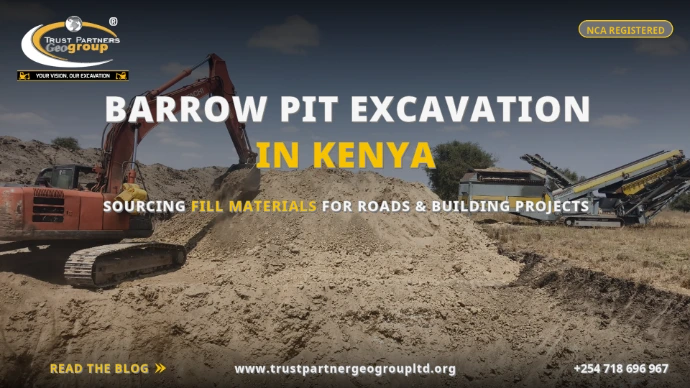
Borrow Pit Excavation in Kenya: Sourcing Fill Material for Road & Building Projects
Approved borrow pits, NEMA permits, soil testing & 2026 fill prices for projects in Nairobi, Mombasa, Nakuru, Kisumu & nationwide
Table of Contents
- 1. What Is a Borrow Pit?
- 2. Fill Material Types & Specifications
- 3. Approved Borrow Pits: Permits & Licensing in Kenya
- 4. Testing Fill Material Before You Buy
- 5. Fill Material Prices in Kenya [2026]
- 6. Haulage: The Hidden Half of Fill Cost
- 7. The Borrow Pit Excavation Process
- 8. Placement, Compaction & Acceptance Testing
- 9. Borrow Pit Rehabilitation & Legal Liability
- 10. 5 Costly Fill Sourcing Mistakes
- 11. Frequently Asked Questions
- 12. Conclusion
When your site needs more soil than it has - a low-lying plot in Syokimau, a road embankment in Nakuru, a dam platform in Machakos - that soil has to come from somewhere. That somewhere is a borrow pit, and choosing the wrong one can cost you double: once for bad material, and again to remove and replace it. This guide covers everything about borrow pit excavation in Kenya: what fill material actually is, how to find approved borrow pits, the permits NEMA and counties require, how to test soil before you pay for it, 2026 prices, and the haulage math that decides whether a cheap pit is actually cheap.
Trust Partners Geo-Group Ltd - Engineering Team
NCA-registered excavation & civil engineering contractor with 15+ years of earthworks and materials supply experience across Kenya. Reviewed by registered engineers and materials technologists.
1. What Is a Borrow Pit?
A borrow pit is a controlled excavation where soil, murram or gravel is "borrowed" from the ground and hauled away for use as earth fill material construction projects need elsewhere. It is the mirror image of the spoil tip: one project's surplus hole is another project's platform.
Borrow pits serve three main markets in Kenya:
- Road construction - embankment fill, subgrade improvement and shoulders. A single kilometre of rural road can consume 5,000-15,000 m3 of borrowed material.
- Building projects - raising plot levels, backfilling behind retaining walls, filling swampy or low-lying ground before foundations. Our cut-and-fill balance guide explains when import becomes necessary.
- Infrastructure - dam cores and shells, railway formation, industrial platforms, airport aprons.
Borrow pit vs. quarry: a borrow pit yields diggable material - soil, murram, decomposed rock - loaded straight onto tippers. A quarry yields hard rock requiring drilling, blasting and crushing. Fill comes from borrow pits; ballast, hardcore and aggregates come from quarries.
2. Fill Material Types & Specifications
Not all dirt is equal. Engineers classify fill by what it must do, and the specification on your drawings determines which borrow pit qualifies:
| Material Class | Typical Spec (Kenya) | Used For | Common Kenyan Sources |
|---|---|---|---|
| Common fill | PI < 20, max particle 150mm, no organics | Raising site levels, landscape fill, non-structural zones | Red coffee soil (Kiambu, Nyeri), lateritic murram |
| Selected / structural fill | PI < 15, CBR 5-10%+, well graded | Under building platforms, behind retaining walls | Decomposed murram (Ruiru, Juja), volcanic soils |
| Subgrade / subbase fill | CBR 15%+ (subbase 25-30%+) | Road pavement layers, hardstanding | Murram gravels (Machakos, Kajiado corridors) |
| Rock fill | Durable rock, max 300-450mm | Embankment cores, swamp crossings, gabions | Quarry overburden, blasted rock (Ngong, Kajiado) |
| Granular / sand fill | Clean sand, low silt | Drainage layers, pipe bedding, backfill around services | River sand (Athi, Tiva rivers - licensed sources only) |
Materials to reject outright: black cotton soil (PI 40+, expands and shrinks - see our black cotton guide), topsoil and organic clays under structures, dumpsite spoil of unknown origin, and any material with visible refuse, roots or chemical staining.
3. Approved Borrow Pits: Permits & Licensing in Kenya
"Approved" is a legal status, not a marketing word. The approved borrow pits Kenya contractors can legally buy from all sit on this permit stack:
| Requirement | Issuing Authority | What It Covers |
|---|---|---|
| Landowner consent / lease agreement | Private (registered at lands office where applicable) | Right to excavate, depth limits, royalties per m3, reinstatement terms |
| County permit / license | County government (physical planning & environment departments) | Zoning compliance, operating hours, truck routes, rehabilitation bond |
| Environmental approval | NEMA - EIA license for larger pits; Environmental Audit / Summary Project Report for smaller ones | Impact mitigation, dust and noise control, water protection, rehabilitation plan |
| Road authority consent (public projects) | KeNHA / KeRRA / KURA | Borrow areas within road reserves; material approval for government works |
| NCA contractor registration | National Construction Authority | The firm excavating and hauling must itself be registered |
Buyer's risk: if your supplier's pit is unlicensed, enforcement action stops your supply mid-project - and NEMA can pursue the transporter and the receiving site too. Always ask for copies of the county permit and NEMA approval before the first load. Reputable suppliers provide them without being asked.
4. Testing Fill Material Before You Buy
Material testing is the cheapest insurance in earthworks. A full source-approval test suite costs KES 40,000-100,000 per borrow pit at a materials lab (university labs and private geotechnical firms across Nairobi, Nakuru, Eldoret, Kisumu and Mombasa) and takes 3-7 days:
| Test | What It Tells You | Acceptance Guide (Building Platforms) |
|---|---|---|
| Sieve analysis (grading) | Particle size distribution - well-graded vs. gap-graded | Well graded, max 150mm |
| Atterberg limits | Plasticity - how the soil behaves with moisture | PI < 15-20 (reject PI > 25) |
| Proctor compaction | Maximum dry density (MDD) & optimum moisture content (OMC) | Baseline for field density testing |
| CBR (soaked) | Strength under pavements | ≥5-10% general fill; ≥15% subgrade; ≥25-30% subbase |
| Organic content | Decomposing matter that never compacts | <2% by mass |
Sampling protocol matters: take samples from several faces and depths across the pit - not just the easy material near the gate. Pits are geologically variable; the murram lens being sold this month may be exhausted next month, leaving silty clay in the same hole. For large programmes (10,000 m3+), retest whenever the face changes visibly. See our earthworks QA/QC guide for the field-testing side.
5. Fill Material Prices in Kenya [2026]
Two ways to buy: delivered (supplier's pit, supplier's trucks, one price) or ex-pit (you buy at the pit gate and arrange haulage). Both are common; the right choice depends on your haul distance and fleet access.
| Material | Ex-Pit Price (KES/m3) | Delivered Nairobi Region (KES/m3) | Notes |
|---|---|---|---|
| Common murram / earth fill | 300-600 | 800-1,500 | Most common building fill |
| Selected granular fill | 500-900 | 1,200-2,000 | Structural platforms, backfill |
| Rock fill | 400-900 | 900-1,800 | Swamp crossings, embankment cores |
| River sand (licensed) | 600-1,200 | 1,500-2,500 | Bedding, screeding, drainage |
| Hardcore (quarry) | 500-1,000 | 1,000-1,800 | Sub-structures, paving base |
These align with the imported-fill line (KES 800-1,500/m3) in our 2026 bulk excavation rates guide. Prices exclude placement and compaction - add KES 300-500/m3 for spreading, watering, rolling and density testing on site.
Volume warning: fill is priced per loose or compacted m3 depending on the supplier - a 20-30% difference. Always agree the measurement basis (weighbridge tonnage x tested density is the cleanest) before the first truck rolls.
6. Haulage: The Hidden Half of Fill Cost
At 2026 rates of KES 200-400/m3 for spoil movement, haulage routinely exceeds the pit-gate price of the material itself. The economics:
| Haul Distance | Cost per m3 (tipper) | Verdict |
|---|---|---|
| Under 5 km | KES 150-250 | Ideal - cheap pit + short haul wins every time |
| 5-15 km | KES 200-350 | Normal Nairobi-region economics |
| 15-30 km | KES 300-500 | Only if no closer source meets spec |
| Over 30 km | KES 400-700+ | Rethink - can the spec change, or is on-site re-use possible? |
A murram pit in Juja charging KES 400/m3 ex-pit beats a KES 300/m3 pit in Thika for a Ruai site every time - the 25 km difference adds KES 250-400/m3 in haulage. For fill material sourcing Nairobi projects, this is therefore a geography problem first and a price problem second: map licensed pits within 15 km of your site, test the nearest two or three, and buy from the nearest one that passes. Truck logistics matter too - a 20-tonne tipper carries roughly 10-12 m3 of loose fill, so a 5,000 m3 import order is 400+ truck trips that must be scheduled around Nairobi's traffic and county haulage permit rules.
7. The Borrow Pit Excavation Process
In practice, the borrow pit excavation Kenya counties will license - whether you are the contractor opening the pit or the buyer auditing your supplier - follows a disciplined sequence:
1. Strip and stockpile topsoil. The top 150-300mm is set aside first and preserved for rehabilitation. Selling topsoil as fill is both a spec failure and an environmental breach.
2. Open controlled faces. Excavate in benches of 2-3m maximum with safe batter slopes (typically 1:1.5 in murram), never undercutting. Excavators load directly into tippers positioned on firm, level ground.
3. Manage water. Pits pond fast in the rains; perimeter drains and a sump pump keep material near optimum moisture. Overly wet material fails compaction at the receiving site and may be rejected at the gate.
4. Control quality at the face. The face supervisor rejects clay lenses, organic pockets and oversize material before loading - rejection at the pit costs nothing; rejection at your site costs the round trip.
5. Record volumes. Calibrated truck counts with signed delivery notes, or weighbridge tickets for larger programmes. Joint records prevent the classic "we delivered 500 loads" vs "we received 430" dispute.
8. Placement, Compaction & Acceptance Testing
Buying good fill is only half the job - it must become ground you can build on:
- Layer thickness: spread in 150-300mm loose layers (thinner for plate compactors, thicker for heavy rollers).
- Moisture: within ±2% of optimum moisture content from the Proctor test - too dry will not compact; too wet turns to pumping mud under the roller.
- Compaction target: 90-95% of MDD for building platforms and embankments (95% under pavements and structures), verified by sand replacement or nuclear density gauge tests - typically one test per 500-1,000 m2 per layer.
- Acceptance: no new layer until the previous one passes. Failed layers are scarified, moisture-adjusted and re-compacted - never buried.
Budget KES 3,000-8,000 per field density test and KES 300-500/m3 all-in for placement and compaction. On a 5,000 m3 import, the QA programme costs KES 100,000-200,000 - and it is the only thing standing between you and differential settlement cracks three years from now.
9. Borrow Pit Rehabilitation & Legal Liability
An exhausted borrow pit is a legal obligation, not an abandoned hole. NEMA approval conditions and county permits require progressive rehabilitation:
- Re-sloping final faces to stable angles (typically 1:3 or gentler) so people and livestock can walk out;
- Spreading the stockpiled topsoil over worked areas;
- Re-vegetating with grass or trees, often with the county's guidance;
- Fencing or backfilling any deep ponded sections - open pits are a documented drowning hazard, and the landowner and operator carry the liability;
- Where agreed, converting the pit to productive use: water pans for irrigation, fish ponds, or landfill subject to separate approvals.
For buyers: rehabilitation is the pit operator's cost, but it is priced into your material. Pits quoting suspiciously low ex-pit prices are often skipping rehabilitation obligations - and when counties crack down, your supply disappears. Ask for the rehabilitation plan along with the permits.
10. 5 Costly Fill Sourcing Mistakes
1. Buying by price alone. The cheapest pit is the nearest compliant pit, not the lowest gate price. Run the haulage math first (Section 6).
2. Skipping source testing. One failed CBR or a PI of 35 discovered after 200 truckloads means paying twice - removal and replacement. Test before the first load.
3. Accepting "fill" of unknown origin. Cheap material from demolition sites or roadside cuts can carry rubble, organics or contamination. Under a building, that is a settlement claim waiting to happen.
4. Ignoring the volume basis. Loose vs. compacted m3, bulking factors, truck calibration - agree the measurement method in writing or expect a 20% invoice dispute.
5. No weather plan. Import programmes scheduled in the long rains face wet material, failed compaction and stuck trucks. Schedule major fill import for dry windows, and stockpile under cover where the programme cannot move.
11. Frequently Asked Questions: Borrow Pits & Fill Material in Kenya
What is a borrow pit in construction?
A borrow pit is an excavation site where soil, murram or gravel is dug out ('borrowed') to be used as fill material on a construction project elsewhere. In Kenya, borrow pits supply earth fill material for road embankments, building platforms, dam cores and backfilling. They must be licensed by the county government, pass NEMA environmental review, and be rehabilitated after use.
How much does fill material cost in Kenya in 2026?
2026 fill material prices in Kenya: common murram/earth fill KES 800-1,500 per m3 delivered (Nairobi region), selected granular fill KES 1,200-2,000 per m3, rock fill KES 900-1,800 per m3, river sand KES 1,500-2,500 per m3. Buying direct from a borrow pit costs KES 300-600 per m3 at the pit, plus haulage of KES 200-400 per m3 depending on distance. Prices exclude placement and compaction (KES 300-500 per m3).
Do I need a permit to open a borrow pit in Kenya?
Yes. Opening a borrow pit in Kenya requires: landowner consent or lease, a county government permit, and NEMA environmental approval (an Environmental Impact Assessment for pits above threshold sizes, or an Environmental Audit for smaller ones). Road projects on public land additionally need KeNHA, KeRRA or KURA approval. Operating without permits risks site closure, fines and liability for rehabilitation.
What makes good fill material for building construction?
Good structural fill is well-graded, free of organic matter, and compacts densely. For Kenyan building platforms: plasticity index (PI) below 15-20, maximum particle size under 150mm, CBR of at least 5-10% for general fill and 15%+ for subgrade under pavements. Red coffee soil and decomposed murram are excellent; black cotton soil (PI 40+) is unsuitable and must be wasted or stabilized with lime.
How is fill material tested before use in Kenya?
Standard tests per Kenyan and BS/ASTM practice: grading (sieve analysis), Atterberg limits (plasticity), Proctor compaction (maximum dry density and optimum moisture content), and CBR for pavement layers. During placement, field density is verified by sand replacement or nuclear gauge tests - typically one test per 500-1,000 m2 per layer, targeting 90-95% of maximum dry density. A materials engineer should approve the borrow pit source before hauling begins.
Where can I find approved borrow pits near Nairobi?
Approved borrow pits around Nairobi are concentrated in Kiambu (Ruiru, Juja, Thika corridor), Machakos (Athi River, Mavoko), Kajiado (Kitengela, Ngong foothills) and along the Nairobi-Nakuru highway. Your county government's environment office keeps the register of licensed pits. Earthworks contractors like Trust Partners Geo-Group Ltd maintain relationships with approved pits and can supply, haul, place and compact fill as one package.
What is the difference between a borrow pit and a quarry?
A borrow pit produces unconsolidated material - soil, murram, gravel - excavated with machines alone. A quarry produces hard rock that must be drilled and blasted, then crushed into aggregates, ballast or rock fill. In Kenya both need county and NEMA permits, but quarries face stricter blasting, vibration and dust controls under the Mining Act. Fill for embankments comes from borrow pits; concrete aggregates and hardcore come from quarries.
Who is responsible for rehabilitating a borrow pit?
Legally, the pit operator or the contractor who opened it - and ultimately the landowner if the operator defaults. NEMA approval conditions require progressive rehabilitation: re-sloping steep faces (typically to 1:3 or gentler), replacing stockpiled topsoil, re-vegetating, and fencing any remaining hazards. Unrehabilitated pits are a drowning and disease hazard; counties increasingly demand rehabilitation bonds before issuing permits.
12. Conclusion: Good Fill Is Approved, Tested and Close
Fill material looks like the simplest line on a construction budget - it is just soil, after all. Yet more Kenyan projects stumble over fill sourcing than over almost any other earthworks item: unlicensed pits shut down mid-supply, untested material fails compaction, and haulage quietly doubles the price. The formula that avoids all three is simple: source from an approved borrow pit, test the material before the first truck, buy from the nearest compliant source, and verify compaction layer by layer.
Trust Partners Geo-Group Ltd supplies the full chain - approved sources, materials testing, haulage, placement, compaction and density certification - as one accountable package for road and building projects across Kenya. Send us your fill volume and specification, and we will return a delivered-and-compacted rate within 48 hours.
Need Approved Fill Material Delivered & Compacted?
We source from licensed borrow pits, test every material, and deliver, place and compact fill to specification - with density test certificates for your project file. Serving Nairobi, Kiambu, Machakos, Kajiado, Nakuru, Mombasa, Kisumu & nationwide.
Free lead magnet: ask for our Fill Material Source Approval Checklist (PDF) - the permit, testing and acceptance criteria our engineers use on every borrow pit.
Related Resources
Cut-and-Fill Earthworks Balance: Calculate Volumes for Kenyan Sites
When do you actually need imported fill? Balance your cut and fill first.
READ MOREBulk Excavation Cost Per Cubic Meter in Kenya [2026 Rates]
Haulage, fill placement and compaction rates referenced in this guide.
READ MOREEarthworks QA/QC: Compaction Testing & Density Control
Field density testing methods and Kenyan standards for fill acceptance.
READ MOREFoundation Excavation in Black Cotton Soil [2026 Guide]
Why expansive soils must be wasted, not used as fill - and how to stabilize them.
READ MOREExcavation in Kenya: Complete Guide to Costs, Methods & Contractors
The pillar guide to excavation methods, equipment and contractor selection.
READ MOREEarthworks Cost Per Cubic Meter in Kenya: 2026 Rate Breakdown
Unit rates for every earthworks activity, from clearance to cart-away.
READ MORETRUST PARTNERS GEO-GROUP LTD | YOUR VISION, OUR EXCAVATION
WEBSITE: WWW.TRUSTPARTNERGEOGROUPLTD.ORG | EMAIL: INFO@TRUSTPARTNERGEOGROUPLTD.ORG | PHONE: +254 718 68 69 67
FOLLOW US: FACEBOOK | TIKTOK | INSTAGRAM | YOUTUBE | LINKEDIN
© 2026 TRUST PARTNERS GEO-GROUP LTD. ALL RIGHTS RESERVED.
Borrow Pit Excavation in Kenya: Sourcing Fill Material for Road & Building Projects
Approved borrow pits, NEMA permits, soil testing & 2026 fill prices for projects in Nairobi, Mombasa, Nakuru, Kisumu & nationwide
Table of Contents
- 1. What Is a Borrow Pit?
- 2. Fill Material Types & Specifications
- 3. Approved Borrow Pits: Permits & Licensing in Kenya
- 4. Testing Fill Material Before You Buy
- 5. Fill Material Prices in Kenya [2026]
- 6. Haulage: The Hidden Half of Fill Cost
- 7. The Borrow Pit Excavation Process
- 8. Placement, Compaction & Acceptance Testing
- 9. Borrow Pit Rehabilitation & Legal Liability
- 10. 5 Costly Fill Sourcing Mistakes
- 11. Frequently Asked Questions
- 12. Conclusion
When your site needs more soil than it has - a low-lying plot in Syokimau, a road embankment in Nakuru, a dam platform in Machakos - that soil has to come from somewhere. That somewhere is a borrow pit, and choosing the wrong one can cost you double: once for bad material, and again to remove and replace it. This guide covers everything about borrow pit excavation in Kenya: what fill material actually is, how to find approved borrow pits, the permits NEMA and counties require, how to test soil before you pay for it, 2026 prices, and the haulage math that decides whether a cheap pit is actually cheap.
Trust Partners Geo-Group Ltd - Engineering Team
NCA-registered excavation & civil engineering contractor with 15+ years of earthworks and materials supply experience across Kenya. Reviewed by registered engineers and materials technologists.
1. What Is a Borrow Pit?
A borrow pit is a controlled excavation where soil, murram or gravel is "borrowed" from the ground and hauled away for use as earth fill material construction projects need elsewhere. It is the mirror image of the spoil tip: one project's surplus hole is another project's platform.
Borrow pits serve three main markets in Kenya:
- Road construction - embankment fill, subgrade improvement and shoulders. A single kilometre of rural road can consume 5,000-15,000 m3 of borrowed material.
- Building projects - raising plot levels, backfilling behind retaining walls, filling swampy or low-lying ground before foundations. Our cut-and-fill balance guide explains when import becomes necessary.
- Infrastructure - dam cores and shells, railway formation, industrial platforms, airport aprons.
Borrow pit vs. quarry: a borrow pit yields diggable material - soil, murram, decomposed rock - loaded straight onto tippers. A quarry yields hard rock requiring drilling, blasting and crushing. Fill comes from borrow pits; ballast, hardcore and aggregates come from quarries.
2. Fill Material Types & Specifications
Not all dirt is equal. Engineers classify fill by what it must do, and the specification on your drawings determines which borrow pit qualifies:
| Material Class | Typical Spec (Kenya) | Used For | Common Kenyan Sources |
|---|---|---|---|
| Common fill | PI < 20, max particle 150mm, no organics | Raising site levels, landscape fill, non-structural zones | Red coffee soil (Kiambu, Nyeri), lateritic murram |
| Selected / structural fill | PI < 15, CBR 5-10%+, well graded | Under building platforms, behind retaining walls | Decomposed murram (Ruiru, Juja), volcanic soils |
| Subgrade / subbase fill | CBR 15%+ (subbase 25-30%+) | Road pavement layers, hardstanding | Murram gravels (Machakos, Kajiado corridors) |
| Rock fill | Durable rock, max 300-450mm | Embankment cores, swamp crossings, gabions | Quarry overburden, blasted rock (Ngong, Kajiado) |
| Granular / sand fill | Clean sand, low silt | Drainage layers, pipe bedding, backfill around services | River sand (Athi, Tiva rivers - licensed sources only) |
Materials to reject outright: black cotton soil (PI 40+, expands and shrinks - see our black cotton guide), topsoil and organic clays under structures, dumpsite spoil of unknown origin, and any material with visible refuse, roots or chemical staining.
3. Approved Borrow Pits: Permits & Licensing in Kenya
"Approved" is a legal status, not a marketing word. The approved borrow pits Kenya contractors can legally buy from all sit on this permit stack:
| Requirement | Issuing Authority | What It Covers |
|---|---|---|
| Landowner consent / lease agreement | Private (registered at lands office where applicable) | Right to excavate, depth limits, royalties per m3, reinstatement terms |
| County permit / license | County government (physical planning & environment departments) | Zoning compliance, operating hours, truck routes, rehabilitation bond |
| Environmental approval | NEMA - EIA license for larger pits; Environmental Audit / Summary Project Report for smaller ones | Impact mitigation, dust and noise control, water protection, rehabilitation plan |
| Road authority consent (public projects) | KeNHA / KeRRA / KURA | Borrow areas within road reserves; material approval for government works |
| NCA contractor registration | National Construction Authority | The firm excavating and hauling must itself be registered |
Buyer's risk: if your supplier's pit is unlicensed, enforcement action stops your supply mid-project - and NEMA can pursue the transporter and the receiving site too. Always ask for copies of the county permit and NEMA approval before the first load. Reputable suppliers provide them without being asked.
4. Testing Fill Material Before You Buy
Material testing is the cheapest insurance in earthworks. A full source-approval test suite costs KES 40,000-100,000 per borrow pit at a materials lab (university labs and private geotechnical firms across Nairobi, Nakuru, Eldoret, Kisumu and Mombasa) and takes 3-7 days:
| Test | What It Tells You | Acceptance Guide (Building Platforms) |
|---|---|---|
| Sieve analysis (grading) | Particle size distribution - well-graded vs. gap-graded | Well graded, max 150mm |
| Atterberg limits | Plasticity - how the soil behaves with moisture | PI < 15-20 (reject PI > 25) |
| Proctor compaction | Maximum dry density (MDD) & optimum moisture content (OMC) | Baseline for field density testing |
| CBR (soaked) | Strength under pavements | ≥5-10% general fill; ≥15% subgrade; ≥25-30% subbase |
| Organic content | Decomposing matter that never compacts | <2% by mass |
Sampling protocol matters: take samples from several faces and depths across the pit - not just the easy material near the gate. Pits are geologically variable; the murram lens being sold this month may be exhausted next month, leaving silty clay in the same hole. For large programmes (10,000 m3+), retest whenever the face changes visibly. See our earthworks QA/QC guide for the field-testing side.
5. Fill Material Prices in Kenya [2026]
Two ways to buy: delivered (supplier's pit, supplier's trucks, one price) or ex-pit (you buy at the pit gate and arrange haulage). Both are common; the right choice depends on your haul distance and fleet access.
| Material | Ex-Pit Price (KES/m3) | Delivered Nairobi Region (KES/m3) | Notes |
|---|---|---|---|
| Common murram / earth fill | 300-600 | 800-1,500 | Most common building fill |
| Selected granular fill | 500-900 | 1,200-2,000 | Structural platforms, backfill |
| Rock fill | 400-900 | 900-1,800 | Swamp crossings, embankment cores |
| River sand (licensed) | 600-1,200 | 1,500-2,500 | Bedding, screeding, drainage |
| Hardcore (quarry) | 500-1,000 | 1,000-1,800 | Sub-structures, paving base |
These align with the imported-fill line (KES 800-1,500/m3) in our 2026 bulk excavation rates guide. Prices exclude placement and compaction - add KES 300-500/m3 for spreading, watering, rolling and density testing on site.
Volume warning: fill is priced per loose or compacted m3 depending on the supplier - a 20-30% difference. Always agree the measurement basis (weighbridge tonnage x tested density is the cleanest) before the first truck rolls.
6. Haulage: The Hidden Half of Fill Cost
At 2026 rates of KES 200-400/m3 for spoil movement, haulage routinely exceeds the pit-gate price of the material itself. The economics:
| Haul Distance | Cost per m3 (tipper) | Verdict |
|---|---|---|
| Under 5 km | KES 150-250 | Ideal - cheap pit + short haul wins every time |
| 5-15 km | KES 200-350 | Normal Nairobi-region economics |
| 15-30 km | KES 300-500 | Only if no closer source meets spec |
| Over 30 km | KES 400-700+ | Rethink - can the spec change, or is on-site re-use possible? |
A murram pit in Juja charging KES 400/m3 ex-pit beats a KES 300/m3 pit in Thika for a Ruai site every time - the 25 km difference adds KES 250-400/m3 in haulage. For fill material sourcing Nairobi projects, this is therefore a geography problem first and a price problem second: map licensed pits within 15 km of your site, test the nearest two or three, and buy from the nearest one that passes. Truck logistics matter too - a 20-tonne tipper carries roughly 10-12 m3 of loose fill, so a 5,000 m3 import order is 400+ truck trips that must be scheduled around Nairobi's traffic and county haulage permit rules.
7. The Borrow Pit Excavation Process
In practice, the borrow pit excavation Kenya counties will license - whether you are the contractor opening the pit or the buyer auditing your supplier - follows a disciplined sequence:
1. Strip and stockpile topsoil. The top 150-300mm is set aside first and preserved for rehabilitation. Selling topsoil as fill is both a spec failure and an environmental breach.
2. Open controlled faces. Excavate in benches of 2-3m maximum with safe batter slopes (typically 1:1.5 in murram), never undercutting. Excavators load directly into tippers positioned on firm, level ground.
3. Manage water. Pits pond fast in the rains; perimeter drains and a sump pump keep material near optimum moisture. Overly wet material fails compaction at the receiving site and may be rejected at the gate.
4. Control quality at the face. The face supervisor rejects clay lenses, organic pockets and oversize material before loading - rejection at the pit costs nothing; rejection at your site costs the round trip.
5. Record volumes. Calibrated truck counts with signed delivery notes, or weighbridge tickets for larger programmes. Joint records prevent the classic "we delivered 500 loads" vs "we received 430" dispute.
8. Placement, Compaction & Acceptance Testing
Buying good fill is only half the job - it must become ground you can build on:
- Layer thickness: spread in 150-300mm loose layers (thinner for plate compactors, thicker for heavy rollers).
- Moisture: within ±2% of optimum moisture content from the Proctor test - too dry will not compact; too wet turns to pumping mud under the roller.
- Compaction target: 90-95% of MDD for building platforms and embankments (95% under pavements and structures), verified by sand replacement or nuclear density gauge tests - typically one test per 500-1,000 m2 per layer.
- Acceptance: no new layer until the previous one passes. Failed layers are scarified, moisture-adjusted and re-compacted - never buried.
Budget KES 3,000-8,000 per field density test and KES 300-500/m3 all-in for placement and compaction. On a 5,000 m3 import, the QA programme costs KES 100,000-200,000 - and it is the only thing standing between you and differential settlement cracks three years from now.
9. Borrow Pit Rehabilitation & Legal Liability
An exhausted borrow pit is a legal obligation, not an abandoned hole. NEMA approval conditions and county permits require progressive rehabilitation:
- Re-sloping final faces to stable angles (typically 1:3 or gentler) so people and livestock can walk out;
- Spreading the stockpiled topsoil over worked areas;
- Re-vegetating with grass or trees, often with the county's guidance;
- Fencing or backfilling any deep ponded sections - open pits are a documented drowning hazard, and the landowner and operator carry the liability;
- Where agreed, converting the pit to productive use: water pans for irrigation, fish ponds, or landfill subject to separate approvals.
For buyers: rehabilitation is the pit operator's cost, but it is priced into your material. Pits quoting suspiciously low ex-pit prices are often skipping rehabilitation obligations - and when counties crack down, your supply disappears. Ask for the rehabilitation plan along with the permits.
10. 5 Costly Fill Sourcing Mistakes
1. Buying by price alone. The cheapest pit is the nearest compliant pit, not the lowest gate price. Run the haulage math first (Section 6).
2. Skipping source testing. One failed CBR or a PI of 35 discovered after 200 truckloads means paying twice - removal and replacement. Test before the first load.
3. Accepting "fill" of unknown origin. Cheap material from demolition sites or roadside cuts can carry rubble, organics or contamination. Under a building, that is a settlement claim waiting to happen.
4. Ignoring the volume basis. Loose vs. compacted m3, bulking factors, truck calibration - agree the measurement method in writing or expect a 20% invoice dispute.
5. No weather plan. Import programmes scheduled in the long rains face wet material, failed compaction and stuck trucks. Schedule major fill import for dry windows, and stockpile under cover where the programme cannot move.
11. Frequently Asked Questions: Borrow Pits & Fill Material in Kenya
What is a borrow pit in construction?
A borrow pit is an excavation site where soil, murram or gravel is dug out ('borrowed') to be used as fill material on a construction project elsewhere. In Kenya, borrow pits supply earth fill material for road embankments, building platforms, dam cores and backfilling. They must be licensed by the county government, pass NEMA environmental review, and be rehabilitated after use.
How much does fill material cost in Kenya in 2026?
2026 fill material prices in Kenya: common murram/earth fill KES 800-1,500 per m3 delivered (Nairobi region), selected granular fill KES 1,200-2,000 per m3, rock fill KES 900-1,800 per m3, river sand KES 1,500-2,500 per m3. Buying direct from a borrow pit costs KES 300-600 per m3 at the pit, plus haulage of KES 200-400 per m3 depending on distance. Prices exclude placement and compaction (KES 300-500 per m3).
Do I need a permit to open a borrow pit in Kenya?
Yes. Opening a borrow pit in Kenya requires: landowner consent or lease, a county government permit, and NEMA environmental approval (an Environmental Impact Assessment for pits above threshold sizes, or an Environmental Audit for smaller ones). Road projects on public land additionally need KeNHA, KeRRA or KURA approval. Operating without permits risks site closure, fines and liability for rehabilitation.
What makes good fill material for building construction?
Good structural fill is well-graded, free of organic matter, and compacts densely. For Kenyan building platforms: plasticity index (PI) below 15-20, maximum particle size under 150mm, CBR of at least 5-10% for general fill and 15%+ for subgrade under pavements. Red coffee soil and decomposed murram are excellent; black cotton soil (PI 40+) is unsuitable and must be wasted or stabilized with lime.
How is fill material tested before use in Kenya?
Standard tests per Kenyan and BS/ASTM practice: grading (sieve analysis), Atterberg limits (plasticity), Proctor compaction (maximum dry density and optimum moisture content), and CBR for pavement layers. During placement, field density is verified by sand replacement or nuclear gauge tests - typically one test per 500-1,000 m2 per layer, targeting 90-95% of maximum dry density. A materials engineer should approve the borrow pit source before hauling begins.
Where can I find approved borrow pits near Nairobi?
Approved borrow pits around Nairobi are concentrated in Kiambu (Ruiru, Juja, Thika corridor), Machakos (Athi River, Mavoko), Kajiado (Kitengela, Ngong foothills) and along the Nairobi-Nakuru highway. Your county government's environment office keeps the register of licensed pits. Earthworks contractors like Trust Partners Geo-Group Ltd maintain relationships with approved pits and can supply, haul, place and compact fill as one package.
What is the difference between a borrow pit and a quarry?
A borrow pit produces unconsolidated material - soil, murram, gravel - excavated with machines alone. A quarry produces hard rock that must be drilled and blasted, then crushed into aggregates, ballast or rock fill. In Kenya both need county and NEMA permits, but quarries face stricter blasting, vibration and dust controls under the Mining Act. Fill for embankments comes from borrow pits; concrete aggregates and hardcore come from quarries.
Who is responsible for rehabilitating a borrow pit?
Legally, the pit operator or the contractor who opened it - and ultimately the landowner if the operator defaults. NEMA approval conditions require progressive rehabilitation: re-sloping steep faces (typically to 1:3 or gentler), replacing stockpiled topsoil, re-vegetating, and fencing any remaining hazards. Unrehabilitated pits are a drowning and disease hazard; counties increasingly demand rehabilitation bonds before issuing permits.
12. Conclusion: Good Fill Is Approved, Tested and Close
Fill material looks like the simplest line on a construction budget - it is just soil, after all. Yet more Kenyan projects stumble over fill sourcing than over almost any other earthworks item: unlicensed pits shut down mid-supply, untested material fails compaction, and haulage quietly doubles the price. The formula that avoids all three is simple: source from an approved borrow pit, test the material before the first truck, buy from the nearest compliant source, and verify compaction layer by layer.
Trust Partners Geo-Group Ltd supplies the full chain - approved sources, materials testing, haulage, placement, compaction and density certification - as one accountable package for road and building projects across Kenya. Send us your fill volume and specification, and we will return a delivered-and-compacted rate within 48 hours.
Need Approved Fill Material Delivered & Compacted?
We source from licensed borrow pits, test every material, and deliver, place and compact fill to specification - with density test certificates for your project file. Serving Nairobi, Kiambu, Machakos, Kajiado, Nakuru, Mombasa, Kisumu & nationwide.
Free lead magnet: ask for our Fill Material Source Approval Checklist (PDF) - the permit, testing and acceptance criteria our engineers use on every borrow pit.
Related Resources
Cut-and-Fill Earthworks Balance: Calculate Volumes for Kenyan Sites
When do you actually need imported fill? Balance your cut and fill first.
READ MOREBulk Excavation Cost Per Cubic Meter in Kenya [2026 Rates]
Haulage, fill placement and compaction rates referenced in this guide.
READ MOREEarthworks QA/QC: Compaction Testing & Density Control
Field density testing methods and Kenyan standards for fill acceptance.
READ MOREFoundation Excavation in Black Cotton Soil [2026 Guide]
Why expansive soils must be wasted, not used as fill - and how to stabilize them.
READ MOREExcavation in Kenya: Complete Guide to Costs, Methods & Contractors
The pillar guide to excavation methods, equipment and contractor selection.
READ MOREEarthworks Cost Per Cubic Meter in Kenya: 2026 Rate Breakdown
Unit rates for every earthworks activity, from clearance to cart-away.
READ MORETRUST PARTNERS GEO-GROUP LTD | YOUR VISION, OUR EXCAVATION
WEBSITE: WWW.TRUSTPARTNERGEOGROUPLTD.ORG | EMAIL: INFO@TRUSTPARTNERGEOGROUPLTD.ORG | PHONE: +254 718 68 69 67
FOLLOW US: FACEBOOK | TIKTOK | INSTAGRAM | YOUTUBE | LINKEDIN
© 2026 TRUST PARTNERS GEO-GROUP LTD. ALL RIGHTS RESERVED.