
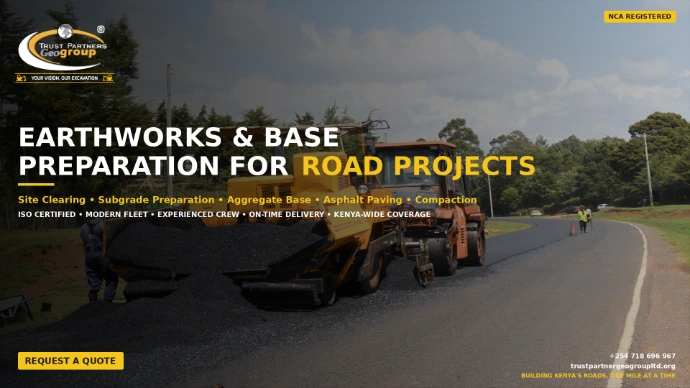
Earthworks and Base Preparation for Road Projects in Kenya
A Complete Technical Guide for Contractors, Engineers & Project Managers Planning Road Earthworks Across Nairobi, Mombasa, Kisumu & Beyond — From Subgrade to Finished Base
Table of Contents
Jump to any section of this guide
Why Earthworks and Base Preparation Matter in Kenya
When planning a road construction project in Kenya, earthworks and base preparation are the most critical — yet often underestimated — phases. Whether you are building a rural access road in Kitui, an urban bypass in Nairobi, or a highway connecting Mombasa to Malindi, the quality of your earthworks directly determines the road's lifespan, maintenance costs, and safety.
At Trust Partners Geo-Group, we have delivered earthworks and base preparation for road projects across Kenya's diverse terrain — from the red volcanic soils of Nairobi to the black cotton soils of Kajiado and the sandy coastal deposits of Mombasa. Poor base preparation is the leading cause of premature road failure in Kenya.
Structural Integrity
Properly prepared subgrade distributes traffic loads evenly, preventing cracking, rutting, and potholes that plague poorly constructed roads.
Drainage Management
Kenya's seasonal rainfall — especially the long rains (March-May) and short rains (October-December) — demands robust subgrade drainage to prevent waterlogging and erosion.
Cost Efficiency
Investing in proper earthworks upfront reduces long-term maintenance costs by up to 60%. A well-prepared base can extend road lifespan from 5 years to 20+ years.
Safety Standards
KeNHA and KURA specifications require minimum CBR (California Bearing Ratio) values for subgrade and base materials. Non-compliance can result in project rejection.
Subgrade Preparation: The Foundation of Every Road
The subgrade is the natural or improved soil layer that forms the foundation of the road pavement. In Kenya, subgrade preparation is particularly challenging due to variable soil conditions, seasonal rainfall, and the prevalence of problematic soils like black cotton soil (vertisol).
Step 1: Site Clearing and Stripping
Before any earthmoving begins, the site must be cleared of vegetation, topsoil, and organic matter. In Kenya, this typically involves:
- Bush clearing and tree removal — Using bulldozers and bush cutters (critical in rural areas like Baringo or Garissa)
- Topsoil stripping — Removing 150-300mm of topsoil, which is often high in organic content and unsuitable for road foundations
- Removal of existing pavements — For road rehabilitation projects in Nairobi, Mombasa, or Kisumu
- Disposal of unsuitable materials — Organic soils, trash, and debris must be hauled to approved disposal sites
Step 2: Subgrade Excavation and Cuttings
For road projects in hilly terrain — common in areas like Limuru, Nakuru, or the Kericho highlands — cuttings are required to achieve the design road level. Key considerations include:
| Cutting Type | Depth Range | Equipment Required | Key Considerations |
|---|---|---|---|
| Shallow Cut | 0 - 3 meters | 20-30 ton excavator, motor grader | Standard excavation; monitor for groundwater |
| Medium Cut | 3 - 6 meters | 30-50 ton excavator, articulated dump trucks | Slope stability; benching may be required |
| Deep Cut | 6+ meters | 50+ ton excavator, rock breakers, dump trucks | Geotechnical survey; retaining structures; drainage |
Step 3: Subgrade Improvement and Stabilization
Many Kenyan soils require improvement before they can serve as a road subgrade. The most common methods include:
Mechanical Stabilization
Mixing and compacting soil to achieve the required density and CBR. This is the most common approach for red volcanic soils in Nairobi and Central Kenya.
Chemical Stabilization
Adding lime, cement, or bitumen to improve soil properties. Essential for:
- Black cotton soil — Found in Kajiado, Athi River, parts of Machakos and Kitui. Lime stabilization (3-6% by weight) is typically used to reduce swelling potential.
- Expansive clays — Common in Rift Valley areas. Cement stabilization (4-8%) provides better long-term performance.
- Weak sandy soils — Found in coastal regions. Cement or lime stabilization increases cohesion and bearing capacity.
Replacement of Unsuitable Material
When in-situ soil cannot be stabilized economically, it is excavated and replaced with imported granular material (crushed stone, murram, or selected gravel). This is common in swampy areas like parts of Kisumu, Budalangi, or the Tana Delta.
Embankment Construction: Building Up Where Needed
In low-lying areas, swampy terrain, or where the natural ground level is below the design road level, embankments must be constructed. This is common in:
- Flood-prone areas — Budalangi, Kano Plains, Tana River Delta
- Urban road upgrades — Raising road levels to improve drainage in Nairobi and Mombasa
- Bridge approaches — Transition zones requiring smooth grade changes
- Railway crossings — Maintaining road level over railway lines
Embankment Material Selection
The quality of embankment fill directly impacts road performance. KeNHA and KURA specifications require:
| Material Type | CBR Requirement | Plasticity Index (PI) | Best Use |
|---|---|---|---|
| Selected granular material | >= 15% | < 12 | Upper embankment layers, within 500mm of subgrade |
| Ordinary fill material | >= 6% | < 20 | Lower embankment layers |
| Rock fill | N/A | N/A | Deep embankments; must be well-graded and compacted |
| Lateritic gravel (murram) | >= 20% | < 15 | Excellent for Kenyan roads; widely available in Central/Eastern regions |
Embankment Compaction Requirements
Proper compaction is non-negotiable. In Kenya, the standard requirement is 95% of Modified Proctor Maximum Dry Density (MDD) for the upper 500mm of the subgrade, and 93% MDD for lower embankment layers.
Layer-by-Layer Construction
Embankments must be built in controlled layers (lifts) to ensure uniform compaction:
- Maximum loose layer thickness: 200-250mm before compaction
- Compacted thickness: Approximately 150mm per layer
- Number of roller passes: 6-8 passes with a vibratory roller for granular materials; 10-12 passes for cohesive soils
- Moisture content: Within +/-2% of optimum moisture content (OMC)
Base and Sub-Base Layers: The Road's Structural Backbone
Above the prepared subgrade lies the structural layers of the road pavement. In Kenya, these typically consist of:
Sub-Base Layer
The sub-base is the first structural layer above the subgrade. It provides:
- Additional load distribution
- Drainage pathway to prevent water accumulation
- Working platform for base layer construction
- Protection of the subgrade from construction equipment damage
Typical specifications for Kenyan roads:
| Parameter | Sub-Base Requirement |
|---|---|
| Material | Crushed stone, natural gravel, or stabilized soil |
| CBR (soaked) | >= 30% |
| Maximum aggregate size | 50mm |
| Plasticity Index | < 6 for unbound materials |
| Compaction | >= 98% MDD (Modified Proctor) |
| Thickness | 150-300mm (varies by design) |
Base Layer
The base layer is the primary structural component of the pavement, carrying the majority of traffic loads. For Kenyan roads, the two main types are:
1. Crushed Stone Base (CSB)
Made from mechanically crushed hard rock (basalt, phonolite, or granite). Common in high-traffic roads and highways.
- CBR requirement: >= 80%
- Maximum aggregate size: 37.5mm
- Crushing value: < 30% (Los Angeles Abrasion Test)
- Typical thickness: 150-200mm
2. Murram Base
Lateritic gravel (murram) is the most common base material for low-volume and rural roads in Kenya. It is cost-effective and widely available in Central, Eastern, and parts of Western Kenya.
- CBR requirement: >= 50% (unsoaked)
- Maximum aggregate size: 50mm
- Plasticity Index: < 15
- Typical thickness: 150-250mm
Base Construction Process
- Material sourcing and testing — Quarry identification, sampling, and laboratory testing for CBR, grading, and plasticity
- Hauling and stockpiling — Transport to site; protect from rain contamination
- Spreading — Motor grader achieves uniform thickness; thickness is checked every 50 meters
- Watering and mixing — Achieve optimum moisture content; disc harrows or graders mix material
- Compaction — Vibratory roller (10-15 ton) in static and vibratory modes; 8-12 passes
- Quality testing — Density tests (sand replacement or nuclear gauge), CBR verification, thickness checks
- Protection — Base must be protected from traffic and rain until surfacing is applied
Heavy Equipment Required for Road Earthworks in Kenya
Executing earthworks and base preparation requires a coordinated fleet of heavy machinery. At Trust Partners Geo-Group, we maintain and operate a comprehensive fleet of modern equipment suitable for all scales of road projects in Kenya.
Earthmoving Equipment
| Equipment | Size/Type | Primary Use | Productivity |
|---|---|---|---|
| Excavators | 20-50 ton (CAT, Komatsu, JCB) | Cutting, trenching, loading trucks | 150-400 m3/hr |
| Bulldozers | D6-D8 (CAT), SD22 (Shantui) | Site clearing, rough grading, spreading fill | 200-500 m3/hr |
| Motor Graders | 140H-140M (CAT), GD655 (Komatsu) | Final grading, slope finishing, base spreading | 1-2 km/day |
| Wheel Loaders | 966H (CAT), WA380 (Komatsu) | Loading trucks, stockpile management | 150-250 m3/hr |
| Dump Trucks | 20-30 ton articulated (CAT, Volvo) | Hauling cut material, importing fill/base | 50-100 m3/hr |
| Scrapers | Self-propelled or towed | Large-scale cut-and-fill operations | 300-800 m3/hr |
Compaction Equipment
| Equipment | Type | Best For | Weight/Force |
|---|---|---|---|
| Vibratory Smooth Drum | Single or double drum | Granular sub-base and base materials | 10-15 ton static; 20-30 ton dynamic |
| Pneumatic Tyre Rollers | 9-11 wheel | Final compaction of bituminous layers; kneading action for cohesive soils | 15-25 ton |
| Padfoot Rollers | Sheepsfoot / padfoot | Cohesive soils, clay embankments | 12-18 ton |
| Tandem Vibratory Rollers | Double drum, articulated | Asphalt base and wearing course | 8-12 ton |
Specialized Equipment
Soil Stabilizers
Self-propelled machines that pulverize and mix lime/cement into soil in one pass. Essential for large-scale chemical stabilization projects in Kajiado or Athi River.
Water Trucks
10,000-20,000 liter capacity for moisture conditioning during compaction. Critical in Kenya's dry climate where soils often require watering to reach OMC.
Nuclear Density Gauges
Real-time in-situ density and moisture testing. Allows immediate correction of under-compacted areas without waiting for laboratory results.
Rock Breakers
Hydraulic attachments for excavators. Required in Nairobi's hard phonolite rock and Rift Valley basalt formations where blasting is not permitted.
Soil Conditions Across Kenya: Regional Challenges
Kenya's geology varies dramatically from region to region, and each soil type presents unique challenges for road earthworks. Understanding your site's soil is the first step to designing appropriate earthworks.
| Region | Soil Type | Characteristics | Challenge | Solution |
|---|---|---|---|---|
| Nairobi & Central | Red volcanic soil (Nitisols) | High iron content, good drainage, stable structure | Hardpan/weathered rock at depth; occasional black cotton patches | Standard compaction; rock breaking for deep cuts |
| Kajiado, Athi River | Black cotton soil (Vertisols) | High clay content, expansive, cracks when dry | Severe swelling/shrinkage; low bearing capacity when wet | Lime/cement stabilization or complete replacement |
| Mombasa, Malindi, Lamu | Coastal sands (Arenosols) | Loose, poorly graded, high permeability | Low cohesion; saltwater intrusion; erosion | Compaction grouting; cement stabilization; geotextiles |
| Kisumu, Siaya, Busia | Lakebed deposits (Gleysols, Fluvisols) | Soft, saturated, organic-rich | High compressibility; poor drainage; very low CBR | Preloading with surcharge; vertical drains; soil replacement |
| Kericho, Bomet, Nandi | Volcanic ash soils (Andosols) | High porosity, good structure, fertile | Can be unstable when saturated; erosion-prone | Controlled compaction; surface drainage; erosion control |
| Kitui, Makueni, Taita | Lateritic gravels (Plinthosols) | Iron-rich concretions, variable hardness | Hard laterite layers; variable quality | Screening and crushing; blending with softer material |
| Turkana, Marsabit, Mandera | Sandy loams, volcanic soils | Arid, low cohesion, wind-blown deposits | Dust; erosion; difficulty achieving compaction OMC | Import water for compaction; windbreaks; surface stabilization |
Quality Control and Testing: Ensuring Long-Term Performance
Quality control during earthworks and base preparation is not optional — it is the difference between a road that lasts 20 years and one that fails in 2. At Trust Partners Geo-Group, we implement rigorous testing protocols aligned with KeNHA, KURA, and AASHTO standards.
Pre-Construction Testing
- Geotechnical investigation — Boreholes, test pits, and laboratory analysis to characterize subgrade soils
- Material source testing — Quarry inspections, sampling, and testing of all borrow materials before approval
- Proctor compaction tests — Determine MDD and OMC for each material type
- CBR testing — Soaked and unsoaked CBR for subgrade, sub-base, and base materials
- Atterberg limits — Liquid limit, plastic limit, and shrinkage limit for cohesive soils
During Construction Testing
| Test | Frequency | Standard | Purpose |
|---|---|---|---|
| In-situ density (Sand replacement or nuclear gauge) | Every 500m2 or 3 tests per layer | BS 1377 / AASHTO T191 | Verify compaction achieves specified % MDD |
| Moisture content | With every density test | BS 1377 / AASHTO T265 | Ensure within +/-2% of OMC |
| Layer thickness | Every 50m longitudinal; 5m transverse | Project specification | Verify design thickness achieved |
| Level and alignment | Every 25m | Project specification | Check road geometry compliance |
| CBR (field verification) | Every 1000m2 or as specified | BS 1377 / AASHTO T193 | Confirm material strength in-place |
| Gradation analysis | Every 500m3 of material placed | BS 1377 / AASHTO T27 | Ensure material meets grading envelope |
Acceptance Criteria
Subgrade
>= 95% MDD (Modified Proctor); CBR >= 6% (soaked); no organic matter; no stones > 75mm within 500mm of surface
Sub-Base
>= 98% MDD; CBR >= 30% (soaked); thickness within +/-20mm of design; surface level within +/-10mm
Base (Murram)
>= 98% MDD; CBR >= 50% (unsoaked); PI < 15; thickness within +/-15mm; cross-fall 2.5-4%
Base (Crushed Stone)
>= 100% MDD; CBR >= 80% (soaked); crushing value < 30%; thickness within +/-10mm; no segregation
Cost Breakdown for Road Earthworks in Kenya [2026 Estimates]
Understanding the cost components of earthworks and base preparation helps in accurate budgeting and contractor selection. The following tables provide 2026 estimates based on current market rates in Kenya.
Earthworks Costs (Per Cubic Meter)
| Activity | Easy Terrain (KES/m3) | Medium Terrain (KES/m3) | Difficult Terrain (KES/m3) |
|---|---|---|---|
| Site clearing and stripping | 150 - 250 | 250 - 400 | 400 - 600 |
| Common excavation (soil) | 800 - 1,200 | 1,200 - 1,800 | 1,800 - 2,500 |
| Rock excavation (breaking) | 2,500 - 3,500 | 3,500 - 5,000 | 5,000 - 8,000 |
| Embankment fill (imported) | 1,200 - 1,800 | 1,800 - 2,500 | 2,500 - 4,000 |
| Soil stabilization (lime) | 1,500 - 2,000 | 2,000 - 2,800 | 2,800 - 4,000 |
| Soil stabilization (cement) | 2,000 - 2,800 | 2,800 - 3,500 | 3,500 - 5,000 |
| Compaction | 300 - 500 | 500 - 800 | 800 - 1,200 |
Base and Sub-Base Costs (Per Square Meter)
| Layer | Material | Thickness | Cost Range (KES/m2) |
|---|---|---|---|
| Sub-base | Natural gravel / crushed stone | 150mm | 450 - 700 |
| Sub-base | Natural gravel / crushed stone | 200mm | 600 - 900 |
| Sub-base | Natural gravel / crushed stone | 300mm | 900 - 1,300 |
| Base (Murram) | Lateritic gravel | 150mm | 350 - 550 |
| Base (Murram) | Lateritic gravel | 200mm | 450 - 700 |
| Base (Murram) | Lateritic gravel | 250mm | 550 - 850 |
| Base (Crushed Stone) | Mechanically crushed hard rock | 150mm | 700 - 1,000 |
| Base (Crushed Stone) | Mechanically crushed hard rock | 200mm | 900 - 1,300 |
Equipment Hire Rates (2026 Daily Rates)
| Equipment | Daily Rate (KES) | Weekly Rate (KES) | Monthly Rate (KES) |
|---|---|---|---|
| 20-ton excavator with operator | 35,000 - 45,000 | 200,000 - 250,000 | 750,000 - 900,000 |
| 30-ton excavator with operator | 50,000 - 65,000 | 280,000 - 350,000 | 1,000,000 - 1,300,000 |
| Bulldozer (D6/D7) with operator | 40,000 - 55,000 | 220,000 - 280,000 | 800,000 - 1,000,000 |
| Motor grader with operator | 35,000 - 50,000 | 200,000 - 260,000 | 700,000 - 900,000 |
| Vibratory roller (10-ton) with operator | 25,000 - 35,000 | 140,000 - 180,000 | 500,000 - 650,000 |
| Dump truck (20-ton) with driver | 18,000 - 25,000 | 100,000 - 130,000 | 350,000 - 450,000 |
| Wheel loader with operator | 30,000 - 40,000 | 170,000 - 210,000 | 600,000 - 750,000 |
| Water truck (15,000L) with driver | 15,000 - 22,000 | 85,000 - 110,000 | 300,000 - 400,000 |
Common Challenges in Kenyan Road Earthworks
After decades of road construction across Kenya, we have encountered — and solved — nearly every earthworks challenge imaginable. Here are the most common issues and how to address them:
Challenge 1: Rainy Season Construction
Kenya's long rains (March-May) and short rains (October-December) can halt earthworks if not properly managed.
- Problem: Saturated soils cannot be compacted; material becomes unworkable; erosion of exposed surfaces
- Solution: Schedule critical earthworks during dry seasons; maintain stockpiles of dry material; use geotextiles for erosion protection; implement temporary drainage channels; cover exposed subgrade with aggregate if surfacing is delayed
Challenge 2: Black Cotton Soil
Expansive soils in Kajiado, Athi River, and parts of Machakos are the nemesis of road engineers.
- Problem: Soil swells when wet (up to 100% volume increase) and shrinks when dry, causing pavement cracking and heaving
- Solution: Lime stabilization (3-6%) or cement stabilization (4-8%); complete removal and replacement with granular material for high-value roads; capping with 1-2m of selected fill; avoiding construction during peak wet season
Challenge 3: Poor Quality Borrow Materials
Not all material that looks like murram is suitable for road construction.
- Problem: High plasticity, poor grading, or high organic content in supposedly "good" borrow pits
- Solution: Mandatory testing before approval; blending different materials to achieve specification; importing material from approved quarries when local sources fail; rejecting substandard material regardless of cost pressure
Challenge 4: Inadequate Compaction
This is the silent killer of road longevity in Kenya.
- Problem: Contractors cutting corners on roller passes; compacting at wrong moisture content; using underweight equipment; insufficient testing
- Solution: Strict supervision with independent testing; real-time nuclear gauge monitoring; payment linked to test results; using heavier rollers (15-ton vibratory) for granular materials; watering dry soils to achieve OMC
Challenge 5: Slope Instability in Cuttings
Common in hilly areas like Limuru, Kericho, and the Aberdare foothills.
- Problem: Cut slope failures during rains; endangering workers and traffic; project delays
- Solution: Proper geotechnical assessment before cutting; benching slopes >6m high; installing drainage behind slopes; using retaining walls where space is limited; monitoring during rainy season; immediate response protocols for slope distress
Overcoming Black Cotton Soil on a 12km Road in Kajiado
Trust Partners Geo-Group was contracted for earthworks and base preparation on a 12km rural road in Kajiado County, where 80% of the alignment crossed black cotton soil. Initial CBR tests showed values as low as 2% — completely unsuitable for road construction.
Our solution: Complete removal of the top 1.2m of black cotton soil across the full road width, followed by importation and placement of 1.5m of selected granular fill (CBR >15%), compacted in 200mm layers to 95% MDD. The project required over 150,000 m3 of imported fill and 6 months of intensive earthmoving.
Result: Final CBR of the prepared subgrade exceeded 20%, and the road has performed excellently through three rainy seasons with zero structural distress. Completed on schedule with zero safety incidents.
NCA Compliance and Regulatory Requirements
Road construction in Kenya is governed by multiple regulatory bodies. Understanding and complying with these requirements is essential for project approval and long-term performance.
National Construction Authority (NCA) Requirements
For earthworks and road base preparation, NCA requires:
- NCA-registered contractor — Appropriate category for project value (Roads & Civil Works category)
- Site safety officer — Certified and present during all earthworks operations
- Method statement and risk assessment — Submitted and approved before work begins
- Equipment inspection records — All heavy equipment must be certified safe
- Operator certifications — Heavy equipment operators must hold valid licenses
KeNHA and KURA Specifications
Roads under national jurisdiction must comply with:
- KeNHA Design Manual for Roads and Bridges — Design standards for trunk roads and highways
- KURA Design Standards — For urban roads and municipal infrastructure
- Material specifications — As detailed in the Kenya Standard Specifications for Road and Bridge Construction (KSS)
- Testing protocols — AASHTO, BS, or equivalent standards for all quality control
NEMA Environmental Compliance
Earthworks can have significant environmental impacts. NEMA requires:
- Environmental Impact Assessment (EIA) — For roads >10km or in sensitive areas
- Erosion and sediment control plan — Mandatory for all earthworks during rainy season
- Spoil disposal plan — Approved disposal sites; no dumping in rivers or wetlands
- Dust suppression — Water spraying during dry conditions; mandatory near residential areas
- Rehabilitation of borrow pits — Restoration plan for all quarries and borrow areas
County Government Requirements
Local county governments may require:
- Construction permits — Especially for urban roads in Nairobi, Mombasa, Kisumu, Nakuru
- Traffic management plans — For roads with existing traffic
- Working hour restrictions — Some counties limit noisy work to daytime hours
- Utility clearance — Coordination with KPLC, Nairobi Water, Kenya Power, etc.
Frequently Asked Questions
Common questions about earthworks and base preparation for road projects in Kenya
Timelines vary significantly by project size and terrain:
- 1-5 km rural road (murram): 2-4 months for earthworks and base
- 5-20 km rural road: 4-8 months
- Urban road (1-3 km): 3-6 months (traffic management adds complexity)
- Highway (10+ km): 12-24 months
Black cotton soil stabilization, rock excavation, and wet season delays can extend timelines by 30-50%.
Yes, but with significant challenges. We recommend:
- Scheduling critical compaction work during dry windows
- Using geotextiles and temporary drainage to protect exposed surfaces
- Stockpiling dry material before rains begin
- Accepting 20-30% productivity reduction during wet periods
- For deep cuttings in unstable soils, consider halting work during peak rains
At Trust Partners Geo-Group, we have developed rainy-season protocols that allow continuous progress while maintaining quality standards.
Murram (lateritic gravel) is a natural material formed by tropical weathering of iron-rich rocks. It is widely available in Central and Eastern Kenya, cost-effective, and suitable for low-to-medium traffic roads (<1,000 vehicles/day). CBR typically 50-80%.
Crushed stone base is mechanically processed from hard rock quarries. It offers superior strength (CBR >80%), better drainage, and longer lifespan. It is mandatory for highways, urban arterials, and heavy-duty roads. Cost is 50-100% higher than murram.
Trust Partners Geo-Group can source, test, and install both materials across Kenya.
Black cotton soil (Vertisol) has distinctive characteristics:
- Visual: Dark gray to black color; clayey texture; forms large cracks in dry season
- Feel: Sticky when wet; hard and cloddy when dry
- Location: Common in Kajiado, Athi River, Mlolongo, parts of Machakos, Kitui, and Isiolo
- Test: Atterberg limits — liquid limit >50%, plasticity index >30%
Always conduct a geotechnical investigation before design. Do not rely on visual assessment alone. Trust Partners Geo-Group offers rapid soil testing services with 48-hour turnaround.
For a typical 5km rural road (earthworks + base preparation), the minimum fleet is:
- 1 x 30-ton excavator — For cuttings, loading, and trenching
- 1 x D6 bulldozer — For clearing, rough grading, and spreading
- 1 x motor grader — For final grading and base spreading
- 1 x 10-ton vibratory roller — For compaction
- 3-4 x 20-ton dump trucks — For hauling material
- 1 x water truck — For moisture conditioning
- 1 x wheel loader — For stockpile management and backup loading
Equipment requirements scale with project size, terrain difficulty, and timeline. Contact us for a project-specific equipment plan.
Yes. Trust Partners Geo-Group offers flexible heavy equipment hire with certified operators for contractors who prefer to manage their own earthworks sequencing. Our hire fleet includes:
- Excavators (20-ton, 30-ton, 50-ton)
- Bulldozers (D6, D7, D8)
- Motor graders (CAT 140 series)
- Vibratory rollers (10-ton, 15-ton)
- Dump trucks (20-ton, 30-ton articulated)
- Wheel loaders and water trucks
All equipment is modern, well-maintained, and delivered with experienced operators. Daily, weekly, and monthly rates available. We also offer full earthworks contracting if you prefer a turnkey solution.
Trust Partners Geo-Group operates nationwide including:
Nairobi: Parklands, Kilimani, Upper Hill, Kileleshwa, Lavington, South C, Karen, Westlands, Industrial Area, Athi River, Syokimau, Ruiru, Kiambu, Thika, Machakos
Other Cities: Mombasa, Kisumu, Nakuru, Eldoret, Garissa, Nyeri, Meru, Kitale, Kakamega, Naivasha, Malindi, Embu, Nanyuki, Isiolo, and all major towns across Kenya.
We also undertake projects in East Africa including Tanzania, Uganda, Rwanda, and Ethiopia.
Ready to Start Your Road Earthworks Project?
Contact Trust Partners Geo-Group for a free site assessment, geotechnical consultation, and preliminary estimate. We serve Nairobi, Mombasa, Kisumu, Nakuru, and all major towns across Kenya.
Call for a Free Quote +254 718 68 69 67Email: info@trustpartnergeogroupltd.org | Coverage: Nationwide Kenya & East Africa
Trust Partners Geo-Group | Basement Excavation | Heavy Equipment | Civil Engineering Solutions
Nairobi, Kenya | +254 718 68 69 67 | info@trustpartnergeogroupltd.org
© 2026 Trust Partners Geo-Group. All rights reserved.
Earthworks and Base Preparation for Road Projects in Kenya
A Complete Technical Guide for Contractors, Engineers & Project Managers Planning Road Earthworks Across Nairobi, Mombasa, Kisumu & Beyond — From Subgrade to Finished Base
Table of Contents
Jump to any section of this guide
Why Earthworks and Base Preparation Matter in Kenya
When planning a road construction project in Kenya, earthworks and base preparation are the most critical — yet often underestimated — phases. Whether you are building a rural access road in Kitui, an urban bypass in Nairobi, or a highway connecting Mombasa to Malindi, the quality of your earthworks directly determines the road's lifespan, maintenance costs, and safety.
At Trust Partners Geo-Group, we have delivered earthworks and base preparation for road projects across Kenya's diverse terrain — from the red volcanic soils of Nairobi to the black cotton soils of Kajiado and the sandy coastal deposits of Mombasa. Poor base preparation is the leading cause of premature road failure in Kenya.
Structural Integrity
Properly prepared subgrade distributes traffic loads evenly, preventing cracking, rutting, and potholes that plague poorly constructed roads.
Drainage Management
Kenya's seasonal rainfall — especially the long rains (March-May) and short rains (October-December) — demands robust subgrade drainage to prevent waterlogging and erosion.
Cost Efficiency
Investing in proper earthworks upfront reduces long-term maintenance costs by up to 60%. A well-prepared base can extend road lifespan from 5 years to 20+ years.
Safety Standards
KeNHA and KURA specifications require minimum CBR (California Bearing Ratio) values for subgrade and base materials. Non-compliance can result in project rejection.
Subgrade Preparation: The Foundation of Every Road
The subgrade is the natural or improved soil layer that forms the foundation of the road pavement. In Kenya, subgrade preparation is particularly challenging due to variable soil conditions, seasonal rainfall, and the prevalence of problematic soils like black cotton soil (vertisol).
Step 1: Site Clearing and Stripping
Before any earthmoving begins, the site must be cleared of vegetation, topsoil, and organic matter. In Kenya, this typically involves:
- Bush clearing and tree removal — Using bulldozers and bush cutters (critical in rural areas like Baringo or Garissa)
- Topsoil stripping — Removing 150-300mm of topsoil, which is often high in organic content and unsuitable for road foundations
- Removal of existing pavements — For road rehabilitation projects in Nairobi, Mombasa, or Kisumu
- Disposal of unsuitable materials — Organic soils, trash, and debris must be hauled to approved disposal sites
Step 2: Subgrade Excavation and Cuttings
For road projects in hilly terrain — common in areas like Limuru, Nakuru, or the Kericho highlands — cuttings are required to achieve the design road level. Key considerations include:
| Cutting Type | Depth Range | Equipment Required | Key Considerations |
|---|---|---|---|
| Shallow Cut | 0 - 3 meters | 20-30 ton excavator, motor grader | Standard excavation; monitor for groundwater |
| Medium Cut | 3 - 6 meters | 30-50 ton excavator, articulated dump trucks | Slope stability; benching may be required |
| Deep Cut | 6+ meters | 50+ ton excavator, rock breakers, dump trucks | Geotechnical survey; retaining structures; drainage |
Step 3: Subgrade Improvement and Stabilization
Many Kenyan soils require improvement before they can serve as a road subgrade. The most common methods include:
Mechanical Stabilization
Mixing and compacting soil to achieve the required density and CBR. This is the most common approach for red volcanic soils in Nairobi and Central Kenya.
Chemical Stabilization
Adding lime, cement, or bitumen to improve soil properties. Essential for:
- Black cotton soil — Found in Kajiado, Athi River, parts of Machakos and Kitui. Lime stabilization (3-6% by weight) is typically used to reduce swelling potential.
- Expansive clays — Common in Rift Valley areas. Cement stabilization (4-8%) provides better long-term performance.
- Weak sandy soils — Found in coastal regions. Cement or lime stabilization increases cohesion and bearing capacity.
Replacement of Unsuitable Material
When in-situ soil cannot be stabilized economically, it is excavated and replaced with imported granular material (crushed stone, murram, or selected gravel). This is common in swampy areas like parts of Kisumu, Budalangi, or the Tana Delta.
Embankment Construction: Building Up Where Needed
In low-lying areas, swampy terrain, or where the natural ground level is below the design road level, embankments must be constructed. This is common in:
- Flood-prone areas — Budalangi, Kano Plains, Tana River Delta
- Urban road upgrades — Raising road levels to improve drainage in Nairobi and Mombasa
- Bridge approaches — Transition zones requiring smooth grade changes
- Railway crossings — Maintaining road level over railway lines
Embankment Material Selection
The quality of embankment fill directly impacts road performance. KeNHA and KURA specifications require:
| Material Type | CBR Requirement | Plasticity Index (PI) | Best Use |
|---|---|---|---|
| Selected granular material | >= 15% | < 12 | Upper embankment layers, within 500mm of subgrade |
| Ordinary fill material | >= 6% | < 20 | Lower embankment layers |
| Rock fill | N/A | N/A | Deep embankments; must be well-graded and compacted |
| Lateritic gravel (murram) | >= 20% | < 15 | Excellent for Kenyan roads; widely available in Central/Eastern regions |
Embankment Compaction Requirements
Proper compaction is non-negotiable. In Kenya, the standard requirement is 95% of Modified Proctor Maximum Dry Density (MDD) for the upper 500mm of the subgrade, and 93% MDD for lower embankment layers.
Layer-by-Layer Construction
Embankments must be built in controlled layers (lifts) to ensure uniform compaction:
- Maximum loose layer thickness: 200-250mm before compaction
- Compacted thickness: Approximately 150mm per layer
- Number of roller passes: 6-8 passes with a vibratory roller for granular materials; 10-12 passes for cohesive soils
- Moisture content: Within +/-2% of optimum moisture content (OMC)
Base and Sub-Base Layers: The Road's Structural Backbone
Above the prepared subgrade lies the structural layers of the road pavement. In Kenya, these typically consist of:
Sub-Base Layer
The sub-base is the first structural layer above the subgrade. It provides:
- Additional load distribution
- Drainage pathway to prevent water accumulation
- Working platform for base layer construction
- Protection of the subgrade from construction equipment damage
Typical specifications for Kenyan roads:
| Parameter | Sub-Base Requirement |
|---|---|
| Material | Crushed stone, natural gravel, or stabilized soil |
| CBR (soaked) | >= 30% |
| Maximum aggregate size | 50mm |
| Plasticity Index | < 6 for unbound materials |
| Compaction | >= 98% MDD (Modified Proctor) |
| Thickness | 150-300mm (varies by design) |
Base Layer
The base layer is the primary structural component of the pavement, carrying the majority of traffic loads. For Kenyan roads, the two main types are:
1. Crushed Stone Base (CSB)
Made from mechanically crushed hard rock (basalt, phonolite, or granite). Common in high-traffic roads and highways.
- CBR requirement: >= 80%
- Maximum aggregate size: 37.5mm
- Crushing value: < 30% (Los Angeles Abrasion Test)
- Typical thickness: 150-200mm
2. Murram Base
Lateritic gravel (murram) is the most common base material for low-volume and rural roads in Kenya. It is cost-effective and widely available in Central, Eastern, and parts of Western Kenya.
- CBR requirement: >= 50% (unsoaked)
- Maximum aggregate size: 50mm
- Plasticity Index: < 15
- Typical thickness: 150-250mm
Base Construction Process
- Material sourcing and testing — Quarry identification, sampling, and laboratory testing for CBR, grading, and plasticity
- Hauling and stockpiling — Transport to site; protect from rain contamination
- Spreading — Motor grader achieves uniform thickness; thickness is checked every 50 meters
- Watering and mixing — Achieve optimum moisture content; disc harrows or graders mix material
- Compaction — Vibratory roller (10-15 ton) in static and vibratory modes; 8-12 passes
- Quality testing — Density tests (sand replacement or nuclear gauge), CBR verification, thickness checks
- Protection — Base must be protected from traffic and rain until surfacing is applied
Heavy Equipment Required for Road Earthworks in Kenya
Executing earthworks and base preparation requires a coordinated fleet of heavy machinery. At Trust Partners Geo-Group, we maintain and operate a comprehensive fleet of modern equipment suitable for all scales of road projects in Kenya.
Earthmoving Equipment
| Equipment | Size/Type | Primary Use | Productivity |
|---|---|---|---|
| Excavators | 20-50 ton (CAT, Komatsu, JCB) | Cutting, trenching, loading trucks | 150-400 m3/hr |
| Bulldozers | D6-D8 (CAT), SD22 (Shantui) | Site clearing, rough grading, spreading fill | 200-500 m3/hr |
| Motor Graders | 140H-140M (CAT), GD655 (Komatsu) | Final grading, slope finishing, base spreading | 1-2 km/day |
| Wheel Loaders | 966H (CAT), WA380 (Komatsu) | Loading trucks, stockpile management | 150-250 m3/hr |
| Dump Trucks | 20-30 ton articulated (CAT, Volvo) | Hauling cut material, importing fill/base | 50-100 m3/hr |
| Scrapers | Self-propelled or towed | Large-scale cut-and-fill operations | 300-800 m3/hr |
Compaction Equipment
| Equipment | Type | Best For | Weight/Force |
|---|---|---|---|
| Vibratory Smooth Drum | Single or double drum | Granular sub-base and base materials | 10-15 ton static; 20-30 ton dynamic |
| Pneumatic Tyre Rollers | 9-11 wheel | Final compaction of bituminous layers; kneading action for cohesive soils | 15-25 ton |
| Padfoot Rollers | Sheepsfoot / padfoot | Cohesive soils, clay embankments | 12-18 ton |
| Tandem Vibratory Rollers | Double drum, articulated | Asphalt base and wearing course | 8-12 ton |
Specialized Equipment
Soil Stabilizers
Self-propelled machines that pulverize and mix lime/cement into soil in one pass. Essential for large-scale chemical stabilization projects in Kajiado or Athi River.
Water Trucks
10,000-20,000 liter capacity for moisture conditioning during compaction. Critical in Kenya's dry climate where soils often require watering to reach OMC.
Nuclear Density Gauges
Real-time in-situ density and moisture testing. Allows immediate correction of under-compacted areas without waiting for laboratory results.
Rock Breakers
Hydraulic attachments for excavators. Required in Nairobi's hard phonolite rock and Rift Valley basalt formations where blasting is not permitted.
Soil Conditions Across Kenya: Regional Challenges
Kenya's geology varies dramatically from region to region, and each soil type presents unique challenges for road earthworks. Understanding your site's soil is the first step to designing appropriate earthworks.
| Region | Soil Type | Characteristics | Challenge | Solution |
|---|---|---|---|---|
| Nairobi & Central | Red volcanic soil (Nitisols) | High iron content, good drainage, stable structure | Hardpan/weathered rock at depth; occasional black cotton patches | Standard compaction; rock breaking for deep cuts |
| Kajiado, Athi River | Black cotton soil (Vertisols) | High clay content, expansive, cracks when dry | Severe swelling/shrinkage; low bearing capacity when wet | Lime/cement stabilization or complete replacement |
| Mombasa, Malindi, Lamu | Coastal sands (Arenosols) | Loose, poorly graded, high permeability | Low cohesion; saltwater intrusion; erosion | Compaction grouting; cement stabilization; geotextiles |
| Kisumu, Siaya, Busia | Lakebed deposits (Gleysols, Fluvisols) | Soft, saturated, organic-rich | High compressibility; poor drainage; very low CBR | Preloading with surcharge; vertical drains; soil replacement |
| Kericho, Bomet, Nandi | Volcanic ash soils (Andosols) | High porosity, good structure, fertile | Can be unstable when saturated; erosion-prone | Controlled compaction; surface drainage; erosion control |
| Kitui, Makueni, Taita | Lateritic gravels (Plinthosols) | Iron-rich concretions, variable hardness | Hard laterite layers; variable quality | Screening and crushing; blending with softer material |
| Turkana, Marsabit, Mandera | Sandy loams, volcanic soils | Arid, low cohesion, wind-blown deposits | Dust; erosion; difficulty achieving compaction OMC | Import water for compaction; windbreaks; surface stabilization |
Quality Control and Testing: Ensuring Long-Term Performance
Quality control during earthworks and base preparation is not optional — it is the difference between a road that lasts 20 years and one that fails in 2. At Trust Partners Geo-Group, we implement rigorous testing protocols aligned with KeNHA, KURA, and AASHTO standards.
Pre-Construction Testing
- Geotechnical investigation — Boreholes, test pits, and laboratory analysis to characterize subgrade soils
- Material source testing — Quarry inspections, sampling, and testing of all borrow materials before approval
- Proctor compaction tests — Determine MDD and OMC for each material type
- CBR testing — Soaked and unsoaked CBR for subgrade, sub-base, and base materials
- Atterberg limits — Liquid limit, plastic limit, and shrinkage limit for cohesive soils
During Construction Testing
| Test | Frequency | Standard | Purpose |
|---|---|---|---|
| In-situ density (Sand replacement or nuclear gauge) | Every 500m2 or 3 tests per layer | BS 1377 / AASHTO T191 | Verify compaction achieves specified % MDD |
| Moisture content | With every density test | BS 1377 / AASHTO T265 | Ensure within +/-2% of OMC |
| Layer thickness | Every 50m longitudinal; 5m transverse | Project specification | Verify design thickness achieved |
| Level and alignment | Every 25m | Project specification | Check road geometry compliance |
| CBR (field verification) | Every 1000m2 or as specified | BS 1377 / AASHTO T193 | Confirm material strength in-place |
| Gradation analysis | Every 500m3 of material placed | BS 1377 / AASHTO T27 | Ensure material meets grading envelope |
Acceptance Criteria
Subgrade
>= 95% MDD (Modified Proctor); CBR >= 6% (soaked); no organic matter; no stones > 75mm within 500mm of surface
Sub-Base
>= 98% MDD; CBR >= 30% (soaked); thickness within +/-20mm of design; surface level within +/-10mm
Base (Murram)
>= 98% MDD; CBR >= 50% (unsoaked); PI < 15; thickness within +/-15mm; cross-fall 2.5-4%
Base (Crushed Stone)
>= 100% MDD; CBR >= 80% (soaked); crushing value < 30%; thickness within +/-10mm; no segregation
Cost Breakdown for Road Earthworks in Kenya [2026 Estimates]
Understanding the cost components of earthworks and base preparation helps in accurate budgeting and contractor selection. The following tables provide 2026 estimates based on current market rates in Kenya.
Earthworks Costs (Per Cubic Meter)
| Activity | Easy Terrain (KES/m3) | Medium Terrain (KES/m3) | Difficult Terrain (KES/m3) |
|---|---|---|---|
| Site clearing and stripping | 150 - 250 | 250 - 400 | 400 - 600 |
| Common excavation (soil) | 800 - 1,200 | 1,200 - 1,800 | 1,800 - 2,500 |
| Rock excavation (breaking) | 2,500 - 3,500 | 3,500 - 5,000 | 5,000 - 8,000 |
| Embankment fill (imported) | 1,200 - 1,800 | 1,800 - 2,500 | 2,500 - 4,000 |
| Soil stabilization (lime) | 1,500 - 2,000 | 2,000 - 2,800 | 2,800 - 4,000 |
| Soil stabilization (cement) | 2,000 - 2,800 | 2,800 - 3,500 | 3,500 - 5,000 |
| Compaction | 300 - 500 | 500 - 800 | 800 - 1,200 |
Base and Sub-Base Costs (Per Square Meter)
| Layer | Material | Thickness | Cost Range (KES/m2) |
|---|---|---|---|
| Sub-base | Natural gravel / crushed stone | 150mm | 450 - 700 |
| Sub-base | Natural gravel / crushed stone | 200mm | 600 - 900 |
| Sub-base | Natural gravel / crushed stone | 300mm | 900 - 1,300 |
| Base (Murram) | Lateritic gravel | 150mm | 350 - 550 |
| Base (Murram) | Lateritic gravel | 200mm | 450 - 700 |
| Base (Murram) | Lateritic gravel | 250mm | 550 - 850 |
| Base (Crushed Stone) | Mechanically crushed hard rock | 150mm | 700 - 1,000 |
| Base (Crushed Stone) | Mechanically crushed hard rock | 200mm | 900 - 1,300 |
Equipment Hire Rates (2026 Daily Rates)
| Equipment | Daily Rate (KES) | Weekly Rate (KES) | Monthly Rate (KES) |
|---|---|---|---|
| 20-ton excavator with operator | 35,000 - 45,000 | 200,000 - 250,000 | 750,000 - 900,000 |
| 30-ton excavator with operator | 50,000 - 65,000 | 280,000 - 350,000 | 1,000,000 - 1,300,000 |
| Bulldozer (D6/D7) with operator | 40,000 - 55,000 | 220,000 - 280,000 | 800,000 - 1,000,000 |
| Motor grader with operator | 35,000 - 50,000 | 200,000 - 260,000 | 700,000 - 900,000 |
| Vibratory roller (10-ton) with operator | 25,000 - 35,000 | 140,000 - 180,000 | 500,000 - 650,000 |
| Dump truck (20-ton) with driver | 18,000 - 25,000 | 100,000 - 130,000 | 350,000 - 450,000 |
| Wheel loader with operator | 30,000 - 40,000 | 170,000 - 210,000 | 600,000 - 750,000 |
| Water truck (15,000L) with driver | 15,000 - 22,000 | 85,000 - 110,000 | 300,000 - 400,000 |
Common Challenges in Kenyan Road Earthworks
After decades of road construction across Kenya, we have encountered — and solved — nearly every earthworks challenge imaginable. Here are the most common issues and how to address them:
Challenge 1: Rainy Season Construction
Kenya's long rains (March-May) and short rains (October-December) can halt earthworks if not properly managed.
- Problem: Saturated soils cannot be compacted; material becomes unworkable; erosion of exposed surfaces
- Solution: Schedule critical earthworks during dry seasons; maintain stockpiles of dry material; use geotextiles for erosion protection; implement temporary drainage channels; cover exposed subgrade with aggregate if surfacing is delayed
Challenge 2: Black Cotton Soil
Expansive soils in Kajiado, Athi River, and parts of Machakos are the nemesis of road engineers.
- Problem: Soil swells when wet (up to 100% volume increase) and shrinks when dry, causing pavement cracking and heaving
- Solution: Lime stabilization (3-6%) or cement stabilization (4-8%); complete removal and replacement with granular material for high-value roads; capping with 1-2m of selected fill; avoiding construction during peak wet season
Challenge 3: Poor Quality Borrow Materials
Not all material that looks like murram is suitable for road construction.
- Problem: High plasticity, poor grading, or high organic content in supposedly "good" borrow pits
- Solution: Mandatory testing before approval; blending different materials to achieve specification; importing material from approved quarries when local sources fail; rejecting substandard material regardless of cost pressure
Challenge 4: Inadequate Compaction
This is the silent killer of road longevity in Kenya.
- Problem: Contractors cutting corners on roller passes; compacting at wrong moisture content; using underweight equipment; insufficient testing
- Solution: Strict supervision with independent testing; real-time nuclear gauge monitoring; payment linked to test results; using heavier rollers (15-ton vibratory) for granular materials; watering dry soils to achieve OMC
Challenge 5: Slope Instability in Cuttings
Common in hilly areas like Limuru, Kericho, and the Aberdare foothills.
- Problem: Cut slope failures during rains; endangering workers and traffic; project delays
- Solution: Proper geotechnical assessment before cutting; benching slopes >6m high; installing drainage behind slopes; using retaining walls where space is limited; monitoring during rainy season; immediate response protocols for slope distress
Overcoming Black Cotton Soil on a 12km Road in Kajiado
Trust Partners Geo-Group was contracted for earthworks and base preparation on a 12km rural road in Kajiado County, where 80% of the alignment crossed black cotton soil. Initial CBR tests showed values as low as 2% — completely unsuitable for road construction.
Our solution: Complete removal of the top 1.2m of black cotton soil across the full road width, followed by importation and placement of 1.5m of selected granular fill (CBR >15%), compacted in 200mm layers to 95% MDD. The project required over 150,000 m3 of imported fill and 6 months of intensive earthmoving.
Result: Final CBR of the prepared subgrade exceeded 20%, and the road has performed excellently through three rainy seasons with zero structural distress. Completed on schedule with zero safety incidents.
NCA Compliance and Regulatory Requirements
Road construction in Kenya is governed by multiple regulatory bodies. Understanding and complying with these requirements is essential for project approval and long-term performance.
National Construction Authority (NCA) Requirements
For earthworks and road base preparation, NCA requires:
- NCA-registered contractor — Appropriate category for project value (Roads & Civil Works category)
- Site safety officer — Certified and present during all earthworks operations
- Method statement and risk assessment — Submitted and approved before work begins
- Equipment inspection records — All heavy equipment must be certified safe
- Operator certifications — Heavy equipment operators must hold valid licenses
KeNHA and KURA Specifications
Roads under national jurisdiction must comply with:
- KeNHA Design Manual for Roads and Bridges — Design standards for trunk roads and highways
- KURA Design Standards — For urban roads and municipal infrastructure
- Material specifications — As detailed in the Kenya Standard Specifications for Road and Bridge Construction (KSS)
- Testing protocols — AASHTO, BS, or equivalent standards for all quality control
NEMA Environmental Compliance
Earthworks can have significant environmental impacts. NEMA requires:
- Environmental Impact Assessment (EIA) — For roads >10km or in sensitive areas
- Erosion and sediment control plan — Mandatory for all earthworks during rainy season
- Spoil disposal plan — Approved disposal sites; no dumping in rivers or wetlands
- Dust suppression — Water spraying during dry conditions; mandatory near residential areas
- Rehabilitation of borrow pits — Restoration plan for all quarries and borrow areas
County Government Requirements
Local county governments may require:
- Construction permits — Especially for urban roads in Nairobi, Mombasa, Kisumu, Nakuru
- Traffic management plans — For roads with existing traffic
- Working hour restrictions — Some counties limit noisy work to daytime hours
- Utility clearance — Coordination with KPLC, Nairobi Water, Kenya Power, etc.
Frequently Asked Questions
Common questions about earthworks and base preparation for road projects in Kenya
Timelines vary significantly by project size and terrain:
- 1-5 km rural road (murram): 2-4 months for earthworks and base
- 5-20 km rural road: 4-8 months
- Urban road (1-3 km): 3-6 months (traffic management adds complexity)
- Highway (10+ km): 12-24 months
Black cotton soil stabilization, rock excavation, and wet season delays can extend timelines by 30-50%.
Yes, but with significant challenges. We recommend:
- Scheduling critical compaction work during dry windows
- Using geotextiles and temporary drainage to protect exposed surfaces
- Stockpiling dry material before rains begin
- Accepting 20-30% productivity reduction during wet periods
- For deep cuttings in unstable soils, consider halting work during peak rains
At Trust Partners Geo-Group, we have developed rainy-season protocols that allow continuous progress while maintaining quality standards.
Murram (lateritic gravel) is a natural material formed by tropical weathering of iron-rich rocks. It is widely available in Central and Eastern Kenya, cost-effective, and suitable for low-to-medium traffic roads (<1,000 vehicles/day). CBR typically 50-80%.
Crushed stone base is mechanically processed from hard rock quarries. It offers superior strength (CBR >80%), better drainage, and longer lifespan. It is mandatory for highways, urban arterials, and heavy-duty roads. Cost is 50-100% higher than murram.
Trust Partners Geo-Group can source, test, and install both materials across Kenya.
Black cotton soil (Vertisol) has distinctive characteristics:
- Visual: Dark gray to black color; clayey texture; forms large cracks in dry season
- Feel: Sticky when wet; hard and cloddy when dry
- Location: Common in Kajiado, Athi River, Mlolongo, parts of Machakos, Kitui, and Isiolo
- Test: Atterberg limits — liquid limit >50%, plasticity index >30%
Always conduct a geotechnical investigation before design. Do not rely on visual assessment alone. Trust Partners Geo-Group offers rapid soil testing services with 48-hour turnaround.
For a typical 5km rural road (earthworks + base preparation), the minimum fleet is:
- 1 x 30-ton excavator — For cuttings, loading, and trenching
- 1 x D6 bulldozer — For clearing, rough grading, and spreading
- 1 x motor grader — For final grading and base spreading
- 1 x 10-ton vibratory roller — For compaction
- 3-4 x 20-ton dump trucks — For hauling material
- 1 x water truck — For moisture conditioning
- 1 x wheel loader — For stockpile management and backup loading
Equipment requirements scale with project size, terrain difficulty, and timeline. Contact us for a project-specific equipment plan.
Yes. Trust Partners Geo-Group offers flexible heavy equipment hire with certified operators for contractors who prefer to manage their own earthworks sequencing. Our hire fleet includes:
- Excavators (20-ton, 30-ton, 50-ton)
- Bulldozers (D6, D7, D8)
- Motor graders (CAT 140 series)
- Vibratory rollers (10-ton, 15-ton)
- Dump trucks (20-ton, 30-ton articulated)
- Wheel loaders and water trucks
All equipment is modern, well-maintained, and delivered with experienced operators. Daily, weekly, and monthly rates available. We also offer full earthworks contracting if you prefer a turnkey solution.
Trust Partners Geo-Group operates nationwide including:
Nairobi: Parklands, Kilimani, Upper Hill, Kileleshwa, Lavington, South C, Karen, Westlands, Industrial Area, Athi River, Syokimau, Ruiru, Kiambu, Thika, Machakos
Other Cities: Mombasa, Kisumu, Nakuru, Eldoret, Garissa, Nyeri, Meru, Kitale, Kakamega, Naivasha, Malindi, Embu, Nanyuki, Isiolo, and all major towns across Kenya.
We also undertake projects in East Africa including Tanzania, Uganda, Rwanda, and Ethiopia.
Ready to Start Your Road Earthworks Project?
Contact Trust Partners Geo-Group for a free site assessment, geotechnical consultation, and preliminary estimate. We serve Nairobi, Mombasa, Kisumu, Nakuru, and all major towns across Kenya.
Call for a Free Quote +254 718 68 69 67Email: info@trustpartnergeogroupltd.org | Coverage: Nationwide Kenya & East Africa
Trust Partners Geo-Group | Basement Excavation | Heavy Equipment | Civil Engineering Solutions
Nairobi, Kenya | +254 718 68 69 67 | info@trustpartnergeogroupltd.org
© 2026 Trust Partners Geo-Group. All rights reserved.