
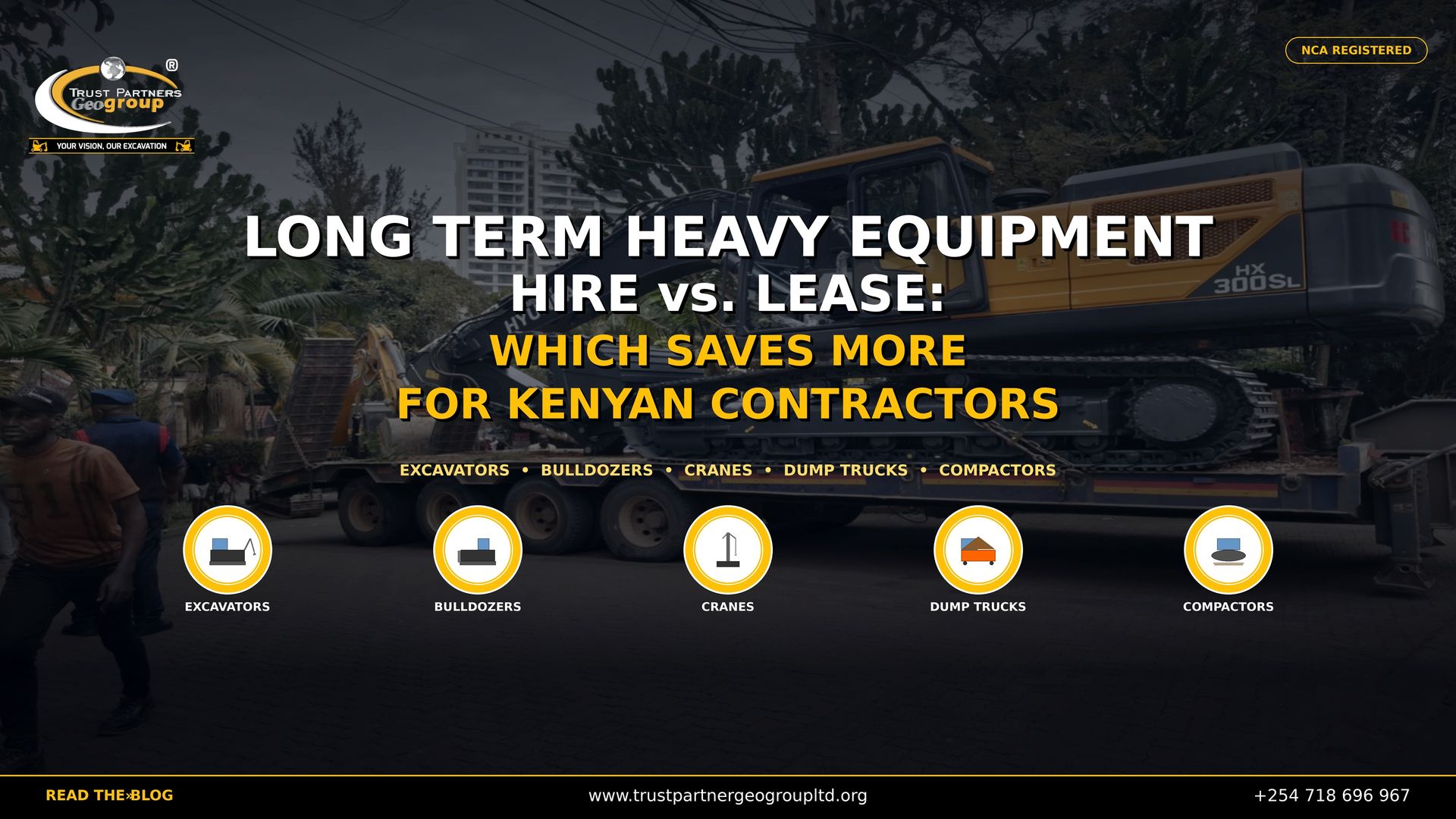
Long-Term Heavy Equipment Hire vs. Lease: Which Saves More for Kenyan Contractors in 2026?
Cost comparison, tax implications & decision matrix for excavators, graders, rollers and dump trucks in Kenya
Table of Contents
- 1. The Equipment Acquisition Dilemma Facing Kenyan Contractors
- 2. What is Heavy Equipment Hire in Kenya?
- 3. What is Construction Equipment Leasing in Kenya?
- 4. Cost Comparison: Hire vs Lease in 2026
- 5. Tax, VAT and Accounting Implications
- 6. Maintenance, Breakdowns and Downtime Risk
- 7. Flexibility and Fleet Scaling
- 8. Decision Matrix: When to Hire vs When to Lease
- 9. Trust Partners Geo-Group Long-Term Hire Packages
- 10. Frequently Asked Questions
- 11. Conclusion
Every Kenyan contractor standing at the gates of a new project faces the same question before breaking ground: do we hire the excavator for six months, or do we lease it for three years? In 2026, with Nairobi's construction volume rebounding and infrastructure spending accelerating, this decision determines whether your project margin lands at 18% or evaporates to 6%. The choice is not simply about monthly rates. It is about capital allocation, tax efficiency, maintenance risk, fleet flexibility, and the hidden costs that never appear in the headline quotation. This guide provides a rigorous, numbers-driven comparison of heavy equipment hire vs lease in Kenya, using real 2026 market rates for excavators, motor graders, rollers and dump trucks. We examine the total cost of ownership, KRA tax treatment, downtime risk allocation, and provide a contractor decision matrix that tells you exactly which acquisition model fits your project pipeline. Whether you are a boutique earthworks contractor in Kiambu or a national road builder with ten active sites, Trust Partners Geo-Group Ltd provides the heavy equipment for hire and fleet management expertise that keeps your balance sheet lean and your projects profitable.
Trust Partners Geo-Group Ltd - Heavy Equipment Hire & Fleet Solutions Team
NCA-registered contractor with 15+ years in heavy equipment hire, long-term rental fleet management and excavation services across Nairobi, Mombasa, Kisumu, Nakuru and all 47 Kenyan counties.
1. The Equipment Acquisition Dilemma Facing Kenyan Contractors
Kenya's construction sector is capital-intensive and cyclical. A contractor bidding on the Nairobi-Mau Summit highway phase needs thirty machines today but may have only three active sites in eighteen months. Purchasing equipment outright ties up millions of shillings in depreciating assets that spend one-third of their life idle. Yet relying on daily spot hire exposes margins to rate volatility and availability gaps during peak season. Leasing promises a middle path - fixed costs, asset control, potential ownership - but locks you into contracts that penalise early exit.
In 2026, the dilemma is sharpened by three market forces. First, bank lending rates remain elevated at 16-18% for commercial equipment finance, making purchase loans expensive. Second, the Kenya Revenue Authority has tightened VAT compliance on cross-border lease arrangements, increasing documentation burden. Third, equipment technology is evolving rapidly: Tier 3 emission excavators, GPS machine control, and telematics-enabled graders are making 2023-model fleets obsolete faster than ever. Contractors who bought machines five years ago now face costly retrofits or competitive disadvantage against hire fleets that refresh annually.
The answer is not universal. A contractor building residential basements in Karen has fundamentally different equipment needs than a road builder in Turkana. This guide breaks the decision into quantifiable components - cost, tax, risk, flexibility - so you can model your specific scenario and choose the path that maximises return on capital employed.
2. What is Heavy Equipment Hire in Kenya?
Heavy equipment hire is a rental agreement where the owner (hiring company) provides a machine for a defined period - daily, weekly, monthly or quarterly - and retains ownership throughout. In Kenya's market, hire splits into two distinct models: dry hire and wet hire.
Dry Hire: Machine Only
Dry hire provides the machine without an operator. The contractor supplies fuel, transport, insurance, and a licensed operator. Daily rates are lower - typically 30-40% below wet hire - but the contractor bears all operational risk. Dry hire suits contractors with in-house operators and workshop capacity who want maximum control. It is common among established earthworks firms in Nairobi and Kiambu with NCA-certified plant operators on payroll.
Wet Hire: Machine Plus Operator
Wet hire includes a machine, a certified operator, fuel, routine maintenance, and insurance. The hiring company manages breakdowns, scheduled servicing, and operator replacement if absent. Wet hire rates are higher but convert a variable cost cluster into a single predictable daily fee. For contractors without in-house mechanics, wet hire eliminates the hidden costs of downtime, spare parts procurement, and operator recruitment. Trust Partners Geo-Group Ltd provides wet hire as our standard offering because Kenyan contractors consistently underestimate the true cost of self-managed maintenance.
Long-Term Hire vs Spot Hire
Spot hire is daily or weekly, often at premium rates with limited availability. Long-term hire contracts run 3-12 months with negotiated monthly rates, guaranteed availability, and fleet swap rights. In 2026, long-term hire discounts range from 15% for 3-month contracts to 25% for 12-month agreements. This is the sweet spot for contractors with predictable project pipelines who want lease-like cost stability without the capital commitment.
3. What is Construction Equipment Leasing in Kenya?
Leasing is a longer-term contractual arrangement where the lessee obtains the right to use an asset for a defined period - typically 24-60 months - in exchange for monthly payments. At lease-end, the lessee may return the asset, renew the lease, or purchase at residual value. In Kenya, leasing structures divide into operating leases and finance leases.
Operating Lease
An operating lease is essentially a long-term rental where the lessor retains ownership and depreciation rights. The lessee records payments as operating expenses. Maintenance and insurance may be bundled or borne by the lessee depending on contract terms. Operating leases offer flexibility and off-balance-sheet treatment but typically carry higher total costs than finance leases because the lessor prices in residual value risk.
Finance Lease (Lease-to-Own)
A finance lease transfers substantially all risks and rewards of ownership to the lessee. The lessee capitalises the asset, claims depreciation, and records interest on the lease liability. Monthly payments are lower than operating leases because the lessee effectively finances the asset purchase over time. At lease-end, the lessee usually exercises a nominal purchase option and owns the machine. Finance leases are attractive for contractors with stable cash flows who want eventual ownership without a large upfront capital outlay.
Hire-Purchase Agreements
Hire-purchase is a hybrid: the hirer pays monthly instalments and gains ownership after the final payment. Unlike finance leases, the asset remains on the seller's balance sheet until the final payment. Hire-purchase is widely used in Kenya for used equipment transactions but less common for new heavy plant because sellers prefer cash or bank-backed leases.
4. Cost Comparison: Hire vs Lease in 2026
The headline rate is never the total cost. Below is a comprehensive comparison for a 20-tonne hydraulic excavator - the most commonly hired machine in Kenyan construction - over a 12-month utilisation scenario at 180 hours per month.
| Cost Component | Short-Term Hire (Daily) | Long-Term Hire (Monthly) | Operating Lease (24 Mo) | Finance Lease (36 Mo) |
|---|---|---|---|---|
| Base Rate (KES) | 22,000/day | 520,000/month | 385,000/month | 295,000/month |
| Annual Cost (180 hrs/mo) | 6,600,000 | 6,240,000 | 4,620,000 | 3,540,000 |
| Operator Wages | Included (wet) | Included (wet) | 55,000/mo (self) | 55,000/mo (self) |
| Fuel (self) | Self | Self | Self | Self |
| Transport to Site | 12,000/move | Included | Self | Self |
| Insurance | Included | Included | 18,000/mo | 18,000/mo |
| Routine Maintenance | Included | Included | Self (35,000/mo) | Self (35,000/mo) |
| Major Repairs | Owner | Owner | Owner (if capped) | Lessee |
| Downtime Risk | Owner bears | Owner bears | Negotiable | Lessee bears |
| Deposit / Upfront | None | 1 month | 2 months | 3 months + VAT |
| Early Exit Penalty | None | 30 days notice | 6 months penalty | Balance + penalty |
| Ownership at End | No | No | No | Yes (nominal fee) |
| Total Annual Cost | ~6,800,000 | ~6,400,000 | ~5,800,000 | ~4,900,000 |
Key insight: On a pure cost basis, finance lease is cheapest annually but requires capital commitment and self-managed maintenance. Long-term hire costs only 15% more than operating lease while eliminating maintenance risk and deposit requirements. For contractors with irregular project pipelines, the flexibility premium of long-term hire is worth the marginal cost.
2026 Heavy Equipment Hire Rate Benchmarks (Nairobi)
These rates reflect wet hire with operator, fuel excluded, for contracts 3+ months:
- 20-tonne excavator: KES 18,000-28,000/day | KES 420,000-650,000/month
- 30-tonne excavator: KES 28,000-42,000/day | KES 650,000-950,000/month
- Motor grader (Caterpillar 140H): KES 22,000-35,000/day | KES 520,000-800,000/month
- 10-tonne smooth drum roller: KES 12,000-18,000/day | KES 280,000-420,000/month
- 20-tonne dump truck: KES 14,000-22,000/day | KES 330,000-520,000/month
- Hydraulic breaker attachment: KES 7,000-8,000/hour (minimum 4 hours/day)
- Low-loader transport: KES 25,000-45,000 per move within Nairobi
5. Tax, VAT and Accounting Implications
How you acquire equipment affects your tax position significantly. Kenyan contractors must consider corporate income tax, VAT, withholding tax, and capital allowances.
Hire Costs: Fully Deductible
Equipment hire costs are recognised as operating expenses in the year incurred. They reduce taxable profit immediately. For a contractor in the 30% corporate tax bracket, every KES 100,000 spent on hire reduces tax liability by KES 30,000. There is no depreciation schedule, no capital allowance complexity, and no residual value risk. Input VAT on hire charges is recoverable if the contractor is VAT-registered and the machines are used for taxable supplies.
Operating Lease: Expense Treatment
Operating lease payments are also fully deductible as operating expenses. The lessor claims capital allowances. The lessee deducts VAT on lease charges. The accounting is straightforward, making operating leases attractive for contractors who want simplicity and off-balance-sheet treatment.
Finance Lease: Capital Allowances and Interest
Under a finance lease, the lessee capitalises the asset and claims capital allowances (industrial building allowance or wear-and-tear allowance) under the Income Tax Act. For heavy plant, wear-and-tear allowance is typically 25-37.5% per annum on a declining balance. The lessee also deducts the interest component of lease payments. However, the lessee must account for VAT on the asset value upfront in some structures, creating a cash flow timing issue. Finance leases require more sophisticated bookkeeping and KRA compliance documentation.
Withholding Tax on Lease Payments
Kenya imposes withholding tax on lease payments to non-resident lessors at 15% (or treaty rates). Even for resident lessors, some finance lease structures trigger 10% withholding tax on the interest component. Contractors must factor this into cash flow planning. Hire payments to resident hiring companies generally do not attract withholding tax, simplifying compliance.
Tax Strategy Recommendation
For contractors with taxable profits exceeding KES 10 million annually, the immediate deductibility of hire costs provides faster tax relief than capital allowances. For loss-making or low-profit contractors, finance lease capital allowances can be carried forward, but this requires careful forecasting. Always engage a KRA-registered tax practitioner before structuring equipment acquisition.
6. Maintenance, Breakdowns and Downtime Risk
The true cost of equipment is not the monthly payment; it is the total cost including downtime. In Kenya's operating environment - dusty sites, variable fuel quality, and long spare parts supply chains - maintenance risk is substantial.
Hire: Risk Transferred to Owner
Under wet hire, the hiring company bears all maintenance and breakdown risk. If the excavator's hydraulic pump fails on a Tuesday, the owner repairs or replaces it at no cost to the contractor. Trust Partners Geo-Group Ltd guarantees 24-hour breakdown response in Nairobi and 48-hour response in Mombasa, Kisumu and Nakuru. This transfers operational risk and protects project schedules. The contractor's only exposure is project delay, which is mitigated by swap-fleet provisions in long-term contracts.
Lease: Risk Borne by Lessee
Under most finance leases and many operating leases, the lessee bears maintenance responsibility. A contractor leasing a grader must budget KES 40,000-60,000 monthly for routine service, plus major overhauls. A single engine rebuild on a 30-tonne excavator can cost KES 2.5-4.5 million. Contractors without workshop infrastructure often find that maintenance costs erode the monthly savings from leasing. Additionally, downtime is the lessee's problem - if the machine breaks down, the project stops and the lease payment continues.
The Hidden Cost of Self-Management
Contractors who choose dry hire or lease often underestimate the overhead of managing maintenance: procurement of genuine parts (vs counterfeit risk), skilled mechanic salaries, workshop rent, and diagnostic tools. A fully equipped plant workshop in Nairobi costs KES 350,000-500,000 monthly in fixed overheads before a single spanner turns. For fleets smaller than eight machines, this overhead per unit is uncompetitive against the bundled maintenance in wet hire.
7. Flexibility and Fleet Scaling
Construction is inherently lumpy. A contractor may need four excavators in Q2 for a road project, then only one in Q3 for maintenance earthworks. The ability to scale fleet size is a strategic advantage.
Hire: Scale Up, Scale Down, Swap
Long-term hire contracts with Trust Partners Geo-Group Ltd include fleet scaling clauses: increase machine count with 14 days notice, reduce with 30 days notice, or swap a 20-tonne excavator for a 30-tonne model as project phases change. This agility is impossible with leased or owned assets. In 2026, where government payment delays and weather disruptions are common, the ability to reduce fixed costs quickly preserves cash flow and survival.
Lease: Fixed Commitment
A lease is a fixed obligation. Reducing fleet size early triggers penalties - typically 50-100% of remaining payments. Swapping machine types requires amending the lease or entering a new contract. For contractors with diversified project types (basements, roads, dams), lease rigidity forces them to maintain machines that sit idle between incompatible projects.
Technology Refresh
Hire fleets refresh every 3-5 years. A contractor hiring in 2026 gets machines with 2023-2025 emissions standards, modern telematics, and GPS readiness. A contractor who leased in 2021 still operates Tier 2 equipment that may face emission restrictions on certain Nairobi County projects or green building contracts. Lease contracts rarely include technology upgrade rights.
8. Decision Matrix: When to Hire vs When to Lease
Use this matrix to determine the optimal acquisition model for your specific contractor profile and project pipeline.
| Contractor Profile | Recommended Model | Rationale |
|---|---|---|
| Startup / First project | Wet hire (monthly) | Zero capital risk, no maintenance overhead, immediate tax deductibility |
| Seasonal work (rainy season gaps) | Long-term hire with scaling clause | Reduce fleet in low season without penalty; maintain cash flow |
| Single large project (6-18 months) | Long-term hire (quarterly rate) | Cost stability without residual value risk; owner handles breakdowns |
| Continuous pipeline (3+ years) | Finance lease or buy | Lowest per-unit cost; utilisation justifies capital commitment |
| Specialised work (breakers, GPS control) | Hire with attachment packages | Technology changes rapidly; avoid obsolescence risk |
| Remote sites (Turkana, Lamu, Northern Kenya) | Wet hire with logistics included | Owner manages transport, spare parts logistics and field mechanics |
| Tax-loss carryforward position | Finance lease | Capital allowances utilised against future profits |
| High-profit, high-tax bracket | Hire or operating lease | Immediate expense deduction minimises current-year tax |
The 65% Utilisation Rule
Our empirical data from 200+ Kenyan contractors shows that the break-even point between hire and lease occurs at approximately 65% annual utilisation. If a machine will operate more than 65% of available working days (roughly 1,560 hours annually), finance lease or purchase becomes cost-competitive. Below 65%, long-term hire wins on total cost of ownership when maintenance, downtime and administrative overhead are fully loaded.
9. Trust Partners Geo-Group Long-Term Hire Packages
Trust Partners Geo-Group Ltd has structured our 2026 long-term hire packages specifically to bridge the gap between short-term hire flexibility and lease cost efficiency. We provide the cost benefits of commitment without the capital risk and maintenance burden of leasing.
Package Structure
Our long-term packages run 3, 6, 9 or 12 months with the following inclusions:
- Machine + NCA-certified operator: All operators hold current NCA plant operator licences and undergo site-specific safety induction.
- Scheduled maintenance: 250-hour service intervals performed on-site or at our Nairobi workshop, minimising downtime.
- 24/7 breakdown response: Guaranteed replacement machine or field mechanic dispatch within 24 hours in Nairobi, 48 hours in Mombasa, Kisumu, Nakuru and Kiambu.
- Fuel monitoring: Telematics-enabled fuel tracking prevents theft and optimises consumption.
- Fleet swap rights: Exchange machine types once per quarter to match project phase changes.
- Transport included: Delivery and collection within Nairobi metro included; discounted rates for upcountry moves.
- Insurance cover: Comprehensive commercial insurance covering fire, theft, and third-party liability while on your site.
2026 Long-Term Hire Discount Tiers
| Contract Duration | Discount off Daily Rate | Payment Terms |
|---|---|---|
| 3 months | 15% | Monthly in advance |
| 6 months | 20% | Monthly in advance |
| 9 months | 23% | Monthly in advance |
| 12 months | 25% | Quarterly in advance (additional 3% discount) |
For contractors managing multiple simultaneous projects, we offer fleet management retainers: a fixed monthly fee covering a mixed fleet of excavators, graders, rollers and trucks with unlimited swap rights and priority breakdown response. This converts variable equipment costs into a predictable fixed overhead, simplifying budgeting and cash flow forecasting.
10. Frequently Asked Questions: Heavy Equipment Hire vs Lease in Kenya
Is it cheaper to hire or lease heavy equipment in Kenya in 2026?
For projects under 12 months, hiring is cheaper in Kenya in 2026 because there is no capital commitment, deposit, or financing interest. For multi-year fleet needs exceeding 24 months, leasing becomes cheaper on a per-day basis due to lower monthly rates, though early termination penalties apply. Contractors with seasonal work should hire; those with continuous 3-5 year programmes should lease.
What is the difference between equipment hire and lease in Kenya?
Equipment hire in Kenya is a short-to-medium term rental where the owner retains title and typically provides maintenance, insurance, and operators. Lease is a longer-term contract where the lessee assumes operational responsibility, pays a fixed monthly fee, and may own the asset at lease-end. Hire offers flexibility; lease offers asset control and potential ownership.
What are typical heavy equipment hire rates in Nairobi for 2026?
In 2026, Nairobi heavy equipment hire rates are: 20-tonne excavator KES 18,000-28,000 per day or KES 420,000-650,000 per month; 30-tonne excavator KES 28,000-42,000 per day; motor grader KES 22,000-35,000 per day; 10-tonne roller KES 12,000-18,000 per day; 20-tonne dump truck KES 14,000-22,000 per day. Long-term hire discounts of 15-25% apply for contracts over 3 months.
Can I claim tax deductions on hired equipment in Kenya?
Yes. Equipment hire costs are fully deductible business expenses in the year incurred under Kenyan tax law. Lease payments are also deductible, but finance leases may be treated as capital expenditure requiring depreciation over the asset life. Operating leases remain fully deductible. Always consult a KRA-registered tax advisor to structure the contract correctly.
Who pays for maintenance on leased construction equipment in Kenya?
Under an operating lease, the lessor typically covers major maintenance and insurance. Under a finance lease or hire-purchase agreement, the lessee bears all maintenance, repair, insurance, and downtime costs. Dry hire agreements in Kenya place maintenance on the hirer, while wet hire packages include maintenance and certified operators in the daily rate.
What is the best equipment acquisition strategy for a small contractor in Kenya?
Small contractors in Kenya should prioritize wet hire with operator packages for the first 2-3 years. This eliminates capital risk, maintenance headaches, and operator recruitment costs. Once annual equipment utilisation exceeds 65% across 12 continuous months, transitioning to long-term hire or lease yields better unit economics. Avoid buying new until cash reserves exceed 18 months of operating costs.
Does Trust Partners Geo-Group offer long-term heavy equipment hire in Kenya?
Yes. Trust Partners Geo-Group Ltd offers long-term heavy equipment hire across Kenya with monthly and quarterly rates for excavators, motor graders, rollers, dump trucks, breakers and low-loaders. All long-term packages include NCA-certified operators, scheduled maintenance, and 24/7 breakdown response in Nairobi, Mombasa, Kisumu, Nakuru and Kiambu. Contact +254 718 68 69 67 for a customised fleet quotation.
11. Conclusion: Hire for Agility, Lease for Ownership
The hire-vs-lease debate is not a moral question of contractor seriousness. It is a financial optimisation problem with a clear analytical answer. In 2026, Kenyan contractors who value agility, cash flow preservation, and risk transfer should choose long-term wet hire. The 15-25% premium over lease rates is insurance against downtime, maintenance surprises, and market volatility. Contractors with predictable, multi-year pipelines and in-house workshop capacity should evaluate finance leases for the lowest per-unit cost and eventual asset ownership.
The danger lies in the middle: contractors who sign operating leases thinking they are getting lease economics with hire flexibility, or who buy equipment with bank debt at 18% interest while projects are delayed. The 65% utilisation rule is a reliable compass. Measure your actual machine hours, load all costs including maintenance and downtime, and choose the structure that aligns with your project pipeline, tax position, and risk appetite.
Trust Partners Geo-Group Ltd has built our fleet around the reality of Kenyan construction: projects start late, weather disrupts schedules, and maintenance is harder than the brochure suggests. Our long-term hire packages give you lease-like cost stability with hire-like flexibility. You do not carry depreciation on your balance sheet. You do not hunt for mechanics at midnight. You do not pay for a grader that sits idle between road phases. You simply build.
For a customised fleet cost comparison - hire vs lease vs buy - specific to your 2026 project pipeline, contact Trust Partners Geo-Group Ltd. We will model your utilisation, load the tax implications, and recommend the acquisition structure that maximises your margin.
Long-Term Heavy Equipment Hire in Kenya
Excavators, motor graders, rollers, dump trucks and breakers with NCA-certified operators, maintenance included and 24/7 breakdown response across Nairobi, Mombasa, Kisumu, Nakuru and Kiambu.
Free lead magnet: ask for our Heavy Equipment Hire vs Lease Decision Matrix (PDF) - cost calculator, tax comparison tables, utilisation benchmarks and contract checklists for Kenyan contractors.
Related Resources
15 Years of Excavation Excellence: Heavy Equipment Rental in Kenya
Two decades of fleet evolution, operator training standards and how Trust Partners Geo-Group built Kenya's most reliable heavy equipment rental service.
READ MOREQuality Assurance in Pre-Owned Equipment by Trust Partners Geo-Group
How we inspect, refurbish and certify used excavators, graders and rollers to ensure that pre-owned fleet meets the same reliability standards as new machines.
READ MOREConstruction Heavy Equipment Machinery for Hire in Kenya
Complete fleet guide: excavators, motor graders, rollers, dump trucks and specialised attachments available for short-term and long-term hire across all counties.
READ MOREConstruction Heavy Equipment Hire Rental Prices in Kenya 2026
Transparent 2026 pricing benchmarks for daily, weekly and monthly hire rates across excavator classes, grader models and compaction equipment.
READ MOREBuying vs Hiring Construction Heavy Equipment in Kenya
The capital acquisition debate: when ownership makes sense, when hire protects cash flow, and the break-even analysis for contractors expanding their fleet.
READ MOREExcavator Hire Prices in Kenya: Hourly, Daily, Monthly Rates 2026
Granular rate breakdown for 11-tonne, 20-tonne and 30-tonne excavators with operator packages, breaker attachments and long-term discount structures.
READ MORETRUST PARTNERS GEO-GROUP LTD | YOUR EXCAVATION IS OUR FUTURE
WEBSITE: WWW.TRUSTPARTNERGEOGROUPLTD.ORG | EMAIL: INFO@TRUSTPARTNERGEOGROUPLTD.ORG | PHONE: +254 718 68 69 67
FOLLOW US: FACEBOOK | TIKTOK | INSTAGRAM | LINKEDIN
© 2026 TRUST PARTNERS GEO-GROUP LTD. ALL RIGHTS RESERVED.
Long-Term Heavy Equipment Hire vs. Lease: Which Saves More for Kenyan Contractors in 2026?
Cost comparison, tax implications & decision matrix for excavators, graders, rollers and dump trucks in Kenya
Table of Contents
- 1. The Equipment Acquisition Dilemma Facing Kenyan Contractors
- 2. What is Heavy Equipment Hire in Kenya?
- 3. What is Construction Equipment Leasing in Kenya?
- 4. Cost Comparison: Hire vs Lease in 2026
- 5. Tax, VAT and Accounting Implications
- 6. Maintenance, Breakdowns and Downtime Risk
- 7. Flexibility and Fleet Scaling
- 8. Decision Matrix: When to Hire vs When to Lease
- 9. Trust Partners Geo-Group Long-Term Hire Packages
- 10. Frequently Asked Questions
- 11. Conclusion
Every Kenyan contractor standing at the gates of a new project faces the same question before breaking ground: do we hire the excavator for six months, or do we lease it for three years? In 2026, with Nairobi's construction volume rebounding and infrastructure spending accelerating, this decision determines whether your project margin lands at 18% or evaporates to 6%. The choice is not simply about monthly rates. It is about capital allocation, tax efficiency, maintenance risk, fleet flexibility, and the hidden costs that never appear in the headline quotation. This guide provides a rigorous, numbers-driven comparison of heavy equipment hire vs lease in Kenya, using real 2026 market rates for excavators, motor graders, rollers and dump trucks. We examine the total cost of ownership, KRA tax treatment, downtime risk allocation, and provide a contractor decision matrix that tells you exactly which acquisition model fits your project pipeline. Whether you are a boutique earthworks contractor in Kiambu or a national road builder with ten active sites, Trust Partners Geo-Group Ltd provides the heavy equipment for hire and fleet management expertise that keeps your balance sheet lean and your projects profitable.
Trust Partners Geo-Group Ltd - Heavy Equipment Hire & Fleet Solutions Team
NCA-registered contractor with 15+ years in heavy equipment hire, long-term rental fleet management and excavation services across Nairobi, Mombasa, Kisumu, Nakuru and all 47 Kenyan counties.
1. The Equipment Acquisition Dilemma Facing Kenyan Contractors
Kenya's construction sector is capital-intensive and cyclical. A contractor bidding on the Nairobi-Mau Summit highway phase needs thirty machines today but may have only three active sites in eighteen months. Purchasing equipment outright ties up millions of shillings in depreciating assets that spend one-third of their life idle. Yet relying on daily spot hire exposes margins to rate volatility and availability gaps during peak season. Leasing promises a middle path - fixed costs, asset control, potential ownership - but locks you into contracts that penalise early exit.
In 2026, the dilemma is sharpened by three market forces. First, bank lending rates remain elevated at 16-18% for commercial equipment finance, making purchase loans expensive. Second, the Kenya Revenue Authority has tightened VAT compliance on cross-border lease arrangements, increasing documentation burden. Third, equipment technology is evolving rapidly: Tier 3 emission excavators, GPS machine control, and telematics-enabled graders are making 2023-model fleets obsolete faster than ever. Contractors who bought machines five years ago now face costly retrofits or competitive disadvantage against hire fleets that refresh annually.
The answer is not universal. A contractor building residential basements in Karen has fundamentally different equipment needs than a road builder in Turkana. This guide breaks the decision into quantifiable components - cost, tax, risk, flexibility - so you can model your specific scenario and choose the path that maximises return on capital employed.
2. What is Heavy Equipment Hire in Kenya?
Heavy equipment hire is a rental agreement where the owner (hiring company) provides a machine for a defined period - daily, weekly, monthly or quarterly - and retains ownership throughout. In Kenya's market, hire splits into two distinct models: dry hire and wet hire.
Dry Hire: Machine Only
Dry hire provides the machine without an operator. The contractor supplies fuel, transport, insurance, and a licensed operator. Daily rates are lower - typically 30-40% below wet hire - but the contractor bears all operational risk. Dry hire suits contractors with in-house operators and workshop capacity who want maximum control. It is common among established earthworks firms in Nairobi and Kiambu with NCA-certified plant operators on payroll.
Wet Hire: Machine Plus Operator
Wet hire includes a machine, a certified operator, fuel, routine maintenance, and insurance. The hiring company manages breakdowns, scheduled servicing, and operator replacement if absent. Wet hire rates are higher but convert a variable cost cluster into a single predictable daily fee. For contractors without in-house mechanics, wet hire eliminates the hidden costs of downtime, spare parts procurement, and operator recruitment. Trust Partners Geo-Group Ltd provides wet hire as our standard offering because Kenyan contractors consistently underestimate the true cost of self-managed maintenance.
Long-Term Hire vs Spot Hire
Spot hire is daily or weekly, often at premium rates with limited availability. Long-term hire contracts run 3-12 months with negotiated monthly rates, guaranteed availability, and fleet swap rights. In 2026, long-term hire discounts range from 15% for 3-month contracts to 25% for 12-month agreements. This is the sweet spot for contractors with predictable project pipelines who want lease-like cost stability without the capital commitment.
3. What is Construction Equipment Leasing in Kenya?
Leasing is a longer-term contractual arrangement where the lessee obtains the right to use an asset for a defined period - typically 24-60 months - in exchange for monthly payments. At lease-end, the lessee may return the asset, renew the lease, or purchase at residual value. In Kenya, leasing structures divide into operating leases and finance leases.
Operating Lease
An operating lease is essentially a long-term rental where the lessor retains ownership and depreciation rights. The lessee records payments as operating expenses. Maintenance and insurance may be bundled or borne by the lessee depending on contract terms. Operating leases offer flexibility and off-balance-sheet treatment but typically carry higher total costs than finance leases because the lessor prices in residual value risk.
Finance Lease (Lease-to-Own)
A finance lease transfers substantially all risks and rewards of ownership to the lessee. The lessee capitalises the asset, claims depreciation, and records interest on the lease liability. Monthly payments are lower than operating leases because the lessee effectively finances the asset purchase over time. At lease-end, the lessee usually exercises a nominal purchase option and owns the machine. Finance leases are attractive for contractors with stable cash flows who want eventual ownership without a large upfront capital outlay.
Hire-Purchase Agreements
Hire-purchase is a hybrid: the hirer pays monthly instalments and gains ownership after the final payment. Unlike finance leases, the asset remains on the seller's balance sheet until the final payment. Hire-purchase is widely used in Kenya for used equipment transactions but less common for new heavy plant because sellers prefer cash or bank-backed leases.
4. Cost Comparison: Hire vs Lease in 2026
The headline rate is never the total cost. Below is a comprehensive comparison for a 20-tonne hydraulic excavator - the most commonly hired machine in Kenyan construction - over a 12-month utilisation scenario at 180 hours per month.
| Cost Component | Short-Term Hire (Daily) | Long-Term Hire (Monthly) | Operating Lease (24 Mo) | Finance Lease (36 Mo) |
|---|---|---|---|---|
| Base Rate (KES) | 22,000/day | 520,000/month | 385,000/month | 295,000/month |
| Annual Cost (180 hrs/mo) | 6,600,000 | 6,240,000 | 4,620,000 | 3,540,000 |
| Operator Wages | Included (wet) | Included (wet) | 55,000/mo (self) | 55,000/mo (self) |
| Fuel (self) | Self | Self | Self | Self |
| Transport to Site | 12,000/move | Included | Self | Self |
| Insurance | Included | Included | 18,000/mo | 18,000/mo |
| Routine Maintenance | Included | Included | Self (35,000/mo) | Self (35,000/mo) |
| Major Repairs | Owner | Owner | Owner (if capped) | Lessee |
| Downtime Risk | Owner bears | Owner bears | Negotiable | Lessee bears |
| Deposit / Upfront | None | 1 month | 2 months | 3 months + VAT |
| Early Exit Penalty | None | 30 days notice | 6 months penalty | Balance + penalty |
| Ownership at End | No | No | No | Yes (nominal fee) |
| Total Annual Cost | ~6,800,000 | ~6,400,000 | ~5,800,000 | ~4,900,000 |
Key insight: On a pure cost basis, finance lease is cheapest annually but requires capital commitment and self-managed maintenance. Long-term hire costs only 15% more than operating lease while eliminating maintenance risk and deposit requirements. For contractors with irregular project pipelines, the flexibility premium of long-term hire is worth the marginal cost.
2026 Heavy Equipment Hire Rate Benchmarks (Nairobi)
These rates reflect wet hire with operator, fuel excluded, for contracts 3+ months:
- 20-tonne excavator: KES 18,000-28,000/day | KES 420,000-650,000/month
- 30-tonne excavator: KES 28,000-42,000/day | KES 650,000-950,000/month
- Motor grader (Caterpillar 140H): KES 22,000-35,000/day | KES 520,000-800,000/month
- 10-tonne smooth drum roller: KES 12,000-18,000/day | KES 280,000-420,000/month
- 20-tonne dump truck: KES 14,000-22,000/day | KES 330,000-520,000/month
- Hydraulic breaker attachment: KES 7,000-8,000/hour (minimum 4 hours/day)
- Low-loader transport: KES 25,000-45,000 per move within Nairobi
5. Tax, VAT and Accounting Implications
How you acquire equipment affects your tax position significantly. Kenyan contractors must consider corporate income tax, VAT, withholding tax, and capital allowances.
Hire Costs: Fully Deductible
Equipment hire costs are recognised as operating expenses in the year incurred. They reduce taxable profit immediately. For a contractor in the 30% corporate tax bracket, every KES 100,000 spent on hire reduces tax liability by KES 30,000. There is no depreciation schedule, no capital allowance complexity, and no residual value risk. Input VAT on hire charges is recoverable if the contractor is VAT-registered and the machines are used for taxable supplies.
Operating Lease: Expense Treatment
Operating lease payments are also fully deductible as operating expenses. The lessor claims capital allowances. The lessee deducts VAT on lease charges. The accounting is straightforward, making operating leases attractive for contractors who want simplicity and off-balance-sheet treatment.
Finance Lease: Capital Allowances and Interest
Under a finance lease, the lessee capitalises the asset and claims capital allowances (industrial building allowance or wear-and-tear allowance) under the Income Tax Act. For heavy plant, wear-and-tear allowance is typically 25-37.5% per annum on a declining balance. The lessee also deducts the interest component of lease payments. However, the lessee must account for VAT on the asset value upfront in some structures, creating a cash flow timing issue. Finance leases require more sophisticated bookkeeping and KRA compliance documentation.
Withholding Tax on Lease Payments
Kenya imposes withholding tax on lease payments to non-resident lessors at 15% (or treaty rates). Even for resident lessors, some finance lease structures trigger 10% withholding tax on the interest component. Contractors must factor this into cash flow planning. Hire payments to resident hiring companies generally do not attract withholding tax, simplifying compliance.
Tax Strategy Recommendation
For contractors with taxable profits exceeding KES 10 million annually, the immediate deductibility of hire costs provides faster tax relief than capital allowances. For loss-making or low-profit contractors, finance lease capital allowances can be carried forward, but this requires careful forecasting. Always engage a KRA-registered tax practitioner before structuring equipment acquisition.
6. Maintenance, Breakdowns and Downtime Risk
The true cost of equipment is not the monthly payment; it is the total cost including downtime. In Kenya's operating environment - dusty sites, variable fuel quality, and long spare parts supply chains - maintenance risk is substantial.
Hire: Risk Transferred to Owner
Under wet hire, the hiring company bears all maintenance and breakdown risk. If the excavator's hydraulic pump fails on a Tuesday, the owner repairs or replaces it at no cost to the contractor. Trust Partners Geo-Group Ltd guarantees 24-hour breakdown response in Nairobi and 48-hour response in Mombasa, Kisumu and Nakuru. This transfers operational risk and protects project schedules. The contractor's only exposure is project delay, which is mitigated by swap-fleet provisions in long-term contracts.
Lease: Risk Borne by Lessee
Under most finance leases and many operating leases, the lessee bears maintenance responsibility. A contractor leasing a grader must budget KES 40,000-60,000 monthly for routine service, plus major overhauls. A single engine rebuild on a 30-tonne excavator can cost KES 2.5-4.5 million. Contractors without workshop infrastructure often find that maintenance costs erode the monthly savings from leasing. Additionally, downtime is the lessee's problem - if the machine breaks down, the project stops and the lease payment continues.
The Hidden Cost of Self-Management
Contractors who choose dry hire or lease often underestimate the overhead of managing maintenance: procurement of genuine parts (vs counterfeit risk), skilled mechanic salaries, workshop rent, and diagnostic tools. A fully equipped plant workshop in Nairobi costs KES 350,000-500,000 monthly in fixed overheads before a single spanner turns. For fleets smaller than eight machines, this overhead per unit is uncompetitive against the bundled maintenance in wet hire.
7. Flexibility and Fleet Scaling
Construction is inherently lumpy. A contractor may need four excavators in Q2 for a road project, then only one in Q3 for maintenance earthworks. The ability to scale fleet size is a strategic advantage.
Hire: Scale Up, Scale Down, Swap
Long-term hire contracts with Trust Partners Geo-Group Ltd include fleet scaling clauses: increase machine count with 14 days notice, reduce with 30 days notice, or swap a 20-tonne excavator for a 30-tonne model as project phases change. This agility is impossible with leased or owned assets. In 2026, where government payment delays and weather disruptions are common, the ability to reduce fixed costs quickly preserves cash flow and survival.
Lease: Fixed Commitment
A lease is a fixed obligation. Reducing fleet size early triggers penalties - typically 50-100% of remaining payments. Swapping machine types requires amending the lease or entering a new contract. For contractors with diversified project types (basements, roads, dams), lease rigidity forces them to maintain machines that sit idle between incompatible projects.
Technology Refresh
Hire fleets refresh every 3-5 years. A contractor hiring in 2026 gets machines with 2023-2025 emissions standards, modern telematics, and GPS readiness. A contractor who leased in 2021 still operates Tier 2 equipment that may face emission restrictions on certain Nairobi County projects or green building contracts. Lease contracts rarely include technology upgrade rights.
8. Decision Matrix: When to Hire vs When to Lease
Use this matrix to determine the optimal acquisition model for your specific contractor profile and project pipeline.
| Contractor Profile | Recommended Model | Rationale |
|---|---|---|
| Startup / First project | Wet hire (monthly) | Zero capital risk, no maintenance overhead, immediate tax deductibility |
| Seasonal work (rainy season gaps) | Long-term hire with scaling clause | Reduce fleet in low season without penalty; maintain cash flow |
| Single large project (6-18 months) | Long-term hire (quarterly rate) | Cost stability without residual value risk; owner handles breakdowns |
| Continuous pipeline (3+ years) | Finance lease or buy | Lowest per-unit cost; utilisation justifies capital commitment |
| Specialised work (breakers, GPS control) | Hire with attachment packages | Technology changes rapidly; avoid obsolescence risk |
| Remote sites (Turkana, Lamu, Northern Kenya) | Wet hire with logistics included | Owner manages transport, spare parts logistics and field mechanics |
| Tax-loss carryforward position | Finance lease | Capital allowances utilised against future profits |
| High-profit, high-tax bracket | Hire or operating lease | Immediate expense deduction minimises current-year tax |
The 65% Utilisation Rule
Our empirical data from 200+ Kenyan contractors shows that the break-even point between hire and lease occurs at approximately 65% annual utilisation. If a machine will operate more than 65% of available working days (roughly 1,560 hours annually), finance lease or purchase becomes cost-competitive. Below 65%, long-term hire wins on total cost of ownership when maintenance, downtime and administrative overhead are fully loaded.
9. Trust Partners Geo-Group Long-Term Hire Packages
Trust Partners Geo-Group Ltd has structured our 2026 long-term hire packages specifically to bridge the gap between short-term hire flexibility and lease cost efficiency. We provide the cost benefits of commitment without the capital risk and maintenance burden of leasing.
Package Structure
Our long-term packages run 3, 6, 9 or 12 months with the following inclusions:
- Machine + NCA-certified operator: All operators hold current NCA plant operator licences and undergo site-specific safety induction.
- Scheduled maintenance: 250-hour service intervals performed on-site or at our Nairobi workshop, minimising downtime.
- 24/7 breakdown response: Guaranteed replacement machine or field mechanic dispatch within 24 hours in Nairobi, 48 hours in Mombasa, Kisumu, Nakuru and Kiambu.
- Fuel monitoring: Telematics-enabled fuel tracking prevents theft and optimises consumption.
- Fleet swap rights: Exchange machine types once per quarter to match project phase changes.
- Transport included: Delivery and collection within Nairobi metro included; discounted rates for upcountry moves.
- Insurance cover: Comprehensive commercial insurance covering fire, theft, and third-party liability while on your site.
2026 Long-Term Hire Discount Tiers
| Contract Duration | Discount off Daily Rate | Payment Terms |
|---|---|---|
| 3 months | 15% | Monthly in advance |
| 6 months | 20% | Monthly in advance |
| 9 months | 23% | Monthly in advance |
| 12 months | 25% | Quarterly in advance (additional 3% discount) |
For contractors managing multiple simultaneous projects, we offer fleet management retainers: a fixed monthly fee covering a mixed fleet of excavators, graders, rollers and trucks with unlimited swap rights and priority breakdown response. This converts variable equipment costs into a predictable fixed overhead, simplifying budgeting and cash flow forecasting.
10. Frequently Asked Questions: Heavy Equipment Hire vs Lease in Kenya
Is it cheaper to hire or lease heavy equipment in Kenya in 2026?
For projects under 12 months, hiring is cheaper in Kenya in 2026 because there is no capital commitment, deposit, or financing interest. For multi-year fleet needs exceeding 24 months, leasing becomes cheaper on a per-day basis due to lower monthly rates, though early termination penalties apply. Contractors with seasonal work should hire; those with continuous 3-5 year programmes should lease.
What is the difference between equipment hire and lease in Kenya?
Equipment hire in Kenya is a short-to-medium term rental where the owner retains title and typically provides maintenance, insurance, and operators. Lease is a longer-term contract where the lessee assumes operational responsibility, pays a fixed monthly fee, and may own the asset at lease-end. Hire offers flexibility; lease offers asset control and potential ownership.
What are typical heavy equipment hire rates in Nairobi for 2026?
In 2026, Nairobi heavy equipment hire rates are: 20-tonne excavator KES 18,000-28,000 per day or KES 420,000-650,000 per month; 30-tonne excavator KES 28,000-42,000 per day; motor grader KES 22,000-35,000 per day; 10-tonne roller KES 12,000-18,000 per day; 20-tonne dump truck KES 14,000-22,000 per day. Long-term hire discounts of 15-25% apply for contracts over 3 months.
Can I claim tax deductions on hired equipment in Kenya?
Yes. Equipment hire costs are fully deductible business expenses in the year incurred under Kenyan tax law. Lease payments are also deductible, but finance leases may be treated as capital expenditure requiring depreciation over the asset life. Operating leases remain fully deductible. Always consult a KRA-registered tax advisor to structure the contract correctly.
Who pays for maintenance on leased construction equipment in Kenya?
Under an operating lease, the lessor typically covers major maintenance and insurance. Under a finance lease or hire-purchase agreement, the lessee bears all maintenance, repair, insurance, and downtime costs. Dry hire agreements in Kenya place maintenance on the hirer, while wet hire packages include maintenance and certified operators in the daily rate.
What is the best equipment acquisition strategy for a small contractor in Kenya?
Small contractors in Kenya should prioritize wet hire with operator packages for the first 2-3 years. This eliminates capital risk, maintenance headaches, and operator recruitment costs. Once annual equipment utilisation exceeds 65% across 12 continuous months, transitioning to long-term hire or lease yields better unit economics. Avoid buying new until cash reserves exceed 18 months of operating costs.
Does Trust Partners Geo-Group offer long-term heavy equipment hire in Kenya?
Yes. Trust Partners Geo-Group Ltd offers long-term heavy equipment hire across Kenya with monthly and quarterly rates for excavators, motor graders, rollers, dump trucks, breakers and low-loaders. All long-term packages include NCA-certified operators, scheduled maintenance, and 24/7 breakdown response in Nairobi, Mombasa, Kisumu, Nakuru and Kiambu. Contact +254 718 68 69 67 for a customised fleet quotation.
11. Conclusion: Hire for Agility, Lease for Ownership
The hire-vs-lease debate is not a moral question of contractor seriousness. It is a financial optimisation problem with a clear analytical answer. In 2026, Kenyan contractors who value agility, cash flow preservation, and risk transfer should choose long-term wet hire. The 15-25% premium over lease rates is insurance against downtime, maintenance surprises, and market volatility. Contractors with predictable, multi-year pipelines and in-house workshop capacity should evaluate finance leases for the lowest per-unit cost and eventual asset ownership.
The danger lies in the middle: contractors who sign operating leases thinking they are getting lease economics with hire flexibility, or who buy equipment with bank debt at 18% interest while projects are delayed. The 65% utilisation rule is a reliable compass. Measure your actual machine hours, load all costs including maintenance and downtime, and choose the structure that aligns with your project pipeline, tax position, and risk appetite.
Trust Partners Geo-Group Ltd has built our fleet around the reality of Kenyan construction: projects start late, weather disrupts schedules, and maintenance is harder than the brochure suggests. Our long-term hire packages give you lease-like cost stability with hire-like flexibility. You do not carry depreciation on your balance sheet. You do not hunt for mechanics at midnight. You do not pay for a grader that sits idle between road phases. You simply build.
For a customised fleet cost comparison - hire vs lease vs buy - specific to your 2026 project pipeline, contact Trust Partners Geo-Group Ltd. We will model your utilisation, load the tax implications, and recommend the acquisition structure that maximises your margin.
Long-Term Heavy Equipment Hire in Kenya
Excavators, motor graders, rollers, dump trucks and breakers with NCA-certified operators, maintenance included and 24/7 breakdown response across Nairobi, Mombasa, Kisumu, Nakuru and Kiambu.
Free lead magnet: ask for our Heavy Equipment Hire vs Lease Decision Matrix (PDF) - cost calculator, tax comparison tables, utilisation benchmarks and contract checklists for Kenyan contractors.
Related Resources
15 Years of Excavation Excellence: Heavy Equipment Rental in Kenya
Two decades of fleet evolution, operator training standards and how Trust Partners Geo-Group built Kenya's most reliable heavy equipment rental service.
READ MOREQuality Assurance in Pre-Owned Equipment by Trust Partners Geo-Group
How we inspect, refurbish and certify used excavators, graders and rollers to ensure that pre-owned fleet meets the same reliability standards as new machines.
READ MOREConstruction Heavy Equipment Machinery for Hire in Kenya
Complete fleet guide: excavators, motor graders, rollers, dump trucks and specialised attachments available for short-term and long-term hire across all counties.
READ MOREConstruction Heavy Equipment Hire Rental Prices in Kenya 2026
Transparent 2026 pricing benchmarks for daily, weekly and monthly hire rates across excavator classes, grader models and compaction equipment.
READ MOREBuying vs Hiring Construction Heavy Equipment in Kenya
The capital acquisition debate: when ownership makes sense, when hire protects cash flow, and the break-even analysis for contractors expanding their fleet.
READ MOREExcavator Hire Prices in Kenya: Hourly, Daily, Monthly Rates 2026
Granular rate breakdown for 11-tonne, 20-tonne and 30-tonne excavators with operator packages, breaker attachments and long-term discount structures.
READ MORETRUST PARTNERS GEO-GROUP LTD | YOUR EXCAVATION IS OUR FUTURE
WEBSITE: WWW.TRUSTPARTNERGEOGROUPLTD.ORG | EMAIL: INFO@TRUSTPARTNERGEOGROUPLTD.ORG | PHONE: +254 718 68 69 67
FOLLOW US: FACEBOOK | TIKTOK | INSTAGRAM | LINKEDIN
© 2026 TRUST PARTNERS GEO-GROUP LTD. ALL RIGHTS RESERVED.