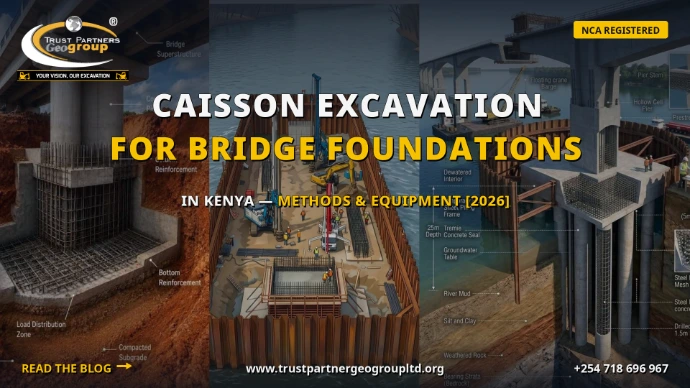
Caisson Excavation for Bridge Foundations in Kenya: Methods & Equipment [2026]
THE COMPLETE GUIDE TO DEEP BRIDGE FOUNDATIONS IN KENYA'S RIVERS, HIGHLANDS, AND COASTAL WATERS
Table of Contents
- 1. Why Caissons Are Essential for Bridge Foundations
- 2. Types of Caissons Used in Kenya
- 2.1 Open Caissons
- 2.2 Pneumatic Caissons
- 2.3 Drilled Shafts (Bored Piles)
- 2.4 Box Caissons
- 3. Kenyan Geology and Caisson Challenges
- 4. Caisson Excavation Equipment
- 5. Construction Methods and Techniques
- 5.1 Dry Method
- 5.2 Slurry Method
- 5.3 Tremie Underwater Concreting
- 6. Quality Control and Testing
- 7. Caisson Excavation Costs in Kenya (2026)
- 8. Major Bridge Projects in Kenya Using Caissons
- 9. The Trust Partners Geo-Group Caisson Process
- 10. Frequently Asked Questions
- 11. The Bottom Line: Building Bridges That Last

WHY CAISSONS ARE ESSENTIAL FOR BRIDGE FOUNDATIONS
Bridges impose unique loads on foundations: concentrated vertical loads from pier columns, lateral loads from wind and water currents, and moment forces from uneven span loading. Shallow foundations (spread footings, mat foundations) cannot reliably support these loads in Kenya's variable riverbed and hillside soils. Caissons solve this by:
- Reaching competent strata: Caissons extend through weak surface soils (alluvium, soft clay, loose sand) to dense soil or rock with adequate bearing capacity (2,000+ kPa)
- Resisting scour: River bridges face scour - the erosion of soil around foundations by fast-moving water. Caissons are embedded deep below scour depth, ensuring stability even when riverbed material is washed away
- Minimizing settlement: Deep foundations transfer loads to stable strata, eliminating differential settlement that would crack bridge decks and damage bearings
- Handling lateral loads: The large diameter and deep embedment of caissons provide resistance to horizontal forces from wind, water currents, and seismic activity
- Working in water: Caissons can be constructed underwater using tremie concreting, eliminating the need for expensive cofferdams in deep or fast-flowing rivers
- Supporting heavy loads: A single 2.5m diameter caisson can support 15,000-25,000 kN - sufficient for multi-span highway bridges
THE SCOUR PROBLEM: WHY BRIDGE PIERS FAIL IN KENYA'S RIVERS
Scour is the leading cause of bridge failure worldwide, and Kenya is no exception. During floods, river velocities increase dramatically, excavating soil around pier foundations. A pier founded on spread footings at 3m depth may be undermined when scour reaches 5m. The Tana River has scoured to 12m during major floods. Caissons embedded 15-25m below riverbed are immune to scour - even if the entire riverbed is washed away, the caisson remains supported by the deep bearing stratum. The additional cost of deep caissons (KES 5M-15M per pier) is trivial compared to the cost of bridge collapse and reconstruction (KES 500M-2B+).
TYPES OF CAISSONS USED IN KENYA
Four main caisson types are used for bridge construction in Kenya, each suited to different soil, water, and load conditions.
OPEN CAISSONS
Open caissons are large-diameter shafts excavated in the dry (with dewatering) or underwater (using clamshell buckets), then filled with concrete. They are the most common type for Kenyan bridge construction.
- Construction: A steel or concrete cutting edge is placed at ground level. Soil is excavated from inside the shaft using clamshell buckets, draglines, or grab cranes. The caisson sinks under its own weight as material is removed. When design depth is reached, the base is cleaned and concrete is placed.
- Diameter: 1.5m-6.0m for bridge piers
- Depth: 5m-40m depending on soil conditions
- Best for: Dry land construction, shallow water, cohesive soils where walls stand without support
- Advantages: Simple construction, no compressed air needed, large load capacity
- Disadvantages: Difficult to control verticality in deep excavations; dewatering required in water-bearing soils; limited to soils where walls are self-supporting
PNEUMATIC CAISSONS
Pneumatic caissons use compressed air to keep water out of the working chamber, allowing excavation in saturated conditions below the water table.
- Construction: A working chamber at the bottom of the caisson is pressurized with compressed air. Workers enter through an airlock and excavate in dry conditions. Air pressure equals hydrostatic pressure at the working face. Concrete is placed in the dry chamber.
- Working pressure: Up to 3.5 bar (equivalent to 35m water depth)
- Best for: Deep foundations in rivers or harbors where dewatering is impossible; excavation through boulders or obstructions
- Advantages: Allows dry work in deep water; direct visual inspection of bearing surface; can handle obstructions
- Disadvantages: Expensive (compressed air plant, airlocks, medical facilities); hazardous (decompression sickness risk); limited working time (4-6 hours per shift at high pressure); rarely used in modern Kenya due to safety regulations
Note: Pneumatic caissons are largely obsolete in Kenyan construction. Drilled shafts with slurry walls and tremie concreting have replaced them for safety and cost reasons.
DRILLED SHAFTS (BORED PILES)
Drilled shafts are the modern standard for bridge caissons in Kenya. They are constructed by rotary drilling a cylindrical hole, then filling it with reinforced concrete.
- Construction: A rotary drilling rig with kelly bar and drilling bucket excavates the shaft. Temporary steel casing is installed through unstable layers. The base is cleaned with a bailer or air lift. A prefabricated rebar cage is lowered, and concrete is placed by tremie pipe or direct pour.
- Diameter: 0.8m-3.0m (standard bridge piers: 1.2m-2.5m)
- Depth: 10m-50m+
- Best for: Most soil conditions; underwater construction; confined sites; variable rock depths
- Advantages: Precise verticality control; minimal ground disturbance; can be constructed in water; fast production rates; no dewatering needed with slurry
- Disadvantages: Requires specialized drilling equipment; base cleaning critical; concrete quality dependent on tremie technique
BOX CAISSONS
Box caissons are hollow precast concrete boxes floated to position and sunk onto a prepared foundation. They are used for bridge piers in deep water where in-situ construction is impractical.
- Construction: Precast concrete boxes with open tops are cast on land, floated to the bridge site, and progressively ballasted with water/concrete until they sink onto the prepared riverbed. The interior is then filled with concrete.
- Dimensions: 5m x 5m to 15m x 20m for major bridge piers
- Best for: Deep water bridge piers (Mombasa port, Likoni channel, Lake Victoria)
- Advantages: Minimal underwater work; factory-quality concrete; rapid installation once floated
- Disadvantages: Requires deep water access for floating; heavy lifting equipment; precise positioning required; limited to sites with adequate water depth
| CAISSON TYPE | DIAMETER/ SIZE | DEPTH RANGE | BEST FOR | COST (KES) | COMPLEXITY |
|---|---|---|---|---|---|
| Open Caisson | 1.5-6.0m | 5-40m | Dry land, shallow water, cohesive soils | Medium | Moderate |
| Pneumatic Caisson | 2.0-6.0m | 15-45m | Deep water, boulders, obstructions | Very High | Very High |
| Drilled Shaft | 0.8-3.0m | 10-50m+ | Most soils, underwater, confined sites | Medium-High | Moderate |
| Box Caisson | 5x5m to 15x20m | 10-30m water | Deep water, major piers | High | High |
KENYAN GEOLOGY AND CAISSON CHALLENGES
Kenya's diverse geology creates unique challenges for caisson construction. Each region requires different approaches, equipment, and expertise.
RIVER VALLEY GEOLOGY (TANA, ATHI, MARA, SONDU)
| LAYER | DEPTH | CHARACTERISTICS | CAISSON CHALLENGE | SOLUTION |
|---|---|---|---|---|
| Alluvium / river sand | 0-5m | Loose, saturated, high permeability, prone to scour | Collapse during excavation; high water inflow | Temporary casing, slurry support, dewatering |
| Soft clay / silt | 3-10m | Low shear strength, high compressibility, organic content | Base heave; sidewall squeeze; low bearing capacity | Deep embedment; belled base; soil replacement |
| Gravel / cobble layer | 5-15m | Variable density; boulders; difficult drilling | Drilling tool damage; slow penetration; deviation | Heavy-duty drilling buckets; roller bits; casing oscillator |
| Weathered rock | 10-25m | Decomposed volcanic or sedimentary rock; variable strength | Difficulty distinguishing soil from rock; overbreak | Core sampling; rock-socket design; careful base cleaning |
| Competent bedrock | 15-40m+ | Fresh basalt, phonolite, gneiss, limestone | Hard rock drilling; slow production; tool wear | Core barrels; roller cone bits; air hammer; extended drilling time |
COASTAL GEOLOGY (MOMBASA, LAMU, MALINDI)
Coastal bridge foundations face coral limestone, sandy soils, and tidal conditions:
- Coral sand: Highly permeable, loose, difficult to stabilize during drilling. Requires full-length casing or heavy bentonite slurry.
- Coral limestone: Variable hardness; solution cavities common. Cavities can cause sudden loss of drilling fluid and ground collapse. Requires probing with down-hole cameras and grouting of voids before concreting.
- Tidal effects: Water level changes of 2-4m affect dewatering and tremie concreting. Work must be timed to tidal windows or designed for worst-case water level.
- Saltwater corrosion: Reinforcement and casing must be protected against saltwater attack. Epoxy-coated rebar, stainless steel couplers, and high-density concrete (minimum 50 MPa) are standard.
HIGHLAND GEOLOGY (NAIROBI, KIAMBU, NAKURU)
Highland bridge foundations encounter volcanic soils and rock:
- Red volcanic soil (Murram): Dense, granular, well-drained. Caissons can be constructed dry with minimal support. Bearing capacity is good at 10-15m depth.
- Volcanic tuff: Soft, erodible, variable strength. Requires careful base cleaning and integrity testing.
- Hard volcanic rock (Basalt, Phonolite): Extremely strong (100-200 MPa) but fractured. Rock socket design required; caissons must extend 3-5m into fresh rock.
- Black cotton soil pockets: Expansive clay in valleys and lowlands. Caissons must extend well below the expansive layer (minimum 5m into stable material).
THE CORAL CAVITY PROBLEM IN MOMBASA
Coastal limestone in Mombasa contains solution cavities formed by groundwater dissolution. A caisson drilled through apparently solid limestone may encounter a 2-meter void at 18m depth. If not detected, concrete flows into the void, leaving the caisson shaft partially empty. Trust Partners Geo-Group uses down-hole cameras and sonic logging to verify caisson integrity in coral limestone. We also pre-grout cavities with cement slurry before caisson construction. This adds 10-15% to caisson cost but prevents catastrophic failure.
CAISSON EXCAVATION EQUIPMENT
Caisson construction requires specialized heavy equipment. Trust Partners Geo-Group maintains a fleet of caisson-specific machinery for projects across Kenya.
PRIMARY EXCAVATION EQUIPMENT
| EQUIPMENT | SPECIFICATION | APPLICATION | PRODUCTIVITY | DAILY HIRE (KES) |
|---|---|---|---|---|
| Rotary drilling rig (small) | 30-50 ton, 60m depth, 1.0-1.5m diameter | Road overpasses, small river bridges | 15-25m/day in soil | 80,000-120,000 |
| Rotary drilling rig (medium) | 80-120 ton, 80m depth, 1.5-2.5m diameter | Highway bridges, medium river piers | 20-35m/day in soil, 5-10m/day in rock | 150,000-220,000 |
| Rotary drilling rig (large) | 150-250 ton, 100m+ depth, 2.5-3.5m diameter | Major bridges, deep foundations | 15-25m/day in soil, 3-8m/day in rock | 250,000-400,000 |
| Reverse circulation rig | 100-200 ton, dual wall drill pipe | Deep shafts in water-bearing strata | 30-50m/day in soil | 200,000-350,000 |
| Casing oscillator | 80-150 ton, 2.0-3.0m diameter casing | Unstable soils, boulders, obstructions | 10-20m/day | 180,000-280,000 |
| Crane-mounted clamshell | 80-120 ton crane, 1.5m clamshell | Open caissons, dry excavation | 50-100m3/day | 120,000-180,000 |
| Core barrel (rock drilling) | 1.0-2.5m diameter, roller cone or diamond bits | Rock socket excavation | 1-5m/day in hard rock | 40,000-80,000 (attachment) |
| Tremie concrete pump | 60-100m3/hour, 200-300mm pipe | Underwater concreting | 30-60m3/hour | 50,000-80,000 |
| Dewatering pump system | Deep well pumps, 50-200m3/hour | Dewatering for dry excavation | Variable | 30,000-60,000 |
| Slurry plant | Bentonite mixing, 100-500m3/day | Slurry-supported excavation | 200-400m3/day | 40,000-70,000 |
SUPPORTING EQUIPMENT
- Crawler cranes (80-250 ton): Lift and lower rebar cages, casing, tremie pipes, and drilling tools. Essential for all caisson operations.
- Concrete batching plant (60-120m3/hour): Produce high-strength concrete (40-60 MPa) with consistent quality. Mobile plants for remote sites.
- Rebar fabrication yard: Prefabricate cages up to 30m long with stiffening rings, lifting lugs, and centralizers.
- Survey equipment: GPS and total station for precise pier positioning; inclinometers for verticality monitoring during drilling.
- Testing equipment: Slurry testing kit (density, viscosity, sand content), concrete testing (slump, temperature, air content), integrity testing (sonic logging).
- Diving equipment: For underwater inspection, base cleaning, and obstruction removal in deep water.
CONSTRUCTION METHODS AND TECHNIQUES
The method chosen depends on soil conditions, water table, and project requirements. Three methods dominate Kenyan caisson construction.
DRY METHOD
Used when the water table is below the caisson base and soil walls are self-supporting.
- Procedure: (1) Position drilling rig over pier location; (2) Drill shaft using rotary bucket or auger; (3) Install temporary casing through unstable upper layers; (4) Continue drilling to design depth; (5) Clean base with bailing bucket or air lift; (6) Place rebar cage; (7) Pour concrete directly or by tremie if water is present.
- Best for: Nairobi highland soils above water table; weathered rock; cohesive soils with stand-up time
- Advantages: Simple, fast, low cost, direct visual inspection of base
- Limitations: Cannot be used below water table in permeable soils; requires stable walls
SLURRY METHOD
Used in saturated soils where dewatering is impractical and walls need support.
- Procedure: (1) Drill shaft filled with bentonite slurry (density 1.05-1.15 g/cm3, viscosity 30-50 seconds); (2) Slurry stabilizes walls and prevents water inflow; (3) Excavate using rotary bucket under slurry; (4) Before concreting, verify slurry properties and clean base; (5) Displace slurry with concrete using tremie pipe.
- Slurry specification: Bentonite content 4-6% by weight; Marsh funnel viscosity 32-50 seconds; sand content under 4%; pH 9-11; density 1.05-1.15 g/cm3.
- Best for: Sandy soils, riverbeds, water-bearing strata, deep excavations
- Advantages: No dewatering needed; walls supported at all times; suitable for underwater work
- Limitations: Requires slurry plant and testing; base cleaning more difficult; slurry disposal required
TREMIE UNDERWATER CONCRETING
The standard method for placing concrete underwater or under slurry in caissons.
- Equipment: Tremie pipe (200-300mm diameter steel pipe) with hopper at top; concrete pump or crane-mounted bucket.
- Procedure: (1) Lower tremie pipe to base of caisson; (2) Seal pipe bottom with plug or keep submerged in fresh concrete; (3) Pour concrete continuously into hopper; (4) Concrete flows down pipe and displaces water/slurry upward; (5) Maintain pipe embedment 1.5-3m in fresh concrete at all times; (6) Raise pipe gradually as concrete level rises; (7) Continue until concrete overflows at top.
- Concrete requirements: Slump 150-200mm; rich mix 1:1.5:3; minimum 40 MPa; maximum aggregate size 20mm (for 250mm pipe) or 40mm (for 300mm pipe); no segregation; continuous supply.
- Quality control: Slump test every truck; temperature monitoring; cube samples for 7-day and 28-day testing; core drilling if integrity is questioned.
TREMIE CONCRETING QUALITY CHECKLIST
- Concrete mix approved by engineer before pour
- Slump 150-200mm verified on every truck
- Tremie pipe diameter minimum 8x aggregate size
- Pipe bottom kept submerged 1.5m minimum in fresh concrete
- Continuous pour - no interruptions over 30 minutes
- Concrete supply rate exceeds rise rate (minimum 10m/hour)
- Slurry/water displaced completely - no contamination
- Overpour 500mm above design level to ensure quality at top
- Cube samples taken every 50m3 or every truck
- Temperature monitoring if ambient exceeds 30 degrees C
QUALITY CONTROL AND TESTING
Caisson quality is non-negotiable - a defective caisson cannot be repaired. Rigorous testing at every stage ensures long-term bridge performance.
DURING CONSTRUCTION TESTS
| TEST | FREQUENCY | ACCEPTANCE CRITERIA | PURPOSE |
|---|---|---|---|
| Verticality check | Every 2m of depth | Deviation under 1% of depth (2cm per 2m) | Ensure caisson is plumb |
| Base cleaning verification | Before every pour | No loose material, no slurry sediment over 50mm | Ensure bearing on competent material |
| Slurry testing | Every 2 hours during drilling | Density 1.05-1.15 g/cm3, viscosity 30-50s, sand under 4% | Verify wall stability |
| Concrete slump | Every truckload | 150-200mm for tremie; 100-150mm for dry pour | Ensure workability |
| Concrete temperature | Every truckload | Under 30 degrees C at placement | Prevent thermal cracking |
| Cube samples | Every 50m3 or per truck | 7-day strength over 70% of design; 28-day over 100% | Verify concrete strength |
| Rebar inspection | Before every pour | Diameter, spacing, cover, cage diameter per design | Verify reinforcement |
POST-CONSTRUCTION TESTS
| TEST | METHOD | FREQUENCY | PURPOSE |
|---|---|---|---|
| Sonic logging | Ultrasonic pulse transmitted between access tubes | All major caissons; 20% of minor caissons | Detect voids, necking, inclusions |
| Cross-hole sonic logging | Transmitter and receiver in paired tubes | Critical caissons over 2.0m diameter | Detailed integrity mapping |
| Low-strain integrity testing | Impact echo method (tapping + accelerometer) | All caissons | Quick screening for major defects |
| Core drilling | 100mm diameter core extracted for lab testing | 5% of caissons or where integrity is questioned | Direct concrete quality verification |
| Static load test | Apply 1.5x design load and measure settlement | One per bridge or per 10 caissons | Verify bearing capacity |
| O-cell load test | Hydraulic jack at base measures side and base resistance separately | Major bridges or where separate verification needed | Determine side friction and base bearing separately |
THE IMPORTANCE OF BASE CLEANING
The most common caisson defect in Kenya is inadequate base cleaning. A 50mm layer of loose sediment or slurry cake at the caisson base reduces bearing capacity by 30-50% and creates a weak plane for settlement. In 2022, a bridge pier in Western Kenya settled 80mm in its first year because the contractor failed to clean the base before concreting. The repair cost (KES 12M) exceeded the original caisson cost (KES 8M). Trust Partners Geo-Group uses air lift pumps, bailing buckets, and down-hole cameras to verify base cleanliness before every pour. We also require engineer inspection and sign-off on base condition before authorizing concreting.
CAISSON EXCAVATION COSTS IN KENYA (2026)
Caisson costs are highly variable. The following ranges represent typical Kenyan market rates for 2026.
CAISSON COST BY TYPE AND SIZE
| CAISSON TYPE | DIAMETER | DEPTH | SOIL | ROCK | UNDERWATER |
|---|---|---|---|---|---|
| Small drilled shaft | 1.0-1.2m | 10-15m | KES 2M-4M | KES 3M-6M | KES 3.5M-7M |
| Medium drilled shaft | 1.5-2.0m | 15-25m | KES 5M-10M | KES 8M-15M | KES 10M-18M |
| Large drilled shaft | 2.5-3.0m | 20-35m | KES 12M-20M | KES 18M-30M | KES 22M-35M |
| Extra-large shaft | 3.5-4.5m | 30-50m | KES 25M-40M | KES 35M-55M | KES 40M-65M |
| Open caisson | 2.0-4.0m | 10-25m | KES 8M-15M | KES 12M-22M | N/A |
| Box caisson | 5x5m to 10x10m | 10-20m | N/A | N/A | KES 30M-80M |
COST COMPONENTS BREAKDOWN
| COST ITEM | PERCENTAGE OF TOTAL | TYPICAL COST (MEDIUM CAISSON) |
|---|---|---|
| Site setup and dewatering | 8-15% | KES 800K-1.5M |
| Drilling/excavation | 25-35% | KES 2.5M-4M |
| Steel reinforcement | 15-20% | KES 1.5M-2.5M |
| Concrete | 20-25% | KES 2M-3M |
| Temporary casing | 5-10% | KES 500K-1M |
| Testing and quality control | 3-5% | KES 300K-500K |
| Engineering and supervision | 5-8% | KES 500K-800K |
| Equipment mobilization | 5-10% | KES 500K-1M |
BRIDGE PROJECT COST EXAMPLES
| PROJECT TYPE | SPAN | PIERS | CAISSON SPEC | TOTAL CAISSON COST |
|---|---|---|---|---|
| Road overpass (urban) | 30m | 2 piers | 2 x 1.2m x 12m | KES 8M-12M |
| Highway river bridge | 80m | 3 piers | 3 x 2.0m x 20m | KES 35M-55M |
| Major river bridge | 150m | 4 piers | 4 x 2.5m x 30m | KES 80M-120M |
| Coastal bridge (deep water) | 200m | 5 piers | 5 x 3.0m x 35m | KES 150M-220M |
| Long-span bridge | 400m+ | 6 piers + towers | 6 x 3.5m x 40m + tower caissons | KES 300M-500M |
Costs are indicative and vary by site conditions, access, contractor experience, and project urgency. Remote sites (Garissa, Turkana, Marsabit) add 20-40% for transport and logistics. Emergency or fast-track projects add 30-50%.
MAJOR BRIDGE PROJECTS IN KENYA USING CAISSONS
Kenya's infrastructure pipeline includes numerous bridge projects that rely on caisson foundations. Here are notable examples:
| PROJECT | LOCATION | CAISSON DETAILS | CONTRACTOR/STATUS |
|---|---|---|---|
| Mombasa Gate Bridge | Mombasa Port | 3.5m diameter, 35m depth, coral limestone | Under construction; deep water caissons with tremie concreting |
| Tana River Bridge (A2 Highway) | Garissa Road | 2.5m diameter, 25m depth, alluvium over rock | Completed 2024; slurry method with reverse circulation |
| Athi River Super Bridge | Nairobi-Mombasa Highway | 3.0m diameter, 30m depth, volcanic soils | Planned 2026-2028; largest highway bridge in East Africa |
| Mara River Bridge (Tourism) | Masai Mara | 2.0m diameter, 18m depth, river alluvium | Completed 2023; environmental constraints limited methods |
| Sondu Miriu Bridge | Kisumu-Kericho Road | 2.0m diameter, 20m depth, black cotton over rock | Completed 2022; deep embedment through expansive clay |
| Nairobi Expressway Overpasses | Nairobi | 1.5m diameter, 12-15m depth, weathered rock | Completed 2022; dry method with hydraulic hammer for rock |
| Lamu Port Access Bridges | Lamu | 2.5m diameter, 25m depth, coastal sand and coral | Under construction; full-length casing required |
| Webuye-Kitale Bridge | Western Kenya | 2.0m diameter, 22m depth, lateritic soil | Planned 2027; challenging access for heavy equipment |
THE TRUST PARTNERS GEO-GROUP CAISSON PROCESS
At Trust Partners Geo-Group Ltd, caisson construction follows a rigorous process that ensures safety, quality, and schedule compliance.
PHASE 1: INVESTIGATION AND DESIGN
- Geotechnical investigation: Boreholes at each pier location (typically 2-3 per pier) to 1.5x design depth. Laboratory testing for strength, permeability, and aggressiveness.
- Hydrological survey: River flow rates, flood levels, scour depth, and water chemistry for river bridges.
- Caisson design: Diameter, depth, reinforcement, and concrete grade based on structural loads and soil capacity. Design by registered structural engineer.
- Method statement: Detailed construction sequence, equipment selection, quality control plan, and risk assessment.
- Permits: NEMA approval for river works, KURA/KENHA approval for highway bridges, county permits, and water authority permits.
PHASE 2: SITE SETUP AND MOBILIZATION
- Working platform: Construct stable platform at pier location. For river piers, use temporary causeways or barges.
- Dewatering: Install wellpoints or deep wells if dry method is planned. Test dewatering capacity before excavation.
- Equipment positioning: Position drilling rig and crane with adequate reach and capacity. Verify ground bearing capacity under outriggers.
- Slurry plant: If using slurry method, set up mixing plant, test slurry properties, and establish circulation system.
PHASE 3: EXCAVATION AND CONSTRUCTION
- Drilling: Excavate shaft using rotary rig, maintaining verticality within 1% tolerance. Install casing through unstable layers.
- Base cleaning: Remove all loose material, slurry sediment, and water. Verify base condition with camera or diver inspection.
- Rebar placement: Lower prefabricated cage using crane. Ensure centralizers maintain minimum concrete cover (75mm typical).
- Concreting: Place concrete by tremie method (underwater) or direct pour (dry). Monitor slump, temperature, and pour rate continuously.
- Curing: Protect fresh concrete from rapid drying in hot weather. Water cure for minimum 7 days.
PHASE 4: TESTING AND HANDOVER
- Integrity testing: Sonic logging or low-strain testing on all caissons. Core drilling if anomalies detected.
- Load testing: Static or O-cell load testing on representative caissons to verify capacity.
- As-built documentation: Compile drilling logs, concrete records, test reports, and survey data.
- Handover: Submit to engineer, client, and KURA/KENHA (for public projects). Include 10-year warranty on workmanship.
- TRUST PARTNERS GEO-GROUP LTD
FREQUENTLY ASKED QUESTIONS: CAISSON EXCAVATION FOR BRIDGE FOUNDATIONS IN KENYA
What is a caisson foundation and when is it used?
A caisson is a deep foundation element constructed by excavating a cylindrical shaft through soil or rock and filling it with reinforced concrete. Caissons are used when: (1) Surface soils are too weak to support bridge loads; (2) Foundations must extend below scour depth in rivers; (3) Large lateral loads from wind or water currents must be resisted; (4) Settlement must be minimized for long-span bridges; (5) Construction in water requires dry working conditions. In Kenya, caissons are standard for major bridge piers over the Tana, Athi, Mara, and Sondu rivers, as well as for highway overpasses in Nairobi and Mombasa.
What is the difference between open caissons and pneumatic caissons?
Open caissons are excavated dry using conventional equipment (clamshell buckets, drilling rigs) with dewatering if needed. They are suitable for soil and soft rock above the water table or where dewatering is feasible. Pneumatic caissons use compressed air to keep water out of the working chamber, allowing excavation in saturated conditions below the water table. Workers enter through an airlock and work under pressure. Pneumatic caissons are used for deep foundations in rivers or harbors where dewatering is impossible. However, they are expensive, hazardous (decompression sickness risk), and rarely used in modern Kenyan construction - drilled shafts with slurry walls or cofferdams have largely replaced them.
How deep can caissons be excavated in Kenya?
Caisson depth depends on soil conditions, load requirements, and equipment. Typical depths in Kenya: (1) Road overpasses and small bridges: 5-15 meters through soil to firm stratum; (2) Major river bridges: 15-30 meters through alluvium and weathered rock to bedrock; (3) Deep foundations in Nairobi's volcanic soils: 10-20 meters to competent rock; (4) Coastal bridges in Mombasa: 20-40 meters through coral sand and clay to limestone bedrock. The deepest caissons in Kenya are for the Mombasa Port expansion, reaching 45 meters below seabed level. Depth is determined by geotechnical investigation - the caisson must bear on competent material (rock or dense soil) with adequate bearing capacity (typically 2,000 kPa minimum for bridge piers).
What equipment is used for caisson excavation in Kenya?
Key equipment for caisson excavation: (1) Rotary drilling rigs (50-150 ton capacity) with kelly bars and drilling buckets for soil and soft rock; (2) Reverse circulation drilling rigs for deep shafts in water-bearing strata; (3) Tremie concrete pumps for underwater concreting; (4) Crane-mounted clamshell buckets for open caissons in dry conditions; (5) Dewatering pumps (wellpoints, deep wells, sump pumps) for dry excavation; (6) Slurry mixing and circulation equipment for bentonite-supported excavations; (7) Rebar cages (prefabricated and lifted by crane); (8) Concrete batching plants with 40+ MPa capacity; (9) Oscillator/rotator systems for casing advancement in unstable soils; (10) Vibration hammers for casing extraction. For large projects, Trust Partners Geo-Group deploys 80-120 ton crawler cranes with 60+ meter booms to handle deep caisson operations.
How much does caisson excavation cost in Kenya?
Caisson costs vary dramatically by diameter, depth, soil conditions, and location. Indicative 2026 pricing: Small caissons (1.0-1.5m diameter, 5-10m depth): KES 2M-5M each. Medium caissons (1.5-2.5m diameter, 10-20m depth): KES 5M-15M each. Large caissons (2.5-4.0m diameter, 20-30m depth): KES 15M-30M each. Extra-large caissons (4.0m+ diameter, 30m+ depth): KES 30M-50M+ each. Factors increasing cost: (1) Rock excavation adds 50-100%; (2) Underwater construction adds 30-60%; (3) Deep dewatering adds 20-40%; (4) Remote sites add 15-30% for transport; (5) Tight access requires specialized equipment. A typical 4-pier river bridge with 2.0m diameter caissons at 20m depth costs KES 40M-80M for caisson foundations alone. This represents 15-25% of total bridge construction cost.
What is the tremie method for underwater concreting?
The tremie method is the standard technique for placing concrete underwater in caissons. A tremie pipe (200-300mm diameter steel pipe) is lowered to the bottom of the caisson, with a hopper at the top. Concrete is poured into the hopper and flows down the pipe, displacing water upward. The pipe bottom is kept submerged in fresh concrete at all times (minimum 1.5m embedment) to prevent water ingress and concrete segregation. Key requirements: (1) Concrete mix must be highly workable (slump 150-200mm) with no segregation; (2) Rich mix (1:1.5:3 or stronger) with 40+ MPa strength; (3) Continuous pour without interruption - cold joints are unacceptable; (4) Pipe diameter at least 8x maximum aggregate size; (5) Initial plug (basketball or foam plug) seals the pipe bottom until concrete flow starts. The tremie method produces concrete with strength comparable to dry-placed concrete when done correctly. Trust Partners Geo-Group uses tremie concreting for all underwater caisson work with full quality control testing.
How is caisson quality controlled during construction?
Caisson quality control involves: (1) Verticality monitoring - survey checks every 2m of depth to ensure deviation under 1% of depth (2cm per 2m); (2) Base cleaning - verify no loose material or slurry sediment before concreting; (3) Concrete testing - slump tests every truckload, cube samples for 7-day and 28-day strength, core drilling if required; (4) Integrity testing - sonic logging or cross-hole sonic logging to detect voids or defects; (5) Load testing - static load tests on representative caissons to 1.5x design load; (6) Rebar inspection - verify cage diameter, length, spacing, and concrete cover before pour; (7) Dewatering records - document water levels before and during excavation; (8) Excavation logs - record soil/rock type at each depth for as-built documentation. For critical bridges, KURA and KENHA require third-party inspection and independent testing. NCA registration is mandatory for caisson contractors on public projects.
What are the main risks in caisson excavation and how are they managed?
Main risks: (1) Collapse of excavation walls in soft or water-bearing soils - managed by casing, slurry support, or dewatering; (2) Base heave in deep excavations in clay - managed by limiting excavation depth and rate, maintaining water balance; (3) Groundwater inflow overwhelming dewatering - managed by deep wells, wellpoints, or switching to slurry method; (4) Concrete defects in underwater placement - managed by tremie method, continuous pour, and integrity testing; (5) Rebar cage buckling during lifting - managed by stiffening rings, controlled lift, and template guides; (6) Equipment failure in deep shafts - managed by redundant hoists, emergency retrieval plans, and communication systems; (7) Worker safety in confined spaces - managed by gas monitoring, ventilation, harness systems, and rescue plans. Trust Partners Geo-Group prepares detailed method statements and risk assessments for every caisson project, with emergency procedures for all identified hazards.
Can caissons be used in Kenya's black cotton soil?
Caissons in black cotton soil require special measures. The expansive nature of black cotton soil (swelling up to 30% when wet, shrinking when dry) creates lateral pressure on caisson walls and potential uplift at the base. Solutions: (1) Belled caissons - enlarged base (bell) resists uplift and increases bearing area; (2) Skin friction reduction - coat caisson walls with bitumen or use smooth casing to reduce swelling pressure transfer; (3) Deep embedment - extend caissons 3-5m below black cotton layer into stable material; (4) Base anchoring - rock anchors or under-reamed bases resist uplift; (5) Surrounding drainage - prevent water accumulation around caisson group. In Kenya's Rift Valley where black cotton is prevalent, caissons are typically extended 15-25m to reach volcanic rock beneath the expansive layer. The additional cost is justified by elimination of differential settlement and long-term stability. Never construct short caissons entirely within black cotton soil - seasonal movement will destroy the foundation.
How long does caisson construction take per pier?
Timeline per caisson depends on diameter, depth, soil, and conditions. Typical durations in Kenya: Small caissons (1.0-1.5m, 5-10m depth) in soil: 5-10 days. Medium caissons (1.5-2.5m, 10-20m depth) in soil/soft rock: 10-20 days. Large caissons (2.5-4.0m, 20-30m depth) in mixed conditions: 20-40 days. Extra-large caissons (4.0m+, 30m+) in hard rock or underwater: 40-80 days. Activities breakdown: Site setup and dewatering: 2-5 days. Excavation: 3-20 days depending on depth and material. Base cleaning and inspection: 1-2 days. Rebar cage placement: 1-3 days. Concreting: 1-2 days (must be continuous). Curing and form removal: 7-14 days. Load testing (if required): 3-7 days. Parallel operations can reduce total project time - while one caisson cures, the next is excavated. For a 4-pier bridge, total caisson program is typically 3-6 months with sequential construction.
THE BOTTOM LINE: BUILDING BRIDGES THAT LAST
Caisson foundations are the invisible backbone of Kenya's bridge infrastructure. Every major river crossing, every highway overpass, every coastal viaduct depends on caissons that were excavated with precision, filled with quality concrete, and tested to rigorous standards. A bridge deck can be repaired; a caisson cannot.
The principles of successful caisson construction are clear:
- Investigate thoroughly: Geotechnical investigation is not an expense - it is the foundation of the foundation. Know your soil, rock, water, and scour before designing.
- Design conservatively: Caissons must survive 100-year floods, seismic events, and decades of scour. Design for the worst case, not the average.
- Execute precisely: Verticality, base cleaning, concrete quality, and curing are not negotiable. A 1% deviation or 50mm of loose sediment can compromise a KES 20M caisson.
- Test rigorously: Integrity testing, load testing, and core drilling verify what you cannot see. Never skip testing to save money.
- Work with specialists: Caisson construction requires specialized equipment, experienced crews, and engineering oversight. General contractors without caisson experience should partner with specialists.
- Plan for the long term: A bridge designed for 50 years needs caissons designed for 100. Scour protection, corrosion protection, and monitoring systems extend service life.
At Trust Partners Geo-Group Ltd, we bring together heavy drilling equipment, experienced caisson crews, geotechnical partnerships, and rigorous quality control to deliver bridge foundations that meet KURA, KENHA, and international standards. From the Tana River to the Mombasa coast, from Nairobi's expressways to Western Kenya's river crossings, we build the deep foundations that keep Kenya's bridges standing.
Whether you are designing a small road overpass in Kiambu, a major river bridge in Garissa, or a coastal viaduct in Mombasa, caisson quality determines bridge longevity. Do not compromise on investigation, design, or execution. Build deep, build strong, and build to last.
- TRUST PARTNERS GEO-GROUP LTD
NEED CAISSON EXCAVATION FOR YOUR BRIDGE PROJECT?
Trust Partners Geo-Group provides comprehensive caisson excavation, drilled shaft construction, and deep foundation services for bridge projects across Kenya. Contact us for a free geotechnical assessment, caisson design consultation, and detailed project quotation.
CALL +254 718 68 69 67 EMAIL US VISIT OUR WEBSITE
NAIROBI HQ | SERVING NAIROBI, MOMBASA, KISUMU, NAKURU, ELDORET, THIKA, GARISSA, KITALE, MACHAKOS, KIAMBU & NATIONWIDE
MON - SAT: 8:00 AM - 6:00 PM | 24/7 EMERGENCY FOUNDATION SUPPORT
RELATED RESOURCES
TRUST PARTNERS GEO-GROUP LTD | YOUR VISION, OUR EXCAVATION
WEBSITE: WWW.TRUSTPARTNERGEOGROUPLTD.ORG | EMAIL: INFO@TRUSTPARTNERGEOGROUPLTD.ORG | PHONE: +254 718 68 69 67
FOLLOW US: FACEBOOK | TIKTOK | INSTAGRAM | YOUTUBE | LINKEDIN
© 2026 TRUST PARTNERS GEO-GROUP LTD. ALL RIGHTS RESERVED.
Caisson Excavation for Bridge Foundations in Kenya: Methods & Equipment [2026]
THE COMPLETE GUIDE TO DEEP BRIDGE FOUNDATIONS IN KENYA'S RIVERS, HIGHLANDS, AND COASTAL WATERS
Table of Contents
- 1. Why Caissons Are Essential for Bridge Foundations
- 2. Types of Caissons Used in Kenya
- 2.1 Open Caissons
- 2.2 Pneumatic Caissons
- 2.3 Drilled Shafts (Bored Piles)
- 2.4 Box Caissons
- 3. Kenyan Geology and Caisson Challenges
- 4. Caisson Excavation Equipment
- 5. Construction Methods and Techniques
- 5.1 Dry Method
- 5.2 Slurry Method
- 5.3 Tremie Underwater Concreting
- 6. Quality Control and Testing
- 7. Caisson Excavation Costs in Kenya (2026)
- 8. Major Bridge Projects in Kenya Using Caissons
- 9. The Trust Partners Geo-Group Caisson Process
- 10. Frequently Asked Questions
- 11. The Bottom Line: Building Bridges That Last
WHY CAISSONS ARE ESSENTIAL FOR BRIDGE FOUNDATIONS
Bridges impose unique loads on foundations: concentrated vertical loads from pier columns, lateral loads from wind and water currents, and moment forces from uneven span loading. Shallow foundations (spread footings, mat foundations) cannot reliably support these loads in Kenya's variable riverbed and hillside soils. Caissons solve this by:
- Reaching competent strata: Caissons extend through weak surface soils (alluvium, soft clay, loose sand) to dense soil or rock with adequate bearing capacity (2,000+ kPa)
- Resisting scour: River bridges face scour - the erosion of soil around foundations by fast-moving water. Caissons are embedded deep below scour depth, ensuring stability even when riverbed material is washed away
- Minimizing settlement: Deep foundations transfer loads to stable strata, eliminating differential settlement that would crack bridge decks and damage bearings
- Handling lateral loads: The large diameter and deep embedment of caissons provide resistance to horizontal forces from wind, water currents, and seismic activity
- Working in water: Caissons can be constructed underwater using tremie concreting, eliminating the need for expensive cofferdams in deep or fast-flowing rivers
- Supporting heavy loads: A single 2.5m diameter caisson can support 15,000-25,000 kN - sufficient for multi-span highway bridges
THE SCOUR PROBLEM: WHY BRIDGE PIERS FAIL IN KENYA'S RIVERS
Scour is the leading cause of bridge failure worldwide, and Kenya is no exception. During floods, river velocities increase dramatically, excavating soil around pier foundations. A pier founded on spread footings at 3m depth may be undermined when scour reaches 5m. The Tana River has scoured to 12m during major floods. Caissons embedded 15-25m below riverbed are immune to scour - even if the entire riverbed is washed away, the caisson remains supported by the deep bearing stratum. The additional cost of deep caissons (KES 5M-15M per pier) is trivial compared to the cost of bridge collapse and reconstruction (KES 500M-2B+).
TYPES OF CAISSONS USED IN KENYA
Four main caisson types are used for bridge construction in Kenya, each suited to different soil, water, and load conditions.
OPEN CAISSONS
Open caissons are large-diameter shafts excavated in the dry (with dewatering) or underwater (using clamshell buckets), then filled with concrete. They are the most common type for Kenyan bridge construction.
- Construction: A steel or concrete cutting edge is placed at ground level. Soil is excavated from inside the shaft using clamshell buckets, draglines, or grab cranes. The caisson sinks under its own weight as material is removed. When design depth is reached, the base is cleaned and concrete is placed.
- Diameter: 1.5m-6.0m for bridge piers
- Depth: 5m-40m depending on soil conditions
- Best for: Dry land construction, shallow water, cohesive soils where walls stand without support
- Advantages: Simple construction, no compressed air needed, large load capacity
- Disadvantages: Difficult to control verticality in deep excavations; dewatering required in water-bearing soils; limited to soils where walls are self-supporting
PNEUMATIC CAISSONS
Pneumatic caissons use compressed air to keep water out of the working chamber, allowing excavation in saturated conditions below the water table.
- Construction: A working chamber at the bottom of the caisson is pressurized with compressed air. Workers enter through an airlock and excavate in dry conditions. Air pressure equals hydrostatic pressure at the working face. Concrete is placed in the dry chamber.
- Working pressure: Up to 3.5 bar (equivalent to 35m water depth)
- Best for: Deep foundations in rivers or harbors where dewatering is impossible; excavation through boulders or obstructions
- Advantages: Allows dry work in deep water; direct visual inspection of bearing surface; can handle obstructions
- Disadvantages: Expensive (compressed air plant, airlocks, medical facilities); hazardous (decompression sickness risk); limited working time (4-6 hours per shift at high pressure); rarely used in modern Kenya due to safety regulations
Note: Pneumatic caissons are largely obsolete in Kenyan construction. Drilled shafts with slurry walls and tremie concreting have replaced them for safety and cost reasons.
DRILLED SHAFTS (BORED PILES)
Drilled shafts are the modern standard for bridge caissons in Kenya. They are constructed by rotary drilling a cylindrical hole, then filling it with reinforced concrete.
- Construction: A rotary drilling rig with kelly bar and drilling bucket excavates the shaft. Temporary steel casing is installed through unstable layers. The base is cleaned with a bailer or air lift. A prefabricated rebar cage is lowered, and concrete is placed by tremie pipe or direct pour.
- Diameter: 0.8m-3.0m (standard bridge piers: 1.2m-2.5m)
- Depth: 10m-50m+
- Best for: Most soil conditions; underwater construction; confined sites; variable rock depths
- Advantages: Precise verticality control; minimal ground disturbance; can be constructed in water; fast production rates; no dewatering needed with slurry
- Disadvantages: Requires specialized drilling equipment; base cleaning critical; concrete quality dependent on tremie technique
BOX CAISSONS
Box caissons are hollow precast concrete boxes floated to position and sunk onto a prepared foundation. They are used for bridge piers in deep water where in-situ construction is impractical.
- Construction: Precast concrete boxes with open tops are cast on land, floated to the bridge site, and progressively ballasted with water/concrete until they sink onto the prepared riverbed. The interior is then filled with concrete.
- Dimensions: 5m x 5m to 15m x 20m for major bridge piers
- Best for: Deep water bridge piers (Mombasa port, Likoni channel, Lake Victoria)
- Advantages: Minimal underwater work; factory-quality concrete; rapid installation once floated
- Disadvantages: Requires deep water access for floating; heavy lifting equipment; precise positioning required; limited to sites with adequate water depth
| CAISSON TYPE | DIAMETER/ SIZE | DEPTH RANGE | BEST FOR | COST (KES) | COMPLEXITY |
|---|---|---|---|---|---|
| Open Caisson | 1.5-6.0m | 5-40m | Dry land, shallow water, cohesive soils | Medium | Moderate |
| Pneumatic Caisson | 2.0-6.0m | 15-45m | Deep water, boulders, obstructions | Very High | Very High |
| Drilled Shaft | 0.8-3.0m | 10-50m+ | Most soils, underwater, confined sites | Medium-High | Moderate |
| Box Caisson | 5x5m to 15x20m | 10-30m water | Deep water, major piers | High | High |
KENYAN GEOLOGY AND CAISSON CHALLENGES
Kenya's diverse geology creates unique challenges for caisson construction. Each region requires different approaches, equipment, and expertise.
RIVER VALLEY GEOLOGY (TANA, ATHI, MARA, SONDU)
| LAYER | DEPTH | CHARACTERISTICS | CAISSON CHALLENGE | SOLUTION |
|---|---|---|---|---|
| Alluvium / river sand | 0-5m | Loose, saturated, high permeability, prone to scour | Collapse during excavation; high water inflow | Temporary casing, slurry support, dewatering |
| Soft clay / silt | 3-10m | Low shear strength, high compressibility, organic content | Base heave; sidewall squeeze; low bearing capacity | Deep embedment; belled base; soil replacement |
| Gravel / cobble layer | 5-15m | Variable density; boulders; difficult drilling | Drilling tool damage; slow penetration; deviation | Heavy-duty drilling buckets; roller bits; casing oscillator |
| Weathered rock | 10-25m | Decomposed volcanic or sedimentary rock; variable strength | Difficulty distinguishing soil from rock; overbreak | Core sampling; rock-socket design; careful base cleaning |
| Competent bedrock | 15-40m+ | Fresh basalt, phonolite, gneiss, limestone | Hard rock drilling; slow production; tool wear | Core barrels; roller cone bits; air hammer; extended drilling time |
COASTAL GEOLOGY (MOMBASA, LAMU, MALINDI)
Coastal bridge foundations face coral limestone, sandy soils, and tidal conditions:
- Coral sand: Highly permeable, loose, difficult to stabilize during drilling. Requires full-length casing or heavy bentonite slurry.
- Coral limestone: Variable hardness; solution cavities common. Cavities can cause sudden loss of drilling fluid and ground collapse. Requires probing with down-hole cameras and grouting of voids before concreting.
- Tidal effects: Water level changes of 2-4m affect dewatering and tremie concreting. Work must be timed to tidal windows or designed for worst-case water level.
- Saltwater corrosion: Reinforcement and casing must be protected against saltwater attack. Epoxy-coated rebar, stainless steel couplers, and high-density concrete (minimum 50 MPa) are standard.
HIGHLAND GEOLOGY (NAIROBI, KIAMBU, NAKURU)
Highland bridge foundations encounter volcanic soils and rock:
- Red volcanic soil (Murram): Dense, granular, well-drained. Caissons can be constructed dry with minimal support. Bearing capacity is good at 10-15m depth.
- Volcanic tuff: Soft, erodible, variable strength. Requires careful base cleaning and integrity testing.
- Hard volcanic rock (Basalt, Phonolite): Extremely strong (100-200 MPa) but fractured. Rock socket design required; caissons must extend 3-5m into fresh rock.
- Black cotton soil pockets: Expansive clay in valleys and lowlands. Caissons must extend well below the expansive layer (minimum 5m into stable material).
THE CORAL CAVITY PROBLEM IN MOMBASA
Coastal limestone in Mombasa contains solution cavities formed by groundwater dissolution. A caisson drilled through apparently solid limestone may encounter a 2-meter void at 18m depth. If not detected, concrete flows into the void, leaving the caisson shaft partially empty. Trust Partners Geo-Group uses down-hole cameras and sonic logging to verify caisson integrity in coral limestone. We also pre-grout cavities with cement slurry before caisson construction. This adds 10-15% to caisson cost but prevents catastrophic failure.
CAISSON EXCAVATION EQUIPMENT
Caisson construction requires specialized heavy equipment. Trust Partners Geo-Group maintains a fleet of caisson-specific machinery for projects across Kenya.
PRIMARY EXCAVATION EQUIPMENT
| EQUIPMENT | SPECIFICATION | APPLICATION | PRODUCTIVITY | DAILY HIRE (KES) |
|---|---|---|---|---|
| Rotary drilling rig (small) | 30-50 ton, 60m depth, 1.0-1.5m diameter | Road overpasses, small river bridges | 15-25m/day in soil | 80,000-120,000 |
| Rotary drilling rig (medium) | 80-120 ton, 80m depth, 1.5-2.5m diameter | Highway bridges, medium river piers | 20-35m/day in soil, 5-10m/day in rock | 150,000-220,000 |
| Rotary drilling rig (large) | 150-250 ton, 100m+ depth, 2.5-3.5m diameter | Major bridges, deep foundations | 15-25m/day in soil, 3-8m/day in rock | 250,000-400,000 |
| Reverse circulation rig | 100-200 ton, dual wall drill pipe | Deep shafts in water-bearing strata | 30-50m/day in soil | 200,000-350,000 |
| Casing oscillator | 80-150 ton, 2.0-3.0m diameter casing | Unstable soils, boulders, obstructions | 10-20m/day | 180,000-280,000 |
| Crane-mounted clamshell | 80-120 ton crane, 1.5m clamshell | Open caissons, dry excavation | 50-100m3/day | 120,000-180,000 |
| Core barrel (rock drilling) | 1.0-2.5m diameter, roller cone or diamond bits | Rock socket excavation | 1-5m/day in hard rock | 40,000-80,000 (attachment) |
| Tremie concrete pump | 60-100m3/hour, 200-300mm pipe | Underwater concreting | 30-60m3/hour | 50,000-80,000 |
| Dewatering pump system | Deep well pumps, 50-200m3/hour | Dewatering for dry excavation | Variable | 30,000-60,000 |
| Slurry plant | Bentonite mixing, 100-500m3/day | Slurry-supported excavation | 200-400m3/day | 40,000-70,000 |
SUPPORTING EQUIPMENT
- Crawler cranes (80-250 ton): Lift and lower rebar cages, casing, tremie pipes, and drilling tools. Essential for all caisson operations.
- Concrete batching plant (60-120m3/hour): Produce high-strength concrete (40-60 MPa) with consistent quality. Mobile plants for remote sites.
- Rebar fabrication yard: Prefabricate cages up to 30m long with stiffening rings, lifting lugs, and centralizers.
- Survey equipment: GPS and total station for precise pier positioning; inclinometers for verticality monitoring during drilling.
- Testing equipment: Slurry testing kit (density, viscosity, sand content), concrete testing (slump, temperature, air content), integrity testing (sonic logging).
- Diving equipment: For underwater inspection, base cleaning, and obstruction removal in deep water.
CONSTRUCTION METHODS AND TECHNIQUES
The method chosen depends on soil conditions, water table, and project requirements. Three methods dominate Kenyan caisson construction.
DRY METHOD
Used when the water table is below the caisson base and soil walls are self-supporting.
- Procedure: (1) Position drilling rig over pier location; (2) Drill shaft using rotary bucket or auger; (3) Install temporary casing through unstable upper layers; (4) Continue drilling to design depth; (5) Clean base with bailing bucket or air lift; (6) Place rebar cage; (7) Pour concrete directly or by tremie if water is present.
- Best for: Nairobi highland soils above water table; weathered rock; cohesive soils with stand-up time
- Advantages: Simple, fast, low cost, direct visual inspection of base
- Limitations: Cannot be used below water table in permeable soils; requires stable walls
SLURRY METHOD
Used in saturated soils where dewatering is impractical and walls need support.
- Procedure: (1) Drill shaft filled with bentonite slurry (density 1.05-1.15 g/cm3, viscosity 30-50 seconds); (2) Slurry stabilizes walls and prevents water inflow; (3) Excavate using rotary bucket under slurry; (4) Before concreting, verify slurry properties and clean base; (5) Displace slurry with concrete using tremie pipe.
- Slurry specification: Bentonite content 4-6% by weight; Marsh funnel viscosity 32-50 seconds; sand content under 4%; pH 9-11; density 1.05-1.15 g/cm3.
- Best for: Sandy soils, riverbeds, water-bearing strata, deep excavations
- Advantages: No dewatering needed; walls supported at all times; suitable for underwater work
- Limitations: Requires slurry plant and testing; base cleaning more difficult; slurry disposal required
TREMIE UNDERWATER CONCRETING
The standard method for placing concrete underwater or under slurry in caissons.
- Equipment: Tremie pipe (200-300mm diameter steel pipe) with hopper at top; concrete pump or crane-mounted bucket.
- Procedure: (1) Lower tremie pipe to base of caisson; (2) Seal pipe bottom with plug or keep submerged in fresh concrete; (3) Pour concrete continuously into hopper; (4) Concrete flows down pipe and displaces water/slurry upward; (5) Maintain pipe embedment 1.5-3m in fresh concrete at all times; (6) Raise pipe gradually as concrete level rises; (7) Continue until concrete overflows at top.
- Concrete requirements: Slump 150-200mm; rich mix 1:1.5:3; minimum 40 MPa; maximum aggregate size 20mm (for 250mm pipe) or 40mm (for 300mm pipe); no segregation; continuous supply.
- Quality control: Slump test every truck; temperature monitoring; cube samples for 7-day and 28-day testing; core drilling if integrity is questioned.
TREMIE CONCRETING QUALITY CHECKLIST
- Concrete mix approved by engineer before pour
- Slump 150-200mm verified on every truck
- Tremie pipe diameter minimum 8x aggregate size
- Pipe bottom kept submerged 1.5m minimum in fresh concrete
- Continuous pour - no interruptions over 30 minutes
- Concrete supply rate exceeds rise rate (minimum 10m/hour)
- Slurry/water displaced completely - no contamination
- Overpour 500mm above design level to ensure quality at top
- Cube samples taken every 50m3 or every truck
- Temperature monitoring if ambient exceeds 30 degrees C
QUALITY CONTROL AND TESTING
Caisson quality is non-negotiable - a defective caisson cannot be repaired. Rigorous testing at every stage ensures long-term bridge performance.
DURING CONSTRUCTION TESTS
| TEST | FREQUENCY | ACCEPTANCE CRITERIA | PURPOSE |
|---|---|---|---|
| Verticality check | Every 2m of depth | Deviation under 1% of depth (2cm per 2m) | Ensure caisson is plumb |
| Base cleaning verification | Before every pour | No loose material, no slurry sediment over 50mm | Ensure bearing on competent material |
| Slurry testing | Every 2 hours during drilling | Density 1.05-1.15 g/cm3, viscosity 30-50s, sand under 4% | Verify wall stability |
| Concrete slump | Every truckload | 150-200mm for tremie; 100-150mm for dry pour | Ensure workability |
| Concrete temperature | Every truckload | Under 30 degrees C at placement | Prevent thermal cracking |
| Cube samples | Every 50m3 or per truck | 7-day strength over 70% of design; 28-day over 100% | Verify concrete strength |
| Rebar inspection | Before every pour | Diameter, spacing, cover, cage diameter per design | Verify reinforcement |
POST-CONSTRUCTION TESTS
| TEST | METHOD | FREQUENCY | PURPOSE |
|---|---|---|---|
| Sonic logging | Ultrasonic pulse transmitted between access tubes | All major caissons; 20% of minor caissons | Detect voids, necking, inclusions |
| Cross-hole sonic logging | Transmitter and receiver in paired tubes | Critical caissons over 2.0m diameter | Detailed integrity mapping |
| Low-strain integrity testing | Impact echo method (tapping + accelerometer) | All caissons | Quick screening for major defects |
| Core drilling | 100mm diameter core extracted for lab testing | 5% of caissons or where integrity is questioned | Direct concrete quality verification |
| Static load test | Apply 1.5x design load and measure settlement | One per bridge or per 10 caissons | Verify bearing capacity |
| O-cell load test | Hydraulic jack at base measures side and base resistance separately | Major bridges or where separate verification needed | Determine side friction and base bearing separately |
THE IMPORTANCE OF BASE CLEANING
The most common caisson defect in Kenya is inadequate base cleaning. A 50mm layer of loose sediment or slurry cake at the caisson base reduces bearing capacity by 30-50% and creates a weak plane for settlement. In 2022, a bridge pier in Western Kenya settled 80mm in its first year because the contractor failed to clean the base before concreting. The repair cost (KES 12M) exceeded the original caisson cost (KES 8M). Trust Partners Geo-Group uses air lift pumps, bailing buckets, and down-hole cameras to verify base cleanliness before every pour. We also require engineer inspection and sign-off on base condition before authorizing concreting.
CAISSON EXCAVATION COSTS IN KENYA (2026)
Caisson costs are highly variable. The following ranges represent typical Kenyan market rates for 2026.
CAISSON COST BY TYPE AND SIZE
| CAISSON TYPE | DIAMETER | DEPTH | SOIL | ROCK | UNDERWATER |
|---|---|---|---|---|---|
| Small drilled shaft | 1.0-1.2m | 10-15m | KES 2M-4M | KES 3M-6M | KES 3.5M-7M |
| Medium drilled shaft | 1.5-2.0m | 15-25m | KES 5M-10M | KES 8M-15M | KES 10M-18M |
| Large drilled shaft | 2.5-3.0m | 20-35m | KES 12M-20M | KES 18M-30M | KES 22M-35M |
| Extra-large shaft | 3.5-4.5m | 30-50m | KES 25M-40M | KES 35M-55M | KES 40M-65M |
| Open caisson | 2.0-4.0m | 10-25m | KES 8M-15M | KES 12M-22M | N/A |
| Box caisson | 5x5m to 10x10m | 10-20m | N/A | N/A | KES 30M-80M |
COST COMPONENTS BREAKDOWN
| COST ITEM | PERCENTAGE OF TOTAL | TYPICAL COST (MEDIUM CAISSON) |
|---|---|---|
| Site setup and dewatering | 8-15% | KES 800K-1.5M |
| Drilling/excavation | 25-35% | KES 2.5M-4M |
| Steel reinforcement | 15-20% | KES 1.5M-2.5M |
| Concrete | 20-25% | KES 2M-3M |
| Temporary casing | 5-10% | KES 500K-1M |
| Testing and quality control | 3-5% | KES 300K-500K |
| Engineering and supervision | 5-8% | KES 500K-800K |
| Equipment mobilization | 5-10% | KES 500K-1M |
BRIDGE PROJECT COST EXAMPLES
| PROJECT TYPE | SPAN | PIERS | CAISSON SPEC | TOTAL CAISSON COST |
|---|---|---|---|---|
| Road overpass (urban) | 30m | 2 piers | 2 x 1.2m x 12m | KES 8M-12M |
| Highway river bridge | 80m | 3 piers | 3 x 2.0m x 20m | KES 35M-55M |
| Major river bridge | 150m | 4 piers | 4 x 2.5m x 30m | KES 80M-120M |
| Coastal bridge (deep water) | 200m | 5 piers | 5 x 3.0m x 35m | KES 150M-220M |
| Long-span bridge | 400m+ | 6 piers + towers | 6 x 3.5m x 40m + tower caissons | KES 300M-500M |
Costs are indicative and vary by site conditions, access, contractor experience, and project urgency. Remote sites (Garissa, Turkana, Marsabit) add 20-40% for transport and logistics. Emergency or fast-track projects add 30-50%.
MAJOR BRIDGE PROJECTS IN KENYA USING CAISSONS
Kenya's infrastructure pipeline includes numerous bridge projects that rely on caisson foundations. Here are notable examples:
| PROJECT | LOCATION | CAISSON DETAILS | CONTRACTOR/STATUS |
|---|---|---|---|
| Mombasa Gate Bridge | Mombasa Port | 3.5m diameter, 35m depth, coral limestone | Under construction; deep water caissons with tremie concreting |
| Tana River Bridge (A2 Highway) | Garissa Road | 2.5m diameter, 25m depth, alluvium over rock | Completed 2024; slurry method with reverse circulation |
| Athi River Super Bridge | Nairobi-Mombasa Highway | 3.0m diameter, 30m depth, volcanic soils | Planned 2026-2028; largest highway bridge in East Africa |
| Mara River Bridge (Tourism) | Masai Mara | 2.0m diameter, 18m depth, river alluvium | Completed 2023; environmental constraints limited methods |
| Sondu Miriu Bridge | Kisumu-Kericho Road | 2.0m diameter, 20m depth, black cotton over rock | Completed 2022; deep embedment through expansive clay |
| Nairobi Expressway Overpasses | Nairobi | 1.5m diameter, 12-15m depth, weathered rock | Completed 2022; dry method with hydraulic hammer for rock |
| Lamu Port Access Bridges | Lamu | 2.5m diameter, 25m depth, coastal sand and coral | Under construction; full-length casing required |
| Webuye-Kitale Bridge | Western Kenya | 2.0m diameter, 22m depth, lateritic soil | Planned 2027; challenging access for heavy equipment |
THE TRUST PARTNERS GEO-GROUP CAISSON PROCESS
At Trust Partners Geo-Group Ltd, caisson construction follows a rigorous process that ensures safety, quality, and schedule compliance.
PHASE 1: INVESTIGATION AND DESIGN
- Geotechnical investigation: Boreholes at each pier location (typically 2-3 per pier) to 1.5x design depth. Laboratory testing for strength, permeability, and aggressiveness.
- Hydrological survey: River flow rates, flood levels, scour depth, and water chemistry for river bridges.
- Caisson design: Diameter, depth, reinforcement, and concrete grade based on structural loads and soil capacity. Design by registered structural engineer.
- Method statement: Detailed construction sequence, equipment selection, quality control plan, and risk assessment.
- Permits: NEMA approval for river works, KURA/KENHA approval for highway bridges, county permits, and water authority permits.
PHASE 2: SITE SETUP AND MOBILIZATION
- Working platform: Construct stable platform at pier location. For river piers, use temporary causeways or barges.
- Dewatering: Install wellpoints or deep wells if dry method is planned. Test dewatering capacity before excavation.
- Equipment positioning: Position drilling rig and crane with adequate reach and capacity. Verify ground bearing capacity under outriggers.
- Slurry plant: If using slurry method, set up mixing plant, test slurry properties, and establish circulation system.
PHASE 3: EXCAVATION AND CONSTRUCTION
- Drilling: Excavate shaft using rotary rig, maintaining verticality within 1% tolerance. Install casing through unstable layers.
- Base cleaning: Remove all loose material, slurry sediment, and water. Verify base condition with camera or diver inspection.
- Rebar placement: Lower prefabricated cage using crane. Ensure centralizers maintain minimum concrete cover (75mm typical).
- Concreting: Place concrete by tremie method (underwater) or direct pour (dry). Monitor slump, temperature, and pour rate continuously.
- Curing: Protect fresh concrete from rapid drying in hot weather. Water cure for minimum 7 days.
PHASE 4: TESTING AND HANDOVER
- Integrity testing: Sonic logging or low-strain testing on all caissons. Core drilling if anomalies detected.
- Load testing: Static or O-cell load testing on representative caissons to verify capacity.
- As-built documentation: Compile drilling logs, concrete records, test reports, and survey data.
- Handover: Submit to engineer, client, and KURA/KENHA (for public projects). Include 10-year warranty on workmanship.
- TRUST PARTNERS GEO-GROUP LTD
FREQUENTLY ASKED QUESTIONS: CAISSON EXCAVATION FOR BRIDGE FOUNDATIONS IN KENYA
What is a caisson foundation and when is it used?
A caisson is a deep foundation element constructed by excavating a cylindrical shaft through soil or rock and filling it with reinforced concrete. Caissons are used when: (1) Surface soils are too weak to support bridge loads; (2) Foundations must extend below scour depth in rivers; (3) Large lateral loads from wind or water currents must be resisted; (4) Settlement must be minimized for long-span bridges; (5) Construction in water requires dry working conditions. In Kenya, caissons are standard for major bridge piers over the Tana, Athi, Mara, and Sondu rivers, as well as for highway overpasses in Nairobi and Mombasa.
What is the difference between open caissons and pneumatic caissons?
Open caissons are excavated dry using conventional equipment (clamshell buckets, drilling rigs) with dewatering if needed. They are suitable for soil and soft rock above the water table or where dewatering is feasible. Pneumatic caissons use compressed air to keep water out of the working chamber, allowing excavation in saturated conditions below the water table. Workers enter through an airlock and work under pressure. Pneumatic caissons are used for deep foundations in rivers or harbors where dewatering is impossible. However, they are expensive, hazardous (decompression sickness risk), and rarely used in modern Kenyan construction - drilled shafts with slurry walls or cofferdams have largely replaced them.
How deep can caissons be excavated in Kenya?
Caisson depth depends on soil conditions, load requirements, and equipment. Typical depths in Kenya: (1) Road overpasses and small bridges: 5-15 meters through soil to firm stratum; (2) Major river bridges: 15-30 meters through alluvium and weathered rock to bedrock; (3) Deep foundations in Nairobi's volcanic soils: 10-20 meters to competent rock; (4) Coastal bridges in Mombasa: 20-40 meters through coral sand and clay to limestone bedrock. The deepest caissons in Kenya are for the Mombasa Port expansion, reaching 45 meters below seabed level. Depth is determined by geotechnical investigation - the caisson must bear on competent material (rock or dense soil) with adequate bearing capacity (typically 2,000 kPa minimum for bridge piers).
What equipment is used for caisson excavation in Kenya?
Key equipment for caisson excavation: (1) Rotary drilling rigs (50-150 ton capacity) with kelly bars and drilling buckets for soil and soft rock; (2) Reverse circulation drilling rigs for deep shafts in water-bearing strata; (3) Tremie concrete pumps for underwater concreting; (4) Crane-mounted clamshell buckets for open caissons in dry conditions; (5) Dewatering pumps (wellpoints, deep wells, sump pumps) for dry excavation; (6) Slurry mixing and circulation equipment for bentonite-supported excavations; (7) Rebar cages (prefabricated and lifted by crane); (8) Concrete batching plants with 40+ MPa capacity; (9) Oscillator/rotator systems for casing advancement in unstable soils; (10) Vibration hammers for casing extraction. For large projects, Trust Partners Geo-Group deploys 80-120 ton crawler cranes with 60+ meter booms to handle deep caisson operations.
How much does caisson excavation cost in Kenya?
Caisson costs vary dramatically by diameter, depth, soil conditions, and location. Indicative 2026 pricing: Small caissons (1.0-1.5m diameter, 5-10m depth): KES 2M-5M each. Medium caissons (1.5-2.5m diameter, 10-20m depth): KES 5M-15M each. Large caissons (2.5-4.0m diameter, 20-30m depth): KES 15M-30M each. Extra-large caissons (4.0m+ diameter, 30m+ depth): KES 30M-50M+ each. Factors increasing cost: (1) Rock excavation adds 50-100%; (2) Underwater construction adds 30-60%; (3) Deep dewatering adds 20-40%; (4) Remote sites add 15-30% for transport; (5) Tight access requires specialized equipment. A typical 4-pier river bridge with 2.0m diameter caissons at 20m depth costs KES 40M-80M for caisson foundations alone. This represents 15-25% of total bridge construction cost.
What is the tremie method for underwater concreting?
The tremie method is the standard technique for placing concrete underwater in caissons. A tremie pipe (200-300mm diameter steel pipe) is lowered to the bottom of the caisson, with a hopper at the top. Concrete is poured into the hopper and flows down the pipe, displacing water upward. The pipe bottom is kept submerged in fresh concrete at all times (minimum 1.5m embedment) to prevent water ingress and concrete segregation. Key requirements: (1) Concrete mix must be highly workable (slump 150-200mm) with no segregation; (2) Rich mix (1:1.5:3 or stronger) with 40+ MPa strength; (3) Continuous pour without interruption - cold joints are unacceptable; (4) Pipe diameter at least 8x maximum aggregate size; (5) Initial plug (basketball or foam plug) seals the pipe bottom until concrete flow starts. The tremie method produces concrete with strength comparable to dry-placed concrete when done correctly. Trust Partners Geo-Group uses tremie concreting for all underwater caisson work with full quality control testing.
How is caisson quality controlled during construction?
Caisson quality control involves: (1) Verticality monitoring - survey checks every 2m of depth to ensure deviation under 1% of depth (2cm per 2m); (2) Base cleaning - verify no loose material or slurry sediment before concreting; (3) Concrete testing - slump tests every truckload, cube samples for 7-day and 28-day strength, core drilling if required; (4) Integrity testing - sonic logging or cross-hole sonic logging to detect voids or defects; (5) Load testing - static load tests on representative caissons to 1.5x design load; (6) Rebar inspection - verify cage diameter, length, spacing, and concrete cover before pour; (7) Dewatering records - document water levels before and during excavation; (8) Excavation logs - record soil/rock type at each depth for as-built documentation. For critical bridges, KURA and KENHA require third-party inspection and independent testing. NCA registration is mandatory for caisson contractors on public projects.
What are the main risks in caisson excavation and how are they managed?
Main risks: (1) Collapse of excavation walls in soft or water-bearing soils - managed by casing, slurry support, or dewatering; (2) Base heave in deep excavations in clay - managed by limiting excavation depth and rate, maintaining water balance; (3) Groundwater inflow overwhelming dewatering - managed by deep wells, wellpoints, or switching to slurry method; (4) Concrete defects in underwater placement - managed by tremie method, continuous pour, and integrity testing; (5) Rebar cage buckling during lifting - managed by stiffening rings, controlled lift, and template guides; (6) Equipment failure in deep shafts - managed by redundant hoists, emergency retrieval plans, and communication systems; (7) Worker safety in confined spaces - managed by gas monitoring, ventilation, harness systems, and rescue plans. Trust Partners Geo-Group prepares detailed method statements and risk assessments for every caisson project, with emergency procedures for all identified hazards.
Can caissons be used in Kenya's black cotton soil?
Caissons in black cotton soil require special measures. The expansive nature of black cotton soil (swelling up to 30% when wet, shrinking when dry) creates lateral pressure on caisson walls and potential uplift at the base. Solutions: (1) Belled caissons - enlarged base (bell) resists uplift and increases bearing area; (2) Skin friction reduction - coat caisson walls with bitumen or use smooth casing to reduce swelling pressure transfer; (3) Deep embedment - extend caissons 3-5m below black cotton layer into stable material; (4) Base anchoring - rock anchors or under-reamed bases resist uplift; (5) Surrounding drainage - prevent water accumulation around caisson group. In Kenya's Rift Valley where black cotton is prevalent, caissons are typically extended 15-25m to reach volcanic rock beneath the expansive layer. The additional cost is justified by elimination of differential settlement and long-term stability. Never construct short caissons entirely within black cotton soil - seasonal movement will destroy the foundation.
How long does caisson construction take per pier?
Timeline per caisson depends on diameter, depth, soil, and conditions. Typical durations in Kenya: Small caissons (1.0-1.5m, 5-10m depth) in soil: 5-10 days. Medium caissons (1.5-2.5m, 10-20m depth) in soil/soft rock: 10-20 days. Large caissons (2.5-4.0m, 20-30m depth) in mixed conditions: 20-40 days. Extra-large caissons (4.0m+, 30m+) in hard rock or underwater: 40-80 days. Activities breakdown: Site setup and dewatering: 2-5 days. Excavation: 3-20 days depending on depth and material. Base cleaning and inspection: 1-2 days. Rebar cage placement: 1-3 days. Concreting: 1-2 days (must be continuous). Curing and form removal: 7-14 days. Load testing (if required): 3-7 days. Parallel operations can reduce total project time - while one caisson cures, the next is excavated. For a 4-pier bridge, total caisson program is typically 3-6 months with sequential construction.
THE BOTTOM LINE: BUILDING BRIDGES THAT LAST
Caisson foundations are the invisible backbone of Kenya's bridge infrastructure. Every major river crossing, every highway overpass, every coastal viaduct depends on caissons that were excavated with precision, filled with quality concrete, and tested to rigorous standards. A bridge deck can be repaired; a caisson cannot.
The principles of successful caisson construction are clear:
- Investigate thoroughly: Geotechnical investigation is not an expense - it is the foundation of the foundation. Know your soil, rock, water, and scour before designing.
- Design conservatively: Caissons must survive 100-year floods, seismic events, and decades of scour. Design for the worst case, not the average.
- Execute precisely: Verticality, base cleaning, concrete quality, and curing are not negotiable. A 1% deviation or 50mm of loose sediment can compromise a KES 20M caisson.
- Test rigorously: Integrity testing, load testing, and core drilling verify what you cannot see. Never skip testing to save money.
- Work with specialists: Caisson construction requires specialized equipment, experienced crews, and engineering oversight. General contractors without caisson experience should partner with specialists.
- Plan for the long term: A bridge designed for 50 years needs caissons designed for 100. Scour protection, corrosion protection, and monitoring systems extend service life.
At Trust Partners Geo-Group Ltd, we bring together heavy drilling equipment, experienced caisson crews, geotechnical partnerships, and rigorous quality control to deliver bridge foundations that meet KURA, KENHA, and international standards. From the Tana River to the Mombasa coast, from Nairobi's expressways to Western Kenya's river crossings, we build the deep foundations that keep Kenya's bridges standing.
Whether you are designing a small road overpass in Kiambu, a major river bridge in Garissa, or a coastal viaduct in Mombasa, caisson quality determines bridge longevity. Do not compromise on investigation, design, or execution. Build deep, build strong, and build to last.
- TRUST PARTNERS GEO-GROUP LTD
NEED CAISSON EXCAVATION FOR YOUR BRIDGE PROJECT?
Trust Partners Geo-Group provides comprehensive caisson excavation, drilled shaft construction, and deep foundation services for bridge projects across Kenya. Contact us for a free geotechnical assessment, caisson design consultation, and detailed project quotation.
CALL +254 718 68 69 67 EMAIL US VISIT OUR WEBSITE
NAIROBI HQ | SERVING NAIROBI, MOMBASA, KISUMU, NAKURU, ELDORET, THIKA, GARISSA, KITALE, MACHAKOS, KIAMBU & NATIONWIDE
MON - SAT: 8:00 AM - 6:00 PM | 24/7 EMERGENCY FOUNDATION SUPPORT
RELATED RESOURCES
TRUST PARTNERS GEO-GROUP LTD | YOUR VISION, OUR EXCAVATION
WEBSITE: WWW.TRUSTPARTNERGEOGROUPLTD.ORG | EMAIL: INFO@TRUSTPARTNERGEOGROUPLTD.ORG | PHONE: +254 718 68 69 67
FOLLOW US: FACEBOOK | TIKTOK | INSTAGRAM | YOUTUBE | LINKEDIN
© 2026 TRUST PARTNERS GEO-GROUP LTD. ALL RIGHTS RESERVED.