
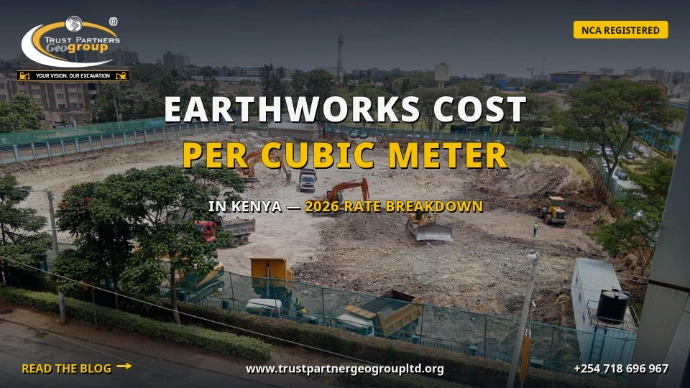
EARTHWORKS COST PER CUBIC METER IN KENYA: 2026 RATE BREAKDOWN
CUT, FILL, COMPACT, AND BUDGET WITH CONFIDENCE — REGIONAL RATES, EQUIPMENT COSTS, AND HIDDEN EXPENSES EXPLAINED
EARTHWORKS COST SUMMARY: 2026 KENYA PRICE RANGES PER M³
| EARTHWORKS TYPE | METHOD | COST PER M³ (KES) | NOTES |
|---|---|---|---|
| Cut to Spoil — Soft Soil (Manual) | Hand tools, laborers | 220 – 330 | Western: KES 225; Nairobi: KES 275; Coast: KES 210 |
| Cut to Spoil — Soft Soil (Mechanical) | Excavator + trucks | 217 – 400 | Standard bulk excavation, most common |
| Cut to Spoil — Hard Soil | Excavator + breaker | 400 – 600 | Compacted soils, some rock fragments |
| Cut to Spoil — Hard (Mechanical) | Large excavator | 433 – 572 | IEK 2022-2023 standard rates |
| Fill in Soft Material & Compact | Excavator + compactor | 602 – 795 | Using on-site material |
| Fill in Hard Material & Compact | Excavator + compactor | 736 – 972 | Hardcore, murram, selected fill |
| Fill with Purchased Material | Import + place + compact | 891 – 1,176 | Soft material imported to site |
| Hardcore Filling to Floor Level | Import + place + compact | 1,350 – 1,600 | Western: KES 1,400; Nairobi: KES 1,600 |
| Rock Fill to Embankment | Import + place + compact | 3,735 – 4,930 | IEK standard for major infrastructure |
| Rock Fill to Swamp | Import + place + compact | 3,428 – 4,525 | Specialized wetland stabilization |
CRITICAL PRICING INSIGHT
Mechanical excavation costs 30–50% less per m³ than manual excavation for volumes over 500 m³. However, manual labor remains cost-effective for small residential projects under 100 m³ where equipment mobilization costs would exceed the excavation value. Always match your method to your volume.
REGIONAL EARTHWORKS COST BREAKDOWN: NAIROBI, MOMBASA, KISUMU, NAKURU
Earthworks rates vary significantly across Kenya's regions due to labor costs, equipment availability, soil conditions, and transport distances. Here is the 2026 breakdown:
CENTRAL REGION — NAIROBI (HIGHEST RATES)
Nairobi commands premium earthworks rates due to higher operational costs, equipment congestion, and strict environmental regulations. The IEK Cost Estimation Manual (2022-2023) establishes Nairobi as the baseline for national pricing.
| WORK ITEM | UNIT | RATE (KES) |
|---|---|---|
| Site clearance | m² | 70 |
| 150mm deep excavation | m² | 90 |
| Manual bulk excavation (soft) | m³ | 275 |
| Mechanical bulk excavation (soft) | m³ | 400 |
| Soft rock excavation | m³ | 1,000 |
| Hard rock Class I | m³ | 1,500 |
| Hard rock Class II | m³ | 1,700 |
| Hard rock Class III | m³ | 1,800 |
| Hardcore filling | m³ | 1,600 |
| 50mm sand blinding | m² | 110 |
| Quarry dust blinding | m² | 100 |
WESTERN REGION — KISUMU, KAKAMEGA (LOWER RATES)
The Western region benefits from lower labor costs and favorable soil conditions. However, equipment availability for specialized earthworks is limited, which can increase costs for complex projects.
| WORK ITEM | UNIT | RATE (KES) |
|---|---|---|
| Site clearance | m² | 55 |
| 150mm deep excavation | m² | 70 |
| Manual bulk excavation (soft) | m³ | 225 |
| Mechanical bulk excavation (soft) | m³ | 330 |
| Soft rock excavation | m³ | 1,000 |
| Hard rock Class I | m³ | 1,500 |
| Hard rock Class II | m³ | 1,700 |
| Hard rock Class III | m³ | 1,800 |
| Hardcore filling | m³ | 1,400 |
| 50mm sand blinding | m² | 135 |
| Quarry dust blinding | m² | 140 |
COAST REGION — MOMBASA, MALINDI (COMPETITIVE RATES)
Coastal sandy soils make excavation easier and faster, but salt corrosion affects equipment lifespan and specialized rock equipment is limited. Rates are generally 10–15% below Nairobi.
| WORK ITEM | UNIT | RATE (KES) |
|---|---|---|
| Site clearance | m² | 70 |
| 150mm deep excavation | m² | 90 |
| Manual bulk excavation (soft) | m³ | 210 |
| Mechanical bulk excavation (soft) | m³ | 350 |
| Soft rock excavation | m³ | 1,000 |
| Hard rock Class I | m³ | 1,200 |
| Hard rock Class II | m³ | 1,700 |
| Hard rock Class III | m³ | 1,800 |
| Hardcore filling | m³ | 1,350 |
| 50mm sand blinding | m² | 125 |
| Quarry dust blinding | m² | 125 |
RIFT VALLEY — NAKURU, ELDORET (VOLCANIC GEOLOGY)
The Rift Valley presents unique volcanic soil and rock conditions. Lower labor costs are offset by equipment mobilization requirements and harder rock formations in volcanic zones.
| WORK ITEM | UNIT | RATE (KES) |
|---|---|---|
| Site clearance | m² | 50 |
| Manual bulk excavation (soft) | m³ | 220 – 330 |
| Mechanical bulk excavation (soft) | m³ | 330 – 400 |
| Soft rock excavation | m³ | 1,000 |
| Hard rock Class I | m³ | 1,500 |
| Hard rock Class II | m³ | 1,700 |
| Hard rock Class III | m³ | 1,800 |
| Hardcore filling | m³ | 1,400 – 1,500 |
CUT AND FILL: THE COMPLETE COST EQUATION
Cut-and-fill operations are the backbone of road construction, site leveling, and basement preparation. Understanding the full cost equation prevents budget overruns:
CUT OPERATIONS (REMOVAL)
| OPERATION | RATE (KES/M³) | INCLUDES |
|---|---|---|
| Cut to spoil — soft soil (manual) | 220 – 330 | Labor, hand tools, loading to truck |
| Cut to spoil — soft soil (mechanical) | 217 – 400 | Excavator, operator, fuel, loading |
| Cut to spoil — hard soil | 400 – 600 | Excavator + breaker, operator, fuel |
| Cut to spoil — hard (mechanical) | 433 – 572 | Large excavator, operator, fuel, loading |
| Cut to spoil — rock (blasting) | 1,500 – 2,500 | Drilling, explosives, blasting, mucking |
FILL OPERATIONS (PLACEMENT)
| OPERATION | RATE (KES/M³) | INCLUDES |
|---|---|---|
| Fill in soft material & compact | 602 – 795 | Spread, compact to 95% MDD, 3 layers |
| Fill in hard material & compact | 736 – 972 | Hardcore, murram, compact to 95% MDD |
| Fill with purchased material | 891 – 1,176 | Material cost, transport, place, compact |
| Hardcore filling to floor level | 1,350 – 1,600 | Import, place, compact hardcore |
| Rock fill to embankment | 3,735 – 4,930 | Import, place, compact rock fill |
THE CUT-AND-FILL BALANCE RULE
Ideally, your cut volume equals your fill volume — meaning you reuse excavated material on-site and avoid import/export costs. When cut exceeds fill, you pay spoil disposal (KES 200–400/m³). When fill exceeds cut, you pay material import (KES 800–1,200/m³). A balanced cut-and-fill design saves 20–40% on earthworks costs.
EQUIPMENT HIRE COSTS: THE REAL DRIVER OF EARTHWORKS PRICING
Equipment costs represent 60–70% of mechanical earthworks pricing. Understanding hire rates helps you evaluate contractor quotations and decide whether to hire equipment or subcontract the entire operation.
| EQUIPMENT | HOURLY (KES) | DAILY (KES) | MONTHLY (KES) | OUTPUT (M³/HR) |
|---|---|---|---|---|
| Mini Excavator (3–6 tons) | 3,000 – 4,500 | 25,000 – 35,000 | 450,000 – 650,000 | 15 – 25 |
| Mid-Size Excavator (15–25 tons) | 6,000 – 9,000 | 50,000 – 75,000 | 900,000 – 1,350,000 | 40 – 80 |
| Large Excavator (25+ tons) | 10,000 – 15,000 | 85,000 – 125,000 | 1,500,000 – 2,250,000 | 100 – 200 |
| Bulldozer (D6–D8) | 8,000 – 12,000 | 65,000 – 100,000 | 1,200,000 – 1,800,000 | 60 – 120 |
| Backhoe Loader | 5,000 – 7,500 | 40,000 – 60,000 | 720,000 – 1,080,000 | 20 – 40 |
| Motor Grader | 7,000 – 10,000 | 55,000 – 80,000 | 1,000,000 – 1,500,000 | N/A |
| Vibratory Compactor | 4,000 – 6,000 | 32,000 – 48,000 | 600,000 – 900,000 | N/A |
| Dump Truck (30-ton) | 5,000 – 7,000 | 40,000 – 55,000 | 800,000 – 1,100,000 | N/A |
Rates include operator and basic fuel allowance. Additional costs apply for transport, specialized attachments, and overtime.
EQUIPMENT PRODUCTIVITY = COST PER M³
A large excavator at KES 12,000/hour producing 150 m³/hour costs KES 80/m³. A mini excavator at KES 3,500/hour producing 20 m³/hour costs KES 175/m³. For bulk earthworks over 1,000 m³, large equipment pays for itself. For precision work under 100 m³, mini excavators are more economical.
VOLUME DISCOUNTS: HOW PROJECT SIZE AFFECTS YOUR RATE
Earthworks is one of the few construction activities where economies of scale are dramatic. The same contractor will quote vastly different per-m³ rates depending on total volume:
| PROJECT VOLUME | DISCOUNT | TYPICAL RATE (KES/M³) | EXAMPLE PROJECT |
|---|---|---|---|
| Under 100 m³ | None (premium) | 450 – 650 | Residential foundation |
| 100 – 500 m³ | 5 – 10% | 350 – 500 | Small commercial site |
| 500 – 1,000 m³ | 10 – 15% | 300 – 450 | Medium commercial site |
| 1,000 – 5,000 m³ | 15 – 25% | 250 – 400 | Road earthworks, estate |
| 5,000 – 20,000 m³ | 25 – 35% | 200 – 350 | Highway, dam, large estate |
| Over 20,000 m³ | 35 – 45% | 150 – 300 | Expressway, major infrastructure |
HIDDEN COSTS THAT INFLATE EARTHWORKS BUDGETS
These ancillary costs add 25–50% to your base earthworks rate. Professional contractors account for them; inexperienced ones discover them too late:
| HIDDEN COST | TYPICAL COST | WHEN IT APPLIES |
|---|---|---|
| Equipment mobilization | KES 25,000 – 150,000 | Every project; higher for remote locations |
| Spoil disposal | KES 200 – 400/m³ | When cut exceeds fill; Nairobi County approved sites |
| Material import | KES 800 – 1,200/m³ | When fill exceeds cut; includes transport |
| Dewatering | KES 150,000 – 500,000/month | High water table areas (Parklands, Upper Hill) |
| Shoring/propping | KES 8,000 – 25,000/m² | Deep excavations over 4 meters |
| Permits and compliance | KES 20,000 – 100,000 | County excavation permits, NEMA, NCA |
| Traffic management | KES 20,000 – 60,000 | Road excavation, utility trenching |
| Site security | KES 50,000 – 150,000/month | Urban sites, equipment protection |
| Rainy season productivity loss | +20 – 40% on duration | March–May and October–December |
| Geotechnical survey | KES 50,000 – 150,000 | Recommended before all major earthworks |
REAL-WORLD EARTHWORKS COST EXAMPLES
EXAMPLE 1: RESIDENTIAL SITE PREPARATION, KAREN (500 M³)
- Scope: Site clearance, bulk excavation, cut-and-fill leveling
- Soil: Normal soil, some medium rock
- Volume: 500 m³ cut, 300 m³ fill, 200 m³ spoil disposal
- Base excavation: 500 m³ × KES 400 = KES 200,000
- Fill and compact: 300 m³ × KES 700 = KES 210,000
- Spoil disposal: 200 m³ × KES 300 = KES 60,000
- Equipment mobilization: KES 50,000
- Permits: KES 25,000
- TOTAL: KES 545,000 (KES 1,090/m³ all-in)
EXAMPLE 2: COMMERCIAL BASEMENT, UPPER HILL (3,000 M³)
- Scope: 12-meter deep basement excavation
- Soil: Hard rock Class I and II
- Volume: 3,000 m³ cut, 1,500 m³ fill, 1,500 m³ spoil
- Base excavation: 3,000 m³ × KES 1,800 = KES 5,400,000
- Shoring (400 m²): KES 6,000,000
- Dewatering (3 months): KES 1,200,000
- Spoil disposal: 1,500 m³ × KES 350 = KES 525,000
- Permits and compliance: KES 150,000
- TOTAL: KES 13,275,000 (KES 4,425/m³ all-in)
EXAMPLE 3: ROAD EARTHWORKS, NAKURU (15,000 M³)
- Scope: Cut-and-fill for 2km rural road
- Soil: Normal soil, some volcanic rock
- Volume: 15,000 m³ balanced cut-and-fill
- Base excavation: 15,000 m³ × KES 280 = KES 4,200,000
- Compaction and grading: KES 1,500,000
- Equipment mobilization: KES 300,000
- Traffic management: KES 80,000
- TOTAL: KES 6,080,000 (KES 405/m³ all-in)
HOW TO GET ACCURATE EARTHWORKS QUOTATIONS
Follow this checklist to ensure your earthworks quotations are comprehensive and comparable:
- SPECIFY EXACT VOLUMES: Provide cut and fill volumes separately, with cross-sections or contour plans
- DEFINE SOIL CONDITIONS: Include geotechnical report or specify assumed soil type (soft, hard, rock)
- STATE DEPTH LIMITS: Deep excavations require shoring and dewatering — specify maximum depth
- IDENTIFY SPOIL DISPOSAL: Who handles disposal? To which site? At what cost?
- SPECIFY FILL SOURCE: On-site reuse or imported material? What compaction standard (95% MDD)?
- INCLUDE ACCESS CONSTRAINTS: Urban sites, restricted hours, and traffic increase costs significantly
- REQUEST ITEMIZED BREAKDOWN: Separate excavation, transport, disposal, fill, compaction, and ancillary costs
- VERIFY EQUIPMENT TYPE: Ensure quoted equipment matches the job (mini vs. large excavator matters)
- CHECK PERMIT INCLUSION: Confirm who pays for county permits, NCA registration, and environmental compliance
- ALLOW FOR VARIATIONS: Rock is unpredictable; include a provisional sum for changed conditions
SEASONAL FACTORS AFFECTING EARTHWORKS COSTS
Kenya's two rainy seasons dramatically impact earthworks productivity and pricing:
| SEASON | MONTHS | IMPACT | RATE ADJUSTMENT |
|---|---|---|---|
| Long Rains | March – May | Reduced productivity, site flooding, equipment stuck | +15 – 30% |
| Short Rains | October – December | Moderate disruption, muddy conditions | +10 – 20% |
| Dry Season 1 | June – September | Optimal conditions, maximum productivity | Standard rates |
| Dry Season 2 | January – February | Good conditions, high demand | +5 – 10% |
DRY SEASON STRATEGY
Schedule major earthworks during June–September for optimal productivity and lower costs. If you must work during rainy seasons, budget for dewatering, temporary access roads, and covered material storage. Productivity drops 20–40% in wet conditions.
FREQUENTLY ASKED QUESTIONS: EARTHWORKS COSTS IN KENYA
What is the cheapest earthworks method for small residential projects?
Manual excavation with laborers is cheapest for volumes under 100 m³, costing KES 220–330/m³. For 100–500 m³, a mini excavator (KES 3,000–4,500/hour) becomes more economical. Always compare total costs including mobilization.
Why do Nairobi earthworks rates cost more than other regions?
Nairobi has higher fuel costs, equipment congestion, stricter environmental regulations, limited working hours, higher skilled labor costs, and increased insurance requirements. The premium is 15–25% above Western Kenya and 10–15% above the Coast.
How do I calculate total earthworks volume for my project?
Use the average end-area method for linear projects (roads, trenches): Volume = (Area 1 + Area 2) / 2 × Length. For site excavations, use contour plans or grid leveling. A surveyor can provide accurate volume calculations from site measurements.
Should I hire equipment or subcontract the entire earthworks?
Subcontract if you lack earthworks expertise — the contractor handles equipment, labor, permits, and risk. Hire equipment directly if you have experienced operators and want cost control. For volumes over 1,000 m³, subcontracting is usually more efficient.
What is 95% MDD compaction and why does it matter?
MDD (Maximum Dry Density) is the densest state soil can achieve through compaction. 95% MDD means the soil is compacted to 95% of this maximum. It matters because under-compacted fill settles over time, causing cracks, foundation failure, and road deformation. Always specify compaction standards in your contract.
Can I use excavated soil as backfill?
Yes, if it meets quality standards — free of organic matter, debris, and excessive moisture. Soft clay and expansive soils are unsuitable. A geotechnical engineer should approve backfill material. Reusing on-site soil saves KES 800–1,200/m³ in import costs.
How much does dewatering add to earthworks costs?
Dewatering costs KES 150,000–500,000/month depending on method (sump pumping, well-points, deep wells). In high water table areas like Parklands and Upper Hill, dewatering can add 10–20% to total earthworks costs. Always conduct a groundwater assessment before budgeting.
What is the most accurate way to estimate earthworks costs?
Combine three methods: (1) Geotechnical survey to determine soil/rock conditions, (2) Accurate volume calculation from survey data, (3) Itemized quotation from at least three NCA-registered contractors. Add 10–15% contingency for unforeseen conditions.
THE BOTTOM LINE: KNOW YOUR NUMBERS, CONTROL YOUR COSTS
Earthworks is not a line item you guess at. A KES 50 difference per m³ on a 10,000 m³ project is KES 500,000 — enough to destroy a contractor's margin or blow a developer's budget. The key to accurate earthworks costing is:
- Know your soil: Geotechnical survey first, budget second
- Match method to volume: Manual for small, mechanical for bulk, blasting for rock
- Account for hidden costs: Disposal, import, dewatering, shoring, permits
- Get multiple quotes: Compare itemized breakdowns, not just bottom lines
- Schedule smart: Dry season work saves 15–30% on productivity
At Trust Partners Geo-Group Ltd, we provide transparent, itemized earthworks quotations with no hidden costs. Our modern fleet of excavators, bulldozers, dump trucks, and compaction equipment handles everything from small residential sites to mega infrastructure projects — on time and on budget.
— TRUST PARTNERS GEO-GROUP LTD
GET YOUR FREE EARTHWORKS QUOTE TODAY
Contact Trust Partners Geo-Group for a free site assessment, accurate volume calculation, and detailed earthworks quotation. We serve Nairobi, Mombasa, Kisumu, Nakuru, Eldoret, and nationwide with transparent pricing and no hidden costs.
CALL +254 718 68 69 67 EMAIL US VISIT OUR WEBSITE
NAIROBI HQ | SERVING MOMBASA, KISUMU, NAKURU, ELDORET, THIKA & NATIONWIDE
MON - SAT: 8:00 AM - 6:00 PM | 24/7 EMERGENCY SUPPORT
RELATED COST GUIDES
- ROCK EXCAVATION COST IN KENYA 2026 — Hard rock, medium rock, blasting, and breaking prices
- SITE CLEARANCE COST IN KENYA — Bush clearing, topsoil removal, and grading prices
- BASEMENT EXCAVATION COST IN NAIROBI — Complete price guide for standard soil, medium rock, and hard rock
- NCA CONTRACTOR REGISTRATION REQUIREMENTS — How to register legally and win tenders
- HEAVY EQUIPMENT FOR HIRE — Excavators, bulldozers, dump trucks, graders & more
TRUST PARTNERS GEO-GROUP LTD | YOUR VISION, OUR EXCAVATION
WEBSITE: WWW.TRUSTPARTNERGEOGROUPLTD.ORG | EMAIL: INFO@TRUSTPARTNERGEOGROUPLTD.ORG | PHONE: +254 718 68 69 67
FOLLOW US: FACEBOOK | TIKTOK | INSTAGRAM | YOUTUBE | LINKEDIN
© 2026 TRUST PARTNERS GEO-GROUP LTD. ALL RIGHTS RESERVED.
EARTHWORKS COST PER CUBIC METER IN KENYA: 2026 RATE BREAKDOWN
CUT, FILL, COMPACT, AND BUDGET WITH CONFIDENCE — REGIONAL RATES, EQUIPMENT COSTS, AND HIDDEN EXPENSES EXPLAINED
EARTHWORKS COST SUMMARY: 2026 KENYA PRICE RANGES PER M³
| EARTHWORKS TYPE | METHOD | COST PER M³ (KES) | NOTES |
|---|---|---|---|
| Cut to Spoil — Soft Soil (Manual) | Hand tools, laborers | 220 – 330 | Western: KES 225; Nairobi: KES 275; Coast: KES 210 |
| Cut to Spoil — Soft Soil (Mechanical) | Excavator + trucks | 217 – 400 | Standard bulk excavation, most common |
| Cut to Spoil — Hard Soil | Excavator + breaker | 400 – 600 | Compacted soils, some rock fragments |
| Cut to Spoil — Hard (Mechanical) | Large excavator | 433 – 572 | IEK 2022-2023 standard rates |
| Fill in Soft Material & Compact | Excavator + compactor | 602 – 795 | Using on-site material |
| Fill in Hard Material & Compact | Excavator + compactor | 736 – 972 | Hardcore, murram, selected fill |
| Fill with Purchased Material | Import + place + compact | 891 – 1,176 | Soft material imported to site |
| Hardcore Filling to Floor Level | Import + place + compact | 1,350 – 1,600 | Western: KES 1,400; Nairobi: KES 1,600 |
| Rock Fill to Embankment | Import + place + compact | 3,735 – 4,930 | IEK standard for major infrastructure |
| Rock Fill to Swamp | Import + place + compact | 3,428 – 4,525 | Specialized wetland stabilization |
CRITICAL PRICING INSIGHT
Mechanical excavation costs 30–50% less per m³ than manual excavation for volumes over 500 m³. However, manual labor remains cost-effective for small residential projects under 100 m³ where equipment mobilization costs would exceed the excavation value. Always match your method to your volume.
REGIONAL EARTHWORKS COST BREAKDOWN: NAIROBI, MOMBASA, KISUMU, NAKURU
Earthworks rates vary significantly across Kenya's regions due to labor costs, equipment availability, soil conditions, and transport distances. Here is the 2026 breakdown:
CENTRAL REGION — NAIROBI (HIGHEST RATES)
Nairobi commands premium earthworks rates due to higher operational costs, equipment congestion, and strict environmental regulations. The IEK Cost Estimation Manual (2022-2023) establishes Nairobi as the baseline for national pricing.
| WORK ITEM | UNIT | RATE (KES) |
|---|---|---|
| Site clearance | m² | 70 |
| 150mm deep excavation | m² | 90 |
| Manual bulk excavation (soft) | m³ | 275 |
| Mechanical bulk excavation (soft) | m³ | 400 |
| Soft rock excavation | m³ | 1,000 |
| Hard rock Class I | m³ | 1,500 |
| Hard rock Class II | m³ | 1,700 |
| Hard rock Class III | m³ | 1,800 |
| Hardcore filling | m³ | 1,600 |
| 50mm sand blinding | m² | 110 |
| Quarry dust blinding | m² | 100 |
WESTERN REGION — KISUMU, KAKAMEGA (LOWER RATES)
The Western region benefits from lower labor costs and favorable soil conditions. However, equipment availability for specialized earthworks is limited, which can increase costs for complex projects.
| WORK ITEM | UNIT | RATE (KES) |
|---|---|---|
| Site clearance | m² | 55 |
| 150mm deep excavation | m² | 70 |
| Manual bulk excavation (soft) | m³ | 225 |
| Mechanical bulk excavation (soft) | m³ | 330 |
| Soft rock excavation | m³ | 1,000 |
| Hard rock Class I | m³ | 1,500 |
| Hard rock Class II | m³ | 1,700 |
| Hard rock Class III | m³ | 1,800 |
| Hardcore filling | m³ | 1,400 |
| 50mm sand blinding | m² | 135 |
| Quarry dust blinding | m² | 140 |
COAST REGION — MOMBASA, MALINDI (COMPETITIVE RATES)
Coastal sandy soils make excavation easier and faster, but salt corrosion affects equipment lifespan and specialized rock equipment is limited. Rates are generally 10–15% below Nairobi.
| WORK ITEM | UNIT | RATE (KES) |
|---|---|---|
| Site clearance | m² | 70 |
| 150mm deep excavation | m² | 90 |
| Manual bulk excavation (soft) | m³ | 210 |
| Mechanical bulk excavation (soft) | m³ | 350 |
| Soft rock excavation | m³ | 1,000 |
| Hard rock Class I | m³ | 1,200 |
| Hard rock Class II | m³ | 1,700 |
| Hard rock Class III | m³ | 1,800 |
| Hardcore filling | m³ | 1,350 |
| 50mm sand blinding | m² | 125 |
| Quarry dust blinding | m² | 125 |
RIFT VALLEY — NAKURU, ELDORET (VOLCANIC GEOLOGY)
The Rift Valley presents unique volcanic soil and rock conditions. Lower labor costs are offset by equipment mobilization requirements and harder rock formations in volcanic zones.
| WORK ITEM | UNIT | RATE (KES) |
|---|---|---|
| Site clearance | m² | 50 |
| Manual bulk excavation (soft) | m³ | 220 – 330 |
| Mechanical bulk excavation (soft) | m³ | 330 – 400 |
| Soft rock excavation | m³ | 1,000 |
| Hard rock Class I | m³ | 1,500 |
| Hard rock Class II | m³ | 1,700 |
| Hard rock Class III | m³ | 1,800 |
| Hardcore filling | m³ | 1,400 – 1,500 |
CUT AND FILL: THE COMPLETE COST EQUATION
Cut-and-fill operations are the backbone of road construction, site leveling, and basement preparation. Understanding the full cost equation prevents budget overruns:
CUT OPERATIONS (REMOVAL)
| OPERATION | RATE (KES/M³) | INCLUDES |
|---|---|---|
| Cut to spoil — soft soil (manual) | 220 – 330 | Labor, hand tools, loading to truck |
| Cut to spoil — soft soil (mechanical) | 217 – 400 | Excavator, operator, fuel, loading |
| Cut to spoil — hard soil | 400 – 600 | Excavator + breaker, operator, fuel |
| Cut to spoil — hard (mechanical) | 433 – 572 | Large excavator, operator, fuel, loading |
| Cut to spoil — rock (blasting) | 1,500 – 2,500 | Drilling, explosives, blasting, mucking |
FILL OPERATIONS (PLACEMENT)
| OPERATION | RATE (KES/M³) | INCLUDES |
|---|---|---|
| Fill in soft material & compact | 602 – 795 | Spread, compact to 95% MDD, 3 layers |
| Fill in hard material & compact | 736 – 972 | Hardcore, murram, compact to 95% MDD |
| Fill with purchased material | 891 – 1,176 | Material cost, transport, place, compact |
| Hardcore filling to floor level | 1,350 – 1,600 | Import, place, compact hardcore |
| Rock fill to embankment | 3,735 – 4,930 | Import, place, compact rock fill |
THE CUT-AND-FILL BALANCE RULE
Ideally, your cut volume equals your fill volume — meaning you reuse excavated material on-site and avoid import/export costs. When cut exceeds fill, you pay spoil disposal (KES 200–400/m³). When fill exceeds cut, you pay material import (KES 800–1,200/m³). A balanced cut-and-fill design saves 20–40% on earthworks costs.
EQUIPMENT HIRE COSTS: THE REAL DRIVER OF EARTHWORKS PRICING
Equipment costs represent 60–70% of mechanical earthworks pricing. Understanding hire rates helps you evaluate contractor quotations and decide whether to hire equipment or subcontract the entire operation.
| EQUIPMENT | HOURLY (KES) | DAILY (KES) | MONTHLY (KES) | OUTPUT (M³/HR) |
|---|---|---|---|---|
| Mini Excavator (3–6 tons) | 3,000 – 4,500 | 25,000 – 35,000 | 450,000 – 650,000 | 15 – 25 |
| Mid-Size Excavator (15–25 tons) | 6,000 – 9,000 | 50,000 – 75,000 | 900,000 – 1,350,000 | 40 – 80 |
| Large Excavator (25+ tons) | 10,000 – 15,000 | 85,000 – 125,000 | 1,500,000 – 2,250,000 | 100 – 200 |
| Bulldozer (D6–D8) | 8,000 – 12,000 | 65,000 – 100,000 | 1,200,000 – 1,800,000 | 60 – 120 |
| Backhoe Loader | 5,000 – 7,500 | 40,000 – 60,000 | 720,000 – 1,080,000 | 20 – 40 |
| Motor Grader | 7,000 – 10,000 | 55,000 – 80,000 | 1,000,000 – 1,500,000 | N/A |
| Vibratory Compactor | 4,000 – 6,000 | 32,000 – 48,000 | 600,000 – 900,000 | N/A |
| Dump Truck (30-ton) | 5,000 – 7,000 | 40,000 – 55,000 | 800,000 – 1,100,000 | N/A |
Rates include operator and basic fuel allowance. Additional costs apply for transport, specialized attachments, and overtime.
EQUIPMENT PRODUCTIVITY = COST PER M³
A large excavator at KES 12,000/hour producing 150 m³/hour costs KES 80/m³. A mini excavator at KES 3,500/hour producing 20 m³/hour costs KES 175/m³. For bulk earthworks over 1,000 m³, large equipment pays for itself. For precision work under 100 m³, mini excavators are more economical.
VOLUME DISCOUNTS: HOW PROJECT SIZE AFFECTS YOUR RATE
Earthworks is one of the few construction activities where economies of scale are dramatic. The same contractor will quote vastly different per-m³ rates depending on total volume:
| PROJECT VOLUME | DISCOUNT | TYPICAL RATE (KES/M³) | EXAMPLE PROJECT |
|---|---|---|---|
| Under 100 m³ | None (premium) | 450 – 650 | Residential foundation |
| 100 – 500 m³ | 5 – 10% | 350 – 500 | Small commercial site |
| 500 – 1,000 m³ | 10 – 15% | 300 – 450 | Medium commercial site |
| 1,000 – 5,000 m³ | 15 – 25% | 250 – 400 | Road earthworks, estate |
| 5,000 – 20,000 m³ | 25 – 35% | 200 – 350 | Highway, dam, large estate |
| Over 20,000 m³ | 35 – 45% | 150 – 300 | Expressway, major infrastructure |
HIDDEN COSTS THAT INFLATE EARTHWORKS BUDGETS
These ancillary costs add 25–50% to your base earthworks rate. Professional contractors account for them; inexperienced ones discover them too late:
| HIDDEN COST | TYPICAL COST | WHEN IT APPLIES |
|---|---|---|
| Equipment mobilization | KES 25,000 – 150,000 | Every project; higher for remote locations |
| Spoil disposal | KES 200 – 400/m³ | When cut exceeds fill; Nairobi County approved sites |
| Material import | KES 800 – 1,200/m³ | When fill exceeds cut; includes transport |
| Dewatering | KES 150,000 – 500,000/month | High water table areas (Parklands, Upper Hill) |
| Shoring/propping | KES 8,000 – 25,000/m² | Deep excavations over 4 meters |
| Permits and compliance | KES 20,000 – 100,000 | County excavation permits, NEMA, NCA |
| Traffic management | KES 20,000 – 60,000 | Road excavation, utility trenching |
| Site security | KES 50,000 – 150,000/month | Urban sites, equipment protection |
| Rainy season productivity loss | +20 – 40% on duration | March–May and October–December |
| Geotechnical survey | KES 50,000 – 150,000 | Recommended before all major earthworks |
REAL-WORLD EARTHWORKS COST EXAMPLES
EXAMPLE 1: RESIDENTIAL SITE PREPARATION, KAREN (500 M³)
- Scope: Site clearance, bulk excavation, cut-and-fill leveling
- Soil: Normal soil, some medium rock
- Volume: 500 m³ cut, 300 m³ fill, 200 m³ spoil disposal
- Base excavation: 500 m³ × KES 400 = KES 200,000
- Fill and compact: 300 m³ × KES 700 = KES 210,000
- Spoil disposal: 200 m³ × KES 300 = KES 60,000
- Equipment mobilization: KES 50,000
- Permits: KES 25,000
- TOTAL: KES 545,000 (KES 1,090/m³ all-in)
EXAMPLE 2: COMMERCIAL BASEMENT, UPPER HILL (3,000 M³)
- Scope: 12-meter deep basement excavation
- Soil: Hard rock Class I and II
- Volume: 3,000 m³ cut, 1,500 m³ fill, 1,500 m³ spoil
- Base excavation: 3,000 m³ × KES 1,800 = KES 5,400,000
- Shoring (400 m²): KES 6,000,000
- Dewatering (3 months): KES 1,200,000
- Spoil disposal: 1,500 m³ × KES 350 = KES 525,000
- Permits and compliance: KES 150,000
- TOTAL: KES 13,275,000 (KES 4,425/m³ all-in)
EXAMPLE 3: ROAD EARTHWORKS, NAKURU (15,000 M³)
- Scope: Cut-and-fill for 2km rural road
- Soil: Normal soil, some volcanic rock
- Volume: 15,000 m³ balanced cut-and-fill
- Base excavation: 15,000 m³ × KES 280 = KES 4,200,000
- Compaction and grading: KES 1,500,000
- Equipment mobilization: KES 300,000
- Traffic management: KES 80,000
- TOTAL: KES 6,080,000 (KES 405/m³ all-in)
HOW TO GET ACCURATE EARTHWORKS QUOTATIONS
Follow this checklist to ensure your earthworks quotations are comprehensive and comparable:
- SPECIFY EXACT VOLUMES: Provide cut and fill volumes separately, with cross-sections or contour plans
- DEFINE SOIL CONDITIONS: Include geotechnical report or specify assumed soil type (soft, hard, rock)
- STATE DEPTH LIMITS: Deep excavations require shoring and dewatering — specify maximum depth
- IDENTIFY SPOIL DISPOSAL: Who handles disposal? To which site? At what cost?
- SPECIFY FILL SOURCE: On-site reuse or imported material? What compaction standard (95% MDD)?
- INCLUDE ACCESS CONSTRAINTS: Urban sites, restricted hours, and traffic increase costs significantly
- REQUEST ITEMIZED BREAKDOWN: Separate excavation, transport, disposal, fill, compaction, and ancillary costs
- VERIFY EQUIPMENT TYPE: Ensure quoted equipment matches the job (mini vs. large excavator matters)
- CHECK PERMIT INCLUSION: Confirm who pays for county permits, NCA registration, and environmental compliance
- ALLOW FOR VARIATIONS: Rock is unpredictable; include a provisional sum for changed conditions
SEASONAL FACTORS AFFECTING EARTHWORKS COSTS
Kenya's two rainy seasons dramatically impact earthworks productivity and pricing:
| SEASON | MONTHS | IMPACT | RATE ADJUSTMENT |
|---|---|---|---|
| Long Rains | March – May | Reduced productivity, site flooding, equipment stuck | +15 – 30% |
| Short Rains | October – December | Moderate disruption, muddy conditions | +10 – 20% |
| Dry Season 1 | June – September | Optimal conditions, maximum productivity | Standard rates |
| Dry Season 2 | January – February | Good conditions, high demand | +5 – 10% |
DRY SEASON STRATEGY
Schedule major earthworks during June–September for optimal productivity and lower costs. If you must work during rainy seasons, budget for dewatering, temporary access roads, and covered material storage. Productivity drops 20–40% in wet conditions.
FREQUENTLY ASKED QUESTIONS: EARTHWORKS COSTS IN KENYA
What is the cheapest earthworks method for small residential projects?
Manual excavation with laborers is cheapest for volumes under 100 m³, costing KES 220–330/m³. For 100–500 m³, a mini excavator (KES 3,000–4,500/hour) becomes more economical. Always compare total costs including mobilization.
Why do Nairobi earthworks rates cost more than other regions?
Nairobi has higher fuel costs, equipment congestion, stricter environmental regulations, limited working hours, higher skilled labor costs, and increased insurance requirements. The premium is 15–25% above Western Kenya and 10–15% above the Coast.
How do I calculate total earthworks volume for my project?
Use the average end-area method for linear projects (roads, trenches): Volume = (Area 1 + Area 2) / 2 × Length. For site excavations, use contour plans or grid leveling. A surveyor can provide accurate volume calculations from site measurements.
Should I hire equipment or subcontract the entire earthworks?
Subcontract if you lack earthworks expertise — the contractor handles equipment, labor, permits, and risk. Hire equipment directly if you have experienced operators and want cost control. For volumes over 1,000 m³, subcontracting is usually more efficient.
What is 95% MDD compaction and why does it matter?
MDD (Maximum Dry Density) is the densest state soil can achieve through compaction. 95% MDD means the soil is compacted to 95% of this maximum. It matters because under-compacted fill settles over time, causing cracks, foundation failure, and road deformation. Always specify compaction standards in your contract.
Can I use excavated soil as backfill?
Yes, if it meets quality standards — free of organic matter, debris, and excessive moisture. Soft clay and expansive soils are unsuitable. A geotechnical engineer should approve backfill material. Reusing on-site soil saves KES 800–1,200/m³ in import costs.
How much does dewatering add to earthworks costs?
Dewatering costs KES 150,000–500,000/month depending on method (sump pumping, well-points, deep wells). In high water table areas like Parklands and Upper Hill, dewatering can add 10–20% to total earthworks costs. Always conduct a groundwater assessment before budgeting.
What is the most accurate way to estimate earthworks costs?
Combine three methods: (1) Geotechnical survey to determine soil/rock conditions, (2) Accurate volume calculation from survey data, (3) Itemized quotation from at least three NCA-registered contractors. Add 10–15% contingency for unforeseen conditions.
THE BOTTOM LINE: KNOW YOUR NUMBERS, CONTROL YOUR COSTS
Earthworks is not a line item you guess at. A KES 50 difference per m³ on a 10,000 m³ project is KES 500,000 — enough to destroy a contractor's margin or blow a developer's budget. The key to accurate earthworks costing is:
- Know your soil: Geotechnical survey first, budget second
- Match method to volume: Manual for small, mechanical for bulk, blasting for rock
- Account for hidden costs: Disposal, import, dewatering, shoring, permits
- Get multiple quotes: Compare itemized breakdowns, not just bottom lines
- Schedule smart: Dry season work saves 15–30% on productivity
At Trust Partners Geo-Group Ltd, we provide transparent, itemized earthworks quotations with no hidden costs. Our modern fleet of excavators, bulldozers, dump trucks, and compaction equipment handles everything from small residential sites to mega infrastructure projects — on time and on budget.
— TRUST PARTNERS GEO-GROUP LTD
GET YOUR FREE EARTHWORKS QUOTE TODAY
Contact Trust Partners Geo-Group for a free site assessment, accurate volume calculation, and detailed earthworks quotation. We serve Nairobi, Mombasa, Kisumu, Nakuru, Eldoret, and nationwide with transparent pricing and no hidden costs.
CALL +254 718 68 69 67 EMAIL US VISIT OUR WEBSITE
NAIROBI HQ | SERVING MOMBASA, KISUMU, NAKURU, ELDORET, THIKA & NATIONWIDE
MON - SAT: 8:00 AM - 6:00 PM | 24/7 EMERGENCY SUPPORT
RELATED COST GUIDES
- ROCK EXCAVATION COST IN KENYA 2026 — Hard rock, medium rock, blasting, and breaking prices
- SITE CLEARANCE COST IN KENYA — Bush clearing, topsoil removal, and grading prices
- BASEMENT EXCAVATION COST IN NAIROBI — Complete price guide for standard soil, medium rock, and hard rock
- NCA CONTRACTOR REGISTRATION REQUIREMENTS — How to register legally and win tenders
- HEAVY EQUIPMENT FOR HIRE — Excavators, bulldozers, dump trucks, graders & more
TRUST PARTNERS GEO-GROUP LTD | YOUR VISION, OUR EXCAVATION
WEBSITE: WWW.TRUSTPARTNERGEOGROUPLTD.ORG | EMAIL: INFO@TRUSTPARTNERGEOGROUPLTD.ORG | PHONE: +254 718 68 69 67
FOLLOW US: FACEBOOK | TIKTOK | INSTAGRAM | YOUTUBE | LINKEDIN
© 2026 TRUST PARTNERS GEO-GROUP LTD. ALL RIGHTS RESERVED.