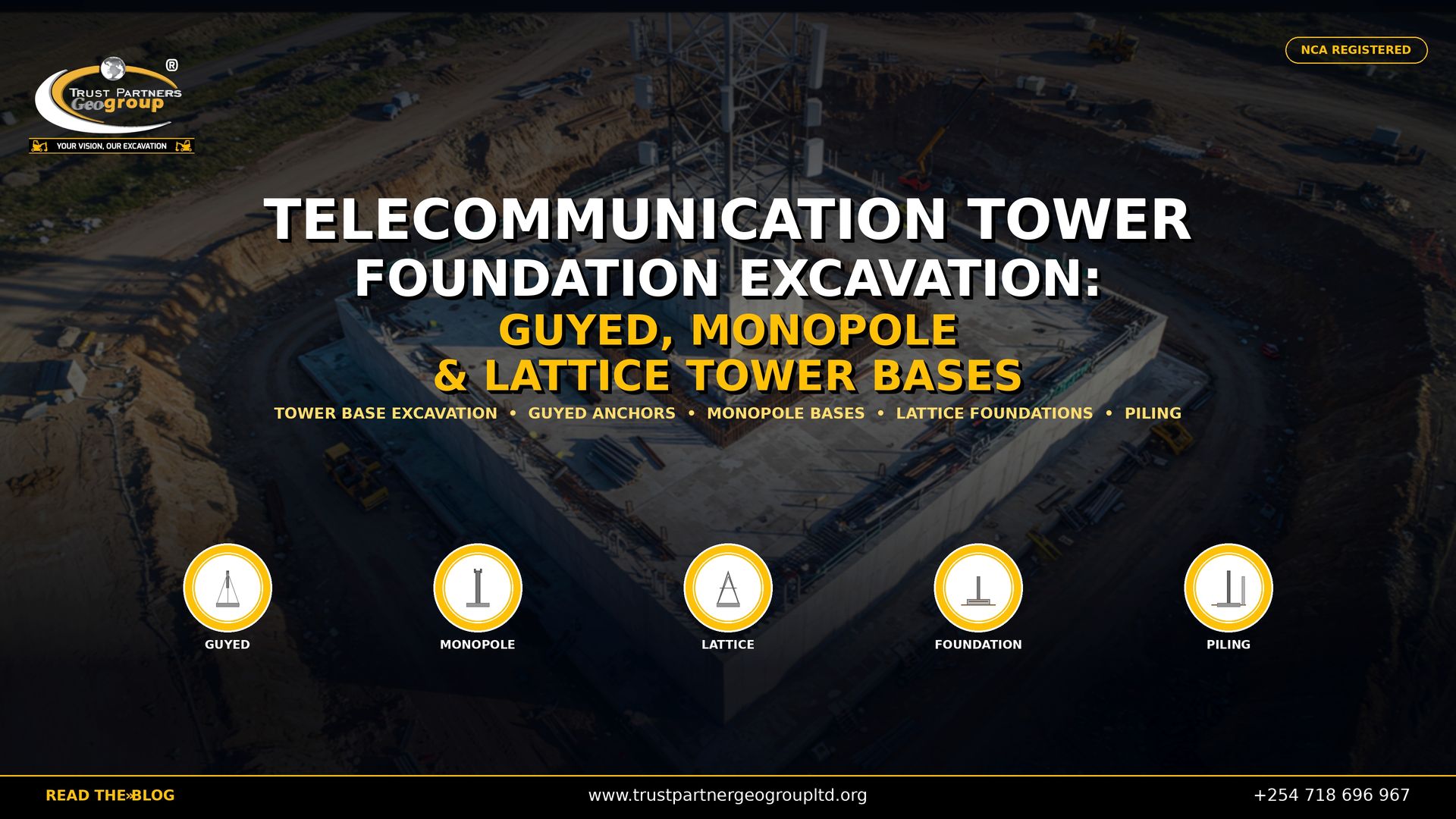
Telecommunication Tower Foundation Excavation: Guyed, Monopole and Lattice Tower Bases [2026]
Mast Bases, Anchor Blocks & Rock-Socketed Foundations for Kenya's Connectivity Rollout
Every phone call, mobile-money transaction and livestream in Kenya travels through a tower — and every tower stands or falls on its foundation. With operators and towercos adding hundreds of sites a year across urban rooftops, peri-urban ridges and remote hillsides, telecom tower foundation excavation in Kenya has become a high-volume, specification-driven niche. This 2026 guide covers guyed, monopole and lattice tower bases — excavation depths, anchor blocks, rock-socketed foundations, equipment, costs and compliance — written for towercos, contractors and landowners planning a communication tower base anywhere in the country. With 15+ years of excavation experience across Kenya, Trust Partners Geo-Group delivers mast excavation in Nairobi and all 47 counties.

From rock-socketed hilltop mast bases to urban monopole caissons, our team delivers foundation excavation across Kenya's telecom, energy and infrastructure sectors — with the rock-breaking fleet and QA/QC discipline these precision structures demand.
1. Kenya's Telecom Tower Rollout: The 2026 Landscape
Kenya's connectivity buildout is accelerating on every front, and each new site is, at its core, a foundation excavation project:
- Network densification: operators and towercos continue adding 4G/5G sites across Nairobi, Mombasa, Kisumu and fast-growing towns — mostly monopoles and rooftop-adjacent ground-based towers on tight urban plots.
- Rural coverage programs: Universal Service Fund and operator-led rural expansion are pushing lattice towers and guyed masts into counties with difficult terrain, weak access roads and rocky hilltop sites.
- Fiber backhaul and data growth: tower sites increasingly pair with ducted fiber connections — linking tower civils to the corridor trenching work we covered in our pipeline trenching guide for oil, gas, water and fiber installation.
- Broadcast and private networks: media houses, ISPs, counties and enterprises commissioning their own masts for radio, CCTV backhaul and campus connectivity.
2. What Is Telecom Tower Foundation Excavation?
Telecom tower foundation excavation is the complete civil works cycle that prepares a site to carry a mast: geotechnical investigation, access construction, foundation excavation (pads, piers, caissons or anchor blocks), reinforcement and anchor-bolt setting, concreting support, backfilling and compound works. Tower foundations are unusual because they are governed less by weight and more by overturning and uplift:
- Wind is the design load. A 45m lattice tower acts like a giant sail; foundations are sized to stop the tower tipping over or being pulled out of the ground, not just to carry its weight.
- Small excavations, high precision. Anchor bolts and stub angles must be set to ±2–3mm or the tower sections will not bolt together — setting-out and template control matter more than volume.
- Sites are rarely convenient. Towers go where coverage demands: hilltops, ridges and farmland — so access tracks, water supply for concrete and rock excavation are routine parts of the scope.
3. Lattice (Self-Supporting) Tower Foundations
The workhorse of Kenyan networks — 30–60m angular or tubular steel lattice towers standing on four legs:
- Foundation type: four independent pad-and-pier footings, typically 1.8–3.0m square pads at 2–4m depth, connected by a stub angle cast into each pier.
- Excavation: open-cut pits per leg; on sloping sites, footings step with the terrain, each at a different level — setting-out discipline is critical.
- Load behaviour: two legs go into compression while two go into uplift under wind; uplift resistance comes from the cone of soil above the pad, so backfill must be compacted in layers, not dumped loose.
- Typical concrete: 8–20 m³ per tower set depending on height and soil.
4. Monopole Tower Bases and Caisson Excavation
The urban default — a single steel pole on one foundation, ideal for plots as small as 8×8m:
- Foundation type: a single large bored or open-cut caisson, typically 1.5–3.0m in diameter and 4–8m deep, heavily reinforced with a bolt cage set by template.
- Excavation method: auger drilling rigs in soils; excavator-plus-breaker or core drilling in rock; temporary casing or slurry support where groundwater or loose sands intrude.
- Spoil and logistics: 10–40 m³ of spoil from one hole — plan cart-away in urban sites where there is nowhere to spread it.
- Quality control: verticality of the bore and bolt-cage position are checked before the pour; correcting a misaligned monopole cage after concreting is effectively impossible.
The bored-caisson technique shares DNA with the piling methods in our bored piles vs. driven piles guide.
5. Guyed Mast Foundations and Anchor Block Excavation
The economical rural choice — a slender mast (often 40–120m) held up by steel guy wires radiating to ground anchors:
| Element | Typical Size | Excavation Notes |
|---|---|---|
| Central base pad | 1.5–2.5 m square, 1.5–2.5 m deep | Carries compression only — the simplest footing on site |
| Inner guy anchors (×3) | Deadman blocks 2–3.5 m deep | Excavated at surveyed radius/angle; block plus compacted backfill resists pull-out |
| Outer guy anchors (×3) | Larger deadman blocks or rock anchors | Highest guy loads; on rock sites, drilled and grouted anchor bars replace concrete blocks |
| Guy radius | 60–80% of mast height | The site must be large and clear — a 60m mast needs anchor points ~40m+ from the base |
Guyed tower foundation in Kenya work is mostly about the anchors: each deadman block is cast in an excavated pit, the guy rod is set at the exact design angle, and the pit is backfilled in compacted layers so the soil mass — not just the concrete — resists the pull. Misplaced anchors cannot be "adjusted" later; the survey comes first, always.
6. Rock Sites and Hilltop Towers: Excavation Strategies
Kenyan tower sites disproportionately sit on volcanic rock — the Ngong and Kikuyu ridges, Rift Valley escarpment hills and coast laterite plateaus. Rock changes the game, mostly for the better:
- Hydraulic breaking: 20–30t excavators with breakers open footings through weathered and moderately hard rock; production of 5–15 m³/day per breaker is realistic in Nairobi phonolite. See our hydraulic breaker selection guide and 2026 rock excavation rates.
- Rock-socketed redesign: where competent rock is shallow, engineers often convert pad footings to socketed piers with dowel bars grouted into drilled holes — less concrete, better uplift resistance, faster programme.
- Chemical/expansive breaking: for sites near existing structures where hammer vibration is restricted, expansive grout cracking offers a silent alternative, as covered in our rock breaking and blasting alternatives guide.
- No blasting near live networks: many new towers sit metres from live masts — blast-free methods are the default assumption on brownfield sites.
7. Compound, Access Road and Earthing Works
The foundation is rarely the whole civils scope. A complete tower-site package includes:
- Access track: often 0.5–3 km of murram access road up to hilltop sites — frequently the longest task on the programme. Culverts, side drains and erosion checks follow the principles in our road drainage solutions guide.
- Compound: a levelled, gravelled and fenced compound (typically 10×10m to 20×20m) with drainage falls away from equipment shelters.
- Earthing trenches: ring-earth trenches (600–800mm deep) around the compound with earth rods and conductor — telecom sites demand low-resistance earthing for lightning protection.
- Ducts: cable ducts between the tower, equipment shelter and any fiber handover point.
- Retaining works: on sloping sites, small gravity or gabion walls protect the compound cut; see our gravity retaining wall construction guide.
8. Equipment Selection for Tower Foundation Excavation
| Machine | Typical Class | Role on Tower Civils | 2026 Hire Rate (guide) |
|---|---|---|---|
| Excavator + hydraulic breaker | 20–30 t | Footings through rock; general site excavation | KES 6,500–12,000/hr with operator |
| Mini excavator | 3–8 t | Urban monopole sites, earthing trenches, ducts | KES 4,500–7,000/hr |
| Auger / bored piling rig | CFA or rotary | Monopole caissons 1.5–3.0m diameter, 4–8m deep | Quoted per bore |
| Compressor + rock drills | Portable | Dowel/anchor holes for rock-socketed foundations | KES 15,000–30,000/day |
| Dump trucks / tippers | 10–25 t | Spoil cart-away, concrete aggregate delivery | Per-trip or per-km rates |
| Concrete mixer / pump | Site mixer or boom pump | Foundation pours on remote or restricted sites | KES 20,000–60,000/day |
| Plate compactors / rollers | Light compaction | Layer backfilling of footings and anchor pits | KES 2,500–5,000/day |
| Water bowser | 5,000–10,000 L | Concrete works and compaction water at remote sites | KES 20,000–35,000/day |
For rate context see our 2026 excavator hire price guide. Tower programmes batch many small sites, so mobilization discipline matters more than machine size — our hire-with-operator packages guide explains what a properly bundled rate should include.
9. Tower Foundation Costs: 2026 Budget Benchmarks
Indicative 2026 civils costs per site (excavation, blinding, reinforcement setting support, concreting support, backfill and compound works; steel tower supply excluded):
| Tower Type | Foundation Scope | Indicative Civils Cost (KES) | Key Cost Drivers |
|---|---|---|---|
| Lattice tower (30–60 m) | 4 pad-and-pier footings | 350,000–900,000 | Soil vs rock, sloping site stepping, access |
| Monopole (20–40 m) | 1 bored/open caisson 4–8 m | 500,000–1,500,000 | Bore diameter/depth, groundwater, urban spoil cart-away |
| Guyed mast (40–120 m) | Base + 6 anchor blocks | 700,000–1,800,000 | Anchor design, guy radius terrain, rock anchoring |
| Rock-socketed variant (any type) | Socketed piers + dowels | +150,000–500,000 | Drilling depth, grout volume, rig availability |
| Access track (remote sites) | Per km of murram track | 1.5–4 million /km | Gradient, culverts, erosion control |
| Compound, fencing & earthing | Per site | 250,000–600,000 | Compound size, earth resistance target, fence spec |
Unit rates anchor in our 2026 earthworks cost per cubic metre breakdown. On tower programmes, the biggest cost lever is batching: surveying, mobilizing and concreting 5–10 sites per circuit cuts per-site cost by 20–30% compared with one-off mobilizations.
10. CA, KCAA, County and NCA Compliance
Telecom tower civils sit under a multi-agency regime:
- Communications Authority (CA): type approval and site clearance for the installation.
- County government: development permission and wayleaves where ducts cross road reserves; rates and advertising/signage rules on compounds.
- NEMA: environmental screening; full EIA for sensitive sites (hillsides, water catchments, near settlements).
- KCAA: obstacle clearance and aviation warning lighting where towers fall within approach surfaces — the same airside discipline we detailed in our airport runway, taxiway and apron excavation guide.
- NCA: contractor and project registration for the civil works — see our NCA registration requirements guide.
- Land and community: registered lease or landowner consent, plus local engagement — community disputes are the most common cause of tower programme delay in Kenya, and they cost more than any excavation problem.
11. Frequently Asked Questions
How deep are telecom tower foundations in Kenya?
Monopole towers use single caissons 4–8m deep; lattice towers use four pad-and-pier footings 2–4m deep; guyed masts use a small central base plus anchor blocks 2–3.5m deep at each guy point. Final depths follow geotechnical results and tower loads.
How much does telecom tower foundation excavation cost in Kenya?
In 2026: roughly KES 350,000–900,000 for a lattice tower footing set, KES 500,000–1.5 million for a monopole caisson, and KES 700,000–1.8 million for a guyed mast with anchor blocks. Rock, dewatering and remote access roads push costs higher.
What is the difference between guyed, monopole and lattice tower foundations?
A monopole sits on one large deep caisson resisting overturning alone. A lattice tower spreads loads to four pad-and-pier footings carrying compression and uplift. A guyed mast needs only a small central base, with each guy wire anchored to a concrete deadman block designed against pull-out.
Who does telecom tower foundation excavation in Kenya?
NCA-registered civil contractors with rock excavation and anchor-installation capability. Trust Partners Geo-Group delivers mast bases, anchor blocks, access roads and earthing trenches nationwide — call +254 718 686 967 for a site assessment.
How long does it take to excavate a tower foundation?
A lattice tower's four footings take 3–7 days including rock breaking. A monopole caisson takes 2–5 days with a drill rig or excavator. A guyed mast base plus anchors takes 5–10 days. Remote access road construction often takes longer than the foundations themselves.
Can tower foundations be excavated in rock in Kenya?
Yes. Hilltop sites across Kenya sit on volcanic rock. Hydraulic breakers or rock saws open the footings, and foundations are often redesigned as rock-socketed piers with grouted dowel bars — rock becomes an asset, providing excellent bearing and uplift resistance.
What approvals are needed to build a telecom tower in Kenya?
Communications Authority clearance, county development permission, NEMA approval (EIA for sensitive sites), KCAA obstacle clearance near flight paths, NCA project registration for civils, and a land lease or title consent for the site and access.
12. Conclusion: Small Holes, High Stakes
Tower foundations are among the smallest excavations in Kenyan construction — and among the least forgiving. A 3mm bolt error strands a tower on the delivery truck; a poorly compacted anchor pit puts a 60m mast one storm away from failure; a skipped geotechnical step turns a KES 600,000 footing into a KES 3 million remediation. The contractors who thrive in this sector are the ones who treat every site like the precision structure it is: survey first, compact in layers, test every pour, document everything.
For towercos and operators, the 2026 playbook is clear: batch sites into regional circuits, insist on geotechnics before pricing, and partner with civils contractors whose fleets and QA/QC systems can hold tolerance on a Nairobi rooftop and a Turkana hilltop alike. For related reading, see our guides to airport runway, taxiway and apron excavation with precision grading and pipeline trenching for oil, gas, water and fiber installation, plus our master resource on excavation in Kenya — costs, methods and contractors.
Building Towers? Start With Foundations That Hold.
Trust Partners Geo-Group delivers NCA-compliant telecom tower foundation excavation — lattice footings, monopole caissons, guyed anchor blocks, access roads and earthing — serving Nairobi, Mombasa, Kisumu, Nakuru and all 47 counties.
Call +254 718 686 967 Request a Free Site AssessmentTelecommunication Tower Foundation Excavation: Guyed, Monopole and Lattice Tower Bases [2026]
Mast Bases, Anchor Blocks & Rock-Socketed Foundations for Kenya's Connectivity Rollout
Every phone call, mobile-money transaction and livestream in Kenya travels through a tower — and every tower stands or falls on its foundation. With operators and towercos adding hundreds of sites a year across urban rooftops, peri-urban ridges and remote hillsides, telecom tower foundation excavation in Kenya has become a high-volume, specification-driven niche. This 2026 guide covers guyed, monopole and lattice tower bases — excavation depths, anchor blocks, rock-socketed foundations, equipment, costs and compliance — written for towercos, contractors and landowners planning a communication tower base anywhere in the country. With 15+ years of excavation experience across Kenya, Trust Partners Geo-Group delivers mast excavation in Nairobi and all 47 counties.
From rock-socketed hilltop mast bases to urban monopole caissons, our team delivers foundation excavation across Kenya's telecom, energy and infrastructure sectors — with the rock-breaking fleet and QA/QC discipline these precision structures demand.
1. Kenya's Telecom Tower Rollout: The 2026 Landscape
Kenya's connectivity buildout is accelerating on every front, and each new site is, at its core, a foundation excavation project:
- Network densification: operators and towercos continue adding 4G/5G sites across Nairobi, Mombasa, Kisumu and fast-growing towns — mostly monopoles and rooftop-adjacent ground-based towers on tight urban plots.
- Rural coverage programs: Universal Service Fund and operator-led rural expansion are pushing lattice towers and guyed masts into counties with difficult terrain, weak access roads and rocky hilltop sites.
- Fiber backhaul and data growth: tower sites increasingly pair with ducted fiber connections — linking tower civils to the corridor trenching work we covered in our pipeline trenching guide for oil, gas, water and fiber installation.
- Broadcast and private networks: media houses, ISPs, counties and enterprises commissioning their own masts for radio, CCTV backhaul and campus connectivity.
2. What Is Telecom Tower Foundation Excavation?
Telecom tower foundation excavation is the complete civil works cycle that prepares a site to carry a mast: geotechnical investigation, access construction, foundation excavation (pads, piers, caissons or anchor blocks), reinforcement and anchor-bolt setting, concreting support, backfilling and compound works. Tower foundations are unusual because they are governed less by weight and more by overturning and uplift:
- Wind is the design load. A 45m lattice tower acts like a giant sail; foundations are sized to stop the tower tipping over or being pulled out of the ground, not just to carry its weight.
- Small excavations, high precision. Anchor bolts and stub angles must be set to ±2–3mm or the tower sections will not bolt together — setting-out and template control matter more than volume.
- Sites are rarely convenient. Towers go where coverage demands: hilltops, ridges and farmland — so access tracks, water supply for concrete and rock excavation are routine parts of the scope.
3. Lattice (Self-Supporting) Tower Foundations
The workhorse of Kenyan networks — 30–60m angular or tubular steel lattice towers standing on four legs:
- Foundation type: four independent pad-and-pier footings, typically 1.8–3.0m square pads at 2–4m depth, connected by a stub angle cast into each pier.
- Excavation: open-cut pits per leg; on sloping sites, footings step with the terrain, each at a different level — setting-out discipline is critical.
- Load behaviour: two legs go into compression while two go into uplift under wind; uplift resistance comes from the cone of soil above the pad, so backfill must be compacted in layers, not dumped loose.
- Typical concrete: 8–20 m³ per tower set depending on height and soil.
4. Monopole Tower Bases and Caisson Excavation
The urban default — a single steel pole on one foundation, ideal for plots as small as 8×8m:
- Foundation type: a single large bored or open-cut caisson, typically 1.5–3.0m in diameter and 4–8m deep, heavily reinforced with a bolt cage set by template.
- Excavation method: auger drilling rigs in soils; excavator-plus-breaker or core drilling in rock; temporary casing or slurry support where groundwater or loose sands intrude.
- Spoil and logistics: 10–40 m³ of spoil from one hole — plan cart-away in urban sites where there is nowhere to spread it.
- Quality control: verticality of the bore and bolt-cage position are checked before the pour; correcting a misaligned monopole cage after concreting is effectively impossible.
The bored-caisson technique shares DNA with the piling methods in our bored piles vs. driven piles guide.
5. Guyed Mast Foundations and Anchor Block Excavation
The economical rural choice — a slender mast (often 40–120m) held up by steel guy wires radiating to ground anchors:
| Element | Typical Size | Excavation Notes |
|---|---|---|
| Central base pad | 1.5–2.5 m square, 1.5–2.5 m deep | Carries compression only — the simplest footing on site |
| Inner guy anchors (×3) | Deadman blocks 2–3.5 m deep | Excavated at surveyed radius/angle; block plus compacted backfill resists pull-out |
| Outer guy anchors (×3) | Larger deadman blocks or rock anchors | Highest guy loads; on rock sites, drilled and grouted anchor bars replace concrete blocks |
| Guy radius | 60–80% of mast height | The site must be large and clear — a 60m mast needs anchor points ~40m+ from the base |
Guyed tower foundation in Kenya work is mostly about the anchors: each deadman block is cast in an excavated pit, the guy rod is set at the exact design angle, and the pit is backfilled in compacted layers so the soil mass — not just the concrete — resists the pull. Misplaced anchors cannot be "adjusted" later; the survey comes first, always.
6. Rock Sites and Hilltop Towers: Excavation Strategies
Kenyan tower sites disproportionately sit on volcanic rock — the Ngong and Kikuyu ridges, Rift Valley escarpment hills and coast laterite plateaus. Rock changes the game, mostly for the better:
- Hydraulic breaking: 20–30t excavators with breakers open footings through weathered and moderately hard rock; production of 5–15 m³/day per breaker is realistic in Nairobi phonolite. See our hydraulic breaker selection guide and 2026 rock excavation rates.
- Rock-socketed redesign: where competent rock is shallow, engineers often convert pad footings to socketed piers with dowel bars grouted into drilled holes — less concrete, better uplift resistance, faster programme.
- Chemical/expansive breaking: for sites near existing structures where hammer vibration is restricted, expansive grout cracking offers a silent alternative, as covered in our rock breaking and blasting alternatives guide.
- No blasting near live networks: many new towers sit metres from live masts — blast-free methods are the default assumption on brownfield sites.
7. Compound, Access Road and Earthing Works
The foundation is rarely the whole civils scope. A complete tower-site package includes:
- Access track: often 0.5–3 km of murram access road up to hilltop sites — frequently the longest task on the programme. Culverts, side drains and erosion checks follow the principles in our road drainage solutions guide.
- Compound: a levelled, gravelled and fenced compound (typically 10×10m to 20×20m) with drainage falls away from equipment shelters.
- Earthing trenches: ring-earth trenches (600–800mm deep) around the compound with earth rods and conductor — telecom sites demand low-resistance earthing for lightning protection.
- Ducts: cable ducts between the tower, equipment shelter and any fiber handover point.
- Retaining works: on sloping sites, small gravity or gabion walls protect the compound cut; see our gravity retaining wall construction guide.
8. Equipment Selection for Tower Foundation Excavation
| Machine | Typical Class | Role on Tower Civils | 2026 Hire Rate (guide) |
|---|---|---|---|
| Excavator + hydraulic breaker | 20–30 t | Footings through rock; general site excavation | KES 6,500–12,000/hr with operator |
| Mini excavator | 3–8 t | Urban monopole sites, earthing trenches, ducts | KES 4,500–7,000/hr |
| Auger / bored piling rig | CFA or rotary | Monopole caissons 1.5–3.0m diameter, 4–8m deep | Quoted per bore |
| Compressor + rock drills | Portable | Dowel/anchor holes for rock-socketed foundations | KES 15,000–30,000/day |
| Dump trucks / tippers | 10–25 t | Spoil cart-away, concrete aggregate delivery | Per-trip or per-km rates |
| Concrete mixer / pump | Site mixer or boom pump | Foundation pours on remote or restricted sites | KES 20,000–60,000/day |
| Plate compactors / rollers | Light compaction | Layer backfilling of footings and anchor pits | KES 2,500–5,000/day |
| Water bowser | 5,000–10,000 L | Concrete works and compaction water at remote sites | KES 20,000–35,000/day |
For rate context see our 2026 excavator hire price guide. Tower programmes batch many small sites, so mobilization discipline matters more than machine size — our hire-with-operator packages guide explains what a properly bundled rate should include.
9. Tower Foundation Costs: 2026 Budget Benchmarks
Indicative 2026 civils costs per site (excavation, blinding, reinforcement setting support, concreting support, backfill and compound works; steel tower supply excluded):
| Tower Type | Foundation Scope | Indicative Civils Cost (KES) | Key Cost Drivers |
|---|---|---|---|
| Lattice tower (30–60 m) | 4 pad-and-pier footings | 350,000–900,000 | Soil vs rock, sloping site stepping, access |
| Monopole (20–40 m) | 1 bored/open caisson 4–8 m | 500,000–1,500,000 | Bore diameter/depth, groundwater, urban spoil cart-away |
| Guyed mast (40–120 m) | Base + 6 anchor blocks | 700,000–1,800,000 | Anchor design, guy radius terrain, rock anchoring |
| Rock-socketed variant (any type) | Socketed piers + dowels | +150,000–500,000 | Drilling depth, grout volume, rig availability |
| Access track (remote sites) | Per km of murram track | 1.5–4 million /km | Gradient, culverts, erosion control |
| Compound, fencing & earthing | Per site | 250,000–600,000 | Compound size, earth resistance target, fence spec |
Unit rates anchor in our 2026 earthworks cost per cubic metre breakdown. On tower programmes, the biggest cost lever is batching: surveying, mobilizing and concreting 5–10 sites per circuit cuts per-site cost by 20–30% compared with one-off mobilizations.
10. CA, KCAA, County and NCA Compliance
Telecom tower civils sit under a multi-agency regime:
- Communications Authority (CA): type approval and site clearance for the installation.
- County government: development permission and wayleaves where ducts cross road reserves; rates and advertising/signage rules on compounds.
- NEMA: environmental screening; full EIA for sensitive sites (hillsides, water catchments, near settlements).
- KCAA: obstacle clearance and aviation warning lighting where towers fall within approach surfaces — the same airside discipline we detailed in our airport runway, taxiway and apron excavation guide.
- NCA: contractor and project registration for the civil works — see our NCA registration requirements guide.
- Land and community: registered lease or landowner consent, plus local engagement — community disputes are the most common cause of tower programme delay in Kenya, and they cost more than any excavation problem.
11. Frequently Asked Questions
How deep are telecom tower foundations in Kenya?
Monopole towers use single caissons 4–8m deep; lattice towers use four pad-and-pier footings 2–4m deep; guyed masts use a small central base plus anchor blocks 2–3.5m deep at each guy point. Final depths follow geotechnical results and tower loads.
How much does telecom tower foundation excavation cost in Kenya?
In 2026: roughly KES 350,000–900,000 for a lattice tower footing set, KES 500,000–1.5 million for a monopole caisson, and KES 700,000–1.8 million for a guyed mast with anchor blocks. Rock, dewatering and remote access roads push costs higher.
What is the difference between guyed, monopole and lattice tower foundations?
A monopole sits on one large deep caisson resisting overturning alone. A lattice tower spreads loads to four pad-and-pier footings carrying compression and uplift. A guyed mast needs only a small central base, with each guy wire anchored to a concrete deadman block designed against pull-out.
Who does telecom tower foundation excavation in Kenya?
NCA-registered civil contractors with rock excavation and anchor-installation capability. Trust Partners Geo-Group delivers mast bases, anchor blocks, access roads and earthing trenches nationwide — call +254 718 686 967 for a site assessment.
How long does it take to excavate a tower foundation?
A lattice tower's four footings take 3–7 days including rock breaking. A monopole caisson takes 2–5 days with a drill rig or excavator. A guyed mast base plus anchors takes 5–10 days. Remote access road construction often takes longer than the foundations themselves.
Can tower foundations be excavated in rock in Kenya?
Yes. Hilltop sites across Kenya sit on volcanic rock. Hydraulic breakers or rock saws open the footings, and foundations are often redesigned as rock-socketed piers with grouted dowel bars — rock becomes an asset, providing excellent bearing and uplift resistance.
What approvals are needed to build a telecom tower in Kenya?
Communications Authority clearance, county development permission, NEMA approval (EIA for sensitive sites), KCAA obstacle clearance near flight paths, NCA project registration for civils, and a land lease or title consent for the site and access.
12. Conclusion: Small Holes, High Stakes
Tower foundations are among the smallest excavations in Kenyan construction — and among the least forgiving. A 3mm bolt error strands a tower on the delivery truck; a poorly compacted anchor pit puts a 60m mast one storm away from failure; a skipped geotechnical step turns a KES 600,000 footing into a KES 3 million remediation. The contractors who thrive in this sector are the ones who treat every site like the precision structure it is: survey first, compact in layers, test every pour, document everything.
For towercos and operators, the 2026 playbook is clear: batch sites into regional circuits, insist on geotechnics before pricing, and partner with civils contractors whose fleets and QA/QC systems can hold tolerance on a Nairobi rooftop and a Turkana hilltop alike. For related reading, see our guides to airport runway, taxiway and apron excavation with precision grading and pipeline trenching for oil, gas, water and fiber installation, plus our master resource on excavation in Kenya — costs, methods and contractors.
Building Towers? Start With Foundations That Hold.
Trust Partners Geo-Group delivers NCA-compliant telecom tower foundation excavation — lattice footings, monopole caissons, guyed anchor blocks, access roads and earthing — serving Nairobi, Mombasa, Kisumu, Nakuru and all 47 counties.
Call +254 718 686 967 Request a Free Site Assessment