![PILE FOUNDATION EXCAVATION IN KENYA: BORED PILES VS. DRIVEN PILES [2026 GUIDE]](https://trustpartnergeogroupltd.org/web/image/blog.post/54/author_avatar/PILE%20FOUNDATION%20EXCAVATION%20IN%20KENYA:%20BORED%20PILES%20VS.%20DRIVEN%20PILES%20%5B2026%20GUIDE%5D?unique=a9efdf8)
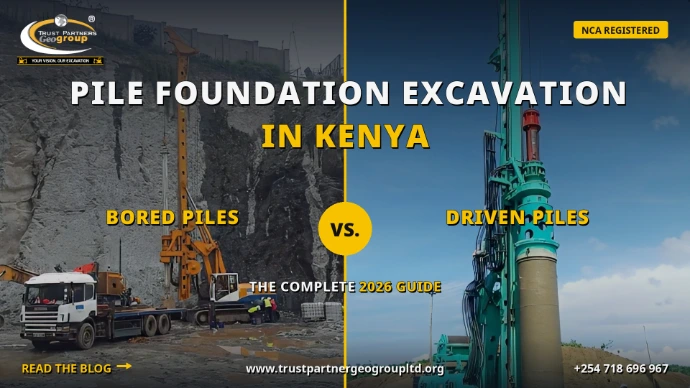
Pile Foundation Excavation in Kenya: Bored Piles vs. Driven Piles [2026 Guide]
Deep foundation costs, methods, and expert guidance for Nairobi, Mombasa, Kisumu & high-rise Kenya
Table of Contents
- 1. When Does Your Kenyan Project Need Pile Foundations?
- 2. How Pile Foundations Work: End-Bearing vs. Friction
- 3. Bored Piles: Method, Equipment & When to Use Them
- 4. Driven Piles: Method, Equipment & When to Use Them
- 5. Bored Piles vs. Driven Piles: Head-to-Head Comparison
- 6. Other Piling Methods in Kenya: CFA, Micropiles & Sheet Piles
- 7. Pile Cap Excavation: Connecting Piles to Your Structure
- 8. The Piling Process: From Soil Investigation to Load Testing
- 9. Pile Foundation Costs in Kenya (2026)
- 10. Pile Testing & Quality Assurance
- 11. How to Choose a Piling Contractor in Kenya
- 12. The Trust Partners Geo-Group Piling Process
- 13. Frequently Asked Questions
- 14. The Bottom Line: Build on Certainty

WHEN DOES YOUR KENYAN PROJECT NEED PILE FOUNDATIONS?
Shallow foundations - strip footings and raft slabs - carry buildings on the soil just below ground level. They are cheap, fast, and perfectly adequate when that soil is strong. But pile foundations become necessary when any of these conditions apply:
- Weak surface soils: Black cotton soil (Embakasi, Ruai, Syokimau, Kajiado), soft lake clays (Kisumu, Busia), loose coastal sands (Mombasa, Malindi), and made-ground/fill cannot carry building loads without excessive settlement. Piles bypass them entirely.
- Heavy structures: As a rule of thumb, buildings over 4-5 storeys in typical Kenyan soils start requiring piles. Nairobi's high-rise boom in Upper Hill, Westlands, Kilimani, and Kileleshwa runs almost entirely on piled foundations.
- Variable ground: When soil strength changes dramatically across your plot - common on Nairobi's volcanic margins where rock head rises and falls by metres - piles equalize the foundation by reaching consistent bearing strata.
- Expansive soils: Black cotton soil swells and shrinks with the seasons, heaving shallow foundations up and down. Piles anchored below the active zone (typically 2.5-4m deep) are immune to this movement.
- Tight settlement tolerances: Hospitals, data centres, precision factories, and high-rise frames cannot tolerate the differential settlement that shallow foundations on marginal soil produce.
- Uplift and lateral loads: Basement structures in high water tables, transmission towers, and retaining structures need piles for tension and lateral resistance, not just compression.
The decision is never made by guesswork or by copying the neighboring plot. It is made by a geotechnical investigation - boreholes or test pits with laboratory testing, interpreted by an engineer. A KES 150,000-500,000 soil investigation protects a KES 50 million - 5 billion investment. See our basement and foundation excavation pillar guide for how shallow and deep foundations compare across Kenyan soil types.
HOW PILE FOUNDATIONS WORK: END-BEARING VS. FRICTION
Every pile in Kenya carries load in one of two ways - and understanding the difference explains most piling decisions:
END-BEARING PILES
The pile acts like a column, transmitting load through weak soil down to a hard stratum - rock, dense gravel, or very stiff clay - at its toe. Capacity comes mostly from the strength of that bearing layer. In Kenya, end-bearing piles are the norm wherever volcanic rock is reachable: Upper Hill (rock at 6-12m), Kilimani, Westlands, Limuru, and Mombasa's coral rock. A 900mm bored pile socketed 1-2 diameters into Nairobi basalt can safely carry 3,000-5,000 kN - the weight of a 20-storey column.
FRICTION PILES
The pile carries load through skin friction - the grip between the pile shaft and the surrounding soil along its entire length. Friction piles work where no hard layer exists at reasonable depth: Kisumu's deep lake clays, the coastal plain's thick sand deposits, and parts of the Athi River basin. Capacity grows with length and shaft area, so friction piles are long (15-30m) and rely on careful installation to preserve shaft friction.
COMBINATION (MOST REAL PILES)
Most Kenyan piles work in combination: friction along the shaft plus end-bearing at the toe. Design codes (Kenyan practice follows Eurocode 7 / BS 8004 methods) apportion capacity between the two, then apply safety factors of 2-3. The practical takeaway for developers: pile cost is driven by depth, and depth is driven by geology - which is why two identical buildings two kilometres apart can have foundation budgets that differ by millions of shillings.
BORED PILES: METHOD, EQUIPMENT & WHEN TO USE THEM
Bored piles - also called cast-in-situ piles or drilled shafts - are manufactured in the ground. A drilling rig bores a cylindrical hole to the design depth, a prefabricated steel reinforcement cage is lowered in, and concrete is placed to form the pile. Bored pile excavation in Nairobi is the dominant piling method in the city's urban construction market - and for good reason, as we will see.
THE BORED PILING SEQUENCE
- Set out and pre-bore: Pile position is surveyed; a guide casing (1-2m) is set to protect the hole collar.
- Drill the bore: A rotary rig with auger or drilling bucket bores to depth. In unstable ground, the hole is supported by temporary steel casing or polymer/bentonite support fluid.
- Clean the base: The drilling bucket or airlift removes loose spoil from the bore bottom - critical for end-bearing capacity.
- Lower the reinforcement cage: Prefabricated cages (typically 12-20mm main bars, helical links) are craned in and spliced as needed.
- Tremie concrete: Concrete (C30-C40) is placed through a tremie pipe from the bottom up, displacing water or slurry without segregation. The temporary casing is withdrawn as concrete rises.
- Log and test: Every pile gets a boring log (depths, strata, concrete volume, time) and integrity testing after curing.
EQUIPMENT FOR BORED PILING IN KENYA
- Rotary piling rigs (e.g., 60-120 kNm torque class) - the standard for 450-1,200mm diameter piles to 25m+
- CFA (continuous flight auger) rigs - faster variant for cohesive soils without boulders; concrete pumped through the hollow auger stem as it is withdrawn
- Support equipment: 50-100t crane or rig-mounted winch for cages, concrete pumps, tremie pipes, desanding units for slurry, and an excavator for spoil handling
- Production rate: 2-4 piles per rig per day (10-15m depth) in typical Nairobi conditions; slower in rock socketing
WHEN BORED PILES WIN
- Urban sites with neighbors close by - no impact vibration, minimal noise (the decisive advantage in Kilimani, Kileleshwa, Lavington, and the CBD fringe)
- Rock at shallow-to-moderate depth - bored piles can socket into basalt and phonolite, which driven piles cannot penetrate
- Variable ground - each bore is logged, so depth is adjusted pile-by-pile to the actual strata
- Very heavy loads - diameters up to 1,500mm carry the largest column loads of any Kenyan piling method
- Sites with obstructions (old foundations, fill with rubble) that would deflect or damage driven piles
Watch-outs: bored piling generates large spoil volumes (a 750mm x 15m pile produces ~7 m3 of soil) that must be excavated, loaded, and disposed of - a real cost in Nairobi where dump sites are controlled. Concrete overbreak (10-20% above theoretical volume) must be budgeted. And bored piles demand disciplined QA: a poorly cleaned base or a tremie break can create a defective pile that only testing will reveal.
DRIVEN PILES: METHOD, EQUIPMENT & WHEN TO USE THEM
Driven piles are factory-manufactured piles - most commonly precast reinforced concrete - installed by hammering them into the ground with a pile driving rig. The pile is also the installation record: driving resistance confirms capacity in real time.
THE DRIVEN PILING SEQUENCE
- Manufacture or procure piles: Precast concrete piles (250-450mm square or octagonal) are cast in factory conditions to C40-C50 concrete, cured, and delivered. Lengths are spliced on site for deeper piles.
- Set out and pitch: The rig's leader (mast) holds the pile vertically over the surveyed position.
- Drive: A diesel hammer or hydraulic hammer drives the pile in repeated blows. The operator records blows per 250mm penetration.
- Reach the "set": Driving stops when the pile reaches the design set - the penetration resistance that confirms design capacity - or refusal on rock.
- Cut off and test: Pile heads are cut to design level, dynamic (PDA) tests confirm capacity on selected piles, and integrity tests verify shaft soundness.
EQUIPMENT FOR DRIVEN PILING IN KENYA
- Piling rig with leader and diesel hammer (most common) or hydraulic drop hammer (quieter, more controllable)
- Vibratory hammer - for sheet piles and non-bearing piles in sand; fast but cannot verify capacity
- Crane support for pile handling; welding equipment for splices; cushion blocks and helmets to protect pile heads
- Production rate: 10-20 piles per rig per day in suitable ground - dramatically faster than bored piling
WHEN DRIVEN PILES WIN
- Soft, uniform soils - loose sands and soft clays where friction piles are needed and driving is easy: the coastal plain (Mombasa, Diani, Malindi), Athi River basin, parts of Kisumu
- Open sites away from noise-sensitive neighbors - industrial zones, logistics parks, greenfield estates
- Fast programs - factory-made piles plus 10-20/day installation makes driven piling the speed champion
- Lower budgets - no spoil, no wet concrete, no casing: typically 30-50% cheaper per metre than bored piles in suitable ground
- High water tables - a precast pile drives straight through groundwater with no concrete placement risk
Watch-outs: driven piles cannot penetrate rock or heavy obstructions - boulders or old foundations deflect them ("pile running off-line"). Driving vibration can crack adjacent buildings and loosen loose sands nearby; pre-condition surveys of neighboring structures are essential. Noise (100-120 dB per blow) is effectively prohibited in dense Nairobi suburbs. And a driven pile that hits refusal above design depth must be extracted or supplemented - the geology must be truly understood first.
BORED PILES VS. DRIVEN PILES: HEAD-TO-HEAD COMPARISON
This is the decision table our engineers walk every client through. Find your site's dominant condition in the left column - the right columns tell you which method it favors:
| FACTOR | BORED PILES (CAST-IN-SITU) | DRIVEN PILES (PRECAST) |
|---|---|---|
| 2026 cost per metre | KES 8,000-40,000 (by diameter) | KES 6,000-12,000 |
| Typical diameters / sizes | 450-1,500mm | 250-450mm square/octagonal |
| Typical depths in Kenya | 6-30m+ | 8-25m (spliced) |
| Load capacity per pile | 1,000-8,000+ kN | 400-1,500 kN |
| Rock penetration | Yes - can socket into basalt/phonolite/coral | No - stops at refusal; rock = no-go |
| Best Kenyan soils | Black cotton, variable volcanic, fill, clay over rock | Uniform soft clay, loose-medium sand |
| Noise & vibration | Low - suitable for dense urban sites | High - 100-120 dB, vibration risk to neighbors |
| Installation speed | 2-4 piles/day/rig | 10-20 piles/day/rig |
| Spoil disposal | Yes - large volumes to excavate and dump | None - soil is displaced, not removed |
| Quality verification | Boring logs + integrity tests + load tests | Driving records (set) + PDA + integrity tests |
| Groundwater handling | Needs casing/slurry + tremie concrete | Excellent - drives straight through |
| Weather sensitivity | High - wet season slows boring and concreting | Moderate - drives in most weather |
| Typical Kenyan applications | Upper Hill/Westlands high-rise, Kilimani apartments, CBD towers, rock sites | Mombasa coastal projects, industrial parks, Athi River logistics, open greenfield sites |
| Mobilization cost | KES 500K-1.5M (rig + crane + support) | KES 300K-800K |
THE 60-SECOND DECISION GUIDE
Choose bored piles if: your site is in a built-up Nairobi suburb (vibration rules), rock is within 15m (socket for big capacity), the ground is variable or obstructed, loads are very heavy, or the soil report shows black cotton over murram/rock - the classic Nairobi profile.
Choose driven piles if: your site is open and away from neighbors, soils are soft and uniform (coastal sand, basin clay), speed matters, budget is tight, and groundwater is high - the classic Mombasa and Athi River profile.
When in doubt: the geotechnical report decides. Trust Partners Geo-Group reviews soil reports and recommends the method - free with every piling quotation.
THE BLACK COTTON TRAP
Black cotton soil creates Kenya's most dangerous piling scenario: it is firm enough when dry to tempt developers into shallow foundations - then the rains arrive. In 2024-2025, multiple apartment blocks in the Ruai-Kamulu corridor developed severe cracking after their strip footings heaved on expansive clay. Retrofitting piles under a cracked building costs 3-5 times more than piling before construction (underpinning runs KES 15,000-35,000 per metre with jacking and needle beams). If your plot is anywhere in the Embakasi-Ruai-Syokimau-Kitengela black cotton belt, budget for piles or complete soil replacement from day one.
OTHER PILING METHODS IN KENYA: CFA, MICROPILES & SHEET PILES
Bored and driven piles cover most Kenyan projects, but three specialist variants solve problems the mainstream methods cannot:
CFA PILES (CONTINUOUS FLIGHT AUGER)
A hybrid of bored and driven thinking: a hollow-stemmed auger drills to depth in one continuous stroke, then concrete is pumped down the stem as the auger is withdrawn - no open hole, no casing, no slurry. The cage is pushed into the fresh concrete afterward.
- Best for: cohesive soils without boulders - Nairobi clays and clay-murram mixes; tight urban sites where slurry handling is impossible
- Speed: 5-10 piles/day - twice bored piling productivity
- Cost (2026): KES 9,000-16,000/m for 450-600mm
- Limitations: depth typically under 20m; cannot socket rock; cage length limited to what can be pushed into fresh concrete (~12m); computerized monitoring of the pour is essential
MICROPILES (MINI-PILES)
Small-diameter (150-300mm) drilled and grouted piles installed with compact rigs that fit through doorways and into basements. Kenya's go-to solution for underpinning existing buildings and restricted-access sites.
- Best for: underpinning cracked buildings on black cotton soil, adding floors to existing structures, tight infill plots, machinery foundations inside operating factories
- Cost (2026): KES 12,000-20,000/m - expensive per metre, but unbeatable when nothing else fits
- Capacity: 300-800 kN per pile through skin friction and end-bearing; can socket into rock with down-hole hammers
SHEET PILES
Interlocking steel sections driven as a continuous wall - a retention system rather than a building foundation. In Kenya they serve basement excavations (holding back soil and water during construction) and marine works (quay walls, jetties) in Mombasa and Lamu. See our upcoming guide on sheet pile wall installation for basement excavation in Nairobi (Blog 23, Volume III series).
PILE CAP EXCAVATION: CONNECTING PILES TO YOUR STRUCTURE
Piles alone do nothing until they are connected to the building above them. That connection happens through pile caps - and pile cap excavation is where foundation engineering meets practical earthmoving. As pile cap excavation contractors, this is a phase we see underestimated constantly.
WHAT PILE CAP EXCAVATION INVOLVES
- Excavate the cap pits: After piles are installed and cured, pits are excavated around the pile heads - typically 1.5-3m deep and 1.5-4m across, sized to the cap design. On a 40-pile project this means 40+ individual excavations or one large dig-out (a "rafted" excavation) where caps are close together.
- Chip the pile heads: The top 300-600mm of each pile - weak, laitance-contaminated concrete from the pour - is broken off with breakers to expose sound concrete and clean reinforcement for the structural connection.
- Blinding and waterproofing: A 50-75mm blinding layer levels the pit base; waterproofing membranes are installed where the water table demands.
- Fix reinforcement and cast: Cap cages (often 2-4 tonnes of steel each on big projects) are fixed, formwork set, and C35-C40 concrete poured and cured.
- Ground beams and backfill: Reinforced concrete ground beams link the caps into a unified foundation; pits are backfilled in compacted layers; the suspended or ground-bearing slab follows.
| PILE CAP EXCAVATION ITEM (2026) | UNIT | COST (KES) |
|---|---|---|
| Cap pit excavation (soft soil) | m3 | 400-700 |
| Cap pit excavation (rock - hammer) | m3 | 1,500-3,000 |
| Pile head chipping/breaking | per pile | 8,000-20,000 |
| Blinding (50-75mm) | m2 | 800-1,500 |
| Cap + ground beam concrete (C35, supplied & poured) | m3 | 18,000-26,000 |
| Cap reinforcement (cut, bent, fixed) | kg | 180-280 |
| Formwork to caps/beams | m2 | 1,200-2,000 |
| Backfill & compaction | m3 | 300-500 |
On a typical Nairobi apartment project, pile cap excavation and construction adds 15-25% on top of the piling contract itself - plan it as one integrated foundation package, not an afterthought.
THE PILING PROCESS: FROM SOIL INVESTIGATION TO LOAD TESTING
A professional Kenyan piling project runs in six controlled stages. Here is what should happen on your site, in order:
STAGE 1: GEOTECHNICAL INVESTIGATION
Boreholes (minimum 2-4 for a typical building, more for large or complex sites) drilled through the full anticipated pile depth, with standard penetration tests (SPT), sampling, and laboratory analysis. Deliverable: a report stating soil profile, groundwater, rock depth, and recommended pile type/depth. Cost: KES 150,000-500,000. Duration: 1-2 weeks. Never pile without it.
STAGE 2: DESIGN & METHOD SELECTION
The structural engineer calculates column loads and designs the pile layout (positions, diameters, depths, reinforcement, pile caps). The piling contractor and engineer jointly confirm bored vs driven vs CFA based on soil, neighbors, access, and budget. Pile working load, test regime, and acceptance criteria are specified.
STAGE 3: MOBILIZATION & PLATFORM
The rig, crane, and support plant mobilize to site (KES 300K-1.5M depending on method and distance). A working platform - typically 300-600mm of compacted hardcore/murram - is built so the rig can stand and travel safely. On black cotton sites the platform is non-negotiable: a 60-tonne rig will sink to its belly in wet cotton soil without one. Pile positions are set out by total station and independently checked.
STAGE 4: PILE INSTALLATION
Production piling with full logging: bored piles get boring logs and concrete pour records; driven piles get blow-count driving records. Preliminary (sacrificial) test piles are installed first on large projects to validate the design before production. Typical durations: 2-6 weeks for most building projects.
STAGE 5: TESTING & VERIFICATION
Integrity tests on 100% of piles (low-strain PIT). Static load tests to 1.5-2x working load on 1-2% of piles (minimum 1-2 per project). Dynamic PDA tests on driven piles. Concrete strength tests on every pour. Failures trigger investigation and remediation - replacement or supplementary piles.
STAGE 6: PILE CAPS, HANDOVER & DOCUMENTATION
Pile cap excavation, head chipping, cap and ground beam casting. Final handover pack: as-built pile layout, all boring/driving logs, test certificates, concrete records. These documents go to the county inspector, the structural engineer of record, and your building's permanent file - insurers and future buyers will ask for them.
PILE FOUNDATION COSTS IN KENYA (2026)
Piling is priced per linear metre of pile installed, plus mobilization, testing, and the pile cap works. These are current 2026 market rates from active projects in Nairobi, Mombasa, and Nakuru:
PILE INSTALLATION RATES BY METHOD AND SIZE
| PILE TYPE / SIZE | RATE (KES PER LINEAR METRE) | TYPICAL CAPACITY | NOTES |
|---|---|---|---|
| Bored pile 450-600mm | 8,000-15,000 | 800-2,000 kN | Apartments, mid-rise; most common Nairobi size |
| Bored pile 750-900mm | 15,000-25,000 | 2,000-4,500 kN | High-rise columns, commercial |
| Bored pile 1,000-1,200mm | 25,000-40,000 | 4,500-8,000+ kN | Towers, bridges; rock-socketed |
| CFA pile 450-600mm | 9,000-16,000 | 800-2,000 kN | Faster than bored; cohesive soils only |
| Driven precast 250-300mm | 6,000-9,000 | 400-800 kN | Light commercial, residential |
| Driven precast 350-450mm | 9,000-12,000 | 800-1,500 kN | Industrial, mid-rise in soft ground |
| Micropile 150-300mm | 12,000-20,000 | 300-800 kN | Underpinning, restricted access |
| Steel sheet piles (supply & drive) | 3,500-6,000 per m2 of wall | - | Retention, not building foundations |
ANCILLARY COSTS (OFTEN FORGOTTEN IN BUDGETS)
| ITEM | 2026 COST (KES) | WHY IT MATTERS |
|---|---|---|
| Geotechnical investigation | 150,000-500,000 | The design input - no report, no responsible piling |
| Rig mobilization/demobilization | 300,000-1,500,000 | Big single line; shared if phasing with neighbors |
| Working platform (hardcore/murram) | 200,000-800,000 | Mandatory on soft sites; 300-600mm compacted |
| Spoil disposal (bored piling) | 200-400 per m3 | A 40-pile job generates 200-400 m3 of spoil |
| Static load test | 300,000-800,000 per test | Kentledge/reaction setup; minimum 1-2 per project |
| Pile integrity test (PIT) | 5,000-15,000 per pile | Every pile, every project - non-negotiable |
| Dynamic test (PDA, driven) | 50,000-150,000 per pile | Capacity verification on driven piles |
| Preliminary test piles | At production rate + test setup | Validate design before production on big jobs |
TOTAL PROJECT BUDGETS BY BUILDING TYPE (2026)
| PROJECT | TYPICAL PILE SCOPE | PILING COST | + CAPS, TESTING, MOBILIZATION |
|---|---|---|---|
| 4-6 storey apartment (Ruaka, Syokimau, Thika Rd) | 25-40 bored piles, 450-600mm, 10-15m | KES 3M-8M | KES 4.5M-11M all-in |
| 8-12 storey block (Kilimani, Kileleshwa) | 40-70 bored piles, 600-900mm, 12-18m | KES 10M-25M | KES 13M-32M all-in |
| High-rise tower (Upper Hill, Westlands) | 80-150 bored piles, 750-1,200mm, rock-socketed | KES 25M-60M+ | KES 32M-75M+ all-in |
| Warehouse / industrial (Athi River, Mombasa Rd) | 100-300 driven piles, 250-350mm, 8-14m | KES 8M-25M | KES 11M-32M all-in |
| Coastal hotel/apartments (Mombasa, Diani) | 60-120 driven piles through sand to coral | KES 9M-22M | KES 12M-28M all-in |
| Underpinning existing building | 20-50 micropiles + needle beams/jacking | KES 4M-15M | Case-by-case; 3-5x prevention cost |
Rules of thumb: driven pile foundation cost runs 30-50% lower per metre than bored piling in suitable ground; rock socketing adds 20-40% to bored pile rates; Mombasa and upcountry mobilization adds 15-30%; wet-season piling adds 10-25% in time-related costs. A piled foundation typically costs 2-4 times a shallow foundation on the same building - which is why the geotechnical report that might let you avoid piles is the best-value document in construction.
PILE TESTING & QUALITY ASSURANCE
A pile is buried the moment it is made - you will never see it again. Testing is the only proof it can carry your building. Kenyan best practice (Eurocode 7 / ICE methods, as applied by local engineers) uses a layered testing regime:
THE FOUR PILLARS OF PILE QA
- 1. Installation records (100% of piles): Bored piles - boring logs with strata depths, concrete volume vs theoretical (overbreak), pour continuity, casing extraction records. Driven piles - blow counts per 250mm, final set, hammer energy. Missing records = unverifiable pile.
- 2. Integrity testing - PIT (100% of piles): Low-strain sonic pulse testing that finds necking, voids, cracks, and soil inclusions in the shaft. Fast (15 minutes per pile), cheap (KES 5,000-15,000), and absolutely mandatory. Any pile failing PIT gets cored or excavated for visual confirmation.
- 3. Static load tests (1-2% of piles, minimum 1-2 per project): The pile is loaded to 1.5-2 times working load with kentledge blocks or tension reaction piles, and settlement is measured over 12-24+ hours. This is the only test that proves real capacity. Budget KES 300,000-800,000 per test - it is the cheapest insurance on the entire project.
- 4. Material testing: Concrete cubes/cylinders from every pour (7-day and 28-day strengths); steel mill certificates for reinforcement and precast piles; grout testing for micropiles.
THE SKIPPED TEST THAT SINKS BUILDINGS
The most dangerous sentence in Kenyan piling is "the piles look fine, let us skip the load test." A bored pile with a soil inclusion at 9m looks identical to a perfect pile from the surface. In 2023, a mid-rise project in Nairobi's eastlands skipped static tests to save KES 600,000; two years later, differential settlement of 40mm across one corner produced diagonal cracking through five floors - remediation by micropile underpinning cost over KES 9 million. Rule: integrity-test every pile, statically load-test at least one, and never pour a cap over an untested pile.
HOW TO CHOOSE A PILING CONTRACTOR IN KENYA
Piling is the most specialized trade in Kenyan excavation - and the least forgiving of amateurs. Vet contractors on these eight criteria:
- NCA registration with piling/foundation capability: Verify on the NCA portal. Piling demands specialist registration, not general building works.
- Owned rigs, not hired promises: Ask for the rig fleet list with photos and registration details. Contractors who must source a rig after signing will delay you weeks and add margins.
- Engineering depth: A serious piling contractor employs or partners with registered geotechnical/structural engineers who interpret borehole logs and adjust pile depths to actual strata - not just drill to a number on a drawing.
- Testing regime in writing: The quotation must state PIT on all piles, static load tests (number and method), and material testing - with named testing partners. If testing is "optional," walk away.
- Itemized pricing: Per-metre rates by diameter, mobilization, platform, spoil disposal, concrete overbreak allowance, and testing as separate lines. One-line lump sums hide the variations that ambush you later.
- Track record you can verify: Three completed piled projects of similar scale with contactable references. Bonus: visit an active site and watch one full pile installation.
- Neighbor-risk management (urban sites): Pre-condition surveys of adjacent buildings, vibration monitoring where driving, and noise compliance - the things that keep your project out of court.
- Insurance: Contractor's All Risks, third-party liability, and WIBA. A piling rig striking a neighbor's foundation or a utility main is a seven-figure event.
THE TRUST PARTNERS GEO-GROUP PILING PROCESS
At Trust Partners Geo-Group Ltd, we deliver the complete pile foundation package - earthworks, working platforms, pile cap excavation, and coordination with Kenya's leading specialist piling partners - as one integrated, engineer-led service.
PHASE 1: GROUND TRUTH
- Free site visit and geotechnical scoping anywhere in Nairobi, Kiambu, Mombasa, Nakuru, and Kisumu (nationwide for larger projects).
- Borehole investigation through our registered engineer partners - soil profile, SPT data, groundwater, rock head mapping.
- Method recommendation: bored vs driven vs CFA, with transparent cost comparison for your specific ground.
PHASE 2: DESIGN & PRICING
- Pile layout, cap design, and test regime coordinated with your structural engineer (or ours).
- Itemized quotation: per-metre rates by diameter, mobilization, platform, spoil, testing - no hidden lump sums.
- County approvals, NEMA liaison where required, and neighbor notification/pre-condition surveys for urban sites.
PHASE 3: INSTALLATION & EARTHWORKS
- Working platform construction from our own earthworks fleet - the same machines and QA discipline behind our compaction QA/QC program.
- Pile installation with 100% logging; daily engineer review of boring/driving records.
- Spoil excavation, loading, and licensed disposal - bored piling's forgotten cost, handled by our own trucks.
PHASE 4: CAPS, TESTING & HANDOVER
- Pile cap excavation, head chipping, cap and ground beam construction.
- Full test regime: PIT on every pile, static load tests, concrete strength verification.
- Complete handover documentation for county inspection, insurance, and your permanent building file - backed by our workmanship warranty.
- TRUST PARTNERS GEO-GROUP LTD
FREQUENTLY ASKED QUESTIONS: PILE FOUNDATIONS IN KENYA
What is the difference between bored piles and driven piles?
Bored piles are cast in the ground: a rig drills a hole, a steel cage is lowered, and concrete is poured (cast-in-situ). Driven piles are factory-made concrete or steel piles hammered into the ground by a pile driver. Bored piles suit rock, variable soils, and urban sites needing low vibration. Driven piles are faster and cheaper in soft, uniform soils but create noise and vibration.
How much does a pile foundation cost in Kenya?
In 2026, bored piles cost KES 8,000-15,000 per metre for 450-600mm diameter, KES 15,000-25,000 for 750-900mm, and KES 25,000-40,000 for 1,000-1,200mm. Driven precast piles cost KES 6,000-12,000 per metre. Add mobilization (KES 300,000-1.5M), pile caps, and load testing (KES 300,000-800,000 per static test). Total project budgets typically run KES 3M-60M+ depending on pile count and depth.
When do I need piles instead of a strip or raft foundation?
You need piles when: (1) weak surface soils (black cotton, soft clay, fill) cannot carry the building load; (2) the structure is heavy - typically buildings over 4-5 storeys; (3) soils are highly variable across the site; (4) you are building on slopes or near water; (5) settlement tolerances are tight (hospitals, precision factories). A geotechnical report determines this - never guess.
How deep do bored piles go in Nairobi?
Depth depends on where strong soil or rock begins. In Embakasi, Ruai, and Syokimau, piles pass through black cotton soil to firm murram at 8-15m. In Upper Hill, Kilimani, and Westlands, piles socket into volcanic rock at 6-12m. CBD high-rises may need 15-25m. In Mombasa, piles reach coral rock at 10-20m. Only borehole data from your specific plot gives a reliable design depth.
Are driven piles too noisy for residential areas in Nairobi?
Often yes. Diesel hammer driving produces 100-120 dB impacts and ground vibration that can crack nearby buildings and violate county noise rules. In dense suburbs like Kilimani, Kileleshwa, and Lavington, bored piles or CFA piles are preferred because they are vibration-free. Driven piles remain excellent for open sites, industrial zones, and projects away from existing structures.
What is a pile cap and does it require excavation?
A pile cap is a thick reinforced concrete block cast over the heads of one or more piles, transferring column loads into the piles. Yes - pile caps require excavation after piling: pits are dug around pile heads (typically 1.5-3m deep), pile heads are chipped to sound concrete, then the cap is formed with blinding, reinforcement, and concrete. Ground beams then link caps together.
How are piles tested in Kenya?
Standard pile testing in Kenya includes: (1) Static load tests - a test pile is loaded to 1.5-2 times working load using kentledge blocks or reaction piles (KES 300,000-800,000 per test); (2) Pile Integrity Tests (PIT) - low-strain sonic testing of every pile shaft for defects (KES 5,000-15,000 per pile); (3) Dynamic load testing (PDA) on driven piles; (4) Concrete cube/cylinder strength tests for every pour.
How long does piling take on a Kenyan construction site?
A typical bored piling rig installs 2-4 piles per day (10-15m deep) in Nairobi soils; a driven pile rig installs 10-20 piles per day in suitable ground. A 40-pile apartment project takes 3-5 weeks for bored piles including mobilization, or 1-2 weeks for driven piles. Add 2-4 weeks for pile cap excavation and casting, and 1-2 weeks for load testing. Rain and rock can extend timelines 30-50%.
THE BOTTOM LINE: BUILD ON CERTAINTY
Pile foundations are where Kenyan construction meets its hardest truth: the ground gets the final vote. Black cotton soil will heave a shallow foundation. Variable volcanic ground will settle a uniform one unevenly. Coastal sand will flow from under a slab. Piles are how serious buildings outvote the ground - reaching the strong, stable strata that carry them for a century.
The decision framework is simple:
- Investigate first: boreholes before budgets. A KES 300,000 soil report directs a KES 30 million foundation decision.
- Match method to ground: bored piles for rock, variable soils, and vibration-sensitive urban sites; driven piles for speed and economy in soft, uniform, open ground; CFA for cohesive soils at pace; micropiles when nothing else fits.
- Budget the whole system: piles + mobilization + platform + spoil + caps + testing. The per-metre rate is only the beginning.
- Test everything: PIT on every pile, static load tests on the critical ones, and never cast a cap over an unverified pile.
- Document permanently: boring logs, driving records, and test certificates are your building's birth certificate - insurers, buyers, and future engineers will all ask for them.
At Trust Partners Geo-Group Ltd, we have prepared platforms, excavated pile caps, and coordinated piling programs across Nairobi's rock ridges and black cotton plains, Mombasa's coral coast, and the Rift Valley's volcanic soils. Whether your project is a 5-storey apartment in Ruiru, a warehouse in Athi River, a hotel in Diani, or a tower in Upper Hill, we bring the earthworks capability, engineering partnerships, and testing discipline that piled foundations demand.
Your building will stand on its foundation for the next hundred years. Make sure that foundation was chosen by evidence, installed by specialists, and proven by testing. That is how Kenya builds on certainty.
- TRUST PARTNERS GEO-GROUP LTD
PLANNING A PILED FOUNDATION IN KENYA?
Trust Partners Geo-Group provides pile foundation excavation, working platforms, pile cap excavation, and complete deep foundation earthworks across Nairobi, Mombasa, Kisumu, Nakuru, and nationwide. Contact us for a free site assessment, geotechnical scoping, and itemized piling quotation - plus our free Pile Foundation Planning Checklist.
CALL +254 718 68 69 67 EMAIL US VISIT OUR WEBSITE
NAIROBI HQ | SERVING NAIROBI, KIAMBU, MACHAKOS, KAJIADO, NAKURU, MOMBASA, KISUMU, ELDORET, THIKA, NAIVASHA & NATIONWIDE
MON - SAT: 8:00 AM - 6:00 PM | GEOTECHNICAL ASSESSMENTS BOOKED WITHIN 48 HOURS
RELATED RESOURCES
TRUST PARTNERS GEO-GROUP LTD | YOUR VISION, OUR EXCAVATION
WEBSITE: WWW.TRUSTPARTNERGEOGROUPLTD.ORG | EMAIL: INFO@TRUSTPARTNERGEOGROUPLTD.ORG | PHONE: +254 718 68 69 67
FOLLOW US: FACEBOOK | TIKTOK | INSTAGRAM | YOUTUBE | LINKEDIN
© 2026 TRUST PARTNERS GEO-GROUP LTD. ALL RIGHTS RESERVED.
Pile Foundation Excavation in Kenya: Bored Piles vs. Driven Piles [2026 Guide]
Deep foundation costs, methods, and expert guidance for Nairobi, Mombasa, Kisumu & high-rise Kenya
Table of Contents
- 1. When Does Your Kenyan Project Need Pile Foundations?
- 2. How Pile Foundations Work: End-Bearing vs. Friction
- 3. Bored Piles: Method, Equipment & When to Use Them
- 4. Driven Piles: Method, Equipment & When to Use Them
- 5. Bored Piles vs. Driven Piles: Head-to-Head Comparison
- 6. Other Piling Methods in Kenya: CFA, Micropiles & Sheet Piles
- 7. Pile Cap Excavation: Connecting Piles to Your Structure
- 8. The Piling Process: From Soil Investigation to Load Testing
- 9. Pile Foundation Costs in Kenya (2026)
- 10. Pile Testing & Quality Assurance
- 11. How to Choose a Piling Contractor in Kenya
- 12. The Trust Partners Geo-Group Piling Process
- 13. Frequently Asked Questions
- 14. The Bottom Line: Build on Certainty
WHEN DOES YOUR KENYAN PROJECT NEED PILE FOUNDATIONS?
Shallow foundations - strip footings and raft slabs - carry buildings on the soil just below ground level. They are cheap, fast, and perfectly adequate when that soil is strong. But pile foundations become necessary when any of these conditions apply:
- Weak surface soils: Black cotton soil (Embakasi, Ruai, Syokimau, Kajiado), soft lake clays (Kisumu, Busia), loose coastal sands (Mombasa, Malindi), and made-ground/fill cannot carry building loads without excessive settlement. Piles bypass them entirely.
- Heavy structures: As a rule of thumb, buildings over 4-5 storeys in typical Kenyan soils start requiring piles. Nairobi's high-rise boom in Upper Hill, Westlands, Kilimani, and Kileleshwa runs almost entirely on piled foundations.
- Variable ground: When soil strength changes dramatically across your plot - common on Nairobi's volcanic margins where rock head rises and falls by metres - piles equalize the foundation by reaching consistent bearing strata.
- Expansive soils: Black cotton soil swells and shrinks with the seasons, heaving shallow foundations up and down. Piles anchored below the active zone (typically 2.5-4m deep) are immune to this movement.
- Tight settlement tolerances: Hospitals, data centres, precision factories, and high-rise frames cannot tolerate the differential settlement that shallow foundations on marginal soil produce.
- Uplift and lateral loads: Basement structures in high water tables, transmission towers, and retaining structures need piles for tension and lateral resistance, not just compression.
The decision is never made by guesswork or by copying the neighboring plot. It is made by a geotechnical investigation - boreholes or test pits with laboratory testing, interpreted by an engineer. A KES 150,000-500,000 soil investigation protects a KES 50 million - 5 billion investment. See our basement and foundation excavation pillar guide for how shallow and deep foundations compare across Kenyan soil types.
HOW PILE FOUNDATIONS WORK: END-BEARING VS. FRICTION
Every pile in Kenya carries load in one of two ways - and understanding the difference explains most piling decisions:
END-BEARING PILES
The pile acts like a column, transmitting load through weak soil down to a hard stratum - rock, dense gravel, or very stiff clay - at its toe. Capacity comes mostly from the strength of that bearing layer. In Kenya, end-bearing piles are the norm wherever volcanic rock is reachable: Upper Hill (rock at 6-12m), Kilimani, Westlands, Limuru, and Mombasa's coral rock. A 900mm bored pile socketed 1-2 diameters into Nairobi basalt can safely carry 3,000-5,000 kN - the weight of a 20-storey column.
FRICTION PILES
The pile carries load through skin friction - the grip between the pile shaft and the surrounding soil along its entire length. Friction piles work where no hard layer exists at reasonable depth: Kisumu's deep lake clays, the coastal plain's thick sand deposits, and parts of the Athi River basin. Capacity grows with length and shaft area, so friction piles are long (15-30m) and rely on careful installation to preserve shaft friction.
COMBINATION (MOST REAL PILES)
Most Kenyan piles work in combination: friction along the shaft plus end-bearing at the toe. Design codes (Kenyan practice follows Eurocode 7 / BS 8004 methods) apportion capacity between the two, then apply safety factors of 2-3. The practical takeaway for developers: pile cost is driven by depth, and depth is driven by geology - which is why two identical buildings two kilometres apart can have foundation budgets that differ by millions of shillings.
BORED PILES: METHOD, EQUIPMENT & WHEN TO USE THEM
Bored piles - also called cast-in-situ piles or drilled shafts - are manufactured in the ground. A drilling rig bores a cylindrical hole to the design depth, a prefabricated steel reinforcement cage is lowered in, and concrete is placed to form the pile. Bored pile excavation in Nairobi is the dominant piling method in the city's urban construction market - and for good reason, as we will see.
THE BORED PILING SEQUENCE
- Set out and pre-bore: Pile position is surveyed; a guide casing (1-2m) is set to protect the hole collar.
- Drill the bore: A rotary rig with auger or drilling bucket bores to depth. In unstable ground, the hole is supported by temporary steel casing or polymer/bentonite support fluid.
- Clean the base: The drilling bucket or airlift removes loose spoil from the bore bottom - critical for end-bearing capacity.
- Lower the reinforcement cage: Prefabricated cages (typically 12-20mm main bars, helical links) are craned in and spliced as needed.
- Tremie concrete: Concrete (C30-C40) is placed through a tremie pipe from the bottom up, displacing water or slurry without segregation. The temporary casing is withdrawn as concrete rises.
- Log and test: Every pile gets a boring log (depths, strata, concrete volume, time) and integrity testing after curing.
EQUIPMENT FOR BORED PILING IN KENYA
- Rotary piling rigs (e.g., 60-120 kNm torque class) - the standard for 450-1,200mm diameter piles to 25m+
- CFA (continuous flight auger) rigs - faster variant for cohesive soils without boulders; concrete pumped through the hollow auger stem as it is withdrawn
- Support equipment: 50-100t crane or rig-mounted winch for cages, concrete pumps, tremie pipes, desanding units for slurry, and an excavator for spoil handling
- Production rate: 2-4 piles per rig per day (10-15m depth) in typical Nairobi conditions; slower in rock socketing
WHEN BORED PILES WIN
- Urban sites with neighbors close by - no impact vibration, minimal noise (the decisive advantage in Kilimani, Kileleshwa, Lavington, and the CBD fringe)
- Rock at shallow-to-moderate depth - bored piles can socket into basalt and phonolite, which driven piles cannot penetrate
- Variable ground - each bore is logged, so depth is adjusted pile-by-pile to the actual strata
- Very heavy loads - diameters up to 1,500mm carry the largest column loads of any Kenyan piling method
- Sites with obstructions (old foundations, fill with rubble) that would deflect or damage driven piles
Watch-outs: bored piling generates large spoil volumes (a 750mm x 15m pile produces ~7 m3 of soil) that must be excavated, loaded, and disposed of - a real cost in Nairobi where dump sites are controlled. Concrete overbreak (10-20% above theoretical volume) must be budgeted. And bored piles demand disciplined QA: a poorly cleaned base or a tremie break can create a defective pile that only testing will reveal.
DRIVEN PILES: METHOD, EQUIPMENT & WHEN TO USE THEM
Driven piles are factory-manufactured piles - most commonly precast reinforced concrete - installed by hammering them into the ground with a pile driving rig. The pile is also the installation record: driving resistance confirms capacity in real time.
THE DRIVEN PILING SEQUENCE
- Manufacture or procure piles: Precast concrete piles (250-450mm square or octagonal) are cast in factory conditions to C40-C50 concrete, cured, and delivered. Lengths are spliced on site for deeper piles.
- Set out and pitch: The rig's leader (mast) holds the pile vertically over the surveyed position.
- Drive: A diesel hammer or hydraulic hammer drives the pile in repeated blows. The operator records blows per 250mm penetration.
- Reach the "set": Driving stops when the pile reaches the design set - the penetration resistance that confirms design capacity - or refusal on rock.
- Cut off and test: Pile heads are cut to design level, dynamic (PDA) tests confirm capacity on selected piles, and integrity tests verify shaft soundness.
EQUIPMENT FOR DRIVEN PILING IN KENYA
- Piling rig with leader and diesel hammer (most common) or hydraulic drop hammer (quieter, more controllable)
- Vibratory hammer - for sheet piles and non-bearing piles in sand; fast but cannot verify capacity
- Crane support for pile handling; welding equipment for splices; cushion blocks and helmets to protect pile heads
- Production rate: 10-20 piles per rig per day in suitable ground - dramatically faster than bored piling
WHEN DRIVEN PILES WIN
- Soft, uniform soils - loose sands and soft clays where friction piles are needed and driving is easy: the coastal plain (Mombasa, Diani, Malindi), Athi River basin, parts of Kisumu
- Open sites away from noise-sensitive neighbors - industrial zones, logistics parks, greenfield estates
- Fast programs - factory-made piles plus 10-20/day installation makes driven piling the speed champion
- Lower budgets - no spoil, no wet concrete, no casing: typically 30-50% cheaper per metre than bored piles in suitable ground
- High water tables - a precast pile drives straight through groundwater with no concrete placement risk
Watch-outs: driven piles cannot penetrate rock or heavy obstructions - boulders or old foundations deflect them ("pile running off-line"). Driving vibration can crack adjacent buildings and loosen loose sands nearby; pre-condition surveys of neighboring structures are essential. Noise (100-120 dB per blow) is effectively prohibited in dense Nairobi suburbs. And a driven pile that hits refusal above design depth must be extracted or supplemented - the geology must be truly understood first.
BORED PILES VS. DRIVEN PILES: HEAD-TO-HEAD COMPARISON
This is the decision table our engineers walk every client through. Find your site's dominant condition in the left column - the right columns tell you which method it favors:
| FACTOR | BORED PILES (CAST-IN-SITU) | DRIVEN PILES (PRECAST) |
|---|---|---|
| 2026 cost per metre | KES 8,000-40,000 (by diameter) | KES 6,000-12,000 |
| Typical diameters / sizes | 450-1,500mm | 250-450mm square/octagonal |
| Typical depths in Kenya | 6-30m+ | 8-25m (spliced) |
| Load capacity per pile | 1,000-8,000+ kN | 400-1,500 kN |
| Rock penetration | Yes - can socket into basalt/phonolite/coral | No - stops at refusal; rock = no-go |
| Best Kenyan soils | Black cotton, variable volcanic, fill, clay over rock | Uniform soft clay, loose-medium sand |
| Noise & vibration | Low - suitable for dense urban sites | High - 100-120 dB, vibration risk to neighbors |
| Installation speed | 2-4 piles/day/rig | 10-20 piles/day/rig |
| Spoil disposal | Yes - large volumes to excavate and dump | None - soil is displaced, not removed |
| Quality verification | Boring logs + integrity tests + load tests | Driving records (set) + PDA + integrity tests |
| Groundwater handling | Needs casing/slurry + tremie concrete | Excellent - drives straight through |
| Weather sensitivity | High - wet season slows boring and concreting | Moderate - drives in most weather |
| Typical Kenyan applications | Upper Hill/Westlands high-rise, Kilimani apartments, CBD towers, rock sites | Mombasa coastal projects, industrial parks, Athi River logistics, open greenfield sites |
| Mobilization cost | KES 500K-1.5M (rig + crane + support) | KES 300K-800K |
THE 60-SECOND DECISION GUIDE
Choose bored piles if: your site is in a built-up Nairobi suburb (vibration rules), rock is within 15m (socket for big capacity), the ground is variable or obstructed, loads are very heavy, or the soil report shows black cotton over murram/rock - the classic Nairobi profile.
Choose driven piles if: your site is open and away from neighbors, soils are soft and uniform (coastal sand, basin clay), speed matters, budget is tight, and groundwater is high - the classic Mombasa and Athi River profile.
When in doubt: the geotechnical report decides. Trust Partners Geo-Group reviews soil reports and recommends the method - free with every piling quotation.
THE BLACK COTTON TRAP
Black cotton soil creates Kenya's most dangerous piling scenario: it is firm enough when dry to tempt developers into shallow foundations - then the rains arrive. In 2024-2025, multiple apartment blocks in the Ruai-Kamulu corridor developed severe cracking after their strip footings heaved on expansive clay. Retrofitting piles under a cracked building costs 3-5 times more than piling before construction (underpinning runs KES 15,000-35,000 per metre with jacking and needle beams). If your plot is anywhere in the Embakasi-Ruai-Syokimau-Kitengela black cotton belt, budget for piles or complete soil replacement from day one.
OTHER PILING METHODS IN KENYA: CFA, MICROPILES & SHEET PILES
Bored and driven piles cover most Kenyan projects, but three specialist variants solve problems the mainstream methods cannot:
CFA PILES (CONTINUOUS FLIGHT AUGER)
A hybrid of bored and driven thinking: a hollow-stemmed auger drills to depth in one continuous stroke, then concrete is pumped down the stem as the auger is withdrawn - no open hole, no casing, no slurry. The cage is pushed into the fresh concrete afterward.
- Best for: cohesive soils without boulders - Nairobi clays and clay-murram mixes; tight urban sites where slurry handling is impossible
- Speed: 5-10 piles/day - twice bored piling productivity
- Cost (2026): KES 9,000-16,000/m for 450-600mm
- Limitations: depth typically under 20m; cannot socket rock; cage length limited to what can be pushed into fresh concrete (~12m); computerized monitoring of the pour is essential
MICROPILES (MINI-PILES)
Small-diameter (150-300mm) drilled and grouted piles installed with compact rigs that fit through doorways and into basements. Kenya's go-to solution for underpinning existing buildings and restricted-access sites.
- Best for: underpinning cracked buildings on black cotton soil, adding floors to existing structures, tight infill plots, machinery foundations inside operating factories
- Cost (2026): KES 12,000-20,000/m - expensive per metre, but unbeatable when nothing else fits
- Capacity: 300-800 kN per pile through skin friction and end-bearing; can socket into rock with down-hole hammers
SHEET PILES
Interlocking steel sections driven as a continuous wall - a retention system rather than a building foundation. In Kenya they serve basement excavations (holding back soil and water during construction) and marine works (quay walls, jetties) in Mombasa and Lamu. See our upcoming guide on sheet pile wall installation for basement excavation in Nairobi (Blog 23, Volume III series).
PILE CAP EXCAVATION: CONNECTING PILES TO YOUR STRUCTURE
Piles alone do nothing until they are connected to the building above them. That connection happens through pile caps - and pile cap excavation is where foundation engineering meets practical earthmoving. As pile cap excavation contractors, this is a phase we see underestimated constantly.
WHAT PILE CAP EXCAVATION INVOLVES
- Excavate the cap pits: After piles are installed and cured, pits are excavated around the pile heads - typically 1.5-3m deep and 1.5-4m across, sized to the cap design. On a 40-pile project this means 40+ individual excavations or one large dig-out (a "rafted" excavation) where caps are close together.
- Chip the pile heads: The top 300-600mm of each pile - weak, laitance-contaminated concrete from the pour - is broken off with breakers to expose sound concrete and clean reinforcement for the structural connection.
- Blinding and waterproofing: A 50-75mm blinding layer levels the pit base; waterproofing membranes are installed where the water table demands.
- Fix reinforcement and cast: Cap cages (often 2-4 tonnes of steel each on big projects) are fixed, formwork set, and C35-C40 concrete poured and cured.
- Ground beams and backfill: Reinforced concrete ground beams link the caps into a unified foundation; pits are backfilled in compacted layers; the suspended or ground-bearing slab follows.
| PILE CAP EXCAVATION ITEM (2026) | UNIT | COST (KES) |
|---|---|---|
| Cap pit excavation (soft soil) | m3 | 400-700 |
| Cap pit excavation (rock - hammer) | m3 | 1,500-3,000 |
| Pile head chipping/breaking | per pile | 8,000-20,000 |
| Blinding (50-75mm) | m2 | 800-1,500 |
| Cap + ground beam concrete (C35, supplied & poured) | m3 | 18,000-26,000 |
| Cap reinforcement (cut, bent, fixed) | kg | 180-280 |
| Formwork to caps/beams | m2 | 1,200-2,000 |
| Backfill & compaction | m3 | 300-500 |
On a typical Nairobi apartment project, pile cap excavation and construction adds 15-25% on top of the piling contract itself - plan it as one integrated foundation package, not an afterthought.
THE PILING PROCESS: FROM SOIL INVESTIGATION TO LOAD TESTING
A professional Kenyan piling project runs in six controlled stages. Here is what should happen on your site, in order:
STAGE 1: GEOTECHNICAL INVESTIGATION
Boreholes (minimum 2-4 for a typical building, more for large or complex sites) drilled through the full anticipated pile depth, with standard penetration tests (SPT), sampling, and laboratory analysis. Deliverable: a report stating soil profile, groundwater, rock depth, and recommended pile type/depth. Cost: KES 150,000-500,000. Duration: 1-2 weeks. Never pile without it.
STAGE 2: DESIGN & METHOD SELECTION
The structural engineer calculates column loads and designs the pile layout (positions, diameters, depths, reinforcement, pile caps). The piling contractor and engineer jointly confirm bored vs driven vs CFA based on soil, neighbors, access, and budget. Pile working load, test regime, and acceptance criteria are specified.
STAGE 3: MOBILIZATION & PLATFORM
The rig, crane, and support plant mobilize to site (KES 300K-1.5M depending on method and distance). A working platform - typically 300-600mm of compacted hardcore/murram - is built so the rig can stand and travel safely. On black cotton sites the platform is non-negotiable: a 60-tonne rig will sink to its belly in wet cotton soil without one. Pile positions are set out by total station and independently checked.
STAGE 4: PILE INSTALLATION
Production piling with full logging: bored piles get boring logs and concrete pour records; driven piles get blow-count driving records. Preliminary (sacrificial) test piles are installed first on large projects to validate the design before production. Typical durations: 2-6 weeks for most building projects.
STAGE 5: TESTING & VERIFICATION
Integrity tests on 100% of piles (low-strain PIT). Static load tests to 1.5-2x working load on 1-2% of piles (minimum 1-2 per project). Dynamic PDA tests on driven piles. Concrete strength tests on every pour. Failures trigger investigation and remediation - replacement or supplementary piles.
STAGE 6: PILE CAPS, HANDOVER & DOCUMENTATION
Pile cap excavation, head chipping, cap and ground beam casting. Final handover pack: as-built pile layout, all boring/driving logs, test certificates, concrete records. These documents go to the county inspector, the structural engineer of record, and your building's permanent file - insurers and future buyers will ask for them.
PILE FOUNDATION COSTS IN KENYA (2026)
Piling is priced per linear metre of pile installed, plus mobilization, testing, and the pile cap works. These are current 2026 market rates from active projects in Nairobi, Mombasa, and Nakuru:
PILE INSTALLATION RATES BY METHOD AND SIZE
| PILE TYPE / SIZE | RATE (KES PER LINEAR METRE) | TYPICAL CAPACITY | NOTES |
|---|---|---|---|
| Bored pile 450-600mm | 8,000-15,000 | 800-2,000 kN | Apartments, mid-rise; most common Nairobi size |
| Bored pile 750-900mm | 15,000-25,000 | 2,000-4,500 kN | High-rise columns, commercial |
| Bored pile 1,000-1,200mm | 25,000-40,000 | 4,500-8,000+ kN | Towers, bridges; rock-socketed |
| CFA pile 450-600mm | 9,000-16,000 | 800-2,000 kN | Faster than bored; cohesive soils only |
| Driven precast 250-300mm | 6,000-9,000 | 400-800 kN | Light commercial, residential |
| Driven precast 350-450mm | 9,000-12,000 | 800-1,500 kN | Industrial, mid-rise in soft ground |
| Micropile 150-300mm | 12,000-20,000 | 300-800 kN | Underpinning, restricted access |
| Steel sheet piles (supply & drive) | 3,500-6,000 per m2 of wall | - | Retention, not building foundations |
ANCILLARY COSTS (OFTEN FORGOTTEN IN BUDGETS)
| ITEM | 2026 COST (KES) | WHY IT MATTERS |
|---|---|---|
| Geotechnical investigation | 150,000-500,000 | The design input - no report, no responsible piling |
| Rig mobilization/demobilization | 300,000-1,500,000 | Big single line; shared if phasing with neighbors |
| Working platform (hardcore/murram) | 200,000-800,000 | Mandatory on soft sites; 300-600mm compacted |
| Spoil disposal (bored piling) | 200-400 per m3 | A 40-pile job generates 200-400 m3 of spoil |
| Static load test | 300,000-800,000 per test | Kentledge/reaction setup; minimum 1-2 per project |
| Pile integrity test (PIT) | 5,000-15,000 per pile | Every pile, every project - non-negotiable |
| Dynamic test (PDA, driven) | 50,000-150,000 per pile | Capacity verification on driven piles |
| Preliminary test piles | At production rate + test setup | Validate design before production on big jobs |
TOTAL PROJECT BUDGETS BY BUILDING TYPE (2026)
| PROJECT | TYPICAL PILE SCOPE | PILING COST | + CAPS, TESTING, MOBILIZATION |
|---|---|---|---|
| 4-6 storey apartment (Ruaka, Syokimau, Thika Rd) | 25-40 bored piles, 450-600mm, 10-15m | KES 3M-8M | KES 4.5M-11M all-in |
| 8-12 storey block (Kilimani, Kileleshwa) | 40-70 bored piles, 600-900mm, 12-18m | KES 10M-25M | KES 13M-32M all-in |
| High-rise tower (Upper Hill, Westlands) | 80-150 bored piles, 750-1,200mm, rock-socketed | KES 25M-60M+ | KES 32M-75M+ all-in |
| Warehouse / industrial (Athi River, Mombasa Rd) | 100-300 driven piles, 250-350mm, 8-14m | KES 8M-25M | KES 11M-32M all-in |
| Coastal hotel/apartments (Mombasa, Diani) | 60-120 driven piles through sand to coral | KES 9M-22M | KES 12M-28M all-in |
| Underpinning existing building | 20-50 micropiles + needle beams/jacking | KES 4M-15M | Case-by-case; 3-5x prevention cost |
Rules of thumb: driven pile foundation cost runs 30-50% lower per metre than bored piling in suitable ground; rock socketing adds 20-40% to bored pile rates; Mombasa and upcountry mobilization adds 15-30%; wet-season piling adds 10-25% in time-related costs. A piled foundation typically costs 2-4 times a shallow foundation on the same building - which is why the geotechnical report that might let you avoid piles is the best-value document in construction.
PILE TESTING & QUALITY ASSURANCE
A pile is buried the moment it is made - you will never see it again. Testing is the only proof it can carry your building. Kenyan best practice (Eurocode 7 / ICE methods, as applied by local engineers) uses a layered testing regime:
THE FOUR PILLARS OF PILE QA
- 1. Installation records (100% of piles): Bored piles - boring logs with strata depths, concrete volume vs theoretical (overbreak), pour continuity, casing extraction records. Driven piles - blow counts per 250mm, final set, hammer energy. Missing records = unverifiable pile.
- 2. Integrity testing - PIT (100% of piles): Low-strain sonic pulse testing that finds necking, voids, cracks, and soil inclusions in the shaft. Fast (15 minutes per pile), cheap (KES 5,000-15,000), and absolutely mandatory. Any pile failing PIT gets cored or excavated for visual confirmation.
- 3. Static load tests (1-2% of piles, minimum 1-2 per project): The pile is loaded to 1.5-2 times working load with kentledge blocks or tension reaction piles, and settlement is measured over 12-24+ hours. This is the only test that proves real capacity. Budget KES 300,000-800,000 per test - it is the cheapest insurance on the entire project.
- 4. Material testing: Concrete cubes/cylinders from every pour (7-day and 28-day strengths); steel mill certificates for reinforcement and precast piles; grout testing for micropiles.
THE SKIPPED TEST THAT SINKS BUILDINGS
The most dangerous sentence in Kenyan piling is "the piles look fine, let us skip the load test." A bored pile with a soil inclusion at 9m looks identical to a perfect pile from the surface. In 2023, a mid-rise project in Nairobi's eastlands skipped static tests to save KES 600,000; two years later, differential settlement of 40mm across one corner produced diagonal cracking through five floors - remediation by micropile underpinning cost over KES 9 million. Rule: integrity-test every pile, statically load-test at least one, and never pour a cap over an untested pile.
HOW TO CHOOSE A PILING CONTRACTOR IN KENYA
Piling is the most specialized trade in Kenyan excavation - and the least forgiving of amateurs. Vet contractors on these eight criteria:
- NCA registration with piling/foundation capability: Verify on the NCA portal. Piling demands specialist registration, not general building works.
- Owned rigs, not hired promises: Ask for the rig fleet list with photos and registration details. Contractors who must source a rig after signing will delay you weeks and add margins.
- Engineering depth: A serious piling contractor employs or partners with registered geotechnical/structural engineers who interpret borehole logs and adjust pile depths to actual strata - not just drill to a number on a drawing.
- Testing regime in writing: The quotation must state PIT on all piles, static load tests (number and method), and material testing - with named testing partners. If testing is "optional," walk away.
- Itemized pricing: Per-metre rates by diameter, mobilization, platform, spoil disposal, concrete overbreak allowance, and testing as separate lines. One-line lump sums hide the variations that ambush you later.
- Track record you can verify: Three completed piled projects of similar scale with contactable references. Bonus: visit an active site and watch one full pile installation.
- Neighbor-risk management (urban sites): Pre-condition surveys of adjacent buildings, vibration monitoring where driving, and noise compliance - the things that keep your project out of court.
- Insurance: Contractor's All Risks, third-party liability, and WIBA. A piling rig striking a neighbor's foundation or a utility main is a seven-figure event.
THE TRUST PARTNERS GEO-GROUP PILING PROCESS
At Trust Partners Geo-Group Ltd, we deliver the complete pile foundation package - earthworks, working platforms, pile cap excavation, and coordination with Kenya's leading specialist piling partners - as one integrated, engineer-led service.
PHASE 1: GROUND TRUTH
- Free site visit and geotechnical scoping anywhere in Nairobi, Kiambu, Mombasa, Nakuru, and Kisumu (nationwide for larger projects).
- Borehole investigation through our registered engineer partners - soil profile, SPT data, groundwater, rock head mapping.
- Method recommendation: bored vs driven vs CFA, with transparent cost comparison for your specific ground.
PHASE 2: DESIGN & PRICING
- Pile layout, cap design, and test regime coordinated with your structural engineer (or ours).
- Itemized quotation: per-metre rates by diameter, mobilization, platform, spoil, testing - no hidden lump sums.
- County approvals, NEMA liaison where required, and neighbor notification/pre-condition surveys for urban sites.
PHASE 3: INSTALLATION & EARTHWORKS
- Working platform construction from our own earthworks fleet - the same machines and QA discipline behind our compaction QA/QC program.
- Pile installation with 100% logging; daily engineer review of boring/driving records.
- Spoil excavation, loading, and licensed disposal - bored piling's forgotten cost, handled by our own trucks.
PHASE 4: CAPS, TESTING & HANDOVER
- Pile cap excavation, head chipping, cap and ground beam construction.
- Full test regime: PIT on every pile, static load tests, concrete strength verification.
- Complete handover documentation for county inspection, insurance, and your permanent building file - backed by our workmanship warranty.
- TRUST PARTNERS GEO-GROUP LTD
FREQUENTLY ASKED QUESTIONS: PILE FOUNDATIONS IN KENYA
What is the difference between bored piles and driven piles?
Bored piles are cast in the ground: a rig drills a hole, a steel cage is lowered, and concrete is poured (cast-in-situ). Driven piles are factory-made concrete or steel piles hammered into the ground by a pile driver. Bored piles suit rock, variable soils, and urban sites needing low vibration. Driven piles are faster and cheaper in soft, uniform soils but create noise and vibration.
How much does a pile foundation cost in Kenya?
In 2026, bored piles cost KES 8,000-15,000 per metre for 450-600mm diameter, KES 15,000-25,000 for 750-900mm, and KES 25,000-40,000 for 1,000-1,200mm. Driven precast piles cost KES 6,000-12,000 per metre. Add mobilization (KES 300,000-1.5M), pile caps, and load testing (KES 300,000-800,000 per static test). Total project budgets typically run KES 3M-60M+ depending on pile count and depth.
When do I need piles instead of a strip or raft foundation?
You need piles when: (1) weak surface soils (black cotton, soft clay, fill) cannot carry the building load; (2) the structure is heavy - typically buildings over 4-5 storeys; (3) soils are highly variable across the site; (4) you are building on slopes or near water; (5) settlement tolerances are tight (hospitals, precision factories). A geotechnical report determines this - never guess.
How deep do bored piles go in Nairobi?
Depth depends on where strong soil or rock begins. In Embakasi, Ruai, and Syokimau, piles pass through black cotton soil to firm murram at 8-15m. In Upper Hill, Kilimani, and Westlands, piles socket into volcanic rock at 6-12m. CBD high-rises may need 15-25m. In Mombasa, piles reach coral rock at 10-20m. Only borehole data from your specific plot gives a reliable design depth.
Are driven piles too noisy for residential areas in Nairobi?
Often yes. Diesel hammer driving produces 100-120 dB impacts and ground vibration that can crack nearby buildings and violate county noise rules. In dense suburbs like Kilimani, Kileleshwa, and Lavington, bored piles or CFA piles are preferred because they are vibration-free. Driven piles remain excellent for open sites, industrial zones, and projects away from existing structures.
What is a pile cap and does it require excavation?
A pile cap is a thick reinforced concrete block cast over the heads of one or more piles, transferring column loads into the piles. Yes - pile caps require excavation after piling: pits are dug around pile heads (typically 1.5-3m deep), pile heads are chipped to sound concrete, then the cap is formed with blinding, reinforcement, and concrete. Ground beams then link caps together.
How are piles tested in Kenya?
Standard pile testing in Kenya includes: (1) Static load tests - a test pile is loaded to 1.5-2 times working load using kentledge blocks or reaction piles (KES 300,000-800,000 per test); (2) Pile Integrity Tests (PIT) - low-strain sonic testing of every pile shaft for defects (KES 5,000-15,000 per pile); (3) Dynamic load testing (PDA) on driven piles; (4) Concrete cube/cylinder strength tests for every pour.
How long does piling take on a Kenyan construction site?
A typical bored piling rig installs 2-4 piles per day (10-15m deep) in Nairobi soils; a driven pile rig installs 10-20 piles per day in suitable ground. A 40-pile apartment project takes 3-5 weeks for bored piles including mobilization, or 1-2 weeks for driven piles. Add 2-4 weeks for pile cap excavation and casting, and 1-2 weeks for load testing. Rain and rock can extend timelines 30-50%.
THE BOTTOM LINE: BUILD ON CERTAINTY
Pile foundations are where Kenyan construction meets its hardest truth: the ground gets the final vote. Black cotton soil will heave a shallow foundation. Variable volcanic ground will settle a uniform one unevenly. Coastal sand will flow from under a slab. Piles are how serious buildings outvote the ground - reaching the strong, stable strata that carry them for a century.
The decision framework is simple:
- Investigate first: boreholes before budgets. A KES 300,000 soil report directs a KES 30 million foundation decision.
- Match method to ground: bored piles for rock, variable soils, and vibration-sensitive urban sites; driven piles for speed and economy in soft, uniform, open ground; CFA for cohesive soils at pace; micropiles when nothing else fits.
- Budget the whole system: piles + mobilization + platform + spoil + caps + testing. The per-metre rate is only the beginning.
- Test everything: PIT on every pile, static load tests on the critical ones, and never cast a cap over an unverified pile.
- Document permanently: boring logs, driving records, and test certificates are your building's birth certificate - insurers, buyers, and future engineers will all ask for them.
At Trust Partners Geo-Group Ltd, we have prepared platforms, excavated pile caps, and coordinated piling programs across Nairobi's rock ridges and black cotton plains, Mombasa's coral coast, and the Rift Valley's volcanic soils. Whether your project is a 5-storey apartment in Ruiru, a warehouse in Athi River, a hotel in Diani, or a tower in Upper Hill, we bring the earthworks capability, engineering partnerships, and testing discipline that piled foundations demand.
Your building will stand on its foundation for the next hundred years. Make sure that foundation was chosen by evidence, installed by specialists, and proven by testing. That is how Kenya builds on certainty.
- TRUST PARTNERS GEO-GROUP LTD
PLANNING A PILED FOUNDATION IN KENYA?
Trust Partners Geo-Group provides pile foundation excavation, working platforms, pile cap excavation, and complete deep foundation earthworks across Nairobi, Mombasa, Kisumu, Nakuru, and nationwide. Contact us for a free site assessment, geotechnical scoping, and itemized piling quotation - plus our free Pile Foundation Planning Checklist.
CALL +254 718 68 69 67 EMAIL US VISIT OUR WEBSITE
NAIROBI HQ | SERVING NAIROBI, KIAMBU, MACHAKOS, KAJIADO, NAKURU, MOMBASA, KISUMU, ELDORET, THIKA, NAIVASHA & NATIONWIDE
MON - SAT: 8:00 AM - 6:00 PM | GEOTECHNICAL ASSESSMENTS BOOKED WITHIN 48 HOURS
RELATED RESOURCES
TRUST PARTNERS GEO-GROUP LTD | YOUR VISION, OUR EXCAVATION
WEBSITE: WWW.TRUSTPARTNERGEOGROUPLTD.ORG | EMAIL: INFO@TRUSTPARTNERGEOGROUPLTD.ORG | PHONE: +254 718 68 69 67
FOLLOW US: FACEBOOK | TIKTOK | INSTAGRAM | YOUTUBE | LINKEDIN
© 2026 TRUST PARTNERS GEO-GROUP LTD. ALL RIGHTS RESERVED.