
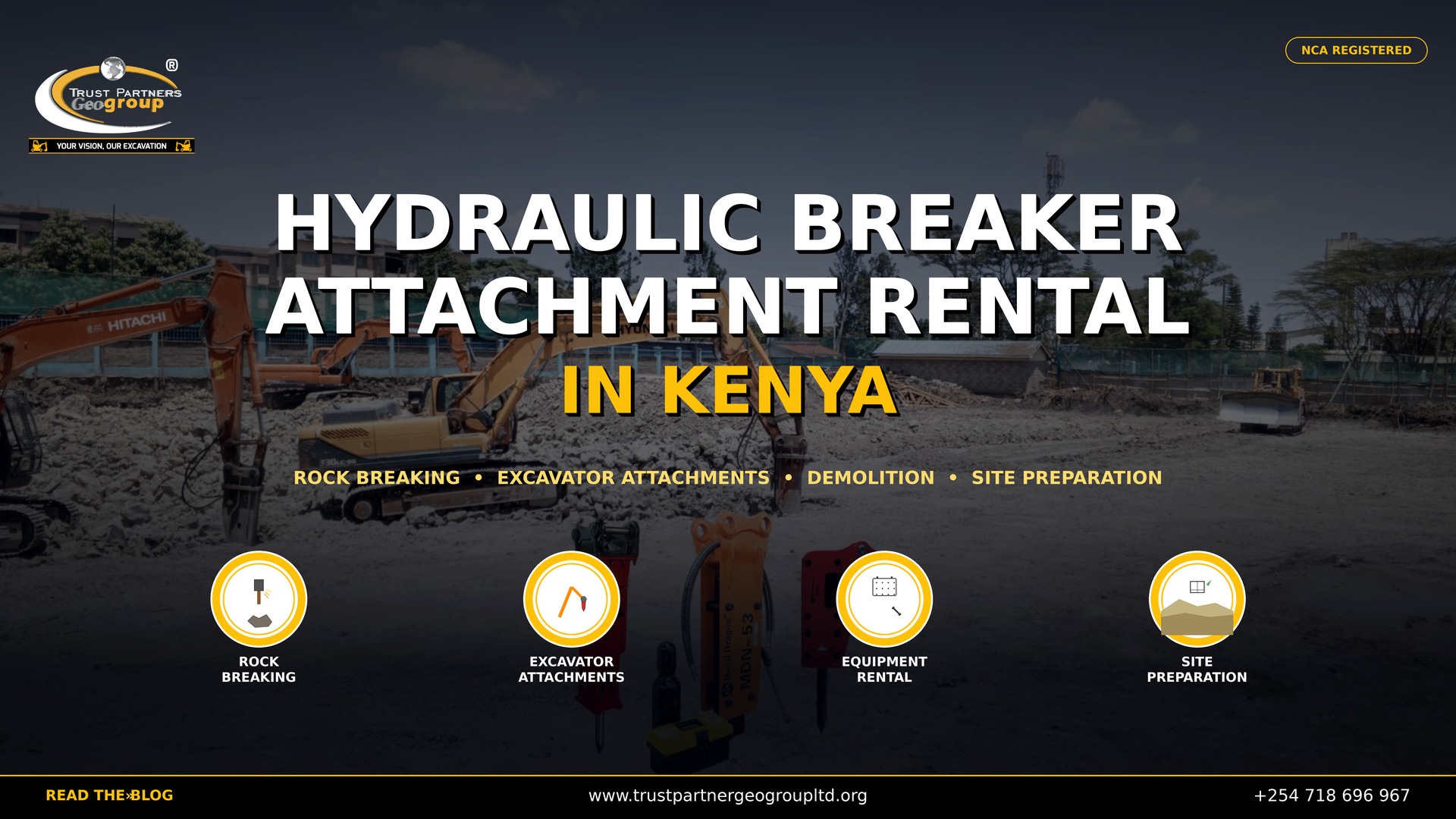
Hydraulic Breaker Attachment Selection Guide: Matching Breaker Size to Excavator Tonnage in Kenya [2026]
How to match hydraulic breaker energy class to excavator tonnage for rock breaking, basement excavation and heavy equipment for hire projects in Nairobi and across Kenya
Table of Contents
- 1. Why Breaker Sizing Matters for Excavation in Kenya
- 2. How Hydraulic Breakers Work: Energy, Impact and Efficiency
- 3. Matching Breaker Size to Excavator Tonnage and Hydraulics
- 4. Tool Bit Selection for Kenyan Rock Types
- 5. Applications: Basement Excavation, Road Rock Breaking and Demolition
- 6. Productivity Rates and Rock Breaking Costs Per m3 [2026]
- 7. Hydraulic Breaker Heavy Equipment for Hire in Kenya
- 8. Safety, Noise Compliance and Maintenance
- 9. Frequently Asked Questions
- 10. Conclusion
On a basement excavation site in Upper Hill Nairobi, a contractor mounts a 5,000 Joule hydraulic breaker on a 20-tonne excavator to break through Nairobi quartzite. Within three hours, the excavator's boom develops a stress crack at the stick connection, a hydraulic hose bursts under overload pressure, and the breaker tool bit seizes in the bush from inadequate greasing. The downtime cost is KES 180,000, the repair is KES 450,000, and the programme loses two days. The breaker was too large for the carrier. The hydraulics were mismatched. The operator was untrained. This is what happens when excavation in Kenya treats rock breaking as an afterthought rather than an engineering discipline. Hydraulic breaker selection is not about renting the biggest hammer available; it is about matching impact energy to excavator tonnage, hydraulic flow to breaker demand, and tool geometry to rock type. For contractors managing basement excavation in Nairobi's hard-rock geology, and for developers hiring heavy equipment for hire that includes rock breaking capability, the wrong breaker destroys machines and budgets. The right breaker transforms impossible ground into manageable spoil. Trust Partners Geo-Group Ltd provides correctly matched breaker attachments across our entire fleet, from 3-tonne mini excavators to 50-tonne quarry machines. This guide explains the physics of hydraulic breaking, the sizing charts that prevent disaster, the tool bits that match Kenyan rock types, and the 2026 costs that determine your project economics.
Trust Partners Geo-Group Ltd - Equipment Operations & Rock Engineering Team
NCA-registered excavation contractor with 15+ years of rock breaking, basement excavation and hydraulic breaker fleet management experience across Nairobi's hard-rock formations and East African quarry projects.
1. Why Breaker Sizing Matters for Excavation in Kenya
Kenya's geology presents a brutal challenge for earthmoving contractors. In Nairobi and the central highlands, construction sites encounter Nairobi quartzite, compacted volcanic tuff, Mazeras sandstone and iron-rich laterite that cannot be ripped by bulldozer or dug by standard excavator bucket. For basement excavation in Kilimani, Westlands and Upper Hill, rock is not an exception; it is the norm. The contractor who underestimates the rock breaking requirement discovers it when the excavator bucket teeth snap against unyielding stone and the programme stalls.
The hydraulic breaker is the standard solution where blasting is prohibited - which is virtually every urban basement excavation in Nairobi due to proximity to buildings, roads and utilities. But breakers are not interchangeable accessories. They are precision percussion machines that must be matched to the carrier excavator's weight, hydraulic capacity and structural strength. Mismatching causes three predictable failures:
- Breaker too large for excavator: overloads the boom and stick, cracks welds, bursts hydraulic hoses, damages pumps and voids the excavator warranty;
- Breaker too small for the rock: the tool bit buries itself in the material without fracturing it, overheats, blunts in hours, and forces the operator to apply prying force that damages the excavator attachment pin;
- Hydraulics mismatched: insufficient flow reduces impact energy; excessive flow causes overheating and seal failure; incorrect pressure spikes damage the breaker's internal valving.
For heavy equipment for hire providers and their clients, breaker sizing is a contractual and technical obligation. The hire company must supply a matched system. The client must verify that the breaker proposed is appropriate for the rock type and volume. This guide provides the data to make that verification possible.
2. How Hydraulic Breakers Work: Energy, Impact and Efficiency
A hydraulic breaker is essentially a piston-driven percussion hammer powered by the excavator's hydraulic system. Understanding its internal mechanics explains why sizing and maintenance are non-negotiable.
The Percussion Cycle
High-pressure hydraulic oil enters the breaker cylinder, driving a piston downward at high velocity. The piston strikes a tool bit (moil point, chisel or blunt) that transfers impact energy into the rock. A nitrogen gas accumulator in the breaker head stores energy from the piston's return stroke and assists the next downward strike, increasing impact force while reducing hydraulic demand. The cycle repeats 300-1,200 times per minute depending on breaker size and hydraulic flow. A 3,000 Joule breaker delivering 600 blows per minute generates 1.8 megajoules of cumulative energy per minute - enough to fracture most Kenyan sedimentary and metamorphic rock when correctly applied.
Impact Energy Classes
Breakers are classified by single-blow impact energy, measured in Joules (J): light breakers (100-700J) for mini excavators and concrete demolition; medium breakers (800-2,000J) for 10-25 tonne excavators and general rock breaking; heavy breakers (2,500-5,000J) for 30-45 tonne excavators and primary quarry production; and super-heavy breakers (6,000J+) for 50+ tonne mining excavators and tunnel heading. For basement excavation in Nairobi, medium breakers are the workhorse, handling 80% of urban rock breaking requirements.
Hydraulic Demand
The excavator's auxiliary hydraulic circuit must deliver the flow (litres per minute) and pressure (bar) that the breaker requires. A medium breaker needing 100 L/min at 170 bar will underperform on an excavator delivering only 70 L/min - the blows become weak and the breaker overheats. Conversely, a small breaker on an excavator with excessive flow receives too many rapid, low-energy impacts that destroy the tool bit and bushings. The match must be precise.
3. Matching Breaker Size to Excavator Tonnage and Hydraulics
The foundation of safe, productive rock breaking is the carrier match. The breaker must be heavy enough to deliver sufficient energy, but not so heavy that it structurally overloads the excavator or exceeds hydraulic capacity.
| Excavator Tonnage | Breaker Weight (kg) | Impact Energy (J) | Flow (L/min) | Pressure (bar) | Typical Application |
|---|---|---|---|---|---|
| 1.5 - 3 tonne | 80 - 150 | 100 - 300 | 20 - 35 | 100 - 140 | Interior demolition, utility trenches |
| 5 - 8 tonne | 200 - 450 | 300 - 700 | 35 - 60 | 130 - 160 | Small basement excavation, asphalt cutting |
| 10 - 15 tonne | 500 - 900 | 800 - 1,500 | 60 - 90 | 150 - 170 | General rock breaking, trenching |
| 20 - 30 tonne | 1,000 - 2,200 | 1,500 - 3,500 | 80 - 130 | 160 - 180 | Primary basement excavation, quarry |
| 35 - 50 tonne | 2,500 - 4,500 | 4,000 - 7,000+ | 130 - 200 | 170 - 200 | Heavy quarry, mining, bulk rock |
The 10-20% Weight Rule
The breaker's operating weight (including tool bit and mounting bracket) should be 10-20% of the excavator's operating weight. A 25-tonne excavator can safely carry a 2,500-5,000 kg breaker. Below 10%, the breaker lacks the mass to absorb recoil and the excavator's hydraulics may overpower the breaker. Above 20%, the excavator's boom, stick and slew ring are overloaded, and the attachment pin bosses experience accelerated wear.
Hydraulic Flow and Pressure Matching
Every breaker has a hydraulic requirement chart specifying minimum and maximum flow, and optimal working pressure. The excavator's auxiliary hydraulic circuit must fall within this range. For example, a 2,500 Joule breaker might require: minimum flow 90 L/min; optimal flow 110 L/min; maximum flow 130 L/min; and working pressure 165-175 bar. If the excavator delivers only 80 L/min, the breaker will not reach rated energy and will overheat. If it delivers 150 L/min, the breaker cycles too fast, the tool bit overheats, and internal seals fail. Trust Partners Geo-Group Ltd verifies hydraulic compatibility before dispatching any breaker-equipped heavy equipment for hire machine.
Critical Warning: Never Pry with the Breaker
The most common operator error that destroys breakers and excavators is using the tool bit as a lever to pry rock fragments. Breakers are designed for vertical impact only. Lateral prying force bends the tool bit, cracks the breaker housing, and overloads the excavator stick. If a rock fragment does not break free after 15-20 seconds of direct impact, reposition the breaker or switch to a larger tool bit. Prying is not breaking.
4. Tool Bit Selection for Kenyan Rock Types
The tool bit is the only part of the breaker that touches the rock. Its geometry determines how energy is transferred and how quickly it wears. Using the wrong bit for the rock type is like using a screwdriver to hammer a nail - it works poorly and breaks quickly.
Moil Point (Conical)
The moil point concentrates impact energy at a single sharp point, creating high stress concentration that fractures hard, brittle rock. It is the default choice for Nairobi quartzite, Mazeras sandstone, reinforced concrete and any material where the objective is to shatter rather than cut. Moil points wear fastest in abrasive rock but deliver the highest breaking rate in hard material.
Chisel (Wedge)
The chisel bit has a flat, wedge-shaped blade that directs energy along a line rather than a point. It is ideal for trenching in laterite, cutting asphalt, creating controlled joints in rock, and directional breaking where the operator needs to split rock along a plane. For basement excavation where rock must be broken into manageable sizes for loading, the chisel is often more productive than the moil because it creates natural fracture planes.
Blunt (Flat)
The blunt tool has a flat, circular face that distributes energy over a larger area. It is used for oversized boulders where the moil point would bury itself without fracturing the mass, and for soft, abrasive rock where sharp tools would wear instantly. Blunt tools are also used for tamping and compacting in some applications. In Kenya's weathered volcanic tuffs and soft laterites, the blunt tool prevents the breaker from "drilling" a hole instead of breaking the mass.
Cross-Cut and Specialized Bits
Cross-cut bits combine the penetration of the moil with the splitting action of the chisel, used for very hard, non-abrasive rock where standard moil points wear too quickly. For specialized excavation in Kenya applications - such as breaking reinforced concrete piles or cutting granite dimension stone - custom tool geometries are available.
| Rock Type | Hardness | Recommended Tool | Expected Bit Life (hrs) |
|---|---|---|---|
| Weathered laterite | Soft | Blunt or chisel | 60-100 |
| Mazeras sandstone | Medium | Chisel or moil | 40-70 |
| Nairobi quartzite | Hard | Moil point | 20-40 |
| Fresh basalt | Very hard | Moil point / cross-cut | 15-30 |
| Reinforced concrete | Variable | Moil point | 30-50 |
5. Applications: Basement Excavation, Road Rock Breaking and Demolition
Hydraulic breakers serve distinct roles across excavation in Kenya, each with specific sizing and operational requirements.
Basement Excavation in Nairobi
Urban basement excavation is the most demanding breaker application in Kenya. The constraints are severe: no blasting within 200 metres of buildings; tight site access limiting excavator size; noise limits of 70 dB during daytime; and vibration limits near neighbouring foundations. Breakers are the only viable primary rock breaking method for most Nairobi basement sites. A typical 12-metre deep basement in Upper Hill requires a 20-30 tonne excavator with a 2,000-3,000 Joule breaker working in 1.0-1.5 metre bench lifts. The rock is broken to 300-500mm fragments for loading by a smaller excavator or front-end loader. Programme rates average 15-25 m3 per day in hard quartzite, meaning a 2,000 m3 rock basement requires 80-120 working days with a single breaker.
Road Construction and Rock Cutting
For road construction through hillside rock in Kiambu, Machakos and the Rift Valley, breakers create bench cuts and side slopes where blasting is restricted near roads or pipelines. A 30-tonne excavator with a 3,000 Joule breaker can cut a 3-metre wide bench in medium rock at 4-6 metres per day, preparing the subgrade for ripping and loading. Where the rock is too massive for direct loading, breakers perform secondary breaking of oversize boulders from blasting operations.
Controlled Demolition
Breaker-equipped mini excavators (3-5 tonne) are the standard tool for controlled demolition of concrete structures, foundations and pavements in confined spaces. The mini excavator's manoeuvrability allows access to interior spaces, and the 300-600 Joule breaker fractures concrete without the structural shock of a larger machine. For high-rise demolition in Nairobi, breakers work from the top down, breaking concrete slabs and columns into manageable pieces for crane removal.
Quarry and Mining Production
In quarries producing aggregate for construction, breakers perform secondary breaking of blast oversize that is too large for the primary crusher. A 40-tonne excavator with a 5,000+ Joule breaker reduces 1-2 metre boulders to 500mm feed size for the crushing plant. This is production work where breaker utilisation exceeds 70% of shift hours, and tool bit consumption is the primary operating cost.
6. Productivity Rates and Rock Breaking Costs Per m3 [2026]
Rock breaking economics determine whether a project is viable and which method - breaker, blasting, or chemical - should be selected. For heavy equipment for hire budgeting, understanding these rates is essential.
| Rock Class | Typical Kenyan Rock | Breaker Size | Production (m3/hr) | Cost per m3 (KES) |
|---|---|---|---|---|
| Soft (RI < 40) | Weathered laterite, soil-rock mix | 800-1,500J | 8 - 15 | 3,500 - 5,500 |
| Medium (RI 40-70) | Mazeras sandstone, tuff | 1,500-2,500J | 4 - 8 | 6,000 - 9,000 |
| Hard (RI 70-100) | Nairobi quartzite, gneiss | 2,500-4,000J | 2 - 4 | 10,000 - 14,000 |
| Very hard (RI > 100) | Fresh basalt, granite | 4,000-7,000J | 1 - 2.5 | 14,000 - 18,000 |
RI = Rock Impact hardness number. Costs include excavator and breaker hire, fuel, operator, tool bit wear and maintenance, but exclude muck-away haulage.
Breaker vs Blasting vs Chemical Breaking
For urban basement excavation, the comparison is decisive. Blasting costs KES 2,000-4,000 per m3 in hard rock but is banned in most of Nairobi. Chemical breaking (expanding grout) costs KES 8,000-12,000 per m3 and requires 24-48 hour reaction time, making it suitable only for small volumes or sensitive structures. Hydraulic breaking at KES 10,000-14,000 per m3 is expensive per unit but is immediately available, legally permissible, and programme-reliable. On a recent 1,500 m3 basement in Kilimani, the developer evaluated chemical breaking but chose hydraulic breaking because the 6-week chemical programme exceeded the overall project deadline. The premium was KES 3 million, but the programme saving was worth KES 8 million in finance costs.
Tool Bit Consumption Economics
Tool bits are the highest consumable cost in breaker operations. A moil point for a 3,000 Joule breaker costs KES 45,000-75,000 and lasts 20-40 hours in hard quartzite. At 30 hours average life breaking hard rock at 3 m3/hr, the bit produces 90 m3 before replacement. Tool cost per m3 is therefore KES 500-800 - a significant but manageable component of the total breaking cost. Using the correct tool bit for the rock type can double bit life and halve this cost.
7. Hydraulic Breaker Heavy Equipment for Hire in Kenya
Trust Partners Geo-Group Ltd provides breaker-equipped excavators as part of our heavy equipment for hire fleet, with correct matching, certified operators and maintenance included.
Available Breaker Configurations
Our current breaker fleet includes: 5-8 tonne excavators with 400-700 Joule breakers for confined basement excavation, utility trenches and demolition; 20-25 tonne excavators with 1,500-2,500 Joule breakers for primary urban rock breaking and mid-size basement excavation; 30-35 tonne excavators with 3,000-4,500 Joule breakers for heavy rock, quarry secondary breaking and large basement sites; and 40-50 tonne excavators with 5,000-7,000 Joule breakers for mining and bulk quarry production. All machines are supplied with two tool bits (moil and chisel as standard), hydraulic quick-couplers, and dust suppression water tanks where required.
Hire Rates and Inclusions
Breaker hire is priced as an excavator-plus-attachment package. The breaker premium over standard excavator hire is typically 25-35% to cover attachment capital cost, accelerated wear and tool bit provision. Indicative 2026 rates: 8-tonne excavator + 600J breaker at KES 5,500-7,500/hour; 20-tonne excavator + 2,000J breaker at KES 10,000-13,000/hour; 30-tonne excavator + 3,500J breaker at KES 14,000-18,000/hour; and 40-tonne excavator + 5,000J breaker at KES 18,000-24,000/hour. Rates include fuel, operator, standard tool bits, daily maintenance and NCA-compliant safety equipment. Long-term contracts (200+ hours) receive discounted tool bit replacement and priority maintenance scheduling.
Operator Competency
Breaker operation requires specific skills beyond standard excavator operation. Our operators are trained in: correct breaking technique (vertical impact, no prying); tool bit changing and greasing procedures; nitrogen pressure checking; hydraulic hose inspection and emergency isolation; and vibration and noise management in urban environments. A breaker operated by an untrained driver consumes 30-50% more fuel, breaks 40% less rock, and damages equipment at 3x the normal rate. Operator competence is not optional.
8. Safety, Noise Compliance and Maintenance
Hydraulic breakers are among the most hazardous attachments in construction. The combination of high-energy impact, flying debris, extreme noise and structural vibration creates risks that must be actively managed on every excavation in Kenya project.
Exclusion Zones and PPE
A 10-metre radius exclusion zone must be established around the breaker during operation, marked with physical barriers and enforced by a dedicated spotter. All personnel within 30 metres must wear hard hats, safety glasses, ear defenders (minimum SNR 30 dB), steel-toe boots and high-visibility vests. The operator's cab must have intact front and side glass; open-cab excavators are prohibited for breaker work due to flyrock risk.
Noise and Vibration Limits
Nairobi County bylaws limit construction noise to 70 dB at the site boundary during daytime (07:00-19:00). A 3,000 Joule breaker produces 110-125 dB at the operator position and 85-100 dB at 30 metres. In noise-sensitive areas (hospitals, schools, residential), operations may be restricted to 08:00-17:00 or require acoustic barriers. Vibration monitoring is mandatory when breaking within 50 metres of existing structures. Peak particle velocity must not exceed 10 mm/s for commercial buildings and 5 mm/s for residential. Trust Partners Geo-Group Ltd provides vibration monitoring as standard on urban basement excavation breaker contracts.
Daily Maintenance Protocol
Breakers require intensive daily maintenance: grease the tool bit every 2 hours of operation with high-temperature breaker grease - lack of lubrication causes seizure and cracks the retainer within 4 hours; inspect hydraulic hoses for abrasion and leaks before each shift; check tool bit wear - replace when the working diameter is reduced by 15% or cracks appear; verify nitrogen pressure with a gauge - low nitrogen reduces impact energy and overloads hydraulics; and inspect the excavator boom, stick and quick-coupler for stress cracks caused by vibration fatigue. Weekly, change the tool bit if worn, torque all mounting bolts, and check the excavator hydraulic filter for metallic debris indicating internal wear.
9. Frequently Asked Questions: Hydraulic Breakers and Rock Breaking in Kenya
How do you match hydraulic breaker size to excavator tonnage?
Hydraulic breaker size is matched to excavator tonnage using the carrier weight ratio and hydraulic compatibility. The breaker should weigh 10-20% of the excavator's operating weight: a 20-tonne excavator carries a 2,000-4,000 kg breaker. Hydraulic flow must match the breaker's requirement: a 1,500 Joule breaker typically needs 80-110 litres per minute at 160-180 bar pressure. Using a breaker that is too large overloads the excavator boom, stick and hydraulic system, causing cracked welds, burst hoses and premature pump failure. Using a breaker that is too small reduces productivity and causes the tool bit to blunt quickly because the operator must hold it on the rock instead of letting it free-impact. Trust Partners Geo-Group Ltd provides correctly matched breaker attachments for every excavator in our heavy equipment for hire fleet, from 3-tonne mini excavators to 50-tonne mining machines.
What is the difference between a hydraulic breaker and a hydraulic hammer?
In the Kenyan construction market, the terms hydraulic breaker and hydraulic hammer are often used interchangeably to describe the same attachment: a percussive tool powered by the excavator's hydraulics that delivers repeated impact blows to break rock or concrete. Technically, a hydraulic hammer refers to the original nitrogen-assisted piston design, while hydraulic breaker is the broader modern term that includes nitrogen-charged, fully hydraulic and gas-hydraulic hybrid designs. For excavation in Kenya and basement excavation projects, both terms describe the attachment mounted on the excavator boom that replaces the bucket for rock breaking. When hiring heavy equipment for hire with rock breaking capability, specify the rock hardness and volume so the contractor supplies the correct energy class, whether they call it a breaker or a hammer.
How much does rock breaking cost per cubic meter in Kenya?
Rock breaking costs in Kenya in 2026 depend on rock hardness, breaker size and site access. Indicative rates are: soft rock (weathered laterite) KES 3,500-5,500 per m3; medium rock (compacted sandstone, Mazeras stone) KES 6,000-9,000 per m3; and hard rock (Nairobi quartzite, fresh basalt) KES 10,000-16,000 per m3. These rates include the excavator and breaker hire, fuel and operator, but exclude haulage of broken material. For basement excavation in Nairobi where blasting is prohibited, hydraulic breaking is often the only viable method despite higher per-m3 costs than blasting. On a recent 2,000 m3 basement excavation in Upper Hill, hydraulic breaking of Nairobi quartzite cost KES 12,500 per m3 compared to a KES 4,000 per m3 blasting estimate, but blasting was banned within 200 metres of occupied buildings. The total rock breaking cost was KES 25 million, which was 8% of total project cost - manageable within the urban premium.
What tool bit should I use for different rock types in Kenya?
Tool bit selection determines breaker efficiency and wear life. For excavation in Kenya, the four standard tool bits are: moil point (conical) for general rock breaking and concrete demolition - it concentrates energy at a single point, ideal for hard, brittle Nairobi quartzite and reinforced concrete; chisel (wedge) for trenching, asphalt cutting and directional breaking - the flat blade directs force along a line, perfect for cutting trenches in laterite or separating slabs; blunt for oversized boulders and soft, abrasive rock - the flat face distributes energy over a larger area, preventing the tool from burying itself in soft material; and cross-cut for very hard, non-abrasive rock where the moil point wears too quickly. For basement excavation in Nairobi's mixed geology, Trust Partners Geo-Group Ltd carries moil points and chisels as standard, switching based on the rock layer encountered. Using the wrong tool bit can increase fuel consumption by 30% and reduce bit life from 80 hours to 20 hours.
Can I hire an excavator with a hydraulic breaker attachment in Kenya?
Yes. Trust Partners Geo-Group Ltd offers hydraulic breaker attachments as part of our heavy equipment for hire fleet across Kenya. We provide breaker-equipped excavators in all size classes: 5-8 tonne with 400-700 Joule breakers for small basement excavation and utility trenching; 20-30 tonne with 1,500-3,000 Joule breakers for primary rock breaking and commercial basement excavation; and 35-50 tonne with 4,000-7,000 Joule breakers for quarry production and bulk rock excavation. Hire rates include the excavator, breaker attachment, standard tool bits, hydraulic hoses, quick-coupler and certified operator. Breaker hire typically adds a 25-35% premium to standard excavator hire rates. We serve Nairobi, Mombasa, Kisumu, Nakuru, Eldoret and nationwide. Contact us at +254 718 68 69 67 to hire a correctly matched breaker and excavator for your rock breaking or basement excavation project.
Is hydraulic breaking better than blasting for urban basement excavation in Nairobi?
For urban basement excavation in Nairobi, hydraulic breaking is almost always the preferred method over blasting due to safety, regulatory and practical constraints. The Nairobi County building bylaws and NEMA regulations prohibit blasting within 200-500 metres of occupied buildings, roads, utilities and hospitals - which covers most of Upper Hill, Kilimani, Westlands and Parklands. Blasting also requires explosive licensing, blast design by a certified engineer, vibration monitoring, flyrock protection and evacuation protocols that add 2-3 weeks to the programme. Hydraulic breaking requires none of these. While the per-m3 cost is higher (KES 6,000-16,000 vs KES 2,000-4,000 for blasting), the total project cost is often lower because there are no blast delays, no vibration damage claims, no special insurance premiums and no programme risk. For basement excavation in dense urban Nairobi, hydraulic breaking is the only practical choice for most sites.
What safety measures are required for hydraulic breaker operations in Kenya?
Hydraulic breaker safety in Kenya is governed by NCA construction safety regulations, Nairobi County noise bylaws and general occupational health requirements. Mandatory safety measures include: a 10-metre exclusion zone around the breaker during operation, marked with bunting or barriers and enforced by a spotter; mandatory PPE for all personnel in the zone - hard hats, safety glasses, ear defenders (breakers exceed 110 dB at the operator position), steel-toe boots and high-visibility vests; vibration monitoring when working within 50 metres of existing buildings - peak particle velocity must not exceed 10 mm/s for commercial structures and 5 mm/s for residential; dust suppression with water spraying when breaking dry rock or concrete; and operator certification - the breaker operator must be trained in attachment connection, tool bit changing, nitrogen pressure checking and emergency shutdown. Trust Partners Geo-Group Ltd provides NCA-compliant safety briefings, exclusion zone setup and dust suppression as standard on all breaker-equipped heavy equipment for hire contracts.
How do you maintain a hydraulic breaker attachment?
Daily maintenance of a hydraulic breaker attachment is essential for longevity and safety. The daily checklist includes: grease the tool bit and bushings every 2 hours of operation with high-temperature breaker grease - lack of lubrication causes the tool to seize in the bush and crack the retainer; inspect hydraulic hoses for abrasion, leaks and coupling security before each shift; check tool bit wear - replace when the diameter at the wear point is reduced by more than 15% or when cracks appear; verify nitrogen charge pressure in the accumulator using a gauge - low nitrogen reduces impact energy and increases hydraulic pressure on the excavator; and inspect the excavator boom and stick for cracks or weld stress, especially at the attachment pin bosses, because breaker vibration is the leading cause of structural fatigue in earthmoving equipment. Weekly maintenance includes changing the tool bit if worn, tightening all mounting bolts to torque specification, and checking the excavator hydraulic filter for metallic debris that indicates internal wear. Trust Partners Geo-Group Ltd performs all breaker maintenance in-house as part of our heavy equipment for hire service.
10. Conclusion: Break Rock, Not Machines
Hydraulic breaking is the brute-force ballet of excavation in Kenya - a marriage of high-energy percussion, hydraulic precision and geological respect. The contractor who treats breaker selection as an afterthought learns expensive lessons: cracked booms, blown hoses, blunt bits and programmes that slip by weeks. The contractor who engineers the match - breaker weight to excavator tonnage, energy to rock hardness, tool bit to material, flow rate to hydraulic capacity - transforms Nairobi's unyielding quartzite into manageable spoil on schedule and on budget.
For developers managing basement excavation in Kenya's hard-rock urban centres, the message is clear: specify the rock breaking method and the breaker size in your earthworks contract. Do not accept a generic "rock breaking included" clause. Demand the energy class, the excavator tonnage, the tool bit type and the productivity rate. The contractor who cannot provide these numbers is guessing. The contractor who can - and who backs it with telematics data, maintenance logs and tool bit inventories - is engineering.
Trust Partners Geo-Group Ltd delivers correctly matched hydraulic breaker attachments across our entire heavy equipment for hire fleet. We size the breaker to your rock, not to our inventory. We train our operators in breaking technique, not just machine operation. We maintain our bits, our nitrogen pressures and our boom inspections to the standard that urban basement excavation demands. Whether you are breaking 200 m3 of laterite for a residential foundation or 5,000 m3 of quartzite for a commercial basement in Nairobi, our breaker-equipped excavators deliver the productivity, safety and accountability that your project requires.
Hydraulic Breaker Hire & Rock Breaking
Hire breaker-equipped excavators for basement excavation, rock breaking, demolition and quarry production in Nairobi, Mombasa, Kisumu and across Kenya.
Free lead magnet: ask for our Hydraulic Breaker Sizing Calculator (PDF) - match excavator tonnage to breaker energy, tool bit selection guide and daily maintenance checklist for Kenyan rock conditions.
Related Resources
Rock Breaking and Blasting Alternatives in Nairobi: Hydraulic Hammer vs Chemical Breaking
Compare all rock breaking methods for urban basement excavation where blasting is prohibited.
READ MORERock Excavation Cost Rates in Kenya [2026]
Transparent pricing for rock breaking, ripping and blasting across all rock hardness classes in Kenya.
READ MOREExcavator Hire Prices in Kenya: Hourly, Daily & Monthly Rates [2026]
Standard and breaker-equipped excavator hire rates across all machine sizes and contract terms.
READ MORE11-20 Ton vs 30 Ton vs 50 Ton Excavator: Which Size Do You Need?
Match excavator tonnage to your project type and understand breaker compatibility for each size class.
READ MOREBasement Excavation Depth Guide: From 4 Meters to 30 Meters in Kenya
Technical depth guide for basement excavation planning, dewatering and rock breaking across all scales.
READ MOREExcavation in Kenya: Complete Guide to Costs, Methods & Contractors [2026]
The definitive overview of excavation in Kenya - methods, regulations, costs and contractor selection.
READ MORETRUST PARTNERS GEO-GROUP LTD | YOUR VISION, OUR EXCAVATION
WEBSITE: WWW.TRUSTPARTNERGEOGROUPLTD.ORG | EMAIL: INFO@TRUSTPARTNERGEOGROUPLTD.ORG | PHONE: +254 718 68 69 67
FOLLOW US: FACEBOOK | TIKTOK | INSTAGRAM | LINKEDIN
© 2026 TRUST PARTNERS GEO-GROUP LTD. ALL RIGHTS RESERVED.
Hydraulic Breaker Attachment Selection Guide: Matching Breaker Size to Excavator Tonnage in Kenya [2026]
How to match hydraulic breaker energy class to excavator tonnage for rock breaking, basement excavation and heavy equipment for hire projects in Nairobi and across Kenya
Table of Contents
- 1. Why Breaker Sizing Matters for Excavation in Kenya
- 2. How Hydraulic Breakers Work: Energy, Impact and Efficiency
- 3. Matching Breaker Size to Excavator Tonnage and Hydraulics
- 4. Tool Bit Selection for Kenyan Rock Types
- 5. Applications: Basement Excavation, Road Rock Breaking and Demolition
- 6. Productivity Rates and Rock Breaking Costs Per m3 [2026]
- 7. Hydraulic Breaker Heavy Equipment for Hire in Kenya
- 8. Safety, Noise Compliance and Maintenance
- 9. Frequently Asked Questions
- 10. Conclusion
On a basement excavation site in Upper Hill Nairobi, a contractor mounts a 5,000 Joule hydraulic breaker on a 20-tonne excavator to break through Nairobi quartzite. Within three hours, the excavator's boom develops a stress crack at the stick connection, a hydraulic hose bursts under overload pressure, and the breaker tool bit seizes in the bush from inadequate greasing. The downtime cost is KES 180,000, the repair is KES 450,000, and the programme loses two days. The breaker was too large for the carrier. The hydraulics were mismatched. The operator was untrained. This is what happens when excavation in Kenya treats rock breaking as an afterthought rather than an engineering discipline. Hydraulic breaker selection is not about renting the biggest hammer available; it is about matching impact energy to excavator tonnage, hydraulic flow to breaker demand, and tool geometry to rock type. For contractors managing basement excavation in Nairobi's hard-rock geology, and for developers hiring heavy equipment for hire that includes rock breaking capability, the wrong breaker destroys machines and budgets. The right breaker transforms impossible ground into manageable spoil. Trust Partners Geo-Group Ltd provides correctly matched breaker attachments across our entire fleet, from 3-tonne mini excavators to 50-tonne quarry machines. This guide explains the physics of hydraulic breaking, the sizing charts that prevent disaster, the tool bits that match Kenyan rock types, and the 2026 costs that determine your project economics.
Trust Partners Geo-Group Ltd - Equipment Operations & Rock Engineering Team
NCA-registered excavation contractor with 15+ years of rock breaking, basement excavation and hydraulic breaker fleet management experience across Nairobi's hard-rock formations and East African quarry projects.
1. Why Breaker Sizing Matters for Excavation in Kenya
Kenya's geology presents a brutal challenge for earthmoving contractors. In Nairobi and the central highlands, construction sites encounter Nairobi quartzite, compacted volcanic tuff, Mazeras sandstone and iron-rich laterite that cannot be ripped by bulldozer or dug by standard excavator bucket. For basement excavation in Kilimani, Westlands and Upper Hill, rock is not an exception; it is the norm. The contractor who underestimates the rock breaking requirement discovers it when the excavator bucket teeth snap against unyielding stone and the programme stalls.
The hydraulic breaker is the standard solution where blasting is prohibited - which is virtually every urban basement excavation in Nairobi due to proximity to buildings, roads and utilities. But breakers are not interchangeable accessories. They are precision percussion machines that must be matched to the carrier excavator's weight, hydraulic capacity and structural strength. Mismatching causes three predictable failures:
- Breaker too large for excavator: overloads the boom and stick, cracks welds, bursts hydraulic hoses, damages pumps and voids the excavator warranty;
- Breaker too small for the rock: the tool bit buries itself in the material without fracturing it, overheats, blunts in hours, and forces the operator to apply prying force that damages the excavator attachment pin;
- Hydraulics mismatched: insufficient flow reduces impact energy; excessive flow causes overheating and seal failure; incorrect pressure spikes damage the breaker's internal valving.
For heavy equipment for hire providers and their clients, breaker sizing is a contractual and technical obligation. The hire company must supply a matched system. The client must verify that the breaker proposed is appropriate for the rock type and volume. This guide provides the data to make that verification possible.
2. How Hydraulic Breakers Work: Energy, Impact and Efficiency
A hydraulic breaker is essentially a piston-driven percussion hammer powered by the excavator's hydraulic system. Understanding its internal mechanics explains why sizing and maintenance are non-negotiable.
The Percussion Cycle
High-pressure hydraulic oil enters the breaker cylinder, driving a piston downward at high velocity. The piston strikes a tool bit (moil point, chisel or blunt) that transfers impact energy into the rock. A nitrogen gas accumulator in the breaker head stores energy from the piston's return stroke and assists the next downward strike, increasing impact force while reducing hydraulic demand. The cycle repeats 300-1,200 times per minute depending on breaker size and hydraulic flow. A 3,000 Joule breaker delivering 600 blows per minute generates 1.8 megajoules of cumulative energy per minute - enough to fracture most Kenyan sedimentary and metamorphic rock when correctly applied.
Impact Energy Classes
Breakers are classified by single-blow impact energy, measured in Joules (J): light breakers (100-700J) for mini excavators and concrete demolition; medium breakers (800-2,000J) for 10-25 tonne excavators and general rock breaking; heavy breakers (2,500-5,000J) for 30-45 tonne excavators and primary quarry production; and super-heavy breakers (6,000J+) for 50+ tonne mining excavators and tunnel heading. For basement excavation in Nairobi, medium breakers are the workhorse, handling 80% of urban rock breaking requirements.
Hydraulic Demand
The excavator's auxiliary hydraulic circuit must deliver the flow (litres per minute) and pressure (bar) that the breaker requires. A medium breaker needing 100 L/min at 170 bar will underperform on an excavator delivering only 70 L/min - the blows become weak and the breaker overheats. Conversely, a small breaker on an excavator with excessive flow receives too many rapid, low-energy impacts that destroy the tool bit and bushings. The match must be precise.
3. Matching Breaker Size to Excavator Tonnage and Hydraulics
The foundation of safe, productive rock breaking is the carrier match. The breaker must be heavy enough to deliver sufficient energy, but not so heavy that it structurally overloads the excavator or exceeds hydraulic capacity.
| Excavator Tonnage | Breaker Weight (kg) | Impact Energy (J) | Flow (L/min) | Pressure (bar) | Typical Application |
|---|---|---|---|---|---|
| 1.5 - 3 tonne | 80 - 150 | 100 - 300 | 20 - 35 | 100 - 140 | Interior demolition, utility trenches |
| 5 - 8 tonne | 200 - 450 | 300 - 700 | 35 - 60 | 130 - 160 | Small basement excavation, asphalt cutting |
| 10 - 15 tonne | 500 - 900 | 800 - 1,500 | 60 - 90 | 150 - 170 | General rock breaking, trenching |
| 20 - 30 tonne | 1,000 - 2,200 | 1,500 - 3,500 | 80 - 130 | 160 - 180 | Primary basement excavation, quarry |
| 35 - 50 tonne | 2,500 - 4,500 | 4,000 - 7,000+ | 130 - 200 | 170 - 200 | Heavy quarry, mining, bulk rock |
The 10-20% Weight Rule
The breaker's operating weight (including tool bit and mounting bracket) should be 10-20% of the excavator's operating weight. A 25-tonne excavator can safely carry a 2,500-5,000 kg breaker. Below 10%, the breaker lacks the mass to absorb recoil and the excavator's hydraulics may overpower the breaker. Above 20%, the excavator's boom, stick and slew ring are overloaded, and the attachment pin bosses experience accelerated wear.
Hydraulic Flow and Pressure Matching
Every breaker has a hydraulic requirement chart specifying minimum and maximum flow, and optimal working pressure. The excavator's auxiliary hydraulic circuit must fall within this range. For example, a 2,500 Joule breaker might require: minimum flow 90 L/min; optimal flow 110 L/min; maximum flow 130 L/min; and working pressure 165-175 bar. If the excavator delivers only 80 L/min, the breaker will not reach rated energy and will overheat. If it delivers 150 L/min, the breaker cycles too fast, the tool bit overheats, and internal seals fail. Trust Partners Geo-Group Ltd verifies hydraulic compatibility before dispatching any breaker-equipped heavy equipment for hire machine.
Critical Warning: Never Pry with the Breaker
The most common operator error that destroys breakers and excavators is using the tool bit as a lever to pry rock fragments. Breakers are designed for vertical impact only. Lateral prying force bends the tool bit, cracks the breaker housing, and overloads the excavator stick. If a rock fragment does not break free after 15-20 seconds of direct impact, reposition the breaker or switch to a larger tool bit. Prying is not breaking.
4. Tool Bit Selection for Kenyan Rock Types
The tool bit is the only part of the breaker that touches the rock. Its geometry determines how energy is transferred and how quickly it wears. Using the wrong bit for the rock type is like using a screwdriver to hammer a nail - it works poorly and breaks quickly.
Moil Point (Conical)
The moil point concentrates impact energy at a single sharp point, creating high stress concentration that fractures hard, brittle rock. It is the default choice for Nairobi quartzite, Mazeras sandstone, reinforced concrete and any material where the objective is to shatter rather than cut. Moil points wear fastest in abrasive rock but deliver the highest breaking rate in hard material.
Chisel (Wedge)
The chisel bit has a flat, wedge-shaped blade that directs energy along a line rather than a point. It is ideal for trenching in laterite, cutting asphalt, creating controlled joints in rock, and directional breaking where the operator needs to split rock along a plane. For basement excavation where rock must be broken into manageable sizes for loading, the chisel is often more productive than the moil because it creates natural fracture planes.
Blunt (Flat)
The blunt tool has a flat, circular face that distributes energy over a larger area. It is used for oversized boulders where the moil point would bury itself without fracturing the mass, and for soft, abrasive rock where sharp tools would wear instantly. Blunt tools are also used for tamping and compacting in some applications. In Kenya's weathered volcanic tuffs and soft laterites, the blunt tool prevents the breaker from "drilling" a hole instead of breaking the mass.
Cross-Cut and Specialized Bits
Cross-cut bits combine the penetration of the moil with the splitting action of the chisel, used for very hard, non-abrasive rock where standard moil points wear too quickly. For specialized excavation in Kenya applications - such as breaking reinforced concrete piles or cutting granite dimension stone - custom tool geometries are available.
| Rock Type | Hardness | Recommended Tool | Expected Bit Life (hrs) |
|---|---|---|---|
| Weathered laterite | Soft | Blunt or chisel | 60-100 |
| Mazeras sandstone | Medium | Chisel or moil | 40-70 |
| Nairobi quartzite | Hard | Moil point | 20-40 |
| Fresh basalt | Very hard | Moil point / cross-cut | 15-30 |
| Reinforced concrete | Variable | Moil point | 30-50 |
5. Applications: Basement Excavation, Road Rock Breaking and Demolition
Hydraulic breakers serve distinct roles across excavation in Kenya, each with specific sizing and operational requirements.
Basement Excavation in Nairobi
Urban basement excavation is the most demanding breaker application in Kenya. The constraints are severe: no blasting within 200 metres of buildings; tight site access limiting excavator size; noise limits of 70 dB during daytime; and vibration limits near neighbouring foundations. Breakers are the only viable primary rock breaking method for most Nairobi basement sites. A typical 12-metre deep basement in Upper Hill requires a 20-30 tonne excavator with a 2,000-3,000 Joule breaker working in 1.0-1.5 metre bench lifts. The rock is broken to 300-500mm fragments for loading by a smaller excavator or front-end loader. Programme rates average 15-25 m3 per day in hard quartzite, meaning a 2,000 m3 rock basement requires 80-120 working days with a single breaker.
Road Construction and Rock Cutting
For road construction through hillside rock in Kiambu, Machakos and the Rift Valley, breakers create bench cuts and side slopes where blasting is restricted near roads or pipelines. A 30-tonne excavator with a 3,000 Joule breaker can cut a 3-metre wide bench in medium rock at 4-6 metres per day, preparing the subgrade for ripping and loading. Where the rock is too massive for direct loading, breakers perform secondary breaking of oversize boulders from blasting operations.
Controlled Demolition
Breaker-equipped mini excavators (3-5 tonne) are the standard tool for controlled demolition of concrete structures, foundations and pavements in confined spaces. The mini excavator's manoeuvrability allows access to interior spaces, and the 300-600 Joule breaker fractures concrete without the structural shock of a larger machine. For high-rise demolition in Nairobi, breakers work from the top down, breaking concrete slabs and columns into manageable pieces for crane removal.
Quarry and Mining Production
In quarries producing aggregate for construction, breakers perform secondary breaking of blast oversize that is too large for the primary crusher. A 40-tonne excavator with a 5,000+ Joule breaker reduces 1-2 metre boulders to 500mm feed size for the crushing plant. This is production work where breaker utilisation exceeds 70% of shift hours, and tool bit consumption is the primary operating cost.
6. Productivity Rates and Rock Breaking Costs Per m3 [2026]
Rock breaking economics determine whether a project is viable and which method - breaker, blasting, or chemical - should be selected. For heavy equipment for hire budgeting, understanding these rates is essential.
| Rock Class | Typical Kenyan Rock | Breaker Size | Production (m3/hr) | Cost per m3 (KES) |
|---|---|---|---|---|
| Soft (RI < 40) | Weathered laterite, soil-rock mix | 800-1,500J | 8 - 15 | 3,500 - 5,500 |
| Medium (RI 40-70) | Mazeras sandstone, tuff | 1,500-2,500J | 4 - 8 | 6,000 - 9,000 |
| Hard (RI 70-100) | Nairobi quartzite, gneiss | 2,500-4,000J | 2 - 4 | 10,000 - 14,000 |
| Very hard (RI > 100) | Fresh basalt, granite | 4,000-7,000J | 1 - 2.5 | 14,000 - 18,000 |
RI = Rock Impact hardness number. Costs include excavator and breaker hire, fuel, operator, tool bit wear and maintenance, but exclude muck-away haulage.
Breaker vs Blasting vs Chemical Breaking
For urban basement excavation, the comparison is decisive. Blasting costs KES 2,000-4,000 per m3 in hard rock but is banned in most of Nairobi. Chemical breaking (expanding grout) costs KES 8,000-12,000 per m3 and requires 24-48 hour reaction time, making it suitable only for small volumes or sensitive structures. Hydraulic breaking at KES 10,000-14,000 per m3 is expensive per unit but is immediately available, legally permissible, and programme-reliable. On a recent 1,500 m3 basement in Kilimani, the developer evaluated chemical breaking but chose hydraulic breaking because the 6-week chemical programme exceeded the overall project deadline. The premium was KES 3 million, but the programme saving was worth KES 8 million in finance costs.
Tool Bit Consumption Economics
Tool bits are the highest consumable cost in breaker operations. A moil point for a 3,000 Joule breaker costs KES 45,000-75,000 and lasts 20-40 hours in hard quartzite. At 30 hours average life breaking hard rock at 3 m3/hr, the bit produces 90 m3 before replacement. Tool cost per m3 is therefore KES 500-800 - a significant but manageable component of the total breaking cost. Using the correct tool bit for the rock type can double bit life and halve this cost.
7. Hydraulic Breaker Heavy Equipment for Hire in Kenya
Trust Partners Geo-Group Ltd provides breaker-equipped excavators as part of our heavy equipment for hire fleet, with correct matching, certified operators and maintenance included.
Available Breaker Configurations
Our current breaker fleet includes: 5-8 tonne excavators with 400-700 Joule breakers for confined basement excavation, utility trenches and demolition; 20-25 tonne excavators with 1,500-2,500 Joule breakers for primary urban rock breaking and mid-size basement excavation; 30-35 tonne excavators with 3,000-4,500 Joule breakers for heavy rock, quarry secondary breaking and large basement sites; and 40-50 tonne excavators with 5,000-7,000 Joule breakers for mining and bulk quarry production. All machines are supplied with two tool bits (moil and chisel as standard), hydraulic quick-couplers, and dust suppression water tanks where required.
Hire Rates and Inclusions
Breaker hire is priced as an excavator-plus-attachment package. The breaker premium over standard excavator hire is typically 25-35% to cover attachment capital cost, accelerated wear and tool bit provision. Indicative 2026 rates: 8-tonne excavator + 600J breaker at KES 5,500-7,500/hour; 20-tonne excavator + 2,000J breaker at KES 10,000-13,000/hour; 30-tonne excavator + 3,500J breaker at KES 14,000-18,000/hour; and 40-tonne excavator + 5,000J breaker at KES 18,000-24,000/hour. Rates include fuel, operator, standard tool bits, daily maintenance and NCA-compliant safety equipment. Long-term contracts (200+ hours) receive discounted tool bit replacement and priority maintenance scheduling.
Operator Competency
Breaker operation requires specific skills beyond standard excavator operation. Our operators are trained in: correct breaking technique (vertical impact, no prying); tool bit changing and greasing procedures; nitrogen pressure checking; hydraulic hose inspection and emergency isolation; and vibration and noise management in urban environments. A breaker operated by an untrained driver consumes 30-50% more fuel, breaks 40% less rock, and damages equipment at 3x the normal rate. Operator competence is not optional.
8. Safety, Noise Compliance and Maintenance
Hydraulic breakers are among the most hazardous attachments in construction. The combination of high-energy impact, flying debris, extreme noise and structural vibration creates risks that must be actively managed on every excavation in Kenya project.
Exclusion Zones and PPE
A 10-metre radius exclusion zone must be established around the breaker during operation, marked with physical barriers and enforced by a dedicated spotter. All personnel within 30 metres must wear hard hats, safety glasses, ear defenders (minimum SNR 30 dB), steel-toe boots and high-visibility vests. The operator's cab must have intact front and side glass; open-cab excavators are prohibited for breaker work due to flyrock risk.
Noise and Vibration Limits
Nairobi County bylaws limit construction noise to 70 dB at the site boundary during daytime (07:00-19:00). A 3,000 Joule breaker produces 110-125 dB at the operator position and 85-100 dB at 30 metres. In noise-sensitive areas (hospitals, schools, residential), operations may be restricted to 08:00-17:00 or require acoustic barriers. Vibration monitoring is mandatory when breaking within 50 metres of existing structures. Peak particle velocity must not exceed 10 mm/s for commercial buildings and 5 mm/s for residential. Trust Partners Geo-Group Ltd provides vibration monitoring as standard on urban basement excavation breaker contracts.
Daily Maintenance Protocol
Breakers require intensive daily maintenance: grease the tool bit every 2 hours of operation with high-temperature breaker grease - lack of lubrication causes seizure and cracks the retainer within 4 hours; inspect hydraulic hoses for abrasion and leaks before each shift; check tool bit wear - replace when the working diameter is reduced by 15% or cracks appear; verify nitrogen pressure with a gauge - low nitrogen reduces impact energy and overloads hydraulics; and inspect the excavator boom, stick and quick-coupler for stress cracks caused by vibration fatigue. Weekly, change the tool bit if worn, torque all mounting bolts, and check the excavator hydraulic filter for metallic debris indicating internal wear.
9. Frequently Asked Questions: Hydraulic Breakers and Rock Breaking in Kenya
How do you match hydraulic breaker size to excavator tonnage?
Hydraulic breaker size is matched to excavator tonnage using the carrier weight ratio and hydraulic compatibility. The breaker should weigh 10-20% of the excavator's operating weight: a 20-tonne excavator carries a 2,000-4,000 kg breaker. Hydraulic flow must match the breaker's requirement: a 1,500 Joule breaker typically needs 80-110 litres per minute at 160-180 bar pressure. Using a breaker that is too large overloads the excavator boom, stick and hydraulic system, causing cracked welds, burst hoses and premature pump failure. Using a breaker that is too small reduces productivity and causes the tool bit to blunt quickly because the operator must hold it on the rock instead of letting it free-impact. Trust Partners Geo-Group Ltd provides correctly matched breaker attachments for every excavator in our heavy equipment for hire fleet, from 3-tonne mini excavators to 50-tonne mining machines.
What is the difference between a hydraulic breaker and a hydraulic hammer?
In the Kenyan construction market, the terms hydraulic breaker and hydraulic hammer are often used interchangeably to describe the same attachment: a percussive tool powered by the excavator's hydraulics that delivers repeated impact blows to break rock or concrete. Technically, a hydraulic hammer refers to the original nitrogen-assisted piston design, while hydraulic breaker is the broader modern term that includes nitrogen-charged, fully hydraulic and gas-hydraulic hybrid designs. For excavation in Kenya and basement excavation projects, both terms describe the attachment mounted on the excavator boom that replaces the bucket for rock breaking. When hiring heavy equipment for hire with rock breaking capability, specify the rock hardness and volume so the contractor supplies the correct energy class, whether they call it a breaker or a hammer.
How much does rock breaking cost per cubic meter in Kenya?
Rock breaking costs in Kenya in 2026 depend on rock hardness, breaker size and site access. Indicative rates are: soft rock (weathered laterite) KES 3,500-5,500 per m3; medium rock (compacted sandstone, Mazeras stone) KES 6,000-9,000 per m3; and hard rock (Nairobi quartzite, fresh basalt) KES 10,000-16,000 per m3. These rates include the excavator and breaker hire, fuel and operator, but exclude haulage of broken material. For basement excavation in Nairobi where blasting is prohibited, hydraulic breaking is often the only viable method despite higher per-m3 costs than blasting. On a recent 2,000 m3 basement excavation in Upper Hill, hydraulic breaking of Nairobi quartzite cost KES 12,500 per m3 compared to a KES 4,000 per m3 blasting estimate, but blasting was banned within 200 metres of occupied buildings. The total rock breaking cost was KES 25 million, which was 8% of total project cost - manageable within the urban premium.
What tool bit should I use for different rock types in Kenya?
Tool bit selection determines breaker efficiency and wear life. For excavation in Kenya, the four standard tool bits are: moil point (conical) for general rock breaking and concrete demolition - it concentrates energy at a single point, ideal for hard, brittle Nairobi quartzite and reinforced concrete; chisel (wedge) for trenching, asphalt cutting and directional breaking - the flat blade directs force along a line, perfect for cutting trenches in laterite or separating slabs; blunt for oversized boulders and soft, abrasive rock - the flat face distributes energy over a larger area, preventing the tool from burying itself in soft material; and cross-cut for very hard, non-abrasive rock where the moil point wears too quickly. For basement excavation in Nairobi's mixed geology, Trust Partners Geo-Group Ltd carries moil points and chisels as standard, switching based on the rock layer encountered. Using the wrong tool bit can increase fuel consumption by 30% and reduce bit life from 80 hours to 20 hours.
Can I hire an excavator with a hydraulic breaker attachment in Kenya?
Yes. Trust Partners Geo-Group Ltd offers hydraulic breaker attachments as part of our heavy equipment for hire fleet across Kenya. We provide breaker-equipped excavators in all size classes: 5-8 tonne with 400-700 Joule breakers for small basement excavation and utility trenching; 20-30 tonne with 1,500-3,000 Joule breakers for primary rock breaking and commercial basement excavation; and 35-50 tonne with 4,000-7,000 Joule breakers for quarry production and bulk rock excavation. Hire rates include the excavator, breaker attachment, standard tool bits, hydraulic hoses, quick-coupler and certified operator. Breaker hire typically adds a 25-35% premium to standard excavator hire rates. We serve Nairobi, Mombasa, Kisumu, Nakuru, Eldoret and nationwide. Contact us at +254 718 68 69 67 to hire a correctly matched breaker and excavator for your rock breaking or basement excavation project.
Is hydraulic breaking better than blasting for urban basement excavation in Nairobi?
For urban basement excavation in Nairobi, hydraulic breaking is almost always the preferred method over blasting due to safety, regulatory and practical constraints. The Nairobi County building bylaws and NEMA regulations prohibit blasting within 200-500 metres of occupied buildings, roads, utilities and hospitals - which covers most of Upper Hill, Kilimani, Westlands and Parklands. Blasting also requires explosive licensing, blast design by a certified engineer, vibration monitoring, flyrock protection and evacuation protocols that add 2-3 weeks to the programme. Hydraulic breaking requires none of these. While the per-m3 cost is higher (KES 6,000-16,000 vs KES 2,000-4,000 for blasting), the total project cost is often lower because there are no blast delays, no vibration damage claims, no special insurance premiums and no programme risk. For basement excavation in dense urban Nairobi, hydraulic breaking is the only practical choice for most sites.
What safety measures are required for hydraulic breaker operations in Kenya?
Hydraulic breaker safety in Kenya is governed by NCA construction safety regulations, Nairobi County noise bylaws and general occupational health requirements. Mandatory safety measures include: a 10-metre exclusion zone around the breaker during operation, marked with bunting or barriers and enforced by a spotter; mandatory PPE for all personnel in the zone - hard hats, safety glasses, ear defenders (breakers exceed 110 dB at the operator position), steel-toe boots and high-visibility vests; vibration monitoring when working within 50 metres of existing buildings - peak particle velocity must not exceed 10 mm/s for commercial structures and 5 mm/s for residential; dust suppression with water spraying when breaking dry rock or concrete; and operator certification - the breaker operator must be trained in attachment connection, tool bit changing, nitrogen pressure checking and emergency shutdown. Trust Partners Geo-Group Ltd provides NCA-compliant safety briefings, exclusion zone setup and dust suppression as standard on all breaker-equipped heavy equipment for hire contracts.
How do you maintain a hydraulic breaker attachment?
Daily maintenance of a hydraulic breaker attachment is essential for longevity and safety. The daily checklist includes: grease the tool bit and bushings every 2 hours of operation with high-temperature breaker grease - lack of lubrication causes the tool to seize in the bush and crack the retainer; inspect hydraulic hoses for abrasion, leaks and coupling security before each shift; check tool bit wear - replace when the diameter at the wear point is reduced by more than 15% or when cracks appear; verify nitrogen charge pressure in the accumulator using a gauge - low nitrogen reduces impact energy and increases hydraulic pressure on the excavator; and inspect the excavator boom and stick for cracks or weld stress, especially at the attachment pin bosses, because breaker vibration is the leading cause of structural fatigue in earthmoving equipment. Weekly maintenance includes changing the tool bit if worn, tightening all mounting bolts to torque specification, and checking the excavator hydraulic filter for metallic debris that indicates internal wear. Trust Partners Geo-Group Ltd performs all breaker maintenance in-house as part of our heavy equipment for hire service.
10. Conclusion: Break Rock, Not Machines
Hydraulic breaking is the brute-force ballet of excavation in Kenya - a marriage of high-energy percussion, hydraulic precision and geological respect. The contractor who treats breaker selection as an afterthought learns expensive lessons: cracked booms, blown hoses, blunt bits and programmes that slip by weeks. The contractor who engineers the match - breaker weight to excavator tonnage, energy to rock hardness, tool bit to material, flow rate to hydraulic capacity - transforms Nairobi's unyielding quartzite into manageable spoil on schedule and on budget.
For developers managing basement excavation in Kenya's hard-rock urban centres, the message is clear: specify the rock breaking method and the breaker size in your earthworks contract. Do not accept a generic "rock breaking included" clause. Demand the energy class, the excavator tonnage, the tool bit type and the productivity rate. The contractor who cannot provide these numbers is guessing. The contractor who can - and who backs it with telematics data, maintenance logs and tool bit inventories - is engineering.
Trust Partners Geo-Group Ltd delivers correctly matched hydraulic breaker attachments across our entire heavy equipment for hire fleet. We size the breaker to your rock, not to our inventory. We train our operators in breaking technique, not just machine operation. We maintain our bits, our nitrogen pressures and our boom inspections to the standard that urban basement excavation demands. Whether you are breaking 200 m3 of laterite for a residential foundation or 5,000 m3 of quartzite for a commercial basement in Nairobi, our breaker-equipped excavators deliver the productivity, safety and accountability that your project requires.
Hydraulic Breaker Hire & Rock Breaking
Hire breaker-equipped excavators for basement excavation, rock breaking, demolition and quarry production in Nairobi, Mombasa, Kisumu and across Kenya.
Free lead magnet: ask for our Hydraulic Breaker Sizing Calculator (PDF) - match excavator tonnage to breaker energy, tool bit selection guide and daily maintenance checklist for Kenyan rock conditions.
Related Resources
Rock Breaking and Blasting Alternatives in Nairobi: Hydraulic Hammer vs Chemical Breaking
Compare all rock breaking methods for urban basement excavation where blasting is prohibited.
READ MORERock Excavation Cost Rates in Kenya [2026]
Transparent pricing for rock breaking, ripping and blasting across all rock hardness classes in Kenya.
READ MOREExcavator Hire Prices in Kenya: Hourly, Daily & Monthly Rates [2026]
Standard and breaker-equipped excavator hire rates across all machine sizes and contract terms.
READ MORE11-20 Ton vs 30 Ton vs 50 Ton Excavator: Which Size Do You Need?
Match excavator tonnage to your project type and understand breaker compatibility for each size class.
READ MOREBasement Excavation Depth Guide: From 4 Meters to 30 Meters in Kenya
Technical depth guide for basement excavation planning, dewatering and rock breaking across all scales.
READ MOREExcavation in Kenya: Complete Guide to Costs, Methods & Contractors [2026]
The definitive overview of excavation in Kenya - methods, regulations, costs and contractor selection.
READ MORETRUST PARTNERS GEO-GROUP LTD | YOUR VISION, OUR EXCAVATION
WEBSITE: WWW.TRUSTPARTNERGEOGROUPLTD.ORG | EMAIL: INFO@TRUSTPARTNERGEOGROUPLTD.ORG | PHONE: +254 718 68 69 67
FOLLOW US: FACEBOOK | TIKTOK | INSTAGRAM | LINKEDIN
© 2026 TRUST PARTNERS GEO-GROUP LTD. ALL RIGHTS RESERVED.