
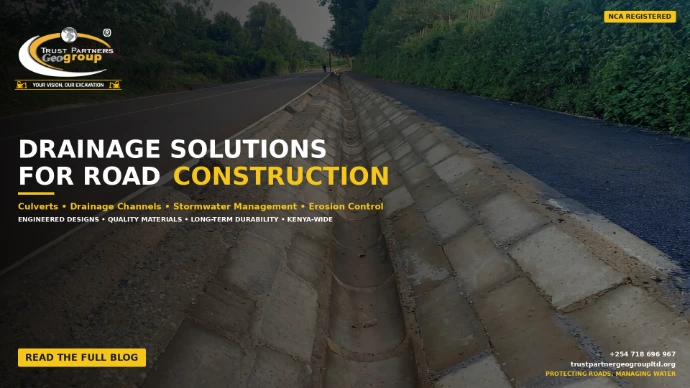
Drainage Solutions for Road Construction in Kenya: Best Practices
Poor drainage is the single greatest cause of premature road failure in Kenya. From the flooded streets of Nairobi to the washed-out rural roads in Western Kenya, inadequate drainage infrastructure costs the economy billions in repair costs, lost productivity, and disrupted supply chains annually. This comprehensive 2026 guide covers culvert design standards, storm water management systems, side drain construction, and the best practices every road engineer, contractor, and county official must follow to build roads that last.
📋 Table of Contents
- Why Drainage Is the #1 Cause of Road Failure in Kenya
- Types of Road Drainage Systems in Kenya
- Culvert Design Standards & Best Practices
- Side Drains, Catch Pits & Channel Design
- Drainage Construction Costs in Kenya (2026)
- Regional Drainage Challenges Across Kenya
- Regulatory Compliance: KeNHA, KURA & County Standards
- Frequently Asked Questions
1. Why Drainage Is the #1 Cause of Road Failure in Kenya
The Kenya Roads Board and KeNHA have consistently identified drainage failure as the leading cause of premature road deterioration across the country. Water infiltration into the road subgrade, uncontrolled surface runoff, and inadequate culvert capacity create a cascade of structural problems that no amount of asphalt thickness can solve.
Consider these facts:
- Over 60% of road maintenance budgets in Kenya are spent repairing damage caused by water infiltration, not traffic loading.
- The March 2026 Nairobi floods disrupted major roads, paralyzed the Jomo Kenyatta International Airport, and caused billions in economic losses—largely due to blocked and undersized drainage channels.
- Many existing culverts in Kenya's urban areas were designed for historical runoff patterns and are now catastrophically undersized given increased impervious surfaces from rapid development.
⚠️ The Cost of Neglect
A road built with poor drainage will require rehabilitation within 3–5 years, compared to 15–25 years for a properly drained road. The cost of retrofitting drainage on an existing road is typically 3 to 4 times higher than incorporating it during initial construction. Drainage is not an optional add-on—it is the foundation of road longevity.
2. Types of Road Drainage Systems in Kenya
Road drainage in Kenya can be classified into two broad categories: surface drainage (managing water on and alongside the road) and subsurface drainage (managing water within and beneath the road structure). Each system serves a distinct purpose and must be designed as an integrated whole.
2.1 Surface Drainage Systems
| Drainage Element | Function | Typical Application | Key Design Parameter |
|---|---|---|---|
| Camber / Crossfall | Sheds water from road surface to side drains | All road types | 2.5%–3.0% for asphalt; 4%–6% for murram |
| Side Drains (Open) | Collects runoff from carriageway and adjacent land | Rural and low-volume roads | Trapezoidal or V-shaped; 0.5–1.5m base width |
| Side Drains (Closed) | Underground conveyance of storm water | Urban roads, highways | Concrete or HDPE pipes; minimum 600mm diameter |
| Catch Pits / Manholes | Collect debris, regulate flow, provide access | Urban closed drain systems | Spaced every 30–50m; 0.5m extra depth for silt |
| Culverts | Convey water beneath the road embankment | All roads crossing watercourses | Hydraulically designed for design storm return period |
| Scour Checks | Reduce flow velocity, prevent channel erosion | Steep-gradient side drains | Spaced at intervals based on slope and soil type |
2.2 Subsurface Drainage Systems
Subsurface drainage prevents water from saturating the road subgrade and pavement layers. In Kenya's high-rainfall regions and areas with high water tables, subsurface drainage is essential for pavement longevity.
| System Type | Function | Application | Construction Details |
|---|---|---|---|
| Subgrade Drains | Lower water table beneath road | High water table areas; swampy terrain | Perforated pipes in gravel trench; 1.0–1.5m depth |
| Edge Drains | Remove water infiltrating pavement edge | Asphalt roads; high-rainfall areas | Geotextile-wrapped perforated pipe at pavement edge |
| Interceptor Drains | Cut off seepage from uphill slopes | Hilly terrain; cut slopes | Upslope of road alignment; deep trench with filter layer |
| Capillary Cut-offs | Block capillary rise of groundwater | Black cotton soil areas | Granular layer or geosynthetic barrier in subgrade |
💡 Design Principle
The Kenya Roads Design Manual (Part 2 – Drainage Design) states that the lowest point in the road cross-section should occur on the carriageway, with footpaths, cycle tracks, and bus stops raised above this level. This prevents pedestrians from wading through water and ensures water is directed away from the pavement structure.
3. Culvert Design Standards & Best Practices
Culverts are the most critical drainage structures on any road project. A poorly designed culvert will destroy a road—often from the inside out, as water saturates the subgrade and causes differential settlement, cracking, and complete pavement failure.
3.1 Hydrological Design: The Rational Method
The standard approach for culvert design in Kenya is the Rational Method:
Q = C × i × A
- Q = Peak discharge (m³/s)
- C = Runoff coefficient (dimensionless, based on land cover)
- i = Rainfall intensity (m/s) for the design return period
- A = Catchment area (m²)
The Kenya Roads Design Manual recommends the following design storm return periods:
| Road Class / Culvert Type | Design Return Period | Application |
|---|---|---|
| Minor culverts (rural access roads) | 10-year storm | Low-volume rural roads; minor crossings |
| Major culverts (secondary roads) | 25-year storm | County roads; district collector roads |
| Primary culverts (national highways) | 50–100-year storm | KeNHA trunk roads; critical infrastructure |
| Urban arterial culverts | 25–50-year storm | Nairobi, Mombasa, Kisumu urban roads |
3.2 Runoff Coefficients for Kenyan Conditions
Selecting the correct runoff coefficient (C) is critical. Underestimating C leads to undersized culverts and catastrophic overtopping. The following values are recommended for Kenya:
| Land Cover / Surface Type | Runoff Coefficient (C) | Typical Kenyan Example |
|---|---|---|
| Paved urban areas | 0.85 – 0.95 | Nairobi CBD, Mombasa Island |
| Residential areas (moderate density) | 0.50 – 0.70 | Suburban estates in Kiambu, Nakuru |
| Light industrial / commercial | 0.60 – 0.80 | Industrial zones; market areas |
| Agricultural / cultivated land | 0.30 – 0.50 | Tea plantations in Kericho; maize farms in Trans Nzoia |
| Grassland / rangeland | 0.20 – 0.35 | Kajiado rangelands; Laikipia plains |
| Forest / dense vegetation | 0.15 – 0.25 | Aberdare forest edges; Mau catchment |
| Sandy, vegetated areas (coastal) | 0.20 – 0.30 | Kilifi, Malindi, Lamu coastal zones |
3.3 Culvert Types and Selection Criteria
The Kenya Roads Design Manual and Standard Culvert and Drifts Manual specify the following culvert types for Kenyan road projects:
| Culvert Type | Typical Sizes | Best For | Approx. Cost (KES) |
|---|---|---|---|
| Circular Concrete Pipe (RCP) | 300mm – 1800mm diameter | Flows below 3 m³/s; standard road crossings | 80,000 – 450,000 per unit |
| Reinforced Concrete Box Culvert | 1.2m × 1.2m to 3.0m × 2.5m | High flows; limited headroom; heavy loading | 350,000 – 1,500,000 per unit |
| Corrugated Metal Pipe (CMP) | 300mm – 2400mm diameter | Temporary works; low-volume roads | 60,000 – 300,000 per unit |
| High-Density Polyethylene (HDPE) | 200mm – 1200mm diameter | Chemical resistance; unstable ground | 120,000 – 600,000 per unit |
| Arch Culverts | Span up to 6m | Wide, shallow waterways; environmental projects | 500,000 – 2,000,000 per unit |
💡 Minimum Standards
The Kenya Roads Design Manual specifies a minimum internal diameter of 600mm for culverts on public roads. This minimum is set to allow for maintenance access and to reduce the risk of blockage from debris. Smaller pipes are only acceptable for private driveways or temporary works. Always apply a 25–50% blockage factor to your design capacity to account for partial blockage from debris and sediment.
3.4 Structural Design and Material Specifications
For reinforced concrete box culverts—the most common type for major roads in Kenya—the following specifications apply per KeNHA and Kenya Bureau of Standards requirements:
- Concrete grade: Class 30/20 (C30/37) for box culvert walls and slabs
- Cement: Ordinary Portland Cement CEM I 42.5N conforming to KS 1725:2001
- Steel reinforcement: BS 4449 or equivalent Kenyan standards; typical bar sizes Y12, Y16, Y20
- Concrete cover: Minimum 50mm for aggressive environments (coastal areas, black cotton soils)
- Foundation compaction: 100% MDD (AASHTO T-99) to 300mm depth before construction
- Backfill compaction: Minimum 95% Modified Proctor Density in 150–200mm lifts
3.5 Inlet, Outlet & Energy Dissipation Design
The culvert barrel is only part of the system. Inlet and outlet configurations significantly affect hydraulic performance and structural integrity:
- Headwalls and wingwalls: Protect embankment from erosion; improve inlet efficiency. Typically constructed in mass concrete (1:2:4 mix) or reinforced concrete for high hydraulic forces.
- Wingwall angle: 30°, 45°, or flared; affects inlet loss coefficient and flow distribution.
- Apron protection: Stone pitching or concrete aprons at the outlet to prevent scour. Required for any culvert passing more than 1.5 m³/s.
- Energy dissipators: Riprap, stilling basins, or gabion mattresses for high-velocity exit flows—especially critical in Rift Valley regions with steep gradients.
- Minimum cover: At least 300mm of fill above pipe culverts (600mm for some specifications) to protect against traffic loads.
4. Side Drains, Catch Pits & Channel Design
4.1 Open vs. Closed Drain Systems
🌊 Open Drains
- ✓ Lower construction cost
- ✓ Easy to inspect and maintain
- ✓ Self-cleaning at adequate gradients
- ✓ Suitable for rural and low-volume roads
- ✗ Occupies road width; reduces space for NMT
- ✗ Safety hazard for pedestrians and cyclists
- ✗ Accumulates debris and silt without maintenance
- ✗ Creates uncomfortable waiting environment
🔒 Closed Drains
- ✓ Frees road width for NMT and landscaping
- ✓ Safer for pedestrians and cyclists
- ✓ Better urban aesthetics
- ✓ Preferred for urban and arterial roads
- ✗ Higher construction cost
- ✗ Requires regular cleaning of catch pits
- ✗ Blockages are hidden and harder to detect
- ✗ Gratings can catch bicycle wheels if poorly designed
4.2 Side Drain Design Parameters
For open side drains on rural roads, the following design parameters are standard practice in Kenya:
| Parameter | Standard Value | Notes |
|---|---|---|
| Cross-section shape | Trapezoidal or V-shaped | Trapezoidal preferred for stability |
| Base width | 0.5 – 1.5m | Depends on expected flow and road class |
| Side slope | 1:1 to 1:1.5 (H:V) | Steeper in rocky ground; flatter in erodible soils |
| Longitudinal gradient | 0.3% – 5.0% | Minimum 0.3% to prevent ponding; maximum 5% to limit erosion |
| Depth below shoulder | 0.3 – 0.6m | Deeper in high-rainfall areas |
| Freeboard | 0.15 – 0.30m | Above design flow level |
| Scour check spacing | 10 – 30m | Closer on steep slopes (>3%) |
4.3 Catch Pit Design for Urban Closed Drains
For urban roads with closed drainage systems, catch pits (or manholes) are essential for debris collection, flow regulation, and maintenance access:
- Spacing: Every 30–50m along the drain line
- Extra depth: 0.5m below the invert level to collect silt and debris
- Gratings: Must be designed so they do not catch bicycle wheels; bar spacing ≤ 100mm
- Material: Precast concrete rings or cast-in-situ reinforced concrete
- Cover: Heavy-duty ductile iron or reinforced concrete for traffic loading
5. Drainage Construction Costs in Kenya (2026)
Drainage works typically represent 8–15% of total road construction costs in Kenya, but this investment is disproportionately important for road longevity. Below are realistic 2026 cost estimates for common drainage elements:
| Drainage Element | Unit | Cost Range (KES) | Cost Range (USD) |
|---|---|---|---|
| Open side drain (earth, trapezoidal) | per meter | 800 – 2,500 | $6 – $19 |
| Open side drain (lined, stone pitching) | per meter | 2,500 – 6,000 | $19 – $46 |
| Open side drain (lined, concrete) | per meter | 4,000 – 10,000 | $31 – $77 |
| Closed drain (concrete pipe, 600mm) | per meter | 6,000 – 12,000 | $46 – $92 |
| Closed drain (concrete pipe, 900mm) | per meter | 10,000 – 20,000 | $77 – $154 |
| Catch pit / manhole | per unit | 35,000 – 80,000 | $269 – $615 |
| Circular concrete pipe culvert (600mm) | per unit (3m length) | 80,000 – 150,000 | $615 – $1,154 |
| Circular concrete pipe culvert (1200mm) | per unit (3m length) | 250,000 – 450,000 | $1,923 – $3,462 |
| Box culvert (2.5m × 1.2m, precast) | per unit (3m length) | 350,000 – 600,000 | $2,692 – $4,615 |
| Headwalls and wingwalls (pair) | per culvert | 150,000 – 400,000 | $1,154 – $3,077 |
| Riprap / stone pitching (outlet protection) | per m² | 1,500 – 3,500 | $12 – $27 |
| Gabion mattress (scour protection) | per m² | 3,500 – 7,000 | $27 – $54 |
| Subgrade drain (perforated pipe + gravel) | per meter | 2,500 – 5,000 | $19 – $38 |
| Interceptor drain | per meter | 3,000 – 6,500 | $23 – $50 |
Source: Kenya Roads Board Cost Estimation Manual, KeNHA tender records, and market surveys adjusted for 2026 pricing. Costs vary significantly by region, material availability, and project scale.
6. Regional Drainage Challenges Across Kenya
Kenya's diverse geography creates distinct drainage challenges that require region-specific solutions:
6.1 High-Rainfall Regions (Western Kenya, Nyanza, Coast)
Areas receiving over 1,000mm of rainfall annually face severe drainage challenges. In Kisumu, Kakamega, and the Coast region, culverts must be designed for intense, sustained rainfall. Key considerations:
- Higher design return periods: Use 25–50 year storms for even minor roads
- Debris management: Install upstream trash screens and silt traps
- Black cotton soils: In areas like Kisumu and parts of Kajiado, expansive soils require special foundation treatments—excavate and replace with stable murram or stabilize with lime/cement
- Erosion control: Dense vegetation on embankments; frequent scour checks in side drains
6.2 Arid and Semi-Arid Regions (Northern Kenya, Eastern, Rift Valley)
In arid zones, drainage design is paradoxical: dry for months, then devastated by intense flash floods. In Kajiado, Marsabit, and Garissa:
- Flash flood design: Culverts must handle infrequent but extremely intense flows carrying heavy sediment and debris
- Larger waterway openings: Required for sediment-laden flows
- Robust energy dissipation: Still basins, riprap aprons, and gabion protection are essential
- Dry-season access: Some roads may use drifts (low-water crossings) instead of culverts where appropriate
6.3 Urban Areas (Nairobi, Mombasa, Kisumu, Nakuru)
Urban drainage is Kenya's most critical challenge. The March 2026 Nairobi floods demonstrated how rapid urbanization has overwhelmed historical drainage capacity:
- Increased impervious surfaces: Runoff coefficients have risen from ~0.40 to 0.85+ in many areas
- Blocked drains: Waste disposal and poor maintenance render drainage systems ineffective
- Closed drain preference: Underground systems with catch pits free road space for NMT and trees
- Climate adaptation: Design for future rainfall intensities, not historical averages
- Integrated planning: Coordinate with water supply, sewer, and power utilities to avoid conflicts
6.4 High-Altitude / Cold Regions (Nyahururu, Nanyuki, Timau)
In high-altitude areas, drainage must account for:
- Frost heave protection: Subsurface drains to prevent water accumulation in freezing zones
- Steep gradients: Energy dissipation and scour protection are critical
- Thermal expansion: Allow for movement in concrete structures
6.5 Coastal Regions (Mombasa, Kilifi, Lamu)
The saline, humid coastal environment accelerates corrosion and creates unique challenges:
- Corrosion-resistant materials: HDPE pipes or coated concrete; avoid unprotected steel
- High cement content concrete: Lower water-cement ratios; specialized admixtures for chloride resistance
- Adequate concrete cover: Minimum 50mm to protect reinforcement from salt ingress
- Tidal influence: Consider buoyancy and backflow in culvert design
7. Regulatory Compliance: KeNHA, KURA & County Standards
All road drainage works in Kenya must comply with national standards and obtain necessary permits. Failure to comply can result in project halts, fines, and demolition orders.
7.1 Key Regulatory Bodies and Requirements
| Regulatory Body | Jurisdiction | Key Requirements |
|---|---|---|
| Kenya National Highways Authority (KeNHA) | National trunk roads (Class A, B, C) | KeNHA Road Design Manual; technical specifications; supervision |
| Kenya Urban Roads Authority (KURA) | Urban roads in major cities | Urban drainage standards; NMT integration; storm water management |
| Kenya Rural Roads Authority (KERRA) | Rural access roads (Class D, E) | Rural road design manual; low-cost drainage solutions |
| Water Resources Authority (WRA) | All watercourse structures | Permit for any structure impacting water resources; hydrological assessment |
| NEMA | Environmental compliance | ESIA for large projects; sediment control; ecological mitigation |
| County Governments | County roads and local drainage | County bylaws; building codes; local drainage master plans |
7.2 Essential Design Documents
Engineers working on road drainage in Kenya must reference the following standards:
- Kenya Roads Design Manual, Part 2 – Drainage Design (Ministry of Transport)
- Standard Culvert and Drifts Manual, Part 1 – Construction Drawings
- Standard Small Span Concrete Bridges, Section 1A – Construction
- Design Manual for Roads and Bridges Part 6A – Bridge and Culvert Design (2009)
- KS 2344:2010 – Kenya Standard for Road Culverts
- BS 5911 – Concrete pipe specifications
- BS 8110 / Eurocode 2 – Structural design of concrete elements
- AASHTO Drainage Manual – For reference on international best practices
7.3 Permit Requirements for Culvert Construction
Any works involving a watercourse, including culvert installations, typically require a permit from the Water Resources Authority (WRA) under the Water Act 2016. The permit application must include:
- Detailed hydrological assessment (catchment delineation, peak flow calculations)
- Environmental impact assessment (for larger projects, coordinated with NEMA)
- Comprehensive engineering designs (structural, hydraulic, geotechnical)
- Proof of no adverse impact on water quantity, quality, or other water users
- Construction methodology and sediment control plan
⚠️ Compliance Warning
Skipping WRA permitting can result in demolition orders, substantial fines, and protracted legal battles that severely delay projects and erode investor confidence. Always integrate regulatory requirements from the initial conceptualization phase.
8. Frequently Asked Questions
Poor drainage is the most common cause of premature road failure in Kenya. Water infiltration into the subgrade, uncontrolled surface runoff, and inadequate culvert capacity lead to subgrade saturation, differential settlement, cracking, and pavement failure. Over 60% of road maintenance budgets are spent repairing water-related damage rather than traffic-induced wear.
The Kenya Roads Design Manual specifies a minimum internal diameter of 600mm for culverts on public roads. This minimum is set to allow for maintenance access and to reduce the risk of blockage from debris. Smaller pipes are only acceptable for private driveways or temporary works. Always apply a 25–50% blockage factor to account for sediment and debris accumulation.
Use the Rational Method (Q = C × i × A) with rainfall intensity-duration-frequency (IDF) curves from the Kenya Meteorological Department. For rural access roads, use a 10-year return period; for county roads, 25 years; and for national highways and critical infrastructure, 50–100 years. The runoff coefficient (C) varies from 0.20 for grassland to 0.90 for paved urban areas. Delineate the catchment area carefully—missing even a small tributary can lead to undersizing.
For rural and low-volume roads, open drains are cost-effective and easier to maintain. For urban roads, highways, and areas with significant pedestrian/cyclist traffic, closed drains are strongly preferred—they free road width for NMT facilities, improve safety, and enhance urban aesthetics. The Street Design Manual for Urban Areas in Kenya recommends closed drains for all urban collector and arterial streets. Both types require regular maintenance, especially before rainy seasons.
In coastal regions like Mombasa and Kilifi, the aggressive saline environment accelerates corrosion. Reinforced concrete culverts with high cement content, low water-cement ratios, and specialized admixtures are preferred. Ensure minimum 50mm concrete cover to protect reinforcement from chloride ingress. HDPE pipes are also excellent for coastal areas due to their chemical resistance. Avoid unprotected corrugated metal pipes (CMP) in saline soils unless coated with bitumen or polymeric protection.
Drainage works typically represent 8–15% of total road construction costs in Kenya. However, this is a wise investment—roads built with inadequate drainage require rehabilitation within 3–5 years, while properly drained roads last 15–25 years. The cost of retrofitting drainage on an existing road is typically 3 to 4 times higher than incorporating it during initial construction. For high-rainfall areas or problematic soils, drainage costs may rise to 20% of the total project budget.
A scour check is a small structure built across a drainage channel to reduce flow velocity and prevent erosion of the channel bed and sides. They are essential in side drains with longitudinal gradients exceeding 3%. In Kenya, scour checks are typically spaced at 10–30 meter intervals depending on slope steepness and soil erodibility. They are constructed from stone masonry, concrete, or gabions and are a standard requirement in the Kenya Roads Design Manual for steep-gradient drains.
Yes. Any structure impacting a watercourse—including culverts—requires a permit from the Water Resources Authority (WRA) under the Water Act 2016. The application must include a hydrological assessment, engineering designs, and proof of no adverse impact on water resources. For larger projects, an Environmental and Social Impact Assessment (ESIA) coordinated with NEMA may also be required. County governments may have additional bylaws for local road drainage. Always secure permits before construction begins to avoid legal penalties and project delays.
Need Expert Drainage Design for Your Road Project?
Trust Partner Geo Group Ltd provides comprehensive road drainage consultancy, hydrological analysis, culvert design, and construction supervision across Kenya. Our registered engineers ensure your drainage systems comply with KeNHA, KURA, and WRA standards while delivering long-term performance in Kenya's diverse climate conditions.
Get a Free Drainage Consultation →Related Articles
Road Construction Cost Per Kilometer in Kenya: 2026 Estimate
Read Article →Asphalt vs. Murram Roads in Kenya: Which is Better?
Read Article →How to Get a Road Construction Permit in Kenya
Read Article →About the Author: Trust Partner Geo Group Ltd is a leading engineering and construction consultancy firm in Kenya, specializing in road construction, drainage design, geotechnical investigations, and project management. We serve clients across East Africa with data-driven, compliant, and sustainable infrastructure solutions.
Published: July 15, 2026 | Last Updated: July 15, 2026 | Categories: Road Drainage, Kenya Infrastructure, Culvert Design, Storm Water Management
Drainage Solutions for Road Construction in Kenya: Best Practices
Poor drainage is the single greatest cause of premature road failure in Kenya. From the flooded streets of Nairobi to the washed-out rural roads in Western Kenya, inadequate drainage infrastructure costs the economy billions in repair costs, lost productivity, and disrupted supply chains annually. This comprehensive 2026 guide covers culvert design standards, storm water management systems, side drain construction, and the best practices every road engineer, contractor, and county official must follow to build roads that last.
📋 Table of Contents
- Why Drainage Is the #1 Cause of Road Failure in Kenya
- Types of Road Drainage Systems in Kenya
- Culvert Design Standards & Best Practices
- Side Drains, Catch Pits & Channel Design
- Drainage Construction Costs in Kenya (2026)
- Regional Drainage Challenges Across Kenya
- Regulatory Compliance: KeNHA, KURA & County Standards
- Frequently Asked Questions
1. Why Drainage Is the #1 Cause of Road Failure in Kenya
The Kenya Roads Board and KeNHA have consistently identified drainage failure as the leading cause of premature road deterioration across the country. Water infiltration into the road subgrade, uncontrolled surface runoff, and inadequate culvert capacity create a cascade of structural problems that no amount of asphalt thickness can solve.
Consider these facts:
- Over 60% of road maintenance budgets in Kenya are spent repairing damage caused by water infiltration, not traffic loading.
- The March 2026 Nairobi floods disrupted major roads, paralyzed the Jomo Kenyatta International Airport, and caused billions in economic losses—largely due to blocked and undersized drainage channels.
- Many existing culverts in Kenya's urban areas were designed for historical runoff patterns and are now catastrophically undersized given increased impervious surfaces from rapid development.
⚠️ The Cost of Neglect
A road built with poor drainage will require rehabilitation within 3–5 years, compared to 15–25 years for a properly drained road. The cost of retrofitting drainage on an existing road is typically 3 to 4 times higher than incorporating it during initial construction. Drainage is not an optional add-on—it is the foundation of road longevity.
2. Types of Road Drainage Systems in Kenya
Road drainage in Kenya can be classified into two broad categories: surface drainage (managing water on and alongside the road) and subsurface drainage (managing water within and beneath the road structure). Each system serves a distinct purpose and must be designed as an integrated whole.
2.1 Surface Drainage Systems
| Drainage Element | Function | Typical Application | Key Design Parameter |
|---|---|---|---|
| Camber / Crossfall | Sheds water from road surface to side drains | All road types | 2.5%–3.0% for asphalt; 4%–6% for murram |
| Side Drains (Open) | Collects runoff from carriageway and adjacent land | Rural and low-volume roads | Trapezoidal or V-shaped; 0.5–1.5m base width |
| Side Drains (Closed) | Underground conveyance of storm water | Urban roads, highways | Concrete or HDPE pipes; minimum 600mm diameter |
| Catch Pits / Manholes | Collect debris, regulate flow, provide access | Urban closed drain systems | Spaced every 30–50m; 0.5m extra depth for silt |
| Culverts | Convey water beneath the road embankment | All roads crossing watercourses | Hydraulically designed for design storm return period |
| Scour Checks | Reduce flow velocity, prevent channel erosion | Steep-gradient side drains | Spaced at intervals based on slope and soil type |
2.2 Subsurface Drainage Systems
Subsurface drainage prevents water from saturating the road subgrade and pavement layers. In Kenya's high-rainfall regions and areas with high water tables, subsurface drainage is essential for pavement longevity.
| System Type | Function | Application | Construction Details |
|---|---|---|---|
| Subgrade Drains | Lower water table beneath road | High water table areas; swampy terrain | Perforated pipes in gravel trench; 1.0–1.5m depth |
| Edge Drains | Remove water infiltrating pavement edge | Asphalt roads; high-rainfall areas | Geotextile-wrapped perforated pipe at pavement edge |
| Interceptor Drains | Cut off seepage from uphill slopes | Hilly terrain; cut slopes | Upslope of road alignment; deep trench with filter layer |
| Capillary Cut-offs | Block capillary rise of groundwater | Black cotton soil areas | Granular layer or geosynthetic barrier in subgrade |
💡 Design Principle
The Kenya Roads Design Manual (Part 2 – Drainage Design) states that the lowest point in the road cross-section should occur on the carriageway, with footpaths, cycle tracks, and bus stops raised above this level. This prevents pedestrians from wading through water and ensures water is directed away from the pavement structure.
3. Culvert Design Standards & Best Practices
Culverts are the most critical drainage structures on any road project. A poorly designed culvert will destroy a road—often from the inside out, as water saturates the subgrade and causes differential settlement, cracking, and complete pavement failure.
3.1 Hydrological Design: The Rational Method
The standard approach for culvert design in Kenya is the Rational Method:
Q = C × i × A
- Q = Peak discharge (m³/s)
- C = Runoff coefficient (dimensionless, based on land cover)
- i = Rainfall intensity (m/s) for the design return period
- A = Catchment area (m²)
The Kenya Roads Design Manual recommends the following design storm return periods:
| Road Class / Culvert Type | Design Return Period | Application |
|---|---|---|
| Minor culverts (rural access roads) | 10-year storm | Low-volume rural roads; minor crossings |
| Major culverts (secondary roads) | 25-year storm | County roads; district collector roads |
| Primary culverts (national highways) | 50–100-year storm | KeNHA trunk roads; critical infrastructure |
| Urban arterial culverts | 25–50-year storm | Nairobi, Mombasa, Kisumu urban roads |
3.2 Runoff Coefficients for Kenyan Conditions
Selecting the correct runoff coefficient (C) is critical. Underestimating C leads to undersized culverts and catastrophic overtopping. The following values are recommended for Kenya:
| Land Cover / Surface Type | Runoff Coefficient (C) | Typical Kenyan Example |
|---|---|---|
| Paved urban areas | 0.85 – 0.95 | Nairobi CBD, Mombasa Island |
| Residential areas (moderate density) | 0.50 – 0.70 | Suburban estates in Kiambu, Nakuru |
| Light industrial / commercial | 0.60 – 0.80 | Industrial zones; market areas |
| Agricultural / cultivated land | 0.30 – 0.50 | Tea plantations in Kericho; maize farms in Trans Nzoia |
| Grassland / rangeland | 0.20 – 0.35 | Kajiado rangelands; Laikipia plains |
| Forest / dense vegetation | 0.15 – 0.25 | Aberdare forest edges; Mau catchment |
| Sandy, vegetated areas (coastal) | 0.20 – 0.30 | Kilifi, Malindi, Lamu coastal zones |
3.3 Culvert Types and Selection Criteria
The Kenya Roads Design Manual and Standard Culvert and Drifts Manual specify the following culvert types for Kenyan road projects:
| Culvert Type | Typical Sizes | Best For | Approx. Cost (KES) |
|---|---|---|---|
| Circular Concrete Pipe (RCP) | 300mm – 1800mm diameter | Flows below 3 m³/s; standard road crossings | 80,000 – 450,000 per unit |
| Reinforced Concrete Box Culvert | 1.2m × 1.2m to 3.0m × 2.5m | High flows; limited headroom; heavy loading | 350,000 – 1,500,000 per unit |
| Corrugated Metal Pipe (CMP) | 300mm – 2400mm diameter | Temporary works; low-volume roads | 60,000 – 300,000 per unit |
| High-Density Polyethylene (HDPE) | 200mm – 1200mm diameter | Chemical resistance; unstable ground | 120,000 – 600,000 per unit |
| Arch Culverts | Span up to 6m | Wide, shallow waterways; environmental projects | 500,000 – 2,000,000 per unit |
💡 Minimum Standards
The Kenya Roads Design Manual specifies a minimum internal diameter of 600mm for culverts on public roads. This minimum is set to allow for maintenance access and to reduce the risk of blockage from debris. Smaller pipes are only acceptable for private driveways or temporary works. Always apply a 25–50% blockage factor to your design capacity to account for partial blockage from debris and sediment.
3.4 Structural Design and Material Specifications
For reinforced concrete box culverts—the most common type for major roads in Kenya—the following specifications apply per KeNHA and Kenya Bureau of Standards requirements:
- Concrete grade: Class 30/20 (C30/37) for box culvert walls and slabs
- Cement: Ordinary Portland Cement CEM I 42.5N conforming to KS 1725:2001
- Steel reinforcement: BS 4449 or equivalent Kenyan standards; typical bar sizes Y12, Y16, Y20
- Concrete cover: Minimum 50mm for aggressive environments (coastal areas, black cotton soils)
- Foundation compaction: 100% MDD (AASHTO T-99) to 300mm depth before construction
- Backfill compaction: Minimum 95% Modified Proctor Density in 150–200mm lifts
3.5 Inlet, Outlet & Energy Dissipation Design
The culvert barrel is only part of the system. Inlet and outlet configurations significantly affect hydraulic performance and structural integrity:
- Headwalls and wingwalls: Protect embankment from erosion; improve inlet efficiency. Typically constructed in mass concrete (1:2:4 mix) or reinforced concrete for high hydraulic forces.
- Wingwall angle: 30°, 45°, or flared; affects inlet loss coefficient and flow distribution.
- Apron protection: Stone pitching or concrete aprons at the outlet to prevent scour. Required for any culvert passing more than 1.5 m³/s.
- Energy dissipators: Riprap, stilling basins, or gabion mattresses for high-velocity exit flows—especially critical in Rift Valley regions with steep gradients.
- Minimum cover: At least 300mm of fill above pipe culverts (600mm for some specifications) to protect against traffic loads.
4. Side Drains, Catch Pits & Channel Design
4.1 Open vs. Closed Drain Systems
🌊 Open Drains
- ✓ Lower construction cost
- ✓ Easy to inspect and maintain
- ✓ Self-cleaning at adequate gradients
- ✓ Suitable for rural and low-volume roads
- ✗ Occupies road width; reduces space for NMT
- ✗ Safety hazard for pedestrians and cyclists
- ✗ Accumulates debris and silt without maintenance
- ✗ Creates uncomfortable waiting environment
🔒 Closed Drains
- ✓ Frees road width for NMT and landscaping
- ✓ Safer for pedestrians and cyclists
- ✓ Better urban aesthetics
- ✓ Preferred for urban and arterial roads
- ✗ Higher construction cost
- ✗ Requires regular cleaning of catch pits
- ✗ Blockages are hidden and harder to detect
- ✗ Gratings can catch bicycle wheels if poorly designed
4.2 Side Drain Design Parameters
For open side drains on rural roads, the following design parameters are standard practice in Kenya:
| Parameter | Standard Value | Notes |
|---|---|---|
| Cross-section shape | Trapezoidal or V-shaped | Trapezoidal preferred for stability |
| Base width | 0.5 – 1.5m | Depends on expected flow and road class |
| Side slope | 1:1 to 1:1.5 (H:V) | Steeper in rocky ground; flatter in erodible soils |
| Longitudinal gradient | 0.3% – 5.0% | Minimum 0.3% to prevent ponding; maximum 5% to limit erosion |
| Depth below shoulder | 0.3 – 0.6m | Deeper in high-rainfall areas |
| Freeboard | 0.15 – 0.30m | Above design flow level |
| Scour check spacing | 10 – 30m | Closer on steep slopes (>3%) |
4.3 Catch Pit Design for Urban Closed Drains
For urban roads with closed drainage systems, catch pits (or manholes) are essential for debris collection, flow regulation, and maintenance access:
- Spacing: Every 30–50m along the drain line
- Extra depth: 0.5m below the invert level to collect silt and debris
- Gratings: Must be designed so they do not catch bicycle wheels; bar spacing ≤ 100mm
- Material: Precast concrete rings or cast-in-situ reinforced concrete
- Cover: Heavy-duty ductile iron or reinforced concrete for traffic loading
5. Drainage Construction Costs in Kenya (2026)
Drainage works typically represent 8–15% of total road construction costs in Kenya, but this investment is disproportionately important for road longevity. Below are realistic 2026 cost estimates for common drainage elements:
| Drainage Element | Unit | Cost Range (KES) | Cost Range (USD) |
|---|---|---|---|
| Open side drain (earth, trapezoidal) | per meter | 800 – 2,500 | $6 – $19 |
| Open side drain (lined, stone pitching) | per meter | 2,500 – 6,000 | $19 – $46 |
| Open side drain (lined, concrete) | per meter | 4,000 – 10,000 | $31 – $77 |
| Closed drain (concrete pipe, 600mm) | per meter | 6,000 – 12,000 | $46 – $92 |
| Closed drain (concrete pipe, 900mm) | per meter | 10,000 – 20,000 | $77 – $154 |
| Catch pit / manhole | per unit | 35,000 – 80,000 | $269 – $615 |
| Circular concrete pipe culvert (600mm) | per unit (3m length) | 80,000 – 150,000 | $615 – $1,154 |
| Circular concrete pipe culvert (1200mm) | per unit (3m length) | 250,000 – 450,000 | $1,923 – $3,462 |
| Box culvert (2.5m × 1.2m, precast) | per unit (3m length) | 350,000 – 600,000 | $2,692 – $4,615 |
| Headwalls and wingwalls (pair) | per culvert | 150,000 – 400,000 | $1,154 – $3,077 |
| Riprap / stone pitching (outlet protection) | per m² | 1,500 – 3,500 | $12 – $27 |
| Gabion mattress (scour protection) | per m² | 3,500 – 7,000 | $27 – $54 |
| Subgrade drain (perforated pipe + gravel) | per meter | 2,500 – 5,000 | $19 – $38 |
| Interceptor drain | per meter | 3,000 – 6,500 | $23 – $50 |
Source: Kenya Roads Board Cost Estimation Manual, KeNHA tender records, and market surveys adjusted for 2026 pricing. Costs vary significantly by region, material availability, and project scale.
6. Regional Drainage Challenges Across Kenya
Kenya's diverse geography creates distinct drainage challenges that require region-specific solutions:
6.1 High-Rainfall Regions (Western Kenya, Nyanza, Coast)
Areas receiving over 1,000mm of rainfall annually face severe drainage challenges. In Kisumu, Kakamega, and the Coast region, culverts must be designed for intense, sustained rainfall. Key considerations:
- Higher design return periods: Use 25–50 year storms for even minor roads
- Debris management: Install upstream trash screens and silt traps
- Black cotton soils: In areas like Kisumu and parts of Kajiado, expansive soils require special foundation treatments—excavate and replace with stable murram or stabilize with lime/cement
- Erosion control: Dense vegetation on embankments; frequent scour checks in side drains
6.2 Arid and Semi-Arid Regions (Northern Kenya, Eastern, Rift Valley)
In arid zones, drainage design is paradoxical: dry for months, then devastated by intense flash floods. In Kajiado, Marsabit, and Garissa:
- Flash flood design: Culverts must handle infrequent but extremely intense flows carrying heavy sediment and debris
- Larger waterway openings: Required for sediment-laden flows
- Robust energy dissipation: Still basins, riprap aprons, and gabion protection are essential
- Dry-season access: Some roads may use drifts (low-water crossings) instead of culverts where appropriate
6.3 Urban Areas (Nairobi, Mombasa, Kisumu, Nakuru)
Urban drainage is Kenya's most critical challenge. The March 2026 Nairobi floods demonstrated how rapid urbanization has overwhelmed historical drainage capacity:
- Increased impervious surfaces: Runoff coefficients have risen from ~0.40 to 0.85+ in many areas
- Blocked drains: Waste disposal and poor maintenance render drainage systems ineffective
- Closed drain preference: Underground systems with catch pits free road space for NMT and trees
- Climate adaptation: Design for future rainfall intensities, not historical averages
- Integrated planning: Coordinate with water supply, sewer, and power utilities to avoid conflicts
6.4 High-Altitude / Cold Regions (Nyahururu, Nanyuki, Timau)
In high-altitude areas, drainage must account for:
- Frost heave protection: Subsurface drains to prevent water accumulation in freezing zones
- Steep gradients: Energy dissipation and scour protection are critical
- Thermal expansion: Allow for movement in concrete structures
6.5 Coastal Regions (Mombasa, Kilifi, Lamu)
The saline, humid coastal environment accelerates corrosion and creates unique challenges:
- Corrosion-resistant materials: HDPE pipes or coated concrete; avoid unprotected steel
- High cement content concrete: Lower water-cement ratios; specialized admixtures for chloride resistance
- Adequate concrete cover: Minimum 50mm to protect reinforcement from salt ingress
- Tidal influence: Consider buoyancy and backflow in culvert design
7. Regulatory Compliance: KeNHA, KURA & County Standards
All road drainage works in Kenya must comply with national standards and obtain necessary permits. Failure to comply can result in project halts, fines, and demolition orders.
7.1 Key Regulatory Bodies and Requirements
| Regulatory Body | Jurisdiction | Key Requirements |
|---|---|---|
| Kenya National Highways Authority (KeNHA) | National trunk roads (Class A, B, C) | KeNHA Road Design Manual; technical specifications; supervision |
| Kenya Urban Roads Authority (KURA) | Urban roads in major cities | Urban drainage standards; NMT integration; storm water management |
| Kenya Rural Roads Authority (KERRA) | Rural access roads (Class D, E) | Rural road design manual; low-cost drainage solutions |
| Water Resources Authority (WRA) | All watercourse structures | Permit for any structure impacting water resources; hydrological assessment |
| NEMA | Environmental compliance | ESIA for large projects; sediment control; ecological mitigation |
| County Governments | County roads and local drainage | County bylaws; building codes; local drainage master plans |
7.2 Essential Design Documents
Engineers working on road drainage in Kenya must reference the following standards:
- Kenya Roads Design Manual, Part 2 – Drainage Design (Ministry of Transport)
- Standard Culvert and Drifts Manual, Part 1 – Construction Drawings
- Standard Small Span Concrete Bridges, Section 1A – Construction
- Design Manual for Roads and Bridges Part 6A – Bridge and Culvert Design (2009)
- KS 2344:2010 – Kenya Standard for Road Culverts
- BS 5911 – Concrete pipe specifications
- BS 8110 / Eurocode 2 – Structural design of concrete elements
- AASHTO Drainage Manual – For reference on international best practices
7.3 Permit Requirements for Culvert Construction
Any works involving a watercourse, including culvert installations, typically require a permit from the Water Resources Authority (WRA) under the Water Act 2016. The permit application must include:
- Detailed hydrological assessment (catchment delineation, peak flow calculations)
- Environmental impact assessment (for larger projects, coordinated with NEMA)
- Comprehensive engineering designs (structural, hydraulic, geotechnical)
- Proof of no adverse impact on water quantity, quality, or other water users
- Construction methodology and sediment control plan
⚠️ Compliance Warning
Skipping WRA permitting can result in demolition orders, substantial fines, and protracted legal battles that severely delay projects and erode investor confidence. Always integrate regulatory requirements from the initial conceptualization phase.
8. Frequently Asked Questions
Poor drainage is the most common cause of premature road failure in Kenya. Water infiltration into the subgrade, uncontrolled surface runoff, and inadequate culvert capacity lead to subgrade saturation, differential settlement, cracking, and pavement failure. Over 60% of road maintenance budgets are spent repairing water-related damage rather than traffic-induced wear.
The Kenya Roads Design Manual specifies a minimum internal diameter of 600mm for culverts on public roads. This minimum is set to allow for maintenance access and to reduce the risk of blockage from debris. Smaller pipes are only acceptable for private driveways or temporary works. Always apply a 25–50% blockage factor to account for sediment and debris accumulation.
Use the Rational Method (Q = C × i × A) with rainfall intensity-duration-frequency (IDF) curves from the Kenya Meteorological Department. For rural access roads, use a 10-year return period; for county roads, 25 years; and for national highways and critical infrastructure, 50–100 years. The runoff coefficient (C) varies from 0.20 for grassland to 0.90 for paved urban areas. Delineate the catchment area carefully—missing even a small tributary can lead to undersizing.
For rural and low-volume roads, open drains are cost-effective and easier to maintain. For urban roads, highways, and areas with significant pedestrian/cyclist traffic, closed drains are strongly preferred—they free road width for NMT facilities, improve safety, and enhance urban aesthetics. The Street Design Manual for Urban Areas in Kenya recommends closed drains for all urban collector and arterial streets. Both types require regular maintenance, especially before rainy seasons.
In coastal regions like Mombasa and Kilifi, the aggressive saline environment accelerates corrosion. Reinforced concrete culverts with high cement content, low water-cement ratios, and specialized admixtures are preferred. Ensure minimum 50mm concrete cover to protect reinforcement from chloride ingress. HDPE pipes are also excellent for coastal areas due to their chemical resistance. Avoid unprotected corrugated metal pipes (CMP) in saline soils unless coated with bitumen or polymeric protection.
Drainage works typically represent 8–15% of total road construction costs in Kenya. However, this is a wise investment—roads built with inadequate drainage require rehabilitation within 3–5 years, while properly drained roads last 15–25 years. The cost of retrofitting drainage on an existing road is typically 3 to 4 times higher than incorporating it during initial construction. For high-rainfall areas or problematic soils, drainage costs may rise to 20% of the total project budget.
A scour check is a small structure built across a drainage channel to reduce flow velocity and prevent erosion of the channel bed and sides. They are essential in side drains with longitudinal gradients exceeding 3%. In Kenya, scour checks are typically spaced at 10–30 meter intervals depending on slope steepness and soil erodibility. They are constructed from stone masonry, concrete, or gabions and are a standard requirement in the Kenya Roads Design Manual for steep-gradient drains.
Yes. Any structure impacting a watercourse—including culverts—requires a permit from the Water Resources Authority (WRA) under the Water Act 2016. The application must include a hydrological assessment, engineering designs, and proof of no adverse impact on water resources. For larger projects, an Environmental and Social Impact Assessment (ESIA) coordinated with NEMA may also be required. County governments may have additional bylaws for local road drainage. Always secure permits before construction begins to avoid legal penalties and project delays.
Need Expert Drainage Design for Your Road Project?
Trust Partner Geo Group Ltd provides comprehensive road drainage consultancy, hydrological analysis, culvert design, and construction supervision across Kenya. Our registered engineers ensure your drainage systems comply with KeNHA, KURA, and WRA standards while delivering long-term performance in Kenya's diverse climate conditions.
Get a Free Drainage Consultation →Related Articles
Road Construction Cost Per Kilometer in Kenya: 2026 Estimate
Read Article →Asphalt vs. Murram Roads in Kenya: Which is Better?
Read Article →How to Get a Road Construction Permit in Kenya
Read Article →About the Author: Trust Partner Geo Group Ltd is a leading engineering and construction consultancy firm in Kenya, specializing in road construction, drainage design, geotechnical investigations, and project management. We serve clients across East Africa with data-driven, compliant, and sustainable infrastructure solutions.
Published: July 15, 2026 | Last Updated: July 15, 2026 | Categories: Road Drainage, Kenya Infrastructure, Culvert Design, Storm Water Management