
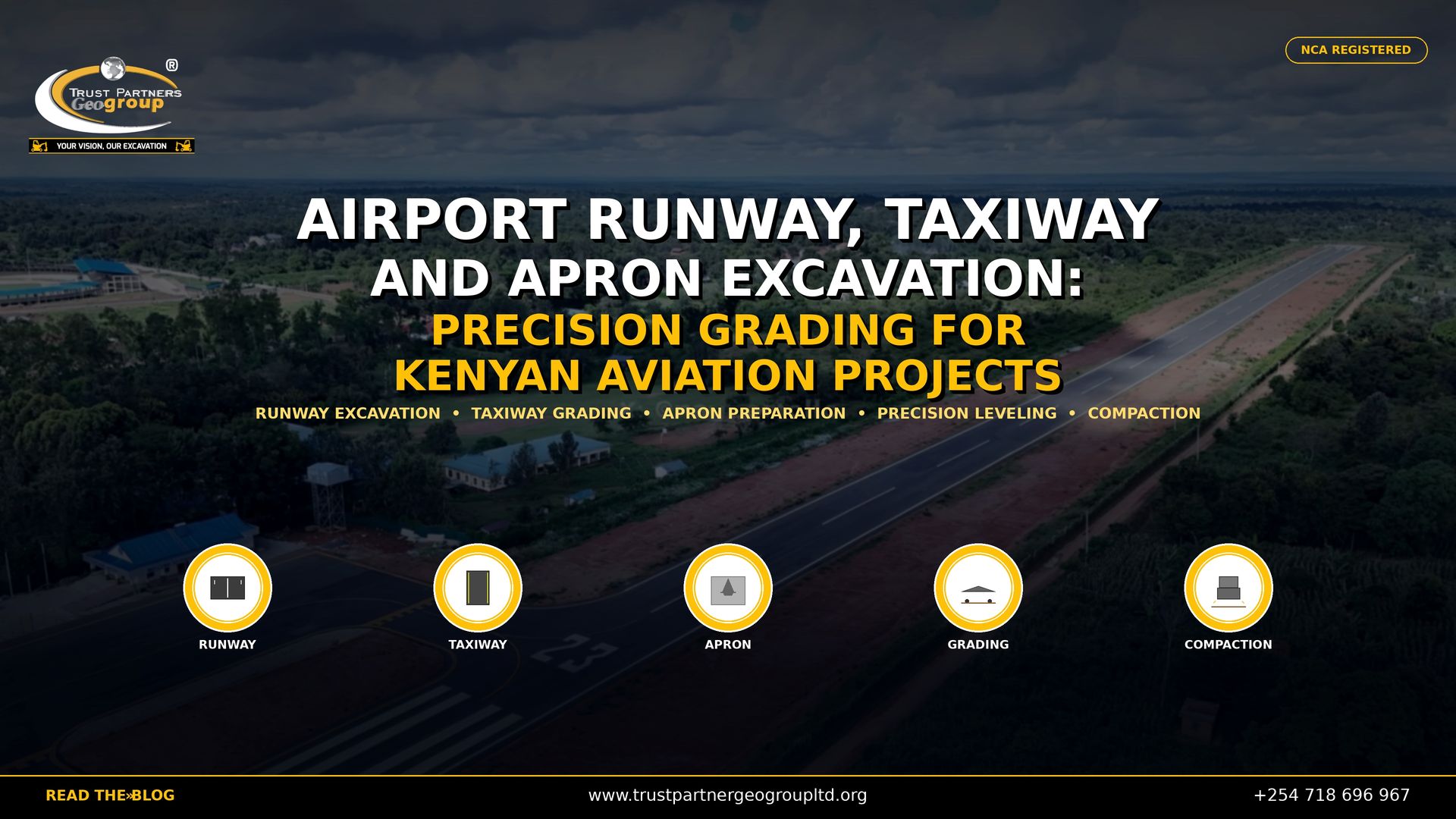
Airport Runway, Taxiway and Apron Excavation: Precision Grading for Kenyan Aviation Projects [2026]
Airside Earthworks to Millimetre Tolerances for Kenya's Growing Aviation Sector
Nowhere in construction is the ground judged more harshly than beneath a runway. A Boeing touching down at 240 km/h turns every millimetre of formation error into a maintenance problem — which is why airport runway excavation in Kenya is the most precision-driven earthworks discipline in the country. From JKIA expansion works and Wilson Airport upgrades to new county airstrips in the tourism and agricultural belts, this 2026 spec guide covers taxiway grading, apron excavation, airside drainage, GPS-controlled tolerances, costs and compliance for aviation construction in Nairobi and beyond. With 15+ years of excavation experience across Kenya, Trust Partners Geo-Group delivers the precision grading that aviation projects demand.

Our team delivers GPS-controlled precision earthworks across Kenya — from corridor grading to airside formation works. We publish spec-level guidance so airport developers, engineers and procurement teams can plan aviation earthworks with confidence.
1. Kenya's Aviation Construction Boom: The 2026 Landscape
Kenya's aviation sector is expanding on three fronts, and each generates substantial airside earthworks:
- Major international gateways: capacity expansion at Jomo Kenyatta International Airport (JKIA), Moi International (Mombasa) and Eldoret — taxiway additions, apron extensions and runway rehabilitation that keep aviation construction in Nairobi and the coast continuously active.
- Regional airport upgrades: Kisumu, Malindi, Ukunda (Diani), Isiolo and Lamu are receiving pavement strengthening, runway extensions and apron expansion to handle larger aircraft and growing passenger numbers.
- County and private airstrips: tourism conservancies (Maasai Mara, Laikipia), agricultural exporters and county governments are building or upgrading dozens of gravel and bitumen airstrips — each a complete earthworks project of clearing, formation, drainage and precision grading.
For earthworks contractors, aviation sits at the top of the precision pyramid. The volumes resemble road and rail corridor earthworks, but the tolerances are tighter, the QA/QC documentation heavier, and the safety environment — working beside live aircraft — uniquely demanding. Contractors who prove themselves airside command premium rates and repeat work.
2. What Is Airport Runway Excavation?
Airport runway excavation is the complete earthworks cycle that converts raw ground into a formation capable of carrying aircraft loads: clearing and stripping the runway strip, mass cut and fill to design gradient, subgrade trimming to millimetre tolerances, airside drainage, and subbase placement ahead of paving. It differs from ordinary earthworks in four ways:
- Tolerances: trimmed formation typically ±10–20mm with longitudinal gradient accuracy of ±0.05% — achievable only with GPS machine control, not conventional survey-and-trim methods.
- Uniformity: aircraft loads punish any localised soft spot. Density, moisture and material quality are tested on a grid, not sampled occasionally.
- Drainage absolutism: standing water is both a structural threat and a wildlife attractant (bird-strike risk). Every airside earthworks plan is, first, a drainage plan.
- Safety environment: works occur beside active runways under strict airside rules — escorted plant, foreign-object-debris (FOD) control, obstacle height limits and daily hand-back inspections.
Many principles carry over from our road sub-grade preparation and CBR testing guide — but airside specs tighten every number.
3. Runway Earthworks: Formation, Subgrade and Strip Works
The runway strip
The graded strip extends well beyond the paved runway — typically 75–150m wide in total including graded shoulders and runway end safety areas (RESA). All of it must be shaped, compacted and free-draining, so earthworks volumes routinely reach 15,000–40,000 m³ per 100m of runway in undulating terrain.
Formation design
Subgrade strength requirements depend on aircraft class: light-aircraft airstrips may accept CBR 8–10% formations, while Code E/F runways for wide-body aircraft demand engineered subgrades with CBR 15%+ or stabilised layers. Weak zones — common in Kenya's black cotton plains (Ukunda, Kisumu approaches) — require undercut and replacement or lime/cement stabilisation, techniques covered in our black cotton soil stabilization guide.
Longitudinal and transverse geometry
Runway gradients are tightly constrained (typically max 1–2% longitudinal, with limits on grade changes and sight distances), which is why runway earthworks design begins with a vertical-alignment optimisation — balancing cut and fill across kilometres while respecting drainage falls on the crossfall.
4. Taxiway Grading and Apron Excavation
Taxiway grading in Kenya follows runway discipline with slight relaxations: formation widths of 15–30m, the same ±10–20mm trimming standard, and connector geometry (fillets and exits) that demands careful machine control around curves.
Apron excavation is a different challenge — large, flat, heavily loaded platforms:
- Footprint scale: terminal aprons run 10,000–60,000 m²; formation uniformity across the whole pad matters more than any single point.
- Stand and service infrastructure: apron earthworks include trenches for fuel hydrants, ground power, drainage channels and lighting cables — coordinated with the duct and trench specs we detailed in our pipeline trenching guide for oil, gas, water and fiber installation.
- Fuel and oil exposure: apron drainage routes to fuel/oil-water separators before discharge — a compliance item in its own right.
- Heavy static loads: parked wide-body aircraft impose higher static loads than rolling gear, so apron subgrades are often specified stronger than the runway itself.
5. Airport Earthworks Precision: Tolerances and GPS Machine Control
| Element | Typical Airside Tolerance | How It's Achieved |
|---|---|---|
| Trimmed formation level | ±10–20 mm | GPS/UTS machine control on graders; final trim verified by survey grid |
| Longitudinal gradient | ±0.05% | 3D design surface loaded to machine control; no manual grade stakes |
| Transverse crossfall | ±0.1% | Dual-mast grader control; checked with digital levels |
| Layer compaction | 95–100% Modified Proctor | Density testing per grid panel; moisture conditioning |
| Subgrade strength | CBR per design (8–15%+) | In-situ DCP/CBR testing; stabilisation where deficient |
| Surface regularity (pre-pave) | No ponding after test rainfall | Water-test or 3m straight-edge verification before paving |
GPS machine control is not optional on airside work — it is the only economical way to hold these numbers over hundreds of thousands of square metres. We cover the technology in GPS machine control for precision earthmoving and the survey side in drone surveying for earthwork progress tracking. Note that drone flights on or near aerodromes require KCAA drone-operation authorisation — plan survey logistics accordingly.
6. Airside Drainage and Pavement Support Excavation
Airside drainage systems protect both the pavement and flight safety:
- Longitudinal storm drains: lined open channels or buried pipes along pavement edges, sized for design storms with outfalls discharging well clear of the strip.
- Underdrains: perforated pipes in gravel trenches beneath the formation where groundwater or perched water threatens subgrade strength.
- Graded grass strips: shaped and topsoiled areas between pavements, graded to shed water without ponding and maintained free of erosion gullies.
- Apron slot drains and separators: channel drains across apron falls feeding fuel/oil-water separators — a NEMA-sensitive discharge.
- Culverts under taxiway crossings: foundation excavation and backfill to pavement-standard compaction, since every culvert crossing is a future settlement risk.
The sequencing rule from corridor work applies doubly airside: drainage first, formation second, paving last — and never let a wet season catch an undrained formation.
7. Working in Live Airports: Possessions, FOD and Airside Safety
Rehabilitation works on operating airports follow a strict daily rhythm:
- Night possessions: works windows between last and first flights (often 6–8 hours), agreed with the airport operator weeks ahead.
- Morning hand-back: every night ends with the runway/taxiway inspected, swept, FOD-free and formally returned to service — unfinished areas are protected with approved temporary ramps or closed markings.
- FOD control: every truck is inspected before crossing airside; spoil, tools and debris are tracked obsessively because a single bolt can destroy an engine.
- Escorted movement: plant and crews move under radio contact and escort; all workers carry airside passes and safety training.
- Obstacle limitation: crane and excavator heights near approach surfaces are restricted and marked with lights/flags per the approved Method of Work Plan (MOWP).
8. Regional Airports and Airstrip Upgrades Across Kenya
Beyond the major gateways, the fastest-growing segment is county and private airstrips:
- Tourism strips (Mara, Amboseli, Laikipia, coastal conservancies): typically 1.0–1.5 km gravel or bitumen strips — full earthworks scopes of clearing, formation, drainage and gravel surfacing, often in remote locations demanding self-sufficient fleets and camps.
- Agricultural/export airstrips serving flower and fresh-produce logistics around Naivasha, Timau and the coast.
- County airport upgrades: Isiolo, Mandera, Migori and others receiving pavement and apron works as regional connectivity grows.
These projects are ideally sized for Kenyan contractors: KES 80–400 million earthworks scopes, private or county clients with faster procurement than national agencies, and specs that reference — rather than exceed — international guidance. They reward firms with mobile fleets and disciplined QA/QC, the same capability set needed for highway corridor equipment deployment.
9. Equipment Selection for Airside Earthworks
| Machine | Typical Class | Role on Airport Earthworks | 2026 Hire Rate (guide) |
|---|---|---|---|
| GPS motor grader | 140–180 hp + 3D kit | Formation and subbase trimming to ±10–20mm | KES 9,000–13,000/hr |
| Hydraulic excavator | 20–30 t | Drainage trenches, culvert pits, apron service ducts | KES 6,500–12,000/hr with operator |
| Bulldozer (GPS) | D6–D8 | Mass cut/fill on strips and RESA areas | KES 9,000–15,000/hr |
| Padfoot / smooth drum rollers | 10–18 t | Layer compaction; proof rolling of formation | KES 5,500–8,500/hr |
| Articulated dump trucks | 25–40 t | Cut-to-fill and borrow haulage | Per-m³/per-km rates |
| Stabilization spreader / mixer | Specialist | Lime/cement stabilisation of weak subgrades | Quoted per m² |
| Water bowsers | 10,000–20,000 L | Moisture conditioning, dust control (critical airside) | KES 35,000–60,000/day |
| Sweepers / FOD magnets | Truck-mounted | Daily pavement sweeping and hand-back inspections | KES 25,000–45,000/day |
For rate context see our 2026 excavator hire price guide and motor grader hire guide. Airport campaigns are long and deadline-critical — our analysis of long-term hire vs. lease explains why monthly packages with maintenance SLAs beat spot hire on airside work.
10. Airport Excavation Costs: 2026 Budget Benchmarks
Indicative 2026 airside earthworks costs (formation, drainage and subgrade preparation; pavement, lighting and NAVAIDs excluded):
| Scope | Unit | Indicative Cost (KES) | Key Cost Drivers |
|---|---|---|---|
| New runway earthworks — flat terrain | per linear metre | 180,000–260,000 | Cut/fill balance, drainage density |
| New runway earthworks — undulating terrain | per linear metre | 260,000–350,000+ | Mass haul distance, rock, stabilisation |
| Taxiway formation and grading | per linear metre | 90,000–160,000 | Width, fillet geometry, connector drainage |
| Apron excavation and formation | per m² footprint | 900–2,200 | Area, service trenches, separator systems |
| Runway rehabilitation (night possessions) | per linear metre | 120,000–220,000 | Possession productivity premium, FOD control |
| County airstrip (gravel strip, complete earthworks) | per strip (1.0–1.5 km) | 80–180 million | Remoteness, camp logistics, gravel surfacing |
Unit-rate anchors: general cut-to-fill at KES 250–450/m³ and rock excavation at KES 800–2,200/m³ — see our 2026 earthworks cost per cubic metre breakdown and rock excavation rate guide. Budget an honest 20–30% premium on live-airport works for possessions, escorts, sweeping and standby plant.
11. KCAA, ICAO Standards and Regulatory Compliance
Airport earthworks in Kenya operate under a layered framework:
- KCAA: the Kenya Civil Aviation Authority enforces aerodrome standards aligned to ICAO Annex 14 — geometry, strip dimensions, RESA, obstacle limitation surfaces and works-safety requirements. Every airside project runs under an approved Method of Work Plan (MOWP).
- Kenya Airports Authority (KAA): project approval, airside access permits, security clearance for all workers and plant, and daily coordination with airport operations.
- NCA: contractor and project registration for civil works — see our NCA registration requirements guide.
- NEMA: environmental licensing for new strips and major expansions, including drainage discharge and separator systems on aprons.
- Materials standards: subbase and stabilised layers per project specifications referencing KEBS/BS/EN or FAA standards; QA/QC dossiers (density, CBR, levels) are contractual deliverables.
The unifying principle: everything airside is documented. Grid-referenced test results, as-built surfaces from machine-control data, daily possession reports and hand-back certificates are as much a part of the product as the formation itself.
12. Frequently Asked Questions
What tolerances apply to airport runway excavation in Kenya?
Trimmed subgrade levels typically carry ±10–20mm tolerances, with longitudinal gradient accuracy of ±0.05% and crossfall of ±0.1%. These effectively require GPS machine control on graders and dozers, verified by continuous survey before paving.
How much does runway earthworks cost in Kenya?
In 2026, airside earthworks for a new regional runway cost roughly KES 180,000–350,000 per linear metre depending on terrain and drainage. Apron excavation runs KES 900–2,200 per square metre of footprint. Pavement, lighting and NAVAIDs are additional.
What is the difference between runway, taxiway and apron excavation?
Runway excavation builds the landing strip formation to the tightest tolerances. Taxiway excavation creates connector pavements with similar specs. Apron excavation forms aircraft parking platforms — larger areas, stronger subgrades, and trenches for fuel hydrants, power and drainage with oil-water separators.
Who does airport runway excavation in Kenya?
NCA-registered civil contractors with GPS machine-control fleets and documented QA/QC systems. Trust Partners Geo-Group provides runway, taxiway and apron excavation with precision grading nationwide — call +254 718 686 967 for an airside works assessment.
How is drainage handled on airport pavements in Kenya?
Through longitudinal storm drains, underdrains beneath the formation, graded grass strips and oil-water separators on apron outflows. All drainage discharges clear of the strip, since standing water weakens subgrade and attracts birds — an aircraft safety hazard.
Can runway rehabilitation happen while an airport stays open?
Yes — most Kenyan airport works run in night possessions between scheduled flights, with the runway swept, inspected and returned to service each morning. This demands daily planning, FOD control, airside escorts and standby plant to never miss a hand-back.
What approvals are needed for airport construction in Kenya?
KAA project approval, KCAA aerodrome standards compliance with an approved Method of Work Plan, NEMA licensing, NCA registration, and security clearance for all airside workers. Obstacle limitation surfaces also restrict plant heights and stockpile locations.
13. Conclusion: Precision Is the Product
On an airport project, the earthworks contractor's product is not moved soil — it is precision. A formation trimmed to ±10mm, drained so no water ever ponds, compacted uniformly across every grid panel, and handed back to aviation each morning without fail. That discipline is what separates airside-capable contractors from general earthmovers, and it is what Kenya's aviation expansion — from JKIA's aprons to the county airstrips opening up the conservancies — will reward for the rest of this decade.
For developers, engineers and procurement teams, the 2026 playbook is clear: invest in geotechnics and drainage design early, specify machine control explicitly, price possession productivity honestly, and choose earthworks partners with audited safety systems and documented QA/QC. For related reading, see our analyses of pipeline trenching for oil, gas, water and fiber installation and railway construction excavation for SGR Phase 2 and freight lines, plus our master resource on excavation in Kenya — costs, methods and contractors.
Planning an Airport, Airstrip or Apron Project?
Trust Partners Geo-Group delivers KCAA-compliant airside earthworks, GPS precision grading, drainage and heavy equipment for hire — serving Nairobi, Mombasa, Kisumu, Eldoret and all 47 counties.
Call +254 718 686 967 Request a Free Site AssessmentAirport Runway, Taxiway and Apron Excavation: Precision Grading for Kenyan Aviation Projects [2026]
Airside Earthworks to Millimetre Tolerances for Kenya's Growing Aviation Sector
Nowhere in construction is the ground judged more harshly than beneath a runway. A Boeing touching down at 240 km/h turns every millimetre of formation error into a maintenance problem — which is why airport runway excavation in Kenya is the most precision-driven earthworks discipline in the country. From JKIA expansion works and Wilson Airport upgrades to new county airstrips in the tourism and agricultural belts, this 2026 spec guide covers taxiway grading, apron excavation, airside drainage, GPS-controlled tolerances, costs and compliance for aviation construction in Nairobi and beyond. With 15+ years of excavation experience across Kenya, Trust Partners Geo-Group delivers the precision grading that aviation projects demand.
Our team delivers GPS-controlled precision earthworks across Kenya — from corridor grading to airside formation works. We publish spec-level guidance so airport developers, engineers and procurement teams can plan aviation earthworks with confidence.
1. Kenya's Aviation Construction Boom: The 2026 Landscape
Kenya's aviation sector is expanding on three fronts, and each generates substantial airside earthworks:
- Major international gateways: capacity expansion at Jomo Kenyatta International Airport (JKIA), Moi International (Mombasa) and Eldoret — taxiway additions, apron extensions and runway rehabilitation that keep aviation construction in Nairobi and the coast continuously active.
- Regional airport upgrades: Kisumu, Malindi, Ukunda (Diani), Isiolo and Lamu are receiving pavement strengthening, runway extensions and apron expansion to handle larger aircraft and growing passenger numbers.
- County and private airstrips: tourism conservancies (Maasai Mara, Laikipia), agricultural exporters and county governments are building or upgrading dozens of gravel and bitumen airstrips — each a complete earthworks project of clearing, formation, drainage and precision grading.
For earthworks contractors, aviation sits at the top of the precision pyramid. The volumes resemble road and rail corridor earthworks, but the tolerances are tighter, the QA/QC documentation heavier, and the safety environment — working beside live aircraft — uniquely demanding. Contractors who prove themselves airside command premium rates and repeat work.
2. What Is Airport Runway Excavation?
Airport runway excavation is the complete earthworks cycle that converts raw ground into a formation capable of carrying aircraft loads: clearing and stripping the runway strip, mass cut and fill to design gradient, subgrade trimming to millimetre tolerances, airside drainage, and subbase placement ahead of paving. It differs from ordinary earthworks in four ways:
- Tolerances: trimmed formation typically ±10–20mm with longitudinal gradient accuracy of ±0.05% — achievable only with GPS machine control, not conventional survey-and-trim methods.
- Uniformity: aircraft loads punish any localised soft spot. Density, moisture and material quality are tested on a grid, not sampled occasionally.
- Drainage absolutism: standing water is both a structural threat and a wildlife attractant (bird-strike risk). Every airside earthworks plan is, first, a drainage plan.
- Safety environment: works occur beside active runways under strict airside rules — escorted plant, foreign-object-debris (FOD) control, obstacle height limits and daily hand-back inspections.
Many principles carry over from our road sub-grade preparation and CBR testing guide — but airside specs tighten every number.
3. Runway Earthworks: Formation, Subgrade and Strip Works
The runway strip
The graded strip extends well beyond the paved runway — typically 75–150m wide in total including graded shoulders and runway end safety areas (RESA). All of it must be shaped, compacted and free-draining, so earthworks volumes routinely reach 15,000–40,000 m³ per 100m of runway in undulating terrain.
Formation design
Subgrade strength requirements depend on aircraft class: light-aircraft airstrips may accept CBR 8–10% formations, while Code E/F runways for wide-body aircraft demand engineered subgrades with CBR 15%+ or stabilised layers. Weak zones — common in Kenya's black cotton plains (Ukunda, Kisumu approaches) — require undercut and replacement or lime/cement stabilisation, techniques covered in our black cotton soil stabilization guide.
Longitudinal and transverse geometry
Runway gradients are tightly constrained (typically max 1–2% longitudinal, with limits on grade changes and sight distances), which is why runway earthworks design begins with a vertical-alignment optimisation — balancing cut and fill across kilometres while respecting drainage falls on the crossfall.
4. Taxiway Grading and Apron Excavation
Taxiway grading in Kenya follows runway discipline with slight relaxations: formation widths of 15–30m, the same ±10–20mm trimming standard, and connector geometry (fillets and exits) that demands careful machine control around curves.
Apron excavation is a different challenge — large, flat, heavily loaded platforms:
- Footprint scale: terminal aprons run 10,000–60,000 m²; formation uniformity across the whole pad matters more than any single point.
- Stand and service infrastructure: apron earthworks include trenches for fuel hydrants, ground power, drainage channels and lighting cables — coordinated with the duct and trench specs we detailed in our pipeline trenching guide for oil, gas, water and fiber installation.
- Fuel and oil exposure: apron drainage routes to fuel/oil-water separators before discharge — a compliance item in its own right.
- Heavy static loads: parked wide-body aircraft impose higher static loads than rolling gear, so apron subgrades are often specified stronger than the runway itself.
5. Airport Earthworks Precision: Tolerances and GPS Machine Control
| Element | Typical Airside Tolerance | How It's Achieved |
|---|---|---|
| Trimmed formation level | ±10–20 mm | GPS/UTS machine control on graders; final trim verified by survey grid |
| Longitudinal gradient | ±0.05% | 3D design surface loaded to machine control; no manual grade stakes |
| Transverse crossfall | ±0.1% | Dual-mast grader control; checked with digital levels |
| Layer compaction | 95–100% Modified Proctor | Density testing per grid panel; moisture conditioning |
| Subgrade strength | CBR per design (8–15%+) | In-situ DCP/CBR testing; stabilisation where deficient |
| Surface regularity (pre-pave) | No ponding after test rainfall | Water-test or 3m straight-edge verification before paving |
GPS machine control is not optional on airside work — it is the only economical way to hold these numbers over hundreds of thousands of square metres. We cover the technology in GPS machine control for precision earthmoving and the survey side in drone surveying for earthwork progress tracking. Note that drone flights on or near aerodromes require KCAA drone-operation authorisation — plan survey logistics accordingly.
6. Airside Drainage and Pavement Support Excavation
Airside drainage systems protect both the pavement and flight safety:
- Longitudinal storm drains: lined open channels or buried pipes along pavement edges, sized for design storms with outfalls discharging well clear of the strip.
- Underdrains: perforated pipes in gravel trenches beneath the formation where groundwater or perched water threatens subgrade strength.
- Graded grass strips: shaped and topsoiled areas between pavements, graded to shed water without ponding and maintained free of erosion gullies.
- Apron slot drains and separators: channel drains across apron falls feeding fuel/oil-water separators — a NEMA-sensitive discharge.
- Culverts under taxiway crossings: foundation excavation and backfill to pavement-standard compaction, since every culvert crossing is a future settlement risk.
The sequencing rule from corridor work applies doubly airside: drainage first, formation second, paving last — and never let a wet season catch an undrained formation.
7. Working in Live Airports: Possessions, FOD and Airside Safety
Rehabilitation works on operating airports follow a strict daily rhythm:
- Night possessions: works windows between last and first flights (often 6–8 hours), agreed with the airport operator weeks ahead.
- Morning hand-back: every night ends with the runway/taxiway inspected, swept, FOD-free and formally returned to service — unfinished areas are protected with approved temporary ramps or closed markings.
- FOD control: every truck is inspected before crossing airside; spoil, tools and debris are tracked obsessively because a single bolt can destroy an engine.
- Escorted movement: plant and crews move under radio contact and escort; all workers carry airside passes and safety training.
- Obstacle limitation: crane and excavator heights near approach surfaces are restricted and marked with lights/flags per the approved Method of Work Plan (MOWP).
8. Regional Airports and Airstrip Upgrades Across Kenya
Beyond the major gateways, the fastest-growing segment is county and private airstrips:
- Tourism strips (Mara, Amboseli, Laikipia, coastal conservancies): typically 1.0–1.5 km gravel or bitumen strips — full earthworks scopes of clearing, formation, drainage and gravel surfacing, often in remote locations demanding self-sufficient fleets and camps.
- Agricultural/export airstrips serving flower and fresh-produce logistics around Naivasha, Timau and the coast.
- County airport upgrades: Isiolo, Mandera, Migori and others receiving pavement and apron works as regional connectivity grows.
These projects are ideally sized for Kenyan contractors: KES 80–400 million earthworks scopes, private or county clients with faster procurement than national agencies, and specs that reference — rather than exceed — international guidance. They reward firms with mobile fleets and disciplined QA/QC, the same capability set needed for highway corridor equipment deployment.
9. Equipment Selection for Airside Earthworks
| Machine | Typical Class | Role on Airport Earthworks | 2026 Hire Rate (guide) |
|---|---|---|---|
| GPS motor grader | 140–180 hp + 3D kit | Formation and subbase trimming to ±10–20mm | KES 9,000–13,000/hr |
| Hydraulic excavator | 20–30 t | Drainage trenches, culvert pits, apron service ducts | KES 6,500–12,000/hr with operator |
| Bulldozer (GPS) | D6–D8 | Mass cut/fill on strips and RESA areas | KES 9,000–15,000/hr |
| Padfoot / smooth drum rollers | 10–18 t | Layer compaction; proof rolling of formation | KES 5,500–8,500/hr |
| Articulated dump trucks | 25–40 t | Cut-to-fill and borrow haulage | Per-m³/per-km rates |
| Stabilization spreader / mixer | Specialist | Lime/cement stabilisation of weak subgrades | Quoted per m² |
| Water bowsers | 10,000–20,000 L | Moisture conditioning, dust control (critical airside) | KES 35,000–60,000/day |
| Sweepers / FOD magnets | Truck-mounted | Daily pavement sweeping and hand-back inspections | KES 25,000–45,000/day |
For rate context see our 2026 excavator hire price guide and motor grader hire guide. Airport campaigns are long and deadline-critical — our analysis of long-term hire vs. lease explains why monthly packages with maintenance SLAs beat spot hire on airside work.
10. Airport Excavation Costs: 2026 Budget Benchmarks
Indicative 2026 airside earthworks costs (formation, drainage and subgrade preparation; pavement, lighting and NAVAIDs excluded):
| Scope | Unit | Indicative Cost (KES) | Key Cost Drivers |
|---|---|---|---|
| New runway earthworks — flat terrain | per linear metre | 180,000–260,000 | Cut/fill balance, drainage density |
| New runway earthworks — undulating terrain | per linear metre | 260,000–350,000+ | Mass haul distance, rock, stabilisation |
| Taxiway formation and grading | per linear metre | 90,000–160,000 | Width, fillet geometry, connector drainage |
| Apron excavation and formation | per m² footprint | 900–2,200 | Area, service trenches, separator systems |
| Runway rehabilitation (night possessions) | per linear metre | 120,000–220,000 | Possession productivity premium, FOD control |
| County airstrip (gravel strip, complete earthworks) | per strip (1.0–1.5 km) | 80–180 million | Remoteness, camp logistics, gravel surfacing |
Unit-rate anchors: general cut-to-fill at KES 250–450/m³ and rock excavation at KES 800–2,200/m³ — see our 2026 earthworks cost per cubic metre breakdown and rock excavation rate guide. Budget an honest 20–30% premium on live-airport works for possessions, escorts, sweeping and standby plant.
11. KCAA, ICAO Standards and Regulatory Compliance
Airport earthworks in Kenya operate under a layered framework:
- KCAA: the Kenya Civil Aviation Authority enforces aerodrome standards aligned to ICAO Annex 14 — geometry, strip dimensions, RESA, obstacle limitation surfaces and works-safety requirements. Every airside project runs under an approved Method of Work Plan (MOWP).
- Kenya Airports Authority (KAA): project approval, airside access permits, security clearance for all workers and plant, and daily coordination with airport operations.
- NCA: contractor and project registration for civil works — see our NCA registration requirements guide.
- NEMA: environmental licensing for new strips and major expansions, including drainage discharge and separator systems on aprons.
- Materials standards: subbase and stabilised layers per project specifications referencing KEBS/BS/EN or FAA standards; QA/QC dossiers (density, CBR, levels) are contractual deliverables.
The unifying principle: everything airside is documented. Grid-referenced test results, as-built surfaces from machine-control data, daily possession reports and hand-back certificates are as much a part of the product as the formation itself.
12. Frequently Asked Questions
What tolerances apply to airport runway excavation in Kenya?
Trimmed subgrade levels typically carry ±10–20mm tolerances, with longitudinal gradient accuracy of ±0.05% and crossfall of ±0.1%. These effectively require GPS machine control on graders and dozers, verified by continuous survey before paving.
How much does runway earthworks cost in Kenya?
In 2026, airside earthworks for a new regional runway cost roughly KES 180,000–350,000 per linear metre depending on terrain and drainage. Apron excavation runs KES 900–2,200 per square metre of footprint. Pavement, lighting and NAVAIDs are additional.
What is the difference between runway, taxiway and apron excavation?
Runway excavation builds the landing strip formation to the tightest tolerances. Taxiway excavation creates connector pavements with similar specs. Apron excavation forms aircraft parking platforms — larger areas, stronger subgrades, and trenches for fuel hydrants, power and drainage with oil-water separators.
Who does airport runway excavation in Kenya?
NCA-registered civil contractors with GPS machine-control fleets and documented QA/QC systems. Trust Partners Geo-Group provides runway, taxiway and apron excavation with precision grading nationwide — call +254 718 686 967 for an airside works assessment.
How is drainage handled on airport pavements in Kenya?
Through longitudinal storm drains, underdrains beneath the formation, graded grass strips and oil-water separators on apron outflows. All drainage discharges clear of the strip, since standing water weakens subgrade and attracts birds — an aircraft safety hazard.
Can runway rehabilitation happen while an airport stays open?
Yes — most Kenyan airport works run in night possessions between scheduled flights, with the runway swept, inspected and returned to service each morning. This demands daily planning, FOD control, airside escorts and standby plant to never miss a hand-back.
What approvals are needed for airport construction in Kenya?
KAA project approval, KCAA aerodrome standards compliance with an approved Method of Work Plan, NEMA licensing, NCA registration, and security clearance for all airside workers. Obstacle limitation surfaces also restrict plant heights and stockpile locations.
13. Conclusion: Precision Is the Product
On an airport project, the earthworks contractor's product is not moved soil — it is precision. A formation trimmed to ±10mm, drained so no water ever ponds, compacted uniformly across every grid panel, and handed back to aviation each morning without fail. That discipline is what separates airside-capable contractors from general earthmovers, and it is what Kenya's aviation expansion — from JKIA's aprons to the county airstrips opening up the conservancies — will reward for the rest of this decade.
For developers, engineers and procurement teams, the 2026 playbook is clear: invest in geotechnics and drainage design early, specify machine control explicitly, price possession productivity honestly, and choose earthworks partners with audited safety systems and documented QA/QC. For related reading, see our analyses of pipeline trenching for oil, gas, water and fiber installation and railway construction excavation for SGR Phase 2 and freight lines, plus our master resource on excavation in Kenya — costs, methods and contractors.
Planning an Airport, Airstrip or Apron Project?
Trust Partners Geo-Group delivers KCAA-compliant airside earthworks, GPS precision grading, drainage and heavy equipment for hire — serving Nairobi, Mombasa, Kisumu, Eldoret and all 47 counties.
Call +254 718 686 967 Request a Free Site Assessment