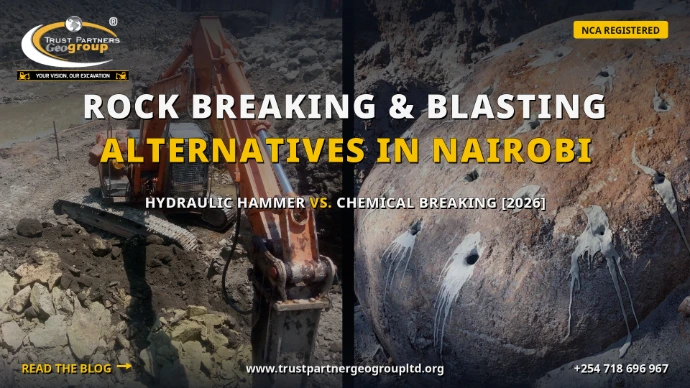
ROCK BREAKING AND BLASTING ALTERNATIVES IN NAIROBI: HYDRAULIC HAMMER VS. CHEMICAL BREAKING [2026]
WHEN EXPLOSIVES ARE NOT AN OPTION — CHOOSING THE RIGHT NON-EXPLOSIVE METHOD FOR URBAN ROCK EXCAVATION
WHY BLASTING IS NOT AN OPTION IN MOST URBAN NAIROBI PROJECTS
Controlled blasting is the fastest and most cost-effective method for large-volume hard rock excavation. But in Nairobi's urban core, it is rarely feasible:
- PROXIMITY RESTRICTIONS: Blasting is prohibited within 50–100 meters of hospitals, schools, heritage buildings, and sensitive infrastructure. In Upper Hill and the CBD, this eliminates most potential blast sites.
- PERMIT BURDEN: Requires blasting license from Chief Inspector of Explosives, county permits, NEMA environmental clearance, police notification (48 hours), and utility clearance from Kenya Power, Nairobi Water, and telecommunications providers. Total permit costs: KES 200,000–800,000.
- VIBRATION MONITORING: Mandatory third-party vibration monitoring within 100 meters of structures. Cost: KES 30,000–80,000. Liability for damage claims if vibrations exceed safe limits.
- NOISE AND DUST: Blasting generates 120–140 dB noise and significant dust — unacceptable in residential and commercial areas with strict environmental controls.
- SAFETY ZONES: Blast sites require 100–200 meter exclusion zones, evacuations, and road closures — impractical on congested urban streets.
- INSURANCE LIMITATIONS: Many urban construction insurance policies exclude blasting-related damage or require specialized coverage.
For these reasons, over 90% of urban rock excavation in Nairobi uses non-explosive methods. The choice is between hydraulic hammer breaking and chemical expansive agents — each with distinct advantages for different project types.
METHOD 1: HYDRAULIC HAMMER BREAKING
Hydraulic hammers (also called rock breakers or peckers) are percussion tools mounted on excavators that deliver repeated high-impact blows to fracture rock. They are the most common non-explosive rock breaking method in Nairobi and across Kenya.
HOW HYDRAULIC HAMMERS WORK
A hydraulic hammer uses pressurized oil from the excavator's hydraulic system to drive a piston that strikes a tool (chisel or moil point) at 300–1,500 blows per minute. The impact energy fractures rock through compressive and tensile stress. Hammers are classified by impact energy (joules) and carrier weight compatibility.
HYDRAULIC HAMMER SIZES AND APPLICATIONS
| HAMMER CLASS | CARRIER EXCAVATOR | IMPACT ENERGY | BEST FOR |
|---|---|---|---|
| Light (100–500 kg) | 3–8 ton mini excavator | 300–800 J | Small boulders, trenching, precision work |
| Medium (500–1,500 kg) | 10–20 ton excavator | 800–2,500 J | Medium rock, foundation excavation, road works |
| Heavy (1,500–3,500 kg) | 20–35 ton excavator | 2,500–6,000 J | Hard rock, bulk excavation, quarry work |
| Extra Heavy (3,500+ kg) | 35+ ton excavator | 6,000–15,000 J | Massive rock, mining, major infrastructure |
HYDRAULIC HAMMER HIRE RATES IN NAIROBI
| HAMMER SIZE | HOURLY (KES) | DAILY (KES) | MONTHLY (KES) |
|---|---|---|---|
| Light hammer + mini excavator | 4,500 – 6,500 | 35,000 – 50,000 | 700,000 – 1,000,000 |
| Medium hammer + 20-ton excavator | 7,000 – 10,000 | 55,000 – 80,000 | 1,100,000 – 1,600,000 |
| Heavy hammer + 30-ton excavator | 10,000 – 15,000 | 80,000 – 120,000 | 1,600,000 – 2,400,000 |
Rates include excavator, hammer attachment, operator, and basic fuel. Additional costs apply for transport, specialized tool steel, and overtime.
HYDRAULIC HAMMER ADVANTAGES
- IMMEDIATE RESULTS: Rock breaks on contact — no waiting period
- HIGH PRODUCTIVITY: 15–50 m³/day depending on rock hardness and hammer size
- NO PERMITS REQUIRED: No blasting licenses, police notification, or NEMA clearance
- PRECISION CONTROL: Operator can target specific areas and avoid utilities
- VERSATILITY: Same excavator can switch to digging, lifting, or grading
- PROVEN RELIABILITY: Established technology with widespread parts availability in Nairobi
HYDRAULIC HAMMER LIMITATIONS
- HIGH NOISE: 95–115 dB — requires hearing protection and may disturb neighbors
- VIBRATION: Ground vibrations can affect nearby structures (typically 2–10 mm/s)
- SLOW FOR HARD ROCK: Very hard rock (compressive strength > 100 MPa) reduces productivity dramatically
- EQUIPMENT WEAR: Tool steel, bushings, and diaphragms require frequent replacement (KES 50,000–200,000/month)
- OVERBREAK RISK: Uncontrolled fracturing can damage adjacent foundations or utilities
- DUST GENERATION: Significant dust requires water suppression
METHOD 2: CHEMICAL EXPANSIVE BREAKING (SOUNDLESS CHEMICAL DEMOLITION AGENTS)
Chemical expansive agents (also called soundless chemical demolition agents or SCDAs) are non-explosive powders that, when mixed with water and poured into drilled holes, expand over several hours generating 18,000 psi (125 MPa) of pressure. This expansive force fractures rock in tension without noise, vibration, or dust.
HOW CHEMICAL BREAKING WORKS
- DRILL HOLES: Drill a pattern of holes (typically 30–50mm diameter, 1–3m deep) into the rock face
- MIX AGENT: Mix the expansive powder with clean water to a slurry consistency
- POUR INTO HOLES: Fill drilled holes with the slurry using a funnel or pump
- WAIT: Expansion begins within 2–4 hours; full cracking occurs in 12–24 hours
- REMOVE FRAGMENTS: Broken rock is removed with excavator or manual labor
CHEMICAL AGENT TYPES AND COSTS
| PRODUCT TYPE | REACTION TIME | COST PER KG (KES) | BEST FOR |
|---|---|---|---|
| Standard (Calcium Oxide based) | 12–24 hours | 800 – 1,200 | General rock breaking, warm climates |
| Fast-Setting | 2–8 hours | 1,200 – 1,800 | Time-sensitive projects, cold conditions |
| Slow-Setting | 24–48 hours | 800 – 1,000 | Hot climates, large volumes, controlled timing |
| High-Strength (18,000+ psi) | 12–24 hours | 1,500 – 2,500 | Very hard rock, reinforced concrete |
CHEMICAL BREAKING COST PER M³
| COST COMPONENT | RATE (KES) | NOTES |
|---|---|---|
| Chemical agent | 2,500 – 4,500/m³ | Depends on hole pattern and rock type |
| Drilling labor | 500 – 800/m³ | Manual or mechanized drilling |
| Drill bit wear | 200 – 400/m³ | Hard rock increases bit consumption |
| Water and mixing | 100 – 200/m³ | Clean water required |
| Removal labor/equipment | 300 – 600/m³ | After cracking |
| TOTAL TYPICAL COST | 3,600 – 6,500/m³ | Comparable to hydraulic hammer for hard rock |
CHEMICAL BREAKING ADVANTAGES
- ZERO NOISE: Completely silent operation — no decibel readings
- ZERO VIBRATION: No ground vibration — safe for adjacent structures, hospitals, schools
- ZERO DUST: Wet process eliminates dust generation
- NO PERMITS: No blasting licenses, police notification, or NEMA clearance required
- NO FLYROCK: No projectile debris — safe for congested sites
- PRECISION: Crack follows drilled hole pattern exactly — controlled demolition
- NO SPECIAL INSURANCE: Standard construction liability coverage applies
- 24-HOUR OPERATION: Agent works overnight — no working hours restrictions
CHEMICAL BREAKING LIMITATIONS
- SLOW: 12–48 hours reaction time vs. immediate results with hammers
- WEATHER DEPENDENT: Rain can dilute agent; extreme heat accelerates reaction unpredictably
- DRILLING INTENSIVE: Requires extensive hole drilling (1 hole per 0.3–0.5 m² of face)
- NOT FOR REINFORCED CONCRETE: Steel reinforcement prevents crack propagation
- LIMITED DEPTH: Effective to 3–5 meters; deeper holes require specialized equipment
- STORAGE REQUIREMENTS: Chemicals must be kept dry; humidity reduces shelf life
- SKILL REQUIRED: Proper hole pattern, mixing ratio, and timing are critical for success
HEAD-TO-HEAD COMPARISON: HYDRAULIC HAMMER VS. CHEMICAL BREAKING
| FACTOR | HYDRAULIC HAMMER | CHEMICAL BREAKING | WINNER |
|---|---|---|---|
| Speed | Immediate — 15–50 m³/day | 12–48 hours delay — 10–30 m³/day effective | Hydraulic Hammer |
| Noise | 95–115 dB (loud) | 0 dB (silent) | Chemical Breaking |
| Vibration | 2–10 mm/s (moderate) | 0 mm/s (none) | Chemical Breaking |
| Dust | High (requires suppression) | None (wet process) | Chemical Breaking |
| Permits | None required | None required | Tie |
| Cost per m³ (medium rock) | KES 1,500 – 2,500 | KES 3,600 – 5,000 | Hydraulic Hammer |
| Cost per m³ (very hard rock) | KES 2,500 – 4,500 | KES 4,500 – 6,500 | Tie |
| Precision | Moderate (operator dependent) | High (follows drill pattern) | Chemical Breaking |
| Adjacent Structure Safety | Moderate risk | Zero risk | Chemical Breaking |
| Weather Sensitivity | Low (works in rain) | High (rain dilutes, heat accelerates) | Hydraulic Hammer |
| Equipment Wear | High (tool steel, bushings) | Low (drill bits only) | Chemical Breaking |
| Operator Skill | High (experienced operator needed) | Medium (proper drilling pattern) | Chemical Breaking |
| Reinforced Concrete | Effective (breaks concrete and steel) | Not effective (steel stops cracks) | Hydraulic Hammer |
| Depth Capability | Unlimited (with large excavator) | Limited to 3–5 meters | Hydraulic Hammer |
| Night/Restricted Hours | Limited (noise restrictions) | Unlimited (silent operation) | Chemical Breaking |
WHEN TO USE EACH METHOD: PROJECT-SPECIFIC GUIDANCE
CHOOSE HYDRAULIC HAMMER WHEN:
- Speed is critical — project timeline does not allow 24–48 hour waiting periods
- Rock volume is large (1,000+ m³) and productivity matters more than precision
- Rock is moderately hard (compressive strength 50–100 MPa)
- Site has adequate setback from sensitive structures (20+ meters)
- Working hours are not restricted (industrial zones, daytime only)
- Reinforced concrete or mixed materials are present
- Budget is tight and cost per m³ is the primary driver
- Weather is unpredictable (rainy season)
CHOOSE CHEMICAL BREAKING WHEN:
- Working near sensitive structures — hospitals, schools, heritage buildings, residential
- Noise restrictions apply — residential areas, night work, hospitals
- Vibration must be zero — adjacent foundations, sensitive equipment, archaeological sites
- Precision is critical — controlled crack lines, architectural stone, monument work
- Permits for blasting are impractical or impossible
- Insurance excludes blasting-related damage
- Working in confined spaces where flyrock would be dangerous
- Environmental sensitivity — no dust, no toxic fumes, no water contamination
- Rock is natural stone (not reinforced concrete)
NAIROBI PROJECT SCENARIOS
| PROJECT | RECOMMENDED METHOD | WHY |
|---|---|---|
| Upper Hill commercial basement (near hospital) | Chemical Breaking | Zero vibration, zero noise, hospital proximity |
| Westlands residential excavation (near neighbors) | Chemical Breaking | Noise restrictions, residential complaints |
| Kilimani road widening (utility congestion) | Hydraulic Hammer | Speed needed, utilities require precision control |
| Industrial park, Athi River | Hydraulic Hammer | Large volume, no sensitive structures, cost-driven |
| CBD foundation (adjacent building 2m away) | Chemical Breaking | Zero vibration risk, precision essential |
| Quarry expansion, Kajiado | Hydraulic Hammer | Large volume, remote location, productivity priority |
OTHER NON-EXPLOSIVE METHODS FOR NAIROBI ROCK BREAKING
Beyond hydraulic hammers and chemical agents, several specialized methods serve niche applications in Nairobi's construction market:
HYDRAULIC SPLITTING (ROCK AND CONCRETE SPLITTERS)
Mechanical wedges inserted into drilled holes and expanded by hydraulic pressure to 400+ tons of force. Produces controlled cracks with minimal noise and vibration. Best for: Large boulders, foundation blocks, and precision demolition where chemical agents are too slow.
Cost: KES 2,500–4,000/m³ | Speed: Moderate | Noise: Low | Vibration: Minimal
DIAMOND WIRE SAWING
Continuous loop of diamond-impregnated wire driven by hydraulic motor. Cuts through reinforced concrete and hard rock with precision. Best for: Large structural cuts, reinforced concrete demolition, and ultra-sensitive environments.
Cost: KES 5,000–10,000/m³ | Speed: Very slow | Noise: Low | Vibration: None
EXPANDING GROUT (EXPANSIVE MORTAR)
Similar to chemical agents but with higher expansion force (18,000+ psi). Mixed with water and poured into holes. Best for: Very hard rock, granite, and situations requiring maximum expansive force.
Cost: KES 3,000–5,500/m³ | Speed: 12–24 hours | Noise: None | Vibration: None
CONTROLLED FOAM INJECTION (CFI)
High-pressure foam injected into drilled holes to fracture rock through controlled pressure. Emerging technology with limited availability in Kenya. Best for: Specialized mining and tunneling applications.
Cost: KES 4,000–7,000/m³ | Speed: Moderate | Noise: Low | Vibration: Minimal
REGULATORY COMPLIANCE FOR NON-EXPLOSIVE ROCK BREAKING IN NAIROBI
Even without explosives, rock breaking in Nairobi requires compliance with multiple regulations:
- NCA REGISTRATION: All contractors must be NCA-registered. Specialized demolition may require additional certification.
- COUNTY EXCAVATION PERMIT: Required from Nairobi City County for depths exceeding 3 meters.
- NEMA ENVIRONMENTAL CLEARANCE: Required for large-scale rock excavation or projects near sensitive areas.
- NOISE REGULATIONS: Nairobi County noise bylaws limit construction noise to 65 dB during daytime and 45 dB at night in residential areas. Hydraulic hammers often exceed these limits.
- VIBRATION LIMITS: BS 5228 recommends maximum 10 mm/s peak particle velocity for structures. Chemical breaking achieves 0 mm/s.
- UTILITY CLEARANCE: Kenya Power, Nairobi Water, and telecommunications providers must clear excavation zones before work commences.
- OCCUPATIONAL SAFETY: OSHA standards apply — hearing protection for hammer operators, dust masks, and safety zones.
COST COMPARISON: REAL NAIROBI PROJECT EXAMPLES
EXAMPLE 1: UPPER HILL BASEMENT (100 M³ HARD ROCK)
Constraints: Adjacent hospital 30m away, noise restrictions, vibration-sensitive
Hydraulic Hammer Option:
- Excavation: 100 m³ × KES 2,500 = KES 250,000
- Vibration monitoring: KES 50,000
- Noise mitigation (enclosures): KES 80,000
- TOTAL: KES 380,000
Chemical Breaking Option:
- Chemical agent: 100 m³ × KES 4,500 = KES 450,000
- Drilling: KES 80,000
- No permits/monitoring needed
- TOTAL: KES 530,000
Verdict: Hydraulic hammer is cheaper but requires expensive mitigation. Chemical breaking is simpler and safer for this sensitive site.
EXAMPLE 2: ATHI RIVER INDUSTRIAL SITE (500 M³ MEDIUM ROCK)
Constraints: Remote location, no sensitive structures, tight deadline
Hydraulic Hammer Option:
- Excavation: 500 m³ × KES 1,800 = KES 900,000
- No additional permits or monitoring
- TOTAL: KES 900,000
Chemical Breaking Option:
- Chemical agent: 500 m³ × KES 4,000 = KES 2,000,000
- Drilling: KES 300,000
- TOTAL: KES 2,300,000
Verdict: Hydraulic hammer is 60% cheaper and 3x faster. Clear winner for this industrial site.
FREQUENTLY ASKED QUESTIONS: NON-EXPLOSIVE ROCK BREAKING IN NAIROBI
Is chemical breaking legal in Kenya?
Yes. Chemical expansive agents are classified as non-explosive demolition materials and do not require blasting licenses, police notification, or explosives permits. They are regulated as construction chemicals under standard occupational safety rules.
How do I choose between hydraulic hammer and chemical breaking?
Use the decision framework in this guide: hydraulic hammers for speed, large volumes, and cost-sensitive projects; chemical breaking for noise-sensitive, vibration-sensitive, and precision projects. For most urban Nairobi sites near buildings, chemical breaking is the safer choice despite higher cost.
Can chemical agents damage underground utilities?
Chemical agents expand within drilled holes and do not migrate through soil. However, drilling must avoid utility lines. Always obtain utility clearance maps before drilling. The expansive force is localized to the hole pattern and does not transmit through ground like blasting vibrations.
What happens if it rains after pouring chemical agent?
Rain can dilute the agent and reduce effectiveness. Cover drilled holes with plastic sheeting if rain is forecast. Some fast-setting agents are designed to begin reaction before rain can penetrate. In Kenya's rainy seasons (March–May, October–December), schedule chemical breaking during dry periods or use protective enclosures.
How loud is a hydraulic hammer compared to other construction noise?
Hydraulic hammers produce 95–115 dB at the operator position — comparable to a chainsaw or jackhammer. At 50 meters, noise drops to 70–80 dB. Nairobi County noise bylaws limit daytime construction to 75 dB in commercial areas and 65 dB in residential areas. Hammers often exceed residential limits, requiring noise barriers or restricted hours.
Can I use both methods on the same project?
Yes — hybrid approaches are common. Use chemical breaking for sensitive areas near structures, then switch to hydraulic hammers for bulk excavation in open areas. This optimizes cost and safety. Trust Partners Geo-Group deploys both methods on complex urban projects.
What is the maximum depth for chemical breaking?
Effective depth is 3–5 meters for standard applications. Deeper holes require specialized long-reach drills and slower-setting agents to prevent premature reaction. For depths exceeding 5 meters, hydraulic hammers or staged chemical breaking (multiple lifts) are more practical.
Do chemical agents work on all rock types?
Chemical agents work best on crystalline rocks (granite, basalt, gneiss) and sedimentary rocks with low clay content. They are less effective on highly porous rocks, weathered soils, and rocks with high clay content. A test hole should always be drilled and evaluated before full-scale application.
THE BOTTOM LINE: MATCH THE METHOD TO THE SITE
There is no single "best" non-explosive rock breaking method. The right choice depends on your project's specific constraints — proximity to sensitive structures, noise restrictions, timeline, budget, and rock characteristics.
In Nairobi's urban environment, chemical breaking dominates near sensitive buildings while hydraulic hammers excel in industrial and remote sites. The most successful contractors master both methods and deploy them strategically across the same project.
At Trust Partners Geo-Group Ltd, we provide both hydraulic hammer breaking and chemical expansive breaking services across Nairobi and Kenya. Our certified operators, specialized equipment, and experienced engineers assess each site individually and recommend the optimal method — or combination of methods — for safe, efficient, and cost-effective rock excavation.
— TRUST PARTNERS GEO-GROUP LTD
NEED ROCK BREAKING IN NAIROBI? WE HAVE BOTH METHODS.
Trust Partners Geo-Group provides hydraulic hammer breaking and chemical expansive breaking for urban rock excavation across Nairobi. Contact us for a free site assessment, method recommendation, and detailed quotation tailored to your project's constraints.
CALL +254 718 68 69 67 EMAIL US VISIT OUR WEBSITE
NAIROBI HQ | SERVING MOMBASA, KISUMU, NAKURU, ELDORET, THIKA & NATIONWIDE
MON - SAT: 8:00 AM - 6:00 PM | 24/7 EMERGENCY SUPPORT
RELATED RESOURCES
- ROCK EXCAVATION COST IN KENYA 2026 — Complete price guide for hard rock, medium rock, and blasting
- CONTROLLED DEMOLITION SERVICES — Safe, compliant structural demolition
- HEAVY EQUIPMENT FOR HIRE — Excavators with hydraulic hammers, bulldozers, dump trucks
- BASEMENT EXCAVATION — From 4m to 30m+ deep bulk basement foundations
- NCA CONTRACTOR REGISTRATION — How to register legally for demolition and excavation tenders
TRUST PARTNERS GEO-GROUP LTD | YOUR VISION, OUR EXCAVATION
WEBSITE: WWW.TRUSTPARTNERGEOGROUPLTD.ORG | EMAIL: INFO@TRUSTPARTNERGEOGROUPLTD.ORG | PHONE: +254 718 68 69 67
FOLLOW US: FACEBOOK | TIKTOK | INSTAGRAM | YOUTUBE | LINKEDIN
© 2026 TRUST PARTNERS GEO-GROUP LTD. ALL RIGHTS RESERVED.
ROCK BREAKING AND BLASTING ALTERNATIVES IN NAIROBI: HYDRAULIC HAMMER VS. CHEMICAL BREAKING [2026]
WHEN EXPLOSIVES ARE NOT AN OPTION — CHOOSING THE RIGHT NON-EXPLOSIVE METHOD FOR URBAN ROCK EXCAVATION
WHY BLASTING IS NOT AN OPTION IN MOST URBAN NAIROBI PROJECTS
Controlled blasting is the fastest and most cost-effective method for large-volume hard rock excavation. But in Nairobi's urban core, it is rarely feasible:
- PROXIMITY RESTRICTIONS: Blasting is prohibited within 50–100 meters of hospitals, schools, heritage buildings, and sensitive infrastructure. In Upper Hill and the CBD, this eliminates most potential blast sites.
- PERMIT BURDEN: Requires blasting license from Chief Inspector of Explosives, county permits, NEMA environmental clearance, police notification (48 hours), and utility clearance from Kenya Power, Nairobi Water, and telecommunications providers. Total permit costs: KES 200,000–800,000.
- VIBRATION MONITORING: Mandatory third-party vibration monitoring within 100 meters of structures. Cost: KES 30,000–80,000. Liability for damage claims if vibrations exceed safe limits.
- NOISE AND DUST: Blasting generates 120–140 dB noise and significant dust — unacceptable in residential and commercial areas with strict environmental controls.
- SAFETY ZONES: Blast sites require 100–200 meter exclusion zones, evacuations, and road closures — impractical on congested urban streets.
- INSURANCE LIMITATIONS: Many urban construction insurance policies exclude blasting-related damage or require specialized coverage.
For these reasons, over 90% of urban rock excavation in Nairobi uses non-explosive methods. The choice is between hydraulic hammer breaking and chemical expansive agents — each with distinct advantages for different project types.
METHOD 1: HYDRAULIC HAMMER BREAKING
Hydraulic hammers (also called rock breakers or peckers) are percussion tools mounted on excavators that deliver repeated high-impact blows to fracture rock. They are the most common non-explosive rock breaking method in Nairobi and across Kenya.
HOW HYDRAULIC HAMMERS WORK
A hydraulic hammer uses pressurized oil from the excavator's hydraulic system to drive a piston that strikes a tool (chisel or moil point) at 300–1,500 blows per minute. The impact energy fractures rock through compressive and tensile stress. Hammers are classified by impact energy (joules) and carrier weight compatibility.
HYDRAULIC HAMMER SIZES AND APPLICATIONS
| HAMMER CLASS | CARRIER EXCAVATOR | IMPACT ENERGY | BEST FOR |
|---|---|---|---|
| Light (100–500 kg) | 3–8 ton mini excavator | 300–800 J | Small boulders, trenching, precision work |
| Medium (500–1,500 kg) | 10–20 ton excavator | 800–2,500 J | Medium rock, foundation excavation, road works |
| Heavy (1,500–3,500 kg) | 20–35 ton excavator | 2,500–6,000 J | Hard rock, bulk excavation, quarry work |
| Extra Heavy (3,500+ kg) | 35+ ton excavator | 6,000–15,000 J | Massive rock, mining, major infrastructure |
HYDRAULIC HAMMER HIRE RATES IN NAIROBI
| HAMMER SIZE | HOURLY (KES) | DAILY (KES) | MONTHLY (KES) |
|---|---|---|---|
| Light hammer + mini excavator | 4,500 – 6,500 | 35,000 – 50,000 | 700,000 – 1,000,000 |
| Medium hammer + 20-ton excavator | 7,000 – 10,000 | 55,000 – 80,000 | 1,100,000 – 1,600,000 |
| Heavy hammer + 30-ton excavator | 10,000 – 15,000 | 80,000 – 120,000 | 1,600,000 – 2,400,000 |
Rates include excavator, hammer attachment, operator, and basic fuel. Additional costs apply for transport, specialized tool steel, and overtime.
HYDRAULIC HAMMER ADVANTAGES
- IMMEDIATE RESULTS: Rock breaks on contact — no waiting period
- HIGH PRODUCTIVITY: 15–50 m³/day depending on rock hardness and hammer size
- NO PERMITS REQUIRED: No blasting licenses, police notification, or NEMA clearance
- PRECISION CONTROL: Operator can target specific areas and avoid utilities
- VERSATILITY: Same excavator can switch to digging, lifting, or grading
- PROVEN RELIABILITY: Established technology with widespread parts availability in Nairobi
HYDRAULIC HAMMER LIMITATIONS
- HIGH NOISE: 95–115 dB — requires hearing protection and may disturb neighbors
- VIBRATION: Ground vibrations can affect nearby structures (typically 2–10 mm/s)
- SLOW FOR HARD ROCK: Very hard rock (compressive strength > 100 MPa) reduces productivity dramatically
- EQUIPMENT WEAR: Tool steel, bushings, and diaphragms require frequent replacement (KES 50,000–200,000/month)
- OVERBREAK RISK: Uncontrolled fracturing can damage adjacent foundations or utilities
- DUST GENERATION: Significant dust requires water suppression
METHOD 2: CHEMICAL EXPANSIVE BREAKING (SOUNDLESS CHEMICAL DEMOLITION AGENTS)
Chemical expansive agents (also called soundless chemical demolition agents or SCDAs) are non-explosive powders that, when mixed with water and poured into drilled holes, expand over several hours generating 18,000 psi (125 MPa) of pressure. This expansive force fractures rock in tension without noise, vibration, or dust.
HOW CHEMICAL BREAKING WORKS
- DRILL HOLES: Drill a pattern of holes (typically 30–50mm diameter, 1–3m deep) into the rock face
- MIX AGENT: Mix the expansive powder with clean water to a slurry consistency
- POUR INTO HOLES: Fill drilled holes with the slurry using a funnel or pump
- WAIT: Expansion begins within 2–4 hours; full cracking occurs in 12–24 hours
- REMOVE FRAGMENTS: Broken rock is removed with excavator or manual labor
CHEMICAL AGENT TYPES AND COSTS
| PRODUCT TYPE | REACTION TIME | COST PER KG (KES) | BEST FOR |
|---|---|---|---|
| Standard (Calcium Oxide based) | 12–24 hours | 800 – 1,200 | General rock breaking, warm climates |
| Fast-Setting | 2–8 hours | 1,200 – 1,800 | Time-sensitive projects, cold conditions |
| Slow-Setting | 24–48 hours | 800 – 1,000 | Hot climates, large volumes, controlled timing |
| High-Strength (18,000+ psi) | 12–24 hours | 1,500 – 2,500 | Very hard rock, reinforced concrete |
CHEMICAL BREAKING COST PER M³
| COST COMPONENT | RATE (KES) | NOTES |
|---|---|---|
| Chemical agent | 2,500 – 4,500/m³ | Depends on hole pattern and rock type |
| Drilling labor | 500 – 800/m³ | Manual or mechanized drilling |
| Drill bit wear | 200 – 400/m³ | Hard rock increases bit consumption |
| Water and mixing | 100 – 200/m³ | Clean water required |
| Removal labor/equipment | 300 – 600/m³ | After cracking |
| TOTAL TYPICAL COST | 3,600 – 6,500/m³ | Comparable to hydraulic hammer for hard rock |
CHEMICAL BREAKING ADVANTAGES
- ZERO NOISE: Completely silent operation — no decibel readings
- ZERO VIBRATION: No ground vibration — safe for adjacent structures, hospitals, schools
- ZERO DUST: Wet process eliminates dust generation
- NO PERMITS: No blasting licenses, police notification, or NEMA clearance required
- NO FLYROCK: No projectile debris — safe for congested sites
- PRECISION: Crack follows drilled hole pattern exactly — controlled demolition
- NO SPECIAL INSURANCE: Standard construction liability coverage applies
- 24-HOUR OPERATION: Agent works overnight — no working hours restrictions
CHEMICAL BREAKING LIMITATIONS
- SLOW: 12–48 hours reaction time vs. immediate results with hammers
- WEATHER DEPENDENT: Rain can dilute agent; extreme heat accelerates reaction unpredictably
- DRILLING INTENSIVE: Requires extensive hole drilling (1 hole per 0.3–0.5 m² of face)
- NOT FOR REINFORCED CONCRETE: Steel reinforcement prevents crack propagation
- LIMITED DEPTH: Effective to 3–5 meters; deeper holes require specialized equipment
- STORAGE REQUIREMENTS: Chemicals must be kept dry; humidity reduces shelf life
- SKILL REQUIRED: Proper hole pattern, mixing ratio, and timing are critical for success
HEAD-TO-HEAD COMPARISON: HYDRAULIC HAMMER VS. CHEMICAL BREAKING
| FACTOR | HYDRAULIC HAMMER | CHEMICAL BREAKING | WINNER |
|---|---|---|---|
| Speed | Immediate — 15–50 m³/day | 12–48 hours delay — 10–30 m³/day effective | Hydraulic Hammer |
| Noise | 95–115 dB (loud) | 0 dB (silent) | Chemical Breaking |
| Vibration | 2–10 mm/s (moderate) | 0 mm/s (none) | Chemical Breaking |
| Dust | High (requires suppression) | None (wet process) | Chemical Breaking |
| Permits | None required | None required | Tie |
| Cost per m³ (medium rock) | KES 1,500 – 2,500 | KES 3,600 – 5,000 | Hydraulic Hammer |
| Cost per m³ (very hard rock) | KES 2,500 – 4,500 | KES 4,500 – 6,500 | Tie |
| Precision | Moderate (operator dependent) | High (follows drill pattern) | Chemical Breaking |
| Adjacent Structure Safety | Moderate risk | Zero risk | Chemical Breaking |
| Weather Sensitivity | Low (works in rain) | High (rain dilutes, heat accelerates) | Hydraulic Hammer |
| Equipment Wear | High (tool steel, bushings) | Low (drill bits only) | Chemical Breaking |
| Operator Skill | High (experienced operator needed) | Medium (proper drilling pattern) | Chemical Breaking |
| Reinforced Concrete | Effective (breaks concrete and steel) | Not effective (steel stops cracks) | Hydraulic Hammer |
| Depth Capability | Unlimited (with large excavator) | Limited to 3–5 meters | Hydraulic Hammer |
| Night/Restricted Hours | Limited (noise restrictions) | Unlimited (silent operation) | Chemical Breaking |
WHEN TO USE EACH METHOD: PROJECT-SPECIFIC GUIDANCE
CHOOSE HYDRAULIC HAMMER WHEN:
- Speed is critical — project timeline does not allow 24–48 hour waiting periods
- Rock volume is large (1,000+ m³) and productivity matters more than precision
- Rock is moderately hard (compressive strength 50–100 MPa)
- Site has adequate setback from sensitive structures (20+ meters)
- Working hours are not restricted (industrial zones, daytime only)
- Reinforced concrete or mixed materials are present
- Budget is tight and cost per m³ is the primary driver
- Weather is unpredictable (rainy season)
CHOOSE CHEMICAL BREAKING WHEN:
- Working near sensitive structures — hospitals, schools, heritage buildings, residential
- Noise restrictions apply — residential areas, night work, hospitals
- Vibration must be zero — adjacent foundations, sensitive equipment, archaeological sites
- Precision is critical — controlled crack lines, architectural stone, monument work
- Permits for blasting are impractical or impossible
- Insurance excludes blasting-related damage
- Working in confined spaces where flyrock would be dangerous
- Environmental sensitivity — no dust, no toxic fumes, no water contamination
- Rock is natural stone (not reinforced concrete)
NAIROBI PROJECT SCENARIOS
| PROJECT | RECOMMENDED METHOD | WHY |
|---|---|---|
| Upper Hill commercial basement (near hospital) | Chemical Breaking | Zero vibration, zero noise, hospital proximity |
| Westlands residential excavation (near neighbors) | Chemical Breaking | Noise restrictions, residential complaints |
| Kilimani road widening (utility congestion) | Hydraulic Hammer | Speed needed, utilities require precision control |
| Industrial park, Athi River | Hydraulic Hammer | Large volume, no sensitive structures, cost-driven |
| CBD foundation (adjacent building 2m away) | Chemical Breaking | Zero vibration risk, precision essential |
| Quarry expansion, Kajiado | Hydraulic Hammer | Large volume, remote location, productivity priority |
OTHER NON-EXPLOSIVE METHODS FOR NAIROBI ROCK BREAKING
Beyond hydraulic hammers and chemical agents, several specialized methods serve niche applications in Nairobi's construction market:
HYDRAULIC SPLITTING (ROCK AND CONCRETE SPLITTERS)
Mechanical wedges inserted into drilled holes and expanded by hydraulic pressure to 400+ tons of force. Produces controlled cracks with minimal noise and vibration. Best for: Large boulders, foundation blocks, and precision demolition where chemical agents are too slow.
Cost: KES 2,500–4,000/m³ | Speed: Moderate | Noise: Low | Vibration: Minimal
DIAMOND WIRE SAWING
Continuous loop of diamond-impregnated wire driven by hydraulic motor. Cuts through reinforced concrete and hard rock with precision. Best for: Large structural cuts, reinforced concrete demolition, and ultra-sensitive environments.
Cost: KES 5,000–10,000/m³ | Speed: Very slow | Noise: Low | Vibration: None
EXPANDING GROUT (EXPANSIVE MORTAR)
Similar to chemical agents but with higher expansion force (18,000+ psi). Mixed with water and poured into holes. Best for: Very hard rock, granite, and situations requiring maximum expansive force.
Cost: KES 3,000–5,500/m³ | Speed: 12–24 hours | Noise: None | Vibration: None
CONTROLLED FOAM INJECTION (CFI)
High-pressure foam injected into drilled holes to fracture rock through controlled pressure. Emerging technology with limited availability in Kenya. Best for: Specialized mining and tunneling applications.
Cost: KES 4,000–7,000/m³ | Speed: Moderate | Noise: Low | Vibration: Minimal
REGULATORY COMPLIANCE FOR NON-EXPLOSIVE ROCK BREAKING IN NAIROBI
Even without explosives, rock breaking in Nairobi requires compliance with multiple regulations:
- NCA REGISTRATION: All contractors must be NCA-registered. Specialized demolition may require additional certification.
- COUNTY EXCAVATION PERMIT: Required from Nairobi City County for depths exceeding 3 meters.
- NEMA ENVIRONMENTAL CLEARANCE: Required for large-scale rock excavation or projects near sensitive areas.
- NOISE REGULATIONS: Nairobi County noise bylaws limit construction noise to 65 dB during daytime and 45 dB at night in residential areas. Hydraulic hammers often exceed these limits.
- VIBRATION LIMITS: BS 5228 recommends maximum 10 mm/s peak particle velocity for structures. Chemical breaking achieves 0 mm/s.
- UTILITY CLEARANCE: Kenya Power, Nairobi Water, and telecommunications providers must clear excavation zones before work commences.
- OCCUPATIONAL SAFETY: OSHA standards apply — hearing protection for hammer operators, dust masks, and safety zones.
COST COMPARISON: REAL NAIROBI PROJECT EXAMPLES
EXAMPLE 1: UPPER HILL BASEMENT (100 M³ HARD ROCK)
Constraints: Adjacent hospital 30m away, noise restrictions, vibration-sensitive
Hydraulic Hammer Option:
- Excavation: 100 m³ × KES 2,500 = KES 250,000
- Vibration monitoring: KES 50,000
- Noise mitigation (enclosures): KES 80,000
- TOTAL: KES 380,000
Chemical Breaking Option:
- Chemical agent: 100 m³ × KES 4,500 = KES 450,000
- Drilling: KES 80,000
- No permits/monitoring needed
- TOTAL: KES 530,000
Verdict: Hydraulic hammer is cheaper but requires expensive mitigation. Chemical breaking is simpler and safer for this sensitive site.
EXAMPLE 2: ATHI RIVER INDUSTRIAL SITE (500 M³ MEDIUM ROCK)
Constraints: Remote location, no sensitive structures, tight deadline
Hydraulic Hammer Option:
- Excavation: 500 m³ × KES 1,800 = KES 900,000
- No additional permits or monitoring
- TOTAL: KES 900,000
Chemical Breaking Option:
- Chemical agent: 500 m³ × KES 4,000 = KES 2,000,000
- Drilling: KES 300,000
- TOTAL: KES 2,300,000
Verdict: Hydraulic hammer is 60% cheaper and 3x faster. Clear winner for this industrial site.
FREQUENTLY ASKED QUESTIONS: NON-EXPLOSIVE ROCK BREAKING IN NAIROBI
Is chemical breaking legal in Kenya?
Yes. Chemical expansive agents are classified as non-explosive demolition materials and do not require blasting licenses, police notification, or explosives permits. They are regulated as construction chemicals under standard occupational safety rules.
How do I choose between hydraulic hammer and chemical breaking?
Use the decision framework in this guide: hydraulic hammers for speed, large volumes, and cost-sensitive projects; chemical breaking for noise-sensitive, vibration-sensitive, and precision projects. For most urban Nairobi sites near buildings, chemical breaking is the safer choice despite higher cost.
Can chemical agents damage underground utilities?
Chemical agents expand within drilled holes and do not migrate through soil. However, drilling must avoid utility lines. Always obtain utility clearance maps before drilling. The expansive force is localized to the hole pattern and does not transmit through ground like blasting vibrations.
What happens if it rains after pouring chemical agent?
Rain can dilute the agent and reduce effectiveness. Cover drilled holes with plastic sheeting if rain is forecast. Some fast-setting agents are designed to begin reaction before rain can penetrate. In Kenya's rainy seasons (March–May, October–December), schedule chemical breaking during dry periods or use protective enclosures.
How loud is a hydraulic hammer compared to other construction noise?
Hydraulic hammers produce 95–115 dB at the operator position — comparable to a chainsaw or jackhammer. At 50 meters, noise drops to 70–80 dB. Nairobi County noise bylaws limit daytime construction to 75 dB in commercial areas and 65 dB in residential areas. Hammers often exceed residential limits, requiring noise barriers or restricted hours.
Can I use both methods on the same project?
Yes — hybrid approaches are common. Use chemical breaking for sensitive areas near structures, then switch to hydraulic hammers for bulk excavation in open areas. This optimizes cost and safety. Trust Partners Geo-Group deploys both methods on complex urban projects.
What is the maximum depth for chemical breaking?
Effective depth is 3–5 meters for standard applications. Deeper holes require specialized long-reach drills and slower-setting agents to prevent premature reaction. For depths exceeding 5 meters, hydraulic hammers or staged chemical breaking (multiple lifts) are more practical.
Do chemical agents work on all rock types?
Chemical agents work best on crystalline rocks (granite, basalt, gneiss) and sedimentary rocks with low clay content. They are less effective on highly porous rocks, weathered soils, and rocks with high clay content. A test hole should always be drilled and evaluated before full-scale application.
THE BOTTOM LINE: MATCH THE METHOD TO THE SITE
There is no single "best" non-explosive rock breaking method. The right choice depends on your project's specific constraints — proximity to sensitive structures, noise restrictions, timeline, budget, and rock characteristics.
In Nairobi's urban environment, chemical breaking dominates near sensitive buildings while hydraulic hammers excel in industrial and remote sites. The most successful contractors master both methods and deploy them strategically across the same project.
At Trust Partners Geo-Group Ltd, we provide both hydraulic hammer breaking and chemical expansive breaking services across Nairobi and Kenya. Our certified operators, specialized equipment, and experienced engineers assess each site individually and recommend the optimal method — or combination of methods — for safe, efficient, and cost-effective rock excavation.
— TRUST PARTNERS GEO-GROUP LTD
NEED ROCK BREAKING IN NAIROBI? WE HAVE BOTH METHODS.
Trust Partners Geo-Group provides hydraulic hammer breaking and chemical expansive breaking for urban rock excavation across Nairobi. Contact us for a free site assessment, method recommendation, and detailed quotation tailored to your project's constraints.
CALL +254 718 68 69 67 EMAIL US VISIT OUR WEBSITE
NAIROBI HQ | SERVING MOMBASA, KISUMU, NAKURU, ELDORET, THIKA & NATIONWIDE
MON - SAT: 8:00 AM - 6:00 PM | 24/7 EMERGENCY SUPPORT
RELATED RESOURCES
- ROCK EXCAVATION COST IN KENYA 2026 — Complete price guide for hard rock, medium rock, and blasting
- CONTROLLED DEMOLITION SERVICES — Safe, compliant structural demolition
- HEAVY EQUIPMENT FOR HIRE — Excavators with hydraulic hammers, bulldozers, dump trucks
- BASEMENT EXCAVATION — From 4m to 30m+ deep bulk basement foundations
- NCA CONTRACTOR REGISTRATION — How to register legally for demolition and excavation tenders
TRUST PARTNERS GEO-GROUP LTD | YOUR VISION, OUR EXCAVATION
WEBSITE: WWW.TRUSTPARTNERGEOGROUPLTD.ORG | EMAIL: INFO@TRUSTPARTNERGEOGROUPLTD.ORG | PHONE: +254 718 68 69 67
FOLLOW US: FACEBOOK | TIKTOK | INSTAGRAM | YOUTUBE | LINKEDIN
© 2026 TRUST PARTNERS GEO-GROUP LTD. ALL RIGHTS RESERVED.