
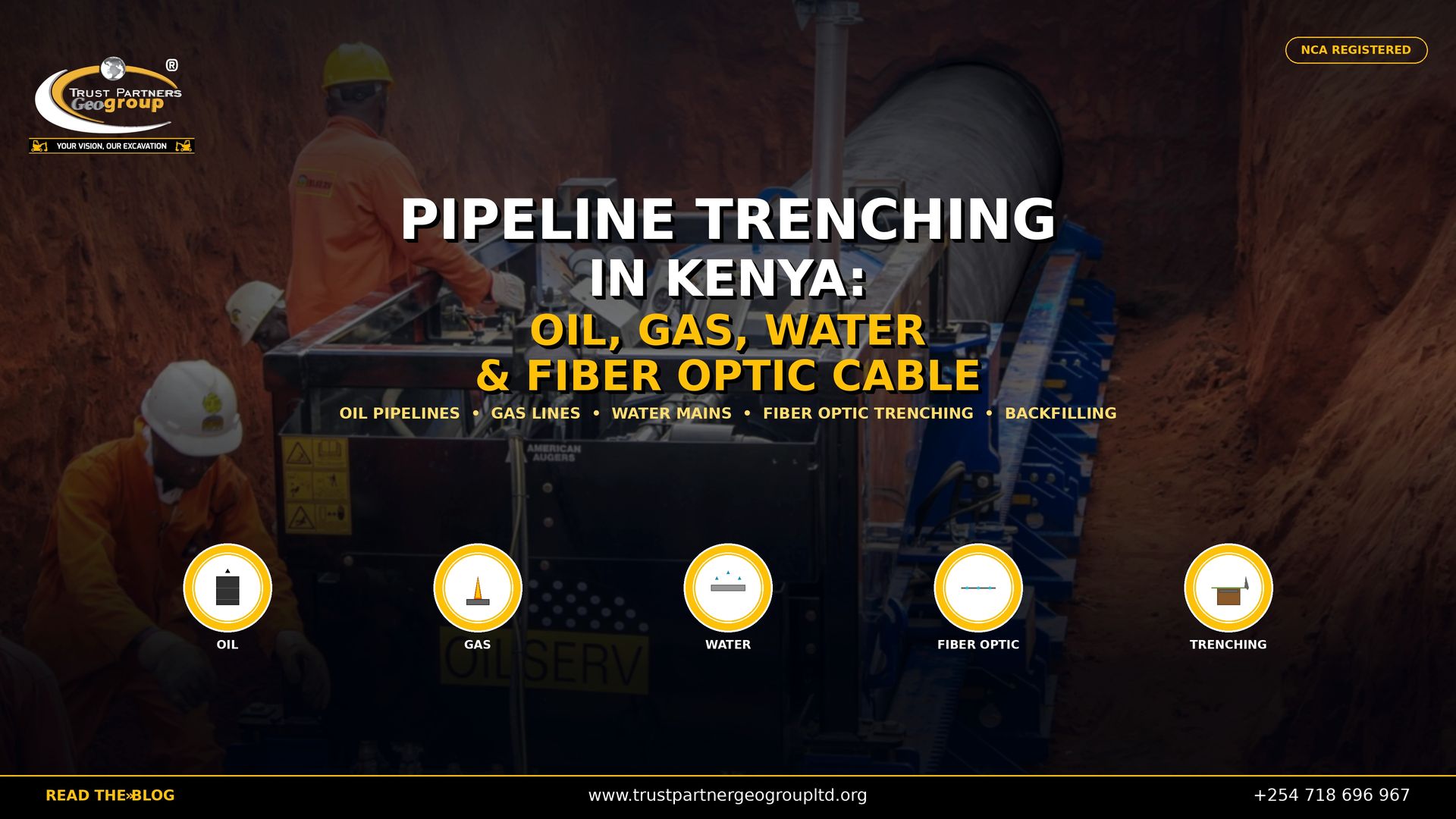
Pipeline Trenching in Kenya: Oil, Gas, Water and Fiber Optic Cable Installation [2026]
Utility Corridor Excavation for Kenya's Energy, Water & Digital Infrastructure Sector
Kenya's growth is literally being built underground. Every new water transmission main, every kilometre of the oil pipeline excavation network from Mombasa to the hinterland, every fiber optic cable trenching route delivering broadband to the counties, and every emerging gas pipeline construction corridor begins the same way — with a properly engineered trench. This 2026 sector guide covers the specifications, depths, equipment, costs and compliance requirements behind pipeline trenching in Kenya, written for utility companies, contractors, county governments and developers planning underground infrastructure. With 15+ years of excavation experience across Kenya, Trust Partners Geo-Group brings field-tested insight to every trench we dig.

From utility trenches in gated estates to corridor earthworks across the Rift Valley, our team has delivered excavation works in all 47 counties. We publish practical guidance so utilities and procurement teams can specify pipeline trenching with confidence.
1. Kenya's Pipeline Construction Sector: The 2026 Landscape
Four utility sectors are simultaneously driving demand for pipeline trenching in Kenya, and 2026 is the busiest year on record for underground utility corridors:
- Water: Nairobi's Northern Collector, county last-mile water programs, and irrigation schemes across the ASALs require hundreds of kilometres of transmission and distribution trenching annually.
- Petroleum: the Mombasa–Nairobi pipeline network (Line 1 through Line 5 upgrades and replacements) and depot connections keep oil pipeline excavation a steady, high-specification niche.
- Gas: LPG import infrastructure at Mombasa, bulk storage inland, and early-stage natural gas distribution planning are creating a new gas pipeline construction market with the strictest trench specifications in the utility sector.
- Fiber optic: national backbone rings, county last-mile fiber and data-center connectivity — every tower, estate and business park needs buried ducts. Fiber optic cable trenching in Kenya is now the highest-volume trenching activity by kilometre.
For earthworks contractors, utility corridors offer repeatable, measurable work — a trench is a trench, priced by the metre — but each utility sector imposes its own depth, bedding, separation and reinstatement rules. Contractors who master all four specs can follow the corridors across the country, much like the linear earthworks model we outlined in our analysis of railway construction excavation for SGR Phase 2, metre-gauge and freight lines.
2. What Is Pipeline Trenching?
Pipeline trenching is the controlled excavation of long, narrow cuts in the ground to install buried pipes, ducts or cables, followed by bedding, backfilling in compacted layers, and surface reinstatement. Although it looks simple, trenching is among the most technically sensitive excavation work because:
- The trench is a confined, dangerous space. Trench collapses kill more construction workers globally than any other excavation accident — anything deeper than 1.5m demands shoring, benching or battering.
- The pipe is only as good as its bedding. A poorly shaped trench floor concentrates loads on pipe joints; correct granular bedding distributes weight evenly along the barrel.
- Backfill quality determines settlement. Under compacted trench backfill becomes a sunken scar across roads and estates within one rainy season — the classic sign of a contractor who skipped layer compaction.
- Existing services are the biggest risk. Striking a live power cable, water main or fiber duct is expensive and dangerous; every urban trench starts with utility detection and hand-dug trial holes.
Pipeline trenching intersects closely with the utility trenching work we detail in our gated community infrastructure excavation guide — but at corridor scale, with stricter engineering control.
3. Water Pipe Trenching in Nairobi and Beyond
Water pipe trenching in Nairobi and the counties covers two distinct scopes:
Transmission mains
Large-diameter (DN300–DN1200) steel or ductile-iron mains — the Northern Collector feeds, Athi Water Works bulk lines, and county bulk transfers. Trenches run 1.5–2.5m deep and 1.2–2.0m wide, with concrete thrust blocks at bends and valves. Excavation is mostly excavator-based, with rock breaking common in Nairobi's volcanic zones (Kikuyu, Ruiru, Karen ridges).
Distribution and last-mile networks
HDPE and uPVC pipes (63–225mm) serving estates and streets: 0.9–1.2m cover, narrow trenches (450–700mm), often in live road reserves with traffic management. Production rates of 150–400m per day per crew are typical in open ground, falling to 40–100m in congested urban corridors.
Key Nairobi-specific challenges: black cotton soil in the eastern plains requiring trench-floor stabilization; rock in the western suburbs; and the sheer density of existing services in the CBD and industrial area. Our black cotton soil stabilization guide covers the soil-replacement techniques that apply equally to trench floors.
4. Oil Pipeline Excavation in Kenya
Oil pipeline excavation is the most specification-driven trenching sector in Kenya, governed by Kenya Pipeline Company (KPC) standards and international codes (API, ASME B31.4):
- Cover depth: minimum 1.0–1.5m, increased at road, rail and river crossings.
- Trench floor: must be rock-free; 100–150mm sand bedding mandatory, with padding (selected fine backfill) to 300mm above the pipe crown before native material returns.
- Coating protection: welded, coated steel pipe cannot be dragged or dropped — excavation support includes side-booms or excavators with lifting eyes, and holiday detection before backfill.
- Crossings: road and rail crossings are typically cased or installed by trenchless methods (HDD/auger bore); open-cut is reserved for greenfield corridor.
- Documentation: every joint, depth and as-built coordinate is recorded; QA/QC dossiers are contractual deliverables, not optional extras.
Earthworks contractors entering this sector need demonstrable experience with long-corridor logistics, rock excavation (see our 2026 rock excavation rates guide) and compaction QA — the same capabilities we apply on earthworks density control and compaction testing.
5. Gas Pipeline Construction: LPG and Natural Gas Corridors
Gas pipeline construction is Kenya's emerging utility sector: LPG bulk lines to storage depots, common-user import infrastructure, and planned natural gas distribution pilots. Trenches resemble oil pipeline work but with tighter rules:
| Parameter | Oil Pipeline Trench | Gas Pipeline Trench |
|---|---|---|
| Typical cover | 1.0–1.5 m | 1.2–1.5 m (higher in urban areas) |
| Bedding / padding | 100–150 mm sand | 150 mm sand bedding + 300 mm padding |
| Warning systems | Marker tape | Marker tape + detectable warning mesh |
| Separation from other utilities | ≥0.5 m | ≥1.0 m (varies by code) |
| Hot-work controls | Standard welding permits | Strict hot-work, gas-free certification zones |
| Design code environment | ASME B31.4 | ASME B31.8 / EPRA requirements |
Gas corridors also demand disciplined hydrotest support: filling, pressurizing and dewatering long sections requires careful temporary works and disposal permits — plan for it in the earthworks programme, not after.
6. Fiber Optic Cable Trenching in Kenya
Fiber optic cable trenching in Kenya is the volume game: tens of thousands of duct-kilometres for national backbones, metro rings and last-mile drops. The work is shallower and narrower than pipelines but far more production-sensitive:
- Cross-country backbone: 1.0–1.2m deep, 300–450mm wide, excavated by chain trencher at 300–800m/day with a mini-excavator handling obstacles and road crossings.
- Urban/metro routes: micro-trenching (a 30–75mm saw cut, 300–400mm deep) along paved roads minimizes reinstatement and permits — increasingly preferred by counties.
- duct installation: HDPE sub-ducts (32–50mm) laid on a sand bed, marker tape at ~300mm below surface, chambers every 1–2km for backbone joints.
- Shared corridors: fiber frequently shares trenches with power ducts and water — separation and marker discipline prevent future strikes.
Fiber trenching margins are won on machine selection and logistics — the right trencher, enough duct and bedding material on site, and rapid reinstatement crews. See our excavator size selection guide for matching machines to trench profiles.
7. Trench Depth, Width and Bedding Specifications
| Utility | Typical Depth (to crown) | Typical Width | Bedding & Surround | Marker |
|---|---|---|---|---|
| Water distribution (HDPE/uPVC) | 0.9–1.2 m | 450–700 mm | 100 mm sand bed; selected fill to 300 mm above crown | Tape at 300 mm |
| Water transmission (DI/steel) | 1.2–1.8 m | OD + 600 mm | 150 mm granular bed; granular surround; thrust blocks at fittings | Tape at 300 mm |
| Oil pipeline | 1.0–1.5 m | OD + 600–900 mm | 100–150 mm sand; padding to 300 mm above crown | Tape; ROW markers |
| Gas pipeline | 1.2–1.5 m | OD + 600 mm | 150 mm sand; 300 mm padding; detectable mesh | Tape + detectable mesh |
| Fiber optic duct | 0.6–1.2 m | 300–450 mm (micro-trench 30–75 mm) | Sand bed; sifted surround | Tape at 300 mm |
| Multi-utility shared trench | 1.2–1.5 m | 1.5–2.5 m | Per-utility zones with separation fill | Per-utility tapes |
Two rules override every table: the design drawing wins, and road crossings always add cover (typically +150–300mm or a concrete/steel casing). Where trenches cross expansive soils, undercut and replace the trench floor rather than trusting compaction alone.
8. Trench Safety, Shoring and Dewatering
Trench safety is non-negotiable. Kenyan law (OSHA 2007) and international practice require protective systems in any trench deeper than 1.5m where workers enter:
- Benching/battering: stepping or sloping the walls to a safe angle (typically 1:1 in average soils, flatter in sand) — cheapest method where space allows.
- Trench boxes: steel shields dragged along with the excavator — the standard for pipe-laying crews moving daily.
- Sheet piling: for deep trenches in urban corridors beside roads and buildings; see our guide on sheet pile installation methods in Nairobi for driven vs vibratory options.
- Dewatering: wellpoints or sump pumps where the water table intrudes — common in Mombasa, Kisumu and Nairobi's high-water-table zones, as detailed in our high water table excavation guide.
- Access and atmosphere: ladders every 15m, barricades and lighting, gas testing near landfills or contaminated ground, and a competent-person inspection every shift and after rain.
9. Equipment Selection for Pipeline Trenching
| Machine | Typical Class | Role in Pipeline Trenching | 2026 Hire Rate (guide) |
|---|---|---|---|
| Chain trencher | 100–250 hp | Long straight trenches, fiber and water, 300–800 m/day | KES 60,000–120,000/day |
| Hydraulic excavator | 20–30 t | Oil/gas/water mains, chambers, crossings, rock with breaker | KES 6,500–12,000/hr with operator |
| Mini excavator | 3–8 t | Urban fiber, congested corridors, service crossings | KES 4,500–7,000/hr |
| Hydraulic breaker attachment | Matches carrier | Rock trenching in Nairobi volcanic zones | Attachment premium on carrier rate |
| Micro-trencher / rock saw | Specialist | Paved-road fiber cuts with minimal reinstatement | Quoted per km |
| Trench boxes / sheet piling | Steel shield sets | Worker protection in trenches >1.5m | KES 15,000–40,000/week per set |
| Dewatering pumps / wellpoints | 2–6 inch | High water table corridors | KES 8,000–25,000/day |
| Plate compactors / rammer | — | Layer compaction of backfill | KES 2,500–5,000/day |
For full rate context see our 2026 excavator hire price guide, and for multi-month corridor campaigns our analysis of long-term hire vs. lease. Attachments matter as much as carriers — our hydraulic breaker selection guide explains matching breaker size to trench rock conditions.
10. Pipeline Trenching Costs: 2026 Budget Benchmarks
Indicative 2026 open-cut trenching rates (excavation, bedding support, backfill and basic reinstatement; pipe/duct supply and specialist laying excluded):
| Sector / Condition | Trench Profile | Indicative Rate (KES per metre) | Key Cost Drivers |
|---|---|---|---|
| Fiber backbone — open ground | 300–450 mm × 1.0 m | 1,200–2,200 | Trencher production, chambers, crossings |
| Fiber metro — paved urban | Micro-trench | 2,500–5,000 | Permits, traffic management, reinstatement |
| Water distribution — normal soil | 600 mm × 1.2 m | 2,000–4,000 | Depth, service density, bedding import |
| Water transmission — normal soil | 1.5 m × 2.0 m | 4,000–7,500 | Volume, thrust blocks, dewatering |
| Oil/gas corridor — greenfield | 1.5–2.0 m deep | 4,500–9,000 | Bedding & padding spec, shoring, QA/QC docs |
| Any sector — rock trenching | Add-on | +3,000–9,000 | Rock hardness, breaker hours, blasting permits |
| Road/rail crossing — trenchless (HDD) | Per crossing | 15,000–40,000 per m | Rig mobilization, length, ground conditions |
Earthworks unit rates anchor these figures — see our 2026 earthworks cost per cubic metre breakdown. The three variables that move a quotation most: rock percentage, water table, and reinstatement standard (a murram verge costs a fraction of an asphalt carriageway to restore).
11. Approvals, Wayleaves and Regulatory Compliance
Pipeline trenching in Kenya operates under a layered approvals regime:
- Wayleaves: consent from the road authority (KeNHA for national trunk roads, KURA for urban roads, county governments for county roads) and from Kenya Railways where corridors cross rail reserves.
- Utility clearance: before excavation, obtain records and physical mark-outs from Kenya Power, water utilities, KPC and fiber operators; hand-dig trial holes at crossings.
- NCA registration: the contractor and project must be NCA-registered for civil works — see our NCA registration requirements guide.
- NEMA: linear projects crossing sensitive areas (rivers, wetlands, forests) require environmental screening or full EIA licences.
- EPRA: oil and gas pipeline works fall under Energy and Petroleum Regulatory Authority technical and safety oversight.
- Traffic management: urban works need county-approved traffic plans, signage and often night-work permissions.
Professional practice: keep a complete wayleave file on site — permits, utility mark-outs, insurance, method statements and the day's inspection records. It is the first thing auditors ask for, and the fastest way to prove your crew is the professional one on the corridor.
12. Frequently Asked Questions
How deep should a pipeline trench be in Kenya?
Standard cover: 900–1,200mm for water mains, 1,000–1,500mm for oil and gas pipelines, and 600–1,000mm for fiber optic ducts. Road crossings require an extra 150–300mm. The design engineer's drawing always overrides generic minimums.
How much does pipeline trenching cost per metre in Kenya?
In 2026: roughly KES 1,800–4,500/m for shallow water and fiber trenches in normal soils, KES 4,500–9,000/m for deeper oil and gas trenches with bedding and shoring, and KES 9,000–20,000+/m in rock or paved urban corridors. Rock, dewatering and reinstatement drive the final rate.
What equipment is used for fiber optic cable trenching in Kenya?
Chain trenchers and rock saws for long narrow cuts, mini-excavators (3–8 tonnes) for urban sections and crossings, and micro-trenching machines along paved roads. Backfill is compacted in layers over a sand or sifted-soil bedding protecting the HDPE ducts.
Who does oil pipeline excavation in Kenya?
NCA-registered civil contractors with trenching, shoring and QA/QC capability. Trust Partners Geo-Group provides oil, gas, water and fiber optic trench excavation with GPS-guided equipment nationwide — call +254 718 686 967 for a corridor assessment.
What safety measures are required for deep pipeline trenches?
Trenches deeper than 1.5m require benching, battering or shoring before workers enter, plus ladder access every 15m, barricading, spoil set back 600mm from edges, daily competent-person inspections, and gas testing near contaminated ground.
Can pipelines be installed without digging trenches in Kenya?
Yes — horizontal directional drilling (HDD), pipe jacking and auger boring serve road, railway and river crossings. HDD costs 3–6 times open-cut rates per metre, so it is reserved for critical crossings while the rest of the corridor is open-trenched.
What approvals are needed for pipeline trenching in Nairobi?
County wayleave/road-reserve approvals, NCA project registration, NEMA clearance, a county-approved traffic management plan, KeNHA/KURA consents on their roads, and utility mark-outs from Kenya Power, water utilities and fiber operators before excavation.
13. Conclusion: The Corridor Beneath Kenya's Growth
Whether it is a water main feeding a growing town, an oil pipeline replacement along the Mombasa corridor, an emerging gas network, or fiber ducts lighting up the counties, the pattern is the same: the project succeeds or fails in the trench. Correct depths, proper bedding, disciplined shoring, layer-compacted backfill and honest reinstatement are what separate a corridor that serves Kenya for fifty years from one that sinks, floods and gets dug up again.
For utilities and procurement teams, the 2026 playbook is straightforward: specify bedding and compaction explicitly, budget shoring and dewatering honestly, clear wayleaves early, and contract trenching partners with audited safety systems and the right fleet. For related infrastructure reading, see our previous analysis of railway construction excavation in Kenya — SGR Phase 2, metre-gauge and freight line earthworks, and our master resource on excavation in Kenya — costs, methods and contractors.
Need a Pipeline Corridor Trenched Right — First Time?
Trust Partners Geo-Group delivers NCA-compliant pipeline trenching, utility excavation, bedding, backfill and reinstatement with GPS-guided equipment — serving Nairobi, Mombasa, Kisumu, Nakuru and all 47 counties.
Call +254 718 686 967 Request a Free Site AssessmentPipeline Trenching in Kenya: Oil, Gas, Water and Fiber Optic Cable Installation [2026]
Utility Corridor Excavation for Kenya's Energy, Water & Digital Infrastructure Sector
Kenya's growth is literally being built underground. Every new water transmission main, every kilometre of the oil pipeline excavation network from Mombasa to the hinterland, every fiber optic cable trenching route delivering broadband to the counties, and every emerging gas pipeline construction corridor begins the same way — with a properly engineered trench. This 2026 sector guide covers the specifications, depths, equipment, costs and compliance requirements behind pipeline trenching in Kenya, written for utility companies, contractors, county governments and developers planning underground infrastructure. With 15+ years of excavation experience across Kenya, Trust Partners Geo-Group brings field-tested insight to every trench we dig.
From utility trenches in gated estates to corridor earthworks across the Rift Valley, our team has delivered excavation works in all 47 counties. We publish practical guidance so utilities and procurement teams can specify pipeline trenching with confidence.
1. Kenya's Pipeline Construction Sector: The 2026 Landscape
Four utility sectors are simultaneously driving demand for pipeline trenching in Kenya, and 2026 is the busiest year on record for underground utility corridors:
- Water: Nairobi's Northern Collector, county last-mile water programs, and irrigation schemes across the ASALs require hundreds of kilometres of transmission and distribution trenching annually.
- Petroleum: the Mombasa–Nairobi pipeline network (Line 1 through Line 5 upgrades and replacements) and depot connections keep oil pipeline excavation a steady, high-specification niche.
- Gas: LPG import infrastructure at Mombasa, bulk storage inland, and early-stage natural gas distribution planning are creating a new gas pipeline construction market with the strictest trench specifications in the utility sector.
- Fiber optic: national backbone rings, county last-mile fiber and data-center connectivity — every tower, estate and business park needs buried ducts. Fiber optic cable trenching in Kenya is now the highest-volume trenching activity by kilometre.
For earthworks contractors, utility corridors offer repeatable, measurable work — a trench is a trench, priced by the metre — but each utility sector imposes its own depth, bedding, separation and reinstatement rules. Contractors who master all four specs can follow the corridors across the country, much like the linear earthworks model we outlined in our analysis of railway construction excavation for SGR Phase 2, metre-gauge and freight lines.
2. What Is Pipeline Trenching?
Pipeline trenching is the controlled excavation of long, narrow cuts in the ground to install buried pipes, ducts or cables, followed by bedding, backfilling in compacted layers, and surface reinstatement. Although it looks simple, trenching is among the most technically sensitive excavation work because:
- The trench is a confined, dangerous space. Trench collapses kill more construction workers globally than any other excavation accident — anything deeper than 1.5m demands shoring, benching or battering.
- The pipe is only as good as its bedding. A poorly shaped trench floor concentrates loads on pipe joints; correct granular bedding distributes weight evenly along the barrel.
- Backfill quality determines settlement. Under compacted trench backfill becomes a sunken scar across roads and estates within one rainy season — the classic sign of a contractor who skipped layer compaction.
- Existing services are the biggest risk. Striking a live power cable, water main or fiber duct is expensive and dangerous; every urban trench starts with utility detection and hand-dug trial holes.
Pipeline trenching intersects closely with the utility trenching work we detail in our gated community infrastructure excavation guide — but at corridor scale, with stricter engineering control.
3. Water Pipe Trenching in Nairobi and Beyond
Water pipe trenching in Nairobi and the counties covers two distinct scopes:
Transmission mains
Large-diameter (DN300–DN1200) steel or ductile-iron mains — the Northern Collector feeds, Athi Water Works bulk lines, and county bulk transfers. Trenches run 1.5–2.5m deep and 1.2–2.0m wide, with concrete thrust blocks at bends and valves. Excavation is mostly excavator-based, with rock breaking common in Nairobi's volcanic zones (Kikuyu, Ruiru, Karen ridges).
Distribution and last-mile networks
HDPE and uPVC pipes (63–225mm) serving estates and streets: 0.9–1.2m cover, narrow trenches (450–700mm), often in live road reserves with traffic management. Production rates of 150–400m per day per crew are typical in open ground, falling to 40–100m in congested urban corridors.
Key Nairobi-specific challenges: black cotton soil in the eastern plains requiring trench-floor stabilization; rock in the western suburbs; and the sheer density of existing services in the CBD and industrial area. Our black cotton soil stabilization guide covers the soil-replacement techniques that apply equally to trench floors.
4. Oil Pipeline Excavation in Kenya
Oil pipeline excavation is the most specification-driven trenching sector in Kenya, governed by Kenya Pipeline Company (KPC) standards and international codes (API, ASME B31.4):
- Cover depth: minimum 1.0–1.5m, increased at road, rail and river crossings.
- Trench floor: must be rock-free; 100–150mm sand bedding mandatory, with padding (selected fine backfill) to 300mm above the pipe crown before native material returns.
- Coating protection: welded, coated steel pipe cannot be dragged or dropped — excavation support includes side-booms or excavators with lifting eyes, and holiday detection before backfill.
- Crossings: road and rail crossings are typically cased or installed by trenchless methods (HDD/auger bore); open-cut is reserved for greenfield corridor.
- Documentation: every joint, depth and as-built coordinate is recorded; QA/QC dossiers are contractual deliverables, not optional extras.
Earthworks contractors entering this sector need demonstrable experience with long-corridor logistics, rock excavation (see our 2026 rock excavation rates guide) and compaction QA — the same capabilities we apply on earthworks density control and compaction testing.
5. Gas Pipeline Construction: LPG and Natural Gas Corridors
Gas pipeline construction is Kenya's emerging utility sector: LPG bulk lines to storage depots, common-user import infrastructure, and planned natural gas distribution pilots. Trenches resemble oil pipeline work but with tighter rules:
| Parameter | Oil Pipeline Trench | Gas Pipeline Trench |
|---|---|---|
| Typical cover | 1.0–1.5 m | 1.2–1.5 m (higher in urban areas) |
| Bedding / padding | 100–150 mm sand | 150 mm sand bedding + 300 mm padding |
| Warning systems | Marker tape | Marker tape + detectable warning mesh |
| Separation from other utilities | ≥0.5 m | ≥1.0 m (varies by code) |
| Hot-work controls | Standard welding permits | Strict hot-work, gas-free certification zones |
| Design code environment | ASME B31.4 | ASME B31.8 / EPRA requirements |
Gas corridors also demand disciplined hydrotest support: filling, pressurizing and dewatering long sections requires careful temporary works and disposal permits — plan for it in the earthworks programme, not after.
6. Fiber Optic Cable Trenching in Kenya
Fiber optic cable trenching in Kenya is the volume game: tens of thousands of duct-kilometres for national backbones, metro rings and last-mile drops. The work is shallower and narrower than pipelines but far more production-sensitive:
- Cross-country backbone: 1.0–1.2m deep, 300–450mm wide, excavated by chain trencher at 300–800m/day with a mini-excavator handling obstacles and road crossings.
- Urban/metro routes: micro-trenching (a 30–75mm saw cut, 300–400mm deep) along paved roads minimizes reinstatement and permits — increasingly preferred by counties.
- duct installation: HDPE sub-ducts (32–50mm) laid on a sand bed, marker tape at ~300mm below surface, chambers every 1–2km for backbone joints.
- Shared corridors: fiber frequently shares trenches with power ducts and water — separation and marker discipline prevent future strikes.
Fiber trenching margins are won on machine selection and logistics — the right trencher, enough duct and bedding material on site, and rapid reinstatement crews. See our excavator size selection guide for matching machines to trench profiles.
7. Trench Depth, Width and Bedding Specifications
| Utility | Typical Depth (to crown) | Typical Width | Bedding & Surround | Marker |
|---|---|---|---|---|
| Water distribution (HDPE/uPVC) | 0.9–1.2 m | 450–700 mm | 100 mm sand bed; selected fill to 300 mm above crown | Tape at 300 mm |
| Water transmission (DI/steel) | 1.2–1.8 m | OD + 600 mm | 150 mm granular bed; granular surround; thrust blocks at fittings | Tape at 300 mm |
| Oil pipeline | 1.0–1.5 m | OD + 600–900 mm | 100–150 mm sand; padding to 300 mm above crown | Tape; ROW markers |
| Gas pipeline | 1.2–1.5 m | OD + 600 mm | 150 mm sand; 300 mm padding; detectable mesh | Tape + detectable mesh |
| Fiber optic duct | 0.6–1.2 m | 300–450 mm (micro-trench 30–75 mm) | Sand bed; sifted surround | Tape at 300 mm |
| Multi-utility shared trench | 1.2–1.5 m | 1.5–2.5 m | Per-utility zones with separation fill | Per-utility tapes |
Two rules override every table: the design drawing wins, and road crossings always add cover (typically +150–300mm or a concrete/steel casing). Where trenches cross expansive soils, undercut and replace the trench floor rather than trusting compaction alone.
8. Trench Safety, Shoring and Dewatering
Trench safety is non-negotiable. Kenyan law (OSHA 2007) and international practice require protective systems in any trench deeper than 1.5m where workers enter:
- Benching/battering: stepping or sloping the walls to a safe angle (typically 1:1 in average soils, flatter in sand) — cheapest method where space allows.
- Trench boxes: steel shields dragged along with the excavator — the standard for pipe-laying crews moving daily.
- Sheet piling: for deep trenches in urban corridors beside roads and buildings; see our guide on sheet pile installation methods in Nairobi for driven vs vibratory options.
- Dewatering: wellpoints or sump pumps where the water table intrudes — common in Mombasa, Kisumu and Nairobi's high-water-table zones, as detailed in our high water table excavation guide.
- Access and atmosphere: ladders every 15m, barricades and lighting, gas testing near landfills or contaminated ground, and a competent-person inspection every shift and after rain.
9. Equipment Selection for Pipeline Trenching
| Machine | Typical Class | Role in Pipeline Trenching | 2026 Hire Rate (guide) |
|---|---|---|---|
| Chain trencher | 100–250 hp | Long straight trenches, fiber and water, 300–800 m/day | KES 60,000–120,000/day |
| Hydraulic excavator | 20–30 t | Oil/gas/water mains, chambers, crossings, rock with breaker | KES 6,500–12,000/hr with operator |
| Mini excavator | 3–8 t | Urban fiber, congested corridors, service crossings | KES 4,500–7,000/hr |
| Hydraulic breaker attachment | Matches carrier | Rock trenching in Nairobi volcanic zones | Attachment premium on carrier rate |
| Micro-trencher / rock saw | Specialist | Paved-road fiber cuts with minimal reinstatement | Quoted per km |
| Trench boxes / sheet piling | Steel shield sets | Worker protection in trenches >1.5m | KES 15,000–40,000/week per set |
| Dewatering pumps / wellpoints | 2–6 inch | High water table corridors | KES 8,000–25,000/day |
| Plate compactors / rammer | — | Layer compaction of backfill | KES 2,500–5,000/day |
For full rate context see our 2026 excavator hire price guide, and for multi-month corridor campaigns our analysis of long-term hire vs. lease. Attachments matter as much as carriers — our hydraulic breaker selection guide explains matching breaker size to trench rock conditions.
10. Pipeline Trenching Costs: 2026 Budget Benchmarks
Indicative 2026 open-cut trenching rates (excavation, bedding support, backfill and basic reinstatement; pipe/duct supply and specialist laying excluded):
| Sector / Condition | Trench Profile | Indicative Rate (KES per metre) | Key Cost Drivers |
|---|---|---|---|
| Fiber backbone — open ground | 300–450 mm × 1.0 m | 1,200–2,200 | Trencher production, chambers, crossings |
| Fiber metro — paved urban | Micro-trench | 2,500–5,000 | Permits, traffic management, reinstatement |
| Water distribution — normal soil | 600 mm × 1.2 m | 2,000–4,000 | Depth, service density, bedding import |
| Water transmission — normal soil | 1.5 m × 2.0 m | 4,000–7,500 | Volume, thrust blocks, dewatering |
| Oil/gas corridor — greenfield | 1.5–2.0 m deep | 4,500–9,000 | Bedding & padding spec, shoring, QA/QC docs |
| Any sector — rock trenching | Add-on | +3,000–9,000 | Rock hardness, breaker hours, blasting permits |
| Road/rail crossing — trenchless (HDD) | Per crossing | 15,000–40,000 per m | Rig mobilization, length, ground conditions |
Earthworks unit rates anchor these figures — see our 2026 earthworks cost per cubic metre breakdown. The three variables that move a quotation most: rock percentage, water table, and reinstatement standard (a murram verge costs a fraction of an asphalt carriageway to restore).
11. Approvals, Wayleaves and Regulatory Compliance
Pipeline trenching in Kenya operates under a layered approvals regime:
- Wayleaves: consent from the road authority (KeNHA for national trunk roads, KURA for urban roads, county governments for county roads) and from Kenya Railways where corridors cross rail reserves.
- Utility clearance: before excavation, obtain records and physical mark-outs from Kenya Power, water utilities, KPC and fiber operators; hand-dig trial holes at crossings.
- NCA registration: the contractor and project must be NCA-registered for civil works — see our NCA registration requirements guide.
- NEMA: linear projects crossing sensitive areas (rivers, wetlands, forests) require environmental screening or full EIA licences.
- EPRA: oil and gas pipeline works fall under Energy and Petroleum Regulatory Authority technical and safety oversight.
- Traffic management: urban works need county-approved traffic plans, signage and often night-work permissions.
Professional practice: keep a complete wayleave file on site — permits, utility mark-outs, insurance, method statements and the day's inspection records. It is the first thing auditors ask for, and the fastest way to prove your crew is the professional one on the corridor.
12. Frequently Asked Questions
How deep should a pipeline trench be in Kenya?
Standard cover: 900–1,200mm for water mains, 1,000–1,500mm for oil and gas pipelines, and 600–1,000mm for fiber optic ducts. Road crossings require an extra 150–300mm. The design engineer's drawing always overrides generic minimums.
How much does pipeline trenching cost per metre in Kenya?
In 2026: roughly KES 1,800–4,500/m for shallow water and fiber trenches in normal soils, KES 4,500–9,000/m for deeper oil and gas trenches with bedding and shoring, and KES 9,000–20,000+/m in rock or paved urban corridors. Rock, dewatering and reinstatement drive the final rate.
What equipment is used for fiber optic cable trenching in Kenya?
Chain trenchers and rock saws for long narrow cuts, mini-excavators (3–8 tonnes) for urban sections and crossings, and micro-trenching machines along paved roads. Backfill is compacted in layers over a sand or sifted-soil bedding protecting the HDPE ducts.
Who does oil pipeline excavation in Kenya?
NCA-registered civil contractors with trenching, shoring and QA/QC capability. Trust Partners Geo-Group provides oil, gas, water and fiber optic trench excavation with GPS-guided equipment nationwide — call +254 718 686 967 for a corridor assessment.
What safety measures are required for deep pipeline trenches?
Trenches deeper than 1.5m require benching, battering or shoring before workers enter, plus ladder access every 15m, barricading, spoil set back 600mm from edges, daily competent-person inspections, and gas testing near contaminated ground.
Can pipelines be installed without digging trenches in Kenya?
Yes — horizontal directional drilling (HDD), pipe jacking and auger boring serve road, railway and river crossings. HDD costs 3–6 times open-cut rates per metre, so it is reserved for critical crossings while the rest of the corridor is open-trenched.
What approvals are needed for pipeline trenching in Nairobi?
County wayleave/road-reserve approvals, NCA project registration, NEMA clearance, a county-approved traffic management plan, KeNHA/KURA consents on their roads, and utility mark-outs from Kenya Power, water utilities and fiber operators before excavation.
13. Conclusion: The Corridor Beneath Kenya's Growth
Whether it is a water main feeding a growing town, an oil pipeline replacement along the Mombasa corridor, an emerging gas network, or fiber ducts lighting up the counties, the pattern is the same: the project succeeds or fails in the trench. Correct depths, proper bedding, disciplined shoring, layer-compacted backfill and honest reinstatement are what separate a corridor that serves Kenya for fifty years from one that sinks, floods and gets dug up again.
For utilities and procurement teams, the 2026 playbook is straightforward: specify bedding and compaction explicitly, budget shoring and dewatering honestly, clear wayleaves early, and contract trenching partners with audited safety systems and the right fleet. For related infrastructure reading, see our previous analysis of railway construction excavation in Kenya — SGR Phase 2, metre-gauge and freight line earthworks, and our master resource on excavation in Kenya — costs, methods and contractors.
Need a Pipeline Corridor Trenched Right — First Time?
Trust Partners Geo-Group delivers NCA-compliant pipeline trenching, utility excavation, bedding, backfill and reinstatement with GPS-guided equipment — serving Nairobi, Mombasa, Kisumu, Nakuru and all 47 counties.
Call +254 718 686 967 Request a Free Site Assessment