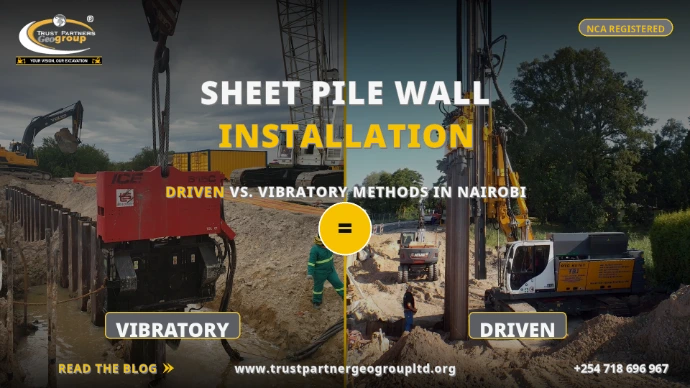
Sheet Pile Wall Installation for Basement Excavation in Nairobi: Driven vs. Vibratory Methods
Steel sheet pile shoring, deep excavation support, waler & strut systems & dewatering for basements in Upper Hill, Kilimani, Westlands & across Kenya
Table of Contents
- 1. Why Sheet Piles for Basement Excavation?
- 2. Types of Steel Sheet Piles
- 3. Shoring Design: Embedment, Bracing & Stability
- 4. Driven Installation: Impact Hammer Method
- 5. Vibratory Installation: High-Frequency Method
- 6. Driven vs. Vibratory: Comparison & Selection
- 7. Walers, Struts & Internal Bracing Systems
- 8. Groundwater Control & Dewatering
- 9. Noise, Vibration & Urban Constraints in Nairobi
- 10. Equipment for Sheet Pile Installation
- 11. NEMA, NCA & County Compliance
- 12. Construction Costs & Programme [2026]
- 13. Frequently Asked Questions
- 14. Conclusion
In the dense urban core of Nairobi - where a new tower on Upper Hill rises within metres of its neighbour, where Westlands basements descend three storeys below groundwater, and where Kilimani's narrow plots leave no room for sloped excavation - the sheet pile wall is the silent steel shield that makes deep construction possible. Sheet pile installation Nairobi contractors perform is a specialist discipline: driving or vibrating interlocking steel sections into the ground, bracing them against the pressure of retained earth and water, and excavating cautiously in stages until the basement slab is cast. This guide covers the full basement shoring sheet piles sequence - section types, driven versus vibratory methods, bracing, dewatering and urban constraints - with 2026 costs and the compliance framework that governs steel sheet pile excavation in Kenya's capital.
Trust Partners Geo-Group Ltd - Engineering Team
NCA-registered excavation & civil engineering contractor with 15+ years of basement excavation, sheet pile shoring and deep earth retention experience across East Africa. Reviewed by registered engineers.
1. Why Sheet Piles for Basement Excavation?
Basement construction in urban Kenya faces three constraints that sheet piles solve uniquely:
- Space: there is no room for sloped cuttings. The boundary wall is 1 metre away, the road is 2 metres away, and the neighbouring foundation is at the same level as yours;
- Depth: modern commercial basements in Nairobi are 6-12 metres deep for parking, plant rooms and storage. Unsupported vertical cuts collapse at 3-4 metres in most soils;
- Groundwater: Nairobi's volcanic soils hold water unpredictably. A basement excavation that is dry in January may flood in April without a cut-off wall.
Sheet piles address all three: they are a vertical wall installed before excavation begins, they retain the soil, they cut off groundwater when driven into an impermeable layer, and they occupy only the wall thickness (typically 400-600mm) plus a minimal working strip. When the basement is complete, they can be extracted and reused on the next project.
Alternatives exist - soldier pile and lagging, diaphragm walls, secant piles - but sheet piles dominate Nairobi basement work because they are faster, cheaper for depths under 15 metres, and reusable. For very deep basements or where groundwater is extreme, diaphragm walls may be specified, but sheet piles remain the default for 80% of urban basement projects.
2. Types of Steel Sheet Piles
Steel sheet piles are rolled steel sections with interlocks on both edges that engage with adjacent piles to form a continuous wall:
| Section Type | Profile | Typical Use | Depth Range |
|---|---|---|---|
| U-section (Larssen) | Symmetrical U-shape, single interlock | General shoring, temporary works | Up to 8-10m |
| Z-section | Asymmetric Z-shape, high section modulus | Deep basements, heavy loads | 8-15m+ |
| Straight web | Flat profile, double interlock | Cofferdams, circular cells | Variable |
| Combined wall | HZ king piles with infill sheets | Very deep or heavy surcharge | 15-25m+ |
In Nairobi, Z-section piles are most common for commercial basements because their high section modulus resists the bending moments from deep excavation and adjacent building surcharge. U-sections are used for lighter temporary works and shallow basements. Steel grades are typically S355GP or S430GP, with hot-dip galvanizing for permanent works or painted protection for temporary installations.
Piles are supplied in standard lengths of 12, 15, 18 and 24 metres. Where longer lengths are needed, piles are spliced by welding with full-penetration butt welds inspected by ultrasonic testing.
3. Shoring Design: Embedment, Bracing & Stability
The geotechnical engineer designs the sheet pile system based on:
- Excavation depth: the primary driver of bending moment and embedment requirement;
- Soil properties: friction angle, cohesion and density of the retained soil and the founding stratum;
- Groundwater: water table level and whether the piles can be seated in an impermeable layer;
- Surcharge: loads from adjacent buildings, roads, stockpiles or construction equipment;
- Deflection limits: adjacent structures may tolerate only 10-25mm of lateral movement.
Embedment Depth
The pile must extend below excavation level far enough to prevent passive failure of the soil in front of the wall. Typical embedment is 1.0-1.5 times excavation depth for cantilever walls, reducing to 0.7-1.0 times for propped or anchored walls. In Nairobi's laterite and volcanic tuff, refusal on dense rock often governs the practical embedment.
Bracing Levels
For basements deeper than 4-5 metres, cantilever sheet piles become uneconomical. Internal bracing (walers and struts) or ground anchors are required. Typical strut spacing is 3-4 metres vertically and 4-6 metres horizontally. The excavation proceeds in stages: dig 2 metres, install waler, dig next 2 metres, install next waler, and so on.
Critical rule: never dig below the lowest strut
Excavating below the lowest level of installed bracing is the most common cause of sheet pile wall failure. The soil pressure at 8 metres depth is four times that at 4 metres. Without support, the wall yields, the ground behind settles, and the adjacent building cracks. The excavation programme must be tied to the bracing installation schedule - not the other way around.
4. Driven Installation: Impact Hammer Method
Impact driving is the traditional method: a heavy hammer strikes the pile head, delivering a percussive blow that forces the pile into the ground.
Equipment
Drop hammers (free-fall weights of 1,000-3,000 kg), single-acting steam/air hammers, or diesel hammers. Modern projects use hydraulic impact hammers with adjustable stroke and energy, mounted on crawler cranes.
Advantages
- Effective in dense soils, gravel, and weathered rock where vibratory methods fail;
- High penetration energy per blow - can drive through obstructions;
- Proven for over a century; simple to understand and control.
Disadvantages
- Extremely loud: 100-120 dB at the source, exceeding Nairobi County noise limits without suppression;
- High ground vibration: peak particle velocity can reach 20-50 mm/s, risking damage to adjacent structures;
- Slower than vibratory driving: 5-15 blows per minute versus continuous penetration;
- Head damage: repeated impact can deform pile heads, requiring trimming or welding.
In Nairobi, impact driving is increasingly restricted to sites with no adjacent buildings, to the final metre of embedment in dense strata, or to pre-augered holes where vibration is reduced. NEMA and county noise officers can issue stop-work orders for uncontrolled impact driving in residential or commercial zones.
5. Vibratory Installation: High-Frequency Method
Vibratory driving uses a high-frequency vibratory hammer (typically 1,200-2,500 vibrations per minute) clamped to the pile head. The vibration liquefies the soil immediately around the pile, reducing skin friction and allowing the pile to sink under its own weight plus the static weight of the hammer and clamp.
Equipment
Excavator-mounted vibratory hammers (for short piles and confined sites) or crane-suspended vibratory hammers (for long piles and high production). Power is hydraulic or electric. Modern hammers have variable frequency and amplitude control.
Advantages
- Fast: a 12-metre pile can be installed in 5-15 minutes in favourable soils;
- Quiet: 80-95 dB at source - manageable with standard noise barriers;
- Low vibration: peak particle velocity typically 2-10 mm/s, acceptable near most structures;
- No head damage: the clamp grips the pile without impact;
- Extractable: the same hammer reverses to extract piles at project completion.
Disadvantages
- Ineffective in very dense soils, boulder-filled ground or weathered rock - the pile simply will not penetrate;
- Can densify loose sands around the pile, potentially causing settlement of adjacent structures;
- Requires a crane or large excavator for long piles - site access must accommodate this;
- Soil liquefaction during driving can temporarily reduce lateral support to adjacent foundations.
Vibratory installation is now the default for urban Nairobi basement projects. Where dense refusal is encountered, the standard compromise is to pre-auger to 2-3 metres above refusal, then vibrate to depth, or to switch to impact driving for the final 1-2 metres only.
6. Driven vs. Vibratory: Comparison & Selection
| Parameter | Impact Driven | Vibratory |
|---|---|---|
| Speed | Slow (5-20 min/pile) | Fast (5-15 min/pile) |
| Noise at source | 100-120 dB | 80-95 dB |
| Ground vibration | High (20-50 mm/s PPV) | Low (2-10 mm/s PPV) |
| Dense soil performance | Excellent | Poor without pre-augering |
| Urban suitability | Limited / restricted | Preferred |
| Pile head damage | Common | None |
| Extraction | Difficult | Easy (reverse vibration) |
| Cost in Kenya | KES 8,000-15,000/m2 | KES 6,000-12,000/m2 |
Selection guidance for Nairobi:
- Adjacent to hospitals, schools, or occupied buildings: vibratory with pre-augering, or hydraulic static press if budget allows;
- Dense laterite or tuff with boulders: pre-auger then vibratory, or impact for final embedment;
- Remote industrial site with no neighbours: impact driving is acceptable and may be cheaper;
- Very sensitive historic structure nearby: hydraulic static press (silent, vibration-free) despite higher cost.
7. Walers, Struts & Internal Bracing Systems
For basements deeper than 4-5 metres, the sheet pile wall cannot stand as a cantilever. Internal bracing transfers the lateral earth pressure to a structural frame:
Walers
Horizontal steel beams (typically H-section or double channel) run continuously along the inside face of the sheet piles at each bracing level. They distribute the pile reaction to the struts. Walers are bolted or welded to pile interlocks or welded plates.
Struts
Horizontal compression members (H-section or tubular steel) span across the excavation from waler to waler. Strut spacing is typically 4-6 metres horizontally. For wide excavations, struts may need intermediate posts to prevent buckling.
Rakers
Where internal struts would obstruct the entire basement, inclined rakers (struts bearing on the basement slab or a berm) can be used. These require careful design to transfer loads into the basement structure without overstressing the slab during construction.
Installation Sequence
The bracing is installed as excavation proceeds: excavate to first waler level, install waler and struts, excavate to second level, install second waler and struts, and so on. Pre-loading struts with hydraulic jacks ensures they take load immediately and reduces wall deflection. Our earthworks QA/QC guide details the staged excavation discipline.
8. Groundwater Control & Dewatering
Sheet piles reduce groundwater ingress but do not eliminate it:
- Interlock seepage: water seeps through the interlocks between piles. In high-pressure conditions, interlocks may be sealed with sealant, welded, or fitted with neoprene seals;
- Toe seepage: if the pile toe is above the impermeable layer, water flows beneath the wall. This is addressed by deeper embedment, grouting beneath the toe, or accepting it and managing the water inside;
- Dewatering inside the excavation: wellpoints, deep wells or sump pumps lower the water table below the excavation level. This is standard practice even with sheet pile walls.
| Dewatering Method | Application | Typical Cost |
|---|---|---|
| Wellpoint system | Shallow excavations (<6m), sandy soils | KES 80,000-150,000/month |
| Deep well system | Deep excavations (>6m), high flow | KES 150,000-300,000/month |
| Sump pumping | Minor seepage, clay soils | KES 30,000-60,000/month |
| Grout curtain | Cut-off where piles cannot reach impermeable layer | KES 2,000-4,000/m2 |
Dewatering discharge must comply with NEMA and WRA requirements. Water pumped from basement excavations often contains sediment and must pass through a settlement tank or silt trap before discharge to stormwater systems.
9. Noise, Vibration & Urban Constraints in Nairobi
Basement construction in Nairobi's commercial districts operates under strict constraints:
- Noise limits: 70 dB daytime, 60 dB nighttime at the site boundary. Vibratory driving with noise blankets typically achieves 65-75 dB at the boundary. Impact driving requires acoustic enclosures or is restricted to daytime hours only;
- Vibration limits: peak particle velocity of 5 mm/s for residential buildings, 10 mm/s for commercial. Vibratory driving is usually below these thresholds; impact driving often exceeds them;
- Working hours: Nairobi County typically restricts noisy construction to 07:30-17:30 on weekdays and 08:00-13:00 on Saturdays. Noisy work on Sundays and public holidays is generally prohibited without special permit;
- Traffic management: sheet pile rigs, cranes and delivery trucks require road space and traffic control. KeNHA or county approval is needed for any encroachment on road reserves;
- Adjacent building protection: pre-construction condition surveys, vibration monitoring and settlement markers on neighbouring structures are standard requirements for deep basement projects near existing buildings.
NEMA may require an Environmental Management Plan (EMP) for basement excavations over 6 metres deep or within 50 metres of sensitive receptors. The EMP covers noise, vibration, dust, dewatering discharge and traffic management.
10. Equipment for Sheet Pile Installation
The fleet for sheet pile installation Nairobi projects is specialized:
| Equipment | Role | Typical Specification |
|---|---|---|
| Crawler crane | Lifting piles and hammer | 50-100 tonne, 30-50m boom |
| Vibratory hammer | Installing and extracting piles | 200-400 kW, 1,200-2,500 vpm |
| Impact hammer | Driving in dense soils | 3,000-8,000 kg ram weight |
| Hydraulic press | Silent installation in sensitive areas | Excavator-mounted, 80-150 tonne static force |
| Pre-augering rig | Loosening dense ground | 300-600mm auger, 15-25m depth |
| Welding set | Splicing piles | 400A MMA or MIG, with UT inspection |
| Dewatering pumps | Groundwater control | Submersible, 5-20 kW |
Site access is a critical planning factor. A 70-tonne crawler crane with 40-metre boom requires 6-8 metres width for assembly and operation. In narrow Nairobi plots, smaller excavator-mounted vibratory hammers or telescopic crawler cranes may be the only option, though they reduce production rates.
11. NEMA, NCA & County Compliance
Sheet pile basement projects in Kenya trigger multiple regulatory layers:
| Requirement | Authority | What It Covers |
|---|---|---|
| Building plan approval | County government | Structural drawings, shoring design, basement levels |
| NEMA approval | NEMA | Noise, vibration, dewatering discharge, EMP for deep excavations |
| NCA registration | National Construction Authority | Contractor registration, site safety, temporary works |
| Traffic / road reserve | KeNHA / KURA / County | Crane positioning, hoarding, road closures |
| Water discharge permit | Water Resources Authority | Dewatering discharge to stormwater or sewer |
| Adjacent building consent | Civil / County | Party wall agreements, access for monitoring |
The temporary works (sheet piles, walers, struts) must be designed by a registered engineer and inspected before excavation begins. County building inspectors may require hold points at each bracing level. Third-party structural monitoring of adjacent buildings is increasingly required by insurers for basements over 6 metres deep.
12. Construction Costs & Programme [2026]
Indicative costs for sheet pile wall installation and basement shoring in Kenya:
| Item | 2026 Rate | Notes |
|---|---|---|
| Steel sheet pile rental | KES 450-750/m2/month | Of wall face area; purchase KES 12,000-18,000/m2 |
| Mobilization / demobilization | KES 150,000-300,000 | Crane, hammer, transport |
| Vibratory installation | KES 6,000-12,000/m2 | Wall face area, including guide wall |
| Impact installation | KES 8,000-15,000/m2 | Higher cost due to slower production |
| Pre-augering | KES 1,500-3,000/m | Per metre of augered hole |
| Waler and strut supply & install | KES 3,000-6,000/m2 | Of shored wall face |
| Pile extraction | KES 2,000-4,000/m2 | At project completion |
| Dewatering system | KES 80,000-300,000/month | Wellpoints or deep wells |
| Third-party monitoring | KES 50,000-120,000/month | Adjacent building settlement and vibration |
All-in project estimates (per 100 linear metres of wall):
- 5m deep basement, vibratory, one strut level: KES 2.5-4.0 million;
- 8m deep basement, vibratory, two strut levels: KES 4.5-7.5 million;
- 12m deep basement, combined wall, three strut levels: KES 8-14 million.
Programme: mobilization 2-3 days; installation 1-2 weeks for a standard basement; excavation and bracing 2-4 weeks depending on depth; extraction 3-5 days after backfill. Pile rental continues monthly until extraction, so programme acceleration saves significant cost.
Pro tip: rent versus buy
For temporary shoring on a single project, rental is almost always cheaper. Purchase only makes sense if you are a specialist contractor with continuous sheet pile work or if the piles are specified as permanent structural elements. Trust Partners Geo-Group Ltd sources sheet piles from regional rental fleets and manages the full installation, bracing, monitoring and extraction cycle.
13. Frequently Asked Questions: Sheet Pile Walls in Kenya
What is a sheet pile wall and when is it used for basement excavation?
A sheet pile wall is a continuous vertical barrier of interlocking steel sections driven or vibrated into the ground to retain soil and exclude groundwater during basement excavation. It is used when excavation depths exceed 3-4 meters in urban areas where space is too tight for sloped cuttings, where adjacent buildings or roads must be protected from ground movement, or where groundwater is present and dewatering alone is insufficient. In Nairobi's dense commercial districts - Upper Hill, Kilimani, Westlands - sheet piles are the default shoring system for multi-storey basement construction because they install quickly, occupy minimal space and can be extracted and reused after construction.
What is the difference between driven and vibratory sheet pile installation?
Driven installation uses an impact hammer to strike the pile head, driving the sheet into the ground by percussion. It is effective in dense soils, gravel and weathered rock but generates significant noise and ground vibration, making it restricted in urban Nairobi near hospitals, schools and occupied buildings. Vibratory installation uses a high-frequency vibratory hammer that liquefies the soil around the pile toe, allowing the sheet to sink under its own weight plus the hammer's static weight. It is faster, quieter and causes less vibration, making it the preferred method in urban areas. However, vibratory installation struggles in very dense soils or where boulders are present - in these conditions, pre-augering or impact driving may be required.
How deep are sheet piles driven for basement excavation in Nairobi?
Sheet pile embedment depth for Nairobi basements is typically 1.0 to 1.5 times the excavation depth below the final excavation level. For a 5-meter deep basement, piles are driven 5-7.5 meters below excavation level, giving a total length of 10-12.5 meters. For deeper basements (8-12 meters) common in Upper Hill commercial towers, piles may reach 18-25 meters total length. The exact embedment is calculated by the geotechnical engineer based on soil strength, groundwater pressure and surcharge loads from adjacent buildings or roads. In Nairobi's volcanic soils, refusal on dense tuff or weathered rock often determines the practical depth rather than theoretical calculations.
What does sheet pile wall installation cost in Kenya in 2026?
2026 indicative costs for sheet pile installation in Kenya: steel sheet pile supply (rental) KES 450-750 per m2 of wall face per month; mobilization and demobilization of pile driving rig KES 150,000-300,000; driven installation KES 8,000-15,000 per m2; vibratory installation KES 6,000-12,000 per m2; waler and strut bracing KES 3,000-6,000 per m2; extraction at completion KES 2,000-4,000 per m2; dewatering system KES 80,000-200,000 per month. A typical 6-meter deep, 50m x 30m rectangular basement shoring project costs KES 3-6 million for installation and KES 1-2 million for extraction, excluding pile rental which continues monthly until backfill is complete. Purchase of new sheet piles (for permanent works) runs KES 12,000-18,000 per m2 of section.
How is groundwater controlled during basement excavation with sheet piles?
Sheet pile walls are not inherently waterproof - water seeps through the interlocks and beneath the toe. Control measures include: installing the piles with high-quality interlocks and using sealant or welding in critical zones; driving piles into an impermeable clay layer to cut off horizontal flow; installing a dewatering system inside the excavation (wellpoints, deep wells or sump pumps) to lower the water table below excavation level; and grouting or jetting beneath the pile toe where seepage paths exist. In Nairobi's highland areas with deep groundwater, dewatering may be minimal. Near rivers, springs or in saturated volcanic soils (parts of Karen, Lavington), continuous dewatering is essential and the sheet pile design must account for hydrostatic pressure on both sides of the wall.
What are the noise and vibration limits for sheet pile driving in Nairobi?
Nairobi County bylaws and NEMA guidelines restrict construction noise to 70 dB during daytime (07:00-19:00) and 60 dB at night at the site boundary. Impact driving typically produces 100-120 dB at the source, requiring noise barriers, mufflers or restricted hours. Vibratory driving produces 80-95 dB - still loud but more manageable with standard suppression. Ground vibration from impact hammers can damage adjacent structures if peak particle velocity exceeds 5-10 mm/s for residential buildings. In practice, most urban Nairobi projects use vibratory installation with pre-augering in dense layers, and impact driving is limited to the final meter of embedment or banned entirely near sensitive buildings. NEMA may require a noise impact assessment before issuing approval for impact driving in built-up areas.
What equipment is used for sheet pile installation in Kenya?
Sheet pile installation in Kenya uses: crawler cranes (50-100 tonne capacity) fitted with vibratory hammers or impact hammers; hydraulic static presses for silent, vibration-free installation in extremely sensitive areas; pre-augering rigs (auger diameters 300-600mm) to loosen dense soil before vibratory driving; and welding equipment for splicing piles when lengths exceed standard 12-15 meter sections. Excavators with hydraulic presses are increasingly used for short piles in confined sites. For extraction, the same vibratory hammer is used in reverse, sometimes assisted by extraction jacks if soil friction is high. The equipment choice depends on pile length, soil conditions, site access and proximity to vibration-sensitive structures.
Do sheet pile walls need building approval in Kenya?
Yes. Basement excavation with sheet pile shoring requires county building plan approval including structural drawings for the temporary works. NEMA approval may be required if the excavation involves significant dewatering, discharge to stormwater systems, or operation within 500 meters of sensitive receptors. NCA-registered contractors must execute the works, and a registered structural or geotechnical engineer must design and certify the shoring system. For deep excavations (over 6 meters) or sites adjacent to roads and buildings, the county may require a method statement, dewatering plan and third-party monitoring of adjacent structures. KeNHA or KURA approval is needed if the excavation encroaches on road reserves. Insurance and third-party liability coverage are standard requirements for urban basement projects.
14. Conclusion: Steel, Strategy and Silence
A sheet pile wall is not just a steel fence in the ground - it is a temporary structural system that must retain tonnes of soil and water, tolerate the vibration of its own installation, and disappear without trace when the basement is complete. The choice between driven and vibratory installation is not merely technical; it is urban: vibratory for the neighbour's peace, driven for the boulder that refuses to yield, and pre-augering for the compromise.
In Nairobi's vertical construction boom, basements are getting deeper and plots are getting tighter. The sheet pile contractor who understands soil refusal, who manages noise and vibration to keep NEMA and the neighbours satisfied, who installs bracing before the excavation gets ahead of itself, and who extracts cleanly at the end, is not just installing steel - they are enabling the entire building.
Trust Partners Geo-Group Ltd delivers the earthworks and shoring package for basement excavations across Kenya: sheet pile wall installation with driven or vibratory methods, waler and strut bracing systems, dewatering coordination, staged excavation management and pile extraction. We work with your structural engineer's design and hold points, manage NEMA noise and vibration compliance, and deliver safe, monitored deep excavations in the tightest urban sites - on unit-rate or lump-sum contracts, with NCA-registered crews and specialist sheet pile equipment.
Sheet Pile Wall Installation & Basement Shoring
Steel sheet pile installation, waler and strut systems, dewatering and deep excavation support for basements across Nairobi and Kenya.
Free lead magnet: ask for our Basement Excavation Shoring Checklist (PDF) - sheet pile hold points, bracing installation records, dewatering logs and vibration monitoring standards your structural engineer will require.
Related Resources
Reinforced Earth Retaining Walls for Road Projects: MSE Wall Excavation & Installation
The previous blog in our retaining wall series - mechanically stabilized earth walls for highways and road projects.
READ MOREGravity Retaining Wall Construction in Kenya: Excavation, Footing Design & Drainage
Mass walls, stone masonry and gabion earthworks for hillside and boundary applications.
READ MOREFoundation Excavation in Black Cotton Soil: Stabilization Techniques for Kenyan Sites
Handling expansive clays that affect basement and shoring design in Nairobi and Kiambu.
READ MOREEarthworks QA/QC: Compaction Testing & Density Control
The layer-by-layer testing regime for excavation backfill and basement earthworks.
READ MOREBulk Excavation Cost Per Cubic Meter in Kenya [2026 Updated Rates]
Transparent pricing for the mass excavation behind every basement shoring project.
READ MOREWarehouse Foundation Excavation in Kenya: Slab-on-Grade vs. Raised Floor Systems
Industrial floor earthworks for large-scale commercial developments with basement considerations.
READ MORETRUST PARTNERS GEO-GROUP LTD | YOUR VISION, OUR EXCAVATION
WEBSITE: WWW.TRUSTPARTNERGEOGROUPLTD.ORG | EMAIL: INFO@TRUSTPARTNERGEOGROUPLTD.ORG | PHONE: +254 718 68 69 67
FOLLOW US: FACEBOOK | TIKTOK | INSTAGRAM | YOUTUBE | LINKEDIN
© 2026 TRUST PARTNERS GEO-GROUP LTD. ALL RIGHTS RESERVED.
Sheet Pile Wall Installation for Basement Excavation in Nairobi: Driven vs. Vibratory Methods
Steel sheet pile shoring, deep excavation support, waler & strut systems & dewatering for basements in Upper Hill, Kilimani, Westlands & across Kenya
Table of Contents
- 1. Why Sheet Piles for Basement Excavation?
- 2. Types of Steel Sheet Piles
- 3. Shoring Design: Embedment, Bracing & Stability
- 4. Driven Installation: Impact Hammer Method
- 5. Vibratory Installation: High-Frequency Method
- 6. Driven vs. Vibratory: Comparison & Selection
- 7. Walers, Struts & Internal Bracing Systems
- 8. Groundwater Control & Dewatering
- 9. Noise, Vibration & Urban Constraints in Nairobi
- 10. Equipment for Sheet Pile Installation
- 11. NEMA, NCA & County Compliance
- 12. Construction Costs & Programme [2026]
- 13. Frequently Asked Questions
- 14. Conclusion
In the dense urban core of Nairobi - where a new tower on Upper Hill rises within metres of its neighbour, where Westlands basements descend three storeys below groundwater, and where Kilimani's narrow plots leave no room for sloped excavation - the sheet pile wall is the silent steel shield that makes deep construction possible. Sheet pile installation Nairobi contractors perform is a specialist discipline: driving or vibrating interlocking steel sections into the ground, bracing them against the pressure of retained earth and water, and excavating cautiously in stages until the basement slab is cast. This guide covers the full basement shoring sheet piles sequence - section types, driven versus vibratory methods, bracing, dewatering and urban constraints - with 2026 costs and the compliance framework that governs steel sheet pile excavation in Kenya's capital.
Trust Partners Geo-Group Ltd - Engineering Team
NCA-registered excavation & civil engineering contractor with 15+ years of basement excavation, sheet pile shoring and deep earth retention experience across East Africa. Reviewed by registered engineers.
1. Why Sheet Piles for Basement Excavation?
Basement construction in urban Kenya faces three constraints that sheet piles solve uniquely:
- Space: there is no room for sloped cuttings. The boundary wall is 1 metre away, the road is 2 metres away, and the neighbouring foundation is at the same level as yours;
- Depth: modern commercial basements in Nairobi are 6-12 metres deep for parking, plant rooms and storage. Unsupported vertical cuts collapse at 3-4 metres in most soils;
- Groundwater: Nairobi's volcanic soils hold water unpredictably. A basement excavation that is dry in January may flood in April without a cut-off wall.
Sheet piles address all three: they are a vertical wall installed before excavation begins, they retain the soil, they cut off groundwater when driven into an impermeable layer, and they occupy only the wall thickness (typically 400-600mm) plus a minimal working strip. When the basement is complete, they can be extracted and reused on the next project.
Alternatives exist - soldier pile and lagging, diaphragm walls, secant piles - but sheet piles dominate Nairobi basement work because they are faster, cheaper for depths under 15 metres, and reusable. For very deep basements or where groundwater is extreme, diaphragm walls may be specified, but sheet piles remain the default for 80% of urban basement projects.
2. Types of Steel Sheet Piles
Steel sheet piles are rolled steel sections with interlocks on both edges that engage with adjacent piles to form a continuous wall:
| Section Type | Profile | Typical Use | Depth Range |
|---|---|---|---|
| U-section (Larssen) | Symmetrical U-shape, single interlock | General shoring, temporary works | Up to 8-10m |
| Z-section | Asymmetric Z-shape, high section modulus | Deep basements, heavy loads | 8-15m+ |
| Straight web | Flat profile, double interlock | Cofferdams, circular cells | Variable |
| Combined wall | HZ king piles with infill sheets | Very deep or heavy surcharge | 15-25m+ |
In Nairobi, Z-section piles are most common for commercial basements because their high section modulus resists the bending moments from deep excavation and adjacent building surcharge. U-sections are used for lighter temporary works and shallow basements. Steel grades are typically S355GP or S430GP, with hot-dip galvanizing for permanent works or painted protection for temporary installations.
Piles are supplied in standard lengths of 12, 15, 18 and 24 metres. Where longer lengths are needed, piles are spliced by welding with full-penetration butt welds inspected by ultrasonic testing.
3. Shoring Design: Embedment, Bracing & Stability
The geotechnical engineer designs the sheet pile system based on:
- Excavation depth: the primary driver of bending moment and embedment requirement;
- Soil properties: friction angle, cohesion and density of the retained soil and the founding stratum;
- Groundwater: water table level and whether the piles can be seated in an impermeable layer;
- Surcharge: loads from adjacent buildings, roads, stockpiles or construction equipment;
- Deflection limits: adjacent structures may tolerate only 10-25mm of lateral movement.
Embedment Depth
The pile must extend below excavation level far enough to prevent passive failure of the soil in front of the wall. Typical embedment is 1.0-1.5 times excavation depth for cantilever walls, reducing to 0.7-1.0 times for propped or anchored walls. In Nairobi's laterite and volcanic tuff, refusal on dense rock often governs the practical embedment.
Bracing Levels
For basements deeper than 4-5 metres, cantilever sheet piles become uneconomical. Internal bracing (walers and struts) or ground anchors are required. Typical strut spacing is 3-4 metres vertically and 4-6 metres horizontally. The excavation proceeds in stages: dig 2 metres, install waler, dig next 2 metres, install next waler, and so on.
Critical rule: never dig below the lowest strut
Excavating below the lowest level of installed bracing is the most common cause of sheet pile wall failure. The soil pressure at 8 metres depth is four times that at 4 metres. Without support, the wall yields, the ground behind settles, and the adjacent building cracks. The excavation programme must be tied to the bracing installation schedule - not the other way around.
4. Driven Installation: Impact Hammer Method
Impact driving is the traditional method: a heavy hammer strikes the pile head, delivering a percussive blow that forces the pile into the ground.
Equipment
Drop hammers (free-fall weights of 1,000-3,000 kg), single-acting steam/air hammers, or diesel hammers. Modern projects use hydraulic impact hammers with adjustable stroke and energy, mounted on crawler cranes.
Advantages
- Effective in dense soils, gravel, and weathered rock where vibratory methods fail;
- High penetration energy per blow - can drive through obstructions;
- Proven for over a century; simple to understand and control.
Disadvantages
- Extremely loud: 100-120 dB at the source, exceeding Nairobi County noise limits without suppression;
- High ground vibration: peak particle velocity can reach 20-50 mm/s, risking damage to adjacent structures;
- Slower than vibratory driving: 5-15 blows per minute versus continuous penetration;
- Head damage: repeated impact can deform pile heads, requiring trimming or welding.
In Nairobi, impact driving is increasingly restricted to sites with no adjacent buildings, to the final metre of embedment in dense strata, or to pre-augered holes where vibration is reduced. NEMA and county noise officers can issue stop-work orders for uncontrolled impact driving in residential or commercial zones.
5. Vibratory Installation: High-Frequency Method
Vibratory driving uses a high-frequency vibratory hammer (typically 1,200-2,500 vibrations per minute) clamped to the pile head. The vibration liquefies the soil immediately around the pile, reducing skin friction and allowing the pile to sink under its own weight plus the static weight of the hammer and clamp.
Equipment
Excavator-mounted vibratory hammers (for short piles and confined sites) or crane-suspended vibratory hammers (for long piles and high production). Power is hydraulic or electric. Modern hammers have variable frequency and amplitude control.
Advantages
- Fast: a 12-metre pile can be installed in 5-15 minutes in favourable soils;
- Quiet: 80-95 dB at source - manageable with standard noise barriers;
- Low vibration: peak particle velocity typically 2-10 mm/s, acceptable near most structures;
- No head damage: the clamp grips the pile without impact;
- Extractable: the same hammer reverses to extract piles at project completion.
Disadvantages
- Ineffective in very dense soils, boulder-filled ground or weathered rock - the pile simply will not penetrate;
- Can densify loose sands around the pile, potentially causing settlement of adjacent structures;
- Requires a crane or large excavator for long piles - site access must accommodate this;
- Soil liquefaction during driving can temporarily reduce lateral support to adjacent foundations.
Vibratory installation is now the default for urban Nairobi basement projects. Where dense refusal is encountered, the standard compromise is to pre-auger to 2-3 metres above refusal, then vibrate to depth, or to switch to impact driving for the final 1-2 metres only.
6. Driven vs. Vibratory: Comparison & Selection
| Parameter | Impact Driven | Vibratory |
|---|---|---|
| Speed | Slow (5-20 min/pile) | Fast (5-15 min/pile) |
| Noise at source | 100-120 dB | 80-95 dB |
| Ground vibration | High (20-50 mm/s PPV) | Low (2-10 mm/s PPV) |
| Dense soil performance | Excellent | Poor without pre-augering |
| Urban suitability | Limited / restricted | Preferred |
| Pile head damage | Common | None |
| Extraction | Difficult | Easy (reverse vibration) |
| Cost in Kenya | KES 8,000-15,000/m2 | KES 6,000-12,000/m2 |
Selection guidance for Nairobi:
- Adjacent to hospitals, schools, or occupied buildings: vibratory with pre-augering, or hydraulic static press if budget allows;
- Dense laterite or tuff with boulders: pre-auger then vibratory, or impact for final embedment;
- Remote industrial site with no neighbours: impact driving is acceptable and may be cheaper;
- Very sensitive historic structure nearby: hydraulic static press (silent, vibration-free) despite higher cost.
7. Walers, Struts & Internal Bracing Systems
For basements deeper than 4-5 metres, the sheet pile wall cannot stand as a cantilever. Internal bracing transfers the lateral earth pressure to a structural frame:
Walers
Horizontal steel beams (typically H-section or double channel) run continuously along the inside face of the sheet piles at each bracing level. They distribute the pile reaction to the struts. Walers are bolted or welded to pile interlocks or welded plates.
Struts
Horizontal compression members (H-section or tubular steel) span across the excavation from waler to waler. Strut spacing is typically 4-6 metres horizontally. For wide excavations, struts may need intermediate posts to prevent buckling.
Rakers
Where internal struts would obstruct the entire basement, inclined rakers (struts bearing on the basement slab or a berm) can be used. These require careful design to transfer loads into the basement structure without overstressing the slab during construction.
Installation Sequence
The bracing is installed as excavation proceeds: excavate to first waler level, install waler and struts, excavate to second level, install second waler and struts, and so on. Pre-loading struts with hydraulic jacks ensures they take load immediately and reduces wall deflection. Our earthworks QA/QC guide details the staged excavation discipline.
8. Groundwater Control & Dewatering
Sheet piles reduce groundwater ingress but do not eliminate it:
- Interlock seepage: water seeps through the interlocks between piles. In high-pressure conditions, interlocks may be sealed with sealant, welded, or fitted with neoprene seals;
- Toe seepage: if the pile toe is above the impermeable layer, water flows beneath the wall. This is addressed by deeper embedment, grouting beneath the toe, or accepting it and managing the water inside;
- Dewatering inside the excavation: wellpoints, deep wells or sump pumps lower the water table below the excavation level. This is standard practice even with sheet pile walls.
| Dewatering Method | Application | Typical Cost |
|---|---|---|
| Wellpoint system | Shallow excavations (<6m), sandy soils | KES 80,000-150,000/month |
| Deep well system | Deep excavations (>6m), high flow | KES 150,000-300,000/month |
| Sump pumping | Minor seepage, clay soils | KES 30,000-60,000/month |
| Grout curtain | Cut-off where piles cannot reach impermeable layer | KES 2,000-4,000/m2 |
Dewatering discharge must comply with NEMA and WRA requirements. Water pumped from basement excavations often contains sediment and must pass through a settlement tank or silt trap before discharge to stormwater systems.
9. Noise, Vibration & Urban Constraints in Nairobi
Basement construction in Nairobi's commercial districts operates under strict constraints:
- Noise limits: 70 dB daytime, 60 dB nighttime at the site boundary. Vibratory driving with noise blankets typically achieves 65-75 dB at the boundary. Impact driving requires acoustic enclosures or is restricted to daytime hours only;
- Vibration limits: peak particle velocity of 5 mm/s for residential buildings, 10 mm/s for commercial. Vibratory driving is usually below these thresholds; impact driving often exceeds them;
- Working hours: Nairobi County typically restricts noisy construction to 07:30-17:30 on weekdays and 08:00-13:00 on Saturdays. Noisy work on Sundays and public holidays is generally prohibited without special permit;
- Traffic management: sheet pile rigs, cranes and delivery trucks require road space and traffic control. KeNHA or county approval is needed for any encroachment on road reserves;
- Adjacent building protection: pre-construction condition surveys, vibration monitoring and settlement markers on neighbouring structures are standard requirements for deep basement projects near existing buildings.
NEMA may require an Environmental Management Plan (EMP) for basement excavations over 6 metres deep or within 50 metres of sensitive receptors. The EMP covers noise, vibration, dust, dewatering discharge and traffic management.
10. Equipment for Sheet Pile Installation
The fleet for sheet pile installation Nairobi projects is specialized:
| Equipment | Role | Typical Specification |
|---|---|---|
| Crawler crane | Lifting piles and hammer | 50-100 tonne, 30-50m boom |
| Vibratory hammer | Installing and extracting piles | 200-400 kW, 1,200-2,500 vpm |
| Impact hammer | Driving in dense soils | 3,000-8,000 kg ram weight |
| Hydraulic press | Silent installation in sensitive areas | Excavator-mounted, 80-150 tonne static force |
| Pre-augering rig | Loosening dense ground | 300-600mm auger, 15-25m depth |
| Welding set | Splicing piles | 400A MMA or MIG, with UT inspection |
| Dewatering pumps | Groundwater control | Submersible, 5-20 kW |
Site access is a critical planning factor. A 70-tonne crawler crane with 40-metre boom requires 6-8 metres width for assembly and operation. In narrow Nairobi plots, smaller excavator-mounted vibratory hammers or telescopic crawler cranes may be the only option, though they reduce production rates.
11. NEMA, NCA & County Compliance
Sheet pile basement projects in Kenya trigger multiple regulatory layers:
| Requirement | Authority | What It Covers |
|---|---|---|
| Building plan approval | County government | Structural drawings, shoring design, basement levels |
| NEMA approval | NEMA | Noise, vibration, dewatering discharge, EMP for deep excavations |
| NCA registration | National Construction Authority | Contractor registration, site safety, temporary works |
| Traffic / road reserve | KeNHA / KURA / County | Crane positioning, hoarding, road closures |
| Water discharge permit | Water Resources Authority | Dewatering discharge to stormwater or sewer |
| Adjacent building consent | Civil / County | Party wall agreements, access for monitoring |
The temporary works (sheet piles, walers, struts) must be designed by a registered engineer and inspected before excavation begins. County building inspectors may require hold points at each bracing level. Third-party structural monitoring of adjacent buildings is increasingly required by insurers for basements over 6 metres deep.
12. Construction Costs & Programme [2026]
Indicative costs for sheet pile wall installation and basement shoring in Kenya:
| Item | 2026 Rate | Notes |
|---|---|---|
| Steel sheet pile rental | KES 450-750/m2/month | Of wall face area; purchase KES 12,000-18,000/m2 |
| Mobilization / demobilization | KES 150,000-300,000 | Crane, hammer, transport |
| Vibratory installation | KES 6,000-12,000/m2 | Wall face area, including guide wall |
| Impact installation | KES 8,000-15,000/m2 | Higher cost due to slower production |
| Pre-augering | KES 1,500-3,000/m | Per metre of augered hole |
| Waler and strut supply & install | KES 3,000-6,000/m2 | Of shored wall face |
| Pile extraction | KES 2,000-4,000/m2 | At project completion |
| Dewatering system | KES 80,000-300,000/month | Wellpoints or deep wells |
| Third-party monitoring | KES 50,000-120,000/month | Adjacent building settlement and vibration |
All-in project estimates (per 100 linear metres of wall):
- 5m deep basement, vibratory, one strut level: KES 2.5-4.0 million;
- 8m deep basement, vibratory, two strut levels: KES 4.5-7.5 million;
- 12m deep basement, combined wall, three strut levels: KES 8-14 million.
Programme: mobilization 2-3 days; installation 1-2 weeks for a standard basement; excavation and bracing 2-4 weeks depending on depth; extraction 3-5 days after backfill. Pile rental continues monthly until extraction, so programme acceleration saves significant cost.
Pro tip: rent versus buy
For temporary shoring on a single project, rental is almost always cheaper. Purchase only makes sense if you are a specialist contractor with continuous sheet pile work or if the piles are specified as permanent structural elements. Trust Partners Geo-Group Ltd sources sheet piles from regional rental fleets and manages the full installation, bracing, monitoring and extraction cycle.
13. Frequently Asked Questions: Sheet Pile Walls in Kenya
What is a sheet pile wall and when is it used for basement excavation?
A sheet pile wall is a continuous vertical barrier of interlocking steel sections driven or vibrated into the ground to retain soil and exclude groundwater during basement excavation. It is used when excavation depths exceed 3-4 meters in urban areas where space is too tight for sloped cuttings, where adjacent buildings or roads must be protected from ground movement, or where groundwater is present and dewatering alone is insufficient. In Nairobi's dense commercial districts - Upper Hill, Kilimani, Westlands - sheet piles are the default shoring system for multi-storey basement construction because they install quickly, occupy minimal space and can be extracted and reused after construction.
What is the difference between driven and vibratory sheet pile installation?
Driven installation uses an impact hammer to strike the pile head, driving the sheet into the ground by percussion. It is effective in dense soils, gravel and weathered rock but generates significant noise and ground vibration, making it restricted in urban Nairobi near hospitals, schools and occupied buildings. Vibratory installation uses a high-frequency vibratory hammer that liquefies the soil around the pile toe, allowing the sheet to sink under its own weight plus the hammer's static weight. It is faster, quieter and causes less vibration, making it the preferred method in urban areas. However, vibratory installation struggles in very dense soils or where boulders are present - in these conditions, pre-augering or impact driving may be required.
How deep are sheet piles driven for basement excavation in Nairobi?
Sheet pile embedment depth for Nairobi basements is typically 1.0 to 1.5 times the excavation depth below the final excavation level. For a 5-meter deep basement, piles are driven 5-7.5 meters below excavation level, giving a total length of 10-12.5 meters. For deeper basements (8-12 meters) common in Upper Hill commercial towers, piles may reach 18-25 meters total length. The exact embedment is calculated by the geotechnical engineer based on soil strength, groundwater pressure and surcharge loads from adjacent buildings or roads. In Nairobi's volcanic soils, refusal on dense tuff or weathered rock often determines the practical depth rather than theoretical calculations.
What does sheet pile wall installation cost in Kenya in 2026?
2026 indicative costs for sheet pile installation in Kenya: steel sheet pile supply (rental) KES 450-750 per m2 of wall face per month; mobilization and demobilization of pile driving rig KES 150,000-300,000; driven installation KES 8,000-15,000 per m2; vibratory installation KES 6,000-12,000 per m2; waler and strut bracing KES 3,000-6,000 per m2; extraction at completion KES 2,000-4,000 per m2; dewatering system KES 80,000-200,000 per month. A typical 6-meter deep, 50m x 30m rectangular basement shoring project costs KES 3-6 million for installation and KES 1-2 million for extraction, excluding pile rental which continues monthly until backfill is complete. Purchase of new sheet piles (for permanent works) runs KES 12,000-18,000 per m2 of section.
How is groundwater controlled during basement excavation with sheet piles?
Sheet pile walls are not inherently waterproof - water seeps through the interlocks and beneath the toe. Control measures include: installing the piles with high-quality interlocks and using sealant or welding in critical zones; driving piles into an impermeable clay layer to cut off horizontal flow; installing a dewatering system inside the excavation (wellpoints, deep wells or sump pumps) to lower the water table below excavation level; and grouting or jetting beneath the pile toe where seepage paths exist. In Nairobi's highland areas with deep groundwater, dewatering may be minimal. Near rivers, springs or in saturated volcanic soils (parts of Karen, Lavington), continuous dewatering is essential and the sheet pile design must account for hydrostatic pressure on both sides of the wall.
What are the noise and vibration limits for sheet pile driving in Nairobi?
Nairobi County bylaws and NEMA guidelines restrict construction noise to 70 dB during daytime (07:00-19:00) and 60 dB at night at the site boundary. Impact driving typically produces 100-120 dB at the source, requiring noise barriers, mufflers or restricted hours. Vibratory driving produces 80-95 dB - still loud but more manageable with standard suppression. Ground vibration from impact hammers can damage adjacent structures if peak particle velocity exceeds 5-10 mm/s for residential buildings. In practice, most urban Nairobi projects use vibratory installation with pre-augering in dense layers, and impact driving is limited to the final meter of embedment or banned entirely near sensitive buildings. NEMA may require a noise impact assessment before issuing approval for impact driving in built-up areas.
What equipment is used for sheet pile installation in Kenya?
Sheet pile installation in Kenya uses: crawler cranes (50-100 tonne capacity) fitted with vibratory hammers or impact hammers; hydraulic static presses for silent, vibration-free installation in extremely sensitive areas; pre-augering rigs (auger diameters 300-600mm) to loosen dense soil before vibratory driving; and welding equipment for splicing piles when lengths exceed standard 12-15 meter sections. Excavators with hydraulic presses are increasingly used for short piles in confined sites. For extraction, the same vibratory hammer is used in reverse, sometimes assisted by extraction jacks if soil friction is high. The equipment choice depends on pile length, soil conditions, site access and proximity to vibration-sensitive structures.
Do sheet pile walls need building approval in Kenya?
Yes. Basement excavation with sheet pile shoring requires county building plan approval including structural drawings for the temporary works. NEMA approval may be required if the excavation involves significant dewatering, discharge to stormwater systems, or operation within 500 meters of sensitive receptors. NCA-registered contractors must execute the works, and a registered structural or geotechnical engineer must design and certify the shoring system. For deep excavations (over 6 meters) or sites adjacent to roads and buildings, the county may require a method statement, dewatering plan and third-party monitoring of adjacent structures. KeNHA or KURA approval is needed if the excavation encroaches on road reserves. Insurance and third-party liability coverage are standard requirements for urban basement projects.
14. Conclusion: Steel, Strategy and Silence
A sheet pile wall is not just a steel fence in the ground - it is a temporary structural system that must retain tonnes of soil and water, tolerate the vibration of its own installation, and disappear without trace when the basement is complete. The choice between driven and vibratory installation is not merely technical; it is urban: vibratory for the neighbour's peace, driven for the boulder that refuses to yield, and pre-augering for the compromise.
In Nairobi's vertical construction boom, basements are getting deeper and plots are getting tighter. The sheet pile contractor who understands soil refusal, who manages noise and vibration to keep NEMA and the neighbours satisfied, who installs bracing before the excavation gets ahead of itself, and who extracts cleanly at the end, is not just installing steel - they are enabling the entire building.
Trust Partners Geo-Group Ltd delivers the earthworks and shoring package for basement excavations across Kenya: sheet pile wall installation with driven or vibratory methods, waler and strut bracing systems, dewatering coordination, staged excavation management and pile extraction. We work with your structural engineer's design and hold points, manage NEMA noise and vibration compliance, and deliver safe, monitored deep excavations in the tightest urban sites - on unit-rate or lump-sum contracts, with NCA-registered crews and specialist sheet pile equipment.
Sheet Pile Wall Installation & Basement Shoring
Steel sheet pile installation, waler and strut systems, dewatering and deep excavation support for basements across Nairobi and Kenya.
Free lead magnet: ask for our Basement Excavation Shoring Checklist (PDF) - sheet pile hold points, bracing installation records, dewatering logs and vibration monitoring standards your structural engineer will require.
Related Resources
Reinforced Earth Retaining Walls for Road Projects: MSE Wall Excavation & Installation
The previous blog in our retaining wall series - mechanically stabilized earth walls for highways and road projects.
READ MOREGravity Retaining Wall Construction in Kenya: Excavation, Footing Design & Drainage
Mass walls, stone masonry and gabion earthworks for hillside and boundary applications.
READ MOREFoundation Excavation in Black Cotton Soil: Stabilization Techniques for Kenyan Sites
Handling expansive clays that affect basement and shoring design in Nairobi and Kiambu.
READ MOREEarthworks QA/QC: Compaction Testing & Density Control
The layer-by-layer testing regime for excavation backfill and basement earthworks.
READ MOREBulk Excavation Cost Per Cubic Meter in Kenya [2026 Updated Rates]
Transparent pricing for the mass excavation behind every basement shoring project.
READ MOREWarehouse Foundation Excavation in Kenya: Slab-on-Grade vs. Raised Floor Systems
Industrial floor earthworks for large-scale commercial developments with basement considerations.
READ MORETRUST PARTNERS GEO-GROUP LTD | YOUR VISION, OUR EXCAVATION
WEBSITE: WWW.TRUSTPARTNERGEOGROUPLTD.ORG | EMAIL: INFO@TRUSTPARTNERGEOGROUPLTD.ORG | PHONE: +254 718 68 69 67
FOLLOW US: FACEBOOK | TIKTOK | INSTAGRAM | YOUTUBE | LINKEDIN
© 2026 TRUST PARTNERS GEO-GROUP LTD. ALL RIGHTS RESERVED.