
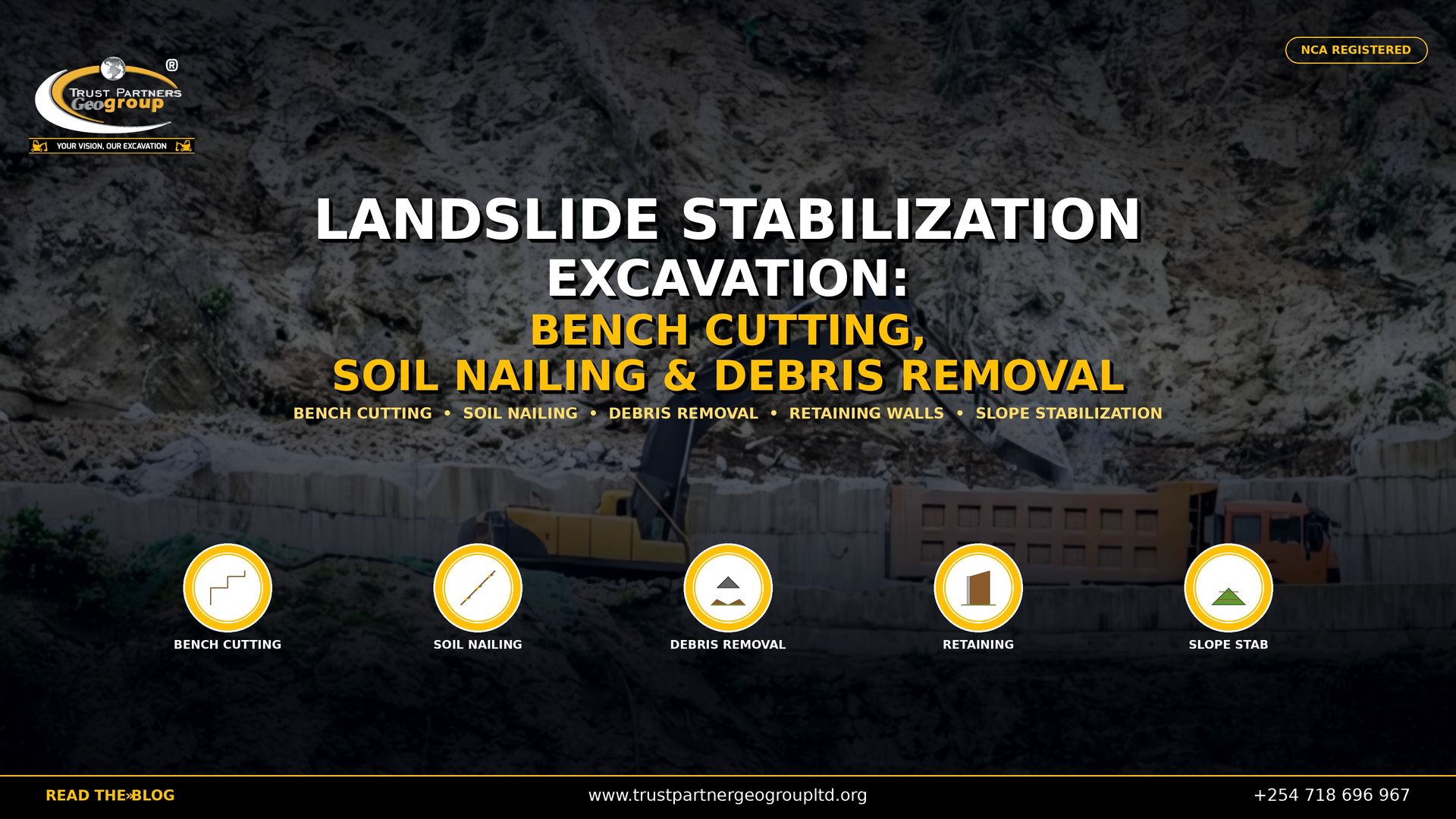
Landslide Stabilization Excavation: Bench Cutting, Soil Nailing and Debris Removal in Kenyan Highlands [2026]
Slope Failure Mitigation for Kenya's Highland Roads, Settlements & Infrastructure
Every rainy season, Kenya's highlands remind us that terrain has a memory: cut slopes fail, escarpment roads disappear under debris, and hillside settlements hold their breath. Landslide stabilization excavation is the engineering answer — regrading failed slopes, reinforcing them in place, draining the water that drives failure, and clearing what has already fallen. This 2026 engineering guide covers bench cutting excavation, soil nailing in Kenya, slope failure mitigation and debris removal in the highlands — from the Murang'a and Nyeri escarpments to West Pokot, Elgon and the Aberdares — with methods, costs, equipment and the compliance pathway. With 15+ years of excavation experience across Kenya, Trust Partners Geo-Group delivers both planned slope stabilization and 24/7 emergency response.

From escarpment road reinstatement to hillside development platforms, our team delivers slope excavation and stabilization across Kenya's highlands — engineered, drained, and built to hold through the next long rains.
1. Landslides in the Kenyan Highlands: The 2026 Landscape
Kenya's highland belt — Murang'a, Nyeri, Kirinyaga, Kiambu's escarpments, West Pokot, Elgeyo-Marakwet, the Elgon slopes and the Aberdare fringes — sits on the country's most landslide-prone geology: steep terrain, deep residual volcanic and lateritic soils, and rainfall that arrives in intense, saturating bursts. Three trends are expanding the stabilization workload:
- Escarpment road expansion: every highway climbing the Rift Valley escarpment — Mai Mahiu, Mau Summit approaches, the Machakos–Kathiani cuts — creates cut slopes that need engineered stabilization from day one.
- Hillside settlement: population pressure pushes housing onto marginal slopes; every unengineered plot cut is tomorrow's slope failure.
- Climate intensification: heavier storm bursts are reactivating old slides and triggering new ones on slopes that held for decades.
2. What Is Landslide Stabilization Excavation?
Landslide stabilization excavation is the earthworks discipline that converts a failed or failing slope into a stable, drained, maintained landform. It combines four toolkits, selected by the geotechnical investigation:
- Regrading — removing driving weight and reshaping the slope (bench cutting, slope flattening, toe buttressing).
- Reinforcement — holding the slope in place where regrading is impossible (soil nailing, anchors, retaining walls, rock bolts).
- Drainage — removing the water that causes failure (cutoff drains, surface channels, subsurface drains).
- Clearance and protection — debris removal, rockfall scaling, gabion and check structures.
These methods build directly on the hillside construction and retention techniques in our slope excavation and stabilization guide for Nairobi and Kiambu — scaled up for highland terrain and disaster-scale failures.
3. Bench Cutting Excavation: Regrading Failed Slopes
Bench cutting is the workhorse of slope stabilization where space allows — and the most cost-effective permanent fix:
| Parameter | Typical Specification | Notes |
|---|---|---|
| Bench width | 3–6 m | Wide enough to intercept flow and allow maintenance access |
| Bench interval (vertical) | 5–8 m | Set by soil strength and design factor of safety |
| Inter-bench slope | 1:1.5–1:2 (soil); steeper in rock | Verified by slope stability analysis, not rule of thumb |
| Bench gradient | 2–5% fall to collector drain | Reverse falls pond water into the slope — a classic failure trigger |
| Surface protection | Grass/vegetation; lining on collector drains | Bare benches erode into gullies within one season |
Execution discipline: work from the crest downward, never undercut the toe; strip and stockpile topsoil for final rehabilitation; excavate in sections short enough that no face stands unsupported through a storm; and install each bench's drainage before cutting the bench below it.
4. Soil Nailing and Shotcrete: In-Place Slope Reinforcement
Where there is no room to regrade — beside live roads, above buildings, on escarpment corridors — the slope must be reinforced standing: soil nailing in Kenya is the standard solution:
- The system: steel bars (typically 25–32mm) drilled and grouted into the face on a 1.5–2.5m grid, 4–12m long, connected by a structural shotcrete facing with weep drains.
- Top-down sequence: excavate a 1–2m high strip, drill and grout the nail row, face it with mesh and shotcrete, then cut the next strip. The slope is never left unsupported.
- Drainage integration: weep holes and horizontal drains through the facing relieve pore pressure — nails without drainage are a temporary fix.
- Testing: sacrificial and production nail pull-out tests verify capacity per our QA discipline in earthworks QA/QC and testing.
Where rockfall rather than soil failure dominates, the toolkit shifts to scaling, rock bolts and draped mesh — with rock excavation methods from our rock breaking alternatives guide.
5. Slope Drainage: The Real Cure for Highland Landslides
Ask any geotechnical engineer: most Kenyan highland landslides are drainage failures wearing a landslide costume. The stabilization drainage hierarchy:
- Crest cutoff drains — intercept runoff above the scarp before it enters the failure mass; the single highest-value cut on any site.
- Surface channels — lined collector drains on every bench, discharging to safe outfalls well clear of the slope.
- Subsurface drains — horizontal drains drilled into the face and trench drains that lower the water table within the slope.
- Gully and scour control — check dams and gabion cascades where flow concentrates, following the principles in our road drainage solutions guide.
- Leak elimination — broken water lines and septic discharges are silent slope killers; every stabilization survey includes a utility and sanitation audit upslope.
6. Emergency Debris Removal and Road Reopening
When a slope lets go onto a road or settlement, debris removal in the highlands is a race with its own safety rules:
- Assess before touching: is the slope still moving? Spotters watch the scarp continuously; work stops on any sign of reactivation.
- Divert water first: even a temporary cutoff trench above the scarp prevents the next storm from re-loading the failure.
- Clear top-down, never bottom-up: excavating the toe of a moving pile can trigger a secondary slide onto the crew. Long-reach excavators work from safe ground wherever possible.
- One lane, then all lanes: reopen a controlled single lane for emergency and local traffic while full clearance continues.
- Stockpile or haul: slipped material that cannot be reused as engineered fill goes to approved spoil sites — never pushed over the downhill edge, where it becomes the next failure.
Our 24/7 emergency equipment dispatch supports county and national agencies during storm events, and our flood mitigation excavation guide covers the companion drainage emergency work that almost always accompanies highland slides.
7. Highland Hotspots: Murang'a, Nyeri, West Pokot, Elgon & Aberdares
| Region | Failure Context | Proven Stabilization Approach |
|---|---|---|
| Murang'a & Kirinyaga escarpments | Road cuts and tea-zone slopes failing onto corridors | Bench cutting, cutoff drains, gabion toe walls |
| Nyeri & Aberdare fringes | Deep residual soils on steep farmland and settlement edges | Slope regrading, subsurface drainage, reforestation zones |
| West Pokot & Elgeyo escarpment | Catastrophic storm-triggered debris flows on roads and villages | Debris-flow channels, check dam cascades, catchment-scale cutoff drainage |
| Mt. Elgon slopes (Bungoma/Trans Nzoia) | Settlement and cultivation on saturated volcanic soils | Benching, soil nailing at critical infrastructure, drainage-first stabilization |
| Kiambu & Nairobi escarpments | Development cuts behind estates and highways | Soil nailing + shotcrete, anchored walls, engineered plot drainage |
| Rift Valley road cuts (Mai Mahiu etc.) | Over-steepened highway cuts, rockfall and slide | Rock scaling, bolts and mesh, benched regrading, lined channels |
8. Equipment Selection for Slope Stabilization
| Machine | Typical Class | Role in Slope Stabilization | 2026 Hire Rate (guide) |
|---|---|---|---|
| Long-reach excavator | 20–30 t, 12–18 m reach | Crest-down regrading and debris work from safe ground | KES 8,500–14,000/hr |
| Standard excavator + breaker | 20–30 t | Bench cutting, rock trimming, drain excavation | KES 6,500–12,000/hr with operator |
| Slope drilling rig | Crawler-mounted | Soil nails, rock bolts, horizontal drains | Quoted per metre drilled |
| Shotcrete equipment | Wet/dry mix + compressor | Nail facing and scour protection | Quoted per m² |
| Dozer | D6–D8 | Benching bulk work, toe buttresses, access | KES 9,000–15,000/hr |
| Dump trucks | 10–25 t | Debris haulage to approved spoil sites | Per-trip rates |
| Dewatering pumps | 4–6 inch | Keeping cuts and trenches workable in storm seasons | KES 8,000–25,000/day |
For rates context see our 2026 excavator hire price guide and the construction equipment hire rate guide. Slope work rewards experienced operators above all — one wrong cut at the toe can undo a season of stabilization.
9. Landslide Stabilization Costs: 2026 Budget Benchmarks
Indicative 2026 costs for highland slope works (geotechnical design supervision recommended on all tiers):
| Scope | Unit | Indicative Cost (KES) | Key Cost Drivers |
|---|---|---|---|
| Bench cutting and regrading | per m³ excavated | 280–500 | Haul distance, access, working platform safety |
| Cutoff and collector drains (lined) | per metre | 4,000–12,000 | Section size, lining type, terrain |
| Soil nailing + shotcrete facing | per m² of face | 18,000–40,000 | Nail length/density, facing thickness, access |
| Gabion toe walls / check dams | per m³ placed | 6,500–12,000 | Stone source distance, foundation excavation |
| Emergency debris removal | per m³ cleared | 350–900 | Urgency premium, haul distance, safety measures |
| Moderate slope section (bench + drains) | per section | 2–8 million | Length, height, drainage extent |
| Major escarpment failure reinstatement | per site | 15–60 million+ | Debris volume, retaining structures, road works |
Unit rates anchor in our 2026 earthworks cost per cubic metre breakdown and rock excavation rate guide. Retaining structure costs are covered in our anchored retaining wall guide.
10. Compliance, Geotechnical Design and Safety
- Geotechnical design is mandatory: slope stabilization without a stability analysis is landscaping with extra steps. Trial pits, boreholes and groundwater assessment precede every design; works are supervised and verified against it.
- NEMA: clearance for works in water catchments, forests and steep-land zones; rehabilitation and re-vegetation conditions are standard.
- County governments & road agencies: KeNHA/KURA approval for works adjoining their corridors; county consent for settlement-edge stabilization.
- NCA: contractor and project registration — see our NCA registration requirements guide.
- Site safety: slope work is high-risk excavation — spotters on active faces, exclusion zones below work fronts, no toe undercutting, weather-triggered work stoppages, and emergency response plans on every site.
- Monitoring and maintenance: stabilization is a system, not an event. Handover includes survey monuments, drain inspection schedules and vegetation maintenance — the slope tells you early if something is wrong, if anyone is looking.
11. Frequently Asked Questions
How much does landslide stabilization cost in Kenya?
In 2026: KES 2–8 million for bench cutting and drainage on a moderate section, KES 8–25 million where soil nailing and shotcrete are required, and KES 15–60 million+ for major escarpment failures needing retaining structures and large debris removal. Emergency mobilization is quoted per event.
What is bench cutting in slope excavation?
Bench cutting divides a steep slope into steps — flat benches separated by stable slopes — reducing the forces that cause landslides. Each bench intercepts and drains water instead of letting it run the full slope. It is the most cost-effective stabilization method where there is room to regrade.
What is soil nailing and when is it used in Kenya?
Soil nailing drills and grouts steel bars into a slope face in a grid pattern, then applies a shotcrete facing. It is used where regrading is impossible — beside roads, buildings and escarpment corridors — and where the slope must remain standing during construction.
Who does landslide debris removal in the Kenyan Highlands?
NCA-registered earthworks contractors with highland experience and rapid-response fleets. Trust Partners Geo-Group provides emergency debris clearance, bench cutting and drainage works across Murang'a, Nyeri, West Pokot, Elgon and the Aberdares — call +254 718 686 967.
What causes landslides in the Kenyan Highlands?
Water is the trigger: intense rainfall saturates residual volcanic soils until they fail. Underlying causes include deforestation, over-steep road cuts, blocked drainage, leaking water lines and cultivation on marginal slopes. Effective stabilization always starts with drainage control.
Can landslide-prone slopes be stabilized without removing houses?
Often yes — soil nailing, anchored walls, subsurface drainage and regrading can stabilize slopes around existing development. Where the failure plane runs beneath structures, relocation may be the honest answer. A geotechnical investigation determines which applies.
What approvals are needed for slope stabilization works in Kenya?
County approvals, NEMA clearance (mandatory near catchments and forests), KeNHA/KURA approval beside their roads, NCA registration and geotechnical design review. Emergency stabilization to protect life can proceed immediately with retrospective documentation.
12. Conclusion: Water Out, Weight Off, Strength In
Every durable landslide repair in the Kenyan Highlands follows the same logic: get the water out, take the driving weight off, put structural strength in, and clear what has already fallen — safely, top-down, with eyes on the scarp. Bench cutting regrades, soil nailing reinforces, drainage cures, and disciplined debris removal buys the time to do all three properly.
For county governments, road agencies and hillside developers, the 2026 playbook is clear: investigate before pricing, stabilize before failure, and keep an emergency-capable contractor on call through the rains. For related reading, see our guides to flood mitigation excavation, drainage channels and emergency culverts in Nairobi and slope excavation for hillside construction in Nairobi and Kiambu, plus our master resource on excavation in Kenya — costs, methods and contractors.
Facing a Failing Slope? Act Before the Next Storm.
Trust Partners Geo-Group delivers NCA-compliant landslide stabilization — bench cutting, soil nailing support, slope drainage and 24/7 emergency debris removal — across the Kenyan Highlands and all 47 counties.
Call +254 718 686 967 — 24/7 Request a Slope AssessmentLandslide Stabilization Excavation: Bench Cutting, Soil Nailing and Debris Removal in Kenyan Highlands [2026]
Slope Failure Mitigation for Kenya's Highland Roads, Settlements & Infrastructure
Every rainy season, Kenya's highlands remind us that terrain has a memory: cut slopes fail, escarpment roads disappear under debris, and hillside settlements hold their breath. Landslide stabilization excavation is the engineering answer — regrading failed slopes, reinforcing them in place, draining the water that drives failure, and clearing what has already fallen. This 2026 engineering guide covers bench cutting excavation, soil nailing in Kenya, slope failure mitigation and debris removal in the highlands — from the Murang'a and Nyeri escarpments to West Pokot, Elgon and the Aberdares — with methods, costs, equipment and the compliance pathway. With 15+ years of excavation experience across Kenya, Trust Partners Geo-Group delivers both planned slope stabilization and 24/7 emergency response.
From escarpment road reinstatement to hillside development platforms, our team delivers slope excavation and stabilization across Kenya's highlands — engineered, drained, and built to hold through the next long rains.
1. Landslides in the Kenyan Highlands: The 2026 Landscape
Kenya's highland belt — Murang'a, Nyeri, Kirinyaga, Kiambu's escarpments, West Pokot, Elgeyo-Marakwet, the Elgon slopes and the Aberdare fringes — sits on the country's most landslide-prone geology: steep terrain, deep residual volcanic and lateritic soils, and rainfall that arrives in intense, saturating bursts. Three trends are expanding the stabilization workload:
- Escarpment road expansion: every highway climbing the Rift Valley escarpment — Mai Mahiu, Mau Summit approaches, the Machakos–Kathiani cuts — creates cut slopes that need engineered stabilization from day one.
- Hillside settlement: population pressure pushes housing onto marginal slopes; every unengineered plot cut is tomorrow's slope failure.
- Climate intensification: heavier storm bursts are reactivating old slides and triggering new ones on slopes that held for decades.
2. What Is Landslide Stabilization Excavation?
Landslide stabilization excavation is the earthworks discipline that converts a failed or failing slope into a stable, drained, maintained landform. It combines four toolkits, selected by the geotechnical investigation:
- Regrading — removing driving weight and reshaping the slope (bench cutting, slope flattening, toe buttressing).
- Reinforcement — holding the slope in place where regrading is impossible (soil nailing, anchors, retaining walls, rock bolts).
- Drainage — removing the water that causes failure (cutoff drains, surface channels, subsurface drains).
- Clearance and protection — debris removal, rockfall scaling, gabion and check structures.
These methods build directly on the hillside construction and retention techniques in our slope excavation and stabilization guide for Nairobi and Kiambu — scaled up for highland terrain and disaster-scale failures.
3. Bench Cutting Excavation: Regrading Failed Slopes
Bench cutting is the workhorse of slope stabilization where space allows — and the most cost-effective permanent fix:
| Parameter | Typical Specification | Notes |
|---|---|---|
| Bench width | 3–6 m | Wide enough to intercept flow and allow maintenance access |
| Bench interval (vertical) | 5–8 m | Set by soil strength and design factor of safety |
| Inter-bench slope | 1:1.5–1:2 (soil); steeper in rock | Verified by slope stability analysis, not rule of thumb |
| Bench gradient | 2–5% fall to collector drain | Reverse falls pond water into the slope — a classic failure trigger |
| Surface protection | Grass/vegetation; lining on collector drains | Bare benches erode into gullies within one season |
Execution discipline: work from the crest downward, never undercut the toe; strip and stockpile topsoil for final rehabilitation; excavate in sections short enough that no face stands unsupported through a storm; and install each bench's drainage before cutting the bench below it.
4. Soil Nailing and Shotcrete: In-Place Slope Reinforcement
Where there is no room to regrade — beside live roads, above buildings, on escarpment corridors — the slope must be reinforced standing: soil nailing in Kenya is the standard solution:
- The system: steel bars (typically 25–32mm) drilled and grouted into the face on a 1.5–2.5m grid, 4–12m long, connected by a structural shotcrete facing with weep drains.
- Top-down sequence: excavate a 1–2m high strip, drill and grout the nail row, face it with mesh and shotcrete, then cut the next strip. The slope is never left unsupported.
- Drainage integration: weep holes and horizontal drains through the facing relieve pore pressure — nails without drainage are a temporary fix.
- Testing: sacrificial and production nail pull-out tests verify capacity per our QA discipline in earthworks QA/QC and testing.
Where rockfall rather than soil failure dominates, the toolkit shifts to scaling, rock bolts and draped mesh — with rock excavation methods from our rock breaking alternatives guide.
5. Slope Drainage: The Real Cure for Highland Landslides
Ask any geotechnical engineer: most Kenyan highland landslides are drainage failures wearing a landslide costume. The stabilization drainage hierarchy:
- Crest cutoff drains — intercept runoff above the scarp before it enters the failure mass; the single highest-value cut on any site.
- Surface channels — lined collector drains on every bench, discharging to safe outfalls well clear of the slope.
- Subsurface drains — horizontal drains drilled into the face and trench drains that lower the water table within the slope.
- Gully and scour control — check dams and gabion cascades where flow concentrates, following the principles in our road drainage solutions guide.
- Leak elimination — broken water lines and septic discharges are silent slope killers; every stabilization survey includes a utility and sanitation audit upslope.
6. Emergency Debris Removal and Road Reopening
When a slope lets go onto a road or settlement, debris removal in the highlands is a race with its own safety rules:
- Assess before touching: is the slope still moving? Spotters watch the scarp continuously; work stops on any sign of reactivation.
- Divert water first: even a temporary cutoff trench above the scarp prevents the next storm from re-loading the failure.
- Clear top-down, never bottom-up: excavating the toe of a moving pile can trigger a secondary slide onto the crew. Long-reach excavators work from safe ground wherever possible.
- One lane, then all lanes: reopen a controlled single lane for emergency and local traffic while full clearance continues.
- Stockpile or haul: slipped material that cannot be reused as engineered fill goes to approved spoil sites — never pushed over the downhill edge, where it becomes the next failure.
Our 24/7 emergency equipment dispatch supports county and national agencies during storm events, and our flood mitigation excavation guide covers the companion drainage emergency work that almost always accompanies highland slides.
7. Highland Hotspots: Murang'a, Nyeri, West Pokot, Elgon & Aberdares
| Region | Failure Context | Proven Stabilization Approach |
|---|---|---|
| Murang'a & Kirinyaga escarpments | Road cuts and tea-zone slopes failing onto corridors | Bench cutting, cutoff drains, gabion toe walls |
| Nyeri & Aberdare fringes | Deep residual soils on steep farmland and settlement edges | Slope regrading, subsurface drainage, reforestation zones |
| West Pokot & Elgeyo escarpment | Catastrophic storm-triggered debris flows on roads and villages | Debris-flow channels, check dam cascades, catchment-scale cutoff drainage |
| Mt. Elgon slopes (Bungoma/Trans Nzoia) | Settlement and cultivation on saturated volcanic soils | Benching, soil nailing at critical infrastructure, drainage-first stabilization |
| Kiambu & Nairobi escarpments | Development cuts behind estates and highways | Soil nailing + shotcrete, anchored walls, engineered plot drainage |
| Rift Valley road cuts (Mai Mahiu etc.) | Over-steepened highway cuts, rockfall and slide | Rock scaling, bolts and mesh, benched regrading, lined channels |
8. Equipment Selection for Slope Stabilization
| Machine | Typical Class | Role in Slope Stabilization | 2026 Hire Rate (guide) |
|---|---|---|---|
| Long-reach excavator | 20–30 t, 12–18 m reach | Crest-down regrading and debris work from safe ground | KES 8,500–14,000/hr |
| Standard excavator + breaker | 20–30 t | Bench cutting, rock trimming, drain excavation | KES 6,500–12,000/hr with operator |
| Slope drilling rig | Crawler-mounted | Soil nails, rock bolts, horizontal drains | Quoted per metre drilled |
| Shotcrete equipment | Wet/dry mix + compressor | Nail facing and scour protection | Quoted per m² |
| Dozer | D6–D8 | Benching bulk work, toe buttresses, access | KES 9,000–15,000/hr |
| Dump trucks | 10–25 t | Debris haulage to approved spoil sites | Per-trip rates |
| Dewatering pumps | 4–6 inch | Keeping cuts and trenches workable in storm seasons | KES 8,000–25,000/day |
For rates context see our 2026 excavator hire price guide and the construction equipment hire rate guide. Slope work rewards experienced operators above all — one wrong cut at the toe can undo a season of stabilization.
9. Landslide Stabilization Costs: 2026 Budget Benchmarks
Indicative 2026 costs for highland slope works (geotechnical design supervision recommended on all tiers):
| Scope | Unit | Indicative Cost (KES) | Key Cost Drivers |
|---|---|---|---|
| Bench cutting and regrading | per m³ excavated | 280–500 | Haul distance, access, working platform safety |
| Cutoff and collector drains (lined) | per metre | 4,000–12,000 | Section size, lining type, terrain |
| Soil nailing + shotcrete facing | per m² of face | 18,000–40,000 | Nail length/density, facing thickness, access |
| Gabion toe walls / check dams | per m³ placed | 6,500–12,000 | Stone source distance, foundation excavation |
| Emergency debris removal | per m³ cleared | 350–900 | Urgency premium, haul distance, safety measures |
| Moderate slope section (bench + drains) | per section | 2–8 million | Length, height, drainage extent |
| Major escarpment failure reinstatement | per site | 15–60 million+ | Debris volume, retaining structures, road works |
Unit rates anchor in our 2026 earthworks cost per cubic metre breakdown and rock excavation rate guide. Retaining structure costs are covered in our anchored retaining wall guide.
10. Compliance, Geotechnical Design and Safety
- Geotechnical design is mandatory: slope stabilization without a stability analysis is landscaping with extra steps. Trial pits, boreholes and groundwater assessment precede every design; works are supervised and verified against it.
- NEMA: clearance for works in water catchments, forests and steep-land zones; rehabilitation and re-vegetation conditions are standard.
- County governments & road agencies: KeNHA/KURA approval for works adjoining their corridors; county consent for settlement-edge stabilization.
- NCA: contractor and project registration — see our NCA registration requirements guide.
- Site safety: slope work is high-risk excavation — spotters on active faces, exclusion zones below work fronts, no toe undercutting, weather-triggered work stoppages, and emergency response plans on every site.
- Monitoring and maintenance: stabilization is a system, not an event. Handover includes survey monuments, drain inspection schedules and vegetation maintenance — the slope tells you early if something is wrong, if anyone is looking.
11. Frequently Asked Questions
How much does landslide stabilization cost in Kenya?
In 2026: KES 2–8 million for bench cutting and drainage on a moderate section, KES 8–25 million where soil nailing and shotcrete are required, and KES 15–60 million+ for major escarpment failures needing retaining structures and large debris removal. Emergency mobilization is quoted per event.
What is bench cutting in slope excavation?
Bench cutting divides a steep slope into steps — flat benches separated by stable slopes — reducing the forces that cause landslides. Each bench intercepts and drains water instead of letting it run the full slope. It is the most cost-effective stabilization method where there is room to regrade.
What is soil nailing and when is it used in Kenya?
Soil nailing drills and grouts steel bars into a slope face in a grid pattern, then applies a shotcrete facing. It is used where regrading is impossible — beside roads, buildings and escarpment corridors — and where the slope must remain standing during construction.
Who does landslide debris removal in the Kenyan Highlands?
NCA-registered earthworks contractors with highland experience and rapid-response fleets. Trust Partners Geo-Group provides emergency debris clearance, bench cutting and drainage works across Murang'a, Nyeri, West Pokot, Elgon and the Aberdares — call +254 718 686 967.
What causes landslides in the Kenyan Highlands?
Water is the trigger: intense rainfall saturates residual volcanic soils until they fail. Underlying causes include deforestation, over-steep road cuts, blocked drainage, leaking water lines and cultivation on marginal slopes. Effective stabilization always starts with drainage control.
Can landslide-prone slopes be stabilized without removing houses?
Often yes — soil nailing, anchored walls, subsurface drainage and regrading can stabilize slopes around existing development. Where the failure plane runs beneath structures, relocation may be the honest answer. A geotechnical investigation determines which applies.
What approvals are needed for slope stabilization works in Kenya?
County approvals, NEMA clearance (mandatory near catchments and forests), KeNHA/KURA approval beside their roads, NCA registration and geotechnical design review. Emergency stabilization to protect life can proceed immediately with retrospective documentation.
12. Conclusion: Water Out, Weight Off, Strength In
Every durable landslide repair in the Kenyan Highlands follows the same logic: get the water out, take the driving weight off, put structural strength in, and clear what has already fallen — safely, top-down, with eyes on the scarp. Bench cutting regrades, soil nailing reinforces, drainage cures, and disciplined debris removal buys the time to do all three properly.
For county governments, road agencies and hillside developers, the 2026 playbook is clear: investigate before pricing, stabilize before failure, and keep an emergency-capable contractor on call through the rains. For related reading, see our guides to flood mitigation excavation, drainage channels and emergency culverts in Nairobi and slope excavation for hillside construction in Nairobi and Kiambu, plus our master resource on excavation in Kenya — costs, methods and contractors.
Facing a Failing Slope? Act Before the Next Storm.
Trust Partners Geo-Group delivers NCA-compliant landslide stabilization — bench cutting, soil nailing support, slope drainage and 24/7 emergency debris removal — across the Kenyan Highlands and all 47 counties.
Call +254 718 686 967 — 24/7 Request a Slope Assessment