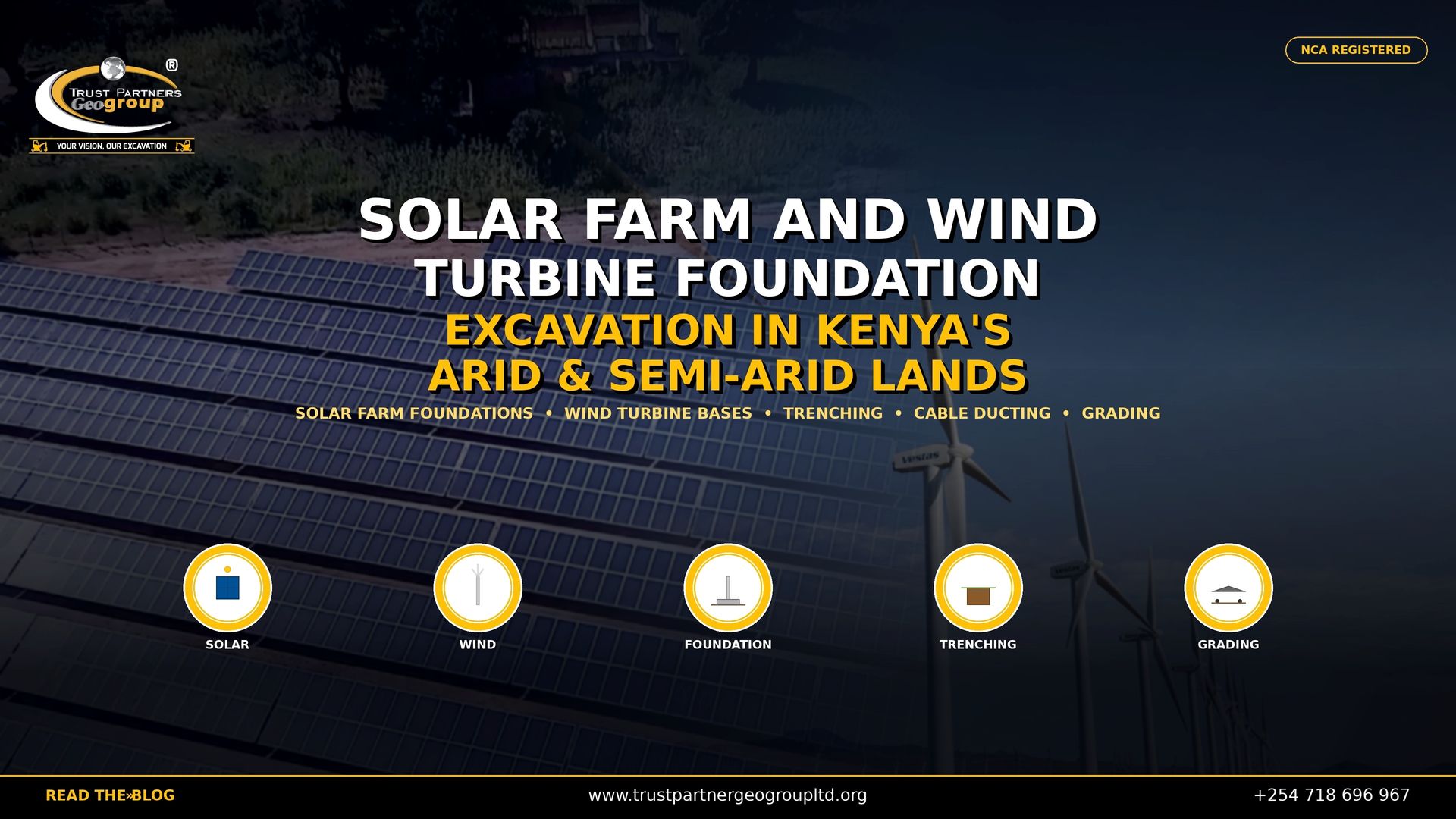
Solar Farm and Wind Turbine Foundation Excavation in Kenya's Arid and Semi-Arid Lands [2026]
Green Energy Groundworks for Kenya's Renewable Boom — Turkana to Kajiado, Marsabit to Garissa
Kenya is already a global green-energy leader — and the next decade of solar farms and wind projects will be built across the country's arid and semi-arid lands (ASALs), where the sun is strongest, the wind steadiest, and the ground most unforgiving. Every megawatt begins with earthworks: array terraces, turbine bases, access roads, cable trenches and drainage. This 2026 green energy guide covers solar farm excavation in Kenya and wind turbine foundation excavation — from Turkana wind farm earthworks to solar panel groundworks in Kajiado and Garissa — with specs, equipment, costs and compliance for developers, EPCs and IPPs. With 15+ years of excavation experience across Kenya, Trust Partners Geo-Group delivers renewable energy groundworks in all 47 counties.

Our team delivers mass earthworks, access roads and precision foundation excavation across Kenya's toughest terrains — from ASAL renewable corridors to urban infrastructure. We publish field-tested guidance so developers and EPCs can plan green energy groundworks with confidence.
1. Kenya's Renewable Energy Boom: The 2026 Landscape
Kenya's grid is already over 90% renewable, and the pipeline keeps growing:
- Wind: following Lake Turkana Wind Power (310 MW — Africa's largest wind farm at commissioning), new projects are advancing in Marsabit, Kajiado (Ngong corridor expansions), Nyandarua and the coastal hinterland. Each turbine is a major excavation event.
- Utility-scale solar: 40–150 MW plants operating or developing in Garissa, Machakos (including Konza-adjacent schemes), Kajiado, Kilifi and Turkana, with county-level and captive industrial solar multiplying fast.
- Mini-grids and captive power: factories, data centers and county projects adding 1–20 MW solar plus storage — each a complete groundworks package near Nairobi and other load centres, feeding renewable energy construction in Nairobi's industrial orbit.
- Transmission: every generation project drags evacuation lines, substations and access infrastructure behind it — more platforms, more trenches, more earthworks.
2. What Is Renewable Energy Earthworks?
Renewable energy earthworks is the complete groundworks package that converts raw rangeland into a buildable energy site: survey and geotechnics, access roads, site grading, drainage and erosion control, foundation excavation (turbine bases or inverter/substation platforms), cable trenching, and post-construction rehabilitation. Two features distinguish it from other infrastructure earthworks:
- Enormous footprints, distributed works. A 50 MW solar farm covers 80–150 hectares; a wind farm's turbines spread across kilometres. Earthworks is thousands of small, repeated operations — production discipline beats brute force.
- ESG is contractual. International lenders impose environmental and social management plans: topsoil banking, habitat protection, dust control, and full rehabilitation of borrow pits and temporary works. Your earthworks contractor is an ESG delivery partner, not just a plant supplier.
3. Solar Farm Excavation and Solar Panel Groundworks
Solar panel groundworks in Kenya follow a standard scope stack:
- Array area preparation: modern trackers tolerate gentle undulation, so grading is usually light — corridor grading for access and drainage rather than full-site levelling. Clearing, grubbing and topsoil management dominate.
- Pile foundations: mounting posts are driven steel piles (vibratory or impact drivers) — typically no excavation per pile. In rocky ground, pre-drilling with auger or DTH rigs replaces driving, and refusal mapping from geotechnics decides which zones need it.
- Inverter and substation platforms: compacted, levelled pads (±10mm) with oil-contained bunds for transformers and proper drainage falls.
- Perimeter and internal roads: 4–6m murram tracks with side drains, designed for O&M traffic and heavy delivery vehicles during construction.
- Security and water infrastructure: fence-line grading, guardhouse foundations, and water storage for construction and panel washing.
4. Wind Turbine Foundation Excavation
A modern 3–5 MW turbine base is one of the largest single excavations in civilian construction:
| Parameter | Typical Value (3–5 MW class) | Excavation Notes |
|---|---|---|
| Base diameter | 18–24 m (octagonal/circular) | Full-face excavation; benches on sloping ground |
| Foundation depth | 3–4.5 m | 400–800 m³ cut per base in soil; rock breaking where shallow geology requires |
| Formation tolerance | Level to ±10 mm | Verified by survey before blinding; anchor cage sits on this surface |
| Mass concrete | 400–700 m³ per base | Continuous pour; thermal control in ASAL heat; cube tests per pour |
| Anchor cage | 100–160 bolts, ±2–3 mm position | Set with steel template; surveyed before, during and after the pour |
| Backfill | Compacted layers over the base flange | Restores ground profile and adds overturning mass |
The geotechnical menu spans Kenya's full range — from competent volcanic rock on ridges (rock-socketed bases, similar to the tower foundation strategies in our telecom mast guide) to collapsible and expansive soils needing replacement or stabilization, as covered in our black cotton soil guide.
5. Access Roads, Crane Pads and Site Logistics
On wind projects, the roads are the project. Blade transporters (60m+ loads) and main cranes (400–650 tonne crawlers) dictate everything:
- Geometry: 6–8m running widths, widening on curves, max gradients typically 10–12%, turning platforms at difficult corners — all verified by swept-path analysis before construction.
- Pavement: compacted gravel running surface over engineered subgrade; weak sections undercut and replaced or stabilized.
- Crane hardstands: each turbine needs a pad (typically 30×50m) built to high bearing spec — often the most heavily engineered surface on site.
- Culverts and drifts: ASAL flash floods destroy unprotected roads in a single event; crossing structures follow the discipline in our road drainage solutions guide.
Solar farms need lighter roads but more of them — every array row must be reachable for panel delivery and washing. Either way, corridor construction competence, as detailed in our railway earthworks analysis, transfers directly.
6. Cable Trenching and Substation Platforms
Every renewable site is laced with buried cable:
- Solar DC/AC trenches: string cables to inverters and MV collectors to the substation — trenches 600–1,000mm deep, sand-bedded, with warning tape; a 50 MW site can carry 50–150 km of trenching. Methods mirror our pipeline and fiber trenching guide.
- Wind collector networks: MV cable rings linking turbines to the collector substation, usually trenched alongside access roads to share the disturbed corridor.
- Substation platforms: compacted terraces with switchgear foundations, control-building footings, earthing grids in trenches, oil bunds and security fencing — a small but dense civils package per site.
7. ASAL Earthworks: Water, Wind and Hostile Soils
The arid and semi-arid lands impose a distinct operating reality:
- Water scarcity: compaction and dust control need thousands of litres daily; successful contractors develop boreholes or water-pan sources early — our water pan excavation guide covers the excavation side of site water storage.
- Wind erosion: exposed formation loses fines within days; work in panels, compact and seal as you go, and never open more area than you can protect.
- Flash floods: ASAL rain arrives as violent events; diversion drains and check dams go in before bulk earthworks, not after the first washout.
- Hostile soils: expansive clays, collapsible silts and saline patches all appear in ASAL geology — geotechnical grids and honest replacement budgets are the only defence.
- Remoteness: fuel bowsers, field workshops, camps and communications are project infrastructure in their own right; logistics planning precedes machine selection.
8. Equipment Selection for Renewable Earthworks
| Machine | Typical Class | Role on Renewable Energy Sites | 2026 Hire Rate (guide) |
|---|---|---|---|
| Hydraulic excavator | 20–30 t | Turbine bases, substation platforms, trenches | KES 6,500–12,000/hr with operator |
| Bulldozer | D6–D8 | Site grading, road formation, erosion control | KES 9,000–15,000/hr |
| Motor grader | 140–180 hp | Access roads, crane pads, platform trimming | KES 7,000–10,000/hr |
| Pile driver (vibratory/impact) | Specialist | Solar mounting posts; pre-drilling in rock | Quoted per pile |
| Chain trencher | 100–250 hp | Cable collector trenches at production rates | KES 60,000–120,000/day |
| Rollers (padfoot/smooth) | 10–18 t | Road and platform compaction | KES 5,500–8,500/hr |
| Water bowsers | 10,000–20,000 L | Compaction moisture, dust control — mission-critical in ASALs | KES 35,000–60,000/day |
| Dump trucks | 25–40 t | Gravel haulage, spoil, cut-to-fill | Per-m³/per-km rates |
For rate context see our 2026 excavator hire price guide and motor grader hire guide. Renewable campaigns run 8–18 months in remote locations — our long-term hire vs. lease analysis explains why monthly packages with on-site maintenance support dominate this sector.
9. Solar & Wind Earthworks Costs: 2026 Budget Benchmarks
Indicative 2026 balance-of-plant earthworks costs (civil supply and installation of turbine/tower steel, panels and electrical works excluded):
| Scope | Unit | Indicative Cost (KES) | Key Cost Drivers |
|---|---|---|---|
| Solar farm groundworks (flat, near-road site) | per MW | 8–14 million | Clearing, internal roads, drainage, trenches |
| Solar farm groundworks (rocky/ASAL site) | per MW | 14–20 million+ | Pre-drilling, water haulage, erosion control |
| Wind turbine base excavation & civils support | per turbine | 6–14 million | Depth, rock, anchor cage setting, concrete logistics |
| Wind farm access roads (heavy-haul spec) | per km | 8–20 million | Gradient, culverts, gravel haul distance |
| Crane hardstand | per pad | 2–5 million | Bearing spec, stabilization, size |
| Cable trenching (soil) | per km | 1.2–3 million | Depth, bedding, rock sections, crossings |
| Substation platform & civils | per platform | 15–40 million | Footprint, foundations, bunds, earthing grid |
Unit rates anchor in our 2026 earthworks cost per cubic metre breakdown. On ASAL projects, add an honest logistics line — fuel, water, camp and maintenance typically add 15–30% over Nairobi-equivalent rates.
10. EPRA, NEMA and County Compliance
Renewable energy civils operate under a defined approvals framework:
- EPRA: generation licensing and technical standards for the project; electrical safety oversight.
- NEMA: full EIA licences for utility-scale projects, with binding conditions on erosion control, borrow pits, water abstraction and rehabilitation — audited through construction.
- County governments: land consents, development permission, and — critically on ASAL group ranches and community trust lands — community land agreements negotiated before any machine mobilizes.
- KCAA: obstacle assessment and aviation lighting for wind turbines, as with any tall structure near flight paths — see the airside principles in our airport excavation guide.
- NCA: contractor and project registration for the civil works — requirements summarized in our NCA registration guide.
- Kenya Power / KETRACO: grid connection works at the substation interface, with their own wayleave and switching protocols.
11. Frequently Asked Questions
How much does solar farm excavation cost per MW in Kenya?
In 2026, solar farm groundworks typically cost KES 8–20 million per MW for site preparation, access tracks, cable trenches and substation platforms. Flat sites near existing roads sit low; rocky or expansive-soil ASAL sites with long access roads and water haulage cost more.
What does a wind turbine foundation excavation involve?
Each turbine sits on a gravity base 18–24m in diameter and 3–4.5m deep — 400–800 m³ of excavation per foundation. Formation must be level to ±10mm for the anchor cage, followed by a continuous mass-concrete pour of 400–700 m³ with thermal control and cube testing.
Who does solar farm and wind turbine excavation in Kenya?
NCA-registered civil contractors with mass-earthworks fleets and remote-site logistics capability. Trust Partners Geo-Group provides solar farm excavation, turbine bases, access roads and cable trenching across Kenya's ASALs — call +254 718 686 967.
How are solar panel foundations installed in Kenya?
Most solar farms use driven steel piles installed by pile drivers — no excavation per pile. Excavation covers site grading, inverter and substation platforms, roads, cable trenches (600–1,000mm deep), drainage and erosion control. Rocky ground requires pre-drilling for the mounting posts.
What are the biggest earthworks challenges in Kenya's arid lands?
Water for compaction and dust control hauled over long distances, wind erosion of exposed formation, expansive or collapsible soils needing replacement, and remoteness — fuel, maintenance and camp logistics often cost more than the machines themselves.
How long do wind farm earthworks take per turbine?
A single turbine base takes 4–8 weeks including curing. Roads, crane pads and cable trenches run in parallel across the site. A 20-turbine wind farm's complete earthworks package typically spans 8–14 months.
What approvals are needed for solar and wind farm construction in Kenya?
EPRA licensing, NEMA environmental approval (full EIA at utility scale), county land and development consents, Kenya Power grid agreements, KCAA obstacle clearance for turbines, NCA registration — and community land agreements on ASAL group ranches and trust lands.
12. Conclusion: Earthworks for the Energy Transition
Kenya's renewable buildout will be decided in the ASALs — on terraces graded for thousands of panels, on turbine bases poured to millimetre accuracy, on roads engineered for 60-metre blades, and on trenches carrying every generated watt to the grid. The contractors who win this decade are those who master the ASAL operating reality: water logistics, erosion discipline, honest geotechnics and ESG-grade documentation.
For developers, EPCs and IPPs, the 2026 playbook is clear: commission geotechnics and water strategy before pricing, specify machine control on platforms, contract earthworks partners with remote-site capability, and treat community agreements as critical path. For related reading, see our guides to telecom tower foundation excavation for guyed, monopole and lattice bases and airport runway and apron precision grading, plus our master resource on excavation in Kenya — costs, methods and contractors.
Building Kenya's Next Solar Farm or Wind Project?
Trust Partners Geo-Group delivers NCA-compliant renewable energy earthworks — turbine bases, solar groundworks, access roads, cable trenches and substation platforms — across Turkana, Kajiado, Marsabit, Garissa and all 47 counties.
Call +254 718 686 967 Request a Free Site AssessmentSolar Farm and Wind Turbine Foundation Excavation in Kenya's Arid and Semi-Arid Lands [2026]
Green Energy Groundworks for Kenya's Renewable Boom — Turkana to Kajiado, Marsabit to Garissa
Kenya is already a global green-energy leader — and the next decade of solar farms and wind projects will be built across the country's arid and semi-arid lands (ASALs), where the sun is strongest, the wind steadiest, and the ground most unforgiving. Every megawatt begins with earthworks: array terraces, turbine bases, access roads, cable trenches and drainage. This 2026 green energy guide covers solar farm excavation in Kenya and wind turbine foundation excavation — from Turkana wind farm earthworks to solar panel groundworks in Kajiado and Garissa — with specs, equipment, costs and compliance for developers, EPCs and IPPs. With 15+ years of excavation experience across Kenya, Trust Partners Geo-Group delivers renewable energy groundworks in all 47 counties.
Our team delivers mass earthworks, access roads and precision foundation excavation across Kenya's toughest terrains — from ASAL renewable corridors to urban infrastructure. We publish field-tested guidance so developers and EPCs can plan green energy groundworks with confidence.
1. Kenya's Renewable Energy Boom: The 2026 Landscape
Kenya's grid is already over 90% renewable, and the pipeline keeps growing:
- Wind: following Lake Turkana Wind Power (310 MW — Africa's largest wind farm at commissioning), new projects are advancing in Marsabit, Kajiado (Ngong corridor expansions), Nyandarua and the coastal hinterland. Each turbine is a major excavation event.
- Utility-scale solar: 40–150 MW plants operating or developing in Garissa, Machakos (including Konza-adjacent schemes), Kajiado, Kilifi and Turkana, with county-level and captive industrial solar multiplying fast.
- Mini-grids and captive power: factories, data centers and county projects adding 1–20 MW solar plus storage — each a complete groundworks package near Nairobi and other load centres, feeding renewable energy construction in Nairobi's industrial orbit.
- Transmission: every generation project drags evacuation lines, substations and access infrastructure behind it — more platforms, more trenches, more earthworks.
2. What Is Renewable Energy Earthworks?
Renewable energy earthworks is the complete groundworks package that converts raw rangeland into a buildable energy site: survey and geotechnics, access roads, site grading, drainage and erosion control, foundation excavation (turbine bases or inverter/substation platforms), cable trenching, and post-construction rehabilitation. Two features distinguish it from other infrastructure earthworks:
- Enormous footprints, distributed works. A 50 MW solar farm covers 80–150 hectares; a wind farm's turbines spread across kilometres. Earthworks is thousands of small, repeated operations — production discipline beats brute force.
- ESG is contractual. International lenders impose environmental and social management plans: topsoil banking, habitat protection, dust control, and full rehabilitation of borrow pits and temporary works. Your earthworks contractor is an ESG delivery partner, not just a plant supplier.
3. Solar Farm Excavation and Solar Panel Groundworks
Solar panel groundworks in Kenya follow a standard scope stack:
- Array area preparation: modern trackers tolerate gentle undulation, so grading is usually light — corridor grading for access and drainage rather than full-site levelling. Clearing, grubbing and topsoil management dominate.
- Pile foundations: mounting posts are driven steel piles (vibratory or impact drivers) — typically no excavation per pile. In rocky ground, pre-drilling with auger or DTH rigs replaces driving, and refusal mapping from geotechnics decides which zones need it.
- Inverter and substation platforms: compacted, levelled pads (±10mm) with oil-contained bunds for transformers and proper drainage falls.
- Perimeter and internal roads: 4–6m murram tracks with side drains, designed for O&M traffic and heavy delivery vehicles during construction.
- Security and water infrastructure: fence-line grading, guardhouse foundations, and water storage for construction and panel washing.
4. Wind Turbine Foundation Excavation
A modern 3–5 MW turbine base is one of the largest single excavations in civilian construction:
| Parameter | Typical Value (3–5 MW class) | Excavation Notes |
|---|---|---|
| Base diameter | 18–24 m (octagonal/circular) | Full-face excavation; benches on sloping ground |
| Foundation depth | 3–4.5 m | 400–800 m³ cut per base in soil; rock breaking where shallow geology requires |
| Formation tolerance | Level to ±10 mm | Verified by survey before blinding; anchor cage sits on this surface |
| Mass concrete | 400–700 m³ per base | Continuous pour; thermal control in ASAL heat; cube tests per pour |
| Anchor cage | 100–160 bolts, ±2–3 mm position | Set with steel template; surveyed before, during and after the pour |
| Backfill | Compacted layers over the base flange | Restores ground profile and adds overturning mass |
The geotechnical menu spans Kenya's full range — from competent volcanic rock on ridges (rock-socketed bases, similar to the tower foundation strategies in our telecom mast guide) to collapsible and expansive soils needing replacement or stabilization, as covered in our black cotton soil guide.
5. Access Roads, Crane Pads and Site Logistics
On wind projects, the roads are the project. Blade transporters (60m+ loads) and main cranes (400–650 tonne crawlers) dictate everything:
- Geometry: 6–8m running widths, widening on curves, max gradients typically 10–12%, turning platforms at difficult corners — all verified by swept-path analysis before construction.
- Pavement: compacted gravel running surface over engineered subgrade; weak sections undercut and replaced or stabilized.
- Crane hardstands: each turbine needs a pad (typically 30×50m) built to high bearing spec — often the most heavily engineered surface on site.
- Culverts and drifts: ASAL flash floods destroy unprotected roads in a single event; crossing structures follow the discipline in our road drainage solutions guide.
Solar farms need lighter roads but more of them — every array row must be reachable for panel delivery and washing. Either way, corridor construction competence, as detailed in our railway earthworks analysis, transfers directly.
6. Cable Trenching and Substation Platforms
Every renewable site is laced with buried cable:
- Solar DC/AC trenches: string cables to inverters and MV collectors to the substation — trenches 600–1,000mm deep, sand-bedded, with warning tape; a 50 MW site can carry 50–150 km of trenching. Methods mirror our pipeline and fiber trenching guide.
- Wind collector networks: MV cable rings linking turbines to the collector substation, usually trenched alongside access roads to share the disturbed corridor.
- Substation platforms: compacted terraces with switchgear foundations, control-building footings, earthing grids in trenches, oil bunds and security fencing — a small but dense civils package per site.
7. ASAL Earthworks: Water, Wind and Hostile Soils
The arid and semi-arid lands impose a distinct operating reality:
- Water scarcity: compaction and dust control need thousands of litres daily; successful contractors develop boreholes or water-pan sources early — our water pan excavation guide covers the excavation side of site water storage.
- Wind erosion: exposed formation loses fines within days; work in panels, compact and seal as you go, and never open more area than you can protect.
- Flash floods: ASAL rain arrives as violent events; diversion drains and check dams go in before bulk earthworks, not after the first washout.
- Hostile soils: expansive clays, collapsible silts and saline patches all appear in ASAL geology — geotechnical grids and honest replacement budgets are the only defence.
- Remoteness: fuel bowsers, field workshops, camps and communications are project infrastructure in their own right; logistics planning precedes machine selection.
8. Equipment Selection for Renewable Earthworks
| Machine | Typical Class | Role on Renewable Energy Sites | 2026 Hire Rate (guide) |
|---|---|---|---|
| Hydraulic excavator | 20–30 t | Turbine bases, substation platforms, trenches | KES 6,500–12,000/hr with operator |
| Bulldozer | D6–D8 | Site grading, road formation, erosion control | KES 9,000–15,000/hr |
| Motor grader | 140–180 hp | Access roads, crane pads, platform trimming | KES 7,000–10,000/hr |
| Pile driver (vibratory/impact) | Specialist | Solar mounting posts; pre-drilling in rock | Quoted per pile |
| Chain trencher | 100–250 hp | Cable collector trenches at production rates | KES 60,000–120,000/day |
| Rollers (padfoot/smooth) | 10–18 t | Road and platform compaction | KES 5,500–8,500/hr |
| Water bowsers | 10,000–20,000 L | Compaction moisture, dust control — mission-critical in ASALs | KES 35,000–60,000/day |
| Dump trucks | 25–40 t | Gravel haulage, spoil, cut-to-fill | Per-m³/per-km rates |
For rate context see our 2026 excavator hire price guide and motor grader hire guide. Renewable campaigns run 8–18 months in remote locations — our long-term hire vs. lease analysis explains why monthly packages with on-site maintenance support dominate this sector.
9. Solar & Wind Earthworks Costs: 2026 Budget Benchmarks
Indicative 2026 balance-of-plant earthworks costs (civil supply and installation of turbine/tower steel, panels and electrical works excluded):
| Scope | Unit | Indicative Cost (KES) | Key Cost Drivers |
|---|---|---|---|
| Solar farm groundworks (flat, near-road site) | per MW | 8–14 million | Clearing, internal roads, drainage, trenches |
| Solar farm groundworks (rocky/ASAL site) | per MW | 14–20 million+ | Pre-drilling, water haulage, erosion control |
| Wind turbine base excavation & civils support | per turbine | 6–14 million | Depth, rock, anchor cage setting, concrete logistics |
| Wind farm access roads (heavy-haul spec) | per km | 8–20 million | Gradient, culverts, gravel haul distance |
| Crane hardstand | per pad | 2–5 million | Bearing spec, stabilization, size |
| Cable trenching (soil) | per km | 1.2–3 million | Depth, bedding, rock sections, crossings |
| Substation platform & civils | per platform | 15–40 million | Footprint, foundations, bunds, earthing grid |
Unit rates anchor in our 2026 earthworks cost per cubic metre breakdown. On ASAL projects, add an honest logistics line — fuel, water, camp and maintenance typically add 15–30% over Nairobi-equivalent rates.
10. EPRA, NEMA and County Compliance
Renewable energy civils operate under a defined approvals framework:
- EPRA: generation licensing and technical standards for the project; electrical safety oversight.
- NEMA: full EIA licences for utility-scale projects, with binding conditions on erosion control, borrow pits, water abstraction and rehabilitation — audited through construction.
- County governments: land consents, development permission, and — critically on ASAL group ranches and community trust lands — community land agreements negotiated before any machine mobilizes.
- KCAA: obstacle assessment and aviation lighting for wind turbines, as with any tall structure near flight paths — see the airside principles in our airport excavation guide.
- NCA: contractor and project registration for the civil works — requirements summarized in our NCA registration guide.
- Kenya Power / KETRACO: grid connection works at the substation interface, with their own wayleave and switching protocols.
11. Frequently Asked Questions
How much does solar farm excavation cost per MW in Kenya?
In 2026, solar farm groundworks typically cost KES 8–20 million per MW for site preparation, access tracks, cable trenches and substation platforms. Flat sites near existing roads sit low; rocky or expansive-soil ASAL sites with long access roads and water haulage cost more.
What does a wind turbine foundation excavation involve?
Each turbine sits on a gravity base 18–24m in diameter and 3–4.5m deep — 400–800 m³ of excavation per foundation. Formation must be level to ±10mm for the anchor cage, followed by a continuous mass-concrete pour of 400–700 m³ with thermal control and cube testing.
Who does solar farm and wind turbine excavation in Kenya?
NCA-registered civil contractors with mass-earthworks fleets and remote-site logistics capability. Trust Partners Geo-Group provides solar farm excavation, turbine bases, access roads and cable trenching across Kenya's ASALs — call +254 718 686 967.
How are solar panel foundations installed in Kenya?
Most solar farms use driven steel piles installed by pile drivers — no excavation per pile. Excavation covers site grading, inverter and substation platforms, roads, cable trenches (600–1,000mm deep), drainage and erosion control. Rocky ground requires pre-drilling for the mounting posts.
What are the biggest earthworks challenges in Kenya's arid lands?
Water for compaction and dust control hauled over long distances, wind erosion of exposed formation, expansive or collapsible soils needing replacement, and remoteness — fuel, maintenance and camp logistics often cost more than the machines themselves.
How long do wind farm earthworks take per turbine?
A single turbine base takes 4–8 weeks including curing. Roads, crane pads and cable trenches run in parallel across the site. A 20-turbine wind farm's complete earthworks package typically spans 8–14 months.
What approvals are needed for solar and wind farm construction in Kenya?
EPRA licensing, NEMA environmental approval (full EIA at utility scale), county land and development consents, Kenya Power grid agreements, KCAA obstacle clearance for turbines, NCA registration — and community land agreements on ASAL group ranches and trust lands.
12. Conclusion: Earthworks for the Energy Transition
Kenya's renewable buildout will be decided in the ASALs — on terraces graded for thousands of panels, on turbine bases poured to millimetre accuracy, on roads engineered for 60-metre blades, and on trenches carrying every generated watt to the grid. The contractors who win this decade are those who master the ASAL operating reality: water logistics, erosion discipline, honest geotechnics and ESG-grade documentation.
For developers, EPCs and IPPs, the 2026 playbook is clear: commission geotechnics and water strategy before pricing, specify machine control on platforms, contract earthworks partners with remote-site capability, and treat community agreements as critical path. For related reading, see our guides to telecom tower foundation excavation for guyed, monopole and lattice bases and airport runway and apron precision grading, plus our master resource on excavation in Kenya — costs, methods and contractors.
Building Kenya's Next Solar Farm or Wind Project?
Trust Partners Geo-Group delivers NCA-compliant renewable energy earthworks — turbine bases, solar groundworks, access roads, cable trenches and substation platforms — across Turkana, Kajiado, Marsabit, Garissa and all 47 counties.
Call +254 718 686 967 Request a Free Site Assessment