![WATER PAN EXCAVATION FOR DAIRY FARMING IN KENYA: SIZE, DEPTH & LINING GUIDE [2026]](https://trustpartnergeogroupltd.org/web/image/blog.post/49/author_avatar/WATER%20PAN%20EXCAVATION%20FOR%20DAIRY%20FARMING%20IN%20KENYA:%20SIZE%2C%20DEPTH%20%26%20LINING%20GUIDE%20%5B2026%5D?unique=ed7b50c)
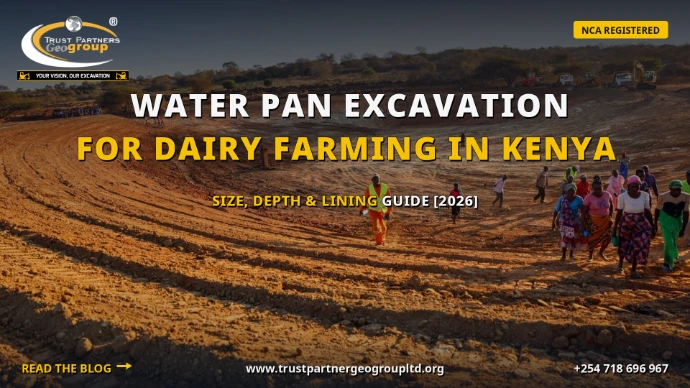
WATER PAN EXCAVATION FOR DAIRY FARMING IN KENYA: SIZE, DEPTH & LINING GUIDE [2026]
HOW TO BUILD A WATER RESERVOIR THAT KEEPS YOUR HERD HYDRATED AND YOUR FARM PROFITABLE
Table of Contents
- 1. Why Every Dairy Farm in Kenya Needs a Water Pan
- 1.1 Water Demand by Herd Size
- 1.2 Beyond Drinking: Multi-Use Water Pans
- 2. Water Pan Sizing: Matching Capacity to Herd
- 2.1 The Sizing Formula
- 2.2 Dimensional Guide by Pan Size
- 3. Excavation Depth: How Deep Should Your Water Pan Be?
- 3.1 Optimal Depth Ranges for Kenya
- 3.2 Depth Factors by Dairy Region
- 4. Side Slopes and Embankment Design
- 5. Lining Options: Keeping Water in the Pan
- 5.1 HDPE Lining: The Gold Standard
- 6. Water Pan Excavation Costs in Kenya (2026)
- 7. The Trust Partners Geo-Group Water Pan Excavation Process
- 8. Equipment Used in Water Pan Excavation
- 9. Hidden Costs and Common Mistakes
- 10. Government Programs and Financing
- 11. Frequently Asked Questions
- 12. The Bottom Line: Water Security is Herd Security

WHY EVERY DAIRY FARM IN KENYA NEEDS A WATER PAN
Kenya's dairy sector contributes approximately 4% of GDP and supports over 1.8 million smallholder farmers. Yet water scarcity remains the single biggest constraint on milk production. Here is why a water pan is non-negotiable for serious dairy operations:
WATER DEMAND BY HERD SIZE
Dairy cattle have high water requirements that fluctuate with milk yield, temperature, and feed type. During Kenya's dry seasons (January-March and July-October), natural water sources often dwindle to nothing.
| HERD SIZE | DAILY WATER NEED (LITERS) | ANNUAL WATER NEED (M3) | RECOMMENDED PAN VOLUME |
|---|---|---|---|
| 10 cows (smallholder) | 600-1,000 | 220-365 | 500-1,000 m3 |
| 50 cows (medium farm) | 3,000-5,000 | 1,100-1,825 | 2,000-3,000 m3 |
| 100 cows (commercial) | 6,000-10,000 | 2,200-3,650 | 4,000-6,000 m3 |
| 300 cows (large dairy) | 18,000-30,000 | 6,600-10,950 | 12,000-18,000 m3 |
| 500+ cows (industrial) | 30,000-50,000+ | 11,000-18,250+ | 20,000-50,000 m3 |
Note: Pan volume should be 1.5-2x annual need to account for evaporation (15-25% in Kenya), seepage, and emergency reserves.
BEYOND DRINKING: MULTI-USE WATER PANS
Modern dairy water pans serve multiple purposes beyond livestock drinking:
- Dairy hygiene: Milking parlor cleaning, equipment washdown, and udder washing (adds 20-30% to water demand)
- Fodder irrigation: Napier grass, lucerne, and oat production require 500-1,500 liters per m2 per season
- Biogas cooling: Dairy biogas digesters need consistent water input for optimal methane production
- Fire protection: Farm infrastructure and hay storage fire suppression reserve
- Aquaculture integration: Tilapia farming in water pans generates secondary income (KES 200-400/kg)
THE DRY SEASON REALITY CHECK
In Kenya's dairy heartlands - Nakuru, Kiambu, Nyandarua, and Uasin Gishu - rivers and shallow wells often dry up completely during drought months. Farmers without water pans face a cruel choice: buy water at KES 20-50 per 20-liter jerrycan (unsustainable at commercial scale) or reduce herd size. A water pan built during the wet season pays for itself in the first dry season it prevents a production collapse.
WATER PAN SIZING: THE SCIENCE OF MATCHING CAPACITY TO HERD
Getting the size wrong is expensive. Too small, and you run dry. Too large, and you waste capital on unnecessary excavation and lining. Here is how to calculate the right size for your dairy farm:
THE SIZING FORMULA
REQUIRED PAN VOLUME = (DAILY DEMAND x DRY DAYS x SAFETY FACTOR) / (1 - EVAPORATION LOSS)
Where:
- Daily demand: 80-100 liters per cow per day (include 25% for dairy operations)
- Dry days: 120-180 days (Kenya's dry season duration varies by region)
- Safety factor: 1.5 (accounts for seepage, unexpected drought extension, and farm expansion)
- Evaporation loss: 15-25% annually (higher in hot, windy areas like Nakuru and Laikipia)
Example: 100-cow farm in Nakuru
Volume = (100 cows x 100 L/day x 150 days x 1.5) / 0.80 = 2,812,500 liters = 2,813 m3 minimum
Recommended design volume: 4,000-5,000 m3 (with 1.5-2x safety margin for full annual coverage)
DIMENSIONAL GUIDE BY PAN SIZE
Water pans are typically rectangular or trapezoidal in shape. The dimensions below assume a standard 3:2 length-to-width ratio with 1:2 side slopes (horizontal:vertical) and a 3-meter maximum depth:
| PAN SIZE | SURFACE AREA (M2) | AVG DEPTH | LENGTH x WIDTH (TOP) | SUITS HERD SIZE | EXCAVATION VOLUME |
|---|---|---|---|---|---|
| Small (500 m3) | 300-400 | 1.5-2.0 m | 25m x 15m | 10-20 cows | 650-800 m3 |
| Medium (2,000 m3) | 800-1,000 | 2.0-2.5 m | 45m x 30m | 50-80 cows | 2,500-3,200 m3 |
| Large (5,000 m3) | 1,800-2,200 | 2.5-3.0 m | 70m x 45m | 100-200 cows | 7,000-8,500 m3 |
| Commercial (15,000 m3) | 5,000-6,000 | 2.5-3.5 m | 120m x 80m | 300-500 cows | 20,000-25,000 m3 |
| Industrial (30,000+ m3) | 10,000+ | 3.0-4.0 m | 180m x 120m | 500+ cows | 45,000-55,000 m3 |
Excavation volume exceeds storage volume because side slopes, embankment compaction, and freeboard add 30-50% to the excavated quantity.
EXCAVATION DEPTH: HOW DEEP SHOULD YOUR WATER PAN BE?
Depth is the most critical design parameter after size. It determines storage capacity, water temperature, evaporation rates, and structural stability. Get it wrong, and your pan cracks, leaks, or becomes a breeding ground for mosquitoes.
OPTIMAL DEPTH RANGES FOR KENYA
| DEPTH RANGE | BEST FOR | PROS | CONS | EXCAVATION COST/M3 |
|---|---|---|---|---|
| Shallow (1.0-1.5 m) | Small farms, high water table areas | Low cost, easy excavation, minimal dewatering | High evaporation, algae growth, warm water, limited capacity | KES 250-400 |
| Medium (1.5-2.5 m) | Medium farms, most soil types | Balanced cost-capacity, cooler water, manageable excavation | May need dewatering in wet seasons | KES 350-550 |
| Deep (2.5-3.5 m) | Commercial farms, dry regions | Maximum capacity, cool water, low evaporation, stable temperatures | Higher excavation cost, possible rock, dewatering essential | KES 500-800 |
| Very Deep (3.5-5.0 m) | Large reservoirs, specific geology | Industrial capacity, year-round reliability | Expensive, complex shoring, high dewatering costs | KES 800-1,500 |
DEPTH FACTORS SPECIFIC TO KENYA'S DAIRY REGIONS
Different regions present different depth challenges:
- Nakuru & Rift Valley: Volcanic soils with murram at 1-3m depth. Pans can be excavated to 3m without rock in most areas. Water table is deep (5-15m), so dewatering is rarely needed.
- Kiambu & Central Highlands: Red volcanic soils, excellent for pan construction. Depths of 2.5-3m are standard. Some areas have weathered rock at 2-4m requiring breaking.
- Nyandarua & Nyahururu: High altitude (2,000m+), cold climate reduces evaporation but soils can be waterlogged. Depths of 2-2.5m are optimal. Dewatering may be needed during excavation.
- Uasin Gishu (Eldoret): Black cotton soil and volcanic mix. Requires careful slope design (1:2.5 or gentler) to prevent embankment collapse. Maximum practical depth: 2.5m without extensive ground improvement.
- Laikipia & Baringo: Sandy soils with high permeability. Depths of 3m+ are needed to reduce surface-area-to-volume ratio and minimize seepage. Lining is absolutely mandatory.
- Coastal Region (Kwale, Kilifi): Coral rock and sandy soils. Shallow pans (1.5-2m) are standard due to high water table and rock proximity. Lining is critical.
THE FREEBOARD RULE
Always add 0.5-0.75 meters of freeboard (height above maximum water level) to your pan design. This prevents overflow during heavy rains, protects the embankment from wave erosion, and provides a safety margin for unexpected inflow. A pan designed for 3m depth should be excavated to 3.5-3.75m total depth.
SIDE SLOPES AND EMBANKMENT DESIGN
The angle of your pan's walls determines structural integrity, excavation volume, and long-term maintenance. Too steep, and the walls collapse. Too gentle, and you waste land and excavation budget.
SLOPE RATIOS BY SOIL TYPE
| SOIL TYPE | RECOMMENDED SLOPE (H:V) | MAX DEPTH | EMBANKMENT TREATMENT |
|---|---|---|---|
| Clay / Black Cotton Soil | 1:2.5 to 1:3 | 2.0 m | Compacted clay core, grass cover, toe drain |
| Red Volcanic Soil (Murram) | 1:2 to 1:2.5 | 3.0 m | Compacted embankment, grass cover, rock riprap at toe |
| Sandy Soil | 1:3 to 1:4 | 2.0 m | Geotextile reinforcement, grass cover, HDPE lining |
| Lateritic Soil | 1:2 to 1:2.5 | 2.5 m | Compacted embankment, grass cover |
| Rocky / Weathered Rock | 1:1.5 to 1:2 | 3.0 m | Shotcrete or concrete facing, rock bolting if needed |
EMBANKMENT CONSTRUCTION BEST PRACTICES
The excavated material forms the embankment (dam wall) that contains the water. Poor embankment construction is the leading cause of water pan failure in Kenya:
- Layered compaction: Build the embankment in 200-300mm layers, compacting each layer to 95% of maximum dry density (Proctor test standard)
- Clay core: For pans in sandy or permeable soils, construct a central clay core (minimum 1m width) within the embankment to prevent seepage through the wall
- Cutoff trench: Excavate a trench (1m wide x 1m deep) along the centerline of the embankment foundation, fill with compacted clay or concrete, to block under-seepage
- Grass cover: Plant drought-resistant grass (Kikuyu, Rhodes, or Star grass) on embankment slopes to prevent erosion. Never leave bare soil.
- Toe drain: Install a gravel drain at the downstream toe of the embankment to relieve pore water pressure and prevent piping failure
- Spillway: Every pan needs an emergency spillway (minimum 3m wide) with rock or concrete lining to handle flood inflows without overtopping the embankment
LINING OPTIONS: KEEPING WATER IN THE PAN
Unlined water pans in Kenya lose 30-50% of stored water to seepage within the first year. Lining is not optional for commercial dairy operations - it is an investment that pays back in 2-4 years through water savings alone.
LINING COMPARISON TABLE
| LINING TYPE | COST (KES/M2) | LIFESPAN | SEEPAGE REDUCTION | BEST FOR | DRAWBACKS |
|---|---|---|---|---|---|
| Compacted Clay (Natural) | 150-300 | 5-10 years | 60-70% | Clay-rich soils, small pans, low budget | Cracks in dry season, requires maintenance, labor-intensive |
| HDPE Geomembrane (0.5mm) | 400-600 | 15-20 years | 95-98% | Medium pans, most soil types, commercial farms | Puncture risk, needs geotextile underlay, UV degradation if exposed |
| HDPE Geomembrane (1.0mm) | 700-1,000 | 20-30 years | 98-99% | Large commercial pans, rocky soils, long-term investment | Higher upfront cost, requires skilled installation |
| Reinforced Concrete (100mm) | 2,500-4,000 | 30-50 years | 99%+ | Small pans, high-value applications, permanent structures | Very expensive, cracks if foundation moves, limited to small areas |
| Soil Cement (10% cement) | 800-1,200 | 10-15 years | 80-85% | Medium pans, murram soils, intermediate budget | Requires careful mixing and curing, may crack |
| Bentonite Clay Mat | 1,200-1,800 | 15-25 years | 90-95% | Difficult access, irregular shapes, self-healing property | Expensive, limited suppliers in Kenya, swelling issues if dry |
HDPE LINING: THE GOLD STANDARD FOR DAIRY FARMS
High-Density Polyethylene (HDPE) geomembrane is the most popular lining choice for commercial dairy water pans in Kenya. Here is why:
- Impermeability: HDPE has a permeability coefficient of less than 10^-13 cm/s - essentially watertight
- Chemical resistance: Resistant to algae, bacteria, and agricultural chemicals
- UV stability: Additives prevent degradation from Kenya's intense equatorial sun
- Flexibility: Adapts to minor ground settlement without cracking
- Cost efficiency: At KES 400-1,000/m2 installed, it delivers the best cost-per-liter-of-water-saved ratio
HDPE LINING INSTALLATION CHECKLIST
- Subgrade preparation: Remove all rocks, roots, and sharp objects. Grade to smooth surface with +/-50mm tolerance.
- Geotextile underlay: Install 200g/m2 non-woven geotextile fabric to protect HDPE from puncture. Cost: KES 80-120/m2.
- Panel layout: HDPE comes in rolls (typically 7m wide). Plan panel layout to minimize seams. Seams are the weakest point.
- Welding: Use double-track hot wedge welding for all seams. Test every seam with air pressure (minimum 0.5 bar for 5 minutes). Failed seams must be re-welded.
- Anchor trench: Bury HDPE edges in a 500mm x 500mm anchor trench around the pan perimeter, backfilled with compacted soil.
- Protection layer: Cover HDPE with 100-200mm of sand or geotextile to protect from UV and animal damage.
- Water testing: Fill pan gradually (first 300mm, hold 48 hours, check for leaks). Repair any punctures with HDPE patch welding.
Critical: Never install HDPE during rainy season. Wet subgrade causes wrinkles, poor welding, and premature failure. Schedule installation for January-February or June-July dry periods.
THE COW-TRAMPLING PROBLEM
Direct livestock access to lined water pans destroys HDPE within months. Cattle hooves puncture liners, and their weight causes liner displacement. Always install a concrete drinking trough or gravel-protected access ramp connected to the pan via a pipe. The pan itself should be fenced off with a gravity-fed drinking system. This simple addition (KES 50,000-150,000) extends liner life by 10+ years.
WATER PAN EXCAVATION COSTS IN KENYA (2026)
Excavation is the largest single cost component of water pan construction, typically representing 40-60% of the total project budget. Costs vary by soil type, depth, access, and region.
EXCAVATION COST BREAKDOWN
| COST COMPONENT | SOFT SOIL | MEDIUM ROCK | HARD ROCK |
|---|---|---|---|
| Site clearance & bush removal | KES 50-80/m2 | KES 50-80/m2 | KES 50-80/m2 |
| Topsoil stripping (150-300mm) | KES 70-100/m2 | KES 70-100/m2 | KES 70-100/m2 |
| Bulk excavation (soft soil/murram) | KES 250-400/m3 | N/A | N/A |
| Rock breaking (hydraulic hammer) | N/A | KES 1,200-2,000/m3 | KES 2,000-3,500/m3 |
| Spoil disposal (off-site) | KES 200-400/m3 | KES 200-400/m3 | KES 200-400/m3 |
| Embankment construction (compaction) | KES 300-500/m3 | KES 300-500/m3 | KES 300-500/m3 |
| Dewatering (if required) | KES 80K-200K/month | KES 80K-200K/month | KES 80K-200K/month |
| Cutoff trench excavation | KES 400-600/m3 | KES 400-600/m3 | KES 400-600/m3 |
TOTAL PROJECT COSTS BY PAN SIZE
These estimates include excavation, embankment, lining, spillway, inlet works, and fencing:
| PAN SIZE | SOFT SOIL (MURRAM) | MEDIUM ROCK | SANDY SOIL (LINING REQUIRED) |
|---|---|---|---|
| 500 m3 (10-20 cows) | KES 150K-250K | KES 250K-400K | KES 300K-450K |
| 2,000 m3 (50-80 cows) | KES 500K-800K | KES 800K-1.2M | KES 1.0M-1.5M |
| 5,000 m3 (100-200 cows) | KES 1.0M-1.6M | KES 1.6M-2.5M | KES 2.0M-3.0M |
| 15,000 m3 (300-500 cows) | KES 2.5M-4.0M | KES 4.0M-6.5M | KES 5.0M-7.5M |
| 30,000+ m3 (500+ cows) | KES 5.0M-8.0M | KES 8.0M-12M | KES 10M-15M |
REGIONAL COST VARIATIONS
Labor rates, equipment availability, and transport costs create regional price differences:
| REGION | SOIL CHARACTERISTICS | EXCAVATION COST/M3 | LINING COST/M2 | NOTES |
|---|---|---|---|---|
| Nakuru | Red volcanic soil, murram | KES 250-400 | KES 400-700 | Good soils, moderate costs, high dairy concentration |
| Kiambu / Thika | Red soil, occasional rock | KES 300-500 | KES 450-750 | Near Nairobi, higher labor costs, good equipment access |
| Nyandarua / Nyahururu | Volcanic soil, high rainfall | KES 280-450 | KES 400-700 | Wet excavation conditions, dewatering common |
| Uasin Gishu (Eldoret) | Black cotton + volcanic mix | KES 350-550 | KES 500-800 | Ground improvement needed, gentler slopes |
| Laikipia / Baringo | Sandy, high permeability | KES 300-500 | KES 600-900 | Lining mandatory, HDPE with geotextile essential |
| Kericho / Bomet | Red loam, good drainage | KES 250-400 | KES 400-650 | Excellent pan soils, moderate costs |
| Coastal (Kwale, Kilifi) | Coral rock, sand | KES 400-700 | KES 700-1,000 | Shallow rock, high water table, expensive lining |
THE TRUST PARTNERS GEO-GROUP WATER PAN EXCAVATION PROCESS
At Trust Partners Geo-Group Ltd, we specialize in dam and water pan excavation across Kenya's dairy regions. Our process ensures your water pan is built to last:
PHASE 1: SITE ASSESSMENT & FEASIBILITY
- Topographical survey: We map the site to determine optimal pan location, catchment area, and spillway alignment
- Soil investigation: Test pits and laboratory analysis (Atterberg limits, particle size, permeability) to determine soil suitability and lining requirements
- Hydrological assessment: Calculate catchment runoff, expected inflow, and design storm events to size the pan and spillway correctly
- Environmental screening: NEMA compliance check, wetland buffer assessment, and erosion control planning
PHASE 2: EXCAVATION & EARTHWORKS
- Site preparation: Clear vegetation, strip topsoil, and establish access roads and stockpile areas
- Precision excavation: Using GPS-guided excavators and motor graders to achieve exact design depths, slopes, and dimensions
- Groundwater management: Dewatering systems (wellpoints, sump pumps) where needed to keep excavation dry and safe
- Rock breaking: Hydraulic hammers and chemical agents for medium to hard rock encountered during excavation
- Spoil management: On-site stockpiling for embankment construction or compliant off-site disposal
PHASE 3: EMBANKMENT & STRUCTURAL WORKS
- Layered embankment construction: 200-300mm lifts compacted to 95% Proctor density with vibrating rollers
- Clay core installation: Central impermeable core for sandy or permeable soil conditions
- Cutoff trench: Excavated and backfilled with compacted clay or concrete to block under-seepage
- Spillway construction: Rock-lined or concrete spillway with adequate capacity for design flood events
- Inlet and outlet works: Screened inlet to prevent debris, pipe outlet with valve control for water distribution
PHASE 4: LINING & FINISHING
- Subgrade preparation: Final grading, removal of all sharp objects, and acceptance testing
- Geotextile placement: Non-woven geotextile underlay for HDPE protection
- HDPE installation: Panel layout, welding, air-pressure testing of all seams, and anchor trench backfill
- Protection layer: Sand or geotextile cover to protect HDPE from UV and mechanical damage
- Water testing: Gradual filling, leak detection, and 48-hour hold test before handover
- Grassing and fencing: Embankment grass cover and livestock-proof fencing with gated access
- TRUST PARTNERS GEO-GROUP LTD
EQUIPMENT USED IN WATER PAN EXCAVATION
The right equipment ensures speed, precision, and cost control. At Trust Partners Geo-Group, we deploy specialized machinery for each phase:
| EQUIPMENT | APPLICATION | PRODUCTIVITY | DAILY HIRE (KES) |
|---|---|---|---|
| 20-Ton Excavator | Small to medium pans, precise digging, slope finishing | 80-120 m3/day | 35,000-50,000 |
| 30-Ton Excavator | Medium to large pans, bulk excavation, rock breaking | 150-250 m3/day | 50,000-70,000 |
| 50-Ton Excavator | Large commercial pans, heavy rock, deep excavation | 300-500 m3/day | 80,000-120,000 |
| Bulldozer (CAT D6/D7) | Site clearing, spoil pushing, embankment grading | 200-400 m3/day | 45,000-65,000 |
| Motor Grader | Final grade control, slope finishing, access roads | 1,000-2,000 m2/day | 35,000-50,000 |
| Dump Trucks (20-ton) | Spoil haulage, material import, embankment fill | 150-250 m3/day | 15,000-22,000/unit |
| Vibrating Roller (12-ton) | Embankment compaction, subgrade preparation | 800-1,500 m2/day | 25,000-35,000 |
| Backhoe Loader (JCB 3CX) | Trenching, cutoff trenches, pipe installation | 40-60 m3/day | 20,000-30,000 |
| Hydraulic Hammer | Rock breaking, medium to hard rock excavation | 20-40 m3/day | 15,000-25,000 (attachment) |
All equipment available for hire with or without certified operators. Contact us for fleet sizing and package rates.
HIDDEN COSTS AND COMMON MISTAKES
These oversights add 20-40% to project budgets and can ruin a water pan:
| MISTAKE / HIDDEN COST | TYPICAL COST | CONSEQUENCE | PREVENTION |
|---|---|---|---|
| No soil testing | KES 15,000-30,000 (skipped) | Unexpected rock, black cotton soil, or high permeability; project delays and cost overruns | Always conduct test pits and lab analysis before design |
| Inadequate spillway | KES 50,000-150,000 (undersized) | Overtopping and embankment breach during first heavy rain | Design spillway for 100-year storm event minimum |
| Poor compaction | KES 100,000-300,000 (rework) | Embankment settlement, cracks, and piping failure within 2-3 years | 95% Proctor density, 200mm lifts, proper moisture control |
| HDPE without geotextile | KES 80-120/m2 (skipped) | Puncture and liner failure within 1-2 years | Never skip geotextile underlay - it is 10% of liner cost but prevents 100% of puncture failures |
| No cutoff trench | KES 50,000-100,000 (skipped) | Under-seepage through embankment foundation causes piping and collapse | Mandatory for all pans on permeable soils |
| Wrong slope angle | KES 200,000-500,000 (re-excavation) | Wall collapse during wet season, liner damage, safety hazard | Follow soil-specific slope ratios; never exceed 1:2 on clay soils |
| No livestock exclusion | KES 50,000-150,000 (fencing/trough) | HDPE liner destroyed, water contaminated, embankment eroded | Fence the pan; install gravity-fed drinking trough |
| Ignoring evaporation | 15-25% annual water loss | Pan runs dry before end of dry season | Design for 1.5-2x calculated need; deeper pans reduce surface area |
| Seasonal timing error | 2-4 week delays | Excavation in wet season causes waterlogging, liner installation failure | Schedule excavation for dry season; liner installation in driest months |
GOVERNMENT PROGRAMS AND FINANCING FOR WATER PANS
Kenyan dairy farmers can access several programs to reduce water pan construction costs:
- National Irrigation Authority (NIA): Subsidized water pan construction in ASAL counties. Covers 30-50% of construction cost for qualifying farmers. Apply through county agricultural offices.
- County Government Programs: Nakuru, Kiambu, Uasin Gishu, and Nyandarua counties offer water pan construction grants for registered dairy cooperatives. Check with your county department of agriculture.
- World Bank Kenya Climate-Smart Agriculture Project (KCSAP): Funding for climate-resilient water infrastructure including water pans, lined reservoirs, and drip irrigation. Targeted at smallholder farmers in 24 counties.
- Cooperative Bank & Equity Bank: Dairy-specific loan products with 12-24 month grace periods for water infrastructure. Collateralized by land title or cooperative guarantee.
- Kenya Dairy Board (KDB) Matching Grants: For cooperatives and medium-scale farms investing in cooling and water infrastructure. Up to KES 500,000 matching grant available.
Tip: Combine grant funding with professional excavation contractors to maximize quality. Cheap, unskilled excavation often costs more in repairs and reconstruction than hiring a professional from day one.
FREQUENTLY ASKED QUESTIONS: WATER PANS FOR DAIRY FARMING
How long does water pan excavation take?
Small pans (500 m3): 3-5 days with one excavator and dump trucks. Medium pans (2,000-5,000 m3): 2-4 weeks. Large commercial pans (15,000+ m3): 6-12 weeks. Rock, dewatering, and wet weather can extend timelines by 30-50%. Lining installation adds 3-7 days depending on size and weather.
Can I build a water pan on black cotton soil?
Yes, but with precautions. Black cotton soil is expansive - it swells when wet and shrinks when dry, causing cracks in liners and embankments. Solutions: (1) Excavate 500mm deeper and replace with compacted murram or gravel sub-base; (2) Use gentler slopes (1:3 or flatter); (3) Install HDPE liner with extra geotextile protection; (4) Avoid soil-cement lining - it cracks. Always consult a geotechnical engineer for black cotton soil sites.
How do I prevent algae in my water pan?
Algae thrive in warm, shallow, nutrient-rich water. Prevention: (1) Design for minimum 2m depth to keep water cool; (2) Install HDPE liner (dark color reduces light penetration); (3) Fence to prevent livestock defecation in the pan; (4) Add copper sulfate treatment (0.5-1.0 ppm) if algae persist; (5) Maintain 20% water turnover monthly. Never use chlorine - it taints milk flavor and harms cattle.
What is the best time of year to excavate a water pan?
Dry season - January to March or June to August in most of Kenya. Benefits: Firm ground for equipment access, minimal dewatering, ideal conditions for HDPE welding (dry subgrade), and completion before the next rainy season for initial filling. Excavating during rains turns your site into a mud pit and doubles costs.
How much does a geotechnical survey cost for a water pan?
Basic soil investigation for a small to medium water pan: KES 30,000-80,000. Includes 2-3 test pits, soil sampling, laboratory testing (Atterberg limits, particle size, permeability), and a foundation recommendation report. For large commercial pans: KES 100,000-250,000 with boreholes and detailed hydrological analysis. This is the cheapest insurance against project failure.
Can I use excavated soil for the embankment?
Yes - in fact, you should. Using on-site material reduces disposal costs by 30-50% and ensures the embankment material matches the foundation soil. However: (1) Topsoil (organic layer) must be stripped and stockpiled separately - it cannot be used in the embankment; (2) Rocky material larger than 150mm must be broken or removed; (3) Soil moisture must be within 2% of optimum for compaction; (4) If excavated soil is too sandy or too clayey, import suitable material (KES 800-1,200/m3) for the embankment core.
Do I need NEMA approval for a water pan?
Small farm water pans (under 5,000 m3) typically do not require full NEMA EIA if they are not in wetlands, riparian zones, or protected areas. However: (1) Always check with your county environmental officer; (2) Pans over 5,000 m3 or in sensitive areas require NEMA registration; (3) All pans should follow best practice: buffer zones from watercourses, erosion control, and no discharge of sediment into natural water bodies. At Trust Partners Geo-Group, we handle all environmental compliance as part of our service.
How do I calculate the catchment area needed to fill my pan?
Use the rational method: Catchment Area (ha) = Pan Volume (m3) / (Runoff Coefficient x Design Rainfall (mm)). For Kenya's dairy highlands: Runoff coefficient = 0.15-0.30 (pasture/grassland). Design rainfall = 50-75mm (1-in-10-year storm for initial filling). Example: A 5,000 m3 pan needs 5,000 / (0.20 x 60) = 417 hectares of catchment. If your farm is smaller, you need a larger catchment, roof harvesting, or a borehole/piped supply supplement.
What maintenance does a water pan require?
Annual maintenance: (1) Inspect embankment for cracks, erosion, and animal burrows - repair immediately; (2) Check spillway for blockage and erosion; (3) Inspect HDPE liner for punctures or seam separation - patch as needed; (4) Remove sediment buildup (expect 50-100mm/year) - desilt every 3-5 years; (5) Maintain grass cover on embankments - reseed bare patches; (6) Service inlet screens and outlet valves; (7) Test water quality quarterly. Budget KES 30,000-100,000/year for maintenance depending on pan size.
Is a water pan better than a borehole for dairy farming?
They serve different purposes. Boreholes provide year-round water but have high upfront costs (KES 500K-2M for drilling and equipping) and ongoing electricity/fuel costs. Water pans capture seasonal rainfall for dry-season storage at lower cost per liter but require land and are vulnerable to drought if undersized. The best solution for commercial dairies: both - a borehole for baseline supply and a water pan for seasonal storage and cost buffering. See our companion guide: Borehole Drilling vs. Water Pan Excavation: Which is Better for Your Farm?
THE BOTTOM LINE: WATER SECURITY IS HERD SECURITY
In Kenya's dairy sector, water is the difference between a thriving commercial operation and a struggling smallholding. A properly excavated, lined, and maintained water pan delivers:
- Production stability: Consistent water supply maintains milk yield through dry seasons (15-30% production drop without adequate water)
- Cost predictability: Eliminates emergency water purchases at 5-10x normal cost during drought
- Herd health: Clean, cool water reduces heat stress and waterborne disease
- Farm expansion capacity: Water infrastructure enables herd growth from 50 to 500+ cows
- Asset value: A well-built water pan adds KES 500K-5M+ to farm property value
- Climate resilience: Drought-proofing that protects against increasingly erratic rainfall patterns
The cost of a water pan - KES 150,000 to KES 2,000,000+ depending on size - is recovered within 2-4 years through water savings, production stability, and avoided emergency costs. For a 100-cow dairy farm producing 2,000 liters of milk daily, a single dry-season production collapse (30% yield drop for 3 months) costs KES 540,000 in lost revenue. A KES 1,000,000 water pan prevents this loss repeatedly for 20+ years.
At Trust Partners Geo-Group Ltd, we build water pans that outlast the mortgages. From smallholder 500 m3 reservoirs in Kericho to 30,000 m3 commercial systems in Nakuru, we deliver precision excavation, professional lining, and embankment construction that meets Kenyan engineering standards and NEMA environmental requirements. Our equipment fleet - excavators, bulldozers, graders, and compactors - is available for direct hire or as part of a turnkey water pan construction package.
- TRUST PARTNERS GEO-GROUP LTD
READY TO BUILD YOUR DAIRY FARM WATER PAN?
Trust Partners Geo-Group provides complete water pan excavation, lining, and embankment construction across Kenya's dairy regions. Contact us for a free site assessment, hydrological analysis, and detailed quotation.
CALL +254 718 68 69 67 EMAIL US VISIT OUR WEBSITE
NAIROBI HQ | SERVING NAKURU, KIAMBU, NYANDARUA, UASIN GISHU, KERICHO, BOMET, LAIKIPIA, ELDORET, THIKA, NYERI, MERU, EMBU & NATIONWIDE
MON - SAT: 8:00 AM - 6:00 PM | 24/7 EMERGENCY SUPPORT
RELATED RESOURCES
TRUST PARTNERS GEO-GROUP LTD | YOUR VISION, OUR EXCAVATION
WEBSITE: WWW.TRUSTPARTNERGEOGROUPLTD.ORG | EMAIL: INFO@TRUSTPARTNERGEOGROUPLTD.ORG | PHONE: +254 718 68 69 67
FOLLOW US: FACEBOOK | TIKTOK | INSTAGRAM | YOUTUBE | LINKEDIN
© 2026 TRUST PARTNERS GEO-GROUP LTD. ALL RIGHTS RESERVED.
WATER PAN EXCAVATION FOR DAIRY FARMING IN KENYA: SIZE, DEPTH & LINING GUIDE [2026]
HOW TO BUILD A WATER RESERVOIR THAT KEEPS YOUR HERD HYDRATED AND YOUR FARM PROFITABLE
Table of Contents
- 1. Why Every Dairy Farm in Kenya Needs a Water Pan
- 1.1 Water Demand by Herd Size
- 1.2 Beyond Drinking: Multi-Use Water Pans
- 2. Water Pan Sizing: Matching Capacity to Herd
- 2.1 The Sizing Formula
- 2.2 Dimensional Guide by Pan Size
- 3. Excavation Depth: How Deep Should Your Water Pan Be?
- 3.1 Optimal Depth Ranges for Kenya
- 3.2 Depth Factors by Dairy Region
- 4. Side Slopes and Embankment Design
- 5. Lining Options: Keeping Water in the Pan
- 5.1 HDPE Lining: The Gold Standard
- 6. Water Pan Excavation Costs in Kenya (2026)
- 7. The Trust Partners Geo-Group Water Pan Excavation Process
- 8. Equipment Used in Water Pan Excavation
- 9. Hidden Costs and Common Mistakes
- 10. Government Programs and Financing
- 11. Frequently Asked Questions
- 12. The Bottom Line: Water Security is Herd Security
WHY EVERY DAIRY FARM IN KENYA NEEDS A WATER PAN
Kenya's dairy sector contributes approximately 4% of GDP and supports over 1.8 million smallholder farmers. Yet water scarcity remains the single biggest constraint on milk production. Here is why a water pan is non-negotiable for serious dairy operations:
WATER DEMAND BY HERD SIZE
Dairy cattle have high water requirements that fluctuate with milk yield, temperature, and feed type. During Kenya's dry seasons (January-March and July-October), natural water sources often dwindle to nothing.
| HERD SIZE | DAILY WATER NEED (LITERS) | ANNUAL WATER NEED (M3) | RECOMMENDED PAN VOLUME |
|---|---|---|---|
| 10 cows (smallholder) | 600-1,000 | 220-365 | 500-1,000 m3 |
| 50 cows (medium farm) | 3,000-5,000 | 1,100-1,825 | 2,000-3,000 m3 |
| 100 cows (commercial) | 6,000-10,000 | 2,200-3,650 | 4,000-6,000 m3 |
| 300 cows (large dairy) | 18,000-30,000 | 6,600-10,950 | 12,000-18,000 m3 |
| 500+ cows (industrial) | 30,000-50,000+ | 11,000-18,250+ | 20,000-50,000 m3 |
Note: Pan volume should be 1.5-2x annual need to account for evaporation (15-25% in Kenya), seepage, and emergency reserves.
BEYOND DRINKING: MULTI-USE WATER PANS
Modern dairy water pans serve multiple purposes beyond livestock drinking:
- Dairy hygiene: Milking parlor cleaning, equipment washdown, and udder washing (adds 20-30% to water demand)
- Fodder irrigation: Napier grass, lucerne, and oat production require 500-1,500 liters per m2 per season
- Biogas cooling: Dairy biogas digesters need consistent water input for optimal methane production
- Fire protection: Farm infrastructure and hay storage fire suppression reserve
- Aquaculture integration: Tilapia farming in water pans generates secondary income (KES 200-400/kg)
THE DRY SEASON REALITY CHECK
In Kenya's dairy heartlands - Nakuru, Kiambu, Nyandarua, and Uasin Gishu - rivers and shallow wells often dry up completely during drought months. Farmers without water pans face a cruel choice: buy water at KES 20-50 per 20-liter jerrycan (unsustainable at commercial scale) or reduce herd size. A water pan built during the wet season pays for itself in the first dry season it prevents a production collapse.
WATER PAN SIZING: THE SCIENCE OF MATCHING CAPACITY TO HERD
Getting the size wrong is expensive. Too small, and you run dry. Too large, and you waste capital on unnecessary excavation and lining. Here is how to calculate the right size for your dairy farm:
THE SIZING FORMULA
REQUIRED PAN VOLUME = (DAILY DEMAND x DRY DAYS x SAFETY FACTOR) / (1 - EVAPORATION LOSS)
Where:
- Daily demand: 80-100 liters per cow per day (include 25% for dairy operations)
- Dry days: 120-180 days (Kenya's dry season duration varies by region)
- Safety factor: 1.5 (accounts for seepage, unexpected drought extension, and farm expansion)
- Evaporation loss: 15-25% annually (higher in hot, windy areas like Nakuru and Laikipia)
Example: 100-cow farm in Nakuru
Volume = (100 cows x 100 L/day x 150 days x 1.5) / 0.80 = 2,812,500 liters = 2,813 m3 minimum
Recommended design volume: 4,000-5,000 m3 (with 1.5-2x safety margin for full annual coverage)
DIMENSIONAL GUIDE BY PAN SIZE
Water pans are typically rectangular or trapezoidal in shape. The dimensions below assume a standard 3:2 length-to-width ratio with 1:2 side slopes (horizontal:vertical) and a 3-meter maximum depth:
| PAN SIZE | SURFACE AREA (M2) | AVG DEPTH | LENGTH x WIDTH (TOP) | SUITS HERD SIZE | EXCAVATION VOLUME |
|---|---|---|---|---|---|
| Small (500 m3) | 300-400 | 1.5-2.0 m | 25m x 15m | 10-20 cows | 650-800 m3 |
| Medium (2,000 m3) | 800-1,000 | 2.0-2.5 m | 45m x 30m | 50-80 cows | 2,500-3,200 m3 |
| Large (5,000 m3) | 1,800-2,200 | 2.5-3.0 m | 70m x 45m | 100-200 cows | 7,000-8,500 m3 |
| Commercial (15,000 m3) | 5,000-6,000 | 2.5-3.5 m | 120m x 80m | 300-500 cows | 20,000-25,000 m3 |
| Industrial (30,000+ m3) | 10,000+ | 3.0-4.0 m | 180m x 120m | 500+ cows | 45,000-55,000 m3 |
Excavation volume exceeds storage volume because side slopes, embankment compaction, and freeboard add 30-50% to the excavated quantity.
EXCAVATION DEPTH: HOW DEEP SHOULD YOUR WATER PAN BE?
Depth is the most critical design parameter after size. It determines storage capacity, water temperature, evaporation rates, and structural stability. Get it wrong, and your pan cracks, leaks, or becomes a breeding ground for mosquitoes.
OPTIMAL DEPTH RANGES FOR KENYA
| DEPTH RANGE | BEST FOR | PROS | CONS | EXCAVATION COST/M3 |
|---|---|---|---|---|
| Shallow (1.0-1.5 m) | Small farms, high water table areas | Low cost, easy excavation, minimal dewatering | High evaporation, algae growth, warm water, limited capacity | KES 250-400 |
| Medium (1.5-2.5 m) | Medium farms, most soil types | Balanced cost-capacity, cooler water, manageable excavation | May need dewatering in wet seasons | KES 350-550 |
| Deep (2.5-3.5 m) | Commercial farms, dry regions | Maximum capacity, cool water, low evaporation, stable temperatures | Higher excavation cost, possible rock, dewatering essential | KES 500-800 |
| Very Deep (3.5-5.0 m) | Large reservoirs, specific geology | Industrial capacity, year-round reliability | Expensive, complex shoring, high dewatering costs | KES 800-1,500 |
DEPTH FACTORS SPECIFIC TO KENYA'S DAIRY REGIONS
Different regions present different depth challenges:
- Nakuru & Rift Valley: Volcanic soils with murram at 1-3m depth. Pans can be excavated to 3m without rock in most areas. Water table is deep (5-15m), so dewatering is rarely needed.
- Kiambu & Central Highlands: Red volcanic soils, excellent for pan construction. Depths of 2.5-3m are standard. Some areas have weathered rock at 2-4m requiring breaking.
- Nyandarua & Nyahururu: High altitude (2,000m+), cold climate reduces evaporation but soils can be waterlogged. Depths of 2-2.5m are optimal. Dewatering may be needed during excavation.
- Uasin Gishu (Eldoret): Black cotton soil and volcanic mix. Requires careful slope design (1:2.5 or gentler) to prevent embankment collapse. Maximum practical depth: 2.5m without extensive ground improvement.
- Laikipia & Baringo: Sandy soils with high permeability. Depths of 3m+ are needed to reduce surface-area-to-volume ratio and minimize seepage. Lining is absolutely mandatory.
- Coastal Region (Kwale, Kilifi): Coral rock and sandy soils. Shallow pans (1.5-2m) are standard due to high water table and rock proximity. Lining is critical.
THE FREEBOARD RULE
Always add 0.5-0.75 meters of freeboard (height above maximum water level) to your pan design. This prevents overflow during heavy rains, protects the embankment from wave erosion, and provides a safety margin for unexpected inflow. A pan designed for 3m depth should be excavated to 3.5-3.75m total depth.
SIDE SLOPES AND EMBANKMENT DESIGN
The angle of your pan's walls determines structural integrity, excavation volume, and long-term maintenance. Too steep, and the walls collapse. Too gentle, and you waste land and excavation budget.
SLOPE RATIOS BY SOIL TYPE
| SOIL TYPE | RECOMMENDED SLOPE (H:V) | MAX DEPTH | EMBANKMENT TREATMENT |
|---|---|---|---|
| Clay / Black Cotton Soil | 1:2.5 to 1:3 | 2.0 m | Compacted clay core, grass cover, toe drain |
| Red Volcanic Soil (Murram) | 1:2 to 1:2.5 | 3.0 m | Compacted embankment, grass cover, rock riprap at toe |
| Sandy Soil | 1:3 to 1:4 | 2.0 m | Geotextile reinforcement, grass cover, HDPE lining |
| Lateritic Soil | 1:2 to 1:2.5 | 2.5 m | Compacted embankment, grass cover |
| Rocky / Weathered Rock | 1:1.5 to 1:2 | 3.0 m | Shotcrete or concrete facing, rock bolting if needed |
EMBANKMENT CONSTRUCTION BEST PRACTICES
The excavated material forms the embankment (dam wall) that contains the water. Poor embankment construction is the leading cause of water pan failure in Kenya:
- Layered compaction: Build the embankment in 200-300mm layers, compacting each layer to 95% of maximum dry density (Proctor test standard)
- Clay core: For pans in sandy or permeable soils, construct a central clay core (minimum 1m width) within the embankment to prevent seepage through the wall
- Cutoff trench: Excavate a trench (1m wide x 1m deep) along the centerline of the embankment foundation, fill with compacted clay or concrete, to block under-seepage
- Grass cover: Plant drought-resistant grass (Kikuyu, Rhodes, or Star grass) on embankment slopes to prevent erosion. Never leave bare soil.
- Toe drain: Install a gravel drain at the downstream toe of the embankment to relieve pore water pressure and prevent piping failure
- Spillway: Every pan needs an emergency spillway (minimum 3m wide) with rock or concrete lining to handle flood inflows without overtopping the embankment
LINING OPTIONS: KEEPING WATER IN THE PAN
Unlined water pans in Kenya lose 30-50% of stored water to seepage within the first year. Lining is not optional for commercial dairy operations - it is an investment that pays back in 2-4 years through water savings alone.
LINING COMPARISON TABLE
| LINING TYPE | COST (KES/M2) | LIFESPAN | SEEPAGE REDUCTION | BEST FOR | DRAWBACKS |
|---|---|---|---|---|---|
| Compacted Clay (Natural) | 150-300 | 5-10 years | 60-70% | Clay-rich soils, small pans, low budget | Cracks in dry season, requires maintenance, labor-intensive |
| HDPE Geomembrane (0.5mm) | 400-600 | 15-20 years | 95-98% | Medium pans, most soil types, commercial farms | Puncture risk, needs geotextile underlay, UV degradation if exposed |
| HDPE Geomembrane (1.0mm) | 700-1,000 | 20-30 years | 98-99% | Large commercial pans, rocky soils, long-term investment | Higher upfront cost, requires skilled installation |
| Reinforced Concrete (100mm) | 2,500-4,000 | 30-50 years | 99%+ | Small pans, high-value applications, permanent structures | Very expensive, cracks if foundation moves, limited to small areas |
| Soil Cement (10% cement) | 800-1,200 | 10-15 years | 80-85% | Medium pans, murram soils, intermediate budget | Requires careful mixing and curing, may crack |
| Bentonite Clay Mat | 1,200-1,800 | 15-25 years | 90-95% | Difficult access, irregular shapes, self-healing property | Expensive, limited suppliers in Kenya, swelling issues if dry |
HDPE LINING: THE GOLD STANDARD FOR DAIRY FARMS
High-Density Polyethylene (HDPE) geomembrane is the most popular lining choice for commercial dairy water pans in Kenya. Here is why:
- Impermeability: HDPE has a permeability coefficient of less than 10^-13 cm/s - essentially watertight
- Chemical resistance: Resistant to algae, bacteria, and agricultural chemicals
- UV stability: Additives prevent degradation from Kenya's intense equatorial sun
- Flexibility: Adapts to minor ground settlement without cracking
- Cost efficiency: At KES 400-1,000/m2 installed, it delivers the best cost-per-liter-of-water-saved ratio
HDPE LINING INSTALLATION CHECKLIST
- Subgrade preparation: Remove all rocks, roots, and sharp objects. Grade to smooth surface with +/-50mm tolerance.
- Geotextile underlay: Install 200g/m2 non-woven geotextile fabric to protect HDPE from puncture. Cost: KES 80-120/m2.
- Panel layout: HDPE comes in rolls (typically 7m wide). Plan panel layout to minimize seams. Seams are the weakest point.
- Welding: Use double-track hot wedge welding for all seams. Test every seam with air pressure (minimum 0.5 bar for 5 minutes). Failed seams must be re-welded.
- Anchor trench: Bury HDPE edges in a 500mm x 500mm anchor trench around the pan perimeter, backfilled with compacted soil.
- Protection layer: Cover HDPE with 100-200mm of sand or geotextile to protect from UV and animal damage.
- Water testing: Fill pan gradually (first 300mm, hold 48 hours, check for leaks). Repair any punctures with HDPE patch welding.
Critical: Never install HDPE during rainy season. Wet subgrade causes wrinkles, poor welding, and premature failure. Schedule installation for January-February or June-July dry periods.
THE COW-TRAMPLING PROBLEM
Direct livestock access to lined water pans destroys HDPE within months. Cattle hooves puncture liners, and their weight causes liner displacement. Always install a concrete drinking trough or gravel-protected access ramp connected to the pan via a pipe. The pan itself should be fenced off with a gravity-fed drinking system. This simple addition (KES 50,000-150,000) extends liner life by 10+ years.
WATER PAN EXCAVATION COSTS IN KENYA (2026)
Excavation is the largest single cost component of water pan construction, typically representing 40-60% of the total project budget. Costs vary by soil type, depth, access, and region.
EXCAVATION COST BREAKDOWN
| COST COMPONENT | SOFT SOIL | MEDIUM ROCK | HARD ROCK |
|---|---|---|---|
| Site clearance & bush removal | KES 50-80/m2 | KES 50-80/m2 | KES 50-80/m2 |
| Topsoil stripping (150-300mm) | KES 70-100/m2 | KES 70-100/m2 | KES 70-100/m2 |
| Bulk excavation (soft soil/murram) | KES 250-400/m3 | N/A | N/A |
| Rock breaking (hydraulic hammer) | N/A | KES 1,200-2,000/m3 | KES 2,000-3,500/m3 |
| Spoil disposal (off-site) | KES 200-400/m3 | KES 200-400/m3 | KES 200-400/m3 |
| Embankment construction (compaction) | KES 300-500/m3 | KES 300-500/m3 | KES 300-500/m3 |
| Dewatering (if required) | KES 80K-200K/month | KES 80K-200K/month | KES 80K-200K/month |
| Cutoff trench excavation | KES 400-600/m3 | KES 400-600/m3 | KES 400-600/m3 |
TOTAL PROJECT COSTS BY PAN SIZE
These estimates include excavation, embankment, lining, spillway, inlet works, and fencing:
| PAN SIZE | SOFT SOIL (MURRAM) | MEDIUM ROCK | SANDY SOIL (LINING REQUIRED) |
|---|---|---|---|
| 500 m3 (10-20 cows) | KES 150K-250K | KES 250K-400K | KES 300K-450K |
| 2,000 m3 (50-80 cows) | KES 500K-800K | KES 800K-1.2M | KES 1.0M-1.5M |
| 5,000 m3 (100-200 cows) | KES 1.0M-1.6M | KES 1.6M-2.5M | KES 2.0M-3.0M |
| 15,000 m3 (300-500 cows) | KES 2.5M-4.0M | KES 4.0M-6.5M | KES 5.0M-7.5M |
| 30,000+ m3 (500+ cows) | KES 5.0M-8.0M | KES 8.0M-12M | KES 10M-15M |
REGIONAL COST VARIATIONS
Labor rates, equipment availability, and transport costs create regional price differences:
| REGION | SOIL CHARACTERISTICS | EXCAVATION COST/M3 | LINING COST/M2 | NOTES |
|---|---|---|---|---|
| Nakuru | Red volcanic soil, murram | KES 250-400 | KES 400-700 | Good soils, moderate costs, high dairy concentration |
| Kiambu / Thika | Red soil, occasional rock | KES 300-500 | KES 450-750 | Near Nairobi, higher labor costs, good equipment access |
| Nyandarua / Nyahururu | Volcanic soil, high rainfall | KES 280-450 | KES 400-700 | Wet excavation conditions, dewatering common |
| Uasin Gishu (Eldoret) | Black cotton + volcanic mix | KES 350-550 | KES 500-800 | Ground improvement needed, gentler slopes |
| Laikipia / Baringo | Sandy, high permeability | KES 300-500 | KES 600-900 | Lining mandatory, HDPE with geotextile essential |
| Kericho / Bomet | Red loam, good drainage | KES 250-400 | KES 400-650 | Excellent pan soils, moderate costs |
| Coastal (Kwale, Kilifi) | Coral rock, sand | KES 400-700 | KES 700-1,000 | Shallow rock, high water table, expensive lining |
THE TRUST PARTNERS GEO-GROUP WATER PAN EXCAVATION PROCESS
At Trust Partners Geo-Group Ltd, we specialize in dam and water pan excavation across Kenya's dairy regions. Our process ensures your water pan is built to last:
PHASE 1: SITE ASSESSMENT & FEASIBILITY
- Topographical survey: We map the site to determine optimal pan location, catchment area, and spillway alignment
- Soil investigation: Test pits and laboratory analysis (Atterberg limits, particle size, permeability) to determine soil suitability and lining requirements
- Hydrological assessment: Calculate catchment runoff, expected inflow, and design storm events to size the pan and spillway correctly
- Environmental screening: NEMA compliance check, wetland buffer assessment, and erosion control planning
PHASE 2: EXCAVATION & EARTHWORKS
- Site preparation: Clear vegetation, strip topsoil, and establish access roads and stockpile areas
- Precision excavation: Using GPS-guided excavators and motor graders to achieve exact design depths, slopes, and dimensions
- Groundwater management: Dewatering systems (wellpoints, sump pumps) where needed to keep excavation dry and safe
- Rock breaking: Hydraulic hammers and chemical agents for medium to hard rock encountered during excavation
- Spoil management: On-site stockpiling for embankment construction or compliant off-site disposal
PHASE 3: EMBANKMENT & STRUCTURAL WORKS
- Layered embankment construction: 200-300mm lifts compacted to 95% Proctor density with vibrating rollers
- Clay core installation: Central impermeable core for sandy or permeable soil conditions
- Cutoff trench: Excavated and backfilled with compacted clay or concrete to block under-seepage
- Spillway construction: Rock-lined or concrete spillway with adequate capacity for design flood events
- Inlet and outlet works: Screened inlet to prevent debris, pipe outlet with valve control for water distribution
PHASE 4: LINING & FINISHING
- Subgrade preparation: Final grading, removal of all sharp objects, and acceptance testing
- Geotextile placement: Non-woven geotextile underlay for HDPE protection
- HDPE installation: Panel layout, welding, air-pressure testing of all seams, and anchor trench backfill
- Protection layer: Sand or geotextile cover to protect HDPE from UV and mechanical damage
- Water testing: Gradual filling, leak detection, and 48-hour hold test before handover
- Grassing and fencing: Embankment grass cover and livestock-proof fencing with gated access
- TRUST PARTNERS GEO-GROUP LTD
EQUIPMENT USED IN WATER PAN EXCAVATION
The right equipment ensures speed, precision, and cost control. At Trust Partners Geo-Group, we deploy specialized machinery for each phase:
| EQUIPMENT | APPLICATION | PRODUCTIVITY | DAILY HIRE (KES) |
|---|---|---|---|
| 20-Ton Excavator | Small to medium pans, precise digging, slope finishing | 80-120 m3/day | 35,000-50,000 |
| 30-Ton Excavator | Medium to large pans, bulk excavation, rock breaking | 150-250 m3/day | 50,000-70,000 |
| 50-Ton Excavator | Large commercial pans, heavy rock, deep excavation | 300-500 m3/day | 80,000-120,000 |
| Bulldozer (CAT D6/D7) | Site clearing, spoil pushing, embankment grading | 200-400 m3/day | 45,000-65,000 |
| Motor Grader | Final grade control, slope finishing, access roads | 1,000-2,000 m2/day | 35,000-50,000 |
| Dump Trucks (20-ton) | Spoil haulage, material import, embankment fill | 150-250 m3/day | 15,000-22,000/unit |
| Vibrating Roller (12-ton) | Embankment compaction, subgrade preparation | 800-1,500 m2/day | 25,000-35,000 |
| Backhoe Loader (JCB 3CX) | Trenching, cutoff trenches, pipe installation | 40-60 m3/day | 20,000-30,000 |
| Hydraulic Hammer | Rock breaking, medium to hard rock excavation | 20-40 m3/day | 15,000-25,000 (attachment) |
All equipment available for hire with or without certified operators. Contact us for fleet sizing and package rates.
HIDDEN COSTS AND COMMON MISTAKES
These oversights add 20-40% to project budgets and can ruin a water pan:
| MISTAKE / HIDDEN COST | TYPICAL COST | CONSEQUENCE | PREVENTION |
|---|---|---|---|
| No soil testing | KES 15,000-30,000 (skipped) | Unexpected rock, black cotton soil, or high permeability; project delays and cost overruns | Always conduct test pits and lab analysis before design |
| Inadequate spillway | KES 50,000-150,000 (undersized) | Overtopping and embankment breach during first heavy rain | Design spillway for 100-year storm event minimum |
| Poor compaction | KES 100,000-300,000 (rework) | Embankment settlement, cracks, and piping failure within 2-3 years | 95% Proctor density, 200mm lifts, proper moisture control |
| HDPE without geotextile | KES 80-120/m2 (skipped) | Puncture and liner failure within 1-2 years | Never skip geotextile underlay - it is 10% of liner cost but prevents 100% of puncture failures |
| No cutoff trench | KES 50,000-100,000 (skipped) | Under-seepage through embankment foundation causes piping and collapse | Mandatory for all pans on permeable soils |
| Wrong slope angle | KES 200,000-500,000 (re-excavation) | Wall collapse during wet season, liner damage, safety hazard | Follow soil-specific slope ratios; never exceed 1:2 on clay soils |
| No livestock exclusion | KES 50,000-150,000 (fencing/trough) | HDPE liner destroyed, water contaminated, embankment eroded | Fence the pan; install gravity-fed drinking trough |
| Ignoring evaporation | 15-25% annual water loss | Pan runs dry before end of dry season | Design for 1.5-2x calculated need; deeper pans reduce surface area |
| Seasonal timing error | 2-4 week delays | Excavation in wet season causes waterlogging, liner installation failure | Schedule excavation for dry season; liner installation in driest months |
GOVERNMENT PROGRAMS AND FINANCING FOR WATER PANS
Kenyan dairy farmers can access several programs to reduce water pan construction costs:
- National Irrigation Authority (NIA): Subsidized water pan construction in ASAL counties. Covers 30-50% of construction cost for qualifying farmers. Apply through county agricultural offices.
- County Government Programs: Nakuru, Kiambu, Uasin Gishu, and Nyandarua counties offer water pan construction grants for registered dairy cooperatives. Check with your county department of agriculture.
- World Bank Kenya Climate-Smart Agriculture Project (KCSAP): Funding for climate-resilient water infrastructure including water pans, lined reservoirs, and drip irrigation. Targeted at smallholder farmers in 24 counties.
- Cooperative Bank & Equity Bank: Dairy-specific loan products with 12-24 month grace periods for water infrastructure. Collateralized by land title or cooperative guarantee.
- Kenya Dairy Board (KDB) Matching Grants: For cooperatives and medium-scale farms investing in cooling and water infrastructure. Up to KES 500,000 matching grant available.
Tip: Combine grant funding with professional excavation contractors to maximize quality. Cheap, unskilled excavation often costs more in repairs and reconstruction than hiring a professional from day one.
FREQUENTLY ASKED QUESTIONS: WATER PANS FOR DAIRY FARMING
How long does water pan excavation take?
Small pans (500 m3): 3-5 days with one excavator and dump trucks. Medium pans (2,000-5,000 m3): 2-4 weeks. Large commercial pans (15,000+ m3): 6-12 weeks. Rock, dewatering, and wet weather can extend timelines by 30-50%. Lining installation adds 3-7 days depending on size and weather.
Can I build a water pan on black cotton soil?
Yes, but with precautions. Black cotton soil is expansive - it swells when wet and shrinks when dry, causing cracks in liners and embankments. Solutions: (1) Excavate 500mm deeper and replace with compacted murram or gravel sub-base; (2) Use gentler slopes (1:3 or flatter); (3) Install HDPE liner with extra geotextile protection; (4) Avoid soil-cement lining - it cracks. Always consult a geotechnical engineer for black cotton soil sites.
How do I prevent algae in my water pan?
Algae thrive in warm, shallow, nutrient-rich water. Prevention: (1) Design for minimum 2m depth to keep water cool; (2) Install HDPE liner (dark color reduces light penetration); (3) Fence to prevent livestock defecation in the pan; (4) Add copper sulfate treatment (0.5-1.0 ppm) if algae persist; (5) Maintain 20% water turnover monthly. Never use chlorine - it taints milk flavor and harms cattle.
What is the best time of year to excavate a water pan?
Dry season - January to March or June to August in most of Kenya. Benefits: Firm ground for equipment access, minimal dewatering, ideal conditions for HDPE welding (dry subgrade), and completion before the next rainy season for initial filling. Excavating during rains turns your site into a mud pit and doubles costs.
How much does a geotechnical survey cost for a water pan?
Basic soil investigation for a small to medium water pan: KES 30,000-80,000. Includes 2-3 test pits, soil sampling, laboratory testing (Atterberg limits, particle size, permeability), and a foundation recommendation report. For large commercial pans: KES 100,000-250,000 with boreholes and detailed hydrological analysis. This is the cheapest insurance against project failure.
Can I use excavated soil for the embankment?
Yes - in fact, you should. Using on-site material reduces disposal costs by 30-50% and ensures the embankment material matches the foundation soil. However: (1) Topsoil (organic layer) must be stripped and stockpiled separately - it cannot be used in the embankment; (2) Rocky material larger than 150mm must be broken or removed; (3) Soil moisture must be within 2% of optimum for compaction; (4) If excavated soil is too sandy or too clayey, import suitable material (KES 800-1,200/m3) for the embankment core.
Do I need NEMA approval for a water pan?
Small farm water pans (under 5,000 m3) typically do not require full NEMA EIA if they are not in wetlands, riparian zones, or protected areas. However: (1) Always check with your county environmental officer; (2) Pans over 5,000 m3 or in sensitive areas require NEMA registration; (3) All pans should follow best practice: buffer zones from watercourses, erosion control, and no discharge of sediment into natural water bodies. At Trust Partners Geo-Group, we handle all environmental compliance as part of our service.
How do I calculate the catchment area needed to fill my pan?
Use the rational method: Catchment Area (ha) = Pan Volume (m3) / (Runoff Coefficient x Design Rainfall (mm)). For Kenya's dairy highlands: Runoff coefficient = 0.15-0.30 (pasture/grassland). Design rainfall = 50-75mm (1-in-10-year storm for initial filling). Example: A 5,000 m3 pan needs 5,000 / (0.20 x 60) = 417 hectares of catchment. If your farm is smaller, you need a larger catchment, roof harvesting, or a borehole/piped supply supplement.
What maintenance does a water pan require?
Annual maintenance: (1) Inspect embankment for cracks, erosion, and animal burrows - repair immediately; (2) Check spillway for blockage and erosion; (3) Inspect HDPE liner for punctures or seam separation - patch as needed; (4) Remove sediment buildup (expect 50-100mm/year) - desilt every 3-5 years; (5) Maintain grass cover on embankments - reseed bare patches; (6) Service inlet screens and outlet valves; (7) Test water quality quarterly. Budget KES 30,000-100,000/year for maintenance depending on pan size.
Is a water pan better than a borehole for dairy farming?
They serve different purposes. Boreholes provide year-round water but have high upfront costs (KES 500K-2M for drilling and equipping) and ongoing electricity/fuel costs. Water pans capture seasonal rainfall for dry-season storage at lower cost per liter but require land and are vulnerable to drought if undersized. The best solution for commercial dairies: both - a borehole for baseline supply and a water pan for seasonal storage and cost buffering. See our companion guide: Borehole Drilling vs. Water Pan Excavation: Which is Better for Your Farm?
THE BOTTOM LINE: WATER SECURITY IS HERD SECURITY
In Kenya's dairy sector, water is the difference between a thriving commercial operation and a struggling smallholding. A properly excavated, lined, and maintained water pan delivers:
- Production stability: Consistent water supply maintains milk yield through dry seasons (15-30% production drop without adequate water)
- Cost predictability: Eliminates emergency water purchases at 5-10x normal cost during drought
- Herd health: Clean, cool water reduces heat stress and waterborne disease
- Farm expansion capacity: Water infrastructure enables herd growth from 50 to 500+ cows
- Asset value: A well-built water pan adds KES 500K-5M+ to farm property value
- Climate resilience: Drought-proofing that protects against increasingly erratic rainfall patterns
The cost of a water pan - KES 150,000 to KES 2,000,000+ depending on size - is recovered within 2-4 years through water savings, production stability, and avoided emergency costs. For a 100-cow dairy farm producing 2,000 liters of milk daily, a single dry-season production collapse (30% yield drop for 3 months) costs KES 540,000 in lost revenue. A KES 1,000,000 water pan prevents this loss repeatedly for 20+ years.
At Trust Partners Geo-Group Ltd, we build water pans that outlast the mortgages. From smallholder 500 m3 reservoirs in Kericho to 30,000 m3 commercial systems in Nakuru, we deliver precision excavation, professional lining, and embankment construction that meets Kenyan engineering standards and NEMA environmental requirements. Our equipment fleet - excavators, bulldozers, graders, and compactors - is available for direct hire or as part of a turnkey water pan construction package.
- TRUST PARTNERS GEO-GROUP LTD
READY TO BUILD YOUR DAIRY FARM WATER PAN?
Trust Partners Geo-Group provides complete water pan excavation, lining, and embankment construction across Kenya's dairy regions. Contact us for a free site assessment, hydrological analysis, and detailed quotation.
CALL +254 718 68 69 67 EMAIL US VISIT OUR WEBSITE
NAIROBI HQ | SERVING NAKURU, KIAMBU, NYANDARUA, UASIN GISHU, KERICHO, BOMET, LAIKIPIA, ELDORET, THIKA, NYERI, MERU, EMBU & NATIONWIDE
MON - SAT: 8:00 AM - 6:00 PM | 24/7 EMERGENCY SUPPORT
RELATED RESOURCES
TRUST PARTNERS GEO-GROUP LTD | YOUR VISION, OUR EXCAVATION
WEBSITE: WWW.TRUSTPARTNERGEOGROUPLTD.ORG | EMAIL: INFO@TRUSTPARTNERGEOGROUPLTD.ORG | PHONE: +254 718 68 69 67
FOLLOW US: FACEBOOK | TIKTOK | INSTAGRAM | YOUTUBE | LINKEDIN
© 2026 TRUST PARTNERS GEO-GROUP LTD. ALL RIGHTS RESERVED.