
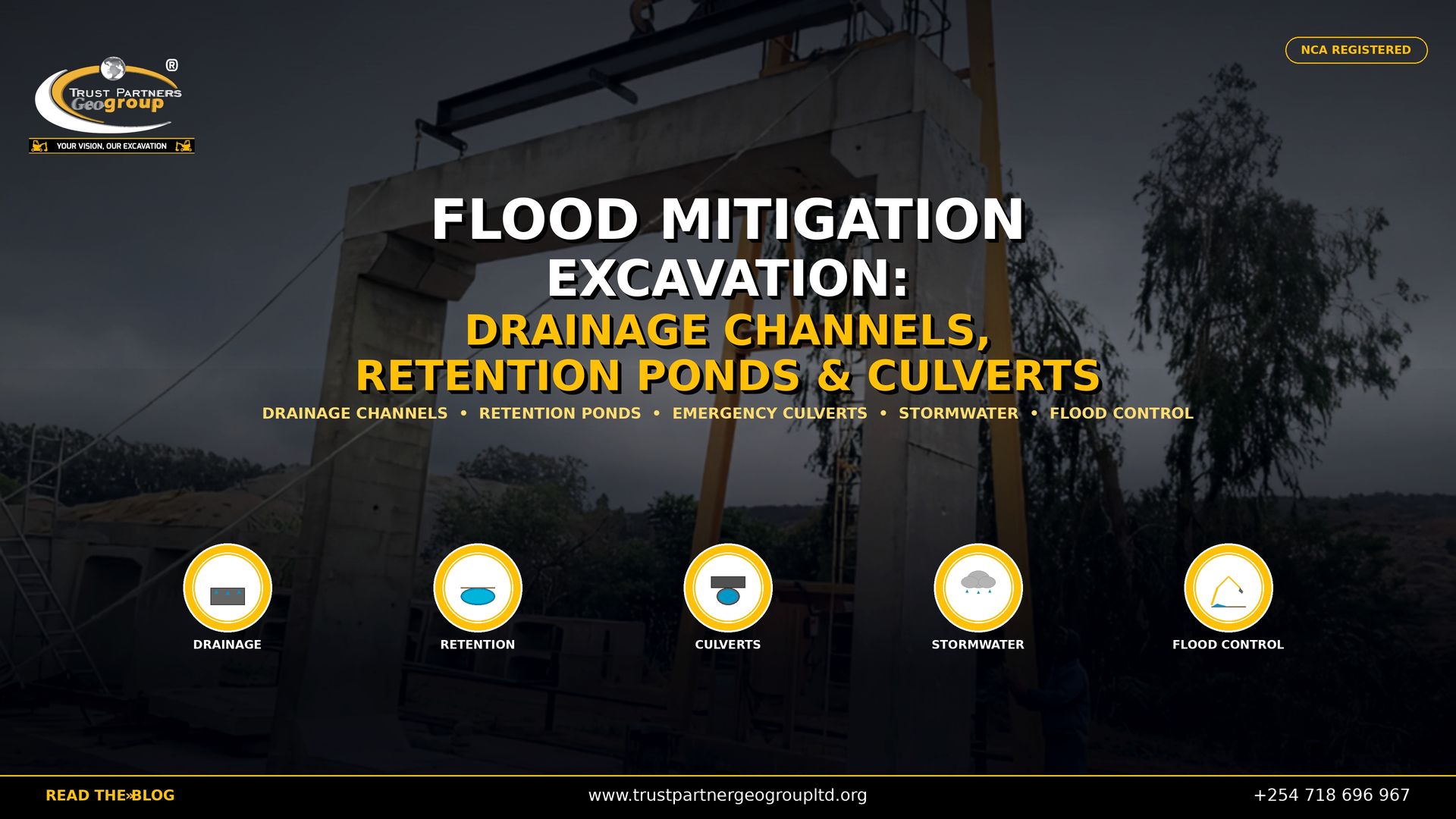
Flood Mitigation Excavation: Drainage Channels, Retention Ponds and Emergency Culverts in Nairobi [2026]
Engineered Flood Protection Earthworks for Nairobi's Most Vulnerable Areas — 24/7 Emergency Response
Every long-rains and short-rains season, the same Nairobi headlines return: submerged roads, flooded estates, washed-out culverts, displaced families. The pattern is not fate — it is an infrastructure deficit, and it is fixable with engineered earthworks. This 2026 emergency guide covers flood mitigation excavation in Kenya: drainage channel construction in Nairobi, retention pond excavation, and emergency culvert installation — with area-by-area analysis of the city's flood hotspots, 2026 cost benchmarks, and the compliance pathway for public and private clients. With 15+ years of excavation experience across Kenya and 24/7 emergency dispatch, Trust Partners Geo-Group delivers both planned flood protection and rapid response when the water is already rising.

From pre-season drainage programmes to 24/7 emergency culvert response, our team delivers flood mitigation earthworks across Nairobi and all 47 counties — engineered, compliant, and built to survive the next storm, not just the last one.
1. Nairobi's Flooding Crisis: The 2026 Landscape
Nairobi's flooding is a systems failure with four interacting causes:
- Lost floodplains: decades of construction on wetlands and riparian reserves along the Nairobi, Ngong and Mathare rivers removed the city's natural sponges.
- Undersized and blocked drainage: channels and culverts designed for a smaller, greener city now receive multiplied runoff from paved surfaces — and arrive pre-loaded with silt and solid waste.
- More intense storms: climate change is concentrating rainfall into shorter, heavier bursts that overwhelm infrastructure sized for historical storms.
- Maintenance gaps: drains that are never desilted function at a fraction of design capacity when the rains arrive.
The response is accelerating: county stormwater programmes, Nairobi River regeneration works, estate-level detention requirements for new developments, and emergency repair budgets activated every season. For earthworks contractors, flood mitigation excavation in Kenya is now a year-round sector — planned works in the dry seasons, emergency response in the wet ones. The seasonal rhythm mirrors what we described in our ASAL earthworks guide: drainage always goes in before the weather, or you rebuild it after.
2. What Is Flood Mitigation Excavation?
Flood mitigation excavation is the earthworks discipline that reduces flood damage by reshaping how water moves and where it waits: constructing or enlarging drainage channels, excavating retention and detention basins, installing or upgrading culverts, desilting existing infrastructure, and rebuilding flood-damaged earthworks after events. It differs from ordinary excavation in three ways:
- Hydraulics lead, machines follow. Every cut is sized by peak-flow calculation; a beautifully excavated channel that is 20% undersized floods exactly like the old one.
- Erosion is the enemy. Flood earthworks operate in the very conditions that destroy unprotected soil — lining, check structures and bank vegetation are part of the excavation scope, not an afterthought.
- Two tempos. Planned works run on dry-season programmes; emergency works run on hours. A competent flood contractor maintains both capabilities.
3. Drainage Channel Construction in Nairobi
Drainage channel construction in Nairobi spans three tiers:
| Tier | Typical Section | Lining | Application |
|---|---|---|---|
| Estate / roadside drains | 0.6–1.2 m deep, 0.6–1.5 m wide | Stone-pitched or concrete; grassed swales where velocities allow | Collecting plot and road runoff into secondary drains |
| Secondary stormwater channels | 1.5–2.5 m deep, trapezoidal 3–8 m top width | Gabion or concrete lining on bends and high-velocity reaches | Feeding estate and industrial catchments to rivers |
| Primary flood conveyance | 2.5–3 m+ deep, 8–20 m top width | Engineered lining, check structures, energy dissipation | Major channels discharging to the Nairobi/Ngong river system |
Construction essentials: excavation to design grade verified by machine control or level stakes (a "flat" channel is a pond, not a drain), side slopes at 1:1.5–1:2, lining where velocities exceed soil scour limits, and silt traps at inflows so the channel does not fill itself. Road-edge works follow the principles in our road drainage solutions guide.
4. Retention and Detention Pond Excavation
Ponds are Nairobi's most underused flood tool — they give stormwater somewhere to wait so downstream channels are not overwhelmed:
- Retention (wet) ponds: permanent pool with controlled outlet; double as amenity water features in estates and parks. Typical sizes 2,000–50,000 m³.
- Detention (dry) ponds: empty between storms; store the flood peak and release it over 24–72 hours. Cheaper land-take, invisible most of the year.
- Excavation essentials: balanced cut-to-fill so excavated material builds the embankments; compacted clay cores or liners where soils are permeable; engineered inlets, outlets and — non-negotiable — an emergency spillway for storms beyond design.
- Siting: low points in the flow path, upstream of the flood problem. A pond in the wrong place is a landscaping feature, not flood infrastructure.
Pond construction borrows heavily from dam and water-pan practice — see our dam excavation and construction guide and embankment stability and seepage control guide for the engineering fundamentals.
5. Emergency Culvert Installation and Flood Response
When a culvert fails, a road floods, a neighbourhood is cut off, and the clock starts. Emergency culvert installation in Kenya follows a disciplined rapid-response sequence:
- Stabilize: close or control traffic, pump standing water, and cut relief channels to prevent the failure from growing.
- Remove and prepare: excavate the failed structure and scour-damaged bedding down to sound ground — quick but never sloppy; a rushed foundation fails again next season.
- Install: precast box culverts for speed (bedding, units placed by crane/excavator, joints sealed same day) or pipe culverts for smaller crossings.
- Protect: headwalls, wing walls and rock aprons at inlet and outlet — most culvert failures are outlet-scour failures.
- Reinstate: compacted backfill in layers, road surface reopened, permanent lining scheduled for the dry window.
Our 24/7 emergency equipment dispatch service exists precisely for these events — excavators, breakers, pumps and crews mobilized at any hour.
6. Nairobi's Flood Hotspots: Area-by-Area Solutions
| Area | Flood Mechanism | Effective Earthworks Solution |
|---|---|---|
| Nairobi CBD & River Road | Overwhelmed aged drains, blocked culverts | Desilting, culvert upsizing, lined channel reconstruction |
| Industrial Area & Enterprise Rd | Hard surfaces, flat grades, silted channels | Secondary channel deepening, silt traps, estate detention |
| Kileleshwa, Lavington & Parklands | Steep catchments onto built-up valleys | Check dams upstream, lined channels, plot-level drainage discipline |
| Embakasi, Mukuru & lowlands east | Flat black-cotton plains, poor outfalls | New outfall channels, retention ponds, raised road formations |
| Karen, Lang'ata & Ngong Rd corridor | Streams in ravines crossing roads | Culvert upgrades with aprons, gabion channel lining, riparian buffer restoration |
| Ruai, Kamulu & eastern expansion zones | Development outpacing any drainage at all | Master-planned channel networks + detention ponds before occupancy |
For estate developers, flood mitigation now starts at the earthworks stage — the grading, drainage and retention planning in our site grading and drainage guide and gated community infrastructure guide is exactly the discipline that prevents an estate from joining next season's headlines.
7. Desilting, Maintenance and Pre-Season Programmes
The highest-return flood mitigation is unglamorous: removing what should not be there. A pre-season programme (ideally January–February, ahead of the long rains) typically includes:
- Channel desilting: long-reach excavators lifting silt and debris from existing drains; production of 150–400m per day per machine in accessible corridors.
- Culvert jetting and clearing: restoring silted barrels to full bore — a culvert at 40% blockage delivers a fraction of design flow.
- Silt trap construction: small excavated forebays at key inflows so future silt is captured where it is cheap to remove.
- Bank repair: regrading and re-vegetating eroded banks before the next season enlarges the damage.
- Waste disposal: lawful cart-away of silt and debris — dumping it on the bank just feeds it back into the channel.
8. Equipment Selection for Flood Mitigation Works
| Machine | Typical Class | Role in Flood Mitigation | 2026 Hire Rate (guide) |
|---|---|---|---|
| Long-reach excavator | 20–30 t, 12–18 m reach | Channel desilting and shaping from the bank | KES 8,500–14,000/hr |
| Standard excavator | 20–30 t | Pond excavation, culvert pits, channel cuts | KES 6,500–12,000/hr with operator |
| Amphibious / swamp excavator | Specialist | Wetland-edge and in-water desilting | Quoted per project |
| Dewatering pumps | 4–8 inch | Emergency pumping, dry working in pond excavations | KES 8,000–25,000/day |
| Dump trucks | 10–25 t | Silt and spoil cart-away to lawful disposal | Per-trip rates |
| Crane / excavator lift | 25–50 t capacity | Placing precast box culvert units | KES 15,000–30,000/hr |
| Rollers & plate compactors | — | Embankment and backfill compaction | KES 2,500–8,500/day-hr |
| Water bowsers | 10,000 L | Compaction moisture, dust control | KES 35,000–60,000/day |
For rates context, see our 2026 excavator hire price guide and dump truck fleet sizing calculator.
9. Flood Mitigation Costs: 2026 Budget Benchmarks
Indicative 2026 rates for flood mitigation earthworks in Nairobi (normal ground, dry-season execution; emergency wet-weather rates carry a 30–60% premium):
| Scope | Unit | Indicative Cost (KES) | Key Cost Drivers |
|---|---|---|---|
| Channel desilting & clearance | per metre | 800–2,500 | Silt volume, access, disposal distance |
| New drainage channel (estate/secondary) | per metre | 4,000–12,000 | Section size, lining type, rock |
| Lined primary channel | per metre | 12,000–35,000 | Depth/width, gabion vs concrete lining |
| Retention/detention pond excavation | per m³ | 300–550 | Volume, haul distance, dewatering |
| Pond embankment & structures | per pond | 2–12 million | Clay core, spillway, inlet/outlet works |
| Box culvert installation (single cell) | per crossing | 1.5–6 million | Size, bedding, headwalls, road reinstatement |
| Emergency flood response callout | per mobilization | Quoted per event | Plant, pumps, crew hours, materials |
Unit-rate anchors sit in our 2026 earthworks cost per cubic metre breakdown. For context on what flooding costs when mitigation is skipped: a single season of flood damage to one flooded industrial street routinely exceeds the cost of the channel upgrade that would have prevented it.
10. NEMA, WARMA, County and NCA Compliance
Flood mitigation earthworks in Nairobi operate under a defined approvals framework:
- Nairobi City County: approval for works on county drainage reserves, roads and public land; development conditions requiring on-site detention for new projects.
- NEMA: environmental clearance; works within riparian reserves and wetlands require specific authorization and restoration conditions.
- WARMA (Water Resources Authority): consents where channels, ponds or outfalls interact with watercourses.
- KeNHA / KURA: approvals where works cross or discharge along national and urban road reserves.
- NCA: contractor and project registration for the civil works — see our NCA registration requirements guide.
- Emergency works: genuine emergencies allow immediate action with retrospective documentation — but the paper trail still matters for payment and audit.
11. Frequently Asked Questions
How much does a retention pond cost to excavate in Kenya?
Retention pond excavation runs roughly KES 300–550 per cubic metre in normal ground — a 5,000 m³ estate pond costs KES 1.5–3 million and a 50,000 m³ regional pond KES 15–30 million for earthworks. Liners, embankments, structures and fencing are priced separately.
Who does emergency culvert installation in Kenya?
NCA-registered contractors with rapid-response fleets. Trust Partners Geo-Group operates 24/7 dispatch for washed-out culverts, blocked drains and flood emergencies across Nairobi and nationwide — call +254 718 686 967 any time.
Why does Nairobi flood every rainy season?
Because stormwater infrastructure has not kept pace with development: floodplains have been built on, drains are undersized or blocked, culverts are silted, and modern storms arrive in intense bursts. Engineered channels, retention ponds and culvert upgrades address each failure point directly.
What is the difference between a retention pond and a detention pond?
A retention pond holds a permanent pool and releases storm inflows slowly. A detention (dry) pond is empty between storms, temporarily storing flood peaks and draining within 24–72 hours. Both are excavated basins with engineered embankments, inlets, outlets and emergency spillways.
How deep should drainage channels be in Nairobi?
Estate and roadside drains typically run 0.6–1.2m deep; engineered flood channels run 1.5–3m deep with trapezoidal sections, 1:1.5–1:2 side slopes, and lining where flow velocities exceed scour limits. Design depth follows the catchment peak-flow calculation.
Can excavation contractors respond during active flooding?
Yes. Emergency works during floods include clearing blocked channels, cutting relief channels, installing temporary culverts and building emergency berms, using pumps, long-reach excavators and safety spotters. Permanent reconstruction follows once levels drop.
What approvals are needed for drainage excavation in Nairobi?
County approval, NEMA clearance (specific authorization near rivers and wetlands), WARMA consents for watercourse interaction, KeNHA/KURA approval on their road reserves, and NCA registration for contractor and project.
12. Conclusion: Build Before It Rains
Nairobi's floods are predictable — the seasons arrive on schedule, the hotspots are mapped, and the engineering solutions are mature. What has been missing is execution at scale: channels sized for tomorrow's storms, ponds that hold the peak, culverts with protected outlets, and drains that are actually clean when the clouds gather. All of it is earthworks, and all of it is deliverable in a single dry season.
For county governments, estate developers and facility managers, the 2026 playbook is simple: commission the flood assessment now, excavate in the dry window, and keep a 24/7 response partner on call for the events that exceed design. For related reading, see our guides to solar farm and wind turbine foundation excavation in Kenya's ASALs, dam excavation and construction, and our master resource on excavation in Kenya — costs, methods and contractors.
Flooding Season Doesn't Wait. Neither Should You.
Trust Partners Geo-Group delivers NCA-compliant flood mitigation earthworks — drainage channels, retention ponds, emergency culverts and 24/7 flood response — across Nairobi and all 47 counties.
Call +254 718 686 967 — 24/7 Request a Flood AssessmentFlood Mitigation Excavation: Drainage Channels, Retention Ponds and Emergency Culverts in Nairobi [2026]
Engineered Flood Protection Earthworks for Nairobi's Most Vulnerable Areas — 24/7 Emergency Response
Every long-rains and short-rains season, the same Nairobi headlines return: submerged roads, flooded estates, washed-out culverts, displaced families. The pattern is not fate — it is an infrastructure deficit, and it is fixable with engineered earthworks. This 2026 emergency guide covers flood mitigation excavation in Kenya: drainage channel construction in Nairobi, retention pond excavation, and emergency culvert installation — with area-by-area analysis of the city's flood hotspots, 2026 cost benchmarks, and the compliance pathway for public and private clients. With 15+ years of excavation experience across Kenya and 24/7 emergency dispatch, Trust Partners Geo-Group delivers both planned flood protection and rapid response when the water is already rising.
From pre-season drainage programmes to 24/7 emergency culvert response, our team delivers flood mitigation earthworks across Nairobi and all 47 counties — engineered, compliant, and built to survive the next storm, not just the last one.
1. Nairobi's Flooding Crisis: The 2026 Landscape
Nairobi's flooding is a systems failure with four interacting causes:
- Lost floodplains: decades of construction on wetlands and riparian reserves along the Nairobi, Ngong and Mathare rivers removed the city's natural sponges.
- Undersized and blocked drainage: channels and culverts designed for a smaller, greener city now receive multiplied runoff from paved surfaces — and arrive pre-loaded with silt and solid waste.
- More intense storms: climate change is concentrating rainfall into shorter, heavier bursts that overwhelm infrastructure sized for historical storms.
- Maintenance gaps: drains that are never desilted function at a fraction of design capacity when the rains arrive.
The response is accelerating: county stormwater programmes, Nairobi River regeneration works, estate-level detention requirements for new developments, and emergency repair budgets activated every season. For earthworks contractors, flood mitigation excavation in Kenya is now a year-round sector — planned works in the dry seasons, emergency response in the wet ones. The seasonal rhythm mirrors what we described in our ASAL earthworks guide: drainage always goes in before the weather, or you rebuild it after.
2. What Is Flood Mitigation Excavation?
Flood mitigation excavation is the earthworks discipline that reduces flood damage by reshaping how water moves and where it waits: constructing or enlarging drainage channels, excavating retention and detention basins, installing or upgrading culverts, desilting existing infrastructure, and rebuilding flood-damaged earthworks after events. It differs from ordinary excavation in three ways:
- Hydraulics lead, machines follow. Every cut is sized by peak-flow calculation; a beautifully excavated channel that is 20% undersized floods exactly like the old one.
- Erosion is the enemy. Flood earthworks operate in the very conditions that destroy unprotected soil — lining, check structures and bank vegetation are part of the excavation scope, not an afterthought.
- Two tempos. Planned works run on dry-season programmes; emergency works run on hours. A competent flood contractor maintains both capabilities.
3. Drainage Channel Construction in Nairobi
Drainage channel construction in Nairobi spans three tiers:
| Tier | Typical Section | Lining | Application |
|---|---|---|---|
| Estate / roadside drains | 0.6–1.2 m deep, 0.6–1.5 m wide | Stone-pitched or concrete; grassed swales where velocities allow | Collecting plot and road runoff into secondary drains |
| Secondary stormwater channels | 1.5–2.5 m deep, trapezoidal 3–8 m top width | Gabion or concrete lining on bends and high-velocity reaches | Feeding estate and industrial catchments to rivers |
| Primary flood conveyance | 2.5–3 m+ deep, 8–20 m top width | Engineered lining, check structures, energy dissipation | Major channels discharging to the Nairobi/Ngong river system |
Construction essentials: excavation to design grade verified by machine control or level stakes (a "flat" channel is a pond, not a drain), side slopes at 1:1.5–1:2, lining where velocities exceed soil scour limits, and silt traps at inflows so the channel does not fill itself. Road-edge works follow the principles in our road drainage solutions guide.
4. Retention and Detention Pond Excavation
Ponds are Nairobi's most underused flood tool — they give stormwater somewhere to wait so downstream channels are not overwhelmed:
- Retention (wet) ponds: permanent pool with controlled outlet; double as amenity water features in estates and parks. Typical sizes 2,000–50,000 m³.
- Detention (dry) ponds: empty between storms; store the flood peak and release it over 24–72 hours. Cheaper land-take, invisible most of the year.
- Excavation essentials: balanced cut-to-fill so excavated material builds the embankments; compacted clay cores or liners where soils are permeable; engineered inlets, outlets and — non-negotiable — an emergency spillway for storms beyond design.
- Siting: low points in the flow path, upstream of the flood problem. A pond in the wrong place is a landscaping feature, not flood infrastructure.
Pond construction borrows heavily from dam and water-pan practice — see our dam excavation and construction guide and embankment stability and seepage control guide for the engineering fundamentals.
5. Emergency Culvert Installation and Flood Response
When a culvert fails, a road floods, a neighbourhood is cut off, and the clock starts. Emergency culvert installation in Kenya follows a disciplined rapid-response sequence:
- Stabilize: close or control traffic, pump standing water, and cut relief channels to prevent the failure from growing.
- Remove and prepare: excavate the failed structure and scour-damaged bedding down to sound ground — quick but never sloppy; a rushed foundation fails again next season.
- Install: precast box culverts for speed (bedding, units placed by crane/excavator, joints sealed same day) or pipe culverts for smaller crossings.
- Protect: headwalls, wing walls and rock aprons at inlet and outlet — most culvert failures are outlet-scour failures.
- Reinstate: compacted backfill in layers, road surface reopened, permanent lining scheduled for the dry window.
Our 24/7 emergency equipment dispatch service exists precisely for these events — excavators, breakers, pumps and crews mobilized at any hour.
6. Nairobi's Flood Hotspots: Area-by-Area Solutions
| Area | Flood Mechanism | Effective Earthworks Solution |
|---|---|---|
| Nairobi CBD & River Road | Overwhelmed aged drains, blocked culverts | Desilting, culvert upsizing, lined channel reconstruction |
| Industrial Area & Enterprise Rd | Hard surfaces, flat grades, silted channels | Secondary channel deepening, silt traps, estate detention |
| Kileleshwa, Lavington & Parklands | Steep catchments onto built-up valleys | Check dams upstream, lined channels, plot-level drainage discipline |
| Embakasi, Mukuru & lowlands east | Flat black-cotton plains, poor outfalls | New outfall channels, retention ponds, raised road formations |
| Karen, Lang'ata & Ngong Rd corridor | Streams in ravines crossing roads | Culvert upgrades with aprons, gabion channel lining, riparian buffer restoration |
| Ruai, Kamulu & eastern expansion zones | Development outpacing any drainage at all | Master-planned channel networks + detention ponds before occupancy |
For estate developers, flood mitigation now starts at the earthworks stage — the grading, drainage and retention planning in our site grading and drainage guide and gated community infrastructure guide is exactly the discipline that prevents an estate from joining next season's headlines.
7. Desilting, Maintenance and Pre-Season Programmes
The highest-return flood mitigation is unglamorous: removing what should not be there. A pre-season programme (ideally January–February, ahead of the long rains) typically includes:
- Channel desilting: long-reach excavators lifting silt and debris from existing drains; production of 150–400m per day per machine in accessible corridors.
- Culvert jetting and clearing: restoring silted barrels to full bore — a culvert at 40% blockage delivers a fraction of design flow.
- Silt trap construction: small excavated forebays at key inflows so future silt is captured where it is cheap to remove.
- Bank repair: regrading and re-vegetating eroded banks before the next season enlarges the damage.
- Waste disposal: lawful cart-away of silt and debris — dumping it on the bank just feeds it back into the channel.
8. Equipment Selection for Flood Mitigation Works
| Machine | Typical Class | Role in Flood Mitigation | 2026 Hire Rate (guide) |
|---|---|---|---|
| Long-reach excavator | 20–30 t, 12–18 m reach | Channel desilting and shaping from the bank | KES 8,500–14,000/hr |
| Standard excavator | 20–30 t | Pond excavation, culvert pits, channel cuts | KES 6,500–12,000/hr with operator |
| Amphibious / swamp excavator | Specialist | Wetland-edge and in-water desilting | Quoted per project |
| Dewatering pumps | 4–8 inch | Emergency pumping, dry working in pond excavations | KES 8,000–25,000/day |
| Dump trucks | 10–25 t | Silt and spoil cart-away to lawful disposal | Per-trip rates |
| Crane / excavator lift | 25–50 t capacity | Placing precast box culvert units | KES 15,000–30,000/hr |
| Rollers & plate compactors | — | Embankment and backfill compaction | KES 2,500–8,500/day-hr |
| Water bowsers | 10,000 L | Compaction moisture, dust control | KES 35,000–60,000/day |
For rates context, see our 2026 excavator hire price guide and dump truck fleet sizing calculator.
9. Flood Mitigation Costs: 2026 Budget Benchmarks
Indicative 2026 rates for flood mitigation earthworks in Nairobi (normal ground, dry-season execution; emergency wet-weather rates carry a 30–60% premium):
| Scope | Unit | Indicative Cost (KES) | Key Cost Drivers |
|---|---|---|---|
| Channel desilting & clearance | per metre | 800–2,500 | Silt volume, access, disposal distance |
| New drainage channel (estate/secondary) | per metre | 4,000–12,000 | Section size, lining type, rock |
| Lined primary channel | per metre | 12,000–35,000 | Depth/width, gabion vs concrete lining |
| Retention/detention pond excavation | per m³ | 300–550 | Volume, haul distance, dewatering |
| Pond embankment & structures | per pond | 2–12 million | Clay core, spillway, inlet/outlet works |
| Box culvert installation (single cell) | per crossing | 1.5–6 million | Size, bedding, headwalls, road reinstatement |
| Emergency flood response callout | per mobilization | Quoted per event | Plant, pumps, crew hours, materials |
Unit-rate anchors sit in our 2026 earthworks cost per cubic metre breakdown. For context on what flooding costs when mitigation is skipped: a single season of flood damage to one flooded industrial street routinely exceeds the cost of the channel upgrade that would have prevented it.
10. NEMA, WARMA, County and NCA Compliance
Flood mitigation earthworks in Nairobi operate under a defined approvals framework:
- Nairobi City County: approval for works on county drainage reserves, roads and public land; development conditions requiring on-site detention for new projects.
- NEMA: environmental clearance; works within riparian reserves and wetlands require specific authorization and restoration conditions.
- WARMA (Water Resources Authority): consents where channels, ponds or outfalls interact with watercourses.
- KeNHA / KURA: approvals where works cross or discharge along national and urban road reserves.
- NCA: contractor and project registration for the civil works — see our NCA registration requirements guide.
- Emergency works: genuine emergencies allow immediate action with retrospective documentation — but the paper trail still matters for payment and audit.
11. Frequently Asked Questions
How much does a retention pond cost to excavate in Kenya?
Retention pond excavation runs roughly KES 300–550 per cubic metre in normal ground — a 5,000 m³ estate pond costs KES 1.5–3 million and a 50,000 m³ regional pond KES 15–30 million for earthworks. Liners, embankments, structures and fencing are priced separately.
Who does emergency culvert installation in Kenya?
NCA-registered contractors with rapid-response fleets. Trust Partners Geo-Group operates 24/7 dispatch for washed-out culverts, blocked drains and flood emergencies across Nairobi and nationwide — call +254 718 686 967 any time.
Why does Nairobi flood every rainy season?
Because stormwater infrastructure has not kept pace with development: floodplains have been built on, drains are undersized or blocked, culverts are silted, and modern storms arrive in intense bursts. Engineered channels, retention ponds and culvert upgrades address each failure point directly.
What is the difference between a retention pond and a detention pond?
A retention pond holds a permanent pool and releases storm inflows slowly. A detention (dry) pond is empty between storms, temporarily storing flood peaks and draining within 24–72 hours. Both are excavated basins with engineered embankments, inlets, outlets and emergency spillways.
How deep should drainage channels be in Nairobi?
Estate and roadside drains typically run 0.6–1.2m deep; engineered flood channels run 1.5–3m deep with trapezoidal sections, 1:1.5–1:2 side slopes, and lining where flow velocities exceed scour limits. Design depth follows the catchment peak-flow calculation.
Can excavation contractors respond during active flooding?
Yes. Emergency works during floods include clearing blocked channels, cutting relief channels, installing temporary culverts and building emergency berms, using pumps, long-reach excavators and safety spotters. Permanent reconstruction follows once levels drop.
What approvals are needed for drainage excavation in Nairobi?
County approval, NEMA clearance (specific authorization near rivers and wetlands), WARMA consents for watercourse interaction, KeNHA/KURA approval on their road reserves, and NCA registration for contractor and project.
12. Conclusion: Build Before It Rains
Nairobi's floods are predictable — the seasons arrive on schedule, the hotspots are mapped, and the engineering solutions are mature. What has been missing is execution at scale: channels sized for tomorrow's storms, ponds that hold the peak, culverts with protected outlets, and drains that are actually clean when the clouds gather. All of it is earthworks, and all of it is deliverable in a single dry season.
For county governments, estate developers and facility managers, the 2026 playbook is simple: commission the flood assessment now, excavate in the dry window, and keep a 24/7 response partner on call for the events that exceed design. For related reading, see our guides to solar farm and wind turbine foundation excavation in Kenya's ASALs, dam excavation and construction, and our master resource on excavation in Kenya — costs, methods and contractors.
Flooding Season Doesn't Wait. Neither Should You.
Trust Partners Geo-Group delivers NCA-compliant flood mitigation earthworks — drainage channels, retention ponds, emergency culverts and 24/7 flood response — across Nairobi and all 47 counties.
Call +254 718 686 967 — 24/7 Request a Flood Assessment