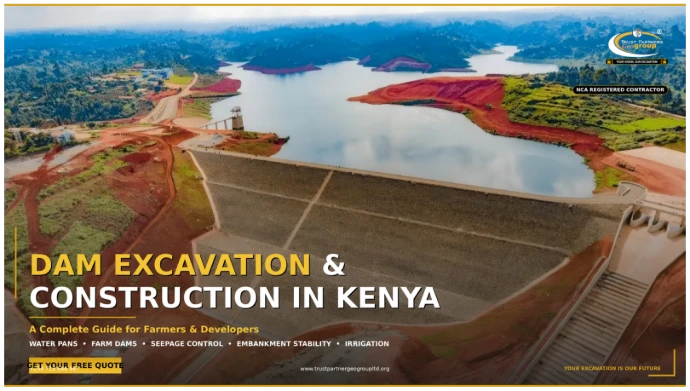
Dam Excavation and Construction in Kenya
A complete guide for farmers & developers. Expert water pan construction, farm dam building, seepage control & embankment stability for irrigation across Kenya's agricultural heartland.
Water is the lifeblood of Kenyan agriculture. With over 70% of Kenyan farmers relying on rain-fed agriculture, the construction of dams and water pans has become not just an investment—but a necessity for food security, climate resilience, and economic growth. Whether you are a small-scale farmer in Kiambu looking to build a 500-cubic-meter water pan, or a commercial developer planning a multi-million-liter irrigation reservoir, understanding the dam excavation and construction process is critical to success. In this comprehensive guide, Trust Partners Geo-Group breaks down everything you need to know about dam excavation, water pan construction, seepage control, and embankment stability in Kenya.
Table of Contents
Why Dam Construction Matters in Kenya
Kenya's agricultural sector faces a growing water crisis. Erratic rainfall, prolonged droughts, and rising food prices have exposed the vulnerability of rain-fed farming, which supports the majority of Kenyan farmers.
The Kenyan government has unveiled plans to construct at least six mega dams and expand irrigation to two million acres of farmland as part of a renewed push to strengthen food security and cushion farmers from climate shocks. Under the National Agricultural Sector Investment Plan, the State Department for Irrigation is spearheading a programme that views irrigation not as a supplementary intervention, but as a core pillar of agricultural production.
"Whenever rains fail, farmers are affected greatly, and that is one of the effects of climate change," said State Department for Irrigation Principal Secretary Ephantus Kimotho. "Irrigation comes in as a mitigating factor. When there is rain, we store water, and when there is drought, we use that water for irrigation."
For individual farmers and developers, water pans and farm dams offer a direct solution. These structures store water during rainy seasons, ensuring a consistent supply during dry periods. They enable year-round farming, leading to higher yields, improved food security, and predictable incomes. Beyond agriculture, dams support livestock sustainability, community development, and environmental conservation by reducing soil erosion.
Irrigation
Rain-Fed Agriculture
ASAL Region
Planned
Types of Dams & Water Pans in Kenya
Understanding the different types of water storage structures is essential for selecting the right solution for your farm or development project. Each type has distinct advantages, cost implications, and suitability depending on topography, soil conditions, and intended use.
Earthfill Embankment Dams
The most common type in Kenya. Constructed using locally available soil, these dams feature a compacted earth wall (embankment) that holds back water. They are cost-effective for small to medium projects and can be built with or without a clay core for improved impermeability.
Lined Water Pans
Excavated depressions lined with HDPE geomembrane sheets to prevent seepage. Ideal for areas with porous soils. HDPE liners at 0.5-1.0mm thickness cost KES 180-450/m² installed, and can prevent 30-50% water loss compared to unlined structures.
Concrete-Faced Rockfill Dams
Used for larger, more permanent structures. These combine rockfill stability with a concrete face for watertightness. More expensive than earthfill but offer superior longevity and can handle greater water depths and pressures.
Elevated Water Tanks & Towers
Steel or concrete towers that store water above ground level, allowing gravity-fed distribution. Best for drip irrigation and domestic use where elevation is needed. Higher initial cost but zero ongoing pumping costs.
Integrated Farm Dams
Multi-purpose structures combining irrigation, livestock watering, and fish farming. These are increasingly popular as farmers seek to maximize ROI from water storage investments. Can include fishpond integration and solar pump systems.
Zoned Embankment Dams
Advanced earthfill dams with distinct zones: an impermeable core (clay or concrete), filter zones to prevent piping, and drainage blankets for seepage control. Used for medium to large reservoirs where safety and longevity are paramount.
Choosing the Right Type
Consider these factors when selecting your dam type:
- Soil Type: Clay soils suit earthfill; sandy soils require liners
- Capacity Needs: Small farms (500-5,000 m³) vs. commercial (50,000+ m³)
- Topography: Natural valleys reduce excavation costs
- Budget: Earthfill is cheapest; concrete is premium
- Intended Use: Irrigation, livestock, fish farming, or domestic
- Longevity: Permanent vs. seasonal structures
Step-by-Step Dam Construction Process
Building a dam or water pan is a systematic process that requires careful planning, engineering, and execution. At Trust Partners Geo-Group, we follow a proven methodology that ensures structural integrity, regulatory compliance, and long-term performance.
Site Survey & Hydrology
Analyze soil type, catchment area, groundwater table, and topography. Geophysical surveys identify bedrock depth and soil permeability.
Design & Engineering
Determine capacity, embankment dimensions, spillway design, and outlet structures. NEMA compliance and water permits secured.
Site Clearance & Prep
Remove vegetation, topsoil stripping, and establish access roads. Install silt traps and erosion control measures.
Excavation
Heavy machinery excavates to design depth and profile. Key cut trenches for embankment foundations. Spoil management for reuse.
Embankment Formation
Layered compaction of soil in 150-200mm lifts at optimum moisture content. Achieve 95% Proctor density for stability.
Lining & Seepage Control
Install HDPE liners, clay cores, or concrete facing. Add drainage blankets, toe drains, and filter zones to manage seepage.
Spillway & Outlets
Construct overflow spillways, inlet/outlet pipes, and valve chambers. Critical for flood management and water control.
Testing & Handover
Fill test, seepage monitoring, and structural inspection. Final documentation, maintenance guidelines, and operator training.
Each phase requires specialized heavy equipment including excavators, bulldozers, compactors, and dump trucks. At Trust Partners Geo-Group, our integrated fleet and experienced operators ensure efficient transitions between phases, minimizing project timelines and cost overruns.
Seepage Control & Embankment Stability
Seepage is the single greatest threat to dam longevity and safety. All dams have some seepage as impounded water seeks paths of least resistance through the embankment and foundation. However, uncontrolled seepage can lead to internal erosion, piping, and catastrophic failure.
Modern design practice incorporates seepage control into the embankment through the use of cutoffs, internal filters, and adequate drainage provisions. Control at points of seepage exit can be accomplished by installation of toe drains, relief wells, or inverted filters. These systems must be designed to prevent migration of soil particles while still allowing seepage to drain freely.
Key Seepage Control Measures
- Clay Core Walls: Central impermeable barrier of compacted clay that reduces seepage through the embankment. Core width typically 1/3 to 1/4 of dam height.
- HDPE Geomembrane Liners: Factory-welded sheets at 0.5-1.0mm thickness. Prevent 30-50% seepage losses in porous soils. Require professional installation to avoid punctures.
- Drainage Blankets: Gravel or sand layers placed downstream of the core to collect and safely discharge seepage water without soil particle migration.
- Toe Drains: Perforated pipes at the downstream toe that relieve water pressure and prevent saturation of the embankment slope.
- Cutoff Trenches: Excavated trenches extending into impermeable foundation strata, filled with clay or concrete to block under-seepage.
- Relief Wells: Vertical wells that reduce uplift pressure in the foundation, particularly important in dams built on alluvial soils.
- Regular Monitoring: V-notch weirs measure flow rates; piezometers determine saturation levels. Visual inspection for wet spots, sinkholes, or boil formation.
"Seepage flow which is muddy and carrying sediment is evidence of 'piping,' and could very possibly cause failure of the dam. A whirlpool in the lake surface may follow and then likely a rapid and complete failure. Emergency procedures, including downstream evacuation, should be implemented if this condition is noted."
At Trust Partners Geo-Group, we design and install comprehensive seepage control systems as standard on all dam projects. Our QA/QC protocols include compaction testing, liner integrity surveys, and post-construction monitoring to ensure your water storage asset remains safe and efficient for decades.
Dam Construction Costs in Kenya [2026]
Dam construction costs in Kenya vary dramatically by scale, from small farm reservoirs to mega hydropower projects, driven by site geology, capacity, and regulatory demands. Understanding these costs helps farmers and developers budget realistically and avoid surprises.
| Dam Type | Capacity | Average Cost (KES) | Cost per m³ |
|---|---|---|---|
| Small Earth Dam | Under 50,000 m³ | 2M - 40M | KES 300 - 600 |
| Medium Lined Reservoir | 100,000 - 500,000 m³ | 50M - 200M | KES 400 - 800 |
| Large Hydropower Dam | 100M+ m³ | 300B+ | KES 5,000+ |
Cost Breakdown Components
Earthworks
KES 150-300 per m³ excavated. Includes bulldozer work, excavation, and compaction. Fuel costs account for ~20% of earthworks expenditure.
HDPE Liners
KES 180-450/m² for 0.5-1.0mm sheets. A 500m² pond totals KES 90,000-320,000 installed. Bulk purchases can reduce costs 10-20%.
Spillways & Outlets
KES 1-3 million for concrete overflow structures, inlet/outlet pipes, and valve chambers. Essential for flood safety.
Pumps & Solar
KES 200,000-2M for solar pumping systems. Eliminates ongoing electricity/diesel costs and provides reliable water distribution.
Permits & Compliance
NEMA environmental audits, water permits, and NCA project registration. Budget 5-10% of total project cost for compliance.
Fencing & Protection
Livestock fencing, silt traps, and access roads. Protects the dam from contamination and structural damage.
Small dams typically yield ROI in 2-3 years through irrigation, with maize yields increasing by up to 50% with reliable water supply. At Trust Partners Geo-Group, we optimize costs through precise earthworks, quality materials, and phased construction approaches that match your budget and timeline.
Government Mega Dam Projects 2026
Kenya's government has committed to constructing 50 mega dams nationwide under the President's pledge. In 2026, at least six flagship dam projects are expected to begin construction, unlocking commercial agriculture and transforming livelihoods in arid and semi-arid regions.
The State Department for Irrigation has earmarked close to two million acres for irrigation development, with a strong focus on historically marginalized regions. "We are confident that in 2026 we will start construction of at least six large-scale dams," said Head of Irrigation Infrastructure Engineer Vincent Kabuti. "These projects will unlock commercial agriculture, create jobs and go a long way in meeting our food security needs as a country."
Six Flagship Dams for 2026
- Lowaat Dam (Turkana County): 384 million m³ capacity on Kerio River. Includes irrigation, tourism, police station, and fish farming components. Estimated cost: KES 35 billion.
- Radat Dam (Baringo County): 124 million m³ on Pekera River. Existing dam being expanded to include irrigation for 58,000 acres. Estimated cost: KES 96.3 billion.
- Thuci Dam (Embu County): Awaiting cabinet approval for 17,000-acre irrigation scheme. Part of the Upper Tana watershed development.
- Basilinga Dam (Isiolo County): Strategic water storage for ASAL region development and livestock watering.
- High Falls Dam (Kitui & Tharaka Nithi): Multi-purpose dam serving two counties with irrigation and domestic water supply.
- Galana Dam (Tana River & Kilifi): Part of the larger Galana-Kulalu irrigation project aimed at food security and commercial farming.
These mega projects complement the thousands of small and medium farm dams being built by private farmers and community groups across Kenya. Trust Partners Geo-Group supports both large-scale government contractors and individual farmers with professional excavation, earthworks, and heavy equipment services for water storage projects of any size.
Why Choose Trust Partners Geo-Group
Building a dam is a significant investment that demands expertise, equipment, and attention to detail. Trust Partners Geo-Group brings all three to every water storage project across Kenya.
Deep Local Expertise
We understand Kenya's diverse soil conditions—from the red volcanic soils of the Rift Valley to the cotton soils of Western Kenya. Our teams have excavated and constructed water pans and farm dams in Kiambu, Nakuru, Nyandarua, Machakos, Kitui, and across the ASAL regions. This local knowledge ensures we select the right construction methods and materials for your specific site.
Integrated Heavy Equipment Fleet
Our fleet includes excavators (20-ton to 50-ton), bulldozers, graders, compactors, and dump trucks. We don't subcontract earthworks—we control quality and timelines directly. This integration reduces coordination overhead and keeps your project on budget.
Engineering & Safety Standards
We follow NCA compliance protocols, NEMA environmental guidelines, and international dam engineering standards. Our safety programs include method statements, risk assessments, and job safety analyses for each phase. We don't cut corners on compaction, liner installation, or drainage design—because a failed dam is far more expensive than a properly built one.
Transparent Partnership
We provide detailed quotations with clear scope definitions, phased payment options, and documented change management. Whether you need a 500m³ water pan or a 50,000m³ irrigation reservoir, we align our project management with your schedule, milestones, and reporting requirements.
Experience
Completed
Incidents
Satisfaction
Ready to Build Your Water Storage Project?
Contact Trust Partners Geo-Group today for a free site assessment and detailed quotation. From water pans to mega reservoirs, we deliver excavation values you can measure and timelines you can trust.
Frequently Asked Questions
Get answers to the most common questions about dam excavation and construction in Kenya:
Costs vary by size and type. Small earth dams under 50,000 m³ range from KES 2-40 million (KES 300-600/m³). Medium lined reservoirs (100,000-500,000 m³) cost KES 50-200 million (KES 400-800/m³). Key factors include earthworks, liner costs, spillway construction, and site accessibility. Contact Trust Partners Geo-Group for a site-specific quotation.
Small water pans (500-5,000 m³) can be completed in 2-6 weeks. Medium farm dams (10,000-50,000 m³) typically take 1-3 months. Large reservoirs (100,000+ m³) may require 6-12 months. Timeline depends on weather, soil conditions, equipment availability, and permit approvals. We provide detailed schedules during quotation.
Yes. Depending on size and location, you may need NEMA environmental clearance, Water Resources Authority permits, and NCA project registration. Trust Partners Geo-Group assists with all permit applications and compliance documentation as part of our comprehensive service package.
Clay and clay-loam soils are ideal for earthfill dams due to their natural impermeability. Sandy or gravelly soils require HDPE liners or clay cores to prevent excessive seepage. We conduct geotechnical surveys before construction to determine the most suitable design and materials for your site.
Seepage control measures include: (1) HDPE geomembrane liners for porous soils, (2) clay core walls for earthfill dams, (3) proper compaction to 95% Proctor density, (4) drainage blankets and toe drains to manage unavoidable seepage, and (5) regular monitoring for wet spots or sinkholes. Trust Partners Geo-Group designs and installs all these systems.
Absolutely. Multi-purpose integrated farm dams are increasingly popular. We design structures that support irrigation, livestock watering, and aquaculture simultaneously. These designs include separate inlet/outlet systems, appropriate depth profiles, and water quality management features. Solar pumping systems can also be integrated for gravity-fed distribution.
Related Articles
How to Build a Water Pan for Irrigation in Kenya: Step-by-Step
Complete construction process from site selection to commissioning for farm water storage.
Seepage Control and Embankment Stability for Dams in Kenya
Advanced engineering solutions for preventing leaks and ensuring long-term dam integrity.
Best Excavation Contractors in Nairobi: Parklands, Kilimani, Kileleshwa & Upper Hill
Expert guide to choosing the right excavation contractor across Nairobi's premium neighborhoods.
Dam Excavation and Construction in Kenya
A complete guide for farmers & developers. Expert water pan construction, farm dam building, seepage control & embankment stability for irrigation across Kenya's agricultural heartland.
Water is the lifeblood of Kenyan agriculture. With over 70% of Kenyan farmers relying on rain-fed agriculture, the construction of dams and water pans has become not just an investment—but a necessity for food security, climate resilience, and economic growth. Whether you are a small-scale farmer in Kiambu looking to build a 500-cubic-meter water pan, or a commercial developer planning a multi-million-liter irrigation reservoir, understanding the dam excavation and construction process is critical to success. In this comprehensive guide, Trust Partners Geo-Group breaks down everything you need to know about dam excavation, water pan construction, seepage control, and embankment stability in Kenya.
Table of Contents
Why Dam Construction Matters in Kenya
Kenya's agricultural sector faces a growing water crisis. Erratic rainfall, prolonged droughts, and rising food prices have exposed the vulnerability of rain-fed farming, which supports the majority of Kenyan farmers.
The Kenyan government has unveiled plans to construct at least six mega dams and expand irrigation to two million acres of farmland as part of a renewed push to strengthen food security and cushion farmers from climate shocks. Under the National Agricultural Sector Investment Plan, the State Department for Irrigation is spearheading a programme that views irrigation not as a supplementary intervention, but as a core pillar of agricultural production.
"Whenever rains fail, farmers are affected greatly, and that is one of the effects of climate change," said State Department for Irrigation Principal Secretary Ephantus Kimotho. "Irrigation comes in as a mitigating factor. When there is rain, we store water, and when there is drought, we use that water for irrigation."
For individual farmers and developers, water pans and farm dams offer a direct solution. These structures store water during rainy seasons, ensuring a consistent supply during dry periods. They enable year-round farming, leading to higher yields, improved food security, and predictable incomes. Beyond agriculture, dams support livestock sustainability, community development, and environmental conservation by reducing soil erosion.
Irrigation
Rain-Fed Agriculture
ASAL Region
Planned
Types of Dams & Water Pans in Kenya
Understanding the different types of water storage structures is essential for selecting the right solution for your farm or development project. Each type has distinct advantages, cost implications, and suitability depending on topography, soil conditions, and intended use.
Earthfill Embankment Dams
The most common type in Kenya. Constructed using locally available soil, these dams feature a compacted earth wall (embankment) that holds back water. They are cost-effective for small to medium projects and can be built with or without a clay core for improved impermeability.
Lined Water Pans
Excavated depressions lined with HDPE geomembrane sheets to prevent seepage. Ideal for areas with porous soils. HDPE liners at 0.5-1.0mm thickness cost KES 180-450/m² installed, and can prevent 30-50% water loss compared to unlined structures.
Concrete-Faced Rockfill Dams
Used for larger, more permanent structures. These combine rockfill stability with a concrete face for watertightness. More expensive than earthfill but offer superior longevity and can handle greater water depths and pressures.
Elevated Water Tanks & Towers
Steel or concrete towers that store water above ground level, allowing gravity-fed distribution. Best for drip irrigation and domestic use where elevation is needed. Higher initial cost but zero ongoing pumping costs.
Integrated Farm Dams
Multi-purpose structures combining irrigation, livestock watering, and fish farming. These are increasingly popular as farmers seek to maximize ROI from water storage investments. Can include fishpond integration and solar pump systems.
Zoned Embankment Dams
Advanced earthfill dams with distinct zones: an impermeable core (clay or concrete), filter zones to prevent piping, and drainage blankets for seepage control. Used for medium to large reservoirs where safety and longevity are paramount.
Choosing the Right Type
Consider these factors when selecting your dam type:
- Soil Type: Clay soils suit earthfill; sandy soils require liners
- Capacity Needs: Small farms (500-5,000 m³) vs. commercial (50,000+ m³)
- Topography: Natural valleys reduce excavation costs
- Budget: Earthfill is cheapest; concrete is premium
- Intended Use: Irrigation, livestock, fish farming, or domestic
- Longevity: Permanent vs. seasonal structures
Step-by-Step Dam Construction Process
Building a dam or water pan is a systematic process that requires careful planning, engineering, and execution. At Trust Partners Geo-Group, we follow a proven methodology that ensures structural integrity, regulatory compliance, and long-term performance.
Site Survey & Hydrology
Analyze soil type, catchment area, groundwater table, and topography. Geophysical surveys identify bedrock depth and soil permeability.
Design & Engineering
Determine capacity, embankment dimensions, spillway design, and outlet structures. NEMA compliance and water permits secured.
Site Clearance & Prep
Remove vegetation, topsoil stripping, and establish access roads. Install silt traps and erosion control measures.
Excavation
Heavy machinery excavates to design depth and profile. Key cut trenches for embankment foundations. Spoil management for reuse.
Embankment Formation
Layered compaction of soil in 150-200mm lifts at optimum moisture content. Achieve 95% Proctor density for stability.
Lining & Seepage Control
Install HDPE liners, clay cores, or concrete facing. Add drainage blankets, toe drains, and filter zones to manage seepage.
Spillway & Outlets
Construct overflow spillways, inlet/outlet pipes, and valve chambers. Critical for flood management and water control.
Testing & Handover
Fill test, seepage monitoring, and structural inspection. Final documentation, maintenance guidelines, and operator training.
Each phase requires specialized heavy equipment including excavators, bulldozers, compactors, and dump trucks. At Trust Partners Geo-Group, our integrated fleet and experienced operators ensure efficient transitions between phases, minimizing project timelines and cost overruns.
Seepage Control & Embankment Stability
Seepage is the single greatest threat to dam longevity and safety. All dams have some seepage as impounded water seeks paths of least resistance through the embankment and foundation. However, uncontrolled seepage can lead to internal erosion, piping, and catastrophic failure.
Modern design practice incorporates seepage control into the embankment through the use of cutoffs, internal filters, and adequate drainage provisions. Control at points of seepage exit can be accomplished by installation of toe drains, relief wells, or inverted filters. These systems must be designed to prevent migration of soil particles while still allowing seepage to drain freely.
Key Seepage Control Measures
- Clay Core Walls: Central impermeable barrier of compacted clay that reduces seepage through the embankment. Core width typically 1/3 to 1/4 of dam height.
- HDPE Geomembrane Liners: Factory-welded sheets at 0.5-1.0mm thickness. Prevent 30-50% seepage losses in porous soils. Require professional installation to avoid punctures.
- Drainage Blankets: Gravel or sand layers placed downstream of the core to collect and safely discharge seepage water without soil particle migration.
- Toe Drains: Perforated pipes at the downstream toe that relieve water pressure and prevent saturation of the embankment slope.
- Cutoff Trenches: Excavated trenches extending into impermeable foundation strata, filled with clay or concrete to block under-seepage.
- Relief Wells: Vertical wells that reduce uplift pressure in the foundation, particularly important in dams built on alluvial soils.
- Regular Monitoring: V-notch weirs measure flow rates; piezometers determine saturation levels. Visual inspection for wet spots, sinkholes, or boil formation.
"Seepage flow which is muddy and carrying sediment is evidence of 'piping,' and could very possibly cause failure of the dam. A whirlpool in the lake surface may follow and then likely a rapid and complete failure. Emergency procedures, including downstream evacuation, should be implemented if this condition is noted."
At Trust Partners Geo-Group, we design and install comprehensive seepage control systems as standard on all dam projects. Our QA/QC protocols include compaction testing, liner integrity surveys, and post-construction monitoring to ensure your water storage asset remains safe and efficient for decades.
Dam Construction Costs in Kenya [2026]
Dam construction costs in Kenya vary dramatically by scale, from small farm reservoirs to mega hydropower projects, driven by site geology, capacity, and regulatory demands. Understanding these costs helps farmers and developers budget realistically and avoid surprises.
| Dam Type | Capacity | Average Cost (KES) | Cost per m³ |
|---|---|---|---|
| Small Earth Dam | Under 50,000 m³ | 2M - 40M | KES 300 - 600 |
| Medium Lined Reservoir | 100,000 - 500,000 m³ | 50M - 200M | KES 400 - 800 |
| Large Hydropower Dam | 100M+ m³ | 300B+ | KES 5,000+ |
Cost Breakdown Components
Earthworks
KES 150-300 per m³ excavated. Includes bulldozer work, excavation, and compaction. Fuel costs account for ~20% of earthworks expenditure.
HDPE Liners
KES 180-450/m² for 0.5-1.0mm sheets. A 500m² pond totals KES 90,000-320,000 installed. Bulk purchases can reduce costs 10-20%.
Spillways & Outlets
KES 1-3 million for concrete overflow structures, inlet/outlet pipes, and valve chambers. Essential for flood safety.
Pumps & Solar
KES 200,000-2M for solar pumping systems. Eliminates ongoing electricity/diesel costs and provides reliable water distribution.
Permits & Compliance
NEMA environmental audits, water permits, and NCA project registration. Budget 5-10% of total project cost for compliance.
Fencing & Protection
Livestock fencing, silt traps, and access roads. Protects the dam from contamination and structural damage.
Small dams typically yield ROI in 2-3 years through irrigation, with maize yields increasing by up to 50% with reliable water supply. At Trust Partners Geo-Group, we optimize costs through precise earthworks, quality materials, and phased construction approaches that match your budget and timeline.
Government Mega Dam Projects 2026
Kenya's government has committed to constructing 50 mega dams nationwide under the President's pledge. In 2026, at least six flagship dam projects are expected to begin construction, unlocking commercial agriculture and transforming livelihoods in arid and semi-arid regions.
The State Department for Irrigation has earmarked close to two million acres for irrigation development, with a strong focus on historically marginalized regions. "We are confident that in 2026 we will start construction of at least six large-scale dams," said Head of Irrigation Infrastructure Engineer Vincent Kabuti. "These projects will unlock commercial agriculture, create jobs and go a long way in meeting our food security needs as a country."
Six Flagship Dams for 2026
- Lowaat Dam (Turkana County): 384 million m³ capacity on Kerio River. Includes irrigation, tourism, police station, and fish farming components. Estimated cost: KES 35 billion.
- Radat Dam (Baringo County): 124 million m³ on Pekera River. Existing dam being expanded to include irrigation for 58,000 acres. Estimated cost: KES 96.3 billion.
- Thuci Dam (Embu County): Awaiting cabinet approval for 17,000-acre irrigation scheme. Part of the Upper Tana watershed development.
- Basilinga Dam (Isiolo County): Strategic water storage for ASAL region development and livestock watering.
- High Falls Dam (Kitui & Tharaka Nithi): Multi-purpose dam serving two counties with irrigation and domestic water supply.
- Galana Dam (Tana River & Kilifi): Part of the larger Galana-Kulalu irrigation project aimed at food security and commercial farming.
These mega projects complement the thousands of small and medium farm dams being built by private farmers and community groups across Kenya. Trust Partners Geo-Group supports both large-scale government contractors and individual farmers with professional excavation, earthworks, and heavy equipment services for water storage projects of any size.
Why Choose Trust Partners Geo-Group
Building a dam is a significant investment that demands expertise, equipment, and attention to detail. Trust Partners Geo-Group brings all three to every water storage project across Kenya.
Deep Local Expertise
We understand Kenya's diverse soil conditions—from the red volcanic soils of the Rift Valley to the cotton soils of Western Kenya. Our teams have excavated and constructed water pans and farm dams in Kiambu, Nakuru, Nyandarua, Machakos, Kitui, and across the ASAL regions. This local knowledge ensures we select the right construction methods and materials for your specific site.
Integrated Heavy Equipment Fleet
Our fleet includes excavators (20-ton to 50-ton), bulldozers, graders, compactors, and dump trucks. We don't subcontract earthworks—we control quality and timelines directly. This integration reduces coordination overhead and keeps your project on budget.
Engineering & Safety Standards
We follow NCA compliance protocols, NEMA environmental guidelines, and international dam engineering standards. Our safety programs include method statements, risk assessments, and job safety analyses for each phase. We don't cut corners on compaction, liner installation, or drainage design—because a failed dam is far more expensive than a properly built one.
Transparent Partnership
We provide detailed quotations with clear scope definitions, phased payment options, and documented change management. Whether you need a 500m³ water pan or a 50,000m³ irrigation reservoir, we align our project management with your schedule, milestones, and reporting requirements.
Experience
Completed
Incidents
Satisfaction
Ready to Build Your Water Storage Project?
Contact Trust Partners Geo-Group today for a free site assessment and detailed quotation. From water pans to mega reservoirs, we deliver excavation values you can measure and timelines you can trust.
Frequently Asked Questions
Get answers to the most common questions about dam excavation and construction in Kenya:
Costs vary by size and type. Small earth dams under 50,000 m³ range from KES 2-40 million (KES 300-600/m³). Medium lined reservoirs (100,000-500,000 m³) cost KES 50-200 million (KES 400-800/m³). Key factors include earthworks, liner costs, spillway construction, and site accessibility. Contact Trust Partners Geo-Group for a site-specific quotation.
Small water pans (500-5,000 m³) can be completed in 2-6 weeks. Medium farm dams (10,000-50,000 m³) typically take 1-3 months. Large reservoirs (100,000+ m³) may require 6-12 months. Timeline depends on weather, soil conditions, equipment availability, and permit approvals. We provide detailed schedules during quotation.
Yes. Depending on size and location, you may need NEMA environmental clearance, Water Resources Authority permits, and NCA project registration. Trust Partners Geo-Group assists with all permit applications and compliance documentation as part of our comprehensive service package.
Clay and clay-loam soils are ideal for earthfill dams due to their natural impermeability. Sandy or gravelly soils require HDPE liners or clay cores to prevent excessive seepage. We conduct geotechnical surveys before construction to determine the most suitable design and materials for your site.
Seepage control measures include: (1) HDPE geomembrane liners for porous soils, (2) clay core walls for earthfill dams, (3) proper compaction to 95% Proctor density, (4) drainage blankets and toe drains to manage unavoidable seepage, and (5) regular monitoring for wet spots or sinkholes. Trust Partners Geo-Group designs and installs all these systems.
Absolutely. Multi-purpose integrated farm dams are increasingly popular. We design structures that support irrigation, livestock watering, and aquaculture simultaneously. These designs include separate inlet/outlet systems, appropriate depth profiles, and water quality management features. Solar pumping systems can also be integrated for gravity-fed distribution.
Related Articles
How to Build a Water Pan for Irrigation in Kenya: Step-by-Step
Complete construction process from site selection to commissioning for farm water storage.
Seepage Control and Embankment Stability for Dams in Kenya
Advanced engineering solutions for preventing leaks and ensuring long-term dam integrity.
Best Excavation Contractors in Nairobi: Parklands, Kilimani, Kileleshwa & Upper Hill
Expert guide to choosing the right excavation contractor across Nairobi's premium neighborhoods.