
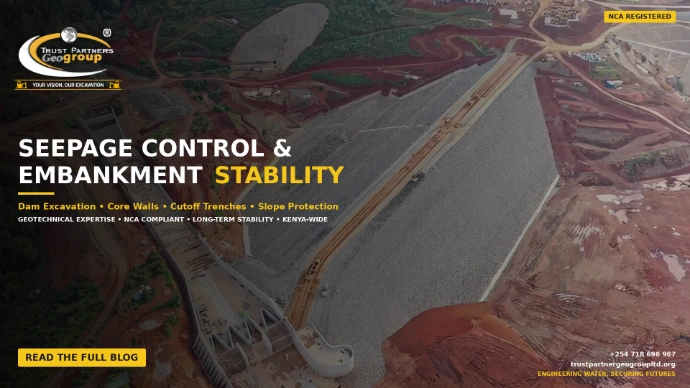
Seepage Control and Embankment Stability for Dams in Kenya: A Complete 2026 Guide
Seepage control and embankment stability are the two most critical engineering challenges in earthfill dam construction in Kenya. From the expansive black cotton soils of Kisumu to the fractured volcanic rock of the Rift Valley, every dam site presents unique geotechnical risks that can lead to catastrophic failure if not properly addressed. This comprehensive 2026 guide covers the engineering principles, construction standards, seepage control methods, and regulatory requirements that every dam designer, contractor, and project owner in Kenya must understand to build safe, durable earthfill dams.
📋 Table of Contents
- Why Seepage Control Is the #1 Risk in Dam Engineering
- Understanding Seepage: Types, Causes, and Consequences
- Earthfill Dam Embankment Zoning and Design
- Seepage Control Methods for Kenyan Dams
- Embankment Stability Analysis and Factor of Safety
- Material Selection and Compaction Standards
- Instrumentation and Monitoring Systems
- Regulatory Compliance: WRA, NEMA & Dam Safety Standards
- Dam Construction Costs in Kenya (2026)
- Frequently Asked Questions
1. Why Seepage Control Is the #1 Risk in Dam Engineering
Seepage is the silent killer of earthfill dams. Unlike overtopping, which is visually dramatic and immediately apparent, seepage operates invisibly—gradually eroding soil particles, undermining foundations, and creating internal voids that can lead to sudden, catastrophic failure without warning. In Kenya, where many dams are constructed on complex geologies including black cotton soils, fractured volcanic rock, and alluvial deposits, seepage control demands extraordinary engineering attention.
Historical dam failures worldwide—and lessons from Kenyan dam projects—demonstrate that internal erosion (piping) caused by uncontrolled seepage is the most common failure mode for earthfill dams. The consequences are severe: loss of life, destruction of downstream communities, loss of water supply for irrigation and domestic use, and economic devastation that can take decades to recover from.
⚠️ The Critical Lesson
Many years of successful dam performance does not guarantee future successful performance. Seepage paths can develop gradually over time due to settlement cracking, biological activity, chemical dissolution, or seismic events. Regular monitoring, maintenance, and periodic safety reviews are essential throughout the operational life of any dam. Safety should never be sacrificed for cost.
2. Understanding Seepage: Types, Causes, and Consequences
2.1 Types of Seepage in Earthfill Dams
Seepage in earthfill dams occurs through multiple pathways, each requiring specific control measures:
| Seepage Type | Pathway | Primary Risk | Control Method |
|---|---|---|---|
| Through the embankment | Through the dam body itself | Internal erosion (piping); slope saturation | Impervious core; internal drains; filters |
| Through the foundation | Under the dam base | Uplift pressure; piping; foundation failure | Cutoff trenches; grout curtains; upstream blankets |
| Through abutments | Through the valley sides | Concentrated flow; erosion of contact zones | Abutment grouting; contact filters; drainage galleries |
| Around conduits | Along outlet works penetrations | Piping along conduit; structural failure | Filter diaphragms; concrete encasement; anti-seep collars |
| Over the embankment | Overtopping and surface erosion | Breach; complete dam failure | Adequate freeboard; spillway capacity; slope protection |
2.2 The Mechanics of Internal Erosion (Piping)
Internal erosion—commonly called "piping"—occurs when seepage water carries soil particles away from the dam body or foundation. The process follows a predictable sequence:
- Initiation: Seepage begins through cracks, poorly compacted zones, or coarse layers within the embankment or foundation.
- Continuation: Flow concentrates in the preferential pathway, progressively enlarging the channel as particles are removed.
- Progression: A "pipe" forms through the dam, creating a direct hydraulic connection between the reservoir and downstream face.
- Breach: The pipe enlarges to the point where the remaining embankment cannot support itself, leading to rapid, catastrophic failure.
The entire process can occur within hours once progression begins, leaving virtually no time for emergency response. This is why prevention through proper design and construction is the only viable strategy.
3. Earthfill Dam Embankment Zoning and Design
Modern earthfill dam design relies on zoning—strategically placing different materials in specific regions of the embankment to control seepage, ensure stability, and optimize material usage. The Kenya Roads Design Manual and international best practices (USACE EM 1110-2-1901) provide the framework for dam zoning.
3.1 Typical Zoning for Earthfill Dams in Kenya
| Zone | Function | Material Requirements | Typical Location |
|---|---|---|---|
| Impervious Core | Primary seepage barrier; low permeability | Clay, clayey silt, or blended material; PI > 15; permeability < 10^-6 cm/s | Central or inclined; extends full height |
| Transition / Filter Zones | Prevent piping; protect core from erosion | Well-graded sand-gravel; designed per filter criteria | Both sides of core; upstream and downstream |
| Shell (Downstream) | Structural support; drainage | Free-draining gravel, rock, or coarse sand | Downstream of transition zone |
| Shell (Upstream) | Structural support; wave protection | Rockfill, gravel, or durable coarse material | Upstream of core |
| Internal Drain | Intercept seepage; lower phreatic surface | Clean gravel or geocomposite drain | Downstream toe or within downstream shell |
| Cutoff Trench | Block foundation seepage | Compacted impervious material; extends into bedrock | Beneath core; full width of impervious zone |
| Riprap / Slope Protection | Protect against wave erosion and rainfall | Durable rock; minimum 300mm thickness | Upstream face; downstream face if erosion risk |
3.2 Core Configuration: Central vs. Inclined
🏗️ Central Core
- ✓ Simpler construction; easier compaction control
- ✓ Better for seismic zones (Kenya Rift Valley)
- ✓ Shorter seepage path length
- ✓ More forgiving of differential settlement
- ✓ Preferred for most Kenyan earthfill dams
- ✗ Requires wider dam base
- ✗ More total fill volume
📐 Inclined Core
- ✓ Narrower dam base
- ✓ Less total fill volume
- ✓ Earlier construction of downstream shell possible
- ✗ More vulnerable to cracking from settlement
- ✗ Harder to inspect and repair
- ✗ Less suitable for seismic zones
- ✗ Requires staged construction expertise
💡 Kenya Design Recommendation
For most earthfill dams in Kenya, a central impervious core with transition filters on both sides is the recommended configuration. This design provides the best balance of constructability, seismic resistance (critical in the Rift Valley), and long-term seepage control. The core should extend vertically through the full height of the dam and horizontally to connect with the cutoff trench in the foundation.
4. Seepage Control Methods for Kenyan Dams
Effective seepage control requires a multi-layered approach addressing both the embankment and the foundation. The following methods are standard practice for earthfill dams in Kenya:
4.1 Foundation Seepage Control
Controlling seepage through the dam foundation is often more challenging than controlling seepage through the embankment itself, particularly in Kenya's variable geology.
| Method | Description | Best For | Approx. Cost (KES) |
|---|---|---|---|
| Compacted Backfill Trench | Excavated trench through pervious foundation, backfilled with compacted impervious material | Shallow pervious layers; visible geology | 8,000 – 15,000 per m3 |
| Slurry Trench Cutoff | Trench excavated using bentonite slurry, backfilled with soil-bentonite or cement-bentonite | Deep pervious layers; dewatering impractical | 12,000 – 25,000 per m3 |
| Concrete Wall Cutoff | Reinforced concrete diaphragm wall extending into bedrock | High-risk foundations; urban dams | 25,000 – 45,000 per m3 |
| Grout Curtain | Injection of cement or chemical grout into fractured rock | Fractured rock foundations (Rift Valley) | 5,000 – 12,000 per linear meter |
| Upstream Impervious Blanket | Layer of impervious material on upstream reservoir floor | Wide, shallow pervious foundations | 3,500 – 7,000 per m2 |
| Downstream Toe Drain | Horizontal drain at downstream toe to relieve uplift pressure | All earthfill dams | 2,500 – 5,000 per linear meter |
| Relief Wells | Vertical wells drilled into foundation to relieve artesian pressure | Confined aquifers; high uplift pressure zones | 150,000 – 350,000 per well |
4.2 Embankment Seepage Control
Within the embankment itself, seepage control relies on the proper design and construction of the core, filters, and drains:
- Impervious Core: The core must have sufficiently low permeability (typically < 10^-6 cm/s) and adequate plasticity to resist cracking. In Kenya, where suitable clay may be scarce, blending local soils with bentonite or importing clay from suitable borrow areas may be necessary.
- Filter Zones: Filters must satisfy both retention criteria (preventing core particles from migrating) and permeability criteria (allowing free drainage). The standard design approach uses the Terzaghi filter criteria: D15(filter) / D85(soil) < 4 to 5, and D15(filter) / D15(soil) > 4 to 5.
- Internal Drains: A chimney drain or inclined drain within the downstream shell intercepts seepage emerging from the core and safely conveys it to the downstream toe. This prevents saturation of the downstream slope and potential slope failure.
- Horizontal Drain: A horizontal drain at the downstream toe significantly reduces uplift pressure in the foundation under the downstream portion of the dam. While this increases total seepage quantity, it dramatically improves stability by lowering the phreatic surface.
4.3 Seepage Control Around Conduits and Penetrations
Outlet conduits passing through earthfill embankments are particularly vulnerable to seepage-induced piping. Modern practice in Kenya and internationally recommends:
- Filter diaphragms: A zone of designed filter material surrounding the conduit, extending vertically and horizontally to intercept any seepage along the conduit-soil interface. This replaces the older, less reliable anti-seep collars.
- Concrete encasement or cradle: A concrete surround or cradle around or under the conduit allows for better compaction of earthfill against the structure and provides a smoother surface for seepage control.
- Watertight joints: All conduit joints within the embankment must be watertight to prevent internal erosion of the surrounding fill.
- Regular inspection: Outlet conduits need to be inspected regularly to confirm their structural integrity and conveyance capacity. Internal CCTV inspection is recommended every 3-5 years.
⚠️ Critical Design Note
The use of corrugated metal pipes (CMP) in embankment dams is strongly discouraged by international dam safety standards. CMP deteriorates over time, creates irregular surfaces that promote seepage concentration, and is difficult to inspect. Reinforced concrete pipes or ductile iron pipes with proper encasement and filter protection are the recommended materials for outlet works in Kenyan earthfill dams.
5. Embankment Stability Analysis and Factor of Safety
Stability analysis ensures that the dam embankment and foundation can resist failure under all anticipated loading conditions. In Kenya, where dams are subject to intense seasonal rainfall, potential seismic activity in the Rift Valley, and variable foundation conditions, comprehensive stability analysis is non-negotiable.
5.1 Loading Conditions for Stability Analysis
Per international standards (USACE 2003, Reclamation 2011) and Kenyan engineering practice, the following loading conditions must be evaluated:
| Loading Condition | Description | Minimum Factor of Safety | Critical Slope |
|---|---|---|---|
| End of Construction | Dam completed, no reservoir; excess pore pressures present | 1.3 | Both upstream and downstream |
| Steady-State Seepage | Normal reservoir operation; long-term seepage established | 1.5 | Downstream (typically critical) |
| Rapid Drawdown | Reservoir lowered faster than pore water can drain | 1.3 | Upstream |
| Flood Loading (IDF) | Reservoir at Inflow Design Flood level | 1.2 – 1.4 | Downstream |
| Post-Earthquake | Following seismic event; residual strength conditions | 1.2 – 1.3 | Both slopes |
5.2 Shear Strength Testing for Kenyan Soils
The selection of appropriate shear strength parameters is the most critical input for stability analysis. For Kenyan earthfill dams, the following testing protocols apply:
- Unconsolidated-Undrained (UU) Triaxial: For end-of-construction analysis of low-permeability foundation clays (e.g., black cotton soils in Western Kenya). Tests must be conducted on undisturbed samples at in-situ moisture contents.
- Consolidated-Undrained (CU) Triaxial with Pore Pressure Measurement: For rapid drawdown and effective stress analysis of impervious embankment materials and foundation clays. Sufficient back pressure must be used to achieve near 100% saturation.
- Consolidated-Drained (CD) Triaxial: For steady-state seepage analysis of free-draining shell materials and sandy foundations. Also appropriate for overconsolidated clays where residual strength is not a concern.
- Direct Shear Test: For sands, gravels, and filter materials. Can also be used for clays, but the required rate of shearing is very slow and may not be practical.
- Residual Strength Testing: For overconsolidated clay shales or soils with pre-existing shear planes (common in parts of the Rift Valley). Repeated direct shear or torsional ring shear tests are required to measure residual strength.
5.3 Special Considerations for Kenyan Conditions
Black Cotton Soils (Vertisols):
Found in Kisumu, parts of Kajiado, and the Athi River basin, these expansive clays present unique challenges. They undergo significant volume change with moisture variation, creating potential for cracking and differential settlement. Mitigation measures include:
- Excavation and replacement with stable material beneath the core and cutoff trench
- Lime or cement stabilization of in-situ black cotton soil
- Capillary cut-offs using granular layers or geosynthetic barriers to block moisture migration
- Wide transition zones to accommodate movement without cracking the core
Fractured Volcanic Rock (Rift Valley):
The Rift Valley's volcanic bedrock is often highly fractured, creating pathways for significant seepage. Foundation treatment must include:
- Comprehensive geologic exploration including diamond drilling and packer testing
- Cement grouting of fractured zones to reduce permeability
- Cutoff trenches extending into unweathered, relatively impermeable rock
- Downstream drainage systems to manage residual seepage
Seismic Considerations:
While Kenya is not a high-seismicity country, the Rift Valley is tectonically active. For dams in this region, seismic design should include:
- Peak Ground Acceleration (PGA) assessment based on site-specific seismic hazard analysis
- Wide dam crests and flared abutments to accommodate potential displacement
- Wide transition and filter zones adjacent to the core
- Core materials with high resistance to erosion and deformation
- Post-earthquake stability analysis with reduced strength parameters
6. Material Selection and Compaction Standards
6.1 Core Material Requirements
The impervious core is the heart of seepage control. Core materials in Kenya must meet stringent specifications:
| Property | Requirement | Test Method | Why It Matters |
|---|---|---|---|
| Permeability | < 10^-6 cm/s | Constant head / falling head permeability | Prevents excessive seepage through core |
| Plasticity Index (PI) | 15 – 40 | Atterberg limits (KS 95 / BS 1377) | Ensures workability and crack resistance |
| Liquid Limit (LL) | 30 – 60 | Atterberg limits | Controls moisture sensitivity |
| Compaction | 95 – 98% MDD (Modified Proctor) | KS 95 / AASHTO T-180 | Achieves design density and low permeability |
| Moisture Content | Optimum +/- 2% | Modified Proctor | Too dry = poor compaction; too wet = pore pressure |
| Organic Content | < 2% | Loss on ignition | Prevents decomposition and settlement |
| Dispersivity | Non-dispersive (Emerson Class 3-7) | Emerson crumb test / pinhole test | Prevents clay dispersion and piping |
6.2 Filter and Drain Material Requirements
Filter materials must be designed to specific gradation criteria to prevent piping while maintaining drainage capacity:
- Retention criterion: D15(filter) / D85(soil) < 4 to 5
- Permeability criterion: D15(filter) / D15(soil) > 4 to 5
- Internal stability: D60(filter) / D10(filter) < 20 (uniformity coefficient)
- Maximum particle size: Typically 75mm for filters; larger for rockfill drains
- Compaction: 85-90% relative density for filters; 70-80% for rockfill drains
6.3 Compaction Control During Construction
Moisture content and compaction of embankment fill material must be carefully monitored for acceptance during construction. The following quality control measures are essential:
- Layer thickness: Maximum 150-200mm loose thickness for clay core; 300-400mm for rockfill shells
- Compaction equipment: Smooth-drum vibratory rollers for clay; heavy pneumatic or vibratory rollers for rockfill
- Test frequency: One density test per 500-1,000 m3 of fill; minimum 3 tests per lift per zone
- Acceptance criteria: 95% of tests must meet specified density; no test below 92% of specified
- Core moisture: Within +/-2% of optimum moisture content; wet of optimum preferred for clay cores
- Documentation: Construction records and reports must be maintained for the entire project
7. Instrumentation and Monitoring Systems
Instrumentation is the dam owner's eyes and ears. It provides early warning of developing problems and validates design assumptions. For earthfill dams in Kenya, the following instrumentation is recommended:
| Instrument | Purpose | Location | Reading Frequency |
|---|---|---|---|
| Piezometers | Measure pore water pressure; track phreatic surface | Within core, downstream shell, foundation | Weekly (daily during first filling) |
| Settlement Gauges | Monitor embankment and foundation settlement | At multiple elevations within core | Monthly |
| Inclinometers | Detect lateral movement / slope deformation | Upstream and downstream toes | Monthly |
| Seepage Weirs / V-Notch | Measure total seepage quantity | Downstream toe drain outlet | Daily |
| Seepage Observation Wells | Monitor seepage water quality and temperature | Downstream of toe drain | Weekly |
| Survey Monuments | Detect surface movement and crest settlement | Crest, upstream/downstream shoulders | Quarterly |
| Rain Gauges | Correlate rainfall with seepage and pore pressure | Near dam site | Event-based / daily |
| Reservoir Level Gauge | Track pool level; correlate with seepage | Reservoir shoreline | Daily |
💡 First Filling Protocol
The first filling of a reservoir must be planned, controlled, and monitored. Raise the water level in stages, holding at each stage while monitoring piezometers, seepage weirs, and settlement gauges. Do not proceed to the next stage until readings stabilize and confirm safe behavior. This is especially critical for dams with slurry trench cutoffs or grouted foundations, where the effectiveness of seepage control must be verified under actual loading.
8. Regulatory Compliance: WRA, NEMA & Dam Safety Standards
All dam projects in Kenya are subject to strict regulatory oversight. Failure to comply can result in project halts, fines, and legal action. The following regulatory framework governs dam construction in Kenya:
8.1 Key Regulatory Bodies and Requirements
| Regulatory Body | Jurisdiction | Key Requirements |
|---|---|---|
| Water Resources Authority (WRA) | All water structures; dam safety | Water permit; dam safety inspection; design review; construction supervision |
| NEMA | Environmental compliance | ESIA for large dams; EMP; sediment control; ecological mitigation |
| County Governments | Local construction permits | Building permits; county bylaws; local stakeholder consultation |
| Ministry of Water, Sanitation & Irrigation | National water policy | Policy alignment; national water master plan; inter-basin transfer approval |
| Kenya Bureau of Standards (KEBS) | Material and construction standards | KS standards for cement, steel, concrete; quality certification |
8.2 Dam Classification and Design Standards
Dams in Kenya are classified by hazard potential, which determines the required design standards and safety measures:
| Hazard Class | Downstream Risk | Design Flood | Inspection Frequency |
|---|---|---|---|
| High Hazard (Class I) | Probable loss of life; major infrastructure damage | PMF (Probable Maximum Flood) | Annual by qualified engineer |
| Significant Hazard (Class II) | Possible loss of life; significant economic damage | IDF (Inflow Design Flood) – 10,000-year | Annual by qualified engineer |
| Low Hazard (Class III) | No loss of life; limited economic damage | 100-year to 1,000-year flood | Biennial by qualified engineer |
8.3 Essential Design Documents and Standards
Engineers working on earthfill dams in Kenya must reference the following standards:
- USACE EM 1110-2-1901: General Design and Construction Considerations for Earth and Rock-Fill Dams
- USACE EM 1110-2-1902: Seepage Analysis and Control for Dams
- Reclamation Design Standards No. 13: Embankment Dams
- ICOLD Bulletins: International Commission on Large Dams guidelines
- BS 6031: Code of Practice for Earthworks
- BS 8004: Code of Practice for Foundations
- KS 95: Kenya Standard for Soil Testing
- KS 1725:2001: Kenya Standard for Portland Cement
8.4 Permit Requirements for Dam Construction
Any works involving a watercourse, including dam construction, typically require a permit from the Water Resources Authority (WRA) under the Water Act 2016. The permit application must include:
- Detailed hydrological assessment (catchment delineation, peak flow calculations)
- Environmental impact assessment (for larger projects, coordinated with NEMA)
- Comprehensive engineering designs (structural, hydraulic, geotechnical)
- Proof of no adverse impact on water quantity, quality, or other water users
- Construction methodology and sediment control plan
⚠️ Compliance Warning
Skipping WRA or NEMA permitting can result in demolition orders, substantial fines, and criminal prosecution under the Water Act 2016 and Environmental Management and Coordination Act. Dam projects are high-visibility infrastructure; non-compliance attracts immediate regulatory attention and public scrutiny. Always engage qualified engineering consultants and legal advisors from project inception.
9. Dam Construction Costs in Kenya (2026)
Earthfill dam construction costs in Kenya vary significantly based on height, storage capacity, foundation conditions, material availability, and access. The following estimates are indicative for 2026:
| Dam Category | Height | Storage Capacity | Estimated Cost (KES) | Estimated Cost (USD) |
|---|---|---|---|---|
| Small Farm Dam (Homestead) | 3 – 6m | 5,000 – 50,000 m3 | 2M – 8M | $15K – $62K |
| Medium Community Dam | 6 – 12m | 50,000 – 500,000 m3 | 8M – 35M | $62K – $269K |
| Large Sub-County Dam | 12 – 20m | 500,000 – 2M m3 | 35M – 120M | $269K – $923K |
| Major County / Regional Dam | 20 – 35m | 2M – 10M m3 | 120M – 400M | $923K – $3.1M |
| Large Multi-Purpose Dam | 35 – 50m+ | 10M – 50M+ m3 | 400M – 1.5B+ | $3.1M – $11.5M+ |
Note: Costs are highly variable and depend on foundation conditions, material haul distances, access road construction, spillway complexity, and environmental mitigation requirements. A detailed feasibility study and geotechnical investigation are essential for accurate cost estimation.
10. Frequently Asked Questions
Internal erosion (piping) caused by uncontrolled seepage is the most common cause of earthfill dam failure worldwide and in Kenya. Seepage gradually erodes soil particles, creating internal channels that enlarge until the remaining embankment can no longer support itself. Unlike overtopping, which is visible and provides warning, piping can progress rapidly and catastrophically without external signs. Proper core design, filter zones, drainage systems, and construction quality control are the only effective preventions.
A filter diaphragm is a zone of designed filter material surrounding a conduit penetration through an earthfill dam. It intercepts any seepage along the conduit-soil interface and safely conveys it to a drainage zone, preventing piping. Modern dam engineering standards (including USACE and international practice) recommend filter diaphragms over traditional anti-seep collars because collars can create stress concentrations, are difficult to compact around, and do not provide the same level of protection against concentrated seepage. Filter diaphragms are now the standard for all new earthfill dams in Kenya.
Black cotton soils (Vertisols) are expansive clays found in Western Kenya, Kajiado, and parts of the Athi River basin. They undergo significant volume change with moisture variation, creating cracking and differential settlement risks. Recommended mitigation measures include: (1) Excavation and replacement—remove black cotton soil beneath the core and cutoff trench, replacing with stable imported material; (2) Chemical stabilization—treat in-situ soil with lime (3-5%) or cement (5-8%) to reduce expansivity; (3) Capillary cut-offs—install granular layers or geosynthetic barriers to block moisture migration into the foundation; (4) Wide transition zones—accommodate movement without cracking the core. A thorough geotechnical investigation is essential before finalizing the foundation treatment strategy.
Per international standards (USACE 2003, Reclamation 2011) and Kenyan engineering practice, the minimum factors of safety are: 1.3 for end-of-construction and rapid drawdown conditions; 1.5 for steady-state seepage under normal reservoir operation; 1.2-1.4 for flood loading (Inflow Design Flood); and 1.2-1.3 for post-earthquake conditions. These values account for uncertainties in material characterization, analysis methods, and loading predictions. Higher factors of safety may be warranted for dams with limited geotechnical data or unusual foundation conditions.
For a small farm dam (3-6m height, 5,000-50,000 m3 storage), construction costs typically range from KES 2 million to 8 million (approximately $15,000-$62,000 USD). This includes site preparation, earthworks, core construction, spillway, outlet works, and basic slope protection. However, costs can vary significantly based on foundation conditions, material availability, access, and whether the project requires professional engineering design and supervision. For community-scale dams (6-12m height), budgets range from KES 8 million to 35 million. Always conduct a feasibility study and geotechnical investigation before committing to a budget.
At minimum, you need: (1) A Water Permit from the Water Resources Authority (WRA) under the Water Act 2016—this is mandatory for any water impoundment; (2) An ESIA License from NEMA for large dams or dams in environmentally sensitive areas; (3) A County Building Permit for construction activities; and (4) Land use consent from the National Land Commission or private landowners. Additional clearances may be required from utility providers (KPLC), the Ministry of Water, and local county authorities. The WRA permit application must include detailed engineering designs, hydrological analysis, and an environmental management plan. Engage a qualified engineering consultant early in the process.
Corrugated metal pipes (CMP) are discouraged in earthfill dams for several critical reasons: (1) Corrosion—CMP deteriorates over time, especially in aggressive soils or water; (2) Seepage concentration—the irregular corrugated surface creates pathways for concentrated seepage along the pipe-soil interface, promoting piping; (3) Inspection difficulty—CMP is difficult to inspect internally for corrosion, deformation, or joint failure; (4) Structural limitations—CMP has limited load-bearing capacity and can deform under embankment loads. International dam safety standards and modern Kenyan practice recommend reinforced concrete pipes or ductile iron pipes with proper concrete encasement and filter diaphragm protection for all outlet works in earthfill dams.
Per international best practices and WRA requirements: High and Significant Hazard dams (Class I and II) must be inspected annually by a qualified professional engineer, with quarterly operational inspections by trained dam owners/operators. Low Hazard dams (Class III) require biennial inspection by a qualified engineer. All dams should receive weekly visual inspections by the owner/operator during the rainy season, checking for: seepage quantity and turbidity, settlement cracks, slope erosion, vegetation growth, spillway blockages, and instrumentation readings. After any flood event, earthquake, or unusual occurrence, an immediate inspection is required. Emergency Action Plans must be updated, understood, and practiced regularly.
Need Expert Dam Engineering Consultancy in Kenya?
Trust Partner Geo Group Ltd provides comprehensive dam engineering services including geotechnical investigation, seepage analysis, embankment stability design, construction supervision, and regulatory compliance support. Our registered engineers and geologists have experience with Kenya's challenging soil conditions, from black cotton soils to fractured volcanic rock. We ensure your dam project meets WRA, NEMA, and international safety standards from feasibility through operation.
Get a Free Dam Project Consultation →Related Articles
Road Construction Cost Per Kilometer in Kenya: 2026 Estimate
Read Article →Asphalt vs. Murram Roads in Kenya: Which is Better?
Read Article →Drainage Solutions for Road Construction in Kenya: Best Practices
Read Article →About the Author: Trust Partner Geo Group Ltd is a leading engineering and construction consultancy firm in Kenya, specializing in dam engineering, geotechnical investigations, road construction, drainage design, and project management. We serve clients across East Africa with data-driven, compliant, and sustainable infrastructure solutions.
Published: July 15, 2026 | Last Updated: July 15, 2026 | Categories: Dam Engineering, Seepage Control, Embankment Stability, Kenya Infrastructure
Seepage Control and Embankment Stability for Dams in Kenya: A Complete 2026 Guide
Seepage control and embankment stability are the two most critical engineering challenges in earthfill dam construction in Kenya. From the expansive black cotton soils of Kisumu to the fractured volcanic rock of the Rift Valley, every dam site presents unique geotechnical risks that can lead to catastrophic failure if not properly addressed. This comprehensive 2026 guide covers the engineering principles, construction standards, seepage control methods, and regulatory requirements that every dam designer, contractor, and project owner in Kenya must understand to build safe, durable earthfill dams.
📋 Table of Contents
- Why Seepage Control Is the #1 Risk in Dam Engineering
- Understanding Seepage: Types, Causes, and Consequences
- Earthfill Dam Embankment Zoning and Design
- Seepage Control Methods for Kenyan Dams
- Embankment Stability Analysis and Factor of Safety
- Material Selection and Compaction Standards
- Instrumentation and Monitoring Systems
- Regulatory Compliance: WRA, NEMA & Dam Safety Standards
- Dam Construction Costs in Kenya (2026)
- Frequently Asked Questions
1. Why Seepage Control Is the #1 Risk in Dam Engineering
Seepage is the silent killer of earthfill dams. Unlike overtopping, which is visually dramatic and immediately apparent, seepage operates invisibly—gradually eroding soil particles, undermining foundations, and creating internal voids that can lead to sudden, catastrophic failure without warning. In Kenya, where many dams are constructed on complex geologies including black cotton soils, fractured volcanic rock, and alluvial deposits, seepage control demands extraordinary engineering attention.
Historical dam failures worldwide—and lessons from Kenyan dam projects—demonstrate that internal erosion (piping) caused by uncontrolled seepage is the most common failure mode for earthfill dams. The consequences are severe: loss of life, destruction of downstream communities, loss of water supply for irrigation and domestic use, and economic devastation that can take decades to recover from.
⚠️ The Critical Lesson
Many years of successful dam performance does not guarantee future successful performance. Seepage paths can develop gradually over time due to settlement cracking, biological activity, chemical dissolution, or seismic events. Regular monitoring, maintenance, and periodic safety reviews are essential throughout the operational life of any dam. Safety should never be sacrificed for cost.
2. Understanding Seepage: Types, Causes, and Consequences
2.1 Types of Seepage in Earthfill Dams
Seepage in earthfill dams occurs through multiple pathways, each requiring specific control measures:
| Seepage Type | Pathway | Primary Risk | Control Method |
|---|---|---|---|
| Through the embankment | Through the dam body itself | Internal erosion (piping); slope saturation | Impervious core; internal drains; filters |
| Through the foundation | Under the dam base | Uplift pressure; piping; foundation failure | Cutoff trenches; grout curtains; upstream blankets |
| Through abutments | Through the valley sides | Concentrated flow; erosion of contact zones | Abutment grouting; contact filters; drainage galleries |
| Around conduits | Along outlet works penetrations | Piping along conduit; structural failure | Filter diaphragms; concrete encasement; anti-seep collars |
| Over the embankment | Overtopping and surface erosion | Breach; complete dam failure | Adequate freeboard; spillway capacity; slope protection |
2.2 The Mechanics of Internal Erosion (Piping)
Internal erosion—commonly called "piping"—occurs when seepage water carries soil particles away from the dam body or foundation. The process follows a predictable sequence:
- Initiation: Seepage begins through cracks, poorly compacted zones, or coarse layers within the embankment or foundation.
- Continuation: Flow concentrates in the preferential pathway, progressively enlarging the channel as particles are removed.
- Progression: A "pipe" forms through the dam, creating a direct hydraulic connection between the reservoir and downstream face.
- Breach: The pipe enlarges to the point where the remaining embankment cannot support itself, leading to rapid, catastrophic failure.
The entire process can occur within hours once progression begins, leaving virtually no time for emergency response. This is why prevention through proper design and construction is the only viable strategy.
3. Earthfill Dam Embankment Zoning and Design
Modern earthfill dam design relies on zoning—strategically placing different materials in specific regions of the embankment to control seepage, ensure stability, and optimize material usage. The Kenya Roads Design Manual and international best practices (USACE EM 1110-2-1901) provide the framework for dam zoning.
3.1 Typical Zoning for Earthfill Dams in Kenya
| Zone | Function | Material Requirements | Typical Location |
|---|---|---|---|
| Impervious Core | Primary seepage barrier; low permeability | Clay, clayey silt, or blended material; PI > 15; permeability < 10^-6 cm/s | Central or inclined; extends full height |
| Transition / Filter Zones | Prevent piping; protect core from erosion | Well-graded sand-gravel; designed per filter criteria | Both sides of core; upstream and downstream |
| Shell (Downstream) | Structural support; drainage | Free-draining gravel, rock, or coarse sand | Downstream of transition zone |
| Shell (Upstream) | Structural support; wave protection | Rockfill, gravel, or durable coarse material | Upstream of core |
| Internal Drain | Intercept seepage; lower phreatic surface | Clean gravel or geocomposite drain | Downstream toe or within downstream shell |
| Cutoff Trench | Block foundation seepage | Compacted impervious material; extends into bedrock | Beneath core; full width of impervious zone |
| Riprap / Slope Protection | Protect against wave erosion and rainfall | Durable rock; minimum 300mm thickness | Upstream face; downstream face if erosion risk |
3.2 Core Configuration: Central vs. Inclined
🏗️ Central Core
- ✓ Simpler construction; easier compaction control
- ✓ Better for seismic zones (Kenya Rift Valley)
- ✓ Shorter seepage path length
- ✓ More forgiving of differential settlement
- ✓ Preferred for most Kenyan earthfill dams
- ✗ Requires wider dam base
- ✗ More total fill volume
📐 Inclined Core
- ✓ Narrower dam base
- ✓ Less total fill volume
- ✓ Earlier construction of downstream shell possible
- ✗ More vulnerable to cracking from settlement
- ✗ Harder to inspect and repair
- ✗ Less suitable for seismic zones
- ✗ Requires staged construction expertise
💡 Kenya Design Recommendation
For most earthfill dams in Kenya, a central impervious core with transition filters on both sides is the recommended configuration. This design provides the best balance of constructability, seismic resistance (critical in the Rift Valley), and long-term seepage control. The core should extend vertically through the full height of the dam and horizontally to connect with the cutoff trench in the foundation.
4. Seepage Control Methods for Kenyan Dams
Effective seepage control requires a multi-layered approach addressing both the embankment and the foundation. The following methods are standard practice for earthfill dams in Kenya:
4.1 Foundation Seepage Control
Controlling seepage through the dam foundation is often more challenging than controlling seepage through the embankment itself, particularly in Kenya's variable geology.
| Method | Description | Best For | Approx. Cost (KES) |
|---|---|---|---|
| Compacted Backfill Trench | Excavated trench through pervious foundation, backfilled with compacted impervious material | Shallow pervious layers; visible geology | 8,000 – 15,000 per m3 |
| Slurry Trench Cutoff | Trench excavated using bentonite slurry, backfilled with soil-bentonite or cement-bentonite | Deep pervious layers; dewatering impractical | 12,000 – 25,000 per m3 |
| Concrete Wall Cutoff | Reinforced concrete diaphragm wall extending into bedrock | High-risk foundations; urban dams | 25,000 – 45,000 per m3 |
| Grout Curtain | Injection of cement or chemical grout into fractured rock | Fractured rock foundations (Rift Valley) | 5,000 – 12,000 per linear meter |
| Upstream Impervious Blanket | Layer of impervious material on upstream reservoir floor | Wide, shallow pervious foundations | 3,500 – 7,000 per m2 |
| Downstream Toe Drain | Horizontal drain at downstream toe to relieve uplift pressure | All earthfill dams | 2,500 – 5,000 per linear meter |
| Relief Wells | Vertical wells drilled into foundation to relieve artesian pressure | Confined aquifers; high uplift pressure zones | 150,000 – 350,000 per well |
4.2 Embankment Seepage Control
Within the embankment itself, seepage control relies on the proper design and construction of the core, filters, and drains:
- Impervious Core: The core must have sufficiently low permeability (typically < 10^-6 cm/s) and adequate plasticity to resist cracking. In Kenya, where suitable clay may be scarce, blending local soils with bentonite or importing clay from suitable borrow areas may be necessary.
- Filter Zones: Filters must satisfy both retention criteria (preventing core particles from migrating) and permeability criteria (allowing free drainage). The standard design approach uses the Terzaghi filter criteria: D15(filter) / D85(soil) < 4 to 5, and D15(filter) / D15(soil) > 4 to 5.
- Internal Drains: A chimney drain or inclined drain within the downstream shell intercepts seepage emerging from the core and safely conveys it to the downstream toe. This prevents saturation of the downstream slope and potential slope failure.
- Horizontal Drain: A horizontal drain at the downstream toe significantly reduces uplift pressure in the foundation under the downstream portion of the dam. While this increases total seepage quantity, it dramatically improves stability by lowering the phreatic surface.
4.3 Seepage Control Around Conduits and Penetrations
Outlet conduits passing through earthfill embankments are particularly vulnerable to seepage-induced piping. Modern practice in Kenya and internationally recommends:
- Filter diaphragms: A zone of designed filter material surrounding the conduit, extending vertically and horizontally to intercept any seepage along the conduit-soil interface. This replaces the older, less reliable anti-seep collars.
- Concrete encasement or cradle: A concrete surround or cradle around or under the conduit allows for better compaction of earthfill against the structure and provides a smoother surface for seepage control.
- Watertight joints: All conduit joints within the embankment must be watertight to prevent internal erosion of the surrounding fill.
- Regular inspection: Outlet conduits need to be inspected regularly to confirm their structural integrity and conveyance capacity. Internal CCTV inspection is recommended every 3-5 years.
⚠️ Critical Design Note
The use of corrugated metal pipes (CMP) in embankment dams is strongly discouraged by international dam safety standards. CMP deteriorates over time, creates irregular surfaces that promote seepage concentration, and is difficult to inspect. Reinforced concrete pipes or ductile iron pipes with proper encasement and filter protection are the recommended materials for outlet works in Kenyan earthfill dams.
5. Embankment Stability Analysis and Factor of Safety
Stability analysis ensures that the dam embankment and foundation can resist failure under all anticipated loading conditions. In Kenya, where dams are subject to intense seasonal rainfall, potential seismic activity in the Rift Valley, and variable foundation conditions, comprehensive stability analysis is non-negotiable.
5.1 Loading Conditions for Stability Analysis
Per international standards (USACE 2003, Reclamation 2011) and Kenyan engineering practice, the following loading conditions must be evaluated:
| Loading Condition | Description | Minimum Factor of Safety | Critical Slope |
|---|---|---|---|
| End of Construction | Dam completed, no reservoir; excess pore pressures present | 1.3 | Both upstream and downstream |
| Steady-State Seepage | Normal reservoir operation; long-term seepage established | 1.5 | Downstream (typically critical) |
| Rapid Drawdown | Reservoir lowered faster than pore water can drain | 1.3 | Upstream |
| Flood Loading (IDF) | Reservoir at Inflow Design Flood level | 1.2 – 1.4 | Downstream |
| Post-Earthquake | Following seismic event; residual strength conditions | 1.2 – 1.3 | Both slopes |
5.2 Shear Strength Testing for Kenyan Soils
The selection of appropriate shear strength parameters is the most critical input for stability analysis. For Kenyan earthfill dams, the following testing protocols apply:
- Unconsolidated-Undrained (UU) Triaxial: For end-of-construction analysis of low-permeability foundation clays (e.g., black cotton soils in Western Kenya). Tests must be conducted on undisturbed samples at in-situ moisture contents.
- Consolidated-Undrained (CU) Triaxial with Pore Pressure Measurement: For rapid drawdown and effective stress analysis of impervious embankment materials and foundation clays. Sufficient back pressure must be used to achieve near 100% saturation.
- Consolidated-Drained (CD) Triaxial: For steady-state seepage analysis of free-draining shell materials and sandy foundations. Also appropriate for overconsolidated clays where residual strength is not a concern.
- Direct Shear Test: For sands, gravels, and filter materials. Can also be used for clays, but the required rate of shearing is very slow and may not be practical.
- Residual Strength Testing: For overconsolidated clay shales or soils with pre-existing shear planes (common in parts of the Rift Valley). Repeated direct shear or torsional ring shear tests are required to measure residual strength.
5.3 Special Considerations for Kenyan Conditions
Black Cotton Soils (Vertisols):
Found in Kisumu, parts of Kajiado, and the Athi River basin, these expansive clays present unique challenges. They undergo significant volume change with moisture variation, creating potential for cracking and differential settlement. Mitigation measures include:
- Excavation and replacement with stable material beneath the core and cutoff trench
- Lime or cement stabilization of in-situ black cotton soil
- Capillary cut-offs using granular layers or geosynthetic barriers to block moisture migration
- Wide transition zones to accommodate movement without cracking the core
Fractured Volcanic Rock (Rift Valley):
The Rift Valley's volcanic bedrock is often highly fractured, creating pathways for significant seepage. Foundation treatment must include:
- Comprehensive geologic exploration including diamond drilling and packer testing
- Cement grouting of fractured zones to reduce permeability
- Cutoff trenches extending into unweathered, relatively impermeable rock
- Downstream drainage systems to manage residual seepage
Seismic Considerations:
While Kenya is not a high-seismicity country, the Rift Valley is tectonically active. For dams in this region, seismic design should include:
- Peak Ground Acceleration (PGA) assessment based on site-specific seismic hazard analysis
- Wide dam crests and flared abutments to accommodate potential displacement
- Wide transition and filter zones adjacent to the core
- Core materials with high resistance to erosion and deformation
- Post-earthquake stability analysis with reduced strength parameters
6. Material Selection and Compaction Standards
6.1 Core Material Requirements
The impervious core is the heart of seepage control. Core materials in Kenya must meet stringent specifications:
| Property | Requirement | Test Method | Why It Matters |
|---|---|---|---|
| Permeability | < 10^-6 cm/s | Constant head / falling head permeability | Prevents excessive seepage through core |
| Plasticity Index (PI) | 15 – 40 | Atterberg limits (KS 95 / BS 1377) | Ensures workability and crack resistance |
| Liquid Limit (LL) | 30 – 60 | Atterberg limits | Controls moisture sensitivity |
| Compaction | 95 – 98% MDD (Modified Proctor) | KS 95 / AASHTO T-180 | Achieves design density and low permeability |
| Moisture Content | Optimum +/- 2% | Modified Proctor | Too dry = poor compaction; too wet = pore pressure |
| Organic Content | < 2% | Loss on ignition | Prevents decomposition and settlement |
| Dispersivity | Non-dispersive (Emerson Class 3-7) | Emerson crumb test / pinhole test | Prevents clay dispersion and piping |
6.2 Filter and Drain Material Requirements
Filter materials must be designed to specific gradation criteria to prevent piping while maintaining drainage capacity:
- Retention criterion: D15(filter) / D85(soil) < 4 to 5
- Permeability criterion: D15(filter) / D15(soil) > 4 to 5
- Internal stability: D60(filter) / D10(filter) < 20 (uniformity coefficient)
- Maximum particle size: Typically 75mm for filters; larger for rockfill drains
- Compaction: 85-90% relative density for filters; 70-80% for rockfill drains
6.3 Compaction Control During Construction
Moisture content and compaction of embankment fill material must be carefully monitored for acceptance during construction. The following quality control measures are essential:
- Layer thickness: Maximum 150-200mm loose thickness for clay core; 300-400mm for rockfill shells
- Compaction equipment: Smooth-drum vibratory rollers for clay; heavy pneumatic or vibratory rollers for rockfill
- Test frequency: One density test per 500-1,000 m3 of fill; minimum 3 tests per lift per zone
- Acceptance criteria: 95% of tests must meet specified density; no test below 92% of specified
- Core moisture: Within +/-2% of optimum moisture content; wet of optimum preferred for clay cores
- Documentation: Construction records and reports must be maintained for the entire project
7. Instrumentation and Monitoring Systems
Instrumentation is the dam owner's eyes and ears. It provides early warning of developing problems and validates design assumptions. For earthfill dams in Kenya, the following instrumentation is recommended:
| Instrument | Purpose | Location | Reading Frequency |
|---|---|---|---|
| Piezometers | Measure pore water pressure; track phreatic surface | Within core, downstream shell, foundation | Weekly (daily during first filling) |
| Settlement Gauges | Monitor embankment and foundation settlement | At multiple elevations within core | Monthly |
| Inclinometers | Detect lateral movement / slope deformation | Upstream and downstream toes | Monthly |
| Seepage Weirs / V-Notch | Measure total seepage quantity | Downstream toe drain outlet | Daily |
| Seepage Observation Wells | Monitor seepage water quality and temperature | Downstream of toe drain | Weekly |
| Survey Monuments | Detect surface movement and crest settlement | Crest, upstream/downstream shoulders | Quarterly |
| Rain Gauges | Correlate rainfall with seepage and pore pressure | Near dam site | Event-based / daily |
| Reservoir Level Gauge | Track pool level; correlate with seepage | Reservoir shoreline | Daily |
💡 First Filling Protocol
The first filling of a reservoir must be planned, controlled, and monitored. Raise the water level in stages, holding at each stage while monitoring piezometers, seepage weirs, and settlement gauges. Do not proceed to the next stage until readings stabilize and confirm safe behavior. This is especially critical for dams with slurry trench cutoffs or grouted foundations, where the effectiveness of seepage control must be verified under actual loading.
8. Regulatory Compliance: WRA, NEMA & Dam Safety Standards
All dam projects in Kenya are subject to strict regulatory oversight. Failure to comply can result in project halts, fines, and legal action. The following regulatory framework governs dam construction in Kenya:
8.1 Key Regulatory Bodies and Requirements
| Regulatory Body | Jurisdiction | Key Requirements |
|---|---|---|
| Water Resources Authority (WRA) | All water structures; dam safety | Water permit; dam safety inspection; design review; construction supervision |
| NEMA | Environmental compliance | ESIA for large dams; EMP; sediment control; ecological mitigation |
| County Governments | Local construction permits | Building permits; county bylaws; local stakeholder consultation |
| Ministry of Water, Sanitation & Irrigation | National water policy | Policy alignment; national water master plan; inter-basin transfer approval |
| Kenya Bureau of Standards (KEBS) | Material and construction standards | KS standards for cement, steel, concrete; quality certification |
8.2 Dam Classification and Design Standards
Dams in Kenya are classified by hazard potential, which determines the required design standards and safety measures:
| Hazard Class | Downstream Risk | Design Flood | Inspection Frequency |
|---|---|---|---|
| High Hazard (Class I) | Probable loss of life; major infrastructure damage | PMF (Probable Maximum Flood) | Annual by qualified engineer |
| Significant Hazard (Class II) | Possible loss of life; significant economic damage | IDF (Inflow Design Flood) – 10,000-year | Annual by qualified engineer |
| Low Hazard (Class III) | No loss of life; limited economic damage | 100-year to 1,000-year flood | Biennial by qualified engineer |
8.3 Essential Design Documents and Standards
Engineers working on earthfill dams in Kenya must reference the following standards:
- USACE EM 1110-2-1901: General Design and Construction Considerations for Earth and Rock-Fill Dams
- USACE EM 1110-2-1902: Seepage Analysis and Control for Dams
- Reclamation Design Standards No. 13: Embankment Dams
- ICOLD Bulletins: International Commission on Large Dams guidelines
- BS 6031: Code of Practice for Earthworks
- BS 8004: Code of Practice for Foundations
- KS 95: Kenya Standard for Soil Testing
- KS 1725:2001: Kenya Standard for Portland Cement
8.4 Permit Requirements for Dam Construction
Any works involving a watercourse, including dam construction, typically require a permit from the Water Resources Authority (WRA) under the Water Act 2016. The permit application must include:
- Detailed hydrological assessment (catchment delineation, peak flow calculations)
- Environmental impact assessment (for larger projects, coordinated with NEMA)
- Comprehensive engineering designs (structural, hydraulic, geotechnical)
- Proof of no adverse impact on water quantity, quality, or other water users
- Construction methodology and sediment control plan
⚠️ Compliance Warning
Skipping WRA or NEMA permitting can result in demolition orders, substantial fines, and criminal prosecution under the Water Act 2016 and Environmental Management and Coordination Act. Dam projects are high-visibility infrastructure; non-compliance attracts immediate regulatory attention and public scrutiny. Always engage qualified engineering consultants and legal advisors from project inception.
9. Dam Construction Costs in Kenya (2026)
Earthfill dam construction costs in Kenya vary significantly based on height, storage capacity, foundation conditions, material availability, and access. The following estimates are indicative for 2026:
| Dam Category | Height | Storage Capacity | Estimated Cost (KES) | Estimated Cost (USD) |
|---|---|---|---|---|
| Small Farm Dam (Homestead) | 3 – 6m | 5,000 – 50,000 m3 | 2M – 8M | $15K – $62K |
| Medium Community Dam | 6 – 12m | 50,000 – 500,000 m3 | 8M – 35M | $62K – $269K |
| Large Sub-County Dam | 12 – 20m | 500,000 – 2M m3 | 35M – 120M | $269K – $923K |
| Major County / Regional Dam | 20 – 35m | 2M – 10M m3 | 120M – 400M | $923K – $3.1M |
| Large Multi-Purpose Dam | 35 – 50m+ | 10M – 50M+ m3 | 400M – 1.5B+ | $3.1M – $11.5M+ |
Note: Costs are highly variable and depend on foundation conditions, material haul distances, access road construction, spillway complexity, and environmental mitigation requirements. A detailed feasibility study and geotechnical investigation are essential for accurate cost estimation.
10. Frequently Asked Questions
Internal erosion (piping) caused by uncontrolled seepage is the most common cause of earthfill dam failure worldwide and in Kenya. Seepage gradually erodes soil particles, creating internal channels that enlarge until the remaining embankment can no longer support itself. Unlike overtopping, which is visible and provides warning, piping can progress rapidly and catastrophically without external signs. Proper core design, filter zones, drainage systems, and construction quality control are the only effective preventions.
A filter diaphragm is a zone of designed filter material surrounding a conduit penetration through an earthfill dam. It intercepts any seepage along the conduit-soil interface and safely conveys it to a drainage zone, preventing piping. Modern dam engineering standards (including USACE and international practice) recommend filter diaphragms over traditional anti-seep collars because collars can create stress concentrations, are difficult to compact around, and do not provide the same level of protection against concentrated seepage. Filter diaphragms are now the standard for all new earthfill dams in Kenya.
Black cotton soils (Vertisols) are expansive clays found in Western Kenya, Kajiado, and parts of the Athi River basin. They undergo significant volume change with moisture variation, creating cracking and differential settlement risks. Recommended mitigation measures include: (1) Excavation and replacement—remove black cotton soil beneath the core and cutoff trench, replacing with stable imported material; (2) Chemical stabilization—treat in-situ soil with lime (3-5%) or cement (5-8%) to reduce expansivity; (3) Capillary cut-offs—install granular layers or geosynthetic barriers to block moisture migration into the foundation; (4) Wide transition zones—accommodate movement without cracking the core. A thorough geotechnical investigation is essential before finalizing the foundation treatment strategy.
Per international standards (USACE 2003, Reclamation 2011) and Kenyan engineering practice, the minimum factors of safety are: 1.3 for end-of-construction and rapid drawdown conditions; 1.5 for steady-state seepage under normal reservoir operation; 1.2-1.4 for flood loading (Inflow Design Flood); and 1.2-1.3 for post-earthquake conditions. These values account for uncertainties in material characterization, analysis methods, and loading predictions. Higher factors of safety may be warranted for dams with limited geotechnical data or unusual foundation conditions.
For a small farm dam (3-6m height, 5,000-50,000 m3 storage), construction costs typically range from KES 2 million to 8 million (approximately $15,000-$62,000 USD). This includes site preparation, earthworks, core construction, spillway, outlet works, and basic slope protection. However, costs can vary significantly based on foundation conditions, material availability, access, and whether the project requires professional engineering design and supervision. For community-scale dams (6-12m height), budgets range from KES 8 million to 35 million. Always conduct a feasibility study and geotechnical investigation before committing to a budget.
At minimum, you need: (1) A Water Permit from the Water Resources Authority (WRA) under the Water Act 2016—this is mandatory for any water impoundment; (2) An ESIA License from NEMA for large dams or dams in environmentally sensitive areas; (3) A County Building Permit for construction activities; and (4) Land use consent from the National Land Commission or private landowners. Additional clearances may be required from utility providers (KPLC), the Ministry of Water, and local county authorities. The WRA permit application must include detailed engineering designs, hydrological analysis, and an environmental management plan. Engage a qualified engineering consultant early in the process.
Corrugated metal pipes (CMP) are discouraged in earthfill dams for several critical reasons: (1) Corrosion—CMP deteriorates over time, especially in aggressive soils or water; (2) Seepage concentration—the irregular corrugated surface creates pathways for concentrated seepage along the pipe-soil interface, promoting piping; (3) Inspection difficulty—CMP is difficult to inspect internally for corrosion, deformation, or joint failure; (4) Structural limitations—CMP has limited load-bearing capacity and can deform under embankment loads. International dam safety standards and modern Kenyan practice recommend reinforced concrete pipes or ductile iron pipes with proper concrete encasement and filter diaphragm protection for all outlet works in earthfill dams.
Per international best practices and WRA requirements: High and Significant Hazard dams (Class I and II) must be inspected annually by a qualified professional engineer, with quarterly operational inspections by trained dam owners/operators. Low Hazard dams (Class III) require biennial inspection by a qualified engineer. All dams should receive weekly visual inspections by the owner/operator during the rainy season, checking for: seepage quantity and turbidity, settlement cracks, slope erosion, vegetation growth, spillway blockages, and instrumentation readings. After any flood event, earthquake, or unusual occurrence, an immediate inspection is required. Emergency Action Plans must be updated, understood, and practiced regularly.
Need Expert Dam Engineering Consultancy in Kenya?
Trust Partner Geo Group Ltd provides comprehensive dam engineering services including geotechnical investigation, seepage analysis, embankment stability design, construction supervision, and regulatory compliance support. Our registered engineers and geologists have experience with Kenya's challenging soil conditions, from black cotton soils to fractured volcanic rock. We ensure your dam project meets WRA, NEMA, and international safety standards from feasibility through operation.
Get a Free Dam Project Consultation →Related Articles
Road Construction Cost Per Kilometer in Kenya: 2026 Estimate
Read Article →Asphalt vs. Murram Roads in Kenya: Which is Better?
Read Article →Drainage Solutions for Road Construction in Kenya: Best Practices
Read Article →About the Author: Trust Partner Geo Group Ltd is a leading engineering and construction consultancy firm in Kenya, specializing in dam engineering, geotechnical investigations, road construction, drainage design, and project management. We serve clients across East Africa with data-driven, compliant, and sustainable infrastructure solutions.
Published: July 15, 2026 | Last Updated: July 15, 2026 | Categories: Dam Engineering, Seepage Control, Embankment Stability, Kenya Infrastructure