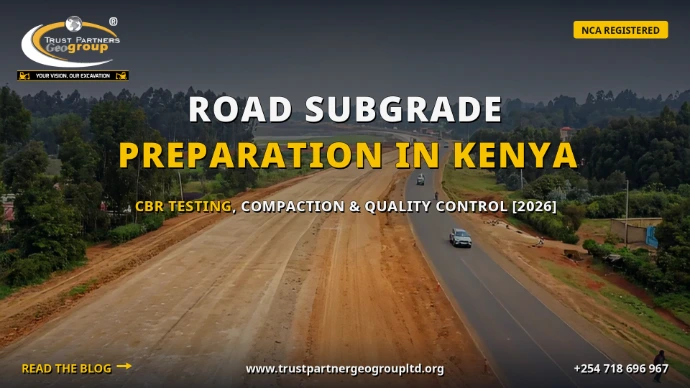
ROAD SUBGRADE PREPARATION IN KENYA: CBR TESTING, COMPACTION & QUALITY CONTROL [2026]
THE COMPLETE TECHNICAL GUIDE TO BUILDING ROADS THAT LAST — FROM SOIL TESTING TO FINAL COMPACTION
WHAT IS ROAD SUBGRADE AND WHY DOES IT MATTER?
The subgrade is the upper 300mm of the road foundation — either the natural soil in its original position (cut) or imported fill material (fill). It is the structural layer that carries the entire road pavement, from the subbase and base course to the asphalt or concrete surface. If the subgrade fails, everything above it fails.
In Kenya, subgrade preparation is particularly critical because of:
- Expansive soils: Black cotton soils in Rift Valley and parts of Nairobi swell when wet and shrink when dry, destroying road surfaces
- High rainfall variability: Two rainy seasons (March–May, October–December) saturate poorly prepared subgrades
- Heavy axle loads: East African corridor traffic includes overloaded trucks that punish weak subgrades
- Volcanic soils: Nairobi and Rift Valley regions have variable soil composition requiring thorough testing
KeNHA specifies that subgrade material must have a CBR of not less than 8% measured after a 4-day soak in a laboratory mix compacted to 100% MDD (AASHTO T99), with a swell of less than 1%. Subgrade repair requires selected material with minimum CBR 30%.
CBR TESTING: THE FOUNDATION OF ROAD DESIGN IN KENYA
The California Bearing Ratio (CBR) test is the standard method for determining subgrade strength in Kenya. Developed by the California Division of Highways in the 1930s, it measures the penetration resistance of soil compared to standard crushed stone.
HOW CBR TESTING WORKS
- Sample Preparation: Soil is placed in a cylindrical mould and compacted to specified density and moisture content
- Penetration Testing: A 50mm cylindrical plunger penetrates the sample at 1.25mm per minute
- Load Measurement: Load required to achieve 2.5mm and 5mm penetration is recorded
- CBR Calculation: CBR = (measured pressure / standard pressure) × 100%
- Soak Test: Sample is soaked for 4 days to simulate worst-case moisture conditions
CBR VALUE INTERPRETATION FOR KENYA ROADS
| CBR VALUE | SOIL CLASSIFICATION | SUITABILITY | TYPICAL APPLICATION |
|---|---|---|---|
| 0 – 3% | Very Poor (Soft Clay) | Unsuitable without stabilization | Requires extensive ground improvement |
| 3 – 7% | Poor to Fair (Clayey Soil) | Marginal for light traffic | Rural roads with stabilization |
| 7 – 20% | Fair to Good (Sandy/Silty) | Suitable for moderate traffic | Residential streets, parking lots |
| 20 – 50% | Good to Excellent (Gravel/Sand) | Suitable for heavy traffic | Highways, commercial roads |
| 50%+ | Excellent (Well-graded Gravel) | Ideal for all applications | Airport runways, heavy industrial |
KEHNA MANDATORY REQUIREMENT
Per KeNHA/R9/166/2026: Subgrade shall have a CBR of not less than 8% measured after a 4-day soak in a laboratory mix compacted to a dry density of 100% MDD (AASHTO T99) and a swell of less than 1%. Where subgrade fails, repair with selected material of minimum CBR 30%.
SUBGRADE PREPARATION PROCESS: STEP-BY-STEP
STEP 1: SITE CLEARING AND TOPSOIL REMOVAL
Remove all topsoil, vegetation, organic matter, and unsuitable material to a depth of 200mm. KeNHA prohibits material containing more than 5% organic matter, material with swell exceeding 3%, clay with plasticity index over 50, or moisture content greater than 105% of OMC.
STEP 2: GEOTECHNICAL INVESTIGATION
Conduct CBR testing, Atterberg limits, particle size distribution, and moisture-density relationship tests. Minimum testing frequency: 1 test per 1,000 m² for subgrade. For low-volume roads, DCP (Dynamic Cone Penetrometer) testing provides rapid in-situ CBR estimation.
STEP 3: EXCAVATION OR FILL PLACEMENT
In cut sections, excavate to design subgrade level. In fill sections, place material in layers not exceeding 200mm loose thickness. Black cotton soil and other expansive materials must be removed or stabilized. Benching of existing pavement required for widening projects — 500mm horizontal, 150mm vertical steps.
STEP 4: MOISTURE CONDITIONING
Bring subgrade material to optimum moisture content (OMC) before compaction. In arid areas, Kenya permits dry compaction using vibrating rollers when material achieves specified density at low moisture contents. Water addition may be impractical in water-scarce regions.
STEP 5: COMPACTION
Compact subgrade to 100% MDD (AASHTO T99) or 95% MDD (4.5kg rammer) as specified. Use vibratory rollers for granular materials; smooth drum or padfoot rollers for cohesive soils. Minimum 6–9 passes depending on roller type and material.
STEP 6: QUALITY CONTROL TESTING
Verify compaction using sand replacement method, nuclear density gauge, or DCP. Test frequency: 1 point per 1,000 m² for conventional testing; continuous monitoring with modern roller-integrated compaction meters (ICM) for advanced projects.
COMPACTION METHODS AND EQUIPMENT FOR KENYA ROADS
| COMPACTOR TYPE | BEST FOR | PASSES REQUIRED | OUTPUT |
|---|---|---|---|
| Vibratory Roller (3.4 Mg/m) | Granular soils, gravel, subbase | 6–9 passes | Best overall performance |
| Vibratory Roller (2.4 Mg/m) | Medium compaction, finishing | 8–12 passes | Good for thinner layers |
| Pneumatic Tyre Roller (1.3 Mg/wheel) | Cohesive soils, asphalt | 10–15 passes | Kneading action for clays |
| Pneumatic Tyre Roller (3.5 Mg/wheel) | Heavy compaction, proof rolling | 6–10 passes | High contact pressure |
| Smooth Drum Roller | Final finishing, sealing surface | 2–4 passes | Surface smoothness |
| Padfoot Roller | Cohesive soils, high clay content | 6–10 passes | High compaction energy |
DRY COMPACTION IN ARID AREAS
Kenya's arid and semi-arid regions (55% of the country receives 250–500mm rainfall; 20% receives less than 250mm) face water scarcity for construction. Research by the Transport and Road Research Laboratory (UK) and Kenya's Ministry of Transport confirmed that high densities can be achieved at low moisture contents using vibrating compaction methods. The vibrating hammer test is the preferred laboratory method for dry compaction, and vibratory rollers with high mass per metre width achieve specified densities without water addition. This is now permitted in KeNHA specifications for arid regions.
QUALITY CONTROL TESTING METHODS
KeNHA and Kenya's road construction industry employ multiple quality control methods for subgrade verification:
1. SAND REPLACEMENT METHOD (BS 1377)
The traditional standard for field density determination. A hole is excavated, the soil is weighed, and the volume is determined by filling with standard sand. Accurate but time-consuming — results available next day at earliest.
2. NUCLEAR DENSITY GAUGE
Rapid non-destructive testing using radioactive sources to measure density and moisture content. Results in minutes. Requires trained operator and radiation safety protocols. Correlation with sand replacement method required for calibration.
3. DYNAMIC CONE PENETROMETER (DCP)
Portable, rapid, and cost-effective. A 8kg hammer drops 575mm onto a 60° cone, and penetration depth per blow is recorded. DCP penetration rate (mm/blow) correlates directly with CBR. Kenya's DCP design method for low-volume roads uses this correlation extensively. Field CBR = 292 / (DCP penetration rate)^1.12.
4. ROLLER-INTEGRATED COMPACTION METERS (ICM)
Modern vibratory rollers equipped with accelerometers measure compaction response in real-time. Provides continuous coverage (approximately 333 points per 1,000 m² vs. 1 point for conventional testing). Results displayed as heat maps on tablet terminals linked to GPS. Enables immediate corrective action during construction.
| METHOD | SPEED | COST | ACCURACY | BEST FOR |
|---|---|---|---|---|
| Sand Replacement | Slow (1 day) | Low | High (reference) | Calibration, disputes |
| Nuclear Gauge | Fast (minutes) | Medium | Medium-High | High-volume projects |
| DCP | Fast (minutes) | Very Low | Medium | Low-volume roads, screening |
| ICM / Intelligent Compaction | Real-time | High | High | Major highways, expressways |
SUBGRADE STABILIZATION: WHEN NATURAL SOIL IS NOT ENOUGH
When natural subgrade soils fail to meet KeNHA's CBR ≥ 8% requirement, stabilization is mandatory. Kenya's common stabilization methods include:
MECHANICAL STABILIZATION
Mixing natural soil with imported gravel, crushed stone, or sand to improve gradation and strength. Cost-effective for marginal soils (CBR 5–7%). Requires blending equipment and careful quality control of mixed material.
CEMENT STABILIZATION
Adding 3–6% ordinary Portland cement to sandy and silty soils. Increases CBR by 3–5 times. Requires 7-day curing period. Effective for subgrade and subbase improvement. Cost: KES 1,500–2,500/m² depending on thickness and cement content.
LIME STABILIZATION
Adding 3–5% hydrated lime to clayey soils. Reduces plasticity, improves workability, and increases CBR by 2–4 times. Particularly effective for black cotton soils. Requires 24–48 hour mellowing period before compaction. Cost: KES 1,200–2,000/m².
BITUMEN STABILIZATION
Adding cutback bitumen or emulsion to granular soils. Provides waterproofing and binding. Used for high-quality subbases in heavy-traffic roads. Higher cost but superior performance in wet conditions.
GEOGRID REINFORCEMENT
Placing geogrids at subgrade level to distribute loads and reduce rutting. Effective for weak subgrades (CBR < 3%) where excavation and replacement is impractical. Cost: KES 300–600/m² for geogrid material plus installation.
SUBGRADE COSTS IN KENYA: 2026 PRICING
| ACTIVITY | UNIT | RATE (KES) | NOTES |
|---|---|---|---|
| Site clearance | m² | 50 – 70 | Regional variation |
| Topsoil removal (150mm) | m² | 70 – 90 | Includes disposal |
| Bulk excavation (soft soil) | m³ | 220 – 400 | Manual vs. mechanical |
| Subgrade compaction | m² | 80 – 120 | To 100% MDD |
| CBR testing (laboratory) | test | 15,000 – 35,000 | Including 4-day soak |
| DCP testing (field) | test | 5,000 – 10,000 | Rapid screening |
| Nuclear density testing | test | 8,000 – 15,000 | Requires certified operator |
| Cement stabilization | m² | 1,500 – 2,500 | 3–6% cement, 150mm thick |
| Lime stabilization | m² | 1,200 – 2,000 | 3–5% lime, 150mm thick |
| Geogrid installation | m² | 300 – 600 | Material + labor |
| Subgrade repair (selected material) | m³ | 2,500 – 4,000 | CBR ≥ 30% material |
COMMON SUBGRADE FAILURES AND HOW TO PREVENT THEM
| FAILURE | CAUSE | PREVENTION |
|---|---|---|
| Rutting | Insufficient compaction, weak subgrade, excess moisture | Compact to 100% MDD, stabilize weak soils, install drainage |
| Potholes | Water infiltration, subgrade erosion, poor drainage | Proper crossfall, sealed shoulders, subgrade waterproofing |
| Cracking | Expansive soils, differential settlement, thermal stress | Remove black cotton soil, lime stabilization, control moisture |
| Edge break | Insufficient shoulder support, water infiltration at edge | Compact shoulders, provide adequate drainage, seal edges |
| Pumping | Free water in subgrade, fines migration under load | Install subdrains, use filter layers, cement stabilization |
| Settlement | Organic matter, poor fill, inadequate compaction | Remove organic material, test fill quality, compact in layers |
FREQUENTLY ASKED QUESTIONS: ROAD SUBGRADE IN KENYA
What is the minimum CBR required for road subgrade in Kenya?
KeNHA specifies CBR ≥ 8% after 4-day soak for subgrade material, measured in a laboratory mix compacted to 100% MDD (AASHTO T99) with swell less than 1%. For subgrade repair, selected material must have minimum CBR 30%.
How often should CBR testing be done during road construction?
Minimum 1 CBR test per 1,000 m² of subgrade. For borrow materials: 1 test per 5,000 m³ for base material, 1 per 10,000 m³ for subbase, and 1 per 20,000 m³ for fill. More frequent testing is required for variable soils.
Can I use black cotton soil for road subgrade?
No — not without stabilization. Black cotton soil has high swell potential (often > 3%) and plasticity index exceeding 50. KeNHA prohibits its use unless stabilized with lime (3–5%) or cement (3–6%). Even then, it requires extensive testing and quality control.
What is the difference between MDD and OMC?
MDD (Maximum Dry Density) is the highest density a soil can achieve at a specific compaction energy. OMC (Optimum Moisture Content) is the moisture content at which MDD is achieved. Compacting at OMC ensures maximum density with minimum compactive effort. In Kenya, AASHTO T99 (Standard Proctor) is the reference method for subgrade.
How do I know if my subgrade is properly compacted?
Verify with field density tests: sand replacement method (most accurate), nuclear density gauge (fastest), or DCP (most economical). The field density must achieve at least 95% of laboratory MDD for road bases and 100% MDD for subgrade in some specifications. Modern projects use ICM-equipped rollers for continuous real-time monitoring.
What is Intelligent Compaction (ICM) and is it used in Kenya?
ICM uses vibratory rollers with accelerometers and GPS to measure compaction response in real-time, displaying results as color-coded heat maps. It provides 333+ measurement points per 1,000 m² versus 1 point for conventional testing. While still emerging in Kenya, ICM is being adopted for major expressway projects like the Nairobi-Mombasa Expressway. It eliminates human testing, improves safety, and enables immediate corrective action.
How much does subgrade preparation cost per kilometer of road?
For a standard 7-meter wide rural road: site clearance (KES 350–490/m), topsoil removal (KES 490–630/m), subgrade excavation and compaction (KES 1,500–2,500/m), and testing (KES 200–400/m). Total subgrade preparation: approximately KES 2,500–4,000 per meter or KES 2.5M–4M per kilometer for normal soil conditions. Hard rock, stabilization, or deep fill increases costs significantly.
Who is responsible for subgrade quality control — contractor or engineer?
The contractor is responsible for achieving specified compaction and CBR values. The engineer (or supervising consultant) verifies compliance through independent testing. In Kenya, the Engineer approves all materials and has authority to reject non-compliant work. The contractor bears the cost of rework for failed tests.
THE BOTTOM LINE: BUILD THE SUBGRADE RIGHT, BUILD THE ROAD ONCE
Road construction in Kenya is full of variables — weather, soil, traffic, and budget pressures. But one principle is non-negotiable: the subgrade must be right. Every shilling saved on inadequate compaction, skipped testing, or unverified material is repaid tenfold in potholes, rehabilitation, and lost economic productivity.
KeNHA's specifications exist because decades of Kenyan road construction proved what works. CBR ≥ 8%. Compaction to 100% MDD. Swell < 1%. These are not bureaucratic hurdles — they are the minimum standards for roads that survive two rainy seasons and twenty years of traffic.
At Trust Partners Geo-Group Ltd, we provide comprehensive subgrade preparation services — from geotechnical investigation and CBR testing to bulk excavation, compaction, stabilization, and quality control verification. Our equipment fleet includes vibratory rollers, DCP testing kits, and nuclear density gauges. We work to KeNHA standards and deliver roads that last.
— TRUST PARTNERS GEO-GROUP LTD
NEED SUBGRADE PREPARATION FOR YOUR ROAD PROJECT?
Trust Partners Geo-Group provides CBR testing, subgrade excavation, compaction, stabilization, and quality control for road construction across Kenya. We serve highway contractors, county governments, and private developers in Nairobi, Mombasa, Kisumu, Nakuru, Eldoret, and nationwide.
CALL +254 718 68 69 67 EMAIL US VISIT OUR WEBSITE
NAIROBI HQ | SERVING MOMBASA, KISUMU, NAKURU, ELDORET, THIKA & NATIONWIDE
MON - SAT: 8:00 AM - 6:00 PM | 24/7 EMERGENCY SUPPORT
RELATED RESOURCES
- EARTHWORKS COST PER M³ KENYA 2026 — Complete rate breakdown for cut, fill, and compaction
- ROCK EXCAVATION COST IN KENYA — Hard rock, medium rock, and blasting prices
- NCA CONTRACTOR REGISTRATION — How to register legally for road construction tenders
- HEAVY EQUIPMENT FOR HIRE — Excavators, bulldozers, rollers, graders & more
- ROAD CONSTRUCTION SERVICES — Earthworks, paving, drainage, and rehabilitation
TRUST PARTNERS GEO-GROUP LTD | YOUR VISION, OUR EXCAVATION
WEBSITE: WWW.TRUSTPARTNERGEOGROUPLTD.ORG | EMAIL: INFO@TRUSTPARTNERGEOGROUPLTD.ORG | PHONE: +254 718 68 69 67
FOLLOW US: FACEBOOK | TIKTOK | INSTAGRAM | YOUTUBE | LINKEDIN
© 2026 TRUST PARTNERS GEO-GROUP LTD. ALL RIGHTS RESERVED.
ROAD SUBGRADE PREPARATION IN KENYA: CBR TESTING, COMPACTION & QUALITY CONTROL [2026]
THE COMPLETE TECHNICAL GUIDE TO BUILDING ROADS THAT LAST — FROM SOIL TESTING TO FINAL COMPACTION
WHAT IS ROAD SUBGRADE AND WHY DOES IT MATTER?
The subgrade is the upper 300mm of the road foundation — either the natural soil in its original position (cut) or imported fill material (fill). It is the structural layer that carries the entire road pavement, from the subbase and base course to the asphalt or concrete surface. If the subgrade fails, everything above it fails.
In Kenya, subgrade preparation is particularly critical because of:
- Expansive soils: Black cotton soils in Rift Valley and parts of Nairobi swell when wet and shrink when dry, destroying road surfaces
- High rainfall variability: Two rainy seasons (March–May, October–December) saturate poorly prepared subgrades
- Heavy axle loads: East African corridor traffic includes overloaded trucks that punish weak subgrades
- Volcanic soils: Nairobi and Rift Valley regions have variable soil composition requiring thorough testing
KeNHA specifies that subgrade material must have a CBR of not less than 8% measured after a 4-day soak in a laboratory mix compacted to 100% MDD (AASHTO T99), with a swell of less than 1%. Subgrade repair requires selected material with minimum CBR 30%.
CBR TESTING: THE FOUNDATION OF ROAD DESIGN IN KENYA
The California Bearing Ratio (CBR) test is the standard method for determining subgrade strength in Kenya. Developed by the California Division of Highways in the 1930s, it measures the penetration resistance of soil compared to standard crushed stone.
HOW CBR TESTING WORKS
- Sample Preparation: Soil is placed in a cylindrical mould and compacted to specified density and moisture content
- Penetration Testing: A 50mm cylindrical plunger penetrates the sample at 1.25mm per minute
- Load Measurement: Load required to achieve 2.5mm and 5mm penetration is recorded
- CBR Calculation: CBR = (measured pressure / standard pressure) × 100%
- Soak Test: Sample is soaked for 4 days to simulate worst-case moisture conditions
CBR VALUE INTERPRETATION FOR KENYA ROADS
| CBR VALUE | SOIL CLASSIFICATION | SUITABILITY | TYPICAL APPLICATION |
|---|---|---|---|
| 0 – 3% | Very Poor (Soft Clay) | Unsuitable without stabilization | Requires extensive ground improvement |
| 3 – 7% | Poor to Fair (Clayey Soil) | Marginal for light traffic | Rural roads with stabilization |
| 7 – 20% | Fair to Good (Sandy/Silty) | Suitable for moderate traffic | Residential streets, parking lots |
| 20 – 50% | Good to Excellent (Gravel/Sand) | Suitable for heavy traffic | Highways, commercial roads |
| 50%+ | Excellent (Well-graded Gravel) | Ideal for all applications | Airport runways, heavy industrial |
KEHNA MANDATORY REQUIREMENT
Per KeNHA/R9/166/2026: Subgrade shall have a CBR of not less than 8% measured after a 4-day soak in a laboratory mix compacted to a dry density of 100% MDD (AASHTO T99) and a swell of less than 1%. Where subgrade fails, repair with selected material of minimum CBR 30%.
SUBGRADE PREPARATION PROCESS: STEP-BY-STEP
STEP 1: SITE CLEARING AND TOPSOIL REMOVAL
Remove all topsoil, vegetation, organic matter, and unsuitable material to a depth of 200mm. KeNHA prohibits material containing more than 5% organic matter, material with swell exceeding 3%, clay with plasticity index over 50, or moisture content greater than 105% of OMC.
STEP 2: GEOTECHNICAL INVESTIGATION
Conduct CBR testing, Atterberg limits, particle size distribution, and moisture-density relationship tests. Minimum testing frequency: 1 test per 1,000 m² for subgrade. For low-volume roads, DCP (Dynamic Cone Penetrometer) testing provides rapid in-situ CBR estimation.
STEP 3: EXCAVATION OR FILL PLACEMENT
In cut sections, excavate to design subgrade level. In fill sections, place material in layers not exceeding 200mm loose thickness. Black cotton soil and other expansive materials must be removed or stabilized. Benching of existing pavement required for widening projects — 500mm horizontal, 150mm vertical steps.
STEP 4: MOISTURE CONDITIONING
Bring subgrade material to optimum moisture content (OMC) before compaction. In arid areas, Kenya permits dry compaction using vibrating rollers when material achieves specified density at low moisture contents. Water addition may be impractical in water-scarce regions.
STEP 5: COMPACTION
Compact subgrade to 100% MDD (AASHTO T99) or 95% MDD (4.5kg rammer) as specified. Use vibratory rollers for granular materials; smooth drum or padfoot rollers for cohesive soils. Minimum 6–9 passes depending on roller type and material.
STEP 6: QUALITY CONTROL TESTING
Verify compaction using sand replacement method, nuclear density gauge, or DCP. Test frequency: 1 point per 1,000 m² for conventional testing; continuous monitoring with modern roller-integrated compaction meters (ICM) for advanced projects.
COMPACTION METHODS AND EQUIPMENT FOR KENYA ROADS
| COMPACTOR TYPE | BEST FOR | PASSES REQUIRED | OUTPUT |
|---|---|---|---|
| Vibratory Roller (3.4 Mg/m) | Granular soils, gravel, subbase | 6–9 passes | Best overall performance |
| Vibratory Roller (2.4 Mg/m) | Medium compaction, finishing | 8–12 passes | Good for thinner layers |
| Pneumatic Tyre Roller (1.3 Mg/wheel) | Cohesive soils, asphalt | 10–15 passes | Kneading action for clays |
| Pneumatic Tyre Roller (3.5 Mg/wheel) | Heavy compaction, proof rolling | 6–10 passes | High contact pressure |
| Smooth Drum Roller | Final finishing, sealing surface | 2–4 passes | Surface smoothness |
| Padfoot Roller | Cohesive soils, high clay content | 6–10 passes | High compaction energy |
DRY COMPACTION IN ARID AREAS
Kenya's arid and semi-arid regions (55% of the country receives 250–500mm rainfall; 20% receives less than 250mm) face water scarcity for construction. Research by the Transport and Road Research Laboratory (UK) and Kenya's Ministry of Transport confirmed that high densities can be achieved at low moisture contents using vibrating compaction methods. The vibrating hammer test is the preferred laboratory method for dry compaction, and vibratory rollers with high mass per metre width achieve specified densities without water addition. This is now permitted in KeNHA specifications for arid regions.
QUALITY CONTROL TESTING METHODS
KeNHA and Kenya's road construction industry employ multiple quality control methods for subgrade verification:
1. SAND REPLACEMENT METHOD (BS 1377)
The traditional standard for field density determination. A hole is excavated, the soil is weighed, and the volume is determined by filling with standard sand. Accurate but time-consuming — results available next day at earliest.
2. NUCLEAR DENSITY GAUGE
Rapid non-destructive testing using radioactive sources to measure density and moisture content. Results in minutes. Requires trained operator and radiation safety protocols. Correlation with sand replacement method required for calibration.
3. DYNAMIC CONE PENETROMETER (DCP)
Portable, rapid, and cost-effective. A 8kg hammer drops 575mm onto a 60° cone, and penetration depth per blow is recorded. DCP penetration rate (mm/blow) correlates directly with CBR. Kenya's DCP design method for low-volume roads uses this correlation extensively. Field CBR = 292 / (DCP penetration rate)^1.12.
4. ROLLER-INTEGRATED COMPACTION METERS (ICM)
Modern vibratory rollers equipped with accelerometers measure compaction response in real-time. Provides continuous coverage (approximately 333 points per 1,000 m² vs. 1 point for conventional testing). Results displayed as heat maps on tablet terminals linked to GPS. Enables immediate corrective action during construction.
| METHOD | SPEED | COST | ACCURACY | BEST FOR |
|---|---|---|---|---|
| Sand Replacement | Slow (1 day) | Low | High (reference) | Calibration, disputes |
| Nuclear Gauge | Fast (minutes) | Medium | Medium-High | High-volume projects |
| DCP | Fast (minutes) | Very Low | Medium | Low-volume roads, screening |
| ICM / Intelligent Compaction | Real-time | High | High | Major highways, expressways |
SUBGRADE STABILIZATION: WHEN NATURAL SOIL IS NOT ENOUGH
When natural subgrade soils fail to meet KeNHA's CBR ≥ 8% requirement, stabilization is mandatory. Kenya's common stabilization methods include:
MECHANICAL STABILIZATION
Mixing natural soil with imported gravel, crushed stone, or sand to improve gradation and strength. Cost-effective for marginal soils (CBR 5–7%). Requires blending equipment and careful quality control of mixed material.
CEMENT STABILIZATION
Adding 3–6% ordinary Portland cement to sandy and silty soils. Increases CBR by 3–5 times. Requires 7-day curing period. Effective for subgrade and subbase improvement. Cost: KES 1,500–2,500/m² depending on thickness and cement content.
LIME STABILIZATION
Adding 3–5% hydrated lime to clayey soils. Reduces plasticity, improves workability, and increases CBR by 2–4 times. Particularly effective for black cotton soils. Requires 24–48 hour mellowing period before compaction. Cost: KES 1,200–2,000/m².
BITUMEN STABILIZATION
Adding cutback bitumen or emulsion to granular soils. Provides waterproofing and binding. Used for high-quality subbases in heavy-traffic roads. Higher cost but superior performance in wet conditions.
GEOGRID REINFORCEMENT
Placing geogrids at subgrade level to distribute loads and reduce rutting. Effective for weak subgrades (CBR < 3%) where excavation and replacement is impractical. Cost: KES 300–600/m² for geogrid material plus installation.
SUBGRADE COSTS IN KENYA: 2026 PRICING
| ACTIVITY | UNIT | RATE (KES) | NOTES |
|---|---|---|---|
| Site clearance | m² | 50 – 70 | Regional variation |
| Topsoil removal (150mm) | m² | 70 – 90 | Includes disposal |
| Bulk excavation (soft soil) | m³ | 220 – 400 | Manual vs. mechanical |
| Subgrade compaction | m² | 80 – 120 | To 100% MDD |
| CBR testing (laboratory) | test | 15,000 – 35,000 | Including 4-day soak |
| DCP testing (field) | test | 5,000 – 10,000 | Rapid screening |
| Nuclear density testing | test | 8,000 – 15,000 | Requires certified operator |
| Cement stabilization | m² | 1,500 – 2,500 | 3–6% cement, 150mm thick |
| Lime stabilization | m² | 1,200 – 2,000 | 3–5% lime, 150mm thick |
| Geogrid installation | m² | 300 – 600 | Material + labor |
| Subgrade repair (selected material) | m³ | 2,500 – 4,000 | CBR ≥ 30% material |
COMMON SUBGRADE FAILURES AND HOW TO PREVENT THEM
| FAILURE | CAUSE | PREVENTION |
|---|---|---|
| Rutting | Insufficient compaction, weak subgrade, excess moisture | Compact to 100% MDD, stabilize weak soils, install drainage |
| Potholes | Water infiltration, subgrade erosion, poor drainage | Proper crossfall, sealed shoulders, subgrade waterproofing |
| Cracking | Expansive soils, differential settlement, thermal stress | Remove black cotton soil, lime stabilization, control moisture |
| Edge break | Insufficient shoulder support, water infiltration at edge | Compact shoulders, provide adequate drainage, seal edges |
| Pumping | Free water in subgrade, fines migration under load | Install subdrains, use filter layers, cement stabilization |
| Settlement | Organic matter, poor fill, inadequate compaction | Remove organic material, test fill quality, compact in layers |
FREQUENTLY ASKED QUESTIONS: ROAD SUBGRADE IN KENYA
What is the minimum CBR required for road subgrade in Kenya?
KeNHA specifies CBR ≥ 8% after 4-day soak for subgrade material, measured in a laboratory mix compacted to 100% MDD (AASHTO T99) with swell less than 1%. For subgrade repair, selected material must have minimum CBR 30%.
How often should CBR testing be done during road construction?
Minimum 1 CBR test per 1,000 m² of subgrade. For borrow materials: 1 test per 5,000 m³ for base material, 1 per 10,000 m³ for subbase, and 1 per 20,000 m³ for fill. More frequent testing is required for variable soils.
Can I use black cotton soil for road subgrade?
No — not without stabilization. Black cotton soil has high swell potential (often > 3%) and plasticity index exceeding 50. KeNHA prohibits its use unless stabilized with lime (3–5%) or cement (3–6%). Even then, it requires extensive testing and quality control.
What is the difference between MDD and OMC?
MDD (Maximum Dry Density) is the highest density a soil can achieve at a specific compaction energy. OMC (Optimum Moisture Content) is the moisture content at which MDD is achieved. Compacting at OMC ensures maximum density with minimum compactive effort. In Kenya, AASHTO T99 (Standard Proctor) is the reference method for subgrade.
How do I know if my subgrade is properly compacted?
Verify with field density tests: sand replacement method (most accurate), nuclear density gauge (fastest), or DCP (most economical). The field density must achieve at least 95% of laboratory MDD for road bases and 100% MDD for subgrade in some specifications. Modern projects use ICM-equipped rollers for continuous real-time monitoring.
What is Intelligent Compaction (ICM) and is it used in Kenya?
ICM uses vibratory rollers with accelerometers and GPS to measure compaction response in real-time, displaying results as color-coded heat maps. It provides 333+ measurement points per 1,000 m² versus 1 point for conventional testing. While still emerging in Kenya, ICM is being adopted for major expressway projects like the Nairobi-Mombasa Expressway. It eliminates human testing, improves safety, and enables immediate corrective action.
How much does subgrade preparation cost per kilometer of road?
For a standard 7-meter wide rural road: site clearance (KES 350–490/m), topsoil removal (KES 490–630/m), subgrade excavation and compaction (KES 1,500–2,500/m), and testing (KES 200–400/m). Total subgrade preparation: approximately KES 2,500–4,000 per meter or KES 2.5M–4M per kilometer for normal soil conditions. Hard rock, stabilization, or deep fill increases costs significantly.
Who is responsible for subgrade quality control — contractor or engineer?
The contractor is responsible for achieving specified compaction and CBR values. The engineer (or supervising consultant) verifies compliance through independent testing. In Kenya, the Engineer approves all materials and has authority to reject non-compliant work. The contractor bears the cost of rework for failed tests.
THE BOTTOM LINE: BUILD THE SUBGRADE RIGHT, BUILD THE ROAD ONCE
Road construction in Kenya is full of variables — weather, soil, traffic, and budget pressures. But one principle is non-negotiable: the subgrade must be right. Every shilling saved on inadequate compaction, skipped testing, or unverified material is repaid tenfold in potholes, rehabilitation, and lost economic productivity.
KeNHA's specifications exist because decades of Kenyan road construction proved what works. CBR ≥ 8%. Compaction to 100% MDD. Swell < 1%. These are not bureaucratic hurdles — they are the minimum standards for roads that survive two rainy seasons and twenty years of traffic.
At Trust Partners Geo-Group Ltd, we provide comprehensive subgrade preparation services — from geotechnical investigation and CBR testing to bulk excavation, compaction, stabilization, and quality control verification. Our equipment fleet includes vibratory rollers, DCP testing kits, and nuclear density gauges. We work to KeNHA standards and deliver roads that last.
— TRUST PARTNERS GEO-GROUP LTD
NEED SUBGRADE PREPARATION FOR YOUR ROAD PROJECT?
Trust Partners Geo-Group provides CBR testing, subgrade excavation, compaction, stabilization, and quality control for road construction across Kenya. We serve highway contractors, county governments, and private developers in Nairobi, Mombasa, Kisumu, Nakuru, Eldoret, and nationwide.
CALL +254 718 68 69 67 EMAIL US VISIT OUR WEBSITE
NAIROBI HQ | SERVING MOMBASA, KISUMU, NAKURU, ELDORET, THIKA & NATIONWIDE
MON - SAT: 8:00 AM - 6:00 PM | 24/7 EMERGENCY SUPPORT
RELATED RESOURCES
- EARTHWORKS COST PER M³ KENYA 2026 — Complete rate breakdown for cut, fill, and compaction
- ROCK EXCAVATION COST IN KENYA — Hard rock, medium rock, and blasting prices
- NCA CONTRACTOR REGISTRATION — How to register legally for road construction tenders
- HEAVY EQUIPMENT FOR HIRE — Excavators, bulldozers, rollers, graders & more
- ROAD CONSTRUCTION SERVICES — Earthworks, paving, drainage, and rehabilitation
TRUST PARTNERS GEO-GROUP LTD | YOUR VISION, OUR EXCAVATION
WEBSITE: WWW.TRUSTPARTNERGEOGROUPLTD.ORG | EMAIL: INFO@TRUSTPARTNERGEOGROUPLTD.ORG | PHONE: +254 718 68 69 67
FOLLOW US: FACEBOOK | TIKTOK | INSTAGRAM | YOUTUBE | LINKEDIN
© 2026 TRUST PARTNERS GEO-GROUP LTD. ALL RIGHTS RESERVED.