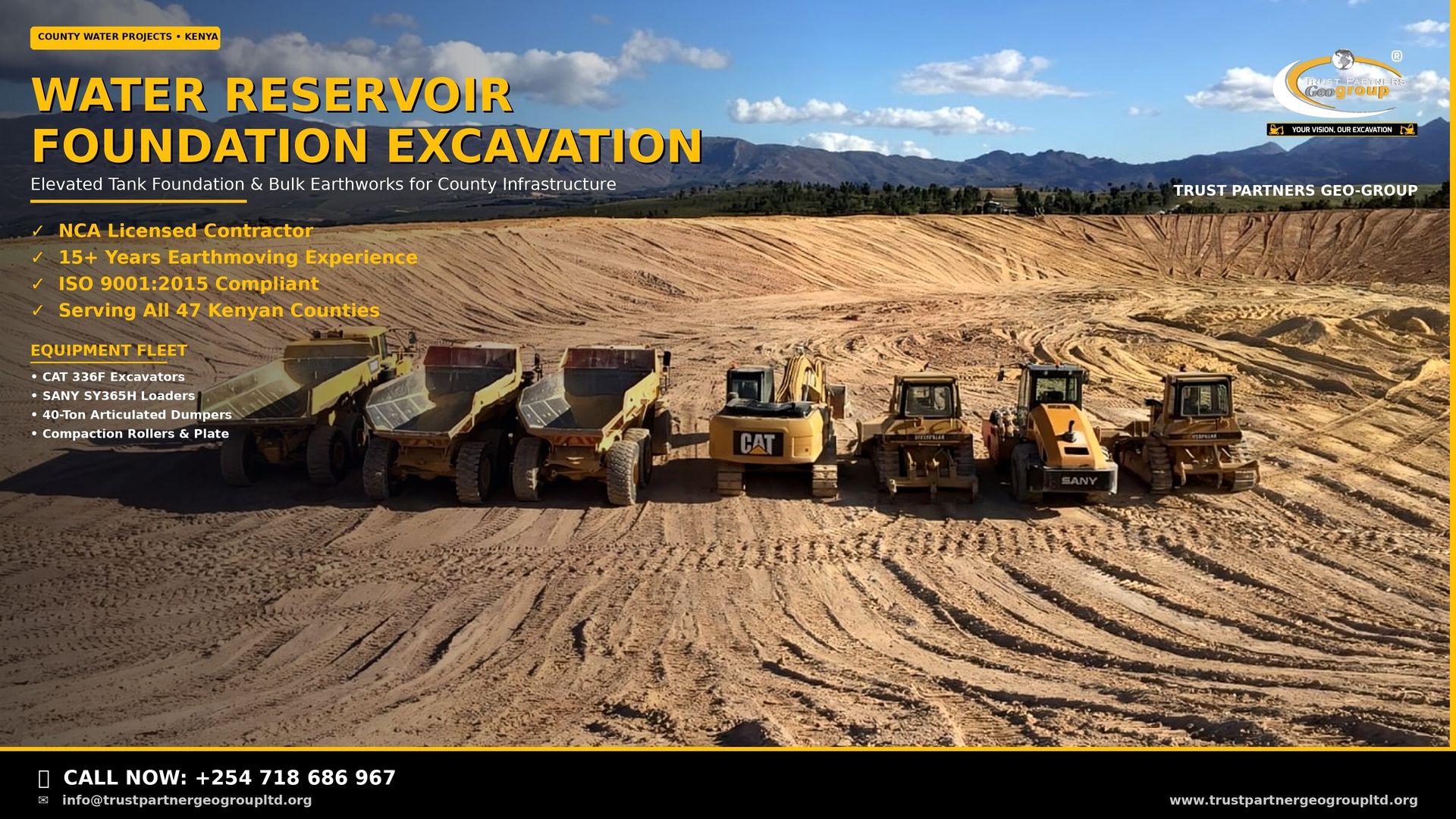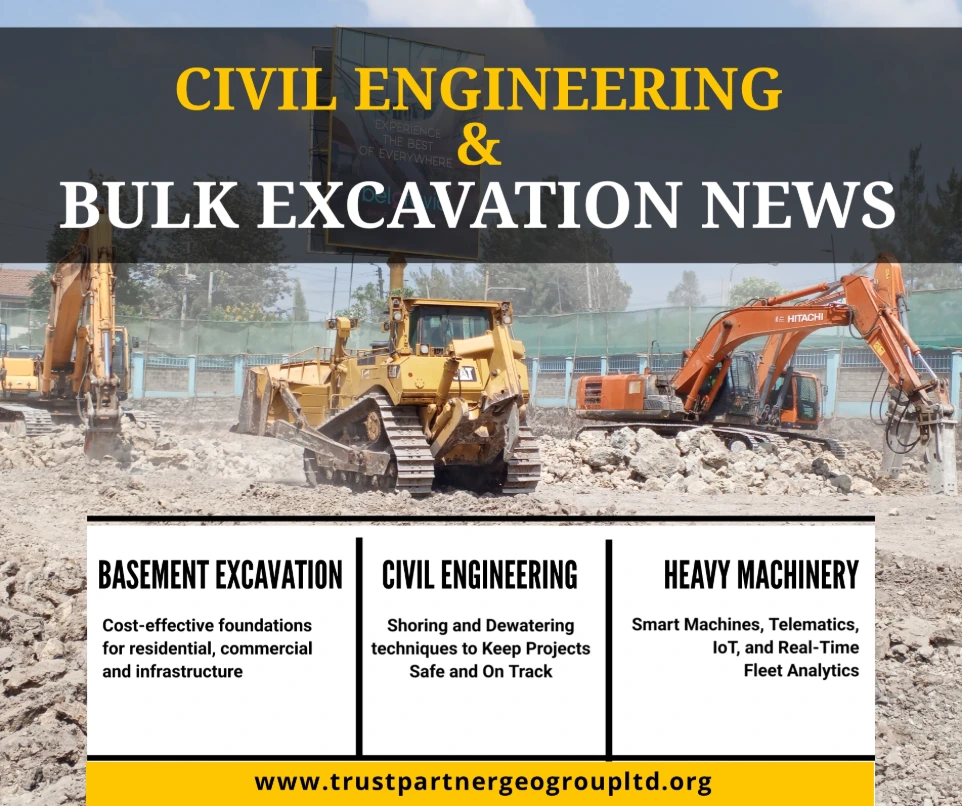
Water Reservoir and Elevated Tank Foundation Excavation for County Water Projects in Kenya
A complete technical guide to precision earthworks for county water infrastructure — from site survey to handover. Trusted by county water departments across all 47 counties.

📋 Table of Contents
- Why County Water Projects Need Specialized Foundation Excavation
- Water Reservoir Foundation Excavation Process [Step-by-Step]
- Elevated Tank Foundation Excavation Requirements
- County Water Project Compliance: NEMA, WRMA & County Permits
- Equipment Used for Reservoir & Tank Foundation Excavation
- Cost Factors for Water Storage Foundation Excavation in Kenya
- Frequently Asked Questions
- Contact Trust Partners for County Water Project Earthworks
County water projects form the backbone of Kenya's rural and urban water supply infrastructure. From water reservoir excavation in Kenya to elevated tank foundation earthworks, precision excavation determines the structural integrity, longevity, and safety of these critical public assets. At Trust Partners Geo-Group Ltd, we have delivered county water project earthworks across Nairobi, Mombasa, Kisumu, Nakuru, and beyond — ensuring every cubic meter of earth is moved with engineering precision.
Whether you are a county water department planning a new reservoir, a CDF committee funding community water storage, or a developer building private water infrastructure, this guide covers everything you need to know about water tower base excavation, dam construction contractors Kenya selection, and compliance requirements for public water projects.
Why County Water Projects Need Specialized Foundation Excavation
Water reservoirs and elevated tanks are among the most technically demanding excavation projects in Kenyan civil engineering. Unlike standard basement excavation or site preparation, water storage structures require:
- Zero-tolerance grading accuracy — Reservoir floors must be perfectly level to ensure even water distribution and prevent structural stress on linings.
- Cut-off trench excavation — Essential for preventing seepage and groundwater contamination, especially for earthfill dams and lined reservoirs.
- High-density compaction — Subgrade must achieve 95% Mod AASHTO density to prevent settlement under hydrostatic load.
- Dewatering expertise — Many Kenyan sites, particularly in Nairobi's high-water-table zones and Western Kenya's swampy areas, require active dewatering throughout excavation.
- NEMA and WRMA compliance — Water projects trigger strict environmental and water resource management regulations.
🏗️ Engineering Insight
A poorly excavated reservoir foundation can lead to liner failure, embankment collapse, and contamination of groundwater aquifers. The cost of corrective earthworks often exceeds the original excavation budget by 300-400%. Investing in experienced dam construction contractors Kenya from day one is non-negotiable.
Our team at Trust Partners Geo-Group brings 15 years of excavation experience in Kenya to every county water project. We understand the unique challenges of water pan excavation Kenya — from black cotton soil stabilization in Kisumu to rocky terrain excavation in Nyeri and high-water-table dewatering in Mombasa.
Water Reservoir Foundation Excavation Process [Step-by-Step]
Executing a water reservoir foundation excavation requires a methodical, phased approach. Below is the proven process our earthworks contractors Kenya team follows on every county water project:
Step 1: Site Survey and Soil Investigation
Before any earth is moved, comprehensive geotechnical investigation determines:
- Soil bearing capacity — Critical for determining foundation depth and whether soil improvement is required.
- Groundwater table depth — Informs dewatering strategy and cut-off trench design. In water reservoir excavation Nairobi and water reservoir excavation Mombasa, groundwater can be as shallow as 1.5 meters.
- Soil permeability — Clay soils require different liner preparation than sandy or loamy soils.
- Topographical contours — Determine optimal reservoir orientation, spillway location, and catchment area boundaries.
We coordinate with county surveyors and independent geotechnical consultants to ensure all data meets NCA contractor registration requirements for excavation works in Kenya and county tender documentation standards.
Step 2: Site Clearing and Topsoil Stripping
Using our heavy equipment hire fleet, we clear vegetation, remove organic topsoil (typically 150-300mm), and establish site access roads. Topsoil is stockpiled for later use in embankment grassing and landscaping.
⚠️ Common Mistake to Avoid
Leaving tree roots or organic material in the excavation zone leads to future voids, settlement, and liner punctures. Always strip completely to mineral soil.
Step 3: Cut-off Trench and Foundation Pit Excavation
This is the most critical phase of reservoir construction Kenya earthworks:
- Cut-off trenches are excavated around the reservoir perimeter to key depth (typically 1.5-2.0 meters into impermeable strata). These trenches are backfilled with compacted clay or concrete to create a vertical barrier against seepage.
- Foundation pits for elevated tanks are excavated to design depth (2.5-4.0 meters) with over-excavation allowances for blinding concrete and reinforcement.
- Slope grading — Reservoir embankment slopes are cut to design angles (typically 1:2 to 1:3 depending on soil type) to ensure long-term stability.
Our 30-ton Hyundai HX300SL excavators and GPS machine control systems ensure excavation accuracy within ±50mm.
Step 4: Compaction and Density Testing
Every layer of backfill and subgrade is compacted and tested:
| Layer | Compaction Requirement | Testing Method | Frequency |
|---|---|---|---|
| Subgrade (reservoir floor) | 95% Mod AASHTO | Sand replacement / Nuclear densometer | Every 500 m² |
| Cut-off trench backfill | 98% Mod AASHTO | Core cutter / Sand cone | Every 50 linear meters |
| Embankment fill | 92% Mod AASHTO | Nuclear densometer | Every 1,000 m² per lift |
| Elevated tank foundation | 95% + Plate Load Test | Plate load test (300mm plate) | One test per tank foundation |
We provide full QA/QC documentation including method statements, test certificates, and as-built drawings — essential for county project handover and NEMA compliance.
Step 5: Dewatering and Groundwater Management
For sites with high groundwater tables, we implement:
- Sump pumping — Shallow sumps with submersible pumps for minor groundwater intrusion.
- Wellpoint dewatering — Arrays of shallow wells connected to a vacuum pump system for moderate water tables.
- Deep well dewatering — For deep excavations (3+ meters) in permeable soils like those found in water reservoir excavation Nakuru and water reservoir excavation Kisumu.
Our dewatering pump hire fleet includes diesel and electric pumps from 2-inch to 8-inch discharge capacity.
Step 6: Spoil Management and Site Grading
Excavated material is either reused on-site as embankment fill (if suitable), carted away to approved disposal sites, or processed through our mobile crusher and screener for reuse as sub-base material. Final site grading ensures proper drainage away from the reservoir structure.
Elevated Tank Foundation Excavation Requirements
Elevated tank foundation earthworks differ significantly from ground-level reservoir excavation. The concentrated structural load of a steel or concrete elevated tank requires:
Deep Foundation Pits
Elevated tanks exert point loads of 150-400 kN per column. Foundation pits must be excavated to depths where soil bearing capacity exceeds 150 kPa. In Nairobi's red volcanic soils, this is typically 2.5-3.0 meters. In Western Kenya's black cotton soils, depths of 3.5-4.5 meters may be required with soil replacement or stabilization.
Reinforcement Preparation
After excavation, foundation pits are prepared for reinforcement cage installation. This includes blinding concrete (50-75mm) to protect reinforcement from soil contamination, formwork for column pedestals and ring beams, and anchor bolt positioning templates.
Vibration Control
For elevated tanks near existing structures, we use controlled excavation techniques to minimize vibration. Our rock breaking alternatives include hydraulic hammers with dampened mounts rather than blasting.
✅ Case Study: Nakuru County Elevated Tank
Trust Partners Geo-Group recently completed a 200,000-liter elevated tank foundation in Nakuru County, excavating 3.2 meters through black cotton soil and achieving 97% compaction density. The project was completed 4 days ahead of schedule, saving the county 15% on earthworks costs.
County Water Project Compliance: NEMA, WRMA & County Permits
Navigating regulatory compliance is critical for county water project earthworks in Kenya. Our team ensures all projects meet:
NEMA Environmental Requirements
- EIA License — Required for reservoirs >50,000 m³ or projects in sensitive ecosystems
- Environmental Management Plan (EMP) — Required for smaller community water pans
- NEMA compliance documentation — We prepare erosion control plans, sediment management protocols, and rehabilitation plans as part of our full-service earthworks package
Water Resources Management Authority (WRMA)
- Water permit — Required for any structure affecting surface or groundwater
- Abstraction license — If the reservoir will feed from a river or stream
- Dam safety compliance — For earthfill dams >3 meters in height
County Government Requirements
- County construction permit — Issued by the county department of public works
- County tender compliance — NCA registration, tax compliance, and performance bonds
- County environmental officer approval — Site-specific conditions
Trust Partners Geo-Group is a NEMA-compliant contractor and NCA-registered earthworks specialist (NCA Category 1 & 2), ensuring your county water project meets every regulatory requirement from excavation to handover.
Equipment Used for Reservoir & Tank Foundation Excavation
Our heavy equipment hire Kenya fleet for water project earthworks includes:
| Equipment | Application | Capacity/Specification |
|---|---|---|
| 30-Ton Excavator (Hyundai HX300SL) | Bulk excavation, cut-off trenches | 1.5 m³ bucket, GPS machine control |
| 20-Ton Excavator | Precision grading, tank foundations | 0.9 m³ bucket, fine grading bucket |
| Bulldozer (D6/D7) | Site clearing, grading, backfill spreading | Ripper attachment for rocky soils |
| Dump Trucks (20-30 Ton) | Spoil removal, fill material transport | 12-20 m³ capacity per trip |
| Vibratory Compactor | Subgrade and embankment compaction | 10-12 ton, smooth drum |
| Dewatering Pumps | Groundwater management | 2" to 8" diesel/electric pumps |
| Plate Compactor | Trench and confined area compaction | 500 kg reversible plate |
All equipment is operated by certified operators with NCA-recognized training. We offer equipment hire with operator packages for county projects requiring flexible earthworks solutions.
Cost Factors for Water Storage Foundation Excavation in Kenya
Understanding water reservoir excavation Kenya costs helps county departments budget accurately. Our 2027 rate guide provides transparent pricing:
| Item | Unit | Rate (KES) | Notes |
|---|---|---|---|
| Soil excavation (reservoir) | per m³ | 1,200 – 1,800 | Depth < 3m, easy access |
| Rock excavation (reservoir) | per m³ | 2,500 – 4,000 | Includes hydraulic hammer |
| Elevated tank foundation | per m³ | 1,800 – 3,500 | Includes dewatering |
| Cut-off trench excavation | per linear m | 3,500 – 6,000 | Depth and width dependent |
| Compaction testing | per test | 8,000 – 15,000 | Sand replacement method |
| Dewatering (pump hire) | per day | 5,000 – 12,000 | Pump size dependent |
| Spoil disposal / cart away | per m³ | 800 – 1,500 | Distance to disposal site |
Note: Rates vary by location. Water reservoir excavation Nairobi and water reservoir excavation Mombasa typically command 10-15% premium due to access constraints and disposal costs. Rural county projects in areas like Nyeri, Meru, and Kitale often benefit from lower mobilization costs.
For a detailed, itemized quote for your county water project, download our 2027 Excavation Rate Card or contact our estimation team.
Frequently Asked Questions About Water Reservoir Foundation Excavation in Kenya
Water reservoir foundation depth in Kenya typically ranges from 1.5 to 3.0 meters depending on reservoir capacity, soil bearing capacity, and groundwater table. For elevated tanks, foundation depth ranges from 2.5 to 4.0 meters with reinforced concrete footings. Soil investigation reports determine exact depths per site. In high-water-table areas like parts of Mombasa and Kisumu, additional dewatering and cut-off measures may increase effective excavation depth by 0.5-1.0 meters.
Water reservoir foundation excavation costs in Kenya range from KES 1,200 to KES 2,800 per cubic meter depending on soil type, depth, dewatering requirements, and location. Elevated tank foundations typically cost KES 1,800 to KES 3,500 per m³ due to deeper excavation and reinforcement preparation. Rock excavation increases costs to KES 2,500-4,000 per m³. For a complete 2027 price list, see our Excavation Rates Guide.
Yes. County water projects in Kenya require NEMA Environmental Impact Assessment (EIA) approval if the reservoir capacity exceeds 50,000 cubic meters or if the project is located within environmentally sensitive areas such as wetlands, forests, or riparian reserves. Smaller community water pans may require a NEMA Environmental Management Plan (EMP) instead. Trust Partners Geo-Group prepares all environmental documentation as part of our comprehensive earthworks service.
Reservoir foundation excavation typically uses 20-30 ton excavators for bulk earthworks, bulldozers for grading, dump trucks for spoil removal, and vibratory compactors for density testing. Dewatering pumps are essential for sites with high groundwater tables. Our GPS machine control systems ensure precise grading to design levels within ±50mm accuracy — critical for liner installation and structural integrity.
Elevated tank foundation excavation in Kenya typically takes 2-4 weeks depending on tank capacity, soil conditions, and weather. A 100,000-liter elevated tank foundation requires approximately 10-14 days for excavation, grading, and compaction testing. Dewatering and rock breaking can extend timelines by 5-10 days. During Kenya's dry season (January-March), projects typically proceed 20-30% faster due to optimal soil conditions and reduced dewatering requirements. See our Excavation Timeline Guide for detailed scheduling.
Planning a County Water Storage Project?
Trust Partners Geo-Group delivers expert reservoir and elevated tank foundation excavation with full NEMA compliance, QA/QC documentation, and on-time delivery. From site survey to handover, we handle every cubic meter with precision.
📞 +254 718 68 69 67Request Free Site Assessment
Serving all 47 counties including Nairobi, Mombasa, Kisumu, Nakuru, Nyeri, Meru, Kitale, Naivasha, and beyond.
Water Reservoir and Elevated Tank Foundation Excavation for County Water Projects in Kenya
A complete technical guide to precision earthworks for county water infrastructure — from site survey to handover. Trusted by county water departments across all 47 counties.
📋 Table of Contents
- Why County Water Projects Need Specialized Foundation Excavation
- Water Reservoir Foundation Excavation Process [Step-by-Step]
- Elevated Tank Foundation Excavation Requirements
- County Water Project Compliance: NEMA, WRMA & County Permits
- Equipment Used for Reservoir & Tank Foundation Excavation
- Cost Factors for Water Storage Foundation Excavation in Kenya
- Frequently Asked Questions
- Contact Trust Partners for County Water Project Earthworks
County water projects form the backbone of Kenya's rural and urban water supply infrastructure. From water reservoir excavation in Kenya to elevated tank foundation earthworks, precision excavation determines the structural integrity, longevity, and safety of these critical public assets. At Trust Partners Geo-Group Ltd, we have delivered county water project earthworks across Nairobi, Mombasa, Kisumu, Nakuru, and beyond — ensuring every cubic meter of earth is moved with engineering precision.
Whether you are a county water department planning a new reservoir, a CDF committee funding community water storage, or a developer building private water infrastructure, this guide covers everything you need to know about water tower base excavation, dam construction contractors Kenya selection, and compliance requirements for public water projects.
Why County Water Projects Need Specialized Foundation Excavation
Water reservoirs and elevated tanks are among the most technically demanding excavation projects in Kenyan civil engineering. Unlike standard basement excavation or site preparation, water storage structures require:
- Zero-tolerance grading accuracy — Reservoir floors must be perfectly level to ensure even water distribution and prevent structural stress on linings.
- Cut-off trench excavation — Essential for preventing seepage and groundwater contamination, especially for earthfill dams and lined reservoirs.
- High-density compaction — Subgrade must achieve 95% Mod AASHTO density to prevent settlement under hydrostatic load.
- Dewatering expertise — Many Kenyan sites, particularly in Nairobi's high-water-table zones and Western Kenya's swampy areas, require active dewatering throughout excavation.
- NEMA and WRMA compliance — Water projects trigger strict environmental and water resource management regulations.
🏗️ Engineering Insight
A poorly excavated reservoir foundation can lead to liner failure, embankment collapse, and contamination of groundwater aquifers. The cost of corrective earthworks often exceeds the original excavation budget by 300-400%. Investing in experienced dam construction contractors Kenya from day one is non-negotiable.
Our team at Trust Partners Geo-Group brings 15 years of excavation experience in Kenya to every county water project. We understand the unique challenges of water pan excavation Kenya — from black cotton soil stabilization in Kisumu to rocky terrain excavation in Nyeri and high-water-table dewatering in Mombasa.
Water Reservoir Foundation Excavation Process [Step-by-Step]
Executing a water reservoir foundation excavation requires a methodical, phased approach. Below is the proven process our earthworks contractors Kenya team follows on every county water project:
Step 1: Site Survey and Soil Investigation
Before any earth is moved, comprehensive geotechnical investigation determines:
- Soil bearing capacity — Critical for determining foundation depth and whether soil improvement is required.
- Groundwater table depth — Informs dewatering strategy and cut-off trench design. In water reservoir excavation Nairobi and water reservoir excavation Mombasa, groundwater can be as shallow as 1.5 meters.
- Soil permeability — Clay soils require different liner preparation than sandy or loamy soils.
- Topographical contours — Determine optimal reservoir orientation, spillway location, and catchment area boundaries.
We coordinate with county surveyors and independent geotechnical consultants to ensure all data meets NCA contractor registration requirements for excavation works in Kenya and county tender documentation standards.
Step 2: Site Clearing and Topsoil Stripping
Using our heavy equipment hire fleet, we clear vegetation, remove organic topsoil (typically 150-300mm), and establish site access roads. Topsoil is stockpiled for later use in embankment grassing and landscaping.
⚠️ Common Mistake to Avoid
Leaving tree roots or organic material in the excavation zone leads to future voids, settlement, and liner punctures. Always strip completely to mineral soil.
Step 3: Cut-off Trench and Foundation Pit Excavation
This is the most critical phase of reservoir construction Kenya earthworks:
- Cut-off trenches are excavated around the reservoir perimeter to key depth (typically 1.5-2.0 meters into impermeable strata). These trenches are backfilled with compacted clay or concrete to create a vertical barrier against seepage.
- Foundation pits for elevated tanks are excavated to design depth (2.5-4.0 meters) with over-excavation allowances for blinding concrete and reinforcement.
- Slope grading — Reservoir embankment slopes are cut to design angles (typically 1:2 to 1:3 depending on soil type) to ensure long-term stability.
Our 30-ton Hyundai HX300SL excavators and GPS machine control systems ensure excavation accuracy within ±50mm.
Step 4: Compaction and Density Testing
Every layer of backfill and subgrade is compacted and tested:
| Layer | Compaction Requirement | Testing Method | Frequency |
|---|---|---|---|
| Subgrade (reservoir floor) | 95% Mod AASHTO | Sand replacement / Nuclear densometer | Every 500 m² |
| Cut-off trench backfill | 98% Mod AASHTO | Core cutter / Sand cone | Every 50 linear meters |
| Embankment fill | 92% Mod AASHTO | Nuclear densometer | Every 1,000 m² per lift |
| Elevated tank foundation | 95% + Plate Load Test | Plate load test (300mm plate) | One test per tank foundation |
We provide full QA/QC documentation including method statements, test certificates, and as-built drawings — essential for county project handover and NEMA compliance.
Step 5: Dewatering and Groundwater Management
For sites with high groundwater tables, we implement:
- Sump pumping — Shallow sumps with submersible pumps for minor groundwater intrusion.
- Wellpoint dewatering — Arrays of shallow wells connected to a vacuum pump system for moderate water tables.
- Deep well dewatering — For deep excavations (3+ meters) in permeable soils like those found in water reservoir excavation Nakuru and water reservoir excavation Kisumu.
Our dewatering pump hire fleet includes diesel and electric pumps from 2-inch to 8-inch discharge capacity.
Step 6: Spoil Management and Site Grading
Excavated material is either reused on-site as embankment fill (if suitable), carted away to approved disposal sites, or processed through our mobile crusher and screener for reuse as sub-base material. Final site grading ensures proper drainage away from the reservoir structure.
Elevated Tank Foundation Excavation Requirements
Elevated tank foundation earthworks differ significantly from ground-level reservoir excavation. The concentrated structural load of a steel or concrete elevated tank requires:
Deep Foundation Pits
Elevated tanks exert point loads of 150-400 kN per column. Foundation pits must be excavated to depths where soil bearing capacity exceeds 150 kPa. In Nairobi's red volcanic soils, this is typically 2.5-3.0 meters. In Western Kenya's black cotton soils, depths of 3.5-4.5 meters may be required with soil replacement or stabilization.
Reinforcement Preparation
After excavation, foundation pits are prepared for reinforcement cage installation. This includes blinding concrete (50-75mm) to protect reinforcement from soil contamination, formwork for column pedestals and ring beams, and anchor bolt positioning templates.
Vibration Control
For elevated tanks near existing structures, we use controlled excavation techniques to minimize vibration. Our rock breaking alternatives include hydraulic hammers with dampened mounts rather than blasting.
✅ Case Study: Nakuru County Elevated Tank
Trust Partners Geo-Group recently completed a 200,000-liter elevated tank foundation in Nakuru County, excavating 3.2 meters through black cotton soil and achieving 97% compaction density. The project was completed 4 days ahead of schedule, saving the county 15% on earthworks costs.
County Water Project Compliance: NEMA, WRMA & County Permits
Navigating regulatory compliance is critical for county water project earthworks in Kenya. Our team ensures all projects meet:
NEMA Environmental Requirements
- EIA License — Required for reservoirs >50,000 m³ or projects in sensitive ecosystems
- Environmental Management Plan (EMP) — Required for smaller community water pans
- NEMA compliance documentation — We prepare erosion control plans, sediment management protocols, and rehabilitation plans as part of our full-service earthworks package
Water Resources Management Authority (WRMA)
- Water permit — Required for any structure affecting surface or groundwater
- Abstraction license — If the reservoir will feed from a river or stream
- Dam safety compliance — For earthfill dams >3 meters in height
County Government Requirements
- County construction permit — Issued by the county department of public works
- County tender compliance — NCA registration, tax compliance, and performance bonds
- County environmental officer approval — Site-specific conditions
Trust Partners Geo-Group is a NEMA-compliant contractor and NCA-registered earthworks specialist (NCA Category 1 & 2), ensuring your county water project meets every regulatory requirement from excavation to handover.
Equipment Used for Reservoir & Tank Foundation Excavation
Our heavy equipment hire Kenya fleet for water project earthworks includes:
| Equipment | Application | Capacity/Specification |
|---|---|---|
| 30-Ton Excavator (Hyundai HX300SL) | Bulk excavation, cut-off trenches | 1.5 m³ bucket, GPS machine control |
| 20-Ton Excavator | Precision grading, tank foundations | 0.9 m³ bucket, fine grading bucket |
| Bulldozer (D6/D7) | Site clearing, grading, backfill spreading | Ripper attachment for rocky soils |
| Dump Trucks (20-30 Ton) | Spoil removal, fill material transport | 12-20 m³ capacity per trip |
| Vibratory Compactor | Subgrade and embankment compaction | 10-12 ton, smooth drum |
| Dewatering Pumps | Groundwater management | 2" to 8" diesel/electric pumps |
| Plate Compactor | Trench and confined area compaction | 500 kg reversible plate |
All equipment is operated by certified operators with NCA-recognized training. We offer equipment hire with operator packages for county projects requiring flexible earthworks solutions.
Cost Factors for Water Storage Foundation Excavation in Kenya
Understanding water reservoir excavation Kenya costs helps county departments budget accurately. Our 2027 rate guide provides transparent pricing:
| Item | Unit | Rate (KES) | Notes |
|---|---|---|---|
| Soil excavation (reservoir) | per m³ | 1,200 – 1,800 | Depth < 3m, easy access |
| Rock excavation (reservoir) | per m³ | 2,500 – 4,000 | Includes hydraulic hammer |
| Elevated tank foundation | per m³ | 1,800 – 3,500 | Includes dewatering |
| Cut-off trench excavation | per linear m | 3,500 – 6,000 | Depth and width dependent |
| Compaction testing | per test | 8,000 – 15,000 | Sand replacement method |
| Dewatering (pump hire) | per day | 5,000 – 12,000 | Pump size dependent |
| Spoil disposal / cart away | per m³ | 800 – 1,500 | Distance to disposal site |
Note: Rates vary by location. Water reservoir excavation Nairobi and water reservoir excavation Mombasa typically command 10-15% premium due to access constraints and disposal costs. Rural county projects in areas like Nyeri, Meru, and Kitale often benefit from lower mobilization costs.
For a detailed, itemized quote for your county water project, download our 2027 Excavation Rate Card or contact our estimation team.
Frequently Asked Questions About Water Reservoir Foundation Excavation in Kenya
Water reservoir foundation depth in Kenya typically ranges from 1.5 to 3.0 meters depending on reservoir capacity, soil bearing capacity, and groundwater table. For elevated tanks, foundation depth ranges from 2.5 to 4.0 meters with reinforced concrete footings. Soil investigation reports determine exact depths per site. In high-water-table areas like parts of Mombasa and Kisumu, additional dewatering and cut-off measures may increase effective excavation depth by 0.5-1.0 meters.
Water reservoir foundation excavation costs in Kenya range from KES 1,200 to KES 2,800 per cubic meter depending on soil type, depth, dewatering requirements, and location. Elevated tank foundations typically cost KES 1,800 to KES 3,500 per m³ due to deeper excavation and reinforcement preparation. Rock excavation increases costs to KES 2,500-4,000 per m³. For a complete 2027 price list, see our Excavation Rates Guide.
Yes. County water projects in Kenya require NEMA Environmental Impact Assessment (EIA) approval if the reservoir capacity exceeds 50,000 cubic meters or if the project is located within environmentally sensitive areas such as wetlands, forests, or riparian reserves. Smaller community water pans may require a NEMA Environmental Management Plan (EMP) instead. Trust Partners Geo-Group prepares all environmental documentation as part of our comprehensive earthworks service.
Reservoir foundation excavation typically uses 20-30 ton excavators for bulk earthworks, bulldozers for grading, dump trucks for spoil removal, and vibratory compactors for density testing. Dewatering pumps are essential for sites with high groundwater tables. Our GPS machine control systems ensure precise grading to design levels within ±50mm accuracy — critical for liner installation and structural integrity.
Elevated tank foundation excavation in Kenya typically takes 2-4 weeks depending on tank capacity, soil conditions, and weather. A 100,000-liter elevated tank foundation requires approximately 10-14 days for excavation, grading, and compaction testing. Dewatering and rock breaking can extend timelines by 5-10 days. During Kenya's dry season (January-March), projects typically proceed 20-30% faster due to optimal soil conditions and reduced dewatering requirements. See our Excavation Timeline Guide for detailed scheduling.
Planning a County Water Storage Project?
Trust Partners Geo-Group delivers expert reservoir and elevated tank foundation excavation with full NEMA compliance, QA/QC documentation, and on-time delivery. From site survey to handover, we handle every cubic meter with precision.
📞 +254 718 68 69 67Request Free Site Assessment
Serving all 47 counties including Nairobi, Mombasa, Kisumu, Nakuru, Nyeri, Meru, Kitale, Naivasha, and beyond.