
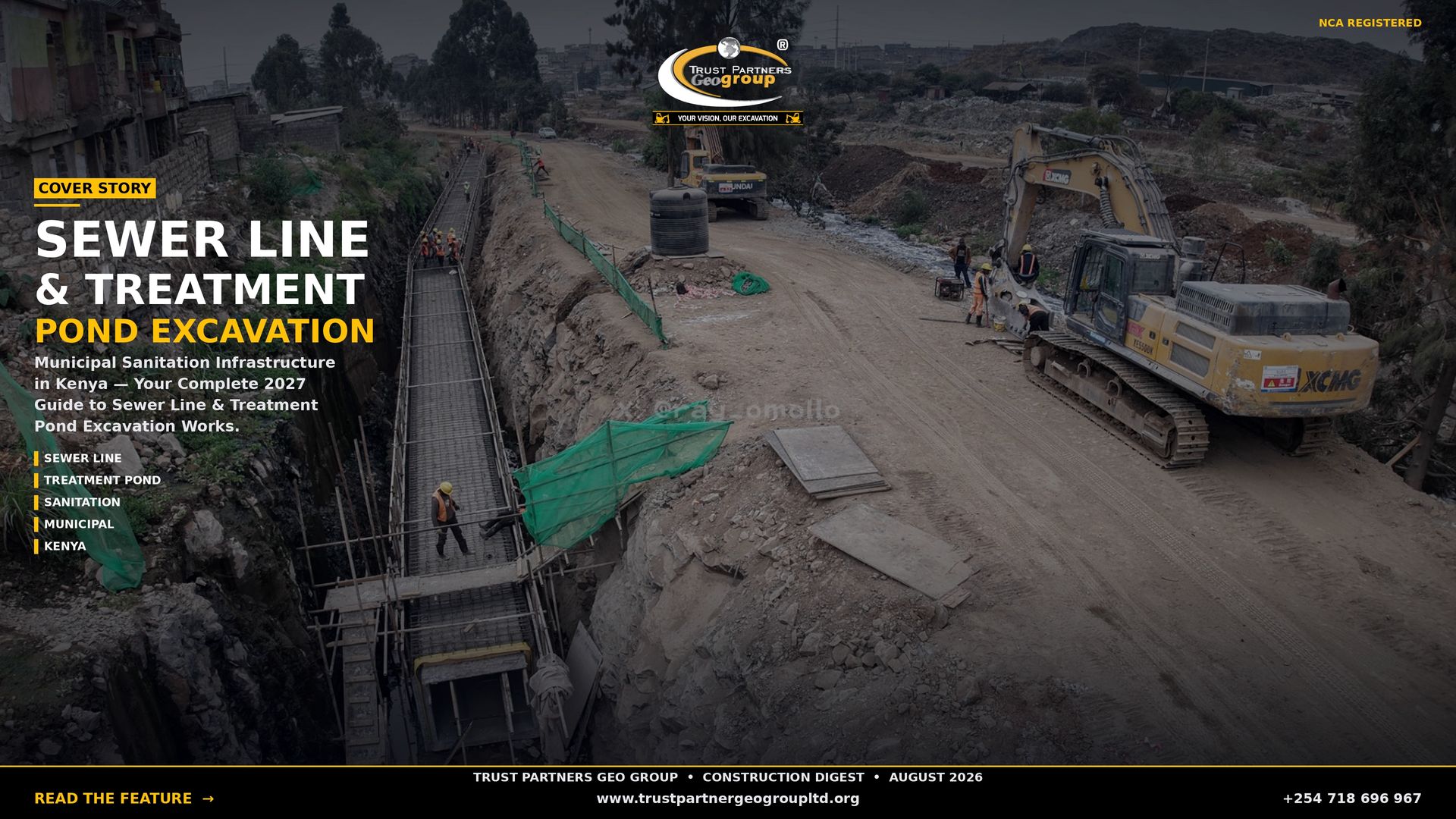
Sewer Line and Treatment Pond Excavation in Kenya: Municipal Sanitation Infrastructure [2027]
Sewer Trenching, Waste Stabilization Pond Construction & Sewage Treatment Earthworks for Kenyan Towns and Cities
Beneath every Kenyan town and city runs a hidden network of pipes and ponds that most residents never see — until they fail. From the 95-hectare Dandora Waste Stabilization Ponds treating sewage for 400,000 Nairobi residents to the new trunk sewers being laid along Thika Road and Mombasa Road, Kenya's municipal sanitation infrastructure is expanding rapidly under devolution and urbanization pressure. But sewer line excavation and waste stabilization pond construction are among the most technically demanding earthworks in the industry: trenches must maintain precise gradients through unstable soils, ponds require massive cut-and-fill balancing with embankment compaction, and every project operates under strict NEMA, Water Authority and county public health oversight. As a leading excavation company Kenya, Trust Partners Geo-Group provides specialized excavation services Kenya for municipal sanitation projects nationwide. This guide covers everything county governments, water companies and contractors need to know about sewer and pond earthworks in Kenya.

NCA-registered excavation company Kenya with 15+ years of municipal sanitation earthworks. We provide sewer line excavation, waste stabilization pond construction and sewage treatment infrastructure for county governments, water companies and private developers across all 47 counties.
Kenya's Sanitation Infrastructure Challenge
Kenya's rapid urbanization has created an urgent sanitation infrastructure deficit:
- Urban growth pressure: Kenya's urban population has grown from 3 million in 1990 to over 15 million in 2025. Nairobi alone adds 200,000+ residents annually. Existing sewer networks and treatment plants are severely overstretched.
- Low sewer coverage: Only 30–40% of Kenya's urban population has access to sewer connections. The majority relies on septic tanks, pit latrines and informal disposal. County governments under devolution are investing heavily in expanding coverage.
- Treatment capacity gap: Existing treatment plants, predominantly waste stabilization ponds, are operating at 150–200% of design capacity. The Dandora WSP, designed for 200,000 people, now serves 400,000 — yet still produces effluent cleaner than the receiving watercourse due to pond system resilience.
- Climate vulnerability: Flooding during El Niño events overwhelms combined sewer systems, causing raw sewage discharge into streets and rivers. Properly designed and maintained sewer lines with adequate capacity reduce this risk.
- Devolution investment: The 47 county governments now control water and sanitation budgets. Counties like Nairobi, Mombasa, Kisumu, Nakuru and Kiambu have multi-billion-shilling sewer expansion programs.
- NEMA enforcement: The National Environment Management Authority increasingly requires functional sewage treatment for new residential estates, industrial parks and commercial developments. Developers who cannot connect to municipal sewers must construct on-site treatment.
Sewer Line Excavation Methods
Open-Cut Trenching
The standard method for sewer line installation in Kenya. Trenches are excavated to design width and depth, pipe is laid on prepared bedding, and trench is backfilled. Gravity sewers require precise gradient control — typically 1/100 to 1/500 fall to maintain self-cleansing velocity of 0.6–1.0 m/s. Trench depths range 1.5–4.5 metres depending on pipe diameter, ground slope and minimum cover requirements (typically 1.0–1.5 metres below road surface).
For residential laterals (150–200 mm pipe), mini-excavators and manual labour work in confined spaces. Secondary sewers (250–400 mm) use backhoe loaders and 20-ton excavators. Trunk sewers (500–1,000+ mm) require bulk excavation with 30-ton machines, often with dewatering and shoring systems.
Trenchless Technology
Used for crossing roads, railways, rivers and sensitive areas where open excavation is impractical. Horizontal directional drilling (HDD) bores a pilot hole that is reamed and pulled back with the pipe. Pipe jacking pushes precast concrete segments through the ground from a launch shaft to a reception shaft. Both methods avoid surface disruption but require specialized equipment and higher capital investment.
Manhole and Structure Excavation
Manholes provide access for inspection, cleaning and maintenance. Excavations are typically 1.2–2.0 metres diameter and 2.0–4.5 metres deep, depending on sewer depth. Manhole bases require concrete blinding and benching to direct flow into the outlet pipe. Drop manholes, where inlet is significantly higher than outlet, require deeper excavations and structural concrete work.
Bedding and Backfill
Pipe bedding uses 100–150 mm of compacted sand or fine gravel (maximum 20 mm particle size) to provide uniform support. For flexible pipes (HDPE, PVC), bedding must extend 150 mm below the pipe invert and 100 mm above the crown. Backfill is placed in 200 mm layers and compacted to 90–95% Mod AASHTO density. In black cotton or expansive soils, the full trench depth may require replacement with granular material to prevent pipe displacement.
Waste Stabilization Pond Construction
Waste stabilization ponds are Kenya's dominant sewage treatment technology — over 80% of the country's treated sewage passes through pond systems. They are ideal for Kenya's tropical climate, requiring no energy for aeration and minimal skilled operation.
Anaerobic Ponds
The first treatment stage — deep ponds (2.5–5 metres) where solids settle and anaerobic bacteria break down organic matter. Design loading: 0.1–0.4 kg BOD₅/m³/day. At Kenya's typical temperatures of 20–30°C, loading rates of 0.3–0.4 kg/m³/day achieve 60–85% BOD removal. Detention time: 1–2 days. Multiple ponds in parallel allow maintenance without system shutdown. Sludge accumulates at the bottom and requires removal every 2–5 years.
Facultative Ponds
The second stage — shallow ponds (1.2–1.8 metres) where algae on the surface produce oxygen for aerobic bacteria, while anaerobic processes continue in the lower layers. Surface BOD loading: 150–400 kg/ha/day. Detention time: 5–15 days. The pond must be shallow enough for sunlight penetration to drive algal photosynthesis, yet deep enough to maintain the facultative zone. Proper embankment design with hard edge details prevents weed growth and mosquito breeding.
Maturation Ponds
The final stage — shallow ponds (1.0–1.5 metres) for pathogen removal through sunlight disinfection, pH rise from algal activity, and natural bacterial die-off. Multiple ponds in series (typically 2–3) achieve 99%+ faecal coliform reduction. Detention time: 5–10 days per pond. Maturation ponds can be stocked with tilapia or carp to control algae and produce protein, though this requires careful management.
Pond Earthworks
WSP construction involves: site clearing and topsoil stripping (minimum 150 mm depth); excavation of pond basins to design depth and side slopes (typically 1:2 to 1:3 for stability); embankment construction using excavated spoil compacted in 200 mm layers to 90–95% density; inlet and outlet structure excavation with concrete benching; and access road construction on embankment crests (minimum 3 metres wide for maintenance vehicles).
Embankments require erosion protection — grass establishment, stone pitching, or concrete facing on waterline. In high-rainfall areas, surface drainage around ponds must be diverted to prevent stormwater inflow that would hydraulically overload the system.
Sewer and Pond Excavation Rates 2027
| Service | Rate (KES) | Notes |
|---|---|---|
| Residential sewer lateral excavation (per linear m) | 2,500 – 4,500 | 150–200 mm pipe; mini-excavator; incl. bedding and backfill |
| Secondary sewer main excavation (per linear m) | 4,000 – 7,500 | 250–400 mm pipe; backhoe/excavator; manholes extra |
| Trunk sewer excavation (per linear m) | 8,000 – 15,000 | 500–1,000 mm pipe; bulk excavation; dewatering and shoring incl. |
| Manhole excavation and construction (per unit) | 45,000 – 120,000 | 1.2–2.0 m diameter; 2.0–4.5 m deep; concrete benching |
| Trench backfill and compaction (per m³) | 1,000 – 2,000 | Layered compaction to 90–95% density |
| Dewatering (per day) | 8,000 – 18,000 | Pump hire, fuel, operator for wet trenches |
| Trench shoring/sheet piling (per linear m) | 3,500 – 7,000 | For trenches over 3 m in unstable soil |
| WSP site clearing (per hectare) | 150,000 – 300,000 | Vegetation removal and topsoil stripping |
| WSP pond excavation (per m³) | 400 – 800 | Bulk excavation; bulldozer and excavator |
| WSP embankment construction (per m³) | 350 – 650 | Spoil placement and compaction in layers |
| WSP inlet/outlet structure (per unit) | 200,000 – 500,000 | Concrete structures with penstocks and flow control |
| WSP lining — compacted clay (per m²) | 400 – 700 | For permeable sandy soils |
| WSP lining — geomembrane (per m²) | 1,500 – 2,800 | HDPE with protective cover |
| WSP access road (per km) | 800,000 – 1,500,000 | Murram road on embankment crest |
| Rock breaking in trenches (per m³) | 2,000 – 3,500 | Phonolite/basalt in Nairobi, Nyeri, Mombasa |
Municipal Projects by Town and City
Nairobi
The Nairobi City Water and Sewerage Company (NCWSC) operates the Dandora WSP — 95 hectares treating 60,000 m³/day for 400,000 people. Major ongoing projects include: sewer network expansion in informal settlements (Kibera, Mathare, Mukuru); trunk sewer upgrades along Mombasa Road, Thika Road and Waiyaki Way; and new estate connections in Syokimau, Kitengela and Ruiru. Nairobi's volcanic soils and high utility density create challenging trenching conditions. The Ruiru-Juja corridor has growing demand as population spills into Kiambu County.
Mombasa
Coastal sandy soils and high water tables (0.5–1.5 m depth) make trenching technically demanding. The Kipevu WSP serves the island and mainland. Mombasa County is expanding sewer networks in Nyali, Bamburi and Kisauni. Coral rock breaking is frequently required. Saltwater intrusion affects pipe material selection and bedding design.
Kisumu
Lake Victoria shoreline and high water table complicate sewer construction. The Kisat WSP and city sewer rehabilitation projects are active. Black cotton soil in surrounding areas requires special bedding and trench stabilization. NEMA closely monitors effluent discharge into the lake due to eutrophication concerns.
Nakuru
Rapid urban growth is straining existing infrastructure. The Nakuru WSP expansion and new trunk sewers serving Lanet, Pipeline and Kiti estates are under construction. Red loam soils are generally favourable for trenching but high rainfall creates seasonal drainage challenges.
Eldoret and Uasin Gishu
The county is investing in sewer networks for the expanding town and surrounding peri-urban areas. Red loam soils are workable but seasonal rivers (laggas) require culvert crossings. Agricultural processing industries add high-BOD effluent that pond systems must handle.
Thika, Ruiru, Juja
Kiambu County's industrial and residential growth is driving sewer line extensions. The Juja WSP at JKUAT demonstrates small-scale pond viability for institutional and estate developments. Black cotton soil patches require careful bedding design.
Machakos, Mavoko, Athi River
Machakos County is connecting new housing estates to sewer mains. Black cotton soil is prevalent, requiring complete trench backfill with granular material. The Athi River basin is environmentally sensitive — effluent standards are strictly enforced.
Meru, Embu, Nyeri
Devolution has funded county-level sewer projects in these growing towns. Volcanic soils and steep terrain create excavation challenges. Smaller WSP systems (1–5 hectares) are being constructed to serve town centres and institutional areas.
Technical Challenges in Sanitation Earthworks
Sewer line and pond construction in Kenya faces distinct technical challenges:
- Utility congestion: Urban trenches in Nairobi, Mombasa and Kisumu cross water mains, power cables, fibre optics and gas lines. Accidental strikes cause service disruptions, injuries and project delays. Proper utility location (using GPR and as-built records) and hand-digging near sensitive services are essential.
- High water tables: Coastal cities (Mombasa, Malindi, Lamu) and lakefront towns (Kisumu, Homa Bay) have water tables within 1–2 metres of surface. Trench dewatering must be maintained continuously during excavation and pipe laying. Pond construction in these areas requires lining to prevent groundwater contamination.
- Expansive soils: Black cotton soil in Machakos, Makueni, Kitui and parts of Kiambu swells when wet and shrinks when dry, displacing pipes and cracking pond embankments. Complete soil replacement with granular backfill or geotextile wrapping is required.
- Rock excavation: Phonolite and basalt in Nairobi, Nyeri, Murang'a and Mombasa require hydraulic breaker or blasting for trenches and pond cuts. This adds 50–100% to excavation costs and requires special permits.
- Traffic management: Sewer construction along major roads requires lane closures, diversions and traffic marshals. In Nairobi CBD and Mombasa island, work is often restricted to night hours, increasing costs.
- Embankment stability: WSP embankments must withstand hydraulic pressure, wave action and rainfall erosion. Poor compaction or steep slopes lead to slip failures that release untreated sewage. Proper compaction testing and slope protection are non-negotiable.
- Odor and community resistance: WSPs near residential areas face opposition due to odor fears. Proper design (sufficient anaerobic pond capacity, recirculation options) and setback distances (minimum 200 metres from housing) address these concerns.
Municipal Sewer and Pond Excavation Services
Trust Partners Geo-Group provides sewer line excavation, waste stabilization pond construction and sewage treatment earthworks for county governments, water companies and developers across all 47 Kenyan counties. Free site survey and itemised quote.
Call +254 718 686 967 Email for QuoteFrequently Asked Questions
What does sewer line excavation involve in Kenya?
Sewer line excavation in Kenya involves trenching for gravity and pressure sewer mains, lateral connections and manhole structures. Gravity sewers are excavated to precise gradients (typically 1/100 to 1/500) to ensure self-cleansing velocity of 0.6–1.0 m/s. Trench depths range 1.5–4.5 metres depending on pipe diameter, ground slope and cover requirements. Excavation methods include: open-cut trenching with mini-excavators and backhoes for urban areas; bulk trenching with 20–30 ton excavators for trunk sewers; and rock breaking with hydraulic hammers where bedrock is encountered. Bedding preparation uses 100–150 mm of compacted sand or gravel. Backfill is placed in 200 mm layers and compacted to 90–95% density. Manhole excavations are typically 1.2–2.0 metres diameter and 2–4 metres deep. In congested urban areas like Nairobi, Mombasa and Kisumu, trenching requires careful utility location, traffic management and dewatering. Trust Partners Geo-Group provides sewer line excavation services Kenya for municipal, industrial and residential developments.
What is waste stabilization pond construction?
Waste stabilization ponds (WSPs) are shallow engineered basins that use natural biological processes to treat sewage. They are the dominant sewage treatment technology in Kenya due to low capital cost, minimal energy requirements and simple operation. A typical WSP system has three pond types in series: (1) Anaerobic ponds — 2.5–5 metres deep with high organic loading. Solids settle and anaerobic bacteria break down organic matter. Design loading: 0.1–0.4 kg BOD5/m³/day depending on temperature. At 20–30°C (typical for Kenya), 0.3–0.4 kg/m³/day is standard. (2) Facultative ponds — 1.2–1.8 metres deep where algae on the surface provide oxygen for aerobic bacteria while anaerobic processes continue at the bottom. Surface BOD loading: 150–400 kg/ha/day. (3) Maturation ponds — 1.0–1.5 metres deep for pathogen removal through sunlight disinfection and natural die-off. Multiple ponds in parallel/series provide redundancy. The Dandora WSP in Nairobi treats 60,000 m³/day across 95 hectares for 400,000 people. The Juja WSP at JKUAT serves 5,000 people with 5 stabilization ponds. Trust Partners Geo-Group, a leading excavation company Kenya, provides WSP excavation and construction services nationwide.
How much does sewer line excavation cost in Kenya?
Sewer line excavation costs in Kenya vary by diameter, depth, soil type and location. Open-cut trench excavation for residential laterals (150–200 mm pipe) costs KES 2,500–4,500 per linear metre including bedding and backfill. Secondary sewer mains (250–400 mm) cost KES 4,000–7,500 per linear metre. Trunk sewers (500–1,000 mm) cost KES 8,000–15,000 per linear metre including dewatering, shoring and rock breaking where required. Manhole excavation and construction costs KES 45,000–120,000 per unit depending on depth and diameter. Key cost components: trench excavation KES 1,500–3,000 per m³; bedding material KES 800–1,500 per m³; backfill and compaction KES 1,000–2,000 per m³; dewatering KES 8,000–18,000 per day; and traffic management KES 5,000–15,000 per day for urban sites. Cost drivers include: depth (trenches over 3 metres require shoring and benching), rock presence (phonolite in Nairobi and Nyeri adds breaker costs), water table (dewatering in Mombasa and Kisumu), utility congestion (Nairobi CBD requires hand-digging near existing services), and haul distance for disposal. Trust Partners Geo-Group provides fixed-price quotes for all sewer line excavation services Kenya.
How much does waste stabilization pond construction cost in Kenya?
Waste stabilization pond construction costs in Kenya depend on population served, land area and lining requirements. Small community systems (1,000–5,000 people) cost KES 8–15 million including earthworks, inlet/outlet structures and fencing. Medium town systems (10,000–50,000 people) cost KES 25–60 million. Large municipal systems (100,000+ people) cost KES 100–300 million. Earthworks typically represent 40–50% of total cost. Key components per hectare of pond: site clearing KES 150,000–300,000; earth excavation and embankment construction KES 800,000–1,500,000; embankment compaction and slope protection KES 300,000–600,000; inlet/outlet structures KES 200,000–500,000; and fencing and access roads KES 250,000–500,000. Lining (where required for permeable soils) adds KES 1.5–3 million per hectare for compacted clay or geomembrane. The Dandora WSP (95 hectares, 400,000 population equivalent) represents one of Kenya's largest pond investments. The Juja WSP at JKUAT serves 5,000 people with a compact footprint. Cost drivers: soil permeability (clay soils need less lining than sandy soils), topography (flat land reduces cut-and-fill), land cost (urban sites like Nairobi are 5–10x more expensive than rural), and access for equipment. Trust Partners Geo-Group provides WSP earthworks quotes after topographic survey and soil testing.
What equipment is used for sewer line and pond excavation?
Sewer line and waste stabilization pond excavation requires specialized municipal earthworks equipment: (1) Mini-excavators (5 ton) — for residential sewer laterals, manhole excavation and confined urban trenching where space is limited and utilities are dense. (2) 20–30 ton excavators — for trunk sewer trenches, bulk pond excavation and embankment construction. Long-reach arms access full pond width from one bank. (3) Backhoe loaders — for secondary sewers and medium-depth trenches in moderate-access areas. (4) Trenchless equipment — horizontal directional drilling (HDD) and pipe jacking for crossing roads, railways and rivers without open excavation. (5) Bulldozers — for pond site clearing, rough grading and pushing spoil to form embankments. (6) Motor graders — for pond embankment profiling, access roads and drainage falls. (7) Vibratory rollers — for compacting embankments to 90–95% Mod AASHTO density. (8) Dewatering pumps — for maintaining dry trenches in high-water-table areas like Mombasa, Kisumu and parts of Nairobi. (9) Shoring systems — trench boxes and sheet piles for trenches over 3 metres deep in unstable soils. (10) Dump trucks — for hauling excess spoil and importing bedding material. All Trust Partners Geo-Group municipal sanitation equipment is available wet hire with NITA-certified operators experienced in sewer and pond construction.
Which towns and cities have the most sewer and pond construction in Kenya?
Sewer line and waste stabilization pond construction is concentrated in Kenya's rapidly urbanizing areas: (1) Nairobi — the Nairobi City Water and Sewerage Company (NCWSC) operates the Dandora WSP (95 ha, 400,000 PE) and is expanding sewer networks in informal settlements and new estates. Major trunk sewers along Mombasa Road, Thika Road and Waiyaki Way require ongoing maintenance and extension. The Ruiru-Juja corridor has growing demand for sewer connections. (2) Mombasa — coastal sandy soils and high water tables create challenging trenching conditions. The Kipevu WSP and Mombasa County sewer expansion projects drive demand. Coral rock breaking is often required. (3) Kisumu — Lake Victoria shoreline and high water table complicate sewer construction. The Kisat WSP and city sewer rehabilitation projects are active. Black cotton soil in surrounding areas requires special bedding. (4) Nakuru — rapid urban growth is straining existing sewer infrastructure. The Nakuru WSP expansion and new trunk sewers serving Lanet, Pipeline and Kiti estates are under construction. (5) Eldoret — Uasin Gishu County is investing in sewer networks for the expanding town and surrounding peri-urban areas. Red loam soils are generally favourable for trenching. (6) Thika, Ruiru, Juja — Kiambu County's industrial and residential growth is driving sewer line extensions. The Juja WSP at JKUAT demonstrates small-scale pond viability. (7) Machakos, Mavoko — Machakos County is connecting new housing estates to sewer mains. Black cotton soil requires careful bedding and compaction. (8) Meru, Embu, Nyeri — devolution has funded county-level sewer projects in these growing towns. Volcanic soils and steep terrain create excavation challenges. Trust Partners Geo-Group provides excavation company Kenya services for municipal sanitation projects in all these locations.
What permits are required for sewer and pond construction in Kenya?
Sewer line and waste stabilization pond construction in Kenya requires multiple permits: (1) County government approval — all sewer construction within county boundaries requires building control and public works department approval. Counties like Nairobi, Mombasa and Kisumu have dedicated sewer departments. (2) NEMA Environmental Impact Assessment — mandatory for wastewater treatment plants serving over 10,000 people, ponds over 5 hectares, or discharge into sensitive water bodies. The Dandora WSP required full EIA. (3) Water Authority permit — required for effluent discharge into rivers, lakes or the sea. Includes effluent quality standards and monitoring requirements. (4) KeNHA/KeRRA approval — required where sewer lines cross or run parallel to national or county roads. Includes traffic management plans and reinstatement bonds. (5) Kenya Power and KPLC clearance — required for trenching near high-voltage lines and underground cables. (6) KURA/utility clearance — for trenching in areas with dense utility networks (water, gas, fibre). (7) Public Health Act compliance — sewer construction must meet Ministry of Health standards for setback distances from water sources, schools and residential areas. (8) NCA contractor registration — all sewer and pond structural excavation must be carried out by NCA-registered contractors. Trust Partners Geo-Group holds full NCA registration and coordinates all permit requirements for municipal sanitation projects.
How long does sewer line and pond construction take?
Sewer line and waste stabilization pond construction timelines depend on scale, terrain and season. A 1 km residential sewer lateral (150–200 mm) in stable soil takes 1–2 weeks: 2–3 days trenching, 2–3 days pipe laying and bedding, and 2–3 days backfill and reinstatement. A 1 km secondary sewer main (300–400 mm) takes 2–4 weeks including manholes. A 1 km trunk sewer (600+ mm) in urban conditions takes 4–8 weeks with dewatering, shoring and traffic management. A small WSP system (1,000–5,000 people, 1–2 hectares) takes 4–8 weeks: 1 week clearing, 2–3 weeks excavation and embankment construction, 1 week inlet/outlet structures, and 1–2 weeks fencing and access. A medium WSP (10,000–50,000 people, 5–10 hectares) takes 3–6 months. Large municipal WSPs like Dandora require multi-year phased construction. Seasonal factors: dry season (January–March, June–September) is optimal — stable trenches, achievable compaction and minimal dewatering. Wet season extends timelines by 30–50% due to trench collapse, flooding and saturated soils. In high-water-table areas, dewatering must be maintained continuously. Trust Partners Geo-Group schedules municipal sanitation earthworks to maximize dry-season productivity.
Related Resources
Municipal Sanitation Earthworks — Sewer and Pond Construction
Contact Trust Partners Geo-Group at +254 718 686 967 for a free site survey and itemised quote for sewer line excavation or waste stabilization pond construction. Serving county governments, water companies and developers across all 47 Kenyan counties.
Call +254 718 686 967 Request QuoteSewer Line and Treatment Pond Excavation in Kenya: Municipal Sanitation Infrastructure [2027]
Sewer Trenching, Waste Stabilization Pond Construction & Sewage Treatment Earthworks for Kenyan Towns and Cities
Beneath every Kenyan town and city runs a hidden network of pipes and ponds that most residents never see — until they fail. From the 95-hectare Dandora Waste Stabilization Ponds treating sewage for 400,000 Nairobi residents to the new trunk sewers being laid along Thika Road and Mombasa Road, Kenya's municipal sanitation infrastructure is expanding rapidly under devolution and urbanization pressure. But sewer line excavation and waste stabilization pond construction are among the most technically demanding earthworks in the industry: trenches must maintain precise gradients through unstable soils, ponds require massive cut-and-fill balancing with embankment compaction, and every project operates under strict NEMA, Water Authority and county public health oversight. As a leading excavation company Kenya, Trust Partners Geo-Group provides specialized excavation services Kenya for municipal sanitation projects nationwide. This guide covers everything county governments, water companies and contractors need to know about sewer and pond earthworks in Kenya.
NCA-registered excavation company Kenya with 15+ years of municipal sanitation earthworks. We provide sewer line excavation, waste stabilization pond construction and sewage treatment infrastructure for county governments, water companies and private developers across all 47 counties.
Kenya's Sanitation Infrastructure Challenge
Kenya's rapid urbanization has created an urgent sanitation infrastructure deficit:
- Urban growth pressure: Kenya's urban population has grown from 3 million in 1990 to over 15 million in 2025. Nairobi alone adds 200,000+ residents annually. Existing sewer networks and treatment plants are severely overstretched.
- Low sewer coverage: Only 30–40% of Kenya's urban population has access to sewer connections. The majority relies on septic tanks, pit latrines and informal disposal. County governments under devolution are investing heavily in expanding coverage.
- Treatment capacity gap: Existing treatment plants, predominantly waste stabilization ponds, are operating at 150–200% of design capacity. The Dandora WSP, designed for 200,000 people, now serves 400,000 — yet still produces effluent cleaner than the receiving watercourse due to pond system resilience.
- Climate vulnerability: Flooding during El Niño events overwhelms combined sewer systems, causing raw sewage discharge into streets and rivers. Properly designed and maintained sewer lines with adequate capacity reduce this risk.
- Devolution investment: The 47 county governments now control water and sanitation budgets. Counties like Nairobi, Mombasa, Kisumu, Nakuru and Kiambu have multi-billion-shilling sewer expansion programs.
- NEMA enforcement: The National Environment Management Authority increasingly requires functional sewage treatment for new residential estates, industrial parks and commercial developments. Developers who cannot connect to municipal sewers must construct on-site treatment.
Sewer Line Excavation Methods
Open-Cut Trenching
The standard method for sewer line installation in Kenya. Trenches are excavated to design width and depth, pipe is laid on prepared bedding, and trench is backfilled. Gravity sewers require precise gradient control — typically 1/100 to 1/500 fall to maintain self-cleansing velocity of 0.6–1.0 m/s. Trench depths range 1.5–4.5 metres depending on pipe diameter, ground slope and minimum cover requirements (typically 1.0–1.5 metres below road surface).
For residential laterals (150–200 mm pipe), mini-excavators and manual labour work in confined spaces. Secondary sewers (250–400 mm) use backhoe loaders and 20-ton excavators. Trunk sewers (500–1,000+ mm) require bulk excavation with 30-ton machines, often with dewatering and shoring systems.
Trenchless Technology
Used for crossing roads, railways, rivers and sensitive areas where open excavation is impractical. Horizontal directional drilling (HDD) bores a pilot hole that is reamed and pulled back with the pipe. Pipe jacking pushes precast concrete segments through the ground from a launch shaft to a reception shaft. Both methods avoid surface disruption but require specialized equipment and higher capital investment.
Manhole and Structure Excavation
Manholes provide access for inspection, cleaning and maintenance. Excavations are typically 1.2–2.0 metres diameter and 2.0–4.5 metres deep, depending on sewer depth. Manhole bases require concrete blinding and benching to direct flow into the outlet pipe. Drop manholes, where inlet is significantly higher than outlet, require deeper excavations and structural concrete work.
Bedding and Backfill
Pipe bedding uses 100–150 mm of compacted sand or fine gravel (maximum 20 mm particle size) to provide uniform support. For flexible pipes (HDPE, PVC), bedding must extend 150 mm below the pipe invert and 100 mm above the crown. Backfill is placed in 200 mm layers and compacted to 90–95% Mod AASHTO density. In black cotton or expansive soils, the full trench depth may require replacement with granular material to prevent pipe displacement.
Waste Stabilization Pond Construction
Waste stabilization ponds are Kenya's dominant sewage treatment technology — over 80% of the country's treated sewage passes through pond systems. They are ideal for Kenya's tropical climate, requiring no energy for aeration and minimal skilled operation.
Anaerobic Ponds
The first treatment stage — deep ponds (2.5–5 metres) where solids settle and anaerobic bacteria break down organic matter. Design loading: 0.1–0.4 kg BOD₅/m³/day. At Kenya's typical temperatures of 20–30°C, loading rates of 0.3–0.4 kg/m³/day achieve 60–85% BOD removal. Detention time: 1–2 days. Multiple ponds in parallel allow maintenance without system shutdown. Sludge accumulates at the bottom and requires removal every 2–5 years.
Facultative Ponds
The second stage — shallow ponds (1.2–1.8 metres) where algae on the surface produce oxygen for aerobic bacteria, while anaerobic processes continue in the lower layers. Surface BOD loading: 150–400 kg/ha/day. Detention time: 5–15 days. The pond must be shallow enough for sunlight penetration to drive algal photosynthesis, yet deep enough to maintain the facultative zone. Proper embankment design with hard edge details prevents weed growth and mosquito breeding.
Maturation Ponds
The final stage — shallow ponds (1.0–1.5 metres) for pathogen removal through sunlight disinfection, pH rise from algal activity, and natural bacterial die-off. Multiple ponds in series (typically 2–3) achieve 99%+ faecal coliform reduction. Detention time: 5–10 days per pond. Maturation ponds can be stocked with tilapia or carp to control algae and produce protein, though this requires careful management.
Pond Earthworks
WSP construction involves: site clearing and topsoil stripping (minimum 150 mm depth); excavation of pond basins to design depth and side slopes (typically 1:2 to 1:3 for stability); embankment construction using excavated spoil compacted in 200 mm layers to 90–95% density; inlet and outlet structure excavation with concrete benching; and access road construction on embankment crests (minimum 3 metres wide for maintenance vehicles).
Embankments require erosion protection — grass establishment, stone pitching, or concrete facing on waterline. In high-rainfall areas, surface drainage around ponds must be diverted to prevent stormwater inflow that would hydraulically overload the system.
Sewer and Pond Excavation Rates 2027
| Service | Rate (KES) | Notes |
|---|---|---|
| Residential sewer lateral excavation (per linear m) | 2,500 – 4,500 | 150–200 mm pipe; mini-excavator; incl. bedding and backfill |
| Secondary sewer main excavation (per linear m) | 4,000 – 7,500 | 250–400 mm pipe; backhoe/excavator; manholes extra |
| Trunk sewer excavation (per linear m) | 8,000 – 15,000 | 500–1,000 mm pipe; bulk excavation; dewatering and shoring incl. |
| Manhole excavation and construction (per unit) | 45,000 – 120,000 | 1.2–2.0 m diameter; 2.0–4.5 m deep; concrete benching |
| Trench backfill and compaction (per m³) | 1,000 – 2,000 | Layered compaction to 90–95% density |
| Dewatering (per day) | 8,000 – 18,000 | Pump hire, fuel, operator for wet trenches |
| Trench shoring/sheet piling (per linear m) | 3,500 – 7,000 | For trenches over 3 m in unstable soil |
| WSP site clearing (per hectare) | 150,000 – 300,000 | Vegetation removal and topsoil stripping |
| WSP pond excavation (per m³) | 400 – 800 | Bulk excavation; bulldozer and excavator |
| WSP embankment construction (per m³) | 350 – 650 | Spoil placement and compaction in layers |
| WSP inlet/outlet structure (per unit) | 200,000 – 500,000 | Concrete structures with penstocks and flow control |
| WSP lining — compacted clay (per m²) | 400 – 700 | For permeable sandy soils |
| WSP lining — geomembrane (per m²) | 1,500 – 2,800 | HDPE with protective cover |
| WSP access road (per km) | 800,000 – 1,500,000 | Murram road on embankment crest |
| Rock breaking in trenches (per m³) | 2,000 – 3,500 | Phonolite/basalt in Nairobi, Nyeri, Mombasa |
Municipal Projects by Town and City
Nairobi
The Nairobi City Water and Sewerage Company (NCWSC) operates the Dandora WSP — 95 hectares treating 60,000 m³/day for 400,000 people. Major ongoing projects include: sewer network expansion in informal settlements (Kibera, Mathare, Mukuru); trunk sewer upgrades along Mombasa Road, Thika Road and Waiyaki Way; and new estate connections in Syokimau, Kitengela and Ruiru. Nairobi's volcanic soils and high utility density create challenging trenching conditions. The Ruiru-Juja corridor has growing demand as population spills into Kiambu County.
Mombasa
Coastal sandy soils and high water tables (0.5–1.5 m depth) make trenching technically demanding. The Kipevu WSP serves the island and mainland. Mombasa County is expanding sewer networks in Nyali, Bamburi and Kisauni. Coral rock breaking is frequently required. Saltwater intrusion affects pipe material selection and bedding design.
Kisumu
Lake Victoria shoreline and high water table complicate sewer construction. The Kisat WSP and city sewer rehabilitation projects are active. Black cotton soil in surrounding areas requires special bedding and trench stabilization. NEMA closely monitors effluent discharge into the lake due to eutrophication concerns.
Nakuru
Rapid urban growth is straining existing infrastructure. The Nakuru WSP expansion and new trunk sewers serving Lanet, Pipeline and Kiti estates are under construction. Red loam soils are generally favourable for trenching but high rainfall creates seasonal drainage challenges.
Eldoret and Uasin Gishu
The county is investing in sewer networks for the expanding town and surrounding peri-urban areas. Red loam soils are workable but seasonal rivers (laggas) require culvert crossings. Agricultural processing industries add high-BOD effluent that pond systems must handle.
Thika, Ruiru, Juja
Kiambu County's industrial and residential growth is driving sewer line extensions. The Juja WSP at JKUAT demonstrates small-scale pond viability for institutional and estate developments. Black cotton soil patches require careful bedding design.
Machakos, Mavoko, Athi River
Machakos County is connecting new housing estates to sewer mains. Black cotton soil is prevalent, requiring complete trench backfill with granular material. The Athi River basin is environmentally sensitive — effluent standards are strictly enforced.
Meru, Embu, Nyeri
Devolution has funded county-level sewer projects in these growing towns. Volcanic soils and steep terrain create excavation challenges. Smaller WSP systems (1–5 hectares) are being constructed to serve town centres and institutional areas.
Technical Challenges in Sanitation Earthworks
Sewer line and pond construction in Kenya faces distinct technical challenges:
- Utility congestion: Urban trenches in Nairobi, Mombasa and Kisumu cross water mains, power cables, fibre optics and gas lines. Accidental strikes cause service disruptions, injuries and project delays. Proper utility location (using GPR and as-built records) and hand-digging near sensitive services are essential.
- High water tables: Coastal cities (Mombasa, Malindi, Lamu) and lakefront towns (Kisumu, Homa Bay) have water tables within 1–2 metres of surface. Trench dewatering must be maintained continuously during excavation and pipe laying. Pond construction in these areas requires lining to prevent groundwater contamination.
- Expansive soils: Black cotton soil in Machakos, Makueni, Kitui and parts of Kiambu swells when wet and shrinks when dry, displacing pipes and cracking pond embankments. Complete soil replacement with granular backfill or geotextile wrapping is required.
- Rock excavation: Phonolite and basalt in Nairobi, Nyeri, Murang'a and Mombasa require hydraulic breaker or blasting for trenches and pond cuts. This adds 50–100% to excavation costs and requires special permits.
- Traffic management: Sewer construction along major roads requires lane closures, diversions and traffic marshals. In Nairobi CBD and Mombasa island, work is often restricted to night hours, increasing costs.
- Embankment stability: WSP embankments must withstand hydraulic pressure, wave action and rainfall erosion. Poor compaction or steep slopes lead to slip failures that release untreated sewage. Proper compaction testing and slope protection are non-negotiable.
- Odor and community resistance: WSPs near residential areas face opposition due to odor fears. Proper design (sufficient anaerobic pond capacity, recirculation options) and setback distances (minimum 200 metres from housing) address these concerns.
Municipal Sewer and Pond Excavation Services
Trust Partners Geo-Group provides sewer line excavation, waste stabilization pond construction and sewage treatment earthworks for county governments, water companies and developers across all 47 Kenyan counties. Free site survey and itemised quote.
Call +254 718 686 967 Email for QuoteFrequently Asked Questions
What does sewer line excavation involve in Kenya?
Sewer line excavation in Kenya involves trenching for gravity and pressure sewer mains, lateral connections and manhole structures. Gravity sewers are excavated to precise gradients (typically 1/100 to 1/500) to ensure self-cleansing velocity of 0.6–1.0 m/s. Trench depths range 1.5–4.5 metres depending on pipe diameter, ground slope and cover requirements. Excavation methods include: open-cut trenching with mini-excavators and backhoes for urban areas; bulk trenching with 20–30 ton excavators for trunk sewers; and rock breaking with hydraulic hammers where bedrock is encountered. Bedding preparation uses 100–150 mm of compacted sand or gravel. Backfill is placed in 200 mm layers and compacted to 90–95% density. Manhole excavations are typically 1.2–2.0 metres diameter and 2–4 metres deep. In congested urban areas like Nairobi, Mombasa and Kisumu, trenching requires careful utility location, traffic management and dewatering. Trust Partners Geo-Group provides sewer line excavation services Kenya for municipal, industrial and residential developments.
What is waste stabilization pond construction?
Waste stabilization ponds (WSPs) are shallow engineered basins that use natural biological processes to treat sewage. They are the dominant sewage treatment technology in Kenya due to low capital cost, minimal energy requirements and simple operation. A typical WSP system has three pond types in series: (1) Anaerobic ponds — 2.5–5 metres deep with high organic loading. Solids settle and anaerobic bacteria break down organic matter. Design loading: 0.1–0.4 kg BOD5/m³/day depending on temperature. At 20–30°C (typical for Kenya), 0.3–0.4 kg/m³/day is standard. (2) Facultative ponds — 1.2–1.8 metres deep where algae on the surface provide oxygen for aerobic bacteria while anaerobic processes continue at the bottom. Surface BOD loading: 150–400 kg/ha/day. (3) Maturation ponds — 1.0–1.5 metres deep for pathogen removal through sunlight disinfection and natural die-off. Multiple ponds in parallel/series provide redundancy. The Dandora WSP in Nairobi treats 60,000 m³/day across 95 hectares for 400,000 people. The Juja WSP at JKUAT serves 5,000 people with 5 stabilization ponds. Trust Partners Geo-Group, a leading excavation company Kenya, provides WSP excavation and construction services nationwide.
How much does sewer line excavation cost in Kenya?
Sewer line excavation costs in Kenya vary by diameter, depth, soil type and location. Open-cut trench excavation for residential laterals (150–200 mm pipe) costs KES 2,500–4,500 per linear metre including bedding and backfill. Secondary sewer mains (250–400 mm) cost KES 4,000–7,500 per linear metre. Trunk sewers (500–1,000 mm) cost KES 8,000–15,000 per linear metre including dewatering, shoring and rock breaking where required. Manhole excavation and construction costs KES 45,000–120,000 per unit depending on depth and diameter. Key cost components: trench excavation KES 1,500–3,000 per m³; bedding material KES 800–1,500 per m³; backfill and compaction KES 1,000–2,000 per m³; dewatering KES 8,000–18,000 per day; and traffic management KES 5,000–15,000 per day for urban sites. Cost drivers include: depth (trenches over 3 metres require shoring and benching), rock presence (phonolite in Nairobi and Nyeri adds breaker costs), water table (dewatering in Mombasa and Kisumu), utility congestion (Nairobi CBD requires hand-digging near existing services), and haul distance for disposal. Trust Partners Geo-Group provides fixed-price quotes for all sewer line excavation services Kenya.
How much does waste stabilization pond construction cost in Kenya?
Waste stabilization pond construction costs in Kenya depend on population served, land area and lining requirements. Small community systems (1,000–5,000 people) cost KES 8–15 million including earthworks, inlet/outlet structures and fencing. Medium town systems (10,000–50,000 people) cost KES 25–60 million. Large municipal systems (100,000+ people) cost KES 100–300 million. Earthworks typically represent 40–50% of total cost. Key components per hectare of pond: site clearing KES 150,000–300,000; earth excavation and embankment construction KES 800,000–1,500,000; embankment compaction and slope protection KES 300,000–600,000; inlet/outlet structures KES 200,000–500,000; and fencing and access roads KES 250,000–500,000. Lining (where required for permeable soils) adds KES 1.5–3 million per hectare for compacted clay or geomembrane. The Dandora WSP (95 hectares, 400,000 population equivalent) represents one of Kenya's largest pond investments. The Juja WSP at JKUAT serves 5,000 people with a compact footprint. Cost drivers: soil permeability (clay soils need less lining than sandy soils), topography (flat land reduces cut-and-fill), land cost (urban sites like Nairobi are 5–10x more expensive than rural), and access for equipment. Trust Partners Geo-Group provides WSP earthworks quotes after topographic survey and soil testing.
What equipment is used for sewer line and pond excavation?
Sewer line and waste stabilization pond excavation requires specialized municipal earthworks equipment: (1) Mini-excavators (5 ton) — for residential sewer laterals, manhole excavation and confined urban trenching where space is limited and utilities are dense. (2) 20–30 ton excavators — for trunk sewer trenches, bulk pond excavation and embankment construction. Long-reach arms access full pond width from one bank. (3) Backhoe loaders — for secondary sewers and medium-depth trenches in moderate-access areas. (4) Trenchless equipment — horizontal directional drilling (HDD) and pipe jacking for crossing roads, railways and rivers without open excavation. (5) Bulldozers — for pond site clearing, rough grading and pushing spoil to form embankments. (6) Motor graders — for pond embankment profiling, access roads and drainage falls. (7) Vibratory rollers — for compacting embankments to 90–95% Mod AASHTO density. (8) Dewatering pumps — for maintaining dry trenches in high-water-table areas like Mombasa, Kisumu and parts of Nairobi. (9) Shoring systems — trench boxes and sheet piles for trenches over 3 metres deep in unstable soils. (10) Dump trucks — for hauling excess spoil and importing bedding material. All Trust Partners Geo-Group municipal sanitation equipment is available wet hire with NITA-certified operators experienced in sewer and pond construction.
Which towns and cities have the most sewer and pond construction in Kenya?
Sewer line and waste stabilization pond construction is concentrated in Kenya's rapidly urbanizing areas: (1) Nairobi — the Nairobi City Water and Sewerage Company (NCWSC) operates the Dandora WSP (95 ha, 400,000 PE) and is expanding sewer networks in informal settlements and new estates. Major trunk sewers along Mombasa Road, Thika Road and Waiyaki Way require ongoing maintenance and extension. The Ruiru-Juja corridor has growing demand for sewer connections. (2) Mombasa — coastal sandy soils and high water tables create challenging trenching conditions. The Kipevu WSP and Mombasa County sewer expansion projects drive demand. Coral rock breaking is often required. (3) Kisumu — Lake Victoria shoreline and high water table complicate sewer construction. The Kisat WSP and city sewer rehabilitation projects are active. Black cotton soil in surrounding areas requires special bedding. (4) Nakuru — rapid urban growth is straining existing sewer infrastructure. The Nakuru WSP expansion and new trunk sewers serving Lanet, Pipeline and Kiti estates are under construction. (5) Eldoret — Uasin Gishu County is investing in sewer networks for the expanding town and surrounding peri-urban areas. Red loam soils are generally favourable for trenching. (6) Thika, Ruiru, Juja — Kiambu County's industrial and residential growth is driving sewer line extensions. The Juja WSP at JKUAT demonstrates small-scale pond viability. (7) Machakos, Mavoko — Machakos County is connecting new housing estates to sewer mains. Black cotton soil requires careful bedding and compaction. (8) Meru, Embu, Nyeri — devolution has funded county-level sewer projects in these growing towns. Volcanic soils and steep terrain create excavation challenges. Trust Partners Geo-Group provides excavation company Kenya services for municipal sanitation projects in all these locations.
What permits are required for sewer and pond construction in Kenya?
Sewer line and waste stabilization pond construction in Kenya requires multiple permits: (1) County government approval — all sewer construction within county boundaries requires building control and public works department approval. Counties like Nairobi, Mombasa and Kisumu have dedicated sewer departments. (2) NEMA Environmental Impact Assessment — mandatory for wastewater treatment plants serving over 10,000 people, ponds over 5 hectares, or discharge into sensitive water bodies. The Dandora WSP required full EIA. (3) Water Authority permit — required for effluent discharge into rivers, lakes or the sea. Includes effluent quality standards and monitoring requirements. (4) KeNHA/KeRRA approval — required where sewer lines cross or run parallel to national or county roads. Includes traffic management plans and reinstatement bonds. (5) Kenya Power and KPLC clearance — required for trenching near high-voltage lines and underground cables. (6) KURA/utility clearance — for trenching in areas with dense utility networks (water, gas, fibre). (7) Public Health Act compliance — sewer construction must meet Ministry of Health standards for setback distances from water sources, schools and residential areas. (8) NCA contractor registration — all sewer and pond structural excavation must be carried out by NCA-registered contractors. Trust Partners Geo-Group holds full NCA registration and coordinates all permit requirements for municipal sanitation projects.
How long does sewer line and pond construction take?
Sewer line and waste stabilization pond construction timelines depend on scale, terrain and season. A 1 km residential sewer lateral (150–200 mm) in stable soil takes 1–2 weeks: 2–3 days trenching, 2–3 days pipe laying and bedding, and 2–3 days backfill and reinstatement. A 1 km secondary sewer main (300–400 mm) takes 2–4 weeks including manholes. A 1 km trunk sewer (600+ mm) in urban conditions takes 4–8 weeks with dewatering, shoring and traffic management. A small WSP system (1,000–5,000 people, 1–2 hectares) takes 4–8 weeks: 1 week clearing, 2–3 weeks excavation and embankment construction, 1 week inlet/outlet structures, and 1–2 weeks fencing and access. A medium WSP (10,000–50,000 people, 5–10 hectares) takes 3–6 months. Large municipal WSPs like Dandora require multi-year phased construction. Seasonal factors: dry season (January–March, June–September) is optimal — stable trenches, achievable compaction and minimal dewatering. Wet season extends timelines by 30–50% due to trench collapse, flooding and saturated soils. In high-water-table areas, dewatering must be maintained continuously. Trust Partners Geo-Group schedules municipal sanitation earthworks to maximize dry-season productivity.
Related Resources
Municipal Sanitation Earthworks — Sewer and Pond Construction
Contact Trust Partners Geo-Group at +254 718 686 967 for a free site survey and itemised quote for sewer line excavation or waste stabilization pond construction. Serving county governments, water companies and developers across all 47 Kenyan counties.
Call +254 718 686 967 Request Quote