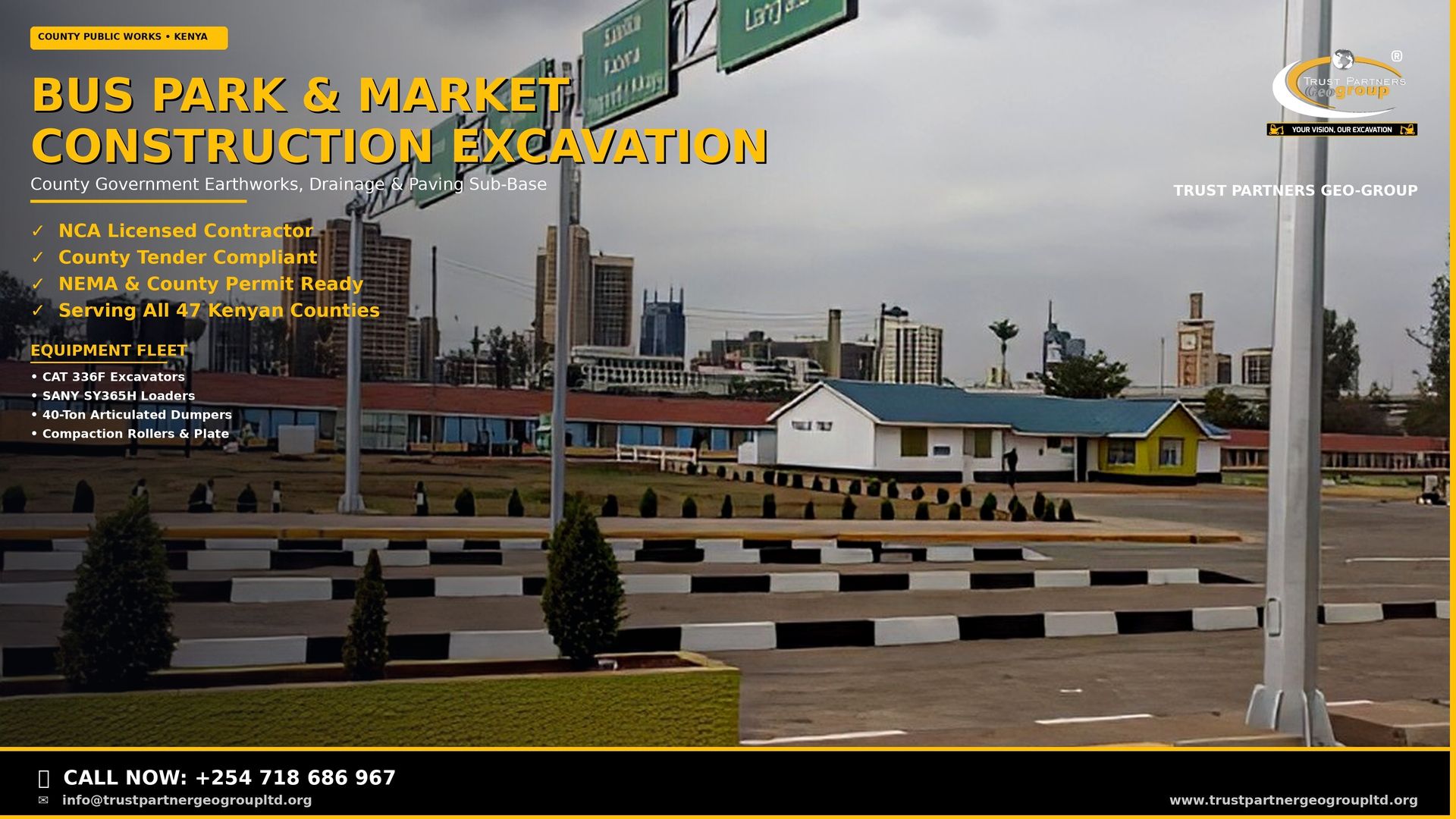
Bus Park, Market & Public Space Construction Excavation: County Government Project Guide
A county government earthworks guide to bus park, market and public space construction excavation in Kenya. Covers drainage, paving sub-base, NCA compliance and tender documentation for all 47 counties.

📋 Table of Contents
- Understanding County Government Construction Earthworks
- Bus Park Construction Excavation Requirements
- Market Construction Foundation Excavation
- Public Space and Recreational Area Earthworks
- County Tender Compliance and Documentation
- NCA, NEMA & County Permit Requirements
- Equipment for County Public Works Excavation
- Cost Estimation for County Government Earthworks
- Frequently Asked Questions
- Contact Trust Partners for County Project Excavation
With Kenya's devolved governance structure, county governments are now the primary drivers of municipal infrastructure — from bus terminals in Nairobi and market complexes in Kisumu to public squares and recreational spaces in Nakuru and Mombasa. These projects share a common foundation: precision county government earthworks that must balance heavy traffic loads, stormwater management, public safety, and strict procurement compliance.
At Trust Partners Geo-Group Ltd, we provide public works excavation contractor services for county governments across all 47 counties. Whether it's a 5-hectare bus park requiring subgrade stabilization, a municipal market with complex drainage, or a county recreational space with landscaped earthworks, our NCA-registered team delivers compliant, on-budget earthworks that meet Public Procurement and Asset Disposal Act (PPADA) standards.
Understanding County Government Construction Earthworks
County infrastructure projects differ from private commercial developments in three critical ways:
- Public procurement compliance — All county projects must follow the PPADA 2015 tendering process, including open advertisement, prequalification, evaluation committees, and contract award disclosure. Earthworks contractors must demonstrate NCA registration, tax compliance, and audited financials.
- High-traffic design loads — Bus parks and markets must accommodate heavy vehicle loads (rigid trucks up to 28 tonnes, axle loads of 8-10 tonnes) and high pedestrian volumes. Subgrade preparation and pavement sub-base must be engineered for these loads.
- Integrated utility coordination — Public spaces require simultaneous trenching for water supply, sewerage, stormwater, power, and street lighting. Earthworks contractors must coordinate with Kenya Power, water companies, and county public works departments.
- Community impact management — Works in active public areas require phased construction, traffic diversion plans, dust suppression, and noise control — all monitored by county environmental health officers.
⚠️ Critical Distinction
Standard bulk excavation contractors without county project experience often fail on procurement documentation, phased construction logistics, and utility coordination. County tender evaluation committees reject bids from contractors who cannot demonstrate prior public works experience and NCA Category 1 or 2 registration.
Bus Park Construction Excavation Requirements
Modern bus parks are engineered transport hubs — not just flat parking areas. Our bus park construction Kenya earthworks address the full operational requirements:
Site Clearing and Demolition
Most county bus park projects involve redevelopment of existing informal terminals or underutilized public land:
- Informal structure demolition — Existing kiosks, sheds, and temporary stalls must be safely demolished and debris removed. Hazardous materials (asbestos roofing, lead paint) require NEMA-certified disposal.
- Underground obstruction removal — Old foundations, septic tanks, fuel storage tanks, and unmapped utility lines are common on former informal sites. Trial pits and GPR surveys identify obstructions before bulk excavation.
- Topsoil management — Stripped topsoil is stockpiled for landscaping berms, median strips, and green buffer zones around the bus park perimeter.
Subgrade Excavation and Compaction
The subgrade is the structural foundation beneath the pavement:
- Excavation to design levels — Bus park floors are typically excavated 400-600mm below finished surface level to accommodate the pavement structure (sub-base + base + wearing course).
- Subgrade improvement — In black cotton soil areas (common in Nairobi, Kisumu, and parts of Mombasa), the subgrade is over-excavated by 300-500mm and replaced with selected granular fill or stabilized with cement/lime.
- Compaction standards — Subgrade compaction to 95% of Maximum Dry Density (Modified Proctor) per KURA/KeNHA standards. Proof rolling with a loaded truck identifies soft spots for replacement.
- Crossfall grading — The entire bus park surface is graded at 1-2% crossfall toward drainage channels to prevent ponding and accelerate surface water removal.
Drainage System Excavation
Bus parks generate significant stormwater runoff from large impervious areas:
- Channel drain excavation — Concrete-lined V-drains or U-drains (typically 300-600mm wide x 400-600mm deep) are excavated along bus bay edges and pedestrian walkways.
- Catch pit and manhole excavation — Precast concrete catch pits (1.0m x 1.0m x 1.2m deep) with sediment traps are installed every 20-30 meters along drains.
- Stormwater pipe trenches — Perforated or solid HDPE/concrete pipes (150-300mm diameter) in trenches 600-900mm deep convey runoff to discharge points or soak pits.
- Oil separator pits — Bus parks require oil-grit separators to treat hydrocarbon-contaminated runoff from vehicle parking and maintenance areas.
| Bus Park Element | Excavation Depth | Material / Standard |
|---|---|---|
| Pavement subgrade | 400 – 600 mm | 95% MDD, CBR ≥15% |
| Sub-base (graded crushed stone) | 150 – 300 mm | Kenya Road Design Manual |
| Channel drains | 400 – 600 mm | KURA Standard Drawings |
| Stormwater pipe trenches | 600 – 900 mm | 1-in-25-year storm design |
| Oil separator pits | 2.0 – 3.0 m | NEMA effluent standards |
| Bus bay wheel stops | 200 – 300 mm | Precast concrete anchors |
Market Construction Foundation Excavation
Municipal markets present unique earthworks challenges due to dense stall layouts, wet waste generation, and high pedestrian traffic:
Stall Foundation and Floor Levels
- Strip footing excavation — Market stall rows require continuous strip footings (typically 600mm wide x 400mm deep) for column bases and wall foundations. Excavation must maintain alignment within ±10mm for proper stall bay spacing.
- Floor slab subgrade — Market floors are typically 150-200mm thick reinforced concrete slabs on grade. The subgrade is excavated to finished level minus slab thickness, compacted to 95% MDD, and covered with a 50mm blinding layer of lean concrete or compacted quarry dust.
- Flood protection — Market floor levels must be minimum 300mm above surrounding ground level and 500mm above the 1-in-25-year flood level. In low-lying areas (Kisumu, Mombasa, riverine counties), this may require significant fill import and platform construction.
- Loading bay excavation — Dedicated loading/unloading bays for trucks require heavier pavement design with 300-400mm sub-base and reinforced concrete surfaces rated for 10-tonne axle loads.
Waste Management Trench Excavation
Markets generate organic waste, wastewater, and packaging materials requiring dedicated infrastructure:
- Central waste collection trenches — Excavated channels (400mm wide x 500mm deep) with precast covers route waste from stall clusters to central collection points.
- Drainage for wet markets — Fish and produce markets require high-capacity drainage with 2-3% floor falls, stainless steel channel drains, and grease traps to prevent sewer blockages.
- Septic tank and soak pit excavation — Where sewer connections are unavailable, septic tanks (3-5m x 2m x 2m deep) and soak pits are excavated to serve public toilets and wash areas.
- Water point trenches — Trenching for water supply pipes (typically 600mm deep) to each stall cluster, with meter chambers and valve pits.
Public Space and Recreational Area Earthworks
Beyond bus parks and markets, counties are investing in public squares, recreational parks, and open-air amphitheaters. These projects require aesthetic and functional earthworks:
- Contour grading and terracing — Sloped sites are terraced into level platforms for seating, performance areas, and children's playgrounds. Cut-and-fill earthworks balance volumes to minimize cart-away costs.
- Amphitheater excavation — Tiered seating requires precision excavation with 300-450mm riser heights and consistent tread depths. Subgrade compaction prevents settlement that would disrupt seating alignment.
- Playground safety surfacing sub-base — Children's play areas require 200-300mm of free-draining sub-base (crushed stone or gravel) beneath rubber safety surfacing or sand pits.
- Landscape mounding and berms — Excavated spoil is shaped into landscape berms (1-2m high) that provide visual screening, noise barriers, and seating nooks. Topsoil cover supports grass and shrub planting.
- Pathway and walkway sub-base — Pedestrian paths require 150mm sub-base of graded crushed stone beneath pavers, concrete, or asphalt surfacing.
✅ Trust Partners Advantage
We are an NCA Category 1 & 2 registered contractor with active county project experience across Nairobi, Mombasa, Kisumu, Nakuru, and Kiambu counties. Our team understands PPADA procurement requirements, county environmental health standards, and the phased construction logistics essential for public space projects.
County Tender Compliance and Documentation
Winning and executing a county government earthworks contract requires meticulous documentation:
Prequalification Requirements
- NCA registration certificate — Valid NCA Category 1 (Building) or Category 2 (Civil) registration with the appropriate class for project value.
- Tax compliance — Current Tax Compliance Certificate from KRA and valid PIN certificate.
- Audited financials — Three years of audited accounts demonstrating turnover capacity (typically 2-3x the contract value).
- Similar project experience — Completion certificates and reference letters for comparable public works projects within the last 5 years.
- Equipment inventory — Proof of owned or leased equipment matching the project scope, including maintenance records.
Technical Proposal Components
- Method statement — Detailed excavation methodology, phasing plan, traffic management, and safety protocols.
- Program of works — Gantt chart or bar chart showing earthworks milestones, compaction testing schedules, and handover dates.
- Quality assurance plan — Testing frequencies for compaction, material gradation, and concrete strength.
- Environmental management plan — Dust suppression, noise control, erosion control, and waste management measures.
NCA, NEMA & County Permit Requirements
County public works projects require a stacked permit framework:
- NCA project registration — All county construction projects must be registered with the National Construction Authority, with monthly progress reporting.
- County construction permit — Issued by the county department of public works or physical planning. Requires approved drawings, structural calculations, and proof of professional supervision.
- NEMA Environmental Audit — Most county public space projects require at minimum a NEMA Environmental Audit (simplified process) or full EIA for large-scale developments.
- County environmental health clearance — Public health officers inspect drainage, waste management provisions, and toilet facilities before operational handover.
- Traffic management approval — For bus parks and markets in active areas, county traffic departments approve diversion plans and temporary road closures.
Equipment for County Public Works Excavation
County projects demand versatile equipment fleets. Our heavy equipment hire Kenya fleet for public works includes:
| Equipment | Application | Specification |
|---|---|---|
| 20-Ton Excavator | Drainage trenches, foundation pits | 0.8 m³ bucket, tight swing |
| 30-Ton Excavator | Bulk excavation, rock breaking | 1.5 m³ bucket, GPS option |
| Bulldozer (D6/D7) | Site grading, subgrade preparation | GPS blade control |
| Motor Grader | Final subgrade leveling, crossfalls | 3.7m moldboard, laser option |
| Smooth Drum Roller | Subgrade and sub-base compaction | 10-ton, vibratory |
| Dump Trucks | Spoil removal, aggregate delivery | 20-30 ton capacity |
| Plate Compactor | Trench backfill, confined areas | 500 kg reversible |
Cost Estimation for County Government Earthworks
Our transparent 2027 pricing for county government earthworks:
| Item | Unit | Rate (KES) | Notes |
|---|---|---|---|
| Site clearing & demolition | per m² | 120 – 250 | Incl. debris cart-away |
| Bulk excavation (soil) | per m³ | 1,500 – 2,800 | Depth 0.5-2.0m |
| Subgrade preparation & compaction | per m² | 350 – 650 | 95% MDD |
| Drainage trench excavation | per linear m | 2,500 – 4,500 | 300-600mm wide |
| Paving sub-base placement | per m² | 450 – 800 | 150-300mm thick |
| Catch pit / manhole excavation | per unit | 18,000 – 35,000 | Incl. backfill |
| Septic tank excavation | per unit | 55,000 – 95,000 | 3m x 2m x 2m |
Note: Rates exclude pavement materials (asphalt, concrete pavers), precast drainage units, and utility pipes. Bus park construction Nairobi and urban county projects may attract 10-15% mobilization premium. Rates are indicative for budgeting; formal BOQ rates apply for tender submissions.
Frequently Asked Questions About County Public Works Excavation
Bus park construction excavation in Kenya costs between KES 350 and KES 650 per square meter for earthworks, grading and compaction. Drainage system excavation adds KES 2,500-4,500 per linear meter. Paving sub-base preparation ranges from KES 450-800 per square meter. Total project costs depend on site size, soil conditions, and existing infrastructure removal requirements.
Market construction earthworks include site clearing and demolition, topsoil stripping, bulk excavation for stall foundations, subgrade compaction to 95% MDD, drainage trench excavation for surface water and waste management, paving sub-base placement (150-300mm graded crushed stone), and utility trenching for water, power and sanitation. Floor levels must account for flood risk with minimum 300mm freeboard above surrounding ground.
Yes. All county government construction projects in Kenya require contractors to be registered with the National Construction Authority (NCA). Excavation and earthworks contractors must hold NCA Category 1 (Building Works) or NCA Category 2 (Civil Works) registration. County tender documents typically require NCA registration certificates, tax compliance certificates, and proof of similar completed projects as mandatory prequalification criteria.
Public space construction excavation timelines vary by project scale. A typical county bus park (2-5 hectares) requires 4-8 weeks for complete earthworks including clearing, excavation, drainage and sub-base preparation. Municipal markets (1-3 hectares) take 3-6 weeks. Small public spaces and parking lots under 1 hectare can be completed in 2-4 weeks. Rainy season conditions, utility relocations, and archaeological clearances can extend timelines by 30-50%.
Bus park drainage systems use a combination of surface and subsurface drainage. Surface water is directed via 1-2% crossfall toward channel drains and catch pits. Subsurface drainage uses perforated pipes in gravel trenches (typically 600mm deep) beneath the pavement. Oil separators are installed to treat runoff from vehicle areas. All drainage must be designed for a 1-in-25-year storm event per Kenya Urban Roads Authority (KURA) standards.
Bidding on a County Government Project?
Trust Partners Geo-Group provides compliant excavation for bus parks, markets & public spaces. From site clearing to drainage excavation and paving sub-base preparation, we deliver county-standard earthworks with full NCA and procurement documentation.
📞 +254 718 68 69 67Request Technical Consultation
Serving all 47 counties including Nairobi, Mombasa, Kisumu, Nakuru, and beyond.
Bus Park, Market & Public Space Construction Excavation: County Government Project Guide
A county government earthworks guide to bus park, market and public space construction excavation in Kenya. Covers drainage, paving sub-base, NCA compliance and tender documentation for all 47 counties.
📋 Table of Contents
- Understanding County Government Construction Earthworks
- Bus Park Construction Excavation Requirements
- Market Construction Foundation Excavation
- Public Space and Recreational Area Earthworks
- County Tender Compliance and Documentation
- NCA, NEMA & County Permit Requirements
- Equipment for County Public Works Excavation
- Cost Estimation for County Government Earthworks
- Frequently Asked Questions
- Contact Trust Partners for County Project Excavation
With Kenya's devolved governance structure, county governments are now the primary drivers of municipal infrastructure — from bus terminals in Nairobi and market complexes in Kisumu to public squares and recreational spaces in Nakuru and Mombasa. These projects share a common foundation: precision county government earthworks that must balance heavy traffic loads, stormwater management, public safety, and strict procurement compliance.
At Trust Partners Geo-Group Ltd, we provide public works excavation contractor services for county governments across all 47 counties. Whether it's a 5-hectare bus park requiring subgrade stabilization, a municipal market with complex drainage, or a county recreational space with landscaped earthworks, our NCA-registered team delivers compliant, on-budget earthworks that meet Public Procurement and Asset Disposal Act (PPADA) standards.
Understanding County Government Construction Earthworks
County infrastructure projects differ from private commercial developments in three critical ways:
- Public procurement compliance — All county projects must follow the PPADA 2015 tendering process, including open advertisement, prequalification, evaluation committees, and contract award disclosure. Earthworks contractors must demonstrate NCA registration, tax compliance, and audited financials.
- High-traffic design loads — Bus parks and markets must accommodate heavy vehicle loads (rigid trucks up to 28 tonnes, axle loads of 8-10 tonnes) and high pedestrian volumes. Subgrade preparation and pavement sub-base must be engineered for these loads.
- Integrated utility coordination — Public spaces require simultaneous trenching for water supply, sewerage, stormwater, power, and street lighting. Earthworks contractors must coordinate with Kenya Power, water companies, and county public works departments.
- Community impact management — Works in active public areas require phased construction, traffic diversion plans, dust suppression, and noise control — all monitored by county environmental health officers.
⚠️ Critical Distinction
Standard bulk excavation contractors without county project experience often fail on procurement documentation, phased construction logistics, and utility coordination. County tender evaluation committees reject bids from contractors who cannot demonstrate prior public works experience and NCA Category 1 or 2 registration.
Bus Park Construction Excavation Requirements
Modern bus parks are engineered transport hubs — not just flat parking areas. Our bus park construction Kenya earthworks address the full operational requirements:
Site Clearing and Demolition
Most county bus park projects involve redevelopment of existing informal terminals or underutilized public land:
- Informal structure demolition — Existing kiosks, sheds, and temporary stalls must be safely demolished and debris removed. Hazardous materials (asbestos roofing, lead paint) require NEMA-certified disposal.
- Underground obstruction removal — Old foundations, septic tanks, fuel storage tanks, and unmapped utility lines are common on former informal sites. Trial pits and GPR surveys identify obstructions before bulk excavation.
- Topsoil management — Stripped topsoil is stockpiled for landscaping berms, median strips, and green buffer zones around the bus park perimeter.
Subgrade Excavation and Compaction
The subgrade is the structural foundation beneath the pavement:
- Excavation to design levels — Bus park floors are typically excavated 400-600mm below finished surface level to accommodate the pavement structure (sub-base + base + wearing course).
- Subgrade improvement — In black cotton soil areas (common in Nairobi, Kisumu, and parts of Mombasa), the subgrade is over-excavated by 300-500mm and replaced with selected granular fill or stabilized with cement/lime.
- Compaction standards — Subgrade compaction to 95% of Maximum Dry Density (Modified Proctor) per KURA/KeNHA standards. Proof rolling with a loaded truck identifies soft spots for replacement.
- Crossfall grading — The entire bus park surface is graded at 1-2% crossfall toward drainage channels to prevent ponding and accelerate surface water removal.
Drainage System Excavation
Bus parks generate significant stormwater runoff from large impervious areas:
- Channel drain excavation — Concrete-lined V-drains or U-drains (typically 300-600mm wide x 400-600mm deep) are excavated along bus bay edges and pedestrian walkways.
- Catch pit and manhole excavation — Precast concrete catch pits (1.0m x 1.0m x 1.2m deep) with sediment traps are installed every 20-30 meters along drains.
- Stormwater pipe trenches — Perforated or solid HDPE/concrete pipes (150-300mm diameter) in trenches 600-900mm deep convey runoff to discharge points or soak pits.
- Oil separator pits — Bus parks require oil-grit separators to treat hydrocarbon-contaminated runoff from vehicle parking and maintenance areas.
| Bus Park Element | Excavation Depth | Material / Standard |
|---|---|---|
| Pavement subgrade | 400 – 600 mm | 95% MDD, CBR ≥15% |
| Sub-base (graded crushed stone) | 150 – 300 mm | Kenya Road Design Manual |
| Channel drains | 400 – 600 mm | KURA Standard Drawings |
| Stormwater pipe trenches | 600 – 900 mm | 1-in-25-year storm design |
| Oil separator pits | 2.0 – 3.0 m | NEMA effluent standards |
| Bus bay wheel stops | 200 – 300 mm | Precast concrete anchors |
Market Construction Foundation Excavation
Municipal markets present unique earthworks challenges due to dense stall layouts, wet waste generation, and high pedestrian traffic:
Stall Foundation and Floor Levels
- Strip footing excavation — Market stall rows require continuous strip footings (typically 600mm wide x 400mm deep) for column bases and wall foundations. Excavation must maintain alignment within ±10mm for proper stall bay spacing.
- Floor slab subgrade — Market floors are typically 150-200mm thick reinforced concrete slabs on grade. The subgrade is excavated to finished level minus slab thickness, compacted to 95% MDD, and covered with a 50mm blinding layer of lean concrete or compacted quarry dust.
- Flood protection — Market floor levels must be minimum 300mm above surrounding ground level and 500mm above the 1-in-25-year flood level. In low-lying areas (Kisumu, Mombasa, riverine counties), this may require significant fill import and platform construction.
- Loading bay excavation — Dedicated loading/unloading bays for trucks require heavier pavement design with 300-400mm sub-base and reinforced concrete surfaces rated for 10-tonne axle loads.
Waste Management Trench Excavation
Markets generate organic waste, wastewater, and packaging materials requiring dedicated infrastructure:
- Central waste collection trenches — Excavated channels (400mm wide x 500mm deep) with precast covers route waste from stall clusters to central collection points.
- Drainage for wet markets — Fish and produce markets require high-capacity drainage with 2-3% floor falls, stainless steel channel drains, and grease traps to prevent sewer blockages.
- Septic tank and soak pit excavation — Where sewer connections are unavailable, septic tanks (3-5m x 2m x 2m deep) and soak pits are excavated to serve public toilets and wash areas.
- Water point trenches — Trenching for water supply pipes (typically 600mm deep) to each stall cluster, with meter chambers and valve pits.
Public Space and Recreational Area Earthworks
Beyond bus parks and markets, counties are investing in public squares, recreational parks, and open-air amphitheaters. These projects require aesthetic and functional earthworks:
- Contour grading and terracing — Sloped sites are terraced into level platforms for seating, performance areas, and children's playgrounds. Cut-and-fill earthworks balance volumes to minimize cart-away costs.
- Amphitheater excavation — Tiered seating requires precision excavation with 300-450mm riser heights and consistent tread depths. Subgrade compaction prevents settlement that would disrupt seating alignment.
- Playground safety surfacing sub-base — Children's play areas require 200-300mm of free-draining sub-base (crushed stone or gravel) beneath rubber safety surfacing or sand pits.
- Landscape mounding and berms — Excavated spoil is shaped into landscape berms (1-2m high) that provide visual screening, noise barriers, and seating nooks. Topsoil cover supports grass and shrub planting.
- Pathway and walkway sub-base — Pedestrian paths require 150mm sub-base of graded crushed stone beneath pavers, concrete, or asphalt surfacing.
✅ Trust Partners Advantage
We are an NCA Category 1 & 2 registered contractor with active county project experience across Nairobi, Mombasa, Kisumu, Nakuru, and Kiambu counties. Our team understands PPADA procurement requirements, county environmental health standards, and the phased construction logistics essential for public space projects.
County Tender Compliance and Documentation
Winning and executing a county government earthworks contract requires meticulous documentation:
Prequalification Requirements
- NCA registration certificate — Valid NCA Category 1 (Building) or Category 2 (Civil) registration with the appropriate class for project value.
- Tax compliance — Current Tax Compliance Certificate from KRA and valid PIN certificate.
- Audited financials — Three years of audited accounts demonstrating turnover capacity (typically 2-3x the contract value).
- Similar project experience — Completion certificates and reference letters for comparable public works projects within the last 5 years.
- Equipment inventory — Proof of owned or leased equipment matching the project scope, including maintenance records.
Technical Proposal Components
- Method statement — Detailed excavation methodology, phasing plan, traffic management, and safety protocols.
- Program of works — Gantt chart or bar chart showing earthworks milestones, compaction testing schedules, and handover dates.
- Quality assurance plan — Testing frequencies for compaction, material gradation, and concrete strength.
- Environmental management plan — Dust suppression, noise control, erosion control, and waste management measures.
NCA, NEMA & County Permit Requirements
County public works projects require a stacked permit framework:
- NCA project registration — All county construction projects must be registered with the National Construction Authority, with monthly progress reporting.
- County construction permit — Issued by the county department of public works or physical planning. Requires approved drawings, structural calculations, and proof of professional supervision.
- NEMA Environmental Audit — Most county public space projects require at minimum a NEMA Environmental Audit (simplified process) or full EIA for large-scale developments.
- County environmental health clearance — Public health officers inspect drainage, waste management provisions, and toilet facilities before operational handover.
- Traffic management approval — For bus parks and markets in active areas, county traffic departments approve diversion plans and temporary road closures.
Equipment for County Public Works Excavation
County projects demand versatile equipment fleets. Our heavy equipment hire Kenya fleet for public works includes:
| Equipment | Application | Specification |
|---|---|---|
| 20-Ton Excavator | Drainage trenches, foundation pits | 0.8 m³ bucket, tight swing |
| 30-Ton Excavator | Bulk excavation, rock breaking | 1.5 m³ bucket, GPS option |
| Bulldozer (D6/D7) | Site grading, subgrade preparation | GPS blade control |
| Motor Grader | Final subgrade leveling, crossfalls | 3.7m moldboard, laser option |
| Smooth Drum Roller | Subgrade and sub-base compaction | 10-ton, vibratory |
| Dump Trucks | Spoil removal, aggregate delivery | 20-30 ton capacity |
| Plate Compactor | Trench backfill, confined areas | 500 kg reversible |
Cost Estimation for County Government Earthworks
Our transparent 2027 pricing for county government earthworks:
| Item | Unit | Rate (KES) | Notes |
|---|---|---|---|
| Site clearing & demolition | per m² | 120 – 250 | Incl. debris cart-away |
| Bulk excavation (soil) | per m³ | 1,500 – 2,800 | Depth 0.5-2.0m |
| Subgrade preparation & compaction | per m² | 350 – 650 | 95% MDD |
| Drainage trench excavation | per linear m | 2,500 – 4,500 | 300-600mm wide |
| Paving sub-base placement | per m² | 450 – 800 | 150-300mm thick |
| Catch pit / manhole excavation | per unit | 18,000 – 35,000 | Incl. backfill |
| Septic tank excavation | per unit | 55,000 – 95,000 | 3m x 2m x 2m |
Note: Rates exclude pavement materials (asphalt, concrete pavers), precast drainage units, and utility pipes. Bus park construction Nairobi and urban county projects may attract 10-15% mobilization premium. Rates are indicative for budgeting; formal BOQ rates apply for tender submissions.
Frequently Asked Questions About County Public Works Excavation
Bus park construction excavation in Kenya costs between KES 350 and KES 650 per square meter for earthworks, grading and compaction. Drainage system excavation adds KES 2,500-4,500 per linear meter. Paving sub-base preparation ranges from KES 450-800 per square meter. Total project costs depend on site size, soil conditions, and existing infrastructure removal requirements.
Market construction earthworks include site clearing and demolition, topsoil stripping, bulk excavation for stall foundations, subgrade compaction to 95% MDD, drainage trench excavation for surface water and waste management, paving sub-base placement (150-300mm graded crushed stone), and utility trenching for water, power and sanitation. Floor levels must account for flood risk with minimum 300mm freeboard above surrounding ground.
Yes. All county government construction projects in Kenya require contractors to be registered with the National Construction Authority (NCA). Excavation and earthworks contractors must hold NCA Category 1 (Building Works) or NCA Category 2 (Civil Works) registration. County tender documents typically require NCA registration certificates, tax compliance certificates, and proof of similar completed projects as mandatory prequalification criteria.
Public space construction excavation timelines vary by project scale. A typical county bus park (2-5 hectares) requires 4-8 weeks for complete earthworks including clearing, excavation, drainage and sub-base preparation. Municipal markets (1-3 hectares) take 3-6 weeks. Small public spaces and parking lots under 1 hectare can be completed in 2-4 weeks. Rainy season conditions, utility relocations, and archaeological clearances can extend timelines by 30-50%.
Bus park drainage systems use a combination of surface and subsurface drainage. Surface water is directed via 1-2% crossfall toward channel drains and catch pits. Subsurface drainage uses perforated pipes in gravel trenches (typically 600mm deep) beneath the pavement. Oil separators are installed to treat runoff from vehicle areas. All drainage must be designed for a 1-in-25-year storm event per Kenya Urban Roads Authority (KURA) standards.
Bidding on a County Government Project?
Trust Partners Geo-Group provides compliant excavation for bus parks, markets & public spaces. From site clearing to drainage excavation and paving sub-base preparation, we deliver county-standard earthworks with full NCA and procurement documentation.
📞 +254 718 68 69 67Request Technical Consultation
Serving all 47 counties including Nairobi, Mombasa, Kisumu, Nakuru, and beyond.