
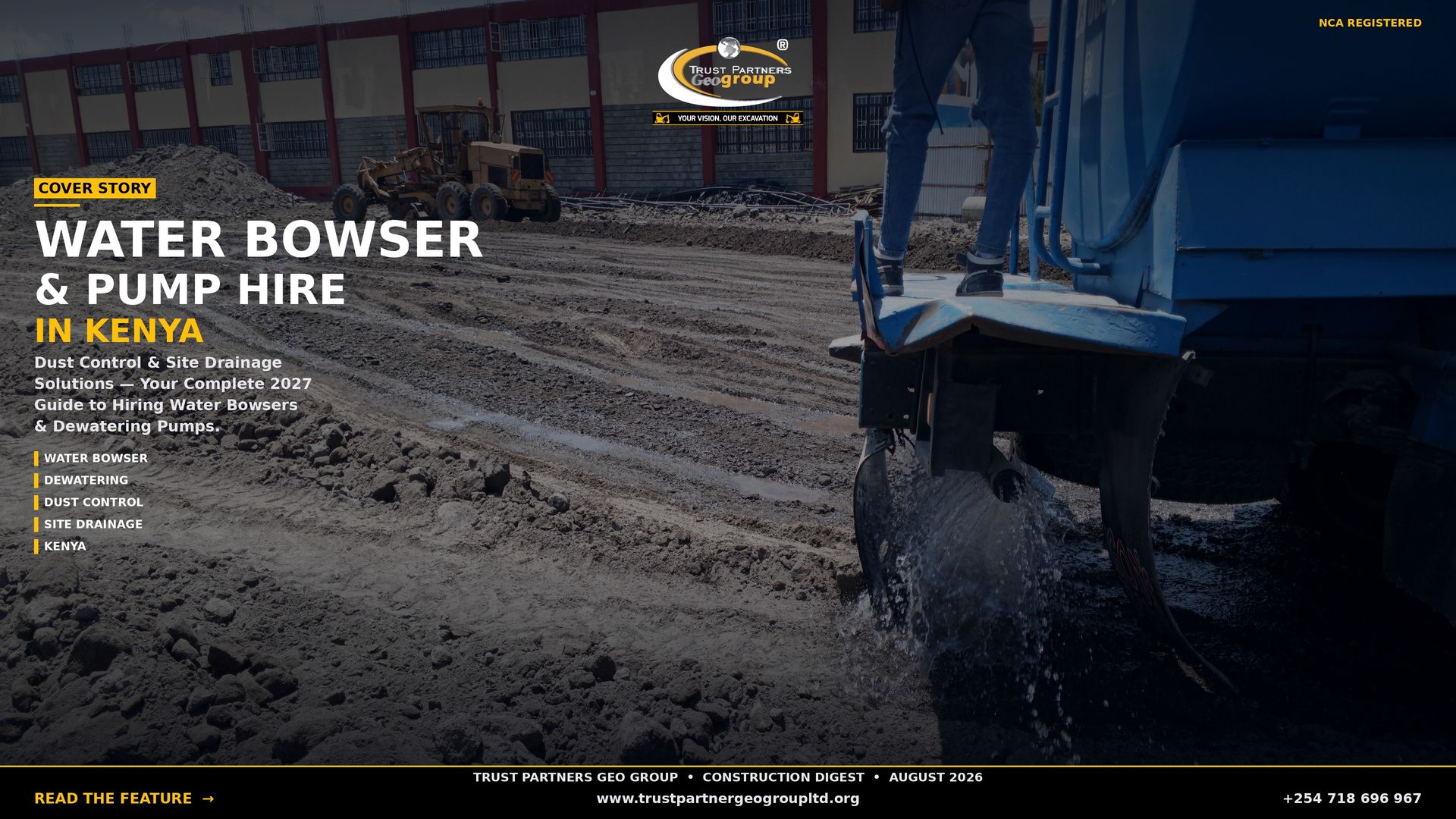
Water Bowser and Dewatering Pump Hire in Kenya: Dust Control and Site Drainage Solutions [2027]
Keep Sites Dry, Safe and Compliant — From Basement Excavations to Bulk Earthworks
Water is both an enemy and an ally on a construction site. Too much groundwater turns excavations into swimming pools, weakens foundations and halts work. Too little moisture turns haul roads into dust clouds, triggers NEMA violations and endangers workers. This 2027 guide covers everything Kenyan contractors, developers and site managers need to know about water bowser and dewatering pump hire in Kenya: dust suppression, site drainage, dewatering systems, hire rates and how Trust Partners Geo-Group delivers water management solutions across all 47 counties.

NCA-registered excavation and heavy equipment hire contractor with 15+ years operating across Kenya. Our auxiliary fleet includes water bowsers, dewatering pumps, wellpoint systems and sediment control equipment for construction site water management.
What Is a Water Bowser and When Do You Need One?
A water bowser is a tanker-mounted truck or trailer designed to transport and spray large volumes of water on construction sites. Unlike water trucks used for domestic supply, construction bowsers are equipped with rear spray bars, hose reels and pressure pumps for targeted dust suppression, soil compaction and concrete curing.
In Kenya, water bowsers are essential when:
- Dust suppression is mandatory: NEMA air quality regulations require active dust control on all sites generating visible dust plumes — especially in Nairobi's dry season (January–March) and on murram road projects.
- Haul roads and stockpiles generate silica dust: Unpaved haul roads on bulk earthwork, quarry and mining sites produce respirable dust that endangers workers and neighbouring communities.
- Soil compaction requires moisture control: Fill material must be at optimum moisture content (OMC) before roller compaction — water bowsers moisten dry murram and black cotton soil to achieve specified density.
- Concrete curing demands continuous wetting: Slabs, roads and structural concrete require 7–28 days of moist curing to achieve design strength — bowsers provide the volume needed for large pours.
- Water-scarce sites need bulk storage: Remote sites in Kajiado, Machakos and Laikipia without piped water rely on bowsers to ferry water from boreholes or county mains.
What Is Dewatering and When Is It Required?
Dewatering is the removal of groundwater and surface water from excavation pits, trenches and basements to create dry, safe working conditions. In Kenya's varied geology — from Nairobi's high water table to Mombasa's coastal sands — dewatering is often the difference between a project that proceeds on schedule and one that sinks in mud.
Dewatering is required when:
- Excavating below the water table: Nairobi's Parklands, Kilimani and Upper Hill areas have perched water tables within 2–5 metres of the surface. Basement excavations below 3 metres inevitably intercept groundwater.
- Working during rainy seasons: Kenya's long rains (March–May) and short rains (October–December) flood trenches, basement pits and road cuttings. Continuous pumping maintains dry working conditions.
- Trenching in clay soils: Sewer, water and cable trenches in Nairobi's black cotton soil and Kano Plains clay hold water and collapse without active pumping.
- Quarry and mining operations: Open pits below the water table require permanent dewatering to prevent flooding and slope instability.
- Coastal construction: Mombasa, Malindi and Diani have high groundwater levels and tidal influence — excavations near the shore need continuous pumping and saltwater-resistant equipment.
Types of Water Bowsers and Dewatering Pumps
Water Bowsers by Capacity
Light-duty bowsers (5,000–8,000 litres): Mounted on pickup trucks or single-axle trailers. Ideal for small residential sites, plot cutting and dust suppression on minor earthworks. Maneuverable in tight urban sites like Karen, Runda and Lavington.
Standard bowsers (10,000–15,000 litres): The workhorse of Kenyan construction. Mounted on medium-duty trucks, these cover 4–6 km of haul road per tank and serve medium-sized commercial and residential projects across Nairobi, Kiambu and Kajiado.
Heavy-duty bowsers (18,000–24,000 litres): Large tankers for road construction, quarry operations and bulk earthworks. A single 20,000-litre bowser can suppress dust on a 15,000 m² site for a full day. Essential for projects in Athi River, Kitengela and Naivasha.
Dewatering Pump Types
Submersible sump pumps (2–5 kW): Electric pumps placed in excavation sumps to remove collected seepage. Best for shallow trenches, minor basement seepage and utility trenches. Quiet and efficient but require mains power or generator supply.
Portable diesel trash pumps (5–15 kW): Self-priming pumps that handle water with silt, sand and debris. The standard choice for surface water removal, muddy excavations and emergency flooding. Independent of electricity — critical on sites without power.
Wellpoint dewatering systems: Arrays of small-diameter suction wells (wellpoints) installed around the excavation perimeter, connected to a central vacuum pump. Best for deep excavations in sandy and silty soils where groundwater inflow is continuous. Common on Nairobi basement projects and road cuttings.
Deep-well submersible pumps: Borehole-style pumps installed in drilled wells around large excavations. Used for permanent dewatering on major projects, quarries and industrial foundations where wellpoint systems cannot achieve sufficient drawdown.
Water Bowser & Dewatering Pump Hire Rates in Kenya 2027
The following table reflects Trust Partners Geo-Group's 2027 rate structure for water management equipment:
| Equipment | Daily Rate (8 hrs) | Weekly Rate (6 days) | Monthly Rate | Notes |
|---|---|---|---|---|
| Water bowser 8,000 litres | KES 12,000 – 18,000 | KES 65,000 – 95,000 | KES 280,000 – 400,000 | Driver included; fuel for spraying |
| Water bowser 15,000 litres | KES 16,000 – 24,000 | KES 85,000 – 130,000 | KES 360,000 – 550,000 | Standard construction site size |
| Water bowser 20,000 litres | KES 18,000 – 28,000 | KES 100,000 – 150,000 | KES 420,000 – 650,000 | Road projects, quarries, bulk earthworks |
| Submersible pump 2–5 kW | KES 3,500 – 7,000 | KES 18,000 – 35,000 | KES 75,000 – 140,000 | Electric; client power or generator |
| Diesel trash pump 10–20 kW | KES 8,000 – 15,000 | KES 42,000 – 78,000 | KES 180,000 – 320,000 | Fuel included; handles silt/debris |
| Wellpoint dewatering system | KES 25,000 – 45,000 | KES 130,000 – 240,000 | KES 550,000 – 950,000 | Includes installation, hoses, monitoring |
| Deep-well pump system | Quoted per project based on well depth, drawdown and duration | |||
| Mobilization (Nairobi) | KES 5,000 – 12,000 depending on equipment size | |||
| Mobilization (Upcountry) | KES 15,000 – 45,000 (Nakuru, Kisumu, Mombasa, Nanyuki) | |||
Applications on Kenyan Construction Sites
Basement Excavation Dewatering
Nairobi's high-rise construction in Upper Hill, Kilimani and Westlands requires basement excavations to 5–15 metres depth — well below the water table in many areas. Wellpoint dewatering systems and deep-well pumps maintain dry conditions for footing construction, waterproofing membrane installation and substructure works. Without dewatering, excavations flood, concrete quality degrades and programme delays accumulate.
Road Construction Dust Suppression
Murram road construction across Kenya — from the Nairobi–Nakuru highway to county access roads — generates massive dust clouds during the dry season. Water bowsers spray haul roads, crusher feed points and aggregate stockpiles 3–4 times daily to maintain NEMA compliance and protect workers from respirable silica. A single 20,000-litre bowser serves 8–10 km of active haul road.
Quarry and Mining Operations
Quarries in Machakos, Kajiado and Nakuru operate below the water table during the rainy season. Diesel trash pumps and deep-well systems remove inflow continuously, preventing pit flooding and maintaining bench stability. Dust suppression on crushing and screening plants requires dedicated bowsers operating on rotation.
Utility Trench Dewatering
Sewer, water and fibre-optic trenching in Nairobi, Mombasa and Kisumu intersects groundwater in clay and sandy soils. Portable submersible pumps placed in trench sumps allow pipe laying, bedding and backfilling to proceed without waterlogged conditions. On long pipeline routes, pumps move with the trench progression.
Concrete Curing and Soil Compaction
Large concrete pours — raft foundations, road slabs and dam spillways — require continuous moist curing for 7–14 days. Water bowsers wet the surface 2–3 times daily, replacing evaporation loss. For soil compaction, bowsers moisten fill material to optimum moisture content before roller passes, ensuring 95% Mod AASHTO density compliance.
NEMA, County and Water Authority Compliance
Water management on Kenyan construction sites is regulated by multiple authorities. Non-compliance risks project shutdowns, fines and licence revocation. Key requirements include:
- NEMA Air Quality Standards: All construction sites generating visible dust must implement dust suppression measures. NEMA inspectors issue improvement notices and penalties for uncontrolled dust emissions — particularly in Nairobi, Mombasa and Kisumu where urban air quality is monitored.
- Water Resources Authority (WRA) Discharge Permits: Dewatering discharge into rivers, streams, storm drains or public waterways requires a WRA permit. Discharge must meet turbidity and sediment standards — typically requiring settlement ponds or silt fences before release.
- NEMA EIA for Large Projects: Basement excavations, quarries and road projects with significant dewatering volumes require environmental impact assessment clearance. The EIA must include a water management plan covering dewatering methods, discharge points and sediment control.
- County Building Permits: Basement excavation permits in Nairobi, Kiambu, Mombasa and Nakuru counties require submission of a dewatering method statement. The statement must specify pump types, discharge arrangements and contingency plans for heavy rain.
- OSHA Site Safety: Waterlogged excavations are classified as confined spaces and must be dewatered before worker entry. Trenches with standing water require shoring, dewatering or both before personnel access.
Trust Partners Geo-Group provides NEMA-compliant method statements, WRA discharge monitoring, sediment control installation and county permit support documentation with every water management deployment.
Trust Partners Geo-Group Water Management Fleet
Trust Partners Geo-Group maintains a dedicated water management fleet stationed in Nairobi with rapid mobilization to all 47 counties:
- Isuzu FRR 15,000-Litre Water Bowser: Standard construction site bowser with rear spray bar, hose reel and pressure pump. Primary deployment: dust suppression, soil compaction and concrete curing on commercial and residential projects in Nairobi, Kiambu and Kajiado.
- Mercedes Actros 20,000-Litre Heavy Bowser: Large-capacity tanker for road projects, quarries and bulk earthworks. Primary deployment: haul road dust suppression, crusher plant watering and large-scale curing operations.
- Grundfos Submersible Dewatering Pumps (3–7.5 kW): Electric submersible pumps for trench, sump and minor basement dewatering. Primary deployment: utility trenches, shallow basements and foundation pits.
- Honda-Powered Diesel Trash Pumps (10–15 kW): Portable self-priming pumps for muddy water, surface flooding and emergency dewatering. Primary deployment: rainy-season sites, quarry pits and road cuttings.
- Wellpoint Dewatering System (50-point capacity): Vacuum pump with header pipe and wellpoint arrays for deep excavation dewatering. Primary deployment: multi-storey basement excavations, road cuttings and industrial foundations.
- Silt Fences and Settlement Pond Kits: Auxiliary sediment control equipment for NEMA-compliant dewatering discharge. Primary deployment: all sites with water discharge to drains or waterways.
All equipment is maintained to manufacturer schedules with full service records. Every deployment includes a water management method statement, risk assessment, NEMA compliance checklist and operator training.
Service coverage includes: Nairobi, Kiambu, Kajiado, Machakos, Mombasa, Nakuru, Kisumu, Naivasha, Nanyuki, Laikipia, Meru, Embu, Kericho and all 47 counties.
Book Your Water Bowser or Dewatering Pump for 2027
Water management equipment is in highest demand during dry season and rainy season peaks. Secure your bowser or pump with certified operator, full hoses and NEMA compliance documentation.
Call +254 718 686 967 Email for QuoteFrequently Asked Questions
What is a water bowser and what is it used for on construction sites?
A water bowser is a tanker-mounted truck or trailer designed to transport and spray large volumes of water on construction sites. In Kenya, water bowsers serve three primary functions: (1) Dust suppression — spraying haul roads, excavation faces and stockpiles to control silica dust and comply with NEMA air quality standards. (2) Soil compaction — moistening fill material to optimum moisture content before roller compaction. (3) Curing — wetting concrete slabs, roads and structures during the 7–28 day curing period. Water bowsers typically carry 8,000–20,000 litres and are equipped with rear spray bars, hose reels and pressure pumps for targeted application.
What is dewatering and when is it needed on Kenyan construction sites?
Dewatering is the removal of groundwater and surface water from excavation pits, trenches and basements to create dry working conditions. In Kenya, dewatering is essential when: (1) Excavating below the water table — common in Nairobi's high-water-table zones (Parklands, Kilimani, Upper Hill) and coastal areas (Mombasa, Malindi). (2) Working during rainy seasons — surface runoff floods trenches and basement excavations. (3) Trenching for utilities — sewer, water and cable trenches in clay soils hold water and collapse without pumping. (4) Basement excavation — deep cuts intercept perched water lenses and seasonal aquifers. Trust Partners Geo-Group provides submersible pumps, wellpoint dewatering systems and sump pumping for all ground conditions.
How much does it cost to hire a water bowser in Kenya?
Water bowser hire rates in Kenya range from KES 12,000–18,000 per day for an 8,000-litre truck with driver. Large 20,000-litre bowsers cost KES 18,000–28,000 per day. Weekly packages (6 days) offer 15–20% savings, ranging from KES 65,000–120,000 depending on tank capacity. Monthly contracts for continuous dust suppression and road watering start from KES 280,000–480,000. Rates include the driver, fuel for spraying operations and routine maintenance. Water sourcing from county mains, boreholes or water vendors is typically charged separately based on volume and distance.
How much does it cost to hire a dewatering pump in Kenya?
Dewatering pump hire rates in Kenya vary by pump type and capacity. Portable submersible pumps (2–5 kW) for trench and sump dewatering cost KES 3,500–7,000 per day. High-capacity diesel dewatering pumps (10–20 kW) for basement and deep excavation cost KES 8,000–15,000 per day. Wellpoint dewatering systems with multiple suction points cost KES 25,000–45,000 per day including installation and monitoring. Weekly and monthly contracts reduce daily rates by 15–25%. All dewatering pump hire from Trust Partners Geo-Group includes delivery, setup, discharge hose and operator training.
What size water bowser do I need for my construction site?
Water bowser sizing depends on site area, dust generation level and water availability. For small sites under 2,000 m² with light dust (residential basements, plot cutting), an 8,000-litre bowser spraying 2–3 times daily is sufficient. For medium sites (2,000–10,000 m²) with heavy haul truck traffic, a 15,000-litre bowser is standard — covering 4–6 km of haul road per fill. For large road projects, quarries and bulk earthworks over 10,000 m², a 20,000-litre bowser or multiple units operating in rotation is required. In water-scarce areas like Kajiado and Machakos, larger tanks reduce refill trips and downtime. Trust Partners Geo-Group assesses site conditions and recommends the optimal bowser size and spray schedule.
What types of dewatering pumps are used in Kenya?
Kenyan construction sites use four main dewatering pump types: (1) Submersible sump pumps — electric pumps placed in excavation sumps to remove collected water. Best for shallow trenches and minor seepage. (2) Portable diesel trash pumps — self-priming pumps that handle water with silt and debris. Best for surface water and muddy conditions. (3) Wellpoint dewatering systems — arrays of small suction wells connected to a central vacuum pump. Best for deep excavations in sandy soils where groundwater inflow is continuous. (4) Deep-well submersible pumps — borehole-style pumps installed in drilled wells around the excavation. Best for large basements and permanent dewatering in high-permeability ground. Trust Partners Geo-Group stocks all four types and designs site-specific dewatering plans based on geotechnical reports.
Do water bowser and dewatering pump hire rates include fuel and operators?
Yes, Trust Partners Geo-Group quotes water bowser and dewatering pump hire on a wet-hire basis. Water bowser rates include a certified driver, fuel for spraying and pumping operations, and routine maintenance. Dewatering pump rates include delivery, installation, discharge hose and operator setup training. For dewatering, fuel for diesel pumps is included; electricity for electric submersible pumps is supplied by the client or charged separately if generator hire is added. Water sourcing — whether from county mains, boreholes or vendors — is typically a separate line item based on actual consumption and haul distance.
What NEMA and county regulations apply to site dewatering in Kenya?
Construction site dewatering in Kenya is regulated by NEMA, county governments and water authorities. Key requirements include: (1) NEMA environmental impact assessment (EIA) for projects discharging large volumes of dewatering effluent into water bodies or storm drains. (2) Discharge permits from the Water Resources Authority (WRA) for pumping groundwater into rivers, streams or public drains. (3) Sediment control — dewatering discharge must pass through settlement ponds or silt fences to prevent muddy water from entering waterways. (4) County building permits for basement excavations must include a dewatering method statement. (5) Dust suppression compliance — NEMA air quality standards require active dust control on all construction sites generating visible dust plumes. Trust Partners Geo-Group provides method statements, discharge monitoring and NEMA compliance documentation with every water management deployment.
Related Resources
Need Water Management Equipment for Your 2027 Project?
Contact Trust Partners Geo-Group at +254 718 686 967 for a free site assessment and itemized water bowser or dewatering pump quote. Serving Nairobi, Mombasa, Kisumu, Nakuru, Naivasha, Nanyuki and all 47 counties.
Call +254 718 686 967 Request QuoteWater Bowser and Dewatering Pump Hire in Kenya: Dust Control and Site Drainage Solutions [2027]
Keep Sites Dry, Safe and Compliant — From Basement Excavations to Bulk Earthworks
Water is both an enemy and an ally on a construction site. Too much groundwater turns excavations into swimming pools, weakens foundations and halts work. Too little moisture turns haul roads into dust clouds, triggers NEMA violations and endangers workers. This 2027 guide covers everything Kenyan contractors, developers and site managers need to know about water bowser and dewatering pump hire in Kenya: dust suppression, site drainage, dewatering systems, hire rates and how Trust Partners Geo-Group delivers water management solutions across all 47 counties.
NCA-registered excavation and heavy equipment hire contractor with 15+ years operating across Kenya. Our auxiliary fleet includes water bowsers, dewatering pumps, wellpoint systems and sediment control equipment for construction site water management.
What Is a Water Bowser and When Do You Need One?
A water bowser is a tanker-mounted truck or trailer designed to transport and spray large volumes of water on construction sites. Unlike water trucks used for domestic supply, construction bowsers are equipped with rear spray bars, hose reels and pressure pumps for targeted dust suppression, soil compaction and concrete curing.
In Kenya, water bowsers are essential when:
- Dust suppression is mandatory: NEMA air quality regulations require active dust control on all sites generating visible dust plumes — especially in Nairobi's dry season (January–March) and on murram road projects.
- Haul roads and stockpiles generate silica dust: Unpaved haul roads on bulk earthwork, quarry and mining sites produce respirable dust that endangers workers and neighbouring communities.
- Soil compaction requires moisture control: Fill material must be at optimum moisture content (OMC) before roller compaction — water bowsers moisten dry murram and black cotton soil to achieve specified density.
- Concrete curing demands continuous wetting: Slabs, roads and structural concrete require 7–28 days of moist curing to achieve design strength — bowsers provide the volume needed for large pours.
- Water-scarce sites need bulk storage: Remote sites in Kajiado, Machakos and Laikipia without piped water rely on bowsers to ferry water from boreholes or county mains.
What Is Dewatering and When Is It Required?
Dewatering is the removal of groundwater and surface water from excavation pits, trenches and basements to create dry, safe working conditions. In Kenya's varied geology — from Nairobi's high water table to Mombasa's coastal sands — dewatering is often the difference between a project that proceeds on schedule and one that sinks in mud.
Dewatering is required when:
- Excavating below the water table: Nairobi's Parklands, Kilimani and Upper Hill areas have perched water tables within 2–5 metres of the surface. Basement excavations below 3 metres inevitably intercept groundwater.
- Working during rainy seasons: Kenya's long rains (March–May) and short rains (October–December) flood trenches, basement pits and road cuttings. Continuous pumping maintains dry working conditions.
- Trenching in clay soils: Sewer, water and cable trenches in Nairobi's black cotton soil and Kano Plains clay hold water and collapse without active pumping.
- Quarry and mining operations: Open pits below the water table require permanent dewatering to prevent flooding and slope instability.
- Coastal construction: Mombasa, Malindi and Diani have high groundwater levels and tidal influence — excavations near the shore need continuous pumping and saltwater-resistant equipment.
Types of Water Bowsers and Dewatering Pumps
Water Bowsers by Capacity
Light-duty bowsers (5,000–8,000 litres): Mounted on pickup trucks or single-axle trailers. Ideal for small residential sites, plot cutting and dust suppression on minor earthworks. Maneuverable in tight urban sites like Karen, Runda and Lavington.
Standard bowsers (10,000–15,000 litres): The workhorse of Kenyan construction. Mounted on medium-duty trucks, these cover 4–6 km of haul road per tank and serve medium-sized commercial and residential projects across Nairobi, Kiambu and Kajiado.
Heavy-duty bowsers (18,000–24,000 litres): Large tankers for road construction, quarry operations and bulk earthworks. A single 20,000-litre bowser can suppress dust on a 15,000 m² site for a full day. Essential for projects in Athi River, Kitengela and Naivasha.
Dewatering Pump Types
Submersible sump pumps (2–5 kW): Electric pumps placed in excavation sumps to remove collected seepage. Best for shallow trenches, minor basement seepage and utility trenches. Quiet and efficient but require mains power or generator supply.
Portable diesel trash pumps (5–15 kW): Self-priming pumps that handle water with silt, sand and debris. The standard choice for surface water removal, muddy excavations and emergency flooding. Independent of electricity — critical on sites without power.
Wellpoint dewatering systems: Arrays of small-diameter suction wells (wellpoints) installed around the excavation perimeter, connected to a central vacuum pump. Best for deep excavations in sandy and silty soils where groundwater inflow is continuous. Common on Nairobi basement projects and road cuttings.
Deep-well submersible pumps: Borehole-style pumps installed in drilled wells around large excavations. Used for permanent dewatering on major projects, quarries and industrial foundations where wellpoint systems cannot achieve sufficient drawdown.
Water Bowser & Dewatering Pump Hire Rates in Kenya 2027
The following table reflects Trust Partners Geo-Group's 2027 rate structure for water management equipment:
| Equipment | Daily Rate (8 hrs) | Weekly Rate (6 days) | Monthly Rate | Notes |
|---|---|---|---|---|
| Water bowser 8,000 litres | KES 12,000 – 18,000 | KES 65,000 – 95,000 | KES 280,000 – 400,000 | Driver included; fuel for spraying |
| Water bowser 15,000 litres | KES 16,000 – 24,000 | KES 85,000 – 130,000 | KES 360,000 – 550,000 | Standard construction site size |
| Water bowser 20,000 litres | KES 18,000 – 28,000 | KES 100,000 – 150,000 | KES 420,000 – 650,000 | Road projects, quarries, bulk earthworks |
| Submersible pump 2–5 kW | KES 3,500 – 7,000 | KES 18,000 – 35,000 | KES 75,000 – 140,000 | Electric; client power or generator |
| Diesel trash pump 10–20 kW | KES 8,000 – 15,000 | KES 42,000 – 78,000 | KES 180,000 – 320,000 | Fuel included; handles silt/debris |
| Wellpoint dewatering system | KES 25,000 – 45,000 | KES 130,000 – 240,000 | KES 550,000 – 950,000 | Includes installation, hoses, monitoring |
| Deep-well pump system | Quoted per project based on well depth, drawdown and duration | |||
| Mobilization (Nairobi) | KES 5,000 – 12,000 depending on equipment size | |||
| Mobilization (Upcountry) | KES 15,000 – 45,000 (Nakuru, Kisumu, Mombasa, Nanyuki) | |||
Applications on Kenyan Construction Sites
Basement Excavation Dewatering
Nairobi's high-rise construction in Upper Hill, Kilimani and Westlands requires basement excavations to 5–15 metres depth — well below the water table in many areas. Wellpoint dewatering systems and deep-well pumps maintain dry conditions for footing construction, waterproofing membrane installation and substructure works. Without dewatering, excavations flood, concrete quality degrades and programme delays accumulate.
Road Construction Dust Suppression
Murram road construction across Kenya — from the Nairobi–Nakuru highway to county access roads — generates massive dust clouds during the dry season. Water bowsers spray haul roads, crusher feed points and aggregate stockpiles 3–4 times daily to maintain NEMA compliance and protect workers from respirable silica. A single 20,000-litre bowser serves 8–10 km of active haul road.
Quarry and Mining Operations
Quarries in Machakos, Kajiado and Nakuru operate below the water table during the rainy season. Diesel trash pumps and deep-well systems remove inflow continuously, preventing pit flooding and maintaining bench stability. Dust suppression on crushing and screening plants requires dedicated bowsers operating on rotation.
Utility Trench Dewatering
Sewer, water and fibre-optic trenching in Nairobi, Mombasa and Kisumu intersects groundwater in clay and sandy soils. Portable submersible pumps placed in trench sumps allow pipe laying, bedding and backfilling to proceed without waterlogged conditions. On long pipeline routes, pumps move with the trench progression.
Concrete Curing and Soil Compaction
Large concrete pours — raft foundations, road slabs and dam spillways — require continuous moist curing for 7–14 days. Water bowsers wet the surface 2–3 times daily, replacing evaporation loss. For soil compaction, bowsers moisten fill material to optimum moisture content before roller passes, ensuring 95% Mod AASHTO density compliance.
NEMA, County and Water Authority Compliance
Water management on Kenyan construction sites is regulated by multiple authorities. Non-compliance risks project shutdowns, fines and licence revocation. Key requirements include:
- NEMA Air Quality Standards: All construction sites generating visible dust must implement dust suppression measures. NEMA inspectors issue improvement notices and penalties for uncontrolled dust emissions — particularly in Nairobi, Mombasa and Kisumu where urban air quality is monitored.
- Water Resources Authority (WRA) Discharge Permits: Dewatering discharge into rivers, streams, storm drains or public waterways requires a WRA permit. Discharge must meet turbidity and sediment standards — typically requiring settlement ponds or silt fences before release.
- NEMA EIA for Large Projects: Basement excavations, quarries and road projects with significant dewatering volumes require environmental impact assessment clearance. The EIA must include a water management plan covering dewatering methods, discharge points and sediment control.
- County Building Permits: Basement excavation permits in Nairobi, Kiambu, Mombasa and Nakuru counties require submission of a dewatering method statement. The statement must specify pump types, discharge arrangements and contingency plans for heavy rain.
- OSHA Site Safety: Waterlogged excavations are classified as confined spaces and must be dewatered before worker entry. Trenches with standing water require shoring, dewatering or both before personnel access.
Trust Partners Geo-Group provides NEMA-compliant method statements, WRA discharge monitoring, sediment control installation and county permit support documentation with every water management deployment.
Trust Partners Geo-Group Water Management Fleet
Trust Partners Geo-Group maintains a dedicated water management fleet stationed in Nairobi with rapid mobilization to all 47 counties:
- Isuzu FRR 15,000-Litre Water Bowser: Standard construction site bowser with rear spray bar, hose reel and pressure pump. Primary deployment: dust suppression, soil compaction and concrete curing on commercial and residential projects in Nairobi, Kiambu and Kajiado.
- Mercedes Actros 20,000-Litre Heavy Bowser: Large-capacity tanker for road projects, quarries and bulk earthworks. Primary deployment: haul road dust suppression, crusher plant watering and large-scale curing operations.
- Grundfos Submersible Dewatering Pumps (3–7.5 kW): Electric submersible pumps for trench, sump and minor basement dewatering. Primary deployment: utility trenches, shallow basements and foundation pits.
- Honda-Powered Diesel Trash Pumps (10–15 kW): Portable self-priming pumps for muddy water, surface flooding and emergency dewatering. Primary deployment: rainy-season sites, quarry pits and road cuttings.
- Wellpoint Dewatering System (50-point capacity): Vacuum pump with header pipe and wellpoint arrays for deep excavation dewatering. Primary deployment: multi-storey basement excavations, road cuttings and industrial foundations.
- Silt Fences and Settlement Pond Kits: Auxiliary sediment control equipment for NEMA-compliant dewatering discharge. Primary deployment: all sites with water discharge to drains or waterways.
All equipment is maintained to manufacturer schedules with full service records. Every deployment includes a water management method statement, risk assessment, NEMA compliance checklist and operator training.
Service coverage includes: Nairobi, Kiambu, Kajiado, Machakos, Mombasa, Nakuru, Kisumu, Naivasha, Nanyuki, Laikipia, Meru, Embu, Kericho and all 47 counties.
Book Your Water Bowser or Dewatering Pump for 2027
Water management equipment is in highest demand during dry season and rainy season peaks. Secure your bowser or pump with certified operator, full hoses and NEMA compliance documentation.
Call +254 718 686 967 Email for QuoteFrequently Asked Questions
What is a water bowser and what is it used for on construction sites?
A water bowser is a tanker-mounted truck or trailer designed to transport and spray large volumes of water on construction sites. In Kenya, water bowsers serve three primary functions: (1) Dust suppression — spraying haul roads, excavation faces and stockpiles to control silica dust and comply with NEMA air quality standards. (2) Soil compaction — moistening fill material to optimum moisture content before roller compaction. (3) Curing — wetting concrete slabs, roads and structures during the 7–28 day curing period. Water bowsers typically carry 8,000–20,000 litres and are equipped with rear spray bars, hose reels and pressure pumps for targeted application.
What is dewatering and when is it needed on Kenyan construction sites?
Dewatering is the removal of groundwater and surface water from excavation pits, trenches and basements to create dry working conditions. In Kenya, dewatering is essential when: (1) Excavating below the water table — common in Nairobi's high-water-table zones (Parklands, Kilimani, Upper Hill) and coastal areas (Mombasa, Malindi). (2) Working during rainy seasons — surface runoff floods trenches and basement excavations. (3) Trenching for utilities — sewer, water and cable trenches in clay soils hold water and collapse without pumping. (4) Basement excavation — deep cuts intercept perched water lenses and seasonal aquifers. Trust Partners Geo-Group provides submersible pumps, wellpoint dewatering systems and sump pumping for all ground conditions.
How much does it cost to hire a water bowser in Kenya?
Water bowser hire rates in Kenya range from KES 12,000–18,000 per day for an 8,000-litre truck with driver. Large 20,000-litre bowsers cost KES 18,000–28,000 per day. Weekly packages (6 days) offer 15–20% savings, ranging from KES 65,000–120,000 depending on tank capacity. Monthly contracts for continuous dust suppression and road watering start from KES 280,000–480,000. Rates include the driver, fuel for spraying operations and routine maintenance. Water sourcing from county mains, boreholes or water vendors is typically charged separately based on volume and distance.
How much does it cost to hire a dewatering pump in Kenya?
Dewatering pump hire rates in Kenya vary by pump type and capacity. Portable submersible pumps (2–5 kW) for trench and sump dewatering cost KES 3,500–7,000 per day. High-capacity diesel dewatering pumps (10–20 kW) for basement and deep excavation cost KES 8,000–15,000 per day. Wellpoint dewatering systems with multiple suction points cost KES 25,000–45,000 per day including installation and monitoring. Weekly and monthly contracts reduce daily rates by 15–25%. All dewatering pump hire from Trust Partners Geo-Group includes delivery, setup, discharge hose and operator training.
What size water bowser do I need for my construction site?
Water bowser sizing depends on site area, dust generation level and water availability. For small sites under 2,000 m² with light dust (residential basements, plot cutting), an 8,000-litre bowser spraying 2–3 times daily is sufficient. For medium sites (2,000–10,000 m²) with heavy haul truck traffic, a 15,000-litre bowser is standard — covering 4–6 km of haul road per fill. For large road projects, quarries and bulk earthworks over 10,000 m², a 20,000-litre bowser or multiple units operating in rotation is required. In water-scarce areas like Kajiado and Machakos, larger tanks reduce refill trips and downtime. Trust Partners Geo-Group assesses site conditions and recommends the optimal bowser size and spray schedule.
What types of dewatering pumps are used in Kenya?
Kenyan construction sites use four main dewatering pump types: (1) Submersible sump pumps — electric pumps placed in excavation sumps to remove collected water. Best for shallow trenches and minor seepage. (2) Portable diesel trash pumps — self-priming pumps that handle water with silt and debris. Best for surface water and muddy conditions. (3) Wellpoint dewatering systems — arrays of small suction wells connected to a central vacuum pump. Best for deep excavations in sandy soils where groundwater inflow is continuous. (4) Deep-well submersible pumps — borehole-style pumps installed in drilled wells around the excavation. Best for large basements and permanent dewatering in high-permeability ground. Trust Partners Geo-Group stocks all four types and designs site-specific dewatering plans based on geotechnical reports.
Do water bowser and dewatering pump hire rates include fuel and operators?
Yes, Trust Partners Geo-Group quotes water bowser and dewatering pump hire on a wet-hire basis. Water bowser rates include a certified driver, fuel for spraying and pumping operations, and routine maintenance. Dewatering pump rates include delivery, installation, discharge hose and operator setup training. For dewatering, fuel for diesel pumps is included; electricity for electric submersible pumps is supplied by the client or charged separately if generator hire is added. Water sourcing — whether from county mains, boreholes or vendors — is typically a separate line item based on actual consumption and haul distance.
What NEMA and county regulations apply to site dewatering in Kenya?
Construction site dewatering in Kenya is regulated by NEMA, county governments and water authorities. Key requirements include: (1) NEMA environmental impact assessment (EIA) for projects discharging large volumes of dewatering effluent into water bodies or storm drains. (2) Discharge permits from the Water Resources Authority (WRA) for pumping groundwater into rivers, streams or public drains. (3) Sediment control — dewatering discharge must pass through settlement ponds or silt fences to prevent muddy water from entering waterways. (4) County building permits for basement excavations must include a dewatering method statement. (5) Dust suppression compliance — NEMA air quality standards require active dust control on all construction sites generating visible dust plumes. Trust Partners Geo-Group provides method statements, discharge monitoring and NEMA compliance documentation with every water management deployment.
Related Resources
Need Water Management Equipment for Your 2027 Project?
Contact Trust Partners Geo-Group at +254 718 686 967 for a free site assessment and itemized water bowser or dewatering pump quote. Serving Nairobi, Mombasa, Kisumu, Nakuru, Naivasha, Nanyuki and all 47 counties.
Call +254 718 686 967 Request Quote