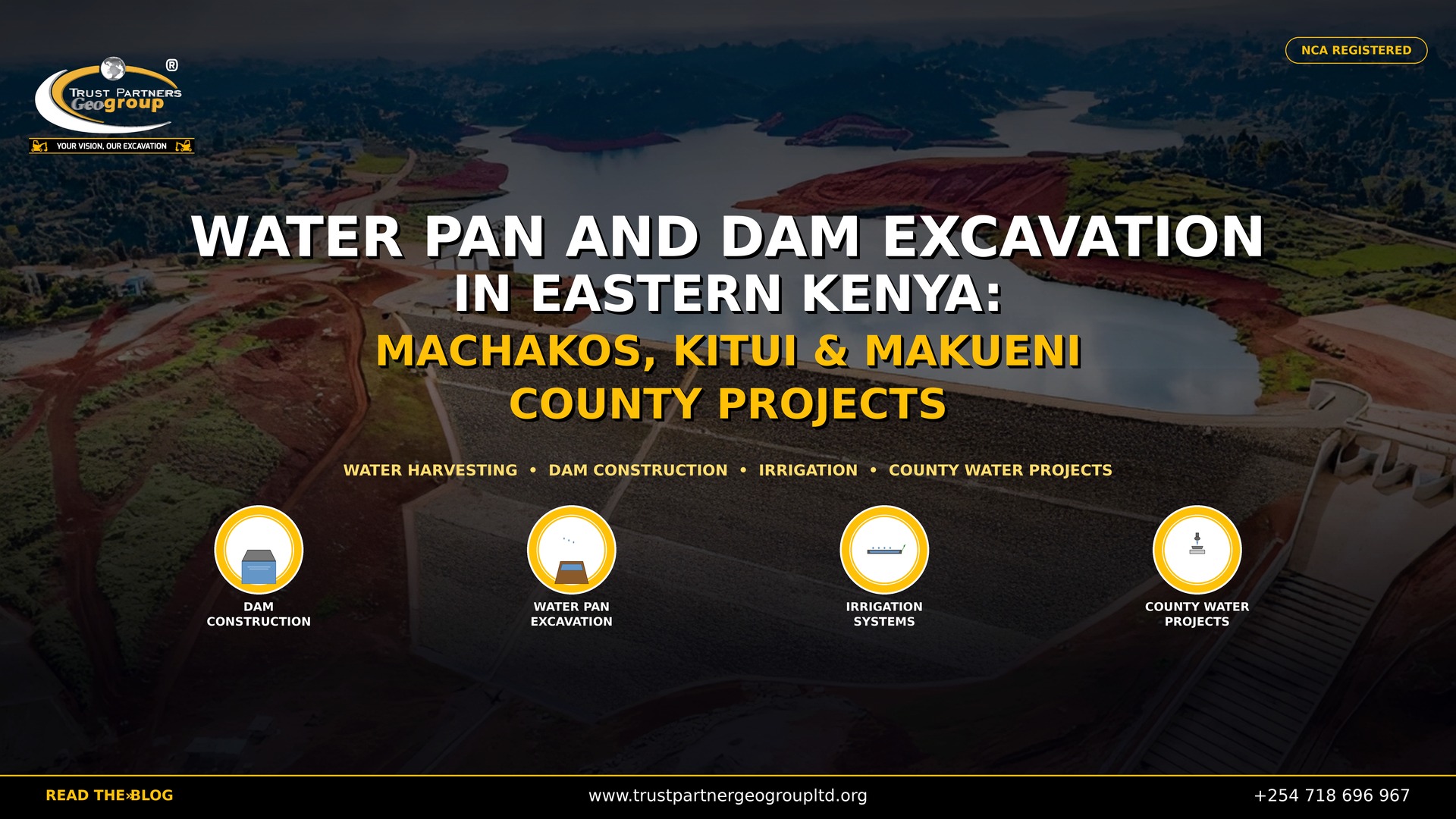
Water Pan and Dam Excavation in Eastern Kenya: Machakos, Kitui & Makueni County Projects [2026]
Farm dam construction and water pan excavation for irrigation, livestock and community water supply across Machakos, Kitui and Makueni with heavy equipment for hire
Table of Contents
- 1. Why Water Pans and Dams are Transforming Eastern Kenya Agriculture
- 2. Types of Water Pans and Farm Dams for Machakos, Kitui and Makueni
- 3. Site Selection and Hydrological Assessment
- 4. Excavation Methods and Heavy Equipment for Hire
- 5. Embankment Construction and Compaction
- 6. Lining and Seepage Control in Porous Eastern Kenya Soils
- 7. Spillways, Inlets and Outlet Works
- 8. Construction Costs and Programme [2026]
- 9. WRMA, NEMA and County Compliance
- 10. Frequently Asked Questions
- ">11. Conclusion
In the red earth of Makueni, where the long rains failed for the third consecutive season and the Athi River has shrunk to a chain of disconnected pools, a newly excavated water pan holds 15,000 cubic metres of harvested runoff - enough to keep 200 dairy cows alive through eight months of drought and irrigate four hectares of fodder that would otherwise be dust. This is not charity. It is engineering. And it is transforming excavation in Kenya's Eastern region from a construction activity into a survival strategy. Machakos, Kitui and Makueni counties sit in Kenya's semi-arid zone, receiving 500-800mm of erratic rainfall annually against evaporation rates exceeding 1,800mm. For farmers, pastoralists and county governments, water pans and farm dams are no longer optional infrastructure - they are the difference between productive land and abandoned scrub. But building them correctly requires more than a bulldozer and a hope for rain. It requires hydrological assessment, precise excavation, engineered embankments, seepage control and regulatory compliance that many informal contractors ignore. Trust Partners Geo-Group Ltd provides heavy equipment for hire and dam construction expertise specifically for Eastern Kenya's challenging geology - from Machakos' sandy loam to Kitui's hard murram calcrete and Makueni's fractured limestone. Whether you are a dairy farmer in Tala, a county engineer in Kitui Central, or an irrigation cooperative in Kibwezi, this guide explains water pan and dam excavation in Kenya's Eastern counties with the technical depth, cost transparency and regulatory clarity your project demands. And when your agricultural water security is secured, remember that the same heavy equipment for hire fleet and excavation expertise is available for your commercial basement excavation and construction projects across the region.
Trust Partners Geo-Group Ltd - Agricultural Waterworks & Earthworks Team
NCA-registered excavation contractor with 15+ years of dam construction, water pan excavation and irrigation earthworks across Kenya's arid and semi-arid counties.
1. Why Water Pans and Dams are Transforming Eastern Kenya Agriculture
Eastern Kenya has always been defined by water scarcity. Machakos, Kitui and Makueni counties experience recurrent drought cycles that devastate livestock, collapse crop yields and force rural-urban migration. The 2022-2024 drought killed an estimated 2.5 million livestock in the broader Eastern and Northern region and left smallholder farmers without production capacity for three seasons.
But a quiet revolution is underway. Driven by county climate adaptation funds, National Irrigation Authority (NIA) programmes, and private investment in commercial agriculture, water pan and farm dam construction has accelerated across Eastern Kenya. The logic is simple: harvest the intense but brief rainy season runoff, store it through the dry months, and transform semi-arid land into irrigated productive plots.
The impact is measurable. A 10,000 m3 water pan in Machakos can irrigate 2-3 hectares of high-value horticulture (tomatoes, capsicum, onions) generating KES 1.5-3.0 million per season - compared to KES 200,000-400,000 from rain-fed maize. A 50,000 m3 farm dam in Kitui supports 200 dairy cows with year-round drinking water and fodder irrigation, converting a livestock operation from drought-vulnerable to drought-proof. For county governments, community dams reduce water trucking costs, lower livestock mortality, and stabilise rural populations.
The constraint is not demand. It is supply of competent contractors who understand that water pan excavation is civil engineering, not just digging a hole. The pan must be sized to the catchment, shaped for stability, sealed against seepage, and integrated with spillways and outlets that survive Eastern Kenya's violent flash floods. Trust Partners Geo-Group Ltd brings excavation in Kenya expertise to this critical sector, with heavy equipment for hire and engineering support that ensures every litre of harvested water is retained.
2. Types of Water Pans and Farm Dams for Machakos, Kitui and Makueni
Not all water storage structures are the same. Selecting the correct type for your site, budget and water demand determines project success.
Excavated Water Pans (Off-Stream)
Water pans are entirely excavated depressions with no raised embankment. They rely on cut volume for storage and are best suited to flat or gently sloping ground with a high water table or seasonal runoff. Typical dimensions: 2-4 metres deep; 1:2 to 1:3 side slopes; and 2,000-20,000 m3 capacity. Water pans are cheaper per m3 than dams because no embankment is required, but they lose more water to evaporation due to large surface-area-to-volume ratios. They are ideal for: smallholder livestock watering; horticulture irrigation (1-3 hectares); and domestic use for schools and dispensaries. In Machakos' flatter agricultural zones, water pans are the dominant structure.
Embankment Farm Dams (Valley Dams)
Farm dams impound water behind a compacted earth embankment constructed across a drainage line or valley. They store 10,000-500,000+ m3 and are suited to sites with defined valleys and reliable catchments. The embankment is typically 3-8 metres high, built from excavated material or imported fill, with a clay core for impermeability. Farm dams are essential for: commercial dairy and beef operations requiring 50,000+ m3; irrigation schemes exceeding 5 hectares; and community water supply serving 500+ people. In Kitui's undulating terrain and Makueni's valley systems, farm dams are more common than pans.
Subsurface Dams and Sand Dams
Subsurface dams are constructed by excavating a trench across a seasonal riverbed and building an impermeable underground wall that raises the water table upstream. Sand dams are low embankments (1-3 metres) across sandy riverbeds that trap coarse sand and store water within the sand matrix. These are low-cost, community-managed structures suited to Kitui's seasonal rivers. While they do not require heavy excavation equipment, they are often paired with pans and dams in integrated water harvesting schemes.
Earth Dam with Masonry or Concrete Wall
For sites with steep valleys or limited suitable embankment material, a masonry or concrete gravity wall replaces the earth embankment. These are more expensive (KES 8,000-15,000 per m3 of wall) but require less land and are structurally robust. They are rare in smallholder contexts but used by county governments for strategic community water supply.
| Structure Type | Capacity | Best Terrain | Relative Cost |
|---|---|---|---|
| Excavated water pan | 2,000-20,000 m3 | Flat, gentle slope | Low |
| Embankment farm dam | 10,000-500,000 m3 | Valley, drainage line | Medium |
| Subsurface / sand dam | 5,000-50,000 m3 | Riverbed, sandy | Very Low |
| Concrete gravity wall | 20,000-200,000 m3 | Steep valley, rock | High |
3. Site Selection and Hydrological Assessment
The most expensive mistake in water pan construction is building in the wrong place. A poorly sited pan either fails to fill (inadequate catchment) or empties into the groundwater (excessive seepage). Professional site selection is non-negotiable.
Catchment Area and Runoff Volume
The catchment area must generate sufficient runoff to fill the pan or dam within the rainy season. The rule of thumb for Eastern Kenya's semi-arid climate: catchment-to-pan surface ratio of 3:1 to 5:1 for unlined pans; and 5:1 to 10:1 for lined structures where direct rainfall on the pan surface is secondary. For a 10,000 m3 pan in Machakos (600mm annual rainfall, 15% runoff coefficient), a 4-hectare catchment is required. In Kitui's harder surface (rocky terrain, 20% runoff coefficient), the same pan requires only 2.5 hectares. Trust Partners Geo-Group Ltd calculates catchment runoff using the Rational Method and local rainfall data before committing to excavation.
Soil Permeability Testing
Eastern Kenya soils range from moderately permeable sandy loam (Machakos) to highly permeable fractured rock (Makueni limestone). Before excavation, infiltration tests (double-ring infiltrometer or auger hole tests) determine whether natural sealing is possible or artificial lining is mandatory. Soils with infiltration rates below 10 mm/hour may self-seal after the first filling. Rates above 50 mm/hour require geomembrane or clay lining.
Topography and Valley Geometry
For embankment dams, the ideal valley has a V-shaped cross-section with a narrow crest (minimising embankment volume) and a wide upstream basin (maximising storage). The valley sides should be stable rock or compacted soil - not fractured or weathered material prone to landslides. For water pans, the site should have a gentle slope (2-5%) that channels runoff toward the pan without causing erosion.
Environmental and Social Constraints
NEMA requires that dams avoid wetlands, riparian zones and sensitive habitats. In Kitui, pans must not intercept community downstream water rights. In Machakos, proximity to livestock corridors requires fencing to prevent contamination. And everywhere, pans must be sited uphill from latrines, cemeteries and waste dumps to prevent groundwater contamination.
4. Excavation Methods and Heavy Equipment for Hire
Water pan and dam excavation in Eastern Kenya uses the same heavy equipment for hire principles as commercial earthworks, but with agricultural-specific requirements for precision and cost control.
Bulk Excavation with Bulldozers
Bulldozers are the primary machines for water pan excavation. They strip topsoil, push bulk material to spoil heaps or embankment locations, and rough-cut the pan shape. In Machakos' soft sandy loam, a medium bulldozer (18-24 tonnes) achieves 150-250 m3 per hour. In Kitui's hard murram, the same machine achieves 60-100 m3 per hour unless the surface is ripped first. For large pans (10,000+ m3), bulldozers are more cost-effective than excavators because they move material faster over short distances.
Precision Shaping with Excavators
Excavators perform the detailed work that bulldozers cannot: cutting side slopes to exact gradients (1:2 or 1:3); shaping the pan floor to a uniform 1% inverse grade toward the deepest point; excavating the keyway trench for embankment foundations; and cutting spillway channels in natural ground. A 20-tonne excavator with GPS guidance achieves ±50mm accuracy on pan floors, ensuring uniform depth and preventing shallow areas that evaporate prematurely. Trust Partners Geo-Group Ltd provides GPS-equipped excavators for precision water pan shaping, ensuring that design volumes are achieved without over-excavation that increases lining costs.
Rock Breaking in Calcrete and Limestone
Kitui and Makueni present hard excavation challenges. Kitui's murram is often capped with calcrete (calcified hardpan) that resists bulldozer ripping. Makueni's limestone areas require hydraulic breaker-equipped excavators to fracture rock before loading. Rock breaking adds KES 800-1,500 per m3 to excavation costs but is unavoidable in these geological zones. On a recent 20,000 m3 pan in Makueni, 15% of the volume was in fractured limestone requiring breaker work, adding KES 420,000 to the project but preventing programme delay.
Equipment Fleet for Dam Construction
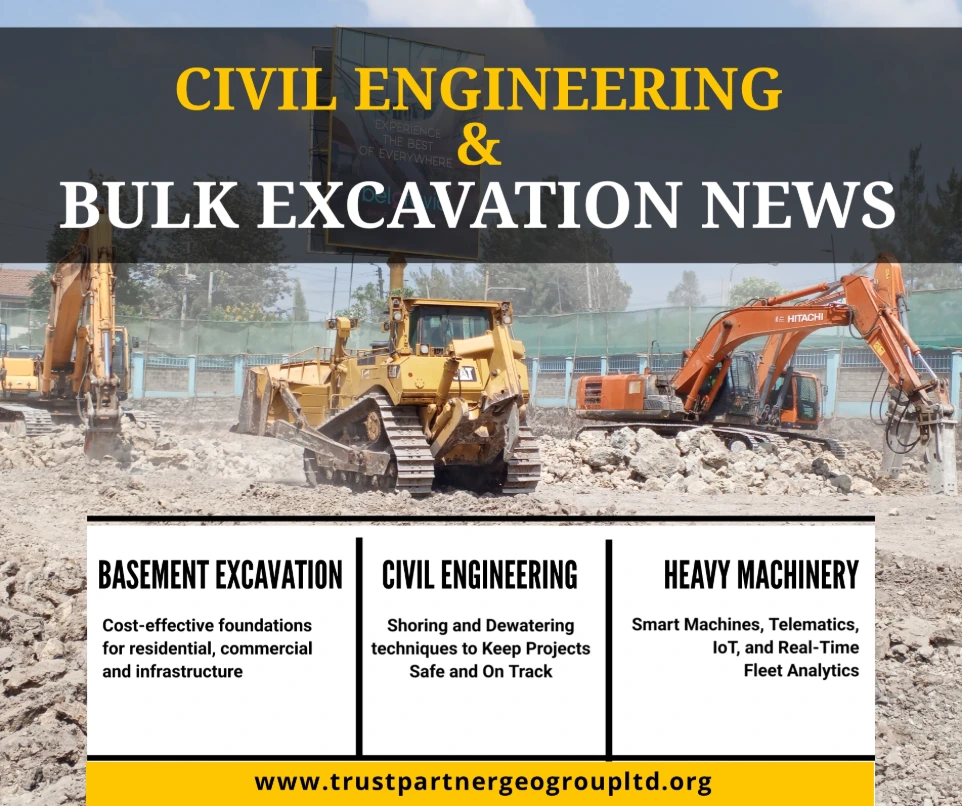
Farm dam construction requires a broader fleet: bulldozers for embankment material haulage and spreading; excavators for keyway, cutoff trench and spillway; motor graders for access roads and embankment crest shaping; padfoot rollers for core compaction; and smooth drum rollers for shell compaction. Trust Partners Geo-Group Ltd provides complete dam construction equipment packages, mobilised from Nairobi to Machakos (60 km), Kitui (150 km) or Makueni (120 km) with managed logistics and on-site maintenance support.
5. Embankment Construction and Compaction
The embankment is the structural heart of a farm dam. Its failure means catastrophic water loss, downstream flooding and total project loss. Correct construction is not optional.
Foundation Preparation and Cutoff Trench
Before placing any fill, the embankment foundation must be cleared of topsoil, vegetation and loose material. A cutoff trench (keyway) is excavated along the centreline of the embankment, extending into impermeable subsoil or bedrock. The trench is typically 1.5-2.5 metres deep and 2-3 metres wide, filled with compacted clay or low-permeability material to create a vertical barrier against under-seepage. In Makueni's limestone areas where bedrock is shallow, the keyway is blasted or breaker-cut into rock and filled with concrete or grout.
Core and Shell Construction
The embankment consists of a central impermeable core and outer structural shells. The core uses clay, imported bentonite-enhanced soil, or low-permeability material from the pan excavation. It is placed in 150-200mm horizontal lifts and compacted to 95% modified Proctor with a padfoot roller. The shells use general fill material (murram, sandy clay) placed in 200-300mm lifts and compacted to 93-95% density. Construction proceeds symmetrically on both sides of the core to prevent differential loading and cracking.
Moisture Control and Compaction
Eastern Kenya's dry climate means embankment fill often arrives below optimum moisture content. Water bowsers spray each lift before rolling, bringing moisture to within 2% of optimum. Under-wet fill pumps and slumps; over-dry fill will not achieve density and will settle excessively after first filling. On-site density testing with a nuclear gauge or sand cone is performed every 500 m3 of placed fill. Trust Partners Geo-Group Ltd provides certified compaction testing as part of our dam construction quality assurance.
Settlement and Crest Width
Embankments settle 2-5% of their height during first filling and consolidation. The design crest must be overbuilt by this amount to ensure the final crest meets design elevation. A typical farm dam embankment has: crest width 3-4 metres (for maintenance access); upstream slope 1:2.5 to 1:3 (gentler for wave protection); and downstream slope 1:2 to 1:2.5 (steeper but stable with turfing).
6. Lining and Seepage Control in Porous Eastern Kenya Soils
Seepage can destroy the economics of a water pan. A pan that loses 30% of stored water to groundwater is a pan that fails its purpose. Eastern Kenya's porous soils make lining essential for most structures.
Natural Compaction and Gley Technique
For small pans in moderately permeable soils, thorough compaction of the pan floor to 95% modified Proctor may reduce seepage to acceptable levels (5-10% per month). The gley technique - spreading 100-150mm of fresh manure, vegetation and topsoil on the pan floor, compacting it, and allowing it to ferment anaerobically - creates a biological seal. This traditional method costs almost nothing but requires 2-3 months of undisturbed fermentation and is unreliable in sandy soils.
Bentonite Clay Lining
Bentonite is a swelling clay that forms an impermeable barrier when hydrated. It is mixed with the native soil at 5-10% by weight and compacted in 100mm lifts. Cost: KES 150-250 per m2 including material and labour. Bentonite is effective in sandy loam but less so in soils with high organic content or extreme pH. It requires careful mixing and compaction to achieve uniform distribution.
HDPE Geomembrane Lining
High-density polyethylene (HDPE) geomembrane is the gold standard for water pan lining. A 0.75-1.0mm thick membrane, properly installed with welded seams and anchor trenches, reduces seepage to near zero. Installation requires: preparing a smooth, stone-free subgrade; deploying the membrane with 300mm overlaps; welding or taping seams; and anchoring the edges in perimeter trenches backfilled with compacted soil. Cost: KES 80-150 per m2 for supply and installation. For a 5,000 m2 pan, lining costs KES 400,000-750,000 - a significant but worthwhile investment for commercial irrigation.
Concrete Lining
Concrete lining (50-100mm thick, reinforced with welded wire mesh) is used for high-value structures, steep side slopes where membranes slip, and spillway channels subject to erosion. Cost: KES 250-400 per m2. It is durable but expensive and prone to cracking if the subgrade settles. Expansion joints every 5-6 metres are essential.
| Lining Method | Cost (KES/m2) | Seepage Reduction | Lifespan |
|---|---|---|---|
| Natural compaction only | 20-40 | 50-70% | 2-5 years |
| Gley technique | 10-20 | 60-80% | 3-7 years |
| Bentonite clay | 150-250 | 85-95% | 10-15 years |
| HDPE geomembrane | 80-150 | 95-99% | 15-25 years |
| Concrete | 250-400 | 95-99% | 20-30 years |
7. Spillways, Inlets and Outlet Works
A water pan without a spillway is a water pan that will breach its embankment during the first intense storm. Eastern Kenya's convective rainfall can dump 50-100mm in six hours, generating runoff that exceeds pan capacity within hours.
Spillway Design
The spillway must pass the peak flood without overtopping the embankment. For farm dams in Eastern Kenya, spillways are typically designed for the 100-year flood event. The spillway channel is excavated in natural ground (never on fill) with a trapezoidal cross-section, stone-pitched invert, and gradient of 2-5% to prevent erosion. Width depends on catchment area: small pans (2 ha catchment) require 1.5-2.0 metre wide spillways; community dams (50+ ha catchment) require 4-6 metre wide spillways with gabion or concrete lining. The spillway crest is set at maximum water level, with a freeboard of 0.5-1.0 metres between spillway crest and embankment crest.
Inlet Works and Silt Traps
Runoff entering the pan carries sediment that gradually reduces storage capacity. Inlet works include: a stone-paved channel that slows water and drops coarse sediment before it reaches the pan; a silt trap or forebay - a small excavated settling pond at the pan inlet that captures sediment and is cleaned annually; and grassed waterways upstream that filter runoff and reduce erosion. On a recent 15,000 m3 pan in Machakos, a 20 m2 silt trap captured an estimated 12 m3 of sediment in the first rainy season, preventing it from entering the main storage.
Outlet and Drawoff Works
Water must be accessible without destabilising the embankment. Standard outlet works include: a 50-100mm PVC or HDPE pipe through the embankment, with a valve or tap on the downstream side and an anti-seep collar within the embankment to prevent piping failure; a livestock drinking trough fed by gravity from the outlet pipe, positioned to maintain minimum water depth; and a scour pipe at the pan floor level to drain the pan completely for desilting every 3-5 years. All pipes through embankments must be installed during construction, not retrofitted, to ensure proper compaction around the pipe zone.
8. Construction Costs and Programme [2026]
Water pan and dam construction costs in Eastern Kenya depend on volume, soil hardness, lining choice and access.
| Item | 2026 Rate (KES) | Notes |
|---|---|---|
| Excavation (soft soil) | 150-250/m3 | Machakos sandy loam |
| Excavation (hard murram) | 350-550/m3 | Kitui calcrete |
| Rock breaking | 800-1,500/m3 | Makueni limestone |
| Embankment construction | 400-700/m3 placed | Includes compaction |
| HDPE geomembrane lining | 80-150/m2 | 0.75-1.0mm, installed |
| Bentonite lining | 150-250/m2 | Mixed and compacted |
| Concrete lining | 250-400/m2 | 50-100mm thick |
| Spillway construction | 8,000-15,000/m | Stone pitching or concrete |
| Outlet pipe installation | 25,000-60,000 each | 50-100mm PVC/HDPE |
| Fencing (chain link) | 1,500-2,500/m | Perimeter protection |
All-in project estimates: small water pan (5,000 m3, soft soil, unlined) KES 400,000-700,000; medium water pan (15,000 m3, murram, HDPE lined) KES 1.5-2.5 million; farm dam with embankment (50,000 m3, clay core, HDPE upstream face) KES 5-8 million; and community dam (200,000 m3, full engineering) KES 15-25 million. Programme durations: small pan 1-2 weeks; medium pan 3-4 weeks; farm dam 6-10 weeks; and community dam 3-6 months.
9. WRMA, NEMA and County Compliance
Water pan and dam construction in Eastern Kenya operates under a multi-layered regulatory framework that informal contractors often ignore - to their clients' cost.
| Requirement | Authority | Threshold / Condition |
|---|---|---|
| Water permit | WRMA | Any impoundment >10,000 m3 or interfering with watercourse |
| NEMA EIA | NEMA | Dam >1 ha surface area or embankment >3m high |
| County building permit | County Government | All structures on private or public land |
| Public health approval | County Public Health | Community water supply structures |
| NCA contractor registration | NCA | All construction works |
WRMA permits require submission of a hydrological report, design drawings and environmental management plan. NEMA EIAs for larger dams require public participation, flora and fauna surveys, and mitigation plans for any riparian or wetland impact. County governments in Machakos, Kitui and Makueni enforce setback requirements from roads and property boundaries. Trust Partners Geo-Group Ltd coordinates all permit applications as part of our dam construction service, ensuring that projects are fully compliant before excavation begins.
10. Frequently Asked Questions: Water Pan and Dam Excavation in Eastern Kenya
What is the difference between a water pan and a farm dam in Eastern Kenya?
A water pan is a shallow, excavated depression with no embankment, typically 2,000-10,000 m3 capacity, dug into flat or gently sloping ground to harvest seasonal runoff. Water pans rely entirely on excavated volume and have no raised wall. A farm dam is an embankment structure with a compacted earth wall (dam wall) across a drainage line or valley, impounding water behind it. Dams can store 10,000-500,000+ m3 and are suited to sites with defined valleys and catchments. In Machakos, Kitui and Makueni counties, water pans are preferred on flat agricultural land for livestock and horticulture, while farm dams are built in the undulating terrain of the Chyulu Hills fringes and Athi River tributaries for larger irrigation schemes. Both require excavation in Kenya by NCA-registered contractors using heavy equipment for hire, but dams demand additional engineering for embankment stability and spillway design.
How much does water pan excavation cost in Machakos, Kitui and Makueni?
In 2026, water pan excavation costs in Eastern Kenya are: small water pan (2,000-5,000 m3) KES 350,000-700,000 including excavation, shaping and basic inlet works; medium water pan (5,000-15,000 m3) KES 700,000-1.5 million; large water pan or small farm dam (15,000-50,000 m3) KES 1.5-4.5 million including embankment construction; and community dam (50,000-200,000 m3) KES 4.5-15 million with full spillway, outlet and lining. Costs depend on soil type: soft sandy loam in lower Machakos excavates easily at KES 150-250 per m3; hard murram and calcrete in Kitui requires ripping or breaking at KES 350-550 per m3; and rock excavation in Makueni's limestone areas costs KES 800-1,500 per m3. Lining adds KES 80-150 per m2 for HDPE geomembrane or KES 200-350 per m2 for concrete. Trust Partners Geo-Group Ltd provides transparent all-in pricing for water pan and dam excavation across Eastern Kenya with heavy equipment for hire packages tailored to project scale.
What equipment is used for dam and water pan excavation in Eastern Kenya?
Water pan and dam excavation in Machakos, Kitui and Makueni requires a specialised heavy equipment for hire fleet: bulldozers for stripping topsoil, cutting inlet channels and bulk earthmoving on embankment construction; excavators (20-30 tonne) for precise pan shaping, keyway trenches in embankment foundations and spillway excavation; motor graders for shaping pan inverts to uniform grades and constructing access roads; smooth drum and padfoot rollers for compacting embankment fill to 95% modified Proctor; dump trucks for hauling embankment material from borrow areas; and water bowsers for moisture conditioning during compaction. In Kitui's hard murram areas, ripper-equipped bulldozers or hydraulic breakers fracture calcrete before excavation. In Makueni's limestone areas, breaker-equipped excavators handle rock pockets. Trust Partners Geo-Group Ltd provides complete dam construction equipment packages across Eastern Kenya, including operators experienced in water pan shaping and embankment compaction.
How do you prevent seepage in farm dams and water pans in Eastern Kenya?
Seepage is the biggest cause of water loss in Eastern Kenya's porous soils. In Machakos and Kitui, the natural soils are often sandy loam or fractured rock with high permeability. Seepage control methods include: compaction of the pan floor and embankment core to 95% modified Proctor, reducing permeability by 80-90%; bentonite clay lining (100-200mm thick) mixed into the pan floor soil, creating a natural clay seal at KES 150-250 per m2; HDPE geomembrane lining (0.5-1.0mm thickness) for guaranteed impermeability at KES 80-150 per m2 installed; concrete lining (50-100mm thick) for high-value irrigation dams at KES 250-400 per m2; and gley technique (compacted organic matter) for small community pans, creating a biological seal. For farm dams, the embankment core must be built from low-permeability clay or imported material, with a cutoff trench (keyway) excavated into bedrock or impermeable subsoil to prevent under-seepage. On a recent 30,000 m3 farm dam in Makueni, Trust Partners Geo-Group Ltd achieved zero measurable seepage by combining a 1.5-metre deep cutoff trench, compacted clay core and 0.75mm HDPE liner on the upstream face.
Do I need a permit to build a water pan or farm dam in Machakos, Kitui or Makueni?
Yes. Water pans and dams in Eastern Kenya require multiple permits. The Water Resources Management Authority (WRMA) issues water permits for any structure impounding more than 10,000 m3 or interfering with a watercourse. NEMA requires an Environmental Impact Assessment (EIA) for dams exceeding 1 hectare surface area or with embankments over 3 metres high. The County Government (Machakos, Kitui or Makueni) issues development approvals and building permits for structures on private land. For community dams funded by county or national programmes, additional National Irrigation Authority (NIA) or Agricultural Finance Corporation (AFC) approvals may apply. Trust Partners Geo-Group Ltd coordinates permit applications as part of our dam construction service, ensuring WRMA, NEMA and county requirements are met before excavation begins. Unpermitted dams can be demolished by county enforcement and attract fines of KES 100,000-500,000.
What size water pan do I need for dairy farming in Eastern Kenya?
Water pan sizing for dairy farming in Machakos, Kitui and Makueni depends on herd size, evaporation rates and rainfall reliability. Eastern Kenya's annual rainfall is 500-800mm with high variability, and evaporation exceeds 1,800mm per year. The standard calculation is: 70-100 litres per cow per day for drinking and cleaning; 30-50 litres per day for calves and heifers; and 20% contingency for evaporation and seepage losses. A 50-cow dairy unit requires 5,000-7,000 litres per day, or 1.8-2.5 million litres per year. Accounting for 8 months of dry season storage and 20% losses, a 3,000-5,000 m3 water pan is minimum for 50 cows. For 200 cows, a 15,000-20,000 m3 pan or small dam is required. For irrigation of fodder crops (napier, lucerne), add 5,000-8,000 m3 per hectare per season. Trust Partners Geo-Group Ltd provides hydrological assessment and pan sizing calculations as part of our Eastern Kenya water pan excavation service, ensuring your investment matches your herd's needs.
How long does it take to excavate a water pan or farm dam in Eastern Kenya?
Programme duration depends on volume, soil hardness and equipment availability. Typical timelines with heavy equipment for hire are: small water pan (3,000 m3) in soft soil 3-5 days with one bulldozer and one excavator; medium water pan (10,000 m3) in murram 2-3 weeks with a full earthworks fleet; farm dam with embankment (30,000 m3) 4-6 weeks including keyway excavation, embankment construction and spillway works; and large community dam (100,000+ m3) 8-14 weeks with phased excavation and compaction. Hard rock in Kitui or Makueni can add 30-50% to the programme. The dry season (June-October and January-March) is optimal - excavating during rains in Eastern Kenya is counterproductive as pans fill with water before completion and embankment compaction is impossible on wet fill. Trust Partners Geo-Group Ltd schedules water pan excavation to complete before the rains, allowing the first filling to occur naturally during the wet season.
Where can I hire heavy equipment for water pan and dam excavation in Eastern Kenya?
Trust Partners Geo-Group Ltd provides heavy equipment for hire for water pan excavation, dam construction and irrigation earthworks across Machakos, Kitui, Makueni and all Eastern Kenya counties. Our agricultural waterworks fleet includes: bulldozers for pan stripping and embankment construction; excavators for precise pan shaping, keyway trenches and spillways; motor graders for access roads and pan floor grading; padfoot and smooth drum rollers for embankment compaction; dump trucks for borrow material haulage; and water bowsers for moisture conditioning. We mobilise from Nairobi to Machakos (60 km), Kitui (150 km) and Makueni (120 km) with managed logistics. For long-term agricultural contracts, we offer seasonal hire packages that align with the farming calendar. All equipment is operated by NCA-certified drivers with water pan construction experience. Contact us at +254 718 68 69 67 or info@trustpartnergeogroupltd.org for dam and water pan excavation in Machakos, Kitui, Makueni and Eastern Kenya.
11. Conclusion: Harvesting Hope from Hardship
Water is Eastern Kenya's defining constraint - and its greatest opportunity. Every cubic metre of runoff that is harvested, stored and managed is a cubic metre of agricultural production, livestock survival and rural prosperity that would otherwise be lost to evaporation or uncontrolled flooding. The water pans and farm dams being built across Machakos, Kitui and Makueni are not mere construction projects. They are climate adaptation infrastructure, food security investments and community resilience mechanisms.
But the difference between a water pan that transforms a farm and one that becomes a muddy depression is engineering discipline. Correct site selection ensures the pan fills. Precision excavation achieves design volume. Compacted embankments prevent catastrophic failure. Lining retains every precious litre. And compliant spillways protect downstream communities. The contractor who treats water pan excavation as simple digging delivers a hole. The contractor who treats it as civil engineering delivers a water asset.
Trust Partners Geo-Group Ltd brings the same engineering rigour to water pan and dam construction that we bring to basement excavation and commercial earthworks in Nairobi. Our heavy equipment for hire fleet is available across Eastern Kenya, operated by drivers who understand agricultural deadlines and county compliance requirements. Whether you need a 5,000 m3 pan for a dairy herd in Machakos, a 50,000 m3 farm dam for an irrigation scheme in Kitui, or a community reservoir in Makueni, we provide the excavation in Kenya expertise that turns seasonal rainfall into year-round water security.
Water Pan & Dam Excavation in Eastern Kenya
Farm dam construction and water pan excavation for Machakos, Kitui, Makueni and Eastern Kenya with heavy equipment for hire and agricultural earthworks expertise.
Free lead magnet: ask for our Water Pan Sizing and Cost Calculator (PDF) - catchment assessment, volume calculation, lining selection and budget estimation for Eastern Kenya farm dams and irrigation pans.
Related Resources
Road Construction in Rift Valley: Nakuru, Eldoret & Kericho Earthworks & Grading Services
The previous regional blog - highland road earthworks and grading across Kenya's Rift Valley.
READ MOREDam Excavation and Construction in Kenya: A Complete Guide for Farmers & Developers
The definitive nationwide guide to dam construction, earthworks and water storage for agricultural and commercial projects.
READ MOREWater Pan Excavation for Dairy Farming in Kenya: Size, Depth & Lining Guide [2026]
Detailed sizing, depth and lining specifications for dairy farm water pans across Kenya's arid and semi-arid counties.
READ MORESeepage Control and Embankment Stability for Dams in Kenya
Technical guide to cutoff trenches, clay cores and lining systems that prevent water loss in farm dams.
READ MORELodiani Dam Construction 2026: Excavation and Earthworks Scope
Case study of a major dam earthworks project demonstrating our large-scale water storage construction capability.
READ MOREBulk Excavation Cost Per Cubic Meter in Kenya [2026 Updated Rates]
Transparent earthworks pricing applicable to water pan excavation and agricultural dam construction budgets.
READ MORETRUST PARTNERS GEO-GROUP LTD | YOUR VISION, OUR EXCAVATION
WEBSITE: WWW.TRUSTPARTNERGEOGROUPLTD.ORG | EMAIL: INFO@TRUSTPARTNERGEOGROUPLTD.ORG | PHONE: +254 718 68 69 67
FOLLOW US: FACEBOOK | TIKTOK | INSTAGRAM | LINKEDIN
© 2026 TRUST PARTNERS GEO-GROUP LTD. ALL RIGHTS RESERVED.
Water Pan and Dam Excavation in Eastern Kenya: Machakos, Kitui & Makueni County Projects [2026]
Farm dam construction and water pan excavation for irrigation, livestock and community water supply across Machakos, Kitui and Makueni with heavy equipment for hire
Table of Contents
- 1. Why Water Pans and Dams are Transforming Eastern Kenya Agriculture
- 2. Types of Water Pans and Farm Dams for Machakos, Kitui and Makueni
- 3. Site Selection and Hydrological Assessment
- 4. Excavation Methods and Heavy Equipment for Hire
- 5. Embankment Construction and Compaction
- 6. Lining and Seepage Control in Porous Eastern Kenya Soils
- 7. Spillways, Inlets and Outlet Works
- 8. Construction Costs and Programme [2026]
- 9. WRMA, NEMA and County Compliance
- 10. Frequently Asked Questions
- ">11. Conclusion
In the red earth of Makueni, where the long rains failed for the third consecutive season and the Athi River has shrunk to a chain of disconnected pools, a newly excavated water pan holds 15,000 cubic metres of harvested runoff - enough to keep 200 dairy cows alive through eight months of drought and irrigate four hectares of fodder that would otherwise be dust. This is not charity. It is engineering. And it is transforming excavation in Kenya's Eastern region from a construction activity into a survival strategy. Machakos, Kitui and Makueni counties sit in Kenya's semi-arid zone, receiving 500-800mm of erratic rainfall annually against evaporation rates exceeding 1,800mm. For farmers, pastoralists and county governments, water pans and farm dams are no longer optional infrastructure - they are the difference between productive land and abandoned scrub. But building them correctly requires more than a bulldozer and a hope for rain. It requires hydrological assessment, precise excavation, engineered embankments, seepage control and regulatory compliance that many informal contractors ignore. Trust Partners Geo-Group Ltd provides heavy equipment for hire and dam construction expertise specifically for Eastern Kenya's challenging geology - from Machakos' sandy loam to Kitui's hard murram calcrete and Makueni's fractured limestone. Whether you are a dairy farmer in Tala, a county engineer in Kitui Central, or an irrigation cooperative in Kibwezi, this guide explains water pan and dam excavation in Kenya's Eastern counties with the technical depth, cost transparency and regulatory clarity your project demands. And when your agricultural water security is secured, remember that the same heavy equipment for hire fleet and excavation expertise is available for your commercial basement excavation and construction projects across the region.
Trust Partners Geo-Group Ltd - Agricultural Waterworks & Earthworks Team
NCA-registered excavation contractor with 15+ years of dam construction, water pan excavation and irrigation earthworks across Kenya's arid and semi-arid counties.
1. Why Water Pans and Dams are Transforming Eastern Kenya Agriculture
Eastern Kenya has always been defined by water scarcity. Machakos, Kitui and Makueni counties experience recurrent drought cycles that devastate livestock, collapse crop yields and force rural-urban migration. The 2022-2024 drought killed an estimated 2.5 million livestock in the broader Eastern and Northern region and left smallholder farmers without production capacity for three seasons.
But a quiet revolution is underway. Driven by county climate adaptation funds, National Irrigation Authority (NIA) programmes, and private investment in commercial agriculture, water pan and farm dam construction has accelerated across Eastern Kenya. The logic is simple: harvest the intense but brief rainy season runoff, store it through the dry months, and transform semi-arid land into irrigated productive plots.
The impact is measurable. A 10,000 m3 water pan in Machakos can irrigate 2-3 hectares of high-value horticulture (tomatoes, capsicum, onions) generating KES 1.5-3.0 million per season - compared to KES 200,000-400,000 from rain-fed maize. A 50,000 m3 farm dam in Kitui supports 200 dairy cows with year-round drinking water and fodder irrigation, converting a livestock operation from drought-vulnerable to drought-proof. For county governments, community dams reduce water trucking costs, lower livestock mortality, and stabilise rural populations.
The constraint is not demand. It is supply of competent contractors who understand that water pan excavation is civil engineering, not just digging a hole. The pan must be sized to the catchment, shaped for stability, sealed against seepage, and integrated with spillways and outlets that survive Eastern Kenya's violent flash floods. Trust Partners Geo-Group Ltd brings excavation in Kenya expertise to this critical sector, with heavy equipment for hire and engineering support that ensures every litre of harvested water is retained.
2. Types of Water Pans and Farm Dams for Machakos, Kitui and Makueni
Not all water storage structures are the same. Selecting the correct type for your site, budget and water demand determines project success.
Excavated Water Pans (Off-Stream)
Water pans are entirely excavated depressions with no raised embankment. They rely on cut volume for storage and are best suited to flat or gently sloping ground with a high water table or seasonal runoff. Typical dimensions: 2-4 metres deep; 1:2 to 1:3 side slopes; and 2,000-20,000 m3 capacity. Water pans are cheaper per m3 than dams because no embankment is required, but they lose more water to evaporation due to large surface-area-to-volume ratios. They are ideal for: smallholder livestock watering; horticulture irrigation (1-3 hectares); and domestic use for schools and dispensaries. In Machakos' flatter agricultural zones, water pans are the dominant structure.
Embankment Farm Dams (Valley Dams)
Farm dams impound water behind a compacted earth embankment constructed across a drainage line or valley. They store 10,000-500,000+ m3 and are suited to sites with defined valleys and reliable catchments. The embankment is typically 3-8 metres high, built from excavated material or imported fill, with a clay core for impermeability. Farm dams are essential for: commercial dairy and beef operations requiring 50,000+ m3; irrigation schemes exceeding 5 hectares; and community water supply serving 500+ people. In Kitui's undulating terrain and Makueni's valley systems, farm dams are more common than pans.
Subsurface Dams and Sand Dams
Subsurface dams are constructed by excavating a trench across a seasonal riverbed and building an impermeable underground wall that raises the water table upstream. Sand dams are low embankments (1-3 metres) across sandy riverbeds that trap coarse sand and store water within the sand matrix. These are low-cost, community-managed structures suited to Kitui's seasonal rivers. While they do not require heavy excavation equipment, they are often paired with pans and dams in integrated water harvesting schemes.
Earth Dam with Masonry or Concrete Wall
For sites with steep valleys or limited suitable embankment material, a masonry or concrete gravity wall replaces the earth embankment. These are more expensive (KES 8,000-15,000 per m3 of wall) but require less land and are structurally robust. They are rare in smallholder contexts but used by county governments for strategic community water supply.
| Structure Type | Capacity | Best Terrain | Relative Cost |
|---|---|---|---|
| Excavated water pan | 2,000-20,000 m3 | Flat, gentle slope | Low |
| Embankment farm dam | 10,000-500,000 m3 | Valley, drainage line | Medium |
| Subsurface / sand dam | 5,000-50,000 m3 | Riverbed, sandy | Very Low |
| Concrete gravity wall | 20,000-200,000 m3 | Steep valley, rock | High |
3. Site Selection and Hydrological Assessment
The most expensive mistake in water pan construction is building in the wrong place. A poorly sited pan either fails to fill (inadequate catchment) or empties into the groundwater (excessive seepage). Professional site selection is non-negotiable.
Catchment Area and Runoff Volume
The catchment area must generate sufficient runoff to fill the pan or dam within the rainy season. The rule of thumb for Eastern Kenya's semi-arid climate: catchment-to-pan surface ratio of 3:1 to 5:1 for unlined pans; and 5:1 to 10:1 for lined structures where direct rainfall on the pan surface is secondary. For a 10,000 m3 pan in Machakos (600mm annual rainfall, 15% runoff coefficient), a 4-hectare catchment is required. In Kitui's harder surface (rocky terrain, 20% runoff coefficient), the same pan requires only 2.5 hectares. Trust Partners Geo-Group Ltd calculates catchment runoff using the Rational Method and local rainfall data before committing to excavation.
Soil Permeability Testing
Eastern Kenya soils range from moderately permeable sandy loam (Machakos) to highly permeable fractured rock (Makueni limestone). Before excavation, infiltration tests (double-ring infiltrometer or auger hole tests) determine whether natural sealing is possible or artificial lining is mandatory. Soils with infiltration rates below 10 mm/hour may self-seal after the first filling. Rates above 50 mm/hour require geomembrane or clay lining.
Topography and Valley Geometry
For embankment dams, the ideal valley has a V-shaped cross-section with a narrow crest (minimising embankment volume) and a wide upstream basin (maximising storage). The valley sides should be stable rock or compacted soil - not fractured or weathered material prone to landslides. For water pans, the site should have a gentle slope (2-5%) that channels runoff toward the pan without causing erosion.
Environmental and Social Constraints
NEMA requires that dams avoid wetlands, riparian zones and sensitive habitats. In Kitui, pans must not intercept community downstream water rights. In Machakos, proximity to livestock corridors requires fencing to prevent contamination. And everywhere, pans must be sited uphill from latrines, cemeteries and waste dumps to prevent groundwater contamination.
4. Excavation Methods and Heavy Equipment for Hire
Water pan and dam excavation in Eastern Kenya uses the same heavy equipment for hire principles as commercial earthworks, but with agricultural-specific requirements for precision and cost control.
Bulk Excavation with Bulldozers
Bulldozers are the primary machines for water pan excavation. They strip topsoil, push bulk material to spoil heaps or embankment locations, and rough-cut the pan shape. In Machakos' soft sandy loam, a medium bulldozer (18-24 tonnes) achieves 150-250 m3 per hour. In Kitui's hard murram, the same machine achieves 60-100 m3 per hour unless the surface is ripped first. For large pans (10,000+ m3), bulldozers are more cost-effective than excavators because they move material faster over short distances.
Precision Shaping with Excavators
Excavators perform the detailed work that bulldozers cannot: cutting side slopes to exact gradients (1:2 or 1:3); shaping the pan floor to a uniform 1% inverse grade toward the deepest point; excavating the keyway trench for embankment foundations; and cutting spillway channels in natural ground. A 20-tonne excavator with GPS guidance achieves ±50mm accuracy on pan floors, ensuring uniform depth and preventing shallow areas that evaporate prematurely. Trust Partners Geo-Group Ltd provides GPS-equipped excavators for precision water pan shaping, ensuring that design volumes are achieved without over-excavation that increases lining costs.
Rock Breaking in Calcrete and Limestone
Kitui and Makueni present hard excavation challenges. Kitui's murram is often capped with calcrete (calcified hardpan) that resists bulldozer ripping. Makueni's limestone areas require hydraulic breaker-equipped excavators to fracture rock before loading. Rock breaking adds KES 800-1,500 per m3 to excavation costs but is unavoidable in these geological zones. On a recent 20,000 m3 pan in Makueni, 15% of the volume was in fractured limestone requiring breaker work, adding KES 420,000 to the project but preventing programme delay.
Equipment Fleet for Dam Construction
Farm dam construction requires a broader fleet: bulldozers for embankment material haulage and spreading; excavators for keyway, cutoff trench and spillway; motor graders for access roads and embankment crest shaping; padfoot rollers for core compaction; and smooth drum rollers for shell compaction. Trust Partners Geo-Group Ltd provides complete dam construction equipment packages, mobilised from Nairobi to Machakos (60 km), Kitui (150 km) or Makueni (120 km) with managed logistics and on-site maintenance support.
5. Embankment Construction and Compaction
The embankment is the structural heart of a farm dam. Its failure means catastrophic water loss, downstream flooding and total project loss. Correct construction is not optional.
Foundation Preparation and Cutoff Trench
Before placing any fill, the embankment foundation must be cleared of topsoil, vegetation and loose material. A cutoff trench (keyway) is excavated along the centreline of the embankment, extending into impermeable subsoil or bedrock. The trench is typically 1.5-2.5 metres deep and 2-3 metres wide, filled with compacted clay or low-permeability material to create a vertical barrier against under-seepage. In Makueni's limestone areas where bedrock is shallow, the keyway is blasted or breaker-cut into rock and filled with concrete or grout.
Core and Shell Construction
The embankment consists of a central impermeable core and outer structural shells. The core uses clay, imported bentonite-enhanced soil, or low-permeability material from the pan excavation. It is placed in 150-200mm horizontal lifts and compacted to 95% modified Proctor with a padfoot roller. The shells use general fill material (murram, sandy clay) placed in 200-300mm lifts and compacted to 93-95% density. Construction proceeds symmetrically on both sides of the core to prevent differential loading and cracking.
Moisture Control and Compaction
Eastern Kenya's dry climate means embankment fill often arrives below optimum moisture content. Water bowsers spray each lift before rolling, bringing moisture to within 2% of optimum. Under-wet fill pumps and slumps; over-dry fill will not achieve density and will settle excessively after first filling. On-site density testing with a nuclear gauge or sand cone is performed every 500 m3 of placed fill. Trust Partners Geo-Group Ltd provides certified compaction testing as part of our dam construction quality assurance.
Settlement and Crest Width
Embankments settle 2-5% of their height during first filling and consolidation. The design crest must be overbuilt by this amount to ensure the final crest meets design elevation. A typical farm dam embankment has: crest width 3-4 metres (for maintenance access); upstream slope 1:2.5 to 1:3 (gentler for wave protection); and downstream slope 1:2 to 1:2.5 (steeper but stable with turfing).
6. Lining and Seepage Control in Porous Eastern Kenya Soils
Seepage can destroy the economics of a water pan. A pan that loses 30% of stored water to groundwater is a pan that fails its purpose. Eastern Kenya's porous soils make lining essential for most structures.
Natural Compaction and Gley Technique
For small pans in moderately permeable soils, thorough compaction of the pan floor to 95% modified Proctor may reduce seepage to acceptable levels (5-10% per month). The gley technique - spreading 100-150mm of fresh manure, vegetation and topsoil on the pan floor, compacting it, and allowing it to ferment anaerobically - creates a biological seal. This traditional method costs almost nothing but requires 2-3 months of undisturbed fermentation and is unreliable in sandy soils.
Bentonite Clay Lining
Bentonite is a swelling clay that forms an impermeable barrier when hydrated. It is mixed with the native soil at 5-10% by weight and compacted in 100mm lifts. Cost: KES 150-250 per m2 including material and labour. Bentonite is effective in sandy loam but less so in soils with high organic content or extreme pH. It requires careful mixing and compaction to achieve uniform distribution.
HDPE Geomembrane Lining
High-density polyethylene (HDPE) geomembrane is the gold standard for water pan lining. A 0.75-1.0mm thick membrane, properly installed with welded seams and anchor trenches, reduces seepage to near zero. Installation requires: preparing a smooth, stone-free subgrade; deploying the membrane with 300mm overlaps; welding or taping seams; and anchoring the edges in perimeter trenches backfilled with compacted soil. Cost: KES 80-150 per m2 for supply and installation. For a 5,000 m2 pan, lining costs KES 400,000-750,000 - a significant but worthwhile investment for commercial irrigation.
Concrete Lining
Concrete lining (50-100mm thick, reinforced with welded wire mesh) is used for high-value structures, steep side slopes where membranes slip, and spillway channels subject to erosion. Cost: KES 250-400 per m2. It is durable but expensive and prone to cracking if the subgrade settles. Expansion joints every 5-6 metres are essential.
| Lining Method | Cost (KES/m2) | Seepage Reduction | Lifespan |
|---|---|---|---|
| Natural compaction only | 20-40 | 50-70% | 2-5 years |
| Gley technique | 10-20 | 60-80% | 3-7 years |
| Bentonite clay | 150-250 | 85-95% | 10-15 years |
| HDPE geomembrane | 80-150 | 95-99% | 15-25 years |
| Concrete | 250-400 | 95-99% | 20-30 years |
7. Spillways, Inlets and Outlet Works
A water pan without a spillway is a water pan that will breach its embankment during the first intense storm. Eastern Kenya's convective rainfall can dump 50-100mm in six hours, generating runoff that exceeds pan capacity within hours.
Spillway Design
The spillway must pass the peak flood without overtopping the embankment. For farm dams in Eastern Kenya, spillways are typically designed for the 100-year flood event. The spillway channel is excavated in natural ground (never on fill) with a trapezoidal cross-section, stone-pitched invert, and gradient of 2-5% to prevent erosion. Width depends on catchment area: small pans (2 ha catchment) require 1.5-2.0 metre wide spillways; community dams (50+ ha catchment) require 4-6 metre wide spillways with gabion or concrete lining. The spillway crest is set at maximum water level, with a freeboard of 0.5-1.0 metres between spillway crest and embankment crest.
Inlet Works and Silt Traps
Runoff entering the pan carries sediment that gradually reduces storage capacity. Inlet works include: a stone-paved channel that slows water and drops coarse sediment before it reaches the pan; a silt trap or forebay - a small excavated settling pond at the pan inlet that captures sediment and is cleaned annually; and grassed waterways upstream that filter runoff and reduce erosion. On a recent 15,000 m3 pan in Machakos, a 20 m2 silt trap captured an estimated 12 m3 of sediment in the first rainy season, preventing it from entering the main storage.
Outlet and Drawoff Works
Water must be accessible without destabilising the embankment. Standard outlet works include: a 50-100mm PVC or HDPE pipe through the embankment, with a valve or tap on the downstream side and an anti-seep collar within the embankment to prevent piping failure; a livestock drinking trough fed by gravity from the outlet pipe, positioned to maintain minimum water depth; and a scour pipe at the pan floor level to drain the pan completely for desilting every 3-5 years. All pipes through embankments must be installed during construction, not retrofitted, to ensure proper compaction around the pipe zone.
8. Construction Costs and Programme [2026]
Water pan and dam construction costs in Eastern Kenya depend on volume, soil hardness, lining choice and access.
| Item | 2026 Rate (KES) | Notes |
|---|---|---|
| Excavation (soft soil) | 150-250/m3 | Machakos sandy loam |
| Excavation (hard murram) | 350-550/m3 | Kitui calcrete |
| Rock breaking | 800-1,500/m3 | Makueni limestone |
| Embankment construction | 400-700/m3 placed | Includes compaction |
| HDPE geomembrane lining | 80-150/m2 | 0.75-1.0mm, installed |
| Bentonite lining | 150-250/m2 | Mixed and compacted |
| Concrete lining | 250-400/m2 | 50-100mm thick |
| Spillway construction | 8,000-15,000/m | Stone pitching or concrete |
| Outlet pipe installation | 25,000-60,000 each | 50-100mm PVC/HDPE |
| Fencing (chain link) | 1,500-2,500/m | Perimeter protection |
All-in project estimates: small water pan (5,000 m3, soft soil, unlined) KES 400,000-700,000; medium water pan (15,000 m3, murram, HDPE lined) KES 1.5-2.5 million; farm dam with embankment (50,000 m3, clay core, HDPE upstream face) KES 5-8 million; and community dam (200,000 m3, full engineering) KES 15-25 million. Programme durations: small pan 1-2 weeks; medium pan 3-4 weeks; farm dam 6-10 weeks; and community dam 3-6 months.
9. WRMA, NEMA and County Compliance
Water pan and dam construction in Eastern Kenya operates under a multi-layered regulatory framework that informal contractors often ignore - to their clients' cost.
| Requirement | Authority | Threshold / Condition |
|---|---|---|
| Water permit | WRMA | Any impoundment >10,000 m3 or interfering with watercourse |
| NEMA EIA | NEMA | Dam >1 ha surface area or embankment >3m high |
| County building permit | County Government | All structures on private or public land |
| Public health approval | County Public Health | Community water supply structures |
| NCA contractor registration | NCA | All construction works |
WRMA permits require submission of a hydrological report, design drawings and environmental management plan. NEMA EIAs for larger dams require public participation, flora and fauna surveys, and mitigation plans for any riparian or wetland impact. County governments in Machakos, Kitui and Makueni enforce setback requirements from roads and property boundaries. Trust Partners Geo-Group Ltd coordinates all permit applications as part of our dam construction service, ensuring that projects are fully compliant before excavation begins.
10. Frequently Asked Questions: Water Pan and Dam Excavation in Eastern Kenya
What is the difference between a water pan and a farm dam in Eastern Kenya?
A water pan is a shallow, excavated depression with no embankment, typically 2,000-10,000 m3 capacity, dug into flat or gently sloping ground to harvest seasonal runoff. Water pans rely entirely on excavated volume and have no raised wall. A farm dam is an embankment structure with a compacted earth wall (dam wall) across a drainage line or valley, impounding water behind it. Dams can store 10,000-500,000+ m3 and are suited to sites with defined valleys and catchments. In Machakos, Kitui and Makueni counties, water pans are preferred on flat agricultural land for livestock and horticulture, while farm dams are built in the undulating terrain of the Chyulu Hills fringes and Athi River tributaries for larger irrigation schemes. Both require excavation in Kenya by NCA-registered contractors using heavy equipment for hire, but dams demand additional engineering for embankment stability and spillway design.
How much does water pan excavation cost in Machakos, Kitui and Makueni?
In 2026, water pan excavation costs in Eastern Kenya are: small water pan (2,000-5,000 m3) KES 350,000-700,000 including excavation, shaping and basic inlet works; medium water pan (5,000-15,000 m3) KES 700,000-1.5 million; large water pan or small farm dam (15,000-50,000 m3) KES 1.5-4.5 million including embankment construction; and community dam (50,000-200,000 m3) KES 4.5-15 million with full spillway, outlet and lining. Costs depend on soil type: soft sandy loam in lower Machakos excavates easily at KES 150-250 per m3; hard murram and calcrete in Kitui requires ripping or breaking at KES 350-550 per m3; and rock excavation in Makueni's limestone areas costs KES 800-1,500 per m3. Lining adds KES 80-150 per m2 for HDPE geomembrane or KES 200-350 per m2 for concrete. Trust Partners Geo-Group Ltd provides transparent all-in pricing for water pan and dam excavation across Eastern Kenya with heavy equipment for hire packages tailored to project scale.
What equipment is used for dam and water pan excavation in Eastern Kenya?
Water pan and dam excavation in Machakos, Kitui and Makueni requires a specialised heavy equipment for hire fleet: bulldozers for stripping topsoil, cutting inlet channels and bulk earthmoving on embankment construction; excavators (20-30 tonne) for precise pan shaping, keyway trenches in embankment foundations and spillway excavation; motor graders for shaping pan inverts to uniform grades and constructing access roads; smooth drum and padfoot rollers for compacting embankment fill to 95% modified Proctor; dump trucks for hauling embankment material from borrow areas; and water bowsers for moisture conditioning during compaction. In Kitui's hard murram areas, ripper-equipped bulldozers or hydraulic breakers fracture calcrete before excavation. In Makueni's limestone areas, breaker-equipped excavators handle rock pockets. Trust Partners Geo-Group Ltd provides complete dam construction equipment packages across Eastern Kenya, including operators experienced in water pan shaping and embankment compaction.
How do you prevent seepage in farm dams and water pans in Eastern Kenya?
Seepage is the biggest cause of water loss in Eastern Kenya's porous soils. In Machakos and Kitui, the natural soils are often sandy loam or fractured rock with high permeability. Seepage control methods include: compaction of the pan floor and embankment core to 95% modified Proctor, reducing permeability by 80-90%; bentonite clay lining (100-200mm thick) mixed into the pan floor soil, creating a natural clay seal at KES 150-250 per m2; HDPE geomembrane lining (0.5-1.0mm thickness) for guaranteed impermeability at KES 80-150 per m2 installed; concrete lining (50-100mm thick) for high-value irrigation dams at KES 250-400 per m2; and gley technique (compacted organic matter) for small community pans, creating a biological seal. For farm dams, the embankment core must be built from low-permeability clay or imported material, with a cutoff trench (keyway) excavated into bedrock or impermeable subsoil to prevent under-seepage. On a recent 30,000 m3 farm dam in Makueni, Trust Partners Geo-Group Ltd achieved zero measurable seepage by combining a 1.5-metre deep cutoff trench, compacted clay core and 0.75mm HDPE liner on the upstream face.
Do I need a permit to build a water pan or farm dam in Machakos, Kitui or Makueni?
Yes. Water pans and dams in Eastern Kenya require multiple permits. The Water Resources Management Authority (WRMA) issues water permits for any structure impounding more than 10,000 m3 or interfering with a watercourse. NEMA requires an Environmental Impact Assessment (EIA) for dams exceeding 1 hectare surface area or with embankments over 3 metres high. The County Government (Machakos, Kitui or Makueni) issues development approvals and building permits for structures on private land. For community dams funded by county or national programmes, additional National Irrigation Authority (NIA) or Agricultural Finance Corporation (AFC) approvals may apply. Trust Partners Geo-Group Ltd coordinates permit applications as part of our dam construction service, ensuring WRMA, NEMA and county requirements are met before excavation begins. Unpermitted dams can be demolished by county enforcement and attract fines of KES 100,000-500,000.
What size water pan do I need for dairy farming in Eastern Kenya?
Water pan sizing for dairy farming in Machakos, Kitui and Makueni depends on herd size, evaporation rates and rainfall reliability. Eastern Kenya's annual rainfall is 500-800mm with high variability, and evaporation exceeds 1,800mm per year. The standard calculation is: 70-100 litres per cow per day for drinking and cleaning; 30-50 litres per day for calves and heifers; and 20% contingency for evaporation and seepage losses. A 50-cow dairy unit requires 5,000-7,000 litres per day, or 1.8-2.5 million litres per year. Accounting for 8 months of dry season storage and 20% losses, a 3,000-5,000 m3 water pan is minimum for 50 cows. For 200 cows, a 15,000-20,000 m3 pan or small dam is required. For irrigation of fodder crops (napier, lucerne), add 5,000-8,000 m3 per hectare per season. Trust Partners Geo-Group Ltd provides hydrological assessment and pan sizing calculations as part of our Eastern Kenya water pan excavation service, ensuring your investment matches your herd's needs.
How long does it take to excavate a water pan or farm dam in Eastern Kenya?
Programme duration depends on volume, soil hardness and equipment availability. Typical timelines with heavy equipment for hire are: small water pan (3,000 m3) in soft soil 3-5 days with one bulldozer and one excavator; medium water pan (10,000 m3) in murram 2-3 weeks with a full earthworks fleet; farm dam with embankment (30,000 m3) 4-6 weeks including keyway excavation, embankment construction and spillway works; and large community dam (100,000+ m3) 8-14 weeks with phased excavation and compaction. Hard rock in Kitui or Makueni can add 30-50% to the programme. The dry season (June-October and January-March) is optimal - excavating during rains in Eastern Kenya is counterproductive as pans fill with water before completion and embankment compaction is impossible on wet fill. Trust Partners Geo-Group Ltd schedules water pan excavation to complete before the rains, allowing the first filling to occur naturally during the wet season.
Where can I hire heavy equipment for water pan and dam excavation in Eastern Kenya?
Trust Partners Geo-Group Ltd provides heavy equipment for hire for water pan excavation, dam construction and irrigation earthworks across Machakos, Kitui, Makueni and all Eastern Kenya counties. Our agricultural waterworks fleet includes: bulldozers for pan stripping and embankment construction; excavators for precise pan shaping, keyway trenches and spillways; motor graders for access roads and pan floor grading; padfoot and smooth drum rollers for embankment compaction; dump trucks for borrow material haulage; and water bowsers for moisture conditioning. We mobilise from Nairobi to Machakos (60 km), Kitui (150 km) and Makueni (120 km) with managed logistics. For long-term agricultural contracts, we offer seasonal hire packages that align with the farming calendar. All equipment is operated by NCA-certified drivers with water pan construction experience. Contact us at +254 718 68 69 67 or info@trustpartnergeogroupltd.org for dam and water pan excavation in Machakos, Kitui, Makueni and Eastern Kenya.
11. Conclusion: Harvesting Hope from Hardship
Water is Eastern Kenya's defining constraint - and its greatest opportunity. Every cubic metre of runoff that is harvested, stored and managed is a cubic metre of agricultural production, livestock survival and rural prosperity that would otherwise be lost to evaporation or uncontrolled flooding. The water pans and farm dams being built across Machakos, Kitui and Makueni are not mere construction projects. They are climate adaptation infrastructure, food security investments and community resilience mechanisms.
But the difference between a water pan that transforms a farm and one that becomes a muddy depression is engineering discipline. Correct site selection ensures the pan fills. Precision excavation achieves design volume. Compacted embankments prevent catastrophic failure. Lining retains every precious litre. And compliant spillways protect downstream communities. The contractor who treats water pan excavation as simple digging delivers a hole. The contractor who treats it as civil engineering delivers a water asset.
Trust Partners Geo-Group Ltd brings the same engineering rigour to water pan and dam construction that we bring to basement excavation and commercial earthworks in Nairobi. Our heavy equipment for hire fleet is available across Eastern Kenya, operated by drivers who understand agricultural deadlines and county compliance requirements. Whether you need a 5,000 m3 pan for a dairy herd in Machakos, a 50,000 m3 farm dam for an irrigation scheme in Kitui, or a community reservoir in Makueni, we provide the excavation in Kenya expertise that turns seasonal rainfall into year-round water security.
Water Pan & Dam Excavation in Eastern Kenya
Farm dam construction and water pan excavation for Machakos, Kitui, Makueni and Eastern Kenya with heavy equipment for hire and agricultural earthworks expertise.
Free lead magnet: ask for our Water Pan Sizing and Cost Calculator (PDF) - catchment assessment, volume calculation, lining selection and budget estimation for Eastern Kenya farm dams and irrigation pans.
Related Resources
Road Construction in Rift Valley: Nakuru, Eldoret & Kericho Earthworks & Grading Services
The previous regional blog - highland road earthworks and grading across Kenya's Rift Valley.
READ MOREDam Excavation and Construction in Kenya: A Complete Guide for Farmers & Developers
The definitive nationwide guide to dam construction, earthworks and water storage for agricultural and commercial projects.
READ MOREWater Pan Excavation for Dairy Farming in Kenya: Size, Depth & Lining Guide [2026]
Detailed sizing, depth and lining specifications for dairy farm water pans across Kenya's arid and semi-arid counties.
READ MORESeepage Control and Embankment Stability for Dams in Kenya
Technical guide to cutoff trenches, clay cores and lining systems that prevent water loss in farm dams.
READ MORELodiani Dam Construction 2026: Excavation and Earthworks Scope
Case study of a major dam earthworks project demonstrating our large-scale water storage construction capability.
READ MOREBulk Excavation Cost Per Cubic Meter in Kenya [2026 Updated Rates]
Transparent earthworks pricing applicable to water pan excavation and agricultural dam construction budgets.
READ MORETRUST PARTNERS GEO-GROUP LTD | YOUR VISION, OUR EXCAVATION
WEBSITE: WWW.TRUSTPARTNERGEOGROUPLTD.ORG | EMAIL: INFO@TRUSTPARTNERGEOGROUPLTD.ORG | PHONE: +254 718 68 69 67
FOLLOW US: FACEBOOK | TIKTOK | INSTAGRAM | LINKEDIN
© 2026 TRUST PARTNERS GEO-GROUP LTD. ALL RIGHTS RESERVED.