
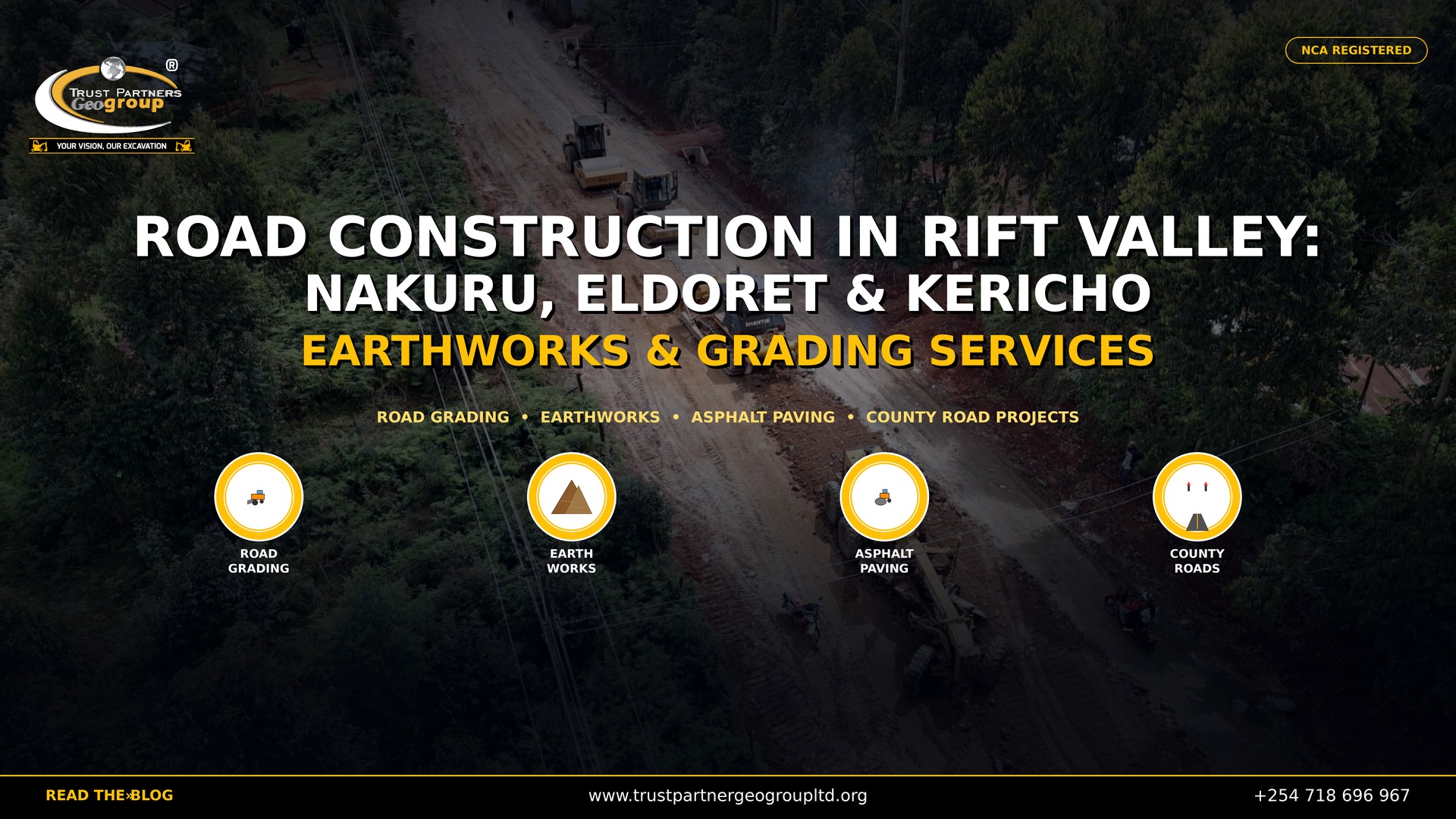
Road Construction in Rift Valley: Nakuru, Eldoret & Kericho Earthworks & Grading Services [2026]
Highland road earthworks and motor grader grading for Nakuru, Eldoret, Kericho and Naivasha county projects with heavy equipment for hire across Kenya's Rift Valley
Table of Contents
- 1. Why Rift Valley Road Construction Needs Specialised Earthworks
- 2. Rift Valley Geology and Terrain Challenges
- 3. Cut-to-Fill Earthworks for Highland Roads
- 4. Motor Grader Grading and Subgrade Preparation
- 5. Heavy Equipment for Hire in the Rift Valley
- 6. Escarpment and Hillside Road Construction
- 7. Drainage and Erosion Control in Highland Roads
- 8. Construction Costs and Programme [2026]
- 9. Frequently Asked Questions
- 10. Conclusion
At 2,400 metres above sea level on the Mau Escarpment, a motor grader cuts formation level through volcanic tuff while a bulldozer pushes excess material down-slope to build a fill bench on the downhill side. The air is thin, the diesel engines have lost 20% of their sea-level power, and the afternoon clouds are already building over the Kericho tea estates - tomorrow's rain will test every drain and cut slope on this 12-kilometre county road. This is road construction in Kenya's Rift Valley - where altitude, geology and climate conspire to make earthworks more demanding than anywhere else in the country. From Nakuru's lake basin volcanic ash to Eldoret's Uasin Gishu red clay loam, from Kericho's 2,000mm annual rainfall to Naivasha's flash-flood riverbeds, the Rift Valley presents a geological laboratory that punishes contractors who apply lowland methods to highland terrain. For county governments in Nakuru, Uasin Gishu, Kericho, Bomet and Nandi, and for contractors bidding Rift Valley road projects, the message is clear: heavy equipment for hire must be altitude-capable, operators must understand volcanic soils, and earthworks design must respect the escarpment's hydrological violence. Trust Partners Geo-Group Ltd provides excavation in Kenya's Rift Valley with a fleet and expertise calibrated for highland road construction - GPS-guided graders, de-rated bulldozers, volcanic tuff breakers and drainage systems that survive Mau rains. This guide explains Rift Valley road earthworks from geology to cost, with 2026 rates for Nakuru, Eldoret, Kericho and beyond.
Trust Partners Geo-Group Ltd - Rift Valley Operations Team
NCA-registered excavation and road construction contractor with 15+ years of highland earthworks experience across Nakuru, Eldoret, Kericho, Naivasha and the Rift Valley escarpment.
1. Why Rift Valley Road Construction Needs Specialised Earthworks
The Rift Valley is Kenya's agricultural and logistical backbone. The Northern Corridor passes through Naivasha and Nakuru. Eldoret is the gateway to Uganda and South Sudan. Kericho feeds the world's tea market. And every kilogram of tea, every truck of fertiliser, every bus of passengers moves on roads that must survive altitudes, gradients and rainfall that lowland contractors underestimate.
The region's road construction sector is accelerating. County governments are upgrading rural access roads under CIDP programmes. National projects like the Nairobi-Nakuru-Mau Summit highway expansion demand massive earthworks. And the Lake Basin region's agricultural processing boom requires all-weather farm-to-market roads that do not dissolve in the first rainy season.
But Rift Valley road construction is not merely Nairobi earthworks at higher altitude. The challenges are distinct:
- Altitude power loss: At 2,000-2,700 metres, naturally aspirated diesel engines lose 15-25% power, reducing grader and bulldozer productivity unless turbocharged machines are specified;
- Volcanic geology variability: A single 10-km road alignment can cross volcanic tuff, red clay loam, black cotton pockets and peat wetlands - each requiring different excavation and compaction methods;
- Escarpment instability: Cut slopes in weathered volcanic material fail during rains unless properly benched, drained and vegetated;
- Extreme rainfall: Kericho and the Mau receive 2,000mm+ annually; Naivasha's dry riverbeds become torrents within minutes;
- Thermal stress: Diurnal temperature swings of 20-25°C at high altitude cause pavement cracking if subgrades are not uniformly compacted.
For excavation in Kenya's highlands, the contractor who treats Rift Valley roads like coastal or lowland projects will face cost overruns, programme delays and subgrade failures. The contractor who respects the altitude, geology and climate will deliver roads that last.
2. Rift Valley Geology and Terrain Challenges
Understanding Rift Valley geology is the foundation of correct earthworks methodology. The region sits on the floor and walls of the Great Rift Valley, a massive trench system formed by tectonic divergence. The result is a geological mosaic that changes every few kilometres.
Volcanic Tuff and Ash (Nakuru, Naivasha, Gilgil)
The valley floor and lower escarpments are blanketed in volcanic tuff, ash and agglomerate from Pleistocene eruptions of Mount Longonot, Eburru and other centres. These soils are generally excellent for road construction: free-draining, high CBR (15-30%), and stable when compacted. However, they are highly erodible. Unprotected cut slopes in volcanic ash can lose 50-100mm of surface material in a single storm. Piping erosion - where water flows through subsurface voids in the porous tuff - can undermine road subgrades from below. For basement excavation and road earthworks in Nakuru, dewatering is rarely needed because the material drains freely, but erosion control is mandatory.
Red Clay Loam (Eldoret, Kitale, Uasin Gishu Plateau)
The Uasin Gishu plateau surrounding Eldoret is underlain by deep red clay loam derived from volcanic parent material. This soil is the agricultural powerhouse of Kenya - and a capable road subgrade when properly compacted. Its challenges are moisture sensitivity: when dry, it is hard and excavates like soft rock; when wet, it becomes plastic and unworkable. Compaction must occur at precise moisture content (typically 2-3% below OMC). In the wet season, earthworks stop because the material cannot be compacted to specification.
Black Cotton Soil (Kericho Lowlands, Nakuru North)
Pockets of black cotton soil occur in low-lying areas and former lake beds. This expansive clay is the enemy of pavement: it swells when wet, exerting upward pressure that cracks roads, and shrinks when dry, creating voids. For Rift Valley road construction, black cotton must be removed to 1.0-1.5m depth and replaced with granular fill - a costly but non-negotiable step.
Peat and Organic Soils (Lake Naivasha Fringes, Kericho Wetlands)
Wetland areas around Lake Naivasha and in the Kericho tea zone contain peat and organic soils with near-zero bearing capacity. Roads built directly on peat settle metres within months. The only solution is complete removal and replacement with rock fill - typically 1.5-2.5m of imported granular material.
Escarpment Rock (Mau Summit, Kericho Hills)
The Rift Valley walls expose harder volcanic material - agglomerate, basalt and trachyte. Road cuts through these formations require ripping with bulldozer scarifiers or hydraulic breaking. Unlike Nairobi's quartzite, Rift Valley volcanic rock is generally fractured and weathered, making it rippable in most locations rather than requiring blasting.
3. Cut-to-Fill Earthworks for Highland Roads
Rift Valley road alignments rarely achieve natural cut-to-fill balance. The terrain is too varied. On escarpment roads, the uphill side generates massive cut volumes while the downhill side consumes fill. On plateau roads, drainage crossings and vertical curve requirements create localised imbalances.
Volume Calculation and Optimisation
Accurate earthworks volumes require topographic survey at 20-metre chainages with cross-sections every 50-100 metres. Software such as Civil 3D or Bentley calculates cut and fill volumes by comparing existing ground to design profile. For Rift Valley roads, the key optimisation is minimising haul distance: excess cut from uphill sections is sidecast or bench-filled on the downhill side; shortfalls are filled from nearby borrow pits rather than hauled long distances; and vertical alignment is adjusted (within design constraints) to reduce total earthworks volume by 10-20%.
Escarpment Bench Filling
On steep slopes, fill cannot simply be dumped - it would slide to the valley floor. Instead, fills are constructed in benches: the slope is cut into 2-3 metre high terraces; fill is placed and compacted on each bench; and retaining structures (gabions, reinforced earth, or masonry walls) support the fill face. On a recent 6-km escarpment road in Kericho, Trust Partners Geo-Group Ltd constructed 12,000 m3 of bench fill supported by 800 m2 of gabion retaining wall, creating a stable road prism on a 35-degree slope.
Borrow Pit Management
When cut volumes are insufficient, material is sourced from approved borrow pits. In the Rift Valley, suitable borrow material is often volcanic ash or weathered tuff. Borrow pits must be: located within 5 km of the road to control haul costs; approved by NEMA and the county environmental officer; and rehabilitated after use (graded, drained and revegetated). Haul distances greater than 5 km make borrow material more expensive than the earthworks itself - in such cases, adjusting the vertical alignment to increase cut depth is often more economical.
| Terrain Type | Cut Volume (m3/km) | Fill Volume (m3/km) | Balance Strategy |
|---|---|---|---|
| Flat plateau | 2,000 - 5,000 | 2,000 - 5,000 | Local balance, minimal haul |
| Rolling terrain | 5,000 - 12,000 | 5,000 - 12,000 | Short haul, borrow pits |
| Escarpment | 15,000 - 40,000 | 10,000 - 30,000 | Bench filling, retaining walls |
| Wetland crossing | 500 - 2,000 | 8,000 - 15,000 | Complete removal and replacement |
4. Motor Grader Grading and Subgrade Preparation
The motor grader is the signature machine of road construction. In the Rift Valley, where grades must shed water on flat plateau sections and maintain traction on steep escarpment curves, precision grading determines pavement life.
GPS-Guided Formation Grading
Modern motor graders equipped with GPS or laser-guided blade control achieve ±20mm accuracy in formation level cutting. For Rift Valley county roads, this precision ensures that: crossfalls are consistent (3-5% for murram roads, 2.5% for bitumen); vertical curves are smooth, preventing ponding and vehicle stress; and formation levels match design exactly, minimising subsequent pavement thickness variations. Trust Partners Geo-Group Ltd deploys GPS-equipped graders on all engineered Rift Valley road projects, with 3D design models loaded directly into the machine control system.
Subgrade Compaction Standards
Rift Valley subgrades must meet Kenya Road Design Manual specifications: 95% modified Proctor MDD for class A and B roads; 93% for class C and D rural roads; CBR minimum 8% for subgrade; and moisture content within -2% to +1% of OMC during compaction. Volcanic ash soils typically exceed these standards naturally. Black cotton and organic soils fail and must be removed. On a recent 15-km murram road in Eldoret, Trust Partners Geo-Group Ltd achieved 97% average compaction across 120 test points, with all CBR values exceeding 15% - eliminating the need for imported sub-base material and saving the county KES 3.8 million.
Moisture Conditioning
In the dry Uasin Gishu climate, subgrade material often dries below optimum moisture content, making compaction impossible. Water bowsers spray the formation ahead of the roller, bringing moisture to within specification. In Kericho's wet climate, the opposite problem occurs - material is too wet and must be allowed to dry or have moisture content reduced by mixing with drier borrow material. The contractor who ignores moisture conditioning achieves either fluffy uncompacted subgrades (too dry) or pumping mud (too wet).
5. Heavy Equipment for Hire in the Rift Valley
Rift Valley altitude and terrain demand specific heavy equipment for hire capabilities that lowland contractors may not provide.
Altitude-De-Rated Machines
At 2,000+ metres, naturally aspirated diesel engines lose significant power due to thin air. A 200hp grader at sea level produces only 160-170hp in Kericho. Turbocharged and intercooled engines mitigate this loss, maintaining 90-95% of rated power. Trust Partners Geo-Group Ltd's Rift Valley fleet is specified with turbocharged engines for all graders, bulldozers and rollers deployed above 2,000m.
Volcanic Tuff Breaking
While most Rift Valley rock is rippable, hard agglomerate and basalt lenses require hydraulic breakers. Excavators with 2,000-3,000 Joule breakers fracture hard layers before bulldozer loading. Breaker tool bits wear faster in abrasive volcanic rock than in sedimentary stone - moil points last 20-30 hours versus 40-50 hours in softer material.
Escarpment-Safe Operation
Equipment working on steep slopes requires: low-centre-of-gravity bulldozers with wide tracks for stability; graders with all-wheel drive and traction control; and excavators with tilt-compensated cabs for operator safety on benches. Trust Partners Geo-Group Ltd provides slope-capable machines with experienced operators for escarpment road projects.
Hire Rates for Rift Valley Deployment
Mobilisation from Nairobi to Nakuru (160 km) costs KES 40,000-80,000 per machine; to Eldoret (320 km) KES 80,000-150,000; to Kericho (270 km) KES 70,000-130,000. Long-term contracts (200+ hours) receive mobilisation waivers. Hourly rates are comparable to Nairobi: motor grader KES 7,500-10,500; bulldozer KES 9,000-13,000; excavator 20t KES 8,500-12,000; roller KES 4,500-6,500; and dump truck KES 5,500-8,000.
6. Escarpment and Hillside Road Construction
The most visually dramatic and technically demanding Rift Valley roads are those that climb the escarpment walls - the Nairobi-Nakuru highway, Mau Summit access roads, and Kericho's tea zone tracks.
Cut Slope Stability
Escarpment cuts in weathered volcanic tuff stand temporarily at 1:1 (45 degrees) but require permanent battering to 1:1.5 or flatter for long-term stability. Benches at 5-8 metre vertical intervals reduce erosion and provide access for maintenance. Drainage is critical: catchwater drains above the cut intercept surface water; weep holes in the cut face relieve pore pressure; and sprayed concrete or geocell facing protects highly erodible sections.
Fill Slope Support
Downhill fills on steep slopes require structural support. Options include: gabion retaining walls (wire mesh baskets filled with stone) for fills up to 6 metres high; reinforced earth walls with geogrid layers for fills up to 10 metres; and concrete cantilever walls for constrained urban areas like Naivasha escarpment developments. Without support, fills creep downslope during rains, cracking the road surface and eventually collapsing.
Hairpin Curve Earthworks
Escarpment roads use hairpin curves to manage gradient. Each curve requires extensive earthworks: the inside of the curve is cut deeply into the hillside; the outside is built up on fill or retaining wall; and drainage must capture water from the uphill cut and discharge it safely around the curve. Hairpin curves are programme-critical activities where equipment utilisation must be maximised - a single curve can consume 2-3 weeks of bulldozer and grader time.
7. Drainage and Erosion Control in Highland Roads
In the Rift Valley, drainage is not an afterthought - it is the primary determinant of road survival. A well-graded but poorly drained road will fail within one rainy season.
Side Drains and Mitre Drains
Side drains run parallel to the road, collecting surface water from the carriageway and adjacent land. In volcanic ash soils, drains must be 1.5-2.0 metres deep with 1:1 side slopes, and the invert must be stone-pitched or concrete-lined to prevent piping erosion. Mitre drains at 50-100 metre intervals discharge water away from the road prism into natural watercourses. On slopes steeper than 5%, mitre drains are spaced at 30-50 metres.
Culverts and Water Crossings
Every water crossing requires a culvert sized for the 50-year flood. In Rift Valley flash-flood zones (Naivasha, Gilgil), dry riverbeds that are mere sand channels in January become 3-metre deep torrents in April. Culverts must be: sized correctly (typically 600mm-1,200mm diameter for county roads); installed on compacted granular bedding; and protected with headwalls, wingwalls and scour aprons. Trust Partners Geo-Group Ltd excavates culvert trenches, installs pipes and constructs protection works as part of road earthworks packages.
Erosion Control on Exposed Slopes
During construction, exposed cut and fill slopes are vulnerable to erosion. Measures include: silt fences at drain outfalls; jute mesh or coir matting on steep cuts; temporary grass seeding on completed fills; and check dams in temporary drainage channels. On the Mau Escarpment, where rainfall intensity exceeds 50mm per hour, unprotected slopes can lose 200 tonnes of soil per hectare in a single storm.
8. Construction Costs and Programme [2026]
Rift Valley road construction costs reflect the terrain, altitude and material challenges.
| Item | Flat Plateau | Rolling Terrain | Escarpment |
|---|---|---|---|
| Earthworks (per m3) | KES 350-550 | KES 500-800 | KES 800-1,400 |
| Grading (per km) | KES 180K-280K | KES 280K-450K | KES 450K-750K |
| Compaction & testing | KES 120K-180K/km | KES 150K-220K/km | KES 200K-300K/km |
| Drainage (culverts + drains) | KES 300K-500K/km | KES 400K-700K/km | KES 600K-1.0M/km |
| Total earthworks (per km) | KES 1.5-2.5M | KES 2.5-4.0M | KES 4.5-7.5M |
| Construction rate (m/day) | 80-120 | 50-80 | 20-40 |
Programme durations for a 10-km class C murram road: flat plateau (Eldoret area) 3-4 months; rolling terrain (Nakuru north) 5-7 months; and escarpment (Kericho hills, Mau Summit) 8-14 months. Bitumen surfacing adds 2-4 months depending on weather windows.
9. Frequently Asked Questions: Road Construction in the Rift Valley
What makes road construction in the Rift Valley different from other parts of Kenya?
Road construction in Kenya's Rift Valley differs from coastal and lowland regions due to high altitude (1,500-2,700m), volcanic geology, steep escarpment terrain and extreme weather variations. The Rift Valley floor consists of deep volcanic soils and lacustrine deposits around Lake Naivasha and Elementaita, while the escarpments present steep cut slopes in volcanic tuff and agglomerate. Nakuru and Naivasha experience high diurnal temperature swings that cause pavement thermal stress, while Kericho and the tea highlands receive 2,000mm+ annual rainfall that tests drainage and erosion control. Eldoret's Uasin Gishu plateau has deep, well-drained red clay loam that is excellent for subgrade but requires careful moisture control during compaction. For excavation in Kenya's Rift Valley, contractors must select heavy equipment for hire that performs at altitude, manage cut-to-fill on steep gradients, and design drainage systems that handle both flash floods and freezing night temperatures.
What heavy equipment is needed for Rift Valley road earthworks?
Rift Valley road construction requires a versatile heavy equipment for hire fleet: motor graders with GPS blade control for precise formation grading on undulating terrain; bulldozers for bulk cut-to-fill on escarpment roads and plateau alignments; excavators for drainage structures, culvert installation and rock breaking in volcanic tuff; smooth drum and padfoot rollers for subgrade compaction to Kenya Road Design Manual standards; dump trucks for hauling fill material across long distances between cut and fill sections; and water bowsers for moisture conditioning in the dry Uasin Gishu climate. For high-altitude projects above 2,500m (Mau Escarpment, Kericho tea zones), equipment must be de-rated for altitude power loss - turbocharged engines lose 15-25% power at these elevations. Trust Partners Geo-Group Ltd provides altitude-capable heavy equipment for hire across Nakuru, Eldoret, Kericho and Naivasha with experienced operators who understand highland earthworks.
How much does road construction cost per kilometre in the Rift Valley?
Road construction costs per kilometre in the Rift Valley in 2026 vary by terrain, pavement type and earthworks volume. Indicative costs for a 6-metre wide class C rural road: flat plateau terrain (Eldoret, Uasin Gishu) KES 12-18 million per km with murram surface; rolling terrain (Nakuru north, Molo) KES 18-28 million per km with moderate cut-to-fill; escarpment terrain (Mau Summit, Kericho hills) KES 28-45 million per km with heavy earthworks and retaining structures; and bitumen standard pavement adds KES 25-40 million per km above earthworks costs. Earthworks specifically account for 25-40% of total road cost in escarpment areas versus 15-20% on flat terrain. A 10-km murram road in Kericho's hills can require 80,000-150,000 m3 of cut-to-fill, compared to 20,000-40,000 m3 on Eldoret's plateau. Trust Partners Geo-Group Ltd provides transparent earthworks pricing for Rift Valley county road tenders, with cut-to-fill volume calculations based on topographic survey.
What are the main soil types for road subgrade in Nakuru, Eldoret and Kericho?
The Rift Valley presents four dominant soil types for road construction: volcanic ash and tuff (Nakuru, Naivasha, Gilgil) - porous, well-graded and generally excellent for subgrade with CBR values of 15-30%, but prone to piping erosion if drainage is inadequate; red clay loam (Eldoret, Kitale, Uasin Gishu plateau) - high plasticity when wet, requiring moisture conditioning to 2-3% below optimum for compaction, but providing strong subgrade once compacted; black cotton soil (pockets in Nakuru north and Kericho lowlands) - expansive clay that must be removed or stabilised with lime before pavement construction; and peat and organic soils (Lake Naivasha fringes, Kericho wetlands) - entirely unsuitable for road foundations, requiring complete removal and replacement with imported granular fill. For excavation in Kenya's Rift Valley, pre-construction geotechnical investigation is essential because soil type can change every 2-3 kilometres along a road alignment. Trust Partners Geo-Group Ltd conducts test pitting and CBR testing as standard on all Rift Valley road projects.
How is cut-to-fill balanced on steep Rift Valley escarpment roads?
Escarpment road construction in the Rift Valley - such as the Nairobi-Nakuru highway, Mau Summit roads and Kericho escarpment access - generates extreme cut-to-fill imbalances. The uphill side requires deep cuts into volcanic tuff and agglomerate, while the downhill side needs high fills on steep slopes. Balancing earthworks requires: detailed topographic survey and digital terrain modelling to calculate cut and fill volumes by chainage; sidecasting excess cut material on the downhill side in engineered benches, not uncontrolled dumping; importing fill from approved borrow pits when cut volumes exceed fill requirements (common on escarpment roads); constructing retaining walls and reinforced earth structures to support high fills on steep slopes; and terracing cut slopes to reduce erosion and create stable batters. On a recent 8-km escarpment road in Mau Summit, Trust Partners Geo-Group Ltd achieved a 65% cut-to-fill balance by benching excess material on the downhill side, reducing imported fill costs by KES 4.2 million.
What drainage and erosion control measures are required for Rift Valley roads?
Rift Valley roads face intense hydrological challenges: high rainfall in Kericho (2,000mm/year) and the Mau, flash floods in Nakuru's dry riverbeds, and freeze-thaw cycles at high altitude that crack unprotected surfaces. Required drainage and erosion control measures include: side drains excavated at 1.5-2.0m depth with 1:1 side slopes, lined with stone pitching in erodible volcanic ash; culverts at all water crossings, sized for 50-year flood events - typically 600mm-1,200mm diameter pipes or box culverts; mitre drains at 50-100m spacing to discharge water away from the road prism; catchwater drains above cut slopes to prevent surface water from saturating the batter; and check dams and gabion structures in steep drainage channels to reduce flow velocity. In volcanic tuff areas, piping erosion can destroy a road subgrade within one rainy season if drains are not properly constructed and maintained. Trust Partners Geo-Group Ltd installs full drainage packages as part of Rift Valley road earthworks contracts.
Can I hire heavy equipment for road construction in Nakuru, Eldoret and Kericho?
Yes. Trust Partners Geo-Group Ltd provides heavy equipment for hire across the entire Rift Valley region for road construction, earthworks and grading. Our highland fleet includes: motor graders (150-220hp) with GPS blade control for precision formation cutting; bulldozers (18-35t) for escarpment cut-to-fill and bulk earthmoving; excavators (20-30t) with breaker attachments for volcanic tuff and rock breaking; smooth drum rollers (10-12t) and padfoot rollers (12-15t) for subgrade compaction; dump trucks (20-30t) for material haulage; and water bowsers (16,000L) for moisture conditioning in dry areas. We mobilise from Nairobi to Nakuru (160 km), Eldoret (320 km) and Kericho (270 km) with managed transport logistics. For long-term county road contracts exceeding 200 machine hours, we waive mobilisation fees. All equipment is operated by NCA-certified drivers with Rift Valley road construction experience. Contact us at +254 718 68 69 67 for heavy equipment for hire in any Rift Valley county.
What compaction and CBR standards apply to Rift Valley road subgrades?
Rift Valley road subgrades must comply with the Kenya Road Design Manual and Kenya Standard KS 02-694. Key requirements are: subgrade compaction to 95% of modified Proctor maximum dry density (MDD) for class A and B roads, and 93% for class C and D rural roads; California Bearing Ratio (CBR) minimum 8% for subgrade, 20% for sub-base, and 30% for base course; in-situ moisture content within -2% to +1% of optimum moisture content (OMC) during compaction; and CBR testing at 2,500m3 intervals or every 500 metres of road alignment, whichever is more frequent. In the Rift Valley, volcanic ash soils often exceed these standards naturally (CBR 15-30%), but black cotton pockets and organic wetland soils fail catastrophically (CBR 2-5%) and must be removed. Trust Partners Geo-Group Ltd provides on-site CBR testing, density testing and compaction control as part of our Rift Valley road earthworks service, ensuring county engineers certify subgrades without rejection or rework.
10. Conclusion: Building Roads That Survive the Rift
The Rift Valley does not forgive shortcuts. A road built without understanding volcanic tuff erosion will vanish in the first Mau rains. A subgrade compacted without moisture control will pump and rut under Eldoret's heavy agricultural trucks. A cut slope left unbenched will bury a Kericho road in a landslide. For excavation in Kenya's highlands, the difference between a road that lasts five years and one that lasts twenty is not the pavement - it is the earthworks beneath it.
For county governments and contractors in Nakuru, Eldoret, Kericho and across the Rift Valley, the investment in correct earthworks pays dividends for decades. Proper cut-to-fill balance reduces material costs. GPS-guided grading ensures pavement uniformity. Drainage designed for 2,000mm rainfall prevents the erosion that destroys roads from below. And altitude-capable heavy equipment for hire maintains productivity where standard machines falter.
Trust Partners Geo-Group Ltd brings Rift Valley road construction expertise to every project we touch. We understand that Nakuru's volcanic ash requires different grading techniques than Eldoret's red clay. We know that Kericho's rainfall demands more aggressive drainage than lowland specifications. We provide turbocharged, altitude-capable machines and operators who have built roads at 2,500 metres. And we deliver earthworks and grading services that meet county engineer standards without rework, delay or cost overrun.
Whether your project is a 40-kilometre county road across the Uasin Gishu plateau, an escarpment access track in the Mau, or a farm-to-market road through Kericho's tea zone, our heavy equipment for hire and road earthworks expertise ensure that your road survives the Rift.
Rift Valley Road Earthworks & Grading
Heavy equipment for hire, motor grader grading and road construction earthworks across Nakuru, Eldoret, Kericho, Naivasha and the Rift Valley.
Free lead magnet: ask for our Rift Valley Road Earthworks Cost Estimator (PDF) - cut-to-fill volume tables, terrain-specific hire rates, drainage cost guides and seasonal scheduling for Nakuru, Eldoret and Kericho county projects.
Related Resources
Heavy Equipment Hire in Kisumu & Western Kenya: Excavators, Graders & Rollers for County Projects
The previous regional blog - equipment hire and earthworks for Western Kenya county road projects.
READ MORERoad Construction in Kenya: Earthwork and Base Preparation for Road Projects
Nationwide methodology for road earthworks and subgrade preparation applicable to Rift Valley terrain.
READ MORERoad Construction Cost Per Kilometer in Kenya [2026 Estimate]
Detailed cost breakdowns for rural and highway road construction across Kenyan terrain types.
READ MORERoad Sub-Grade Preparation in Kenya: CBR Testing, Compaction and Quality Control [2026]
Technical standards for subgrade compaction and CBR testing on Rift Valley road projects.
READ MOREMotor Grader Hire Kenya: Road Leveling, Grading and Surface Preparation Guide
Grader selection and GPS-guided grading techniques for precision road formation.
READ MOREDrainage Solutions for Road Construction in Kenya
High-rainfall drainage design applicable to Kericho, Mau and Rift Valley escarpment roads.
READ MORETRUST PARTNERS GEO-GROUP LTD | YOUR VISION, OUR EXCAVATION
WEBSITE: WWW.TRUSTPARTNERGEOGROUPLTD.ORG | EMAIL: INFO@TRUSTPARTNERGEOGROUPLTD.ORG | PHONE: +254 718 68 69 67
FOLLOW US: FACEBOOK | TIKTOK | INSTAGRAM | LINKEDIN
© 2026 TRUST PARTNERS GEO-GROUP LTD. ALL RIGHTS RESERVED.
Road Construction in Rift Valley: Nakuru, Eldoret & Kericho Earthworks & Grading Services [2026]
Highland road earthworks and motor grader grading for Nakuru, Eldoret, Kericho and Naivasha county projects with heavy equipment for hire across Kenya's Rift Valley
Table of Contents
- 1. Why Rift Valley Road Construction Needs Specialised Earthworks
- 2. Rift Valley Geology and Terrain Challenges
- 3. Cut-to-Fill Earthworks for Highland Roads
- 4. Motor Grader Grading and Subgrade Preparation
- 5. Heavy Equipment for Hire in the Rift Valley
- 6. Escarpment and Hillside Road Construction
- 7. Drainage and Erosion Control in Highland Roads
- 8. Construction Costs and Programme [2026]
- 9. Frequently Asked Questions
- 10. Conclusion
At 2,400 metres above sea level on the Mau Escarpment, a motor grader cuts formation level through volcanic tuff while a bulldozer pushes excess material down-slope to build a fill bench on the downhill side. The air is thin, the diesel engines have lost 20% of their sea-level power, and the afternoon clouds are already building over the Kericho tea estates - tomorrow's rain will test every drain and cut slope on this 12-kilometre county road. This is road construction in Kenya's Rift Valley - where altitude, geology and climate conspire to make earthworks more demanding than anywhere else in the country. From Nakuru's lake basin volcanic ash to Eldoret's Uasin Gishu red clay loam, from Kericho's 2,000mm annual rainfall to Naivasha's flash-flood riverbeds, the Rift Valley presents a geological laboratory that punishes contractors who apply lowland methods to highland terrain. For county governments in Nakuru, Uasin Gishu, Kericho, Bomet and Nandi, and for contractors bidding Rift Valley road projects, the message is clear: heavy equipment for hire must be altitude-capable, operators must understand volcanic soils, and earthworks design must respect the escarpment's hydrological violence. Trust Partners Geo-Group Ltd provides excavation in Kenya's Rift Valley with a fleet and expertise calibrated for highland road construction - GPS-guided graders, de-rated bulldozers, volcanic tuff breakers and drainage systems that survive Mau rains. This guide explains Rift Valley road earthworks from geology to cost, with 2026 rates for Nakuru, Eldoret, Kericho and beyond.
Trust Partners Geo-Group Ltd - Rift Valley Operations Team
NCA-registered excavation and road construction contractor with 15+ years of highland earthworks experience across Nakuru, Eldoret, Kericho, Naivasha and the Rift Valley escarpment.
1. Why Rift Valley Road Construction Needs Specialised Earthworks
The Rift Valley is Kenya's agricultural and logistical backbone. The Northern Corridor passes through Naivasha and Nakuru. Eldoret is the gateway to Uganda and South Sudan. Kericho feeds the world's tea market. And every kilogram of tea, every truck of fertiliser, every bus of passengers moves on roads that must survive altitudes, gradients and rainfall that lowland contractors underestimate.
The region's road construction sector is accelerating. County governments are upgrading rural access roads under CIDP programmes. National projects like the Nairobi-Nakuru-Mau Summit highway expansion demand massive earthworks. And the Lake Basin region's agricultural processing boom requires all-weather farm-to-market roads that do not dissolve in the first rainy season.
But Rift Valley road construction is not merely Nairobi earthworks at higher altitude. The challenges are distinct:
- Altitude power loss: At 2,000-2,700 metres, naturally aspirated diesel engines lose 15-25% power, reducing grader and bulldozer productivity unless turbocharged machines are specified;
- Volcanic geology variability: A single 10-km road alignment can cross volcanic tuff, red clay loam, black cotton pockets and peat wetlands - each requiring different excavation and compaction methods;
- Escarpment instability: Cut slopes in weathered volcanic material fail during rains unless properly benched, drained and vegetated;
- Extreme rainfall: Kericho and the Mau receive 2,000mm+ annually; Naivasha's dry riverbeds become torrents within minutes;
- Thermal stress: Diurnal temperature swings of 20-25°C at high altitude cause pavement cracking if subgrades are not uniformly compacted.
For excavation in Kenya's highlands, the contractor who treats Rift Valley roads like coastal or lowland projects will face cost overruns, programme delays and subgrade failures. The contractor who respects the altitude, geology and climate will deliver roads that last.
2. Rift Valley Geology and Terrain Challenges
Understanding Rift Valley geology is the foundation of correct earthworks methodology. The region sits on the floor and walls of the Great Rift Valley, a massive trench system formed by tectonic divergence. The result is a geological mosaic that changes every few kilometres.
Volcanic Tuff and Ash (Nakuru, Naivasha, Gilgil)
The valley floor and lower escarpments are blanketed in volcanic tuff, ash and agglomerate from Pleistocene eruptions of Mount Longonot, Eburru and other centres. These soils are generally excellent for road construction: free-draining, high CBR (15-30%), and stable when compacted. However, they are highly erodible. Unprotected cut slopes in volcanic ash can lose 50-100mm of surface material in a single storm. Piping erosion - where water flows through subsurface voids in the porous tuff - can undermine road subgrades from below. For basement excavation and road earthworks in Nakuru, dewatering is rarely needed because the material drains freely, but erosion control is mandatory.
Red Clay Loam (Eldoret, Kitale, Uasin Gishu Plateau)
The Uasin Gishu plateau surrounding Eldoret is underlain by deep red clay loam derived from volcanic parent material. This soil is the agricultural powerhouse of Kenya - and a capable road subgrade when properly compacted. Its challenges are moisture sensitivity: when dry, it is hard and excavates like soft rock; when wet, it becomes plastic and unworkable. Compaction must occur at precise moisture content (typically 2-3% below OMC). In the wet season, earthworks stop because the material cannot be compacted to specification.
Black Cotton Soil (Kericho Lowlands, Nakuru North)
Pockets of black cotton soil occur in low-lying areas and former lake beds. This expansive clay is the enemy of pavement: it swells when wet, exerting upward pressure that cracks roads, and shrinks when dry, creating voids. For Rift Valley road construction, black cotton must be removed to 1.0-1.5m depth and replaced with granular fill - a costly but non-negotiable step.
Peat and Organic Soils (Lake Naivasha Fringes, Kericho Wetlands)
Wetland areas around Lake Naivasha and in the Kericho tea zone contain peat and organic soils with near-zero bearing capacity. Roads built directly on peat settle metres within months. The only solution is complete removal and replacement with rock fill - typically 1.5-2.5m of imported granular material.
Escarpment Rock (Mau Summit, Kericho Hills)
The Rift Valley walls expose harder volcanic material - agglomerate, basalt and trachyte. Road cuts through these formations require ripping with bulldozer scarifiers or hydraulic breaking. Unlike Nairobi's quartzite, Rift Valley volcanic rock is generally fractured and weathered, making it rippable in most locations rather than requiring blasting.
3. Cut-to-Fill Earthworks for Highland Roads
Rift Valley road alignments rarely achieve natural cut-to-fill balance. The terrain is too varied. On escarpment roads, the uphill side generates massive cut volumes while the downhill side consumes fill. On plateau roads, drainage crossings and vertical curve requirements create localised imbalances.
Volume Calculation and Optimisation
Accurate earthworks volumes require topographic survey at 20-metre chainages with cross-sections every 50-100 metres. Software such as Civil 3D or Bentley calculates cut and fill volumes by comparing existing ground to design profile. For Rift Valley roads, the key optimisation is minimising haul distance: excess cut from uphill sections is sidecast or bench-filled on the downhill side; shortfalls are filled from nearby borrow pits rather than hauled long distances; and vertical alignment is adjusted (within design constraints) to reduce total earthworks volume by 10-20%.
Escarpment Bench Filling
On steep slopes, fill cannot simply be dumped - it would slide to the valley floor. Instead, fills are constructed in benches: the slope is cut into 2-3 metre high terraces; fill is placed and compacted on each bench; and retaining structures (gabions, reinforced earth, or masonry walls) support the fill face. On a recent 6-km escarpment road in Kericho, Trust Partners Geo-Group Ltd constructed 12,000 m3 of bench fill supported by 800 m2 of gabion retaining wall, creating a stable road prism on a 35-degree slope.
Borrow Pit Management
When cut volumes are insufficient, material is sourced from approved borrow pits. In the Rift Valley, suitable borrow material is often volcanic ash or weathered tuff. Borrow pits must be: located within 5 km of the road to control haul costs; approved by NEMA and the county environmental officer; and rehabilitated after use (graded, drained and revegetated). Haul distances greater than 5 km make borrow material more expensive than the earthworks itself - in such cases, adjusting the vertical alignment to increase cut depth is often more economical.
| Terrain Type | Cut Volume (m3/km) | Fill Volume (m3/km) | Balance Strategy |
|---|---|---|---|
| Flat plateau | 2,000 - 5,000 | 2,000 - 5,000 | Local balance, minimal haul |
| Rolling terrain | 5,000 - 12,000 | 5,000 - 12,000 | Short haul, borrow pits |
| Escarpment | 15,000 - 40,000 | 10,000 - 30,000 | Bench filling, retaining walls |
| Wetland crossing | 500 - 2,000 | 8,000 - 15,000 | Complete removal and replacement |
4. Motor Grader Grading and Subgrade Preparation
The motor grader is the signature machine of road construction. In the Rift Valley, where grades must shed water on flat plateau sections and maintain traction on steep escarpment curves, precision grading determines pavement life.
GPS-Guided Formation Grading
Modern motor graders equipped with GPS or laser-guided blade control achieve ±20mm accuracy in formation level cutting. For Rift Valley county roads, this precision ensures that: crossfalls are consistent (3-5% for murram roads, 2.5% for bitumen); vertical curves are smooth, preventing ponding and vehicle stress; and formation levels match design exactly, minimising subsequent pavement thickness variations. Trust Partners Geo-Group Ltd deploys GPS-equipped graders on all engineered Rift Valley road projects, with 3D design models loaded directly into the machine control system.
Subgrade Compaction Standards
Rift Valley subgrades must meet Kenya Road Design Manual specifications: 95% modified Proctor MDD for class A and B roads; 93% for class C and D rural roads; CBR minimum 8% for subgrade; and moisture content within -2% to +1% of OMC during compaction. Volcanic ash soils typically exceed these standards naturally. Black cotton and organic soils fail and must be removed. On a recent 15-km murram road in Eldoret, Trust Partners Geo-Group Ltd achieved 97% average compaction across 120 test points, with all CBR values exceeding 15% - eliminating the need for imported sub-base material and saving the county KES 3.8 million.
Moisture Conditioning
In the dry Uasin Gishu climate, subgrade material often dries below optimum moisture content, making compaction impossible. Water bowsers spray the formation ahead of the roller, bringing moisture to within specification. In Kericho's wet climate, the opposite problem occurs - material is too wet and must be allowed to dry or have moisture content reduced by mixing with drier borrow material. The contractor who ignores moisture conditioning achieves either fluffy uncompacted subgrades (too dry) or pumping mud (too wet).
5. Heavy Equipment for Hire in the Rift Valley
Rift Valley altitude and terrain demand specific heavy equipment for hire capabilities that lowland contractors may not provide.
Altitude-De-Rated Machines
At 2,000+ metres, naturally aspirated diesel engines lose significant power due to thin air. A 200hp grader at sea level produces only 160-170hp in Kericho. Turbocharged and intercooled engines mitigate this loss, maintaining 90-95% of rated power. Trust Partners Geo-Group Ltd's Rift Valley fleet is specified with turbocharged engines for all graders, bulldozers and rollers deployed above 2,000m.
Volcanic Tuff Breaking
While most Rift Valley rock is rippable, hard agglomerate and basalt lenses require hydraulic breakers. Excavators with 2,000-3,000 Joule breakers fracture hard layers before bulldozer loading. Breaker tool bits wear faster in abrasive volcanic rock than in sedimentary stone - moil points last 20-30 hours versus 40-50 hours in softer material.
Escarpment-Safe Operation
Equipment working on steep slopes requires: low-centre-of-gravity bulldozers with wide tracks for stability; graders with all-wheel drive and traction control; and excavators with tilt-compensated cabs for operator safety on benches. Trust Partners Geo-Group Ltd provides slope-capable machines with experienced operators for escarpment road projects.
Hire Rates for Rift Valley Deployment
Mobilisation from Nairobi to Nakuru (160 km) costs KES 40,000-80,000 per machine; to Eldoret (320 km) KES 80,000-150,000; to Kericho (270 km) KES 70,000-130,000. Long-term contracts (200+ hours) receive mobilisation waivers. Hourly rates are comparable to Nairobi: motor grader KES 7,500-10,500; bulldozer KES 9,000-13,000; excavator 20t KES 8,500-12,000; roller KES 4,500-6,500; and dump truck KES 5,500-8,000.
6. Escarpment and Hillside Road Construction
The most visually dramatic and technically demanding Rift Valley roads are those that climb the escarpment walls - the Nairobi-Nakuru highway, Mau Summit access roads, and Kericho's tea zone tracks.
Cut Slope Stability
Escarpment cuts in weathered volcanic tuff stand temporarily at 1:1 (45 degrees) but require permanent battering to 1:1.5 or flatter for long-term stability. Benches at 5-8 metre vertical intervals reduce erosion and provide access for maintenance. Drainage is critical: catchwater drains above the cut intercept surface water; weep holes in the cut face relieve pore pressure; and sprayed concrete or geocell facing protects highly erodible sections.
Fill Slope Support
Downhill fills on steep slopes require structural support. Options include: gabion retaining walls (wire mesh baskets filled with stone) for fills up to 6 metres high; reinforced earth walls with geogrid layers for fills up to 10 metres; and concrete cantilever walls for constrained urban areas like Naivasha escarpment developments. Without support, fills creep downslope during rains, cracking the road surface and eventually collapsing.
Hairpin Curve Earthworks
Escarpment roads use hairpin curves to manage gradient. Each curve requires extensive earthworks: the inside of the curve is cut deeply into the hillside; the outside is built up on fill or retaining wall; and drainage must capture water from the uphill cut and discharge it safely around the curve. Hairpin curves are programme-critical activities where equipment utilisation must be maximised - a single curve can consume 2-3 weeks of bulldozer and grader time.
7. Drainage and Erosion Control in Highland Roads
In the Rift Valley, drainage is not an afterthought - it is the primary determinant of road survival. A well-graded but poorly drained road will fail within one rainy season.
Side Drains and Mitre Drains
Side drains run parallel to the road, collecting surface water from the carriageway and adjacent land. In volcanic ash soils, drains must be 1.5-2.0 metres deep with 1:1 side slopes, and the invert must be stone-pitched or concrete-lined to prevent piping erosion. Mitre drains at 50-100 metre intervals discharge water away from the road prism into natural watercourses. On slopes steeper than 5%, mitre drains are spaced at 30-50 metres.
Culverts and Water Crossings
Every water crossing requires a culvert sized for the 50-year flood. In Rift Valley flash-flood zones (Naivasha, Gilgil), dry riverbeds that are mere sand channels in January become 3-metre deep torrents in April. Culverts must be: sized correctly (typically 600mm-1,200mm diameter for county roads); installed on compacted granular bedding; and protected with headwalls, wingwalls and scour aprons. Trust Partners Geo-Group Ltd excavates culvert trenches, installs pipes and constructs protection works as part of road earthworks packages.
Erosion Control on Exposed Slopes
During construction, exposed cut and fill slopes are vulnerable to erosion. Measures include: silt fences at drain outfalls; jute mesh or coir matting on steep cuts; temporary grass seeding on completed fills; and check dams in temporary drainage channels. On the Mau Escarpment, where rainfall intensity exceeds 50mm per hour, unprotected slopes can lose 200 tonnes of soil per hectare in a single storm.
8. Construction Costs and Programme [2026]
Rift Valley road construction costs reflect the terrain, altitude and material challenges.
| Item | Flat Plateau | Rolling Terrain | Escarpment |
|---|---|---|---|
| Earthworks (per m3) | KES 350-550 | KES 500-800 | KES 800-1,400 |
| Grading (per km) | KES 180K-280K | KES 280K-450K | KES 450K-750K |
| Compaction & testing | KES 120K-180K/km | KES 150K-220K/km | KES 200K-300K/km |
| Drainage (culverts + drains) | KES 300K-500K/km | KES 400K-700K/km | KES 600K-1.0M/km |
| Total earthworks (per km) | KES 1.5-2.5M | KES 2.5-4.0M | KES 4.5-7.5M |
| Construction rate (m/day) | 80-120 | 50-80 | 20-40 |
Programme durations for a 10-km class C murram road: flat plateau (Eldoret area) 3-4 months; rolling terrain (Nakuru north) 5-7 months; and escarpment (Kericho hills, Mau Summit) 8-14 months. Bitumen surfacing adds 2-4 months depending on weather windows.
9. Frequently Asked Questions: Road Construction in the Rift Valley
What makes road construction in the Rift Valley different from other parts of Kenya?
Road construction in Kenya's Rift Valley differs from coastal and lowland regions due to high altitude (1,500-2,700m), volcanic geology, steep escarpment terrain and extreme weather variations. The Rift Valley floor consists of deep volcanic soils and lacustrine deposits around Lake Naivasha and Elementaita, while the escarpments present steep cut slopes in volcanic tuff and agglomerate. Nakuru and Naivasha experience high diurnal temperature swings that cause pavement thermal stress, while Kericho and the tea highlands receive 2,000mm+ annual rainfall that tests drainage and erosion control. Eldoret's Uasin Gishu plateau has deep, well-drained red clay loam that is excellent for subgrade but requires careful moisture control during compaction. For excavation in Kenya's Rift Valley, contractors must select heavy equipment for hire that performs at altitude, manage cut-to-fill on steep gradients, and design drainage systems that handle both flash floods and freezing night temperatures.
What heavy equipment is needed for Rift Valley road earthworks?
Rift Valley road construction requires a versatile heavy equipment for hire fleet: motor graders with GPS blade control for precise formation grading on undulating terrain; bulldozers for bulk cut-to-fill on escarpment roads and plateau alignments; excavators for drainage structures, culvert installation and rock breaking in volcanic tuff; smooth drum and padfoot rollers for subgrade compaction to Kenya Road Design Manual standards; dump trucks for hauling fill material across long distances between cut and fill sections; and water bowsers for moisture conditioning in the dry Uasin Gishu climate. For high-altitude projects above 2,500m (Mau Escarpment, Kericho tea zones), equipment must be de-rated for altitude power loss - turbocharged engines lose 15-25% power at these elevations. Trust Partners Geo-Group Ltd provides altitude-capable heavy equipment for hire across Nakuru, Eldoret, Kericho and Naivasha with experienced operators who understand highland earthworks.
How much does road construction cost per kilometre in the Rift Valley?
Road construction costs per kilometre in the Rift Valley in 2026 vary by terrain, pavement type and earthworks volume. Indicative costs for a 6-metre wide class C rural road: flat plateau terrain (Eldoret, Uasin Gishu) KES 12-18 million per km with murram surface; rolling terrain (Nakuru north, Molo) KES 18-28 million per km with moderate cut-to-fill; escarpment terrain (Mau Summit, Kericho hills) KES 28-45 million per km with heavy earthworks and retaining structures; and bitumen standard pavement adds KES 25-40 million per km above earthworks costs. Earthworks specifically account for 25-40% of total road cost in escarpment areas versus 15-20% on flat terrain. A 10-km murram road in Kericho's hills can require 80,000-150,000 m3 of cut-to-fill, compared to 20,000-40,000 m3 on Eldoret's plateau. Trust Partners Geo-Group Ltd provides transparent earthworks pricing for Rift Valley county road tenders, with cut-to-fill volume calculations based on topographic survey.
What are the main soil types for road subgrade in Nakuru, Eldoret and Kericho?
The Rift Valley presents four dominant soil types for road construction: volcanic ash and tuff (Nakuru, Naivasha, Gilgil) - porous, well-graded and generally excellent for subgrade with CBR values of 15-30%, but prone to piping erosion if drainage is inadequate; red clay loam (Eldoret, Kitale, Uasin Gishu plateau) - high plasticity when wet, requiring moisture conditioning to 2-3% below optimum for compaction, but providing strong subgrade once compacted; black cotton soil (pockets in Nakuru north and Kericho lowlands) - expansive clay that must be removed or stabilised with lime before pavement construction; and peat and organic soils (Lake Naivasha fringes, Kericho wetlands) - entirely unsuitable for road foundations, requiring complete removal and replacement with imported granular fill. For excavation in Kenya's Rift Valley, pre-construction geotechnical investigation is essential because soil type can change every 2-3 kilometres along a road alignment. Trust Partners Geo-Group Ltd conducts test pitting and CBR testing as standard on all Rift Valley road projects.
How is cut-to-fill balanced on steep Rift Valley escarpment roads?
Escarpment road construction in the Rift Valley - such as the Nairobi-Nakuru highway, Mau Summit roads and Kericho escarpment access - generates extreme cut-to-fill imbalances. The uphill side requires deep cuts into volcanic tuff and agglomerate, while the downhill side needs high fills on steep slopes. Balancing earthworks requires: detailed topographic survey and digital terrain modelling to calculate cut and fill volumes by chainage; sidecasting excess cut material on the downhill side in engineered benches, not uncontrolled dumping; importing fill from approved borrow pits when cut volumes exceed fill requirements (common on escarpment roads); constructing retaining walls and reinforced earth structures to support high fills on steep slopes; and terracing cut slopes to reduce erosion and create stable batters. On a recent 8-km escarpment road in Mau Summit, Trust Partners Geo-Group Ltd achieved a 65% cut-to-fill balance by benching excess material on the downhill side, reducing imported fill costs by KES 4.2 million.
What drainage and erosion control measures are required for Rift Valley roads?
Rift Valley roads face intense hydrological challenges: high rainfall in Kericho (2,000mm/year) and the Mau, flash floods in Nakuru's dry riverbeds, and freeze-thaw cycles at high altitude that crack unprotected surfaces. Required drainage and erosion control measures include: side drains excavated at 1.5-2.0m depth with 1:1 side slopes, lined with stone pitching in erodible volcanic ash; culverts at all water crossings, sized for 50-year flood events - typically 600mm-1,200mm diameter pipes or box culverts; mitre drains at 50-100m spacing to discharge water away from the road prism; catchwater drains above cut slopes to prevent surface water from saturating the batter; and check dams and gabion structures in steep drainage channels to reduce flow velocity. In volcanic tuff areas, piping erosion can destroy a road subgrade within one rainy season if drains are not properly constructed and maintained. Trust Partners Geo-Group Ltd installs full drainage packages as part of Rift Valley road earthworks contracts.
Can I hire heavy equipment for road construction in Nakuru, Eldoret and Kericho?
Yes. Trust Partners Geo-Group Ltd provides heavy equipment for hire across the entire Rift Valley region for road construction, earthworks and grading. Our highland fleet includes: motor graders (150-220hp) with GPS blade control for precision formation cutting; bulldozers (18-35t) for escarpment cut-to-fill and bulk earthmoving; excavators (20-30t) with breaker attachments for volcanic tuff and rock breaking; smooth drum rollers (10-12t) and padfoot rollers (12-15t) for subgrade compaction; dump trucks (20-30t) for material haulage; and water bowsers (16,000L) for moisture conditioning in dry areas. We mobilise from Nairobi to Nakuru (160 km), Eldoret (320 km) and Kericho (270 km) with managed transport logistics. For long-term county road contracts exceeding 200 machine hours, we waive mobilisation fees. All equipment is operated by NCA-certified drivers with Rift Valley road construction experience. Contact us at +254 718 68 69 67 for heavy equipment for hire in any Rift Valley county.
What compaction and CBR standards apply to Rift Valley road subgrades?
Rift Valley road subgrades must comply with the Kenya Road Design Manual and Kenya Standard KS 02-694. Key requirements are: subgrade compaction to 95% of modified Proctor maximum dry density (MDD) for class A and B roads, and 93% for class C and D rural roads; California Bearing Ratio (CBR) minimum 8% for subgrade, 20% for sub-base, and 30% for base course; in-situ moisture content within -2% to +1% of optimum moisture content (OMC) during compaction; and CBR testing at 2,500m3 intervals or every 500 metres of road alignment, whichever is more frequent. In the Rift Valley, volcanic ash soils often exceed these standards naturally (CBR 15-30%), but black cotton pockets and organic wetland soils fail catastrophically (CBR 2-5%) and must be removed. Trust Partners Geo-Group Ltd provides on-site CBR testing, density testing and compaction control as part of our Rift Valley road earthworks service, ensuring county engineers certify subgrades without rejection or rework.
10. Conclusion: Building Roads That Survive the Rift
The Rift Valley does not forgive shortcuts. A road built without understanding volcanic tuff erosion will vanish in the first Mau rains. A subgrade compacted without moisture control will pump and rut under Eldoret's heavy agricultural trucks. A cut slope left unbenched will bury a Kericho road in a landslide. For excavation in Kenya's highlands, the difference between a road that lasts five years and one that lasts twenty is not the pavement - it is the earthworks beneath it.
For county governments and contractors in Nakuru, Eldoret, Kericho and across the Rift Valley, the investment in correct earthworks pays dividends for decades. Proper cut-to-fill balance reduces material costs. GPS-guided grading ensures pavement uniformity. Drainage designed for 2,000mm rainfall prevents the erosion that destroys roads from below. And altitude-capable heavy equipment for hire maintains productivity where standard machines falter.
Trust Partners Geo-Group Ltd brings Rift Valley road construction expertise to every project we touch. We understand that Nakuru's volcanic ash requires different grading techniques than Eldoret's red clay. We know that Kericho's rainfall demands more aggressive drainage than lowland specifications. We provide turbocharged, altitude-capable machines and operators who have built roads at 2,500 metres. And we deliver earthworks and grading services that meet county engineer standards without rework, delay or cost overrun.
Whether your project is a 40-kilometre county road across the Uasin Gishu plateau, an escarpment access track in the Mau, or a farm-to-market road through Kericho's tea zone, our heavy equipment for hire and road earthworks expertise ensure that your road survives the Rift.
Rift Valley Road Earthworks & Grading
Heavy equipment for hire, motor grader grading and road construction earthworks across Nakuru, Eldoret, Kericho, Naivasha and the Rift Valley.
Free lead magnet: ask for our Rift Valley Road Earthworks Cost Estimator (PDF) - cut-to-fill volume tables, terrain-specific hire rates, drainage cost guides and seasonal scheduling for Nakuru, Eldoret and Kericho county projects.
Related Resources
Heavy Equipment Hire in Kisumu & Western Kenya: Excavators, Graders & Rollers for County Projects
The previous regional blog - equipment hire and earthworks for Western Kenya county road projects.
READ MORERoad Construction in Kenya: Earthwork and Base Preparation for Road Projects
Nationwide methodology for road earthworks and subgrade preparation applicable to Rift Valley terrain.
READ MORERoad Construction Cost Per Kilometer in Kenya [2026 Estimate]
Detailed cost breakdowns for rural and highway road construction across Kenyan terrain types.
READ MORERoad Sub-Grade Preparation in Kenya: CBR Testing, Compaction and Quality Control [2026]
Technical standards for subgrade compaction and CBR testing on Rift Valley road projects.
READ MOREMotor Grader Hire Kenya: Road Leveling, Grading and Surface Preparation Guide
Grader selection and GPS-guided grading techniques for precision road formation.
READ MOREDrainage Solutions for Road Construction in Kenya
High-rainfall drainage design applicable to Kericho, Mau and Rift Valley escarpment roads.
READ MORETRUST PARTNERS GEO-GROUP LTD | YOUR VISION, OUR EXCAVATION
WEBSITE: WWW.TRUSTPARTNERGEOGROUPLTD.ORG | EMAIL: INFO@TRUSTPARTNERGEOGROUPLTD.ORG | PHONE: +254 718 68 69 67
FOLLOW US: FACEBOOK | TIKTOK | INSTAGRAM | LINKEDIN
© 2026 TRUST PARTNERS GEO-GROUP LTD. ALL RIGHTS RESERVED.