
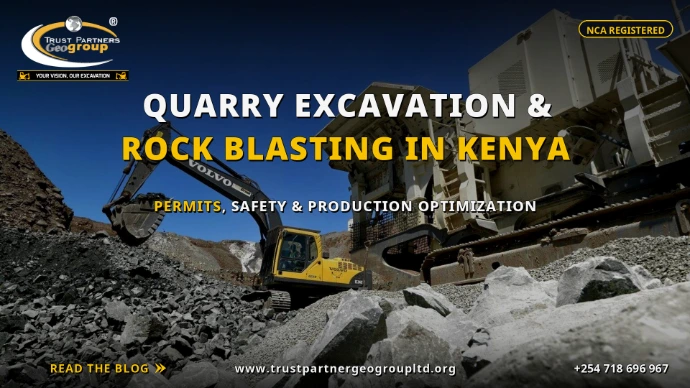
Quarry Excavation and Rock Blasting in Kenya: Permits, Safety & Production Optimization
Blast design, permits & crusher-feed discipline for ballast quarries in Nairobi, Juja, Kajiado, Machakos, Kilifi & nationwide
Table of Contents
- 1. Quarrying in Kenya: The Industry at a Glance
- 2. The Quarry Excavation Process, End to End
- 3. Rock Blasting Methods Used in Kenyan Quarries
- 4. Blast Design: The Parameters That Control Everything
- 5. Permits & Licensing for Quarry Blasting in Kenya
- 6. Blasting Safety: Flyrock, Vibration, Airblast & Dust
- 7. Stone Quarry Blasting in Nairobi: Working Next to Neighbors
- 8. Quarry Production Optimization: The Five Levers
- 9. Crushing, Screening & Product Streams
- 10. Costs & Quarry Economics [2026]
- 11. Frequently Asked Questions
- 12. Conclusion
Every building in Kenya stands on quarry output - ballast in the concrete, hardcore under the slab, sand in the mortar. Yet quarry excavation Kenya regulators oversee is one of the most regulated and least understood construction activities: one wrong blast near a neighbor can close a profitable pit for good. This guide walks through the full cycle - how a rock blasting quarry operation is designed, permitted, fired safely and tuned for maximum production - with 2026 costs and the specific rules that apply to stone quarry blasting in Nairobi's built-up corridors.
Trust Partners Geo-Group Ltd - Engineering Team
NCA-registered excavation & civil engineering contractor with 15+ years of quarry, blasting-support and contract crushing experience across Kenya. Reviewed by registered engineers and licensed blasters.
1. Quarrying in Kenya: The Industry at a Glance
Kenya's quarry sector supplies an estimated 40+ million tonnes of construction materials annually, dominated by:
| Product | Main Corridors | Rock Type | Method |
|---|---|---|---|
| Ballast & aggregates | Juja-Thika, Kajiado, Machakos (Mlolongo), Kilifi, Nakuru | Phonolite, trachyte, basalt | Drill & blast + crushing |
| Cement limestone | Athi River, Bamburi, Kitui | Limestone | Large-bench drill & blast |
| Hardcore & rock fill | Nairobi periphery, Nakuru, Kisumu | Mixed volcanic | Ripping or light blasting |
| Dimension stone (machine-cut blocks) | Juja, Thika, Nyeri, Kitengela | Tuff (NDARUGO stone) | Saw cutting - no blasting |
| Murram & laterite gravels | Every county | Weathered rock | Free dig / ripping (see borrow pit guide) |
Regulation is shared between the State Department for Mining (Mining Act 2016), county governments, NEMA, DOSHS and - for anything involving explosives - the Ministry of Interior. The details are in Section 5.
2. The Quarry Excavation Process, End to End
A production quarry repeats one continuous cycle:
- 1. Overburden stripping - remove soil and weathered mantle to expose sound rock (free dig or ripping; this waste goes to dumps or is sold as fill).
- 2. Face survey & blast design - survey the bench face, design the shot (Section 4).
- 3. Drilling - crawler drills sink the blast hole pattern, typically 76-102mm holes for quarry benches.
- 4. Charging & firing - explosives loaded, exclusion enforced, shot fired under the licensed blaster.
- 5. Mucking (load & haul) - excavators load the muck pile into trucks for the crusher or waste dump.
- 6. Crushing & screening - rock reduced to ballast sizes and stockpiled by fraction (Section 9).
- 7. Bench maintenance - floor cleanup, drainage, crest scaling, road grading - then the next shot.
Production rhythm: a medium Kenyan ballast quarry (150,000-250,000 m3/yr) typically blasts 2-4 times per week, each shot releasing 3,000-8,000 m3 of rock - two to four days of crusher feed per blast.
3. Rock Blasting Methods Used in Kenyan Quarries
| Method | Application | 2026 Cost (KES/m3) | Constraints |
|---|---|---|---|
| Bench blasting (production) | Main production shots, 6-12m benches | 800-1,500 incl. load & haul | Full permit stack; exclusion zones |
| Pre-splitting / buffer blasting | Final wall faces - clean, stable crests | +30-60% over production cost | Precision drilling required |
| Secondary breaking (hammer) | Oversize boulders from the muck pile | 200-500 per m3 of oversize | Slow; avoided by good blast design |
| Chemical (expansive grout) | Vibration-free breaking near structures | 2,500-4,500 | Slow (12-48 hrs), hole-intensive |
| Rip & push (no blasting) | Weathered rock <60-80 MPa | 700-1,200 | Only viable in weak rock |
Explosives systems in Kenyan use: ANFO (ammonium nitrate/fuel oil) as the workhorse bulk explosive for dry holes, emulsion or packaged watergel where holes are wet, and electronic detonators increasingly replacing detonating cord - they cost more per hole but give millisecond-accurate timing that cuts vibration and improves fragmentation. Initiation per delay, not per shot, is the fundamental vibration control.
4. Blast Design: The Parameters That Control Everything
A blast is designed, not improvised. The licensed blaster sets these parameters from the face survey:
| Parameter | Typical Kenyan Quarry Value | What It Controls |
|---|---|---|
| Burden (face to first row) | 2.0-3.0m | Too small = flyrock; too large = poor fragmentation, toe |
| Spacing (hole to hole) | 2.5-3.5m (1.15-1.4 x burden) | Fragmentation uniformity |
| Hole depth | Bench height + 0.5-1.0m sub-drill | Toe breakage; floor level control |
| Stemming | ≥20-25 x hole diameter (1.6-2.5m) | Gas confinement - the #1 flyrock control |
| Powder factor | 0.3-0.5 kg/m3 (hard volcanic rock) | Fragmentation fineness vs. cost |
| Charge per delay | Set by vibration limit at nearest structure | PPV (vibration) - the #1 neighbor-complaint control |
Fragmentation is the profit dial. A slightly higher powder factor (say 0.45 vs 0.35 kg/m3) adds perhaps KES 40-60/m3 to the blast, but the finer muck pile loads 15-25% faster, reduces secondary breaking to near zero, and lets the crusher run choke-fed - worth far more than the extra explosive. This is the first lever of quarry production optimization (Section 8).
5. Permits & Licensing for Quarry Blasting in Kenya
The full legal stack for quarry excavation in Kenya:
| Permit | Authority | Key Conditions |
|---|---|---|
| Quarry license / mining permit | State Department for Mining; county for construction minerals | Boundary plan, work programme, annual returns |
| EIA license + annual audits | NEMA | Public participation, dust/noise/vibration management plan, rehabilitation plan & bond |
| County permits | County government | Land use consent, business permits, truck routes, community agreements |
| Explosives authorization | Ministry of Interior | Licensed blaster in charge of every shot; approved magazine; police notification and escort; records of every cartridge |
| Workplace registration & safety audits | DOSHS | Safety policy, PPE, first aid, statutory equipment inspections |
| NCA registration | National Construction Authority | For the excavation/crushing contractor on construction works |
The blaster is personal-license, not company-license. Every blast must be designed and fired under a named, licensed blaster whose license class covers the shot type. If your contractor cannot name their blaster and produce the license, they are not blasting legally - and the liability attaches to the quarry owner.
6. Blasting Safety: Flyrock, Vibration, Airblast & Dust
Flyrock is the deadliest blast hazard. Controls: correct burden and stemming (Section 4), blasting mats or soil cover on sensitive shots, and a manned exclusion zone - 300-500m depending on charge - with sentries on every approach route, a siren sequence (warning, firing, all-clear), and post-blast inspection by the blaster before anyone re-enters.
Ground vibration is measured as peak particle velocity (PPV) at the nearest structure. Accepted limits: 10-25 mm/s for sound residential buildings, 5-10 mm/s for old or fragile structures, 2-5 mm/s near hospitals and precision facilities. Every blast within 300m of structures should be seismograph-recorded - the record is your legal defense. Vibration scales with charge weight per delay, which is why electronic detonators that split one shot into 30-50 delays are transforming urban blasting.
Airblast (overpressure) - the concussion that rattles windows - is controlled by confinement (stemming, mats) and firing in favorable weather (never under low cloud inversions, which reflect the pressure wave onto neighborhoods).
Dust and noise - from drilling, crushing and haulage - are NEMA compliance items: water suppression at the crusher and on haul roads, enclosed screens where neighbors are close, and working-hour agreements with the community.
Misfire discipline: a misfired hole is never approached for at least 15-30 minutes (electric/electronic systems) and is handled only by the blaster per written procedure. Misfire incidents are the leading cause of fatal blasting accidents worldwide - no schedule pressure ever justifies shortcutting the wait time.
7. Stone Quarry Blasting in Nairobi: Working Next to Neighbors
Stone quarry blasting Nairobi quarries undertake - and the same applies across the satellite towns (Juja, Ruiru, Kitengela, Ngong, Mlolongo) happens in some of the tightest neighbor conditions anywhere - homes and factories routinely sit 100-300m from working faces. The operating playbook that keeps urban quarries open:
- Reduced charge per delay - sometimes 10-20 delays on a shot that would fire in 5 upcountry;
- Electronic detonators as standard, not optional;
- Blasting mats on any shot within 200m of structures;
- Seismograph on every blast, with reports shared with the county and retained for years;
- Community notification - fixed blast windows (typically mid-morning or mid-afternoon), advance notice to adjacent plots, and a complaints register with response times;
- Progressive face retreat - working faces advance away from neighbors so every year the shot gets further, not closer;
- Chemical breaking or wire saws on the closest faces - at KES 2,500-4,500/m3 it is expensive, but it is what keeps the license when the boundary wall is 50m away.
Dimension-stone quarries around Nairobi sidestep blasting entirely - tuff is sawn, not blasted - which is why machine-cut stone quarries can operate almost inside residential estates.
8. Quarry Production Optimization: The Five Levers
Quarry production optimization is a system discipline - the cheapest tonne is found at the interfaces between blast, load, haul and crush:
1. Fragmentation. Tune powder factor and timing so the muck pile matches your loader and crusher gape. Target: 90%+ passing the crusher's feed opening from the blast, secondary breaking under 3% of tonnage.
2. Face & floor condition. Square faces, level floors, working sumps drained. A clean face loads 10-15% faster than a toe-riddled one - blast for the floor, not just the face.
3. Haul roads. Grade twice per shift, water in dry weather, keep grades ≤10%. Road condition alone swings truck cycles 10-20%; it is the highest-ROI spend in the pit.
4. Crusher feed discipline. Steady choke-feeding raises crusher throughput 15-30% versus starve-and-surge running. A loader dedicated to the crusher hopper pays for itself in weeks.
5. Product mix management. Sell the fractions the market prices highest: 10-20mm and 20-40mm ballast premium grades first, then 6-10mm, and turn crusher dust (0-6mm) from a disposal problem into a product for paving blocks and bedding. Track everything with a daily production sheet: tonnes blasted, loaded, crushed, sold, and stock by fraction.
"Quarries don't lose money in the pit - they lose it at the interfaces: the idle excavator waiting for trucks, the crusher waiting for rock, the dust pile nobody priced. Optimization is closing those gaps." - Trust Partners Geo-Group Ltd, Quarry Operations Team
9. Crushing, Screening & Product Streams
Blasted rock becomes product through a staged plant:
| Stage | Machine | Output |
|---|---|---|
| Primary crushing | Jaw crusher | Run-of-blast reduced to <200mm |
| Secondary crushing | Cone or impact crusher | <60-80mm |
| Screening | Vibrating screens (2-3 decks) | Separated fractions: 20-40mm, 10-20mm, 6-10mm |
| Fines recovery | Screen undersize / dust collector | 0-6mm crusher dust |
Typical 2026 Nairobi product prices (ex-quarry): 10-20mm and 20-40mm ballast KES 1,600-2,200/tonne; 6-10mm KES 1,400-1,900/tonne; crusher dust KES 600-1,000/tonne; hardcore KES 1,000-1,800/m3. Plant capacities run from 30 tonnes/hour (single jaw + screen, KES 8-15M) to 200+ tonnes/hour (two-stage tracked plants, KES 40M+). Many quarries skip ownership entirely and bring in contract crushers at KES 350-700/tonne crushed - a model that converts fixed cost to variable and keeps the quarry focused on the pit.
10. Costs & Quarry Economics [2026]
Cost build-up for a medium ballast quarry producing 15,000 tonnes/month (approximately 10,000 m3 in-situ):
| Cost Line | KES / tonne product | Share |
|---|---|---|
| Overburden stripping (amortized) | 60-120 | 6% |
| Drilling & blasting | 250-400 | 18% |
| Load & haul to crusher | 250-450 | 20% |
| Crushing & screening | 350-700 | 30% |
| Roads, water, support fleet | 80-150 | 7% |
| Permits, compliance, community, admin | 100-200 | 9% |
| Royalties & land lease | 80-200 | 8% |
| Total production cost | 1,200-2,200 / tonne | against ex-quarry ballast at KES 1,600-2,200/t |
The margin spread between KES 1,200/t and KES 2,200/t is exactly what production optimization buys - the same pit, the same rock, run tightly versus loosely. For per-machine rates behind these figures see our equipment hire guide, and for excavation unit rates our bulk excavation cost guide.
11. Frequently Asked Questions: Quarry Excavation & Blasting in Kenya
What permits do you need to blast rock in a quarry in Kenya?
Rock blasting in Kenya requires: a quarry license or mining permit (State Department for Mining / county), NEMA environmental approval, and explosives authorization from the Ministry of Interior - including a licensed blaster, an approved explosives magazine for storage, police notification before each blast, and transport escorts for explosives. Counties near urban areas add conditions on blast timing, vibration limits and community notification. Unlicensed blasting leads to closure and prosecution.
How much does rock blasting cost per cubic meter in Kenya?
2026 drill-and-blast costs in Kenya: KES 800-1,500 per m3 including drilling, explosives, loading and haulage at production scale (50,000+ m3). The explosives component alone is roughly KES 200-400 per m3 at powder factors of 0.3-0.5 kg/m3. Small or sensitive blasts cost more; chemical (expansive grout) breaking runs KES 2,500-4,500 per m3 for vibration-free urban work. Ripping weathered rock where possible costs KES 700-1,200 per m3.
How is flyrock controlled during quarry blasting?
Flyrock is controlled by correct blast design (adequate burden, stemming length of at least 20-25 times hole diameter, proper charge confinement), blasting mats or soil cover on sensitive shots, and strict exclusion zones - typically 300-500m manned clearance depending on charge size. Every blast needs a siren sequence, sentry postings on all approach routes, and a post-blast inspection before the all-clear. Most flyrock incidents trace to overloaded holes or insufficient stemming.
What is a safe vibration limit for quarry blasting near buildings?
International practice (and what Kenyan consultants specify) limits peak particle velocity (PPV) to 10-25 mm/s at residential structures, with 5-10 mm/s for old or sensitive buildings and 2-5 mm/s near hospitals or precision facilities. A seismograph should record every blast within 300m of structures. If readings approach limits, reduce charge weight per delay, increase the number of delays, or switch to chemical breaking for the closest faces.
How do you optimize production in a ballast quarry?
Quarry production optimization focuses on five levers: (1) blast fragmentation - finer, uniform fragmentation cuts excavator cycle time and crusher downtime; (2) face geometry - square, well-drained benches keep loaders efficient; (3) haul roads - graded, watered roads cut cycle times 10-20%; (4) crusher feed discipline - steady, choke-fed crushing raises throughput 15-30%; (5) product mix - balancing 0-6mm dust, 6-10mm, 10-20mm and 20-40mm stock to market prices instead of wasting fractions.
Can you blast rock close to buildings in Nairobi?
Yes, but under strict conditions. Urban blasting within Nairobi uses reduced charges per delay, electronic detonators for precise timing, blasting mats, seismograph monitoring of every shot, and community notification - usually limited to agreed daytime windows. Where structures sit within 50-100m, contractors often switch to hydraulic splitters, expansive chemical grout (KES 2,500-4,500/m3) or wire saws on the nearest faces, reserving blasting for the pit interior.
What is the difference between quarrying and open-pit mining?
Technically they share the same excavation engineering - benches, drilling, blasting, loading, haulage. The difference is product and regulation: quarries extract construction materials (ballast, limestone, sand, dimension stone) licensed mainly through counties, while mines extract minerals (gold, soda ash, titanium) licensed under the national Mining Act 2016. In Kenya, both require NEMA approval, and both use identical bench and blast design principles.
How much does it cost to start a quarry in Kenya?
A small-to-medium Kenyan ballast quarry in 2026: land lease KES 500,000-2,000,000/year, permits and EIA KES 500,000-1,500,000, site works (access road, benches, magazine) KES 2,000,000-8,000,000, and a crusher plant KES 8,000,000-40,000,000 depending on capacity (30-200 tonnes/hour). Excavation fleet is usually hired initially - KES 4,500-8,000 per machine-hour. Total entry ranges from KES 15 million (hired plant, small crusher) to KES 80 million+ for a fully equipped operation.
12. Conclusion: Blast Safely, Crush Steadily, Count Daily
A profitable Kenyan quarry rests on three disciplines: blasting that is designed, permitted and monitored on every single shot; a load-haul-crush chain with no idle links; and daily production accounting that catches margin leaks while they are still small. Cut corners on the first and you lose the license; ignore the second and third and you lose the business.
Trust Partners Geo-Group Ltd provides contract quarry excavation and blasting support - face design, drilling, blast management with licensed blasters, load and haul, and crusher-feed operations - for quarries across Nairobi, Kiambu, Machakos, Kajiado, Nakuru, Kilifi and nationwide. Talk to us about a per-cubic-meter or per-tonne contract for your pit.
Contract Quarry Excavation & Blasting Support
Licensed blasters, proven blast designs, seismograph monitoring and production-matched fleets - we keep your quarry compliant, safe and crushing at capacity.
Free lead magnet: ask for our Quarry Blast Compliance Checklist (PDF) - every permit, notification and safety step in one auditable sheet.
Related Resources
Open-Pit Mine Excavation in Kenya: Stripping Ratio, Bench Design & Equipment
The sister guide to pit planning, stripping ratios and fleet matching.
READ MOREBulk Excavation Cost Per Cubic Meter in Kenya [2026 Rates]
Free-dig, ripping and drill-blast rates referenced throughout this guide.
READ MOREBorrow Pit Excavation in Kenya: Sourcing Fill Material [2026]
Shallow-pit sourcing for murram and fill - permits, testing, prices.
READ MOREConstruction Heavy Equipment Hire & Rental Prices in Kenya [2026]
Machine-hour rates for the excavators, dozers and trucks in this guide.
READ MORESlope Excavation & Stabilization for Hillside Construction
Benching and slope controls for quarry overburden and weathered faces.
READ MOREExcavation in Kenya: Complete Guide to Costs, Methods & Contractors
The pillar guide to excavation methods, equipment and contractor selection.
READ MORETRUST PARTNERS GEO-GROUP LTD | YOUR VISION, OUR EXCAVATION
WEBSITE: WWW.TRUSTPARTNERGEOGROUPLTD.ORG | EMAIL: INFO@TRUSTPARTNERGEOGROUPLTD.ORG | PHONE: +254 718 68 69 67
FOLLOW US: FACEBOOK | TIKTOK | INSTAGRAM | YOUTUBE | LINKEDIN
© 2026 TRUST PARTNERS GEO-GROUP LTD. ALL RIGHTS RESERVED.
Quarry Excavation and Rock Blasting in Kenya: Permits, Safety & Production Optimization
Blast design, permits & crusher-feed discipline for ballast quarries in Nairobi, Juja, Kajiado, Machakos, Kilifi & nationwide
Table of Contents
- 1. Quarrying in Kenya: The Industry at a Glance
- 2. The Quarry Excavation Process, End to End
- 3. Rock Blasting Methods Used in Kenyan Quarries
- 4. Blast Design: The Parameters That Control Everything
- 5. Permits & Licensing for Quarry Blasting in Kenya
- 6. Blasting Safety: Flyrock, Vibration, Airblast & Dust
- 7. Stone Quarry Blasting in Nairobi: Working Next to Neighbors
- 8. Quarry Production Optimization: The Five Levers
- 9. Crushing, Screening & Product Streams
- 10. Costs & Quarry Economics [2026]
- 11. Frequently Asked Questions
- 12. Conclusion
Every building in Kenya stands on quarry output - ballast in the concrete, hardcore under the slab, sand in the mortar. Yet quarry excavation Kenya regulators oversee is one of the most regulated and least understood construction activities: one wrong blast near a neighbor can close a profitable pit for good. This guide walks through the full cycle - how a rock blasting quarry operation is designed, permitted, fired safely and tuned for maximum production - with 2026 costs and the specific rules that apply to stone quarry blasting in Nairobi's built-up corridors.
Trust Partners Geo-Group Ltd - Engineering Team
NCA-registered excavation & civil engineering contractor with 15+ years of quarry, blasting-support and contract crushing experience across Kenya. Reviewed by registered engineers and licensed blasters.
1. Quarrying in Kenya: The Industry at a Glance
Kenya's quarry sector supplies an estimated 40+ million tonnes of construction materials annually, dominated by:
| Product | Main Corridors | Rock Type | Method |
|---|---|---|---|
| Ballast & aggregates | Juja-Thika, Kajiado, Machakos (Mlolongo), Kilifi, Nakuru | Phonolite, trachyte, basalt | Drill & blast + crushing |
| Cement limestone | Athi River, Bamburi, Kitui | Limestone | Large-bench drill & blast |
| Hardcore & rock fill | Nairobi periphery, Nakuru, Kisumu | Mixed volcanic | Ripping or light blasting |
| Dimension stone (machine-cut blocks) | Juja, Thika, Nyeri, Kitengela | Tuff (NDARUGO stone) | Saw cutting - no blasting |
| Murram & laterite gravels | Every county | Weathered rock | Free dig / ripping (see borrow pit guide) |
Regulation is shared between the State Department for Mining (Mining Act 2016), county governments, NEMA, DOSHS and - for anything involving explosives - the Ministry of Interior. The details are in Section 5.
2. The Quarry Excavation Process, End to End
A production quarry repeats one continuous cycle:
- 1. Overburden stripping - remove soil and weathered mantle to expose sound rock (free dig or ripping; this waste goes to dumps or is sold as fill).
- 2. Face survey & blast design - survey the bench face, design the shot (Section 4).
- 3. Drilling - crawler drills sink the blast hole pattern, typically 76-102mm holes for quarry benches.
- 4. Charging & firing - explosives loaded, exclusion enforced, shot fired under the licensed blaster.
- 5. Mucking (load & haul) - excavators load the muck pile into trucks for the crusher or waste dump.
- 6. Crushing & screening - rock reduced to ballast sizes and stockpiled by fraction (Section 9).
- 7. Bench maintenance - floor cleanup, drainage, crest scaling, road grading - then the next shot.
Production rhythm: a medium Kenyan ballast quarry (150,000-250,000 m3/yr) typically blasts 2-4 times per week, each shot releasing 3,000-8,000 m3 of rock - two to four days of crusher feed per blast.
3. Rock Blasting Methods Used in Kenyan Quarries
| Method | Application | 2026 Cost (KES/m3) | Constraints |
|---|---|---|---|
| Bench blasting (production) | Main production shots, 6-12m benches | 800-1,500 incl. load & haul | Full permit stack; exclusion zones |
| Pre-splitting / buffer blasting | Final wall faces - clean, stable crests | +30-60% over production cost | Precision drilling required |
| Secondary breaking (hammer) | Oversize boulders from the muck pile | 200-500 per m3 of oversize | Slow; avoided by good blast design |
| Chemical (expansive grout) | Vibration-free breaking near structures | 2,500-4,500 | Slow (12-48 hrs), hole-intensive |
| Rip & push (no blasting) | Weathered rock <60-80 MPa | 700-1,200 | Only viable in weak rock |
Explosives systems in Kenyan use: ANFO (ammonium nitrate/fuel oil) as the workhorse bulk explosive for dry holes, emulsion or packaged watergel where holes are wet, and electronic detonators increasingly replacing detonating cord - they cost more per hole but give millisecond-accurate timing that cuts vibration and improves fragmentation. Initiation per delay, not per shot, is the fundamental vibration control.
4. Blast Design: The Parameters That Control Everything
A blast is designed, not improvised. The licensed blaster sets these parameters from the face survey:
| Parameter | Typical Kenyan Quarry Value | What It Controls |
|---|---|---|
| Burden (face to first row) | 2.0-3.0m | Too small = flyrock; too large = poor fragmentation, toe |
| Spacing (hole to hole) | 2.5-3.5m (1.15-1.4 x burden) | Fragmentation uniformity |
| Hole depth | Bench height + 0.5-1.0m sub-drill | Toe breakage; floor level control |
| Stemming | ≥20-25 x hole diameter (1.6-2.5m) | Gas confinement - the #1 flyrock control |
| Powder factor | 0.3-0.5 kg/m3 (hard volcanic rock) | Fragmentation fineness vs. cost |
| Charge per delay | Set by vibration limit at nearest structure | PPV (vibration) - the #1 neighbor-complaint control |
Fragmentation is the profit dial. A slightly higher powder factor (say 0.45 vs 0.35 kg/m3) adds perhaps KES 40-60/m3 to the blast, but the finer muck pile loads 15-25% faster, reduces secondary breaking to near zero, and lets the crusher run choke-fed - worth far more than the extra explosive. This is the first lever of quarry production optimization (Section 8).
5. Permits & Licensing for Quarry Blasting in Kenya
The full legal stack for quarry excavation in Kenya:
| Permit | Authority | Key Conditions |
|---|---|---|
| Quarry license / mining permit | State Department for Mining; county for construction minerals | Boundary plan, work programme, annual returns |
| EIA license + annual audits | NEMA | Public participation, dust/noise/vibration management plan, rehabilitation plan & bond |
| County permits | County government | Land use consent, business permits, truck routes, community agreements |
| Explosives authorization | Ministry of Interior | Licensed blaster in charge of every shot; approved magazine; police notification and escort; records of every cartridge |
| Workplace registration & safety audits | DOSHS | Safety policy, PPE, first aid, statutory equipment inspections |
| NCA registration | National Construction Authority | For the excavation/crushing contractor on construction works |
The blaster is personal-license, not company-license. Every blast must be designed and fired under a named, licensed blaster whose license class covers the shot type. If your contractor cannot name their blaster and produce the license, they are not blasting legally - and the liability attaches to the quarry owner.
6. Blasting Safety: Flyrock, Vibration, Airblast & Dust
Flyrock is the deadliest blast hazard. Controls: correct burden and stemming (Section 4), blasting mats or soil cover on sensitive shots, and a manned exclusion zone - 300-500m depending on charge - with sentries on every approach route, a siren sequence (warning, firing, all-clear), and post-blast inspection by the blaster before anyone re-enters.
Ground vibration is measured as peak particle velocity (PPV) at the nearest structure. Accepted limits: 10-25 mm/s for sound residential buildings, 5-10 mm/s for old or fragile structures, 2-5 mm/s near hospitals and precision facilities. Every blast within 300m of structures should be seismograph-recorded - the record is your legal defense. Vibration scales with charge weight per delay, which is why electronic detonators that split one shot into 30-50 delays are transforming urban blasting.
Airblast (overpressure) - the concussion that rattles windows - is controlled by confinement (stemming, mats) and firing in favorable weather (never under low cloud inversions, which reflect the pressure wave onto neighborhoods).
Dust and noise - from drilling, crushing and haulage - are NEMA compliance items: water suppression at the crusher and on haul roads, enclosed screens where neighbors are close, and working-hour agreements with the community.
Misfire discipline: a misfired hole is never approached for at least 15-30 minutes (electric/electronic systems) and is handled only by the blaster per written procedure. Misfire incidents are the leading cause of fatal blasting accidents worldwide - no schedule pressure ever justifies shortcutting the wait time.
7. Stone Quarry Blasting in Nairobi: Working Next to Neighbors
Stone quarry blasting Nairobi quarries undertake - and the same applies across the satellite towns (Juja, Ruiru, Kitengela, Ngong, Mlolongo) happens in some of the tightest neighbor conditions anywhere - homes and factories routinely sit 100-300m from working faces. The operating playbook that keeps urban quarries open:
- Reduced charge per delay - sometimes 10-20 delays on a shot that would fire in 5 upcountry;
- Electronic detonators as standard, not optional;
- Blasting mats on any shot within 200m of structures;
- Seismograph on every blast, with reports shared with the county and retained for years;
- Community notification - fixed blast windows (typically mid-morning or mid-afternoon), advance notice to adjacent plots, and a complaints register with response times;
- Progressive face retreat - working faces advance away from neighbors so every year the shot gets further, not closer;
- Chemical breaking or wire saws on the closest faces - at KES 2,500-4,500/m3 it is expensive, but it is what keeps the license when the boundary wall is 50m away.
Dimension-stone quarries around Nairobi sidestep blasting entirely - tuff is sawn, not blasted - which is why machine-cut stone quarries can operate almost inside residential estates.
8. Quarry Production Optimization: The Five Levers
Quarry production optimization is a system discipline - the cheapest tonne is found at the interfaces between blast, load, haul and crush:
1. Fragmentation. Tune powder factor and timing so the muck pile matches your loader and crusher gape. Target: 90%+ passing the crusher's feed opening from the blast, secondary breaking under 3% of tonnage.
2. Face & floor condition. Square faces, level floors, working sumps drained. A clean face loads 10-15% faster than a toe-riddled one - blast for the floor, not just the face.
3. Haul roads. Grade twice per shift, water in dry weather, keep grades ≤10%. Road condition alone swings truck cycles 10-20%; it is the highest-ROI spend in the pit.
4. Crusher feed discipline. Steady choke-feeding raises crusher throughput 15-30% versus starve-and-surge running. A loader dedicated to the crusher hopper pays for itself in weeks.
5. Product mix management. Sell the fractions the market prices highest: 10-20mm and 20-40mm ballast premium grades first, then 6-10mm, and turn crusher dust (0-6mm) from a disposal problem into a product for paving blocks and bedding. Track everything with a daily production sheet: tonnes blasted, loaded, crushed, sold, and stock by fraction.
"Quarries don't lose money in the pit - they lose it at the interfaces: the idle excavator waiting for trucks, the crusher waiting for rock, the dust pile nobody priced. Optimization is closing those gaps." - Trust Partners Geo-Group Ltd, Quarry Operations Team
9. Crushing, Screening & Product Streams
Blasted rock becomes product through a staged plant:
| Stage | Machine | Output |
|---|---|---|
| Primary crushing | Jaw crusher | Run-of-blast reduced to <200mm |
| Secondary crushing | Cone or impact crusher | <60-80mm |
| Screening | Vibrating screens (2-3 decks) | Separated fractions: 20-40mm, 10-20mm, 6-10mm |
| Fines recovery | Screen undersize / dust collector | 0-6mm crusher dust |
Typical 2026 Nairobi product prices (ex-quarry): 10-20mm and 20-40mm ballast KES 1,600-2,200/tonne; 6-10mm KES 1,400-1,900/tonne; crusher dust KES 600-1,000/tonne; hardcore KES 1,000-1,800/m3. Plant capacities run from 30 tonnes/hour (single jaw + screen, KES 8-15M) to 200+ tonnes/hour (two-stage tracked plants, KES 40M+). Many quarries skip ownership entirely and bring in contract crushers at KES 350-700/tonne crushed - a model that converts fixed cost to variable and keeps the quarry focused on the pit.
10. Costs & Quarry Economics [2026]
Cost build-up for a medium ballast quarry producing 15,000 tonnes/month (approximately 10,000 m3 in-situ):
| Cost Line | KES / tonne product | Share |
|---|---|---|
| Overburden stripping (amortized) | 60-120 | 6% |
| Drilling & blasting | 250-400 | 18% |
| Load & haul to crusher | 250-450 | 20% |
| Crushing & screening | 350-700 | 30% |
| Roads, water, support fleet | 80-150 | 7% |
| Permits, compliance, community, admin | 100-200 | 9% |
| Royalties & land lease | 80-200 | 8% |
| Total production cost | 1,200-2,200 / tonne | against ex-quarry ballast at KES 1,600-2,200/t |
The margin spread between KES 1,200/t and KES 2,200/t is exactly what production optimization buys - the same pit, the same rock, run tightly versus loosely. For per-machine rates behind these figures see our equipment hire guide, and for excavation unit rates our bulk excavation cost guide.
11. Frequently Asked Questions: Quarry Excavation & Blasting in Kenya
What permits do you need to blast rock in a quarry in Kenya?
Rock blasting in Kenya requires: a quarry license or mining permit (State Department for Mining / county), NEMA environmental approval, and explosives authorization from the Ministry of Interior - including a licensed blaster, an approved explosives magazine for storage, police notification before each blast, and transport escorts for explosives. Counties near urban areas add conditions on blast timing, vibration limits and community notification. Unlicensed blasting leads to closure and prosecution.
How much does rock blasting cost per cubic meter in Kenya?
2026 drill-and-blast costs in Kenya: KES 800-1,500 per m3 including drilling, explosives, loading and haulage at production scale (50,000+ m3). The explosives component alone is roughly KES 200-400 per m3 at powder factors of 0.3-0.5 kg/m3. Small or sensitive blasts cost more; chemical (expansive grout) breaking runs KES 2,500-4,500 per m3 for vibration-free urban work. Ripping weathered rock where possible costs KES 700-1,200 per m3.
How is flyrock controlled during quarry blasting?
Flyrock is controlled by correct blast design (adequate burden, stemming length of at least 20-25 times hole diameter, proper charge confinement), blasting mats or soil cover on sensitive shots, and strict exclusion zones - typically 300-500m manned clearance depending on charge size. Every blast needs a siren sequence, sentry postings on all approach routes, and a post-blast inspection before the all-clear. Most flyrock incidents trace to overloaded holes or insufficient stemming.
What is a safe vibration limit for quarry blasting near buildings?
International practice (and what Kenyan consultants specify) limits peak particle velocity (PPV) to 10-25 mm/s at residential structures, with 5-10 mm/s for old or sensitive buildings and 2-5 mm/s near hospitals or precision facilities. A seismograph should record every blast within 300m of structures. If readings approach limits, reduce charge weight per delay, increase the number of delays, or switch to chemical breaking for the closest faces.
How do you optimize production in a ballast quarry?
Quarry production optimization focuses on five levers: (1) blast fragmentation - finer, uniform fragmentation cuts excavator cycle time and crusher downtime; (2) face geometry - square, well-drained benches keep loaders efficient; (3) haul roads - graded, watered roads cut cycle times 10-20%; (4) crusher feed discipline - steady, choke-fed crushing raises throughput 15-30%; (5) product mix - balancing 0-6mm dust, 6-10mm, 10-20mm and 20-40mm stock to market prices instead of wasting fractions.
Can you blast rock close to buildings in Nairobi?
Yes, but under strict conditions. Urban blasting within Nairobi uses reduced charges per delay, electronic detonators for precise timing, blasting mats, seismograph monitoring of every shot, and community notification - usually limited to agreed daytime windows. Where structures sit within 50-100m, contractors often switch to hydraulic splitters, expansive chemical grout (KES 2,500-4,500/m3) or wire saws on the nearest faces, reserving blasting for the pit interior.
What is the difference between quarrying and open-pit mining?
Technically they share the same excavation engineering - benches, drilling, blasting, loading, haulage. The difference is product and regulation: quarries extract construction materials (ballast, limestone, sand, dimension stone) licensed mainly through counties, while mines extract minerals (gold, soda ash, titanium) licensed under the national Mining Act 2016. In Kenya, both require NEMA approval, and both use identical bench and blast design principles.
How much does it cost to start a quarry in Kenya?
A small-to-medium Kenyan ballast quarry in 2026: land lease KES 500,000-2,000,000/year, permits and EIA KES 500,000-1,500,000, site works (access road, benches, magazine) KES 2,000,000-8,000,000, and a crusher plant KES 8,000,000-40,000,000 depending on capacity (30-200 tonnes/hour). Excavation fleet is usually hired initially - KES 4,500-8,000 per machine-hour. Total entry ranges from KES 15 million (hired plant, small crusher) to KES 80 million+ for a fully equipped operation.
12. Conclusion: Blast Safely, Crush Steadily, Count Daily
A profitable Kenyan quarry rests on three disciplines: blasting that is designed, permitted and monitored on every single shot; a load-haul-crush chain with no idle links; and daily production accounting that catches margin leaks while they are still small. Cut corners on the first and you lose the license; ignore the second and third and you lose the business.
Trust Partners Geo-Group Ltd provides contract quarry excavation and blasting support - face design, drilling, blast management with licensed blasters, load and haul, and crusher-feed operations - for quarries across Nairobi, Kiambu, Machakos, Kajiado, Nakuru, Kilifi and nationwide. Talk to us about a per-cubic-meter or per-tonne contract for your pit.
Contract Quarry Excavation & Blasting Support
Licensed blasters, proven blast designs, seismograph monitoring and production-matched fleets - we keep your quarry compliant, safe and crushing at capacity.
Free lead magnet: ask for our Quarry Blast Compliance Checklist (PDF) - every permit, notification and safety step in one auditable sheet.
Related Resources
Open-Pit Mine Excavation in Kenya: Stripping Ratio, Bench Design & Equipment
The sister guide to pit planning, stripping ratios and fleet matching.
READ MOREBulk Excavation Cost Per Cubic Meter in Kenya [2026 Rates]
Free-dig, ripping and drill-blast rates referenced throughout this guide.
READ MOREBorrow Pit Excavation in Kenya: Sourcing Fill Material [2026]
Shallow-pit sourcing for murram and fill - permits, testing, prices.
READ MOREConstruction Heavy Equipment Hire & Rental Prices in Kenya [2026]
Machine-hour rates for the excavators, dozers and trucks in this guide.
READ MORESlope Excavation & Stabilization for Hillside Construction
Benching and slope controls for quarry overburden and weathered faces.
READ MOREExcavation in Kenya: Complete Guide to Costs, Methods & Contractors
The pillar guide to excavation methods, equipment and contractor selection.
READ MORETRUST PARTNERS GEO-GROUP LTD | YOUR VISION, OUR EXCAVATION
WEBSITE: WWW.TRUSTPARTNERGEOGROUPLTD.ORG | EMAIL: INFO@TRUSTPARTNERGEOGROUPLTD.ORG | PHONE: +254 718 68 69 67
FOLLOW US: FACEBOOK | TIKTOK | INSTAGRAM | YOUTUBE | LINKEDIN
© 2026 TRUST PARTNERS GEO-GROUP LTD. ALL RIGHTS RESERVED.