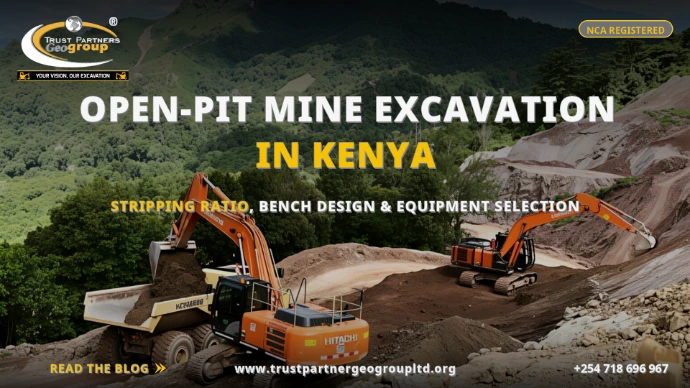
Open-Pit Mine Excavation in Kenya: Stripping Ratio, Bench Design & Equipment Selection
Mine planning, bench geometry & fleet matching for quarries and open pits across Nairobi, Kajiado, Machakos, Kilifi & nationwide
Table of Contents
- 1. Open-Pit Mining in Kenya: The Landscape
- 2. The Stripping Ratio: The Number That Decides Everything
- 3. Bench Design: Geometry That Keeps Pits Standing
- 4. Slope Stability & Geotechnical Controls
- 5. Equipment Selection: Matching Machines to the Dig
- 6. Free Dig, Rip or Blast? The Excavation Method Decision
- 7. Haulage & Fleet Matching
- 8. Permits & the Regulatory Framework
- 9. Unit Costs & Pit Economics [2026]
- 10. Safety in Open-Pit Operations
- 11. Frequently Asked Questions
- 12. Conclusion
Behind every tonne of soda ash from Magadi, every bag of cement from Athi River limestone, and every lorry of ballast leaving a Juja quarry sits the same engineering discipline: open-pit excavation. Get the stripping ratio wrong and the mine loses money on every truck; get the bench design wrong and the pit wall comes down; get the equipment match wrong and half the fleet idles. This guide explains how open pit mining excavation Kenya-wide is actually planned and executed - the stripping ratio math, quarry bench design rules, equipment selection logic, permits, and 2026 unit costs - from a contractor that digs these pits for a living.
Trust Partners Geo-Group Ltd - Engineering Team
NCA-registered excavation & civil engineering contractor with 15+ years of earthworks, quarry and contract mining experience across Kenya. Reviewed by registered engineers.
1. Open-Pit Mining in Kenya: The Landscape
Kenya's extractive sector is overwhelmingly surface mining. Underground operations are rare; the geology and economics favor open pits and quarries almost everywhere:
| Commodity | Key Locations | Typical Pit Scale |
|---|---|---|
| Soda ash (trona) | Lake Magadi, Kajiado | Very large - dredged and dry-pit, millions of tonnes/year |
| Limestone (cement) | Athi River, Bamburi (Mombasa), Kitui, Kajiado | Large benches, 10-15m, drill & blast |
| Titanium sands | Kwale | Large shallow pits, dredge + dry mining |
| Gypsum | Garissa, Tana River | Medium pits, mostly free dig and ripping |
| Fluorspar | Kerio Valley, Elgeyo-Marakwet | Medium hard-rock pits, drill & blast |
| Gold (oxide zones) | Migori, Kakamega, Vihiga, Narok | Small-medium pits, high stripping ratios |
| Construction materials (ballast, murram, sand) | Every county - Juja, Kajiado, Machakos, Kilifi corridors | Small-medium quarries and borrow pits |
Whether the product is gold ore or ballast, the excavation engineering is the same three questions: how much waste must move to reach it (stripping ratio), how the pit is stepped down safely (bench design), and what machines move the material cheapest (equipment selection).
2. The Stripping Ratio: The Number That Decides Everything
The mine stripping ratio is the volume of waste (overburden + barren rock) that must be excavated to expose one unit of ore:
Stripping Ratio (SR) = Waste volume (m3 or BCM) / Ore quantity (tonnes or m3)
A pit shell containing 300,000 m3 of waste over 100,000 tonnes of ore works at SR = 3:1 (m3 per tonne).
Two variants matter in planning: the overall stripping ratio (total waste over total ore in the final pit) and the instantaneous (incremental) stripping ratio (waste per ore unit for the next pushback or bench). Mines die on the second one: a pit can average 3:1 overall yet require a 9:1 strip for the final benches - which may be uneconomic.
Break-even stripping ratio (BESR)
| Formula | BESR = (Revenue per tonne ore - Ore production cost per tonne) / Stripping cost per m3 waste |
| Kenyan quarry example | Ballast revenue KES 1,800/t, crushing+loading cost KES 1,100/t, stripping cost KES 350/m3: BESR = (1,800-1,100)/350 = 2:1 - beyond 2 m3 waste per tonne of rock, the quarry loses money |
| Typical working ranges | Construction quarries 0.2:1-1:1 | Cement limestone 0.3:1-1.5:1 | Gold oxide pits 3:1-8:1 | High-grade metal mines 10:1+ |
This is why stripping ratio drives pit design: every meter of pit depth adds waste on the walls but not necessarily ore, so the SR climbs with depth until it hits break-even - and that intersection is the economic pit limit.
3. Bench Design: Geometry That Keeps Pits Standing
A deep open pit is not a single giant slope - it is a staircase. Each step is a bench, and the geometry of that staircase determines both safety and how much waste the pit swallows. Good quarry bench design balances four parameters:
| Parameter | Kenyan Practice | Governing Factor |
|---|---|---|
| Bench height | 2-5m small murram pits; 6-10m medium quarries; 10-15m large hard-rock operations | Reach of loading machine (max dig height), blast hole drill capability, rock mass stability |
| Bench face angle | 60-80° fresh rock; 45-55° weathered rock; 35-45° soils | Rock mass strength, joint orientation |
| Berm (catch bench) width | ≥1/3 of bench height, min 3-4m; wider on final walls | Must catch and retain raveling rock from the face above |
| Working bench width | Minimum 20-30m for excavator + truck operation | Machine turning, safe passing, blast clearance |
The overall slope angle - the line from pit crest to toe - is flatter than any single face because berms interrupt the staircase: typically 45-55° in competent rock, 30-40° in weathered material. Every degree of flattening increases the stripping ratio, which is why bench design and stripping ratio are negotiated together, not separately.
Regulatory note: Kenyan mines regulations require that faces in loose or weathered ground be benched or sloped to a safe angle, and prohibit undercutting ("overhanging") faces entirely. Inspectors can and do stop non-compliant pits.
4. Slope Stability & Geotechnical Controls
Pit walls fail when driving forces (gravity on the slope mass, water pressure) exceed resisting forces (rock and soil strength). The controls, in order of cost:
- Geotechnical investigation first: boreholes, test pits and discontinuity mapping before final wall design - KES 300,000-1,500,000 for a medium pit, trivial against a wall failure.
- Water management: crest diversion drains so runoff never enters the pit, horizontal drain holes in suspect faces, and a sump pump system at the pit floor. Water is the trigger in the majority of Kenyan slope failures, especially in the long rains.
- Catch berms kept clean: a berm buried under ravel gives zero protection - schedule dozer clean-ups.
- Controlled blasting near final walls: pre-splitting or buffer rows so blast damage does not weaken the final face.
- Monitoring: survey prisms or crack gauges on active walls; any movement trend triggers an exclusion zone and engineering review.
For soil-like overburden - black cotton and ash beds included - treat slopes conservatively (30-35°) and bench frequently; expansive soils lose up to half their strength when wet. Our slope stabilization guide covers the soil-side techniques in detail.
5. Equipment Selection: Matching Machines to the Dig
Mining excavation equipment Kenya operators rely on is chosen by a cascade: production target → loader bucket size → truck size → support fleet. The golden match rule: 4-6 bucket passes per truckload. Fewer passes and the truck is hard to spot and overloads; more and cycle efficiency collapses.
| Operation Scale | Loading Unit | Bucket | Matched Trucks | Typical Use |
|---|---|---|---|---|
| Small quarry / borrow pit (<50,000 m3/yr) | 20-25t excavator (CAT 320/325 class) | 1.0-1.6 m3 | 10-20t tippers | Murram, overburden, small ballast pits |
| Medium quarry (50,000-300,000 m3/yr) | 30-45t excavator (330/345 class) | 1.8-3.0 m3 | 20-30t tippers / ADTs | Limestone, gypsum, production ballast quarries |
| Large mine (300,000+ m3/yr) | 60-90t excavator / face shovel | 4-7 m3 | 40-60t rigid or articulated trucks | Soda ash, large cement quarries, contract mining |
The support fleet that keeps production moving: dozers (D6-D8 class) for ripping, bench clean-up and dump maintenance; wheel loaders (950/966 class) for stockpiles and crusher feed; graders for haul roads - a well-graded haul road alone improves truck cycle times 10-20%; water bowsers for dust suppression on haul routes; and crawler drills or drill rigs where blasting applies. For machine-hour rates, see our 2026 equipment hire price guide.
Hire or buy? Below roughly 150,000 m3/year, hired or subcontracted fleets almost always beat ownership in Kenya - no capital tie-up, no maintenance department, and the contractor carries the breakdown risk. Above that, ownership or long-term dry-lease starts to win. Trust Partners Geo-Group Ltd offers contract excavation on both models.
6. Free Dig, Rip or Blast? The Excavation Method Decision
Three ways to break ground, in ascending order of rock strength - and cost behavior:
| Method | Rock Condition | 2026 Rate (KES/m3) | Notes |
|---|---|---|---|
| Free dig (excavator direct) | Soils, murram, fully weathered rock | 250-450 | Cheapest and fastest; no permits beyond the pit license |
| Rip & load (dozer ripping) | Weathered/fractured rock, <60-80 MPa UCS | 700-1,200 | No explosives needed; production drops steeply as rock hardens |
| Drill & blast | Fresh hard rock | 800-1,500 (incl. load & haul at scale) | Needs blasting permits, licensed blaster, explosives storage & vibration control |
The crossover is found empirically: run a D8/D9-class dozer over a trial face. If ripping production holds above roughly 150-200 m3/hour, ripping wins; when it falls below, blasting's flat cost curve takes over. Most Kenyan construction quarries blast fresh rock; most gold oxide pits free-dig and rip; cement limestone is always blasted. Vibration and flyrock control near neighbors is the main operational constraint - our upcoming quarry blasting guide covers the permits and safety case in depth.
7. Haulage & Fleet Matching
In most open pits, haulage is 40-60% of operating cost - so fleet matching is where the money is made. The sizing formula:
Trucks required = (Truck cycle time / Loading time per truck) + 1
Example: 12-minute cycle (spot, load excluded, haul, dump, return) with a 3-minute load = 12/3 + 1 = 5 trucks per excavator.
Cycle time is built from: loading (3-5 min), haul out loaded (speed limited by road grade - 8-10% max sustained for rigid trucks), spot and dump (1-2 min), return empty, and queuing (the hidden one - fixed by correct truck numbers, not faster driving). Road maintenance is the cheapest production upgrade in any pit: a grader pass twice a shift on the main haul road typically returns 10-20% more tonnage from the same fleet. As pits deepen, evaluate the crossover where in-pit crushing and conveying or larger trucks beat adding more small ones.
8. Permits & the Regulatory Framework
Open-pit extraction in Kenya sits on this permit stack:
| Requirement | Authority | Notes |
|---|---|---|
| Mining permit / lease / artisanal permit | State Department for Mining (Mining Act 2016) | Scale-dependent; quarry minerals on private land follow county licensing in parallel |
| Environmental license | NEMA - EIA license (second schedule projects) | Public participation mandatory; annual environmental audits thereafter |
| County permits | County government | Land use consent, business permits, truck route approvals, rehabilitation bond |
| Blasting authorization | Ministry of Interior (explosives regulations) | Licensed blaster, approved explosives magazine, police notification per blast |
| Health & safety registration | DOSHS | Workplace registration, safety audits, first aid and welfare provisions |
| NCA registration (contract works) | National Construction Authority | Applies to the excavation contractor on construction-mineral works |
Realistic timeline for a new medium quarry permit set: 6-18 months, dominated by the EIA process. Factor this into project finance - pits that start digging "while papers process" routinely get closed and lose their equipment deposit with the county.
9. Unit Costs & Pit Economics [2026]
Contract excavation rates for Kenyan open-pit work in 2026, consistent with our published bulk excavation rate guide:
| Activity | Unit | 2026 Rate (KES) | Basis |
|---|---|---|---|
| Topsoil strip & stockpile | m3 | 70-150 | Dozer or excavator, short haul |
| Free-dig overburden, load & haul | m3 | 250-450 | Volumes >50,000 m3, <2 km haul |
| Rip, load & haul weathered rock | m3 | 700-1,200 | D8-class ripping |
| Drill, blast, load & haul hard rock | m3 | 800-1,500 | Production scale, powder factor dependent |
| Ore loading & delivery to crusher/plant | tonne | 150-400 | Distance dependent |
| Haul road construction & maintenance | km / month | Per design / 150,000-400,000 | Grader + water bowser programmes |
| Mobilization (fleet) | project | 100,000-500,000+ | Lowbed moves per machine |
Worked example - a 200,000 m3/year ballast quarry near Juja: overburden strip 40,000 m3 @ 350 = KES 14.0M; drill-blast-load-haul 160,000 m3 @ 1,100 = KES 176.0M; roads & support KES 3.6M; mobilization KES 0.4M. Total annual excavation spend ≈ KES 194M, or roughly KES 970/m3 average - against ballast revenue of ~KES 1,800/tonne, the margin lives or dies on the stripping ratio (0.25:1 here) and haul distance to the crusher.
"Every open pit is a factory where the raw material walks away if you price it wrong. Know your stripping ratio weekly, not annually." - Trust Partners Geo-Group Ltd, Contracts Team
10. Safety in Open-Pit Operations
The five killers in Kenyan pits - and their controls:
- Wall and face failures: benched profiles, no undercutting, exclusion zones below faces during and after rain, geotechnical review of final walls.
- Vehicle interaction: one-way haul circuits where possible, right-size windrows/berms on edges (half wheel height), spotters at dumps, segregated light-vehicle routes.
- Flyrock and vibration: blast exclusion zones (minimum 300-500m depending on charge), blast sirens and clearance sweeps, vibration monitoring near structures.
- Water and drowning: sump control, fenced abandoned workings, no swimming enforcement - abandoned pits are a documented killer in every mining county.
- Dust and noise: watering programmes, enclosed crusher screens, PPE enforcement - both a DOSHS and NEMA compliance item.
Closure obligations: open pits must be progressively rehabilitated - re-sloped, topsoiled, revegetated, and hazards fenced - under NEMA approval conditions, and counties increasingly require rehabilitation bonds upfront. Budget rehabilitation into the stripping cost from day one, not as an afterthought at closure.
11. Frequently Asked Questions: Open-Pit Excavation in Kenya
What is the stripping ratio in open-pit mining?
The stripping ratio is the volume of waste material (overburden) that must be removed to expose one unit of ore or marketable material, expressed as m3 waste per tonne (or m3) of ore. A 3:1 stripping ratio means 3 m3 of waste per 1 tonne of ore. The break-even stripping ratio - where the cost of removing extra waste equals the revenue from the ore it exposes - sets the economic pit limit. Kenyan quarries typically work at 0.2:1 to 1:1; metal mines can remain economic at 5:1 or higher depending on grade and price.
How high should benches be in a quarry or open pit?
Bench height is governed by reach of the loading equipment, stability of the rock mass, and regulations. Kenyan practice: small quarries and murram pits 2-5m benches excavated by 20-25t excavators; medium hard-rock quarries 6-10m benches with drilling and blasting; large operations 10-15m benches matched to 40-90t excavators and face shovels. Bench face angles run 60-80 degrees in fresh rock, 45-55 degrees in weathered material, with catch berms at least one-third of bench height in width.
What equipment is used for open-pit excavation in Kenya?
Typical Kenyan open-pit fleets: 20-25t hydraulic excavators (CAT 320/325 class) for overburden and small benches, 30-45t excavators (CAT 330/345) for production loading, wheel loaders (950/966 class) for stockpile and crusher feed work, 20-30t articulated or rigid dump trucks for haulage, D6-D8 dozers for ripping and bench maintenance, and crawler drills or drill rigs for blast holes. Support kit includes water bowsers, graders for haul roads and service bowsers.
Do you need a license to open a mine or quarry in Kenya?
Yes. Under the Mining Act 2016, mineral extraction requires a license from the State Department for Mining - artisanal mining permits, mining permits, or mining leases depending on scale. Quarrying of construction minerals requires county permits and NEMA environmental approval (EIA license for larger operations). Blasting additionally requires permits and licensed blasters under the explosives regulations administered by the Ministry of Interior. Operating informally risks closure, equipment seizure and prosecution.
What does open-pit excavation cost per cubic meter in Kenya?
2026 Kenyan contract mining rates: free-dig overburden KES 250-450 per m3, ripping and loading weathered rock KES 700-1,200 per m3, drill and blast with load and haul KES 800-1,500 per m3 for hard rock at production scale. Ore loading and hauling runs KES 150-400 per tonne-km equivalent depending on haul distance. Rates assume volumes above 50,000 m3; small campaigns carry mobilization premiums of KES 100,000-500,000.
When should a mine use drilling and blasting instead of ripping?
Blasting wins when rock strength exceeds what dozers can rip economically - roughly above 60-80 MPa unconfined compressive strength, or when seismic velocity surveys show rippability margins closing. Ripping costs KES 700-1,200 per m3 but production collapses as rock hardens; drill and blast holds KES 800-1,500 per m3 across a wide hardness range. Most Kenyan hard-rock quarries blast; most murram and weathered operations rip. A trial ripping pass with a D8 or D9 class dozer is the standard field test.
How do you match excavator and truck fleet sizes in open-pit mining?
Match truck capacity to 4-6 excavator bucket passes per load for efficient cycles - a 3-4 m3 bucket pairs with 20-30t trucks; a 5-7 m3 bucket with 40-60t trucks. Then size truck numbers from the cycle time: trucks = (cycle time / loading time) + 1. For a Kenyan pit with a 12-minute truck cycle and 3-minute load time, five trucks per excavator keeps the loader working continuously. Undersizing the fleet idles the excavator; oversizing queues trucks at the face.
Which minerals are mined by open-pit methods in Kenya?
Kenya's open-pit sector includes soda ash at Lake Magadi, limestone at Athi River, Bamburi and Kitui for cement, gypsum in Garissa and Tana River, fluorspar in Kerio Valley, titanium sands at Kwale (dredge and dry mining), manganese in Samburu and Kilifi, gold in Migori, Kakamega and Vihiga belts, gemstones in Taita-Taveta, plus thousands of construction-material quarries - ballast, sand and murram - in every county.
12. Conclusion: Plan the Pit, Then Dig the Plan
Profitable open-pit excavation is decided long before the first bucket: the stripping ratio sets the economic limit, the bench geometry keeps the walls standing, and the fleet match decides whether the pit makes money at 40 or 60 truck cycles a day. Kenyan operators who run these numbers weekly survive price swings; those who dig first and count later become the abandoned pits counties keep fencing off.
Trust Partners Geo-Group Ltd provides contract open-pit and quarry excavation - overburden stripping, bench development, ripping, drill-and-blast support, loading and haulage - with fleet matching and weekly volume reconciliation built into every contract. Send us your reserve data or pit plan for a per-cubic-meter quotation within 48 hours.
Contract Open-Pit & Quarry Excavation Services
From stripping the first overburden bench to production loading and haulage - we plan the stripping ratio, design the benches and match the fleet to your deposit. Serving quarries and mines across Kajiado, Machakos, Kiambu, Kilifi, Nakuru & nationwide.
Free lead magnet: ask for our Pit Economics Calculator (Excel) - stripping ratio, BESR and fleet matching with 2026 Kenyan rates pre-loaded.
Related Resources
Bulk Excavation Cost Per Cubic Meter in Kenya [2026 Rates]
The excavation unit rates behind this guide's pit economics.
READ MOREConstruction Heavy Equipment Hire & Rental Prices in Kenya [2026]
Machine-hour rates for excavators, dozers, loaders and tippers.
READ MOREBorrow Pit Excavation in Kenya: Sourcing Fill Material [2026]
The sister guide on shallow pits for fill material - permits, testing, prices.
READ MORESlope Excavation & Stabilization for Hillside Construction
Benching and slope stabilization techniques for soil and weathered rock.
READ MORECut-and-Fill Earthworks Balance: Calculate Volumes for Kenyan Sites
Volume calculation methods that also drive stripping ratio estimates.
READ MOREExcavation in Kenya: Complete Guide to Costs, Methods & Contractors
The pillar guide to excavation methods, equipment and contractor selection.
READ MORETRUST PARTNERS GEO-GROUP LTD | YOUR VISION, OUR EXCAVATION
WEBSITE: WWW.TRUSTPARTNERGEOGROUPLTD.ORG | EMAIL: INFO@TRUSTPARTNERGEOGROUPLTD.ORG | PHONE: +254 718 68 69 67
FOLLOW US: FACEBOOK | TIKTOK | INSTAGRAM | YOUTUBE | LINKEDIN
© 2026 TRUST PARTNERS GEO-GROUP LTD. ALL RIGHTS RESERVED.
Open-Pit Mine Excavation in Kenya: Stripping Ratio, Bench Design & Equipment Selection
Mine planning, bench geometry & fleet matching for quarries and open pits across Nairobi, Kajiado, Machakos, Kilifi & nationwide
Table of Contents
- 1. Open-Pit Mining in Kenya: The Landscape
- 2. The Stripping Ratio: The Number That Decides Everything
- 3. Bench Design: Geometry That Keeps Pits Standing
- 4. Slope Stability & Geotechnical Controls
- 5. Equipment Selection: Matching Machines to the Dig
- 6. Free Dig, Rip or Blast? The Excavation Method Decision
- 7. Haulage & Fleet Matching
- 8. Permits & the Regulatory Framework
- 9. Unit Costs & Pit Economics [2026]
- 10. Safety in Open-Pit Operations
- 11. Frequently Asked Questions
- 12. Conclusion
Behind every tonne of soda ash from Magadi, every bag of cement from Athi River limestone, and every lorry of ballast leaving a Juja quarry sits the same engineering discipline: open-pit excavation. Get the stripping ratio wrong and the mine loses money on every truck; get the bench design wrong and the pit wall comes down; get the equipment match wrong and half the fleet idles. This guide explains how open pit mining excavation Kenya-wide is actually planned and executed - the stripping ratio math, quarry bench design rules, equipment selection logic, permits, and 2026 unit costs - from a contractor that digs these pits for a living.
Trust Partners Geo-Group Ltd - Engineering Team
NCA-registered excavation & civil engineering contractor with 15+ years of earthworks, quarry and contract mining experience across Kenya. Reviewed by registered engineers.
1. Open-Pit Mining in Kenya: The Landscape
Kenya's extractive sector is overwhelmingly surface mining. Underground operations are rare; the geology and economics favor open pits and quarries almost everywhere:
| Commodity | Key Locations | Typical Pit Scale |
|---|---|---|
| Soda ash (trona) | Lake Magadi, Kajiado | Very large - dredged and dry-pit, millions of tonnes/year |
| Limestone (cement) | Athi River, Bamburi (Mombasa), Kitui, Kajiado | Large benches, 10-15m, drill & blast |
| Titanium sands | Kwale | Large shallow pits, dredge + dry mining |
| Gypsum | Garissa, Tana River | Medium pits, mostly free dig and ripping |
| Fluorspar | Kerio Valley, Elgeyo-Marakwet | Medium hard-rock pits, drill & blast |
| Gold (oxide zones) | Migori, Kakamega, Vihiga, Narok | Small-medium pits, high stripping ratios |
| Construction materials (ballast, murram, sand) | Every county - Juja, Kajiado, Machakos, Kilifi corridors | Small-medium quarries and borrow pits |
Whether the product is gold ore or ballast, the excavation engineering is the same three questions: how much waste must move to reach it (stripping ratio), how the pit is stepped down safely (bench design), and what machines move the material cheapest (equipment selection).
2. The Stripping Ratio: The Number That Decides Everything
The mine stripping ratio is the volume of waste (overburden + barren rock) that must be excavated to expose one unit of ore:
Stripping Ratio (SR) = Waste volume (m3 or BCM) / Ore quantity (tonnes or m3)
A pit shell containing 300,000 m3 of waste over 100,000 tonnes of ore works at SR = 3:1 (m3 per tonne).
Two variants matter in planning: the overall stripping ratio (total waste over total ore in the final pit) and the instantaneous (incremental) stripping ratio (waste per ore unit for the next pushback or bench). Mines die on the second one: a pit can average 3:1 overall yet require a 9:1 strip for the final benches - which may be uneconomic.
Break-even stripping ratio (BESR)
| Formula | BESR = (Revenue per tonne ore - Ore production cost per tonne) / Stripping cost per m3 waste |
| Kenyan quarry example | Ballast revenue KES 1,800/t, crushing+loading cost KES 1,100/t, stripping cost KES 350/m3: BESR = (1,800-1,100)/350 = 2:1 - beyond 2 m3 waste per tonne of rock, the quarry loses money |
| Typical working ranges | Construction quarries 0.2:1-1:1 | Cement limestone 0.3:1-1.5:1 | Gold oxide pits 3:1-8:1 | High-grade metal mines 10:1+ |
This is why stripping ratio drives pit design: every meter of pit depth adds waste on the walls but not necessarily ore, so the SR climbs with depth until it hits break-even - and that intersection is the economic pit limit.
3. Bench Design: Geometry That Keeps Pits Standing
A deep open pit is not a single giant slope - it is a staircase. Each step is a bench, and the geometry of that staircase determines both safety and how much waste the pit swallows. Good quarry bench design balances four parameters:
| Parameter | Kenyan Practice | Governing Factor |
|---|---|---|
| Bench height | 2-5m small murram pits; 6-10m medium quarries; 10-15m large hard-rock operations | Reach of loading machine (max dig height), blast hole drill capability, rock mass stability |
| Bench face angle | 60-80° fresh rock; 45-55° weathered rock; 35-45° soils | Rock mass strength, joint orientation |
| Berm (catch bench) width | ≥1/3 of bench height, min 3-4m; wider on final walls | Must catch and retain raveling rock from the face above |
| Working bench width | Minimum 20-30m for excavator + truck operation | Machine turning, safe passing, blast clearance |
The overall slope angle - the line from pit crest to toe - is flatter than any single face because berms interrupt the staircase: typically 45-55° in competent rock, 30-40° in weathered material. Every degree of flattening increases the stripping ratio, which is why bench design and stripping ratio are negotiated together, not separately.
Regulatory note: Kenyan mines regulations require that faces in loose or weathered ground be benched or sloped to a safe angle, and prohibit undercutting ("overhanging") faces entirely. Inspectors can and do stop non-compliant pits.
4. Slope Stability & Geotechnical Controls
Pit walls fail when driving forces (gravity on the slope mass, water pressure) exceed resisting forces (rock and soil strength). The controls, in order of cost:
- Geotechnical investigation first: boreholes, test pits and discontinuity mapping before final wall design - KES 300,000-1,500,000 for a medium pit, trivial against a wall failure.
- Water management: crest diversion drains so runoff never enters the pit, horizontal drain holes in suspect faces, and a sump pump system at the pit floor. Water is the trigger in the majority of Kenyan slope failures, especially in the long rains.
- Catch berms kept clean: a berm buried under ravel gives zero protection - schedule dozer clean-ups.
- Controlled blasting near final walls: pre-splitting or buffer rows so blast damage does not weaken the final face.
- Monitoring: survey prisms or crack gauges on active walls; any movement trend triggers an exclusion zone and engineering review.
For soil-like overburden - black cotton and ash beds included - treat slopes conservatively (30-35°) and bench frequently; expansive soils lose up to half their strength when wet. Our slope stabilization guide covers the soil-side techniques in detail.
5. Equipment Selection: Matching Machines to the Dig
Mining excavation equipment Kenya operators rely on is chosen by a cascade: production target → loader bucket size → truck size → support fleet. The golden match rule: 4-6 bucket passes per truckload. Fewer passes and the truck is hard to spot and overloads; more and cycle efficiency collapses.
| Operation Scale | Loading Unit | Bucket | Matched Trucks | Typical Use |
|---|---|---|---|---|
| Small quarry / borrow pit (<50,000 m3/yr) | 20-25t excavator (CAT 320/325 class) | 1.0-1.6 m3 | 10-20t tippers | Murram, overburden, small ballast pits |
| Medium quarry (50,000-300,000 m3/yr) | 30-45t excavator (330/345 class) | 1.8-3.0 m3 | 20-30t tippers / ADTs | Limestone, gypsum, production ballast quarries |
| Large mine (300,000+ m3/yr) | 60-90t excavator / face shovel | 4-7 m3 | 40-60t rigid or articulated trucks | Soda ash, large cement quarries, contract mining |
The support fleet that keeps production moving: dozers (D6-D8 class) for ripping, bench clean-up and dump maintenance; wheel loaders (950/966 class) for stockpiles and crusher feed; graders for haul roads - a well-graded haul road alone improves truck cycle times 10-20%; water bowsers for dust suppression on haul routes; and crawler drills or drill rigs where blasting applies. For machine-hour rates, see our 2026 equipment hire price guide.
Hire or buy? Below roughly 150,000 m3/year, hired or subcontracted fleets almost always beat ownership in Kenya - no capital tie-up, no maintenance department, and the contractor carries the breakdown risk. Above that, ownership or long-term dry-lease starts to win. Trust Partners Geo-Group Ltd offers contract excavation on both models.
6. Free Dig, Rip or Blast? The Excavation Method Decision
Three ways to break ground, in ascending order of rock strength - and cost behavior:
| Method | Rock Condition | 2026 Rate (KES/m3) | Notes |
|---|---|---|---|
| Free dig (excavator direct) | Soils, murram, fully weathered rock | 250-450 | Cheapest and fastest; no permits beyond the pit license |
| Rip & load (dozer ripping) | Weathered/fractured rock, <60-80 MPa UCS | 700-1,200 | No explosives needed; production drops steeply as rock hardens |
| Drill & blast | Fresh hard rock | 800-1,500 (incl. load & haul at scale) | Needs blasting permits, licensed blaster, explosives storage & vibration control |
The crossover is found empirically: run a D8/D9-class dozer over a trial face. If ripping production holds above roughly 150-200 m3/hour, ripping wins; when it falls below, blasting's flat cost curve takes over. Most Kenyan construction quarries blast fresh rock; most gold oxide pits free-dig and rip; cement limestone is always blasted. Vibration and flyrock control near neighbors is the main operational constraint - our upcoming quarry blasting guide covers the permits and safety case in depth.
7. Haulage & Fleet Matching
In most open pits, haulage is 40-60% of operating cost - so fleet matching is where the money is made. The sizing formula:
Trucks required = (Truck cycle time / Loading time per truck) + 1
Example: 12-minute cycle (spot, load excluded, haul, dump, return) with a 3-minute load = 12/3 + 1 = 5 trucks per excavator.
Cycle time is built from: loading (3-5 min), haul out loaded (speed limited by road grade - 8-10% max sustained for rigid trucks), spot and dump (1-2 min), return empty, and queuing (the hidden one - fixed by correct truck numbers, not faster driving). Road maintenance is the cheapest production upgrade in any pit: a grader pass twice a shift on the main haul road typically returns 10-20% more tonnage from the same fleet. As pits deepen, evaluate the crossover where in-pit crushing and conveying or larger trucks beat adding more small ones.
8. Permits & the Regulatory Framework
Open-pit extraction in Kenya sits on this permit stack:
| Requirement | Authority | Notes |
|---|---|---|
| Mining permit / lease / artisanal permit | State Department for Mining (Mining Act 2016) | Scale-dependent; quarry minerals on private land follow county licensing in parallel |
| Environmental license | NEMA - EIA license (second schedule projects) | Public participation mandatory; annual environmental audits thereafter |
| County permits | County government | Land use consent, business permits, truck route approvals, rehabilitation bond |
| Blasting authorization | Ministry of Interior (explosives regulations) | Licensed blaster, approved explosives magazine, police notification per blast |
| Health & safety registration | DOSHS | Workplace registration, safety audits, first aid and welfare provisions |
| NCA registration (contract works) | National Construction Authority | Applies to the excavation contractor on construction-mineral works |
Realistic timeline for a new medium quarry permit set: 6-18 months, dominated by the EIA process. Factor this into project finance - pits that start digging "while papers process" routinely get closed and lose their equipment deposit with the county.
9. Unit Costs & Pit Economics [2026]
Contract excavation rates for Kenyan open-pit work in 2026, consistent with our published bulk excavation rate guide:
| Activity | Unit | 2026 Rate (KES) | Basis |
|---|---|---|---|
| Topsoil strip & stockpile | m3 | 70-150 | Dozer or excavator, short haul |
| Free-dig overburden, load & haul | m3 | 250-450 | Volumes >50,000 m3, <2 km haul |
| Rip, load & haul weathered rock | m3 | 700-1,200 | D8-class ripping |
| Drill, blast, load & haul hard rock | m3 | 800-1,500 | Production scale, powder factor dependent |
| Ore loading & delivery to crusher/plant | tonne | 150-400 | Distance dependent |
| Haul road construction & maintenance | km / month | Per design / 150,000-400,000 | Grader + water bowser programmes |
| Mobilization (fleet) | project | 100,000-500,000+ | Lowbed moves per machine |
Worked example - a 200,000 m3/year ballast quarry near Juja: overburden strip 40,000 m3 @ 350 = KES 14.0M; drill-blast-load-haul 160,000 m3 @ 1,100 = KES 176.0M; roads & support KES 3.6M; mobilization KES 0.4M. Total annual excavation spend ≈ KES 194M, or roughly KES 970/m3 average - against ballast revenue of ~KES 1,800/tonne, the margin lives or dies on the stripping ratio (0.25:1 here) and haul distance to the crusher.
"Every open pit is a factory where the raw material walks away if you price it wrong. Know your stripping ratio weekly, not annually." - Trust Partners Geo-Group Ltd, Contracts Team
10. Safety in Open-Pit Operations
The five killers in Kenyan pits - and their controls:
- Wall and face failures: benched profiles, no undercutting, exclusion zones below faces during and after rain, geotechnical review of final walls.
- Vehicle interaction: one-way haul circuits where possible, right-size windrows/berms on edges (half wheel height), spotters at dumps, segregated light-vehicle routes.
- Flyrock and vibration: blast exclusion zones (minimum 300-500m depending on charge), blast sirens and clearance sweeps, vibration monitoring near structures.
- Water and drowning: sump control, fenced abandoned workings, no swimming enforcement - abandoned pits are a documented killer in every mining county.
- Dust and noise: watering programmes, enclosed crusher screens, PPE enforcement - both a DOSHS and NEMA compliance item.
Closure obligations: open pits must be progressively rehabilitated - re-sloped, topsoiled, revegetated, and hazards fenced - under NEMA approval conditions, and counties increasingly require rehabilitation bonds upfront. Budget rehabilitation into the stripping cost from day one, not as an afterthought at closure.
11. Frequently Asked Questions: Open-Pit Excavation in Kenya
What is the stripping ratio in open-pit mining?
The stripping ratio is the volume of waste material (overburden) that must be removed to expose one unit of ore or marketable material, expressed as m3 waste per tonne (or m3) of ore. A 3:1 stripping ratio means 3 m3 of waste per 1 tonne of ore. The break-even stripping ratio - where the cost of removing extra waste equals the revenue from the ore it exposes - sets the economic pit limit. Kenyan quarries typically work at 0.2:1 to 1:1; metal mines can remain economic at 5:1 or higher depending on grade and price.
How high should benches be in a quarry or open pit?
Bench height is governed by reach of the loading equipment, stability of the rock mass, and regulations. Kenyan practice: small quarries and murram pits 2-5m benches excavated by 20-25t excavators; medium hard-rock quarries 6-10m benches with drilling and blasting; large operations 10-15m benches matched to 40-90t excavators and face shovels. Bench face angles run 60-80 degrees in fresh rock, 45-55 degrees in weathered material, with catch berms at least one-third of bench height in width.
What equipment is used for open-pit excavation in Kenya?
Typical Kenyan open-pit fleets: 20-25t hydraulic excavators (CAT 320/325 class) for overburden and small benches, 30-45t excavators (CAT 330/345) for production loading, wheel loaders (950/966 class) for stockpile and crusher feed work, 20-30t articulated or rigid dump trucks for haulage, D6-D8 dozers for ripping and bench maintenance, and crawler drills or drill rigs for blast holes. Support kit includes water bowsers, graders for haul roads and service bowsers.
Do you need a license to open a mine or quarry in Kenya?
Yes. Under the Mining Act 2016, mineral extraction requires a license from the State Department for Mining - artisanal mining permits, mining permits, or mining leases depending on scale. Quarrying of construction minerals requires county permits and NEMA environmental approval (EIA license for larger operations). Blasting additionally requires permits and licensed blasters under the explosives regulations administered by the Ministry of Interior. Operating informally risks closure, equipment seizure and prosecution.
What does open-pit excavation cost per cubic meter in Kenya?
2026 Kenyan contract mining rates: free-dig overburden KES 250-450 per m3, ripping and loading weathered rock KES 700-1,200 per m3, drill and blast with load and haul KES 800-1,500 per m3 for hard rock at production scale. Ore loading and hauling runs KES 150-400 per tonne-km equivalent depending on haul distance. Rates assume volumes above 50,000 m3; small campaigns carry mobilization premiums of KES 100,000-500,000.
When should a mine use drilling and blasting instead of ripping?
Blasting wins when rock strength exceeds what dozers can rip economically - roughly above 60-80 MPa unconfined compressive strength, or when seismic velocity surveys show rippability margins closing. Ripping costs KES 700-1,200 per m3 but production collapses as rock hardens; drill and blast holds KES 800-1,500 per m3 across a wide hardness range. Most Kenyan hard-rock quarries blast; most murram and weathered operations rip. A trial ripping pass with a D8 or D9 class dozer is the standard field test.
How do you match excavator and truck fleet sizes in open-pit mining?
Match truck capacity to 4-6 excavator bucket passes per load for efficient cycles - a 3-4 m3 bucket pairs with 20-30t trucks; a 5-7 m3 bucket with 40-60t trucks. Then size truck numbers from the cycle time: trucks = (cycle time / loading time) + 1. For a Kenyan pit with a 12-minute truck cycle and 3-minute load time, five trucks per excavator keeps the loader working continuously. Undersizing the fleet idles the excavator; oversizing queues trucks at the face.
Which minerals are mined by open-pit methods in Kenya?
Kenya's open-pit sector includes soda ash at Lake Magadi, limestone at Athi River, Bamburi and Kitui for cement, gypsum in Garissa and Tana River, fluorspar in Kerio Valley, titanium sands at Kwale (dredge and dry mining), manganese in Samburu and Kilifi, gold in Migori, Kakamega and Vihiga belts, gemstones in Taita-Taveta, plus thousands of construction-material quarries - ballast, sand and murram - in every county.
12. Conclusion: Plan the Pit, Then Dig the Plan
Profitable open-pit excavation is decided long before the first bucket: the stripping ratio sets the economic limit, the bench geometry keeps the walls standing, and the fleet match decides whether the pit makes money at 40 or 60 truck cycles a day. Kenyan operators who run these numbers weekly survive price swings; those who dig first and count later become the abandoned pits counties keep fencing off.
Trust Partners Geo-Group Ltd provides contract open-pit and quarry excavation - overburden stripping, bench development, ripping, drill-and-blast support, loading and haulage - with fleet matching and weekly volume reconciliation built into every contract. Send us your reserve data or pit plan for a per-cubic-meter quotation within 48 hours.
Contract Open-Pit & Quarry Excavation Services
From stripping the first overburden bench to production loading and haulage - we plan the stripping ratio, design the benches and match the fleet to your deposit. Serving quarries and mines across Kajiado, Machakos, Kiambu, Kilifi, Nakuru & nationwide.
Free lead magnet: ask for our Pit Economics Calculator (Excel) - stripping ratio, BESR and fleet matching with 2026 Kenyan rates pre-loaded.
Related Resources
Bulk Excavation Cost Per Cubic Meter in Kenya [2026 Rates]
The excavation unit rates behind this guide's pit economics.
READ MOREConstruction Heavy Equipment Hire & Rental Prices in Kenya [2026]
Machine-hour rates for excavators, dozers, loaders and tippers.
READ MOREBorrow Pit Excavation in Kenya: Sourcing Fill Material [2026]
The sister guide on shallow pits for fill material - permits, testing, prices.
READ MORESlope Excavation & Stabilization for Hillside Construction
Benching and slope stabilization techniques for soil and weathered rock.
READ MORECut-and-Fill Earthworks Balance: Calculate Volumes for Kenyan Sites
Volume calculation methods that also drive stripping ratio estimates.
READ MOREExcavation in Kenya: Complete Guide to Costs, Methods & Contractors
The pillar guide to excavation methods, equipment and contractor selection.
READ MORETRUST PARTNERS GEO-GROUP LTD | YOUR VISION, OUR EXCAVATION
WEBSITE: WWW.TRUSTPARTNERGEOGROUPLTD.ORG | EMAIL: INFO@TRUSTPARTNERGEOGROUPLTD.ORG | PHONE: +254 718 68 69 67
FOLLOW US: FACEBOOK | TIKTOK | INSTAGRAM | YOUTUBE | LINKEDIN
© 2026 TRUST PARTNERS GEO-GROUP LTD. ALL RIGHTS RESERVED.