
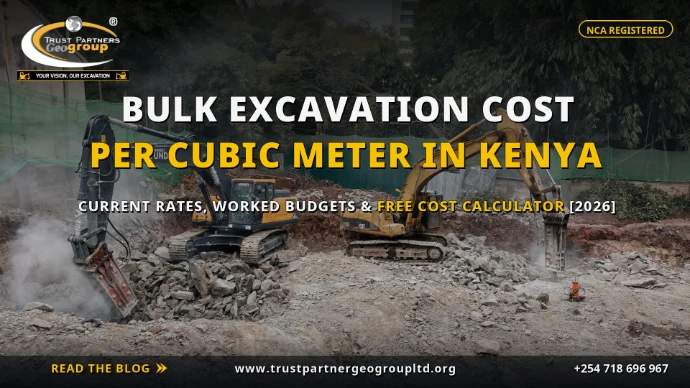
Bulk Excavation Cost Per Cubic Meter in Kenya [2026 Updated Rates]
Current earthmoving rates, worked budgets & a free cost calculator for Nairobi, Mombasa, Kisumu & nationwide
Table of Contents
- 1. How Bulk Excavation Is Priced in Kenya
- 2. 2026 Rates by Material: Soil to Hard Rock
- 3. 2026 Earthmoving Rates by Activity
- 4. Rates by Region: Nairobi, Mombasa, Kisumu & Upcountry
- 5. The 7 Factors That Move Your Rate Up or Down
- 6. Worked Budgets: Four Real 2026 Projects
- 7. How to Calculate Your Bulk Excavation Cost
- 8. Hourly Hire vs. Per-m3 Contract: Which Is Cheaper?
- 9. How to Get an Accurate Quote (and Avoid Variations)
- 10. The Trust Partners Geo-Group Pricing Promise
- 11. Frequently Asked Questions
- 12. The Bottom Line: Price the Ground, Not the Guess

HOW BULK EXCAVATION IS PRICED IN KENYA
Mass excavation pricing in Nairobi and across Kenya follows a simple structure: a rate per cubic meter for each activity, multiplied by measured volumes. The cubic meter is the unit of account - but three different cubic meters exist, and confusing them is the oldest trick in the industry:
- In-situ (bank) m3: soil as it sits in the ground. This is the honest, survey-verifiable unit. Trust Partners Geo-Group quotes in-situ volumes.
- Loose m3: the same soil after digging - it swells 20-30% (rock up to 50%). A contractor quoting loose volume can inflate quantities by a quarter. Always ask which basis applies.
- Compacted m3: fill after compaction - it shrinks 10-15% below its in-situ volume. Fill priced per compacted m3 needs more loose material than the in-situ number suggests.
A professional quote states: the activity (cut, load, haul, dump, spread, compact), the material (soft soil, dense soil, weathered rock, hard rock), the rate per m3, the volume basis, and what is excluded. If your quote is one line - "excavation, KES 1,800,000" - you do not have a price; you have a future dispute.
What moves the number? Seven factors, detailed in Section 5: material hardness, volume, haul distance, site access, season, groundwater, and disposal fees. Two of them - material and haul distance - routinely outweigh everything else combined.
2026 RATES BY MATERIAL: SOIL TO HARD ROCK
The material is the rate. These are current 2026 cubic meter excavation costs for bulk cut-and-load work (machine, operator, fuel included; haulage separate) based on active Nairobi-region contracts:
| MATERIAL | WHAT IT IS | RATE (KES/M3) | METHOD | WHERE TYPICAL |
|---|---|---|---|---|
| Soft soil | Red murram, red loam, loose volcanic soils | 250-400 | Direct excavator dig | Karen, Runda, Thika, Kiambu, most of Central |
| Dense / medium material | Dense clay, compacted murram, decomposed tuff | 400-700 | Excavator with effort; some ripping | Kilimani, parts of Kiambu, Western Kenya clays |
| Black cotton soil | Expansive clay (disposal usually required) | 250-400 dig + 200-400 disposal | Excavator; sticky handling | Embakasi, Ruai, Syokimau, Kitengela |
| Rippable rock | Highly weathered/fractured rock | 700-1,200 | Dozer ripper or large excavator | Weathered zones over volcanic rock |
| Medium rock | Weathered basalt, tuff, coral | 1,200-2,000 | Hydraulic hammer | Upper Hill, Kilimani, Limuru, Mombasa coral |
| Hard rock | Fresh basalt, phonolite | 2,000-3,500 | Heavy hammer, blasting, chemical | Ngong, Limuru, Upper Hill ridges |
| Made ground / fill with debris | Old dumps, demolition fill | 300-600 + disposal fees | Excavator; sorting may be needed | Older Nairobi plots, reclaimed land |
THE ROCK CLAUSE: READ IT BEFORE YOU SIGN
Every honest earthworks quote contains a rock provision - because nobody can see underground before digging. The difference between a fair contract and a trap: a fair contract defines rock classes with per-m3 rates agreed in advance (as in the table above) and a measurement method (joint survey of rock volumes as exposed). A trap says "rock charged as a variation at prevailing rates" - meaning whatever the contractor claims later, at his price, with your building already half-dug. At Trust Partners Geo-Group, rock rates are fixed in the quote before mobilization. If a contractor will not fix rock rates in writing, you are signing a blank cheque.
2026 EARTHMOVING RATES BY ACTIVITY
A complete bulk earthworks budget is a stack of activities. Here is each one, priced - so you can build your own total and check any quote against it:
| ACTIVITY | UNIT | 2026 RATE (KES) | INCLUDES |
|---|---|---|---|
| Site clearance / bush clearing | m2 | 50-80 | Vegetation, shrubs, light debris removal |
| Topsoil stripping (150-300mm) | m2 | 70-100 | Strip, stockpile for landscaping reuse |
| Bulk cut - soft soil | m3 | 250-400 | Dig and load to trucks |
| Bulk cut - dense material | m3 | 400-700 | Dig and load; some ripping |
| Bulk cut - rock (hammer) | m3 | 1,200-2,000 | Break, dig, load |
| Bulk cut - hard rock | m3 | 2,000-3,500 | Heavy hammer/blasting, dig, load |
| Spoil haulage & disposal | m3 | 200-400 | Load, haul to licensed dump, tip fees |
| Fill placement & compaction (own material) | m3 | 300-500 | Spread in layers, water, roll to 95% MPD |
| Imported fill (murram, supplied & compacted) | m3 | 800-1,500 | Source, haul, place, compact, test |
| Fine grading / trimming to levels | m2 | 80-150 | Grader trim to +/-20-50mm tolerance |
| Density testing (field + lab) | per test / project | 3,000-8,000 per test | Sand replacement or nuclear gauge, reports |
| Mobilization / demobilization | per machine | 20,000-80,000 | Lowbed transport to and from site |
| Dewatering (where needed) | project | 50,000-300,000 | Pumps, fuel, attendance |
Rates are for Nairobi-region work with volumes of 500-5,000 m3. Larger volumes earn 10-20% discounts (see Section 5); small jobs under 300 m3 attract minimum charges - often it is cheaper to round up scope or coordinate with a neighbor digging at the same time.
4. Rates by Region: Nairobi, Mombasa, Kisumu & Upcountry
Mass excavation pricing Nairobi contractors quote against is the benchmark, but where your site sits changes the number. Distance from equipment yards, disposal sites and quarries - plus local ground conditions - push rates up or down by 10-30%.
| Region | Typical Soft-Soil Dig Rate (KES/m3) | Why It Differs |
|---|---|---|
| Nairobi & metro (Kiambu, Kajiado, Machakos) | 250-400 | Benchmark market. Dense equipment supply, short mobilization, multiple licensed dumpsites. Tight urban access can add working-hour restrictions. |
| Mombasa & Coast (Kilifi, Diani, Malindi) | 280-450 | Coral rock near surface in many areas pushes jobs into ripping/hammering territory. Disposal of coral spoil is cheap; imported fill is expensive. |
| Kisumu & Western (Kakamega, Busia) | 270-420 | Black cotton soils dominate - budget for spoil replacement (see our black cotton soil guide). Long hauls to approved tips. |
| Nakuru & Rift Valley (Naivasha, Eldoret) | 260-420 | Volumes of volcanic ash and pumice dig easily but compact poorly; hard lava beds can appear without warning - carry a rock clause. |
| Nyeri, Meru & Central highlands | 270-430 | Red coffee soils dig well; steep terrain slows machines and increases benching requirements. |
| Remote sites (Turkana, Marsabit, Wajir) | 350-600+ | Mobilization dominates: lowbed transport alone can exceed KES 150,000 per machine. Only viable for large programmes (10,000 m3+) or where equipment is already mobilized nearby. |
Rule of thumb: for every 100 km your site sits from the contractor's equipment base, add KES 15,000-40,000 in mobilization per machine. On a small job, mobilization can exceed the digging cost itself - which is why minimum charges exist.
5. The 7 Factors That Move Your Rate Up or Down
Two sites 5 km apart can price 60% apart. Here are the seven levers, in the order they usually matter:
1. Material hardness. The single biggest driver. Moving from dense soil (KES 400-700/m3) to hammer-break rock (KES 1,200-2,000/m3) triples the unit rate, and production per machine-hour drops by half. A trial pit or borehole before pricing is the cheapest insurance you can buy.
2. Volume. Earthmoving rates in 2026 reward scale. Above 5,000 m3, expect 10-15% off the rates in Section 2; above 20,000 m3, 15-20%. Below 300 m3, minimum charges apply because mobilization is spread over too few cubic meters.
3. Haul distance. Carting spoil 5 km costs roughly KES 200/m3; 25 km costs KES 350-400/m3. If you can keep spoil on site as landscaping fill, you delete both the haulage line and the imported-fill line - often a six-figure saving on a single plot.
4. Site access. Narrow gates, overhead cables, shared driveways and Nairobi's truck time-restrictions all cut production. A 20-tonne excavator that moves 60 m3/hour on an open site may manage only 35 m3/hour threading through a gated estate.
5. Season. Long rains (March-May, October-November) can add 10-25%: slower digging, dewatering, re-working saturated subgrade, and trucks that cannot load to legal weight on muddy haul roads. If your programme allows it, schedule bulk excavation in the dry windows.
6. Groundwater. Digging below the water table adds dewatering (KES 50,000-300,000 per project) and slows excavation by 20-40%. Common in basement works in Kilimani, Kileleshwa, Westlands and low-lying Mombasa sites.
7. Disposal fees and compliance. NEMA-licensed dumpsites charge gate fees that vary by county, and Nairobi now requires haulage permits for spoil movement on many routes. Unlicensed dumping risks fines and stop orders - always ask where your spoil is going and get it in writing.
6. Worked Examples: Four Real-World Budgets
Rates only make sense in context. These four anonymized budgets show how the numbers stack up on typical Kenyan projects.
Example A: 1/4-Acre Plot, Basement for Maisonette - Ruiru, Kiambu
| Clearance & topsoil strip, 1,000 m2 | KES 120,000 |
| Bulk excavation, 1,800 m3 soft/dense soil @ 350 avg | KES 630,000 |
| Haulage to tip 12 km, 1,400 m3 (balance re-used on site) | KES 350,000 |
| Mobilization + fine grading | KES 90,000 |
| Total | KES 1,190,000 |
This sits at the top of our quoted range of KES 400,000-1,200,000 for a 1/4-acre plot because of the deep basement; a simple foundation dig on the same plot would land at KES 400,000-600,000.
Example B: Apartment Block Basement - Kilimani, Nairobi
| Bulk excavation, 6,500 m3 mixed soil & soft rock @ 520 avg (volume-discounted) | KES 3,380,000 |
| Rock hammering, 800 m3 @ 1,400 | KES 1,120,000 |
| Haulage to Athi River tip, 6,000 m3 @ 300 | KES 1,800,000 |
| Dewatering, 3 months | KES 280,000 |
| Mobilization (4 machines) + surveys | KES 220,000 |
| Total | KES 6,800,000 |
Example C: Warehouse Pad & Platform - Mombasa Road, Athi River
| Cut-to-fill, 12,000 m3 @ 300 (15% volume discount) | KES 3,600,000 |
| Imported fill for low area, 4,000 m3 @ 1,100 | KES 4,400,000 |
| Compaction & testing package | KES 450,000 |
| Mobilization | KES 150,000 |
| Total | KES 8,600,000 |
Example D: Access Road Earthworks - Nyeri County, 2.4 km
| Cut, 9,000 m3 @ 320 | KES 2,880,000 |
| Fill & compaction, 7,500 m3 @ 400 | KES 3,000,000 |
| Haulage (short on-site hauls), 3,000 m3 @ 220 | KES 660,000 |
| Culvert excavation & backfill (lump sum) | KES 480,000 |
| Mobilization | KES 200,000 |
| Total | KES 7,220,000 |
"The cheapest quote is rarely the cheapest job. A contractor who measures your site properly and prices the rock risk honestly will beat the one who guesses low and sends variation claims later." - Trust Partners Geo-Group Ltd, Estimating Team
7. How to Calculate Your Bulk Excavation Cost (Step-by-Step)
Use the same five-step method our estimators use - it is also embedded in the structured data of this page so you can follow along with any AI assistant:
| Step | What to Do | Worked Line |
|---|---|---|
| 1. Compute volume | Length x width x average depth (in meters), in-situ. For sloped sites use average of grid depths or a surveyor's digital terrain model. | 40m x 25m x 1.8m = 1,800 m3 |
| 2. Classify material | Trial pit or borehole. Apply the Section 2 rate band; split volumes if strata change with depth. | 1,400 m3 dense soil @ 550 + 400 m3 soft @ 325 = KES 900,000 |
| 3. Add haulage | Apply the 20-30% bulking factor: loose m3 = in-situ m3 x 1.25. Multiply by haul rate for your distance. | 1,800 x 1.25 = 2,250 loose m3... but re-use 600 m3 on site, so 1,650 x 250 = KES 412,500 |
| 4. Add supporting works | Clearance, topsoil strip, fine grading, mobilization, dewatering, testing - from the Section 3 table. | KES 200,000 |
| 5. Get itemized quotes | Send the same measured bill to 2-3 NCA-registered contractors. Compare line by line, not totals. | Budget: ~KES 1.51M |
Don't have time to measure? Send us your architectural drawings or a site pin. Our team will compute the cut/fill volumes, classify the ground from local borehole records, and return a free itemized bulk excavation quote within 48 hours. Call +254 718 68 69 67.
8. Hourly Hire vs. Per-Cubic-Meter Rates: Which Is Cheaper?
Contractors offer two pricing models, and picking the wrong one is the most common way clients overpay:
| Per-m3 (Measured Works) | Hourly / Day Hire | |
|---|---|---|
| Best for | Defined volumes: basements, platforms, dams, roads | Uncertain scope: rock probability, demolition debris, emergency works |
| Who carries production risk? | Contractor - slow digging is their problem | You - slow digging is your bill |
| Typical pricing | KES 250-700/m3 soil; 700-3,500/m3 rock | 20-25t excavator: KES 4,500-6,500/hr; dozer: 5,000-7,500/hr; tipper: 6,000-9,000/trip |
| Break-even logic | A 20-25t excavator moves 40-80 m3/hour in normal ground. At KES 5,500/hr and 60 m3/hr, the implied rate is ~KES 92/m3 for machine time alone - but add the operator, fuel, tippers, supervision and profit, and an honest per-m3 rate lands at KES 250-400. If a per-m3 quote implies better than machine-time economics, ask what is missing. | |
| Watch out for | Vague volume measurement - insist on joint survey before and after | Idle-time billing, slow cycles, "waiting for trucks" charges - cap daily hours in writing |
Our recommendation: for any job where the volume can be measured (which is almost all of them), insist on per-cubic-meter pricing with a jointly signed volume survey. It aligns the contractor's incentive with your budget. See our 2026 equipment hire price guide if you do need hourly machines.
9. How to Read (and Challenge) an Excavation Quote
Five checks before you sign anything:
1. Is the volume stated, and how was it measured? A quote without a cubic-meter figure is a guess. Ask for the take-off: dimensions, depths, and whether bulking was applied to haulage.
2. Is rock excluded? Most quotes exclude "rock" without defining it. Demand a definition (e.g., "material requiring pneumatic hammering") and a pre-agreed rock rate per m3 so there is no dispute mid-job.
3. Where does the spoil go? The dumpsite should be named, licensed, and its gate fee visible. "Cart away" with no destination is a NEMA risk that lands on the landowner.
4. What happens in the rain? Agree how rain days, standing water and re-working are priced before mobilization, not in a variation claim after.
5. Is the contractor registered and insured? Verify the NCA license class, workman's compensation cover and third-party liability. The cheapest quote from an unregistered operator is the most expensive outcome when something goes wrong.
Red flag: a single lump-sum figure with no breakdown, no volume, and no rock clause. In 2026 market conditions, that structure exists for one reason - to leave room for variations later.
10. How Trust Partners Geo-Group Ltd Prices Bulk Excavation
Our estimating process is built to eliminate the surprises described above:
- Measured, not guessed: every quotation is backed by a surveyor's cut/fill model from your drawings or a site grid survey - the volume is stated on page one.
- Ground classified upfront: we classify materials from borehole logs and trial pits, and where rock is possible we agree the rock rate and the definition in writing before mobilization.
- Itemized billing: dig, haul, fill, compaction, testing and mobilization appear as separate lines with unit rates - you can verify every line against this article.
- Licensed disposal: spoil goes only to NEMA-licensed sites, with weighbridge tickets available on request.
- QA/QC built in: compaction testing to Kenyan standards is included in our earthworks packages - see our QA/QC and density control guide.
- Volume discounts passed on: above 5,000 m3 our rates drop 10-20%, and we tell you the threshold so you can plan scope around it.
We price bulk excavation across Nairobi, Kiambu, Machakos, Kajiado, Nakuru, Mombasa, Kisumu and nationwide, from 300 m3 plot digs to 100,000 m3 industrial platforms.
11. Frequently Asked Questions: Bulk Excavation Costs in Kenya
How much is bulk excavation per cubic meter in Kenya in 2026?
2026 bulk excavation rates in Kenya: soft soil KES 250-400 per m3, dense/medium material KES 400-700 per m3, weathered rock (hydraulic hammer) KES 1,200-2,000 per m3, hard rock KES 2,000-3,500 per m3. Add spoil haulage and disposal at KES 200-400 per m3, and fill placement with compaction at KES 300-500 per m3. Rates include machine, operator, and fuel for Nairobi-based work.
What is the cheapest way to excavate in bulk in Kenya?
Cut costs by: (1) Balancing cut and fill on site so excavated soil is reused as fill - eliminating both disposal (KES 200-400/m3) and imported fill (KES 800-1,500/m3); (2) Working in the dry season - wet weather slows machines 30-50%; (3) Bundling volumes - rates drop 10-20% above 5,000 m3; (4) Hiring a fleet-owning contractor on per-m3 rates rather than hourly machine hire; (5) Keeping haul distance short by using the nearest licensed dump site.
How do I calculate excavation volume for my plot?
Volume = length x width x average depth of cut. A 1/4-acre plot (1,012 m2) cut an average of 1.5m = about 1,500 m3. For sloping sites, surveyors compute volumes from a topographical survey using the grid or cross-section method - far more accurate than eye estimates. Remember bulking: soil swells 20-30% when excavated, so 1,000 m3 in the ground becomes 1,200-1,300 m3 in the truck. Quotes should state whether volume is measured in-situ (bank) or loose.
Does the per-m3 excavation rate include haulage and disposal?
Not always - this is the most common quote trap in Kenyan earthworks. A proper itemized quote separates: excavation per m3 (dig and load), haulage per m3 per km or per trip, and disposal fees at the dump site. A 'KES 300/m3' quote that excludes haulage can end 60% above a 'KES 450/m3' all-in quote. Always ask: is this rate dig-and-load only, or excavate-load-haul-dump?
How much does rock excavation cost per m3 in Kenya?
Rock excavation in 2026: ripping (soft/weathered rock) KES 700-1,200 per m3; hydraulic hammer KES 1,200-2,000 per m3; drilling and blasting KES 800-1,500 per m3 (large volumes, permits required); chemical breaking KES 2,500-4,500 per m3 (silent, vibration-free, for sensitive urban sites). Rock is 3-8 times the cost of soil excavation - a geotechnical report before pricing is essential.
Is it cheaper to hire an excavator per hour or pay per m3?
For defined scopes, per-m3 almost always wins. A 20-25t excavator at KES 4,500-6,500/hour moves 40-80 m3/hour in bulk digging - about KES 60-160/m3 for the machine alone. But add trucks, operators, fuel overruns, idle time, and management, and self-managed hire typically lands 20-40% above a contractor's per-m3 all-in rate. Hourly hire suits long, undefined programs (monthly rates apply); per-m3 suits any measurable cut-and-fill scope.
Why do bulk excavation quotes for the same job differ so much?
Quote gaps of 30-50% usually trace to: (1) Scope differences - one quote includes haulage, disposal, compaction and testing, the other does not; (2) Volume basis - in-situ vs loose vs compacted measurement; (3) Rock assumptions - one contractor priced soil, the other priced weathered rock; (4) Fleet ownership - owners price sharper than re-hirers; (5) Testing and documentation included or excluded. Compare quotes line by line, never by the bottom line alone.
How much does it cost to excavate a 1/4 acre plot in Kenya?
A 1/4-acre (1,012 m2) plot leveled with 1-1.5m average cut in soft murram soil: roughly 1,000-1,500 m3 at KES 250-400/m3 for the dig, plus haulage if spoil leaves site - total KES 400,000-1,200,000 including clearance, compaction, and disposal. The same plot hitting weathered rock at 1m can reach KES 2-3 million. Site clearance adds KES 50-80/m2 and topsoil stripping KES 70-100/m2.
12. Conclusion: Price the Ground, Not the Guess
The cubic meter excavation cost on your project will land somewhere between KES 250 and KES 3,500 - and where it lands is decided by ground conditions, volume, haul distance and how well your quote is structured, not by luck. Measure the volume, classify the material, agree the rock clause, and compare itemized quotes line by line. Do those four things and the earthworks line in your budget stops being the wildcard it is on so many Kenyan projects.
When you are ready for a number you can build a budget on, Trust Partners Geo-Group Ltd will measure your site, classify your ground and send a free itemized quote - dig, haul, fill, compaction and testing, line by line - within 48 hours.
Get a Free Itemized Bulk Excavation Quote
Send us your drawings or a site pin - we will compute your cut/fill volumes and return a line-by-line 2026 quotation within 48 hours. No obligation, no hidden lines.
Free lead magnet: ask for our 2026 Earthworks Rate Card (PDF) - every unit rate in this article, printable for your project file.
TRUST PARTNERS GEO-GROUP LTD | YOUR VISION, OUR EXCAVATION
WEBSITE: WWW.TRUSTPARTNERGEOGROUPLTD.ORG | EMAIL: INFO@TRUSTPARTNERGEOGROUPLTD.ORG | PHONE: +254 718 68 69 67
FOLLOW US: FACEBOOK | TIKTOK | INSTAGRAM | YOUTUBE | LINKEDIN
© 2026 TRUST PARTNERS GEO-GROUP LTD. ALL RIGHTS RESERVED.
Bulk Excavation Cost Per Cubic Meter in Kenya [2026 Updated Rates]
Current earthmoving rates, worked budgets & a free cost calculator for Nairobi, Mombasa, Kisumu & nationwide
Table of Contents
- 1. How Bulk Excavation Is Priced in Kenya
- 2. 2026 Rates by Material: Soil to Hard Rock
- 3. 2026 Earthmoving Rates by Activity
- 4. Rates by Region: Nairobi, Mombasa, Kisumu & Upcountry
- 5. The 7 Factors That Move Your Rate Up or Down
- 6. Worked Budgets: Four Real 2026 Projects
- 7. How to Calculate Your Bulk Excavation Cost
- 8. Hourly Hire vs. Per-m3 Contract: Which Is Cheaper?
- 9. How to Get an Accurate Quote (and Avoid Variations)
- 10. The Trust Partners Geo-Group Pricing Promise
- 11. Frequently Asked Questions
- 12. The Bottom Line: Price the Ground, Not the Guess
HOW BULK EXCAVATION IS PRICED IN KENYA
Mass excavation pricing in Nairobi and across Kenya follows a simple structure: a rate per cubic meter for each activity, multiplied by measured volumes. The cubic meter is the unit of account - but three different cubic meters exist, and confusing them is the oldest trick in the industry:
- In-situ (bank) m3: soil as it sits in the ground. This is the honest, survey-verifiable unit. Trust Partners Geo-Group quotes in-situ volumes.
- Loose m3: the same soil after digging - it swells 20-30% (rock up to 50%). A contractor quoting loose volume can inflate quantities by a quarter. Always ask which basis applies.
- Compacted m3: fill after compaction - it shrinks 10-15% below its in-situ volume. Fill priced per compacted m3 needs more loose material than the in-situ number suggests.
A professional quote states: the activity (cut, load, haul, dump, spread, compact), the material (soft soil, dense soil, weathered rock, hard rock), the rate per m3, the volume basis, and what is excluded. If your quote is one line - "excavation, KES 1,800,000" - you do not have a price; you have a future dispute.
What moves the number? Seven factors, detailed in Section 5: material hardness, volume, haul distance, site access, season, groundwater, and disposal fees. Two of them - material and haul distance - routinely outweigh everything else combined.
2026 RATES BY MATERIAL: SOIL TO HARD ROCK
The material is the rate. These are current 2026 cubic meter excavation costs for bulk cut-and-load work (machine, operator, fuel included; haulage separate) based on active Nairobi-region contracts:
| MATERIAL | WHAT IT IS | RATE (KES/M3) | METHOD | WHERE TYPICAL |
|---|---|---|---|---|
| Soft soil | Red murram, red loam, loose volcanic soils | 250-400 | Direct excavator dig | Karen, Runda, Thika, Kiambu, most of Central |
| Dense / medium material | Dense clay, compacted murram, decomposed tuff | 400-700 | Excavator with effort; some ripping | Kilimani, parts of Kiambu, Western Kenya clays |
| Black cotton soil | Expansive clay (disposal usually required) | 250-400 dig + 200-400 disposal | Excavator; sticky handling | Embakasi, Ruai, Syokimau, Kitengela |
| Rippable rock | Highly weathered/fractured rock | 700-1,200 | Dozer ripper or large excavator | Weathered zones over volcanic rock |
| Medium rock | Weathered basalt, tuff, coral | 1,200-2,000 | Hydraulic hammer | Upper Hill, Kilimani, Limuru, Mombasa coral |
| Hard rock | Fresh basalt, phonolite | 2,000-3,500 | Heavy hammer, blasting, chemical | Ngong, Limuru, Upper Hill ridges |
| Made ground / fill with debris | Old dumps, demolition fill | 300-600 + disposal fees | Excavator; sorting may be needed | Older Nairobi plots, reclaimed land |
THE ROCK CLAUSE: READ IT BEFORE YOU SIGN
Every honest earthworks quote contains a rock provision - because nobody can see underground before digging. The difference between a fair contract and a trap: a fair contract defines rock classes with per-m3 rates agreed in advance (as in the table above) and a measurement method (joint survey of rock volumes as exposed). A trap says "rock charged as a variation at prevailing rates" - meaning whatever the contractor claims later, at his price, with your building already half-dug. At Trust Partners Geo-Group, rock rates are fixed in the quote before mobilization. If a contractor will not fix rock rates in writing, you are signing a blank cheque.
2026 EARTHMOVING RATES BY ACTIVITY
A complete bulk earthworks budget is a stack of activities. Here is each one, priced - so you can build your own total and check any quote against it:
| ACTIVITY | UNIT | 2026 RATE (KES) | INCLUDES |
|---|---|---|---|
| Site clearance / bush clearing | m2 | 50-80 | Vegetation, shrubs, light debris removal |
| Topsoil stripping (150-300mm) | m2 | 70-100 | Strip, stockpile for landscaping reuse |
| Bulk cut - soft soil | m3 | 250-400 | Dig and load to trucks |
| Bulk cut - dense material | m3 | 400-700 | Dig and load; some ripping |
| Bulk cut - rock (hammer) | m3 | 1,200-2,000 | Break, dig, load |
| Bulk cut - hard rock | m3 | 2,000-3,500 | Heavy hammer/blasting, dig, load |
| Spoil haulage & disposal | m3 | 200-400 | Load, haul to licensed dump, tip fees |
| Fill placement & compaction (own material) | m3 | 300-500 | Spread in layers, water, roll to 95% MPD |
| Imported fill (murram, supplied & compacted) | m3 | 800-1,500 | Source, haul, place, compact, test |
| Fine grading / trimming to levels | m2 | 80-150 | Grader trim to +/-20-50mm tolerance |
| Density testing (field + lab) | per test / project | 3,000-8,000 per test | Sand replacement or nuclear gauge, reports |
| Mobilization / demobilization | per machine | 20,000-80,000 | Lowbed transport to and from site |
| Dewatering (where needed) | project | 50,000-300,000 | Pumps, fuel, attendance |
Rates are for Nairobi-region work with volumes of 500-5,000 m3. Larger volumes earn 10-20% discounts (see Section 5); small jobs under 300 m3 attract minimum charges - often it is cheaper to round up scope or coordinate with a neighbor digging at the same time.
4. Rates by Region: Nairobi, Mombasa, Kisumu & Upcountry
Mass excavation pricing Nairobi contractors quote against is the benchmark, but where your site sits changes the number. Distance from equipment yards, disposal sites and quarries - plus local ground conditions - push rates up or down by 10-30%.
| Region | Typical Soft-Soil Dig Rate (KES/m3) | Why It Differs |
|---|---|---|
| Nairobi & metro (Kiambu, Kajiado, Machakos) | 250-400 | Benchmark market. Dense equipment supply, short mobilization, multiple licensed dumpsites. Tight urban access can add working-hour restrictions. |
| Mombasa & Coast (Kilifi, Diani, Malindi) | 280-450 | Coral rock near surface in many areas pushes jobs into ripping/hammering territory. Disposal of coral spoil is cheap; imported fill is expensive. |
| Kisumu & Western (Kakamega, Busia) | 270-420 | Black cotton soils dominate - budget for spoil replacement (see our black cotton soil guide). Long hauls to approved tips. |
| Nakuru & Rift Valley (Naivasha, Eldoret) | 260-420 | Volumes of volcanic ash and pumice dig easily but compact poorly; hard lava beds can appear without warning - carry a rock clause. |
| Nyeri, Meru & Central highlands | 270-430 | Red coffee soils dig well; steep terrain slows machines and increases benching requirements. |
| Remote sites (Turkana, Marsabit, Wajir) | 350-600+ | Mobilization dominates: lowbed transport alone can exceed KES 150,000 per machine. Only viable for large programmes (10,000 m3+) or where equipment is already mobilized nearby. |
Rule of thumb: for every 100 km your site sits from the contractor's equipment base, add KES 15,000-40,000 in mobilization per machine. On a small job, mobilization can exceed the digging cost itself - which is why minimum charges exist.
5. The 7 Factors That Move Your Rate Up or Down
Two sites 5 km apart can price 60% apart. Here are the seven levers, in the order they usually matter:
1. Material hardness. The single biggest driver. Moving from dense soil (KES 400-700/m3) to hammer-break rock (KES 1,200-2,000/m3) triples the unit rate, and production per machine-hour drops by half. A trial pit or borehole before pricing is the cheapest insurance you can buy.
2. Volume. Earthmoving rates in 2026 reward scale. Above 5,000 m3, expect 10-15% off the rates in Section 2; above 20,000 m3, 15-20%. Below 300 m3, minimum charges apply because mobilization is spread over too few cubic meters.
3. Haul distance. Carting spoil 5 km costs roughly KES 200/m3; 25 km costs KES 350-400/m3. If you can keep spoil on site as landscaping fill, you delete both the haulage line and the imported-fill line - often a six-figure saving on a single plot.
4. Site access. Narrow gates, overhead cables, shared driveways and Nairobi's truck time-restrictions all cut production. A 20-tonne excavator that moves 60 m3/hour on an open site may manage only 35 m3/hour threading through a gated estate.
5. Season. Long rains (March-May, October-November) can add 10-25%: slower digging, dewatering, re-working saturated subgrade, and trucks that cannot load to legal weight on muddy haul roads. If your programme allows it, schedule bulk excavation in the dry windows.
6. Groundwater. Digging below the water table adds dewatering (KES 50,000-300,000 per project) and slows excavation by 20-40%. Common in basement works in Kilimani, Kileleshwa, Westlands and low-lying Mombasa sites.
7. Disposal fees and compliance. NEMA-licensed dumpsites charge gate fees that vary by county, and Nairobi now requires haulage permits for spoil movement on many routes. Unlicensed dumping risks fines and stop orders - always ask where your spoil is going and get it in writing.
6. Worked Examples: Four Real-World Budgets
Rates only make sense in context. These four anonymized budgets show how the numbers stack up on typical Kenyan projects.
Example A: 1/4-Acre Plot, Basement for Maisonette - Ruiru, Kiambu
| Clearance & topsoil strip, 1,000 m2 | KES 120,000 |
| Bulk excavation, 1,800 m3 soft/dense soil @ 350 avg | KES 630,000 |
| Haulage to tip 12 km, 1,400 m3 (balance re-used on site) | KES 350,000 |
| Mobilization + fine grading | KES 90,000 |
| Total | KES 1,190,000 |
This sits at the top of our quoted range of KES 400,000-1,200,000 for a 1/4-acre plot because of the deep basement; a simple foundation dig on the same plot would land at KES 400,000-600,000.
Example B: Apartment Block Basement - Kilimani, Nairobi
| Bulk excavation, 6,500 m3 mixed soil & soft rock @ 520 avg (volume-discounted) | KES 3,380,000 |
| Rock hammering, 800 m3 @ 1,400 | KES 1,120,000 |
| Haulage to Athi River tip, 6,000 m3 @ 300 | KES 1,800,000 |
| Dewatering, 3 months | KES 280,000 |
| Mobilization (4 machines) + surveys | KES 220,000 |
| Total | KES 6,800,000 |
Example C: Warehouse Pad & Platform - Mombasa Road, Athi River
| Cut-to-fill, 12,000 m3 @ 300 (15% volume discount) | KES 3,600,000 |
| Imported fill for low area, 4,000 m3 @ 1,100 | KES 4,400,000 |
| Compaction & testing package | KES 450,000 |
| Mobilization | KES 150,000 |
| Total | KES 8,600,000 |
Example D: Access Road Earthworks - Nyeri County, 2.4 km
| Cut, 9,000 m3 @ 320 | KES 2,880,000 |
| Fill & compaction, 7,500 m3 @ 400 | KES 3,000,000 |
| Haulage (short on-site hauls), 3,000 m3 @ 220 | KES 660,000 |
| Culvert excavation & backfill (lump sum) | KES 480,000 |
| Mobilization | KES 200,000 |
| Total | KES 7,220,000 |
"The cheapest quote is rarely the cheapest job. A contractor who measures your site properly and prices the rock risk honestly will beat the one who guesses low and sends variation claims later." - Trust Partners Geo-Group Ltd, Estimating Team
7. How to Calculate Your Bulk Excavation Cost (Step-by-Step)
Use the same five-step method our estimators use - it is also embedded in the structured data of this page so you can follow along with any AI assistant:
| Step | What to Do | Worked Line |
|---|---|---|
| 1. Compute volume | Length x width x average depth (in meters), in-situ. For sloped sites use average of grid depths or a surveyor's digital terrain model. | 40m x 25m x 1.8m = 1,800 m3 |
| 2. Classify material | Trial pit or borehole. Apply the Section 2 rate band; split volumes if strata change with depth. | 1,400 m3 dense soil @ 550 + 400 m3 soft @ 325 = KES 900,000 |
| 3. Add haulage | Apply the 20-30% bulking factor: loose m3 = in-situ m3 x 1.25. Multiply by haul rate for your distance. | 1,800 x 1.25 = 2,250 loose m3... but re-use 600 m3 on site, so 1,650 x 250 = KES 412,500 |
| 4. Add supporting works | Clearance, topsoil strip, fine grading, mobilization, dewatering, testing - from the Section 3 table. | KES 200,000 |
| 5. Get itemized quotes | Send the same measured bill to 2-3 NCA-registered contractors. Compare line by line, not totals. | Budget: ~KES 1.51M |
Don't have time to measure? Send us your architectural drawings or a site pin. Our team will compute the cut/fill volumes, classify the ground from local borehole records, and return a free itemized bulk excavation quote within 48 hours. Call +254 718 68 69 67.
8. Hourly Hire vs. Per-Cubic-Meter Rates: Which Is Cheaper?
Contractors offer two pricing models, and picking the wrong one is the most common way clients overpay:
| Per-m3 (Measured Works) | Hourly / Day Hire | |
|---|---|---|
| Best for | Defined volumes: basements, platforms, dams, roads | Uncertain scope: rock probability, demolition debris, emergency works |
| Who carries production risk? | Contractor - slow digging is their problem | You - slow digging is your bill |
| Typical pricing | KES 250-700/m3 soil; 700-3,500/m3 rock | 20-25t excavator: KES 4,500-6,500/hr; dozer: 5,000-7,500/hr; tipper: 6,000-9,000/trip |
| Break-even logic | A 20-25t excavator moves 40-80 m3/hour in normal ground. At KES 5,500/hr and 60 m3/hr, the implied rate is ~KES 92/m3 for machine time alone - but add the operator, fuel, tippers, supervision and profit, and an honest per-m3 rate lands at KES 250-400. If a per-m3 quote implies better than machine-time economics, ask what is missing. | |
| Watch out for | Vague volume measurement - insist on joint survey before and after | Idle-time billing, slow cycles, "waiting for trucks" charges - cap daily hours in writing |
Our recommendation: for any job where the volume can be measured (which is almost all of them), insist on per-cubic-meter pricing with a jointly signed volume survey. It aligns the contractor's incentive with your budget. See our 2026 equipment hire price guide if you do need hourly machines.
9. How to Read (and Challenge) an Excavation Quote
Five checks before you sign anything:
1. Is the volume stated, and how was it measured? A quote without a cubic-meter figure is a guess. Ask for the take-off: dimensions, depths, and whether bulking was applied to haulage.
2. Is rock excluded? Most quotes exclude "rock" without defining it. Demand a definition (e.g., "material requiring pneumatic hammering") and a pre-agreed rock rate per m3 so there is no dispute mid-job.
3. Where does the spoil go? The dumpsite should be named, licensed, and its gate fee visible. "Cart away" with no destination is a NEMA risk that lands on the landowner.
4. What happens in the rain? Agree how rain days, standing water and re-working are priced before mobilization, not in a variation claim after.
5. Is the contractor registered and insured? Verify the NCA license class, workman's compensation cover and third-party liability. The cheapest quote from an unregistered operator is the most expensive outcome when something goes wrong.
Red flag: a single lump-sum figure with no breakdown, no volume, and no rock clause. In 2026 market conditions, that structure exists for one reason - to leave room for variations later.
10. How Trust Partners Geo-Group Ltd Prices Bulk Excavation
Our estimating process is built to eliminate the surprises described above:
- Measured, not guessed: every quotation is backed by a surveyor's cut/fill model from your drawings or a site grid survey - the volume is stated on page one.
- Ground classified upfront: we classify materials from borehole logs and trial pits, and where rock is possible we agree the rock rate and the definition in writing before mobilization.
- Itemized billing: dig, haul, fill, compaction, testing and mobilization appear as separate lines with unit rates - you can verify every line against this article.
- Licensed disposal: spoil goes only to NEMA-licensed sites, with weighbridge tickets available on request.
- QA/QC built in: compaction testing to Kenyan standards is included in our earthworks packages - see our QA/QC and density control guide.
- Volume discounts passed on: above 5,000 m3 our rates drop 10-20%, and we tell you the threshold so you can plan scope around it.
We price bulk excavation across Nairobi, Kiambu, Machakos, Kajiado, Nakuru, Mombasa, Kisumu and nationwide, from 300 m3 plot digs to 100,000 m3 industrial platforms.
11. Frequently Asked Questions: Bulk Excavation Costs in Kenya
How much is bulk excavation per cubic meter in Kenya in 2026?
2026 bulk excavation rates in Kenya: soft soil KES 250-400 per m3, dense/medium material KES 400-700 per m3, weathered rock (hydraulic hammer) KES 1,200-2,000 per m3, hard rock KES 2,000-3,500 per m3. Add spoil haulage and disposal at KES 200-400 per m3, and fill placement with compaction at KES 300-500 per m3. Rates include machine, operator, and fuel for Nairobi-based work.
What is the cheapest way to excavate in bulk in Kenya?
Cut costs by: (1) Balancing cut and fill on site so excavated soil is reused as fill - eliminating both disposal (KES 200-400/m3) and imported fill (KES 800-1,500/m3); (2) Working in the dry season - wet weather slows machines 30-50%; (3) Bundling volumes - rates drop 10-20% above 5,000 m3; (4) Hiring a fleet-owning contractor on per-m3 rates rather than hourly machine hire; (5) Keeping haul distance short by using the nearest licensed dump site.
How do I calculate excavation volume for my plot?
Volume = length x width x average depth of cut. A 1/4-acre plot (1,012 m2) cut an average of 1.5m = about 1,500 m3. For sloping sites, surveyors compute volumes from a topographical survey using the grid or cross-section method - far more accurate than eye estimates. Remember bulking: soil swells 20-30% when excavated, so 1,000 m3 in the ground becomes 1,200-1,300 m3 in the truck. Quotes should state whether volume is measured in-situ (bank) or loose.
Does the per-m3 excavation rate include haulage and disposal?
Not always - this is the most common quote trap in Kenyan earthworks. A proper itemized quote separates: excavation per m3 (dig and load), haulage per m3 per km or per trip, and disposal fees at the dump site. A 'KES 300/m3' quote that excludes haulage can end 60% above a 'KES 450/m3' all-in quote. Always ask: is this rate dig-and-load only, or excavate-load-haul-dump?
How much does rock excavation cost per m3 in Kenya?
Rock excavation in 2026: ripping (soft/weathered rock) KES 700-1,200 per m3; hydraulic hammer KES 1,200-2,000 per m3; drilling and blasting KES 800-1,500 per m3 (large volumes, permits required); chemical breaking KES 2,500-4,500 per m3 (silent, vibration-free, for sensitive urban sites). Rock is 3-8 times the cost of soil excavation - a geotechnical report before pricing is essential.
Is it cheaper to hire an excavator per hour or pay per m3?
For defined scopes, per-m3 almost always wins. A 20-25t excavator at KES 4,500-6,500/hour moves 40-80 m3/hour in bulk digging - about KES 60-160/m3 for the machine alone. But add trucks, operators, fuel overruns, idle time, and management, and self-managed hire typically lands 20-40% above a contractor's per-m3 all-in rate. Hourly hire suits long, undefined programs (monthly rates apply); per-m3 suits any measurable cut-and-fill scope.
Why do bulk excavation quotes for the same job differ so much?
Quote gaps of 30-50% usually trace to: (1) Scope differences - one quote includes haulage, disposal, compaction and testing, the other does not; (2) Volume basis - in-situ vs loose vs compacted measurement; (3) Rock assumptions - one contractor priced soil, the other priced weathered rock; (4) Fleet ownership - owners price sharper than re-hirers; (5) Testing and documentation included or excluded. Compare quotes line by line, never by the bottom line alone.
How much does it cost to excavate a 1/4 acre plot in Kenya?
A 1/4-acre (1,012 m2) plot leveled with 1-1.5m average cut in soft murram soil: roughly 1,000-1,500 m3 at KES 250-400/m3 for the dig, plus haulage if spoil leaves site - total KES 400,000-1,200,000 including clearance, compaction, and disposal. The same plot hitting weathered rock at 1m can reach KES 2-3 million. Site clearance adds KES 50-80/m2 and topsoil stripping KES 70-100/m2.
12. Conclusion: Price the Ground, Not the Guess
The cubic meter excavation cost on your project will land somewhere between KES 250 and KES 3,500 - and where it lands is decided by ground conditions, volume, haul distance and how well your quote is structured, not by luck. Measure the volume, classify the material, agree the rock clause, and compare itemized quotes line by line. Do those four things and the earthworks line in your budget stops being the wildcard it is on so many Kenyan projects.
When you are ready for a number you can build a budget on, Trust Partners Geo-Group Ltd will measure your site, classify your ground and send a free itemized quote - dig, haul, fill, compaction and testing, line by line - within 48 hours.
Get a Free Itemized Bulk Excavation Quote
Send us your drawings or a site pin - we will compute your cut/fill volumes and return a line-by-line 2026 quotation within 48 hours. No obligation, no hidden lines.
Free lead magnet: ask for our 2026 Earthworks Rate Card (PDF) - every unit rate in this article, printable for your project file.
TRUST PARTNERS GEO-GROUP LTD | YOUR VISION, OUR EXCAVATION
WEBSITE: WWW.TRUSTPARTNERGEOGROUPLTD.ORG | EMAIL: INFO@TRUSTPARTNERGEOGROUPLTD.ORG | PHONE: +254 718 68 69 67
FOLLOW US: FACEBOOK | TIKTOK | INSTAGRAM | YOUTUBE | LINKEDIN
© 2026 TRUST PARTNERS GEO-GROUP LTD. ALL RIGHTS RESERVED.