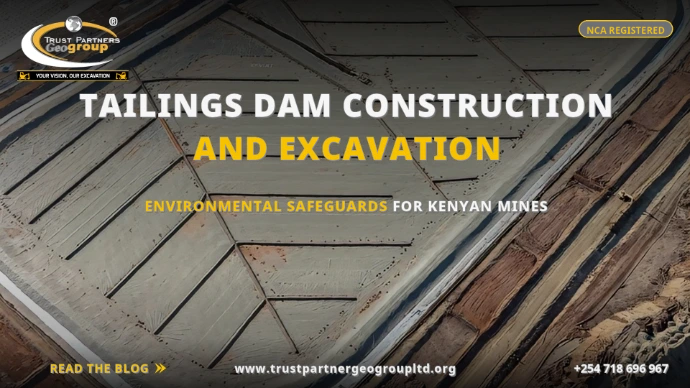
Tailings Dam Construction and Excavation: Environmental Safeguards for Kenyan Mines
Design, excavation, liners & compliance for tailings storage facilities in Migori, Kakamega, Narok, Vihiga & across Kenya
Table of Contents
- 1. What Is a Tailings Dam?
- 2. Tailings Dam Design: Upstream, Downstream & Centerline
- 3. Site Selection & Geotechnical Investigation
- 4. Foundation Excavation & Preparation
- 5. Embankment Construction: Zoning & Compaction
- 6. Liners & Seepage Control
- 7. Water Management: Decant, Spillways & Return Systems
- 8. Environmental Safeguards & Compliance in Kenya
- 9. Monitoring, GISTM & Dam Safety Reviews
- 10. Construction Costs & Programme [2026]
- 11. Frequently Asked Questions
- 12. Conclusion
Every gold pour in Migori, every processing plant in Kakamega, produces a stream of finely ground waste that must be stored safely - forever. That is the job of the tailings dam, the most consequential structure on any mine site: when one fails, the consequences are measured in lives and rivers, not just shillings. This guide explains how tailings dam construction Kenya's mining sector depends on is done properly - the design choices, foundation excavation, embankment zoning, liners, water systems and the environmental safeguards demanded by mining environmental compliance Kenya regulators enforce today, aligned with the Global Industry Standard on Tailings Management (GISTM).
Trust Partners Geo-Group Ltd - Engineering Team
NCA-registered excavation & civil engineering contractor with 15+ years of dam, pond and heavy earthworks experience across East Africa. Reviewed by registered engineers.
1. What Is a Tailings Dam?
After ore is crushed, ground and processed, what remains is tailings - a silt-fine slurry of rock particles, residual process chemicals (cyanide in gold plants, reagents in flotation), and water. A tailings dam - formally a Tailings Storage Facility (TSF) - is the engineered impoundment where this material is deposited:
- Tailings arrive as slurry (typically 30-50% solids) through pipelines and are discharged around the perimeter;
- solids settle and gradually consolidate, forming beaches;
- water collects in a decant pond and is pumped back to the processing plant - modern Kenyan gold plants recycle 70-90% of process water;
- the embankment is raised in stages over the mine's life, growing with production.
Why tailings dams are different from water dams: they must contain fine, sometimes contaminated solids permanently - there is no "end of operations" after which the structure stops mattering. Design, construction and monitoring standards are correspondingly stricter, and closure is an engineered phase measured in decades.
2. Tailings Dam Design: Upstream, Downstream & Centerline
Tailings dam design begins with how the embankment will be raised as storage is consumed:
| Method | How It Works | Fill Demand | Risk Profile |
|---|---|---|---|
| Upstream | Each raise steps inward, founded partly on settled tailings | Lowest (cheapest) | Highest - sensitive to saturation, liquefaction and seismic events; behind most global failures |
| Downstream | Each raise steps outward onto firm natural ground | Highest fill volumes | Most stable; the default for new facilities under GISTM-aligned practice |
| Centerline | Raises placed directly on the previous crest | Intermediate | Intermediate - acceptable with good drainage and beach control |
Design outputs an earthworks contractor builds from include: embankment cross-sections with zoning, starter dam geometry, staged raise schedule, liner extents, decant and spillway hydraulics, and the instrumentation plan. Alternative storage - thickened tailings, paste backfill, dry stacking of filtered tailings - is increasingly specified for new East African projects; dry stacks eliminate the flow-failure mode entirely at an operating cost of roughly KES 100-300/tonne for filtration.
3. Site Selection & Geotechnical Investigation
Most tailings risk is eliminated before construction - by where you put the facility:
- Topography: side-hill and valley sites that maximize storage per meter of embankment;
- Foundation conditions: investigated by boreholes and test pits - bearing capacity, settlement, and especially permeability (a TSF on fractured rock or sand leaks by default);
- Water: outside floodplains, clear of springs, with groundwater mapped so monitoring bores can be placed upstream and downstream;
- Materials balance: suitable embankment fill and clay liner material within economical haul - borrow investigations run in parallel (see our fill sourcing guide);
- Consequence assessment: what lies in the failure path - settlements, rivers, farms - which sets the consequence classification and the design standard itself.
Investigation budgets for a small-medium Kenyan TSF run KES 2-8 million - trivial against the KES 30-150 million construction cost, and non-negotiable against the alternative.
4. Foundation Excavation & Preparation
Mine tailings excavation for the foundation follows the same discipline as any critical earth structure:
- Clear and strip the full footprint; stockpile topsoil for closure works (never use it in the embankment).
- Excavate to firm bearing: remove organic, loose and expansive soils - black cotton within the foundation must come out entirely or be replaced; it shrinks, swells and cracks liners.
- Cut the key trench along the embankment centerline - a trench excavated into firm material that locks the embankment to the foundation and cuts off under-seepage paths.
- Treat the foundation: proof-roll, scarify and re-compact the exposed surface; grout or dental-treat rock joints where seepage paths exist.
- Engineer sign-off before fill: the foundation is inspected and approved in writing by the Engineer of Record. No fill is placed on an unapproved foundation - this hold point is the cheapest failure-prevention step in the entire project.
2026 rates for this phase track standard earthworks: excavation KES 250-450/m3, topsoil strip KES 70-150/m3 - volumes and method in our overburden stripping guide.
5. Embankment Construction: Zoning & Compaction
A tailings embankment is not a heap of soil - it is a zoned structure:
| Zone | Material | Function |
|---|---|---|
| Core / low-permeability zone | Selected clayey fill, PI 15-30 | The waterproof heart of the dam |
| Shell / structural zone | Well-graded earthfill or rockfill | Strength and stability |
| Filter & drain zones | Graded sands and gravels | Capture seepage safely, prevent internal erosion (piping) |
| Riprap / outer protection | Durable rock | Erosion protection on faces |
Placement discipline: 150-300mm layers, moisture within ±2% of optimum, compaction to 95-98% of maximum dry density (higher than ordinary fill because seepage performance depends on it), with field density testing every layer - one test per 500-1,000 m2. Filter zones demand strict grading control; a contaminated filter is a failed filter. Our earthworks QA/QC guide details the testing regime.
6. Liners & Seepage Control
Because tailings water carries process chemicals, the basin itself must not leak:
| System | Construction | 2026 Cost | Application |
|---|---|---|---|
| Compacted clay liner (CCL) | 300-600mm clay in 150mm layers, moisture-conditioned | KES 300-600/m2 | Where suitable clay exists near site |
| HDPE geomembrane | 1.5-2.0mm sheets, thermally welded, seam-tested | KES 600-1,200/m2 installed | Standard for gold/CIL plants and any chemical process water |
| Composite liner (CCL + HDPE) | Geomembrane over compacted clay | KES 900-1,800/m2 | High-consequence facilities; belt and braces |
| Under-drainage & seepage collection | Perforated pipes in gravel blankets, collection sump, return pumps | Project-specific | Captures what gets through and returns it to the pond |
Quality control on geomembrane is absolute: every weld is logged, non-destructively tested (air channel or vacuum box), and a sample of seams destructively tested. A pinhole you would never see becomes a contamination pathway over a 20-year operating life - liner QA is where "built cheap" turns into "contaminated aquifer."
7. Water Management: Decant, Spillways & Return Systems
Most tailings dam failures are water failures - overtopping or internal erosion driven by uncontrolled water. The defenses:
- Beach management: discharge points rotated so tailings form a wide dry beach, keeping the pond away from the embankment;
- Decant system: a tower decant or floating pump barge draws clarified water from the pond back to the plant - sized to keep pond levels at design minimum;
- Penstock: the pipe through or under the embankment is a critical seepage path - it gets filter diaphragms and careful backfill compaction, not ordinary trench backfill;
- Emergency spillway: sized for the design storm (extreme events - GISTM-aligned practice uses very rare storm criteria for high-consequence facilities), with a freeboard margin that is never, ever traded for storage;
- Storm diversification: clean-water diversion drains around the catchment so rain that never touches tailings never enters the pond.
8. Environmental Safeguards & Compliance in Kenya
Mining environmental compliance in Kenya for a TSF stacks national law, regulator conditions and international standards:
| Requirement | Authority | What It Covers |
|---|---|---|
| Mining license conditions | State Department for Mining (Mining Act 2016) | Approved mine plan, waste management, financial provision for closure |
| EIA license + annual audits | NEMA | Effluent standards, monitoring data, cyanide/reagent management, rehabilitation |
| Abstraction & discharge permits; dam safety | Water Resources Authority (WRA) | Water use, any discharge, dam registration and safety for structures above thresholds |
| County permits | County government | Land use, community agreements, local conditions |
| GISTM conformance | Industry standard (lenders, off-takers, insurers) | Engineer of Record, independent tailings review board, consequence classification, emergency preparedness |
Two items routinely surprise Kenyan operators: the funded closure plan (money set aside during operations - a medium TSF closure runs KES 50-300 million), and community disclosure - GISTM-aligned practice requires downstream communities to know the facility exists, what it contains, and what the emergency plan is.
9. Monitoring, GISTM & Dam Safety Reviews
A tailings dam is never "finished" - it is operated. The monitoring regime:
- Piezometers in the embankment and foundation track pore pressure - the single most important stability indicator. Rising trends trigger drawdown of the pond and engineering review.
- Survey monuments and/or InSAR measure movement; millimeter-scale trends matter because they precede visible distress by months.
- Seepage weirs measure flows - the trend matters more than the value; any increase is investigated.
- Groundwater bores upstream and downstream confirm the liner system is performing.
- Inspections and reviews: weekly operator checks, monthly instrument reads, annual formal dam safety inspections by the Engineer of Record, and periodic independent reviews under GISTM.
"A tailings dam talks to you through its instruments years before it shows you anything on the surface. The operators who listen never make the news." - Trust Partners Geo-Group Ltd, Engineering Team
10. Construction Costs & Programme [2026]
Indicative earthworks costs for a small-medium Kenyan TSF (100,000-500,000 m3 capacity starter cell):
| Item | 2026 Rate | Typical Share |
|---|---|---|
| Foundation excavation & preparation | KES 250-450/m3 | 10-15% |
| Zoned embankment (place & compact) | KES 400-800/m3 | 30-45% |
| Clay liner | KES 300-600/m2 | 10-20% |
| HDPE geomembrane | KES 600-1,200/m2 | 10-20% |
| Decant, penstock & return systems | KES 2-8M | 10% |
| Instrumentation & monitoring bores | KES 1-5M | 5% |
All-in starter facilities typically land at KES 30-150 million excluding land, with a construction programme of 4-9 months for the starter cell (dry-season earthworks strongly advised). Staged raises continue through mine life - which is why operators increasingly negotiate life-of-mine earthworks contracts: one contractor, one QA system, one accountable pair of hands from foundation to closure.
11. Frequently Asked Questions: Tailings Dams in Kenya
What is a tailings dam and how does it work?
A tailings dam (tailings storage facility, TSF) is an engineered embankment that stores the finely ground waste slurry left after minerals are extracted from ore. Tailings are pumped into the facility as slurry; solids settle and consolidate while water is recovered through decant systems and recycled to the plant. Unlike water dams, tailings dams are built progressively over the mine's life and must contain both solids and contaminated water permanently - which is why their design, liners and monitoring are so heavily regulated.
What are the main types of tailings dam design?
Three embankment-raising methods: upstream (each new raise sits partly on settled tailings - cheapest but most vulnerable to seismic and saturation failure), downstream (raises step out onto firm ground downstream - most stable, highest fill volumes), and centerline (raises placed on the previous crest - a compromise). Following global failures, new Kenyan facilities are strongly steered toward downstream or centerline designs, and the Global Industry Standard on Tailings Management (GISTM) discourages upstream raises for new facilities.
How much does tailings dam construction cost in Kenya?
2026 Kenyan costs for a small-medium TSF (100,000-500,000 m3 capacity): foundation excavation and preparation KES 250-450 per m3; zoned earthfill embankment KES 400-800 per m3 placed and compacted; clay liner KES 300-600 per m2; HDPE geomembrane supply and install KES 600-1,200 per m2; decant and penstock systems KES 2-8 million; instrumentation KES 1-5 million. A starter facility typically runs KES 30-150 million excluding land - with staged raises over mine life adding similar amounts.
What environmental safeguards do Kenyan tailings dams require?
Key safeguards: engineered liners (compacted clay and/or HDPE geomembrane) to stop seepage; under-drainage and seepage collection with return pumps; groundwater monitoring boreholes upstream and downstream; decant and spillway systems sized for extreme storms; NEMA EIA licensing with annual environmental audits; water abstraction and discharge permits (WRA); and a funded closure and rehabilitation plan. Larger facilities also need an Engineer of Record and independent tailings review under GISTM-aligned practice.
Who regulates tailings dams in Kenya?
Oversight is shared: the State Department for Mining (license conditions under the Mining Act 2016), NEMA (EIA license, audits and effluent standards), the Water Resources Authority (abstraction, discharge and dam safety permits for structures above threshold sizes), and county governments (land use and local conditions). International lenders and off-takers increasingly require GISTM conformance and independent reviews regardless of local minimums - and these often exceed statutory requirements.
How are tailings dams monitored for safety?
Monitoring combines instrumentation and inspection: piezometers tracking pore-water pressure in the embankment, survey monuments measuring movement, seepage weirs measuring flow rates, decant pond level monitoring, and regular engineer inspections - weekly operational checks, monthly instrument reads, and annual (or more frequent) formal dam safety reviews. Any rising piezometric trend or seepage increase triggers investigation; modern facilities add satellite InSAR or drone surveys for millimeter-scale movement detection.
Can tailings be dewatered instead of stored behind dams?
Yes - and the trend is accelerating. Alternatives to conventional slurry dams: thickened tailings (high-density slurry with smaller ponds), paste backfill (tailings mixed with binder returned underground), dry stacking (filtered tailings compacted in stacks - no dam, minimal water, but KES 100-300 per tonne filtration cost), and co-disposal with waste rock. Dry stacking eliminates catastrophic flow-failure risk and recovers 80-90% of process water, increasingly favored for new East African gold projects despite higher operating cost.
What happens to a tailings dam when the mine closes?
Closure is a designed phase, not abandonment: the facility is de-watered, the surface capped with compacted clay and/or geomembrane, topsoiled and re-vegetated; spillways are converted to permanent storm channels; and seepage and groundwater monitoring continues for years until performance is proven stable. Kenyan mining licenses require a funded closure plan with financial provision, and NEMA audits verify it. A medium TSF closure typically costs KES 50-300 million - which is why regulators demand the money be set aside during operations, not at the end.
12. Conclusion: Build It Like It Must Last Forever - Because It Must
A tailings dam is the one structure on a mine that has to work perfectly for longer than the mine itself exists. The discipline that achieves that is unglamorous: investigate the foundation properly, excavate to firm ground, zone and compact the embankment layer by tested layer, weld and test every liner seam, keep the pond small and the spillway honest, and read the instruments every week for decades. There are no shortcuts - only deferred disasters.
Trust Partners Geo-Group Ltd delivers the earthworks side of tailings storage facilities across Kenya - foundation excavation, zoned embankments, clay liners, drainage and staged raises - under the Engineer of Record's design and QA system. Talk to us about starter dams, raises and closure earthworks on per-cubic-meter or life-of-mine contracts.
Tailings Dam Earthworks & Construction Services
Foundation excavation, zoned embankment construction, clay liners and drainage works for tailings storage facilities - built to design, tested every layer, documented for audit.
Free lead magnet: ask for our TSF Earthworks QA Checklist (PDF) - hold points, density testing and liner QA records your Engineer of Record will ask for.
Related Resources
Overburden Removal for Mining Projects: Stripping Methods in East Africa
The bulk earthworks methods and rates behind TSF foundation excavation.
READ MOREEarthworks QA/QC: Compaction Testing & Density Control
The layer-by-layer testing regime every dam embankment demands.
READ MOREBorrow Pit Excavation in Kenya: Sourcing Fill Material [2026]
Finding and approving clay core and shell fill materials for dam zones.
READ MOREOpen-Pit Mine Excavation in Kenya: Stripping Ratio, Bench Design & Equipment
Pit planning and excavation for the mine the TSF serves.
READ MORECut-and-Fill Earthworks Balance: Calculate Volumes for Kenyan Sites
Volume balancing for embankment borrow and platform works.
READ MOREExcavation in Kenya: Complete Guide to Costs, Methods & Contractors
The pillar guide to excavation methods, equipment and contractor selection.
READ MORETRUST PARTNERS GEO-GROUP LTD | YOUR VISION, OUR EXCAVATION
WEBSITE: WWW.TRUSTPARTNERGEOGROUPLTD.ORG | EMAIL: INFO@TRUSTPARTNERGEOGROUPLTD.ORG | PHONE: +254 718 68 69 67
FOLLOW US: FACEBOOK | TIKTOK | INSTAGRAM | YOUTUBE | LINKEDIN
© 2026 TRUST PARTNERS GEO-GROUP LTD. ALL RIGHTS RESERVED.
Tailings Dam Construction and Excavation: Environmental Safeguards for Kenyan Mines
Design, excavation, liners & compliance for tailings storage facilities in Migori, Kakamega, Narok, Vihiga & across Kenya
Table of Contents
- 1. What Is a Tailings Dam?
- 2. Tailings Dam Design: Upstream, Downstream & Centerline
- 3. Site Selection & Geotechnical Investigation
- 4. Foundation Excavation & Preparation
- 5. Embankment Construction: Zoning & Compaction
- 6. Liners & Seepage Control
- 7. Water Management: Decant, Spillways & Return Systems
- 8. Environmental Safeguards & Compliance in Kenya
- 9. Monitoring, GISTM & Dam Safety Reviews
- 10. Construction Costs & Programme [2026]
- 11. Frequently Asked Questions
- 12. Conclusion
Every gold pour in Migori, every processing plant in Kakamega, produces a stream of finely ground waste that must be stored safely - forever. That is the job of the tailings dam, the most consequential structure on any mine site: when one fails, the consequences are measured in lives and rivers, not just shillings. This guide explains how tailings dam construction Kenya's mining sector depends on is done properly - the design choices, foundation excavation, embankment zoning, liners, water systems and the environmental safeguards demanded by mining environmental compliance Kenya regulators enforce today, aligned with the Global Industry Standard on Tailings Management (GISTM).
Trust Partners Geo-Group Ltd - Engineering Team
NCA-registered excavation & civil engineering contractor with 15+ years of dam, pond and heavy earthworks experience across East Africa. Reviewed by registered engineers.
1. What Is a Tailings Dam?
After ore is crushed, ground and processed, what remains is tailings - a silt-fine slurry of rock particles, residual process chemicals (cyanide in gold plants, reagents in flotation), and water. A tailings dam - formally a Tailings Storage Facility (TSF) - is the engineered impoundment where this material is deposited:
- Tailings arrive as slurry (typically 30-50% solids) through pipelines and are discharged around the perimeter;
- solids settle and gradually consolidate, forming beaches;
- water collects in a decant pond and is pumped back to the processing plant - modern Kenyan gold plants recycle 70-90% of process water;
- the embankment is raised in stages over the mine's life, growing with production.
Why tailings dams are different from water dams: they must contain fine, sometimes contaminated solids permanently - there is no "end of operations" after which the structure stops mattering. Design, construction and monitoring standards are correspondingly stricter, and closure is an engineered phase measured in decades.
2. Tailings Dam Design: Upstream, Downstream & Centerline
Tailings dam design begins with how the embankment will be raised as storage is consumed:
| Method | How It Works | Fill Demand | Risk Profile |
|---|---|---|---|
| Upstream | Each raise steps inward, founded partly on settled tailings | Lowest (cheapest) | Highest - sensitive to saturation, liquefaction and seismic events; behind most global failures |
| Downstream | Each raise steps outward onto firm natural ground | Highest fill volumes | Most stable; the default for new facilities under GISTM-aligned practice |
| Centerline | Raises placed directly on the previous crest | Intermediate | Intermediate - acceptable with good drainage and beach control |
Design outputs an earthworks contractor builds from include: embankment cross-sections with zoning, starter dam geometry, staged raise schedule, liner extents, decant and spillway hydraulics, and the instrumentation plan. Alternative storage - thickened tailings, paste backfill, dry stacking of filtered tailings - is increasingly specified for new East African projects; dry stacks eliminate the flow-failure mode entirely at an operating cost of roughly KES 100-300/tonne for filtration.
3. Site Selection & Geotechnical Investigation
Most tailings risk is eliminated before construction - by where you put the facility:
- Topography: side-hill and valley sites that maximize storage per meter of embankment;
- Foundation conditions: investigated by boreholes and test pits - bearing capacity, settlement, and especially permeability (a TSF on fractured rock or sand leaks by default);
- Water: outside floodplains, clear of springs, with groundwater mapped so monitoring bores can be placed upstream and downstream;
- Materials balance: suitable embankment fill and clay liner material within economical haul - borrow investigations run in parallel (see our fill sourcing guide);
- Consequence assessment: what lies in the failure path - settlements, rivers, farms - which sets the consequence classification and the design standard itself.
Investigation budgets for a small-medium Kenyan TSF run KES 2-8 million - trivial against the KES 30-150 million construction cost, and non-negotiable against the alternative.
4. Foundation Excavation & Preparation
Mine tailings excavation for the foundation follows the same discipline as any critical earth structure:
- Clear and strip the full footprint; stockpile topsoil for closure works (never use it in the embankment).
- Excavate to firm bearing: remove organic, loose and expansive soils - black cotton within the foundation must come out entirely or be replaced; it shrinks, swells and cracks liners.
- Cut the key trench along the embankment centerline - a trench excavated into firm material that locks the embankment to the foundation and cuts off under-seepage paths.
- Treat the foundation: proof-roll, scarify and re-compact the exposed surface; grout or dental-treat rock joints where seepage paths exist.
- Engineer sign-off before fill: the foundation is inspected and approved in writing by the Engineer of Record. No fill is placed on an unapproved foundation - this hold point is the cheapest failure-prevention step in the entire project.
2026 rates for this phase track standard earthworks: excavation KES 250-450/m3, topsoil strip KES 70-150/m3 - volumes and method in our overburden stripping guide.
5. Embankment Construction: Zoning & Compaction
A tailings embankment is not a heap of soil - it is a zoned structure:
| Zone | Material | Function |
|---|---|---|
| Core / low-permeability zone | Selected clayey fill, PI 15-30 | The waterproof heart of the dam |
| Shell / structural zone | Well-graded earthfill or rockfill | Strength and stability |
| Filter & drain zones | Graded sands and gravels | Capture seepage safely, prevent internal erosion (piping) |
| Riprap / outer protection | Durable rock | Erosion protection on faces |
Placement discipline: 150-300mm layers, moisture within ±2% of optimum, compaction to 95-98% of maximum dry density (higher than ordinary fill because seepage performance depends on it), with field density testing every layer - one test per 500-1,000 m2. Filter zones demand strict grading control; a contaminated filter is a failed filter. Our earthworks QA/QC guide details the testing regime.
6. Liners & Seepage Control
Because tailings water carries process chemicals, the basin itself must not leak:
| System | Construction | 2026 Cost | Application |
|---|---|---|---|
| Compacted clay liner (CCL) | 300-600mm clay in 150mm layers, moisture-conditioned | KES 300-600/m2 | Where suitable clay exists near site |
| HDPE geomembrane | 1.5-2.0mm sheets, thermally welded, seam-tested | KES 600-1,200/m2 installed | Standard for gold/CIL plants and any chemical process water |
| Composite liner (CCL + HDPE) | Geomembrane over compacted clay | KES 900-1,800/m2 | High-consequence facilities; belt and braces |
| Under-drainage & seepage collection | Perforated pipes in gravel blankets, collection sump, return pumps | Project-specific | Captures what gets through and returns it to the pond |
Quality control on geomembrane is absolute: every weld is logged, non-destructively tested (air channel or vacuum box), and a sample of seams destructively tested. A pinhole you would never see becomes a contamination pathway over a 20-year operating life - liner QA is where "built cheap" turns into "contaminated aquifer."
7. Water Management: Decant, Spillways & Return Systems
Most tailings dam failures are water failures - overtopping or internal erosion driven by uncontrolled water. The defenses:
- Beach management: discharge points rotated so tailings form a wide dry beach, keeping the pond away from the embankment;
- Decant system: a tower decant or floating pump barge draws clarified water from the pond back to the plant - sized to keep pond levels at design minimum;
- Penstock: the pipe through or under the embankment is a critical seepage path - it gets filter diaphragms and careful backfill compaction, not ordinary trench backfill;
- Emergency spillway: sized for the design storm (extreme events - GISTM-aligned practice uses very rare storm criteria for high-consequence facilities), with a freeboard margin that is never, ever traded for storage;
- Storm diversification: clean-water diversion drains around the catchment so rain that never touches tailings never enters the pond.
8. Environmental Safeguards & Compliance in Kenya
Mining environmental compliance in Kenya for a TSF stacks national law, regulator conditions and international standards:
| Requirement | Authority | What It Covers |
|---|---|---|
| Mining license conditions | State Department for Mining (Mining Act 2016) | Approved mine plan, waste management, financial provision for closure |
| EIA license + annual audits | NEMA | Effluent standards, monitoring data, cyanide/reagent management, rehabilitation |
| Abstraction & discharge permits; dam safety | Water Resources Authority (WRA) | Water use, any discharge, dam registration and safety for structures above thresholds |
| County permits | County government | Land use, community agreements, local conditions |
| GISTM conformance | Industry standard (lenders, off-takers, insurers) | Engineer of Record, independent tailings review board, consequence classification, emergency preparedness |
Two items routinely surprise Kenyan operators: the funded closure plan (money set aside during operations - a medium TSF closure runs KES 50-300 million), and community disclosure - GISTM-aligned practice requires downstream communities to know the facility exists, what it contains, and what the emergency plan is.
9. Monitoring, GISTM & Dam Safety Reviews
A tailings dam is never "finished" - it is operated. The monitoring regime:
- Piezometers in the embankment and foundation track pore pressure - the single most important stability indicator. Rising trends trigger drawdown of the pond and engineering review.
- Survey monuments and/or InSAR measure movement; millimeter-scale trends matter because they precede visible distress by months.
- Seepage weirs measure flows - the trend matters more than the value; any increase is investigated.
- Groundwater bores upstream and downstream confirm the liner system is performing.
- Inspections and reviews: weekly operator checks, monthly instrument reads, annual formal dam safety inspections by the Engineer of Record, and periodic independent reviews under GISTM.
"A tailings dam talks to you through its instruments years before it shows you anything on the surface. The operators who listen never make the news." - Trust Partners Geo-Group Ltd, Engineering Team
10. Construction Costs & Programme [2026]
Indicative earthworks costs for a small-medium Kenyan TSF (100,000-500,000 m3 capacity starter cell):
| Item | 2026 Rate | Typical Share |
|---|---|---|
| Foundation excavation & preparation | KES 250-450/m3 | 10-15% |
| Zoned embankment (place & compact) | KES 400-800/m3 | 30-45% |
| Clay liner | KES 300-600/m2 | 10-20% |
| HDPE geomembrane | KES 600-1,200/m2 | 10-20% |
| Decant, penstock & return systems | KES 2-8M | 10% |
| Instrumentation & monitoring bores | KES 1-5M | 5% |
All-in starter facilities typically land at KES 30-150 million excluding land, with a construction programme of 4-9 months for the starter cell (dry-season earthworks strongly advised). Staged raises continue through mine life - which is why operators increasingly negotiate life-of-mine earthworks contracts: one contractor, one QA system, one accountable pair of hands from foundation to closure.
11. Frequently Asked Questions: Tailings Dams in Kenya
What is a tailings dam and how does it work?
A tailings dam (tailings storage facility, TSF) is an engineered embankment that stores the finely ground waste slurry left after minerals are extracted from ore. Tailings are pumped into the facility as slurry; solids settle and consolidate while water is recovered through decant systems and recycled to the plant. Unlike water dams, tailings dams are built progressively over the mine's life and must contain both solids and contaminated water permanently - which is why their design, liners and monitoring are so heavily regulated.
What are the main types of tailings dam design?
Three embankment-raising methods: upstream (each new raise sits partly on settled tailings - cheapest but most vulnerable to seismic and saturation failure), downstream (raises step out onto firm ground downstream - most stable, highest fill volumes), and centerline (raises placed on the previous crest - a compromise). Following global failures, new Kenyan facilities are strongly steered toward downstream or centerline designs, and the Global Industry Standard on Tailings Management (GISTM) discourages upstream raises for new facilities.
How much does tailings dam construction cost in Kenya?
2026 Kenyan costs for a small-medium TSF (100,000-500,000 m3 capacity): foundation excavation and preparation KES 250-450 per m3; zoned earthfill embankment KES 400-800 per m3 placed and compacted; clay liner KES 300-600 per m2; HDPE geomembrane supply and install KES 600-1,200 per m2; decant and penstock systems KES 2-8 million; instrumentation KES 1-5 million. A starter facility typically runs KES 30-150 million excluding land - with staged raises over mine life adding similar amounts.
What environmental safeguards do Kenyan tailings dams require?
Key safeguards: engineered liners (compacted clay and/or HDPE geomembrane) to stop seepage; under-drainage and seepage collection with return pumps; groundwater monitoring boreholes upstream and downstream; decant and spillway systems sized for extreme storms; NEMA EIA licensing with annual environmental audits; water abstraction and discharge permits (WRA); and a funded closure and rehabilitation plan. Larger facilities also need an Engineer of Record and independent tailings review under GISTM-aligned practice.
Who regulates tailings dams in Kenya?
Oversight is shared: the State Department for Mining (license conditions under the Mining Act 2016), NEMA (EIA license, audits and effluent standards), the Water Resources Authority (abstraction, discharge and dam safety permits for structures above threshold sizes), and county governments (land use and local conditions). International lenders and off-takers increasingly require GISTM conformance and independent reviews regardless of local minimums - and these often exceed statutory requirements.
How are tailings dams monitored for safety?
Monitoring combines instrumentation and inspection: piezometers tracking pore-water pressure in the embankment, survey monuments measuring movement, seepage weirs measuring flow rates, decant pond level monitoring, and regular engineer inspections - weekly operational checks, monthly instrument reads, and annual (or more frequent) formal dam safety reviews. Any rising piezometric trend or seepage increase triggers investigation; modern facilities add satellite InSAR or drone surveys for millimeter-scale movement detection.
Can tailings be dewatered instead of stored behind dams?
Yes - and the trend is accelerating. Alternatives to conventional slurry dams: thickened tailings (high-density slurry with smaller ponds), paste backfill (tailings mixed with binder returned underground), dry stacking (filtered tailings compacted in stacks - no dam, minimal water, but KES 100-300 per tonne filtration cost), and co-disposal with waste rock. Dry stacking eliminates catastrophic flow-failure risk and recovers 80-90% of process water, increasingly favored for new East African gold projects despite higher operating cost.
What happens to a tailings dam when the mine closes?
Closure is a designed phase, not abandonment: the facility is de-watered, the surface capped with compacted clay and/or geomembrane, topsoiled and re-vegetated; spillways are converted to permanent storm channels; and seepage and groundwater monitoring continues for years until performance is proven stable. Kenyan mining licenses require a funded closure plan with financial provision, and NEMA audits verify it. A medium TSF closure typically costs KES 50-300 million - which is why regulators demand the money be set aside during operations, not at the end.
12. Conclusion: Build It Like It Must Last Forever - Because It Must
A tailings dam is the one structure on a mine that has to work perfectly for longer than the mine itself exists. The discipline that achieves that is unglamorous: investigate the foundation properly, excavate to firm ground, zone and compact the embankment layer by tested layer, weld and test every liner seam, keep the pond small and the spillway honest, and read the instruments every week for decades. There are no shortcuts - only deferred disasters.
Trust Partners Geo-Group Ltd delivers the earthworks side of tailings storage facilities across Kenya - foundation excavation, zoned embankments, clay liners, drainage and staged raises - under the Engineer of Record's design and QA system. Talk to us about starter dams, raises and closure earthworks on per-cubic-meter or life-of-mine contracts.
Tailings Dam Earthworks & Construction Services
Foundation excavation, zoned embankment construction, clay liners and drainage works for tailings storage facilities - built to design, tested every layer, documented for audit.
Free lead magnet: ask for our TSF Earthworks QA Checklist (PDF) - hold points, density testing and liner QA records your Engineer of Record will ask for.
Related Resources
Overburden Removal for Mining Projects: Stripping Methods in East Africa
The bulk earthworks methods and rates behind TSF foundation excavation.
READ MOREEarthworks QA/QC: Compaction Testing & Density Control
The layer-by-layer testing regime every dam embankment demands.
READ MOREBorrow Pit Excavation in Kenya: Sourcing Fill Material [2026]
Finding and approving clay core and shell fill materials for dam zones.
READ MOREOpen-Pit Mine Excavation in Kenya: Stripping Ratio, Bench Design & Equipment
Pit planning and excavation for the mine the TSF serves.
READ MORECut-and-Fill Earthworks Balance: Calculate Volumes for Kenyan Sites
Volume balancing for embankment borrow and platform works.
READ MOREExcavation in Kenya: Complete Guide to Costs, Methods & Contractors
The pillar guide to excavation methods, equipment and contractor selection.
READ MORETRUST PARTNERS GEO-GROUP LTD | YOUR VISION, OUR EXCAVATION
WEBSITE: WWW.TRUSTPARTNERGEOGROUPLTD.ORG | EMAIL: INFO@TRUSTPARTNERGEOGROUPLTD.ORG | PHONE: +254 718 68 69 67
FOLLOW US: FACEBOOK | TIKTOK | INSTAGRAM | YOUTUBE | LINKEDIN
© 2026 TRUST PARTNERS GEO-GROUP LTD. ALL RIGHTS RESERVED.