
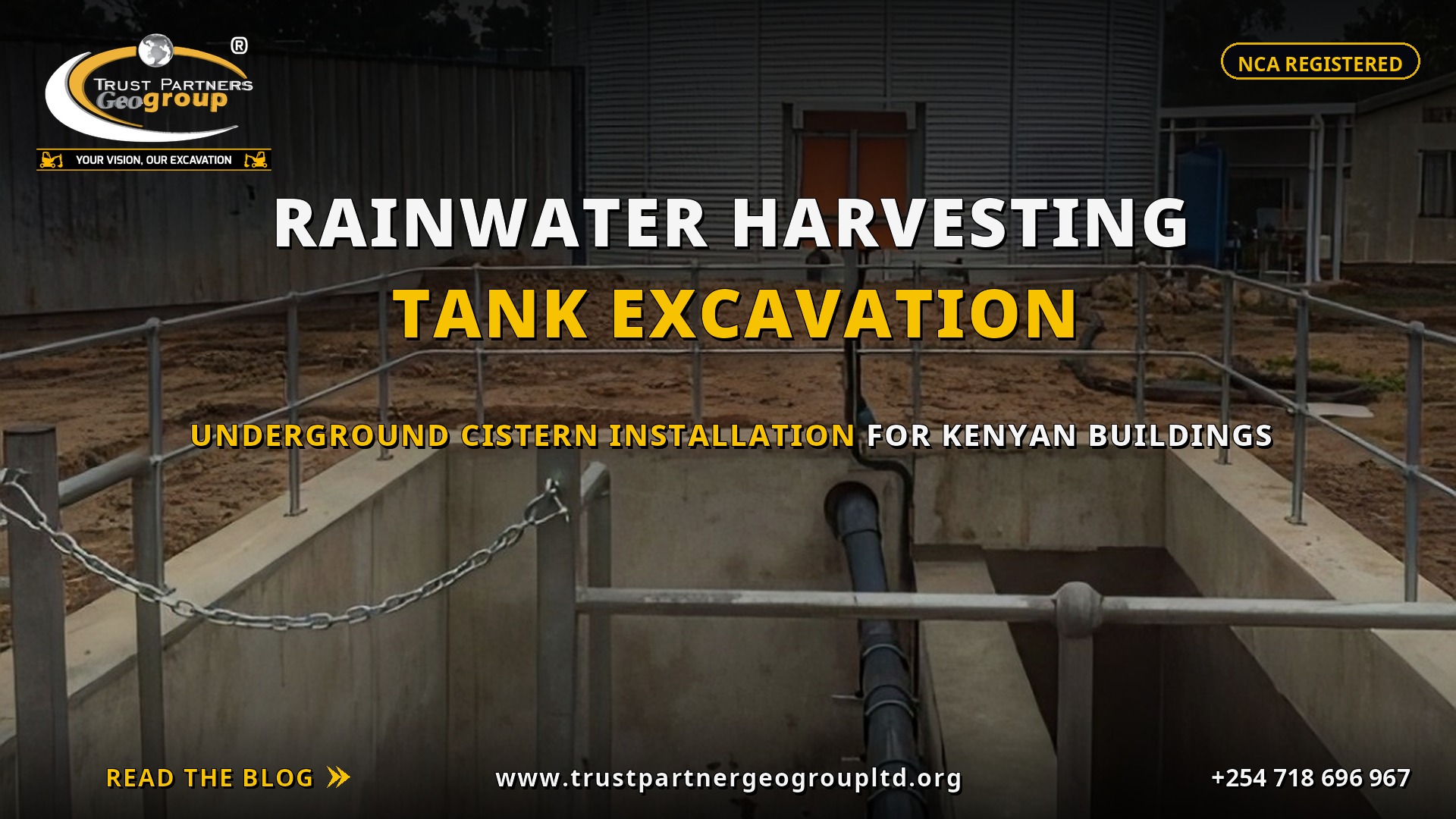
Rainwater Harvesting Tank Excavation: Underground Cistern Installation for Kenyan Buildings
Underground rainwater tank pit excavation, cistern installation, bedding, backfilling & stormwater storage for residential & commercial buildings in Nairobi, Mombasa, Kisumu & across Kenya
Table of Contents
- 1. Why Underground Rainwater Harvesting in Kenya?
- 2. Tank Types: Plastic, Concrete, Fibreglass and Modular
- 3. Tank Sizing and Catchment Calculations
- 4. Tank Pit Excavation Methods
- 5. Shoring and Safety for Deep Tank Pits
- 6. Bedding, Base Slabs and Tank Placement
- 7. Inlet, Overflow and Distribution Pipework
- 8. Backfilling and Compaction Around Tanks
- 9. Heavy Equipment for Hire: Machines for Tank Excavation
- 10. NEMA, County and Building Compliance
- 11. Construction Costs and Programme [2026]
- 12. Frequently Asked Questions
- 13. Conclusion
In a Nairobi suburb where the municipal water supply runs twice a week if you are lucky, or on a Mombasa commercial plot where stormwater runoff floods the parking lot with every downpour, the underground rainwater harvesting tank is the silent infrastructure that turns a problem into a resource. Buried beneath the driveway, the lawn or the car park, a cistern collects thousands of litres of clean rainwater from the roof, stores it through the dry season, and delivers it for flushing, irrigation and cleaning. But before the tank can store a drop, the earth must be moved - a pit excavated to precise dimensions, shored against collapse, bedded on sand or concrete, and backfilled with care to prevent settlement or flotation. Water tank excavation Nairobi contractors perform is a specialist discipline within the broader field of excavation in Kenya: it demands tight tolerances, safety discipline, and an understanding of how plastic, concrete or fibreglass tanks interact with soil and groundwater. With heavy equipment for hire from Trust Partners Geo-Group Ltd, builders, developers and homeowners can install rainwater harvesting systems without capital investment in machinery. This guide covers the full underground cistern excavation sequence - tank selection, pit excavation, shoring, bedding, pipework, backfilling and compliance - with 2026 costs for Kenyan building projects.
Trust Partners Geo-Group Ltd - Engineering Team
NCA-registered excavation & civil engineering contractor with 15+ years of tank pit excavation, cistern installation, water storage earthworks and confined-site construction experience across East Africa. Reviewed by registered engineers.
1. Why Underground Rainwater Harvesting in Kenya?
Kenya's water security is under pressure. Nairobi's water demand exceeds supply by 25-30% on average days, rising to 50% during dry spells. Mombasa's coastal aquifers are saline and over-abstracted. Kisumu's Lake Victoria water requires expensive treatment. For building owners, the consequences are unreliable supply, high water bills, and increasing regulation of borehole drilling.
Rainwater harvesting addresses these challenges at the building level. Kenya receives 500-1,500mm of rainfall annually depending on location - enough to meet a significant portion of non-potable demand if captured and stored. A 150 m2 roof in Nairobi (1,000mm annual rainfall) can harvest 80,000-100,000 litres per year, assuming 80% collection efficiency. For a household using 200 litres per day, this replaces 40-50% of total demand, or 100% of non-potable uses (toilet flushing, laundry, cleaning, irrigation).
Underground tanks are preferred over above-ground tanks for several reasons:
- Space: on tight urban plots of 0.05-0.1 hectares, there is no room for a 20,000-litre tank above ground without sacrificing parking or garden;
- Temperature: buried tanks keep water cool (18-22 degrees Celsius), preventing algae growth and bacterial proliferation that plague above-ground tanks in Kenya's sun;
- Durability: underground tanks are protected from UV radiation, wind, vehicle impact and vandalism;
- Aesthetics: a buried cistern is invisible; the only visible elements are the access manhole and a small pump housing;
- Stormwater management: large underground tanks can be designed as dual-purpose systems, storing rainwater for reuse while providing detention capacity that reduces downstream flooding.
The Nairobi County Building Code now encourages rainwater harvesting for all new buildings over 2 storeys, and some municipalities (Kiambu, Machakos) are considering mandatory requirements. For developers, early integration of tank excavation into the construction programme is cheaper than retrofitting after the building is complete.
2. Tank Types: Plastic, Concrete, Fibreglass and Modular
The choice of tank type determines the excavation method, bedding requirements, and long-term performance. Each type has advantages and limitations in Kenyan conditions.
| Tank Type | Capacity | Cost (2026) | Lifespan | Best For |
|---|---|---|---|---|
| Plastic polyethylene | 5,000-50,000L | KES 50,000-320,000 | 20-30 years | Residential, quick install, tight budgets |
| Concrete (cast in-situ) | 10,000-100,000L+ | KES 250,000-1.2M | 50+ years | Commercial, large volumes, permanent |
| Fibreglass (GRP) | 10,000-80,000L | KES 180,000-700,000 | 30-40 years | Corrosive soils, chemical resistance |
| Modular crate system | 50,000-500,000L+ | KES 150-300/m3 | 25-35 years | Commercial, beneath car parks |
Plastic Polyethylene Tanks
Rotationally moulded from UV-stabilized polyethylene, these tanks are the most common choice for residential installations in Kenya. They are lightweight (a 20,000L tank weighs 400-600kg), corrosion-proof, and quick to install - a crew can lower a plastic tank into a prepared pit and connect pipework in a single day. Disadvantages include: limited size (manufacturing constraints restrict single-piece tanks to about 50,000L); susceptibility to flotation in high groundwater if not properly anchored; and potential deformation if backfilled unevenly or compacted with heavy equipment against the walls. In Nairobi's clay laterite, plastic tanks perform well because the soil provides support; in sandy coastal soils, additional anchoring is essential.
Concrete Tanks
Cast-in-situ concrete cisterns are the premium option for commercial buildings, apartment blocks and estates where long-term durability and large volumes are required. They are constructed by excavating a pit, casting a reinforced concrete base slab, erecting formwork for walls, pouring concrete, and waterproofing the interior with cementitious coatings or bituminous membranes. Concrete tanks can be any size or shape, withstand high groundwater pressure, and last 50+ years with minimal maintenance. The disadvantages are higher cost, longer construction time (2-4 weeks for formwork, pouring and curing), and the need for skilled concrete work. In Kenya, where formwork timber is expensive and skilled labour is variable, concrete tanks cost 40-60% more than equivalent plastic tanks.
Fibreglass (GRP) Tanks
Glass-reinforced plastic tanks offer a middle ground: stronger than polyethylene, lighter than concrete, and resistant to chemicals and corrosion. They are factory-manufactured in standard sizes and delivered to site. GRP tanks are preferred where soil conditions are aggressive (acidic laterite, saline coastal soils) or where the stored water may have low pH. The main limitation is cost - 20-30% more than plastic and approaching concrete prices for large sizes.
Modular Crate Systems
For very large volumes (100,000L to millions of litres) beneath car parks, driveways or sports fields, modular plastic crate systems (geocellular attenuation) are used. The crates are assembled in the excavated pit like Lego blocks, wrapped in a geomembrane liner, and covered with a load-bearing slab. They are cost-effective at scale (KES 150-300 per m3 of storage) but require careful membrane installation and are only suitable where heavy vehicle loads will not crack the cover slab.
3. Tank Sizing and Catchment Calculations
Tank sizing balances water demand, roof catchment area, rainfall pattern, and budget. An oversized tank wastes money; an undersized tank overflows during the first rains and sits empty through the dry season.
Catchment Calculation
The basic formula for rainwater harvesting potential is:
Annual Harvest (litres) = Roof Area (m2) x Annual Rainfall (mm) x Runoff Coefficient x 0.8 (filter efficiency)
For a 150 m2 roof in Nairobi (1,000mm rainfall, runoff coefficient 0.85 for metal or tile roofs):
150 x 1,000 x 0.85 x 0.8 = 102,000 litres per year
This is the theoretical maximum. In practice, tank size is determined by the dry season storage requirement. Nairobi has two rainy seasons (March-May and October-November) with dry periods of 3-4 months. A tank sized to store 60-90 days of non-potable demand is typically optimal:
- Small household (2-3 people): 10,000-15,000 litres;
- Medium household (4-6 people): 20,000-30,000 litres;
- Large household or small commercial: 30,000-50,000 litres;
- Apartment block (20 units): 100,000-200,000 litres;
- Commercial building with irrigation: 50,000-100,000 litres.
Excavation Volume
The excavation volume is larger than the tank volume because clearance is needed around the tank for bedding, backfill and access. For a 20,000L plastic tank (2.4m diameter x 4.5m length), the excavation is typically 3.0m wide x 5.5m long x 2.8m deep - approximately 46 m3 of excavation versus 20 m3 of tank volume. For concrete tanks, the excavation follows the external formwork dimensions plus working space.
4. Tank Pit Excavation Methods
Tank pit excavation is straightforward in principle - dig a hole the shape of the tank plus clearance - but complicated in practice by confined sites, underground services, adjacent buildings, and variable soil conditions.
Site Preparation
The tank location is marked with spray paint and stakes, referencing the building downpipes and the available space. Before digging, underground services must be located: Nairobi's older suburbs (Parklands, Eastleigh, parts of Kilimani) have unmapped water, sewer and power lines that can be damaged by excavation. A service locator with cable and pipe detectors should verify the absence of buried utilities in the tank footprint. In new construction, the tank pit is excavated before the building foundation where possible, avoiding the need to work around completed structures.
Excavation Sequence
For a typical residential tank:
- A 20-tonne excavator (or mini-excavator for confined plots) strips topsoil and stockpiles it for later reinstatement;
- The pit is excavated to design depth in 500mm lifts, with the operator checking depth regularly;
- Spoil is loaded into dump trucks and hauled to approved disposal or used for landscaping elsewhere on site;
- The pit base is trimmed level with a laser level or spirit level, achieving +/- 50mm tolerance;
- For plastic tanks, a 200-300mm sand bedding layer is placed and compacted;
- For concrete tanks, a 150-200mm reinforced concrete base slab is cast with starter bars for wall connection.
Soil Conditions
In Nairobi's red laterite, excavation to 3 metres is generally straightforward, though dense tuff or boulders may require breaker attachments. In Mombasa's coral sand, side slopes must be cut at 2:1 or shored to prevent collapse. In black cotton soil areas (parts of Kajiado, Athi River), the expansive clay swells when wet and shrinks when dry, exerting pressure on tank walls - special design measures (tank anchoring, flexible joints, or soil replacement) are required.
5. Shoring and Safety for Deep Tank Pits
Tank pits deeper than 1.5 metres are excavations under Kenyan safety law, and pits deeper than 2.5 metres require formal shoring or sloping under NCA regulations. The risk is real: Nairobi's clay laterite can appear stable when dry but slough or collapse when exposed to rain or groundwater seepage.
Shoring Methods
| Method | Application | Cost |
|---|---|---|
| Battered slopes (1:1 or 2:1) | Open sites with space | Low - just extra excavation |
| Timber shoring (walers and struts) | Pits to 3m, temporary | KES 1,500-2,500/m2 |
| Steel sheet piles | Deep pits, adjacent buildings | KES 3,000-5,000/m2 |
| Trench boxes | Narrow pits, pipe trenches | KES 2,000-3,500/m2 |
For most residential tank pits in Nairobi, timber shoring with 200x50mm planks and 100x100mm walers is sufficient. The shoring is installed as excavation proceeds: dig 1 metre, install planks and walers, dig next metre, install next set. Workers never enter an unsupported pit deeper than 1.5 metres. In commercial projects with deep concrete cisterns (3-4 metres) near existing buildings, steel sheet pile shoring may be required to prevent ground movement that could crack adjacent foundations.
Dewatering
In areas with shallow groundwater (coastal Mombasa, riparian zones, parts of Karen and Lavington), tank pits may fill with water during excavation. Dewatering options include: sump pumping with submersible pumps for minor seepage; wellpoint systems for sustained inflow; and pre-casting the tank base above groundwater level and waterproofing the exterior. Plastic tanks in high groundwater must be anchored with concrete ballast or hold-down straps to prevent flotation when the tank is empty.
Critical rule: never enter an unshored pit
On a Kiambu residential project in 2024, a worker entered a 2.8-metre deep tank pit to trim the base while the excavator operator took a break. The laterite wall collapsed, burying the worker to the chest. Emergency excavation freed him, but he sustained crush injuries and the project was shut down for two weeks during a NCA safety investigation. The cost of proper timber shoring (KES 45,000) was trivial compared to the medical, legal and programme costs of the accident. The specification must require shoring for all pits over 1.5 metres, and no worker enters without the site foreman's inspection.
6. Bedding, Base Slabs and Tank Placement
The bedding layer is the foundation that supports the tank, distributes loads, and prevents point loading that could crack concrete or deform plastic.
Sand Bedding for Plastic Tanks
A 200-300mm layer of clean, washed sand (free of clay, silt and stones over 20mm) is placed on the trimmed pit base and compacted to a flat, level surface. The sand must be moistened during compaction to achieve 90-95% standard proctor density without over-compacting. The tank is lowered onto the sand bed using excavator slings or a crane, and levelled in two directions using a spirit level. Shims or additional sand are used to correct any unevenness. A geotextile sheet beneath the sand prevents mixing with native soil.
Concrete Base Slabs
For concrete tanks, a 150-200mm thick reinforced concrete base slab (C25-C30 grade) is cast on a 100mm blinding layer of lean concrete. The slab must be level to +/- 10mm and include starter bars or dowels that connect to the tank wall reinforcement. For very large concrete cisterns, a 200-300mm thick slab with mesh reinforcement (A142 or A193) may be required to distribute the tank load over soft spots in the subgrade. The slab must cure for 3-7 days before wall formwork is erected.
Tank Placement
Plastic tanks are delivered to site by flatbed truck and lifted into the pit using the excavator (with a certified sling and spreader bar) or a mobile crane. The tank must be handled carefully - dragging or dropping can crack the inlet/outlet bosses or deform the walls. Concrete tanks are constructed in-situ, with formwork erected on the base slab and concrete poured in lifts. GRP tanks are lowered similarly to plastic tanks but require more lifting capacity due to their rigidity.
7. Inlet, Overflow and Distribution Pipework
The pipework connects the tank to the building's rainwater collection system and to the points of use. Poor pipework design is the most common cause of rainwater harvesting system failure.
Inlet from Roof
Rainwater from roof gutters flows via downpipes to a filter or leaf separator, then into the tank through a screened inlet pipe (typically 75-110mm diameter PVC). The inlet should be positioned to prevent disturbance of any sediment layer at the tank base - entering near the top or via a calming inlet that discharges below water level. A first-flush diverter is recommended: the initial 20-50 litres of each rainfall (which carries roof dust, bird droppings and debris) are diverted to waste before clean water enters the tank.
Overflow
The overflow pipe (110-160mm diameter) discharges excess water to a stormwater drain, soak pit, or garden when the tank is full. It must be sized to handle the maximum inflow rate during intense rainfall - in Nairobi, a 150 m2 roof can generate 15-25 litres per second during a heavy storm. The overflow outlet must include a mosquito screen and a non-return flap to prevent backflow from the stormwater system.
Outlet and Pump
Water is extracted from the tank by gravity (if the tank is elevated above the points of use) or by pump. Submersible pumps (0.5-1.5 kW) are placed on the tank base with a floating suction that draws from 100-200mm below the surface, avoiding sediment. The pump delivers water to a pressure tank or header tank that supplies toilets, washing machines and outdoor taps. A mains water top-up connection is typically included for dry periods, with a float valve or solenoid that prevents backflow contamination of the municipal supply.
Vent and Access
Every underground tank requires a vent pipe (50-75mm diameter, extending 500mm above ground with a mosquito screen) to allow air exchange as water level changes. An access manhole (600x600mm minimum) allows inspection, cleaning and pump maintenance. The manhole must be sealed but removable, with a lockable cover for safety.
8. Backfilling and Compaction Around Tanks
Backfilling is where many tank installations fail. Improper backfill material, uneven placement, or excessive compaction can deform plastic tanks, crack concrete walls, or create settlement voids that undermine driveways and pavements above.
Backfill Material
The ideal backfill is selected granular material - sand, fine gravel, or crushed stone with particles under 40mm. It must be free of organic matter, clay lumps, and large stones that could puncture plastic or create voids. In Nairobi, washed river sand or quarry dust is commonly used. Native excavated soil can be used only if it is free-draining and free of large stones - clay laterite with boulders must be screened or replaced.
Placement and Compaction
Backfill is placed in 200-300mm layers around the tank, compacted to 90-95% standard proctor density. The critical rules are: backfill evenly on all sides to prevent lateral pressure imbalance; use plate compactors or hand rammers for plastic tanks - never vibratory rollers that can deform the walls; compact to the same density on all sides to prevent the tank from shifting; and leave 300-500mm below finished ground level for topsoil or paving. For concrete tanks, heavier compaction equipment can be used once the walls have achieved sufficient strength (typically 14 days after pouring).
Surface Reinstatement
The final surface above the tank must be reinstated to match the surrounding area: turf for lawns, concrete or pavers for driveways, or gravel for utility areas. Where vehicles will drive over the tank, a reinforced concrete slab (150-200mm thick) may be required to distribute loads and prevent tank damage. The manhole and vent pipe must be integrated into the surface design without creating trip hazards.
9. Heavy Equipment for Hire: Machines for Tank Excavation
Rainwater tank excavation requires a compact equipment fleet suited to residential and commercial building sites. Trust Partners Geo-Group Ltd provides heavy equipment for hire on a project basis.
| Equipment | Role | Hire Rate (2026) |
|---|---|---|
| 20-tonne excavator | Bulk pit excavation | KES 8,000-12,000/hr |
| 3-5 tonne mini-excavator | Confined residential plots | KES 3,500-5,500/hr |
| Dump truck (10 m3) | Spoil haulage | KES 5,000-8,000/hr |
| Plate compactor | Sand bedding and backfill | KES 2,000-3,500/hr |
| Concrete mixer / pump | Base slab casting | KES 3,000-5,000/hr |
| Mobile crane (10-20t) | Tank lowering (large tanks) | KES 10,000-18,000/hr |
| Water truck | Dust suppression, pipe testing | KES 4,000-6,000/hr |
For a typical residential tank installation, the equipment programme is: 1 day site clearing and topsoil strip with mini-excavator; 1-2 days pit excavation with mini-excavator or 20-tonne machine; 1 day bedding placement and compaction; 1 day tank delivery and lowering; 1-2 days pipework and backfilling; and 1 day surface reinstatement. Total equipment hire for a standard residential project is KES 80,000-150,000 - compared to KES 5-8 million to purchase equivalent machines. For commercial projects with multiple large tanks, a 20-tonne excavator and dump truck fleet operates for 1-2 weeks.
Mini-excavators are the workhorse of residential tank installation in Nairobi. Their 1.5-2.0 metre width allows access through standard gates and between houses, and their 3-4 metre digging depth handles all residential tank sizes. Rubber-tracked machines protect driveways and paving from damage.
10. NEMA, County and Building Compliance
Underground tank installation in Kenya triggers several regulatory requirements depending on size, location and building type.
| Requirement | Authority | What It Covers |
|---|---|---|
| Building plan approval | County government | Tank location, structural design, drainage integration |
| NEMA approval (large systems) | NEMA | Earthworks >1,000 m3, stormwater discharge |
| NCA contractor registration | NCA | Excavation contractor, site safety |
| Public health approval | County public health | Water quality, mosquito prevention |
| Water top-up backflow prevention | County water department | Prevention of municipal supply contamination |
For new buildings, the rainwater harvesting system is included in the building plan submission. For retrofits on existing buildings, a standalone application may be required if the tank exceeds 20,000 litres or if excavation involves significant earthworks. NEMA approval is typically not required for residential tanks under 50,000 litres on plots under 0.5 hectares, but commercial installations with multiple large tanks or discharge to natural watercourses may need an Environmental Management Plan.
County public health departments are concerned about mosquito breeding in stored rainwater. All tanks must have sealed lids, screened vents, and overflow flaps. In malaria-prone areas (coastal Kenya, lowland areas), additional mosquito-proofing may be inspected before occupancy certificates are issued.
11. Construction Costs and Programme [2026]
Indicative costs for rainwater harvesting tank excavation and installation in Kenya:
| Item | 2026 Rate | Notes |
|---|---|---|
| Site clearance and topsoil strip | KES 150-300/m3 | Includes stockpiling |
| Pit excavation (standard soil) | KES 400-700/m3 | Laterite, volcanic soils |
| Pit excavation (rock/boulders) | KES 800-1,200/m3 | With breaker |
| Timber shoring | KES 1,500-2,500/m2 | Pit wall face |
| Sand bedding and compaction | KES 800-1,500/m3 | Clean washed sand |
| Concrete base slab | KES 4,000-6,000/m2 | C25, mesh reinforced |
| Plastic tank (10,000L) | KES 80,000-120,000 | Polyethylene, delivered |
| Plastic tank (20,000L) | KES 150,000-220,000 | Polyethylene, delivered |
| Plastic tank (30,000L) | KES 220,000-320,000 | Polyethylene, delivered |
| Concrete tank (30,000L) | KES 350,000-500,000 | Cast in-situ, complete |
| GRP tank (20,000L) | KES 200,000-300,000 | Delivered, lowered |
| Inlet/overflow pipework | KES 30,000-80,000 | PVC, fittings, screens |
| Pump and pressure system | KES 40,000-100,000 | Submersible, pressure tank |
| Backfilling and compaction | KES 300-500/m3 | Selected material |
| Surface reinstatement | KES 500-1,000/m2 | Turf, concrete or pavers |
| Heavy equipment for hire | KES 8,000-12,000/hr | Excavator, trucks |
| Mobilization / demobilization | KES 50,000-150,000 | Transport, setup |
All-in project estimates:
- Residential plastic tank (10,000L) with excavation and pipework: KES 250,000-380,000;
- Residential plastic tank (20,000L) with full installation: KES 350,000-550,000;
- Residential concrete cistern (30,000L): KES 600,000-900,000;
- Commercial plastic tanks (2 x 50,000L) with excavation: KES 900,000-1.4 million;
- Commercial concrete cistern (100,000L) with pump house: KES 1.5-2.2 million.
Programme: site investigation and clearance 1 day; excavation and shoring 1-2 days; bedding and base slab 1-2 days; tank delivery and placement 1 day; pipework and backfilling 1-2 days; surface reinstatement 1 day. Total programme for a residential installation: 5-8 working days. Commercial projects with large concrete cisterns: 3-5 weeks including curing time.
Pro tip: integrate with construction, not after
The cheapest time to install a rainwater harvesting tank is during building construction, when the excavator is already on site for foundations and the ground is open. Retrofitting a tank into a completed landscape requires hand excavation, protection of existing paving and plants, and often restricted access that increases costs by 30-50%. Trust Partners Geo-Group Ltd coordinates tank excavation with the building contractor's programme, completing the pit while foundation trenches are open and backfilling before the ground floor slab is cast. This integration saves KES 50,000-100,000 on a typical residential project.
12. Frequently Asked Questions: Rainwater Tank Excavation in Kenya
What is an underground rainwater harvesting tank and why is it used in Kenya?
An underground rainwater harvesting tank or cistern is a buried storage vessel that collects rainwater from building roofs via gutters and downpipes, stores it for dry periods, and distributes it for non-potable uses such as toilet flushing, irrigation, car washing and cleaning. In Kenya, where municipal water supply is unreliable in many areas and borehole drilling is increasingly regulated, rainwater harvesting is a critical water security strategy. Underground tanks are preferred over above-ground tanks because they: save valuable space on tight urban plots; keep water cool (reducing algae growth); are protected from UV degradation and physical damage; and do not detract from building aesthetics. A typical 4-bedroom house in Nairobi can harvest 50,000-100,000 litres annually from a 150 m2 roof, meeting 30-50% of non-potable water demand.
What types of underground rainwater tanks are used in Kenya?
Four main types of underground rainwater tanks are used in Kenya. Concrete tanks are cast in-situ or precast on site - they are durable, can be any shape, and last 50+ years, but they are expensive and require skilled formwork. Plastic polyethylene tanks (10,000-50,000 litre capacity) are factory-moulded, lightweight, corrosion-proof and quick to install, but limited in size and can float in high groundwater if not properly anchored. Fibreglass (GRP) tanks are strong, lightweight and corrosion-resistant, suitable for 20,000-100,000 litre capacities, but they cost 20-30% more than plastic. Modular crate systems (geocellular attenuation crates) are plastic cells wrapped in geomembrane, used for very large volumes (100,000+ litres) beneath car parks or driveways - they are cost-effective for commercial buildings but require careful membrane installation. For residential buildings in Nairobi and Kiambu, plastic polyethylene tanks of 10,000-30,000 litres are the most common due to lower cost and faster installation.
How deep are underground rainwater tanks excavated in Kenya?
Underground rainwater tank excavation depth in Kenya depends on tank height, groundwater level, and frost protection (minimal in Kenya's climate). Plastic tanks of 10,000-20,000 litres are typically 1.8-2.5 metres in height, requiring excavation of 2.2-3.0 metres including a 200-300mm sand or concrete bedding layer. Concrete tanks can be deeper - 2.5-4.0 metres for 30,000-50,000 litre capacities. The excavation must allow 300-500mm clearance around the tank for backfilling and compaction. In Nairobi's volcanic soils, excavation to 3 metres is straightforward in most areas, though dense tuff or boulders may require breaker attachments. In areas with high groundwater (parts of Karen, Lavington, coastal Mombasa), tanks must be anchored to prevent flotation, and dewatering may be required during excavation. The tank lid must be at least 100-150mm below finished ground level to prevent surface water ingress, but accessible for maintenance.
What does rainwater tank excavation cost in Kenya in 2026?
2026 indicative costs for rainwater harvesting tank excavation in Kenya: excavation of tank pit KES 400-700 per m3; shoring for deep pits (over 2.5m) KES 1,500-3,000 per m2 of wall face; sand bedding and levelling KES 800-1,500 per m3; concrete base slab (if required) KES 4,000-6,000 per m2; plastic polyethylene tank (10,000L) KES 80,000-120,000; plastic tank (20,000L) KES 150,000-220,000; plastic tank (30,000L) KES 220,000-320,000; concrete tank (cast in-situ, 30,000L) KES 350,000-500,000; inlet and overflow pipework KES 30,000-80,000; pump and distribution system KES 40,000-100,000; backfilling and compaction KES 300-500 per m3; surface reinstatement KES 500-1,000 per m2. A complete 20,000-litre plastic tank installation with excavation, bedding, pipework and backfill costs KES 350,000-550,000. A 50,000-litre concrete cistern with full excavation and mechanical systems costs KES 800,000-1.2 million. Heavy equipment for hire including 20-tonne excavators and dump trucks is typically KES 8,000-12,000 per hour.
How is an underground tank pit excavated and shored in urban Nairobi?
Underground tank pit excavation in urban Nairobi follows a safe sequence to protect adjacent buildings and workers. First, the tank location is marked and underground services (water, sewer, power) are located using utility maps and cable detectors. A 20-tonne excavator with a bucket excavates the pit to design depth, with spoil loaded into dump trucks for disposal. For pits deeper than 2.5 metres or where adjacent foundations are within 3 metres, timber or steel sheet pile shoring is installed to prevent wall collapse. In Nairobi's clay laterite, unsupported vertical cuts are stable to 1.5-2.0 metres; below this, shoring is mandatory under NCA safety regulations. The pit base is trimmed level and a 200-300mm sand bedding layer is placed and compacted. For concrete tanks, a 150-200mm reinforced concrete base slab is cast with starter bars for wall connection. The tank is lowered into the pit using an excavator or crane, levelled, and connected to inlet, overflow and outlet pipes before backfilling begins.
What backfilling and compaction methods are used around underground tanks?
Backfilling around underground tanks must provide support without damaging the tank or creating voids that lead to settlement. The procedure is: place 200-300mm layers of selected backfill (sand or fine gravel, free of large stones and organic matter) around the tank; compact each layer with a plate compactor or hand rammer to 90-95% standard proctor density; never use heavy vibratory rollers directly against plastic tank walls, which can deform or crack; backfill evenly on all sides to prevent lateral pressure imbalance that could distort the tank; and leave the final 300-500mm below ground level for topsoil or paving reinstatement. For concrete tanks, stronger backfill including crushed stone can be used with heavier compaction equipment. In all cases, the backfill must be free-draining to prevent water accumulation around the tank, which can cause flotation in plastic tanks or concrete deterioration. A geotextile wrap around the tank prevents fine soil migration into the backfill voids.
What heavy equipment is used for rainwater tank excavation in Kenya?
Rainwater tank excavation in Kenya uses heavy equipment for hire including: 20-tonne hydraulic excavators with buckets for bulk pit excavation in laterite and volcanic soils; mini-excavators (3-5 tonne) for confined residential plots where a full-size machine cannot access; dump trucks (10-20 m3) for spoil haulage to approved disposal; plate compactors for sand bedding and backfill compaction around plastic tanks; concrete mixers or pumps for base slab casting where required; and water trucks for dust suppression and pipe testing. In urban Nairobi where plot sizes are small (0.05-0.1 hectares), mini-excavators are often the only option for tank pits beside houses or apartment blocks. For commercial buildings with multiple large tanks, 20-30 tonne excavators with long-reach arms work from the building perimeter. Trust Partners Geo-Group Ltd provides the full equipment fleet for tank excavation projects, from residential single-tank installations to commercial stormwater harvesting systems, with operators experienced in confined-site earthworks.
Do underground rainwater tanks need building approval in Kenya?
Yes. Underground rainwater tank installation requires county building plan approval as part of the overall building plans, or as a standalone application for retrofits. The approval covers tank location, depth, structural design (for concrete tanks), and integration with building drainage. NEMA approval may be required for large commercial installations (over 100,000 litres) or where excavation involves significant earthworks, vegetation clearance, or discharge to stormwater systems. Water Resources Authority (WRA) permits are not typically required for rainwater harvesting, but may be needed if the system includes borehole backup or discharge to natural watercourses. NCA-registered contractors must execute the works, and a method statement may be required for deep excavations (over 3 metres) or sites near roads and buildings. For apartment buildings and commercial developments, the county may require structural engineer certification for concrete cisterns and geotechnical assessment for tank foundations in expansive soils.
13. Conclusion: Buried Treasure
An underground rainwater harvesting tank is invisible infrastructure with visible benefits. The homeowner who flushes with harvested rain saves KES 15,000-30,000 annually on water bills. The apartment block that irrigates its gardens from stored stormwater reduces its municipal demand by 30-40%. The commercial development that captures roof runoff prevents flooding in the parking lot while creating a water reserve for dry periods. And all of this begins with a hole in the ground - excavated to the right depth, shored for safety, bedded for support, and backfilled with care.
The excavation of a tank pit is not bulk earthworks. It is precision work in confined space, often between a boundary wall and a building foundation, with underground services that must not be damaged and adjacent structures that must not settle. The contractor who treats it as a simple dig risks wall collapse, service strikes, tank deformation, and surface settlement that cracks driveways and paths. The contractor who understands shoring, bedding, backfill compaction, and the behaviour of plastic tanks in groundwater delivers a system that lasts decades.
Trust Partners Geo-Group Ltd delivers the full rainwater harvesting tank excavation package across Kenya: site investigation and utility location, pit excavation with mini-excavators or full-size machines, timber or steel shoring for deep pits, sand bedding and concrete base slabs, tank lowering and levelling, inlet and overflow pipework installation, controlled backfilling and compaction, and surface reinstatement with turf, concrete or pavers. We provide heavy equipment for hire with experienced operators, coordinate with your building contractor's programme, manage county and NEMA compliance, and deliver tank installations on budget and schedule - from single residential cisterns to commercial stormwater harvesting systems.
Rainwater Harvesting Tank Excavation & Installation
Underground cistern excavation, tank pit shoring, bedding, backfilling and surface reinstatement for residential and commercial buildings across Nairobi, Mombasa, Kisumu and Kenya.
Free lead magnet: ask for our Underground Tank Installation Checklist (PDF) - excavation safety hold points, shoring inspection records, bedding compaction logs and backfill standards your building inspector will require.
Related Resources
Bio-Pond Construction for Eco-Resorts in Kenya: Natural Swimming Pool Excavation & Filtration
The previous blog in our environmental series - natural pool excavation and biological filtration for resort water features.
READ MOREWetland Excavation and Restoration in Kenya: Creating Artificial Wetlands for Stormwater
Constructed wetland earthworks for stormwater management and environmental restoration.
READ MOREWater Pan Excavation for Dairy Farming in Kenya: Size, Depth & Lining Guide [2026]
Water feature excavation, lining and earthworks for agricultural and environmental water storage.
READ MOREEarthworks QA/QC: Compaction Testing & Density Control
Testing protocols for tank bedding, backfill and structural earthworks.
READ MOREBulk Excavation Cost Per Cubic Meter in Kenya [2026 Updated Rates]
Transparent pricing for the bulk earthworks component of every tank installation project.
READ MORESlope Excavation and Stabilization for Hillside Construction in Nairobi & Kiambu
Cut slopes and stabilization for building developments on sloped terrain.
READ MORETRUST PARTNERS GEO-GROUP LTD | YOUR VISION, OUR EXCAVATION
WEBSITE: WWW.TRUSTPARTNERGEOGROUPLTD.ORG | EMAIL: INFO@TRUSTPARTNERGEOGROUPLTD.ORG | PHONE: +254 718 68 69 67
FOLLOW US: FACEBOOK | TIKTOK | INSTAGRAM | LINKEDIN
© 2026 TRUST PARTNERS GEO-GROUP LTD. ALL RIGHTS RESERVED.
Rainwater Harvesting Tank Excavation: Underground Cistern Installation for Kenyan Buildings
Underground rainwater tank pit excavation, cistern installation, bedding, backfilling & stormwater storage for residential & commercial buildings in Nairobi, Mombasa, Kisumu & across Kenya
Table of Contents
- 1. Why Underground Rainwater Harvesting in Kenya?
- 2. Tank Types: Plastic, Concrete, Fibreglass and Modular
- 3. Tank Sizing and Catchment Calculations
- 4. Tank Pit Excavation Methods
- 5. Shoring and Safety for Deep Tank Pits
- 6. Bedding, Base Slabs and Tank Placement
- 7. Inlet, Overflow and Distribution Pipework
- 8. Backfilling and Compaction Around Tanks
- 9. Heavy Equipment for Hire: Machines for Tank Excavation
- 10. NEMA, County and Building Compliance
- 11. Construction Costs and Programme [2026]
- 12. Frequently Asked Questions
- 13. Conclusion
In a Nairobi suburb where the municipal water supply runs twice a week if you are lucky, or on a Mombasa commercial plot where stormwater runoff floods the parking lot with every downpour, the underground rainwater harvesting tank is the silent infrastructure that turns a problem into a resource. Buried beneath the driveway, the lawn or the car park, a cistern collects thousands of litres of clean rainwater from the roof, stores it through the dry season, and delivers it for flushing, irrigation and cleaning. But before the tank can store a drop, the earth must be moved - a pit excavated to precise dimensions, shored against collapse, bedded on sand or concrete, and backfilled with care to prevent settlement or flotation. Water tank excavation Nairobi contractors perform is a specialist discipline within the broader field of excavation in Kenya: it demands tight tolerances, safety discipline, and an understanding of how plastic, concrete or fibreglass tanks interact with soil and groundwater. With heavy equipment for hire from Trust Partners Geo-Group Ltd, builders, developers and homeowners can install rainwater harvesting systems without capital investment in machinery. This guide covers the full underground cistern excavation sequence - tank selection, pit excavation, shoring, bedding, pipework, backfilling and compliance - with 2026 costs for Kenyan building projects.
Trust Partners Geo-Group Ltd - Engineering Team
NCA-registered excavation & civil engineering contractor with 15+ years of tank pit excavation, cistern installation, water storage earthworks and confined-site construction experience across East Africa. Reviewed by registered engineers.
1. Why Underground Rainwater Harvesting in Kenya?
Kenya's water security is under pressure. Nairobi's water demand exceeds supply by 25-30% on average days, rising to 50% during dry spells. Mombasa's coastal aquifers are saline and over-abstracted. Kisumu's Lake Victoria water requires expensive treatment. For building owners, the consequences are unreliable supply, high water bills, and increasing regulation of borehole drilling.
Rainwater harvesting addresses these challenges at the building level. Kenya receives 500-1,500mm of rainfall annually depending on location - enough to meet a significant portion of non-potable demand if captured and stored. A 150 m2 roof in Nairobi (1,000mm annual rainfall) can harvest 80,000-100,000 litres per year, assuming 80% collection efficiency. For a household using 200 litres per day, this replaces 40-50% of total demand, or 100% of non-potable uses (toilet flushing, laundry, cleaning, irrigation).
Underground tanks are preferred over above-ground tanks for several reasons:
- Space: on tight urban plots of 0.05-0.1 hectares, there is no room for a 20,000-litre tank above ground without sacrificing parking or garden;
- Temperature: buried tanks keep water cool (18-22 degrees Celsius), preventing algae growth and bacterial proliferation that plague above-ground tanks in Kenya's sun;
- Durability: underground tanks are protected from UV radiation, wind, vehicle impact and vandalism;
- Aesthetics: a buried cistern is invisible; the only visible elements are the access manhole and a small pump housing;
- Stormwater management: large underground tanks can be designed as dual-purpose systems, storing rainwater for reuse while providing detention capacity that reduces downstream flooding.
The Nairobi County Building Code now encourages rainwater harvesting for all new buildings over 2 storeys, and some municipalities (Kiambu, Machakos) are considering mandatory requirements. For developers, early integration of tank excavation into the construction programme is cheaper than retrofitting after the building is complete.
2. Tank Types: Plastic, Concrete, Fibreglass and Modular
The choice of tank type determines the excavation method, bedding requirements, and long-term performance. Each type has advantages and limitations in Kenyan conditions.
| Tank Type | Capacity | Cost (2026) | Lifespan | Best For |
|---|---|---|---|---|
| Plastic polyethylene | 5,000-50,000L | KES 50,000-320,000 | 20-30 years | Residential, quick install, tight budgets |
| Concrete (cast in-situ) | 10,000-100,000L+ | KES 250,000-1.2M | 50+ years | Commercial, large volumes, permanent |
| Fibreglass (GRP) | 10,000-80,000L | KES 180,000-700,000 | 30-40 years | Corrosive soils, chemical resistance |
| Modular crate system | 50,000-500,000L+ | KES 150-300/m3 | 25-35 years | Commercial, beneath car parks |
Plastic Polyethylene Tanks
Rotationally moulded from UV-stabilized polyethylene, these tanks are the most common choice for residential installations in Kenya. They are lightweight (a 20,000L tank weighs 400-600kg), corrosion-proof, and quick to install - a crew can lower a plastic tank into a prepared pit and connect pipework in a single day. Disadvantages include: limited size (manufacturing constraints restrict single-piece tanks to about 50,000L); susceptibility to flotation in high groundwater if not properly anchored; and potential deformation if backfilled unevenly or compacted with heavy equipment against the walls. In Nairobi's clay laterite, plastic tanks perform well because the soil provides support; in sandy coastal soils, additional anchoring is essential.
Concrete Tanks
Cast-in-situ concrete cisterns are the premium option for commercial buildings, apartment blocks and estates where long-term durability and large volumes are required. They are constructed by excavating a pit, casting a reinforced concrete base slab, erecting formwork for walls, pouring concrete, and waterproofing the interior with cementitious coatings or bituminous membranes. Concrete tanks can be any size or shape, withstand high groundwater pressure, and last 50+ years with minimal maintenance. The disadvantages are higher cost, longer construction time (2-4 weeks for formwork, pouring and curing), and the need for skilled concrete work. In Kenya, where formwork timber is expensive and skilled labour is variable, concrete tanks cost 40-60% more than equivalent plastic tanks.
Fibreglass (GRP) Tanks
Glass-reinforced plastic tanks offer a middle ground: stronger than polyethylene, lighter than concrete, and resistant to chemicals and corrosion. They are factory-manufactured in standard sizes and delivered to site. GRP tanks are preferred where soil conditions are aggressive (acidic laterite, saline coastal soils) or where the stored water may have low pH. The main limitation is cost - 20-30% more than plastic and approaching concrete prices for large sizes.
Modular Crate Systems
For very large volumes (100,000L to millions of litres) beneath car parks, driveways or sports fields, modular plastic crate systems (geocellular attenuation) are used. The crates are assembled in the excavated pit like Lego blocks, wrapped in a geomembrane liner, and covered with a load-bearing slab. They are cost-effective at scale (KES 150-300 per m3 of storage) but require careful membrane installation and are only suitable where heavy vehicle loads will not crack the cover slab.
3. Tank Sizing and Catchment Calculations
Tank sizing balances water demand, roof catchment area, rainfall pattern, and budget. An oversized tank wastes money; an undersized tank overflows during the first rains and sits empty through the dry season.
Catchment Calculation
The basic formula for rainwater harvesting potential is:
Annual Harvest (litres) = Roof Area (m2) x Annual Rainfall (mm) x Runoff Coefficient x 0.8 (filter efficiency)
For a 150 m2 roof in Nairobi (1,000mm rainfall, runoff coefficient 0.85 for metal or tile roofs):
150 x 1,000 x 0.85 x 0.8 = 102,000 litres per year
This is the theoretical maximum. In practice, tank size is determined by the dry season storage requirement. Nairobi has two rainy seasons (March-May and October-November) with dry periods of 3-4 months. A tank sized to store 60-90 days of non-potable demand is typically optimal:
- Small household (2-3 people): 10,000-15,000 litres;
- Medium household (4-6 people): 20,000-30,000 litres;
- Large household or small commercial: 30,000-50,000 litres;
- Apartment block (20 units): 100,000-200,000 litres;
- Commercial building with irrigation: 50,000-100,000 litres.
Excavation Volume
The excavation volume is larger than the tank volume because clearance is needed around the tank for bedding, backfill and access. For a 20,000L plastic tank (2.4m diameter x 4.5m length), the excavation is typically 3.0m wide x 5.5m long x 2.8m deep - approximately 46 m3 of excavation versus 20 m3 of tank volume. For concrete tanks, the excavation follows the external formwork dimensions plus working space.
4. Tank Pit Excavation Methods
Tank pit excavation is straightforward in principle - dig a hole the shape of the tank plus clearance - but complicated in practice by confined sites, underground services, adjacent buildings, and variable soil conditions.
Site Preparation
The tank location is marked with spray paint and stakes, referencing the building downpipes and the available space. Before digging, underground services must be located: Nairobi's older suburbs (Parklands, Eastleigh, parts of Kilimani) have unmapped water, sewer and power lines that can be damaged by excavation. A service locator with cable and pipe detectors should verify the absence of buried utilities in the tank footprint. In new construction, the tank pit is excavated before the building foundation where possible, avoiding the need to work around completed structures.
Excavation Sequence
For a typical residential tank:
- A 20-tonne excavator (or mini-excavator for confined plots) strips topsoil and stockpiles it for later reinstatement;
- The pit is excavated to design depth in 500mm lifts, with the operator checking depth regularly;
- Spoil is loaded into dump trucks and hauled to approved disposal or used for landscaping elsewhere on site;
- The pit base is trimmed level with a laser level or spirit level, achieving +/- 50mm tolerance;
- For plastic tanks, a 200-300mm sand bedding layer is placed and compacted;
- For concrete tanks, a 150-200mm reinforced concrete base slab is cast with starter bars for wall connection.
Soil Conditions
In Nairobi's red laterite, excavation to 3 metres is generally straightforward, though dense tuff or boulders may require breaker attachments. In Mombasa's coral sand, side slopes must be cut at 2:1 or shored to prevent collapse. In black cotton soil areas (parts of Kajiado, Athi River), the expansive clay swells when wet and shrinks when dry, exerting pressure on tank walls - special design measures (tank anchoring, flexible joints, or soil replacement) are required.
5. Shoring and Safety for Deep Tank Pits
Tank pits deeper than 1.5 metres are excavations under Kenyan safety law, and pits deeper than 2.5 metres require formal shoring or sloping under NCA regulations. The risk is real: Nairobi's clay laterite can appear stable when dry but slough or collapse when exposed to rain or groundwater seepage.
Shoring Methods
| Method | Application | Cost |
|---|---|---|
| Battered slopes (1:1 or 2:1) | Open sites with space | Low - just extra excavation |
| Timber shoring (walers and struts) | Pits to 3m, temporary | KES 1,500-2,500/m2 |
| Steel sheet piles | Deep pits, adjacent buildings | KES 3,000-5,000/m2 |
| Trench boxes | Narrow pits, pipe trenches | KES 2,000-3,500/m2 |
For most residential tank pits in Nairobi, timber shoring with 200x50mm planks and 100x100mm walers is sufficient. The shoring is installed as excavation proceeds: dig 1 metre, install planks and walers, dig next metre, install next set. Workers never enter an unsupported pit deeper than 1.5 metres. In commercial projects with deep concrete cisterns (3-4 metres) near existing buildings, steel sheet pile shoring may be required to prevent ground movement that could crack adjacent foundations.
Dewatering
In areas with shallow groundwater (coastal Mombasa, riparian zones, parts of Karen and Lavington), tank pits may fill with water during excavation. Dewatering options include: sump pumping with submersible pumps for minor seepage; wellpoint systems for sustained inflow; and pre-casting the tank base above groundwater level and waterproofing the exterior. Plastic tanks in high groundwater must be anchored with concrete ballast or hold-down straps to prevent flotation when the tank is empty.
Critical rule: never enter an unshored pit
On a Kiambu residential project in 2024, a worker entered a 2.8-metre deep tank pit to trim the base while the excavator operator took a break. The laterite wall collapsed, burying the worker to the chest. Emergency excavation freed him, but he sustained crush injuries and the project was shut down for two weeks during a NCA safety investigation. The cost of proper timber shoring (KES 45,000) was trivial compared to the medical, legal and programme costs of the accident. The specification must require shoring for all pits over 1.5 metres, and no worker enters without the site foreman's inspection.
6. Bedding, Base Slabs and Tank Placement
The bedding layer is the foundation that supports the tank, distributes loads, and prevents point loading that could crack concrete or deform plastic.
Sand Bedding for Plastic Tanks
A 200-300mm layer of clean, washed sand (free of clay, silt and stones over 20mm) is placed on the trimmed pit base and compacted to a flat, level surface. The sand must be moistened during compaction to achieve 90-95% standard proctor density without over-compacting. The tank is lowered onto the sand bed using excavator slings or a crane, and levelled in two directions using a spirit level. Shims or additional sand are used to correct any unevenness. A geotextile sheet beneath the sand prevents mixing with native soil.
Concrete Base Slabs
For concrete tanks, a 150-200mm thick reinforced concrete base slab (C25-C30 grade) is cast on a 100mm blinding layer of lean concrete. The slab must be level to +/- 10mm and include starter bars or dowels that connect to the tank wall reinforcement. For very large concrete cisterns, a 200-300mm thick slab with mesh reinforcement (A142 or A193) may be required to distribute the tank load over soft spots in the subgrade. The slab must cure for 3-7 days before wall formwork is erected.
Tank Placement
Plastic tanks are delivered to site by flatbed truck and lifted into the pit using the excavator (with a certified sling and spreader bar) or a mobile crane. The tank must be handled carefully - dragging or dropping can crack the inlet/outlet bosses or deform the walls. Concrete tanks are constructed in-situ, with formwork erected on the base slab and concrete poured in lifts. GRP tanks are lowered similarly to plastic tanks but require more lifting capacity due to their rigidity.
7. Inlet, Overflow and Distribution Pipework
The pipework connects the tank to the building's rainwater collection system and to the points of use. Poor pipework design is the most common cause of rainwater harvesting system failure.
Inlet from Roof
Rainwater from roof gutters flows via downpipes to a filter or leaf separator, then into the tank through a screened inlet pipe (typically 75-110mm diameter PVC). The inlet should be positioned to prevent disturbance of any sediment layer at the tank base - entering near the top or via a calming inlet that discharges below water level. A first-flush diverter is recommended: the initial 20-50 litres of each rainfall (which carries roof dust, bird droppings and debris) are diverted to waste before clean water enters the tank.
Overflow
The overflow pipe (110-160mm diameter) discharges excess water to a stormwater drain, soak pit, or garden when the tank is full. It must be sized to handle the maximum inflow rate during intense rainfall - in Nairobi, a 150 m2 roof can generate 15-25 litres per second during a heavy storm. The overflow outlet must include a mosquito screen and a non-return flap to prevent backflow from the stormwater system.
Outlet and Pump
Water is extracted from the tank by gravity (if the tank is elevated above the points of use) or by pump. Submersible pumps (0.5-1.5 kW) are placed on the tank base with a floating suction that draws from 100-200mm below the surface, avoiding sediment. The pump delivers water to a pressure tank or header tank that supplies toilets, washing machines and outdoor taps. A mains water top-up connection is typically included for dry periods, with a float valve or solenoid that prevents backflow contamination of the municipal supply.
Vent and Access
Every underground tank requires a vent pipe (50-75mm diameter, extending 500mm above ground with a mosquito screen) to allow air exchange as water level changes. An access manhole (600x600mm minimum) allows inspection, cleaning and pump maintenance. The manhole must be sealed but removable, with a lockable cover for safety.
8. Backfilling and Compaction Around Tanks
Backfilling is where many tank installations fail. Improper backfill material, uneven placement, or excessive compaction can deform plastic tanks, crack concrete walls, or create settlement voids that undermine driveways and pavements above.
Backfill Material
The ideal backfill is selected granular material - sand, fine gravel, or crushed stone with particles under 40mm. It must be free of organic matter, clay lumps, and large stones that could puncture plastic or create voids. In Nairobi, washed river sand or quarry dust is commonly used. Native excavated soil can be used only if it is free-draining and free of large stones - clay laterite with boulders must be screened or replaced.
Placement and Compaction
Backfill is placed in 200-300mm layers around the tank, compacted to 90-95% standard proctor density. The critical rules are: backfill evenly on all sides to prevent lateral pressure imbalance; use plate compactors or hand rammers for plastic tanks - never vibratory rollers that can deform the walls; compact to the same density on all sides to prevent the tank from shifting; and leave 300-500mm below finished ground level for topsoil or paving. For concrete tanks, heavier compaction equipment can be used once the walls have achieved sufficient strength (typically 14 days after pouring).
Surface Reinstatement
The final surface above the tank must be reinstated to match the surrounding area: turf for lawns, concrete or pavers for driveways, or gravel for utility areas. Where vehicles will drive over the tank, a reinforced concrete slab (150-200mm thick) may be required to distribute loads and prevent tank damage. The manhole and vent pipe must be integrated into the surface design without creating trip hazards.
9. Heavy Equipment for Hire: Machines for Tank Excavation
Rainwater tank excavation requires a compact equipment fleet suited to residential and commercial building sites. Trust Partners Geo-Group Ltd provides heavy equipment for hire on a project basis.
| Equipment | Role | Hire Rate (2026) |
|---|---|---|
| 20-tonne excavator | Bulk pit excavation | KES 8,000-12,000/hr |
| 3-5 tonne mini-excavator | Confined residential plots | KES 3,500-5,500/hr |
| Dump truck (10 m3) | Spoil haulage | KES 5,000-8,000/hr |
| Plate compactor | Sand bedding and backfill | KES 2,000-3,500/hr |
| Concrete mixer / pump | Base slab casting | KES 3,000-5,000/hr |
| Mobile crane (10-20t) | Tank lowering (large tanks) | KES 10,000-18,000/hr |
| Water truck | Dust suppression, pipe testing | KES 4,000-6,000/hr |
For a typical residential tank installation, the equipment programme is: 1 day site clearing and topsoil strip with mini-excavator; 1-2 days pit excavation with mini-excavator or 20-tonne machine; 1 day bedding placement and compaction; 1 day tank delivery and lowering; 1-2 days pipework and backfilling; and 1 day surface reinstatement. Total equipment hire for a standard residential project is KES 80,000-150,000 - compared to KES 5-8 million to purchase equivalent machines. For commercial projects with multiple large tanks, a 20-tonne excavator and dump truck fleet operates for 1-2 weeks.
Mini-excavators are the workhorse of residential tank installation in Nairobi. Their 1.5-2.0 metre width allows access through standard gates and between houses, and their 3-4 metre digging depth handles all residential tank sizes. Rubber-tracked machines protect driveways and paving from damage.
10. NEMA, County and Building Compliance
Underground tank installation in Kenya triggers several regulatory requirements depending on size, location and building type.
| Requirement | Authority | What It Covers |
|---|---|---|
| Building plan approval | County government | Tank location, structural design, drainage integration |
| NEMA approval (large systems) | NEMA | Earthworks >1,000 m3, stormwater discharge |
| NCA contractor registration | NCA | Excavation contractor, site safety |
| Public health approval | County public health | Water quality, mosquito prevention |
| Water top-up backflow prevention | County water department | Prevention of municipal supply contamination |
For new buildings, the rainwater harvesting system is included in the building plan submission. For retrofits on existing buildings, a standalone application may be required if the tank exceeds 20,000 litres or if excavation involves significant earthworks. NEMA approval is typically not required for residential tanks under 50,000 litres on plots under 0.5 hectares, but commercial installations with multiple large tanks or discharge to natural watercourses may need an Environmental Management Plan.
County public health departments are concerned about mosquito breeding in stored rainwater. All tanks must have sealed lids, screened vents, and overflow flaps. In malaria-prone areas (coastal Kenya, lowland areas), additional mosquito-proofing may be inspected before occupancy certificates are issued.
11. Construction Costs and Programme [2026]
Indicative costs for rainwater harvesting tank excavation and installation in Kenya:
| Item | 2026 Rate | Notes |
|---|---|---|
| Site clearance and topsoil strip | KES 150-300/m3 | Includes stockpiling |
| Pit excavation (standard soil) | KES 400-700/m3 | Laterite, volcanic soils |
| Pit excavation (rock/boulders) | KES 800-1,200/m3 | With breaker |
| Timber shoring | KES 1,500-2,500/m2 | Pit wall face |
| Sand bedding and compaction | KES 800-1,500/m3 | Clean washed sand |
| Concrete base slab | KES 4,000-6,000/m2 | C25, mesh reinforced |
| Plastic tank (10,000L) | KES 80,000-120,000 | Polyethylene, delivered |
| Plastic tank (20,000L) | KES 150,000-220,000 | Polyethylene, delivered |
| Plastic tank (30,000L) | KES 220,000-320,000 | Polyethylene, delivered |
| Concrete tank (30,000L) | KES 350,000-500,000 | Cast in-situ, complete |
| GRP tank (20,000L) | KES 200,000-300,000 | Delivered, lowered |
| Inlet/overflow pipework | KES 30,000-80,000 | PVC, fittings, screens |
| Pump and pressure system | KES 40,000-100,000 | Submersible, pressure tank |
| Backfilling and compaction | KES 300-500/m3 | Selected material |
| Surface reinstatement | KES 500-1,000/m2 | Turf, concrete or pavers |
| Heavy equipment for hire | KES 8,000-12,000/hr | Excavator, trucks |
| Mobilization / demobilization | KES 50,000-150,000 | Transport, setup |
All-in project estimates:
- Residential plastic tank (10,000L) with excavation and pipework: KES 250,000-380,000;
- Residential plastic tank (20,000L) with full installation: KES 350,000-550,000;
- Residential concrete cistern (30,000L): KES 600,000-900,000;
- Commercial plastic tanks (2 x 50,000L) with excavation: KES 900,000-1.4 million;
- Commercial concrete cistern (100,000L) with pump house: KES 1.5-2.2 million.
Programme: site investigation and clearance 1 day; excavation and shoring 1-2 days; bedding and base slab 1-2 days; tank delivery and placement 1 day; pipework and backfilling 1-2 days; surface reinstatement 1 day. Total programme for a residential installation: 5-8 working days. Commercial projects with large concrete cisterns: 3-5 weeks including curing time.
Pro tip: integrate with construction, not after
The cheapest time to install a rainwater harvesting tank is during building construction, when the excavator is already on site for foundations and the ground is open. Retrofitting a tank into a completed landscape requires hand excavation, protection of existing paving and plants, and often restricted access that increases costs by 30-50%. Trust Partners Geo-Group Ltd coordinates tank excavation with the building contractor's programme, completing the pit while foundation trenches are open and backfilling before the ground floor slab is cast. This integration saves KES 50,000-100,000 on a typical residential project.
12. Frequently Asked Questions: Rainwater Tank Excavation in Kenya
What is an underground rainwater harvesting tank and why is it used in Kenya?
An underground rainwater harvesting tank or cistern is a buried storage vessel that collects rainwater from building roofs via gutters and downpipes, stores it for dry periods, and distributes it for non-potable uses such as toilet flushing, irrigation, car washing and cleaning. In Kenya, where municipal water supply is unreliable in many areas and borehole drilling is increasingly regulated, rainwater harvesting is a critical water security strategy. Underground tanks are preferred over above-ground tanks because they: save valuable space on tight urban plots; keep water cool (reducing algae growth); are protected from UV degradation and physical damage; and do not detract from building aesthetics. A typical 4-bedroom house in Nairobi can harvest 50,000-100,000 litres annually from a 150 m2 roof, meeting 30-50% of non-potable water demand.
What types of underground rainwater tanks are used in Kenya?
Four main types of underground rainwater tanks are used in Kenya. Concrete tanks are cast in-situ or precast on site - they are durable, can be any shape, and last 50+ years, but they are expensive and require skilled formwork. Plastic polyethylene tanks (10,000-50,000 litre capacity) are factory-moulded, lightweight, corrosion-proof and quick to install, but limited in size and can float in high groundwater if not properly anchored. Fibreglass (GRP) tanks are strong, lightweight and corrosion-resistant, suitable for 20,000-100,000 litre capacities, but they cost 20-30% more than plastic. Modular crate systems (geocellular attenuation crates) are plastic cells wrapped in geomembrane, used for very large volumes (100,000+ litres) beneath car parks or driveways - they are cost-effective for commercial buildings but require careful membrane installation. For residential buildings in Nairobi and Kiambu, plastic polyethylene tanks of 10,000-30,000 litres are the most common due to lower cost and faster installation.
How deep are underground rainwater tanks excavated in Kenya?
Underground rainwater tank excavation depth in Kenya depends on tank height, groundwater level, and frost protection (minimal in Kenya's climate). Plastic tanks of 10,000-20,000 litres are typically 1.8-2.5 metres in height, requiring excavation of 2.2-3.0 metres including a 200-300mm sand or concrete bedding layer. Concrete tanks can be deeper - 2.5-4.0 metres for 30,000-50,000 litre capacities. The excavation must allow 300-500mm clearance around the tank for backfilling and compaction. In Nairobi's volcanic soils, excavation to 3 metres is straightforward in most areas, though dense tuff or boulders may require breaker attachments. In areas with high groundwater (parts of Karen, Lavington, coastal Mombasa), tanks must be anchored to prevent flotation, and dewatering may be required during excavation. The tank lid must be at least 100-150mm below finished ground level to prevent surface water ingress, but accessible for maintenance.
What does rainwater tank excavation cost in Kenya in 2026?
2026 indicative costs for rainwater harvesting tank excavation in Kenya: excavation of tank pit KES 400-700 per m3; shoring for deep pits (over 2.5m) KES 1,500-3,000 per m2 of wall face; sand bedding and levelling KES 800-1,500 per m3; concrete base slab (if required) KES 4,000-6,000 per m2; plastic polyethylene tank (10,000L) KES 80,000-120,000; plastic tank (20,000L) KES 150,000-220,000; plastic tank (30,000L) KES 220,000-320,000; concrete tank (cast in-situ, 30,000L) KES 350,000-500,000; inlet and overflow pipework KES 30,000-80,000; pump and distribution system KES 40,000-100,000; backfilling and compaction KES 300-500 per m3; surface reinstatement KES 500-1,000 per m2. A complete 20,000-litre plastic tank installation with excavation, bedding, pipework and backfill costs KES 350,000-550,000. A 50,000-litre concrete cistern with full excavation and mechanical systems costs KES 800,000-1.2 million. Heavy equipment for hire including 20-tonne excavators and dump trucks is typically KES 8,000-12,000 per hour.
How is an underground tank pit excavated and shored in urban Nairobi?
Underground tank pit excavation in urban Nairobi follows a safe sequence to protect adjacent buildings and workers. First, the tank location is marked and underground services (water, sewer, power) are located using utility maps and cable detectors. A 20-tonne excavator with a bucket excavates the pit to design depth, with spoil loaded into dump trucks for disposal. For pits deeper than 2.5 metres or where adjacent foundations are within 3 metres, timber or steel sheet pile shoring is installed to prevent wall collapse. In Nairobi's clay laterite, unsupported vertical cuts are stable to 1.5-2.0 metres; below this, shoring is mandatory under NCA safety regulations. The pit base is trimmed level and a 200-300mm sand bedding layer is placed and compacted. For concrete tanks, a 150-200mm reinforced concrete base slab is cast with starter bars for wall connection. The tank is lowered into the pit using an excavator or crane, levelled, and connected to inlet, overflow and outlet pipes before backfilling begins.
What backfilling and compaction methods are used around underground tanks?
Backfilling around underground tanks must provide support without damaging the tank or creating voids that lead to settlement. The procedure is: place 200-300mm layers of selected backfill (sand or fine gravel, free of large stones and organic matter) around the tank; compact each layer with a plate compactor or hand rammer to 90-95% standard proctor density; never use heavy vibratory rollers directly against plastic tank walls, which can deform or crack; backfill evenly on all sides to prevent lateral pressure imbalance that could distort the tank; and leave the final 300-500mm below ground level for topsoil or paving reinstatement. For concrete tanks, stronger backfill including crushed stone can be used with heavier compaction equipment. In all cases, the backfill must be free-draining to prevent water accumulation around the tank, which can cause flotation in plastic tanks or concrete deterioration. A geotextile wrap around the tank prevents fine soil migration into the backfill voids.
What heavy equipment is used for rainwater tank excavation in Kenya?
Rainwater tank excavation in Kenya uses heavy equipment for hire including: 20-tonne hydraulic excavators with buckets for bulk pit excavation in laterite and volcanic soils; mini-excavators (3-5 tonne) for confined residential plots where a full-size machine cannot access; dump trucks (10-20 m3) for spoil haulage to approved disposal; plate compactors for sand bedding and backfill compaction around plastic tanks; concrete mixers or pumps for base slab casting where required; and water trucks for dust suppression and pipe testing. In urban Nairobi where plot sizes are small (0.05-0.1 hectares), mini-excavators are often the only option for tank pits beside houses or apartment blocks. For commercial buildings with multiple large tanks, 20-30 tonne excavators with long-reach arms work from the building perimeter. Trust Partners Geo-Group Ltd provides the full equipment fleet for tank excavation projects, from residential single-tank installations to commercial stormwater harvesting systems, with operators experienced in confined-site earthworks.
Do underground rainwater tanks need building approval in Kenya?
Yes. Underground rainwater tank installation requires county building plan approval as part of the overall building plans, or as a standalone application for retrofits. The approval covers tank location, depth, structural design (for concrete tanks), and integration with building drainage. NEMA approval may be required for large commercial installations (over 100,000 litres) or where excavation involves significant earthworks, vegetation clearance, or discharge to stormwater systems. Water Resources Authority (WRA) permits are not typically required for rainwater harvesting, but may be needed if the system includes borehole backup or discharge to natural watercourses. NCA-registered contractors must execute the works, and a method statement may be required for deep excavations (over 3 metres) or sites near roads and buildings. For apartment buildings and commercial developments, the county may require structural engineer certification for concrete cisterns and geotechnical assessment for tank foundations in expansive soils.
13. Conclusion: Buried Treasure
An underground rainwater harvesting tank is invisible infrastructure with visible benefits. The homeowner who flushes with harvested rain saves KES 15,000-30,000 annually on water bills. The apartment block that irrigates its gardens from stored stormwater reduces its municipal demand by 30-40%. The commercial development that captures roof runoff prevents flooding in the parking lot while creating a water reserve for dry periods. And all of this begins with a hole in the ground - excavated to the right depth, shored for safety, bedded for support, and backfilled with care.
The excavation of a tank pit is not bulk earthworks. It is precision work in confined space, often between a boundary wall and a building foundation, with underground services that must not be damaged and adjacent structures that must not settle. The contractor who treats it as a simple dig risks wall collapse, service strikes, tank deformation, and surface settlement that cracks driveways and paths. The contractor who understands shoring, bedding, backfill compaction, and the behaviour of plastic tanks in groundwater delivers a system that lasts decades.
Trust Partners Geo-Group Ltd delivers the full rainwater harvesting tank excavation package across Kenya: site investigation and utility location, pit excavation with mini-excavators or full-size machines, timber or steel shoring for deep pits, sand bedding and concrete base slabs, tank lowering and levelling, inlet and overflow pipework installation, controlled backfilling and compaction, and surface reinstatement with turf, concrete or pavers. We provide heavy equipment for hire with experienced operators, coordinate with your building contractor's programme, manage county and NEMA compliance, and deliver tank installations on budget and schedule - from single residential cisterns to commercial stormwater harvesting systems.
Rainwater Harvesting Tank Excavation & Installation
Underground cistern excavation, tank pit shoring, bedding, backfilling and surface reinstatement for residential and commercial buildings across Nairobi, Mombasa, Kisumu and Kenya.
Free lead magnet: ask for our Underground Tank Installation Checklist (PDF) - excavation safety hold points, shoring inspection records, bedding compaction logs and backfill standards your building inspector will require.
Related Resources
Bio-Pond Construction for Eco-Resorts in Kenya: Natural Swimming Pool Excavation & Filtration
The previous blog in our environmental series - natural pool excavation and biological filtration for resort water features.
READ MOREWetland Excavation and Restoration in Kenya: Creating Artificial Wetlands for Stormwater
Constructed wetland earthworks for stormwater management and environmental restoration.
READ MOREWater Pan Excavation for Dairy Farming in Kenya: Size, Depth & Lining Guide [2026]
Water feature excavation, lining and earthworks for agricultural and environmental water storage.
READ MOREEarthworks QA/QC: Compaction Testing & Density Control
Testing protocols for tank bedding, backfill and structural earthworks.
READ MOREBulk Excavation Cost Per Cubic Meter in Kenya [2026 Updated Rates]
Transparent pricing for the bulk earthworks component of every tank installation project.
READ MORESlope Excavation and Stabilization for Hillside Construction in Nairobi & Kiambu
Cut slopes and stabilization for building developments on sloped terrain.
READ MORETRUST PARTNERS GEO-GROUP LTD | YOUR VISION, OUR EXCAVATION
WEBSITE: WWW.TRUSTPARTNERGEOGROUPLTD.ORG | EMAIL: INFO@TRUSTPARTNERGEOGROUPLTD.ORG | PHONE: +254 718 68 69 67
FOLLOW US: FACEBOOK | TIKTOK | INSTAGRAM | LINKEDIN
© 2026 TRUST PARTNERS GEO-GROUP LTD. ALL RIGHTS RESERVED.