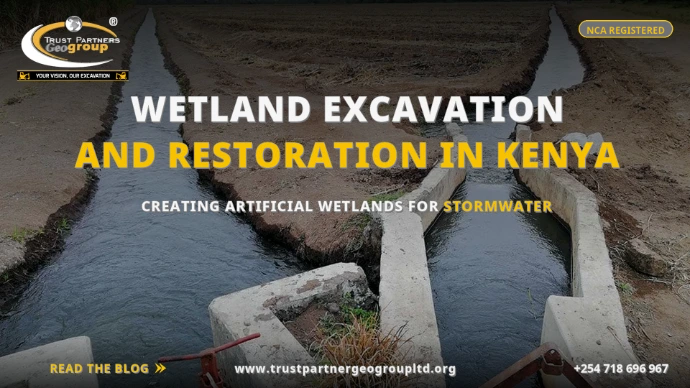
Wetland Excavation and Restoration in Kenya: Creating Artificial Wetlands for Stormwater
Constructed wetland earthworks, stormwater treatment, environmental restoration, heavy equipment for hire & native vegetation for Nairobi, Mombasa, Kisumu & across Kenya
Table of Contents
- 1. Why Artificial Wetlands for Stormwater in Kenya?
- 2. Types of Constructed Wetlands
- 3. Wetland Design: Sizing, Depth and Zoning
- 4. Excavation of Pond Cells and Marsh Zones
- 5. Liner Installation: Clay, Geomembrane and BESL
- 6. Substrate, Soil Amendment and Gravel Beds
- 7. Water Control Structures: Inlets, Outlets and Weirs
- 8. Native Vegetation Establishment
- 9. Heavy Equipment for Hire: Machines for Wetland Earthworks
- 10. NEMA, WRA and Environmental Compliance
- 11. Construction Costs and Programme [2026]
- 12. Frequently Asked Questions
- 13. Conclusion
When the rains hit Nairobi's paved surfaces - the parking lots of Westlands, the industrial yards of Embakasi, the new estates of Ruiru - the water has nowhere to go but down, carrying oil, sediment, fertiliser and litter into the Athi River and its tributaries. Concrete detention tanks store the flood but do not treat it. Percolation pits drain it underground but contaminate the aquifer. The artificial wetland is the green alternative: a landscape of shallow ponds and marsh plants engineered to slow, filter and biologically treat stormwater before it reaches natural watercourses. Wetland excavation Kenya contractors perform is a specialist environmental earthworks discipline - cutting pond cells to precise depths, installing liners to prevent seepage, placing substrates that support root growth, and establishing native vegetation that does the actual treatment work. With heavy equipment for hire from Trust Partners Geo-Group Ltd, developers, county governments and environmental consultants can execute wetland projects without capital investment in machinery. This guide covers the full wetland restoration earthworks sequence - design, excavation, lining, planting and compliance - with 2026 costs for Kenyan stormwater wetland projects.
Trust Partners Geo-Group Ltd - Environmental Engineering Team
NCA-registered excavation & civil engineering contractor with 15+ years of wetland excavation, environmental earthworks, heavy equipment for hire and stormwater management experience across East Africa. Reviewed by registered environmental engineers.
1. Why Artificial Wetlands for Stormwater in Kenya?
Kenya's rapid urbanization has replaced permeable landscapes with impermeable roofs, roads and parking areas. In Nairobi, the built-up area has expanded from 200 km2 in 1990 to over 700 km2 in 2026, reducing natural infiltration and increasing stormwater runoff volumes by 300-500%. The consequences are:
- Flash flooding: stormwater that once soaked into forest and farmland now runs off in minutes, overwhelming drainage systems and flooding low-lying areas (Industrial Area, Mathare, parts of Eastleigh);
- Water pollution: runoff from roads, industrial yards and agricultural land carries suspended solids, heavy metals, hydrocarbons, nutrients and pathogens into rivers and wetlands;
- Aquifer depletion: reduced infiltration means less groundwater recharge, lowering water tables and drying boreholes;
- Loss of biodiversity: natural wetlands are drained for development, eliminating habitat for birds, fish, amphibians and insects.
Artificial wetlands address all four problems simultaneously. They detain stormwater, reducing peak flows and flood risk. They treat pollutants through settling, filtration, plant uptake and microbial action. They recharge groundwater by allowing treated water to percolate through the substrate. And they create new habitat, supporting bird populations and aquatic species even in urban settings.
In Kenya, constructed wetlands are now required or encouraged by NEMA for developments over 1 hectare in sensitive catchments. Major projects including the Nairobi Expressway drainage system, Tatu City stormwater management, and Mombasa Port expansion have incorporated artificial wetlands as part of their environmental mitigation. For developers, a well-designed wetland is not just compliance - it is a landscaped amenity that enhances property value.
2. Types of Constructed Wetlands
Three main types of constructed wetlands are used in Kenya, each suited to different site conditions, treatment targets and budgets:
| Type | Flow Path | Depth | Cost/m2 | Best For |
|---|---|---|---|---|
| Surface flow wetland | Water flows openly across vegetated zones | 0.2-1.2m | KES 350-650 | Large stormwater volumes, visual amenity, low maintenance |
| Subsurface flow wetland | Water flows through gravel bed beneath surface | 0.5-1.0m (gravel bed) | KES 800-1,400 | High nutrient removal, mosquito control, limited space |
| Hybrid system | Surface flow followed by subsurface flow cells | Variable | KES 600-1,100 | Complex treatment, variable flows, high performance |
Surface Flow Wetlands
Surface flow wetlands are the most common type in Kenya. They consist of shallow basins (0.3-1.0m deep) with emergent vegetation covering 30-70% of the surface. Water flows openly across the wetland, with treatment occurring through settling of solids in deeper ponds, nutrient uptake by plants in marsh zones, and microbial action on plant roots and sediments. They are cheapest to construct, easiest to maintain, and provide visual amenity and wildlife habitat. The main disadvantage is mosquito breeding in open water, which requires mosquito fish (Gambusia) or biological control.
Subsurface Flow Wetlands
Subsurface flow wetlands contain a gravel bed (10-20mm clean stone, 400-600mm deep) through which water flows horizontally beneath the surface. Emergent plants are rooted in the gravel, and their roots create a dense network that supports microbial biofilms. Because water is below the surface, mosquito breeding is eliminated, and odour is minimized. Subsurface flow systems are 30-50% more expensive due to gravel costs and require careful construction to prevent clogging. They are preferred for treating domestic sewage, industrial effluent, or stormwater in residential areas where mosquitoes are a concern.
Hybrid Systems
Hybrid wetlands combine a surface flow forebay (for sediment settling and initial treatment) with a subsurface flow cell (for polishing and nutrient removal). They are used where high treatment performance is required - for example, treating runoff from industrial areas or agricultural land before discharge to sensitive water bodies. The surface flow component handles peak storm flows; the subsurface flow component provides consistent treatment during base flows.
3. Wetland Design: Sizing, Depth and Zoning
Wetland design is governed by hydrology, water quality targets, and available land. The environmental engineer calculates the required wetland area based on catchment size, runoff coefficient, and treatment performance targets.
Sizing
Rule-of-thumb sizing for stormwater treatment wetlands is 2-5% of the contributing catchment area. For a 20-hectare residential development in Nairobi, the wetland area is typically 0.4-1.0 hectares. For industrial or commercial catchments with higher pollutant loads, 5-8% may be required. The wetland must also provide detention storage for the "first flush" - the initial 10-15mm of rainfall that carries the highest pollutant load. In Nairobi's climate, a first flush volume of 200-300 m3 per hectare of catchment is typical.
Depth Zoning
A well-designed wetland has distinct depth zones, each with different vegetation and treatment functions:
- Inlet forebay: 1.0-1.5m deep, 10-15% of wetland area. Settles coarse solids and grit. Requires periodic dredging;
- Open water zone: 0.8-1.2m deep, 20-30% of area. Supports submerged and floating plants, fish, and waterfowl. Provides oxygen transfer;
- Emergent marsh zone: 0.2-0.5m deep, 40-50% of area. Dense stands of papyrus, reeds and sedges provide the primary treatment surface;
- Shallow fringe zone: 0.1-0.3m deep, 10-15% of area. Transition to dry land, planted with moisture-tolerant grasses and shrubs;
- Outlet pond: 0.5-0.8m deep, 5-10% of area. Final settling before discharge, with adjustable water level control.
Side Slopes
Side slopes must be stable during construction and safe after completion. In Nairobi's clay laterite, slopes of 3:1 (horizontal:vertical) are stable. In Mombasa's loose sand, 4:1 or flatter is required. Steep slopes (2:1 or steeper) may require geogrid reinforcement or riprap protection.
4. Excavation of Pond Cells and Marsh Zones
Wetland excavation is precision earthworks with environmental constraints. Unlike bulk excavation where over-depth is acceptable, wetland excavation must achieve design depths exactly - too deep and the marsh plants drown; too shallow and they dry out.
Bulk Excavation
Using 20-30 tonne hydraulic excavators, the wetland area is excavated in stages from the inlet to the outlet. The excavator works from the perimeter or from temporary access ramps to avoid entering the wetland footprint. In Nairobi's volcanic soils, breaker attachments are often needed to fracture dense tuff or boulders. Spoil is hauled by dump trucks to approved disposal sites or used for surrounding landscape mounding. On a 1-hectare wetland, bulk excavation volume is 8,000-15,000 m3, taking 2-4 weeks with a single excavator and truck fleet.
Fine Grading
After bulk excavation, motor graders and small excavators (5-8 tonne) trim the wetland bed to design levels with +/- 50mm tolerance. The marsh zone must be flat or with a very gentle fall (0.2-0.5%) toward the outlet to prevent stagnant pockets. Hand tools are used for final trimming around inlet and outlet structures, and to create the organic contours that machine grading cannot achieve.
Subgrade Protection
The excavated subgrade must be protected from compaction, erosion and contamination before liner placement. Construction traffic is restricted to designated haul routes. Rainfall on exposed subgrades can cause slumping in sandy soils or cracking in clay soils - temporary cover with geotextile or mulch may be required if liner installation is delayed.
Critical rule: do not compact the wetland bed
The wetland bed must remain permeable to allow root penetration, gas exchange, and (in subsurface flow systems) water movement through the substrate. Compacting the bed with heavy equipment destroys soil structure and creates an impermeable pan that kills plants and blocks flow. On a Kisumu wetland project where a contractor drove a dump truck across the finished bed to "save time," the compacted zone had to be ripped and re-graded, adding KES 800,000 to the project cost. Access for equipment must be from the perimeter only, using long-reach excavators where necessary.
5. Liner Installation: Clay, Geomembrane and BESL
Wetland liners serve two purposes: preventing treated water from leaking into the surrounding groundwater (which would lose treatment volume and potentially contaminate the aquifer), and preventing groundwater from entering the wetland (which would dilute concentrations and reduce treatment efficiency).
Compacted Clay Liners
Where native clay is available and has low permeability, a 300-500mm thick compacted clay liner can be constructed. The clay is excavated, moisture-conditioned to optimum, placed in 150mm lifts, and compacted to 95% standard proctor density. Permeability must be less than 1x10^-7 cm/s. Clay liners are cheapest but require skilled placement and can crack during dry periods. They are suitable for Mombasa's clayey coastal soils and parts of Kisumu's lacustrine deposits, but generally unsuitable for Nairobi's fractured volcanic soils.
Synthetic Geomembranes
HDPE (high-density polyethylene) or LLDPE (linear low-density polyethylene) geomembranes of 1.0-1.5mm thickness are the most reliable liner system. They are factory-welded into panels, laid on a smooth sand bedding layer (100-150mm), and seam-welded on site. All seams are tested with air pressure or vacuum methods. Geomembranes perform in all soil types, resist root penetration, and have a design life of 50+ years. The main disadvantage is cost - KES 800-1,500 per m2 installed, including bedding and cover layers. In Nairobi's volcanic terrain, HDPE is the default liner because clay cannot achieve required permeability.
Bentonite-Enhanced Soil Liners (BESL)
BESL is a compromise: native soil is mixed with sodium bentonite clay (2-5% by weight) to create a low-permeability barrier. It costs 30-40% less than geomembranes but requires careful mixing, placement and moisture control. BESL is suitable for large wetlands where geomembrane cost is prohibitive and some leakage is acceptable. It is not suitable where groundwater protection is critical.
| Liner Type | Cost/m2 | Permeability | Best For |
|---|---|---|---|
| Compacted clay | KES 200-400 | 1x10^-7 cm/s (if well placed) | Clay soils, large wetlands, low budget |
| HDPE geomembrane | KES 800-1,500 | 1x10^-12 cm/s | All soils, critical groundwater protection |
| BESL | KES 400-700 | 1x10^-8 cm/s | Large wetlands, moderate protection needs |
6. Substrate, Soil Amendment and Gravel Beds
The substrate is the material that fills the wetland bed and supports plant growth. Its composition affects drainage, nutrient availability, root penetration, and treatment performance.
Surface Flow Wetland Substrate
Surface flow wetlands typically use a 200-300mm layer of topsoil and organic amendment in the marsh and fringe zones. The topsoil provides nutrients and rooting medium; the organic matter (compost, peat, or well-rotted manure) improves water retention and cation exchange capacity. In Kenya, where native laterite is nutrient-poor and acidic, imported topsoil from agricultural areas or composted organic waste is blended with the stripped topsoil to create a suitable rooting medium. The substrate is placed after liner installation, graded to design contours, and lightly firmed (not compacted).
Subsurface Flow Gravel Beds
Subsurface flow wetlands require a 400-600mm deep bed of clean, washed gravel (10-20mm particle size). The gravel must be free of fines, clay and organic matter that could clog the bed. In Kenya, crushed stone from quarries in Athi River or Juja is washed and screened to specification. The gravel is placed on the liner in 150mm lifts, with light compaction between lifts to prevent settlement. A 50-100mm layer of coarse sand or fine gravel on top provides a rooting medium for emergent plants.
Soil Amendment
Where native soils are too acidic (pH < 5.0) or too alkaline (pH > 8.0), agricultural lime or sulphur is added to adjust pH to the 6.0-7.5 range preferred by wetland plants. Slow-release fertilizer is sometimes added at planting to accelerate establishment, but must be used cautiously - excess nutrients can cause algal blooms in open water zones.
7. Water Control Structures: Inlets, Outlets and Weirs
Water control structures regulate flow, maintain design water levels, and allow maintenance access. They are the engineering elements that make the wetland function as a treatment system rather than a simple pond.
Inlet Structures
Inlet structures dissipate the energy of incoming stormwater to prevent erosion of the wetland bed. Common designs include: concrete stilling basins with baffle walls that spread flow across the width of the wetland; riprap aprons that reduce velocity before water enters the vegetated zone; and perforated distribution pipes that spread flow evenly across the wetland width. In Kenya, where storm events can be intense, inlet structures must handle peak flows of 1-5 m3/s without scour or bypass.
Outlet Structures
Outlet structures maintain the design water level and allow controlled discharge. Adjustable weirs (V-notch or rectangular) are standard, with the crest set at the design water level. During dry periods, the weir maintains a minimum water depth for plant survival. During storms, the weir allows excess water to overflow while retaining the first-flush volume for treatment. Multi-stage outlet structures with low-flow orifices and high-flow spillways are used where variable water levels are required.
Water Level Control
Seasonal water level adjustment is important in Kenya's climate. During the dry season (June-October), water levels may need to be lowered by 100-200mm to concentrate pollutants and maintain plant health. During the wet season, levels are raised to increase detention storage. Adjustable stoplogs or sluice gates in the outlet structure allow operators to change levels without dewatering the wetland.
8. Native Vegetation Establishment
Wetland plants are the biological engine of the treatment system. Their roots provide surface area for microbial biofilms, their stems slow water flow and trap solids, and their tissues absorb nutrients. The wrong plants - or plants planted at the wrong depth - will fail and leave the wetland as an ineffective pond.
Species Selection for Kenya
| Species | Zone | Depth | Function |
|---|---|---|---|
| Papyrus (Cyperus papyrus) | Open water edge, deep marsh | 0.3-1.0m | Nutrient uptake, habitat, erosion control |
| Common reed (Phragmites australis) | Emergent marsh | 0.2-0.6m | High nutrient removal, dense root mass |
| Cattail (Typha species) | Shallow marsh | 0.1-0.4m | Sediment trapping, nutrient uptake |
| Water hyacinth (Eichhornia crassipes) | Open water | Floating | High nutrient removal, oxygenation |
| Sedges (Cyperus species) | Fringe, shallow marsh | 0.05-0.3m | Transition stabilization, diversity |
| Mosaic plant (Ludwigia species) | Shallow water | 0.1-0.3m | Ground cover, nutrient uptake |
Planting Methods
Plants are established from nursery-grown seedlings, rhizome divisions, or in-vitro propagated plantlets. Spacing is typically 0.5-1.0m for emergent species and 1.0-2.0m for floating species. Planting is done by hand or with small excavators in the dry bed before water is introduced. In Kenya, the best planting time is at the start of the long rains (March-April) when soil moisture is high and temperatures are moderate. Planting during the dry season requires irrigation until the wetland is filled.
Establishment and Maintenance
Newly planted wetlands require 3-6 months to establish full plant cover. During this period, water levels are gradually raised as plants grow. Weeding of invasive species is essential - in Nairobi, invasive species such as water lettuce (Pistia stratiotes) and salvinia can outcompete native plantings if not controlled. NEMA may require a 2-year maintenance period with quarterly monitoring of plant survival, water quality, and wildlife use before final project sign-off.
9. Heavy Equipment for Hire: Machines for Wetland Earthworks
Wetland excavation requires specialized heavy equipment that can work in soft ground, achieve fine tolerances, and minimize environmental damage. Trust Partners Geo-Group Ltd provides the full equipment fleet for wetland projects on a hire basis - eliminating the capital investment that developers would otherwise need to make.
| Equipment | Role | Hire Rate (2026) |
|---|---|---|
| 20-30t hydraulic excavator | Bulk excavation, breaker work | KES 8,000-12,000/hr |
| Long-reach excavator (15-20m) | Excavation from stable ground | KES 10,000-15,000/hr |
| 5-8t mini excavator | Fine trimming, confined sites | KES 4,000-6,000/hr |
| Bulldozer (D6-D8) | Grading, spoil movement | KES 8,000-12,000/hr |
| Motor grader (GPS-guided) | Fine grading to tolerance | KES 7,000-10,000/hr |
| Dump truck (10-20 m3) | Spoil haulage, substrate delivery | KES 5,000-8,000/hr |
| Plate compactor / roller | Liner bedding compaction | KES 2,000-3,500/hr |
| Amphibious excavator | Work in saturated ground | KES 15,000-25,000/hr |
Heavy equipment for hire is the most cost-effective approach for wetland projects, which typically last 2-4 months and do not justify equipment purchase. Trust Partners Geo-Group Ltd provides machines with experienced operators, fuel, maintenance and insurance included in the hire rate. For wetland projects, we recommend rubber-tracked excavators and low-ground-pressure bulldozers to minimize subgrade damage. Long-reach excavators are essential where the wetland bed is too soft to support conventional machines - the excavator works from the perimeter or a temporary platform, reaching across the full width of the wetland.
In saturated or waterlogged conditions, amphibious excavators with pontoon undercarriages and wide tracks can work directly in the wetland without sinking. These specialized machines are available for hire in Kenya and are invaluable for maintenance dredging and restoration of existing wetlands where dewatering is not possible.
10. NEMA, WRA and Environmental Compliance
Wetland construction in Kenya is heavily regulated because it involves water, biodiversity, and potential impacts on natural wetlands. Compliance is not optional - NEMA can issue stop-work orders and prosecute unpermitted wetland disturbance.
| Requirement | Authority | What It Covers |
|---|---|---|
| Environmental Impact Assessment | NEMA | Wetland construction, vegetation clearance, earthworks >1,000 m3 |
| Water discharge permit | WRA | Treated water discharge to natural watercourses |
| Water abstraction permit | WRA | Borehole or surface water for wetland maintenance |
| County building approval | County government | Associated structures, land use change |
| NCA contractor registration | NCA | Earthworks contractor registration and site safety |
| Biodiversity monitoring | NEMA / KWS | Wildlife use, invasive species control |
| 5-year maintenance plan | NEMA | Planting, water quality, sediment removal |
NEMA EIA Requirements
The EIA for a wetland project must include: a hydrological assessment showing that the wetland will not increase downstream flooding or reduce dry-season flows; a biodiversity assessment for impacts on existing flora and fauna; a water quality monitoring plan with baseline data and performance targets; and a 5-year maintenance and monitoring plan with performance metrics. Public participation is required, with community hearings in the project area.
WRA Permits
Water Resources Authority permits are required for: discharge of treated water to a river, stream or lake; abstraction of water from a borehole, well or surface source for wetland maintenance; and any damming, diversion or alteration of natural watercourses. In water-stressed catchments (Naivasha, parts of Athi River), WRA may limit abstraction volumes or require recycling systems.
Sediment and Erosion Control
During construction, exposed soils are highly vulnerable to erosion. Required controls include: silt fences around the entire wetland perimeter; sediment traps at every drainage outfall; check dams in temporary channels; and mulching of exposed slopes within 7 days of grading. NEMA inspectors can suspend work for inadequate controls, particularly where sediment enters natural wetlands or watercourses.
11. Construction Costs and Programme [2026]
Indicative costs for wetland excavation and construction in Kenya:
| Item | 2026 Rate | Notes |
|---|---|---|
| Site clearance and topsoil stripping | KES 150-300/m3 | Includes stockpiling |
| Bulk excavation (pond and marsh) | KES 250-450/m3 | Standard soils |
| Bulk excavation (rock/boulders) | KES 500-900/m3 | With breaker attachment |
| Fine grading and contouring | KES 350-600/m3 | +/- 50mm tolerance |
| Clay liner supply and placement | KES 200-400/m2 | 300-500mm thick |
| HDPE geomembrane liner | KES 800-1,500/m2 | 1.0-1.5mm, welded |
| BESL liner | KES 400-700/m2 | Bentonite-soil mix |
| Gravel substrate (subsurface flow) | KES 1,500-2,500/m3 | Clean 10-20mm stone |
| Topsoil and organic amendment | KES 800-1,500/m3 | For marsh zones |
| Inlet/outlet structures | KES 80,000-250,000 each | Concrete or precast |
| Native vegetation supply and plant | KES 150-400/m2 | Nursery-grown seedlings |
| Fencing and access paths | KES 2,000-4,000/m | Chain link or timber |
| Heavy equipment for hire (fleet) | KES 8,000-15,000/hr | Excavator, dozer, grader, trucks |
| Mobilization / demobilization | KES 150,000-400,000 | Transport, setup |
All-in project estimates:
- 0.5 ha surface flow wetland (stormwater treatment): KES 2.0-3.5 million;
- 1.0 ha surface flow wetland (stormwater treatment): KES 3.5-6.5 million;
- 0.5 ha subsurface flow wetland (sewage treatment): KES 4.0-7.0 million;
- 2.0 ha hybrid wetland (industrial runoff): KES 8-14 million;
- Existing wetland restoration (1 ha): KES 1.5-3.0 million (dredging, replanting, structures).
Programme: site clearance and sediment control 1-2 weeks; bulk excavation 3-6 weeks; fine grading and subgrade prep 1-2 weeks; liner installation 1-2 weeks; substrate placement 1-2 weeks; structure construction 1-2 weeks; planting 1-2 weeks; commissioning and monitoring 3-6 months. Total construction programme for a 1-hectare wetland: 3-5 months, plus 3-6 months establishment monitoring.
Pro tip: hire, don't buy
Wetland projects are typically 2-4 month programmes that do not justify equipment purchase. Trust Partners Geo-Group Ltd provides heavy equipment for hire on daily, weekly or monthly rates, with operators, fuel and maintenance included. This eliminates capital expenditure, storage costs, and the risk of idle equipment after project completion. For a typical 1-hectare wetland, equipment hire costs are KES 1.5-2.5 million - compared to KES 8-15 million to purchase equivalent machines. Hire also gives you access to specialized equipment such as long-reach excavators and amphibious machines that you would never purchase for a single project.
12. Frequently Asked Questions: Wetland Excavation in Kenya
What is an artificial wetland and how does it manage stormwater in Kenya?
An artificial or constructed wetland is an engineered system of shallow ponds and vegetated marsh areas designed to treat stormwater runoff through natural physical, chemical and biological processes. Stormwater flows into the wetland, where suspended solids settle out, nutrients are absorbed by wetland plants, and pollutants are broken down by bacteria in the root zone. In Kenya, artificial wetlands are used to manage runoff from urban developments, industrial sites, roads and agricultural areas in Nairobi, Mombasa, Kisumu and Nakuru. They reduce flooding, improve water quality before discharge to natural watercourses, and provide habitat for birds and aquatic species. Unlike concrete detention tanks, constructed wetlands treat water while creating green space and biodiversity value.
What are the main types of constructed wetlands used in Kenya?
Three main types of constructed wetlands are used in Kenya. Surface flow wetlands have open water areas 0.3-1.0m deep with emergent vegetation along edges and shallow zones - they are cheapest to construct and maintain, and are preferred for large stormwater treatment systems. Subsurface flow wetlands have gravel beds 0.5-1.0m deep with water flowing beneath the surface through the root zone - they are more efficient at pollutant removal but cost 30-50% more and require careful construction. Hybrid systems combine surface and subsurface cells in series, optimizing treatment for high-nutrient loads from agricultural or industrial runoff. In Nairobi's urban developments, surface flow wetlands are most common because they handle large storm volumes, are visually attractive, and require minimal maintenance. Subsurface flow systems are used where mosquito breeding must be minimized or where space is limited.
How deep are artificial wetlands excavated in Kenya?
Artificial wetland excavation depths in Kenya vary by zone and function. Inlet ponds and forebays are excavated 1.0-1.5m deep to allow sediment settling and periodic dredging. Open water zones are 0.8-1.2m deep to support aquatic plants and prevent excessive algal growth. Emergent marsh zones are 0.2-0.5m deep to support rooted wetland plants such as papyrus, reeds and cattails. Shallow fringe zones of 0.1-0.3m depth transition to the surrounding landscape. The overall excavation volume for a 1-hectare wetland treating stormwater from 20 hectares of urban catchment is typically 8,000-15,000 m3. In Nairobi's volcanic soils, excavation may encounter dense tuff or boulders that require breaker attachments on excavators. In Mombasa's sandy soils, side slopes must be gentler (4:1 or flatter) to prevent collapse during construction.
What does wetland excavation cost in Kenya in 2026?
2026 indicative costs for wetland excavation in Kenya: bulk excavation of pond and marsh zones KES 250-450 per m3; fine grading and contouring of shallow zones KES 350-600 per m3; clay or synthetic liner supply and installation KES 800-1,500 per m2; gravel substrate for subsurface flow beds KES 1,500-2,500 per m3; topsoil and organic amendment for planting zones KES 800-1,500 per m3; water control structures (inlet, outlet, weirs) KES 80,000-250,000 each; native vegetation supply and planting KES 150-400 per m2; fencing and access paths KES 2,000-4,000 per linear metre. A 1-hectare surface flow wetland for stormwater treatment costs KES 3.5-6.5 million for excavation, lining and planting. A 0.5-hectare subsurface flow system costs KES 4-7 million due to gravel substrate and underdrain requirements. Heavy equipment for hire including 20-30 tonne excavators, bulldozers and dump trucks is typically KES 8,000-15,000 per hour for the complete fleet.
What heavy equipment is used for wetland excavation in Kenya?
Wetland excavation in Kenya uses heavy equipment for hire including: 20-30 tonne hydraulic excavators with bucket and breaker attachments for bulk excavation in dense soils and rock; long-reach excavators (15-20m reach) for excavation from stable ground into saturated areas where machines cannot enter; bulldozers for grading and shaping large pond areas; motor graders for final contouring of shallow marsh zones; dump trucks (10-20 m3) for spoil haulage and substrate delivery; and plate compactors or smooth drum rollers for liner bedding compaction. In saturated or soft ground conditions, amphibious excavators with pontoon undercarriages may be required - these are specialized machines available for hire in Kenya at premium rates. For small urban wetlands, mini-excavators (3-8 tonne) provide access in confined sites. Trust Partners Geo-Group Ltd provides the full heavy equipment fleet for wetland projects, from bulk excavation to fine grading, with operators experienced in environmental earthworks.
How is a wetland liner installed to prevent seepage loss?
Wetland liners prevent treated water from seeping into the surrounding groundwater (which would lose treatment volume and potentially contaminate the aquifer), and prevent groundwater from entering the wetland (which would dilute concentrations and reduce treatment efficiency). In Kenya, three liner types are used: compacted clay liners (300-500mm thick) are suitable where native clay is available and permeability is low - they are cheapest but require careful compaction and can crack during dry periods; synthetic geomembranes (1.0-1.5mm HDPE or LLDPE) are the most reliable, welded on site and tested for leaks - they cost more but perform in all soil types; and bentonite-enhanced soil liners (BESL) where bentonite clay is mixed into native soil to create a low-permeability barrier. In Nairobi's fractured volcanic soils, HDPE geomembranes are almost always required because clay liners cannot achieve the required permeability of 1x10^-7 cm/s. Installation involves excavating to design depth, trimming and smoothing the subgrade, placing a 100-150mm sand bedding layer, laying and welding the geomembrane, and protecting it with a 100-200mm sand or geotextile cover before placing substrate or water.
What native plants are used in Kenyan constructed wetlands?
Kenyan constructed wetlands use native wetland plants that are adapted to local climate, provide treatment function, and support biodiversity. Common species include: papyrus (Cyperus papyrus) for deep open water and marsh edges - excellent for nutrient uptake and habitat; common reed (Phragmites australis) for emergent zones - aggressive root systems treat high nutrient loads; cattail or bulrush (Typha species) for shallow marsh areas - tolerate fluctuating water levels; water hyacinth (Eichhornia crassipes) for open water - highly effective at nutrient removal but must be managed to prevent overgrowth; and various sedges (Cyperus species) for fringe zones. Planting is done with nursery-grown seedlings or rhizome divisions, spaced 0.5-1.0m apart in the marsh zone. In Nairobi's climate, planting should occur at the start of the long rains (March-April) to ensure establishment before the dry season. NEMA may require that planting plans use only native species and avoid invasive exotics that could escape into natural wetlands.
What environmental approvals are needed for wetland construction in Kenya?
Wetland construction in Kenya requires NEMA Environmental Impact Assessment (EIA) approval if the project involves vegetation clearance over 1 hectare, earthworks exceeding 1,000 m3, or disturbance of existing wetlands or riparian zones. The EIA must cover: hydrological assessment showing that the wetland will not alter downstream flows or flood patterns; biodiversity assessment for impacts on existing flora and fauna; water quality monitoring plan for inlet and outlet; and a 5-year maintenance and monitoring plan. Water Resources Authority (WRA) permits are required if the wetland discharges to a natural watercourse, abstracts water for maintenance, or involves damming or diversion of existing flows. County government approval is needed for land use change and building plans for any associated structures. Where existing natural wetlands are being restored rather than new ones constructed, NEMA may require a restoration plan with performance metrics for water quality, vegetation cover and wildlife use. Trust Partners Geo-Group Ltd coordinates with environmental consultants to ensure earthworks comply with all approvals.
13. Conclusion: Digging for Clean Water
An artificial wetland is a paradox: it is built by heavy machines excavating tonnes of soil, yet its purpose is the most delicate of environmental functions - cleaning water with plants and bacteria. The excavator that cuts the pond cell must stop at exactly the right depth; the grader that shapes the marsh must create a surface so flat that water spreads evenly across it; the liner that prevents seepage must be welded without a single pinhole; and the plants that are placed by hand must survive the dry season to do their work when the rains return.
In Kenya, where urban runoff is increasing, natural wetlands are shrinking, and NEMA is requiring stormwater treatment for ever-larger developments, the constructed wetland is moving from an environmental luxury to a planning requirement. The developer who builds a wetland as a tick-box compliance exercise gets a pond that silts up and smells. The developer who builds it as a landscape asset - with proper design, quality earthworks, native plants, and ongoing maintenance - gets a treatment system that also attracts birds, cools the microclimate, and increases property values.
Trust Partners Geo-Group Ltd delivers the full wetland excavation and construction package across Kenya: site clearance and sediment control, bulk and fine excavation of pond and marsh zones, liner installation (clay, geomembrane or BESL), substrate and soil amendment placement, water control structure construction, native vegetation supply and planting, and commissioning with water quality monitoring. We provide heavy equipment for hire with experienced environmental earthworks operators, coordinate with your environmental consultant's design, manage NEMA and WRA compliance, and deliver wetland projects on programme and budget - from small urban stormwater cells to multi-hectare treatment systems.
Wetland Excavation & Environmental Earthworks
Artificial wetland construction, stormwater management, heavy equipment for hire, native vegetation planting and environmental restoration across Nairobi, Mombasa, Kisumu and Kenya.
Free lead magnet: ask for our Wetland Construction Specification Checklist (PDF) - excavation tolerances, liner testing protocols, planting schedules and NEMA compliance standards your environmental consultant will require.
Related Resources
Landscape Grading and Excavation for Golf Courses in Kenya: Contouring, Drainage & Turf Prep
Precision landscape earthworks for golf developments - the previous blog in our environmental excavation series.
READ MOREWater Pan Excavation for Dairy Farming in Kenya: Size, Depth & Lining Guide [2026]
Water feature excavation, lining and earthworks for agricultural and environmental water storage projects.
READ MOREEarthworks QA/QC: Compaction Testing & Density Control
Testing protocols for wetland subgrades, liner bedding and structural backfill.
READ MORESlope Excavation and Stabilization for Hillside Construction in Nairobi & Kiambu
Cut slopes and stabilization for wetland projects on sloped terrain.
READ MOREBulk Excavation Cost Per Cubic Meter in Kenya [2026 Updated Rates]
Transparent pricing for the bulk earthworks component of every wetland project.
READ MOREAnchored Retaining Walls for Slope Stabilization: Tie-Back Installation & Load Testing
Ground anchor solutions for wetland embankments and retaining structures.
READ MORETRUST PARTNERS GEO-GROUP LTD | YOUR VISION, OUR EXCAVATION
WEBSITE: WWW.TRUSTPARTNERGEOGROUPLTD.ORG | EMAIL: INFO@TRUSTPARTNERGEOGROUPLTD.ORG | PHONE: +254 718 68 69 67
FOLLOW US: FACEBOOK | TIKTOK | INSTAGRAM | LINKEDIN
© 2026 TRUST PARTNERS GEO-GROUP LTD. ALL RIGHTS RESERVED.
Wetland Excavation and Restoration in Kenya: Creating Artificial Wetlands for Stormwater
Constructed wetland earthworks, stormwater treatment, environmental restoration, heavy equipment for hire & native vegetation for Nairobi, Mombasa, Kisumu & across Kenya
Table of Contents
- 1. Why Artificial Wetlands for Stormwater in Kenya?
- 2. Types of Constructed Wetlands
- 3. Wetland Design: Sizing, Depth and Zoning
- 4. Excavation of Pond Cells and Marsh Zones
- 5. Liner Installation: Clay, Geomembrane and BESL
- 6. Substrate, Soil Amendment and Gravel Beds
- 7. Water Control Structures: Inlets, Outlets and Weirs
- 8. Native Vegetation Establishment
- 9. Heavy Equipment for Hire: Machines for Wetland Earthworks
- 10. NEMA, WRA and Environmental Compliance
- 11. Construction Costs and Programme [2026]
- 12. Frequently Asked Questions
- 13. Conclusion
When the rains hit Nairobi's paved surfaces - the parking lots of Westlands, the industrial yards of Embakasi, the new estates of Ruiru - the water has nowhere to go but down, carrying oil, sediment, fertiliser and litter into the Athi River and its tributaries. Concrete detention tanks store the flood but do not treat it. Percolation pits drain it underground but contaminate the aquifer. The artificial wetland is the green alternative: a landscape of shallow ponds and marsh plants engineered to slow, filter and biologically treat stormwater before it reaches natural watercourses. Wetland excavation Kenya contractors perform is a specialist environmental earthworks discipline - cutting pond cells to precise depths, installing liners to prevent seepage, placing substrates that support root growth, and establishing native vegetation that does the actual treatment work. With heavy equipment for hire from Trust Partners Geo-Group Ltd, developers, county governments and environmental consultants can execute wetland projects without capital investment in machinery. This guide covers the full wetland restoration earthworks sequence - design, excavation, lining, planting and compliance - with 2026 costs for Kenyan stormwater wetland projects.
Trust Partners Geo-Group Ltd - Environmental Engineering Team
NCA-registered excavation & civil engineering contractor with 15+ years of wetland excavation, environmental earthworks, heavy equipment for hire and stormwater management experience across East Africa. Reviewed by registered environmental engineers.
1. Why Artificial Wetlands for Stormwater in Kenya?
Kenya's rapid urbanization has replaced permeable landscapes with impermeable roofs, roads and parking areas. In Nairobi, the built-up area has expanded from 200 km2 in 1990 to over 700 km2 in 2026, reducing natural infiltration and increasing stormwater runoff volumes by 300-500%. The consequences are:
- Flash flooding: stormwater that once soaked into forest and farmland now runs off in minutes, overwhelming drainage systems and flooding low-lying areas (Industrial Area, Mathare, parts of Eastleigh);
- Water pollution: runoff from roads, industrial yards and agricultural land carries suspended solids, heavy metals, hydrocarbons, nutrients and pathogens into rivers and wetlands;
- Aquifer depletion: reduced infiltration means less groundwater recharge, lowering water tables and drying boreholes;
- Loss of biodiversity: natural wetlands are drained for development, eliminating habitat for birds, fish, amphibians and insects.
Artificial wetlands address all four problems simultaneously. They detain stormwater, reducing peak flows and flood risk. They treat pollutants through settling, filtration, plant uptake and microbial action. They recharge groundwater by allowing treated water to percolate through the substrate. And they create new habitat, supporting bird populations and aquatic species even in urban settings.
In Kenya, constructed wetlands are now required or encouraged by NEMA for developments over 1 hectare in sensitive catchments. Major projects including the Nairobi Expressway drainage system, Tatu City stormwater management, and Mombasa Port expansion have incorporated artificial wetlands as part of their environmental mitigation. For developers, a well-designed wetland is not just compliance - it is a landscaped amenity that enhances property value.
2. Types of Constructed Wetlands
Three main types of constructed wetlands are used in Kenya, each suited to different site conditions, treatment targets and budgets:
| Type | Flow Path | Depth | Cost/m2 | Best For |
|---|---|---|---|---|
| Surface flow wetland | Water flows openly across vegetated zones | 0.2-1.2m | KES 350-650 | Large stormwater volumes, visual amenity, low maintenance |
| Subsurface flow wetland | Water flows through gravel bed beneath surface | 0.5-1.0m (gravel bed) | KES 800-1,400 | High nutrient removal, mosquito control, limited space |
| Hybrid system | Surface flow followed by subsurface flow cells | Variable | KES 600-1,100 | Complex treatment, variable flows, high performance |
Surface Flow Wetlands
Surface flow wetlands are the most common type in Kenya. They consist of shallow basins (0.3-1.0m deep) with emergent vegetation covering 30-70% of the surface. Water flows openly across the wetland, with treatment occurring through settling of solids in deeper ponds, nutrient uptake by plants in marsh zones, and microbial action on plant roots and sediments. They are cheapest to construct, easiest to maintain, and provide visual amenity and wildlife habitat. The main disadvantage is mosquito breeding in open water, which requires mosquito fish (Gambusia) or biological control.
Subsurface Flow Wetlands
Subsurface flow wetlands contain a gravel bed (10-20mm clean stone, 400-600mm deep) through which water flows horizontally beneath the surface. Emergent plants are rooted in the gravel, and their roots create a dense network that supports microbial biofilms. Because water is below the surface, mosquito breeding is eliminated, and odour is minimized. Subsurface flow systems are 30-50% more expensive due to gravel costs and require careful construction to prevent clogging. They are preferred for treating domestic sewage, industrial effluent, or stormwater in residential areas where mosquitoes are a concern.
Hybrid Systems
Hybrid wetlands combine a surface flow forebay (for sediment settling and initial treatment) with a subsurface flow cell (for polishing and nutrient removal). They are used where high treatment performance is required - for example, treating runoff from industrial areas or agricultural land before discharge to sensitive water bodies. The surface flow component handles peak storm flows; the subsurface flow component provides consistent treatment during base flows.
3. Wetland Design: Sizing, Depth and Zoning
Wetland design is governed by hydrology, water quality targets, and available land. The environmental engineer calculates the required wetland area based on catchment size, runoff coefficient, and treatment performance targets.
Sizing
Rule-of-thumb sizing for stormwater treatment wetlands is 2-5% of the contributing catchment area. For a 20-hectare residential development in Nairobi, the wetland area is typically 0.4-1.0 hectares. For industrial or commercial catchments with higher pollutant loads, 5-8% may be required. The wetland must also provide detention storage for the "first flush" - the initial 10-15mm of rainfall that carries the highest pollutant load. In Nairobi's climate, a first flush volume of 200-300 m3 per hectare of catchment is typical.
Depth Zoning
A well-designed wetland has distinct depth zones, each with different vegetation and treatment functions:
- Inlet forebay: 1.0-1.5m deep, 10-15% of wetland area. Settles coarse solids and grit. Requires periodic dredging;
- Open water zone: 0.8-1.2m deep, 20-30% of area. Supports submerged and floating plants, fish, and waterfowl. Provides oxygen transfer;
- Emergent marsh zone: 0.2-0.5m deep, 40-50% of area. Dense stands of papyrus, reeds and sedges provide the primary treatment surface;
- Shallow fringe zone: 0.1-0.3m deep, 10-15% of area. Transition to dry land, planted with moisture-tolerant grasses and shrubs;
- Outlet pond: 0.5-0.8m deep, 5-10% of area. Final settling before discharge, with adjustable water level control.
Side Slopes
Side slopes must be stable during construction and safe after completion. In Nairobi's clay laterite, slopes of 3:1 (horizontal:vertical) are stable. In Mombasa's loose sand, 4:1 or flatter is required. Steep slopes (2:1 or steeper) may require geogrid reinforcement or riprap protection.
4. Excavation of Pond Cells and Marsh Zones
Wetland excavation is precision earthworks with environmental constraints. Unlike bulk excavation where over-depth is acceptable, wetland excavation must achieve design depths exactly - too deep and the marsh plants drown; too shallow and they dry out.
Bulk Excavation
Using 20-30 tonne hydraulic excavators, the wetland area is excavated in stages from the inlet to the outlet. The excavator works from the perimeter or from temporary access ramps to avoid entering the wetland footprint. In Nairobi's volcanic soils, breaker attachments are often needed to fracture dense tuff or boulders. Spoil is hauled by dump trucks to approved disposal sites or used for surrounding landscape mounding. On a 1-hectare wetland, bulk excavation volume is 8,000-15,000 m3, taking 2-4 weeks with a single excavator and truck fleet.
Fine Grading
After bulk excavation, motor graders and small excavators (5-8 tonne) trim the wetland bed to design levels with +/- 50mm tolerance. The marsh zone must be flat or with a very gentle fall (0.2-0.5%) toward the outlet to prevent stagnant pockets. Hand tools are used for final trimming around inlet and outlet structures, and to create the organic contours that machine grading cannot achieve.
Subgrade Protection
The excavated subgrade must be protected from compaction, erosion and contamination before liner placement. Construction traffic is restricted to designated haul routes. Rainfall on exposed subgrades can cause slumping in sandy soils or cracking in clay soils - temporary cover with geotextile or mulch may be required if liner installation is delayed.
Critical rule: do not compact the wetland bed
The wetland bed must remain permeable to allow root penetration, gas exchange, and (in subsurface flow systems) water movement through the substrate. Compacting the bed with heavy equipment destroys soil structure and creates an impermeable pan that kills plants and blocks flow. On a Kisumu wetland project where a contractor drove a dump truck across the finished bed to "save time," the compacted zone had to be ripped and re-graded, adding KES 800,000 to the project cost. Access for equipment must be from the perimeter only, using long-reach excavators where necessary.
5. Liner Installation: Clay, Geomembrane and BESL
Wetland liners serve two purposes: preventing treated water from leaking into the surrounding groundwater (which would lose treatment volume and potentially contaminate the aquifer), and preventing groundwater from entering the wetland (which would dilute concentrations and reduce treatment efficiency).
Compacted Clay Liners
Where native clay is available and has low permeability, a 300-500mm thick compacted clay liner can be constructed. The clay is excavated, moisture-conditioned to optimum, placed in 150mm lifts, and compacted to 95% standard proctor density. Permeability must be less than 1x10^-7 cm/s. Clay liners are cheapest but require skilled placement and can crack during dry periods. They are suitable for Mombasa's clayey coastal soils and parts of Kisumu's lacustrine deposits, but generally unsuitable for Nairobi's fractured volcanic soils.
Synthetic Geomembranes
HDPE (high-density polyethylene) or LLDPE (linear low-density polyethylene) geomembranes of 1.0-1.5mm thickness are the most reliable liner system. They are factory-welded into panels, laid on a smooth sand bedding layer (100-150mm), and seam-welded on site. All seams are tested with air pressure or vacuum methods. Geomembranes perform in all soil types, resist root penetration, and have a design life of 50+ years. The main disadvantage is cost - KES 800-1,500 per m2 installed, including bedding and cover layers. In Nairobi's volcanic terrain, HDPE is the default liner because clay cannot achieve required permeability.
Bentonite-Enhanced Soil Liners (BESL)
BESL is a compromise: native soil is mixed with sodium bentonite clay (2-5% by weight) to create a low-permeability barrier. It costs 30-40% less than geomembranes but requires careful mixing, placement and moisture control. BESL is suitable for large wetlands where geomembrane cost is prohibitive and some leakage is acceptable. It is not suitable where groundwater protection is critical.
| Liner Type | Cost/m2 | Permeability | Best For |
|---|---|---|---|
| Compacted clay | KES 200-400 | 1x10^-7 cm/s (if well placed) | Clay soils, large wetlands, low budget |
| HDPE geomembrane | KES 800-1,500 | 1x10^-12 cm/s | All soils, critical groundwater protection |
| BESL | KES 400-700 | 1x10^-8 cm/s | Large wetlands, moderate protection needs |
6. Substrate, Soil Amendment and Gravel Beds
The substrate is the material that fills the wetland bed and supports plant growth. Its composition affects drainage, nutrient availability, root penetration, and treatment performance.
Surface Flow Wetland Substrate
Surface flow wetlands typically use a 200-300mm layer of topsoil and organic amendment in the marsh and fringe zones. The topsoil provides nutrients and rooting medium; the organic matter (compost, peat, or well-rotted manure) improves water retention and cation exchange capacity. In Kenya, where native laterite is nutrient-poor and acidic, imported topsoil from agricultural areas or composted organic waste is blended with the stripped topsoil to create a suitable rooting medium. The substrate is placed after liner installation, graded to design contours, and lightly firmed (not compacted).
Subsurface Flow Gravel Beds
Subsurface flow wetlands require a 400-600mm deep bed of clean, washed gravel (10-20mm particle size). The gravel must be free of fines, clay and organic matter that could clog the bed. In Kenya, crushed stone from quarries in Athi River or Juja is washed and screened to specification. The gravel is placed on the liner in 150mm lifts, with light compaction between lifts to prevent settlement. A 50-100mm layer of coarse sand or fine gravel on top provides a rooting medium for emergent plants.
Soil Amendment
Where native soils are too acidic (pH < 5.0) or too alkaline (pH > 8.0), agricultural lime or sulphur is added to adjust pH to the 6.0-7.5 range preferred by wetland plants. Slow-release fertilizer is sometimes added at planting to accelerate establishment, but must be used cautiously - excess nutrients can cause algal blooms in open water zones.
7. Water Control Structures: Inlets, Outlets and Weirs
Water control structures regulate flow, maintain design water levels, and allow maintenance access. They are the engineering elements that make the wetland function as a treatment system rather than a simple pond.
Inlet Structures
Inlet structures dissipate the energy of incoming stormwater to prevent erosion of the wetland bed. Common designs include: concrete stilling basins with baffle walls that spread flow across the width of the wetland; riprap aprons that reduce velocity before water enters the vegetated zone; and perforated distribution pipes that spread flow evenly across the wetland width. In Kenya, where storm events can be intense, inlet structures must handle peak flows of 1-5 m3/s without scour or bypass.
Outlet Structures
Outlet structures maintain the design water level and allow controlled discharge. Adjustable weirs (V-notch or rectangular) are standard, with the crest set at the design water level. During dry periods, the weir maintains a minimum water depth for plant survival. During storms, the weir allows excess water to overflow while retaining the first-flush volume for treatment. Multi-stage outlet structures with low-flow orifices and high-flow spillways are used where variable water levels are required.
Water Level Control
Seasonal water level adjustment is important in Kenya's climate. During the dry season (June-October), water levels may need to be lowered by 100-200mm to concentrate pollutants and maintain plant health. During the wet season, levels are raised to increase detention storage. Adjustable stoplogs or sluice gates in the outlet structure allow operators to change levels without dewatering the wetland.
8. Native Vegetation Establishment
Wetland plants are the biological engine of the treatment system. Their roots provide surface area for microbial biofilms, their stems slow water flow and trap solids, and their tissues absorb nutrients. The wrong plants - or plants planted at the wrong depth - will fail and leave the wetland as an ineffective pond.
Species Selection for Kenya
| Species | Zone | Depth | Function |
|---|---|---|---|
| Papyrus (Cyperus papyrus) | Open water edge, deep marsh | 0.3-1.0m | Nutrient uptake, habitat, erosion control |
| Common reed (Phragmites australis) | Emergent marsh | 0.2-0.6m | High nutrient removal, dense root mass |
| Cattail (Typha species) | Shallow marsh | 0.1-0.4m | Sediment trapping, nutrient uptake |
| Water hyacinth (Eichhornia crassipes) | Open water | Floating | High nutrient removal, oxygenation |
| Sedges (Cyperus species) | Fringe, shallow marsh | 0.05-0.3m | Transition stabilization, diversity |
| Mosaic plant (Ludwigia species) | Shallow water | 0.1-0.3m | Ground cover, nutrient uptake |
Planting Methods
Plants are established from nursery-grown seedlings, rhizome divisions, or in-vitro propagated plantlets. Spacing is typically 0.5-1.0m for emergent species and 1.0-2.0m for floating species. Planting is done by hand or with small excavators in the dry bed before water is introduced. In Kenya, the best planting time is at the start of the long rains (March-April) when soil moisture is high and temperatures are moderate. Planting during the dry season requires irrigation until the wetland is filled.
Establishment and Maintenance
Newly planted wetlands require 3-6 months to establish full plant cover. During this period, water levels are gradually raised as plants grow. Weeding of invasive species is essential - in Nairobi, invasive species such as water lettuce (Pistia stratiotes) and salvinia can outcompete native plantings if not controlled. NEMA may require a 2-year maintenance period with quarterly monitoring of plant survival, water quality, and wildlife use before final project sign-off.
9. Heavy Equipment for Hire: Machines for Wetland Earthworks
Wetland excavation requires specialized heavy equipment that can work in soft ground, achieve fine tolerances, and minimize environmental damage. Trust Partners Geo-Group Ltd provides the full equipment fleet for wetland projects on a hire basis - eliminating the capital investment that developers would otherwise need to make.
| Equipment | Role | Hire Rate (2026) |
|---|---|---|
| 20-30t hydraulic excavator | Bulk excavation, breaker work | KES 8,000-12,000/hr |
| Long-reach excavator (15-20m) | Excavation from stable ground | KES 10,000-15,000/hr |
| 5-8t mini excavator | Fine trimming, confined sites | KES 4,000-6,000/hr |
| Bulldozer (D6-D8) | Grading, spoil movement | KES 8,000-12,000/hr |
| Motor grader (GPS-guided) | Fine grading to tolerance | KES 7,000-10,000/hr |
| Dump truck (10-20 m3) | Spoil haulage, substrate delivery | KES 5,000-8,000/hr |
| Plate compactor / roller | Liner bedding compaction | KES 2,000-3,500/hr |
| Amphibious excavator | Work in saturated ground | KES 15,000-25,000/hr |
Heavy equipment for hire is the most cost-effective approach for wetland projects, which typically last 2-4 months and do not justify equipment purchase. Trust Partners Geo-Group Ltd provides machines with experienced operators, fuel, maintenance and insurance included in the hire rate. For wetland projects, we recommend rubber-tracked excavators and low-ground-pressure bulldozers to minimize subgrade damage. Long-reach excavators are essential where the wetland bed is too soft to support conventional machines - the excavator works from the perimeter or a temporary platform, reaching across the full width of the wetland.
In saturated or waterlogged conditions, amphibious excavators with pontoon undercarriages and wide tracks can work directly in the wetland without sinking. These specialized machines are available for hire in Kenya and are invaluable for maintenance dredging and restoration of existing wetlands where dewatering is not possible.
10. NEMA, WRA and Environmental Compliance
Wetland construction in Kenya is heavily regulated because it involves water, biodiversity, and potential impacts on natural wetlands. Compliance is not optional - NEMA can issue stop-work orders and prosecute unpermitted wetland disturbance.
| Requirement | Authority | What It Covers |
|---|---|---|
| Environmental Impact Assessment | NEMA | Wetland construction, vegetation clearance, earthworks >1,000 m3 |
| Water discharge permit | WRA | Treated water discharge to natural watercourses |
| Water abstraction permit | WRA | Borehole or surface water for wetland maintenance |
| County building approval | County government | Associated structures, land use change |
| NCA contractor registration | NCA | Earthworks contractor registration and site safety |
| Biodiversity monitoring | NEMA / KWS | Wildlife use, invasive species control |
| 5-year maintenance plan | NEMA | Planting, water quality, sediment removal |
NEMA EIA Requirements
The EIA for a wetland project must include: a hydrological assessment showing that the wetland will not increase downstream flooding or reduce dry-season flows; a biodiversity assessment for impacts on existing flora and fauna; a water quality monitoring plan with baseline data and performance targets; and a 5-year maintenance and monitoring plan with performance metrics. Public participation is required, with community hearings in the project area.
WRA Permits
Water Resources Authority permits are required for: discharge of treated water to a river, stream or lake; abstraction of water from a borehole, well or surface source for wetland maintenance; and any damming, diversion or alteration of natural watercourses. In water-stressed catchments (Naivasha, parts of Athi River), WRA may limit abstraction volumes or require recycling systems.
Sediment and Erosion Control
During construction, exposed soils are highly vulnerable to erosion. Required controls include: silt fences around the entire wetland perimeter; sediment traps at every drainage outfall; check dams in temporary channels; and mulching of exposed slopes within 7 days of grading. NEMA inspectors can suspend work for inadequate controls, particularly where sediment enters natural wetlands or watercourses.
11. Construction Costs and Programme [2026]
Indicative costs for wetland excavation and construction in Kenya:
| Item | 2026 Rate | Notes |
|---|---|---|
| Site clearance and topsoil stripping | KES 150-300/m3 | Includes stockpiling |
| Bulk excavation (pond and marsh) | KES 250-450/m3 | Standard soils |
| Bulk excavation (rock/boulders) | KES 500-900/m3 | With breaker attachment |
| Fine grading and contouring | KES 350-600/m3 | +/- 50mm tolerance |
| Clay liner supply and placement | KES 200-400/m2 | 300-500mm thick |
| HDPE geomembrane liner | KES 800-1,500/m2 | 1.0-1.5mm, welded |
| BESL liner | KES 400-700/m2 | Bentonite-soil mix |
| Gravel substrate (subsurface flow) | KES 1,500-2,500/m3 | Clean 10-20mm stone |
| Topsoil and organic amendment | KES 800-1,500/m3 | For marsh zones |
| Inlet/outlet structures | KES 80,000-250,000 each | Concrete or precast |
| Native vegetation supply and plant | KES 150-400/m2 | Nursery-grown seedlings |
| Fencing and access paths | KES 2,000-4,000/m | Chain link or timber |
| Heavy equipment for hire (fleet) | KES 8,000-15,000/hr | Excavator, dozer, grader, trucks |
| Mobilization / demobilization | KES 150,000-400,000 | Transport, setup |
All-in project estimates:
- 0.5 ha surface flow wetland (stormwater treatment): KES 2.0-3.5 million;
- 1.0 ha surface flow wetland (stormwater treatment): KES 3.5-6.5 million;
- 0.5 ha subsurface flow wetland (sewage treatment): KES 4.0-7.0 million;
- 2.0 ha hybrid wetland (industrial runoff): KES 8-14 million;
- Existing wetland restoration (1 ha): KES 1.5-3.0 million (dredging, replanting, structures).
Programme: site clearance and sediment control 1-2 weeks; bulk excavation 3-6 weeks; fine grading and subgrade prep 1-2 weeks; liner installation 1-2 weeks; substrate placement 1-2 weeks; structure construction 1-2 weeks; planting 1-2 weeks; commissioning and monitoring 3-6 months. Total construction programme for a 1-hectare wetland: 3-5 months, plus 3-6 months establishment monitoring.
Pro tip: hire, don't buy
Wetland projects are typically 2-4 month programmes that do not justify equipment purchase. Trust Partners Geo-Group Ltd provides heavy equipment for hire on daily, weekly or monthly rates, with operators, fuel and maintenance included. This eliminates capital expenditure, storage costs, and the risk of idle equipment after project completion. For a typical 1-hectare wetland, equipment hire costs are KES 1.5-2.5 million - compared to KES 8-15 million to purchase equivalent machines. Hire also gives you access to specialized equipment such as long-reach excavators and amphibious machines that you would never purchase for a single project.
12. Frequently Asked Questions: Wetland Excavation in Kenya
What is an artificial wetland and how does it manage stormwater in Kenya?
An artificial or constructed wetland is an engineered system of shallow ponds and vegetated marsh areas designed to treat stormwater runoff through natural physical, chemical and biological processes. Stormwater flows into the wetland, where suspended solids settle out, nutrients are absorbed by wetland plants, and pollutants are broken down by bacteria in the root zone. In Kenya, artificial wetlands are used to manage runoff from urban developments, industrial sites, roads and agricultural areas in Nairobi, Mombasa, Kisumu and Nakuru. They reduce flooding, improve water quality before discharge to natural watercourses, and provide habitat for birds and aquatic species. Unlike concrete detention tanks, constructed wetlands treat water while creating green space and biodiversity value.
What are the main types of constructed wetlands used in Kenya?
Three main types of constructed wetlands are used in Kenya. Surface flow wetlands have open water areas 0.3-1.0m deep with emergent vegetation along edges and shallow zones - they are cheapest to construct and maintain, and are preferred for large stormwater treatment systems. Subsurface flow wetlands have gravel beds 0.5-1.0m deep with water flowing beneath the surface through the root zone - they are more efficient at pollutant removal but cost 30-50% more and require careful construction. Hybrid systems combine surface and subsurface cells in series, optimizing treatment for high-nutrient loads from agricultural or industrial runoff. In Nairobi's urban developments, surface flow wetlands are most common because they handle large storm volumes, are visually attractive, and require minimal maintenance. Subsurface flow systems are used where mosquito breeding must be minimized or where space is limited.
How deep are artificial wetlands excavated in Kenya?
Artificial wetland excavation depths in Kenya vary by zone and function. Inlet ponds and forebays are excavated 1.0-1.5m deep to allow sediment settling and periodic dredging. Open water zones are 0.8-1.2m deep to support aquatic plants and prevent excessive algal growth. Emergent marsh zones are 0.2-0.5m deep to support rooted wetland plants such as papyrus, reeds and cattails. Shallow fringe zones of 0.1-0.3m depth transition to the surrounding landscape. The overall excavation volume for a 1-hectare wetland treating stormwater from 20 hectares of urban catchment is typically 8,000-15,000 m3. In Nairobi's volcanic soils, excavation may encounter dense tuff or boulders that require breaker attachments on excavators. In Mombasa's sandy soils, side slopes must be gentler (4:1 or flatter) to prevent collapse during construction.
What does wetland excavation cost in Kenya in 2026?
2026 indicative costs for wetland excavation in Kenya: bulk excavation of pond and marsh zones KES 250-450 per m3; fine grading and contouring of shallow zones KES 350-600 per m3; clay or synthetic liner supply and installation KES 800-1,500 per m2; gravel substrate for subsurface flow beds KES 1,500-2,500 per m3; topsoil and organic amendment for planting zones KES 800-1,500 per m3; water control structures (inlet, outlet, weirs) KES 80,000-250,000 each; native vegetation supply and planting KES 150-400 per m2; fencing and access paths KES 2,000-4,000 per linear metre. A 1-hectare surface flow wetland for stormwater treatment costs KES 3.5-6.5 million for excavation, lining and planting. A 0.5-hectare subsurface flow system costs KES 4-7 million due to gravel substrate and underdrain requirements. Heavy equipment for hire including 20-30 tonne excavators, bulldozers and dump trucks is typically KES 8,000-15,000 per hour for the complete fleet.
What heavy equipment is used for wetland excavation in Kenya?
Wetland excavation in Kenya uses heavy equipment for hire including: 20-30 tonne hydraulic excavators with bucket and breaker attachments for bulk excavation in dense soils and rock; long-reach excavators (15-20m reach) for excavation from stable ground into saturated areas where machines cannot enter; bulldozers for grading and shaping large pond areas; motor graders for final contouring of shallow marsh zones; dump trucks (10-20 m3) for spoil haulage and substrate delivery; and plate compactors or smooth drum rollers for liner bedding compaction. In saturated or soft ground conditions, amphibious excavators with pontoon undercarriages may be required - these are specialized machines available for hire in Kenya at premium rates. For small urban wetlands, mini-excavators (3-8 tonne) provide access in confined sites. Trust Partners Geo-Group Ltd provides the full heavy equipment fleet for wetland projects, from bulk excavation to fine grading, with operators experienced in environmental earthworks.
How is a wetland liner installed to prevent seepage loss?
Wetland liners prevent treated water from seeping into the surrounding groundwater (which would lose treatment volume and potentially contaminate the aquifer), and prevent groundwater from entering the wetland (which would dilute concentrations and reduce treatment efficiency). In Kenya, three liner types are used: compacted clay liners (300-500mm thick) are suitable where native clay is available and permeability is low - they are cheapest but require careful compaction and can crack during dry periods; synthetic geomembranes (1.0-1.5mm HDPE or LLDPE) are the most reliable, welded on site and tested for leaks - they cost more but perform in all soil types; and bentonite-enhanced soil liners (BESL) where bentonite clay is mixed into native soil to create a low-permeability barrier. In Nairobi's fractured volcanic soils, HDPE geomembranes are almost always required because clay liners cannot achieve the required permeability of 1x10^-7 cm/s. Installation involves excavating to design depth, trimming and smoothing the subgrade, placing a 100-150mm sand bedding layer, laying and welding the geomembrane, and protecting it with a 100-200mm sand or geotextile cover before placing substrate or water.
What native plants are used in Kenyan constructed wetlands?
Kenyan constructed wetlands use native wetland plants that are adapted to local climate, provide treatment function, and support biodiversity. Common species include: papyrus (Cyperus papyrus) for deep open water and marsh edges - excellent for nutrient uptake and habitat; common reed (Phragmites australis) for emergent zones - aggressive root systems treat high nutrient loads; cattail or bulrush (Typha species) for shallow marsh areas - tolerate fluctuating water levels; water hyacinth (Eichhornia crassipes) for open water - highly effective at nutrient removal but must be managed to prevent overgrowth; and various sedges (Cyperus species) for fringe zones. Planting is done with nursery-grown seedlings or rhizome divisions, spaced 0.5-1.0m apart in the marsh zone. In Nairobi's climate, planting should occur at the start of the long rains (March-April) to ensure establishment before the dry season. NEMA may require that planting plans use only native species and avoid invasive exotics that could escape into natural wetlands.
What environmental approvals are needed for wetland construction in Kenya?
Wetland construction in Kenya requires NEMA Environmental Impact Assessment (EIA) approval if the project involves vegetation clearance over 1 hectare, earthworks exceeding 1,000 m3, or disturbance of existing wetlands or riparian zones. The EIA must cover: hydrological assessment showing that the wetland will not alter downstream flows or flood patterns; biodiversity assessment for impacts on existing flora and fauna; water quality monitoring plan for inlet and outlet; and a 5-year maintenance and monitoring plan. Water Resources Authority (WRA) permits are required if the wetland discharges to a natural watercourse, abstracts water for maintenance, or involves damming or diversion of existing flows. County government approval is needed for land use change and building plans for any associated structures. Where existing natural wetlands are being restored rather than new ones constructed, NEMA may require a restoration plan with performance metrics for water quality, vegetation cover and wildlife use. Trust Partners Geo-Group Ltd coordinates with environmental consultants to ensure earthworks comply with all approvals.
13. Conclusion: Digging for Clean Water
An artificial wetland is a paradox: it is built by heavy machines excavating tonnes of soil, yet its purpose is the most delicate of environmental functions - cleaning water with plants and bacteria. The excavator that cuts the pond cell must stop at exactly the right depth; the grader that shapes the marsh must create a surface so flat that water spreads evenly across it; the liner that prevents seepage must be welded without a single pinhole; and the plants that are placed by hand must survive the dry season to do their work when the rains return.
In Kenya, where urban runoff is increasing, natural wetlands are shrinking, and NEMA is requiring stormwater treatment for ever-larger developments, the constructed wetland is moving from an environmental luxury to a planning requirement. The developer who builds a wetland as a tick-box compliance exercise gets a pond that silts up and smells. The developer who builds it as a landscape asset - with proper design, quality earthworks, native plants, and ongoing maintenance - gets a treatment system that also attracts birds, cools the microclimate, and increases property values.
Trust Partners Geo-Group Ltd delivers the full wetland excavation and construction package across Kenya: site clearance and sediment control, bulk and fine excavation of pond and marsh zones, liner installation (clay, geomembrane or BESL), substrate and soil amendment placement, water control structure construction, native vegetation supply and planting, and commissioning with water quality monitoring. We provide heavy equipment for hire with experienced environmental earthworks operators, coordinate with your environmental consultant's design, manage NEMA and WRA compliance, and deliver wetland projects on programme and budget - from small urban stormwater cells to multi-hectare treatment systems.
Wetland Excavation & Environmental Earthworks
Artificial wetland construction, stormwater management, heavy equipment for hire, native vegetation planting and environmental restoration across Nairobi, Mombasa, Kisumu and Kenya.
Free lead magnet: ask for our Wetland Construction Specification Checklist (PDF) - excavation tolerances, liner testing protocols, planting schedules and NEMA compliance standards your environmental consultant will require.
Related Resources
Landscape Grading and Excavation for Golf Courses in Kenya: Contouring, Drainage & Turf Prep
Precision landscape earthworks for golf developments - the previous blog in our environmental excavation series.
READ MOREWater Pan Excavation for Dairy Farming in Kenya: Size, Depth & Lining Guide [2026]
Water feature excavation, lining and earthworks for agricultural and environmental water storage projects.
READ MOREEarthworks QA/QC: Compaction Testing & Density Control
Testing protocols for wetland subgrades, liner bedding and structural backfill.
READ MORESlope Excavation and Stabilization for Hillside Construction in Nairobi & Kiambu
Cut slopes and stabilization for wetland projects on sloped terrain.
READ MOREBulk Excavation Cost Per Cubic Meter in Kenya [2026 Updated Rates]
Transparent pricing for the bulk earthworks component of every wetland project.
READ MOREAnchored Retaining Walls for Slope Stabilization: Tie-Back Installation & Load Testing
Ground anchor solutions for wetland embankments and retaining structures.
READ MORETRUST PARTNERS GEO-GROUP LTD | YOUR VISION, OUR EXCAVATION
WEBSITE: WWW.TRUSTPARTNERGEOGROUPLTD.ORG | EMAIL: INFO@TRUSTPARTNERGEOGROUPLTD.ORG | PHONE: +254 718 68 69 67
FOLLOW US: FACEBOOK | TIKTOK | INSTAGRAM | LINKEDIN
© 2026 TRUST PARTNERS GEO-GROUP LTD. ALL RIGHTS RESERVED.