
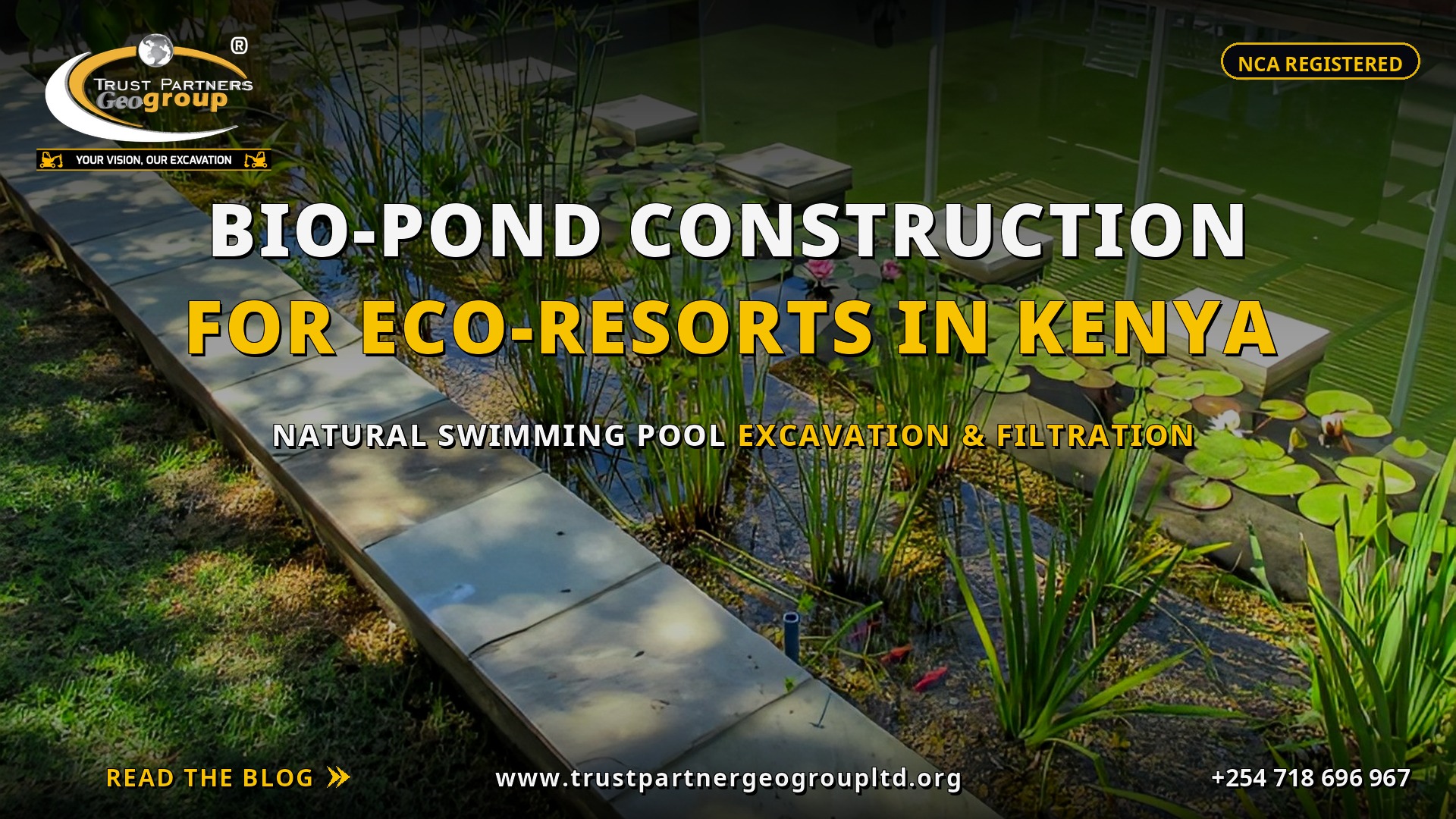
Bio-Pond Construction for Eco-Resorts in Kenya: Natural Swimming Pool Excavation & Filtration
Natural swimming pool excavation, biological filtration, regeneration zones, aquatic planting & eco-resort pond construction for Naivasha, Diani, Watamu & across Kenya
Table of Contents
- 1. What Is a Bio-Pond or Natural Swimming Pool?
- 2. Design: Swimming Zone vs. Regeneration Zone
- 3. Excavation and Organic Shaping
- 4. Liner Selection and Waterproofing
- 5. Gravel Substrate and Filtration Media
- 6. Water Circulation, Skimming and Aeration
- 7. Aquatic Plant Selection for Kenyan Bio-Ponds
- 8. Water Quality Management Without Chemicals
- 9. Heavy Equipment for Hire: Machines for Pond Excavation
- 10. Resort Landscape Integration
- 11. NEMA and Environmental Compliance
- 12. Construction Costs and Programme [2026]
- 13. Frequently Asked Questions
- 14. Conclusion
On the shores of Lake Naivasha, where eco-lodges promise guests an experience untouched by chlorine and concrete, the bio-pond is the centrepiece amenity that delivers on that promise. It is a swimming pool that looks like a pond - irregular in shape, edged with reeds and water lilies, filtered by gravel and plant roots rather than chemicals - and it is constructed through a sequence of excavation in Kenya that is closer to landscape art than civil engineering. Unlike the rectilinear dig of a conventional pool, natural swimming pool excavation carves organic contours with variable depths, beaches, planting shelves and regeneration zones that must blend seamlessly with the surrounding savanna or coastal forest. With heavy equipment for hire from Trust Partners Geo-Group Ltd, eco-resort developers can execute bio-pond projects without capital investment in machinery, paying only for the machines and operators they need for the 6-10 week construction programme. This guide covers the full biological pool construction Nairobi and Kenya-wide sequence - design, excavation, liner, filtration, planting and compliance - with 2026 costs for resort developers.
Trust Partners Geo-Group Ltd - Environmental Engineering Team
NCA-registered excavation & civil engineering contractor with 15+ years of bio-pond construction, natural swimming pool excavation, water feature earthworks and eco-resort landscape grading experience across East Africa. Reviewed by registered environmental engineers.
1. What Is a Bio-Pond or Natural Swimming Pool?
A bio-pond - also called a natural swimming pool, biological pool, or swimming pond - is a water body designed for human swimming that maintains water quality through biological filtration rather than chemical disinfection. The system was developed in Austria and Germany in the 1980s and has spread globally as eco-tourism and chemical-free living have gained popularity. In Kenya, bio-ponds are now standard features at high-end eco-resorts in Naivasha, the Mara, Diani, Watamu and Laikipia, where guests expect luxury without environmental compromise.
The bio-pond consists of two distinct zones:
- The swimming zone: a deep, open water area with clear water, designed for swimming, diving and recreation. It looks like a conventional pool but has no chlorine, no algae blooms (if properly designed), and no chemical smell;
- The regeneration zone: a shallow area filled with gravel and aquatic plants that acts as the biological filter. Water is pumped from the swimming zone through the regeneration zone, where plant roots and beneficial bacteria remove nutrients and organic matter before the cleaned water returns to the swimming area.
The two zones may be adjacent and visually connected, or separated by a submerged wall that keeps swimmers out of the gravel bed while allowing water to flow freely. In resort settings, the regeneration zone is often designed as a water garden - attractive to guests, supportive of dragonflies and birds, and indistinguishable from a natural wetland edge.
Compared to conventional concrete pools, bio-ponds offer: no chemical costs (chlorine, pH adjusters, algaecides); no chemical storage and handling risks; lower long-term maintenance; higher aesthetic value that blends with landscape; wildlife habitat; and a powerful marketing message for eco-conscious tourists. The trade-off is higher initial construction cost (20-40% more than a conventional pool of similar size) and the need for a larger footprint (the regeneration zone is typically 50-100% of the swimming zone area).
2. Design: Swimming Zone vs. Regeneration Zone
The design of a bio-pond balances swimming function, filtration performance, and landscape integration. The ratio of swimming zone to regeneration zone is the critical design parameter.
Zone Sizing
| Pool Type | Swimming Zone | Regeneration Zone | Total Area | Best For |
|---|---|---|---|---|
| Compact bio-pond | 60% | 40% | 100-200 m2 | Small resorts, private villas, tight sites |
| Standard bio-pond | 50% | 50% | 200-400 m2 | Mid-size eco-resorts, 20-40 guests |
| Generous bio-pond | 40% | 60% | 400-800 m2 | Large resorts, high bather loads, warm climates |
| Lagoon-style | 30% | 70% | 800+ m2 | Luxury eco-lodges, visual impact priority |
In Kenya's warm climate (average temperatures 20-30 degrees Celsius), the generous ratio is recommended because higher temperatures accelerate algae growth and increase organic loading from sunscreen, sweat and debris. A resort pool with 20-30 daily bathers in Diani or Naivasha requires a larger regeneration zone than an equivalent pool in Europe.
Depth Design
The swimming zone is typically 1.2-2.5 metres deep, with shallow entry beaches of 0.3-0.5 metres for children and wading. Diving areas, if included, require 2.5-3.5 metres with appropriate safety slopes and signage. The regeneration zone is 0.4-0.8 metres deep - shallow enough to support emergent plants but deep enough to maintain water flow through the gravel bed. A submerged dividing wall (300-500mm below water level) separates the zones while allowing water to pass over it.
Shape and Aesthetics
Bio-ponds reject the rectangular geometry of conventional pools. They are designed with organic, irregular shapes that mimic natural ponds - curved shorelines, inlets and bays, islands of vegetation, and beaches that blend into the surrounding landscape. The excavation must follow the landscape architect's design precisely, because a bio-pond that looks "engineered" defeats its purpose. In Kenya, shapes often reference local water bodies: the sinuous shorelines of Lake Naivasha, the mangrove-edged creeks of the coast, or the seasonal pans of the savanna.
3. Excavation and Organic Shaping
Bio-pond excavation is the most critical phase of construction. Unlike a concrete pool, where formwork can correct excavation irregularities, a bio-pond's final shape is determined entirely by the dig. The liner follows the soil; the water surface follows the liner; and the guest's experience follows the water surface.
Site Preparation
The pool location is marked with spray paint and stakes, following the landscape architect's plan. Existing vegetation is cleared and topsoil stripped to 200-300mm depth, stockpiled for later use in the regeneration zone or surrounding landscaping. In Kenya, where many eco-resort sites are on volcanic soil (Naivasha, Laikipia) or coastal sand (Diani, Watamu), the subgrade conditions vary significantly. A geotechnical investigation is recommended to identify boulders, groundwater, or unstable soils before excavation begins.
Bulk Excavation
A 20-30 tonne hydraulic excavator with a bucket and blade attachment performs the bulk excavation. The operator works from the perimeter, carving the swimming zone to design depth and the regeneration zone to its shallower profile. The key challenge is creating smooth, organic contours without straight lines or flat bottoms. Experienced operators use the excavator bucket to sculpt curved transitions between depths, creating the naturalistic form that defines a bio-pond. In rocky volcanic soils, breaker attachments fracture tuff and boulders. In loose coastal sands, side slopes must be cut at 3:1 or gentler to prevent collapse.
Fine Shaping and Shelves
After bulk excavation, a 5-8 tonne mini-excavator or skilled labourers with shovels fine-tune the shape. Planting shelves (300-500mm wide, 200-300mm deep) are cut around the regeneration zone perimeter to support marginal plants. Beaches are shaped with gentle slopes (8-12 degrees) of compacted sand. The subgrade is trimmed to remove tool marks, overhangs, and loose material that could puncture the liner. Final tolerance is +/- 50mm - tighter than bulk earthworks but looser than concrete pool excavation, because the liner and substrate will absorb minor irregularities.
Critical rule: protect the subgrade from compaction
The bio-pond subgrade must remain permeable to allow groundwater pressure to equalize beneath the liner, preventing buoyancy or bubble formation. Driving heavy equipment across the finished excavation compacts the soil and creates an impermeable pan. On a Naivasha resort project where a concrete mixer was driven across the pool bed to "save time" on edging work, the compacted zone had to be ripped and re-graded, delaying the project by two weeks. All equipment must work from the perimeter, with spoil hauled by long-reach excavators or conveyor systems.
4. Liner Selection and Waterproofing
The liner is the waterproof barrier that prevents the pool water from seeping into the surrounding soil and groundwater from entering the pool. In a bio-pond, the liner must also be non-toxic to plants, fish and bacteria - ruling out some industrial-grade membranes that contain harmful plasticizers.
EPDM Rubber Liner
EPDM (ethylene propylene diene terpolymer) is the gold standard for bio-ponds. It is highly flexible, conforming to organic shapes and irregular contours without creasing. It is UV-stable, root-resistant, and has a lifespan of 30-50 years. EPDM is fish-safe and plant-safe, making it ideal for biological systems. The main disadvantage is cost - KES 1,000-1,800 per m2 installed, including underlay and labour. EPDM is the recommended liner for all Kenyan bio-pond projects where budget allows.
Reinforced PVC Liner
Reinforced PVC (polyvinyl chloride) is a cheaper alternative at KES 600-1,200 per m2. It is flexible and weldable, but less durable than EPDM (15-20 year lifespan) and can become brittle in intense UV exposure. Some PVC formulations contain plasticizers that may be harmful to aquatic life - only fish-safe, phthalate-free grades should be used in bio-ponds. Reinforced PVC is acceptable for smaller pools or projects with tight budgets, but EPDM is preferred for resort developments where longevity matters.
Installation
Liner installation follows a strict sequence: the excavated subgrade is trimmed and smoothed; a 100-150mm sand bedding layer is placed and lightly compacted; a geotextile underlay (300-500gsm) is laid to protect against puncture; the liner panel is positioned and unfolded; seams are welded with hot air or solvent welding (for PVC) or taped with primer (for EPDM); and the liner is tested for leaks using vacuum or flood testing. The liner edge is anchored in a perimeter trench (300mm deep x 200mm wide) backfilled with compacted soil or concrete, preventing wind uplift and animal burrowing.
| Liner Type | Cost/m2 | Lifespan | Flexibility | Best For |
|---|---|---|---|---|
| EPDM rubber | KES 1,000-1,800 | 30-50 years | Excellent | All bio-ponds, resort developments |
| Reinforced PVC | KES 600-1,200 | 15-20 years | Good | Budget projects, smaller pools |
| Bentonite mat | KES 400-800 | 20+ years | Moderate | Clay soils, large ponds |
5. Gravel Substrate and Filtration Media
The regeneration zone is filled with a layered gravel substrate that supports plant roots, provides surface area for bacteria, and allows water to percolate evenly. The substrate is the biological filter - its design determines filtration performance.
Gravel Specification
The substrate typically has two layers: a base layer of coarse gravel (20-40mm, 200-300mm deep) for drainage and structural support; and a top layer of fine gravel (4-8mm, 100-200mm deep) for root anchoring and maximum bacterial surface area. The gravel must be clean, washed, and free of clay, silt, or organic matter that could clog the bed. In Kenya, crushed stone from quarries in Athi River or Juja is washed and screened to specification. River gravel can be used if it is angular rather than rounded - rounded gravel settles and compacts, reducing permeability.
Substrate Depth
Total substrate depth in the regeneration zone is 300-500mm. Deeper substrates do not improve filtration and make planting more difficult. The substrate is placed directly on the liner (with a protective geotextile layer if the liner is PVC), graded to design contours, and lightly firmed by hand or plate compactor - never by heavy equipment. The surface must be 100-150mm below the design water level to allow for plant root establishment without drowning the stems.
Filtration Performance
A well-designed gravel bed with healthy plant roots achieves the equivalent of mechanical and biological filtration in a conventional pool system. The gravel traps suspended solids; bacteria on gravel surfaces convert ammonia to nitrite and then to nitrate (the nitrogen cycle); and plant roots absorb nitrate and phosphate, preventing algal growth. In Kenya's warm climate, the system must be sized for higher organic loading - a bather load of 20-30 people per day generates significantly more organic matter than the same number in a temperate climate.
6. Water Circulation, Skimming and Aeration
While the regeneration zone provides biological filtration, mechanical systems are still needed to move water, remove surface debris, and provide oxygen. These systems are smaller and simpler than conventional pool filtration plants, but they are essential.
Circulation System
Water is pumped from the swimming zone (typically from the deepest point or a sump) through the regeneration zone, where it percolates through the gravel and plant roots before returning to the swimming zone via gravity overflow or distribution pipes. The circulation rate is typically the entire pool volume every 4-8 hours - slower than conventional pools (which turn over every 4-6 hours) because biological filtration is slower than chemical disinfection. In Kenya, where warm water increases bacterial growth, a turnover every 4-6 hours is recommended.
Skimmer
A surface skimmer removes leaves, insects, pollen and floating debris before they sink and decompose. In resort settings surrounded by trees or near the coast, skimmers are essential. The skimmer basket is emptied daily during the leaf season. Without a skimmer, organic debris accumulates on the regeneration zone surface, creating anaerobic conditions and odours.
Aeration
Aeration supports the aerobic bacteria that drive biological filtration. Options include: submersible diffusers that bubble air through the regeneration zone; fountain jets that oxygenate while creating a visual feature; and cascades or waterfalls that aerate by turbulence. In Kenya, solar-powered aeration systems are increasingly popular for off-grid eco-resorts, eliminating electrical running costs. A typical 200 m2 bio-pond requires 500-1,000 watts of aeration capacity.
UV Clarifier (Optional)
Some designers include a UV clarifier in the circulation loop to control algae without chemicals. The UV lamp kills free-floating algae cells as water passes through the chamber. While not strictly necessary in a well-designed bio-pond, UV provides a safety margin during the establishment period (first 6-12 months) when plant coverage is incomplete. UV clarifiers for bio-ponds are low-power units (30-60 watts) compared to conventional pool systems.
7. Aquatic Plant Selection for Kenyan Bio-Ponds
Plants are the living filtration system. Their roots penetrate the gravel substrate, absorbing nutrients and hosting bacteria. Their leaves shade the water, reducing algae growth. And their flowers and form create the aesthetic that distinguishes a bio-pond from a conventional pool.
| Plant Type | Species | Depth | Function |
|---|---|---|---|
| Submerged | Hornwort, Elodea, Pondweed | 0.5-2.0m | Oxygen production, nutrient absorption, habitat |
| Emergent | Papyrus, Reed, Sedge | 0.2-0.6m | Primary filtration, nutrient uptake, structure |
| Floating-leaf | Water lily, Lotus | 0.3-1.0m | Shade, algae suppression, aesthetic value |
| Floating | Water hyacinth (managed) | Surface | Nutrient removal, shade (requires control) |
| Marginal | Iris, Canna, Rush, Pickerel weed | 0-0.3m | Edge stabilization, transition beauty |
Planting Strategy
In the regeneration zone, emergent species are planted at 3-5 plants per m2 to achieve rapid coverage. Submerged species are weighted and placed on the gravel surface, where they root naturally. Floating-leaf plants are placed in the deeper areas of the regeneration zone, away from the swimming zone edge where falling leaves could be a nuisance. Marginal plants are placed on the perimeter shelf, softening the transition to dry land.
Kenyan Native Species
Kenya's native aquatic flora is well-adapted to bio-pond conditions. Papyrus (Cyperus papyrus) is iconic and highly effective at nutrient removal. Yellow water lily (Nymphaea lotus) is native to Kenyan wetlands and more appropriate than exotic tropical lilies. Kenya sedge (Cyperus articulatus) and common reed (Phragmites mauritianus) are locally available and support native insect and bird populations. NEMA may require that planting plans use native species and avoid invasive exotics such as salvinia or water lettuce that could escape into natural water bodies.
8. Water Quality Management Without Chemicals
The ultimate test of a bio-pond is water quality. Guests will not swim in water that is cloudy, green, or smells. Achieving crystal-clear water without chlorine requires understanding the biological balance.
The Nitrogen Cycle
In a bio-pond, the nitrogen cycle operates as follows: organic matter (skin cells, sunscreen, leaves) decomposes into ammonia; nitrifying bacteria (Nitrosomonas) convert ammonia to nitrite; other bacteria (Nitrobacter) convert nitrite to nitrate; and plants absorb nitrate as fertilizer. If any step is disrupted - too much organic matter, insufficient oxygen, or too few plants - ammonia or nitrite accumulates, algae blooms, and water quality fails. In Kenya's warm water, this cycle operates faster than in temperate climates, which is both an advantage (faster establishment) and a risk (faster failure if unbalanced).
Water Quality Parameters
A well-functioning bio-pond in Kenya should maintain:
- pH: 6.5-8.5 (slightly alkaline is acceptable);
- Turbidity: less than 5 NTU (crystal clear to 1-2m depth);
- Dissolved oxygen: greater than 5 mg/L (supported by plants and aeration);
- Ammonia: less than 0.5 mg/L;
- Nitrite: less than 0.2 mg/L;
- Phosphate: less than 0.1 mg/L (plant uptake should keep this low);
- Bacteria (E. coli): less than 100 CFU/100ml (swimming safety standard).
Water testing should be conducted weekly during the first 3 months, then monthly once the system is stable. Simple field test kits are available in Nairobi for pH, ammonia, nitrite and phosphate. Bacterial testing requires laboratory analysis.
Common Problems and Solutions
- Green water (algal bloom): usually caused by excess nutrients before plants are established. Solution: increase aeration, add more plants, reduce bather load temporarily, or install a UV clarifier;
- Cloudy water: caused by suspended clay or organic particles. Solution: check skimmer function, ensure gravel bed is not disturbed, and allow settling time;
- Odour: caused by anaerobic conditions in the gravel bed. Solution: increase aeration, remove decaying plant matter, and check that water is flowing evenly through the regeneration zone;
- Mosquitoes: prevented by fish (if included) or by ensuring water is moving and not stagnant. In Kenya, mosquito fish (Gambusia affinis) or native tilapia can be added to the swimming zone.
9. Heavy Equipment for Hire: Machines for Pond Excavation
Bio-pond construction requires a specialized equipment fleet that can achieve organic shapes, work on sensitive resort sites, and minimize environmental damage. Trust Partners Geo-Group Ltd provides heavy equipment for hire on a project basis, eliminating the capital cost of machine ownership.
| Equipment | Role | Hire Rate (2026) |
|---|---|---|
| 20-30t hydraulic excavator | Bulk excavation, organic shaping | KES 8,000-12,000/hr |
| 5-8t mini excavator | Fine trimming, shelves, beaches | KES 4,000-6,000/hr |
| Bulldozer (D4-D6) | Site clearing, access roads | KES 6,000-10,000/hr |
| Dump truck (10-20 m3) | Spoil haulage, gravel delivery | KES 5,000-8,000/hr |
| Plate compactor | Sand bedding compaction | KES 2,000-3,500/hr |
| Concrete mixer / pump | Edging, anchor trenches | KES 3,000-5,000/hr |
| Water truck | Pool filling, plant watering | KES 4,000-6,000/hr |
For a typical 200 m2 bio-pond, the equipment programme is: 2-3 days site clearing and topsoil stripping with bulldozer and excavator; 5-8 days bulk excavation with 20-30t excavator; 2-3 days fine shaping with mini-excavator and labour; 1-2 days liner bedding placement and compaction; 2-3 days gravel delivery and placement; and 1-2 days backfilling and landscaping. Total equipment hire for a standard resort bio-pond is KES 1.2-2.0 million - compared to KES 8-15 million to purchase equivalent machines.
Rubber-tracked excavators are strongly recommended for resort sites to prevent damage to existing landscaping and to minimize ground pressure on soft soils. Long-reach excavators are useful where the pool must be excavated from a distance to protect mature trees or sensitive vegetation. Trust Partners Geo-Group Ltd provides machines with experienced operators who understand landscape earthworks and organic shaping.
10. Resort Landscape Integration
A bio-pond is not an isolated feature - it is part of the resort landscape. Its edges, surrounds, and visual relationships with guest villas, dining areas and walking paths determine whether it is an asset or an afterthought.
Edging and Beaches
Natural stone edging (local lava stone in Naivasha, coral stone on the coast) creates a transition between water and land that looks natural and provides seating. Timber decking extends over the water for sun lounging and access. Sand beaches of washed river sand provide child-friendly entry points. The edge design must conceal the liner anchor trench and any mechanical equipment while allowing maintenance access.
Lighting
Underwater LED lighting in the swimming zone creates a magical evening atmosphere and extends usable hours. Subtle uplighting of papyrus and reeds in the regeneration zone highlights the water garden after dark. Solar-powered lights are ideal for off-grid eco-resorts. All electrical equipment must be low-voltage (12-24V) and installed by certified electricians with waterproof fittings.
Wildlife Integration
In Kenya, bio-ponds attract dragonflies, frogs, kingfishers, and water birds. The design should encourage this: shallow shelves for wading birds, emergent vegetation for nesting, and fish populations (tilapia, barbus) that control mosquitoes and add life. However, the design must also prevent unwanted wildlife - hippos in Naivasha, monkeys everywhere - from damaging the liner or plants. Fencing, rock barriers, or raised edges may be needed where wildlife pressure is high.
11. NEMA and Environmental Compliance
Bio-pond construction at eco-resorts in Kenya operates within a framework of environmental regulation that protects both the development and the surrounding ecosystem.
| Requirement | Authority | What It Covers |
|---|---|---|
| Environmental Impact Assessment | NEMA | Vegetation clearance, earthworks, water use, wetland proximity |
| Water abstraction permit | WRA | Borehole, river or lake water for pool filling |
| County building approval | County government | Associated structures, land use compliance |
| KWS approval (if near park) | Kenya Wildlife Service | Wildlife impact, buffer zones |
| NCA contractor registration | NCA | Contractor registration, site safety |
| Invasive species control | NEMA / KWS | Plant species approval, escape prevention |
NEMA's primary concern is the risk of introducing invasive aquatic plants that could escape into natural wetlands. All planting plans must be reviewed and approved, with a commitment to remove any invasive species that establish. Where the bio-pond is near a national park, reserve or Ramsar wetland (Lake Naivasha, Lake Elementaita), additional buffer zones and monitoring may be required. Trust Partners Geo-Group Ltd ensures all earthworks comply with the approved environmental documentation and coordinates with consultants for permit acquisition.
12. Construction Costs and Programme [2026]
Indicative costs for bio-pond and natural swimming pool construction in Kenya:
| Item | 2026 Rate | Notes |
|---|---|---|
| Site clearance and topsoil strip | KES 150-300/m3 | Includes stockpiling |
| Bulk excavation (swimming zone) | KES 400-700/m3 | Deep excavation, rock breaking |
| Shallow excavation (regeneration zone) | KES 300-500/m3 | Shallow, wide area |
| Fine shaping and trimming | KES 500-800/m3 | Mini-excavator and labour |
| Sand bedding and geotextile | KES 200-400/m2 | Underlay protection |
| EPDM liner supply and install | KES 1,000-1,800/m2 | Welded, tested |
| Reinforced PVC liner | KES 600-1,200/m2 | Budget option |
| Gravel substrate (regeneration zone) | KES 1,500-2,500/m3 | Washed, screened |
| Circulation pump and pipework | KES 150,000-400,000 | Complete system |
| Skimmer and aeration | KES 80,000-200,000 | Surface cleaning, oxygenation |
| UV clarifier (optional) | KES 60,000-120,000 | Algae control backup |
| Aquatic plants supply and plant | KES 200-500/m2 | Regeneration zone |
| Natural stone edging | KES 2,500-5,000/m | Local stone, hand placed |
| Timber decking | KES 3,500-6,000/m2 | Hardwood, treated |
| Underwater lighting | KES 15,000-40,000 each | LED, low voltage |
| Heavy equipment for hire (fleet) | KES 8,000-15,000/hr | Excavator, trucks, compactor |
| Mobilization / demobilization | KES 100,000-300,000 | Transport to remote sites |
All-in project estimates:
- Small private bio-pond (80 m2): KES 1.5-2.5 million;
- Mid-size resort pool (200 m2, 100m2 swim + 100m2 regen): KES 3.5-6.0 million;
- Large resort lagoon (500 m2): KES 8-14 million;
- Luxury eco-lodge feature (800+ m2 with landscaping): KES 12-20 million.
Programme: site clearance 2-3 days; bulk excavation 5-8 days; fine shaping 2-3 days; liner installation 2-3 days; substrate placement 2-3 days; circulation installation 2-3 days; planting 2-3 days; filling and commissioning 1-2 weeks; edging and landscaping 1-2 weeks. Total construction programme for a standard resort bio-pond: 6-10 weeks, plus 4-8 weeks for establishment before guest use.
Pro tip: hire equipment, don't buy
Bio-pond construction is a 6-10 week programme that does not justify equipment purchase. Trust Partners Geo-Group Ltd provides heavy equipment for hire with operators, fuel and maintenance included, allowing resort developers to allocate capital to guest-facing amenities rather than earthmoving machines. For a typical project, equipment hire is KES 1.2-2.0 million versus KES 8-15 million to purchase. Hire also gives access to specialized machines such as long-reach excavators for sensitive sites and mini-excavators for fine shaping that would sit idle after the project.
13. Frequently Asked Questions: Bio-Ponds in Kenya
What is a bio-pond or natural swimming pool?
A bio-pond or natural swimming pool is a water body that uses biological filtration instead of chemicals like chlorine to maintain clean, safe swimming water. It consists of two zones: a swimming zone that looks and functions like a conventional pool, and a regeneration zone filled with gravel and aquatic plants whose roots absorb nutrients and harbour beneficial bacteria that break down organic matter. In Kenya, bio-ponds are increasingly popular for eco-resorts in Naivasha, Diani, Watamu and the Mara because they blend with the natural landscape, support wildlife, eliminate chemical costs and maintenance, and appeal to environmentally conscious tourists. Unlike conventional pools that require concrete structures and filtration plants, bio-ponds are excavated from natural soil, lined to prevent seepage, and filtered by nature.
How does a natural swimming pool stay clean without chlorine?
Natural swimming pools stay clean through a combination of physical, biological and mechanical processes. Water is pumped from the swimming zone through the regeneration zone, where it percolates through layers of coarse gravel (10-20mm) and fine gravel (4-8mm). Aquatic plants rooted in the gravel absorb nitrates and phosphates that would otherwise feed algae. Microorganisms living on the gravel surfaces and plant roots break down organic matter. A surface skimmer removes leaves and debris, while an aeration system or fountain provides oxygen that supports the aerobic bacteria essential for the filtration process. In Kenya's warm climate, the system must be sized generously - typically the regeneration zone is equal to or larger than the swimming zone - because higher temperatures accelerate algae growth and organic decomposition. With proper design, natural pools in Kenya achieve water clarity of 1-2 metres and bacterial counts well within swimming safety standards without any chlorine.
How deep is a natural swimming pool excavated in Kenya?
Natural swimming pools in Kenya are typically excavated to depths of 1.2-2.5 metres in the swimming zone, with shallow entry beaches of 0.3-0.5 metres and regeneration zones of 0.4-0.8 metres. The swimming zone must be deep enough for comfortable swimming and to prevent excessive warming - in Kenya's climate, depths under 1.2m can become uncomfortably warm in direct sun. Diving areas, if included, require 2.5-3.5 metres with appropriate safety slopes and signage. The regeneration zone is shallower to support emergent and submerged plants. The overall excavation volume for a 200 m2 natural pool (100 m2 swimming + 100 m2 regeneration) is typically 250-350 m3. In Nairobi's volcanic soils, excavation may encounter tuff or boulders; in coastal sands, side slopes require geotextile stabilization. The excavation must achieve smooth, organic contours that blend with the resort landscape - no straight lines or sharp corners.
What does bio-pond construction cost in Kenya in 2026?
2026 indicative costs for bio-pond construction in Kenya: excavation and shaping KES 400-700 per m3; HDPE or EPDM liner supply and installation KES 800-1,500 per m2; gravel substrate for regeneration zone KES 1,500-2,500 per m3; water circulation pump and pipework KES 150,000-400,000 per system; skimmer and aeration system KES 80,000-200,000; aquatic plants supply and planting KES 200-500 per m2; decking or natural stone edging KES 2,500-5,000 per linear metre; underwater lighting KES 15,000-40,000 per fitting. A 150 m2 natural swimming pool (75 m2 swimming + 75 m2 regeneration) for an eco-resort costs KES 2.5-4.5 million for excavation, lining and filtration. A 300 m2 resort bio-pond with landscaping and decking costs KES 5-9 million. Heavy equipment for hire including 20-30 tonne excavators, dump trucks and compactors is typically KES 8,000-15,000 per hour for the complete fleet.
What liner is best for natural swimming pools in Kenya?
Natural swimming pools in Kenya require a liner that is non-toxic, flexible enough to conform to organic shapes, and durable enough to resist root penetration and UV exposure. The two main options are EPDM (ethylene propylene diene terpolymer) rubber liners and reinforced PVC liners. EPDM is the premium choice: it is fish-safe, plant-safe, highly flexible for complex shapes, and has a lifespan of 30-50 years. It costs KES 1,000-1,800 per m2 installed. Reinforced PVC is cheaper at KES 600-1,200 per m2 but less flexible and has a shorter lifespan of 15-20 years. Some PVC formulations contain plasticizers that may be harmful to aquatic life - only fish-safe, phthalate-free grades should be used in bio-ponds. HDPE geomembranes, while excellent for wastewater ponds, are generally too stiff for the organic shapes of natural pools and are not recommended. In all cases, a 100-150mm sand bedding layer protects the liner from puncture by stones or roots. A geotextile underlay adds further protection in rocky soils. The liner must be welded by certified technicians and tested for leaks before any substrate or water is placed.
What plants are used in the regeneration zone of a Kenyan bio-pond?
The regeneration zone of a Kenyan bio-pond uses native aquatic plants that are effective at nutrient uptake, attractive to guests, and adapted to local climate. Submerged plants include hornwort (Ceratophyllum demersum) and elodea, which grow entirely underwater and provide oxygen while absorbing nutrients. Emergent plants include papyrus (Cyperus papyrus), common reed (Phragmites australis), and various sedges that root in the gravel with stems and leaves above water - these are the primary filtration workhorses. Floating plants such as water lilies (Nymphaea species) provide shade that reduces algae growth while adding aesthetic value. Marginal plants like iris, rushes and cannas soften the transition between water and land. In Kenya, plants should be sourced from local nurseries or existing wetland areas (with permits) to ensure they are adapted to the climate and do not introduce invasive species. NEMA may require that planting plans use only native species. Trust Partners Geo-Group Ltd sources aquatic plants from certified Kenyan nurseries and installs them with the correct spacing and depth for each species.
What heavy equipment is used for bio-pond excavation in Kenya?
Bio-pond excavation in Kenya uses heavy equipment for hire including: 20-30 tonne hydraulic excavators with bucket and blade attachments for bulk excavation and organic shaping of the swimming and regeneration zones; 5-8 tonne mini excavators for fine trimming around edges, beaches and planting shelves; bulldozers for grading surrounding landscape and creating access; motor graders for fine contouring of adjacent resort landscaping; dump trucks for spoil haulage and gravel delivery; plate compactors for sand bedding and substrate compaction; and concrete mixers or pumps if artificial rock features or edging are included. Unlike rectangular concrete pools, bio-ponds require excavators that can carve smooth, curved contours with variable depths. GPS or laser-guided equipment is less critical than for golf courses, but experienced operators who understand organic shaping are essential. Trust Partners Geo-Group Ltd provides rubber-tracked excavators that minimize ground damage on resort sites, with operators experienced in landscape and water feature earthworks.
Do bio-ponds need environmental approval in Kenya?
Yes. Bio-pond construction in Kenya requires NEMA Environmental Impact Assessment (EIA) approval if the project involves vegetation clearance over 1 hectare, earthworks exceeding 1,000 m3, or disturbance of existing wetlands or watercourses. For smaller resort pools under 500 m2 on already developed land, a simplified EIA or environmental management plan may suffice. County government approval is required for any construction on agricultural or conservation land, and for associated structures such as pump houses or decking. Water Resources Authority (WRA) permits are needed if the pool is filled from a borehole, river or lake, or if discharge overflow enters a natural watercourse. Where the bio-pond is designed to attract wildlife or is located near a national park or reserve, Kenya Wildlife Service (KWS) may require additional assessment. NEMA is particularly concerned about the risk of introducing invasive aquatic plants that could escape into natural wetlands. Trust Partners Geo-Group Ltd ensures all earthworks comply with the approved environmental documentation and coordinates with consultants for permit acquisition.
14. Conclusion: Swimming With Nature
A bio-pond is more than a swimming pool without chlorine - it is a statement about how a resort relates to its environment. The guest who swims in clear water surrounded by papyrus and water lilies, who watches a kingfisher dive from a reed stem, who smells no chemical sharpness in the air - that guest will pay more, stay longer, and tell their friends. The bio-pond is both infrastructure and marketing, both engineering and landscape art.
But it only works if the earthworks are right. The excavation must create organic shapes that look natural, not machine-dug. The liner must be flawless, because a leak in a bio-pond is harder to find and fix than in a concrete pool. The gravel bed must be clean and evenly placed, because a clogged filter cannot be backwashed like a sand filter - it must be dug out and replaced. The plants must be the right species, planted at the right depth, at the right time of year. And the water quality must be monitored patiently through the establishment period until the biological balance is achieved.
Trust Partners Geo-Group Ltd delivers the full bio-pond construction package across Kenya: site investigation and geotechnical assessment, organic excavation and shaping with experienced operators, EPDM and PVC liner supply and installation, gravel substrate placement, circulation and aeration system installation, native aquatic plant supply and planting, water quality commissioning, and resort landscape integration with natural stone, decking and lighting. We provide heavy equipment for hire with skilled operators, coordinate with your landscape architect and environmental consultant, manage NEMA and county compliance, and deliver bio-pond projects on programme and budget - from small private pools to resort lagoons.
Bio-Pond & Natural Swimming Pool Construction
Natural swimming pool excavation, biological filtration, liner installation, aquatic planting and eco-resort pond construction across Nairobi, Naivasha, Mombasa and Kenya.
Free lead magnet: ask for our Bio-Pond Construction Specification Checklist (PDF) - excavation tolerances, liner testing protocols, plant spacing guides and water quality standards your landscape architect will require.
Related Resources
Wetland Excavation and Restoration in Kenya: Creating Artificial Wetlands for Stormwater
The previous blog in our environmental series - constructed wetlands for stormwater treatment and restoration.
READ MORELandscape Grading and Excavation for Golf Courses in Kenya: Contouring, Drainage & Turf Prep
Precision landscape earthworks for golf developments - related water feature and grading expertise.
READ MOREWater Pan Excavation for Dairy Farming in Kenya: Size, Depth & Lining Guide [2026]
Water feature excavation, lining and earthworks for agricultural and environmental water storage.
READ MOREEarthworks QA/QC: Compaction Testing & Density Control
Testing protocols for pond subgrades, liner bedding and structural backfill.
READ MORESlope Excavation and Stabilization for Hillside Construction in Nairobi & Kiambu
Cut slopes and stabilization for resort developments on sloped terrain.
READ MOREBulk Excavation Cost Per Cubic Meter in Kenya [2026 Updated Rates]
Transparent pricing for the bulk earthworks component of every pond and water feature project.
READ MORETRUST PARTNERS GEO-GROUP LTD | YOUR VISION, OUR EXCAVATION
WEBSITE: WWW.TRUSTPARTNERGEOGROUPLTD.ORG | EMAIL: INFO@TRUSTPARTNERGEOGROUPLTD.ORG | PHONE: +254 718 68 69 67
FOLLOW US: FACEBOOK | TIKTOK | INSTAGRAM | LINKEDIN
© 2026 TRUST PARTNERS GEO-GROUP LTD. ALL RIGHTS RESERVED.
Bio-Pond Construction for Eco-Resorts in Kenya: Natural Swimming Pool Excavation & Filtration
Natural swimming pool excavation, biological filtration, regeneration zones, aquatic planting & eco-resort pond construction for Naivasha, Diani, Watamu & across Kenya
Table of Contents
- 1. What Is a Bio-Pond or Natural Swimming Pool?
- 2. Design: Swimming Zone vs. Regeneration Zone
- 3. Excavation and Organic Shaping
- 4. Liner Selection and Waterproofing
- 5. Gravel Substrate and Filtration Media
- 6. Water Circulation, Skimming and Aeration
- 7. Aquatic Plant Selection for Kenyan Bio-Ponds
- 8. Water Quality Management Without Chemicals
- 9. Heavy Equipment for Hire: Machines for Pond Excavation
- 10. Resort Landscape Integration
- 11. NEMA and Environmental Compliance
- 12. Construction Costs and Programme [2026]
- 13. Frequently Asked Questions
- 14. Conclusion
On the shores of Lake Naivasha, where eco-lodges promise guests an experience untouched by chlorine and concrete, the bio-pond is the centrepiece amenity that delivers on that promise. It is a swimming pool that looks like a pond - irregular in shape, edged with reeds and water lilies, filtered by gravel and plant roots rather than chemicals - and it is constructed through a sequence of excavation in Kenya that is closer to landscape art than civil engineering. Unlike the rectilinear dig of a conventional pool, natural swimming pool excavation carves organic contours with variable depths, beaches, planting shelves and regeneration zones that must blend seamlessly with the surrounding savanna or coastal forest. With heavy equipment for hire from Trust Partners Geo-Group Ltd, eco-resort developers can execute bio-pond projects without capital investment in machinery, paying only for the machines and operators they need for the 6-10 week construction programme. This guide covers the full biological pool construction Nairobi and Kenya-wide sequence - design, excavation, liner, filtration, planting and compliance - with 2026 costs for resort developers.
Trust Partners Geo-Group Ltd - Environmental Engineering Team
NCA-registered excavation & civil engineering contractor with 15+ years of bio-pond construction, natural swimming pool excavation, water feature earthworks and eco-resort landscape grading experience across East Africa. Reviewed by registered environmental engineers.
1. What Is a Bio-Pond or Natural Swimming Pool?
A bio-pond - also called a natural swimming pool, biological pool, or swimming pond - is a water body designed for human swimming that maintains water quality through biological filtration rather than chemical disinfection. The system was developed in Austria and Germany in the 1980s and has spread globally as eco-tourism and chemical-free living have gained popularity. In Kenya, bio-ponds are now standard features at high-end eco-resorts in Naivasha, the Mara, Diani, Watamu and Laikipia, where guests expect luxury without environmental compromise.
The bio-pond consists of two distinct zones:
- The swimming zone: a deep, open water area with clear water, designed for swimming, diving and recreation. It looks like a conventional pool but has no chlorine, no algae blooms (if properly designed), and no chemical smell;
- The regeneration zone: a shallow area filled with gravel and aquatic plants that acts as the biological filter. Water is pumped from the swimming zone through the regeneration zone, where plant roots and beneficial bacteria remove nutrients and organic matter before the cleaned water returns to the swimming area.
The two zones may be adjacent and visually connected, or separated by a submerged wall that keeps swimmers out of the gravel bed while allowing water to flow freely. In resort settings, the regeneration zone is often designed as a water garden - attractive to guests, supportive of dragonflies and birds, and indistinguishable from a natural wetland edge.
Compared to conventional concrete pools, bio-ponds offer: no chemical costs (chlorine, pH adjusters, algaecides); no chemical storage and handling risks; lower long-term maintenance; higher aesthetic value that blends with landscape; wildlife habitat; and a powerful marketing message for eco-conscious tourists. The trade-off is higher initial construction cost (20-40% more than a conventional pool of similar size) and the need for a larger footprint (the regeneration zone is typically 50-100% of the swimming zone area).
2. Design: Swimming Zone vs. Regeneration Zone
The design of a bio-pond balances swimming function, filtration performance, and landscape integration. The ratio of swimming zone to regeneration zone is the critical design parameter.
Zone Sizing
| Pool Type | Swimming Zone | Regeneration Zone | Total Area | Best For |
|---|---|---|---|---|
| Compact bio-pond | 60% | 40% | 100-200 m2 | Small resorts, private villas, tight sites |
| Standard bio-pond | 50% | 50% | 200-400 m2 | Mid-size eco-resorts, 20-40 guests |
| Generous bio-pond | 40% | 60% | 400-800 m2 | Large resorts, high bather loads, warm climates |
| Lagoon-style | 30% | 70% | 800+ m2 | Luxury eco-lodges, visual impact priority |
In Kenya's warm climate (average temperatures 20-30 degrees Celsius), the generous ratio is recommended because higher temperatures accelerate algae growth and increase organic loading from sunscreen, sweat and debris. A resort pool with 20-30 daily bathers in Diani or Naivasha requires a larger regeneration zone than an equivalent pool in Europe.
Depth Design
The swimming zone is typically 1.2-2.5 metres deep, with shallow entry beaches of 0.3-0.5 metres for children and wading. Diving areas, if included, require 2.5-3.5 metres with appropriate safety slopes and signage. The regeneration zone is 0.4-0.8 metres deep - shallow enough to support emergent plants but deep enough to maintain water flow through the gravel bed. A submerged dividing wall (300-500mm below water level) separates the zones while allowing water to pass over it.
Shape and Aesthetics
Bio-ponds reject the rectangular geometry of conventional pools. They are designed with organic, irregular shapes that mimic natural ponds - curved shorelines, inlets and bays, islands of vegetation, and beaches that blend into the surrounding landscape. The excavation must follow the landscape architect's design precisely, because a bio-pond that looks "engineered" defeats its purpose. In Kenya, shapes often reference local water bodies: the sinuous shorelines of Lake Naivasha, the mangrove-edged creeks of the coast, or the seasonal pans of the savanna.
3. Excavation and Organic Shaping
Bio-pond excavation is the most critical phase of construction. Unlike a concrete pool, where formwork can correct excavation irregularities, a bio-pond's final shape is determined entirely by the dig. The liner follows the soil; the water surface follows the liner; and the guest's experience follows the water surface.
Site Preparation
The pool location is marked with spray paint and stakes, following the landscape architect's plan. Existing vegetation is cleared and topsoil stripped to 200-300mm depth, stockpiled for later use in the regeneration zone or surrounding landscaping. In Kenya, where many eco-resort sites are on volcanic soil (Naivasha, Laikipia) or coastal sand (Diani, Watamu), the subgrade conditions vary significantly. A geotechnical investigation is recommended to identify boulders, groundwater, or unstable soils before excavation begins.
Bulk Excavation
A 20-30 tonne hydraulic excavator with a bucket and blade attachment performs the bulk excavation. The operator works from the perimeter, carving the swimming zone to design depth and the regeneration zone to its shallower profile. The key challenge is creating smooth, organic contours without straight lines or flat bottoms. Experienced operators use the excavator bucket to sculpt curved transitions between depths, creating the naturalistic form that defines a bio-pond. In rocky volcanic soils, breaker attachments fracture tuff and boulders. In loose coastal sands, side slopes must be cut at 3:1 or gentler to prevent collapse.
Fine Shaping and Shelves
After bulk excavation, a 5-8 tonne mini-excavator or skilled labourers with shovels fine-tune the shape. Planting shelves (300-500mm wide, 200-300mm deep) are cut around the regeneration zone perimeter to support marginal plants. Beaches are shaped with gentle slopes (8-12 degrees) of compacted sand. The subgrade is trimmed to remove tool marks, overhangs, and loose material that could puncture the liner. Final tolerance is +/- 50mm - tighter than bulk earthworks but looser than concrete pool excavation, because the liner and substrate will absorb minor irregularities.
Critical rule: protect the subgrade from compaction
The bio-pond subgrade must remain permeable to allow groundwater pressure to equalize beneath the liner, preventing buoyancy or bubble formation. Driving heavy equipment across the finished excavation compacts the soil and creates an impermeable pan. On a Naivasha resort project where a concrete mixer was driven across the pool bed to "save time" on edging work, the compacted zone had to be ripped and re-graded, delaying the project by two weeks. All equipment must work from the perimeter, with spoil hauled by long-reach excavators or conveyor systems.
4. Liner Selection and Waterproofing
The liner is the waterproof barrier that prevents the pool water from seeping into the surrounding soil and groundwater from entering the pool. In a bio-pond, the liner must also be non-toxic to plants, fish and bacteria - ruling out some industrial-grade membranes that contain harmful plasticizers.
EPDM Rubber Liner
EPDM (ethylene propylene diene terpolymer) is the gold standard for bio-ponds. It is highly flexible, conforming to organic shapes and irregular contours without creasing. It is UV-stable, root-resistant, and has a lifespan of 30-50 years. EPDM is fish-safe and plant-safe, making it ideal for biological systems. The main disadvantage is cost - KES 1,000-1,800 per m2 installed, including underlay and labour. EPDM is the recommended liner for all Kenyan bio-pond projects where budget allows.
Reinforced PVC Liner
Reinforced PVC (polyvinyl chloride) is a cheaper alternative at KES 600-1,200 per m2. It is flexible and weldable, but less durable than EPDM (15-20 year lifespan) and can become brittle in intense UV exposure. Some PVC formulations contain plasticizers that may be harmful to aquatic life - only fish-safe, phthalate-free grades should be used in bio-ponds. Reinforced PVC is acceptable for smaller pools or projects with tight budgets, but EPDM is preferred for resort developments where longevity matters.
Installation
Liner installation follows a strict sequence: the excavated subgrade is trimmed and smoothed; a 100-150mm sand bedding layer is placed and lightly compacted; a geotextile underlay (300-500gsm) is laid to protect against puncture; the liner panel is positioned and unfolded; seams are welded with hot air or solvent welding (for PVC) or taped with primer (for EPDM); and the liner is tested for leaks using vacuum or flood testing. The liner edge is anchored in a perimeter trench (300mm deep x 200mm wide) backfilled with compacted soil or concrete, preventing wind uplift and animal burrowing.
| Liner Type | Cost/m2 | Lifespan | Flexibility | Best For |
|---|---|---|---|---|
| EPDM rubber | KES 1,000-1,800 | 30-50 years | Excellent | All bio-ponds, resort developments |
| Reinforced PVC | KES 600-1,200 | 15-20 years | Good | Budget projects, smaller pools |
| Bentonite mat | KES 400-800 | 20+ years | Moderate | Clay soils, large ponds |
5. Gravel Substrate and Filtration Media
The regeneration zone is filled with a layered gravel substrate that supports plant roots, provides surface area for bacteria, and allows water to percolate evenly. The substrate is the biological filter - its design determines filtration performance.
Gravel Specification
The substrate typically has two layers: a base layer of coarse gravel (20-40mm, 200-300mm deep) for drainage and structural support; and a top layer of fine gravel (4-8mm, 100-200mm deep) for root anchoring and maximum bacterial surface area. The gravel must be clean, washed, and free of clay, silt, or organic matter that could clog the bed. In Kenya, crushed stone from quarries in Athi River or Juja is washed and screened to specification. River gravel can be used if it is angular rather than rounded - rounded gravel settles and compacts, reducing permeability.
Substrate Depth
Total substrate depth in the regeneration zone is 300-500mm. Deeper substrates do not improve filtration and make planting more difficult. The substrate is placed directly on the liner (with a protective geotextile layer if the liner is PVC), graded to design contours, and lightly firmed by hand or plate compactor - never by heavy equipment. The surface must be 100-150mm below the design water level to allow for plant root establishment without drowning the stems.
Filtration Performance
A well-designed gravel bed with healthy plant roots achieves the equivalent of mechanical and biological filtration in a conventional pool system. The gravel traps suspended solids; bacteria on gravel surfaces convert ammonia to nitrite and then to nitrate (the nitrogen cycle); and plant roots absorb nitrate and phosphate, preventing algal growth. In Kenya's warm climate, the system must be sized for higher organic loading - a bather load of 20-30 people per day generates significantly more organic matter than the same number in a temperate climate.
6. Water Circulation, Skimming and Aeration
While the regeneration zone provides biological filtration, mechanical systems are still needed to move water, remove surface debris, and provide oxygen. These systems are smaller and simpler than conventional pool filtration plants, but they are essential.
Circulation System
Water is pumped from the swimming zone (typically from the deepest point or a sump) through the regeneration zone, where it percolates through the gravel and plant roots before returning to the swimming zone via gravity overflow or distribution pipes. The circulation rate is typically the entire pool volume every 4-8 hours - slower than conventional pools (which turn over every 4-6 hours) because biological filtration is slower than chemical disinfection. In Kenya, where warm water increases bacterial growth, a turnover every 4-6 hours is recommended.
Skimmer
A surface skimmer removes leaves, insects, pollen and floating debris before they sink and decompose. In resort settings surrounded by trees or near the coast, skimmers are essential. The skimmer basket is emptied daily during the leaf season. Without a skimmer, organic debris accumulates on the regeneration zone surface, creating anaerobic conditions and odours.
Aeration
Aeration supports the aerobic bacteria that drive biological filtration. Options include: submersible diffusers that bubble air through the regeneration zone; fountain jets that oxygenate while creating a visual feature; and cascades or waterfalls that aerate by turbulence. In Kenya, solar-powered aeration systems are increasingly popular for off-grid eco-resorts, eliminating electrical running costs. A typical 200 m2 bio-pond requires 500-1,000 watts of aeration capacity.
UV Clarifier (Optional)
Some designers include a UV clarifier in the circulation loop to control algae without chemicals. The UV lamp kills free-floating algae cells as water passes through the chamber. While not strictly necessary in a well-designed bio-pond, UV provides a safety margin during the establishment period (first 6-12 months) when plant coverage is incomplete. UV clarifiers for bio-ponds are low-power units (30-60 watts) compared to conventional pool systems.
7. Aquatic Plant Selection for Kenyan Bio-Ponds
Plants are the living filtration system. Their roots penetrate the gravel substrate, absorbing nutrients and hosting bacteria. Their leaves shade the water, reducing algae growth. And their flowers and form create the aesthetic that distinguishes a bio-pond from a conventional pool.
| Plant Type | Species | Depth | Function |
|---|---|---|---|
| Submerged | Hornwort, Elodea, Pondweed | 0.5-2.0m | Oxygen production, nutrient absorption, habitat |
| Emergent | Papyrus, Reed, Sedge | 0.2-0.6m | Primary filtration, nutrient uptake, structure |
| Floating-leaf | Water lily, Lotus | 0.3-1.0m | Shade, algae suppression, aesthetic value |
| Floating | Water hyacinth (managed) | Surface | Nutrient removal, shade (requires control) |
| Marginal | Iris, Canna, Rush, Pickerel weed | 0-0.3m | Edge stabilization, transition beauty |
Planting Strategy
In the regeneration zone, emergent species are planted at 3-5 plants per m2 to achieve rapid coverage. Submerged species are weighted and placed on the gravel surface, where they root naturally. Floating-leaf plants are placed in the deeper areas of the regeneration zone, away from the swimming zone edge where falling leaves could be a nuisance. Marginal plants are placed on the perimeter shelf, softening the transition to dry land.
Kenyan Native Species
Kenya's native aquatic flora is well-adapted to bio-pond conditions. Papyrus (Cyperus papyrus) is iconic and highly effective at nutrient removal. Yellow water lily (Nymphaea lotus) is native to Kenyan wetlands and more appropriate than exotic tropical lilies. Kenya sedge (Cyperus articulatus) and common reed (Phragmites mauritianus) are locally available and support native insect and bird populations. NEMA may require that planting plans use native species and avoid invasive exotics such as salvinia or water lettuce that could escape into natural water bodies.
8. Water Quality Management Without Chemicals
The ultimate test of a bio-pond is water quality. Guests will not swim in water that is cloudy, green, or smells. Achieving crystal-clear water without chlorine requires understanding the biological balance.
The Nitrogen Cycle
In a bio-pond, the nitrogen cycle operates as follows: organic matter (skin cells, sunscreen, leaves) decomposes into ammonia; nitrifying bacteria (Nitrosomonas) convert ammonia to nitrite; other bacteria (Nitrobacter) convert nitrite to nitrate; and plants absorb nitrate as fertilizer. If any step is disrupted - too much organic matter, insufficient oxygen, or too few plants - ammonia or nitrite accumulates, algae blooms, and water quality fails. In Kenya's warm water, this cycle operates faster than in temperate climates, which is both an advantage (faster establishment) and a risk (faster failure if unbalanced).
Water Quality Parameters
A well-functioning bio-pond in Kenya should maintain:
- pH: 6.5-8.5 (slightly alkaline is acceptable);
- Turbidity: less than 5 NTU (crystal clear to 1-2m depth);
- Dissolved oxygen: greater than 5 mg/L (supported by plants and aeration);
- Ammonia: less than 0.5 mg/L;
- Nitrite: less than 0.2 mg/L;
- Phosphate: less than 0.1 mg/L (plant uptake should keep this low);
- Bacteria (E. coli): less than 100 CFU/100ml (swimming safety standard).
Water testing should be conducted weekly during the first 3 months, then monthly once the system is stable. Simple field test kits are available in Nairobi for pH, ammonia, nitrite and phosphate. Bacterial testing requires laboratory analysis.
Common Problems and Solutions
- Green water (algal bloom): usually caused by excess nutrients before plants are established. Solution: increase aeration, add more plants, reduce bather load temporarily, or install a UV clarifier;
- Cloudy water: caused by suspended clay or organic particles. Solution: check skimmer function, ensure gravel bed is not disturbed, and allow settling time;
- Odour: caused by anaerobic conditions in the gravel bed. Solution: increase aeration, remove decaying plant matter, and check that water is flowing evenly through the regeneration zone;
- Mosquitoes: prevented by fish (if included) or by ensuring water is moving and not stagnant. In Kenya, mosquito fish (Gambusia affinis) or native tilapia can be added to the swimming zone.
9. Heavy Equipment for Hire: Machines for Pond Excavation
Bio-pond construction requires a specialized equipment fleet that can achieve organic shapes, work on sensitive resort sites, and minimize environmental damage. Trust Partners Geo-Group Ltd provides heavy equipment for hire on a project basis, eliminating the capital cost of machine ownership.
| Equipment | Role | Hire Rate (2026) |
|---|---|---|
| 20-30t hydraulic excavator | Bulk excavation, organic shaping | KES 8,000-12,000/hr |
| 5-8t mini excavator | Fine trimming, shelves, beaches | KES 4,000-6,000/hr |
| Bulldozer (D4-D6) | Site clearing, access roads | KES 6,000-10,000/hr |
| Dump truck (10-20 m3) | Spoil haulage, gravel delivery | KES 5,000-8,000/hr |
| Plate compactor | Sand bedding compaction | KES 2,000-3,500/hr |
| Concrete mixer / pump | Edging, anchor trenches | KES 3,000-5,000/hr |
| Water truck | Pool filling, plant watering | KES 4,000-6,000/hr |
For a typical 200 m2 bio-pond, the equipment programme is: 2-3 days site clearing and topsoil stripping with bulldozer and excavator; 5-8 days bulk excavation with 20-30t excavator; 2-3 days fine shaping with mini-excavator and labour; 1-2 days liner bedding placement and compaction; 2-3 days gravel delivery and placement; and 1-2 days backfilling and landscaping. Total equipment hire for a standard resort bio-pond is KES 1.2-2.0 million - compared to KES 8-15 million to purchase equivalent machines.
Rubber-tracked excavators are strongly recommended for resort sites to prevent damage to existing landscaping and to minimize ground pressure on soft soils. Long-reach excavators are useful where the pool must be excavated from a distance to protect mature trees or sensitive vegetation. Trust Partners Geo-Group Ltd provides machines with experienced operators who understand landscape earthworks and organic shaping.
10. Resort Landscape Integration
A bio-pond is not an isolated feature - it is part of the resort landscape. Its edges, surrounds, and visual relationships with guest villas, dining areas and walking paths determine whether it is an asset or an afterthought.
Edging and Beaches
Natural stone edging (local lava stone in Naivasha, coral stone on the coast) creates a transition between water and land that looks natural and provides seating. Timber decking extends over the water for sun lounging and access. Sand beaches of washed river sand provide child-friendly entry points. The edge design must conceal the liner anchor trench and any mechanical equipment while allowing maintenance access.
Lighting
Underwater LED lighting in the swimming zone creates a magical evening atmosphere and extends usable hours. Subtle uplighting of papyrus and reeds in the regeneration zone highlights the water garden after dark. Solar-powered lights are ideal for off-grid eco-resorts. All electrical equipment must be low-voltage (12-24V) and installed by certified electricians with waterproof fittings.
Wildlife Integration
In Kenya, bio-ponds attract dragonflies, frogs, kingfishers, and water birds. The design should encourage this: shallow shelves for wading birds, emergent vegetation for nesting, and fish populations (tilapia, barbus) that control mosquitoes and add life. However, the design must also prevent unwanted wildlife - hippos in Naivasha, monkeys everywhere - from damaging the liner or plants. Fencing, rock barriers, or raised edges may be needed where wildlife pressure is high.
11. NEMA and Environmental Compliance
Bio-pond construction at eco-resorts in Kenya operates within a framework of environmental regulation that protects both the development and the surrounding ecosystem.
| Requirement | Authority | What It Covers |
|---|---|---|
| Environmental Impact Assessment | NEMA | Vegetation clearance, earthworks, water use, wetland proximity |
| Water abstraction permit | WRA | Borehole, river or lake water for pool filling |
| County building approval | County government | Associated structures, land use compliance |
| KWS approval (if near park) | Kenya Wildlife Service | Wildlife impact, buffer zones |
| NCA contractor registration | NCA | Contractor registration, site safety |
| Invasive species control | NEMA / KWS | Plant species approval, escape prevention |
NEMA's primary concern is the risk of introducing invasive aquatic plants that could escape into natural wetlands. All planting plans must be reviewed and approved, with a commitment to remove any invasive species that establish. Where the bio-pond is near a national park, reserve or Ramsar wetland (Lake Naivasha, Lake Elementaita), additional buffer zones and monitoring may be required. Trust Partners Geo-Group Ltd ensures all earthworks comply with the approved environmental documentation and coordinates with consultants for permit acquisition.
12. Construction Costs and Programme [2026]
Indicative costs for bio-pond and natural swimming pool construction in Kenya:
| Item | 2026 Rate | Notes |
|---|---|---|
| Site clearance and topsoil strip | KES 150-300/m3 | Includes stockpiling |
| Bulk excavation (swimming zone) | KES 400-700/m3 | Deep excavation, rock breaking |
| Shallow excavation (regeneration zone) | KES 300-500/m3 | Shallow, wide area |
| Fine shaping and trimming | KES 500-800/m3 | Mini-excavator and labour |
| Sand bedding and geotextile | KES 200-400/m2 | Underlay protection |
| EPDM liner supply and install | KES 1,000-1,800/m2 | Welded, tested |
| Reinforced PVC liner | KES 600-1,200/m2 | Budget option |
| Gravel substrate (regeneration zone) | KES 1,500-2,500/m3 | Washed, screened |
| Circulation pump and pipework | KES 150,000-400,000 | Complete system |
| Skimmer and aeration | KES 80,000-200,000 | Surface cleaning, oxygenation |
| UV clarifier (optional) | KES 60,000-120,000 | Algae control backup |
| Aquatic plants supply and plant | KES 200-500/m2 | Regeneration zone |
| Natural stone edging | KES 2,500-5,000/m | Local stone, hand placed |
| Timber decking | KES 3,500-6,000/m2 | Hardwood, treated |
| Underwater lighting | KES 15,000-40,000 each | LED, low voltage |
| Heavy equipment for hire (fleet) | KES 8,000-15,000/hr | Excavator, trucks, compactor |
| Mobilization / demobilization | KES 100,000-300,000 | Transport to remote sites |
All-in project estimates:
- Small private bio-pond (80 m2): KES 1.5-2.5 million;
- Mid-size resort pool (200 m2, 100m2 swim + 100m2 regen): KES 3.5-6.0 million;
- Large resort lagoon (500 m2): KES 8-14 million;
- Luxury eco-lodge feature (800+ m2 with landscaping): KES 12-20 million.
Programme: site clearance 2-3 days; bulk excavation 5-8 days; fine shaping 2-3 days; liner installation 2-3 days; substrate placement 2-3 days; circulation installation 2-3 days; planting 2-3 days; filling and commissioning 1-2 weeks; edging and landscaping 1-2 weeks. Total construction programme for a standard resort bio-pond: 6-10 weeks, plus 4-8 weeks for establishment before guest use.
Pro tip: hire equipment, don't buy
Bio-pond construction is a 6-10 week programme that does not justify equipment purchase. Trust Partners Geo-Group Ltd provides heavy equipment for hire with operators, fuel and maintenance included, allowing resort developers to allocate capital to guest-facing amenities rather than earthmoving machines. For a typical project, equipment hire is KES 1.2-2.0 million versus KES 8-15 million to purchase. Hire also gives access to specialized machines such as long-reach excavators for sensitive sites and mini-excavators for fine shaping that would sit idle after the project.
13. Frequently Asked Questions: Bio-Ponds in Kenya
What is a bio-pond or natural swimming pool?
A bio-pond or natural swimming pool is a water body that uses biological filtration instead of chemicals like chlorine to maintain clean, safe swimming water. It consists of two zones: a swimming zone that looks and functions like a conventional pool, and a regeneration zone filled with gravel and aquatic plants whose roots absorb nutrients and harbour beneficial bacteria that break down organic matter. In Kenya, bio-ponds are increasingly popular for eco-resorts in Naivasha, Diani, Watamu and the Mara because they blend with the natural landscape, support wildlife, eliminate chemical costs and maintenance, and appeal to environmentally conscious tourists. Unlike conventional pools that require concrete structures and filtration plants, bio-ponds are excavated from natural soil, lined to prevent seepage, and filtered by nature.
How does a natural swimming pool stay clean without chlorine?
Natural swimming pools stay clean through a combination of physical, biological and mechanical processes. Water is pumped from the swimming zone through the regeneration zone, where it percolates through layers of coarse gravel (10-20mm) and fine gravel (4-8mm). Aquatic plants rooted in the gravel absorb nitrates and phosphates that would otherwise feed algae. Microorganisms living on the gravel surfaces and plant roots break down organic matter. A surface skimmer removes leaves and debris, while an aeration system or fountain provides oxygen that supports the aerobic bacteria essential for the filtration process. In Kenya's warm climate, the system must be sized generously - typically the regeneration zone is equal to or larger than the swimming zone - because higher temperatures accelerate algae growth and organic decomposition. With proper design, natural pools in Kenya achieve water clarity of 1-2 metres and bacterial counts well within swimming safety standards without any chlorine.
How deep is a natural swimming pool excavated in Kenya?
Natural swimming pools in Kenya are typically excavated to depths of 1.2-2.5 metres in the swimming zone, with shallow entry beaches of 0.3-0.5 metres and regeneration zones of 0.4-0.8 metres. The swimming zone must be deep enough for comfortable swimming and to prevent excessive warming - in Kenya's climate, depths under 1.2m can become uncomfortably warm in direct sun. Diving areas, if included, require 2.5-3.5 metres with appropriate safety slopes and signage. The regeneration zone is shallower to support emergent and submerged plants. The overall excavation volume for a 200 m2 natural pool (100 m2 swimming + 100 m2 regeneration) is typically 250-350 m3. In Nairobi's volcanic soils, excavation may encounter tuff or boulders; in coastal sands, side slopes require geotextile stabilization. The excavation must achieve smooth, organic contours that blend with the resort landscape - no straight lines or sharp corners.
What does bio-pond construction cost in Kenya in 2026?
2026 indicative costs for bio-pond construction in Kenya: excavation and shaping KES 400-700 per m3; HDPE or EPDM liner supply and installation KES 800-1,500 per m2; gravel substrate for regeneration zone KES 1,500-2,500 per m3; water circulation pump and pipework KES 150,000-400,000 per system; skimmer and aeration system KES 80,000-200,000; aquatic plants supply and planting KES 200-500 per m2; decking or natural stone edging KES 2,500-5,000 per linear metre; underwater lighting KES 15,000-40,000 per fitting. A 150 m2 natural swimming pool (75 m2 swimming + 75 m2 regeneration) for an eco-resort costs KES 2.5-4.5 million for excavation, lining and filtration. A 300 m2 resort bio-pond with landscaping and decking costs KES 5-9 million. Heavy equipment for hire including 20-30 tonne excavators, dump trucks and compactors is typically KES 8,000-15,000 per hour for the complete fleet.
What liner is best for natural swimming pools in Kenya?
Natural swimming pools in Kenya require a liner that is non-toxic, flexible enough to conform to organic shapes, and durable enough to resist root penetration and UV exposure. The two main options are EPDM (ethylene propylene diene terpolymer) rubber liners and reinforced PVC liners. EPDM is the premium choice: it is fish-safe, plant-safe, highly flexible for complex shapes, and has a lifespan of 30-50 years. It costs KES 1,000-1,800 per m2 installed. Reinforced PVC is cheaper at KES 600-1,200 per m2 but less flexible and has a shorter lifespan of 15-20 years. Some PVC formulations contain plasticizers that may be harmful to aquatic life - only fish-safe, phthalate-free grades should be used in bio-ponds. HDPE geomembranes, while excellent for wastewater ponds, are generally too stiff for the organic shapes of natural pools and are not recommended. In all cases, a 100-150mm sand bedding layer protects the liner from puncture by stones or roots. A geotextile underlay adds further protection in rocky soils. The liner must be welded by certified technicians and tested for leaks before any substrate or water is placed.
What plants are used in the regeneration zone of a Kenyan bio-pond?
The regeneration zone of a Kenyan bio-pond uses native aquatic plants that are effective at nutrient uptake, attractive to guests, and adapted to local climate. Submerged plants include hornwort (Ceratophyllum demersum) and elodea, which grow entirely underwater and provide oxygen while absorbing nutrients. Emergent plants include papyrus (Cyperus papyrus), common reed (Phragmites australis), and various sedges that root in the gravel with stems and leaves above water - these are the primary filtration workhorses. Floating plants such as water lilies (Nymphaea species) provide shade that reduces algae growth while adding aesthetic value. Marginal plants like iris, rushes and cannas soften the transition between water and land. In Kenya, plants should be sourced from local nurseries or existing wetland areas (with permits) to ensure they are adapted to the climate and do not introduce invasive species. NEMA may require that planting plans use only native species. Trust Partners Geo-Group Ltd sources aquatic plants from certified Kenyan nurseries and installs them with the correct spacing and depth for each species.
What heavy equipment is used for bio-pond excavation in Kenya?
Bio-pond excavation in Kenya uses heavy equipment for hire including: 20-30 tonne hydraulic excavators with bucket and blade attachments for bulk excavation and organic shaping of the swimming and regeneration zones; 5-8 tonne mini excavators for fine trimming around edges, beaches and planting shelves; bulldozers for grading surrounding landscape and creating access; motor graders for fine contouring of adjacent resort landscaping; dump trucks for spoil haulage and gravel delivery; plate compactors for sand bedding and substrate compaction; and concrete mixers or pumps if artificial rock features or edging are included. Unlike rectangular concrete pools, bio-ponds require excavators that can carve smooth, curved contours with variable depths. GPS or laser-guided equipment is less critical than for golf courses, but experienced operators who understand organic shaping are essential. Trust Partners Geo-Group Ltd provides rubber-tracked excavators that minimize ground damage on resort sites, with operators experienced in landscape and water feature earthworks.
Do bio-ponds need environmental approval in Kenya?
Yes. Bio-pond construction in Kenya requires NEMA Environmental Impact Assessment (EIA) approval if the project involves vegetation clearance over 1 hectare, earthworks exceeding 1,000 m3, or disturbance of existing wetlands or watercourses. For smaller resort pools under 500 m2 on already developed land, a simplified EIA or environmental management plan may suffice. County government approval is required for any construction on agricultural or conservation land, and for associated structures such as pump houses or decking. Water Resources Authority (WRA) permits are needed if the pool is filled from a borehole, river or lake, or if discharge overflow enters a natural watercourse. Where the bio-pond is designed to attract wildlife or is located near a national park or reserve, Kenya Wildlife Service (KWS) may require additional assessment. NEMA is particularly concerned about the risk of introducing invasive aquatic plants that could escape into natural wetlands. Trust Partners Geo-Group Ltd ensures all earthworks comply with the approved environmental documentation and coordinates with consultants for permit acquisition.
14. Conclusion: Swimming With Nature
A bio-pond is more than a swimming pool without chlorine - it is a statement about how a resort relates to its environment. The guest who swims in clear water surrounded by papyrus and water lilies, who watches a kingfisher dive from a reed stem, who smells no chemical sharpness in the air - that guest will pay more, stay longer, and tell their friends. The bio-pond is both infrastructure and marketing, both engineering and landscape art.
But it only works if the earthworks are right. The excavation must create organic shapes that look natural, not machine-dug. The liner must be flawless, because a leak in a bio-pond is harder to find and fix than in a concrete pool. The gravel bed must be clean and evenly placed, because a clogged filter cannot be backwashed like a sand filter - it must be dug out and replaced. The plants must be the right species, planted at the right depth, at the right time of year. And the water quality must be monitored patiently through the establishment period until the biological balance is achieved.
Trust Partners Geo-Group Ltd delivers the full bio-pond construction package across Kenya: site investigation and geotechnical assessment, organic excavation and shaping with experienced operators, EPDM and PVC liner supply and installation, gravel substrate placement, circulation and aeration system installation, native aquatic plant supply and planting, water quality commissioning, and resort landscape integration with natural stone, decking and lighting. We provide heavy equipment for hire with skilled operators, coordinate with your landscape architect and environmental consultant, manage NEMA and county compliance, and deliver bio-pond projects on programme and budget - from small private pools to resort lagoons.
Bio-Pond & Natural Swimming Pool Construction
Natural swimming pool excavation, biological filtration, liner installation, aquatic planting and eco-resort pond construction across Nairobi, Naivasha, Mombasa and Kenya.
Free lead magnet: ask for our Bio-Pond Construction Specification Checklist (PDF) - excavation tolerances, liner testing protocols, plant spacing guides and water quality standards your landscape architect will require.
Related Resources
Wetland Excavation and Restoration in Kenya: Creating Artificial Wetlands for Stormwater
The previous blog in our environmental series - constructed wetlands for stormwater treatment and restoration.
READ MORELandscape Grading and Excavation for Golf Courses in Kenya: Contouring, Drainage & Turf Prep
Precision landscape earthworks for golf developments - related water feature and grading expertise.
READ MOREWater Pan Excavation for Dairy Farming in Kenya: Size, Depth & Lining Guide [2026]
Water feature excavation, lining and earthworks for agricultural and environmental water storage.
READ MOREEarthworks QA/QC: Compaction Testing & Density Control
Testing protocols for pond subgrades, liner bedding and structural backfill.
READ MORESlope Excavation and Stabilization for Hillside Construction in Nairobi & Kiambu
Cut slopes and stabilization for resort developments on sloped terrain.
READ MOREBulk Excavation Cost Per Cubic Meter in Kenya [2026 Updated Rates]
Transparent pricing for the bulk earthworks component of every pond and water feature project.
READ MORETRUST PARTNERS GEO-GROUP LTD | YOUR VISION, OUR EXCAVATION
WEBSITE: WWW.TRUSTPARTNERGEOGROUPLTD.ORG | EMAIL: INFO@TRUSTPARTNERGEOGROUPLTD.ORG | PHONE: +254 718 68 69 67
FOLLOW US: FACEBOOK | TIKTOK | INSTAGRAM | LINKEDIN
© 2026 TRUST PARTNERS GEO-GROUP LTD. ALL RIGHTS RESERVED.