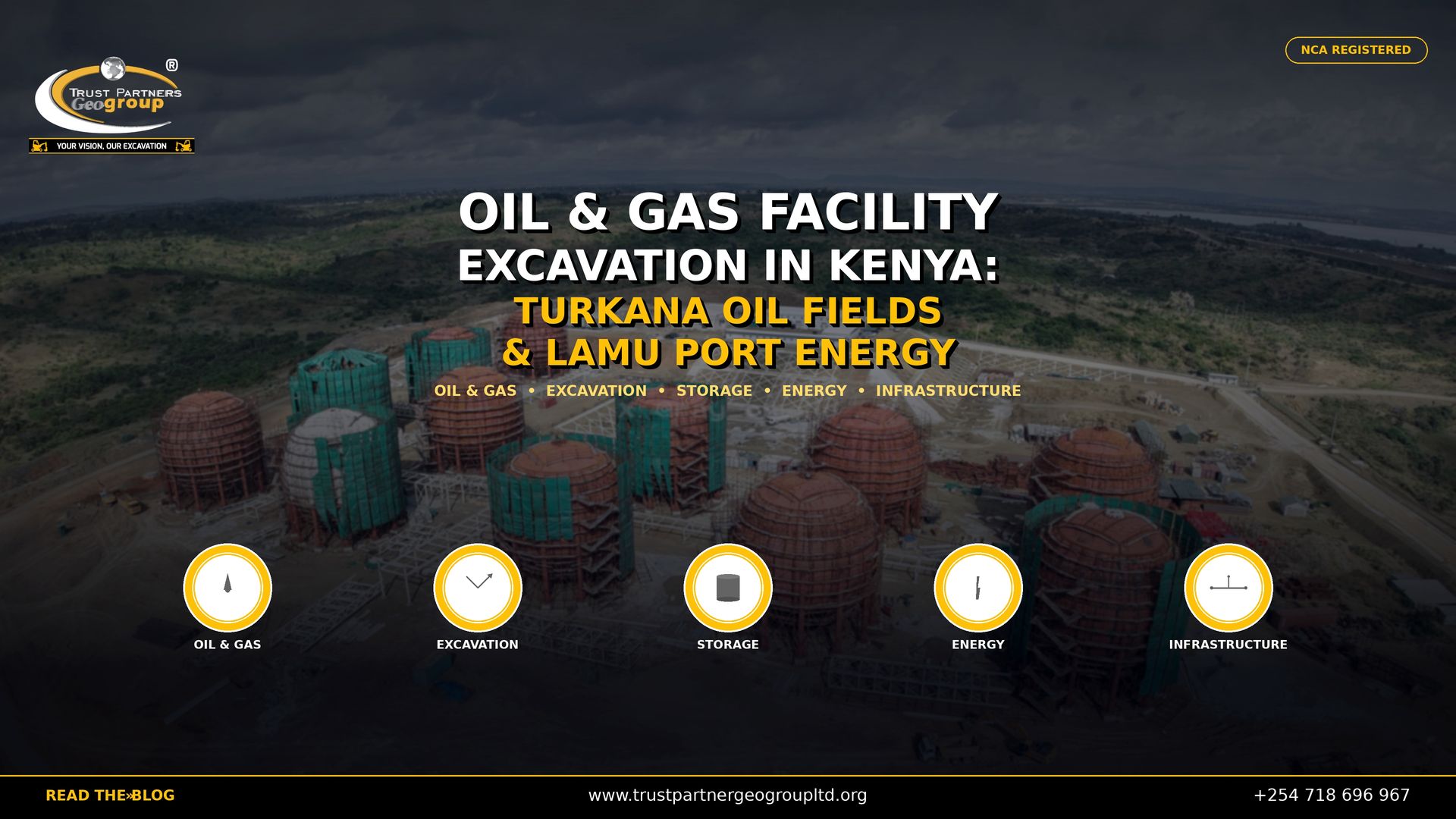
Oil and Gas Facility Excavation in Kenya: Turkana Oil Fields & Lamu Port Energy Infrastructure [2026]
The Energy Sector Earthworks Guide — Well Pads, Pipeline Corridors, Refineries & Marine Infrastructure
Kenya's petroleum sector has moved from discovery to development. The Turkana oil fields are producing through the Early Oil Pilot Scheme, the Lamu refinery and storage complex is taking shape at the coast, and the export pipeline corridor between them will be one of the largest linear earthworks projects in East Africa. Every barrel depends on excavation executed to specification — well pads leveled to drilling-rig tolerance, sumps lined and bunded for containment, pipeline trenches bedded and backfilled to petroleum-grade standards, and marine jetties founded below the tidal zone. This 2026 energy sector guide covers oil and gas excavation in Kenya, Turkana oil field construction, petroleum facility excavation and Lamu port energy infrastructure earthworks — the scope, the soils, the remote logistics and the costs. With 15+ years of excavation experience across Kenya's toughest terrain, Trust Partners Geo-Group delivers petroleum-sector earthworks with the HSE discipline and remote capability that upstream and downstream projects demand.

From Turkana well pads to Lamu refinery foundations, our teams deliver energy-sector earthworks with petroleum-specific HSE, self-sufficient remote spreads and the environmental compliance that NEMA and international operators both require.
1. Kenya's Oil & Gas Build-Out: Where the Energy Sector Stands in 2026
Petroleum development in Kenya is no longer exploratory — it is infrastructural. The earthworks packages that support it are substantial, recurring and technically demanding:
- Turkana upstream production: well pads, production facilities, water injection plants and associated infrastructure in the South Lokichar Basin — active and expanding.
- Export pipeline: the proposed crude oil pipeline from Lokichar to Lamu, spanning over 800 km through some of Kenya's most remote terrain, generating continuous trenching, access track and crossing earthworks.
- Lamu downstream complex: refinery site preparation, tank farm foundations, marine jetty construction and product handling facilities at the port — large-scale industrial earthworks in a coastal marine environment.
- Regional storage and distribution: fuel depots, pipeline terminals and storage caverns in Nairobi, Mombasa and Nakuru that require the same precision foundation discipline.
- Geothermal and energy transition: while not petroleum, the same contractors and equipment spreads serve the Menengai and Baringo-Silali geothermal fields — expanding the energy earthworks market further.

2. The Energy Earthworks Map: Turkana, Lamu and the Corridor Between
| Component | Location | Earthworks Scope |
|---|---|---|
| Well pads and production facilities | South Lokichar Basin, Turkana | Platform excavation, sump construction, access roads, drainage, camp earthworks |
| Drilling waste management | Turkana well sites | Cut-and-lined sumps, evaporation ponds, containment bunds |
| Access roads and airstrips | Turkana — Lokichar to well sites | Cut-to-fill, culverts, drainage, murram surfacing — 50–150 km networks |
| Export pipeline corridor | Lokichar–Lamu alignment | Continuous trenching, river crossings, road crossings, reinstatement — our pipeline trenching discipline at energy scale |
| Refinery site preparation | Lamu Port | Mass grading, tank farm platforms, drainage, bund walls, road networks |
| Marine jetty and berth | Lamu (Manda Bay) | Dredging support, revetments, pile cap excavation, cofferdams |
| Product storage terminals | Lamu, Nairobi, Nakuru | Tank foundation pads, containment bunds, fire-water reservoir excavation |
3. Turkana Oil Fields: Well Pads, Sumps and Access Earthworks
The South Lokichar Basin is where Kenya's petroleum story begins below ground — and where the surface earthworks determine whether drilling proceeds on schedule. Turkana oil field construction excavation covers several distinct disciplines:
Well Pad Construction
Each well pad is a leveled, compacted platform — typically 80m x 80m to 120m x 120m — capable of supporting a drilling rig, mud systems, generator sets and accommodation units. Excavation requirements:
- Precision grading: pads must be flat and uniformly compacted to support rig mast loads that concentrate through outrigger pads. Tolerance is typically ±50mm across the entire platform.
- Cut-to-fill balance: Turkana's rolling terrain often requires significant cut-to-fill, with imported material sometimes needed where the natural ground is too loose or expansive.
- Expansive soil management: black cotton and expansive clay patches around Lokichar demand selective removal and replacement with engineered granular fill — the same black cotton soil discipline applied to industrial scale.
- Compaction to petroleum standard: typically 95–98% of maximum dry density (MDD) to prevent rig settlement during the 30–90 day drilling cycle.
Drilling Sumps and Waste Management
Every well requires sumps for drilling mud, cuttings and produced water. These are not simple pits — they are engineered containment systems:
- Excavation and lining: sumps are excavated to precise dimensions, lined with HDPE or compacted clay, and surrounded by secondary containment bunds.
- Spill protection: bund walls are earthworks structures designed to contain 110% of the sump volume. Excavation must achieve the design height and compaction to prevent bund failure.
- Evaporation ponds: larger facilities require lined ponds with controlled gradients and overflow protection — earthworks that double as environmental safeguards.
Access Roads and Logistics Corridors
Turkana's existing road network cannot support heavy drilling rig mobilization. New or upgraded access roads are earthworks packages in themselves:
- Alignment and cut-to-fill: roads are engineered to 6–8m formation width with drainage structures at every watercourse.
- Bridge and culvert approaches: excavation for abutments and wing walls where ephemeral rivers must be crossed.
- Airstrip upgrades: many well sites rely on gravel airstrips for personnel and light cargo — requiring precision grading and compaction to aviation tolerance.
Water Infrastructure
Drilling and camp operations consume enormous water volumes in a water-scarce county. Earthworks include:
- Water pan excavation: large pans to capture seasonal rainfall — our water pan excavation methods scaled to industrial demand.
- Borehole pad construction: leveled, drained platforms for drilling and pump installation.
- Pipeline trenches: water supply lines from source to camp and well site.

4. Lamu Port Energy Infrastructure: Marine and Downstream Groundworks
At the downstream end of the corridor, Lamu port energy infrastructure earthworks combine industrial precision with marine construction discipline:
Refinery Site Preparation
A refinery is essentially a city of steel vessels on concrete foundations — and the earthworks must create a platform stable enough to support distillation columns, reactors and storage tanks that will operate for forty years:
- Mass grading: the refinery footprint requires large-area cut-to-fill, often involving millions of cubic metres to create a level platform above flood and tide levels.
- Tank farm foundations: circular tank pads excavated and compacted to exacting tolerance, with ring-wall foundations requiring precision trenching and formwork preparation.
- Containment and bunds: every tank sits inside an earthworks bund designed to contain the full tank volume. Bund walls are compacted structural fills, not casual embankments.
- Fire-water reservoirs: excavated reservoirs with impermeable lining, sized to feed the facility's fire suppression system.
Marine Jetty and Berth Construction
The marine interface where crude arrives or products ship out requires earthworks below and above the waterline:
- Cofferdam and caisson excavation: dry working environments created below sea level for pile cap and jetty foundation construction — the same caisson excavation methods applied to petroleum marine works.
- Revetment and shoreline protection: armoured slopes where dredged fill meets open water — drawing on our coastal protection experience.
- Dredging support: excavation and disposal of dredged material for berth deepening and channel maintenance.
Product Pipeline Terminal
The Lamu end of the export pipeline requires a reception terminal with pump stations, metering facilities and storage. Earthworks include:
- Station pads: vibration-isolated platforms for pumps and compressors.
- Pipeline manifold trenches: complex underground pipe networks requiring precision trenching and controlled backfill.
- Leak detection and containment: excavated containment channels and sump systems around transfer points.

5. Pipeline Corridors: Trenching, Crossings and Reclamation
The Lokichar–Lamu crude pipeline is the spine of Kenya's petroleum logistics — and its construction is an earthworks marathon. The pipeline corridor earthworks include:
Mainline Trenching
- Continuous trench excavation: typically 1.5–2.5m deep and 0.8–1.2m wide, through variable terrain from loose alluvium to weathered basalt.
- Bedding and padding: excavated trenches receive a compacted sand or fine gravel bedding layer before pipe laying — the bedding is itself an excavation and placement discipline.
- Backfill and compaction: pipe zones are backfilled in controlled lifts with select material, compacted to avoid settlement that would strain welds.
- Reinstatement: topsoil is replaced and the corridor reinstated to agricultural or grazing use — an environmental obligation, not an afterthought.
Crossings
The pipeline crosses roads, rivers, railways and existing utilities. Each crossing is a specialized excavation:
- Road crossings: trenching beneath existing highways using directional drilling or open-cut with traffic management — excavation must support temporary road plates and embankments.
- River crossings: wet trenching, cofferdams or horizontal directional drilling launch pits — each requiring dewatering and sediment control.
- Utility crossings: hand-dug verification of existing fiber, power and water lines before machine work proceeds.
Access Tracks and Logistics
Pipeline construction requires parallel access tracks for welding, coating and inspection crews. These tracks are earthworks packages — cut-to-fill, drainage and culverts — that often remain as community assets after construction.

6. Remote Delivery: Equipment, Camps and Arid-Zone Discipline
Petroleum earthworks in Turkana and the corridor are defined by distance. The disciplines that separate successful contractors from stranded ones:
Equipment Selection
| Machine | Role on Oil & Gas Projects |
|---|---|
| 30–45 t excavators (tropical spec, fire-suppressed) | Well pad excavation, sump construction, trenching — with fire suppression and spill kits mandatory |
| Bulldozers (D7–D9 class) | Bulk push, pad formation, corridor clearing over long distances |
| Motor graders | Access road formation and maintenance; precision grading for airstrips |
| Articulated dump trucks | Cut-to-fill haulage on unfinished haul roads |
| Water bowsers | Compaction water, dust suppression and drilling support — the most critical machine in Turkana |
| Rollers & compactors | Pad and road compaction to 95–98% MDD with disciplined moisture control |
| Service trucks (fire-suppressed) | Field maintenance, fuel delivery and lubrication with petroleum-safe equipment |
Camp and Logistics
Remote oilfield spreads are self-sufficient by design:
- Accommodation camps: excavated and leveled camp platforms with drainage, often for 50–200 personnel.
- Fuel farms: bulk diesel storage with containment bunds — excavated earthworks structures with impermeable liners.
- Workshops and parts storage: the nearest parts dealer is a two-day drive; critical spares and field repair capability are pre-positioned.
- Water supply: boreholes, water pans or trucked supply — established before the main earthworks begin.
- Security: camp perimeters, access control and coordination with local security structures — planned as part of the earthworks logistics, not improvised.
HSE and Environmental Discipline
Petroleum earthworks carry HSE obligations that general construction does not:
- No-smoking protocols: entire well sites and fuel storage areas are no-smoking zones — camp design and equipment specification must support this.
- Spill containment: every machine carries spill kits; refueling occurs over drip trays; sumps and bunds are inspected daily.
- NEMA compliance: Environmental Impact Assessment conditions govern topsoil handling, waste disposal, noise, dust and rehabilitation — with bonds forfeited for non-compliance.
- Community engagement: local employment, grazing access and water rights are negotiated before earthworks begin — corridor projects cannot proceed without community buy-in.
Heat, Dust and Soil Management
The same arid-zone challenges that govern our renewable energy earthworks apply here, amplified by petroleum HSE:
- Heat management: 40°C+ afternoons demand shift rotation, shade infrastructure and hydration protocols.
- Dust suppression: continuous water spraying on haul roads and work areas — dust is both an environmental violation and a respiratory hazard.
- Flash flood risk: ephemeral rivers run violently when they run; camps and sumps must never sit in drainage lines.

7. Oil and Gas Excavation Costs: 2026 Kenya Benchmarks
| Work Item | Typical 2026 Range (KES) | Notes |
|---|---|---|
| Well pad excavation and compaction | 5M–25M per pad | Size 80m x 80m to 120m x 120m; includes cut-to-fill and replacement |
| Drilling sump excavation and bund | 800K–3.5M per sump | Includes lining preparation and secondary containment earthworks |
| Access road construction | 3M–8M per km | Formation, drainage, culverts; murram surfacing extra |
| Pipeline trenching (mainline) | 1,500–4,500 per metre | Depth, ground, bedding and backfill; crossings extra |
| Road/railway crossing (open cut) | 2.5M–8M per crossing | Traffic management, temporary works, reinstatement |
| River crossing (trench/cofferdam) | 4M–15M per crossing | Dewatering, sediment control, cofferdam |
| Refinery pad (mass grading) | 15M–80M per platform | Size and fill depth dependent; includes drainage |
| Tank farm foundation and bund | 3M–18M per tank | Pad, ring wall trench, bund wall and compaction |
| Machine mobilization (per unit) | 400,000–900,000+ | Distance to Turkana or Lamu; security escorts |
| Remote project premium | +25–60% vs Nairobi | Mobilization, camp, water, security, HSE |
8. Frequently Asked Questions
What excavation work do oil and gas projects in Kenya involve?
Well pad and production facility excavation in Turkana, drilling sumps and containment bunds, access roads and airstrips, pipeline trenching from Lokichar to Lamu, refinery and tank farm earthworks at Lamu, marine jetty foundations, and product storage terminals with fire-water reservoirs and spill containment.
How much does oilfield excavation cost in Turkana compared to Nairobi?
Unit rates are similar at KES 300–750 per m³, but total costs run 25–60% higher due to remote mobilization, security, camps and water logistics. Well pads cost KES 5M–25M all-in, and machine mobilization to Turkana runs KES 400,000–900,000 per unit.
What is the status of Turkana oil field development in 2026?
The Early Oil Pilot Scheme continues with new well pad construction, production facility expansion and access road upgrades. Full field development planning advances, and the Lokichar–Lamu export pipeline corridor is in advanced preparation with clearing and access track earthworks underway in sections.
What are the main challenges of petroleum facility excavation in Kenya?
Extreme heat, water scarcity, long mobilization distances, security coordination, expansive soils around Lokichar, strict NEMA environmental compliance, oil spill containment requirements, fire-safe camp protocols, and thin local supply chains for fuel and parts.
What equipment is needed for remote oil and gas earthworks?
Tropical-spec excavators and dozers with fire suppression, motor graders for haul roads, articulated dump trucks, water bowsers, compaction rollers, and fire-suppressed service trucks. All plant carries spill kits; reliability is critical when dealer support is 700 km away.
How do you manage environmental compliance during oilfield excavation?
Through NEMA-approved EIAs, topsoil stockpiling for reinstatement, sediment and erosion control, oil spill containment bunds and drip trays, controlled waste disposal, silt fences, and rehabilitation bonds. Spill response plans are maintained as live documents on every site.
Who provides oil and gas facility excavation services in Kenya?
NCA-registered contractors with remote mobilization, petroleum HSE systems and environmental compliance. Trust Partners Geo-Group delivers well pads, pipeline trenching, refinery foundations and energy infrastructure earthworks across Turkana, Lamu and northern Kenya. Call +254 718 686 967.
9. Conclusion: Energy Infrastructure Is Built on Disciplined Earthworks
Kenya's petroleum sector — from the wellheads of South Lokichar to the jetties of Lamu — is an earthworks business as much as an energy business. The well pad that settles after rig mobilization costs more than the pad itself. The pipeline trench that backfills with rock instead of select material fractures a weld six months later. The tank bund that compacts poorly fails when it is needed most.
The contractors who win and retain oil and gas earthworks contracts are those who treat remote logistics, environmental compliance and precision compaction as core competencies — not afterthoughts. Turkana and Lamu are 800 km apart, but they demand the same thing: self-sufficient spreads, documented QA, and crews who understand that petroleum earthworks end only when the site is reinstated and the NEMA bond is released.
Trust Partners Geo-Group delivers energy-sector earthworks end-to-end: well pads, sumps, access roads, pipeline trenches, refinery platforms, tank farm foundations and marine support works — with the QA discipline, remote logistics and marine experience that petroleum projects require. From Turkana's arid basin to Lamu's tidal shoreline, we build the ground that Kenya's energy future flows through.
Tendering Energy Sector Earthworks? Partner With a Fleet That Knows Petroleum.
Trust Partners Geo-Group delivers oil and gas facility excavation — well pads, pipeline trenches, refinery foundations and marine earthworks — across Turkana, Lamu and all 47 counties.
Call +254 718 686 967 — 24/7 Request an Energy Sector QuoteOil and Gas Facility Excavation in Kenya: Turkana Oil Fields & Lamu Port Energy Infrastructure [2026]
The Energy Sector Earthworks Guide — Well Pads, Pipeline Corridors, Refineries & Marine Infrastructure
Kenya's petroleum sector has moved from discovery to development. The Turkana oil fields are producing through the Early Oil Pilot Scheme, the Lamu refinery and storage complex is taking shape at the coast, and the export pipeline corridor between them will be one of the largest linear earthworks projects in East Africa. Every barrel depends on excavation executed to specification — well pads leveled to drilling-rig tolerance, sumps lined and bunded for containment, pipeline trenches bedded and backfilled to petroleum-grade standards, and marine jetties founded below the tidal zone. This 2026 energy sector guide covers oil and gas excavation in Kenya, Turkana oil field construction, petroleum facility excavation and Lamu port energy infrastructure earthworks — the scope, the soils, the remote logistics and the costs. With 15+ years of excavation experience across Kenya's toughest terrain, Trust Partners Geo-Group delivers petroleum-sector earthworks with the HSE discipline and remote capability that upstream and downstream projects demand.
From Turkana well pads to Lamu refinery foundations, our teams deliver energy-sector earthworks with petroleum-specific HSE, self-sufficient remote spreads and the environmental compliance that NEMA and international operators both require.
1. Kenya's Oil & Gas Build-Out: Where the Energy Sector Stands in 2026
Petroleum development in Kenya is no longer exploratory — it is infrastructural. The earthworks packages that support it are substantial, recurring and technically demanding:
- Turkana upstream production: well pads, production facilities, water injection plants and associated infrastructure in the South Lokichar Basin — active and expanding.
- Export pipeline: the proposed crude oil pipeline from Lokichar to Lamu, spanning over 800 km through some of Kenya's most remote terrain, generating continuous trenching, access track and crossing earthworks.
- Lamu downstream complex: refinery site preparation, tank farm foundations, marine jetty construction and product handling facilities at the port — large-scale industrial earthworks in a coastal marine environment.
- Regional storage and distribution: fuel depots, pipeline terminals and storage caverns in Nairobi, Mombasa and Nakuru that require the same precision foundation discipline.
- Geothermal and energy transition: while not petroleum, the same contractors and equipment spreads serve the Menengai and Baringo-Silali geothermal fields — expanding the energy earthworks market further.
2. The Energy Earthworks Map: Turkana, Lamu and the Corridor Between
| Component | Location | Earthworks Scope |
|---|---|---|
| Well pads and production facilities | South Lokichar Basin, Turkana | Platform excavation, sump construction, access roads, drainage, camp earthworks |
| Drilling waste management | Turkana well sites | Cut-and-lined sumps, evaporation ponds, containment bunds |
| Access roads and airstrips | Turkana — Lokichar to well sites | Cut-to-fill, culverts, drainage, murram surfacing — 50–150 km networks |
| Export pipeline corridor | Lokichar–Lamu alignment | Continuous trenching, river crossings, road crossings, reinstatement — our pipeline trenching discipline at energy scale |
| Refinery site preparation | Lamu Port | Mass grading, tank farm platforms, drainage, bund walls, road networks |
| Marine jetty and berth | Lamu (Manda Bay) | Dredging support, revetments, pile cap excavation, cofferdams |
| Product storage terminals | Lamu, Nairobi, Nakuru | Tank foundation pads, containment bunds, fire-water reservoir excavation |
3. Turkana Oil Fields: Well Pads, Sumps and Access Earthworks
The South Lokichar Basin is where Kenya's petroleum story begins below ground — and where the surface earthworks determine whether drilling proceeds on schedule. Turkana oil field construction excavation covers several distinct disciplines:
Well Pad Construction
Each well pad is a leveled, compacted platform — typically 80m x 80m to 120m x 120m — capable of supporting a drilling rig, mud systems, generator sets and accommodation units. Excavation requirements:
- Precision grading: pads must be flat and uniformly compacted to support rig mast loads that concentrate through outrigger pads. Tolerance is typically ±50mm across the entire platform.
- Cut-to-fill balance: Turkana's rolling terrain often requires significant cut-to-fill, with imported material sometimes needed where the natural ground is too loose or expansive.
- Expansive soil management: black cotton and expansive clay patches around Lokichar demand selective removal and replacement with engineered granular fill — the same black cotton soil discipline applied to industrial scale.
- Compaction to petroleum standard: typically 95–98% of maximum dry density (MDD) to prevent rig settlement during the 30–90 day drilling cycle.
Drilling Sumps and Waste Management
Every well requires sumps for drilling mud, cuttings and produced water. These are not simple pits — they are engineered containment systems:
- Excavation and lining: sumps are excavated to precise dimensions, lined with HDPE or compacted clay, and surrounded by secondary containment bunds.
- Spill protection: bund walls are earthworks structures designed to contain 110% of the sump volume. Excavation must achieve the design height and compaction to prevent bund failure.
- Evaporation ponds: larger facilities require lined ponds with controlled gradients and overflow protection — earthworks that double as environmental safeguards.
Access Roads and Logistics Corridors
Turkana's existing road network cannot support heavy drilling rig mobilization. New or upgraded access roads are earthworks packages in themselves:
- Alignment and cut-to-fill: roads are engineered to 6–8m formation width with drainage structures at every watercourse.
- Bridge and culvert approaches: excavation for abutments and wing walls where ephemeral rivers must be crossed.
- Airstrip upgrades: many well sites rely on gravel airstrips for personnel and light cargo — requiring precision grading and compaction to aviation tolerance.
Water Infrastructure
Drilling and camp operations consume enormous water volumes in a water-scarce county. Earthworks include:
- Water pan excavation: large pans to capture seasonal rainfall — our water pan excavation methods scaled to industrial demand.
- Borehole pad construction: leveled, drained platforms for drilling and pump installation.
- Pipeline trenches: water supply lines from source to camp and well site.
4. Lamu Port Energy Infrastructure: Marine and Downstream Groundworks
At the downstream end of the corridor, Lamu port energy infrastructure earthworks combine industrial precision with marine construction discipline:
Refinery Site Preparation
A refinery is essentially a city of steel vessels on concrete foundations — and the earthworks must create a platform stable enough to support distillation columns, reactors and storage tanks that will operate for forty years:
- Mass grading: the refinery footprint requires large-area cut-to-fill, often involving millions of cubic metres to create a level platform above flood and tide levels.
- Tank farm foundations: circular tank pads excavated and compacted to exacting tolerance, with ring-wall foundations requiring precision trenching and formwork preparation.
- Containment and bunds: every tank sits inside an earthworks bund designed to contain the full tank volume. Bund walls are compacted structural fills, not casual embankments.
- Fire-water reservoirs: excavated reservoirs with impermeable lining, sized to feed the facility's fire suppression system.
Marine Jetty and Berth Construction
The marine interface where crude arrives or products ship out requires earthworks below and above the waterline:
- Cofferdam and caisson excavation: dry working environments created below sea level for pile cap and jetty foundation construction — the same caisson excavation methods applied to petroleum marine works.
- Revetment and shoreline protection: armoured slopes where dredged fill meets open water — drawing on our coastal protection experience.
- Dredging support: excavation and disposal of dredged material for berth deepening and channel maintenance.
Product Pipeline Terminal
The Lamu end of the export pipeline requires a reception terminal with pump stations, metering facilities and storage. Earthworks include:
- Station pads: vibration-isolated platforms for pumps and compressors.
- Pipeline manifold trenches: complex underground pipe networks requiring precision trenching and controlled backfill.
- Leak detection and containment: excavated containment channels and sump systems around transfer points.
5. Pipeline Corridors: Trenching, Crossings and Reclamation
The Lokichar–Lamu crude pipeline is the spine of Kenya's petroleum logistics — and its construction is an earthworks marathon. The pipeline corridor earthworks include:
Mainline Trenching
- Continuous trench excavation: typically 1.5–2.5m deep and 0.8–1.2m wide, through variable terrain from loose alluvium to weathered basalt.
- Bedding and padding: excavated trenches receive a compacted sand or fine gravel bedding layer before pipe laying — the bedding is itself an excavation and placement discipline.
- Backfill and compaction: pipe zones are backfilled in controlled lifts with select material, compacted to avoid settlement that would strain welds.
- Reinstatement: topsoil is replaced and the corridor reinstated to agricultural or grazing use — an environmental obligation, not an afterthought.
Crossings
The pipeline crosses roads, rivers, railways and existing utilities. Each crossing is a specialized excavation:
- Road crossings: trenching beneath existing highways using directional drilling or open-cut with traffic management — excavation must support temporary road plates and embankments.
- River crossings: wet trenching, cofferdams or horizontal directional drilling launch pits — each requiring dewatering and sediment control.
- Utility crossings: hand-dug verification of existing fiber, power and water lines before machine work proceeds.
Access Tracks and Logistics
Pipeline construction requires parallel access tracks for welding, coating and inspection crews. These tracks are earthworks packages — cut-to-fill, drainage and culverts — that often remain as community assets after construction.
6. Remote Delivery: Equipment, Camps and Arid-Zone Discipline
Petroleum earthworks in Turkana and the corridor are defined by distance. The disciplines that separate successful contractors from stranded ones:
Equipment Selection
| Machine | Role on Oil & Gas Projects |
|---|---|
| 30–45 t excavators (tropical spec, fire-suppressed) | Well pad excavation, sump construction, trenching — with fire suppression and spill kits mandatory |
| Bulldozers (D7–D9 class) | Bulk push, pad formation, corridor clearing over long distances |
| Motor graders | Access road formation and maintenance; precision grading for airstrips |
| Articulated dump trucks | Cut-to-fill haulage on unfinished haul roads |
| Water bowsers | Compaction water, dust suppression and drilling support — the most critical machine in Turkana |
| Rollers & compactors | Pad and road compaction to 95–98% MDD with disciplined moisture control |
| Service trucks (fire-suppressed) | Field maintenance, fuel delivery and lubrication with petroleum-safe equipment |
Camp and Logistics
Remote oilfield spreads are self-sufficient by design:
- Accommodation camps: excavated and leveled camp platforms with drainage, often for 50–200 personnel.
- Fuel farms: bulk diesel storage with containment bunds — excavated earthworks structures with impermeable liners.
- Workshops and parts storage: the nearest parts dealer is a two-day drive; critical spares and field repair capability are pre-positioned.
- Water supply: boreholes, water pans or trucked supply — established before the main earthworks begin.
- Security: camp perimeters, access control and coordination with local security structures — planned as part of the earthworks logistics, not improvised.
HSE and Environmental Discipline
Petroleum earthworks carry HSE obligations that general construction does not:
- No-smoking protocols: entire well sites and fuel storage areas are no-smoking zones — camp design and equipment specification must support this.
- Spill containment: every machine carries spill kits; refueling occurs over drip trays; sumps and bunds are inspected daily.
- NEMA compliance: Environmental Impact Assessment conditions govern topsoil handling, waste disposal, noise, dust and rehabilitation — with bonds forfeited for non-compliance.
- Community engagement: local employment, grazing access and water rights are negotiated before earthworks begin — corridor projects cannot proceed without community buy-in.
Heat, Dust and Soil Management
The same arid-zone challenges that govern our renewable energy earthworks apply here, amplified by petroleum HSE:
- Heat management: 40°C+ afternoons demand shift rotation, shade infrastructure and hydration protocols.
- Dust suppression: continuous water spraying on haul roads and work areas — dust is both an environmental violation and a respiratory hazard.
- Flash flood risk: ephemeral rivers run violently when they run; camps and sumps must never sit in drainage lines.
7. Oil and Gas Excavation Costs: 2026 Kenya Benchmarks
| Work Item | Typical 2026 Range (KES) | Notes |
|---|---|---|
| Well pad excavation and compaction | 5M–25M per pad | Size 80m x 80m to 120m x 120m; includes cut-to-fill and replacement |
| Drilling sump excavation and bund | 800K–3.5M per sump | Includes lining preparation and secondary containment earthworks |
| Access road construction | 3M–8M per km | Formation, drainage, culverts; murram surfacing extra |
| Pipeline trenching (mainline) | 1,500–4,500 per metre | Depth, ground, bedding and backfill; crossings extra |
| Road/railway crossing (open cut) | 2.5M–8M per crossing | Traffic management, temporary works, reinstatement |
| River crossing (trench/cofferdam) | 4M–15M per crossing | Dewatering, sediment control, cofferdam |
| Refinery pad (mass grading) | 15M–80M per platform | Size and fill depth dependent; includes drainage |
| Tank farm foundation and bund | 3M–18M per tank | Pad, ring wall trench, bund wall and compaction |
| Machine mobilization (per unit) | 400,000–900,000+ | Distance to Turkana or Lamu; security escorts |
| Remote project premium | +25–60% vs Nairobi | Mobilization, camp, water, security, HSE |
8. Frequently Asked Questions
What excavation work do oil and gas projects in Kenya involve?
Well pad and production facility excavation in Turkana, drilling sumps and containment bunds, access roads and airstrips, pipeline trenching from Lokichar to Lamu, refinery and tank farm earthworks at Lamu, marine jetty foundations, and product storage terminals with fire-water reservoirs and spill containment.
How much does oilfield excavation cost in Turkana compared to Nairobi?
Unit rates are similar at KES 300–750 per m³, but total costs run 25–60% higher due to remote mobilization, security, camps and water logistics. Well pads cost KES 5M–25M all-in, and machine mobilization to Turkana runs KES 400,000–900,000 per unit.
What is the status of Turkana oil field development in 2026?
The Early Oil Pilot Scheme continues with new well pad construction, production facility expansion and access road upgrades. Full field development planning advances, and the Lokichar–Lamu export pipeline corridor is in advanced preparation with clearing and access track earthworks underway in sections.
What are the main challenges of petroleum facility excavation in Kenya?
Extreme heat, water scarcity, long mobilization distances, security coordination, expansive soils around Lokichar, strict NEMA environmental compliance, oil spill containment requirements, fire-safe camp protocols, and thin local supply chains for fuel and parts.
What equipment is needed for remote oil and gas earthworks?
Tropical-spec excavators and dozers with fire suppression, motor graders for haul roads, articulated dump trucks, water bowsers, compaction rollers, and fire-suppressed service trucks. All plant carries spill kits; reliability is critical when dealer support is 700 km away.
How do you manage environmental compliance during oilfield excavation?
Through NEMA-approved EIAs, topsoil stockpiling for reinstatement, sediment and erosion control, oil spill containment bunds and drip trays, controlled waste disposal, silt fences, and rehabilitation bonds. Spill response plans are maintained as live documents on every site.
Who provides oil and gas facility excavation services in Kenya?
NCA-registered contractors with remote mobilization, petroleum HSE systems and environmental compliance. Trust Partners Geo-Group delivers well pads, pipeline trenching, refinery foundations and energy infrastructure earthworks across Turkana, Lamu and northern Kenya. Call +254 718 686 967.
9. Conclusion: Energy Infrastructure Is Built on Disciplined Earthworks
Kenya's petroleum sector — from the wellheads of South Lokichar to the jetties of Lamu — is an earthworks business as much as an energy business. The well pad that settles after rig mobilization costs more than the pad itself. The pipeline trench that backfills with rock instead of select material fractures a weld six months later. The tank bund that compacts poorly fails when it is needed most.
The contractors who win and retain oil and gas earthworks contracts are those who treat remote logistics, environmental compliance and precision compaction as core competencies — not afterthoughts. Turkana and Lamu are 800 km apart, but they demand the same thing: self-sufficient spreads, documented QA, and crews who understand that petroleum earthworks end only when the site is reinstated and the NEMA bond is released.
Trust Partners Geo-Group delivers energy-sector earthworks end-to-end: well pads, sumps, access roads, pipeline trenches, refinery platforms, tank farm foundations and marine support works — with the QA discipline, remote logistics and marine experience that petroleum projects require. From Turkana's arid basin to Lamu's tidal shoreline, we build the ground that Kenya's energy future flows through.
Tendering Energy Sector Earthworks? Partner With a Fleet That Knows Petroleum.
Trust Partners Geo-Group delivers oil and gas facility excavation — well pads, pipeline trenches, refinery foundations and marine earthworks — across Turkana, Lamu and all 47 counties.
Call +254 718 686 967 — 24/7 Request an Energy Sector Quote