
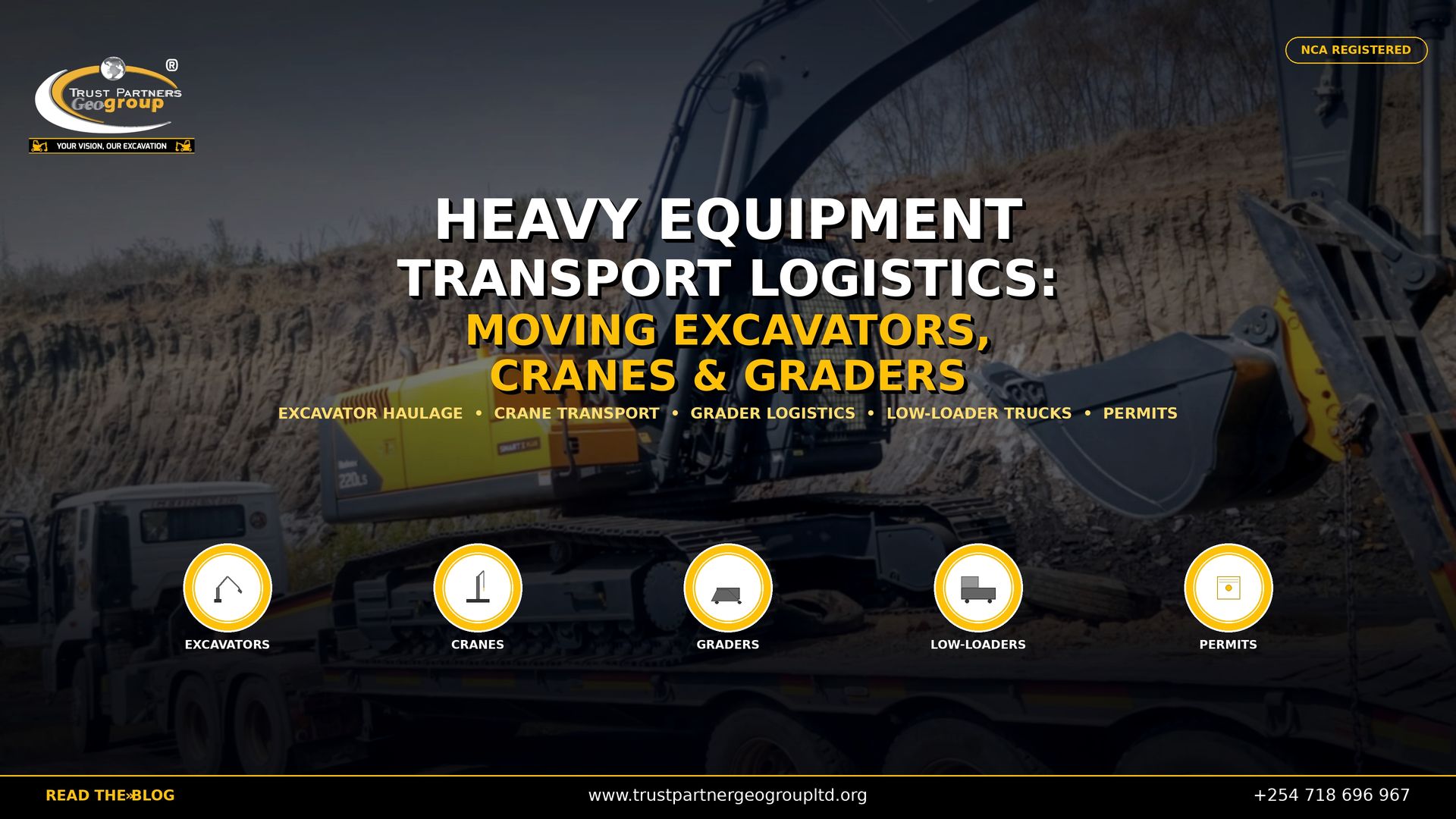
Heavy Equipment Transport and Logistics: Moving Excavators, Cranes and Graders Across Kenya [2026]
Low Loaders, Permits & Route Planning for Machine Mobilization Across All 47 Counties
Every Kenyan construction project begins the same way: a machine has to get there. The excavator that digs your basement in Nairobi may have started its week in Nakuru; the grader finishing your estate road in Kitengela may arrive from Mombasa on a low loader. Heavy equipment transport is the invisible half of the hire market — and done badly, it is where projects bleed time, money and machines. This 2026 logistics guide covers machinery logistics from Nairobi, excavator transport to Mombasa, construction equipment haulage across Kenya and low loader rental — transport options, permits and axle-load rules, route planning, loading discipline, insurance and current rates. With 15+ years of excavation experience across Kenya, Trust Partners Geo-Group has mobilized machines to all 47 counties — and we handle the haulage end-to-end on every hire.

From same-day Nairobi mobilization to multi-day remote-county moves, our logistics team moves machines the way we run sites: permitted, chained down, insured and on programme.
1. Why Machine Logistics Make or Break Kenyan Projects in 2026
Kenya's construction geography is spread out: major plant fleets concentrate in Nairobi and Mombasa, while projects scatter across all 47 counties. That gap is bridged by low loaders — and the quality of that bridging determines whether your machine arrives on programme, undamaged and legal:
- Programme risk: a late machine idles your entire site crew. Mobilization timing is the first line of the excavation programme, not an afterthought.
- Compliance risk: over-limit loads without permits attract KeNHA enforcement, impoundment and project delays that dwarf the permit cost.
- Damage risk: poorly loaded machines suffer slew-ring damage, bent booms and hydraulic line failures in transit — problems discovered only when the machine fails to work on arrival.
- Wet-season risk: the last 20 km of murram road decides many mobilizations; a route that works in January may be impassable in April.
2. Transport Options: Low Loaders, Flatbeds and Self-Propelled Moves
| Option | Best For | Limits |
|---|---|---|
| Low loader (drop-deck trailer) | Excavators, dozers, rollers, graders — the default for tracked and heavy wheeled plant | Needs loading ramps or crane at both ends; height limits still apply |
| Multi-axle / modular low loader | Large cranes, heavy mining plant, loads needing axle-load spreading | Premium rates; permits and often escorts mandatory |
| Flatbed semi-trailer | Attachments, containers, light rollers, site cabins | Deck height limits tall machines; not for tracked plant |
| Self-propelled (wheeled plant) | Short urban hops by wheeled loaders, telehandlers, backhoes | Distance and speed limits; licence class required; never for tracked machines |
| Crane-assisted loading | Non-running machines, awkward loads, confined yards | Adds crane hire; needs lift planning |
Tracked machines — excavators, dozers — never travel on tarmac under their own power: it is illegal, destroys road surface and tracks alike, and voids any insurance. Any transporter suggesting a "quick drive down the road" for a tracked machine has told you everything you need to know about their standards.
3. What Each Machine Needs: Excavators, Cranes, Graders, Rollers
| Machine | Transport Requirements |
|---|---|
| Excavators (5–30 t) | Low loader; boom dipped and bucket rested; slew lock engaged; sometimes counterweight or boom removal for the largest classes; cab secured |
| Long-reach excavators | Boom/stick transport configuration; often width or length permits; the machines we move for riverbank and coastal projects travel this way |
| Motor graders | Low loader; blade secured and mouldboard locked; articulation locked; cab glass protection on rough corridors |
| Rollers / compactors | Low loader; drum locks; vibration systems isolated; articulated frames locked straight |
| Mobile cranes | Self-propelled on road where licensed, or multi-axle low loader for large units; boom removal for heavy classes; counterweights travel separately |
| Dozers | Low loader with blade on or shipped separately for wide blades; ripper pinned |
| Attachments & breakers | Flatbed or same-trailer loading; hydraulic lines capped — breakers ship with accumulators serviced |
4. Permits, Axle Loads and KeNHA Compliance
Kenya's road authorities regulate what may move on which road, and heavy plant moves sit squarely in the regulated zone:
- Axle-load limits: legal limits per axle and gross vehicle weight are enforced at weighbridges on all major corridors — overloaded combinations are stopped, fined and sometimes impounded.
- Dimensional limits: standard legal width, height and length apply; anything beyond them is an abnormal load requiring a permit.
- Abnormal load permits: issued against a declared load and route; may impose escort vehicles, night-only travel, or route-specific conditions. The haulage contractor obtains them — a quote without permit line items is a quote for an illegal move.
- County roads: moves terminating on county roads need the county's awareness for weak bridges and low lines; reputable transporters survey rather than assume.
- Documentation on board: permits, insurance, machine documents and driver credentials travel with the load — weighbridge delays usually trace to missing paper, not excess weight.
5. Route Planning: Bridges, Power Lines and Wet-Season Reality
Route planning is where professional haulage earns its fee:
- Bridge and culvert capacity: older bridges and county-road culverts may not carry a loaded low loader; the survey checks them before the load commits.
- Overhead clearances: power lines, footbridges and canopies — machine heights that fit a main highway may not fit the last junction into site.
- Gradients and surface: escarpment routes (Mai Mahiu, Timboroa, the coast approach) demand gearing, braking and convoy discipline from the tractor unit.
- Wet-season passability: murram access roads fail in rain; remote mobilizations carry matting, a dozer on standby, or schedule float in the long rains. Our arid-zone solar and wind farm mobilizations and highland landslide responses both live or die on this last-mile assessment.
- Timing: urban legs are programmed off-peak or at night where permits require; Nairobi exits are planned around congestion as much as around regulations.
6. Loading and Securing: How Machines Should Travel
- Loading: on firm, level ground with rated ramps or crane assist; winch for non-runners; a banksman throughout — loading is the highest-risk moment of the whole move.
- Position: machine placed at the trailer's rated load position, boom lowered and rested, slew and articulation locks engaged, cab doors and covers latched.
- Securing: rated chains and binders to designated lashing points — never ropes, never to hydraulic lines or cylinders. Lashings are re-checked at the first stop and every stop after.
- Loose items: buckets swapped for transit, breakers pinned or shipped separately, cab contents cleared — anything not chained will arrive damaged or not arrive.
- Documentation: pre-loading photos, hour-meter and condition record signed by both parties — the baseline for any dispute.
7. Kenya's Key Haulage Corridors and Typical Transit Times
| Corridor | Typical Transit (Loaded Low Loader) | Notes |
|---|---|---|
| Within Nairobi & environs (Kiambu, Kajiado, Machakos) | Same day | Off-peak or night legs; our standard mobilization for emergency dispatch |
| Nairobi – Nakuru – Eldoret | 1 day | Escarpment gradients; weighbridge stops at Gilgil/Mau Summit |
| Nairobi – Kisumu / Busia | 1–2 days | Long corridor; wet-season bridge checks on river crossings |
| Nairobi – Mombasa (excavator transport Mombasa corridor) | 1–2 days | Heaviest enforcement corridor; permits checked at multiple points |
| Nairobi – Nanyuki / Isiolo / Meru | 1 day | Generally good roads; county-road last miles vary |
| Nairobi – Garissa / Lamu / Lodwar (remote) | 2–4 days | Route survey mandatory; wet-season contingency essential |
| Mombasa – coast projects (Kilifi, Diani, Lamu) | Same day–2 days | Ferry queues at Likoni factor into Mombasa-south moves |
8. Insurance, Risk and Condition Documentation
- Goods-in-transit insurance: the transporter's policy must cover the machine's value — demand the certificate before loading, not the promise of one.
- Condition documentation: joint inspection with photos at loading and offloading; hour-meter, fuel and existing damage recorded and signed.
- Contract clarity: liability for transit damage, delays, and offload incidents allocated in writing. Verbal haulage arrangements are how machines fall off trailers into disputes.
- Security: overnight stops in secured yards on multi-day moves; a loaded low loader parked roadside overnight is a parts store waiting to be opened.
9. Heavy Equipment Transport Costs: 2026 Benchmarks
| Move | Typical 2026 Range (KES) | Cost Driver |
|---|---|---|
| Within Nairobi & environs (20 t excavator) | 60,000–150,000 | Distance, loading method, timing |
| Nairobi – Nakuru / Naivasha | 120,000–220,000 | Machine weight class |
| Nairobi – Kisumu / Eldoret | 180,000–350,000 | Distance, axle configuration |
| Nairobi – Mombasa | 250,000–450,000 | Weight, permits, Likoni timing for south coast |
| Remote counties (Garissa, Lodwar, Lamu) | 350,000–800,000+ | Route survey, escorts, wet-season contingency |
| Abnormal load permit & escorts | Included or itemised 30,000–120,000 | Permit class and escort requirement |
| Crane-assisted loading/offloading | 45,000–150,000 per lift | Crane capacity and site access |
| Low loader rental (with tractor & driver) | Quoted per move | Day rates uneconomical vs per-move pricing |
10. Choosing a Heavy Haulage Contractor
- Equipment: tractor units rated for the load with low-range gearing; low loaders with genuine rated capacity, not optimistic paint.
- Permits and insurance: produced before loading — abnormal load permit, goods-in-transit cover, vehicle documents.
- Loading discipline: chains and binders as standard, a banksman on every load, condition photos volunteered.
- Route knowledge: a transporter who asks about your last 20 km before quoting has done this before; one who quotes blind has not.
- Communication: live progress reporting on the move, a named contact, and honest arrival windows.
- Track record: reference moves on similar machines and corridors. Our operators ride with machines on operated hires — the machine and the certified operator arrive together, ready to work.
11. Frequently Asked Questions
How much does it cost to transport an excavator in Kenya?
In 2026: KES 60,000–150,000 within Nairobi and environs, KES 250,000–450,000 Nairobi–Mombasa, KES 180,000–350,000 Nairobi–Kisumu/Eldoret, and KES 350,000–800,000+ for remote counties — depending on weight, route, permits and loading arrangements.
What is a low loader and when do I need one?
A trailer with a dropped deck that keeps heavy machines low and stable. Any tracked excavator, dozer, grader or roller moving on public roads needs one — driving tracked plant on tarmac is illegal and destroys both track and road.
Do I need a permit to move heavy equipment on Kenyan roads?
Yes for abnormal loads. KeNHA enforces axle-load and dimensional limits at weighbridges; over-limit loads need an abnormal load permit and sometimes escorts or night travel. The haulage contractor handles permits — verify they exist.
How long does machine mobilization take from Nairobi to site?
Same day within Nairobi and environs; one day to Nakuru, Naivasha or Machakos; one to two days to Mombasa or Kisumu; two to four days to remote counties. Emergency dispatch compresses this — our 24/7 line mobilizes within hours.
Who is responsible if a machine is damaged during transport?
The haulage contractor, under a written contract with goods-in-transit insurance. Verify the cover before loading, photograph condition at both ends, and record hour-meter and fuel state with joint signatures.
Can heavy equipment be transported to remote county sites in Kenya?
Yes — with route surveys for bridges, power lines and murram passability, plus wet-season contingency. Trust Partners Geo-Group has mobilized to all 47 counties, including riverbank, highland and arid-zone sites — call +254 718 686 967.
What is included in a machine mobilization service?
Loading (ramps or crane), chain-and-binder securing, the permitted haul with escorts where required, offloading and positioning at site, and operator travel for operated machines. Quotes should state permits, escorts, loading method and insurance explicitly.
12. Conclusion: The Project Starts When the Machine Moves
Heavy equipment logistics is unglamorous — and absolutely decisive. The projects that start on time share the same habits: the right low loader for the machine, permits secured before the wheels turn, routes surveyed to the site gate, loads chained and photographed, and insurance in writing before anything loads.
Whether it is an excavator to Mombasa, a grader to Eldoret or a long-reach to a remote riverbank, treat mobilization as the first activity of the works — planned with the same seriousness as the excavation itself. It connects directly to everything else in this series: the certified operators who ride with the machines, and the sites — from estate SuDS works to coastal defences — that those machines exist to build.
Trust Partners Geo-Group handles heavy equipment transport end-to-end: low loaders, abnormal load permits, route surveys, escorts, insured haulage and machine-plus-operator delivery — Nairobi, Mombasa and all 47 counties, 24/7.
Need a Machine Moved? Permitted, Insured and On Programme.
Trust Partners Geo-Group delivers heavy equipment transport — low loaders, permits, escorts and certified operators — from Nairobi to every county in Kenya.
Call +254 718 686 967 — 24/7 Request a Transport QuoteHeavy Equipment Transport and Logistics: Moving Excavators, Cranes and Graders Across Kenya [2026]
Low Loaders, Permits & Route Planning for Machine Mobilization Across All 47 Counties
Every Kenyan construction project begins the same way: a machine has to get there. The excavator that digs your basement in Nairobi may have started its week in Nakuru; the grader finishing your estate road in Kitengela may arrive from Mombasa on a low loader. Heavy equipment transport is the invisible half of the hire market — and done badly, it is where projects bleed time, money and machines. This 2026 logistics guide covers machinery logistics from Nairobi, excavator transport to Mombasa, construction equipment haulage across Kenya and low loader rental — transport options, permits and axle-load rules, route planning, loading discipline, insurance and current rates. With 15+ years of excavation experience across Kenya, Trust Partners Geo-Group has mobilized machines to all 47 counties — and we handle the haulage end-to-end on every hire.
From same-day Nairobi mobilization to multi-day remote-county moves, our logistics team moves machines the way we run sites: permitted, chained down, insured and on programme.
1. Why Machine Logistics Make or Break Kenyan Projects in 2026
Kenya's construction geography is spread out: major plant fleets concentrate in Nairobi and Mombasa, while projects scatter across all 47 counties. That gap is bridged by low loaders — and the quality of that bridging determines whether your machine arrives on programme, undamaged and legal:
- Programme risk: a late machine idles your entire site crew. Mobilization timing is the first line of the excavation programme, not an afterthought.
- Compliance risk: over-limit loads without permits attract KeNHA enforcement, impoundment and project delays that dwarf the permit cost.
- Damage risk: poorly loaded machines suffer slew-ring damage, bent booms and hydraulic line failures in transit — problems discovered only when the machine fails to work on arrival.
- Wet-season risk: the last 20 km of murram road decides many mobilizations; a route that works in January may be impassable in April.
2. Transport Options: Low Loaders, Flatbeds and Self-Propelled Moves
| Option | Best For | Limits |
|---|---|---|
| Low loader (drop-deck trailer) | Excavators, dozers, rollers, graders — the default for tracked and heavy wheeled plant | Needs loading ramps or crane at both ends; height limits still apply |
| Multi-axle / modular low loader | Large cranes, heavy mining plant, loads needing axle-load spreading | Premium rates; permits and often escorts mandatory |
| Flatbed semi-trailer | Attachments, containers, light rollers, site cabins | Deck height limits tall machines; not for tracked plant |
| Self-propelled (wheeled plant) | Short urban hops by wheeled loaders, telehandlers, backhoes | Distance and speed limits; licence class required; never for tracked machines |
| Crane-assisted loading | Non-running machines, awkward loads, confined yards | Adds crane hire; needs lift planning |
Tracked machines — excavators, dozers — never travel on tarmac under their own power: it is illegal, destroys road surface and tracks alike, and voids any insurance. Any transporter suggesting a "quick drive down the road" for a tracked machine has told you everything you need to know about their standards.
3. What Each Machine Needs: Excavators, Cranes, Graders, Rollers
| Machine | Transport Requirements |
|---|---|
| Excavators (5–30 t) | Low loader; boom dipped and bucket rested; slew lock engaged; sometimes counterweight or boom removal for the largest classes; cab secured |
| Long-reach excavators | Boom/stick transport configuration; often width or length permits; the machines we move for riverbank and coastal projects travel this way |
| Motor graders | Low loader; blade secured and mouldboard locked; articulation locked; cab glass protection on rough corridors |
| Rollers / compactors | Low loader; drum locks; vibration systems isolated; articulated frames locked straight |
| Mobile cranes | Self-propelled on road where licensed, or multi-axle low loader for large units; boom removal for heavy classes; counterweights travel separately |
| Dozers | Low loader with blade on or shipped separately for wide blades; ripper pinned |
| Attachments & breakers | Flatbed or same-trailer loading; hydraulic lines capped — breakers ship with accumulators serviced |
4. Permits, Axle Loads and KeNHA Compliance
Kenya's road authorities regulate what may move on which road, and heavy plant moves sit squarely in the regulated zone:
- Axle-load limits: legal limits per axle and gross vehicle weight are enforced at weighbridges on all major corridors — overloaded combinations are stopped, fined and sometimes impounded.
- Dimensional limits: standard legal width, height and length apply; anything beyond them is an abnormal load requiring a permit.
- Abnormal load permits: issued against a declared load and route; may impose escort vehicles, night-only travel, or route-specific conditions. The haulage contractor obtains them — a quote without permit line items is a quote for an illegal move.
- County roads: moves terminating on county roads need the county's awareness for weak bridges and low lines; reputable transporters survey rather than assume.
- Documentation on board: permits, insurance, machine documents and driver credentials travel with the load — weighbridge delays usually trace to missing paper, not excess weight.
5. Route Planning: Bridges, Power Lines and Wet-Season Reality
Route planning is where professional haulage earns its fee:
- Bridge and culvert capacity: older bridges and county-road culverts may not carry a loaded low loader; the survey checks them before the load commits.
- Overhead clearances: power lines, footbridges and canopies — machine heights that fit a main highway may not fit the last junction into site.
- Gradients and surface: escarpment routes (Mai Mahiu, Timboroa, the coast approach) demand gearing, braking and convoy discipline from the tractor unit.
- Wet-season passability: murram access roads fail in rain; remote mobilizations carry matting, a dozer on standby, or schedule float in the long rains. Our arid-zone solar and wind farm mobilizations and highland landslide responses both live or die on this last-mile assessment.
- Timing: urban legs are programmed off-peak or at night where permits require; Nairobi exits are planned around congestion as much as around regulations.
6. Loading and Securing: How Machines Should Travel
- Loading: on firm, level ground with rated ramps or crane assist; winch for non-runners; a banksman throughout — loading is the highest-risk moment of the whole move.
- Position: machine placed at the trailer's rated load position, boom lowered and rested, slew and articulation locks engaged, cab doors and covers latched.
- Securing: rated chains and binders to designated lashing points — never ropes, never to hydraulic lines or cylinders. Lashings are re-checked at the first stop and every stop after.
- Loose items: buckets swapped for transit, breakers pinned or shipped separately, cab contents cleared — anything not chained will arrive damaged or not arrive.
- Documentation: pre-loading photos, hour-meter and condition record signed by both parties — the baseline for any dispute.
7. Kenya's Key Haulage Corridors and Typical Transit Times
| Corridor | Typical Transit (Loaded Low Loader) | Notes |
|---|---|---|
| Within Nairobi & environs (Kiambu, Kajiado, Machakos) | Same day | Off-peak or night legs; our standard mobilization for emergency dispatch |
| Nairobi – Nakuru – Eldoret | 1 day | Escarpment gradients; weighbridge stops at Gilgil/Mau Summit |
| Nairobi – Kisumu / Busia | 1–2 days | Long corridor; wet-season bridge checks on river crossings |
| Nairobi – Mombasa (excavator transport Mombasa corridor) | 1–2 days | Heaviest enforcement corridor; permits checked at multiple points |
| Nairobi – Nanyuki / Isiolo / Meru | 1 day | Generally good roads; county-road last miles vary |
| Nairobi – Garissa / Lamu / Lodwar (remote) | 2–4 days | Route survey mandatory; wet-season contingency essential |
| Mombasa – coast projects (Kilifi, Diani, Lamu) | Same day–2 days | Ferry queues at Likoni factor into Mombasa-south moves |
8. Insurance, Risk and Condition Documentation
- Goods-in-transit insurance: the transporter's policy must cover the machine's value — demand the certificate before loading, not the promise of one.
- Condition documentation: joint inspection with photos at loading and offloading; hour-meter, fuel and existing damage recorded and signed.
- Contract clarity: liability for transit damage, delays, and offload incidents allocated in writing. Verbal haulage arrangements are how machines fall off trailers into disputes.
- Security: overnight stops in secured yards on multi-day moves; a loaded low loader parked roadside overnight is a parts store waiting to be opened.
9. Heavy Equipment Transport Costs: 2026 Benchmarks
| Move | Typical 2026 Range (KES) | Cost Driver |
|---|---|---|
| Within Nairobi & environs (20 t excavator) | 60,000–150,000 | Distance, loading method, timing |
| Nairobi – Nakuru / Naivasha | 120,000–220,000 | Machine weight class |
| Nairobi – Kisumu / Eldoret | 180,000–350,000 | Distance, axle configuration |
| Nairobi – Mombasa | 250,000–450,000 | Weight, permits, Likoni timing for south coast |
| Remote counties (Garissa, Lodwar, Lamu) | 350,000–800,000+ | Route survey, escorts, wet-season contingency |
| Abnormal load permit & escorts | Included or itemised 30,000–120,000 | Permit class and escort requirement |
| Crane-assisted loading/offloading | 45,000–150,000 per lift | Crane capacity and site access |
| Low loader rental (with tractor & driver) | Quoted per move | Day rates uneconomical vs per-move pricing |
10. Choosing a Heavy Haulage Contractor
- Equipment: tractor units rated for the load with low-range gearing; low loaders with genuine rated capacity, not optimistic paint.
- Permits and insurance: produced before loading — abnormal load permit, goods-in-transit cover, vehicle documents.
- Loading discipline: chains and binders as standard, a banksman on every load, condition photos volunteered.
- Route knowledge: a transporter who asks about your last 20 km before quoting has done this before; one who quotes blind has not.
- Communication: live progress reporting on the move, a named contact, and honest arrival windows.
- Track record: reference moves on similar machines and corridors. Our operators ride with machines on operated hires — the machine and the certified operator arrive together, ready to work.
11. Frequently Asked Questions
How much does it cost to transport an excavator in Kenya?
In 2026: KES 60,000–150,000 within Nairobi and environs, KES 250,000–450,000 Nairobi–Mombasa, KES 180,000–350,000 Nairobi–Kisumu/Eldoret, and KES 350,000–800,000+ for remote counties — depending on weight, route, permits and loading arrangements.
What is a low loader and when do I need one?
A trailer with a dropped deck that keeps heavy machines low and stable. Any tracked excavator, dozer, grader or roller moving on public roads needs one — driving tracked plant on tarmac is illegal and destroys both track and road.
Do I need a permit to move heavy equipment on Kenyan roads?
Yes for abnormal loads. KeNHA enforces axle-load and dimensional limits at weighbridges; over-limit loads need an abnormal load permit and sometimes escorts or night travel. The haulage contractor handles permits — verify they exist.
How long does machine mobilization take from Nairobi to site?
Same day within Nairobi and environs; one day to Nakuru, Naivasha or Machakos; one to two days to Mombasa or Kisumu; two to four days to remote counties. Emergency dispatch compresses this — our 24/7 line mobilizes within hours.
Who is responsible if a machine is damaged during transport?
The haulage contractor, under a written contract with goods-in-transit insurance. Verify the cover before loading, photograph condition at both ends, and record hour-meter and fuel state with joint signatures.
Can heavy equipment be transported to remote county sites in Kenya?
Yes — with route surveys for bridges, power lines and murram passability, plus wet-season contingency. Trust Partners Geo-Group has mobilized to all 47 counties, including riverbank, highland and arid-zone sites — call +254 718 686 967.
What is included in a machine mobilization service?
Loading (ramps or crane), chain-and-binder securing, the permitted haul with escorts where required, offloading and positioning at site, and operator travel for operated machines. Quotes should state permits, escorts, loading method and insurance explicitly.
12. Conclusion: The Project Starts When the Machine Moves
Heavy equipment logistics is unglamorous — and absolutely decisive. The projects that start on time share the same habits: the right low loader for the machine, permits secured before the wheels turn, routes surveyed to the site gate, loads chained and photographed, and insurance in writing before anything loads.
Whether it is an excavator to Mombasa, a grader to Eldoret or a long-reach to a remote riverbank, treat mobilization as the first activity of the works — planned with the same seriousness as the excavation itself. It connects directly to everything else in this series: the certified operators who ride with the machines, and the sites — from estate SuDS works to coastal defences — that those machines exist to build.
Trust Partners Geo-Group handles heavy equipment transport end-to-end: low loaders, abnormal load permits, route surveys, escorts, insured haulage and machine-plus-operator delivery — Nairobi, Mombasa and all 47 counties, 24/7.
Need a Machine Moved? Permitted, Insured and On Programme.
Trust Partners Geo-Group delivers heavy equipment transport — low loaders, permits, escorts and certified operators — from Nairobi to every county in Kenya.
Call +254 718 686 967 — 24/7 Request a Transport Quote