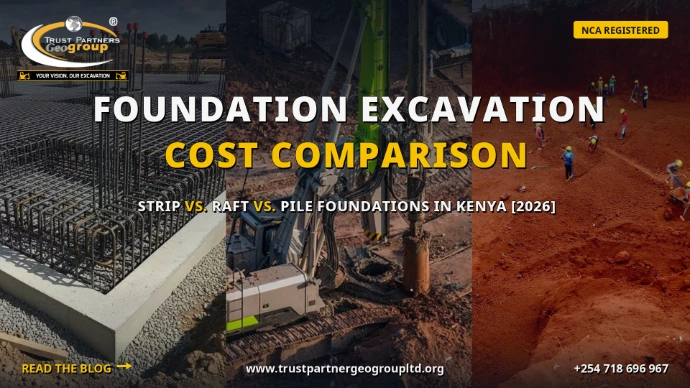
FOUNDATION EXCAVATION COST COMPARISON: STRIP VS. RAFT VS. PILE FOUNDATIONS IN KENYA [2026]
WHICH FOUNDATION TYPE SAVES YOU MONEY — AND WHICH ONE SAVES YOUR BUILDING
FOUNDATION TYPES: THE THREE MAIN OPTIONS IN KENYA
Kenyan construction uses three primary foundation types, each suited to different soil conditions, building loads, and excavation depths:
STRIP FOUNDATION (SHALLOW FOUNDATION)
Strip foundations are continuous concrete strips that run under load-bearing walls. They are the most common and economical foundation type in Kenya for low-rise buildings on stable soil.
- Depth: 1.0–1.5 meters (typically not exceeding 1.5m per standard BOQs)
- Width: 450–750mm depending on wall load and soil bearing capacity
- Best for: Low-rise buildings (1–3 stories) on firm, stable soil with good bearing capacity
- Soil requirement: Cohesive or granular soil with bearing capacity ≥ 100 kN/m²
- Excavation volume: Moderate — trenches along wall lines only
RAFT FOUNDATION (MAT FOUNDATION)
Raft foundations are thick concrete slabs that cover the entire building footprint, distributing the load over a wide area. They are used when soil bearing capacity is low or loads are heavy.
- Depth: 300–600mm thick slab, with excavation to firm strata (often 2–4 meters in Nairobi)
- Width: Full building footprint
- Best for: Medium-rise buildings (3–8 stories), weak soils, or where differential settlement is a concern
- Soil requirement: Suitable for most soils including marginal ground; requires ground improvement for very poor soils
- Excavation volume: Large — entire building footprint excavated or filled
PILE FOUNDATION (DEEP FOUNDATION)
Pile foundations transfer building loads through weak surface soils to stronger underlying strata via deep columns (piles). They are the most expensive but most reliable option for challenging ground.
- Depth: 6–30+ meters depending on soil profile and load requirements
- Width: 300–1,200mm diameter per pile
- Best for: High-rise buildings (8+ stories), very weak soils, expansive soils, or heavy industrial loads
- Soil requirement: Used when surface soils are inadequate; piles bear on rock or dense strata at depth
- Excavation volume: Minimal surface excavation; deep drilling required
EXCAVATION COST COMPARISON: STRIP VS. RAFT VS. PILE
Excavation costs vary dramatically by foundation type, soil conditions, and region. Here is the 2026 breakdown for Kenya:
| COST COMPONENT | STRIP FOUNDATION | RAFT FOUNDATION | PILE FOUNDATION |
|---|---|---|---|
| Site clearance | KES 50–70/m² | KES 50–70/m² | KES 50–70/m² |
| Topsoil removal (150mm) | KES 70–90/m² | KES 70–90/m² | KES 70–90/m² |
| Bulk excavation (soft soil) | KES 220–400/m³ | KES 220–400/m³ | KES 220–400/m³ |
| Hard rock excavation | KES 1,500–2,500/m³ | KES 1,500–2,500/m³ | KES 1,500–2,500/m³ |
| Trench excavation (strip) | KES 300–500/m³ | N/A | N/A |
| Full footprint excavation (raft) | N/A | KES 250–400/m³ | N/A |
| Pile drilling/boring | N/A | N/A | KES 8,000–25,000/m |
| Spoil disposal | KES 200–400/m³ | KES 200–400/m³ | KES 200–400/m³ |
| Backfilling | KES 400–700/m³ | KES 400–700/m³ | KES 400–700/m³ |
| Dewatering (if required) | KES 150K–500K/month | KES 150K–500K/month | KES 100K–300K/month |
| Shoring (deep excavations) | Rarely needed | KES 8,000–25,000/m² | Rarely needed |
TOTAL FOUNDATION EXCAVATION COSTS (TYPICAL 3-BEDROOM HOUSE, 120 M²)
| FOUNDATION TYPE | SOIL TYPE | EXCAVATION COST | TOTAL FOUNDATION COST |
|---|---|---|---|
| Strip Foundation | Good soil (Nairobi, Karen) | KES 80,000 – 150,000 | KES 250,000 – 450,000 |
| Strip Foundation | Medium rock (Upper Hill) | KES 200,000 – 350,000 | KES 450,000 – 750,000 |
| Raft Foundation | Soft soil (Parklands, Westlands) | KES 300,000 – 600,000 | KES 800,000 – 1,500,000 |
| Raft Foundation | Hard rock (Upper Hill deep) | KES 800,000 – 1,500,000 | KES 1,500,000 – 3,000,000 |
| Pile Foundation | Black cotton soil (Rift Valley) | KES 400,000 – 800,000 | KES 2,000,000 – 4,000,000 |
| Pile Foundation | Deep rock (Nairobi high-rise) | KES 600,000 – 1,200,000 | KES 3,000,000 – 5,000,000+ |
Total foundation costs include excavation, concrete, reinforcement, formwork, and labor. Excavation represents 20–40% of total foundation cost for strip and raft; 15–25% for pile foundations.
SOIL TYPE AND FOUNDATION SELECTION GUIDE FOR KENYA
The foundation type must match the soil. Choosing wrong is expensive — and dangerous. Here is how Kenya's common soils map to foundation types:
| SOIL TYPE | LOCATIONS | BEARING CAPACITY | RECOMMENDED FOUNDATION | EXCAVATION CHALLENGES |
|---|---|---|---|---|
| Red Volcanic Soil (Murram) | Karen, Lavington, Kileleshwa | Good (150–300 kN/m²) | Strip Foundation | Normal excavation, occasional rock |
| Black Cotton Soil (Expansive) | Parts of Nairobi, Rift Valley, Kisumu | Poor (50–100 kN/m²) | Raft or Pile | Deep excavation, high water table, swelling |
| Weathered Rock | Upper Hill, Westlands, Kilimani | Variable (100–250 kN/m²) | Strip or Raft | Hard rock breaking, dewatering |
| Sandy Soil | Mombasa, Malindi, Coastal regions | Good (150–250 kN/m²) | Strip Foundation | Easy excavation, dewatering needed |
| Alluvial Soil | River valleys, Lake Victoria basin | Poor (50–100 kN/m²) | Raft or Pile | Deep soft soil, groundwater |
| Hard Rock (Volcanic) | Upper Hill deep, Ngong Hills | Excellent (300+ kN/m²) | Strip or Pile | Rock excavation, blasting alternatives |
| Lateritic Soil | Western Kenya, Kakamega | Good (150–250 kN/m²) | Strip Foundation | Normal excavation |
THE BLACK COTTON SOIL WARNING
Black cotton soil is Kenya's most problematic foundation soil. It swells when wet (up to 30% volume increase) and shrinks when dry, causing foundation heave and settlement. Never build a strip foundation on black cotton soil without ground improvement. Minimum requirement: 1.5 meter over-excavation and replacement with compacted murram, or a raft/pile foundation designed by a structural engineer.
REGIONAL FOUNDATION EXCAVATION COSTS IN KENYA
Foundation excavation costs vary significantly across Kenya's regions due to soil conditions, labor costs, equipment availability, and rock prevalence:
NAIROBI REGION
Nairobi's volcanic geology creates variable conditions. Karen and Lavington have good red soils; Upper Hill and parts of Westlands encounter weathered rock and hard rock at depth. Black cotton soil pockets exist in Dagoretti and parts of Embakasi.
| FOUNDATION TYPE | GOOD SOIL | MEDIUM ROCK | HARD ROCK |
|---|---|---|---|
| Strip Foundation | KES 250K–400K | KES 450K–700K | KES 700K–1.2M |
| Raft Foundation | KES 800K–1.2M | KES 1.2M–2M | KES 2M–3.5M |
| Pile Foundation | KES 2M–3M | KES 3M–4.5M | KES 4M–6M |
MOMBASA & COAST REGION
Coastal sandy soils are generally favorable for shallow foundations. Coral rock exists in some areas but is less prevalent than Nairobi's volcanic rock. High water table requires dewatering for deep excavations.
| FOUNDATION TYPE | SANDY SOIL | CORAL ROCK |
|---|---|---|
| Strip Foundation | KES 200K–350K | KES 400K–600K |
| Raft Foundation | KES 700K–1M | KES 1M–1.8M |
| Pile Foundation | KES 1.8M–2.8M | KES 2.5M–4M |
KISUMU & WESTERN REGION
Western Kenya has mixed soils — good lateritic soils in some areas, black cotton soil and alluvial deposits in others. The Lake Victoria basin presents challenges with soft, waterlogged soils.
| FOUNDATION TYPE | LATERITIC SOIL | BLACK COTTON/ALLUVIAL |
|---|---|---|
| Strip Foundation | KES 220K–380K | Not recommended |
| Raft Foundation | KES 700K–1M | KES 1M–1.8M |
| Pile Foundation | KES 1.8M–2.8M | KES 2.5M–4M |
NAKURU & RIFT VALLEY
The Rift Valley has extensive black cotton soil and volcanic rock formations. Foundation costs are highly variable depending on specific location and soil profile.
| FOUNDATION TYPE | VOLCANIC SOIL | BLACK COTTON |
|---|---|---|
| Strip Foundation | KES 220K–380K | Not recommended |
| Raft Foundation | KES 700K–1M | KES 1M–1.8M |
| Pile Foundation | KES 1.8M–2.8M | KES 2.5M–4M |
HIDDEN COSTS THAT INFLATE FOUNDATION EXCAVATION BUDGETS
These ancillary costs add 25–60% to your base excavation rate. Professional contractors account for them; inexperienced ones discover them too late:
| HIDDEN COST | TYPICAL COST | WHEN IT APPLIES |
|---|---|---|
| Geotechnical survey | KES 50,000 – 150,000 | Before all major foundations |
| Soil testing (CBR, Atterberg) | KES 15,000 – 35,000/test | Required for engineering design |
| Rock breaking (hydraulic hammer) | KES 1,500 – 2,500/m³ | When rock is encountered |
| Dewatering | KES 150,000 – 500,000/month | High water table areas |
| Shoring/propping | KES 8,000 – 25,000/m² | Deep excavations over 4 meters |
| Ground improvement | KES 500 – 1,500/m² | Weak soils requiring stabilization |
| Spoil disposal | KES 200 – 400/m³ | When excavation exceeds backfill |
| Material import | KES 800 – 1,200/m³ | When fill exceeds on-site material |
| Permits and compliance | KES 20,000 – 100,000 | County excavation, NCA, NEMA |
| Unexpected rock | +50 – 100% on excavation | Geotechnical survey missed rock |
DECISION FRAMEWORK: WHICH FOUNDATION IS RIGHT FOR YOUR PROJECT?
Use this flowchart to select the most cost-effective foundation:
STEP 1: HOW MANY STORIES?
- 1–2 stories: Strip foundation (if soil is good)
- 3–5 stories: Strip or raft (depending on soil)
- 6–10 stories: Raft or pile (engineer's decision)
- 10+ stories: Pile foundation (mandatory)
STEP 2: WHAT IS THE SOIL?
- Good red soil / murram: Strip foundation
- Soft soil / black cotton: Raft or pile
- Variable / unknown: Geotechnical survey first
STEP 3: IS ROCK PRESENT?
- No rock: Standard excavation rates apply
- Medium rock at 1–2m: Strip still viable; budget for breaking
- Hard rock at shallow depth: Consider pile foundation to bypass rock
- Deep rock: Pile foundation is most economical
STEP 4: WHAT IS THE WATER TABLE?
- Deep water table (>5m): Standard excavation
- High water table (<3m): Raft with dewatering, or pile to bypass
STEP 5: WHAT IS THE BUDGET?
- Tight budget, good soil: Strip foundation
- Moderate budget, weak soil: Raft with ground improvement
- Flexible budget, complex ground: Pile foundation (long-term value)
REAL-WORLD FOUNDATION COST EXAMPLES
EXAMPLE 1: KAREN RESIDENTIAL (3-BEDROOM, STRIP FOUNDATION)
- Building: 120 m² single-story house
- Soil: Good red volcanic soil (murram)
- Foundation: Strip foundation, 1.2m deep
- Excavation: 45 m³ at KES 350/m³ = KES 15,750
- Site clearance: 150 m² at KES 60/m² = KES 9,000
- Concrete (1:2:4): 12 m³ at KES 12,000/m³ = KES 144,000
- Reinforcement: KES 45,000
- Formwork: KES 35,000
- Backfilling: KES 18,000
- TOTAL FOUNDATION: KES 266,750
EXAMPLE 2: UPPER HILL APARTMENT (5-STORY, RAFT FOUNDATION)
- Building: 800 m² footprint, 5 stories
- Soil: Weathered rock with hard rock at 3m depth
- Foundation: Raft foundation, 2.5m deep excavation
- Excavation: 2,000 m³ at KES 1,800/m³ (rock) = KES 3,600,000
- Dewatering (3 months): KES 1,200,000
- Shoring: KES 2,000,000
- Concrete (raft): 400 m³ at KES 14,000/m³ = KES 5,600,000
- Reinforcement: KES 1,800,000
- Formwork: KES 600,000
- TOTAL FOUNDATION: KES 14,800,000
EXAMPLE 3: RIFT VALLEY COMMERCIAL (HIGH-RISE, PILE FOUNDATION)
- Building: 1,500 m² footprint, 12 stories
- Soil: Black cotton soil over rock at 15m
- Foundation: 60 bored piles, 600mm diameter, 18m deep
- Pile drilling: 1,080m at KES 18,000/m = KES 19,440,000
- Pile caps and ground beams: KES 4,500,000
- Surface excavation: KES 800,000
- Testing (load tests, integrity tests): KES 1,200,000
- TOTAL FOUNDATION: KES 25,940,000
HOW TO REDUCE YOUR FOUNDATION EXCAVATION COSTS
- CONDUCT GEOTECHNICAL SURVEY EARLY: A KES 100,000 survey prevents KES 2M surprises. Know your soil before designing.
- CHOOSE THE RIGHT FOUNDATION TYPE: Do not over-engineer. Strip foundations on good soil are 80% cheaper than piles.
- OPTIMIZE EXCAVATION DEPTH: Every meter deeper adds cost. Minimize depth while meeting structural requirements.
- REUSE EXCAVATED MATERIAL: Quality soil can be used for backfill, landscaping, or road base. Reduce disposal costs by 30–50%.
- SCHEDULE DURING DRY SEASON: Avoid rainy season excavation — dewatering costs and delays multiply.
- BUNDLE SERVICES: Combine excavation, concrete, and reinforcement with one contractor for package discounts.
- NEGOTIATE VOLUME DISCOUNTS: Large projects (500+ m³) attract 15–30% lower per-m³ rates.
- SELECT EXPERIENCED CONTRACTOR: Experienced foundation contractors complete faster with fewer complications and rework.
FREQUENTLY ASKED QUESTIONS: FOUNDATION EXCAVATION IN KENYA
How deep should a foundation be in Kenya?
Strip foundations: 1.0–1.5 meters for low-rise buildings. Raft foundations: excavation to firm strata, typically 2–4 meters in Nairobi. Pile foundations: 6–30+ meters depending on soil profile. Depth is determined by geotechnical survey and structural engineer's design.
Can I build a strip foundation on black cotton soil?
No — not without ground improvement. Black cotton soil swells when wet and shrinks when dry, destroying strip foundations. Minimum requirement: remove 1.5 meters of black cotton soil and replace with compacted murram, or use a raft/pile foundation designed by a structural engineer.
Why is pile foundation so expensive?
Pile foundations require specialized drilling equipment, skilled operators, extensive concrete and reinforcement, and mandatory load testing. The cost per meter of pile (KES 8,000–25,000) multiplied by depth (6–30m) and quantity (20–100+ piles) adds up quickly. However, for high-rise buildings on weak soil, piles are the only safe option.
What happens if rock is found during excavation?
Rock increases costs by 50–100%. Options: (1) Break rock with hydraulic hammers or chemical agents; (2) Deepen foundation to bypass shallow rock; (3) Switch to pile foundation to reach rock as bearing stratum. A geotechnical survey before design minimizes this risk.
How much does a geotechnical survey cost in Kenya?
Basic geotechnical investigation for a residential project: KES 50,000–150,000. Commercial projects: KES 150,000–500,000. The survey includes boreholes, soil sampling, laboratory testing (CBR, Atterberg limits, particle size), and foundation recommendation report. This is the best investment you can make before breaking ground.
Is a raft foundation always better than a strip foundation?
No. Raft foundations cost 3–4 times more than strip foundations. They are only "better" when soil is weak, loads are heavy, or differential settlement is a concern. On good soil with light loads, a strip foundation is the smarter, more economical choice.
How long does foundation excavation take?
Strip foundation: 3–7 days for a standard house. Raft foundation: 2–4 weeks depending on depth and soil. Pile foundation: 4–8 weeks for drilling, concreting, and curing. Rock, dewatering, and weather can extend these timelines significantly.
Do I need NCA registration for foundation excavation?
Yes. All foundation excavation contractors must be NCA-registered. The required class depends on project value: NCA 7–8 for small residential, NCA 5–6 for commercial, NCA 3–4 for large developments. The contractor must also register the project with NCA before commencing work.
THE BOTTOM LINE: FOUNDATION FIRST, EVERYTHING ELSE FOLLOWS
The foundation is not a place to cut corners. A KES 100,000 saving on a cheap foundation becomes a KES 1,000,000 nightmare when the building cracks, settles, or collapses. In Kenya's variable soils — from Nairobi's volcanic rock to the Rift Valley's black cotton — the right foundation type, properly excavated and constructed, is the single most important investment in your building's future.
Choose strip for simplicity and economy on good soil. Choose raft for stability on weak ground. Choose pile when nothing else will do. And always, always conduct a geotechnical survey before committing to a foundation design.
At Trust Partners Geo-Group Ltd, we provide foundation excavation services for all three types — strip, raft, and pile — with full geotechnical support, NCA compliance, and transparent pricing. From Karen's red soils to Upper Hill's hard rock, we excavate foundations that hold buildings for generations.
— TRUST PARTNERS GEO-GROUP LTD
NEED FOUNDATION EXCAVATION FOR YOUR PROJECT?
Trust Partners Geo-Group provides strip, raft, and pile foundation excavation across Kenya. Contact us for a free geotechnical assessment, foundation recommendation, and detailed excavation quotation.
CALL +254 718 68 69 67 EMAIL US VISIT OUR WEBSITE
NAIROBI HQ | SERVING MOMBASA, KISUMU, NAKURU, ELDORET, THIKA & NATIONWIDE
MON - SAT: 8:00 AM - 6:00 PM | 24/7 EMERGENCY SUPPORT
RELATED RESOURCES
- BASEMENT EXCAVATION COST IN NAIROBI — Complete price guide for deep basement foundations
- ROCK EXCAVATION COST IN KENYA — Hard rock, medium rock, and breaking prices
- EARTHWORKS COST PER M³ KENYA — 2026 rate breakdown for cut and fill
- NCA CONTRACTOR REGISTRATION — How to register legally for construction tenders
- HEAVY EQUIPMENT FOR HIRE — Excavators, bulldozers, dump trucks for foundation work
TRUST PARTNERS GEO-GROUP LTD | YOUR VISION, OUR EXCAVATION
WEBSITE: WWW.TRUSTPARTNERGEOGROUPLTD.ORG | EMAIL: INFO@TRUSTPARTNERGEOGROUPLTD.ORG | PHONE: +254 718 68 69 67
FOLLOW US: FACEBOOK | TIKTOK | INSTAGRAM | YOUTUBE | LINKEDIN
© 2026 TRUST PARTNERS GEO-GROUP LTD. ALL RIGHTS RESERVED.
FOUNDATION EXCAVATION COST COMPARISON: STRIP VS. RAFT VS. PILE FOUNDATIONS IN KENYA [2026]
WHICH FOUNDATION TYPE SAVES YOU MONEY — AND WHICH ONE SAVES YOUR BUILDING
FOUNDATION TYPES: THE THREE MAIN OPTIONS IN KENYA
Kenyan construction uses three primary foundation types, each suited to different soil conditions, building loads, and excavation depths:
STRIP FOUNDATION (SHALLOW FOUNDATION)
Strip foundations are continuous concrete strips that run under load-bearing walls. They are the most common and economical foundation type in Kenya for low-rise buildings on stable soil.
- Depth: 1.0–1.5 meters (typically not exceeding 1.5m per standard BOQs)
- Width: 450–750mm depending on wall load and soil bearing capacity
- Best for: Low-rise buildings (1–3 stories) on firm, stable soil with good bearing capacity
- Soil requirement: Cohesive or granular soil with bearing capacity ≥ 100 kN/m²
- Excavation volume: Moderate — trenches along wall lines only
RAFT FOUNDATION (MAT FOUNDATION)
Raft foundations are thick concrete slabs that cover the entire building footprint, distributing the load over a wide area. They are used when soil bearing capacity is low or loads are heavy.
- Depth: 300–600mm thick slab, with excavation to firm strata (often 2–4 meters in Nairobi)
- Width: Full building footprint
- Best for: Medium-rise buildings (3–8 stories), weak soils, or where differential settlement is a concern
- Soil requirement: Suitable for most soils including marginal ground; requires ground improvement for very poor soils
- Excavation volume: Large — entire building footprint excavated or filled
PILE FOUNDATION (DEEP FOUNDATION)
Pile foundations transfer building loads through weak surface soils to stronger underlying strata via deep columns (piles). They are the most expensive but most reliable option for challenging ground.
- Depth: 6–30+ meters depending on soil profile and load requirements
- Width: 300–1,200mm diameter per pile
- Best for: High-rise buildings (8+ stories), very weak soils, expansive soils, or heavy industrial loads
- Soil requirement: Used when surface soils are inadequate; piles bear on rock or dense strata at depth
- Excavation volume: Minimal surface excavation; deep drilling required
EXCAVATION COST COMPARISON: STRIP VS. RAFT VS. PILE
Excavation costs vary dramatically by foundation type, soil conditions, and region. Here is the 2026 breakdown for Kenya:
| COST COMPONENT | STRIP FOUNDATION | RAFT FOUNDATION | PILE FOUNDATION |
|---|---|---|---|
| Site clearance | KES 50–70/m² | KES 50–70/m² | KES 50–70/m² |
| Topsoil removal (150mm) | KES 70–90/m² | KES 70–90/m² | KES 70–90/m² |
| Bulk excavation (soft soil) | KES 220–400/m³ | KES 220–400/m³ | KES 220–400/m³ |
| Hard rock excavation | KES 1,500–2,500/m³ | KES 1,500–2,500/m³ | KES 1,500–2,500/m³ |
| Trench excavation (strip) | KES 300–500/m³ | N/A | N/A |
| Full footprint excavation (raft) | N/A | KES 250–400/m³ | N/A |
| Pile drilling/boring | N/A | N/A | KES 8,000–25,000/m |
| Spoil disposal | KES 200–400/m³ | KES 200–400/m³ | KES 200–400/m³ |
| Backfilling | KES 400–700/m³ | KES 400–700/m³ | KES 400–700/m³ |
| Dewatering (if required) | KES 150K–500K/month | KES 150K–500K/month | KES 100K–300K/month |
| Shoring (deep excavations) | Rarely needed | KES 8,000–25,000/m² | Rarely needed |
TOTAL FOUNDATION EXCAVATION COSTS (TYPICAL 3-BEDROOM HOUSE, 120 M²)
| FOUNDATION TYPE | SOIL TYPE | EXCAVATION COST | TOTAL FOUNDATION COST |
|---|---|---|---|
| Strip Foundation | Good soil (Nairobi, Karen) | KES 80,000 – 150,000 | KES 250,000 – 450,000 |
| Strip Foundation | Medium rock (Upper Hill) | KES 200,000 – 350,000 | KES 450,000 – 750,000 |
| Raft Foundation | Soft soil (Parklands, Westlands) | KES 300,000 – 600,000 | KES 800,000 – 1,500,000 |
| Raft Foundation | Hard rock (Upper Hill deep) | KES 800,000 – 1,500,000 | KES 1,500,000 – 3,000,000 |
| Pile Foundation | Black cotton soil (Rift Valley) | KES 400,000 – 800,000 | KES 2,000,000 – 4,000,000 |
| Pile Foundation | Deep rock (Nairobi high-rise) | KES 600,000 – 1,200,000 | KES 3,000,000 – 5,000,000+ |
Total foundation costs include excavation, concrete, reinforcement, formwork, and labor. Excavation represents 20–40% of total foundation cost for strip and raft; 15–25% for pile foundations.
SOIL TYPE AND FOUNDATION SELECTION GUIDE FOR KENYA
The foundation type must match the soil. Choosing wrong is expensive — and dangerous. Here is how Kenya's common soils map to foundation types:
| SOIL TYPE | LOCATIONS | BEARING CAPACITY | RECOMMENDED FOUNDATION | EXCAVATION CHALLENGES |
|---|---|---|---|---|
| Red Volcanic Soil (Murram) | Karen, Lavington, Kileleshwa | Good (150–300 kN/m²) | Strip Foundation | Normal excavation, occasional rock |
| Black Cotton Soil (Expansive) | Parts of Nairobi, Rift Valley, Kisumu | Poor (50–100 kN/m²) | Raft or Pile | Deep excavation, high water table, swelling |
| Weathered Rock | Upper Hill, Westlands, Kilimani | Variable (100–250 kN/m²) | Strip or Raft | Hard rock breaking, dewatering |
| Sandy Soil | Mombasa, Malindi, Coastal regions | Good (150–250 kN/m²) | Strip Foundation | Easy excavation, dewatering needed |
| Alluvial Soil | River valleys, Lake Victoria basin | Poor (50–100 kN/m²) | Raft or Pile | Deep soft soil, groundwater |
| Hard Rock (Volcanic) | Upper Hill deep, Ngong Hills | Excellent (300+ kN/m²) | Strip or Pile | Rock excavation, blasting alternatives |
| Lateritic Soil | Western Kenya, Kakamega | Good (150–250 kN/m²) | Strip Foundation | Normal excavation |
THE BLACK COTTON SOIL WARNING
Black cotton soil is Kenya's most problematic foundation soil. It swells when wet (up to 30% volume increase) and shrinks when dry, causing foundation heave and settlement. Never build a strip foundation on black cotton soil without ground improvement. Minimum requirement: 1.5 meter over-excavation and replacement with compacted murram, or a raft/pile foundation designed by a structural engineer.
REGIONAL FOUNDATION EXCAVATION COSTS IN KENYA
Foundation excavation costs vary significantly across Kenya's regions due to soil conditions, labor costs, equipment availability, and rock prevalence:
NAIROBI REGION
Nairobi's volcanic geology creates variable conditions. Karen and Lavington have good red soils; Upper Hill and parts of Westlands encounter weathered rock and hard rock at depth. Black cotton soil pockets exist in Dagoretti and parts of Embakasi.
| FOUNDATION TYPE | GOOD SOIL | MEDIUM ROCK | HARD ROCK |
|---|---|---|---|
| Strip Foundation | KES 250K–400K | KES 450K–700K | KES 700K–1.2M |
| Raft Foundation | KES 800K–1.2M | KES 1.2M–2M | KES 2M–3.5M |
| Pile Foundation | KES 2M–3M | KES 3M–4.5M | KES 4M–6M |
MOMBASA & COAST REGION
Coastal sandy soils are generally favorable for shallow foundations. Coral rock exists in some areas but is less prevalent than Nairobi's volcanic rock. High water table requires dewatering for deep excavations.
| FOUNDATION TYPE | SANDY SOIL | CORAL ROCK |
|---|---|---|
| Strip Foundation | KES 200K–350K | KES 400K–600K |
| Raft Foundation | KES 700K–1M | KES 1M–1.8M |
| Pile Foundation | KES 1.8M–2.8M | KES 2.5M–4M |
KISUMU & WESTERN REGION
Western Kenya has mixed soils — good lateritic soils in some areas, black cotton soil and alluvial deposits in others. The Lake Victoria basin presents challenges with soft, waterlogged soils.
| FOUNDATION TYPE | LATERITIC SOIL | BLACK COTTON/ALLUVIAL |
|---|---|---|
| Strip Foundation | KES 220K–380K | Not recommended |
| Raft Foundation | KES 700K–1M | KES 1M–1.8M |
| Pile Foundation | KES 1.8M–2.8M | KES 2.5M–4M |
NAKURU & RIFT VALLEY
The Rift Valley has extensive black cotton soil and volcanic rock formations. Foundation costs are highly variable depending on specific location and soil profile.
| FOUNDATION TYPE | VOLCANIC SOIL | BLACK COTTON |
|---|---|---|
| Strip Foundation | KES 220K–380K | Not recommended |
| Raft Foundation | KES 700K–1M | KES 1M–1.8M |
| Pile Foundation | KES 1.8M–2.8M | KES 2.5M–4M |
HIDDEN COSTS THAT INFLATE FOUNDATION EXCAVATION BUDGETS
These ancillary costs add 25–60% to your base excavation rate. Professional contractors account for them; inexperienced ones discover them too late:
| HIDDEN COST | TYPICAL COST | WHEN IT APPLIES |
|---|---|---|
| Geotechnical survey | KES 50,000 – 150,000 | Before all major foundations |
| Soil testing (CBR, Atterberg) | KES 15,000 – 35,000/test | Required for engineering design |
| Rock breaking (hydraulic hammer) | KES 1,500 – 2,500/m³ | When rock is encountered |
| Dewatering | KES 150,000 – 500,000/month | High water table areas |
| Shoring/propping | KES 8,000 – 25,000/m² | Deep excavations over 4 meters |
| Ground improvement | KES 500 – 1,500/m² | Weak soils requiring stabilization |
| Spoil disposal | KES 200 – 400/m³ | When excavation exceeds backfill |
| Material import | KES 800 – 1,200/m³ | When fill exceeds on-site material |
| Permits and compliance | KES 20,000 – 100,000 | County excavation, NCA, NEMA |
| Unexpected rock | +50 – 100% on excavation | Geotechnical survey missed rock |
DECISION FRAMEWORK: WHICH FOUNDATION IS RIGHT FOR YOUR PROJECT?
Use this flowchart to select the most cost-effective foundation:
STEP 1: HOW MANY STORIES?
- 1–2 stories: Strip foundation (if soil is good)
- 3–5 stories: Strip or raft (depending on soil)
- 6–10 stories: Raft or pile (engineer's decision)
- 10+ stories: Pile foundation (mandatory)
STEP 2: WHAT IS THE SOIL?
- Good red soil / murram: Strip foundation
- Soft soil / black cotton: Raft or pile
- Variable / unknown: Geotechnical survey first
STEP 3: IS ROCK PRESENT?
- No rock: Standard excavation rates apply
- Medium rock at 1–2m: Strip still viable; budget for breaking
- Hard rock at shallow depth: Consider pile foundation to bypass rock
- Deep rock: Pile foundation is most economical
STEP 4: WHAT IS THE WATER TABLE?
- Deep water table (>5m): Standard excavation
- High water table (<3m): Raft with dewatering, or pile to bypass
STEP 5: WHAT IS THE BUDGET?
- Tight budget, good soil: Strip foundation
- Moderate budget, weak soil: Raft with ground improvement
- Flexible budget, complex ground: Pile foundation (long-term value)
REAL-WORLD FOUNDATION COST EXAMPLES
EXAMPLE 1: KAREN RESIDENTIAL (3-BEDROOM, STRIP FOUNDATION)
- Building: 120 m² single-story house
- Soil: Good red volcanic soil (murram)
- Foundation: Strip foundation, 1.2m deep
- Excavation: 45 m³ at KES 350/m³ = KES 15,750
- Site clearance: 150 m² at KES 60/m² = KES 9,000
- Concrete (1:2:4): 12 m³ at KES 12,000/m³ = KES 144,000
- Reinforcement: KES 45,000
- Formwork: KES 35,000
- Backfilling: KES 18,000
- TOTAL FOUNDATION: KES 266,750
EXAMPLE 2: UPPER HILL APARTMENT (5-STORY, RAFT FOUNDATION)
- Building: 800 m² footprint, 5 stories
- Soil: Weathered rock with hard rock at 3m depth
- Foundation: Raft foundation, 2.5m deep excavation
- Excavation: 2,000 m³ at KES 1,800/m³ (rock) = KES 3,600,000
- Dewatering (3 months): KES 1,200,000
- Shoring: KES 2,000,000
- Concrete (raft): 400 m³ at KES 14,000/m³ = KES 5,600,000
- Reinforcement: KES 1,800,000
- Formwork: KES 600,000
- TOTAL FOUNDATION: KES 14,800,000
EXAMPLE 3: RIFT VALLEY COMMERCIAL (HIGH-RISE, PILE FOUNDATION)
- Building: 1,500 m² footprint, 12 stories
- Soil: Black cotton soil over rock at 15m
- Foundation: 60 bored piles, 600mm diameter, 18m deep
- Pile drilling: 1,080m at KES 18,000/m = KES 19,440,000
- Pile caps and ground beams: KES 4,500,000
- Surface excavation: KES 800,000
- Testing (load tests, integrity tests): KES 1,200,000
- TOTAL FOUNDATION: KES 25,940,000
HOW TO REDUCE YOUR FOUNDATION EXCAVATION COSTS
- CONDUCT GEOTECHNICAL SURVEY EARLY: A KES 100,000 survey prevents KES 2M surprises. Know your soil before designing.
- CHOOSE THE RIGHT FOUNDATION TYPE: Do not over-engineer. Strip foundations on good soil are 80% cheaper than piles.
- OPTIMIZE EXCAVATION DEPTH: Every meter deeper adds cost. Minimize depth while meeting structural requirements.
- REUSE EXCAVATED MATERIAL: Quality soil can be used for backfill, landscaping, or road base. Reduce disposal costs by 30–50%.
- SCHEDULE DURING DRY SEASON: Avoid rainy season excavation — dewatering costs and delays multiply.
- BUNDLE SERVICES: Combine excavation, concrete, and reinforcement with one contractor for package discounts.
- NEGOTIATE VOLUME DISCOUNTS: Large projects (500+ m³) attract 15–30% lower per-m³ rates.
- SELECT EXPERIENCED CONTRACTOR: Experienced foundation contractors complete faster with fewer complications and rework.
FREQUENTLY ASKED QUESTIONS: FOUNDATION EXCAVATION IN KENYA
How deep should a foundation be in Kenya?
Strip foundations: 1.0–1.5 meters for low-rise buildings. Raft foundations: excavation to firm strata, typically 2–4 meters in Nairobi. Pile foundations: 6–30+ meters depending on soil profile. Depth is determined by geotechnical survey and structural engineer's design.
Can I build a strip foundation on black cotton soil?
No — not without ground improvement. Black cotton soil swells when wet and shrinks when dry, destroying strip foundations. Minimum requirement: remove 1.5 meters of black cotton soil and replace with compacted murram, or use a raft/pile foundation designed by a structural engineer.
Why is pile foundation so expensive?
Pile foundations require specialized drilling equipment, skilled operators, extensive concrete and reinforcement, and mandatory load testing. The cost per meter of pile (KES 8,000–25,000) multiplied by depth (6–30m) and quantity (20–100+ piles) adds up quickly. However, for high-rise buildings on weak soil, piles are the only safe option.
What happens if rock is found during excavation?
Rock increases costs by 50–100%. Options: (1) Break rock with hydraulic hammers or chemical agents; (2) Deepen foundation to bypass shallow rock; (3) Switch to pile foundation to reach rock as bearing stratum. A geotechnical survey before design minimizes this risk.
How much does a geotechnical survey cost in Kenya?
Basic geotechnical investigation for a residential project: KES 50,000–150,000. Commercial projects: KES 150,000–500,000. The survey includes boreholes, soil sampling, laboratory testing (CBR, Atterberg limits, particle size), and foundation recommendation report. This is the best investment you can make before breaking ground.
Is a raft foundation always better than a strip foundation?
No. Raft foundations cost 3–4 times more than strip foundations. They are only "better" when soil is weak, loads are heavy, or differential settlement is a concern. On good soil with light loads, a strip foundation is the smarter, more economical choice.
How long does foundation excavation take?
Strip foundation: 3–7 days for a standard house. Raft foundation: 2–4 weeks depending on depth and soil. Pile foundation: 4–8 weeks for drilling, concreting, and curing. Rock, dewatering, and weather can extend these timelines significantly.
Do I need NCA registration for foundation excavation?
Yes. All foundation excavation contractors must be NCA-registered. The required class depends on project value: NCA 7–8 for small residential, NCA 5–6 for commercial, NCA 3–4 for large developments. The contractor must also register the project with NCA before commencing work.
THE BOTTOM LINE: FOUNDATION FIRST, EVERYTHING ELSE FOLLOWS
The foundation is not a place to cut corners. A KES 100,000 saving on a cheap foundation becomes a KES 1,000,000 nightmare when the building cracks, settles, or collapses. In Kenya's variable soils — from Nairobi's volcanic rock to the Rift Valley's black cotton — the right foundation type, properly excavated and constructed, is the single most important investment in your building's future.
Choose strip for simplicity and economy on good soil. Choose raft for stability on weak ground. Choose pile when nothing else will do. And always, always conduct a geotechnical survey before committing to a foundation design.
At Trust Partners Geo-Group Ltd, we provide foundation excavation services for all three types — strip, raft, and pile — with full geotechnical support, NCA compliance, and transparent pricing. From Karen's red soils to Upper Hill's hard rock, we excavate foundations that hold buildings for generations.
— TRUST PARTNERS GEO-GROUP LTD
NEED FOUNDATION EXCAVATION FOR YOUR PROJECT?
Trust Partners Geo-Group provides strip, raft, and pile foundation excavation across Kenya. Contact us for a free geotechnical assessment, foundation recommendation, and detailed excavation quotation.
CALL +254 718 68 69 67 EMAIL US VISIT OUR WEBSITE
NAIROBI HQ | SERVING MOMBASA, KISUMU, NAKURU, ELDORET, THIKA & NATIONWIDE
MON - SAT: 8:00 AM - 6:00 PM | 24/7 EMERGENCY SUPPORT
RELATED RESOURCES
- BASEMENT EXCAVATION COST IN NAIROBI — Complete price guide for deep basement foundations
- ROCK EXCAVATION COST IN KENYA — Hard rock, medium rock, and breaking prices
- EARTHWORKS COST PER M³ KENYA — 2026 rate breakdown for cut and fill
- NCA CONTRACTOR REGISTRATION — How to register legally for construction tenders
- HEAVY EQUIPMENT FOR HIRE — Excavators, bulldozers, dump trucks for foundation work
TRUST PARTNERS GEO-GROUP LTD | YOUR VISION, OUR EXCAVATION
WEBSITE: WWW.TRUSTPARTNERGEOGROUPLTD.ORG | EMAIL: INFO@TRUSTPARTNERGEOGROUPLTD.ORG | PHONE: +254 718 68 69 67
FOLLOW US: FACEBOOK | TIKTOK | INSTAGRAM | YOUTUBE | LINKEDIN
© 2026 TRUST PARTNERS GEO-GROUP LTD. ALL RIGHTS RESERVED.