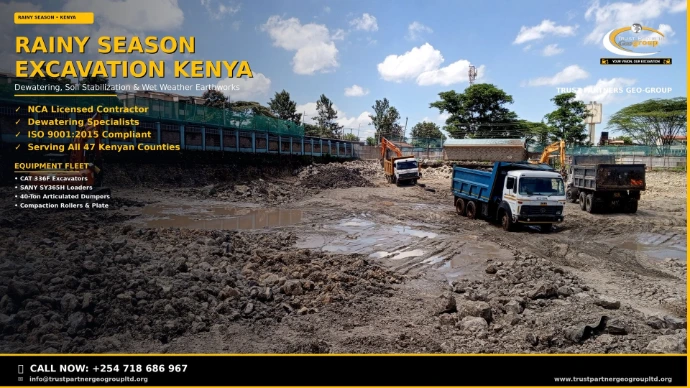
Excavation During Kenya's Rainy Season: How Professional Contractors Keep Sites Moving
Professional rainy season excavation in Kenya. Dewatering, soil stabilisation & wet weather earthworks techniques to keep your project on track.

📋 Table of Contents
- Understanding Kenya's Rain Patterns and Construction Impact
- Pre-Rain Season Site Preparation
- Dewatering Techniques for Active Excavation Sites
- Soil Stabilization During Wet Weather
- Equipment Protection and Access Management
- Safety Protocols for Wet Weather Earthworks
- When to Pause and When to Proceed: Decision Framework
- Frequently Asked Questions
Understanding Kenya's Rain Patterns and Construction Impact
Kenya experiences two distinct rainy seasons that every contractor, developer and project manager must plan around. The long rains arrive in March and continue through May, bringing sustained heavy rainfall that can dump 200-400 mm per month in highland areas and 100-200 mm in Nairobi and the central region. The short rains come in October and November, typically shorter in duration but often more intense, with sudden storms that overwhelm drainage systems and cause flash flooding.
For earthworks contractors, these seasons present both challenge and opportunity. The challenge is obvious: waterlogged soil, impassable haul roads, trench collapse risks, and dewatering costs that can consume 12-18% of total project budgets. The opportunity is less visible but equally real — contractors who master rainy season excavation Kenya techniques can maintain productivity when competitors shut down, winning client loyalty and premium rates for reliability.
The impact of rain on construction varies dramatically by region. Nairobi's red loam soils drain relatively well, allowing work to resume within 24-48 hours of moderate rainfall. In contrast, Machakos, Makueni and Kitui counties with their black cotton soils face days of waterlogging after every storm, as the expansive clay swells and becomes virtually unworkable. Coastal regions like Mombasa and Kilifi deal with saline groundwater and coral rock that complicates dewatering. Understanding your specific site's rainfall response is the first step to effective wet-season management.
⚠️ Rainfall Reality Check
A single day of heavy rain can add 3-5 days of delay to an earthworks project if proper drainage and dewatering are not in place. For a basement excavation in Nairobi's high water-table zone, a week of long rains without active dewatering can flood a 5-metre deep pit to within 1 metre of ground level — requiring 5-7 days of pumping before work can resume.
Pre-Rain Season Site Preparation
The most successful wet-season earthworks projects are those that prepare before the first drop falls. Professional contractors like Trust Partners Geo-Group implement comprehensive pre-rain programmes that transform vulnerable sites into resilient operations capable of withstanding sustained rainfall.
Drainage System Installation Before Rains
Surface water management is the foundation of rainy season excavation. Before the rains arrive, contractors should install:
- Perimeter diversion channels: V-ditches or trapezoidal channels (minimum 0.3 m deep × 0.5 m wide) excavated around the site perimeter to intercept runoff from adjacent land and direct it to natural drainage lines or temporary sediment ponds.
- Internal site drains: Graded trenches within the site that collect surface water and channel it to sumps or discharge points. These should be cleaned weekly during the rainy season to prevent blockage by mud and debris.
- Culvert crossings: Where haul roads intersect drainage lines, corrugated metal or concrete culverts prevent road washout while maintaining water flow. Inadequate culverts are a leading cause of rainy season access failures.
- Sediment control ponds: Before discharging site water to storm drains or natural watercourses, it must pass through settlement ponds or silt traps to comply with NEMA environmental requirements. Failure to control sediment can result in fines of KSh 50,000-200,000.
Silt Fence and Erosion Control Setup
Erosion control measures prevent soil loss that undermines excavation slopes, fills drainage channels, and creates environmental liability. Standard measures include:
- Silt fences: Geotextile fabric supported by wooden or steel posts, installed along contour lines below disturbed areas. Effective for sheet flow but require inspection after every storm — a single torn fence can release tonnes of sediment.
- Hay bales and check dams: Used in channels and drainage ways to slow water velocity and promote sediment settlement. Must be replaced monthly during heavy rain periods.
- Turf reinforcement matting: For longer-term protection of slopes that cannot be immediately re-vegetated, biodegradable matting stabilises soil while grass establishes.
- Stockpile protection: Topsoil and spoil stockpiles should be covered with tarpaulin or geotextile and surrounded by silt fences. Exposed stockpiles can lose 20-30% of their volume to erosion in a single heavy storm.
✅ Pre-Rain Checklist
Before the long rains begin in March, verify: all perimeter drains are excavated and flowing freely; silt fences are installed and undamaged; sump pump positions are marked and power supply confirmed; geotextile covers are on stockpiles; haul roads are crowned and culverts are clear; emergency contact numbers for pump technicians are posted; and NEMA discharge permits are current.
Dewatering Techniques for Active Excavation Sites
Even with perfect surface drainage, groundwater and infiltrating rainfall will accumulate in excavations. The choice of dewatering systems depends on excavation depth, soil permeability, rainfall intensity, and proximity to water bodies.
Sump Pump Systems
Sump pumping is the simplest and most cost-effective dewatering method for shallow excavations and minor groundwater intrusion. A sump is excavated at the lowest point of the excavation, and one or more submersible pumps discharge water to a suitable outlet.
- Capacity: 2-10 HP submersible pumps handle 5-30 litres per second
- Cost: KSh 2,500-5,000 per day for pump hire, plus fuel
- Best for: Excavations under 3 metres deep, sandy or gravelly soils, minor seepage
- Limitations: Ineffective in clay soils where water moves too slowly; pumps clog with silt; cannot lower water table beyond sump depth
For trench excavations during rainy season, sump pumps are often the only practical dewatering option due to space constraints. Multiple small sumps spaced every 20-30 metres along a trench are more effective than a single large sump at one end.
Wellpoint Dewatering
Wellpoint systems consist of a series of small-diameter wells (typically 50 mm PVC or steel) installed around the excavation perimeter, connected by a header pipe to a vacuum pump. The vacuum draws groundwater down to the wellpoint level, creating a cone of depression that keeps the excavation dry.
- Capacity: Effective for excavations up to 5-6 metres deep in permeable soils
- Cost: KSh 3,500-8,000 per day for system hire and operation
- Installation: Wellpoints are jetted or drilled into place, typically 1-2 metres apart
- Best for: Medium-depth basements, trench works, and sites with moderate groundwater flow
- Limitations: Less effective in clay soils; requires continuous power; vacuum pumps are noisy for urban sites
Wellpoint systems are the workhorse of Nairobi basement excavation during rainy season. In areas like Kilimani and Kileleshwa where the water table sits 2-4 metres below ground, wellpoints can maintain a dry working environment even during sustained rainfall — provided the system is installed before the rains begin and operated continuously.
Deep Well Dewatering for Basements
For deep basements (10 metres or more) and large-scale excavations where wellpoints cannot provide sufficient drawdown, deep well dewatering is required. This involves drilling 150-300 mm diameter wells to depths of 15-30 metres, each equipped with a submersible pump.
- Capacity: Individual wells can pump 10-50 litres per second depending on aquifer yield
- Cost: KSh 8,000-18,000 per day per well, plus drilling costs of KSh 150,000-300,000 per well
- Best for: Deep commercial basements, mega-basements (4+ levels), and sites with artesian pressure
- Advantages: Can lower water table 15+ metres; handles high groundwater flow; individual wells can be maintained without shutting down the entire system
Deep well dewatering requires professional design by a hydrogeologist to determine well spacing, depth, and pump sizing. Improperly designed systems can cause ground settlement, damage adjacent foundations, or dewater neighbouring properties — creating legal liability. Trust Partners Geo-Group provides dewatering pump hire with technical support for system design and operation.
Soil Stabilization During Wet Weather
Water changes soil behaviour fundamentally. Cohesive soils (clays) swell and lose shear strength when wet, while granular soils (sands) can liquefy under vibration or flowing water. Soil stabilization wet season techniques are essential for maintaining safe excavation slopes and preventing foundation failures.
Chemical Stabilization
For black cotton soils and other expansive clays common in Kajiado, Thika, Ruiru and Machakos, chemical stabilization with lime or cement can reduce swelling and improve workability during wet conditions. Quicklime (calcium oxide) reacts with clay minerals to reduce plasticity and increase strength.
- Application rate: 3-6% lime by dry weight of soil
- Method: Spread lime on exposed soil surface, mix to 150-300 mm depth using disc harrow or rotavator, compact, and cure for 48-72 hours
- Cost: KSh 450-750 per m² depending on thickness and lime price
- Effectiveness: Reduces swelling by 60-80%; improves California Bearing Ratio (CBR) for subgrade preparation
Geotextile Reinforcement
Geotextiles and geogrids reinforce soil slopes and prevent erosion during rainfall. In excavation applications, they are used to:
- Stabilise temporary cut slopes until permanent works are constructed
- Separate different soil layers (e.g., preventing fine clay from migrating into coarse drainage gravel)
- Protect waterproofing membranes during backfill in wet conditions
Temporary Slope Protection
Exposed soil slopes during rainy season require active protection:
- Spray-on tackifiers: Organic or synthetic binders sprayed on slope surfaces to prevent erosion during establishment of vegetation
- Temporary covers: Plastic sheeting or geotextile pinned to slopes, effective immediately but must be removed before permanent works
- Berms and benches: Cutting slopes into stepped benches reduces runoff velocity and provides access for maintenance
Equipment Protection and Access Management
Heavy equipment represents millions of shillings of capital investment. Protecting it from rain damage and ensuring site access during wet conditions is both an operational and financial priority.
Equipment Protection Measures
- Hardstand areas: Equipment parking and maintenance areas should be surfaced with 150-200 mm of compacted murram or hardcore to prevent machines from sinking into mud
- Covers and shelters: Excavators, bulldozers and graders should be parked under temporary shelters or fitted with weather covers when not in use for extended periods
- Daily maintenance: Wet conditions accelerate corrosion and electrical faults. Daily greasing, air filter cleaning, and electrical system checks are essential
- Fuel storage: Diesel tanks must be protected from water ingress — contaminated fuel is a leading cause of rainy season equipment breakdown
Haul Road Management
Haul roads are the critical link between excavation and disposal. In wet weather, they deteriorate rapidly:
- Surface grading: Roads must be crowned (higher in centre than edges) to shed water, with cross-falls of 2-3%
- Gravel surfacing: A 100-150 mm layer of hard, angular gravel (not rounded river stone) provides traction and prevents rutting
- Culvert maintenance: All culverts must be cleared before rains and inspected weekly during wet season
- Weight restrictions: In extreme conditions, restrict loaded truck weights to prevent road destruction
For sites with particularly poor access, consider constructing a temporary haul road of crushed stone or using tracked dumpers instead of wheeled trucks. The additional cost is recovered through sustained productivity when conventional access would be impassable.
Safety Protocols for Wet Weather Earthworks
Safe excavation in Kenya requires enhanced protocols during wet weather. Water increases the risk of trench collapse, slope failure, electrical hazards, and vehicle accidents. The following measures are mandatory for professional wet-season operations.
Trench Protection in Saturated Soils
OSHA and Kenyan construction safety standards require that trenches deeper than 1.5 metres be protected by shoring, benching, or sloping. In wet conditions, these requirements become more stringent:
- Shoring spacing must be reduced by 20-30% in saturated soils compared to dry conditions
- Benching widths must increase — the horizontal bench should be at least as wide as the trench is deep
- Sloped excavations in wet clay require flatter angles (1.5:1 or 2:1 instead of 1:1) to prevent slippage
- Excavated material must be kept at least 1.5 metres from trench edges (2 metres in wet conditions) to prevent surcharge loading
Slope Monitoring and Early Warning
All cut slopes and embankments should be inspected daily during rainy season. Warning signs of impending failure include:
- New tension cracks at the slope crest
- Seepage or spring lines emerging from the slope face
- Bulging or heaving at the slope toe
- Audible cracking or popping sounds
Movement monitoring pins should be installed on critical slopes, with measurements taken weekly. Any movement exceeding 5 mm per week triggers an immediate engineering review and potential evacuation of the work area below.
Electrical Safety
Water and electricity are a lethal combination. Wet-season safety protocols must include:
- All temporary electrical installations must be protected by residual current devices (RCDs) with 30 mA sensitivity
- Cables must be elevated or buried — never left on wet ground where they can be damaged by equipment or submerged
- Generator sets must be housed in weatherproof enclosures with adequate ventilation
- Submersible pumps must be connected through isolating transformers or use low-voltage (110V) supplies where possible
Lightning Protocols
Kenya's highland regions experience frequent thunderstorms during rainy season. Lightning kills construction workers every year — often because they continue working in exposed excavations during storms. The rule is simple: when thunder is audible, all personnel must evacuate to grounded vehicles or permanent buildings. Work resumes only 30 minutes after the last thunderclap.
When to Pause and When to Proceed: Decision Framework
Not all rain requires work stoppage. Professional contractors use a decision framework that balances productivity against safety risk:
| Condition | Action | Rationale |
|---|---|---|
| Light rain, well-drained soil, shallow excavation | Continue with caution | Minimal risk; monitor slopes and sump levels |
| Moderate rain, clay soil, any depth | Continue with enhanced monitoring | Clay swells slowly; watch for surface water accumulation |
| Heavy rain, any soil, trenches >2 m | Pause trench work; continue surface work | Trench collapse risk becomes critical |
| Storm with lightning | Full evacuation | Lightning risk in excavations is extreme |
| Water table rising, pumps overwhelmed | Pause and reinforce dewatering | Excavation flooding creates drowning and stability hazards |
| Haul roads impassable | Pause spoil removal; continue excavation if possible | Trucks stuck in mud create secondary hazards |
| 24+ hours continuous rain | Full shutdown and inspection | Saturated ground conditions require geotechnical review |
The key principle is that safety decisions must be made by competent persons on site — not by office-based managers looking at weather apps. A site foreman who knows the local soil, has inspected the slopes that morning, and can see the water accumulating in the sump is the right person to call a halt. Trusting that judgment saves lives and prevents catastrophic collapses.
Rain or Shine, Trust Partners Delivers
Don't let the rains stop your project. Trust Partners Geo-Group has the dewatering expertise, equipment and trained crews to keep earthworks on schedule through Kenya's wettest months. Serving Nairobi, Mombasa, Kisumu, Nakuru and all 47 counties.
Call +254 718 68 69 67📧 info@trustpartnergeogroupltd.org
Frequently Asked Questions
Yes, excavation can continue during Kenya's rainy season with proper planning and equipment. Professional contractors use dewatering pumps, temporary drainage channels, soil stabilisation techniques, and protective coverings to keep sites operational. However, work may need to pause during extreme rainfall events, particularly for deep trenches where collapse risk is elevated. The key is pre-rain preparation: installing drainage before storms arrive, stockpiling geotextile covers, and having standby dewatering equipment ready. With these measures, productive excavation can continue at 60-70% of dry-season efficiency during moderate rainfall periods.
Contractors manage water on excavation sites through a multi-layered approach: (1) Surface water diversion — temporary berms, channels, and culverts redirect runoff away from excavation areas. (2) Sump pumping — portable submersible pumps in excavated sums remove accumulated water continuously. (3) Wellpoint dewatering — arrays of shallow wells connected to vacuum pumps lower the water table around the excavation. (4) Deep well dewatering — submersible pumps in drilled wells manage groundwater for deep basements. (5) Geotextile and tarpaulin covers — protect exposed soil surfaces from direct rainfall. (6) Sloped excavation bases — graded to low points where water collects for easy pumping. Effective water management requires 24/7 pump operation in high water-table areas, with fuel and maintenance costs adding KSh 3,500-18,000 per day depending on the system used.
The most common dewatering equipment for wet season excavation in Kenya includes: (1) Submersible sump pumps (2-10 HP) for minor seepage and surface water — cost KSh 2,500-5,000 per day to hire. (2) Wellpoint dewatering systems with vacuum pumps — ideal for shallow excavations up to 6 metres, costing KSh 3,500-8,000 per day. (3) Deep well submersible pumps (15-50 HP) — required for basements deeper than 10 metres, costing KSh 8,000-18,000 per day. (4) Trash pumps for silty water with high solids content. (5) High-pressure jetting pumps for wellpoint installation. Trust Partners Geo-Group maintains a fleet of dewatering pumps available for emergency and planned wet-season hire, with 24/7 standby support for critical basement projects in Nairobi's high water-table zones.
Rain affects excavation timelines in Kenya through multiple mechanisms. Direct productivity loss reduces output by 30-50% during active rainfall as operators work more cautiously and equipment manoeuvrability decreases on muddy surfaces. Waterlogged soil increases excavation difficulty — black cotton soil swells and becomes sticky, while sandy soils lose bearing capacity. Trench collapse risk increases dramatically in saturated soils, requiring additional shoring or benching that slows progress. Haul roads become impassable, halting spoil removal until surfaces dry or are graveled. Compaction testing fails more frequently in wet conditions, requiring rework. Dewatering systems may be overwhelmed during intense storms, forcing temporary shutdowns. Overall, projects spanning rainy seasons should budget a 25-40% time contingency compared to dry-season schedules.
Wet weather earthworks safety in Kenya requires enhanced protocols beyond standard dry-season measures: (1) Trench protection — saturated soils require closer-spaced shoring, wider benching, or reduced trench depths. OSHA standards mandate that trenches deeper than 1.5 metres in unstable soil must be shored or benched. (2) Slope monitoring — embankments and cut slopes must be inspected daily for signs of slippage, with movement pins and crack monitoring. (3) Equipment access control — tracked machines only on muddy surfaces; wheeled equipment restricted to gravelled haul roads. (4) Worker PPE — non-slip boots, high-visibility rain gear, and insulated gloves for electrical safety in wet conditions. (5) Lightning protocols — work must cease when thunderstorms approach, with workers retreating to grounded vehicles or buildings. (6) Emergency evacuation routes — maintained free of mud and water at all times. (7) Daily safety briefings — addressing weather-specific hazards before each shift.
Excavation During Kenya's Rainy Season: How Professional Contractors Keep Sites Moving
Professional rainy season excavation in Kenya. Dewatering, soil stabilisation & wet weather earthworks techniques to keep your project on track.
📋 Table of Contents
- Understanding Kenya's Rain Patterns and Construction Impact
- Pre-Rain Season Site Preparation
- Dewatering Techniques for Active Excavation Sites
- Soil Stabilization During Wet Weather
- Equipment Protection and Access Management
- Safety Protocols for Wet Weather Earthworks
- When to Pause and When to Proceed: Decision Framework
- Frequently Asked Questions
Understanding Kenya's Rain Patterns and Construction Impact
Kenya experiences two distinct rainy seasons that every contractor, developer and project manager must plan around. The long rains arrive in March and continue through May, bringing sustained heavy rainfall that can dump 200-400 mm per month in highland areas and 100-200 mm in Nairobi and the central region. The short rains come in October and November, typically shorter in duration but often more intense, with sudden storms that overwhelm drainage systems and cause flash flooding.
For earthworks contractors, these seasons present both challenge and opportunity. The challenge is obvious: waterlogged soil, impassable haul roads, trench collapse risks, and dewatering costs that can consume 12-18% of total project budgets. The opportunity is less visible but equally real — contractors who master rainy season excavation Kenya techniques can maintain productivity when competitors shut down, winning client loyalty and premium rates for reliability.
The impact of rain on construction varies dramatically by region. Nairobi's red loam soils drain relatively well, allowing work to resume within 24-48 hours of moderate rainfall. In contrast, Machakos, Makueni and Kitui counties with their black cotton soils face days of waterlogging after every storm, as the expansive clay swells and becomes virtually unworkable. Coastal regions like Mombasa and Kilifi deal with saline groundwater and coral rock that complicates dewatering. Understanding your specific site's rainfall response is the first step to effective wet-season management.
⚠️ Rainfall Reality Check
A single day of heavy rain can add 3-5 days of delay to an earthworks project if proper drainage and dewatering are not in place. For a basement excavation in Nairobi's high water-table zone, a week of long rains without active dewatering can flood a 5-metre deep pit to within 1 metre of ground level — requiring 5-7 days of pumping before work can resume.
Pre-Rain Season Site Preparation
The most successful wet-season earthworks projects are those that prepare before the first drop falls. Professional contractors like Trust Partners Geo-Group implement comprehensive pre-rain programmes that transform vulnerable sites into resilient operations capable of withstanding sustained rainfall.
Drainage System Installation Before Rains
Surface water management is the foundation of rainy season excavation. Before the rains arrive, contractors should install:
- Perimeter diversion channels: V-ditches or trapezoidal channels (minimum 0.3 m deep × 0.5 m wide) excavated around the site perimeter to intercept runoff from adjacent land and direct it to natural drainage lines or temporary sediment ponds.
- Internal site drains: Graded trenches within the site that collect surface water and channel it to sumps or discharge points. These should be cleaned weekly during the rainy season to prevent blockage by mud and debris.
- Culvert crossings: Where haul roads intersect drainage lines, corrugated metal or concrete culverts prevent road washout while maintaining water flow. Inadequate culverts are a leading cause of rainy season access failures.
- Sediment control ponds: Before discharging site water to storm drains or natural watercourses, it must pass through settlement ponds or silt traps to comply with NEMA environmental requirements. Failure to control sediment can result in fines of KSh 50,000-200,000.
Silt Fence and Erosion Control Setup
Erosion control measures prevent soil loss that undermines excavation slopes, fills drainage channels, and creates environmental liability. Standard measures include:
- Silt fences: Geotextile fabric supported by wooden or steel posts, installed along contour lines below disturbed areas. Effective for sheet flow but require inspection after every storm — a single torn fence can release tonnes of sediment.
- Hay bales and check dams: Used in channels and drainage ways to slow water velocity and promote sediment settlement. Must be replaced monthly during heavy rain periods.
- Turf reinforcement matting: For longer-term protection of slopes that cannot be immediately re-vegetated, biodegradable matting stabilises soil while grass establishes.
- Stockpile protection: Topsoil and spoil stockpiles should be covered with tarpaulin or geotextile and surrounded by silt fences. Exposed stockpiles can lose 20-30% of their volume to erosion in a single heavy storm.
✅ Pre-Rain Checklist
Before the long rains begin in March, verify: all perimeter drains are excavated and flowing freely; silt fences are installed and undamaged; sump pump positions are marked and power supply confirmed; geotextile covers are on stockpiles; haul roads are crowned and culverts are clear; emergency contact numbers for pump technicians are posted; and NEMA discharge permits are current.
Dewatering Techniques for Active Excavation Sites
Even with perfect surface drainage, groundwater and infiltrating rainfall will accumulate in excavations. The choice of dewatering systems depends on excavation depth, soil permeability, rainfall intensity, and proximity to water bodies.
Sump Pump Systems
Sump pumping is the simplest and most cost-effective dewatering method for shallow excavations and minor groundwater intrusion. A sump is excavated at the lowest point of the excavation, and one or more submersible pumps discharge water to a suitable outlet.
- Capacity: 2-10 HP submersible pumps handle 5-30 litres per second
- Cost: KSh 2,500-5,000 per day for pump hire, plus fuel
- Best for: Excavations under 3 metres deep, sandy or gravelly soils, minor seepage
- Limitations: Ineffective in clay soils where water moves too slowly; pumps clog with silt; cannot lower water table beyond sump depth
For trench excavations during rainy season, sump pumps are often the only practical dewatering option due to space constraints. Multiple small sumps spaced every 20-30 metres along a trench are more effective than a single large sump at one end.
Wellpoint Dewatering
Wellpoint systems consist of a series of small-diameter wells (typically 50 mm PVC or steel) installed around the excavation perimeter, connected by a header pipe to a vacuum pump. The vacuum draws groundwater down to the wellpoint level, creating a cone of depression that keeps the excavation dry.
- Capacity: Effective for excavations up to 5-6 metres deep in permeable soils
- Cost: KSh 3,500-8,000 per day for system hire and operation
- Installation: Wellpoints are jetted or drilled into place, typically 1-2 metres apart
- Best for: Medium-depth basements, trench works, and sites with moderate groundwater flow
- Limitations: Less effective in clay soils; requires continuous power; vacuum pumps are noisy for urban sites
Wellpoint systems are the workhorse of Nairobi basement excavation during rainy season. In areas like Kilimani and Kileleshwa where the water table sits 2-4 metres below ground, wellpoints can maintain a dry working environment even during sustained rainfall — provided the system is installed before the rains begin and operated continuously.
Deep Well Dewatering for Basements
For deep basements (10 metres or more) and large-scale excavations where wellpoints cannot provide sufficient drawdown, deep well dewatering is required. This involves drilling 150-300 mm diameter wells to depths of 15-30 metres, each equipped with a submersible pump.
- Capacity: Individual wells can pump 10-50 litres per second depending on aquifer yield
- Cost: KSh 8,000-18,000 per day per well, plus drilling costs of KSh 150,000-300,000 per well
- Best for: Deep commercial basements, mega-basements (4+ levels), and sites with artesian pressure
- Advantages: Can lower water table 15+ metres; handles high groundwater flow; individual wells can be maintained without shutting down the entire system
Deep well dewatering requires professional design by a hydrogeologist to determine well spacing, depth, and pump sizing. Improperly designed systems can cause ground settlement, damage adjacent foundations, or dewater neighbouring properties — creating legal liability. Trust Partners Geo-Group provides dewatering pump hire with technical support for system design and operation.
Soil Stabilization During Wet Weather
Water changes soil behaviour fundamentally. Cohesive soils (clays) swell and lose shear strength when wet, while granular soils (sands) can liquefy under vibration or flowing water. Soil stabilization wet season techniques are essential for maintaining safe excavation slopes and preventing foundation failures.
Chemical Stabilization
For black cotton soils and other expansive clays common in Kajiado, Thika, Ruiru and Machakos, chemical stabilization with lime or cement can reduce swelling and improve workability during wet conditions. Quicklime (calcium oxide) reacts with clay minerals to reduce plasticity and increase strength.
- Application rate: 3-6% lime by dry weight of soil
- Method: Spread lime on exposed soil surface, mix to 150-300 mm depth using disc harrow or rotavator, compact, and cure for 48-72 hours
- Cost: KSh 450-750 per m² depending on thickness and lime price
- Effectiveness: Reduces swelling by 60-80%; improves California Bearing Ratio (CBR) for subgrade preparation
Geotextile Reinforcement
Geotextiles and geogrids reinforce soil slopes and prevent erosion during rainfall. In excavation applications, they are used to:
- Stabilise temporary cut slopes until permanent works are constructed
- Separate different soil layers (e.g., preventing fine clay from migrating into coarse drainage gravel)
- Protect waterproofing membranes during backfill in wet conditions
Temporary Slope Protection
Exposed soil slopes during rainy season require active protection:
- Spray-on tackifiers: Organic or synthetic binders sprayed on slope surfaces to prevent erosion during establishment of vegetation
- Temporary covers: Plastic sheeting or geotextile pinned to slopes, effective immediately but must be removed before permanent works
- Berms and benches: Cutting slopes into stepped benches reduces runoff velocity and provides access for maintenance
Equipment Protection and Access Management
Heavy equipment represents millions of shillings of capital investment. Protecting it from rain damage and ensuring site access during wet conditions is both an operational and financial priority.
Equipment Protection Measures
- Hardstand areas: Equipment parking and maintenance areas should be surfaced with 150-200 mm of compacted murram or hardcore to prevent machines from sinking into mud
- Covers and shelters: Excavators, bulldozers and graders should be parked under temporary shelters or fitted with weather covers when not in use for extended periods
- Daily maintenance: Wet conditions accelerate corrosion and electrical faults. Daily greasing, air filter cleaning, and electrical system checks are essential
- Fuel storage: Diesel tanks must be protected from water ingress — contaminated fuel is a leading cause of rainy season equipment breakdown
Haul Road Management
Haul roads are the critical link between excavation and disposal. In wet weather, they deteriorate rapidly:
- Surface grading: Roads must be crowned (higher in centre than edges) to shed water, with cross-falls of 2-3%
- Gravel surfacing: A 100-150 mm layer of hard, angular gravel (not rounded river stone) provides traction and prevents rutting
- Culvert maintenance: All culverts must be cleared before rains and inspected weekly during wet season
- Weight restrictions: In extreme conditions, restrict loaded truck weights to prevent road destruction
For sites with particularly poor access, consider constructing a temporary haul road of crushed stone or using tracked dumpers instead of wheeled trucks. The additional cost is recovered through sustained productivity when conventional access would be impassable.
Safety Protocols for Wet Weather Earthworks
Safe excavation in Kenya requires enhanced protocols during wet weather. Water increases the risk of trench collapse, slope failure, electrical hazards, and vehicle accidents. The following measures are mandatory for professional wet-season operations.
Trench Protection in Saturated Soils
OSHA and Kenyan construction safety standards require that trenches deeper than 1.5 metres be protected by shoring, benching, or sloping. In wet conditions, these requirements become more stringent:
- Shoring spacing must be reduced by 20-30% in saturated soils compared to dry conditions
- Benching widths must increase — the horizontal bench should be at least as wide as the trench is deep
- Sloped excavations in wet clay require flatter angles (1.5:1 or 2:1 instead of 1:1) to prevent slippage
- Excavated material must be kept at least 1.5 metres from trench edges (2 metres in wet conditions) to prevent surcharge loading
Slope Monitoring and Early Warning
All cut slopes and embankments should be inspected daily during rainy season. Warning signs of impending failure include:
- New tension cracks at the slope crest
- Seepage or spring lines emerging from the slope face
- Bulging or heaving at the slope toe
- Audible cracking or popping sounds
Movement monitoring pins should be installed on critical slopes, with measurements taken weekly. Any movement exceeding 5 mm per week triggers an immediate engineering review and potential evacuation of the work area below.
Electrical Safety
Water and electricity are a lethal combination. Wet-season safety protocols must include:
- All temporary electrical installations must be protected by residual current devices (RCDs) with 30 mA sensitivity
- Cables must be elevated or buried — never left on wet ground where they can be damaged by equipment or submerged
- Generator sets must be housed in weatherproof enclosures with adequate ventilation
- Submersible pumps must be connected through isolating transformers or use low-voltage (110V) supplies where possible
Lightning Protocols
Kenya's highland regions experience frequent thunderstorms during rainy season. Lightning kills construction workers every year — often because they continue working in exposed excavations during storms. The rule is simple: when thunder is audible, all personnel must evacuate to grounded vehicles or permanent buildings. Work resumes only 30 minutes after the last thunderclap.
When to Pause and When to Proceed: Decision Framework
Not all rain requires work stoppage. Professional contractors use a decision framework that balances productivity against safety risk:
| Condition | Action | Rationale |
|---|---|---|
| Light rain, well-drained soil, shallow excavation | Continue with caution | Minimal risk; monitor slopes and sump levels |
| Moderate rain, clay soil, any depth | Continue with enhanced monitoring | Clay swells slowly; watch for surface water accumulation |
| Heavy rain, any soil, trenches >2 m | Pause trench work; continue surface work | Trench collapse risk becomes critical |
| Storm with lightning | Full evacuation | Lightning risk in excavations is extreme |
| Water table rising, pumps overwhelmed | Pause and reinforce dewatering | Excavation flooding creates drowning and stability hazards |
| Haul roads impassable | Pause spoil removal; continue excavation if possible | Trucks stuck in mud create secondary hazards |
| 24+ hours continuous rain | Full shutdown and inspection | Saturated ground conditions require geotechnical review |
The key principle is that safety decisions must be made by competent persons on site — not by office-based managers looking at weather apps. A site foreman who knows the local soil, has inspected the slopes that morning, and can see the water accumulating in the sump is the right person to call a halt. Trusting that judgment saves lives and prevents catastrophic collapses.
Rain or Shine, Trust Partners Delivers
Don't let the rains stop your project. Trust Partners Geo-Group has the dewatering expertise, equipment and trained crews to keep earthworks on schedule through Kenya's wettest months. Serving Nairobi, Mombasa, Kisumu, Nakuru and all 47 counties.
Call +254 718 68 69 67📧 info@trustpartnergeogroupltd.org
Frequently Asked Questions
Yes, excavation can continue during Kenya's rainy season with proper planning and equipment. Professional contractors use dewatering pumps, temporary drainage channels, soil stabilisation techniques, and protective coverings to keep sites operational. However, work may need to pause during extreme rainfall events, particularly for deep trenches where collapse risk is elevated. The key is pre-rain preparation: installing drainage before storms arrive, stockpiling geotextile covers, and having standby dewatering equipment ready. With these measures, productive excavation can continue at 60-70% of dry-season efficiency during moderate rainfall periods.
Contractors manage water on excavation sites through a multi-layered approach: (1) Surface water diversion — temporary berms, channels, and culverts redirect runoff away from excavation areas. (2) Sump pumping — portable submersible pumps in excavated sums remove accumulated water continuously. (3) Wellpoint dewatering — arrays of shallow wells connected to vacuum pumps lower the water table around the excavation. (4) Deep well dewatering — submersible pumps in drilled wells manage groundwater for deep basements. (5) Geotextile and tarpaulin covers — protect exposed soil surfaces from direct rainfall. (6) Sloped excavation bases — graded to low points where water collects for easy pumping. Effective water management requires 24/7 pump operation in high water-table areas, with fuel and maintenance costs adding KSh 3,500-18,000 per day depending on the system used.
The most common dewatering equipment for wet season excavation in Kenya includes: (1) Submersible sump pumps (2-10 HP) for minor seepage and surface water — cost KSh 2,500-5,000 per day to hire. (2) Wellpoint dewatering systems with vacuum pumps — ideal for shallow excavations up to 6 metres, costing KSh 3,500-8,000 per day. (3) Deep well submersible pumps (15-50 HP) — required for basements deeper than 10 metres, costing KSh 8,000-18,000 per day. (4) Trash pumps for silty water with high solids content. (5) High-pressure jetting pumps for wellpoint installation. Trust Partners Geo-Group maintains a fleet of dewatering pumps available for emergency and planned wet-season hire, with 24/7 standby support for critical basement projects in Nairobi's high water-table zones.
Rain affects excavation timelines in Kenya through multiple mechanisms. Direct productivity loss reduces output by 30-50% during active rainfall as operators work more cautiously and equipment manoeuvrability decreases on muddy surfaces. Waterlogged soil increases excavation difficulty — black cotton soil swells and becomes sticky, while sandy soils lose bearing capacity. Trench collapse risk increases dramatically in saturated soils, requiring additional shoring or benching that slows progress. Haul roads become impassable, halting spoil removal until surfaces dry or are graveled. Compaction testing fails more frequently in wet conditions, requiring rework. Dewatering systems may be overwhelmed during intense storms, forcing temporary shutdowns. Overall, projects spanning rainy seasons should budget a 25-40% time contingency compared to dry-season schedules.
Wet weather earthworks safety in Kenya requires enhanced protocols beyond standard dry-season measures: (1) Trench protection — saturated soils require closer-spaced shoring, wider benching, or reduced trench depths. OSHA standards mandate that trenches deeper than 1.5 metres in unstable soil must be shored or benched. (2) Slope monitoring — embankments and cut slopes must be inspected daily for signs of slippage, with movement pins and crack monitoring. (3) Equipment access control — tracked machines only on muddy surfaces; wheeled equipment restricted to gravelled haul roads. (4) Worker PPE — non-slip boots, high-visibility rain gear, and insulated gloves for electrical safety in wet conditions. (5) Lightning protocols — work must cease when thunderstorms approach, with workers retreating to grounded vehicles or buildings. (6) Emergency evacuation routes — maintained free of mud and water at all times. (7) Daily safety briefings — addressing weather-specific hazards before each shift.