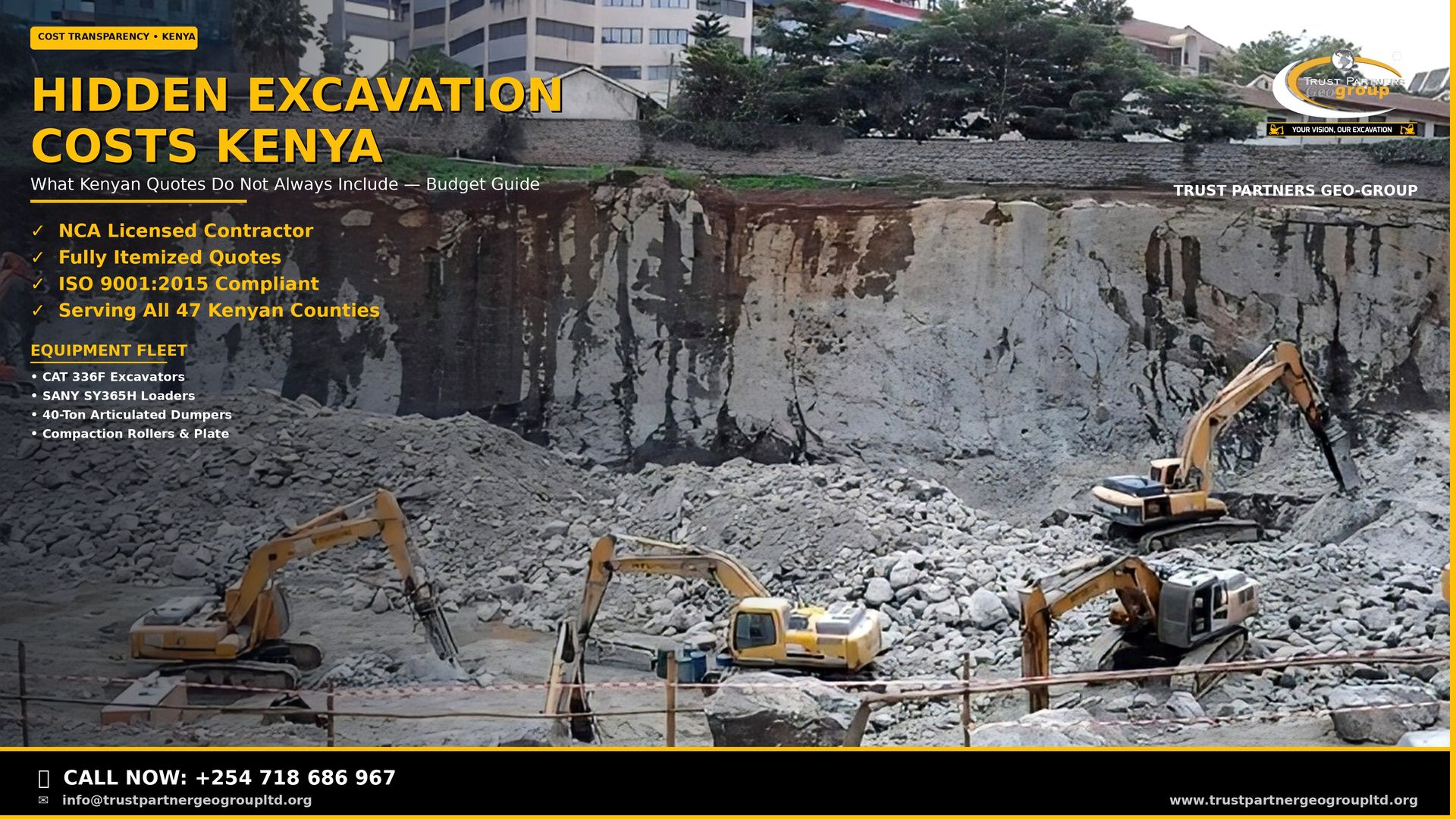
Hidden Costs in Excavation Projects: What Kenyan Quotes Don't Always Include
Avoid budget surprises on your earthworks project. We expose the hidden costs Kenyan excavation quotes often omit — and show you how to demand full transparency.

📋 Table of Contents
- Why Excavation Budgets Blow Out in Kenya
- Hidden Cost #1: Spoil Disposal and Cart Away
- Hidden Cost #2: Dewatering and Groundwater Management
- Hidden Cost #3: Rock Breaking and Unforeseen Ground Conditions
- Hidden Cost #4: Compaction Testing and QA/QC
- Hidden Cost #5: Permit and Compliance Fees
- Hidden Cost #6: Utility Relocation and Protection
- Hidden Cost #7: Traffic Management and Site Access
- Hidden Cost #8: Variation Orders and Scope Creep
- How to Spot Hidden Costs in Excavation Quotes
- Trust Partners' Transparent Pricing Promise
- Frequently Asked Questions
Why Excavation Budgets Blow Out in Kenya
Excavation is one of the riskiest line items in any Kenyan construction budget. Unlike concrete or steel, where quantities are precisely calculable from drawings, earthworks are full of unknowns lurking beneath the surface. A quote that looks competitive at first glance can balloon by 25-40% once work begins — turning a profitable project into a financial headache for developers and contractors alike.
The root cause is often a mismatch between what the client assumes is included and what the contractor actually quoted. In Kenya's highly competitive construction market, some contractors deliberately exclude high-risk cost items to win tenders, planning to recover margins through variation orders once work is underway. Others simply underestimate site conditions, particularly in Nairobi's diverse geological zones where red loam, black cotton soil, volcanic rock and high water tables can coexist within a single project.
This guide identifies the eight most common hidden excavation costs Kenya contractors encounter. Whether you are developing a high-rise in Upper Hill, building a warehouse in Athi River, or excavating a dam in Nakuru, understanding these costs upfront protects your budget and your project timeline.
⚠️ The Real Cost of "Cheap" Quotes
A basement excavation quote of KSh 1,800 per m³ that excludes dewatering, cart-away and testing can easily escalate to KSh 2,800-3,200 per m³ once all extras are added. The "cheaper" contractor often ends up costing 30-50% more than a fully itemised quote from a transparent provider.
Hidden Cost #1: Spoil Disposal and Cart Away
Spoil disposal is the single most commonly excluded item in Kenyan excavation quotes. Contractors frequently price only the digging, assuming spoil can be side-cast on site or that the client has arranged disposal separately. In reality, urban projects in Nairobi, Mombasa and Kisumu rarely have space for spoil stockpiling, meaning every cubic metre must be trucked to an approved dump site.
What Cart Away Actually Costs
- Short haul (under 15 km): KSh 350-450 per m³
- Medium haul (15-30 km): KSh 450-600 per m³
- Long haul (30+ km): KSh 600-850 per m³
- Dump site fees: KSh 500-1,500 per truck load depending on site and material type
For a typical 3,500 m³ basement excavation in Nairobi, cart-away adds KSh 1,225,000 to KSh 2,100,000 to the project cost — often more than the excavation itself. Yet many quotes simply state "spoil to be disposed by client" or assume a haul distance that proves unrealistic once the nearest dump site fills up or raises fees.
💡 How to Protect Your Budget
Always insist that the contractor confirms: (1) whether cart-away is included, (2) the assumed haul distance, (3) the nominated dump site, and (4) who bears cost increases if the dump site closes or raises fees. For large projects, negotiate a fixed cart-away rate per m³ with a fuel price adjustment clause.
Hidden Cost #2: Dewatering and Groundwater Management
Groundwater is the silent budget killer of Kenyan basement projects. Nairobi sits on a complex aquifer system where the water table can vary dramatically within metres. Areas like Kilimani, Kileleshwa, Lavington and parts of Westlands have particularly high water tables, while Karen and Runda generally fare better.
Dewatering Cost Breakdown
- Sump pumping (portable pumps): KSh 2,500-5,000 per day — only effective for minor seepage
- Wellpoint dewatering: KSh 3,500-8,000 per day — suitable for excavations up to 6 metres
- Deep well dewatering: KSh 8,000-18,000 per day — required for basements deeper than 10 metres
- Wellpoint installation (one-time): KSh 15,000-25,000 per wellpoint
- Discharge permits (NEMA/WRMA): KSh 25,000-75,000 depending on volume and discharge point
A six-week dewatering programme for a commercial basement can cost KSh 294,000 to KSh 756,000 — yet many contractors exclude this entirely from their quotes, assuming the client will manage water or that the dry season will eliminate the need. When the long rains arrive in March or October, dewatering costs can double as pumps work overtime and sediment control measures become mandatory.
Hidden Cost #3: Rock Breaking and Unforeseen Ground Conditions
Kenya's geology is notoriously unpredictable. A site that shows soft topsoil in test pits can reveal hard volcanic rock or lateritic pan just metres below. Rock breaking with hydraulic breakers is 3-4 times slower than soil excavation, and blasting — while faster — requires NEMA permits, specialist crews and safety exclusion zones that can halt work on adjacent sites.
Rock Encounter Costs
- Soft rock (breaker work): KSh 1,200-1,800 per m³ — 3-4× slower than soil
- Hard rock (controlled blasting): KSh 800-1,200 per m³ — plus permit costs of KSh 50,000-150,000
- Blasting supervision ( Mines & Geology Department): KSh 15,000-30,000 per blast
- Seismic monitoring (urban sites): KSh 20,000-40,000 per blast
- Adjacent property protection: KSh 50,000-200,000 depending on proximity
The Hyundai HX300SL excavators in Trust Partners' fleet are equipped with heavy-duty breaker attachments specifically for urban rock breaking where blasting is prohibited. However, even with the right equipment, rock adds weeks to programmes and hundreds of thousands to budgets.
Hidden Cost #4: Compaction Testing and QA/QC
Every layer of backfill and every sub-grade surface must meet Kenya's compaction standards before the next construction phase begins. Testing is not optional — NCA and county building inspectors require proof of compliance. Yet many excavation quotes omit testing costs entirely or assume the client's engineer will arrange it separately.
Testing Cost Schedule
- In-situ density test (sand replacement): KSh 8,000-15,000 per test
- CBR test (California Bearing Ratio): KSh 12,000-20,000 per test
- Plate load test: KSh 25,000-45,000 per test
- Soil classification (laboratory): KSh 5,000-10,000 per sample
- Geotechnical reporting: KSh 75,000-150,000 per project
For a 50,000 m³ road earthworks project, compaction testing at one test per 500 m² per layer can require 80-120 tests across multiple layers — costing KSh 640,000 to KSh 1,800,000. For basement projects, foundation bearing capacity tests and sub-grade CBR tests add KSh 100,000-300,000. These are not trivial amounts, and contractors who exclude them from quotes create a false sense of project affordability.
Hidden Cost #5: Permit and Compliance Fees
Excavation in Kenya triggers a web of permits and approvals that many first-time developers underestimate. While the contractor should know what is required, the cost is often passed through to the client — and sometimes not disclosed until work is delayed waiting for approvals.
Common Permit Costs
- NEMA EIA licence (if triggered): KSh 50,000-150,000 depending on project scale
- County excavation permit: KSh 10,000-50,000 depending on county
- NEMA noise pollution permit (urban/night work): KSh 15,000-30,000
- Blasting permit (Mines & Geology): KSh 50,000-150,000
- WRMA dewatering discharge permit: KSh 25,000-75,000
- Traffic management approval (KeNHA/county): KSh 20,000-50,000
- Utility wayleave (KPLC, Nairobi Water, fibre): KSh 10,000-40,000 per utility
Permit delays are equally costly. A two-week wait for a blasting permit or NEMA approval can idle equipment and crew, burning KSh 50,000-100,000 per day in standing charges. Experienced contractors like Trust Partners Geo-Group build permit timelines into their programmes and advise clients on requirements before work begins — but many do not.
Hidden Cost #6: Utility Relocation and Protection
Urban excavation in Nairobi, Mombasa and Kisumu inevitably encounters buried utilities — water mains, sewer lines, power cables, fibre optic ducts and gas pipes. Unmapped or inaccurately mapped utilities are a major source of variation orders and project delays.
Utility Protection and Diversion Costs
- Utility location survey (GPR): KSh 30,000-75,000 per survey
- Hand digging around utilities: KSh 800-1,200 per m³ — 2-3× slower than machine digging
- Water main diversion (Nairobi Water): KSh 150,000-500,000 depending on diameter
- Power cable diversion (KPLC): KSh 100,000-400,000 depending on voltage
- Fibre optic cable repair (if damaged): KSh 200,000-800,000 depending on provider and downtime
- Emergency utility response (call-out): KSh 25,000-75,000 per incident
The risk is particularly acute in Nairobi's older suburbs like Parklands, Ngara and Industrial Area, where utility records are incomplete or decades out of date. In rapidly developing areas like Ruiru, Juja and Thika, new fibre and water lines are laid continuously, meaning even recent surveys can miss active installations.
Hidden Cost #7: Traffic Management and Site Access
Excavation on or adjacent to public roads requires traffic management measures that are often absent from initial quotes. County governments and KeNHA have become increasingly strict about road safety during construction, with fines for non-compliance reaching KSh 100,000 or more.
Traffic Management Costs
- Traffic management plan (TMP): KSh 25,000-50,000
- Flagmen/traffic marshals (per day): KSh 1,500-2,500 each × 2-4 required
- Signage, cones and barriers: KSh 35,000-75,000 one-time
- Temporary road plates (trench crossings): KSh 15,000-40,000 per plate
- Night work lighting (urban sites): KSh 8,000-15,000 per night
- Police escort (major roads): KSh 5,000-10,000 per day
For a six-week utility trenching project along a busy Nairobi road, traffic management can add KSh 250,000-500,000 — yet it is frequently omitted from quotes because contractors assume the client or county will handle it. Night-shift excavation, sometimes required in high-traffic areas, adds a 20-30% premium to both labour and equipment rates.
Hidden Cost #8: Variation Orders and Scope Creep
Variation orders are formal changes to the original contract scope, price or programme. In excavation, they are almost always triggered by unforeseen ground conditions — but poor contract drafting and inadequate site investigation make them far more common and contentious than necessary.
Under standard Kenyan construction contracts (including FIDIC-based agreements), the contractor must:
- Notify the client/engineer within 14-28 days of encountering the unforeseen condition
- Submit a detailed method statement and cost breakdown for the additional work
- Obtain written approval before proceeding (or risk non-payment)
- Maintain detailed records of additional time, equipment and labour
When these procedures are not followed, disputes arise. The contractor claims KSh 500,000 for rock breaking; the client argues the rock should have been foreseeable. The project stalls, lawyers get involved, and both parties lose. The best prevention is thorough pre-tender site investigation and a contract that clearly defines how variations will be priced and approved.
✅ Smart Contract Clauses
Include a provisional sum of 10-15% for unforeseen conditions. Define "unforeseen" as conditions that could not reasonably be identified by a competent contractor from the provided site data. Specify that borehole logs and trial pit reports form the basis of the geological assumption — and that deviations beyond these assumptions trigger the provisional sum.
How to Spot Hidden Costs in Excavation Quotes
Before signing any excavation contract in Kenya, demand that the contractor provides a fully itemised quote addressing each of the following:
| Checklist Item | What to Look For | Red Flag |
|---|---|---|
| Spoil disposal | Explicit cart-away rate per m³ and dump site | "Spoil by client" or no mention |
| Dewatering | Daily rate, system type, assumed duration | "If required" or excluded entirely |
| Rock breaking | Rate per m³ for soft and hard rock | No rock rate provided |
| Testing | Number of tests, type, rate per test | "Testing by others" |
| Permits | List of required permits and who pays | "Permits excluded" |
| Utilities | GPR survey included, protection measures | No utility mention |
| Traffic | TMP, flagmen, signage costed | "By client" or absent |
| Variations | Clear procedure and pricing mechanism | Vague or missing clause |
| Contingency | Provisional sum percentage | Zero contingency |
If a contractor cannot or will not provide these details, that is a strong signal to walk away. Our 15-point contractor due diligence checklist provides a comprehensive framework for vetting excavation providers before you commit.
Trust Partners' Transparent Pricing Promise
At Trust Partners Geo-Group, we believe transparency builds trust — and trust builds lasting client relationships. Every quote we issue is fully itemised, with no hidden costs and no unpleasant surprises.
Our standard quote includes:
- Clear excavation rate per m³ by soil type
- Itemised cart-away rate with assumed haul distance
- Dewatering cost with system specification and duration estimate
- Rock breaking rate (if geotechnical data suggests risk)
- Compaction testing schedule and per-test rate
- Permit list with cost allocation
- Traffic management plan and cost (if applicable)
- 10% provisional sum for unforeseen conditions
- Fixed-price option available for risk-averse clients
Get a Fully Itemised Quote from Trust Partners
Tired of hidden costs? Trust Partners Geo-Group provides fully itemised, transparent excavation quotes with zero surprises. Serving Nairobi, Mombasa, Kisumu, Nakuru and all 47 Kenyan counties.
Call +254 718 68 69 67📧 info@trustpartnergeogroupltd.org
Frequently Asked Questions
The most common hidden costs in Kenyan excavation projects include: spoil disposal and cart-away (KSh 350-600 per m3), dewatering (KSh 3,500-18,000 per day), rock breaking (KSh 1,200-1,800 per m3), compaction testing (KSh 8,000-20,000 per test), permit and compliance fees, utility relocation, traffic management, and variation orders from unforeseen ground conditions. These can add 25-40% to the base excavation quote if not itemised upfront.
Spoil disposal is frequently excluded from base excavation quotes in Kenya. Contractors often quote only the digging rate, assuming spoil can be side-cast on site. When spoil must be carted away — which is the norm in urban Nairobi projects — additional costs of KSh 350-600 per m3 apply, plus dump site fees of KSh 500-1,500 per truck load. Always confirm whether cart-away is included and verify the assumed haul distance, as rates beyond 15 km attract surcharges.
Dewatering costs in Kenya range from KSh 3,500 to KSh 8,000 per day for wellpoint systems suitable for shallow excavations, and KSh 8,000 to KSh 18,000 per day for deep-well systems required for basements deeper than 10 metres. Sump pumping with portable pumps costs KSh 2,500-5,000 per day but is only effective for minor groundwater intrusion. For high water-table areas like Kilimani, Kileleshwa and parts of Westlands, dewatering can add 12-18% to total project cost.
Variation orders in excavation contracts are formal amendments to the original scope and price, triggered by unforeseen conditions such as unmapped rock, buried foundations, contaminated soil, or utility conflicts. Under Kenyan construction law and standard FIDIC conditions, the contractor must notify the client within 14-28 days of encountering the condition, provide a method statement and cost breakdown, and obtain written approval before proceeding. Without proper documentation, disputes over payment are common.
To avoid budget overruns in Kenyan earthworks: (1) Conduct thorough soil investigation before tendering — boreholes cost KSh 15,000-30,000 each but prevent surprises worth millions. (2) Demand fully itemised quotes showing every line item including cart-away, dewatering, testing and contingencies. (3) Include a 10-15% provisional sum for unforeseen conditions. (4) Verify contractor NCA registration and insurance. (5) Agree on variation order procedures before work begins. (6) Schedule work in dry season to avoid rain delays and waterlogging costs.
Hidden Costs in Excavation Projects: What Kenyan Quotes Don't Always Include
Avoid budget surprises on your earthworks project. We expose the hidden costs Kenyan excavation quotes often omit — and show you how to demand full transparency.
📋 Table of Contents
- Why Excavation Budgets Blow Out in Kenya
- Hidden Cost #1: Spoil Disposal and Cart Away
- Hidden Cost #2: Dewatering and Groundwater Management
- Hidden Cost #3: Rock Breaking and Unforeseen Ground Conditions
- Hidden Cost #4: Compaction Testing and QA/QC
- Hidden Cost #5: Permit and Compliance Fees
- Hidden Cost #6: Utility Relocation and Protection
- Hidden Cost #7: Traffic Management and Site Access
- Hidden Cost #8: Variation Orders and Scope Creep
- How to Spot Hidden Costs in Excavation Quotes
- Trust Partners' Transparent Pricing Promise
- Frequently Asked Questions
Why Excavation Budgets Blow Out in Kenya
Excavation is one of the riskiest line items in any Kenyan construction budget. Unlike concrete or steel, where quantities are precisely calculable from drawings, earthworks are full of unknowns lurking beneath the surface. A quote that looks competitive at first glance can balloon by 25-40% once work begins — turning a profitable project into a financial headache for developers and contractors alike.
The root cause is often a mismatch between what the client assumes is included and what the contractor actually quoted. In Kenya's highly competitive construction market, some contractors deliberately exclude high-risk cost items to win tenders, planning to recover margins through variation orders once work is underway. Others simply underestimate site conditions, particularly in Nairobi's diverse geological zones where red loam, black cotton soil, volcanic rock and high water tables can coexist within a single project.
This guide identifies the eight most common hidden excavation costs Kenya contractors encounter. Whether you are developing a high-rise in Upper Hill, building a warehouse in Athi River, or excavating a dam in Nakuru, understanding these costs upfront protects your budget and your project timeline.
⚠️ The Real Cost of "Cheap" Quotes
A basement excavation quote of KSh 1,800 per m³ that excludes dewatering, cart-away and testing can easily escalate to KSh 2,800-3,200 per m³ once all extras are added. The "cheaper" contractor often ends up costing 30-50% more than a fully itemised quote from a transparent provider.
Hidden Cost #1: Spoil Disposal and Cart Away
Spoil disposal is the single most commonly excluded item in Kenyan excavation quotes. Contractors frequently price only the digging, assuming spoil can be side-cast on site or that the client has arranged disposal separately. In reality, urban projects in Nairobi, Mombasa and Kisumu rarely have space for spoil stockpiling, meaning every cubic metre must be trucked to an approved dump site.
What Cart Away Actually Costs
- Short haul (under 15 km): KSh 350-450 per m³
- Medium haul (15-30 km): KSh 450-600 per m³
- Long haul (30+ km): KSh 600-850 per m³
- Dump site fees: KSh 500-1,500 per truck load depending on site and material type
For a typical 3,500 m³ basement excavation in Nairobi, cart-away adds KSh 1,225,000 to KSh 2,100,000 to the project cost — often more than the excavation itself. Yet many quotes simply state "spoil to be disposed by client" or assume a haul distance that proves unrealistic once the nearest dump site fills up or raises fees.
💡 How to Protect Your Budget
Always insist that the contractor confirms: (1) whether cart-away is included, (2) the assumed haul distance, (3) the nominated dump site, and (4) who bears cost increases if the dump site closes or raises fees. For large projects, negotiate a fixed cart-away rate per m³ with a fuel price adjustment clause.
Hidden Cost #2: Dewatering and Groundwater Management
Groundwater is the silent budget killer of Kenyan basement projects. Nairobi sits on a complex aquifer system where the water table can vary dramatically within metres. Areas like Kilimani, Kileleshwa, Lavington and parts of Westlands have particularly high water tables, while Karen and Runda generally fare better.
Dewatering Cost Breakdown
- Sump pumping (portable pumps): KSh 2,500-5,000 per day — only effective for minor seepage
- Wellpoint dewatering: KSh 3,500-8,000 per day — suitable for excavations up to 6 metres
- Deep well dewatering: KSh 8,000-18,000 per day — required for basements deeper than 10 metres
- Wellpoint installation (one-time): KSh 15,000-25,000 per wellpoint
- Discharge permits (NEMA/WRMA): KSh 25,000-75,000 depending on volume and discharge point
A six-week dewatering programme for a commercial basement can cost KSh 294,000 to KSh 756,000 — yet many contractors exclude this entirely from their quotes, assuming the client will manage water or that the dry season will eliminate the need. When the long rains arrive in March or October, dewatering costs can double as pumps work overtime and sediment control measures become mandatory.
Hidden Cost #3: Rock Breaking and Unforeseen Ground Conditions
Kenya's geology is notoriously unpredictable. A site that shows soft topsoil in test pits can reveal hard volcanic rock or lateritic pan just metres below. Rock breaking with hydraulic breakers is 3-4 times slower than soil excavation, and blasting — while faster — requires NEMA permits, specialist crews and safety exclusion zones that can halt work on adjacent sites.
Rock Encounter Costs
- Soft rock (breaker work): KSh 1,200-1,800 per m³ — 3-4× slower than soil
- Hard rock (controlled blasting): KSh 800-1,200 per m³ — plus permit costs of KSh 50,000-150,000
- Blasting supervision ( Mines & Geology Department): KSh 15,000-30,000 per blast
- Seismic monitoring (urban sites): KSh 20,000-40,000 per blast
- Adjacent property protection: KSh 50,000-200,000 depending on proximity
The Hyundai HX300SL excavators in Trust Partners' fleet are equipped with heavy-duty breaker attachments specifically for urban rock breaking where blasting is prohibited. However, even with the right equipment, rock adds weeks to programmes and hundreds of thousands to budgets.
Hidden Cost #4: Compaction Testing and QA/QC
Every layer of backfill and every sub-grade surface must meet Kenya's compaction standards before the next construction phase begins. Testing is not optional — NCA and county building inspectors require proof of compliance. Yet many excavation quotes omit testing costs entirely or assume the client's engineer will arrange it separately.
Testing Cost Schedule
- In-situ density test (sand replacement): KSh 8,000-15,000 per test
- CBR test (California Bearing Ratio): KSh 12,000-20,000 per test
- Plate load test: KSh 25,000-45,000 per test
- Soil classification (laboratory): KSh 5,000-10,000 per sample
- Geotechnical reporting: KSh 75,000-150,000 per project
For a 50,000 m³ road earthworks project, compaction testing at one test per 500 m² per layer can require 80-120 tests across multiple layers — costing KSh 640,000 to KSh 1,800,000. For basement projects, foundation bearing capacity tests and sub-grade CBR tests add KSh 100,000-300,000. These are not trivial amounts, and contractors who exclude them from quotes create a false sense of project affordability.
Hidden Cost #5: Permit and Compliance Fees
Excavation in Kenya triggers a web of permits and approvals that many first-time developers underestimate. While the contractor should know what is required, the cost is often passed through to the client — and sometimes not disclosed until work is delayed waiting for approvals.
Common Permit Costs
- NEMA EIA licence (if triggered): KSh 50,000-150,000 depending on project scale
- County excavation permit: KSh 10,000-50,000 depending on county
- NEMA noise pollution permit (urban/night work): KSh 15,000-30,000
- Blasting permit (Mines & Geology): KSh 50,000-150,000
- WRMA dewatering discharge permit: KSh 25,000-75,000
- Traffic management approval (KeNHA/county): KSh 20,000-50,000
- Utility wayleave (KPLC, Nairobi Water, fibre): KSh 10,000-40,000 per utility
Permit delays are equally costly. A two-week wait for a blasting permit or NEMA approval can idle equipment and crew, burning KSh 50,000-100,000 per day in standing charges. Experienced contractors like Trust Partners Geo-Group build permit timelines into their programmes and advise clients on requirements before work begins — but many do not.
Hidden Cost #6: Utility Relocation and Protection
Urban excavation in Nairobi, Mombasa and Kisumu inevitably encounters buried utilities — water mains, sewer lines, power cables, fibre optic ducts and gas pipes. Unmapped or inaccurately mapped utilities are a major source of variation orders and project delays.
Utility Protection and Diversion Costs
- Utility location survey (GPR): KSh 30,000-75,000 per survey
- Hand digging around utilities: KSh 800-1,200 per m³ — 2-3× slower than machine digging
- Water main diversion (Nairobi Water): KSh 150,000-500,000 depending on diameter
- Power cable diversion (KPLC): KSh 100,000-400,000 depending on voltage
- Fibre optic cable repair (if damaged): KSh 200,000-800,000 depending on provider and downtime
- Emergency utility response (call-out): KSh 25,000-75,000 per incident
The risk is particularly acute in Nairobi's older suburbs like Parklands, Ngara and Industrial Area, where utility records are incomplete or decades out of date. In rapidly developing areas like Ruiru, Juja and Thika, new fibre and water lines are laid continuously, meaning even recent surveys can miss active installations.
Hidden Cost #7: Traffic Management and Site Access
Excavation on or adjacent to public roads requires traffic management measures that are often absent from initial quotes. County governments and KeNHA have become increasingly strict about road safety during construction, with fines for non-compliance reaching KSh 100,000 or more.
Traffic Management Costs
- Traffic management plan (TMP): KSh 25,000-50,000
- Flagmen/traffic marshals (per day): KSh 1,500-2,500 each × 2-4 required
- Signage, cones and barriers: KSh 35,000-75,000 one-time
- Temporary road plates (trench crossings): KSh 15,000-40,000 per plate
- Night work lighting (urban sites): KSh 8,000-15,000 per night
- Police escort (major roads): KSh 5,000-10,000 per day
For a six-week utility trenching project along a busy Nairobi road, traffic management can add KSh 250,000-500,000 — yet it is frequently omitted from quotes because contractors assume the client or county will handle it. Night-shift excavation, sometimes required in high-traffic areas, adds a 20-30% premium to both labour and equipment rates.
Hidden Cost #8: Variation Orders and Scope Creep
Variation orders are formal changes to the original contract scope, price or programme. In excavation, they are almost always triggered by unforeseen ground conditions — but poor contract drafting and inadequate site investigation make them far more common and contentious than necessary.
Under standard Kenyan construction contracts (including FIDIC-based agreements), the contractor must:
- Notify the client/engineer within 14-28 days of encountering the unforeseen condition
- Submit a detailed method statement and cost breakdown for the additional work
- Obtain written approval before proceeding (or risk non-payment)
- Maintain detailed records of additional time, equipment and labour
When these procedures are not followed, disputes arise. The contractor claims KSh 500,000 for rock breaking; the client argues the rock should have been foreseeable. The project stalls, lawyers get involved, and both parties lose. The best prevention is thorough pre-tender site investigation and a contract that clearly defines how variations will be priced and approved.
✅ Smart Contract Clauses
Include a provisional sum of 10-15% for unforeseen conditions. Define "unforeseen" as conditions that could not reasonably be identified by a competent contractor from the provided site data. Specify that borehole logs and trial pit reports form the basis of the geological assumption — and that deviations beyond these assumptions trigger the provisional sum.
How to Spot Hidden Costs in Excavation Quotes
Before signing any excavation contract in Kenya, demand that the contractor provides a fully itemised quote addressing each of the following:
| Checklist Item | What to Look For | Red Flag |
|---|---|---|
| Spoil disposal | Explicit cart-away rate per m³ and dump site | "Spoil by client" or no mention |
| Dewatering | Daily rate, system type, assumed duration | "If required" or excluded entirely |
| Rock breaking | Rate per m³ for soft and hard rock | No rock rate provided |
| Testing | Number of tests, type, rate per test | "Testing by others" |
| Permits | List of required permits and who pays | "Permits excluded" |
| Utilities | GPR survey included, protection measures | No utility mention |
| Traffic | TMP, flagmen, signage costed | "By client" or absent |
| Variations | Clear procedure and pricing mechanism | Vague or missing clause |
| Contingency | Provisional sum percentage | Zero contingency |
If a contractor cannot or will not provide these details, that is a strong signal to walk away. Our 15-point contractor due diligence checklist provides a comprehensive framework for vetting excavation providers before you commit.
Trust Partners' Transparent Pricing Promise
At Trust Partners Geo-Group, we believe transparency builds trust — and trust builds lasting client relationships. Every quote we issue is fully itemised, with no hidden costs and no unpleasant surprises.
Our standard quote includes:
- Clear excavation rate per m³ by soil type
- Itemised cart-away rate with assumed haul distance
- Dewatering cost with system specification and duration estimate
- Rock breaking rate (if geotechnical data suggests risk)
- Compaction testing schedule and per-test rate
- Permit list with cost allocation
- Traffic management plan and cost (if applicable)
- 10% provisional sum for unforeseen conditions
- Fixed-price option available for risk-averse clients
Get a Fully Itemised Quote from Trust Partners
Tired of hidden costs? Trust Partners Geo-Group provides fully itemised, transparent excavation quotes with zero surprises. Serving Nairobi, Mombasa, Kisumu, Nakuru and all 47 Kenyan counties.
Call +254 718 68 69 67📧 info@trustpartnergeogroupltd.org
Frequently Asked Questions
The most common hidden costs in Kenyan excavation projects include: spoil disposal and cart-away (KSh 350-600 per m3), dewatering (KSh 3,500-18,000 per day), rock breaking (KSh 1,200-1,800 per m3), compaction testing (KSh 8,000-20,000 per test), permit and compliance fees, utility relocation, traffic management, and variation orders from unforeseen ground conditions. These can add 25-40% to the base excavation quote if not itemised upfront.
Spoil disposal is frequently excluded from base excavation quotes in Kenya. Contractors often quote only the digging rate, assuming spoil can be side-cast on site. When spoil must be carted away — which is the norm in urban Nairobi projects — additional costs of KSh 350-600 per m3 apply, plus dump site fees of KSh 500-1,500 per truck load. Always confirm whether cart-away is included and verify the assumed haul distance, as rates beyond 15 km attract surcharges.
Dewatering costs in Kenya range from KSh 3,500 to KSh 8,000 per day for wellpoint systems suitable for shallow excavations, and KSh 8,000 to KSh 18,000 per day for deep-well systems required for basements deeper than 10 metres. Sump pumping with portable pumps costs KSh 2,500-5,000 per day but is only effective for minor groundwater intrusion. For high water-table areas like Kilimani, Kileleshwa and parts of Westlands, dewatering can add 12-18% to total project cost.
Variation orders in excavation contracts are formal amendments to the original scope and price, triggered by unforeseen conditions such as unmapped rock, buried foundations, contaminated soil, or utility conflicts. Under Kenyan construction law and standard FIDIC conditions, the contractor must notify the client within 14-28 days of encountering the condition, provide a method statement and cost breakdown, and obtain written approval before proceeding. Without proper documentation, disputes over payment are common.
To avoid budget overruns in Kenyan earthworks: (1) Conduct thorough soil investigation before tendering — boreholes cost KSh 15,000-30,000 each but prevent surprises worth millions. (2) Demand fully itemised quotes showing every line item including cart-away, dewatering, testing and contingencies. (3) Include a 10-15% provisional sum for unforeseen conditions. (4) Verify contractor NCA registration and insurance. (5) Agree on variation order procedures before work begins. (6) Schedule work in dry season to avoid rain delays and waterlogging costs.