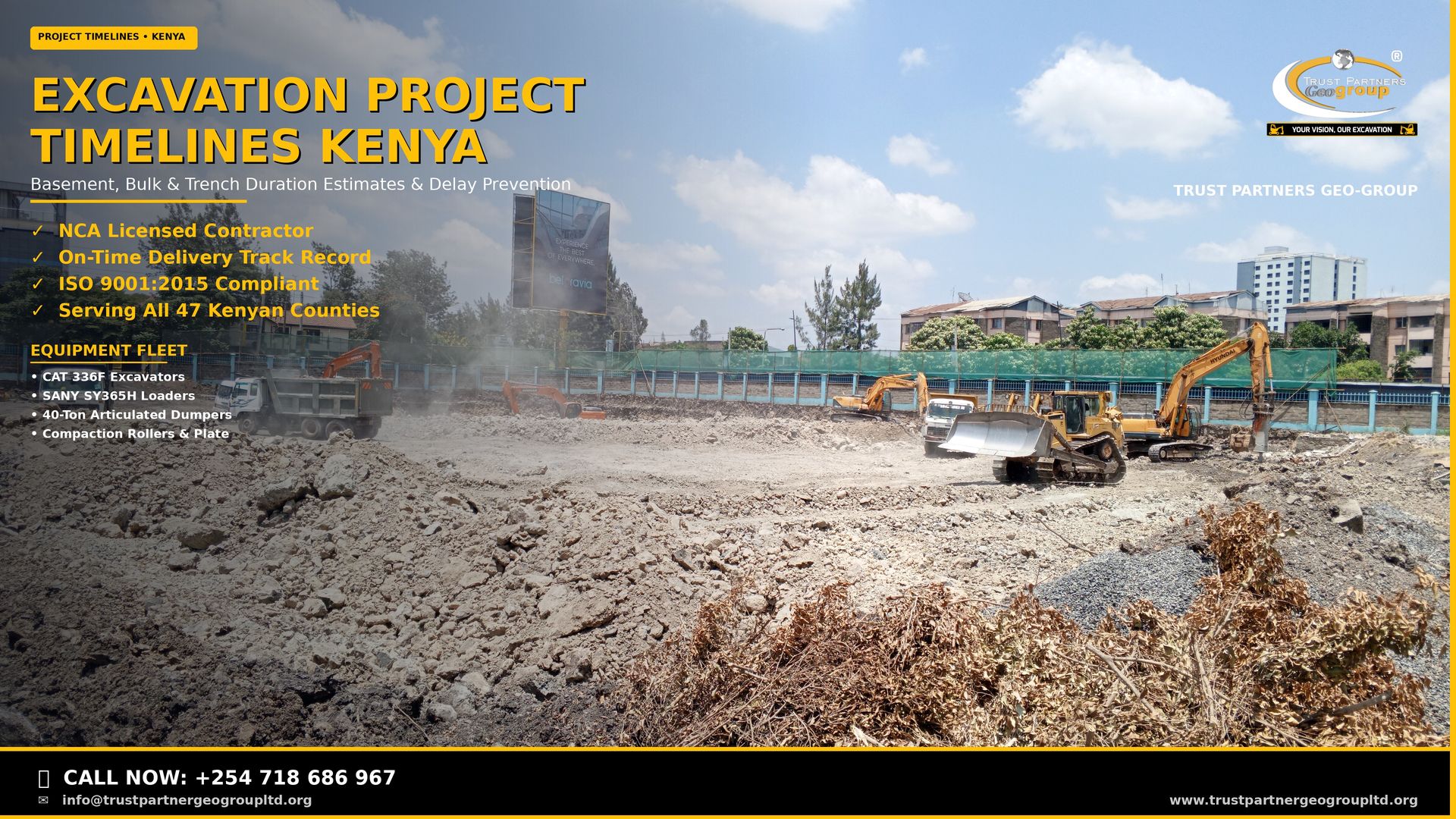
Excavation Project Timelines in Kenya: Basement, Bulk & Trench Duration Guide
Realistic excavation timelines for Kenyan construction projects. How long basement, bulk and trench excavation takes — and how to keep your programme on track.

Table of Contents
"How long will the excavation take?" is the first question every developer asks — and the most difficult to answer accurately. In Kenya, where soil conditions vary from volcanic rock in Nakuru to black cotton clay in Kajiado, and where rainy seasons can halt earthworks for weeks, timeline estimation is as much art as science.
At Trust Partners Geo-Group Ltd, we have delivered over 400 excavation projects across Kenya's 47 counties. This guide distils that data into realistic timelines for basement, bulk, and trench excavation — with the factors that accelerate or delay each.
Factors That Determine Excavation Timelines in Kenya
Before estimating duration, understand the five variables that most affect excavation speed in Kenya:
Soil Type and Ground Conditions
Soil type is the single biggest determinant of excavation speed. In general:
- Red volcanic soil (Nairobi, Kiambu) — Fastest to excavate; good load-bearing capacity; minimal dewatering
- Black cotton soil (Kajiado, Thika, Machakos) — 15–25% slower; sticky when wet; requires careful compaction
- Coastal sand (Mombasa, Malindi) — Moderate speed; trench collapse risk; requires shoring
- Rock (Nakuru, Nyeri, parts of Nairobi) — 3–4× slower; requires hydraulic breakers or controlled blasting
- Expansive clay (Kikuyu, Limuru) — Slow; swells when wet; requires specialised handling
A geotechnical investigation before tendering reduces timeline uncertainty by 30–40%.
Project Scale and Depth
Excavation productivity is not linear. A 10,000 m³ basement does not take twice as long as a 5,000 m³ basement — it takes longer per cubic metre because:
- Deep excavations require benching, shoring, or piling before bulk excavation begins
- Haul routes lengthen as the excavation deepens
- Dewatering intensity increases with depth
- Spoil disposal costs and distances grow
Equipment Availability and Fleet Size
A single 30-ton excavator moves approximately 300–400 m³ of soil per day in favourable conditions. To excavate 20,000 m³ in 4 weeks requires at least two excavators and four dump trucks working double shifts. Contractors who rely on hired equipment face availability risks — the hire company may recall machines for a higher-paying client.
Trust Partners Geo-Group maintains a fully owned fleet, ensuring that equipment is available for the full programme duration.
Weather and Seasonal Constraints
Kenya's two rainy seasons — March–May (long rains) and October–November (short rains) — can reduce earthworks productivity by 30–50%. Key impacts include:
- Waterlogged soil becomes unworkable
- Trench collapse risk increases in saturated ground
- Haul roads become impassable for heavy trucks
- Compaction testing fails due to excessive moisture
💡 Pro Tip
Schedule critical earthworks during dry months (January–March, June–September). If your project spans rainy seasons, add 25–40% contingency time. See our rainy season excavation guide for mitigation strategies.
Permit and Approval Delays
Regulatory approvals are a hidden timeline killer. Typical durations:
- NEMA EIA licence: 6–12 weeks
- County excavation permit: 2–4 weeks
- Utility wayleave (KPLC, Nairobi Water, fibre): 4–8 weeks
- NCA project registration: 1–2 weeks
- Traffic management approval (urban sites): 2–3 weeks
Start permit applications before mobilisation. A contractor who begins work without permits risks stop-work orders that add weeks to the programme.
Basement Excavation Timeline Breakdown
Residential Basement (1–2 Levels)
Typical depth: 3–6 metres. Volume: 2,000–8,000 m³.
| Phase | Duration | Notes |
|---|---|---|
| Site establishment & clearance | 3–5 days | Fencing, signage, site office |
| Topsoil stripping | 1–2 days | Store for landscaping reuse |
| Bulk excavation (soil) | 2–4 weeks | 2× 30-ton excavators, 4× dump trucks |
| Dewatering (if required) | Ongoing | Wellpoints or sump pumps |
| Rock breaking (if encountered) | +1–3 weeks | Hydraulic breaker attachment |
| Formation trimming & levelling | 2–3 days | ±25mm tolerance |
| Compaction testing | 1–2 days | Every 500 m², 95% MDD |
| Total (typical) | 3–6 weeks | Stable soil, dry season |
| Total (challenging) | 6–10 weeks | Black cotton soil, high water table |
Commercial Basement (2–3 Levels)
Typical depth: 6–10 metres. Volume: 10,000–30,000 m³.
| Phase | Duration | Notes |
|---|---|---|
| Site establishment & shoring | 1–2 weeks | Sheet piles or soldier piles |
| Topsoil stripping | 2–3 days | |
| Stage 1 excavation (to 3m) | 2–3 weeks | Install first level of struts |
| Stage 2 excavation (to 6m) | 2–3 weeks | Install second level of struts |
| Stage 3 excavation (to 10m) | 2–3 weeks | Final trim, dewatering intensive |
| Rock breaking (if encountered) | +2–4 weeks | Breaker or controlled blasting |
| Formation trimming & testing | 3–5 days | |
| Total (typical) | 8–12 weeks | Stable soil, effective dewatering |
| Total (challenging) | 12–20 weeks | Deep water table, rock, urban constraints |
Mega Basement (4+ Levels / 15m+ Depth)
Typical depth: 15–30 metres. Volume: 50,000–150,000 m³. Projects like mega basements over 30 metres deep require specialised engineering.
| Phase | Duration | Notes |
|---|---|---|
| Geotechnical investigation & design | 4–6 weeks | Pre-contract, but affects start date |
| Piling / diaphragm wall installation | 6–8 weeks | Before bulk excavation begins |
| Site establishment | 1–2 weeks | |
| Topsoil stripping | 3–5 days | |
| Phased excavation (4–6 stages) | 12–20 weeks | Strut installation between stages |
| Dewatering (deep wells) | Ongoing | May continue through construction |
| Rock breaking / blasting | +4–8 weeks | Permit-dependent |
| Formation trimming & testing | 1 week | |
| Total (typical) | 4–6 months | Well-planned, no major surprises |
| Total (challenging) | 6–10 months | Rock, water, urban constraints |
Bulk Excavation Timeline Estimates
Bulk excavation — for roads, dams, reservoirs, and large commercial sites — follows different productivity rules than basement work. The key metric is cubic metres per day per excavator.
| Soil Type | m³/Day (30-ton excavator) | Notes |
|---|---|---|
| Loose soil / sand | 400–500 | Fastest; minimal resistance |
| Compacted clay | 300–400 | Moderate; sticky when wet |
| Black cotton soil | 250–350 | Slow; requires careful handling |
| Soft rock (weathered) | 100–150 | Requires breaker attachment |
| Hard rock (fresh) | 50–80 | Blasting or chemical breaking |
Sample project durations:
- 10,000 m³ soil excavation (2 excavators, 4 trucks): 2–3 weeks
- 50,000 m³ road earthworks (4 excavators, 8 trucks): 6–10 weeks
- 100,000 m³ dam excavation (6 excavators, 12 trucks): 12–20 weeks
- 200,000 m³ commercial site (8 excavators, 16 trucks): 20–30 weeks
These estimates assume dry-season working, 10-hour shifts, and no major equipment breakdowns. Add 20–30% for rainy season work.
Trench Excavation Timeline per Meter
Trenching for utilities (water, sewer, electricity, fibre) is measured in linear metres per day. Progress depends on width, depth, soil type, and surface constraints.
| Trench Type | Dimensions | Soil | Progress/Day | Days per 100m |
|---|---|---|---|---|
| Utility trench (water/sewer) | 0.6m × 1.2m | Soil | 15–25 m | 4–7 |
| Utility trench (water/sewer) | 0.6m × 1.2m | Rock | 5–8 m | 12–20 |
| Drainage trench | 1.0m × 2.0m | Soil | 10–15 m | 7–10 |
| Drainage trench | 1.0m × 2.0m | Rock | 3–5 m | 20–33 |
| Deep foundation trench | 1.5m × 3.0m | Soil | 8–12 m | 8–12 |
| Deep foundation trench | 1.5m × 3.0m | Rock | 2–4 m | 25–50 |
Urban trenching in Nairobi's CBD or Parklands / Kilimani is slower due to traffic management, utility congestion, and restricted working hours (often 8pm–5am only).
Timeline Comparison Table
| Project Type | Volume/Scope | Fast Track | Typical | Challenging |
|---|---|---|---|---|
| Residential basement (1–2 levels) | 2,000–8,000 m³ | 3 weeks | 4–6 weeks | 6–10 weeks |
| Commercial basement (2–3 levels) | 10,000–30,000 m³ | 6 weeks | 8–12 weeks | 12–20 weeks |
| Mega basement (4+ levels) | 50,000–150,000 m³ | 3 months | 4–6 months | 6–10 months |
| Bulk earthworks (road) | 50,000 m³ | 5 weeks | 6–10 weeks | 10–14 weeks |
| Bulk earthworks (dam) | 100,000 m³ | 10 weeks | 12–20 weeks | 20–28 weeks |
| Utility trench (soil) | 100 linear m | 3 days | 4–7 days | 7–10 days |
| Utility trench (rock) | 100 linear m | 8 days | 12–20 days | 20–30 days |
How to Prevent Excavation Delays
Based on 15 years of Kenyan earthworks delivery, here are the most effective delay prevention strategies:
1. Complete Geotechnical Investigation Before Tender
A KES 500,000 geotechnical report saves KES 5,000,000 in surprises. Know your soil, water table, and rock depth before breaking ground.
2. Secure All Permits Before Mobilisation
NEMA, county, and utility approvals take 6–12 weeks. Start early. Do not mobilise equipment until every permit is in hand.
3. Schedule Around Rainy Seasons
Plan critical earthworks for January–March or June–September. If unavoidable, budget 25–40% contingency time and install temporary drainage.
4. Maintain Owned Equipment
Hired equipment is recalled. Owned equipment stays. A contractor with a fully owned fleet delivers on time 90% more often than one reliant on third-party hire.
5. Pre-qualify Subcontractors and Suppliers
Spoil disposal, dewatering, and testing subcontractors should be contracted before mobilisation. Last-minute sourcing adds weeks.
6. Implement Daily Progress Tracking
Measure daily excavation volume against the programme. A 10% shortfall in Week 1 becomes a 30% delay by Week 4 if uncorrected.
7. Build Contingency Into the Contract
Include provisional sums for rock breaking, dewatering, and additional testing. A contract with no contingency forces the contractor to claim variations — or cut corners.
✅ Best Practice
Always request a Gantt chart programme from your contractor before award. The programme should show: mobilisation, each excavation phase, dewatering, testing, and handover milestones. If the contractor cannot produce one, they cannot manage your timeline.
Frequently Asked Questions
Basement excavation timelines in Kenya vary by depth, soil type, and project scale. A residential basement (1–2 levels, 3–6 metres deep) typically takes 3–6 weeks in stable soil and 6–10 weeks in black cotton soil or high water-table areas. A commercial basement (2–3 levels, 6–10 metres deep) takes 8–16 weeks depending on dewatering requirements and shoring complexity. Mega basements (4+ levels, 15+ metres deep) can take 4–8 months, with piling and dewatering occupying the first 6–8 weeks. Rock encounters, rainy seasons, and permit delays can add 20–40% to these estimates.
Bulk excavation duration depends on volume, soil type, and equipment fleet size. As a rule of thumb: 10,000 m³ of soil excavation takes 2–3 weeks with two 30-ton excavators and four 40-ton dump trucks. Rock excavation takes 3–4 times longer than soil. Black cotton soil in areas like Kajiado or Thika slows progress by 15–25% due to stickiness and compaction requirements. A typical 50,000 m³ road earthworks project in Kenya takes 6–10 weeks, while a 100,000 m³ dam excavation takes 12–20 weeks. Equipment breakdowns, fuel supply interruptions, and haul route restrictions are the most common causes of delay.
Trench excavation progress in Kenya averages 15–25 linear metres per day for standard utility trenches (0.6m wide × 1.2m deep) in soil. This translates to 4–7 days per 100 metres. In rock, progress drops to 5–8 metres per day (12–20 days per 100 metres). For deep drainage trenches (2m+ depth) requiring benching or shoring, expect 10–15 metres per day (7–10 days per 100 metres). Factors affecting speed include: utility congestion (especially in Nairobi's CBD), traffic management requirements, spoil carting distance, and the need for dewatering.
The most common delay factors for excavation projects in Kenya are: (1) Rainy season — March–May long rains and October–November short rains can halt earthworks for 2–4 weeks; (2) Permit delays — NEMA EIA approvals, county excavation permits, and utility wayleaves take 4–12 weeks; (3) Rock encounters — unmapped rock can add weeks of breaker work; (4) Equipment breakdowns — hired equipment is more prone to failure; (5) Fuel shortages — price spikes or supply interruptions affect productivity; (6) Utility relocations — unmapped water mains, fibre optic cables, and power lines require emergency diversion; (7) Community disputes — land access, noise complaints, and haul route objections; and (8) Payment delays — contractor slowdowns when interim certificates are late.
Kenya's rainy seasons significantly impact excavation timelines. The long rains (March–May) and short rains (October–November) can reduce productivity by 30–50% due to: waterlogged soil becoming unworkable, trench collapse risks in saturated ground, dewatering systems being overwhelmed, haul roads becoming impassable for heavy trucks, and compaction testing failures due to excessive moisture. Professional contractors mitigate these impacts by installing temporary drainage, covering stockpiles with geotextile, scheduling critical earthworks during dry months (January–March, June–September), and maintaining standby dewatering pumps. As a rule, add 25–40% contingency time for projects spanning rainy seasons.
Plan Your Excavation Schedule with Trust Partners
Need a realistic programme for your basement, bulk, or trench excavation project? Trust Partners Geo-Group delivers detailed Gantt charts, milestone tracking, and on-time completion — backed by 15 years of Kenyan earthworks data.
📞 +254 718 68 69 67Request a Programme
Excavation Project Timelines in Kenya: Basement, Bulk & Trench Duration Guide
Realistic excavation timelines for Kenyan construction projects. How long basement, bulk and trench excavation takes — and how to keep your programme on track.
Table of Contents
"How long will the excavation take?" is the first question every developer asks — and the most difficult to answer accurately. In Kenya, where soil conditions vary from volcanic rock in Nakuru to black cotton clay in Kajiado, and where rainy seasons can halt earthworks for weeks, timeline estimation is as much art as science.
At Trust Partners Geo-Group Ltd, we have delivered over 400 excavation projects across Kenya's 47 counties. This guide distils that data into realistic timelines for basement, bulk, and trench excavation — with the factors that accelerate or delay each.
Factors That Determine Excavation Timelines in Kenya
Before estimating duration, understand the five variables that most affect excavation speed in Kenya:
Soil Type and Ground Conditions
Soil type is the single biggest determinant of excavation speed. In general:
- Red volcanic soil (Nairobi, Kiambu) — Fastest to excavate; good load-bearing capacity; minimal dewatering
- Black cotton soil (Kajiado, Thika, Machakos) — 15–25% slower; sticky when wet; requires careful compaction
- Coastal sand (Mombasa, Malindi) — Moderate speed; trench collapse risk; requires shoring
- Rock (Nakuru, Nyeri, parts of Nairobi) — 3–4× slower; requires hydraulic breakers or controlled blasting
- Expansive clay (Kikuyu, Limuru) — Slow; swells when wet; requires specialised handling
A geotechnical investigation before tendering reduces timeline uncertainty by 30–40%.
Project Scale and Depth
Excavation productivity is not linear. A 10,000 m³ basement does not take twice as long as a 5,000 m³ basement — it takes longer per cubic metre because:
- Deep excavations require benching, shoring, or piling before bulk excavation begins
- Haul routes lengthen as the excavation deepens
- Dewatering intensity increases with depth
- Spoil disposal costs and distances grow
Equipment Availability and Fleet Size
A single 30-ton excavator moves approximately 300–400 m³ of soil per day in favourable conditions. To excavate 20,000 m³ in 4 weeks requires at least two excavators and four dump trucks working double shifts. Contractors who rely on hired equipment face availability risks — the hire company may recall machines for a higher-paying client.
Trust Partners Geo-Group maintains a fully owned fleet, ensuring that equipment is available for the full programme duration.
Weather and Seasonal Constraints
Kenya's two rainy seasons — March–May (long rains) and October–November (short rains) — can reduce earthworks productivity by 30–50%. Key impacts include:
- Waterlogged soil becomes unworkable
- Trench collapse risk increases in saturated ground
- Haul roads become impassable for heavy trucks
- Compaction testing fails due to excessive moisture
💡 Pro Tip
Schedule critical earthworks during dry months (January–March, June–September). If your project spans rainy seasons, add 25–40% contingency time. See our rainy season excavation guide for mitigation strategies.
Permit and Approval Delays
Regulatory approvals are a hidden timeline killer. Typical durations:
- NEMA EIA licence: 6–12 weeks
- County excavation permit: 2–4 weeks
- Utility wayleave (KPLC, Nairobi Water, fibre): 4–8 weeks
- NCA project registration: 1–2 weeks
- Traffic management approval (urban sites): 2–3 weeks
Start permit applications before mobilisation. A contractor who begins work without permits risks stop-work orders that add weeks to the programme.
Basement Excavation Timeline Breakdown
Residential Basement (1–2 Levels)
Typical depth: 3–6 metres. Volume: 2,000–8,000 m³.
| Phase | Duration | Notes |
|---|---|---|
| Site establishment & clearance | 3–5 days | Fencing, signage, site office |
| Topsoil stripping | 1–2 days | Store for landscaping reuse |
| Bulk excavation (soil) | 2–4 weeks | 2× 30-ton excavators, 4× dump trucks |
| Dewatering (if required) | Ongoing | Wellpoints or sump pumps |
| Rock breaking (if encountered) | +1–3 weeks | Hydraulic breaker attachment |
| Formation trimming & levelling | 2–3 days | ±25mm tolerance |
| Compaction testing | 1–2 days | Every 500 m², 95% MDD |
| Total (typical) | 3–6 weeks | Stable soil, dry season |
| Total (challenging) | 6–10 weeks | Black cotton soil, high water table |
Commercial Basement (2–3 Levels)
Typical depth: 6–10 metres. Volume: 10,000–30,000 m³.
| Phase | Duration | Notes |
|---|---|---|
| Site establishment & shoring | 1–2 weeks | Sheet piles or soldier piles |
| Topsoil stripping | 2–3 days | |
| Stage 1 excavation (to 3m) | 2–3 weeks | Install first level of struts |
| Stage 2 excavation (to 6m) | 2–3 weeks | Install second level of struts |
| Stage 3 excavation (to 10m) | 2–3 weeks | Final trim, dewatering intensive |
| Rock breaking (if encountered) | +2–4 weeks | Breaker or controlled blasting |
| Formation trimming & testing | 3–5 days | |
| Total (typical) | 8–12 weeks | Stable soil, effective dewatering |
| Total (challenging) | 12–20 weeks | Deep water table, rock, urban constraints |
Mega Basement (4+ Levels / 15m+ Depth)
Typical depth: 15–30 metres. Volume: 50,000–150,000 m³. Projects like mega basements over 30 metres deep require specialised engineering.
| Phase | Duration | Notes |
|---|---|---|
| Geotechnical investigation & design | 4–6 weeks | Pre-contract, but affects start date |
| Piling / diaphragm wall installation | 6–8 weeks | Before bulk excavation begins |
| Site establishment | 1–2 weeks | |
| Topsoil stripping | 3–5 days | |
| Phased excavation (4–6 stages) | 12–20 weeks | Strut installation between stages |
| Dewatering (deep wells) | Ongoing | May continue through construction |
| Rock breaking / blasting | +4–8 weeks | Permit-dependent |
| Formation trimming & testing | 1 week | |
| Total (typical) | 4–6 months | Well-planned, no major surprises |
| Total (challenging) | 6–10 months | Rock, water, urban constraints |
Bulk Excavation Timeline Estimates
Bulk excavation — for roads, dams, reservoirs, and large commercial sites — follows different productivity rules than basement work. The key metric is cubic metres per day per excavator.
| Soil Type | m³/Day (30-ton excavator) | Notes |
|---|---|---|
| Loose soil / sand | 400–500 | Fastest; minimal resistance |
| Compacted clay | 300–400 | Moderate; sticky when wet |
| Black cotton soil | 250–350 | Slow; requires careful handling |
| Soft rock (weathered) | 100–150 | Requires breaker attachment |
| Hard rock (fresh) | 50–80 | Blasting or chemical breaking |
Sample project durations:
- 10,000 m³ soil excavation (2 excavators, 4 trucks): 2–3 weeks
- 50,000 m³ road earthworks (4 excavators, 8 trucks): 6–10 weeks
- 100,000 m³ dam excavation (6 excavators, 12 trucks): 12–20 weeks
- 200,000 m³ commercial site (8 excavators, 16 trucks): 20–30 weeks
These estimates assume dry-season working, 10-hour shifts, and no major equipment breakdowns. Add 20–30% for rainy season work.
Trench Excavation Timeline per Meter
Trenching for utilities (water, sewer, electricity, fibre) is measured in linear metres per day. Progress depends on width, depth, soil type, and surface constraints.
| Trench Type | Dimensions | Soil | Progress/Day | Days per 100m |
|---|---|---|---|---|
| Utility trench (water/sewer) | 0.6m × 1.2m | Soil | 15–25 m | 4–7 |
| Utility trench (water/sewer) | 0.6m × 1.2m | Rock | 5–8 m | 12–20 |
| Drainage trench | 1.0m × 2.0m | Soil | 10–15 m | 7–10 |
| Drainage trench | 1.0m × 2.0m | Rock | 3–5 m | 20–33 |
| Deep foundation trench | 1.5m × 3.0m | Soil | 8–12 m | 8–12 |
| Deep foundation trench | 1.5m × 3.0m | Rock | 2–4 m | 25–50 |
Urban trenching in Nairobi's CBD or Parklands / Kilimani is slower due to traffic management, utility congestion, and restricted working hours (often 8pm–5am only).
Timeline Comparison Table
| Project Type | Volume/Scope | Fast Track | Typical | Challenging |
|---|---|---|---|---|
| Residential basement (1–2 levels) | 2,000–8,000 m³ | 3 weeks | 4–6 weeks | 6–10 weeks |
| Commercial basement (2–3 levels) | 10,000–30,000 m³ | 6 weeks | 8–12 weeks | 12–20 weeks |
| Mega basement (4+ levels) | 50,000–150,000 m³ | 3 months | 4–6 months | 6–10 months |
| Bulk earthworks (road) | 50,000 m³ | 5 weeks | 6–10 weeks | 10–14 weeks |
| Bulk earthworks (dam) | 100,000 m³ | 10 weeks | 12–20 weeks | 20–28 weeks |
| Utility trench (soil) | 100 linear m | 3 days | 4–7 days | 7–10 days |
| Utility trench (rock) | 100 linear m | 8 days | 12–20 days | 20–30 days |
How to Prevent Excavation Delays
Based on 15 years of Kenyan earthworks delivery, here are the most effective delay prevention strategies:
1. Complete Geotechnical Investigation Before Tender
A KES 500,000 geotechnical report saves KES 5,000,000 in surprises. Know your soil, water table, and rock depth before breaking ground.
2. Secure All Permits Before Mobilisation
NEMA, county, and utility approvals take 6–12 weeks. Start early. Do not mobilise equipment until every permit is in hand.
3. Schedule Around Rainy Seasons
Plan critical earthworks for January–March or June–September. If unavoidable, budget 25–40% contingency time and install temporary drainage.
4. Maintain Owned Equipment
Hired equipment is recalled. Owned equipment stays. A contractor with a fully owned fleet delivers on time 90% more often than one reliant on third-party hire.
5. Pre-qualify Subcontractors and Suppliers
Spoil disposal, dewatering, and testing subcontractors should be contracted before mobilisation. Last-minute sourcing adds weeks.
6. Implement Daily Progress Tracking
Measure daily excavation volume against the programme. A 10% shortfall in Week 1 becomes a 30% delay by Week 4 if uncorrected.
7. Build Contingency Into the Contract
Include provisional sums for rock breaking, dewatering, and additional testing. A contract with no contingency forces the contractor to claim variations — or cut corners.
✅ Best Practice
Always request a Gantt chart programme from your contractor before award. The programme should show: mobilisation, each excavation phase, dewatering, testing, and handover milestones. If the contractor cannot produce one, they cannot manage your timeline.
Frequently Asked Questions
Basement excavation timelines in Kenya vary by depth, soil type, and project scale. A residential basement (1–2 levels, 3–6 metres deep) typically takes 3–6 weeks in stable soil and 6–10 weeks in black cotton soil or high water-table areas. A commercial basement (2–3 levels, 6–10 metres deep) takes 8–16 weeks depending on dewatering requirements and shoring complexity. Mega basements (4+ levels, 15+ metres deep) can take 4–8 months, with piling and dewatering occupying the first 6–8 weeks. Rock encounters, rainy seasons, and permit delays can add 20–40% to these estimates.
Bulk excavation duration depends on volume, soil type, and equipment fleet size. As a rule of thumb: 10,000 m³ of soil excavation takes 2–3 weeks with two 30-ton excavators and four 40-ton dump trucks. Rock excavation takes 3–4 times longer than soil. Black cotton soil in areas like Kajiado or Thika slows progress by 15–25% due to stickiness and compaction requirements. A typical 50,000 m³ road earthworks project in Kenya takes 6–10 weeks, while a 100,000 m³ dam excavation takes 12–20 weeks. Equipment breakdowns, fuel supply interruptions, and haul route restrictions are the most common causes of delay.
Trench excavation progress in Kenya averages 15–25 linear metres per day for standard utility trenches (0.6m wide × 1.2m deep) in soil. This translates to 4–7 days per 100 metres. In rock, progress drops to 5–8 metres per day (12–20 days per 100 metres). For deep drainage trenches (2m+ depth) requiring benching or shoring, expect 10–15 metres per day (7–10 days per 100 metres). Factors affecting speed include: utility congestion (especially in Nairobi's CBD), traffic management requirements, spoil carting distance, and the need for dewatering.
The most common delay factors for excavation projects in Kenya are: (1) Rainy season — March–May long rains and October–November short rains can halt earthworks for 2–4 weeks; (2) Permit delays — NEMA EIA approvals, county excavation permits, and utility wayleaves take 4–12 weeks; (3) Rock encounters — unmapped rock can add weeks of breaker work; (4) Equipment breakdowns — hired equipment is more prone to failure; (5) Fuel shortages — price spikes or supply interruptions affect productivity; (6) Utility relocations — unmapped water mains, fibre optic cables, and power lines require emergency diversion; (7) Community disputes — land access, noise complaints, and haul route objections; and (8) Payment delays — contractor slowdowns when interim certificates are late.
Kenya's rainy seasons significantly impact excavation timelines. The long rains (March–May) and short rains (October–November) can reduce productivity by 30–50% due to: waterlogged soil becoming unworkable, trench collapse risks in saturated ground, dewatering systems being overwhelmed, haul roads becoming impassable for heavy trucks, and compaction testing failures due to excessive moisture. Professional contractors mitigate these impacts by installing temporary drainage, covering stockpiles with geotextile, scheduling critical earthworks during dry months (January–March, June–September), and maintaining standby dewatering pumps. As a rule, add 25–40% contingency time for projects spanning rainy seasons.
Plan Your Excavation Schedule with Trust Partners
Need a realistic programme for your basement, bulk, or trench excavation project? Trust Partners Geo-Group delivers detailed Gantt charts, milestone tracking, and on-time completion — backed by 15 years of Kenyan earthworks data.
📞 +254 718 68 69 67Request a Programme