
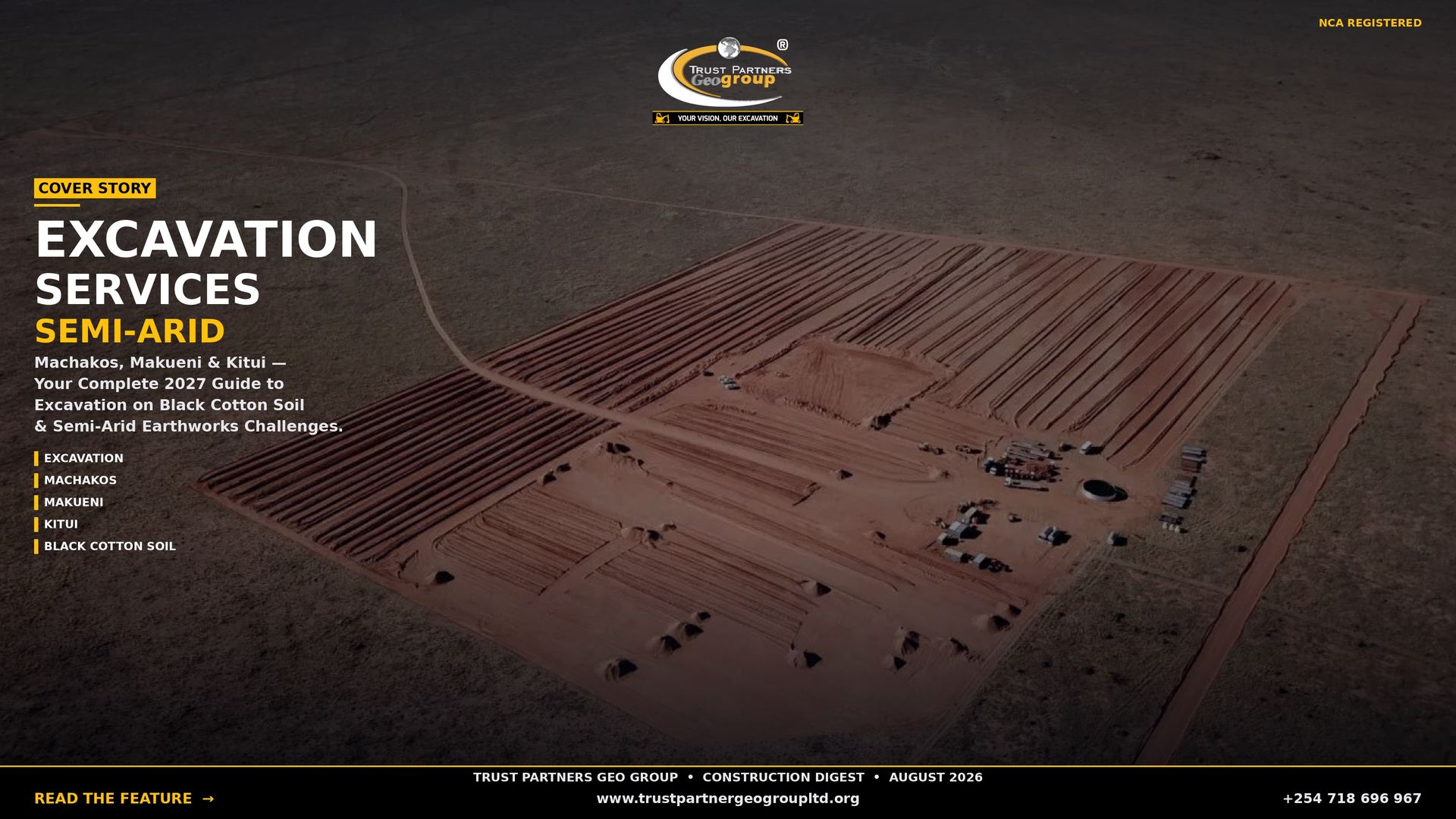
Excavation Services in Machakos, Makueni and Kitui: Black Cotton Soil and Semi-Arid Earthworks Challenges [2027]
Black Cotton Soil Removal, ASAL Earthworks & Water Infrastructure for Kenya's Eastern Frontier
Along Kenya's eastern frontier, three counties are rewriting the nation's construction map. Machakos, Makueni and Kitui — historic Ukambani heartland, semi-arid savannah and emerging industrial corridor — now form one of Kenya's most geotechnically demanding growth belts. But beneath the acacia scrub and red murram plains lies a soil that strikes fear into builders: black cotton soil that swells and shrinks with every rain, deep vertisol layers that heave foundations apart, seasonal flash floods that erase unprotected cuts, and water scarcity that turns every compaction job into a logistics puzzle. This guide covers everything developers need to know about eastern Kenya excavation — from black cotton removal and murram replacement to water pan construction and ASAL site preparation.

NCA-registered excavation and heavy equipment hire contractor with 15+ years operating across Kenya. We provide black cotton soil removal, semi-arid earthworks and water infrastructure excavation for Machakos, Makueni, Kitui and all eastern Kenya projects.
Why Machakos, Makueni and Kitui Are Expanding
The eastern corridor is experiencing sustained growth driven by seven key factors:
- Nairobi satellite advantage: Machakos borders the capital, with Syokimau, Mlolongo and Athi River serving as affordable dormitory towns. The Mombasa-Nairobi Highway and Standard Gauge Railway connect the county to Nairobi in under 30 minutes.
- KSh 110 billion government plan: The national government has unveiled an unprecedented development plan for eastern counties covering affordable housing, 600 km of road upgrades, dam construction and 39 fresh produce markets.
- Konza Technopolis spillover: Africa's first planned smart city in neighboring Kajiado drives demand for housing, logistics parks and service infrastructure across Machakos.
- Thwake Dam transformation: The multi-purpose dam on the Athi River between Machakos and Kitui will provide irrigation water, hydroelectric power and domestic supply — unlocking agricultural and industrial potential across both counties.
- Affordable eastern land: A 50×100 ft plot in Machakos costs KES 1.5–3 million, Makueni KES 800K–2 million, and Kitui KES 600K–1.8 million. Comparable Nairobi plots cost 4–6× more.
- Machakos Special Economic Zone: A 100-acre SEZ offers reduced corporate tax, duty-free raw material import and streamlined licensing for manufacturing and export businesses.
- Devolution dividends: County governments have invested in modern markets, stadiums, tarmac roads and health facilities — opening new zones for commercial and residential development.
The Eastern Soil Challenge: Black Cotton, Murram and ASAL Terrain
The Machakos-Makueni-Kitui corridor sits in Kenya's Arid and Semi-Arid Lands (ASALs), with soil conditions that create unique construction challenges:
- Black cotton soil (vertisols): Expansive clay soils cover large portions of Machakos, Makueni and Kitui. These soils contain 50–70% clay, with liquid limits above 50% and plasticity indices above 25%. They swell when wet and shrink when dry, generating ground movement of 50–150 mm annually.
- Variable depth: Black cotton depth ranges from 0.5 metres to over 3 metres within a single plot. Some areas have shallow clay over murram; others have deep, continuous vertisol profiles requiring extensive removal.
- Murram and sandy loams: Found on ridges and upper slopes, these granular soils are stable and free-draining but can cement into hardpan during dry seasons, requiring ripping before excavation.
- Rocky outcrops: Isolated phonolite and basalt outcrops appear in Kitui and eastern Makueni, requiring breaker excavation for foundation work.
- Seasonal river beds (laggas): Dry for most of the year, these channels become torrents during April–May and October–December rains, eroding unprotected cuts and flooding construction sites.
- Water scarcity: Annual rainfall of 500–900 mm is erratically distributed. Compaction moisture must often be trucked to site, adding cost and logistical complexity.
- Deep shrinkage cracks: In dry season, black cotton soil cracks to depths of 1–2 metres, revealing the full extent of the problematic layer but also creating entry points for water that accelerates swelling.
Excavation Services for Semi-Arid and Black Cotton Sites
Black Cotton Soil Removal and Replacement
Our signature service for eastern Kenya is complete removal of expansive clay to geotechnical depth, followed by replacement with compacted murram, hardcore or engineered fill. We calculate exact removal volumes, coordinate disposal to approved county sites, and import quality replacement material from verified borrow pits.
Water Pan and Dam Excavation
In water-scarce Machakos, Makueni and Kitui, water pans and small dams are essential for agriculture and domestic use. We excavate pan basins, construct compacted embankments, install inlet and outlet works, and line channels with clay or geomembrane where specified.
Foundation Excavation on Replaced Soil
After black cotton removal, we excavate strip footings, raft slabs and pile caps in the replacement material. Immediate blinding concrete protects exposed murram from rain erosion and maintains trench stability.
Site Clearing and Bush Removal
Converting scrubland and bush to build-ready sites requires acacia removal, stump grinding, topsoil stripping and rough grading. We preserve mature trees where specified and manage biomass disposal through chipping or controlled burning permits.
Road and Access Earthworks
Eastern Kenya developments require all-weather access roads built on murram subgrades with proper drainage. We construct cambered surfaces, side drains and culverts across laggas to prevent washout during flash floods.
Lagga and Drainage Channel Excavation
We excavate diversion channels, retention basins and subsoil drainage systems that protect foundations from seasonal flooding. Gabion and masonry lining prevents erosion in high-velocity channels.
Foundation Solutions for Black Cotton Soil
| Foundation Type | Best For | Construction Method | Relative Cost |
|---|---|---|---|
| Complete removal + raft | Shallow black cotton (<1.5 m); bungalows, apartments, commercial | All expansive soil excavated; replaced with compacted murram; reinforced raft distributes loads | Moderate-High — KES 4,000–6,500/m² incl. replacement |
| Pad and chimney (suspended) | Deep black cotton (>1.5 m); light to medium structures | Pad footings on stable soil; short columns extend through active zone to suspend floor slab | Moderate — KES 3,500–5,500/m² |
| Bored pile foundation | Multi-storey buildings; deep or variable black cotton | Piles through expansive layer into firm murram or weathered rock below | High — KES 7,000–14,000/pile |
| Strip footing on replaced soil | Light structures with shallow black cotton; perimeter walls, cottages | Trenches over-excavated; backfilled with compacted murram; conventional strip footing | Moderate — KES 2,000–3,500/linear m |
Foundation selection depends on black cotton depth, swell potential and structural load. Trust Partners Geo-Group excavates to geotechnical and structural engineer specifications for all foundation types.
Excavation Rates in Machakos, Makueni and Kitui 2027
| Service | Rate (KES) | Notes |
|---|---|---|
| Plot cutting and clearing (per m²) | 150 – 300 | Upper end for acacia removal and rocky ground |
| Topsoil stripping (per m²) | 80 – 150 | Minimal topsoil in ASAL areas; often direct to murram |
| Bulk excavation — murram/sandy soil (per m³) | 600 – 1,000 | Standard bucket excavation in granular soils |
| Black cotton removal + replacement (per m³) | 1,800 – 3,000 | Incl. disposal, murram import and compaction |
| Foundation excavation — rock with breaker (per m³) | 2,000 – 3,200 | Phonolite/basalt breaking in Kitui and Makueni |
| Water pan excavation (per m³) | 400 – 700 | Large volume; includes embankment construction |
| Retaining wall foundation (per m) | 2,000 – 3,500 | Trench in murram, bedding, backfill and drainage |
| Access road cut-and-fill (per m²) | 300 – 500 | Murram subgrade, camber, side drains |
| Lagga crossing culvert excavation (per unit) | 45,000 – 85,000 | Incl. bedding, pipe laying and headwall foundation |
| Black cotton disposal (per 20-ton truck) | 800 – 1,500 | Haul to approved county dumping sites |
| Murram import (per 20-ton truck) | 2,500 – 4,500 | Depends on haul distance from borrow pit |
| 30-ton excavator wet hire (daily) | 38,000 – 52,000 | Operator, fuel, eastern Kenya mobilization |
| Vibratory roller 10-ton wet hire (daily) | 16,000 – 25,000 | Operator, fuel; essential for replacement fill compaction |
Key Development Zones
Machakos: Nairobi's Eastern Dormitory
Machakos is the anchor of the eastern corridor. Syokimau, Mlolongo and Athi River have exploded as Nairobi dormitory towns, with gated estates, apartment blocks and commercial centres. Machakos town itself is seeing county office construction, hotel development and retail expansion. The Machakos SEZ is attracting manufacturing and logistics investment. Black cotton soil is prevalent in the lower-lying areas around Athi River and Mavoko.
Makueni: County Capital and Agricultural Growth
Wote town and surrounding areas are expanding with county government infrastructure, health facilities and educational institutions. The lower-lying zones have significant black cotton soil challenges, while the hillier areas toward Mbooni have more stable murram. USAID and county partnerships are driving agribusiness and market construction.
Kitui: Frontier Town and Mining Heritage
Kitui town is the commercial hub of Kenya's eastern frontier, with county offices, Meru University satellite campus and growing retail. The surrounding area has historical coal mining and significant gypsum deposits. New road construction toward Thika and Mwingi is opening previously remote areas. Kitui has some of the deepest black cotton soils in the corridor, particularly in the lower plains.
Konza Corridor: Technopolis Spillover
While Konza itself sits in Kajiado, the corridor toward Machakos is seeing logistics parks, housing estates and service infrastructure. Developers are buying land in anticipation of technopolis employment growth. The area has mixed murram and black cotton soils requiring careful investigation.
Water Infrastructure Earthworks
Water scarcity defines eastern Kenya construction. Trust Partners Geo-Group provides specialized water infrastructure excavation:
- Water pan construction: Excavation of catchment basins (5,000–50,000 m³ capacity) with compacted embankments, spillways and inlet channels. Critical for livestock and irrigation in Makueni and Kitui.
- Small dam earthworks: Cut-off trench excavation, core wall construction and downstream embankment compaction for farm dams and county water projects.
- Borehole pad and sump excavation: Level platforms for drilling rigs, drainage sumps for pump installations and access roads to remote borehole sites.
- Irrigation channel excavation: Contour channels, diversion weirs and distribution networks for the Yatta Canal extension and Thwake Dam irrigation command area.
- Rainwater harvesting tanks: Underground cistern excavation for residential and commercial buildings, often combined with first-flush diverters and overflow systems.
- Subsurface drainage: French drains, agricultural tile drains and building perimeter drains that lower water tables and prevent black cotton swelling near foundations.
Permits for Eastern and South Eastern Counties
Excavation in the eastern corridor involves compliance across three county governments:
- County building permits: Machakos, Makueni and Kitui county building control departments require soil test reports for all structures over 2 storeys and any building on suspected expansive soil. Processing takes 2–4 weeks.
- NEMA Environmental Impact Assessment: Mandatory for projects over 1 hectare, water pan construction, dam earthworks or excavation within 30 metres of seasonal rivers.
- Water Authority permits: Required for water pan construction, dam excavation and any dewatering that discharges into laggas or seasonal streams. Also required for borehole pad construction in some areas.
- NCA registration: All structural excavation must be carried out by NCA-registered contractors. Trust Partners Geo-Group holds full eastern Kenya registration.
- County disposal permits: Black cotton soil disposal to county sites requires transport permits and dumping tickets from Machakos, Makueni or Kitui environmental departments.
- Fire and burning permits: Bush clearing and biomass disposal may require county fire department permits, particularly during dry season.
Trust Partners Geo-Group Eastern Fleet
Our eastern Kenya fleet is configured for black cotton removal, murram handling and water-scarce operation:
- Hyundai HX300SL 30-ton Excavators (4 units): Primary machines for black cotton removal, murram loading and foundation excavation. Long-reach arms for deep water pan work.
- Komatsu D65 Bulldozers with Ripper (2 units): Bush clearing, hardpan ripping and rough grading on large ASAL sites.
- Shacman 30-ton Tippers (10 units): Black cotton disposal and murram import. Critical for the high haul volumes eastern Kenya replacement work demands.
- Sany Motor Grader (1 unit): Access road profiling, drainage channels and site leveling on commercial and SEZ projects.
- Vibratory Rollers 10-ton (2 units): Compaction of murram replacement layers to 95% Mod AASHTO density.
- Plate Compactors (4 units): Trench backfill in confined foundation areas.
- Water Bowser 15,000 litres (2 units): Dust suppression and moisture conditioning. Essential in water-scarce eastern Kenya.
- Mini-Excavators 5-ton (3 units): Restricted-access residential plots in Machakos town and established areas.
- Drilling Rigs (2 units): Bored piles and ground improvement in deep black cotton areas.
All eastern Kenya operators receive training in expansive soil handling, water conservation and ASAL environmental protection. Projects receive dedicated supervisors, daily progress reports and compliance documentation for county and NEMA inspections.
Start Your Eastern Kenya Project in Machakos, Makueni or Kitui
Trust Partners Geo-Group is the eastern corridor's leading black cotton soil excavation contractor. Free site assessment, soil evaluation, itemised quote and rapid mobilisation.
Call +254 718 686 967 Email for QuoteFrequently Asked Questions
Why are Machakos, Makueni and Kitui growing so fast?
Machakos, Makueni and Kitui are eastern Kenya's fastest-growing corridor due to: (1) Proximity to Nairobi — Machakos borders the capital, with Syokimau, Mlolongo and Athi River serving as affordable satellite towns. (2) KSh 110 billion government development plan covering affordable housing, road upgrades, dam construction and fresh produce markets across the three counties. (3) Konza Technopolis — Africa's first planned smart city in neighboring Kajiado drives demand for housing, logistics and services in Machakos. (4) Thwake Dam — the multi-purpose dam on the Athi River will provide irrigation water, transforming agricultural potential across Machakos and Kitui. (5) Affordable land — a 50×100 ft plot in Machakos costs KES 1.5–3 million, Makueni KES 800K–2 million, and Kitui KES 600K–1.8 million. (6) Special Economic Zone — Machakos hosts a 100-acre SEZ with tax incentives for manufacturing and export businesses. (7) Devolution investment — county governments have built markets, stadiums, roads and health facilities.
What makes black cotton soil difficult for construction?
Black cotton soil (vertisols) is an expansive clay found across Machakos, Makueni and Kitui. It swells significantly when wet and shrinks when dry, causing repeated ground movement. This leads to diagonal wall cracks, uneven floors, sticking doors, broken drainage and tilting structures. The soil contains high clay content (often 50–70%), with liquid limits above 50% and plasticity indices above 25%. During wet seasons, black cotton soil can heave 50–150 mm; in dry seasons it cracks to depths of 1–2 metres. Standard strip foundations fail on black cotton without special measures. The soil must either be completely removed and replaced with murram/hardcore, or structures must be built on suspended foundations or piles that bypass the active layer.
How much does excavation cost in Machakos, Makueni and Kitui?
Eastern Kenya excavation costs vary by soil type and haul distance: Bulk excavation in murram/sandy soils costs KES 600–1,000 per m³. Black cotton soil removal and replacement costs KES 1,800–3,000 per m³ including disposal and murram backfill. Foundation excavation through rocky outcrops costs KES 2,000–3,200 per m³ with breaker. Plot cutting and clearing on bushland costs KES 150–300 per m². Water pan excavation costs KES 400–700 per m³. Road subgrade in murram areas costs KES 300–500 per m². Key cost drivers include: black cotton depth (removal adds 60–100% premium), haul distance to murram sources (KES 800–1,500 per 20-ton truck), water scarcity (dust suppression and compaction moisture add costs), and seasonal access during rains. A typical 3-bedroom bungalow on black cotton soil in Machakos costs KES 350,000–650,000 including soil removal, murram replacement and foundation excavation. Trust Partners Geo-Group provides fixed-price quotes after site investigation.
What foundation types work best on black cotton soil?
Four foundation systems are proven for eastern Kenya's black cotton soil: (1) Complete removal and raft foundation — for shallow black cotton (under 1.5 m). All expansive soil is excavated and replaced with compacted murram/hardcore; a reinforced raft slab distributes loads. Cost: KES 4,000–6,500 per m² including replacement. (2) Suspended floor with pad and chimney foundations — for deeper black cotton. Short columns (chimneys) extend from pad footings through the active zone to suspend the floor above ground movement. Cost: KES 3,500–5,500 per m². (3) Bored pile foundation — for multi-storey buildings or deep black cotton. Piles extend through the expansive layer into stable murram or weathered rock below. Cost: KES 7,000–14,000 per pile (300–450 mm diameter, 6–12 m depth). (4) Strip footing on replaced soil — for light structures with shallow black cotton. Trenches are over-excavated and backfilled with compacted murram before constructing conventional strip footings. Cost: KES 2,000–3,500 per linear metre. Trust Partners Geo-Group excavates to geotechnical specifications for all foundation types.
Do I need a soil test before building in Machakos or Kitui?
Yes — a geotechnical investigation is essential before any construction in Machakos, Makueni or Kitui due to highly variable soil conditions. Black cotton soil depth can change dramatically within a single plot — from 0.5 metres to over 3 metres. Machakos, Makueni and Kitui county building control require soil test reports for all buildings over 2 storeys and any structure on suspected expansive soil. A standard eastern Kenya geotechnical investigation includes: (1) Trial pits or boreholes — 3–4 pits per plot to 3–5 m depth, logging soil strata. Cost: KES 25,000–40,000 per plot. (2) Laboratory testing — Atterberg limits, moisture content, particle size distribution, swell potential and bearing capacity. (3) Foundation recommendation report — specifies black cotton depth, removal volumes, replacement material requirements and drainage design. (4) NEMA may require assessment for sites near seasonal rivers, dams or wetlands. Trust Partners Geo-Group works with NCA-registered geotechnical firms to coordinate investigations. Skipping soil testing risks foundation failure and repair costs exceeding KES 1.5 million.
How does the dry climate affect excavation in eastern Kenya?
The semi-arid climate of Machakos, Makueni and Kitui creates distinct excavation challenges: (1) Water scarcity — compaction requires controlled moisture (typically 8–12% for murram). Water must be trucked to site at KES 1,500–3,000 per 10,000-litre bowser. (2) Dust control — dry season excavation generates significant dust. Sites require regular watering, which conflicts with water scarcity. (3) Seasonal flash floods — though dry most of the year, intense storms in April–May and October–December create flash flooding in seasonal river beds (laggas) and erode unprotected cuts. (4) Hardpan formation — prolonged dry periods cement murram soils into hardpan layers that require ripping before excavation. (5) Shrinkage cracks — black cotton soil shrinks and cracks deeply in dry season, making excavation easier but revealing the full extent of the problematic layer. (6) Equipment overheating — temperatures regularly exceed 30°C, requiring more frequent equipment cooling breaks. Trust Partners Geo-Group schedules heavy earthworks in cooler morning hours and maintains water bowsers on all eastern Kenya sites.
Where does excavated black cotton soil go?
Excavated black cotton soil from Machakos, Makueni and Kitui sites requires careful disposal: (1) Approved county dumping sites — Machakos, Makueni and Kitui counties designate disposal areas for expansive clay. Transport costs range KES 800–1,500 per 20-ton truck depending on haul distance. (2) On-site burial — where space permits, black cotton can be buried in deep pits on the property perimeter, covered with murram and marked as non-buildable. (3) Landfill capping — approved sites use black cotton soil as daily cover material. (4) Brick making — some processors use black cotton soil for unfired compressed earth blocks, though this requires stabilization with cement. (5) Road shoulder fill — with proper compaction and drainage, black cotton can be used for non-structural road shoulders. Trust Partners Geo-Group manages disposal logistics including county permits and on-site burial where appropriate. Note that dumping black cotton soil into seasonal rivers (laggas), dams or unapproved sites carries severe NEMA and county penalties. The soil must never be reused as foundation backfill without stabilization.
What equipment is needed for eastern Kenya excavation?
Eastern Kenya's semi-arid and black cotton terrain requires specialized fleet: (1) 30-ton excavators — primary tool for black cotton removal, murram loading and foundation excavation. Long-reach arms useful for deep water pans. (2) Bulldozers with ripper attachments — for clearing acacia scrub, ripping hardpan murram and rough grading on large sites. (3) 20–30 ton tippers — spoil removal and murram delivery. Critical for hauling black cotton to disposal sites and importing replacement fill. (4) Motor graders — for road construction, drainage channels and site leveling on commercial and SEZ projects. (5) Vibratory rollers 10-ton — compaction of murram replacement layers to 95% Mod AASHTO density. (6) Plate compactors — trench backfill in confined foundation areas. (7) Water bowsers 15,000 litres — dust suppression and moisture conditioning for compaction. Essential in water-scarce eastern Kenya. (8) Mini-excavators 5-ton — for restricted-access residential plots in Machakos town and established areas. (9) Drilling rigs — for bored piles and ground improvement in deep black cotton areas. (10) Compaction testing equipment — field density tests to verify replacement fill meets engineering specifications. All equipment is available wet hire with NITA-certified operators from Trust Partners Geo-Group, mobilised to Machakos, Makueni and Kitui.
Related Resources
Planning a Project in Machakos, Makueni or Kitui?
Contact Trust Partners Geo-Group at +254 718 686 967 for a free eastern Kenya site assessment and itemised excavation quote. Serving Machakos, Makueni, Kitui and all 47 counties.
Call +254 718 686 967 Request QuoteExcavation Services in Machakos, Makueni and Kitui: Black Cotton Soil and Semi-Arid Earthworks Challenges [2027]
Black Cotton Soil Removal, ASAL Earthworks & Water Infrastructure for Kenya's Eastern Frontier
Along Kenya's eastern frontier, three counties are rewriting the nation's construction map. Machakos, Makueni and Kitui — historic Ukambani heartland, semi-arid savannah and emerging industrial corridor — now form one of Kenya's most geotechnically demanding growth belts. But beneath the acacia scrub and red murram plains lies a soil that strikes fear into builders: black cotton soil that swells and shrinks with every rain, deep vertisol layers that heave foundations apart, seasonal flash floods that erase unprotected cuts, and water scarcity that turns every compaction job into a logistics puzzle. This guide covers everything developers need to know about eastern Kenya excavation — from black cotton removal and murram replacement to water pan construction and ASAL site preparation.
NCA-registered excavation and heavy equipment hire contractor with 15+ years operating across Kenya. We provide black cotton soil removal, semi-arid earthworks and water infrastructure excavation for Machakos, Makueni, Kitui and all eastern Kenya projects.
Why Machakos, Makueni and Kitui Are Expanding
The eastern corridor is experiencing sustained growth driven by seven key factors:
- Nairobi satellite advantage: Machakos borders the capital, with Syokimau, Mlolongo and Athi River serving as affordable dormitory towns. The Mombasa-Nairobi Highway and Standard Gauge Railway connect the county to Nairobi in under 30 minutes.
- KSh 110 billion government plan: The national government has unveiled an unprecedented development plan for eastern counties covering affordable housing, 600 km of road upgrades, dam construction and 39 fresh produce markets.
- Konza Technopolis spillover: Africa's first planned smart city in neighboring Kajiado drives demand for housing, logistics parks and service infrastructure across Machakos.
- Thwake Dam transformation: The multi-purpose dam on the Athi River between Machakos and Kitui will provide irrigation water, hydroelectric power and domestic supply — unlocking agricultural and industrial potential across both counties.
- Affordable eastern land: A 50×100 ft plot in Machakos costs KES 1.5–3 million, Makueni KES 800K–2 million, and Kitui KES 600K–1.8 million. Comparable Nairobi plots cost 4–6× more.
- Machakos Special Economic Zone: A 100-acre SEZ offers reduced corporate tax, duty-free raw material import and streamlined licensing for manufacturing and export businesses.
- Devolution dividends: County governments have invested in modern markets, stadiums, tarmac roads and health facilities — opening new zones for commercial and residential development.
The Eastern Soil Challenge: Black Cotton, Murram and ASAL Terrain
The Machakos-Makueni-Kitui corridor sits in Kenya's Arid and Semi-Arid Lands (ASALs), with soil conditions that create unique construction challenges:
- Black cotton soil (vertisols): Expansive clay soils cover large portions of Machakos, Makueni and Kitui. These soils contain 50–70% clay, with liquid limits above 50% and plasticity indices above 25%. They swell when wet and shrink when dry, generating ground movement of 50–150 mm annually.
- Variable depth: Black cotton depth ranges from 0.5 metres to over 3 metres within a single plot. Some areas have shallow clay over murram; others have deep, continuous vertisol profiles requiring extensive removal.
- Murram and sandy loams: Found on ridges and upper slopes, these granular soils are stable and free-draining but can cement into hardpan during dry seasons, requiring ripping before excavation.
- Rocky outcrops: Isolated phonolite and basalt outcrops appear in Kitui and eastern Makueni, requiring breaker excavation for foundation work.
- Seasonal river beds (laggas): Dry for most of the year, these channels become torrents during April–May and October–December rains, eroding unprotected cuts and flooding construction sites.
- Water scarcity: Annual rainfall of 500–900 mm is erratically distributed. Compaction moisture must often be trucked to site, adding cost and logistical complexity.
- Deep shrinkage cracks: In dry season, black cotton soil cracks to depths of 1–2 metres, revealing the full extent of the problematic layer but also creating entry points for water that accelerates swelling.
Excavation Services for Semi-Arid and Black Cotton Sites
Black Cotton Soil Removal and Replacement
Our signature service for eastern Kenya is complete removal of expansive clay to geotechnical depth, followed by replacement with compacted murram, hardcore or engineered fill. We calculate exact removal volumes, coordinate disposal to approved county sites, and import quality replacement material from verified borrow pits.
Water Pan and Dam Excavation
In water-scarce Machakos, Makueni and Kitui, water pans and small dams are essential for agriculture and domestic use. We excavate pan basins, construct compacted embankments, install inlet and outlet works, and line channels with clay or geomembrane where specified.
Foundation Excavation on Replaced Soil
After black cotton removal, we excavate strip footings, raft slabs and pile caps in the replacement material. Immediate blinding concrete protects exposed murram from rain erosion and maintains trench stability.
Site Clearing and Bush Removal
Converting scrubland and bush to build-ready sites requires acacia removal, stump grinding, topsoil stripping and rough grading. We preserve mature trees where specified and manage biomass disposal through chipping or controlled burning permits.
Road and Access Earthworks
Eastern Kenya developments require all-weather access roads built on murram subgrades with proper drainage. We construct cambered surfaces, side drains and culverts across laggas to prevent washout during flash floods.
Lagga and Drainage Channel Excavation
We excavate diversion channels, retention basins and subsoil drainage systems that protect foundations from seasonal flooding. Gabion and masonry lining prevents erosion in high-velocity channels.
Foundation Solutions for Black Cotton Soil
| Foundation Type | Best For | Construction Method | Relative Cost |
|---|---|---|---|
| Complete removal + raft | Shallow black cotton (<1.5 m); bungalows, apartments, commercial | All expansive soil excavated; replaced with compacted murram; reinforced raft distributes loads | Moderate-High — KES 4,000–6,500/m² incl. replacement |
| Pad and chimney (suspended) | Deep black cotton (>1.5 m); light to medium structures | Pad footings on stable soil; short columns extend through active zone to suspend floor slab | Moderate — KES 3,500–5,500/m² |
| Bored pile foundation | Multi-storey buildings; deep or variable black cotton | Piles through expansive layer into firm murram or weathered rock below | High — KES 7,000–14,000/pile |
| Strip footing on replaced soil | Light structures with shallow black cotton; perimeter walls, cottages | Trenches over-excavated; backfilled with compacted murram; conventional strip footing | Moderate — KES 2,000–3,500/linear m |
Foundation selection depends on black cotton depth, swell potential and structural load. Trust Partners Geo-Group excavates to geotechnical and structural engineer specifications for all foundation types.
Excavation Rates in Machakos, Makueni and Kitui 2027
| Service | Rate (KES) | Notes |
|---|---|---|
| Plot cutting and clearing (per m²) | 150 – 300 | Upper end for acacia removal and rocky ground |
| Topsoil stripping (per m²) | 80 – 150 | Minimal topsoil in ASAL areas; often direct to murram |
| Bulk excavation — murram/sandy soil (per m³) | 600 – 1,000 | Standard bucket excavation in granular soils |
| Black cotton removal + replacement (per m³) | 1,800 – 3,000 | Incl. disposal, murram import and compaction |
| Foundation excavation — rock with breaker (per m³) | 2,000 – 3,200 | Phonolite/basalt breaking in Kitui and Makueni |
| Water pan excavation (per m³) | 400 – 700 | Large volume; includes embankment construction |
| Retaining wall foundation (per m) | 2,000 – 3,500 | Trench in murram, bedding, backfill and drainage |
| Access road cut-and-fill (per m²) | 300 – 500 | Murram subgrade, camber, side drains |
| Lagga crossing culvert excavation (per unit) | 45,000 – 85,000 | Incl. bedding, pipe laying and headwall foundation |
| Black cotton disposal (per 20-ton truck) | 800 – 1,500 | Haul to approved county dumping sites |
| Murram import (per 20-ton truck) | 2,500 – 4,500 | Depends on haul distance from borrow pit |
| 30-ton excavator wet hire (daily) | 38,000 – 52,000 | Operator, fuel, eastern Kenya mobilization |
| Vibratory roller 10-ton wet hire (daily) | 16,000 – 25,000 | Operator, fuel; essential for replacement fill compaction |
Key Development Zones
Machakos: Nairobi's Eastern Dormitory
Machakos is the anchor of the eastern corridor. Syokimau, Mlolongo and Athi River have exploded as Nairobi dormitory towns, with gated estates, apartment blocks and commercial centres. Machakos town itself is seeing county office construction, hotel development and retail expansion. The Machakos SEZ is attracting manufacturing and logistics investment. Black cotton soil is prevalent in the lower-lying areas around Athi River and Mavoko.
Makueni: County Capital and Agricultural Growth
Wote town and surrounding areas are expanding with county government infrastructure, health facilities and educational institutions. The lower-lying zones have significant black cotton soil challenges, while the hillier areas toward Mbooni have more stable murram. USAID and county partnerships are driving agribusiness and market construction.
Kitui: Frontier Town and Mining Heritage
Kitui town is the commercial hub of Kenya's eastern frontier, with county offices, Meru University satellite campus and growing retail. The surrounding area has historical coal mining and significant gypsum deposits. New road construction toward Thika and Mwingi is opening previously remote areas. Kitui has some of the deepest black cotton soils in the corridor, particularly in the lower plains.
Konza Corridor: Technopolis Spillover
While Konza itself sits in Kajiado, the corridor toward Machakos is seeing logistics parks, housing estates and service infrastructure. Developers are buying land in anticipation of technopolis employment growth. The area has mixed murram and black cotton soils requiring careful investigation.
Water Infrastructure Earthworks
Water scarcity defines eastern Kenya construction. Trust Partners Geo-Group provides specialized water infrastructure excavation:
- Water pan construction: Excavation of catchment basins (5,000–50,000 m³ capacity) with compacted embankments, spillways and inlet channels. Critical for livestock and irrigation in Makueni and Kitui.
- Small dam earthworks: Cut-off trench excavation, core wall construction and downstream embankment compaction for farm dams and county water projects.
- Borehole pad and sump excavation: Level platforms for drilling rigs, drainage sumps for pump installations and access roads to remote borehole sites.
- Irrigation channel excavation: Contour channels, diversion weirs and distribution networks for the Yatta Canal extension and Thwake Dam irrigation command area.
- Rainwater harvesting tanks: Underground cistern excavation for residential and commercial buildings, often combined with first-flush diverters and overflow systems.
- Subsurface drainage: French drains, agricultural tile drains and building perimeter drains that lower water tables and prevent black cotton swelling near foundations.
Permits for Eastern and South Eastern Counties
Excavation in the eastern corridor involves compliance across three county governments:
- County building permits: Machakos, Makueni and Kitui county building control departments require soil test reports for all structures over 2 storeys and any building on suspected expansive soil. Processing takes 2–4 weeks.
- NEMA Environmental Impact Assessment: Mandatory for projects over 1 hectare, water pan construction, dam earthworks or excavation within 30 metres of seasonal rivers.
- Water Authority permits: Required for water pan construction, dam excavation and any dewatering that discharges into laggas or seasonal streams. Also required for borehole pad construction in some areas.
- NCA registration: All structural excavation must be carried out by NCA-registered contractors. Trust Partners Geo-Group holds full eastern Kenya registration.
- County disposal permits: Black cotton soil disposal to county sites requires transport permits and dumping tickets from Machakos, Makueni or Kitui environmental departments.
- Fire and burning permits: Bush clearing and biomass disposal may require county fire department permits, particularly during dry season.
Trust Partners Geo-Group Eastern Fleet
Our eastern Kenya fleet is configured for black cotton removal, murram handling and water-scarce operation:
- Hyundai HX300SL 30-ton Excavators (4 units): Primary machines for black cotton removal, murram loading and foundation excavation. Long-reach arms for deep water pan work.
- Komatsu D65 Bulldozers with Ripper (2 units): Bush clearing, hardpan ripping and rough grading on large ASAL sites.
- Shacman 30-ton Tippers (10 units): Black cotton disposal and murram import. Critical for the high haul volumes eastern Kenya replacement work demands.
- Sany Motor Grader (1 unit): Access road profiling, drainage channels and site leveling on commercial and SEZ projects.
- Vibratory Rollers 10-ton (2 units): Compaction of murram replacement layers to 95% Mod AASHTO density.
- Plate Compactors (4 units): Trench backfill in confined foundation areas.
- Water Bowser 15,000 litres (2 units): Dust suppression and moisture conditioning. Essential in water-scarce eastern Kenya.
- Mini-Excavators 5-ton (3 units): Restricted-access residential plots in Machakos town and established areas.
- Drilling Rigs (2 units): Bored piles and ground improvement in deep black cotton areas.
All eastern Kenya operators receive training in expansive soil handling, water conservation and ASAL environmental protection. Projects receive dedicated supervisors, daily progress reports and compliance documentation for county and NEMA inspections.
Start Your Eastern Kenya Project in Machakos, Makueni or Kitui
Trust Partners Geo-Group is the eastern corridor's leading black cotton soil excavation contractor. Free site assessment, soil evaluation, itemised quote and rapid mobilisation.
Call +254 718 686 967 Email for QuoteFrequently Asked Questions
Why are Machakos, Makueni and Kitui growing so fast?
Machakos, Makueni and Kitui are eastern Kenya's fastest-growing corridor due to: (1) Proximity to Nairobi — Machakos borders the capital, with Syokimau, Mlolongo and Athi River serving as affordable satellite towns. (2) KSh 110 billion government development plan covering affordable housing, road upgrades, dam construction and fresh produce markets across the three counties. (3) Konza Technopolis — Africa's first planned smart city in neighboring Kajiado drives demand for housing, logistics and services in Machakos. (4) Thwake Dam — the multi-purpose dam on the Athi River will provide irrigation water, transforming agricultural potential across Machakos and Kitui. (5) Affordable land — a 50×100 ft plot in Machakos costs KES 1.5–3 million, Makueni KES 800K–2 million, and Kitui KES 600K–1.8 million. (6) Special Economic Zone — Machakos hosts a 100-acre SEZ with tax incentives for manufacturing and export businesses. (7) Devolution investment — county governments have built markets, stadiums, roads and health facilities.
What makes black cotton soil difficult for construction?
Black cotton soil (vertisols) is an expansive clay found across Machakos, Makueni and Kitui. It swells significantly when wet and shrinks when dry, causing repeated ground movement. This leads to diagonal wall cracks, uneven floors, sticking doors, broken drainage and tilting structures. The soil contains high clay content (often 50–70%), with liquid limits above 50% and plasticity indices above 25%. During wet seasons, black cotton soil can heave 50–150 mm; in dry seasons it cracks to depths of 1–2 metres. Standard strip foundations fail on black cotton without special measures. The soil must either be completely removed and replaced with murram/hardcore, or structures must be built on suspended foundations or piles that bypass the active layer.
How much does excavation cost in Machakos, Makueni and Kitui?
Eastern Kenya excavation costs vary by soil type and haul distance: Bulk excavation in murram/sandy soils costs KES 600–1,000 per m³. Black cotton soil removal and replacement costs KES 1,800–3,000 per m³ including disposal and murram backfill. Foundation excavation through rocky outcrops costs KES 2,000–3,200 per m³ with breaker. Plot cutting and clearing on bushland costs KES 150–300 per m². Water pan excavation costs KES 400–700 per m³. Road subgrade in murram areas costs KES 300–500 per m². Key cost drivers include: black cotton depth (removal adds 60–100% premium), haul distance to murram sources (KES 800–1,500 per 20-ton truck), water scarcity (dust suppression and compaction moisture add costs), and seasonal access during rains. A typical 3-bedroom bungalow on black cotton soil in Machakos costs KES 350,000–650,000 including soil removal, murram replacement and foundation excavation. Trust Partners Geo-Group provides fixed-price quotes after site investigation.
What foundation types work best on black cotton soil?
Four foundation systems are proven for eastern Kenya's black cotton soil: (1) Complete removal and raft foundation — for shallow black cotton (under 1.5 m). All expansive soil is excavated and replaced with compacted murram/hardcore; a reinforced raft slab distributes loads. Cost: KES 4,000–6,500 per m² including replacement. (2) Suspended floor with pad and chimney foundations — for deeper black cotton. Short columns (chimneys) extend from pad footings through the active zone to suspend the floor above ground movement. Cost: KES 3,500–5,500 per m². (3) Bored pile foundation — for multi-storey buildings or deep black cotton. Piles extend through the expansive layer into stable murram or weathered rock below. Cost: KES 7,000–14,000 per pile (300–450 mm diameter, 6–12 m depth). (4) Strip footing on replaced soil — for light structures with shallow black cotton. Trenches are over-excavated and backfilled with compacted murram before constructing conventional strip footings. Cost: KES 2,000–3,500 per linear metre. Trust Partners Geo-Group excavates to geotechnical specifications for all foundation types.
Do I need a soil test before building in Machakos or Kitui?
Yes — a geotechnical investigation is essential before any construction in Machakos, Makueni or Kitui due to highly variable soil conditions. Black cotton soil depth can change dramatically within a single plot — from 0.5 metres to over 3 metres. Machakos, Makueni and Kitui county building control require soil test reports for all buildings over 2 storeys and any structure on suspected expansive soil. A standard eastern Kenya geotechnical investigation includes: (1) Trial pits or boreholes — 3–4 pits per plot to 3–5 m depth, logging soil strata. Cost: KES 25,000–40,000 per plot. (2) Laboratory testing — Atterberg limits, moisture content, particle size distribution, swell potential and bearing capacity. (3) Foundation recommendation report — specifies black cotton depth, removal volumes, replacement material requirements and drainage design. (4) NEMA may require assessment for sites near seasonal rivers, dams or wetlands. Trust Partners Geo-Group works with NCA-registered geotechnical firms to coordinate investigations. Skipping soil testing risks foundation failure and repair costs exceeding KES 1.5 million.
How does the dry climate affect excavation in eastern Kenya?
The semi-arid climate of Machakos, Makueni and Kitui creates distinct excavation challenges: (1) Water scarcity — compaction requires controlled moisture (typically 8–12% for murram). Water must be trucked to site at KES 1,500–3,000 per 10,000-litre bowser. (2) Dust control — dry season excavation generates significant dust. Sites require regular watering, which conflicts with water scarcity. (3) Seasonal flash floods — though dry most of the year, intense storms in April–May and October–December create flash flooding in seasonal river beds (laggas) and erode unprotected cuts. (4) Hardpan formation — prolonged dry periods cement murram soils into hardpan layers that require ripping before excavation. (5) Shrinkage cracks — black cotton soil shrinks and cracks deeply in dry season, making excavation easier but revealing the full extent of the problematic layer. (6) Equipment overheating — temperatures regularly exceed 30°C, requiring more frequent equipment cooling breaks. Trust Partners Geo-Group schedules heavy earthworks in cooler morning hours and maintains water bowsers on all eastern Kenya sites.
Where does excavated black cotton soil go?
Excavated black cotton soil from Machakos, Makueni and Kitui sites requires careful disposal: (1) Approved county dumping sites — Machakos, Makueni and Kitui counties designate disposal areas for expansive clay. Transport costs range KES 800–1,500 per 20-ton truck depending on haul distance. (2) On-site burial — where space permits, black cotton can be buried in deep pits on the property perimeter, covered with murram and marked as non-buildable. (3) Landfill capping — approved sites use black cotton soil as daily cover material. (4) Brick making — some processors use black cotton soil for unfired compressed earth blocks, though this requires stabilization with cement. (5) Road shoulder fill — with proper compaction and drainage, black cotton can be used for non-structural road shoulders. Trust Partners Geo-Group manages disposal logistics including county permits and on-site burial where appropriate. Note that dumping black cotton soil into seasonal rivers (laggas), dams or unapproved sites carries severe NEMA and county penalties. The soil must never be reused as foundation backfill without stabilization.
What equipment is needed for eastern Kenya excavation?
Eastern Kenya's semi-arid and black cotton terrain requires specialized fleet: (1) 30-ton excavators — primary tool for black cotton removal, murram loading and foundation excavation. Long-reach arms useful for deep water pans. (2) Bulldozers with ripper attachments — for clearing acacia scrub, ripping hardpan murram and rough grading on large sites. (3) 20–30 ton tippers — spoil removal and murram delivery. Critical for hauling black cotton to disposal sites and importing replacement fill. (4) Motor graders — for road construction, drainage channels and site leveling on commercial and SEZ projects. (5) Vibratory rollers 10-ton — compaction of murram replacement layers to 95% Mod AASHTO density. (6) Plate compactors — trench backfill in confined foundation areas. (7) Water bowsers 15,000 litres — dust suppression and moisture conditioning for compaction. Essential in water-scarce eastern Kenya. (8) Mini-excavators 5-ton — for restricted-access residential plots in Machakos town and established areas. (9) Drilling rigs — for bored piles and ground improvement in deep black cotton areas. (10) Compaction testing equipment — field density tests to verify replacement fill meets engineering specifications. All equipment is available wet hire with NITA-certified operators from Trust Partners Geo-Group, mobilised to Machakos, Makueni and Kitui.
Related Resources
Planning a Project in Machakos, Makueni or Kitui?
Contact Trust Partners Geo-Group at +254 718 686 967 for a free eastern Kenya site assessment and itemised excavation quote. Serving Machakos, Makueni, Kitui and all 47 counties.
Call +254 718 686 967 Request Quote