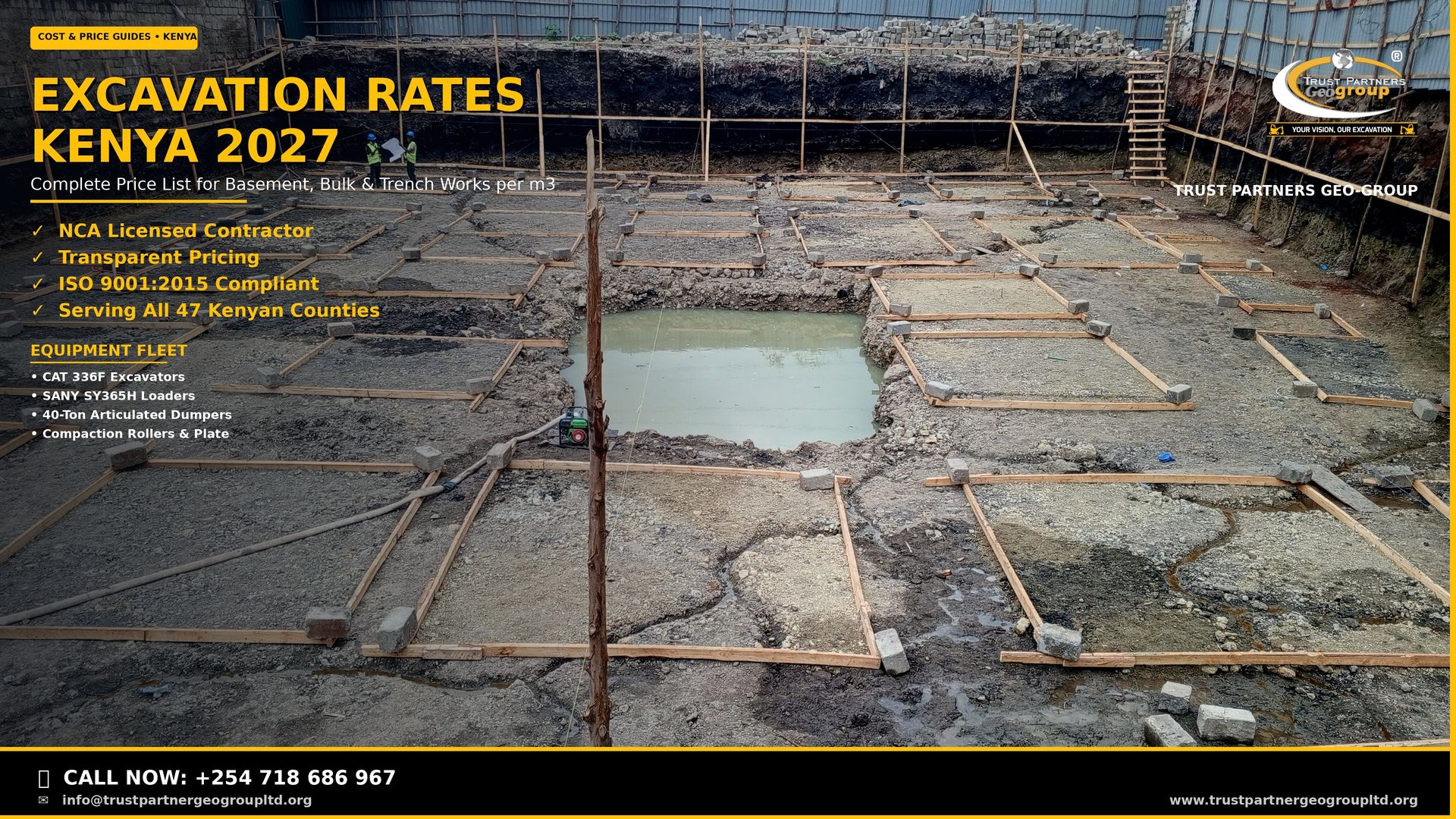
Excavation Rates in Kenya 2027: Complete Price List for Basement, Bulk & Trench Works
Updated 2027 excavation rates for Kenyan construction. Basement, bulk and trench works pricing per cubic metre — with cost breakdowns, regional variations and budgeting guidance.

📋 Table of Contents
Introduction: 2027 Excavation Pricing Overview
Accurate cost estimation is the foundation of every successful construction project in Kenya. Whether you are a developer breaking ground on a high-rise in Parklands or Upper Hill, a county government preparing a bus park, or a farmer excavating a water pan, understanding current excavation rates Kenya 2027 is essential for realistic budgeting and tender preparation.
This guide presents the most comprehensive excavation price list available for the Kenyan market in 2027. Rates are compiled from live project data across Nairobi, Mombasa, Kisumu, Nakuru and the 47 counties, reflecting actual contractor pricing inclusive of equipment, labour, fuel and standard overheads. All figures are given per cubic metre (m³) for bulk and basement works, and per linear metre for trenching.
⚠️ Rate Disclaimer
Rates quoted are indicative market ranges for Q1 2027 and exclude VAT. Final pricing depends on site-specific conditions, haul distances, soil type, dewatering requirements and project duration. Contact Trust Partners Geo-Group for an itemised quote tailored to your project.
Basement Excavation Rates 2027
Basement excavation is the most technically demanding — and therefore most expensive — category of earthworks. Pricing varies dramatically by depth, soil conditions, proximity to adjacent buildings and the complexity of shoring or piling required. The following table breaks down basement excavation cost 2027 by project type.
| Basement Type | Depth | Soil Rate (KSh/m³) | Rock Rate (KSh/m³) | Typical Duration |
|---|---|---|---|---|
| Residential (1-2 levels) | 3 – 6 m | 1,800 – 2,500 | 3,200 – 4,500 | 3 – 6 weeks |
| Commercial (2-3 levels) | 6 – 10 m | 2,200 – 3,200 | 4,000 – 5,500 | 8 – 16 weeks |
| Mega (4+ levels) | 15 m+ | 3,500 – 5,500 | 6,000 – 9,000 | 4 – 8 months |
| Mixed-use podium | 8 – 12 m | 2,800 – 4,000 | 5,000 – 7,000 | 10 – 20 weeks |
What Drives Basement Excavation Cost?
Several factors push basement rates above standard bulk earthworks:
- Depth and shoring: Deep excavations require sheet piles, soldier piles or diaphragm walls. Shoring can add KSh 8,000 – 25,000 per linear metre of wall.
- Dewatering: High water-table areas like Kilimani, Kileleshwa and parts of Westlands require 24/7 pumping. Expect KSh 3,500 – 8,000 per day for wellpoint or deep-well dewatering.
- Soil type: Black cotton soil in Kajiado, Thika and Ruiru swells when wet and requires specialised handling, adding 15 – 25% to rates.
- Haulage distance: Spoil disposal in Nairobi is increasingly expensive. Cart-away costs range from KSh 350 – 600 per m³ depending on dump site location.
- Access constraints: Urban sites with limited access require smaller equipment, longer cycles and sometimes night-shift premiums of 20 – 30%.
💡 Pro Tip for Developers
For basement projects in Nairobi's high water-table zones, budget at least 12 – 18% of total excavation cost for dewatering alone. Early soil investigation (KSh 15,000 – 30,000 per borehole) pays for itself by eliminating surprises.
Bulk Excavation Rates 2027
Bulk excavation covers large-volume earthworks for roads, dams, reservoirs, site grading and plot cutting. Rates are lower per m³ than basement work because of simpler access, shallower depths and reduced shoring requirements. The following table summarises bulk excavation cost per m3 Kenya for 2027.
| Material Type | Rate (KSh/m³) | Productivity (m³/day) | Key Considerations |
|---|---|---|---|
| Common soil (loam/sandy) | 450 – 650 | 400 – 700 | Standard excavator + truck fleet |
| Black cotton soil | 550 – 750 | 300 – 500 | Sticky, high moisture, compaction needed |
| Soft rock (breaker) | 1,200 – 1,800 | 80 – 150 | Hydraulic breaker attachment, slower progress |
| Hard rock (blasting) | 800 – 1,200 | 200 – 400 | Requires blasting permits, specialist crew |
| Lateritic gravel | 500 – 700 | 350 – 600 | Common in Nairobi, Kiambu, Kajiado |
| Murram (selected) | 350 – 500 | 500 – 800 | Often used as fill; lower excavation cost |
Equipment Fleet Impact on Bulk Rates
The size and efficiency of the equipment fleet directly affects earthworks rates Nairobi 2027. A typical 50,000 m³ road earthworks project achieves optimal cost with:
- Two 30-ton excavators (e.g., CAT 336F or Hyundai HX300SL)
- Four 40-ton articulated dump trucks
- One motor grader for haul road maintenance
- One compactor roller for sub-grade preparation
This configuration delivers approximately 600 – 900 m³ per day in good soil, completing the project in 6 – 10 weeks. Trust Partners Geo-Group operates a fleet of four Hyundai HX300SL 30-ton excavators specifically for large-scale bulk earthworks.
✅ Cost-Saving Insight
Scheduling bulk excavation during Kenya's dry season (January – March or June – September) can reduce rates by 10 – 15% by eliminating rain delays, dewatering costs and muddy haul road maintenance.
Trench Excavation Rates 2027
Trenching for utilities, drainage and foundations is priced per linear metre because volume is directly correlated with trench dimensions. Trench digging cost per metre in Kenya for 2027 is shown below.
| Trench Type | Dimensions | Soil (KSh/m) | Rock (KSh/m) | Progress (m/day) |
|---|---|---|---|---|
| Utility trench (water/sewer/electric) | 0.6m W x 1.2m D | 350 – 500 | 1,200 – 1,800 | 15 – 25 |
| Drainage trench (deep) | 0.8m W x 2.0m D | 600 – 900 | 1,800 – 2,500 | 10 – 15 |
| Foundation trench (strip footing) | 0.5m W x 1.0m D | 450 – 700 | 1,500 – 2,200 | 12 – 20 |
| Foundation trench (raft) | Full basement outline | 1,800 – 2,500/m³ | 3,200 – 4,500/m³ | Project-specific |
| Cable trench (fibre/power) | 0.4m W x 0.8m D | 250 – 400 | 900 – 1,400 | 20 – 30 |
Trenching Productivity Factors
Trench excavation progress in Kenya averages 15 – 25 linear metres per day for standard utility trenches in soil. Key productivity drivers include:
- Utility congestion: Trenches in Nairobi CBD, Industrial Area and Eastleigh often encounter unmapped water mains, fibre optic cables and power lines, requiring hand digging and emergency diversion.
- Traffic management: Roadside trenching requires signage, flagmen and sometimes night work, adding 20 – 35% to rates.
- Spoil carting distance: Urban trenches with limited side-cast space require truck loading, reducing progress by 30 – 40%.
- Benching and shoring: Trenches deeper than 1.5 m in unstable soil require benching or timber shoring per OSHA standards, adding KSh 150 – 300 per metre.
Additional Cost Factors
Beyond the basic excavation rate, several line items can significantly affect total project cost. The following table outlines these extras so you can budget accurately.
| Cost Item | Unit | Rate (KSh) | When Applicable |
|---|---|---|---|
| Equipment mobilisation | Per machine | 15,000 – 45,000 | All projects; distance-dependent |
| Dewatering (wellpoint) | Per day | 3,500 – 8,000 | High water-table sites |
| Dewatering (deep well) | Per day | 8,000 – 18,000 | Deep basements >10 m |
| Spoil disposal / cart away | Per m³ | 350 – 600 | When spoil cannot be side-cast |
| Compaction testing (density) | Per test | 8,000 – 15,000 | Every 500 m² or per layer |
| CBR testing | Per test | 12,000 – 20,000 | Road and pavement projects |
| Soil investigation | Per borehole | 15,000 – 30,000 | Recommended for all basements |
| Rock breaking (breaker) | Per m³ | 1,200 – 1,800 | Unmapped rock encounters |
| Blasting (controlled) | Per m³ | 800 – 1,200 | Hard rock with NEMA permit |
| Night-shift premium | Per hour | +20 – 30% | Urban sites with day restrictions |
| Traffic management | Per day | 5,000 – 12,000 | Roadside trenching |
Regional Rate Variations
Earthworks rates Nairobi 2027 are typically 10 – 20% higher than national averages due to fuel costs, traffic congestion, dump site distances and labour premiums. Conversely, rural counties like Machakos, Kajiado and Nakuru often see lower rates but may incur higher mobilisation fees. Coastal regions (Mombasa, Kilifi, Malindi) face unique challenges with coral rock and saline groundwater, pushing trench and foundation rates 15 – 25% above inland equivalents.
Downloadable 2027 Excavation Rate Card PDF
For your convenience, Trust Partners Geo-Group has compiled all the rates in this guide into a single, printable 2027 Excavation Rate Card PDF. The PDF includes:
- Quick-reference tables for basement, bulk and trench rates
- Equipment hire rates (hourly, daily and monthly)
- Additional cost factor checklist
- Regional adjustment factors for all 47 counties
- Sample BOQ format for quantity surveyors
Download Your Free 2027 Excavation Rate Card
Get the complete PDF rate card with county-specific adjustments and equipment hire pricing. Essential for developers, QSs and procurement teams.
Download Rate Card PDF📞 +254 718 68 69 67
How to Use This Rate Card for Budgeting
Translating rates into a realistic project budget requires more than simple multiplication. Follow this step-by-step framework used by professional quantity surveyors across Kenya:
Step 1: Calculate Net Excavation Volume
From architectural and structural drawings, compute the net volume of cut. For basements, remember to include working space (typically 0.6 – 1.0 m beyond the structural footprint) and slope allowances if unshored.
Step 2: Apply Soil Factor
Multiply net volume by a bulking factor of 1.15 – 1.30 for soil (1.0 for rock) to determine spoil volume. This affects cart-away costs.
Step 3: Select Appropriate Rate
Choose the rate from the tables above that matches your soil type, project scale and location. For mixed soil/rock profiles, apply weighted averages based on borehole data.
Step 4: Add Ancillary Costs
Include dewatering, testing, mobilisation, spoil disposal and contingencies. A 10 – 15% contingency is standard for 2027 projects given fuel price volatility.
Step 5: Compare with BOQ
Cross-check your estimate against the 2026 rate breakdown and adjust for inflation. If your estimate exceeds 15% above 2026 levels, review for scope creep or unusual site conditions.
📊 Budget Example: 2-Level Basement in Kilimani
Net volume: 3,500 m³ | Soil: Red loam + lateritic gravel | Depth: 5.5 m
Excavation: 3,500 m³ × KSh 2,200 = KSh 7,700,000
Dewatering (6 weeks): 42 days × KSh 5,500 = KSh 231,000
Spoil cart away (3,800 m³): × KSh 450 = KSh 1,710,000
Compaction testing (8 tests): × KSh 12,000 = KSh 96,000
Mobilisation: KSh 35,000
Subtotal: KSh 9,772,000 | +10% contingency = KSh 10,749,200
Frequently Asked Questions
In 2027, general soil excavation in Kenya costs between KSh 450 and KSh 650 per cubic meter. Rock excavation ranges from KSh 800 to KSh 1,800 per cubic meter depending on hardness and method (breaker vs blasting). Basement excavation costs KSh 1,800 to KSh 5,500 per cubic meter depending on depth and complexity. Black cotton soil excavation costs KSh 550 to KSh 750 per cubic meter due to handling difficulties.
Basement excavation rates in Nairobi for 2027 are: Residential basement (1-2 levels, up to 6m deep) at KSh 1,800-2,500 per m3; Commercial basement (2-3 levels, 6-10m deep) at KSh 2,200-3,200 per m3; and Mega basement (4+ levels, 15m+ deep) at KSh 3,500-5,500 per m3. Rates vary by soil type, dewatering requirements, shoring complexity, and proximity to adjacent structures.
Trench excavation costs in Kenya for 2027 average: Standard utility trench (0.6m wide x 1.2m deep) at KSh 350-500 per linear meter; Drainage trench (1.5m+ deep with benching) at KSh 600-900 per meter; and Foundation trench at KSh 450-700 per meter. Rock trenching costs KSh 1,200-2,000 per meter. Prices include excavation and basic backfilling but exclude pipe laying and compaction testing.
Rock excavation in Kenya costs 2.5 to 3.5 times more than soil excavation. In 2027, soil excavation averages KSh 450-650 per m3, while soft rock (breaker work) costs KSh 1,200-1,800 per m3 and hard rock (blasting) costs KSh 800-1,200 per m3. The higher cost reflects slower progress, specialized equipment (hydraulic breakers, drill rigs), increased fuel consumption, and additional safety measures required for rock work.
Excavation rates in Kenya increased by approximately 8-12% from 2026 to 2027, driven by rising diesel prices, higher equipment import costs, increased labour wages, and inflation in construction materials. Soil excavation rose from KSh 400-600/m3 to KSh 450-650/m3. Basement excavation increased by 10-15% due to stricter NEMA compliance and dewatering requirements. Contractors should budget an additional 10-15% contingency for 2027 projects compared to 2026 estimates.
Get Your Itemised 2027 Excavation Quote
Ready to budget your project with confidence? Trust Partners Geo-Group provides fully itemised, transparent quotes with zero hidden costs. Serving Nairobi, Mombasa, Kisumu, Nakuru and all 47 Kenyan counties.
Call +254 718 68 69 67📧 info@trustpartnergeogroupltd.org
Excavation Rates in Kenya 2027: Complete Price List for Basement, Bulk & Trench Works
Updated 2027 excavation rates for Kenyan construction. Basement, bulk and trench works pricing per cubic metre — with cost breakdowns, regional variations and budgeting guidance.
📋 Table of Contents
Introduction: 2027 Excavation Pricing Overview
Accurate cost estimation is the foundation of every successful construction project in Kenya. Whether you are a developer breaking ground on a high-rise in Parklands or Upper Hill, a county government preparing a bus park, or a farmer excavating a water pan, understanding current excavation rates Kenya 2027 is essential for realistic budgeting and tender preparation.
This guide presents the most comprehensive excavation price list available for the Kenyan market in 2027. Rates are compiled from live project data across Nairobi, Mombasa, Kisumu, Nakuru and the 47 counties, reflecting actual contractor pricing inclusive of equipment, labour, fuel and standard overheads. All figures are given per cubic metre (m³) for bulk and basement works, and per linear metre for trenching.
⚠️ Rate Disclaimer
Rates quoted are indicative market ranges for Q1 2027 and exclude VAT. Final pricing depends on site-specific conditions, haul distances, soil type, dewatering requirements and project duration. Contact Trust Partners Geo-Group for an itemised quote tailored to your project.
Basement Excavation Rates 2027
Basement excavation is the most technically demanding — and therefore most expensive — category of earthworks. Pricing varies dramatically by depth, soil conditions, proximity to adjacent buildings and the complexity of shoring or piling required. The following table breaks down basement excavation cost 2027 by project type.
| Basement Type | Depth | Soil Rate (KSh/m³) | Rock Rate (KSh/m³) | Typical Duration |
|---|---|---|---|---|
| Residential (1-2 levels) | 3 – 6 m | 1,800 – 2,500 | 3,200 – 4,500 | 3 – 6 weeks |
| Commercial (2-3 levels) | 6 – 10 m | 2,200 – 3,200 | 4,000 – 5,500 | 8 – 16 weeks |
| Mega (4+ levels) | 15 m+ | 3,500 – 5,500 | 6,000 – 9,000 | 4 – 8 months |
| Mixed-use podium | 8 – 12 m | 2,800 – 4,000 | 5,000 – 7,000 | 10 – 20 weeks |
What Drives Basement Excavation Cost?
Several factors push basement rates above standard bulk earthworks:
- Depth and shoring: Deep excavations require sheet piles, soldier piles or diaphragm walls. Shoring can add KSh 8,000 – 25,000 per linear metre of wall.
- Dewatering: High water-table areas like Kilimani, Kileleshwa and parts of Westlands require 24/7 pumping. Expect KSh 3,500 – 8,000 per day for wellpoint or deep-well dewatering.
- Soil type: Black cotton soil in Kajiado, Thika and Ruiru swells when wet and requires specialised handling, adding 15 – 25% to rates.
- Haulage distance: Spoil disposal in Nairobi is increasingly expensive. Cart-away costs range from KSh 350 – 600 per m³ depending on dump site location.
- Access constraints: Urban sites with limited access require smaller equipment, longer cycles and sometimes night-shift premiums of 20 – 30%.
💡 Pro Tip for Developers
For basement projects in Nairobi's high water-table zones, budget at least 12 – 18% of total excavation cost for dewatering alone. Early soil investigation (KSh 15,000 – 30,000 per borehole) pays for itself by eliminating surprises.
Bulk Excavation Rates 2027
Bulk excavation covers large-volume earthworks for roads, dams, reservoirs, site grading and plot cutting. Rates are lower per m³ than basement work because of simpler access, shallower depths and reduced shoring requirements. The following table summarises bulk excavation cost per m3 Kenya for 2027.
| Material Type | Rate (KSh/m³) | Productivity (m³/day) | Key Considerations |
|---|---|---|---|
| Common soil (loam/sandy) | 450 – 650 | 400 – 700 | Standard excavator + truck fleet |
| Black cotton soil | 550 – 750 | 300 – 500 | Sticky, high moisture, compaction needed |
| Soft rock (breaker) | 1,200 – 1,800 | 80 – 150 | Hydraulic breaker attachment, slower progress |
| Hard rock (blasting) | 800 – 1,200 | 200 – 400 | Requires blasting permits, specialist crew |
| Lateritic gravel | 500 – 700 | 350 – 600 | Common in Nairobi, Kiambu, Kajiado |
| Murram (selected) | 350 – 500 | 500 – 800 | Often used as fill; lower excavation cost |
Equipment Fleet Impact on Bulk Rates
The size and efficiency of the equipment fleet directly affects earthworks rates Nairobi 2027. A typical 50,000 m³ road earthworks project achieves optimal cost with:
- Two 30-ton excavators (e.g., CAT 336F or Hyundai HX300SL)
- Four 40-ton articulated dump trucks
- One motor grader for haul road maintenance
- One compactor roller for sub-grade preparation
This configuration delivers approximately 600 – 900 m³ per day in good soil, completing the project in 6 – 10 weeks. Trust Partners Geo-Group operates a fleet of four Hyundai HX300SL 30-ton excavators specifically for large-scale bulk earthworks.
✅ Cost-Saving Insight
Scheduling bulk excavation during Kenya's dry season (January – March or June – September) can reduce rates by 10 – 15% by eliminating rain delays, dewatering costs and muddy haul road maintenance.
Trench Excavation Rates 2027
Trenching for utilities, drainage and foundations is priced per linear metre because volume is directly correlated with trench dimensions. Trench digging cost per metre in Kenya for 2027 is shown below.
| Trench Type | Dimensions | Soil (KSh/m) | Rock (KSh/m) | Progress (m/day) |
|---|---|---|---|---|
| Utility trench (water/sewer/electric) | 0.6m W x 1.2m D | 350 – 500 | 1,200 – 1,800 | 15 – 25 |
| Drainage trench (deep) | 0.8m W x 2.0m D | 600 – 900 | 1,800 – 2,500 | 10 – 15 |
| Foundation trench (strip footing) | 0.5m W x 1.0m D | 450 – 700 | 1,500 – 2,200 | 12 – 20 |
| Foundation trench (raft) | Full basement outline | 1,800 – 2,500/m³ | 3,200 – 4,500/m³ | Project-specific |
| Cable trench (fibre/power) | 0.4m W x 0.8m D | 250 – 400 | 900 – 1,400 | 20 – 30 |
Trenching Productivity Factors
Trench excavation progress in Kenya averages 15 – 25 linear metres per day for standard utility trenches in soil. Key productivity drivers include:
- Utility congestion: Trenches in Nairobi CBD, Industrial Area and Eastleigh often encounter unmapped water mains, fibre optic cables and power lines, requiring hand digging and emergency diversion.
- Traffic management: Roadside trenching requires signage, flagmen and sometimes night work, adding 20 – 35% to rates.
- Spoil carting distance: Urban trenches with limited side-cast space require truck loading, reducing progress by 30 – 40%.
- Benching and shoring: Trenches deeper than 1.5 m in unstable soil require benching or timber shoring per OSHA standards, adding KSh 150 – 300 per metre.
Additional Cost Factors
Beyond the basic excavation rate, several line items can significantly affect total project cost. The following table outlines these extras so you can budget accurately.
| Cost Item | Unit | Rate (KSh) | When Applicable |
|---|---|---|---|
| Equipment mobilisation | Per machine | 15,000 – 45,000 | All projects; distance-dependent |
| Dewatering (wellpoint) | Per day | 3,500 – 8,000 | High water-table sites |
| Dewatering (deep well) | Per day | 8,000 – 18,000 | Deep basements >10 m |
| Spoil disposal / cart away | Per m³ | 350 – 600 | When spoil cannot be side-cast |
| Compaction testing (density) | Per test | 8,000 – 15,000 | Every 500 m² or per layer |
| CBR testing | Per test | 12,000 – 20,000 | Road and pavement projects |
| Soil investigation | Per borehole | 15,000 – 30,000 | Recommended for all basements |
| Rock breaking (breaker) | Per m³ | 1,200 – 1,800 | Unmapped rock encounters |
| Blasting (controlled) | Per m³ | 800 – 1,200 | Hard rock with NEMA permit |
| Night-shift premium | Per hour | +20 – 30% | Urban sites with day restrictions |
| Traffic management | Per day | 5,000 – 12,000 | Roadside trenching |
Regional Rate Variations
Earthworks rates Nairobi 2027 are typically 10 – 20% higher than national averages due to fuel costs, traffic congestion, dump site distances and labour premiums. Conversely, rural counties like Machakos, Kajiado and Nakuru often see lower rates but may incur higher mobilisation fees. Coastal regions (Mombasa, Kilifi, Malindi) face unique challenges with coral rock and saline groundwater, pushing trench and foundation rates 15 – 25% above inland equivalents.
Downloadable 2027 Excavation Rate Card PDF
For your convenience, Trust Partners Geo-Group has compiled all the rates in this guide into a single, printable 2027 Excavation Rate Card PDF. The PDF includes:
- Quick-reference tables for basement, bulk and trench rates
- Equipment hire rates (hourly, daily and monthly)
- Additional cost factor checklist
- Regional adjustment factors for all 47 counties
- Sample BOQ format for quantity surveyors
Download Your Free 2027 Excavation Rate Card
Get the complete PDF rate card with county-specific adjustments and equipment hire pricing. Essential for developers, QSs and procurement teams.
Download Rate Card PDF📞 +254 718 68 69 67
How to Use This Rate Card for Budgeting
Translating rates into a realistic project budget requires more than simple multiplication. Follow this step-by-step framework used by professional quantity surveyors across Kenya:
Step 1: Calculate Net Excavation Volume
From architectural and structural drawings, compute the net volume of cut. For basements, remember to include working space (typically 0.6 – 1.0 m beyond the structural footprint) and slope allowances if unshored.
Step 2: Apply Soil Factor
Multiply net volume by a bulking factor of 1.15 – 1.30 for soil (1.0 for rock) to determine spoil volume. This affects cart-away costs.
Step 3: Select Appropriate Rate
Choose the rate from the tables above that matches your soil type, project scale and location. For mixed soil/rock profiles, apply weighted averages based on borehole data.
Step 4: Add Ancillary Costs
Include dewatering, testing, mobilisation, spoil disposal and contingencies. A 10 – 15% contingency is standard for 2027 projects given fuel price volatility.
Step 5: Compare with BOQ
Cross-check your estimate against the 2026 rate breakdown and adjust for inflation. If your estimate exceeds 15% above 2026 levels, review for scope creep or unusual site conditions.
📊 Budget Example: 2-Level Basement in Kilimani
Net volume: 3,500 m³ | Soil: Red loam + lateritic gravel | Depth: 5.5 m
Excavation: 3,500 m³ × KSh 2,200 = KSh 7,700,000
Dewatering (6 weeks): 42 days × KSh 5,500 = KSh 231,000
Spoil cart away (3,800 m³): × KSh 450 = KSh 1,710,000
Compaction testing (8 tests): × KSh 12,000 = KSh 96,000
Mobilisation: KSh 35,000
Subtotal: KSh 9,772,000 | +10% contingency = KSh 10,749,200
Frequently Asked Questions
In 2027, general soil excavation in Kenya costs between KSh 450 and KSh 650 per cubic meter. Rock excavation ranges from KSh 800 to KSh 1,800 per cubic meter depending on hardness and method (breaker vs blasting). Basement excavation costs KSh 1,800 to KSh 5,500 per cubic meter depending on depth and complexity. Black cotton soil excavation costs KSh 550 to KSh 750 per cubic meter due to handling difficulties.
Basement excavation rates in Nairobi for 2027 are: Residential basement (1-2 levels, up to 6m deep) at KSh 1,800-2,500 per m3; Commercial basement (2-3 levels, 6-10m deep) at KSh 2,200-3,200 per m3; and Mega basement (4+ levels, 15m+ deep) at KSh 3,500-5,500 per m3. Rates vary by soil type, dewatering requirements, shoring complexity, and proximity to adjacent structures.
Trench excavation costs in Kenya for 2027 average: Standard utility trench (0.6m wide x 1.2m deep) at KSh 350-500 per linear meter; Drainage trench (1.5m+ deep with benching) at KSh 600-900 per meter; and Foundation trench at KSh 450-700 per meter. Rock trenching costs KSh 1,200-2,000 per meter. Prices include excavation and basic backfilling but exclude pipe laying and compaction testing.
Rock excavation in Kenya costs 2.5 to 3.5 times more than soil excavation. In 2027, soil excavation averages KSh 450-650 per m3, while soft rock (breaker work) costs KSh 1,200-1,800 per m3 and hard rock (blasting) costs KSh 800-1,200 per m3. The higher cost reflects slower progress, specialized equipment (hydraulic breakers, drill rigs), increased fuel consumption, and additional safety measures required for rock work.
Excavation rates in Kenya increased by approximately 8-12% from 2026 to 2027, driven by rising diesel prices, higher equipment import costs, increased labour wages, and inflation in construction materials. Soil excavation rose from KSh 400-600/m3 to KSh 450-650/m3. Basement excavation increased by 10-15% due to stricter NEMA compliance and dewatering requirements. Contractors should budget an additional 10-15% contingency for 2027 projects compared to 2026 estimates.
Get Your Itemised 2027 Excavation Quote
Ready to budget your project with confidence? Trust Partners Geo-Group provides fully itemised, transparent quotes with zero hidden costs. Serving Nairobi, Mombasa, Kisumu, Nakuru and all 47 Kenyan counties.
Call +254 718 68 69 67📧 info@trustpartnergeogroupltd.org