
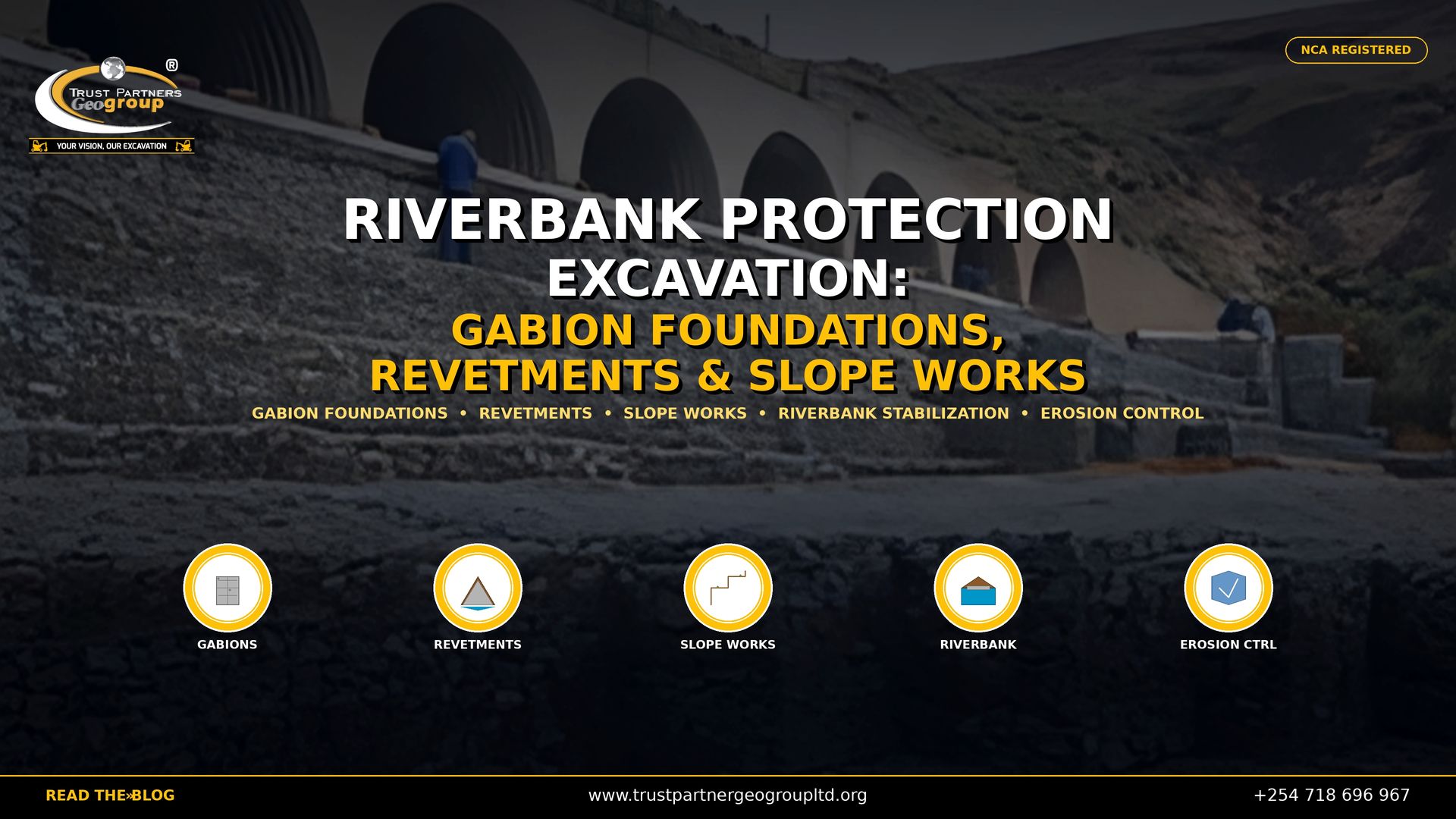
Riverbank Protection Excavation: Gabion Foundations, Revetments and Slope Works in Kenya [2026]
Riverbank Erosion Control for Kenya's Rivers, Roads, Farms & Riparian Communities
Every rainy season, Kenya's rivers take what is not defended: metres of farmland on the Nzoia and Nyando, road embankments along the Athi and Tana, and whole riparian plots on Nairobi's urban streams. Riverbank protection excavation is the engineered response — gabion foundations keyed below scour depth, revetments that armour the bank face, and slope works that give the river a stable edge. This 2026 engineering guide covers gabion foundation excavation, revetment construction in Kenya, riverbank erosion control and slope works — from the Athi and Tana to the Nzoia, Nyando, Mara and Nairobi river systems — with methods, specifications, costs and the WRA/NEMA compliance pathway. With 15+ years of excavation experience across Kenya, Trust Partners Geo-Group delivers both programmed riverbank works and emergency scour response.

From gabion toe walls on farm streams to kilometre-scale river training on major rivers, our team delivers riverbank protection across Kenya — founded below scour depth, armoured for the flood, and built to hold.
1. Riverbank Erosion in Kenya: The 2026 Landscape
Riverbank erosion is one of Kenya's most expensive quiet disasters. It does not make headlines like floods, but it consumes farmland, undermines road and bridge approaches, fills channels with sediment, and pushes riparian communities off their land — one storm at a time. Four forces are driving the 2026 workload:
- Heavier flood peaks: more intense storm bursts mean higher velocities, and velocity is what tears banks apart. Reaches that were stable for decades are now failing in a single season.
- Catchment degradation: deforestation and cultivation upstream deliver more runoff and more sediment, destabilising channel equilibrium downstream.
- Sand harvesting: unregulated instream sand harvesting lowers beds and triggers head-cutting that migrates upstream, undermining banks and bridge foundations.
- Riparian encroachment: buildings, farms and infrastructure press closer to channel edges than the riparian reserve allows — leaving no room for the river to move and no buffer when it does.
Riverbank protection sits inside the same water-management family as the drainage and retention works we covered in our flood mitigation excavation guide for Nairobi — but where flood works manage water on land, riverbank works defend land against the water itself.
2. What Is Riverbank Protection Excavation?
Riverbank protection excavation is the earthworks discipline that prepares and constructs engineered defences along eroding watercourses. It combines five toolkits, selected by the hydraulic and geotechnical assessment:
- Gabion structures — wire-mesh baskets and mattresses filled with stone, forming flexible, permeable walls and armour that move with the bank instead of cracking against it.
- Revetments — sloped armour layers (gabion mattresses, riprap, concrete block systems) that absorb flow energy on the bank face.
- Slope works — regrading over-steep banks to stable angles, benching, drainage and vegetation.
- Toe and foundation works — excavated, keyed-in bases that stop scour from undermining everything above.
- River training structures — check dams, groynes and spurs that manage where the channel flows and where sediment drops.
Gabions dominate Kenyan riverbank work for good reasons: they use locally available stone, tolerate differential settlement, drain freely (no pore-pressure build-up behind the face), and can be built with excavators, skilled fundis and modest formwork — a practical technology for county-scale budgets. The slope-engineering principles behind bank regrading are the same ones we apply in our landslide stabilization and bench cutting work in the Kenyan Highlands — water management first, then geometry, then structure.
3. Gabion Foundation Excavation: The Base That Decides Everything
Ask any experienced river engineer why gabion walls fail, and the answer is almost never the baskets — it is the foundation. Flood flow scours the bed at the toe of the bank; if the gabion base sits above the scour depth, the river simply excavates underneath it and the structure overturns. Gabion foundation excavation is therefore the most critical excavation activity on any riverbank project:
| Element | Typical Specification | Why It Matters |
|---|---|---|
| Foundation depth | Below design scour depth — commonly 1.0–2.0 m below bed level on perennial rivers; deeper on large alluvial rivers | Prevents undermining and overturning during floods |
| Key trench | 0.5–1.0 m into stable bank/bed material at both ends of the structure | Stops the river flanking the protection at its ends |
| Foundation width | Base gabion typically 1.0–1.5 m wide; stepped up in 0.5–1.0 m lifts | Distributes load; lower courses act as a flexible footing |
| Bed preparation | Remove soft silt and organic material to firm gravel/weathered rock; level to ±50 mm | Prevents differential settlement and basket distortion |
| Geotextile | Non-woven filter fabric under and behind all gabion faces | Stops fines washing out through the stone while letting water drain |
| Stone fill | Hard, durable rock, 100–250 mm, well graded; no weathered or flaky stone | Soft or undersized stone breaks down and the basket loses integrity |
| Basket mesh | Heavily galvanised or PVC-coated double-twist hexagonal mesh, typically 80×100 mm | PVC coating extends life dramatically in aggressive or polluted water |
Foundation excavation in a wet channel is done against the flow-management plan (Section 6): excavators work from the bank or from temporary stone causeways, trench sections are opened, founded and gabioned in short lengths, and each completed section protects the next. Where the bed is rock rather than alluvium, our hydraulic hammer and chemical breaking techniques shape the foundation bench without explosives near the water.
4. Revetment Construction: Armouring the Bank Face
Where the bank can be laid back to a stable slope, a revetment — a sloped armour layer — is usually cheaper per metre of river than a vertical gabion wall, and hydraulically gentler:
- Gabion mattress revetments: flat baskets 0.17–0.5 m thick laid on the regraded bank over geotextile; the standard Kenyan solution for eroding bends and bridge approaches. Flexible, permeable, and repairable in pieces after each flood season.
- Riprap (loose stone armour): dumped and dressed stone, typically 300–600 mm, placed on a filter layer. Cheapest where suitable rock is close to site; needs a stable regraded slope and a properly excavated toe trench or launch apron.
- Concrete block and articulated systems: for high-velocity urban channels where stone supply or vandalism is a concern.
- Gabion wall + mattress combinations: a vertical or stepped gabion toe wall keyed below scour depth, with a mattress revetment on the slope above — the workhorse detail for banks that cannot be fully laid back.
5. Riverbank Slope Works: Regrading, Benching and Drainage
Slope works prepare the bank to receive its protection — and often deliver most of the stability by themselves:
- Regrading: over-steep, actively failing banks are cut back to stable angles — typically 1V:1.5H to 1V:2H in alluvial soils, flatter in loose sands. Excavated material that is clean and granular is reused as backfill behind gabions; silt and organics are hauled away.
- Benching and berms: on high banks, intermediate berms break the slope, provide construction and maintenance access, and catch debris.
- Bank-top drainage: cutoff drains above the protection line intercept overland flow before it pours down the face — uncontrolled surface water is the most common cause of failure behind otherwise good gabion work. The same principle drives the drainage-first approach in our highland slope stabilization programme.
- Compaction: regraded fill placed in 150–200 mm layers and compacted; uncompacted banks settle, and settlement opens cracks that concentrate the next rain.
- Vegetation: grassing, bamboo and deep-rooted riparian planting on the finished slope above the armoured zone — roots are free reinforcement that improves every year.
6. Working In and Near Water: Dewatering, Diversions and Seasonal Windows
Riverbank excavation is won or lost on water management:
- Seasonal programming: foundation and toe works are scheduled for the dry windows (January–March, June–September) when levels are lowest. Flood season is for emergency response only.
- Staged construction: long reaches are split into 20–50 m sections; each is excavated, founded and armoured before the next opens, so no long length of bank is ever exposed to a surprise storm.
- Temporary diversions and cofferdams: on perennial flows, a partial channel diversion or a stone-and-sandbag cofferdam creates a dry working face for foundation excavation. Diversions are designed to pass normal dry-season flow and to fail safely — not catastrophically — if a storm arrives early.
- Dewatering: pumps and wellpoints handle seepage into foundation trenches; discharge is settled before returning to the river to protect water quality and comply with NEMA conditions.
- Weather discipline: river sites operate under weather-triggered work stoppages — upstream rainfall warnings matter as much as the sky overhead. A flash flood into an open foundation trench is the defining safety risk of this work.
For genuinely urgent scour — a bridge approach being cut, a water intake exposed — our 24/7 emergency equipment dispatch mobilises excavators, tippers and gabion crews within hours, with rapid-placement gabions and riprap to arrest the scour before engineered works follow.
7. Kenya's Riverbank Protection Hotspots
Riverbank protection demand follows Kenya's hydrology — big alluvial rivers in the west and east, flashy urban streams in Nairobi, and degraded highland catchments everywhere:
| River System | Region | Dominant Problem | Typical Protection Works |
|---|---|---|---|
| Nzoia | Busia, Siaya, Kakamega, Bungoma | Meander migration consuming farmland; floodplain scour | Gabion toe walls + mattress revetments on bends; groynes |
| Nyando & Kano Plains | Kisumu, Nyando | Chronic flooding and bank breach into low-lying farms and settlements | Dyke raising, bank regrading, gabion scour protection at breach points |
| Tana | Tana River, Garissa, Kitui, Machakos | High-energy floods, deep scour at bridges and intakes | Heavy riprap, deep-keyed gabion walls, launch aprons |
| Athi & tributaries | Machakos, Makueni, Nairobi, Kajiado | Sand harvesting head-cuts; urban encroachment; bridge scour | Check dams, gabion walls, mattress revetments |
| Nairobi, Ngong & Mathare rivers | Nairobi | Flash floods against encroached banks; infrastructure exposure | Channel regrading, gabion toe walls, combined drainage works |
| Mara | Narok, Bomet | Meander erosion on tourist-lodge frontages and grazing land | Mattress revetments, riprap, riparian revegetation |
| Perkerra, Kerio & Turkwell | Baringo, Elgeyo-Marakwet, West Pokot | Ephemeral flash floods; irrigation-intake and road crossings scour | Gabion spurs, weir aprons, embankment protection |
8. Equipment Selection for Riverbank Works
| Machine | Role on Riverbank Projects |
|---|---|
| Long-reach excavator (12–18 m) | Foundation and toe excavation, gabion setting, mattress placement and bank dressing from stable ground — the defining machine for river work |
| Standard 20–30 t excavator | Bulk bank regrading, trenching, stone handling with grab, cofferdam construction |
| Excavator with hydraulic breaker | Rock benches, boulder splitting, foundation shaping on rock beds |
| Bulldozer | Bulk regrading and riprap dressing on laid-back banks above the waterline |
| Wheel loader + tippers | Stone haulage from quarry to placement face — stone logistics usually set the production rate |
| Dewatering pumps & wellpoints | Foundation trench dewatering and seepage control |
| Plate compactors & rollers | Layered compaction of regraded banks and backfill behind gabions |
All plant is available through our heavy equipment for hire fleet, operated or self-drive, with long-reach configurations allocated to river projects first during the dry-season window.
9. Riverbank Protection Costs: 2026 Budget Benchmarks
Riverbank protection is priced per square metre of protected face or per metre of river reach, driven by structure depth, stone haulage distance and flow-management complexity:
| Work Item | Typical 2026 Range (KES) | Cost Driver |
|---|---|---|
| Gabion baskets, supplied & installed | 8,000–18,000 per m² of face | Mesh spec, stone source distance, access |
| Gabion mattresses, supplied & installed | 6,000–14,000 per m² | Thickness, geotextile, stone quality |
| Riprap placed on filter layer | 3,500–8,000 per m² | Stone size and haul distance |
| Foundation/toe excavation (wet) | 450–1,200 per m³ | Water handling, material, depth |
| Bank regrading | 250–650 per m³ | Slope height, disposal distance |
| Small farm/plot protection (50–100 m reach) | 1.5M–8M per project | Toe wall + regraded grassed slope detail |
| County-scale reach protection | 3M–15M per 100 m reach | Structure height and scour depth |
| Major river training (large alluvial rivers) | 20M–100M+ per km | Groynes, check dams, deep keyed works |
| Emergency scour response | Quoted per event | Mobilization speed, flow conditions |
10. WRA, NEMA and County Compliance for River Works
Riverbank protection touches Kenya's most regulated work environment — the watercourse itself:
- Water Resources Authority (WRA): a permit is required for any works in or affecting a watercourse — diversions, structures in the channel, abstractions for dewatering. Applications include drawings, method statements and hydrology.
- NEMA: environmental clearance via EIA or summary project report depending on scale; conditions typically cover water quality, sediment control, working windows and riparian restoration.
- Riparian reserves: works and any adjacent development must respect riparian setbacks — generally 6–30 m from the bank depending on the watercourse. Protection works that lawful occupants depend on are defensible; new encroachment is not.
- County governments: approvals and, for community rivers, public participation — riverbank projects fail socially before they fail technically if downstream and opposite-bank communities are not engaged.
- NCA: contractor and project registration — see our NCA registration requirements guide.
- Site safety: open water plus excavation is a compound hazard — life jackets at the waterline, no lone working in trenches below water level, weather-triggered stoppages, and rescue equipment on every river site.
11. Frequently Asked Questions
How much does riverbank protection cost in Kenya?
In 2026: gabion protection typically runs KES 8,000–18,000 per m² of face, a 100-metre reach KES 3–15 million, and major river training KES 20–100 million+ per kilometre on large rivers. Emergency scour repairs are quoted per event.
What is a gabion foundation and why is it excavated?
It is the excavated, levelled, keyed-in base on which gabion baskets sit — dug below the scour depth into stable ground. Without it, flood flow excavates beneath the structure and overturns it. The foundation decides whether the protection survives its first major flood.
What is the difference between a revetment and a gabion wall?
A revetment is a sloped armour layer (gabion mattresses, riprap or blocks) on a regraded bank. A gabion wall is a vertical or stepped stacked-basket structure used where the bank must be held steep or land is limited. Many projects combine a gabion toe wall with a mattress revetment above.
Do I need a permit to protect a riverbank in Kenya?
Yes — a WRA permit for works in or affecting the watercourse, NEMA environmental clearance, county approval and an NCA-registered contractor. Riparian setback rules (typically 6–30 m) must be respected.
When is the best time to do riverbank works in Kenya?
The dry windows — January to March and June to September — when low flows allow foundation excavation and gabion placement without major diversion works. Emergency scour repairs proceed any time with cofferdams and rapid-placement gabions.
Can riverbank protection work on small farms and riverside plots?
Yes — the methods scale down to a 1–2 m gabion toe wall with a regraded, grassed slope above, or mattress revetments on the critical bend. Protecting a small erosion scar early costs a fraction of reclaiming land after metres of bank are lost.
Who does gabion installation and riverbank protection in Kenya?
NCA-registered earthworks and civil contractors with river-works experience. Trust Partners Geo-Group delivers gabion foundation excavation, gabion supply and installation, revetments and emergency scour repairs across all 47 counties — call +254 718 686 967.
12. Conclusion: Key the Toe, Armour the Face, Respect the River
Durable riverbank protection in Kenya always follows the same sequence: excavate the foundation below scour depth and key it into stable ground, armour the face with gabions, mattresses or riprap that flex and drain, regrade and drain the slope above so surface water never attacks from behind, and programme the wet work for the dry window — with emergency capability for the scours that will not wait.
For county governments, road agencies, irrigation schemes, farmers and riverside landowners, the 2026 reality is simple: rivers are running harder, and unprotected banks are retreating faster. The cheapest metre of protection is the one built before the flood takes the next five. From a single farm bend to a kilometre of county river frontage, the approach connects directly to our flood mitigation works and our slope stabilization programme — one integrated water-and-earth capability across all 47 counties.
Trust Partners Geo-Group delivers riverbank protection end-to-end: hydrology-aware assessment, WRA and NEMA compliance support, gabion foundation excavation, gabion supply and installation, revetments, slope works, and 24/7 emergency scour response — nationwide.
River Taking Your Bank? Defend It Before the Next Rains.
Trust Partners Geo-Group delivers WRA-compliant riverbank protection — gabion foundations, revetments, slope works and 24/7 emergency scour response — across Nairobi and all 47 counties.
Call +254 718 686 967 — 24/7 Request a Riverbank AssessmentRiverbank Protection Excavation: Gabion Foundations, Revetments and Slope Works in Kenya [2026]
Riverbank Erosion Control for Kenya's Rivers, Roads, Farms & Riparian Communities
Every rainy season, Kenya's rivers take what is not defended: metres of farmland on the Nzoia and Nyando, road embankments along the Athi and Tana, and whole riparian plots on Nairobi's urban streams. Riverbank protection excavation is the engineered response — gabion foundations keyed below scour depth, revetments that armour the bank face, and slope works that give the river a stable edge. This 2026 engineering guide covers gabion foundation excavation, revetment construction in Kenya, riverbank erosion control and slope works — from the Athi and Tana to the Nzoia, Nyando, Mara and Nairobi river systems — with methods, specifications, costs and the WRA/NEMA compliance pathway. With 15+ years of excavation experience across Kenya, Trust Partners Geo-Group delivers both programmed riverbank works and emergency scour response.
From gabion toe walls on farm streams to kilometre-scale river training on major rivers, our team delivers riverbank protection across Kenya — founded below scour depth, armoured for the flood, and built to hold.
1. Riverbank Erosion in Kenya: The 2026 Landscape
Riverbank erosion is one of Kenya's most expensive quiet disasters. It does not make headlines like floods, but it consumes farmland, undermines road and bridge approaches, fills channels with sediment, and pushes riparian communities off their land — one storm at a time. Four forces are driving the 2026 workload:
- Heavier flood peaks: more intense storm bursts mean higher velocities, and velocity is what tears banks apart. Reaches that were stable for decades are now failing in a single season.
- Catchment degradation: deforestation and cultivation upstream deliver more runoff and more sediment, destabilising channel equilibrium downstream.
- Sand harvesting: unregulated instream sand harvesting lowers beds and triggers head-cutting that migrates upstream, undermining banks and bridge foundations.
- Riparian encroachment: buildings, farms and infrastructure press closer to channel edges than the riparian reserve allows — leaving no room for the river to move and no buffer when it does.
Riverbank protection sits inside the same water-management family as the drainage and retention works we covered in our flood mitigation excavation guide for Nairobi — but where flood works manage water on land, riverbank works defend land against the water itself.
2. What Is Riverbank Protection Excavation?
Riverbank protection excavation is the earthworks discipline that prepares and constructs engineered defences along eroding watercourses. It combines five toolkits, selected by the hydraulic and geotechnical assessment:
- Gabion structures — wire-mesh baskets and mattresses filled with stone, forming flexible, permeable walls and armour that move with the bank instead of cracking against it.
- Revetments — sloped armour layers (gabion mattresses, riprap, concrete block systems) that absorb flow energy on the bank face.
- Slope works — regrading over-steep banks to stable angles, benching, drainage and vegetation.
- Toe and foundation works — excavated, keyed-in bases that stop scour from undermining everything above.
- River training structures — check dams, groynes and spurs that manage where the channel flows and where sediment drops.
Gabions dominate Kenyan riverbank work for good reasons: they use locally available stone, tolerate differential settlement, drain freely (no pore-pressure build-up behind the face), and can be built with excavators, skilled fundis and modest formwork — a practical technology for county-scale budgets. The slope-engineering principles behind bank regrading are the same ones we apply in our landslide stabilization and bench cutting work in the Kenyan Highlands — water management first, then geometry, then structure.
3. Gabion Foundation Excavation: The Base That Decides Everything
Ask any experienced river engineer why gabion walls fail, and the answer is almost never the baskets — it is the foundation. Flood flow scours the bed at the toe of the bank; if the gabion base sits above the scour depth, the river simply excavates underneath it and the structure overturns. Gabion foundation excavation is therefore the most critical excavation activity on any riverbank project:
| Element | Typical Specification | Why It Matters |
|---|---|---|
| Foundation depth | Below design scour depth — commonly 1.0–2.0 m below bed level on perennial rivers; deeper on large alluvial rivers | Prevents undermining and overturning during floods |
| Key trench | 0.5–1.0 m into stable bank/bed material at both ends of the structure | Stops the river flanking the protection at its ends |
| Foundation width | Base gabion typically 1.0–1.5 m wide; stepped up in 0.5–1.0 m lifts | Distributes load; lower courses act as a flexible footing |
| Bed preparation | Remove soft silt and organic material to firm gravel/weathered rock; level to ±50 mm | Prevents differential settlement and basket distortion |
| Geotextile | Non-woven filter fabric under and behind all gabion faces | Stops fines washing out through the stone while letting water drain |
| Stone fill | Hard, durable rock, 100–250 mm, well graded; no weathered or flaky stone | Soft or undersized stone breaks down and the basket loses integrity |
| Basket mesh | Heavily galvanised or PVC-coated double-twist hexagonal mesh, typically 80×100 mm | PVC coating extends life dramatically in aggressive or polluted water |
Foundation excavation in a wet channel is done against the flow-management plan (Section 6): excavators work from the bank or from temporary stone causeways, trench sections are opened, founded and gabioned in short lengths, and each completed section protects the next. Where the bed is rock rather than alluvium, our hydraulic hammer and chemical breaking techniques shape the foundation bench without explosives near the water.
4. Revetment Construction: Armouring the Bank Face
Where the bank can be laid back to a stable slope, a revetment — a sloped armour layer — is usually cheaper per metre of river than a vertical gabion wall, and hydraulically gentler:
- Gabion mattress revetments: flat baskets 0.17–0.5 m thick laid on the regraded bank over geotextile; the standard Kenyan solution for eroding bends and bridge approaches. Flexible, permeable, and repairable in pieces after each flood season.
- Riprap (loose stone armour): dumped and dressed stone, typically 300–600 mm, placed on a filter layer. Cheapest where suitable rock is close to site; needs a stable regraded slope and a properly excavated toe trench or launch apron.
- Concrete block and articulated systems: for high-velocity urban channels where stone supply or vandalism is a concern.
- Gabion wall + mattress combinations: a vertical or stepped gabion toe wall keyed below scour depth, with a mattress revetment on the slope above — the workhorse detail for banks that cannot be fully laid back.
5. Riverbank Slope Works: Regrading, Benching and Drainage
Slope works prepare the bank to receive its protection — and often deliver most of the stability by themselves:
- Regrading: over-steep, actively failing banks are cut back to stable angles — typically 1V:1.5H to 1V:2H in alluvial soils, flatter in loose sands. Excavated material that is clean and granular is reused as backfill behind gabions; silt and organics are hauled away.
- Benching and berms: on high banks, intermediate berms break the slope, provide construction and maintenance access, and catch debris.
- Bank-top drainage: cutoff drains above the protection line intercept overland flow before it pours down the face — uncontrolled surface water is the most common cause of failure behind otherwise good gabion work. The same principle drives the drainage-first approach in our highland slope stabilization programme.
- Compaction: regraded fill placed in 150–200 mm layers and compacted; uncompacted banks settle, and settlement opens cracks that concentrate the next rain.
- Vegetation: grassing, bamboo and deep-rooted riparian planting on the finished slope above the armoured zone — roots are free reinforcement that improves every year.
6. Working In and Near Water: Dewatering, Diversions and Seasonal Windows
Riverbank excavation is won or lost on water management:
- Seasonal programming: foundation and toe works are scheduled for the dry windows (January–March, June–September) when levels are lowest. Flood season is for emergency response only.
- Staged construction: long reaches are split into 20–50 m sections; each is excavated, founded and armoured before the next opens, so no long length of bank is ever exposed to a surprise storm.
- Temporary diversions and cofferdams: on perennial flows, a partial channel diversion or a stone-and-sandbag cofferdam creates a dry working face for foundation excavation. Diversions are designed to pass normal dry-season flow and to fail safely — not catastrophically — if a storm arrives early.
- Dewatering: pumps and wellpoints handle seepage into foundation trenches; discharge is settled before returning to the river to protect water quality and comply with NEMA conditions.
- Weather discipline: river sites operate under weather-triggered work stoppages — upstream rainfall warnings matter as much as the sky overhead. A flash flood into an open foundation trench is the defining safety risk of this work.
For genuinely urgent scour — a bridge approach being cut, a water intake exposed — our 24/7 emergency equipment dispatch mobilises excavators, tippers and gabion crews within hours, with rapid-placement gabions and riprap to arrest the scour before engineered works follow.
7. Kenya's Riverbank Protection Hotspots
Riverbank protection demand follows Kenya's hydrology — big alluvial rivers in the west and east, flashy urban streams in Nairobi, and degraded highland catchments everywhere:
| River System | Region | Dominant Problem | Typical Protection Works |
|---|---|---|---|
| Nzoia | Busia, Siaya, Kakamega, Bungoma | Meander migration consuming farmland; floodplain scour | Gabion toe walls + mattress revetments on bends; groynes |
| Nyando & Kano Plains | Kisumu, Nyando | Chronic flooding and bank breach into low-lying farms and settlements | Dyke raising, bank regrading, gabion scour protection at breach points |
| Tana | Tana River, Garissa, Kitui, Machakos | High-energy floods, deep scour at bridges and intakes | Heavy riprap, deep-keyed gabion walls, launch aprons |
| Athi & tributaries | Machakos, Makueni, Nairobi, Kajiado | Sand harvesting head-cuts; urban encroachment; bridge scour | Check dams, gabion walls, mattress revetments |
| Nairobi, Ngong & Mathare rivers | Nairobi | Flash floods against encroached banks; infrastructure exposure | Channel regrading, gabion toe walls, combined drainage works |
| Mara | Narok, Bomet | Meander erosion on tourist-lodge frontages and grazing land | Mattress revetments, riprap, riparian revegetation |
| Perkerra, Kerio & Turkwell | Baringo, Elgeyo-Marakwet, West Pokot | Ephemeral flash floods; irrigation-intake and road crossings scour | Gabion spurs, weir aprons, embankment protection |
8. Equipment Selection for Riverbank Works
| Machine | Role on Riverbank Projects |
|---|---|
| Long-reach excavator (12–18 m) | Foundation and toe excavation, gabion setting, mattress placement and bank dressing from stable ground — the defining machine for river work |
| Standard 20–30 t excavator | Bulk bank regrading, trenching, stone handling with grab, cofferdam construction |
| Excavator with hydraulic breaker | Rock benches, boulder splitting, foundation shaping on rock beds |
| Bulldozer | Bulk regrading and riprap dressing on laid-back banks above the waterline |
| Wheel loader + tippers | Stone haulage from quarry to placement face — stone logistics usually set the production rate |
| Dewatering pumps & wellpoints | Foundation trench dewatering and seepage control |
| Plate compactors & rollers | Layered compaction of regraded banks and backfill behind gabions |
All plant is available through our heavy equipment for hire fleet, operated or self-drive, with long-reach configurations allocated to river projects first during the dry-season window.
9. Riverbank Protection Costs: 2026 Budget Benchmarks
Riverbank protection is priced per square metre of protected face or per metre of river reach, driven by structure depth, stone haulage distance and flow-management complexity:
| Work Item | Typical 2026 Range (KES) | Cost Driver |
|---|---|---|
| Gabion baskets, supplied & installed | 8,000–18,000 per m² of face | Mesh spec, stone source distance, access |
| Gabion mattresses, supplied & installed | 6,000–14,000 per m² | Thickness, geotextile, stone quality |
| Riprap placed on filter layer | 3,500–8,000 per m² | Stone size and haul distance |
| Foundation/toe excavation (wet) | 450–1,200 per m³ | Water handling, material, depth |
| Bank regrading | 250–650 per m³ | Slope height, disposal distance |
| Small farm/plot protection (50–100 m reach) | 1.5M–8M per project | Toe wall + regraded grassed slope detail |
| County-scale reach protection | 3M–15M per 100 m reach | Structure height and scour depth |
| Major river training (large alluvial rivers) | 20M–100M+ per km | Groynes, check dams, deep keyed works |
| Emergency scour response | Quoted per event | Mobilization speed, flow conditions |
10. WRA, NEMA and County Compliance for River Works
Riverbank protection touches Kenya's most regulated work environment — the watercourse itself:
- Water Resources Authority (WRA): a permit is required for any works in or affecting a watercourse — diversions, structures in the channel, abstractions for dewatering. Applications include drawings, method statements and hydrology.
- NEMA: environmental clearance via EIA or summary project report depending on scale; conditions typically cover water quality, sediment control, working windows and riparian restoration.
- Riparian reserves: works and any adjacent development must respect riparian setbacks — generally 6–30 m from the bank depending on the watercourse. Protection works that lawful occupants depend on are defensible; new encroachment is not.
- County governments: approvals and, for community rivers, public participation — riverbank projects fail socially before they fail technically if downstream and opposite-bank communities are not engaged.
- NCA: contractor and project registration — see our NCA registration requirements guide.
- Site safety: open water plus excavation is a compound hazard — life jackets at the waterline, no lone working in trenches below water level, weather-triggered stoppages, and rescue equipment on every river site.
11. Frequently Asked Questions
How much does riverbank protection cost in Kenya?
In 2026: gabion protection typically runs KES 8,000–18,000 per m² of face, a 100-metre reach KES 3–15 million, and major river training KES 20–100 million+ per kilometre on large rivers. Emergency scour repairs are quoted per event.
What is a gabion foundation and why is it excavated?
It is the excavated, levelled, keyed-in base on which gabion baskets sit — dug below the scour depth into stable ground. Without it, flood flow excavates beneath the structure and overturns it. The foundation decides whether the protection survives its first major flood.
What is the difference between a revetment and a gabion wall?
A revetment is a sloped armour layer (gabion mattresses, riprap or blocks) on a regraded bank. A gabion wall is a vertical or stepped stacked-basket structure used where the bank must be held steep or land is limited. Many projects combine a gabion toe wall with a mattress revetment above.
Do I need a permit to protect a riverbank in Kenya?
Yes — a WRA permit for works in or affecting the watercourse, NEMA environmental clearance, county approval and an NCA-registered contractor. Riparian setback rules (typically 6–30 m) must be respected.
When is the best time to do riverbank works in Kenya?
The dry windows — January to March and June to September — when low flows allow foundation excavation and gabion placement without major diversion works. Emergency scour repairs proceed any time with cofferdams and rapid-placement gabions.
Can riverbank protection work on small farms and riverside plots?
Yes — the methods scale down to a 1–2 m gabion toe wall with a regraded, grassed slope above, or mattress revetments on the critical bend. Protecting a small erosion scar early costs a fraction of reclaiming land after metres of bank are lost.
Who does gabion installation and riverbank protection in Kenya?
NCA-registered earthworks and civil contractors with river-works experience. Trust Partners Geo-Group delivers gabion foundation excavation, gabion supply and installation, revetments and emergency scour repairs across all 47 counties — call +254 718 686 967.
12. Conclusion: Key the Toe, Armour the Face, Respect the River
Durable riverbank protection in Kenya always follows the same sequence: excavate the foundation below scour depth and key it into stable ground, armour the face with gabions, mattresses or riprap that flex and drain, regrade and drain the slope above so surface water never attacks from behind, and programme the wet work for the dry window — with emergency capability for the scours that will not wait.
For county governments, road agencies, irrigation schemes, farmers and riverside landowners, the 2026 reality is simple: rivers are running harder, and unprotected banks are retreating faster. The cheapest metre of protection is the one built before the flood takes the next five. From a single farm bend to a kilometre of county river frontage, the approach connects directly to our flood mitigation works and our slope stabilization programme — one integrated water-and-earth capability across all 47 counties.
Trust Partners Geo-Group delivers riverbank protection end-to-end: hydrology-aware assessment, WRA and NEMA compliance support, gabion foundation excavation, gabion supply and installation, revetments, slope works, and 24/7 emergency scour response — nationwide.
River Taking Your Bank? Defend It Before the Next Rains.
Trust Partners Geo-Group delivers WRA-compliant riverbank protection — gabion foundations, revetments, slope works and 24/7 emergency scour response — across Nairobi and all 47 counties.
Call +254 718 686 967 — 24/7 Request a Riverbank Assessment