
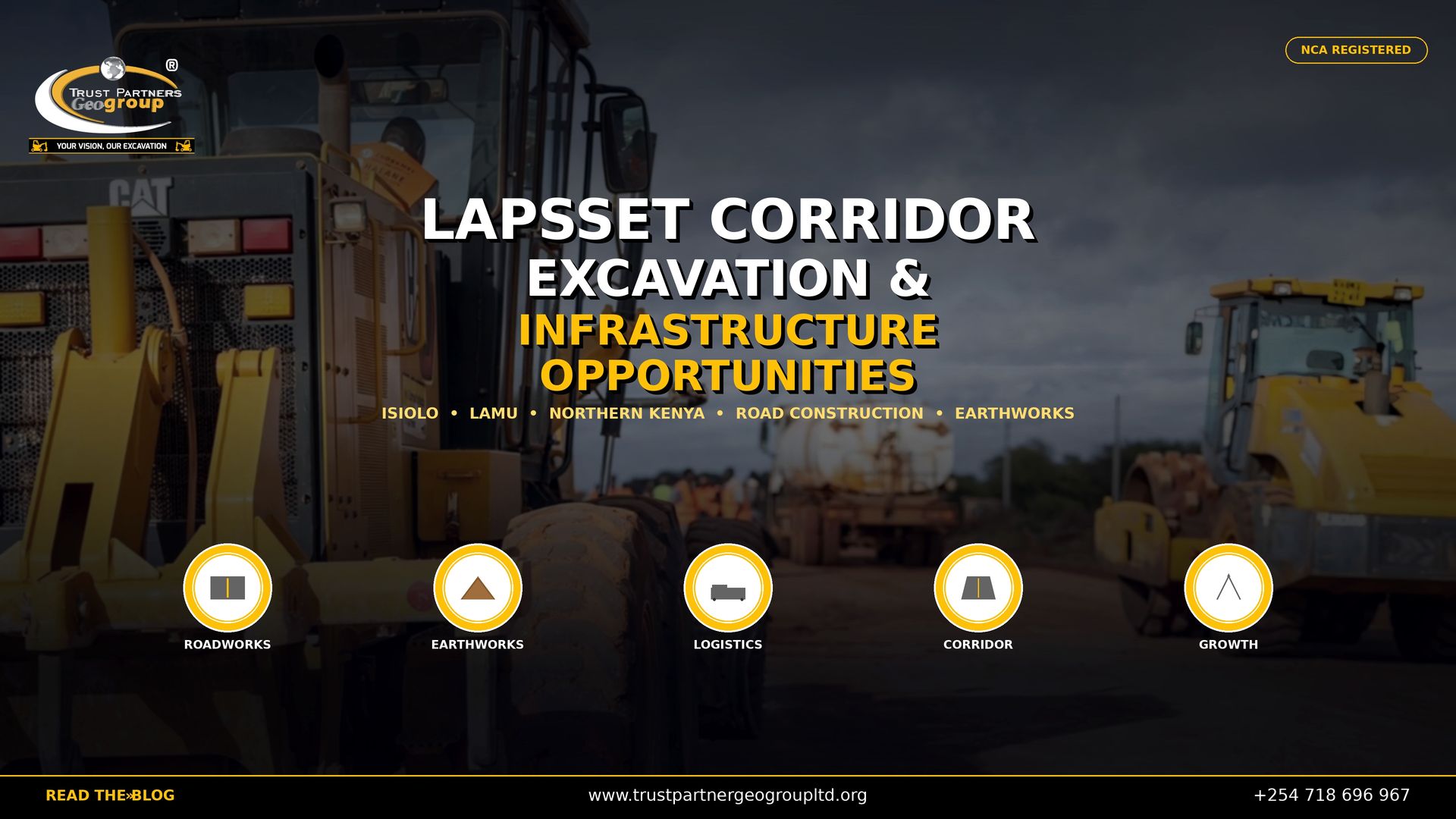
LAPSSET Corridor Excavation: Infrastructure Opportunities in Isiolo, Lamu and Northern Kenya [2026]
The Mega-Project Earthworks Map for Northern Kenya — Ports, Roads, Pads, Pipelines & Power
The LAPSSET corridor — Lamu Port, the transport corridor through Isiolo, and the pipelines and power lines reaching toward South Sudan and Ethiopia — is Kenya's largest infrastructure canvas. Behind every headline berth and highway sits the same unglamorous foundation: excavation and earthworks, at scale, in some of the toughest working conditions in the country. This 2026 mega-project map covers LAPSSET corridor excavation in Kenya, Isiolo construction excavation, Lamu port earthworks and northern Kenya infrastructure excavation — what the components involve, where the subcontract opportunities sit, how remote logistics work, and what it costs. With 15+ years of excavation experience across Kenya, Trust Partners Geo-Group operates self-sufficient earthworks spreads from Nairobi to the northern frontier.

From corridor roads to construction pads, our teams deliver remote earthworks the way the north demands — self-sufficient water, parts and camp logistics, heat-managed shifts, and records that survive the distance from head office.
1. LAPSSET in 2026: Where the Corridor Actually Stands
LAPSSET — the Lamu Port–South Sudan–Ethiopia Transport corridor — is no longer a single mega-project but a portfolio of packages at different stages. For earthworks contractors, what matters is where dirt is actually moving:
- Lamu Port: operational berths with continuing associated works — yard expansions, access roads, utilities and the port city's supporting infrastructure.
- Corridor roads: staged construction of the Lamu–Isiolo–Lokichar highway axis, with sections at different stages from earthworks to surfacing.
- Isiolo node: airport infrastructure, resort-city groundwork and the commercial development following the corridor's central hub.
- Pipeline and power corridors: the Lokichar–Lamu crude pipeline alignment and transmission line corridors generating trenching and foundation work.
- Private follow-on investment: logistics parks, fuel depots, housing and hospitality along the corridor — steady, financeable earthworks demand that does not wait for mega-project headlines.
2. The Corridor Earthworks Map: Component by Component
| Component | Location | Earthworks Scope |
|---|---|---|
| Lamu Port & port city | Lamu (Manda Bay) | Platforms, yards, utilities, drainage, access roads, building foundations |
| Corridor highway sections | Lamu–Garissa–Isiolo–Lokichar | Mass cut-to-fill, formation, drainage, culverts, borrow operations |
| Isiolo hub | Isiolo | Airport-support earthworks, resort-city platforms, commercial pads |
| Crude pipeline corridor | Lokichar–Lamu alignment | Pipeline trenching, crossings, access tracks — our pipeline trenching discipline at corridor scale |
| Power transmission lines | Corridor-wide | Tower foundation excavation, access tracks — the same tower foundation methods scaled to transmission steel |
| Water infrastructure | Corridor-wide | Water pans, dams, borehole pads, pipeline routes serving construction and communities |
| Private follow-on development | Lamu, Isiolo, corridor towns | Logistics parks, depots, housing estates, hotel platforms |
3. Lamu Port and Harbour: Earthworks at the Water's Edge
Lamu port earthworks combine marine and land disciplines in one site:
- Platform and yard earthworks: mass fill over soft coastal deposits, surcharge and drainage discipline, pavements built on ground that was recently seabed-margin.
- Reclamation-edge works: revetments and armouring where land meets dredged fill — the same protection engineering as our coastal erosion control work.
- Utilities and drainage: deep service trenches through variable ground, culverts sized for coastal storm bursts.
- Access and logistics earthworks: haul roads carrying construction traffic that continues for years, not months.
4. Isiolo: Construction Excavation at the Corridor's Centre
Isiolo is the corridor's inland pivot — and its most active private-market node. Isiolo construction excavation in 2026 spans:
- Building and commercial pads: levelled, compacted platforms for the hotels, logistics facilities and commercial buildings following the corridor — cut-to-fill on sloping terrain with black cotton patches requiring selective replacement.
- Resort-city groundwork: large-scale platform formation, lakes and landscape earthworks, road networks — long-duration earthworks programmes.
- Airport-support infrastructure: aprons, access and drainage adjoining the upgraded airport — where our precision grading experience applies directly.
- Water and drainage: pans, channels and stormwater systems — in a semi-arid county, every development's earthworks begin with where the occasional, violent rain will go.
5. Corridor Roads, Pipelines and Power Lines
The linear components are the corridor's largest earthworks volumes:
- Highway earthworks: mass cut-to-fill through rolling and broken terrain, formation to tight tolerance over hundreds of kilometres, drainage structures at every watercourse — and borrow-pit management across a landscape where suitable material is not evenly distributed.
- Pipeline corridors: continuous trenching with crossings at roads, rivers and communities; padding and backfill to specification; reinstatement to pre-construction condition as an environmental obligation.
- Power line foundations: hundreds of tower bases along access tracks that often must be built first — the access track itself is an earthworks package.
- Railway reservation works: formation and drainage where the standard-gauge extension is prepared — the methods of our railway earthworks guide applied to new corridor.
6. Arid-Zone Earthworks: Water, Heat and Soils
Northern Kenya changes the earthworks rulebook:
- Water is the first mobilization item: compaction needs water — thousands of litres per day. Water bowsers, negotiated sources, pans and sometimes boreholes are established before the first cut. Our arid-zone solar and wind experience was built on exactly this discipline.
- Heat management: machines need tropical cooling packages and disciplined maintenance; crews need shade, hydration and shift patterns that respect 40°C afternoons.
- Flash floods in dry country: ephemeral watercourses run violently when they run; earthworks in luggas and crossings are programmed with weather discipline, and camps never sit in drainage lines.
- Variable soils: expansive clays, saline patches and loose sands appear within single sites — selective excavation, replacement and stabilization are normal scope, not extras.
- Dust: a safety, environmental and community issue — dust suppression is continuous scope on corridor works, not an occasional courtesy.
7. Remote Logistics: Getting Plant to Northern Kenya
Mobilization is a project inside the project. The disciplines that decide success — detailed in our heavy equipment transport guide — are amplified in the north:
- Route surveys: bridge capacities and road condition to Isiolo are manageable; beyond, toward Lamu's hinterland or Turkana, the last sections decide the plan.
- Fuel and parts chains: bulk fuel storage on site, scheduled resupply convoys, and critical spares pre-positioned — the nearest dealer support may be 600 km away.
- Camp infrastructure: accommodation, workshops, communications and medical provision — remote spreads are self-sufficient by design.
- Security coordination: route and site security arranged with local structures where required — planned professionally, not improvised.
- Seasonal windows: rain closes murram corridors; mobilization is timed to seasons as seriously as the earthworks programme itself.
8. Equipment Selection for Northern Kenya Projects
| Machine | Role on Corridor Projects |
|---|---|
| 30–45 t excavators (tropical spec) | Mass excavation, trenching, loading — reliability packages and cooling suited to 40°C |
| Bulldozers (D7–D9 class) | Bulk push, corridor clearing, platform formation over long distances |
| Motor graders | Road formation, haul road maintenance — on corridor work, graders never stop |
| Articulated dump trucks / tippers | Cut-to-fill haulage; ADTs where haul roads are unfinished |
| Water bowsers | Compaction water and dust suppression — the most important machine in an arid spread |
| Rollers & compactors | Formation and fill compaction with disciplined moisture control |
| Screening/crushing plant | Processing borrow material where suitable gravels must be manufactured on site |
| Service trucks & workshop units | Field maintenance keeping the spread alive far from dealer support |
Every machine is crewed by certified operators experienced in remote conditions — in the north, operator machine-care discipline is a survival skill, not a nicety.
9. Northern Kenya Excavation Costs: 2026 Benchmarks
| Work Item | Typical 2026 Range (KES) | Remote Factor |
|---|---|---|
| General cut-to-fill earthworks | 250–650 per m³ | Base rates similar to Nairobi |
| Road formation & trimming | 350–900 per m² | Water and borrow distance drive cost |
| Construction pads & platforms | 1M–20M per pad | Size, fill depth, ground conditions |
| Pipeline trenching (corridor) | 1,500–4,500 per metre | Depth, ground, crossings |
| Water pans / small dams | 400–900 per m³ | Liner/lining method, spillway works |
| Machine mobilization (per machine) | 350,000–800,000+ | Distance, route, escorts |
| Camp & site establishment | 3M–25M per site | Duration, capacity, services |
| Remote project total premium | +20–50% vs Nairobi equivalent | Mobilization, water, logistics, security |
10. Winning Subcontract Work on the Corridor
- NCA registration at the appropriate class — the entry ticket; see our NCA registration guide.
- Demonstrable capacity: plant schedules, operator credentials, and evidence of remote delivery — main contractors buy certainty, not promises.
- HSE systems: documented safety, heat management, security and environmental plans — corridor consortia audit these before price.
- Financial standing: remote work demands working capital — mobilization, camps and fuel are paid long before certificates are.
- Local engagement: county liaison, local employment and community protocols — corridor packages carry community obligations that subcontractors help deliver.
- Package targeting: access roads, pads, drainage, water pans and general earthworks are the recurring subcontracted scope — position for them explicitly.
11. Frequently Asked Questions
What excavation work does the LAPSSET corridor involve?
Port and harbour earthworks at Lamu, highway cut-to-fill along the corridor, construction pads at Isiolo, pipeline trenching toward Lokichar, power line foundations, water pans and drainage, and building platforms for the towns growing around the corridor.
How much does excavation cost in northern Kenya compared to Nairobi?
Unit rates are similar — KES 250–650 per m³ for cut and fill — but total costs rise 20–50% with mobilization, water logistics, camps, security and long supply lines. Machine mobilization runs KES 350,000–800,000+ per machine.
What is the status of LAPSSET projects in 2026?
Progress continues in packages: Lamu port works, staged corridor road sections, Isiolo's airport and resort-city infrastructure, transmission lines and water infrastructure — plus private logistics, housing and hospitality investment generating steady earthworks demand around the corridor.
What are the challenges of construction excavation in northern Kenya?
Extreme heat, water scarcity for compaction, long mobilization distances, security coordination, thin supply chains, expansive and saline soils, and flash floods in dry-looking terrain. Successful contractors pre-position water, parts and camp infrastructure before mobilizing.
Can Kenyan contractors work on LAPSSET subcontract packages?
Yes — corridor main contractors subcontract earthworks, access roads, pads, drainage and haulage to capable local firms. Requirements: NCA registration, demonstrable plant and operator capacity, HSE systems, financial standing and remote-delivery capability.
What equipment is best suited to northern Kenya earthworks?
Tropical-spec excavators and dozers, ADTs or scrapers for long hauls, graders for corridor roads, water bowsers, rollers, and on-site screening/crushing where borrow must be processed. Reliability beats peak specification when the nearest dealer is 600 km away.
Who provides excavation and heavy equipment for northern Kenya projects?
NCA-registered contractors with proven remote capability. Trust Partners Geo-Group delivers earthworks, pads, access roads, trenching and water infrastructure across Isiolo, Lamu, Garissa, Marsabit and Turkana — self-sufficient spreads, water logistics, 24/7 support. Call +254 718 686 967.
12. Conclusion: The Corridor Is Built by Those Who Can Reach It
LAPSSET's earthworks opportunity belongs to contractors who can do two things at once: deliver specification earthworks, and sustain themselves 600 kilometres from the nearest dealer. The scope is real and recurring — pads, roads, trenches, pans and platforms across Isiolo, Lamu and the corridor counties — and it rewards preparation: water secured first, machines that survive the heat, records that travel back intact.
The corridor compounds with everything else Kenya is building — the renewable energy projects across the same arid counties, the port-edge protection of our coastal programme, and the documented delivery standards of our handover discipline.
Trust Partners Geo-Group delivers northern Kenya earthworks end-to-end: mobilization, camps, water logistics, earthworks, trenching, pads and documented handover — Isiolo, Lamu, Garissa, Marsabit, Turkana and all 47 counties.
Bidding Corridor Work? Partner With a Fleet That Knows the North.
Trust Partners Geo-Group delivers remote earthworks — self-sufficient spreads, water logistics and documented handover — across Isiolo, Lamu and all of northern Kenya.
Call +254 718 686 967 — 24/7 Discuss a Corridor PackageLAPSSET Corridor Excavation: Infrastructure Opportunities in Isiolo, Lamu and Northern Kenya [2026]
The Mega-Project Earthworks Map for Northern Kenya — Ports, Roads, Pads, Pipelines & Power
The LAPSSET corridor — Lamu Port, the transport corridor through Isiolo, and the pipelines and power lines reaching toward South Sudan and Ethiopia — is Kenya's largest infrastructure canvas. Behind every headline berth and highway sits the same unglamorous foundation: excavation and earthworks, at scale, in some of the toughest working conditions in the country. This 2026 mega-project map covers LAPSSET corridor excavation in Kenya, Isiolo construction excavation, Lamu port earthworks and northern Kenya infrastructure excavation — what the components involve, where the subcontract opportunities sit, how remote logistics work, and what it costs. With 15+ years of excavation experience across Kenya, Trust Partners Geo-Group operates self-sufficient earthworks spreads from Nairobi to the northern frontier.
From corridor roads to construction pads, our teams deliver remote earthworks the way the north demands — self-sufficient water, parts and camp logistics, heat-managed shifts, and records that survive the distance from head office.
1. LAPSSET in 2026: Where the Corridor Actually Stands
LAPSSET — the Lamu Port–South Sudan–Ethiopia Transport corridor — is no longer a single mega-project but a portfolio of packages at different stages. For earthworks contractors, what matters is where dirt is actually moving:
- Lamu Port: operational berths with continuing associated works — yard expansions, access roads, utilities and the port city's supporting infrastructure.
- Corridor roads: staged construction of the Lamu–Isiolo–Lokichar highway axis, with sections at different stages from earthworks to surfacing.
- Isiolo node: airport infrastructure, resort-city groundwork and the commercial development following the corridor's central hub.
- Pipeline and power corridors: the Lokichar–Lamu crude pipeline alignment and transmission line corridors generating trenching and foundation work.
- Private follow-on investment: logistics parks, fuel depots, housing and hospitality along the corridor — steady, financeable earthworks demand that does not wait for mega-project headlines.
2. The Corridor Earthworks Map: Component by Component
| Component | Location | Earthworks Scope |
|---|---|---|
| Lamu Port & port city | Lamu (Manda Bay) | Platforms, yards, utilities, drainage, access roads, building foundations |
| Corridor highway sections | Lamu–Garissa–Isiolo–Lokichar | Mass cut-to-fill, formation, drainage, culverts, borrow operations |
| Isiolo hub | Isiolo | Airport-support earthworks, resort-city platforms, commercial pads |
| Crude pipeline corridor | Lokichar–Lamu alignment | Pipeline trenching, crossings, access tracks — our pipeline trenching discipline at corridor scale |
| Power transmission lines | Corridor-wide | Tower foundation excavation, access tracks — the same tower foundation methods scaled to transmission steel |
| Water infrastructure | Corridor-wide | Water pans, dams, borehole pads, pipeline routes serving construction and communities |
| Private follow-on development | Lamu, Isiolo, corridor towns | Logistics parks, depots, housing estates, hotel platforms |
3. Lamu Port and Harbour: Earthworks at the Water's Edge
Lamu port earthworks combine marine and land disciplines in one site:
- Platform and yard earthworks: mass fill over soft coastal deposits, surcharge and drainage discipline, pavements built on ground that was recently seabed-margin.
- Reclamation-edge works: revetments and armouring where land meets dredged fill — the same protection engineering as our coastal erosion control work.
- Utilities and drainage: deep service trenches through variable ground, culverts sized for coastal storm bursts.
- Access and logistics earthworks: haul roads carrying construction traffic that continues for years, not months.
4. Isiolo: Construction Excavation at the Corridor's Centre
Isiolo is the corridor's inland pivot — and its most active private-market node. Isiolo construction excavation in 2026 spans:
- Building and commercial pads: levelled, compacted platforms for the hotels, logistics facilities and commercial buildings following the corridor — cut-to-fill on sloping terrain with black cotton patches requiring selective replacement.
- Resort-city groundwork: large-scale platform formation, lakes and landscape earthworks, road networks — long-duration earthworks programmes.
- Airport-support infrastructure: aprons, access and drainage adjoining the upgraded airport — where our precision grading experience applies directly.
- Water and drainage: pans, channels and stormwater systems — in a semi-arid county, every development's earthworks begin with where the occasional, violent rain will go.
5. Corridor Roads, Pipelines and Power Lines
The linear components are the corridor's largest earthworks volumes:
- Highway earthworks: mass cut-to-fill through rolling and broken terrain, formation to tight tolerance over hundreds of kilometres, drainage structures at every watercourse — and borrow-pit management across a landscape where suitable material is not evenly distributed.
- Pipeline corridors: continuous trenching with crossings at roads, rivers and communities; padding and backfill to specification; reinstatement to pre-construction condition as an environmental obligation.
- Power line foundations: hundreds of tower bases along access tracks that often must be built first — the access track itself is an earthworks package.
- Railway reservation works: formation and drainage where the standard-gauge extension is prepared — the methods of our railway earthworks guide applied to new corridor.
6. Arid-Zone Earthworks: Water, Heat and Soils
Northern Kenya changes the earthworks rulebook:
- Water is the first mobilization item: compaction needs water — thousands of litres per day. Water bowsers, negotiated sources, pans and sometimes boreholes are established before the first cut. Our arid-zone solar and wind experience was built on exactly this discipline.
- Heat management: machines need tropical cooling packages and disciplined maintenance; crews need shade, hydration and shift patterns that respect 40°C afternoons.
- Flash floods in dry country: ephemeral watercourses run violently when they run; earthworks in luggas and crossings are programmed with weather discipline, and camps never sit in drainage lines.
- Variable soils: expansive clays, saline patches and loose sands appear within single sites — selective excavation, replacement and stabilization are normal scope, not extras.
- Dust: a safety, environmental and community issue — dust suppression is continuous scope on corridor works, not an occasional courtesy.
7. Remote Logistics: Getting Plant to Northern Kenya
Mobilization is a project inside the project. The disciplines that decide success — detailed in our heavy equipment transport guide — are amplified in the north:
- Route surveys: bridge capacities and road condition to Isiolo are manageable; beyond, toward Lamu's hinterland or Turkana, the last sections decide the plan.
- Fuel and parts chains: bulk fuel storage on site, scheduled resupply convoys, and critical spares pre-positioned — the nearest dealer support may be 600 km away.
- Camp infrastructure: accommodation, workshops, communications and medical provision — remote spreads are self-sufficient by design.
- Security coordination: route and site security arranged with local structures where required — planned professionally, not improvised.
- Seasonal windows: rain closes murram corridors; mobilization is timed to seasons as seriously as the earthworks programme itself.
8. Equipment Selection for Northern Kenya Projects
| Machine | Role on Corridor Projects |
|---|---|
| 30–45 t excavators (tropical spec) | Mass excavation, trenching, loading — reliability packages and cooling suited to 40°C |
| Bulldozers (D7–D9 class) | Bulk push, corridor clearing, platform formation over long distances |
| Motor graders | Road formation, haul road maintenance — on corridor work, graders never stop |
| Articulated dump trucks / tippers | Cut-to-fill haulage; ADTs where haul roads are unfinished |
| Water bowsers | Compaction water and dust suppression — the most important machine in an arid spread |
| Rollers & compactors | Formation and fill compaction with disciplined moisture control |
| Screening/crushing plant | Processing borrow material where suitable gravels must be manufactured on site |
| Service trucks & workshop units | Field maintenance keeping the spread alive far from dealer support |
Every machine is crewed by certified operators experienced in remote conditions — in the north, operator machine-care discipline is a survival skill, not a nicety.
9. Northern Kenya Excavation Costs: 2026 Benchmarks
| Work Item | Typical 2026 Range (KES) | Remote Factor |
|---|---|---|
| General cut-to-fill earthworks | 250–650 per m³ | Base rates similar to Nairobi |
| Road formation & trimming | 350–900 per m² | Water and borrow distance drive cost |
| Construction pads & platforms | 1M–20M per pad | Size, fill depth, ground conditions |
| Pipeline trenching (corridor) | 1,500–4,500 per metre | Depth, ground, crossings |
| Water pans / small dams | 400–900 per m³ | Liner/lining method, spillway works |
| Machine mobilization (per machine) | 350,000–800,000+ | Distance, route, escorts |
| Camp & site establishment | 3M–25M per site | Duration, capacity, services |
| Remote project total premium | +20–50% vs Nairobi equivalent | Mobilization, water, logistics, security |
10. Winning Subcontract Work on the Corridor
- NCA registration at the appropriate class — the entry ticket; see our NCA registration guide.
- Demonstrable capacity: plant schedules, operator credentials, and evidence of remote delivery — main contractors buy certainty, not promises.
- HSE systems: documented safety, heat management, security and environmental plans — corridor consortia audit these before price.
- Financial standing: remote work demands working capital — mobilization, camps and fuel are paid long before certificates are.
- Local engagement: county liaison, local employment and community protocols — corridor packages carry community obligations that subcontractors help deliver.
- Package targeting: access roads, pads, drainage, water pans and general earthworks are the recurring subcontracted scope — position for them explicitly.
11. Frequently Asked Questions
What excavation work does the LAPSSET corridor involve?
Port and harbour earthworks at Lamu, highway cut-to-fill along the corridor, construction pads at Isiolo, pipeline trenching toward Lokichar, power line foundations, water pans and drainage, and building platforms for the towns growing around the corridor.
How much does excavation cost in northern Kenya compared to Nairobi?
Unit rates are similar — KES 250–650 per m³ for cut and fill — but total costs rise 20–50% with mobilization, water logistics, camps, security and long supply lines. Machine mobilization runs KES 350,000–800,000+ per machine.
What is the status of LAPSSET projects in 2026?
Progress continues in packages: Lamu port works, staged corridor road sections, Isiolo's airport and resort-city infrastructure, transmission lines and water infrastructure — plus private logistics, housing and hospitality investment generating steady earthworks demand around the corridor.
What are the challenges of construction excavation in northern Kenya?
Extreme heat, water scarcity for compaction, long mobilization distances, security coordination, thin supply chains, expansive and saline soils, and flash floods in dry-looking terrain. Successful contractors pre-position water, parts and camp infrastructure before mobilizing.
Can Kenyan contractors work on LAPSSET subcontract packages?
Yes — corridor main contractors subcontract earthworks, access roads, pads, drainage and haulage to capable local firms. Requirements: NCA registration, demonstrable plant and operator capacity, HSE systems, financial standing and remote-delivery capability.
What equipment is best suited to northern Kenya earthworks?
Tropical-spec excavators and dozers, ADTs or scrapers for long hauls, graders for corridor roads, water bowsers, rollers, and on-site screening/crushing where borrow must be processed. Reliability beats peak specification when the nearest dealer is 600 km away.
Who provides excavation and heavy equipment for northern Kenya projects?
NCA-registered contractors with proven remote capability. Trust Partners Geo-Group delivers earthworks, pads, access roads, trenching and water infrastructure across Isiolo, Lamu, Garissa, Marsabit and Turkana — self-sufficient spreads, water logistics, 24/7 support. Call +254 718 686 967.
12. Conclusion: The Corridor Is Built by Those Who Can Reach It
LAPSSET's earthworks opportunity belongs to contractors who can do two things at once: deliver specification earthworks, and sustain themselves 600 kilometres from the nearest dealer. The scope is real and recurring — pads, roads, trenches, pans and platforms across Isiolo, Lamu and the corridor counties — and it rewards preparation: water secured first, machines that survive the heat, records that travel back intact.
The corridor compounds with everything else Kenya is building — the renewable energy projects across the same arid counties, the port-edge protection of our coastal programme, and the documented delivery standards of our handover discipline.
Trust Partners Geo-Group delivers northern Kenya earthworks end-to-end: mobilization, camps, water logistics, earthworks, trenching, pads and documented handover — Isiolo, Lamu, Garissa, Marsabit, Turkana and all 47 counties.
Bidding Corridor Work? Partner With a Fleet That Knows the North.
Trust Partners Geo-Group delivers remote earthworks — self-sufficient spreads, water logistics and documented handover — across Isiolo, Lamu and all of northern Kenya.
Call +254 718 686 967 — 24/7 Discuss a Corridor Package