
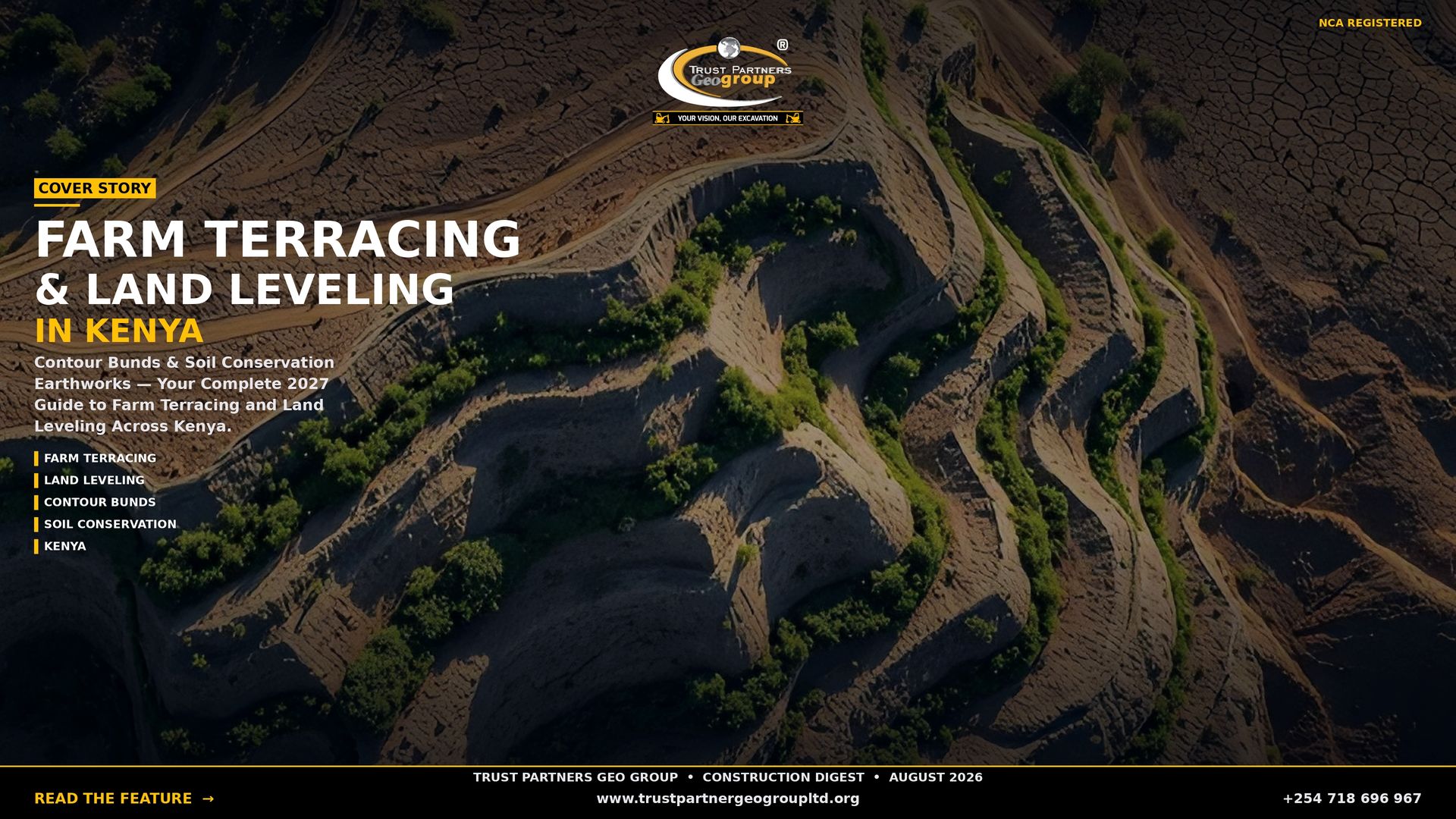
Farm Terracing and Land Leveling in Kenya: Contour Bunds and Soil Conservation Earthworks [2027]
Fanya Juu, Bench Terraces, Tied Ridges and Precision Land Leveling for Kenyan Agriculture
Over 70% of Kenya's agricultural land sits on slopes — from the tea-covered hills of Kericho to the maize terraces of Machakos. Every rainy season, unprotected farmland loses 30–50 tonnes of topsoil per hectare to runoff and gully erosion. For Kenyan farmers and agribusiness investors, farm terracing, contour bund construction and precision land leveling are not optional conservation measures — they are the foundation of productive, climate-resilient agriculture. This guide covers every soil conservation earthwork technique used in Kenya: Fanya Juu and Fanya Chini terraces, contour bunds, bench terraces, tied ridges, compartmental bunds and laser land leveling — with 2027 rates, county-specific recommendations and equipment specifications.

NCA-registered excavation contractor with 15+ years of agricultural earthworks across Kenya's 47 counties. We provide farm terracing, contour bund construction, land leveling and soil conservation for commercial farms, smallholders and agribusiness developments.
Why Farm Terracing Matters in Kenya
Kenya's diverse topography and rainfall patterns make soil conservation earthworks essential for sustained agricultural productivity:
- Topsoil loss crisis: Kenya loses an estimated 30–50 tonnes of soil per hectare annually on unprotected slopes. This strips the organic matter and nutrients that crops depend on, reducing yields by 20–40% within five years on eroded land.
- Climate variability: Erratic rainfall — intense storms followed by prolonged droughts — accelerates both erosion and water scarcity. Terracing captures storm runoff for slow release during dry spells.
- Commercial farm expansion: Large-scale tea, coffee, avocado and horticulture operations in Murang'a, Nyeri, Kericho and Kiambu require bench terraces and contour systems to manage steep terrain mechanically.
- Smallholder resilience: In Machakos, Makueni, Kitui and Embu, contour bunds and tied ridges transform marginal slopes into productive plots by harvesting scarce rainfall.
- Irrigation readiness: Laser-leveled fields are prerequisites for drip and flood irrigation. Uneven land wastes 25–35% of irrigation water through ponding and runoff.
- Regulatory pressure: NEMA increasingly requires soil conservation plans for commercial agricultural projects over 5 hectares, particularly in high-erosion zones.
Types of Soil Conservation Earthworks
Fanya Juu Terraces (Throw Upwards)
The most widely used terracing technique in Kenya's semi-arid eastern counties. A trench 60 cm wide by 60 cm deep is dug along the contour; soil is thrown upslope to form a bund 50 cm high and 150 cm wide at the base. The trench captures runoff while the bund stabilizes the slope. Spacing varies from 5 m on steep slopes to 20 m on gentle terrain. Fanya Juu is ideal for slopes of 5–20% in areas with 300–700 mm annual rainfall — Machakos, Makueni, Kitui, parts of Laikipia and Kajiado. Grasses like Napier grass or Guatemala grass are planted on the bund to prevent erosion.
Fanya Chini Terraces (Throw Downwards)
Soil is thrown downslope to form a ridge, creating a retention trench on the upslope side. Unlike Fanya Juu, this design includes controlled spillways for excess runoff — critical in high-rainfall zones. Fanya Chini suits sub-humid areas (700–1,200 mm rainfall) such as Murang'a, Nyeri, Kirinyaga, Embu and Western Kenya. The technique reduces waterlogging risk while still trapping sediment. Fruit trees — citrus, bananas, avocado — thrive on the bund above the trench where runoff concentrates.
Bench Terraces
Constructed by cutting into the slope and using the spoil to build a level platform or bench. Used on steep commercial land (15–35°) for tea, coffee and horticulture in Kericho, Nyeri, Murang'a and Kiambu. Bench terraces require cut-and-fill earthworks, compaction and outlet drains. They are the most labor- and equipment-intensive technique but deliver the highest productivity per hectare on steep terrain.
Contour Bunds and Furrows
Also called strip farming, contour bunds are lower embankments than terraces — typically 30–50 cm high — built along contour lines with crops planted between them. Suitable for gentle slopes (3–12%) and lower-rainfall areas. Contour furrows are the simplest form: shallow channels that intercept runoff and direct it slowly across the slope. Both can be constructed by hand, ox-drawn plough or mini-excavator.
Tied Ridges
Furrows dug along contour lines with cross-ties at 1–3 m intervals, creating small basins that trap rainfall. Ridges are 30 cm high; ties are half to two-thirds that height. Ideal for maize, beans and sorghum in semi-arid zones. Tied ridges increase water infiltration by 25–40% compared to flat planting. They are quick to construct and can be reshaped each season.
Compartmental Bunding
A series of earthen embankments (0.5 m high) dividing a field into small catchment cells, following contours as closely as possible. Best suited for medium to deep soils with high clay content in low-rainfall areas (under 700 mm). Compartmental bunds recharge the soil profile uniformly, reduce runoff and arrest nutrient loss. They are cost-effective for large cereal farms in Kitui, Makueni and parts of Baringo.
Laser Land Leveling
Precision grading using laser-guided equipment to achieve slopes of 0.1–0.5% for irrigation. Essential for drip, sprinkler and flood irrigation systems on flat to gently rolling land. Laser leveling reduces irrigation water use by 25–35% and improves crop uniformity. Used extensively in Naivasha flower farms, Mwea rice schemes and commercial horticulture in Kiambu and Kajiado.
Equipment and Methods for Agricultural Earthworks
Trust Partners Geo-Group deploys specialized agricultural earthworks equipment nationwide:
- 20–30 ton excavators with GPS grade control: For precise contour trenching and bench cutting. GPS systems follow surveyor-marked contour lines to within 2 cm accuracy — essential for commercial tea and coffee estates.
- Bulldozers with rippers: For clearing bush, rough grading and ripping hardpan before terracing. Critical in ASAL areas where cemented murram lies beneath topsoil.
- Motor graders: For final leveling of bench terraces, cambered surfaces and farm access roads between terraces.
- Mini-excavators (5 ton): For smallholder plots, precision work near existing crops and confined orchards where large machines cannot maneuver.
- Vibratory rollers: For compacting bench terrace fill to 90–95% Mod AASHTO density, preventing settlement and wall collapse.
- Laser leveling equipment: Tractor-pulled scrapers with laser receivers for precision irrigation field preparation.
- Water bowsers: For dust suppression and moisture conditioning during compaction in dry-season construction.
- Dump trucks: For hauling excess cut material from bench terraces and importing fill where cut-and-fill is unbalanced.
Farm Terracing and Land Leveling Rates 2027
| Technique | Rate (KES/acre) | Best For | Equipment |
|---|---|---|---|
| Manual contour bunds | 15,000 – 35,000 | Smallholder plots, gentle slopes, community projects | Hand tools, ox plough |
| Mini-excavator Fanya Juu/Chini | 45,000 – 90,000 | Moderate slopes (10–20%), orchards, medium farms | 5-ton excavator, labor |
| Bulldozer bench terraces | 80,000 – 150,000 | Steep commercial land (15–35°), tea/coffee estates | Dozer, roller, grader |
| Laser land leveling | 25,000 – 55,000 | Irrigation fields, flower farms, rice schemes | Laser scraper, tractor |
| Tied ridges (machine) | 10,000 – 25,000 | Maize, beans, sorghum on gentle slopes | Tractor-drawn ridger |
| Compartmental bunding | 20,000 – 40,000 | Large cereal farms, low-rainfall ASAL areas | Grader, dozer, roller |
| Topographic survey | 8,000 – 18,000 | Contour mapping before terracing | GPS/total station |
| Grass establishment (Napier) | 5,000 – 12,000 | Bund stabilization, fodder production | Manual planting |
| Stone bund reinforcement | 25,000 – 50,000 | Rocky areas, permanent structures, black cotton | Manual + mini-excavator |
County-Specific Terracing Recommendations
| Region / County | Dominant Terrain | Recommended Technique | Key Consideration |
|---|---|---|---|
| Central Highlands Murang'a, Nyeri, Kirinyaga | Steep slopes 15–35°, high rainfall | Bench terraces, Fanya Chini | Drainage outlets essential; grass stabilization on bunds |
| Western Highlands Kericho, Bomet, Bungoma | Rolling hills, deep red loam | Bench terraces, contour bunds | High erosion risk; maintain ground cover |
| Eastern / Ukambani Machakos, Makueni, Kitui | Semi-arid, gentle to moderate slopes | Fanya Juu, tied ridges, compartmental bunds | Water harvesting priority; minimal spillways |
| Rift Valley Nakuru, Naivasha, Baringo | Mixed terrain, lake sediment | Contour bunds, laser leveling | Geothermal areas need special concrete |
| Coast Hinterland Kwale, Kilifi, Taita Taveta | Steep escarpments, sandy soils | Bench terraces, stone bunds | Sandy soils need compaction and grass cover |
| Nairobi Peri-Urban Kiambu, Kajiado, Limuru | Undulating, mixed soil | Laser leveling, Fanya Juu | Near-urban farms need precision for irrigation |
Integrating Water Harvesting with Terracing
Modern Kenyan agriculture increasingly combines terracing with water storage:
- Terrace-fed water pans: Excess runoff from bench terraces is directed into small excavated pans (5,000–20,000 m³) for livestock and supplemental irrigation. Common in Machakos, Makueni and Laikipia.
- Contour trench reservoirs: Fanya Juu trenches are connected to underground cisterns or lined storage tanks, capturing 15–25% of rainfall that would otherwise run off.
- Subsurface drainage: Perforated pipes behind bench terraces drain saturated soil into collection sumps, preventing waterlogging in high-rainfall zones while storing water for dry periods.
- Zai pits integration: Within terraced fields, Zai pits (30 cm diameter planting basins filled with compost) concentrate water and nutrients around individual plants — boosting yields by up to 500% in Sahelian conditions, with proven results in Kitui and Makueni.
- Drip irrigation from terrace storage: Gravity-fed drip lines from terrace collection trenches deliver water directly to crop roots, reducing evaporation losses by 40–60% compared to flood irrigation.
Transform Your Farm with Professional Terracing and Land Leveling
Trust Partners Geo-Group provides farm terracing, contour bund construction and precision land leveling across all 47 Kenyan counties. Free farm survey, technique recommendation and itemised quote.
Call +254 718 686 967 Email for QuoteFrequently Asked Questions
Why is farm terracing important in Kenya?
Farm terracing is critical in Kenya because over 70% of the country's agricultural land is on slopes of 5–35 degrees. Without terracing, rainfall runoff strips topsoil, carries away nutrients and creates gullies that render farmland unproductive. Kenya loses an estimated 30–50 tonnes of soil per hectare annually on unprotected slopes. Terracing slows runoff, traps sediment, increases water infiltration and can boost crop yields by 20–50%. In semi-arid counties like Machakos, Makueni and Kitui, terracing also functions as water harvesting — capturing rainfall that would otherwise evaporate or run off. For commercial farms in Kericho, Nyeri and Murang'a, bench terraces and contour bunds are essential for tea, coffee and horticulture production on steep terrain.
What is the difference between Fanya Juu and Fanya Chini terraces?
Fanya Juu (throw upwards) and Fanya Chini (throw downwards) are the two most common terracing techniques in Kenya. Fanya Juu involves digging a trench along the contour and throwing soil upslope to form a bund. The trench captures runoff while the bund stabilizes the slope. It is ideal for semi-arid areas (300–700 mm rainfall) with slopes of 5–20% and is widely used in Machakos, Makueni and Kitui. Fanya Chini involves throwing soil downslope to form a ridge, creating a retention trench on the upslope side. It is better suited for sub-humid zones (700–1,200 mm rainfall) like Murang'a, Nyeri and parts of Western Kenya where excess runoff needs controlled discharge. Fanya Juu harvests water; Fanya Chini manages both retention and drainage. Both techniques use contour-aligned trenches 60 cm wide by 60 cm deep, with bund heights of 50 cm and base widths of 150 cm. Spacing depends on slope: 5 m apart on steep land, up to 20 m on gentle slopes.
How much does farm terracing cost per acre in Kenya?
Farm terracing costs in Kenya vary by technique, slope and equipment used. Manual contour bund construction costs KES 15,000–35,000 per acre — suitable for smallholder plots and gentle slopes. Machine-constructed Fanya Juu or Fanya Chini terraces cost KES 45,000–90,000 per acre using mini-excavators and bulldozers on moderate slopes. Bench terrace construction on steep commercial land costs KES 80,000–150,000 per acre — requires cut-and-fill earthworks, compaction and outlet construction. Laser land leveling for irrigation costs KES 25,000–55,000 per acre. Tied ridges and compartmental bunds cost KES 10,000–25,000 per acre. Key cost drivers include: slope steepness (steeper slopes require closer spacing and more earth movement), rock presence (phonolite outcrops in Nyeri and Murang'a add breaker costs), soil type (black cotton requires special drainage), access (remote farms in Kitui have higher mobilization), and vegetation clearing (dense bush adds KES 5,000–12,000 per acre). Trust Partners Geo-Group provides fixed-price quotes after topographic survey and soil assessment.
Which Kenyan counties benefit most from contour bunds and terracing?
Contour bunds and terracing deliver the highest returns in Kenya's hilly and semi-arid agricultural zones: (1) Central Highlands — Murang'a, Nyeri, Kirinyaga, Embu and Meru: steep coffee and tea zones with high rainfall erosion risk. Bench terraces and Fanya Chini systems protect slopes of 15–35 degrees. (2) Western Highlands — Bungoma, Kakamega, Vihiga, Kericho and Bomet: high-rainfall areas with deep red loam that erodes rapidly on unprotected slopes. (3) Eastern / Ukambani — Machakos, Makueni and Kitui: semi-arid zones where contour bunds harvest scarce rainfall for maize, beans and fruit trees. (4) Rift Valley — Nakuru, Naivasha, Eldoret and Baringo: mixed farming on rolling terrain where compartmental bunds reduce runoff. (5) Coast Hinterland — Kwale, Kilifi and Taita Taveta: steep slopes behind the coastal plain where bench terraces support cashew, coconut and mango orchards. Each county requires technique adaptation: Central Highlands need drainage outlets for heavy rain; Eastern counties need water-harvesting bunds with minimal spillways; Western counties need grass stabilization on bund faces.
Can contour bunds work on black cotton soil?
Contour bunds can work on black cotton soil (vertisols) but require design modifications. Black cotton soil swells when wet and shrinks when dry, which can crack and destabilize earthen bunds. For black cotton sites in Machakos, Makueni, Kitui and parts of Kisumu: (1) Bunds must be wider at the base (minimum 200 cm) with gentler side slopes (1:2 instead of 1:1.5) to accommodate ground movement. (2) Grass cover must be established immediately — Napier grass, Guatemala grass or local legumes bind the soil and reduce crack propagation. (3) Spillways should be stone-lined or grassed to prevent scouring when bunds overtop during intense storms. (4) Compartmental bunds (0.5 m high embankments creating small catchment cells) are often more effective than long contour bunds on black cotton because they distribute water pressure. (5) In deep black cotton areas, stone bunds or gabion reinforcement may be needed for permanent structures. Trust Partners Geo-Group assesses clay content, swell potential and slope before recommending terracing techniques for expansive soils.
What equipment is used for large-scale farm terracing?
Large-scale farm terracing in Kenya requires specialized earthmoving equipment: (1) 20–30 ton excavators with GPS grade control — for precise contour trenching and bench cutting on steep slopes. GPS systems follow surveyor-marked contour lines to within 2 cm accuracy. (2) Bulldozers with rippers — for clearing bush, rough grading and ripping hardpan before terracing. Essential for breaking cemented murram in ASAL areas. (3) Motor graders — for final leveling of bench terraces, cambered surfaces and access roads between terraces. (4) Mini-excavators (5 ton) — for smallholder plots, precision work near existing crops and confined orchards. (5) Vibratory rollers — for compacting bench terrace fill to 90–95% density, preventing settlement. (6) Laser leveling equipment — for irrigation field preparation, achieving slopes of 0.1–0.5% for flood or drip irrigation. (7) Water bowsers — for dust suppression and moisture conditioning during compaction. (8) Dump trucks — for hauling excess cut material and importing fill where needed. All Trust Partners Geo-Group terracing equipment is available wet hire with NITA-certified operators experienced in agricultural earthworks.
How long does farm terracing take per acre?
Farm terracing timelines depend on technique, slope and equipment: Manual contour bunds on gentle slopes take 3–5 person-days per acre — suitable for smallholder groups and community projects. Mini-excavator Fanya Juu construction takes 1–2 days per acre on moderate slopes (10–20%). Bulldozer bench terracing on steep commercial land takes 2–4 days per acre including cut-and-fill, compaction and outlet construction. Laser land leveling for irrigation takes 1 day per acre after initial survey. Large commercial farms of 50+ acres with bench terraces require 4–8 weeks with a fleet of 2–3 excavators and bulldozers. Seasonal factors affect timelines: dry season (January–March, June–September) is optimal — soils are workable and compaction is easier. Wet season work extends timelines by 30–50% due to slippery access, saturated soils and drainage delays. Trust Partners Geo-Group schedules terracing in dry months where possible and maintains water drainage on all-weather sites.
Do I need a permit for farm terracing in Kenya?
Farm terracing on private agricultural land generally does not require a county building permit, but several regulatory considerations apply: (1) NEMA Environmental Impact Assessment — required for terracing projects over 5 hectares, work near wetlands/rivers, or on land with indigenous forest cover. (2) Kenya Forest Service (KFS) — required if terracing involves clearing indigenous forest or is within forest reserve boundaries (common in Mount Kenya and Aberdare foothills). (3) Water Authority — required if terracing alters natural drainage into seasonal rivers (laggas) or affects downstream water rights. (4) County agricultural officer — some counties (Nyeri, Murang'a, Kericho) require notification for large-scale land modification to prevent downstream sedimentation. (5) Community land — in group ranch areas (Kajiado, Narok, Laikipia), terracing may require community consent. (6) For commercial farms with irrigation integration, a Water Authority permit is required for reservoir and canal construction. Trust Partners Geo-Group manages permit coordination for all agricultural earthworks projects, including NEMA screening, KFS clearance and county agricultural notifications.
Related Resources
Plan Your Farm Terracing Project in Any Kenyan County
Contact Trust Partners Geo-Group at +254 718 686 967 for a free farm survey and terracing quote. Serving commercial farms, smallholders and agribusiness across all 47 counties.
Call +254 718 686 967 Request QuoteFarm Terracing and Land Leveling in Kenya: Contour Bunds and Soil Conservation Earthworks [2027]
Fanya Juu, Bench Terraces, Tied Ridges and Precision Land Leveling for Kenyan Agriculture
Over 70% of Kenya's agricultural land sits on slopes — from the tea-covered hills of Kericho to the maize terraces of Machakos. Every rainy season, unprotected farmland loses 30–50 tonnes of topsoil per hectare to runoff and gully erosion. For Kenyan farmers and agribusiness investors, farm terracing, contour bund construction and precision land leveling are not optional conservation measures — they are the foundation of productive, climate-resilient agriculture. This guide covers every soil conservation earthwork technique used in Kenya: Fanya Juu and Fanya Chini terraces, contour bunds, bench terraces, tied ridges, compartmental bunds and laser land leveling — with 2027 rates, county-specific recommendations and equipment specifications.
NCA-registered excavation contractor with 15+ years of agricultural earthworks across Kenya's 47 counties. We provide farm terracing, contour bund construction, land leveling and soil conservation for commercial farms, smallholders and agribusiness developments.
Why Farm Terracing Matters in Kenya
Kenya's diverse topography and rainfall patterns make soil conservation earthworks essential for sustained agricultural productivity:
- Topsoil loss crisis: Kenya loses an estimated 30–50 tonnes of soil per hectare annually on unprotected slopes. This strips the organic matter and nutrients that crops depend on, reducing yields by 20–40% within five years on eroded land.
- Climate variability: Erratic rainfall — intense storms followed by prolonged droughts — accelerates both erosion and water scarcity. Terracing captures storm runoff for slow release during dry spells.
- Commercial farm expansion: Large-scale tea, coffee, avocado and horticulture operations in Murang'a, Nyeri, Kericho and Kiambu require bench terraces and contour systems to manage steep terrain mechanically.
- Smallholder resilience: In Machakos, Makueni, Kitui and Embu, contour bunds and tied ridges transform marginal slopes into productive plots by harvesting scarce rainfall.
- Irrigation readiness: Laser-leveled fields are prerequisites for drip and flood irrigation. Uneven land wastes 25–35% of irrigation water through ponding and runoff.
- Regulatory pressure: NEMA increasingly requires soil conservation plans for commercial agricultural projects over 5 hectares, particularly in high-erosion zones.
Types of Soil Conservation Earthworks
Fanya Juu Terraces (Throw Upwards)
The most widely used terracing technique in Kenya's semi-arid eastern counties. A trench 60 cm wide by 60 cm deep is dug along the contour; soil is thrown upslope to form a bund 50 cm high and 150 cm wide at the base. The trench captures runoff while the bund stabilizes the slope. Spacing varies from 5 m on steep slopes to 20 m on gentle terrain. Fanya Juu is ideal for slopes of 5–20% in areas with 300–700 mm annual rainfall — Machakos, Makueni, Kitui, parts of Laikipia and Kajiado. Grasses like Napier grass or Guatemala grass are planted on the bund to prevent erosion.
Fanya Chini Terraces (Throw Downwards)
Soil is thrown downslope to form a ridge, creating a retention trench on the upslope side. Unlike Fanya Juu, this design includes controlled spillways for excess runoff — critical in high-rainfall zones. Fanya Chini suits sub-humid areas (700–1,200 mm rainfall) such as Murang'a, Nyeri, Kirinyaga, Embu and Western Kenya. The technique reduces waterlogging risk while still trapping sediment. Fruit trees — citrus, bananas, avocado — thrive on the bund above the trench where runoff concentrates.
Bench Terraces
Constructed by cutting into the slope and using the spoil to build a level platform or bench. Used on steep commercial land (15–35°) for tea, coffee and horticulture in Kericho, Nyeri, Murang'a and Kiambu. Bench terraces require cut-and-fill earthworks, compaction and outlet drains. They are the most labor- and equipment-intensive technique but deliver the highest productivity per hectare on steep terrain.
Contour Bunds and Furrows
Also called strip farming, contour bunds are lower embankments than terraces — typically 30–50 cm high — built along contour lines with crops planted between them. Suitable for gentle slopes (3–12%) and lower-rainfall areas. Contour furrows are the simplest form: shallow channels that intercept runoff and direct it slowly across the slope. Both can be constructed by hand, ox-drawn plough or mini-excavator.
Tied Ridges
Furrows dug along contour lines with cross-ties at 1–3 m intervals, creating small basins that trap rainfall. Ridges are 30 cm high; ties are half to two-thirds that height. Ideal for maize, beans and sorghum in semi-arid zones. Tied ridges increase water infiltration by 25–40% compared to flat planting. They are quick to construct and can be reshaped each season.
Compartmental Bunding
A series of earthen embankments (0.5 m high) dividing a field into small catchment cells, following contours as closely as possible. Best suited for medium to deep soils with high clay content in low-rainfall areas (under 700 mm). Compartmental bunds recharge the soil profile uniformly, reduce runoff and arrest nutrient loss. They are cost-effective for large cereal farms in Kitui, Makueni and parts of Baringo.
Laser Land Leveling
Precision grading using laser-guided equipment to achieve slopes of 0.1–0.5% for irrigation. Essential for drip, sprinkler and flood irrigation systems on flat to gently rolling land. Laser leveling reduces irrigation water use by 25–35% and improves crop uniformity. Used extensively in Naivasha flower farms, Mwea rice schemes and commercial horticulture in Kiambu and Kajiado.
Equipment and Methods for Agricultural Earthworks
Trust Partners Geo-Group deploys specialized agricultural earthworks equipment nationwide:
- 20–30 ton excavators with GPS grade control: For precise contour trenching and bench cutting. GPS systems follow surveyor-marked contour lines to within 2 cm accuracy — essential for commercial tea and coffee estates.
- Bulldozers with rippers: For clearing bush, rough grading and ripping hardpan before terracing. Critical in ASAL areas where cemented murram lies beneath topsoil.
- Motor graders: For final leveling of bench terraces, cambered surfaces and farm access roads between terraces.
- Mini-excavators (5 ton): For smallholder plots, precision work near existing crops and confined orchards where large machines cannot maneuver.
- Vibratory rollers: For compacting bench terrace fill to 90–95% Mod AASHTO density, preventing settlement and wall collapse.
- Laser leveling equipment: Tractor-pulled scrapers with laser receivers for precision irrigation field preparation.
- Water bowsers: For dust suppression and moisture conditioning during compaction in dry-season construction.
- Dump trucks: For hauling excess cut material from bench terraces and importing fill where cut-and-fill is unbalanced.
Farm Terracing and Land Leveling Rates 2027
| Technique | Rate (KES/acre) | Best For | Equipment |
|---|---|---|---|
| Manual contour bunds | 15,000 – 35,000 | Smallholder plots, gentle slopes, community projects | Hand tools, ox plough |
| Mini-excavator Fanya Juu/Chini | 45,000 – 90,000 | Moderate slopes (10–20%), orchards, medium farms | 5-ton excavator, labor |
| Bulldozer bench terraces | 80,000 – 150,000 | Steep commercial land (15–35°), tea/coffee estates | Dozer, roller, grader |
| Laser land leveling | 25,000 – 55,000 | Irrigation fields, flower farms, rice schemes | Laser scraper, tractor |
| Tied ridges (machine) | 10,000 – 25,000 | Maize, beans, sorghum on gentle slopes | Tractor-drawn ridger |
| Compartmental bunding | 20,000 – 40,000 | Large cereal farms, low-rainfall ASAL areas | Grader, dozer, roller |
| Topographic survey | 8,000 – 18,000 | Contour mapping before terracing | GPS/total station |
| Grass establishment (Napier) | 5,000 – 12,000 | Bund stabilization, fodder production | Manual planting |
| Stone bund reinforcement | 25,000 – 50,000 | Rocky areas, permanent structures, black cotton | Manual + mini-excavator |
County-Specific Terracing Recommendations
| Region / County | Dominant Terrain | Recommended Technique | Key Consideration |
|---|---|---|---|
| Central Highlands Murang'a, Nyeri, Kirinyaga | Steep slopes 15–35°, high rainfall | Bench terraces, Fanya Chini | Drainage outlets essential; grass stabilization on bunds |
| Western Highlands Kericho, Bomet, Bungoma | Rolling hills, deep red loam | Bench terraces, contour bunds | High erosion risk; maintain ground cover |
| Eastern / Ukambani Machakos, Makueni, Kitui | Semi-arid, gentle to moderate slopes | Fanya Juu, tied ridges, compartmental bunds | Water harvesting priority; minimal spillways |
| Rift Valley Nakuru, Naivasha, Baringo | Mixed terrain, lake sediment | Contour bunds, laser leveling | Geothermal areas need special concrete |
| Coast Hinterland Kwale, Kilifi, Taita Taveta | Steep escarpments, sandy soils | Bench terraces, stone bunds | Sandy soils need compaction and grass cover |
| Nairobi Peri-Urban Kiambu, Kajiado, Limuru | Undulating, mixed soil | Laser leveling, Fanya Juu | Near-urban farms need precision for irrigation |
Integrating Water Harvesting with Terracing
Modern Kenyan agriculture increasingly combines terracing with water storage:
- Terrace-fed water pans: Excess runoff from bench terraces is directed into small excavated pans (5,000–20,000 m³) for livestock and supplemental irrigation. Common in Machakos, Makueni and Laikipia.
- Contour trench reservoirs: Fanya Juu trenches are connected to underground cisterns or lined storage tanks, capturing 15–25% of rainfall that would otherwise run off.
- Subsurface drainage: Perforated pipes behind bench terraces drain saturated soil into collection sumps, preventing waterlogging in high-rainfall zones while storing water for dry periods.
- Zai pits integration: Within terraced fields, Zai pits (30 cm diameter planting basins filled with compost) concentrate water and nutrients around individual plants — boosting yields by up to 500% in Sahelian conditions, with proven results in Kitui and Makueni.
- Drip irrigation from terrace storage: Gravity-fed drip lines from terrace collection trenches deliver water directly to crop roots, reducing evaporation losses by 40–60% compared to flood irrigation.
Transform Your Farm with Professional Terracing and Land Leveling
Trust Partners Geo-Group provides farm terracing, contour bund construction and precision land leveling across all 47 Kenyan counties. Free farm survey, technique recommendation and itemised quote.
Call +254 718 686 967 Email for QuoteFrequently Asked Questions
Why is farm terracing important in Kenya?
Farm terracing is critical in Kenya because over 70% of the country's agricultural land is on slopes of 5–35 degrees. Without terracing, rainfall runoff strips topsoil, carries away nutrients and creates gullies that render farmland unproductive. Kenya loses an estimated 30–50 tonnes of soil per hectare annually on unprotected slopes. Terracing slows runoff, traps sediment, increases water infiltration and can boost crop yields by 20–50%. In semi-arid counties like Machakos, Makueni and Kitui, terracing also functions as water harvesting — capturing rainfall that would otherwise evaporate or run off. For commercial farms in Kericho, Nyeri and Murang'a, bench terraces and contour bunds are essential for tea, coffee and horticulture production on steep terrain.
What is the difference between Fanya Juu and Fanya Chini terraces?
Fanya Juu (throw upwards) and Fanya Chini (throw downwards) are the two most common terracing techniques in Kenya. Fanya Juu involves digging a trench along the contour and throwing soil upslope to form a bund. The trench captures runoff while the bund stabilizes the slope. It is ideal for semi-arid areas (300–700 mm rainfall) with slopes of 5–20% and is widely used in Machakos, Makueni and Kitui. Fanya Chini involves throwing soil downslope to form a ridge, creating a retention trench on the upslope side. It is better suited for sub-humid zones (700–1,200 mm rainfall) like Murang'a, Nyeri and parts of Western Kenya where excess runoff needs controlled discharge. Fanya Juu harvests water; Fanya Chini manages both retention and drainage. Both techniques use contour-aligned trenches 60 cm wide by 60 cm deep, with bund heights of 50 cm and base widths of 150 cm. Spacing depends on slope: 5 m apart on steep land, up to 20 m on gentle slopes.
How much does farm terracing cost per acre in Kenya?
Farm terracing costs in Kenya vary by technique, slope and equipment used. Manual contour bund construction costs KES 15,000–35,000 per acre — suitable for smallholder plots and gentle slopes. Machine-constructed Fanya Juu or Fanya Chini terraces cost KES 45,000–90,000 per acre using mini-excavators and bulldozers on moderate slopes. Bench terrace construction on steep commercial land costs KES 80,000–150,000 per acre — requires cut-and-fill earthworks, compaction and outlet construction. Laser land leveling for irrigation costs KES 25,000–55,000 per acre. Tied ridges and compartmental bunds cost KES 10,000–25,000 per acre. Key cost drivers include: slope steepness (steeper slopes require closer spacing and more earth movement), rock presence (phonolite outcrops in Nyeri and Murang'a add breaker costs), soil type (black cotton requires special drainage), access (remote farms in Kitui have higher mobilization), and vegetation clearing (dense bush adds KES 5,000–12,000 per acre). Trust Partners Geo-Group provides fixed-price quotes after topographic survey and soil assessment.
Which Kenyan counties benefit most from contour bunds and terracing?
Contour bunds and terracing deliver the highest returns in Kenya's hilly and semi-arid agricultural zones: (1) Central Highlands — Murang'a, Nyeri, Kirinyaga, Embu and Meru: steep coffee and tea zones with high rainfall erosion risk. Bench terraces and Fanya Chini systems protect slopes of 15–35 degrees. (2) Western Highlands — Bungoma, Kakamega, Vihiga, Kericho and Bomet: high-rainfall areas with deep red loam that erodes rapidly on unprotected slopes. (3) Eastern / Ukambani — Machakos, Makueni and Kitui: semi-arid zones where contour bunds harvest scarce rainfall for maize, beans and fruit trees. (4) Rift Valley — Nakuru, Naivasha, Eldoret and Baringo: mixed farming on rolling terrain where compartmental bunds reduce runoff. (5) Coast Hinterland — Kwale, Kilifi and Taita Taveta: steep slopes behind the coastal plain where bench terraces support cashew, coconut and mango orchards. Each county requires technique adaptation: Central Highlands need drainage outlets for heavy rain; Eastern counties need water-harvesting bunds with minimal spillways; Western counties need grass stabilization on bund faces.
Can contour bunds work on black cotton soil?
Contour bunds can work on black cotton soil (vertisols) but require design modifications. Black cotton soil swells when wet and shrinks when dry, which can crack and destabilize earthen bunds. For black cotton sites in Machakos, Makueni, Kitui and parts of Kisumu: (1) Bunds must be wider at the base (minimum 200 cm) with gentler side slopes (1:2 instead of 1:1.5) to accommodate ground movement. (2) Grass cover must be established immediately — Napier grass, Guatemala grass or local legumes bind the soil and reduce crack propagation. (3) Spillways should be stone-lined or grassed to prevent scouring when bunds overtop during intense storms. (4) Compartmental bunds (0.5 m high embankments creating small catchment cells) are often more effective than long contour bunds on black cotton because they distribute water pressure. (5) In deep black cotton areas, stone bunds or gabion reinforcement may be needed for permanent structures. Trust Partners Geo-Group assesses clay content, swell potential and slope before recommending terracing techniques for expansive soils.
What equipment is used for large-scale farm terracing?
Large-scale farm terracing in Kenya requires specialized earthmoving equipment: (1) 20–30 ton excavators with GPS grade control — for precise contour trenching and bench cutting on steep slopes. GPS systems follow surveyor-marked contour lines to within 2 cm accuracy. (2) Bulldozers with rippers — for clearing bush, rough grading and ripping hardpan before terracing. Essential for breaking cemented murram in ASAL areas. (3) Motor graders — for final leveling of bench terraces, cambered surfaces and access roads between terraces. (4) Mini-excavators (5 ton) — for smallholder plots, precision work near existing crops and confined orchards. (5) Vibratory rollers — for compacting bench terrace fill to 90–95% density, preventing settlement. (6) Laser leveling equipment — for irrigation field preparation, achieving slopes of 0.1–0.5% for flood or drip irrigation. (7) Water bowsers — for dust suppression and moisture conditioning during compaction. (8) Dump trucks — for hauling excess cut material and importing fill where needed. All Trust Partners Geo-Group terracing equipment is available wet hire with NITA-certified operators experienced in agricultural earthworks.
How long does farm terracing take per acre?
Farm terracing timelines depend on technique, slope and equipment: Manual contour bunds on gentle slopes take 3–5 person-days per acre — suitable for smallholder groups and community projects. Mini-excavator Fanya Juu construction takes 1–2 days per acre on moderate slopes (10–20%). Bulldozer bench terracing on steep commercial land takes 2–4 days per acre including cut-and-fill, compaction and outlet construction. Laser land leveling for irrigation takes 1 day per acre after initial survey. Large commercial farms of 50+ acres with bench terraces require 4–8 weeks with a fleet of 2–3 excavators and bulldozers. Seasonal factors affect timelines: dry season (January–March, June–September) is optimal — soils are workable and compaction is easier. Wet season work extends timelines by 30–50% due to slippery access, saturated soils and drainage delays. Trust Partners Geo-Group schedules terracing in dry months where possible and maintains water drainage on all-weather sites.
Do I need a permit for farm terracing in Kenya?
Farm terracing on private agricultural land generally does not require a county building permit, but several regulatory considerations apply: (1) NEMA Environmental Impact Assessment — required for terracing projects over 5 hectares, work near wetlands/rivers, or on land with indigenous forest cover. (2) Kenya Forest Service (KFS) — required if terracing involves clearing indigenous forest or is within forest reserve boundaries (common in Mount Kenya and Aberdare foothills). (3) Water Authority — required if terracing alters natural drainage into seasonal rivers (laggas) or affects downstream water rights. (4) County agricultural officer — some counties (Nyeri, Murang'a, Kericho) require notification for large-scale land modification to prevent downstream sedimentation. (5) Community land — in group ranch areas (Kajiado, Narok, Laikipia), terracing may require community consent. (6) For commercial farms with irrigation integration, a Water Authority permit is required for reservoir and canal construction. Trust Partners Geo-Group manages permit coordination for all agricultural earthworks projects, including NEMA screening, KFS clearance and county agricultural notifications.
Related Resources
Plan Your Farm Terracing Project in Any Kenyan County
Contact Trust Partners Geo-Group at +254 718 686 967 for a free farm survey and terracing quote. Serving commercial farms, smallholders and agribusiness across all 47 counties.
Call +254 718 686 967 Request Quote