
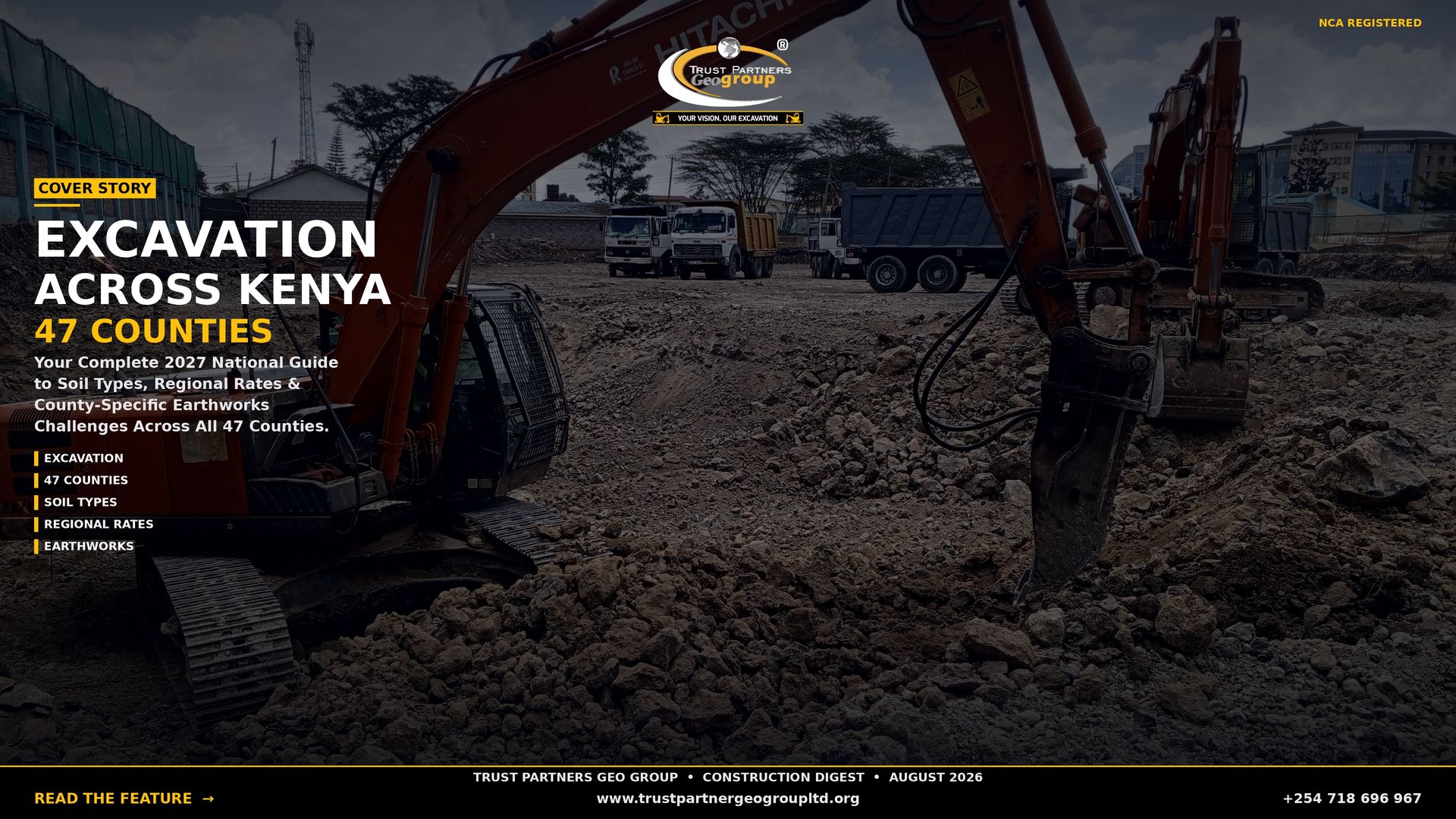
Excavation Across Kenya's 47 Counties: A 2027 National Guide to Soil Types, Regional Rates and County-Specific Earthworks Challenges
The Complete National Map for Developers, Contractors and Investors Building From Mombasa to Moyale
Kenya is not one country geologically — it is six distinct construction terrains stretched across 580,000 km². From the coral limestone cliffs of Kilifi to the black cotton plains of Kitui, from the volcanic slopes of Mount Kenya to the deep red loams of Bungoma, every county presents a unique earthworks puzzle. For developers and contractors working nationwide, understanding these soil zones, their cost implications and their regulatory requirements is the difference between profitable delivery and catastrophic foundation failure. This guide distills 15 years of national excavation experience into a single reference: soil types, regional rates, county permits, equipment logistics and market trends for every corner of Kenya.

NCA-registered excavation contractor operating across all 47 Kenyan counties. 15+ years of national earthworks experience from Lunga Lunga to Lokichoggio.
The National Soil Map: Kenya's 6 Construction Zones
Kenya's geology divides into six dominant soil zones that dictate excavation methodology, equipment selection and foundation design:
1. Black Cotton Belt (Vertisols)
Counties: Machakos, Makueni, Kitui, Kajiado (eastern), parts of Kiambu, Thika, Nakuru, Kisumu, Kakamega, Busia.
Expansive clay with 50–70% clay content, liquid limits above 50%, and plasticity indices exceeding 25%. Swells 50–150 mm in wet season; shrinks and cracks 1–2 m deep in dry season. Excavation strategy: Complete removal to geotechnical depth, replacement with compacted murram/hardcore, or suspended foundations/piles. Never reuse as structural backfill without stabilization.
2. Volcanic Highlands (Andosols / Nitisols)
Counties: Nyeri, Nanyuki (Laikipia), Meru, Embu, Kirinyaga, parts of Nakuru, Naivasha, Kiambu (Limuru), Kericho.
Deep, fertile volcanic ash and red loam derived from Mount Kenya, Aberdares, Mau and Rift Valley volcanoes. Variable depth (1–10+ m) with frequent phonolite/trachyte outcrops on upper slopes. Steep terrain (15–35°) common. Excavation strategy: Hillside benching, breaker excavation for rock, extensive drainage, and soil testing on every slope site.
3. Coastal Coral and Sand (Coral Limestone / Arenosols)
Counties: Mombasa, Kilifi, Kwale, Malindi, Lamu, Tana River (coastal).
Hard coral limestone bedrock at shallow depth, loose coral sand, saline groundwater and high water tables. Coral rock requires hydraulic breaker or controlled blasting. Sandy soils need compaction and ground improvement. Excavation strategy: Coral breaking, dewatering, sand compaction with geotextiles, and salt-resistant concrete protection.
4. Western Highlands (Ferralsols / Red Loam)
Counties: Bungoma, Kakamega, Busia, Vihiga, parts of Kisii, Nyamira, Trans Nzoia, Uasin Gishu.
Deep, stable red loam and murram soils — among Kenya's most construction-friendly. Well-draining, high bearing capacity, minimal swelling. Some areas have black cotton patches and high rainfall erosion. Excavation strategy: Standard bulk excavation, moderate compaction, attention to drainage in high-rainfall zones.
5. Rift Valley Sedimentary (Volcanic Ash / Lake Sediment)
Counties: Nakuru, Naivasha, Gilgil, Elementaita, Baringo, Bogoria.
Volcanic ash deposits, diatomaceous earth, lake sediments and geothermal areas. Soils are generally workable but can be silty, with high water tables near lakes. Geothermal areas require special foundation protection. Excavation strategy: Ground improvement for silty soils, dewatering near lakes, and geothermal-resistant concrete.
6. ASAL Hardpan and Alluvial (Murram / Regosols)
Counties: Garissa, Wajir, Mandera, Marsabit, Turkana, Samburu, Isiolo, Tana River (interior), Kajiado (south).
Cemented laterite hardpan, sandy alluvial soils along seasonal rivers, and rocky desert terrain. Hardpan requires ripping before excavation; alluvial soils need compaction and stabilization. Excavation strategy: Hardpan ripping, controlled moisture compaction, dust suppression, and flash-flood drainage protection.
Regional Rate Comparison 2027
| Region / Soil Zone | Key Counties | Bulk Excavation (KES/m³) | Foundation Excavation (KES/m³) | Primary Cost Driver |
|---|---|---|---|---|
| Nairobi Metro | Nairobi, Kiambu, Kajiado | 1,200–2,000 | 2,500–5,500 | High water table, confined sites, dewatering |
| Mount Kenya Highlands | Nyeri, Nanyuki, Meru, Embu | 800–1,300 | 2,200–3,500 | Steep slopes, volcanic rock, benching |
| Eastern / Ukambani | Machakos, Makueni, Kitui | 600–1,000 | 1,800–3,200 | Black cotton removal, water scarcity, haul |
| Coast | Mombasa, Kilifi, Malindi | 900–1,500 | 2,000–3,500 | Coral breaking, dewatering, sand stabilization |
| Western Highlands | Kakamega, Bungoma, Busia | 700–1,100 | 1,500–2,800 | High rainfall, seasonal flooding, access |
| Rift Valley | Nakuru, Naivasha, Eldoret | 700–1,200 | 1,800–3,000 | Lake sediment, geothermal, variable rock |
| Northern / ASAL | Isiolo, Garissa, Turkana | 400–800 | 1,200–2,500 | Hardpan ripping, mobilization distance, water |
County Permit Navigator
Every Kenyan county has a building control department under the National Building Code, but requirements and timelines vary:
| Permit Type | Required For | Typical Cost | Timeline |
|---|---|---|---|
| County Building Permit | All permanent structures; every county | KES 5,000–50,000 | 2–4 weeks |
| Soil Test Report | Buildings >2 storeys, basements, slopes >15° | KES 25,000–55,000 | 1–2 weeks |
| NEMA EIA | Projects >1 ha, dams, deep basements, wetlands | KES 30,000–150,000 | 4–12 weeks |
| NCA Contractor Reg. | All structural excavation; contractor must be registered | Included in contractor fees | Ongoing |
| Water Authority | Dewatering, water pans, dam excavation, river work | KES 10,000–40,000 | 2–6 weeks |
| KFS Permit | Work within forest reserves or indigenous forest | KES 15,000–60,000 | 3–8 weeks |
| County Disposal Permit | Black cotton, contaminated or excess spoil transport | KES 2,000–10,000 | 1–2 weeks |
Strictest counties: Nairobi, Kiambu, Nakuru, Mombasa and Kisumu have rigorous enforcement with digital permit tracking. Fastest counties: Laikipia, Bomet, Kericho and Nyandarua typically process building permits within 10–14 days. Remote counties: Turkana, Marsabit, Wajir and Mandera have limited building control capacity — NEMA becomes the primary regulator for large projects.
Equipment Mobility & National Fleet
Trust Partners Geo-Group operates the only truly national excavation fleet in Kenya:
- Nairobi Central Depot: 30-ton excavators (8), bulldozers (4), tippers (20), graders (2), rollers (4), water bowsers (4), mini-excavators (6), drilling rigs (4).
- Mombasa Coastal Depot: Coral breakers, dewatering pumps, sand compactors and salt-resistant equipment for Coast operations.
- Nakuru Rift Depot: Geothermal-resistant fleet with lake-sediment excavation capability for Rift Valley projects.
- Eldoret Western Depot: Red-loam excavation fleet with high-rainfall drainage equipment for Western Kenya.
Mobilization timelines from Nairobi depot: Same day (Nairobi, Kiambu, Kajiado, Machakos). 1–2 days (Nakuru, Naivasha, Thika, Nyeri). 2–3 days (Nanyuki, Meru, Kisumu, Eldoret). 3–4 days (Mombasa, Kilifi, Kitui, Busia). 4–6 days (Garissa, Isiolo, Lodwar). 5–7 days (Mandera, Wajir, Moyale). Emergency 24/7 dispatch available nationwide.
Case Study Round-Up by Region
| Region | Project Type | Challenge | Solution |
|---|---|---|---|
| Nairobi | 5-level basement, Lavington | High water table, confined site, adjacent buildings | Dewatering wells, sheet pile walls, 24/7 pumping |
| Kiambu | Gated community, Ruiru | Black cotton soil, 2.5 m depth | Complete removal, murram replacement, raft slabs |
| Nyeri | Hotel foundation, coffee zone | 25° slope, volcanic rock, high rainfall | Hillside benching, breaker excavation, drainage |
| Machakos | Water pan, Mavoko | Deep black cotton, water scarcity | Soil removal, compacted embankment, inlet works |
| Mombasa | Apartment block, Nyali | Coral rock, saline water, loose sand | Coral breaking, dewatering, raft on engineered fill |
| Kakamega | School complex | Deep red loam, high rainfall | Bulk excavation, drainage channels, standard strips |
| Nakuru | Greenhouse pads, Naivasha | Lake sediment, silt, high water table | Ground improvement, raised platforms, drainage |
| Isiolo | Access road, LAPSSET corridor | Hardpan, extreme heat, flash floods | Hardpan ripping, cambered road, culverts |
2027 National Construction Outlook
Five macro trends are reshaping Kenya's excavation market in 2027:
- Affordable Housing Program: The national target of 250,000 units is driving mass foundation excavation in Nairobi, Kiambu, Nakuru, Mombasa and Kisumu. Expect 30–40% volume growth in residential foundation work through 2028.
- SGR Phase 2 & Railway Expansion: The Nairobi–Naivasha standard gauge extension and meter-gauge rehabilitation require millions of m³ of cut-and-fill earthworks. Contractors with rail-sector experience are in high demand.
- LAPSSET Northern Corridor: Lamu Port, Isiolo and northern Kenya roads are opening previously remote ASAL areas. Excavation in these counties requires ASAL expertise, water conservation and long mobilization logistics.
- Devolution Infrastructure Boom: County governments are building markets, stadiums, roads and hospitals in all 47 counties. This creates distributed, smaller-scale demand that national contractors are best positioned to serve.
- Data Centres & Industrial Parks: Konza Technopolis, Tatu City, Naivasha EPZ and Mombasa SEZ need precision grading and deep foundation excavation for heavy industrial loads. Vibration control and precision tolerances are critical.
These trends have increased national equipment demand by 25–35%. Trust Partners Geo-Group has expanded fleet capacity by 40% and opened the Mombasa and Eldoret depots to meet 2027 demand. Early booking is essential for Q3–Q4 projects.
Nationwide Excavation Across All 47 Counties
Trust Partners Geo-Group is Kenya's only truly national excavation contractor. Free site assessment in any county, soil evaluation, itemised quote and rapid fleet mobilization.
Call +254 718 686 967 Email for QuoteFrequently Asked Questions
How much does excavation cost in Kenya per m³ in 2027?
National excavation rates in Kenya vary dramatically by region and soil type. Bulk excavation in murram or sandy soils costs KES 500–1,000 per m³. Black cotton soil removal and replacement costs KES 1,800–3,500 per m³. Volcanic slope benching costs KES 1,500–2,500 per m³. Coral rock excavation with breaker in Mombasa and Kilifi costs KES 2,000–3,500 per m³. Basement excavation in Nairobi costs KES 2,500–4,500 per m³. Foundation excavation in deep red loam (Western Kenya) costs KES 800–1,300 per m³. The cheapest excavation is in ASAL murram areas like Kitui and Garissa (KES 400–700 per m³); the most expensive is urban basement work in Nairobi's high-water-table zones (KES 3,500–5,500 per m³ with dewatering).
What are the main soil types for construction in Kenya?
Kenya has six dominant construction soil zones: (1) Black cotton soil (vertisols) — expansive clay found in Eastern, Central and parts of Rift Valley. Swells when wet, shrinks when dry. Requires removal or special foundations. (2) Volcanic soils (andosols/nitisols) — deep red loams on Mount Kenya, Aberdares and Rift Valley slopes. Fertile but variable depth with occasional rock outcrops. (3) Coral rock and coastal sands — found in Mombasa, Kilifi, Malindi and Lamu. Hard coral limestone requires breaking; sandy soils need compaction and stabilization. (4) Red loam and murram (ferralsols) — stable, well-draining soils in Western Highlands (Kakamega, Bungoma, Busia) and parts of Nyanza. (5) Sandy alluvial soils — along Tana River, Athi River and Lake Victoria shores. Requires ground improvement and drainage. (6) Hardpan murram — cemented laterite in ASAL areas. Stable but requires ripping before excavation.
Do all Kenyan counties require soil tests before excavation?
Yes — all 47 county governments in Kenya require geotechnical investigations under the National Building Code, though enforcement intensity varies. Nairobi, Kiambu, Nakuru, Mombasa and Kisumu have the strictest building control departments, requiring soil test reports for all buildings over 2 storeys and any basement excavation. Machakos, Kitui, Makueni and Meru require soil tests for structures on expansive soil or slopes over 15 degrees. Remote counties like Turkana, Wajir and Mandera have less capacity but NEMA still mandates testing for projects over 1 hectare. A standard soil test costs KES 25,000–55,000 per plot depending on location and depth. Trust Partners Geo-Group coordinates NCA-registered geotechnical firms in all 47 counties.
Which counties have the hardest excavation conditions in Kenya?
The most challenging excavation conditions are found in: (1) Nairobi (high water table, confined urban sites, utility congestion) — basement dewatering adds 30–50% to costs. (2) Mombasa/Kilifi (coral rock, saline groundwater, loose sand) — coral limestone requires breaker or blasting; tidal zones complicate drainage. (3) Nyeri/Nanyuki (volcanic slopes, steep terrain, high rainfall) — benching adds 40–70% premium on slopes over 20 degrees. (4) Kitui/Machakos (deep black cotton, water scarcity, flash floods) — expansive clay removal and water hauling increase costs significantly. (5) Kisumu/Kakamega (black cotton and high water table) — combination of expansive clay and seasonal flooding. The easiest excavation is in murram-rich ASAL areas like Kajiado, Narok and parts of Laikipia, where granular soils are stable and free-draining.
How long does it take to mobilize equipment to remote counties?
Trust Partners Geo-Group maintains a Nairobi depot with national mobilization capability. Typical equipment delivery times are: Same day for Nairobi, Kiambu, Kajiado and Machakos. 1–2 days for Nakuru, Naivasha, Thika, Ruiru and Nyeri. 2–3 days for Nanyuki, Meru, Embu, Nyeri and Kisumu. 3–4 days for Mombasa, Kilifi, Malindi, Eldoret and Kitale. 4–6 days for Kitui, Machakos deep rural, Busia and Bungoma. 5–7 days for Turkana, Marsabit, Wajir, Garissa and Mandera. Long-reach excavators, drilling rigs and specialized breakers require additional 1–2 days. All mobilization includes NITA-certified operators, fuel, maintenance kits and GPS tracking. Emergency 24/7 dispatch is available for critical infrastructure projects across all counties.
What NEMA and county permits are needed for national excavation projects?
National excavation projects require a layered permit approach: (1) County building permit — issued by the county building control department where the project is located. Requires architectural plans, structural drawings and soil test report. Cost: KES 5,000–50,000 depending on project value. (2) NEMA Environmental Impact Assessment — mandatory for projects over 1 hectare, basement excavations over 5 metres deep, work near wetlands/rivers, or projects in sensitive ecosystems. Cost: KES 30,000–150,000. (3) NCA contractor registration — all structural excavation must be carried out by NCA-registered contractors (Trust Partners Geo-Group is NCA-registered nationwide). (4) Water Authority permit — required for dewatering, dam construction or water pan excavation affecting rivers. (5) KFS permit — required for excavation within forest reserves or on land with indigenous forest cover. (6) County disposal permit — for black cotton or contaminated spoil transport to designated dumping sites. Permit timelines range from 2 weeks (county building) to 3 months (NEMA full EIA).
How do Kenya's 2027 construction trends affect excavation demand?
Five national trends are driving unprecedented excavation demand in 2027: (1) Affordable Housing Program — the government's 250,000-unit target requires mass foundation excavation across Nairobi, Kiambu, Nakuru, Mombasa and Kisumu. (2) SGR Phase 2 and railway expansion — Nairobi–Naivasha standard gauge extension and meter-gauge rehabilitation need extensive cut-and-fill earthworks. (3) LAPSSET corridor — Lamu Port, Isiolo and northern Kenya infrastructure projects require ASAL excavation expertise. (4) Devolution infrastructure — county governments are building markets, stadiums, roads and hospitals in all 47 counties, creating distributed demand for earthworks. (5) Data centres and industrial parks — Konza Technopolis, Tatu City, Naivasha EPZ and Mombasa SEZ need precision grading and deep foundation excavation for heavy industrial loads. These trends have increased national equipment demand by 25–35%, making early booking essential. Trust Partners Geo-Group has expanded fleet capacity by 40% to meet 2027 national demand.
Can one excavation contractor work across all 47 Kenyan counties?
Yes — Trust Partners Geo-Group is one of the few NCA-registered contractors with true nationwide coverage. Operating across all 47 counties requires: (1) NCA registration in all county jurisdictions — we hold valid registration certificates in every county. (2) Mobile fleet with low-bed transport — our equipment moves on specialized trailers to all regions. (3) Regional operator pools — NITA-certified operators recruited from local communities who understand regional terrain and county regulations. (4) Geotechnical partnerships — relationships with soil testing firms in every county for rapid investigation turnaround. (5) County permit expertise — in-house compliance team that navigates each county's unique building control and NEMA requirements. (6) Local knowledge — understanding that excavation in Turkana requires dust management and water conservation, while excavation in Kisii requires drainage for high-rainfall laterite. Not all contractors have this national capability. Many Nairobi-based firms only operate within 200 km of the capital. Trust Partners Geo-Group has completed projects in 43 of Kenya's 47 counties.
Related Resources
Get a Nationwide Excavation Quote for Any Kenyan County
Contact Trust Partners Geo-Group at +254 718 686 967 for a free site assessment and itemised quote. Serving all 47 counties from Lunga Lunga to Lokichoggio.
Call +254 718 686 967 Request QuoteExcavation Across Kenya's 47 Counties: A 2027 National Guide to Soil Types, Regional Rates and County-Specific Earthworks Challenges
The Complete National Map for Developers, Contractors and Investors Building From Mombasa to Moyale
Kenya is not one country geologically — it is six distinct construction terrains stretched across 580,000 km². From the coral limestone cliffs of Kilifi to the black cotton plains of Kitui, from the volcanic slopes of Mount Kenya to the deep red loams of Bungoma, every county presents a unique earthworks puzzle. For developers and contractors working nationwide, understanding these soil zones, their cost implications and their regulatory requirements is the difference between profitable delivery and catastrophic foundation failure. This guide distills 15 years of national excavation experience into a single reference: soil types, regional rates, county permits, equipment logistics and market trends for every corner of Kenya.
NCA-registered excavation contractor operating across all 47 Kenyan counties. 15+ years of national earthworks experience from Lunga Lunga to Lokichoggio.
The National Soil Map: Kenya's 6 Construction Zones
Kenya's geology divides into six dominant soil zones that dictate excavation methodology, equipment selection and foundation design:
1. Black Cotton Belt (Vertisols)
Counties: Machakos, Makueni, Kitui, Kajiado (eastern), parts of Kiambu, Thika, Nakuru, Kisumu, Kakamega, Busia.
Expansive clay with 50–70% clay content, liquid limits above 50%, and plasticity indices exceeding 25%. Swells 50–150 mm in wet season; shrinks and cracks 1–2 m deep in dry season. Excavation strategy: Complete removal to geotechnical depth, replacement with compacted murram/hardcore, or suspended foundations/piles. Never reuse as structural backfill without stabilization.
2. Volcanic Highlands (Andosols / Nitisols)
Counties: Nyeri, Nanyuki (Laikipia), Meru, Embu, Kirinyaga, parts of Nakuru, Naivasha, Kiambu (Limuru), Kericho.
Deep, fertile volcanic ash and red loam derived from Mount Kenya, Aberdares, Mau and Rift Valley volcanoes. Variable depth (1–10+ m) with frequent phonolite/trachyte outcrops on upper slopes. Steep terrain (15–35°) common. Excavation strategy: Hillside benching, breaker excavation for rock, extensive drainage, and soil testing on every slope site.
3. Coastal Coral and Sand (Coral Limestone / Arenosols)
Counties: Mombasa, Kilifi, Kwale, Malindi, Lamu, Tana River (coastal).
Hard coral limestone bedrock at shallow depth, loose coral sand, saline groundwater and high water tables. Coral rock requires hydraulic breaker or controlled blasting. Sandy soils need compaction and ground improvement. Excavation strategy: Coral breaking, dewatering, sand compaction with geotextiles, and salt-resistant concrete protection.
4. Western Highlands (Ferralsols / Red Loam)
Counties: Bungoma, Kakamega, Busia, Vihiga, parts of Kisii, Nyamira, Trans Nzoia, Uasin Gishu.
Deep, stable red loam and murram soils — among Kenya's most construction-friendly. Well-draining, high bearing capacity, minimal swelling. Some areas have black cotton patches and high rainfall erosion. Excavation strategy: Standard bulk excavation, moderate compaction, attention to drainage in high-rainfall zones.
5. Rift Valley Sedimentary (Volcanic Ash / Lake Sediment)
Counties: Nakuru, Naivasha, Gilgil, Elementaita, Baringo, Bogoria.
Volcanic ash deposits, diatomaceous earth, lake sediments and geothermal areas. Soils are generally workable but can be silty, with high water tables near lakes. Geothermal areas require special foundation protection. Excavation strategy: Ground improvement for silty soils, dewatering near lakes, and geothermal-resistant concrete.
6. ASAL Hardpan and Alluvial (Murram / Regosols)
Counties: Garissa, Wajir, Mandera, Marsabit, Turkana, Samburu, Isiolo, Tana River (interior), Kajiado (south).
Cemented laterite hardpan, sandy alluvial soils along seasonal rivers, and rocky desert terrain. Hardpan requires ripping before excavation; alluvial soils need compaction and stabilization. Excavation strategy: Hardpan ripping, controlled moisture compaction, dust suppression, and flash-flood drainage protection.
Regional Rate Comparison 2027
| Region / Soil Zone | Key Counties | Bulk Excavation (KES/m³) | Foundation Excavation (KES/m³) | Primary Cost Driver |
|---|---|---|---|---|
| Nairobi Metro | Nairobi, Kiambu, Kajiado | 1,200–2,000 | 2,500–5,500 | High water table, confined sites, dewatering |
| Mount Kenya Highlands | Nyeri, Nanyuki, Meru, Embu | 800–1,300 | 2,200–3,500 | Steep slopes, volcanic rock, benching |
| Eastern / Ukambani | Machakos, Makueni, Kitui | 600–1,000 | 1,800–3,200 | Black cotton removal, water scarcity, haul |
| Coast | Mombasa, Kilifi, Malindi | 900–1,500 | 2,000–3,500 | Coral breaking, dewatering, sand stabilization |
| Western Highlands | Kakamega, Bungoma, Busia | 700–1,100 | 1,500–2,800 | High rainfall, seasonal flooding, access |
| Rift Valley | Nakuru, Naivasha, Eldoret | 700–1,200 | 1,800–3,000 | Lake sediment, geothermal, variable rock |
| Northern / ASAL | Isiolo, Garissa, Turkana | 400–800 | 1,200–2,500 | Hardpan ripping, mobilization distance, water |
County Permit Navigator
Every Kenyan county has a building control department under the National Building Code, but requirements and timelines vary:
| Permit Type | Required For | Typical Cost | Timeline |
|---|---|---|---|
| County Building Permit | All permanent structures; every county | KES 5,000–50,000 | 2–4 weeks |
| Soil Test Report | Buildings >2 storeys, basements, slopes >15° | KES 25,000–55,000 | 1–2 weeks |
| NEMA EIA | Projects >1 ha, dams, deep basements, wetlands | KES 30,000–150,000 | 4–12 weeks |
| NCA Contractor Reg. | All structural excavation; contractor must be registered | Included in contractor fees | Ongoing |
| Water Authority | Dewatering, water pans, dam excavation, river work | KES 10,000–40,000 | 2–6 weeks |
| KFS Permit | Work within forest reserves or indigenous forest | KES 15,000–60,000 | 3–8 weeks |
| County Disposal Permit | Black cotton, contaminated or excess spoil transport | KES 2,000–10,000 | 1–2 weeks |
Strictest counties: Nairobi, Kiambu, Nakuru, Mombasa and Kisumu have rigorous enforcement with digital permit tracking. Fastest counties: Laikipia, Bomet, Kericho and Nyandarua typically process building permits within 10–14 days. Remote counties: Turkana, Marsabit, Wajir and Mandera have limited building control capacity — NEMA becomes the primary regulator for large projects.
Equipment Mobility & National Fleet
Trust Partners Geo-Group operates the only truly national excavation fleet in Kenya:
- Nairobi Central Depot: 30-ton excavators (8), bulldozers (4), tippers (20), graders (2), rollers (4), water bowsers (4), mini-excavators (6), drilling rigs (4).
- Mombasa Coastal Depot: Coral breakers, dewatering pumps, sand compactors and salt-resistant equipment for Coast operations.
- Nakuru Rift Depot: Geothermal-resistant fleet with lake-sediment excavation capability for Rift Valley projects.
- Eldoret Western Depot: Red-loam excavation fleet with high-rainfall drainage equipment for Western Kenya.
Mobilization timelines from Nairobi depot: Same day (Nairobi, Kiambu, Kajiado, Machakos). 1–2 days (Nakuru, Naivasha, Thika, Nyeri). 2–3 days (Nanyuki, Meru, Kisumu, Eldoret). 3–4 days (Mombasa, Kilifi, Kitui, Busia). 4–6 days (Garissa, Isiolo, Lodwar). 5–7 days (Mandera, Wajir, Moyale). Emergency 24/7 dispatch available nationwide.
Case Study Round-Up by Region
| Region | Project Type | Challenge | Solution |
|---|---|---|---|
| Nairobi | 5-level basement, Lavington | High water table, confined site, adjacent buildings | Dewatering wells, sheet pile walls, 24/7 pumping |
| Kiambu | Gated community, Ruiru | Black cotton soil, 2.5 m depth | Complete removal, murram replacement, raft slabs |
| Nyeri | Hotel foundation, coffee zone | 25° slope, volcanic rock, high rainfall | Hillside benching, breaker excavation, drainage |
| Machakos | Water pan, Mavoko | Deep black cotton, water scarcity | Soil removal, compacted embankment, inlet works |
| Mombasa | Apartment block, Nyali | Coral rock, saline water, loose sand | Coral breaking, dewatering, raft on engineered fill |
| Kakamega | School complex | Deep red loam, high rainfall | Bulk excavation, drainage channels, standard strips |
| Nakuru | Greenhouse pads, Naivasha | Lake sediment, silt, high water table | Ground improvement, raised platforms, drainage |
| Isiolo | Access road, LAPSSET corridor | Hardpan, extreme heat, flash floods | Hardpan ripping, cambered road, culverts |
2027 National Construction Outlook
Five macro trends are reshaping Kenya's excavation market in 2027:
- Affordable Housing Program: The national target of 250,000 units is driving mass foundation excavation in Nairobi, Kiambu, Nakuru, Mombasa and Kisumu. Expect 30–40% volume growth in residential foundation work through 2028.
- SGR Phase 2 & Railway Expansion: The Nairobi–Naivasha standard gauge extension and meter-gauge rehabilitation require millions of m³ of cut-and-fill earthworks. Contractors with rail-sector experience are in high demand.
- LAPSSET Northern Corridor: Lamu Port, Isiolo and northern Kenya roads are opening previously remote ASAL areas. Excavation in these counties requires ASAL expertise, water conservation and long mobilization logistics.
- Devolution Infrastructure Boom: County governments are building markets, stadiums, roads and hospitals in all 47 counties. This creates distributed, smaller-scale demand that national contractors are best positioned to serve.
- Data Centres & Industrial Parks: Konza Technopolis, Tatu City, Naivasha EPZ and Mombasa SEZ need precision grading and deep foundation excavation for heavy industrial loads. Vibration control and precision tolerances are critical.
These trends have increased national equipment demand by 25–35%. Trust Partners Geo-Group has expanded fleet capacity by 40% and opened the Mombasa and Eldoret depots to meet 2027 demand. Early booking is essential for Q3–Q4 projects.
Nationwide Excavation Across All 47 Counties
Trust Partners Geo-Group is Kenya's only truly national excavation contractor. Free site assessment in any county, soil evaluation, itemised quote and rapid fleet mobilization.
Call +254 718 686 967 Email for QuoteFrequently Asked Questions
How much does excavation cost in Kenya per m³ in 2027?
National excavation rates in Kenya vary dramatically by region and soil type. Bulk excavation in murram or sandy soils costs KES 500–1,000 per m³. Black cotton soil removal and replacement costs KES 1,800–3,500 per m³. Volcanic slope benching costs KES 1,500–2,500 per m³. Coral rock excavation with breaker in Mombasa and Kilifi costs KES 2,000–3,500 per m³. Basement excavation in Nairobi costs KES 2,500–4,500 per m³. Foundation excavation in deep red loam (Western Kenya) costs KES 800–1,300 per m³. The cheapest excavation is in ASAL murram areas like Kitui and Garissa (KES 400–700 per m³); the most expensive is urban basement work in Nairobi's high-water-table zones (KES 3,500–5,500 per m³ with dewatering).
What are the main soil types for construction in Kenya?
Kenya has six dominant construction soil zones: (1) Black cotton soil (vertisols) — expansive clay found in Eastern, Central and parts of Rift Valley. Swells when wet, shrinks when dry. Requires removal or special foundations. (2) Volcanic soils (andosols/nitisols) — deep red loams on Mount Kenya, Aberdares and Rift Valley slopes. Fertile but variable depth with occasional rock outcrops. (3) Coral rock and coastal sands — found in Mombasa, Kilifi, Malindi and Lamu. Hard coral limestone requires breaking; sandy soils need compaction and stabilization. (4) Red loam and murram (ferralsols) — stable, well-draining soils in Western Highlands (Kakamega, Bungoma, Busia) and parts of Nyanza. (5) Sandy alluvial soils — along Tana River, Athi River and Lake Victoria shores. Requires ground improvement and drainage. (6) Hardpan murram — cemented laterite in ASAL areas. Stable but requires ripping before excavation.
Do all Kenyan counties require soil tests before excavation?
Yes — all 47 county governments in Kenya require geotechnical investigations under the National Building Code, though enforcement intensity varies. Nairobi, Kiambu, Nakuru, Mombasa and Kisumu have the strictest building control departments, requiring soil test reports for all buildings over 2 storeys and any basement excavation. Machakos, Kitui, Makueni and Meru require soil tests for structures on expansive soil or slopes over 15 degrees. Remote counties like Turkana, Wajir and Mandera have less capacity but NEMA still mandates testing for projects over 1 hectare. A standard soil test costs KES 25,000–55,000 per plot depending on location and depth. Trust Partners Geo-Group coordinates NCA-registered geotechnical firms in all 47 counties.
Which counties have the hardest excavation conditions in Kenya?
The most challenging excavation conditions are found in: (1) Nairobi (high water table, confined urban sites, utility congestion) — basement dewatering adds 30–50% to costs. (2) Mombasa/Kilifi (coral rock, saline groundwater, loose sand) — coral limestone requires breaker or blasting; tidal zones complicate drainage. (3) Nyeri/Nanyuki (volcanic slopes, steep terrain, high rainfall) — benching adds 40–70% premium on slopes over 20 degrees. (4) Kitui/Machakos (deep black cotton, water scarcity, flash floods) — expansive clay removal and water hauling increase costs significantly. (5) Kisumu/Kakamega (black cotton and high water table) — combination of expansive clay and seasonal flooding. The easiest excavation is in murram-rich ASAL areas like Kajiado, Narok and parts of Laikipia, where granular soils are stable and free-draining.
How long does it take to mobilize equipment to remote counties?
Trust Partners Geo-Group maintains a Nairobi depot with national mobilization capability. Typical equipment delivery times are: Same day for Nairobi, Kiambu, Kajiado and Machakos. 1–2 days for Nakuru, Naivasha, Thika, Ruiru and Nyeri. 2–3 days for Nanyuki, Meru, Embu, Nyeri and Kisumu. 3–4 days for Mombasa, Kilifi, Malindi, Eldoret and Kitale. 4–6 days for Kitui, Machakos deep rural, Busia and Bungoma. 5–7 days for Turkana, Marsabit, Wajir, Garissa and Mandera. Long-reach excavators, drilling rigs and specialized breakers require additional 1–2 days. All mobilization includes NITA-certified operators, fuel, maintenance kits and GPS tracking. Emergency 24/7 dispatch is available for critical infrastructure projects across all counties.
What NEMA and county permits are needed for national excavation projects?
National excavation projects require a layered permit approach: (1) County building permit — issued by the county building control department where the project is located. Requires architectural plans, structural drawings and soil test report. Cost: KES 5,000–50,000 depending on project value. (2) NEMA Environmental Impact Assessment — mandatory for projects over 1 hectare, basement excavations over 5 metres deep, work near wetlands/rivers, or projects in sensitive ecosystems. Cost: KES 30,000–150,000. (3) NCA contractor registration — all structural excavation must be carried out by NCA-registered contractors (Trust Partners Geo-Group is NCA-registered nationwide). (4) Water Authority permit — required for dewatering, dam construction or water pan excavation affecting rivers. (5) KFS permit — required for excavation within forest reserves or on land with indigenous forest cover. (6) County disposal permit — for black cotton or contaminated spoil transport to designated dumping sites. Permit timelines range from 2 weeks (county building) to 3 months (NEMA full EIA).
How do Kenya's 2027 construction trends affect excavation demand?
Five national trends are driving unprecedented excavation demand in 2027: (1) Affordable Housing Program — the government's 250,000-unit target requires mass foundation excavation across Nairobi, Kiambu, Nakuru, Mombasa and Kisumu. (2) SGR Phase 2 and railway expansion — Nairobi–Naivasha standard gauge extension and meter-gauge rehabilitation need extensive cut-and-fill earthworks. (3) LAPSSET corridor — Lamu Port, Isiolo and northern Kenya infrastructure projects require ASAL excavation expertise. (4) Devolution infrastructure — county governments are building markets, stadiums, roads and hospitals in all 47 counties, creating distributed demand for earthworks. (5) Data centres and industrial parks — Konza Technopolis, Tatu City, Naivasha EPZ and Mombasa SEZ need precision grading and deep foundation excavation for heavy industrial loads. These trends have increased national equipment demand by 25–35%, making early booking essential. Trust Partners Geo-Group has expanded fleet capacity by 40% to meet 2027 national demand.
Can one excavation contractor work across all 47 Kenyan counties?
Yes — Trust Partners Geo-Group is one of the few NCA-registered contractors with true nationwide coverage. Operating across all 47 counties requires: (1) NCA registration in all county jurisdictions — we hold valid registration certificates in every county. (2) Mobile fleet with low-bed transport — our equipment moves on specialized trailers to all regions. (3) Regional operator pools — NITA-certified operators recruited from local communities who understand regional terrain and county regulations. (4) Geotechnical partnerships — relationships with soil testing firms in every county for rapid investigation turnaround. (5) County permit expertise — in-house compliance team that navigates each county's unique building control and NEMA requirements. (6) Local knowledge — understanding that excavation in Turkana requires dust management and water conservation, while excavation in Kisii requires drainage for high-rainfall laterite. Not all contractors have this national capability. Many Nairobi-based firms only operate within 200 km of the capital. Trust Partners Geo-Group has completed projects in 43 of Kenya's 47 counties.
Related Resources
Get a Nationwide Excavation Quote for Any Kenyan County
Contact Trust Partners Geo-Group at +254 718 686 967 for a free site assessment and itemised quote. Serving all 47 counties from Lunga Lunga to Lokichoggio.
Call +254 718 686 967 Request Quote